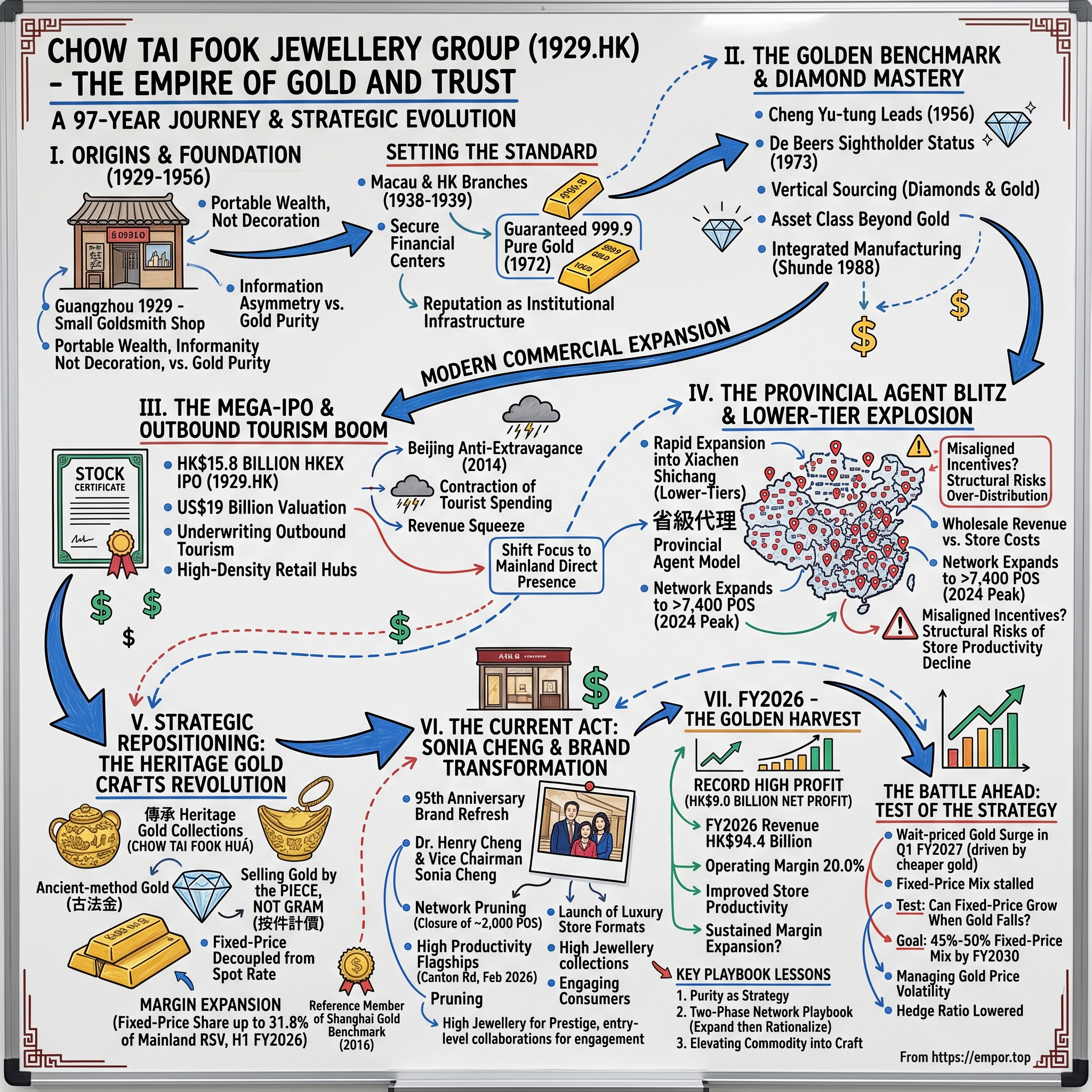
Chow Tai Fook Jewellery Group: The Empire of Gold and Trust
I. Introduction & Episode Roadmap
On 11 June 2026, Chow Tai Fook Jewellery Group Limited (周大福珠寶集團有限公司) reported the highest annual profit in its 97-year history. For the fiscal year ended 31 March 2026, revenue rose 5.3% to HK$94.4 billion, while operating profit jumped 27.8% to HK$18.9 billion. Net profit attributable to shareholders surged 52.2% to a record HK$9.0 billion, supported by a return on equity of 28.4%—well above its five-year average of 20.5%.1
Despite these financial results, equity markets reacted with caution. By late July 2026, Chow Tai Fook shares traded around HK$12.37, roughly 27% below their 52-week high of HK$16.95, valuing the group at approximately HK$122 billion.17 Even as the company posted record profits, expanded operating margins to a five-year high, and distributed nearly three-quarters of earnings as dividends, its stock price reflected lingering market skepticism.
That valuation disconnect highlights the central investment question facing the company: whether current pressures stem from temporary cyclical dynamics or structural shifts in its business model.
The scale of the enterprise remains vast, even amid a strategy to streamline operations. Chow Tai Fook maintains one of the world's largest jewelry retail networks, though its store footprint contracted from a peak of more than 7,400 points of sale in 2024 to 5,460 by 31 March 2026.1221 Alongside its retail operations, the company functions as a major buyer of physical gold, an integrated manufacturer, a primary wholesaler to hundreds of franchise partners, and a trusted store of wealth for millions of retail consumers across Greater China.
This multidimensional business model creates a strategic tension. Is Chow Tai Fook a luxury brand capable of commanding premium pricing for design and brand equity akin to Cartier or Tiffany? Is it a high-volume distribution network supplying gold across lower-tier Chinese cities on thin margins? Or is it primarily an operating proxy tied to two macroeconomic factors beyond its control: the market price of gold and Chinese consumer spending?
As of mid-2026, Chow Tai Fook reflects elements of all three models, while management pursues a strategic repositioning toward higher-margin luxury products.
Four key themes outline this development.
First is the company's long-term evolution from a modest goldsmith shop established in Guangzhou in 1929 into a leading authority for gold purity in Greater China. That history established a foundation of consumer trust that remains a durable competitive advantage.
Second is its modern commercial expansion, marked by a HK$15.8 billion Hong Kong initial public offering in December 2011, a franchise-led expansion across interior China, and the development of heritage-craft gold collections that elevated standard bullion products into higher-margin cultural items.[^6]
Third is its ongoing operational restructuring: a planned closure of nearly 2,000 retail locations, a management reorganization led by Vice Chairman Sonia Cheng Chi-man (鄭志雯) focused on brand elevation, and an effort to transition gold sales into a luxury pricing tier.
Fourth is the investor debate over margin durability and demand quality. Record profit margins were supported by a period of significant gold appreciation; gold traded near US$5,000 per ounce around the time annual results were finalized before easing to approximately US$4,082 per ounce by 30 July 2026.1214 In the quarter ended June 2026, lower gold prices stimulated store traffic, but demand gravitated toward lower-margin, weight-priced gold products rather than the higher-margin lines management has targeted for growth.13
This dynamic—rebounding sales volume driven by traditional, weight-priced gold—underscores the operational challenges ahead. The origins of this corporate transformation begin nearly a century ago in a city facing political upheaval.
 Subscribe on LinkedIn
II. Origins & The Golden Benchmark (1929–1956)
Guangzhou in 1929 was an unlikely setting for long-term corporate planning. Although the Northern Expedition had nominally unified China two years earlier, regional military factions still dominated the south, provincial currencies traded at chaotic discounts, and the global economy was months away from the Great Depression.
In that volatile climate, Chow Chi-yuen (周至元), a native of Shunde in Guangdong, opened a small goldsmith shop in 1929.34
That decision was rooted in practical economics rather than sentiment. In an era when paper currency could be rendered worthless by regional political shifts, gold functioned less as decorative jewellery and more as a family balance sheet. A gold bangle was a liquid reserve—portable across borders, free of political credit risk, and exchangeable in any city with a scale and an assayer. The goldsmith acted as a private bullion bank, where enterprise value hinged on a single question customers could not easily verify: whether the gold was as pure as promised.
Resolving that information asymmetry became the foundation of Chow Tai Fook's long-term business strategy.
Two flights and a bedrock
The company's early geographic expansion was driven by survival rather than ambition. As the Second Sino-Japanese War advanced southward, Chow Tai Fook opened branches in Macau in 1938 and Hong Kong in 1939.3 Guangzhou subsequently fell under military occupation, whereas the Portuguese enclave and British colony provided relative sanctuary.
This movement mirrored a broader pattern among mid-century Chinese enterprises, where capital and operational expertise migrated ahead of conflict and compounded in secure financial centers. Hong Kong offered Chow Tai Fook key structural advantages unavailable in mainland cities: a stable legal framework, a free gold market, and an influx of migrant families seeking portable, inflation-resistant wealth.
The apprentice who married the boss's daughter
Cheng Yu-tung (鄭裕彤) joined the firm as an apprentice in the trade.4 Also hailing from Shunde—a shared regional background that provided trust in the era's clan-based commercial networks—Cheng mastered operations, married Chow's daughter, and assumed operational leadership of the business in 1956.4
Cheng guided the firm's growth for six decades prior to his death on 29 September 2016 at age 91.8 While his broader career expanded into real estate and conglomerates, his defining contribution to the jewellery business was establishing an uncompromising purity standard.
Setting a bar nobody asked for
In the mid-twentieth century, Hong Kong's gold retail trade relied on an unstated industry norm: advertised gold purity frequently exceeded actual fineness. Because retail buyers lacked practical tools to assay metal content at the point of sale, jewellers captured higher margins in the purity gap.
Chow Tai Fook disrupted this practice in 1972 by introducing guaranteed 999.9 pure gold jewellery (99.99% fineness) across Hong Kong and Macau.3
From a commercial perspective, adopting the highest fineness standard meant surrendering the hidden margins competitors retained, compressing short-term profit margins on individual unit sales. In return, Chow Tai Fook established an independently verifiable market claim that did not depend on consumer trust in an individual shopkeeper.
Verifiable purity turned reputation into institutional infrastructure. Once 999.9 gold became the benchmark across Hong Kong and Macau—and eventually the basis for local regulatory standards—every subsequent transaction, trade-in, and secondary market sale carried Chow Tai Fook's implicit warranty. The brand evolved from a retail preference into a benchmark specification.
What the origin story actually establishes
Chow Tai Fook did not originate as a fashion house, nor did it historically compete on design aesthetics. Instead, it operated as a trusted custodian of physical value—an institution families relied upon to convert cash savings into wealth capable of surviving currency debasement and political instability.
That heritage explains both the group's durable customer loyalty and its central strategic constraint. Deep trust is reinforced whenever customers return to trade in legacy gold pieces at current spot prices. However, anchoring the brand to verifiable purity trained consumers to evaluate products strictly by weight and metal spot rates. That commodity-oriented mindset caps gross margins—creating the precise hurdle management is now attempting to overcome through brand elevation.
By the 1960s, Cheng Yu-tung had already begun seeking ways to escape the commodity trap, leading him toward an asset class far harder than gold.
III. Diamond Mastery & The "King of Shops" Era (1960s–2000s)
For much of the twentieth century, rough diamonds were allocated rather than sold on an open market.
De Beers controlled the global trade through a tightly managed network of buyers known as sightholders. These selected dealers were invited to periodic sales, or "sights," where they were offered boxes of rough stones at prices set by the cartel on a take-it-or-leave-it basis. Without room for negotiation, securing sightholder status was essential to accessing primary supply. For decades, that privilege remained almost exclusively with European and Israeli firms.
In 1973, Chow Tai Fook became a De Beers Global Sightholder—a designation it has maintained for more than 50 years.35
Why the sightholder seat mattered more than the diamonds
The economics of gold retailing are exceptionally transparent. Consumers can easily check prevailing spot rates, weigh an item, and calculate the retailer's markup—a dynamic that limits gross margins on weight-priced gold across the industry.
Diamond jewellery operates on a different economic model. Without a single daily benchmark price, valuation depends on the complex interplay of cut, color, clarity, and carat weight. This opacity allows gem-set jewellery to command higher profit margins. Access to rough diamonds at allocation prices, bypassing wholesale intermediaries, sits at the top of that value chain.
Cheng Yu-tung's acquisition of a sightholder seat was a strategic vertical integration move. It established a higher-margin product category alongside the group's high-volume gold business decades before mainland Chinese consumer demand for diamonds matured. The company subsequently expanded its direct sourcing by becoming a Select Diamantaire of Rio Tinto Diamonds in 2009, securing a second direct channel for rough supply.3
The King of Shops
The second structural advantage developed during this era lay outside jewellery retail.
Through Chow Tai Fook Enterprises (周大福企業), the family built a broad commercial conglomerate spanning real estate via New World Development (新世界發展), hospitality through Rosewood, as well as infrastructure and transport. Within Hong Kong business circles, Cheng was often viewed primarily as a property developer who also operated a major retail jeweller.
This structure provided critical operational benefits. High-end jewellery retail depends heavily on prime real estate; footfall on major commercial corridors like Nathan Road or Central commands a significant premium over adjacent side streets. In Hong Kong's volatile commercial real estate market, where sharp rent increases frequently squeezed smaller operators, Chow Tai Fook secured premier retail locations through family-controlled properties, maintaining prime storefronts across market cycles at manageable occupancy costs.
This real estate linkage demonstrated a broader strategic principle: when selling standard commodities, controlling prime distribution channels can convert an operating cost into a competitive moat. However, it also meant that a portion of Chow Tai Fook's historical profitability relied on related-party real estate holdings not directly owned by the listed entity—a corporate governance consideration that would gain greater scrutiny after its public listing.
Two disciplines that travelled north
Two operational decisions established during this period served as the blueprint for the company's eventual expansion into mainland China.
The first was vertical manufacturing. In 1988, Chow Tai Fook constructed a production facility in Shunde—the founding family's ancestral county—marking its transition from purely retailing jewellery to direct manufacturing.3
The second was standardized pricing. In 1990, the group introduced a fixed-price policy.3 In a retail environment where bargaining was customary—and where price negotiation often undermined consumer trust—a non-negotiable pricing structure signaled transparency and consistency. The policy reinforced Chow Tai Fook's positioning as a modern, standardized retail enterprise.
Chow Tai Fook entered mainland China in the late 1990s, navigating a market where gold imports and retail distribution remained tightly regulated. By the late 2000s, as market restrictions eased and consumer purchasing power expanded, the commercial opportunity in the mainland became clear.
By that time, the group had established key operational pillars: a recognized purity benchmark, direct access to rough diamond allocations, integrated manufacturing, non-negotiable pricing, and prime Hong Kong retail locations. To fund further growth and formalize its corporate structure, the company required access to public equity markets.
IV. The HKEX Mega-IPO & The M&A Benchmark (2011–2017)
By late 2011, Hong Kong's initial public offering market faced significant uncertainty. European sovereign debt issues remained unresolved, mainland Chinese economic growth was decelerating from its post-crisis stimulus peak, and several planned listings had been cancelled.
Chow Tai Fook proceeded regardless. In December 2011, the group sold 1.05 billion shares at HK$15.00—the bottom of its marketed price range—raising HK$15.8 billion for roughly a 10.5% stake. The offering valued the company at approximately US$19 billion, more than twice the market capitalization of Tiffany & Co. at the time.[^6] It listed on the Main Board of the Hong Kong Stock Exchange under stock code 1929, referencing its founding year.3
Pricing at the bottom, and what that told you
Management accepted the lower end of the pricing range rather than delay the offering—a choice that secured capital despite a lower valuation headline. For public investors, the core investment thesis rested on a clear macroeconomic trend.
Investors were effectively underwriting the expansion of mainland outbound tourism. Under the Individual Visit Scheme, mainland visitors traveled to Hong Kong and Macau in record volumes. A substantial portion of their spending went toward gold and jewellery, which benefited from lower taxes, greater consumer trust, and favorable pricing relative to mainland stores. Chow Tai Fook's Hong Kong locations operated as high-density retail hubs capturing that cross-border demand.
However, that revenue model remained highly dependent on travel flows and regulatory settings.
The squeeze
Beginning in 2014, two external pressures affected the business simultaneously. Beijing's anti-extravagance policy curtailed corporate gifting, reducing demand for high-end jewellery. At the same time, the Hong Kong tourist shopping advantage narrowed as mainland retail infrastructure expanded, visa policies tightened, and subsequent local disruptions followed by the COVID-19 pandemic halted visitor arrivals.
The resulting downturn triggered the first major earnings contraction of Chow Tai Fook's public history. For a group marketed on growth, the contraction demonstrated that relying primarily on Hong Kong tourist spending was unsustainable. Future expansion required building a direct presence across hundreds of inland cities in mainland China.
That shift defined the company's strategy over the following decade. Before expanding its physical retail footprint inland, however, management sought to improve profit margins through acquisition.
Hearts On Fire: a case study in what acquired brands do and do not do
In June 2014, Chow Tai Fook agreed to acquire Hearts On Fire Company LLC—a Boston-based diamond brand founded in 1996 and recognized for its proprietary "perfect cut"—for US$150 million on a cash-free, debt-free basis, funded entirely from internal cash resources.67 The brand continued operating as an independent unit under existing leadership, with products scheduled for introduction across Chow Tai Fook's retail network in Hong Kong, Macau, and mainland China within six months of closing.6
The strategic rationale was straightforward. Although Chow Tai Fook possessed direct access to rough diamonds, it lacked a recognized global diamond brand. Hearts On Fire provided an established cutting standard, Western brand heritage, and products sold at fixed retail prices rather than variable metal weight rates. Integrating the brand into thousands of retail points of sale was intended to elevate product mix and gross margins.
At approximately 1.4 times annual sales, the transaction valuation was modest compared to subsequent industry deals, such as LVMH's acquisition of Tiffany & Co. Chow Tai Fook did not overpay relative to prevailing market metrics.
Instead, the operational outcome highlighted the limits of the strategic premise. Over the subsequent decade, Hearts On Fire failed to become a major contributor to group earnings.
A specialized luxury brand relies on perceived scarcity, controlled distribution, and targeted market positioning. Distributing products through a large retail network—including franchised stores in lower-tier markets where brand recognition was limited—compromised the exclusivity that generated its value. Concurrently, Chinese market demand shifted away from natural diamonds. Younger consumers increasingly favored gold jewellery, marriage rates slowed, and the entry of lab-grown diamonds put downward pressure on natural diamond prices.
The transaction demonstrated an important capital allocation principle: acquiring a brand does not automatically replicate the market conditions required to sustain its positioning. Chow Tai Fook's main operational strength—its vast distribution network—proved ill-suited for preserving a niche luxury product.
That experience continues to inform current strategy as management focuses on developing higher-margin brand positioning organically within its existing operations.
Having attempted an up-market brand acquisition, Chow Tai Fook redirected its capital toward a rapid expansion into lower-tier mainland markets.
V. The Provincial Agent Blitz & Lower-Tier Footprint Explosion (2018–2022)
By 2018, market dynamics in China's Tier 1 and Tier 2 cities had grown constrained. Prime shopping centers already featured dedicated jewellery zones, those zones already included Chow Tai Fook locations, and opening additional stores increasingly cannibalized existing sales rather than generating new demand. Meanwhile, in lower-tier markets (xiachen shichang)—spanning third-, fourth-, and fifth-tier cities as well as county towns where most of China's population resides—household incomes were rising, wedding traditions remained centered on gold, and branded jewellery penetration remained low.
While the market opportunity was clear, the primary constraint was operational execution. Constructing and managing thousands of retail stores across mainland China—each requiring local real estate relationships, staffing, security protocols, and inventory management—presented significant logistical challenges for a Hong Kong–based corporate headquarters.
The 省級代理 provincial agent model
To solve this operational bottleneck, Chow Tai Fook shifted away from direct retail expansion.
Instead of developing corporate-owned stores, the group adopted a franchise architecture anchored by provincial agents (shengji daili). These regional partners co-invested capital, secured mall leases, managed local regulatory relationships, and recruited and supervised sub-franchisees within their designated territories.
This structural pivot fundamentally altered the group's financial metrics, creating a reporting profile distinct from traditional direct retailers.
Under a direct retail model, Chow Tai Fook recognizes the full retail price at the point of consumer sale, but bears store rental, staffing, store fit-out, and display inventory costs. This model generates higher gross margins, but requires substantial operating expenditure and capital investment.
Under the franchise model, Chow Tai Fook recognizes wholesale revenue upon shipping product to franchisees. While gross margins per unit are substantially lower, the group incurs almost no store-level operating costs, as franchisees fund store fit-outs and inventory. Cash is collected upon shipment rather than final consumer purchase, raising return on equity by reducing capital employed.
This model exchanged per-unit gross margins for capital efficiency, enabling network expansion at a pace unachievable through direct corporate rollouts.
The network expanded rapidly. At its 2024 peak, the group operated more than 7,400 points of sale, with franchised locations comprising the vast majority of the mainland footprint.12 Even after subsequent network rationalization, franchised locations accounted for 70.9% of mainland points of sale as of 31 March 2026.21
What the model quietly optimised for
However, the provincial agent structure introduced misaligned incentives between regional agents and the parent brand.
A provincial agent's revenue depends primarily on aggregate volume across a territory. Opening an additional store in a county town increases an agent's wholesale distribution even if it partially cannibalizes sales from an existing store nearby owned by a different sub-franchisee. Concurrently, Chow Tai Fook recognized wholesale revenue upon channel delivery rather than end-consumer purchase.
This combination—agents incentivized by geographic coverage and a brand owner recognizing revenue at wholesale shipment—created structural risks of over-distribution. While effective during periods of expanding consumer demand, the model proved vulnerable when store traffic slowed. As channel inventory accumulated, average store productivity declined, putting financial pressure on store operators.
When mainland consumer demand moderated and gold prices advanced sharply through 2023 and 2024, high store density shifted from a growth driver to an operational drag. Average sales per store contracted, leaving franchisees with excess inventory in catchments where consumer traffic had diminished.
This expansion logic triggered a simultaneous sector-wide consolidation. In the first quarter of 2026 alone, Chow Tai Seng (周大生) closed a net 286 stores, Lao Feng Xiang (老鳳祥) closed 185, China Gold (中國黃金) closed 203, and Yuyuan's (豫園股份) Lao Miao and Ya Yi brands closed a combined 192.15 Chow Tai Seng had previously closed a net 529 stores during 2025, citing subdued consumer spending and franchisee store consolidations.15 Luk Fook Holdings (六福集團) also recorded a net contraction of 175 locations.15
These contractions demonstrate that franchise expansion was an industry-wide cycle whose geographic limits were reached across major brands simultaneously. Competitive differentiation subsequently shifted toward execution in network rationalization and store-level productivity enhancement.
Chow Tai Fook initiated network restructuring earlier than many industry peers. However, understanding the underlying value of its remaining retail footprint requires examining the product developments that supported brand equity throughout this expansion.
VI. Product Evolution: The 傳承 Heritage Gold Crafts Revolution
In traditional Chinese gold retail, transactions follow a standardized economic structure. A customer selects an item, the retailer weighs it, and the retail price is calculated as the prevailing spot price of gold per gram multiplied by the weight, plus a modest crafting fee (jiagong fei / 加工費).
This model provides clear consumer transparency, allowing buyers to verify pricing and resell gold on an equivalent weight basis. However, for the retailer, it creates a structural limitation: the company operates essentially as a distributor of a standardized commodity. Gross margins on weight-priced gold remain narrow, and increases in spot gold prices raise nominal inventory costs without expanding per-gram profit margins.
For decades, this low-margin structure characterized Chow Tai Fook's core gold operations. To elevate profitability, management sought a product strategy that could decouple retail jewellery prices from underlying spot metal rates.
古法金 and the 國潮 moment
The commercial opportunity emerged through traditional goldsmithing techniques. Ancient-method gold (gufa jin / 古法金) revived imperial-era craftsmanship, incorporating hand-hammering, filigree, granulation, and matte finishes that contrasted with the high-polish gold prevalent in late-twentieth-century retail. The resulting pieces were heavier, more sculptural, and visually distinct.
This craft revival coincided with the rise of guochao (國潮)—a consumer trend through the late 2010s in which younger Chinese buyers increasingly favored domestic heritage, traditional cultural motifs, and local brands over Western luxury logos.
Chow Tai Fook responded by launching the Chuan Cheng (傳承) Heritage collection, marketed internationally as CHOW TAI FOOK HUÁ. The decisive commercial innovation was not merely the aesthetic shift, but a fundamental change in the pricing model.
Selling gold by the piece, not by the gram
Heritage pieces are sold at a fixed price per item (an jian ji jia / 按件計價) rather than by weight. This shift fundamentally alters product economics.
Under weight-based pricing, raw gold is the primary price determinant, leaving the retailer with a narrow markup. Under fixed-piece pricing, the market price of gold becomes one input among several, allowing the retailer to price based on design, craftsmanship, and brand equity. Consequently, fixed-price gold items command gross margins significantly above traditional weight-priced inventory.
This product mix shift directly supported corporate margin expansion. In the first half of FY2026, fixed-price jewellery accounted for 31.8% of mainland retail sales value, up from 27.4% a year earlier, helping group gross margin hold above 30%—a historically elevated level for the company.11 Management established a strategic target to increase the fixed-price share of mainland retail sales value to between 45% and 50% by FY2030.2
Commercial scale expanded rapidly alongside mix expansion. The HUÁ Heritage franchise generated HK$43 billion in retail sales value in FY2026, while newer lines—including the Rouge, Joie, and Palace Museum collections—contributed approximately HK$10 billion combined.1 (Retail sales value measures total sell-through across self-operated and franchised stores, making it a broader metric than reported corporate revenue.)
Management continued expanding its higher-margin product pipeline: signature collections generated HK$3.4 billion in sales during the first half of FY2026 compared to HK$2.3 billion a year earlier, jadeite (Fei Cui / 翡翠) sales doubled year-over-year, and the DAWN collection launched in April 2026 reached HK$500 million in retail sales value by late May, with management reporting that over 20% of purchasers were new to the brand.111
Sustained margin expansion depends on whether higher-margin lines can consistently attract new customers rather than merely re-selling to existing buyers at higher prices. While a 20% new-customer rate on a launch provides positive initial evidence, it reflects a single company-disclosed data point rather than an established long-term trend.
The machine behind it
Executing a fixed-price product strategy requires substantial operational agility. Unlike bulk-cast weight-priced products, fixed-price collections require continuous design updates, small-batch manufacturing, and rapid replenishment across a widespread store network. Chow Tai Fook's integrated manufacturing base, rooted in its Shunde facility and subsequent expansions, provided the necessary production flexibility.3
To manage raw material sourcing and inventory risk, the group became a reference member of the Shanghai Gold Benchmark Price in April 2016, integrating directly into the price-formation mechanism of the Shanghai Gold Exchange (Shanghai Huangjin Jiaoyisuo / 上海黃金交易所).322
This direct exchange access serves a critical risk-management function. A jewellery enterprise holding substantial gold inventory carries unhedged commodity price risk; direct integration with primary exchange mechanisms enables the execution of institutional inventory hedging strategies.
While the expansion of fixed-price heritage collections provided Chow Tai Fook with an effective margin driver, it did not resolve the operational drag of store over-expansion across mainland China—a structural challenge that required a comprehensive network rationalization.
VII. The Current Act: Sonia Cheng, Brand Transformation, & Network Pruning (2023–Present)
In April 2024, Chow Tai Fook marked its 95th anniversary by launching a comprehensive brand transformation.20 The initiative introduced a refreshed logo, redesigned store formats, new collections, and an elevated market positioning. For an enterprise historically recognized as a trusted retail seller of physical gold, the effort represented a strategic transition toward operating as a premier Chinese luxury house.
Two years into the rollout, the execution of this strategy presents a mixed picture.
Who is running this
The corporate structure remains firmly family-controlled, with the controlling family entity holding approximately 73% of outstanding shares and leaving a public float of roughly 25%.18
Dr. Henry Cheng Kar-shun (鄭家純), son of founder Cheng Yu-tung, chairs the board and sets strategic direction. In the FY2026 annual results, he committed the group to investing boldly in brand equity—signaling management's willingness to prioritize long-term brand building over near-term earnings.1
Vice Chairman Sonia Cheng Chi-man (鄭志雯) leads the operational brand transformation. Her executive background includes developing Rosewood Hotel Group from a boutique operation into a global luxury hospitality brand, bringing expertise in brand positioning, customer experience, and flagships. Applied to jewellery retail, this strategy emphasizes a rationalized store footprint, high jewellery offerings priced competitively against international luxury houses, and a flagship-driven brand narrative. In reviewing the FY2026 results, she framed the financial performance as validation of the strategy, outlining three core growth levers: redefining Chinese luxury globally, rejuvenating the product portfolio, and expanding into new geographies and categories.12
Vice Chairman Conroy Cheng Chi-heng (鄭志恒) oversees product design and material sourcing, while Managing Director Kent Wong Siu-kee (黃紹基) manages daily operations, including store rationalization, franchisee relations, and merchandising discipline. This executive arrangement balances family leadership setting brand ambition with seasoned management executing operational restructuring.
The surgery
The network reduction represents a deliberate trade-off, sacrificing immediate revenue to eliminate lower-performing locations and raise overall profitability.
From a peak exceeding 7,400 points of sale in 2024, the network contracted to 5,813 by the end of 2025 and 5,460 by 31 March 2026—a net reduction of 969 locations in FY2026 alone, comprising 141 mainland closures against 13 openings in the March quarter.1221
The initial top-line impact of this pruning appeared in FY2025, when revenue fell 17.5% to HK$89.66 billion—the sharpest annual decline in the company's listed history.9 However, disclosures in the FY2025 report supported this strategy, revealing that stores opened during that year delivered more than double the average sales productivity of closed locations.10
By FY2026, the operational benefits of the smaller footprint became evident. Same-store sales grew 6.9% in mainland China, 13.3% in Hong Kong, and 29.4% in Macau, while stores under two years old generated average monthly retail sales value of roughly HK$1.6 million—up 57% year-over-year.1 Driven by improved store productivity, operating margin reached 20.0%—a 360 basis-point improvement to a five-year high—supported by a gross margin of 32.3%.1
The flagship bet
Complementing store closures is the rollout of high-productivity luxury store formats. Eight of these newly designed luxury-format stores were operational as of the FY2026 results, with management reporting that they generate eight to ten times the productivity of an average store.2 The group opened its first global flagship on Canton Road in Tsim Sha Tsui in February 2026 and targeted 50 of the new-format stores in mainland China by FY2030.31
Product strategy followed a similar segmentation model. In June 2025, the company launched its first High Jewellery collection, "Timeless Harmony," priced to compete with international luxury houses. At the other end of the range, it introduced accessible items, including HK$480 Disney "blind box" collaborations aimed at younger consumers.1112
This strategy uses high jewellery to establish prestige at the top tier, entry-level collaborations to engage younger consumers, and core fixed-price collections to capture operating margins.
However, the long-term scalability of the flagship model remains to be proven. An eight-store sample generating high relative productivity provides an initial proof of concept, but "average store productivity" itself shifted upward as the company eliminated nearly 2,000 underperforming locations. Evaluating the model's durability will require observing performance across a broader network of 30 to 40 flagship locations.
The gold price, both ways
A crucial factor behind FY2026 performance was a buoyant gold market. Management raised gold product prices three times during 2025 and evaluated further increases.12
Appreciating gold prices generated a direct operational benefit: inventory acquired at lower costs sold at higher prevailing market rates, expanding gross margin by 280 basis points.12 Conversely, higher gold prices increased the cost of physical gold loans used to fund inventory working capital. Fair value losses on gold loans equaled 6.6% of revenue in FY2026.2
To manage price volatility, the company maintains gold hedging positions. Notably, the hedge ratio fell from 55% to 39%, an adjustment management characterized as pragmatic risk management amid heightened volatility.2
Lowering the hedge ratio during a period of price swings increases unhedged exposure to spot gold price movements. While this strategy boosted reported earnings during a rising market, it also tightens the relationship between group earnings and spot gold prices.
Gold's retreat to roughly US$4,082 an ounce by late July 2026 alters these mechanics, setting up a key test for operating performance in subsequent quarters.14
VIII. Segment Breakdown, Financial Engine, & Capital Allocation
Chow Tai Fook is really two businesses wearing one brand, and understanding the seam between them explains almost every quirk in its financials.
Retail and wholesale: one brand, two economic models
The mainland accounts for the overwhelming majority of the group — roughly 84% of retail sales value in the June 2026 quarter, with Hong Kong, Macau and other markets making up the remaining 16%.13 Within the mainland, the split between self-operated and franchised points of sale runs roughly 29% to 71%.21
The self-operated business is a conventional retailer: full retail price captured, full store cost absorbed, high gross margin, high operating expense.
The franchise business is a wholesale operation dressed as retail. Chow Tai Fook manufactures or sources product, ships it to franchise partners at wholesale prices, and collects cash on shipment. Gross margin per unit is a fraction of retail, but the group carries no store rent, no store labour, no store fit-out capital, and a much shorter cash conversion cycle. It is a high-turnover, low-margin, capital-light engine bolted onto a lower-turnover, higher-margin retail engine.
The consolidated result is a company whose blended gross margin sits in the low thirties — well below a Western luxury house, which would be roughly double that — but whose return on equity reached 28.4% in FY2026, a level most luxury retailers would envy.1 That gap between margin and return on equity is the signature of the wholesale model, and it is the single most important thing to understand about how this company makes money.
The product mix and where the pressure sits
Gold products dominate. The great majority of what Chow Tai Fook sells by revenue is gold in some form, split between weight-priced and fixed-price. Gem-set, platinum and K-gold jewellery form the secondary category, and watches a small distribution business concentrated in Hong Kong and selected mainland flagships.
Gem-set is the structurally troubled one. Chinese demand for natural diamonds has weakened as younger consumers shifted toward gold, marriage rates declined, and lab-grown stones eroded the price anchor. There is a visible attempt to defend average selling prices — gem-set average selling price in the mainland rose to HK$9,500 in the March 2026 quarter from HK$8,200 a year earlier — but a rising average price in a shrinking category usually indicates that the entry-level customer has left, not that the category is healthy.21
Meanwhile the fixed-price category, the margin engine, was squeezed from the opposite direction. Its average selling price jumped to HK$7,900 in the March quarter from HK$5,700 — a direct consequence of gold price inflation feeding into fixed-price tags — while its share of retail sales value came in at 29.8%, essentially flat against 30.1% a year earlier.21
That is the tension in one sentence: fixed-price products got more expensive faster than customers absorbed them, so mix stalled even as the strategy was working on every other measure.
The June 2026 quarter, and why it complicates the story
Then gold fell, and the picture inverted.
In the quarter to 30 June 2026, group retail sales value rose 15.1%. Mainland same-store sales grew 19.6% at self-operated stores and 15.7% at franchised stores; Hong Kong and Macau together grew 41.7%, with Macau up 64.6%.13
Superb numbers. Now look underneath them. Same-store sales of weight-based gold jewellery rose 38% in the mainland and 63.7% in Hong Kong and Macau — cheaper gold pulled value-conscious buyers straight back to the scales. Same-store sales of fixed-price jewellery in the mainland fell 1%.13
This is the most important operating fact in the entire story as of August 2026, and it cuts directly against the strategic narrative. The volume recovery is being driven by exactly the low-margin, commodity-linked product management has spent three years de-emphasising, while the high-margin fixed-price category — the one that must reach 45–50% of mix by FY2030 — went backwards.213
It does not falsify the transformation thesis. Gold price direction dominates short-run consumer behaviour in this category, and a single quarter of falling prices producing a weight-gold surge is entirely expected. But it establishes the test: if fixed-price mix keeps drifting while weight-gold volume booms, FY2027 will deliver revenue growth alongside margin compression, and the "we are becoming a luxury company" narrative will need better evidence than a rising gold price provided in FY2026.
Capital allocation
On returning cash, the record is strong and consistent. The FY2026 full-year dividend was HK$0.67 per share, a payout ratio of 73.4%, with a final dividend of HK$0.45.1 The interim payout ratio in the first half was 85.7%, with the interim dividend raised to HK$0.22 from HK$0.20 even though profit was flat.11
Raising the dividend into a flat profit period is a deliberate signal of confidence, and it is backed by a balance sheet reality: a business shedding stores releases working capital rather than consuming it. Capital expenditure is modest against the revenue base, concentrated on manufacturing, logistics and selective flagship refurbishment rather than mass rollout.
On capital discipline more broadly, the closure programme is the strongest available evidence. A management team that cuts a fifth of its network, accepts a 17.5% revenue decline, and emerges with record operating margin is behaving like an owner. That is a meaningfully better record than the 2014 acquisition era.
The counter-argument an activist would press: with roughly 73% of the shares held by the controlling family and a related-party ecosystem that includes a property group under significant refinancing pressure, minority shareholders should ask whether a payout ratio in the seventies-to-eighties reflects optimal capital allocation for the jeweller or the cash needs of the controlling structure. Both explanations fit the observed behaviour, and the company does not disclose enough to distinguish them.
IX. Helmer's 7 Powers & Porter's 5 Forces Analysis
Evaluating Chow Tai Fook through formal strategic frameworks highlights where the group's competitive advantages are structural, where they are contested, and where they remain absent.
Hamilton Helmer's 7 Powers
Scale Economies — strong and differentiating. Chow Tai Fook purchases physical gold at a scale matched by few global retailers, participates as a reference member in the Shanghai gold price-formation mechanism, and amortizes manufacturing and logistics costs across thousands of retail outlets.3 Direct access to rough diamonds through De Beers sightholder status and Rio Tinto Select Diamantaire status compounds this advantage in gem-set jewellery.35 These procurement and supply-chain efficiencies create cost and access barriers that regional competitors cannot easily replicate.
However, procurement scale does not automatically yield retail pricing power. Because consumers can readily verify spot gold prices, scale reduces operational costs rather than elevating retail selling prices.
Brand and Cornered Resource — strong, but narrower than it appears. The trust developed over nearly a century of guaranteed gold purity represents the group's most durable intangible asset. This manifests in consumer behavior, notably through the trade-in (yi jiu huan xin / 以舊換新) program, where customers return legacy pieces to upgrade to new designs, confident that the metal content will be fully honored. That trade-in mechanism reinforces customer retention by making initial gold purchases feel financially reversible.
Yet that brand authority primarily conveys trust rather than luxury pricing power. While consumers rely on Chow Tai Fook for metal fineness, they have not historically paid high luxury premiums for design equity. Management's capital deployment into flagship locations, high jewellery, and a modernized visual identity reflects an effort to transform traditional trust into luxury brand power capable of supporting higher gross margins.
Process Power — moderate. The group's automated replenishment infrastructure connecting centralized manufacturing facilities to thousands of franchised locations, alongside frequent product design refreshes, represents a key operational capability. However, major domestic peers operate comparable supply-chain systems, and the simultaneous industry-wide expansion and contraction cycles indicate that these operating models offer limited structural differentiation.
Switching Costs — low to moderate. Consumers face minimal friction when choosing between Chow Tai Fook and competing jewellers like Lao Feng Xiang. While trade-in programs and loyalty schemes encourage repeat business, customer lock-in remains low.
Counter-Positioning — weak. Counter-positioning occurs when an entrant adopts a business model that an incumbent cannot copy without damaging its existing operations. Chow Tai Fook operates as the traditional incumbent rather than a market disruptor. Instead, counter-positioning is evident in competitors like Laopu Gold (老鋪黃金), which established a boutique, heritage-craft luxury gold brand in high-end shopping centers. Laopu generated RMB 27.3 billion in revenue in 2025—up 221%—from just 45 self-operated stores, while net profit rose 230% to RMB 4.87 billion.16
That comparison highlights a key structural dynamic. Laopu generated revenue equal to roughly a third of Chow Tai Fook's total from 45 locations, compared to Chow Tai Fook's 5,460 points of sale. This performance demonstrates that Chinese consumers will purchase luxury-priced gold without requiring an extensive retail footprint—the core asset Chow Tai Fook developed over decades. Consequently, a massive retail network functions less as an unassailable moat and more as an operational asset requiring continuous productivity justification.
Network Economies and other cornered supply — largely absent. Fine jewellery retail lacks meaningful network effects, as individual purchases do not increase in value as more consumers buy from the brand.
Porter's Five Forces
Rivalry — intense. Competitors including Lao Feng Xiang, Luk Fook, Chow Sang Sang (周生生), Chow Tai Seng, China Gold, Yuyuan's Lao Miao, and Laopu Gold compete for similar consumer spending using comparable products and retail strategies. The synchronized store closures across major brands confirm that physical footprint scale alone does not guarantee a defensible market position.15
Buyer power — high. Transparent gold spot prices and standardized weight measurements allow consumers to compare weight-priced items across retailers instantly. This price transparency creates a structural ceiling on gross margins for traditional gold products, underscoring why transitioning toward fixed-price jewellery is critical for long-term margin expansion.
Supplier power — low. Physical gold is a standardized, globally traded commodity, and Chow Tai Fook maintains direct access to primary bullion exchanges. While rough diamond supply is more concentrated, the group's long-standing sightholder status positions it favorably within that supply chain.
Threat of substitutes — moderate to high. For wealth-preservation purchases, consumers can access financial gold products, including bank bullion bars, exchange-traded funds, and digital gold accounts, at lower transaction costs than finished jewellery. In gem-set categories, lab-grown diamonds present a growing substitute that has exerted downward pressure on natural diamond prices and their perceived store of value.
Threat of new entrants — low for mass distribution, but higher in luxury positioning. Establishing a multi-thousand-store distribution network with the requisite inventory financing presents formidable capital barriers. However, recent market entrants have shown that competing at the high-end luxury tier requires targeted brand positioning and design authority rather than a vast retail store footprint.16
The strategic balance indicates that Chow Tai Fook retains durable advantages in procurement scale, integrated supply chains, and consumer trust. However, its position is less secure in retail pricing power and design-led differentiation. The investment outlook ultimately depends on whether management can convert a legacy benchmark of trust into a high-margin luxury brand.
X. Investment Spine: Bull vs. Bear Case & Skeptical Stress Test
The neutral framing is straightforward: Chow Tai Fook is a cash-generative, family-controlled market leader executing a deliberate transition from store-count expansion to store-level productivity and brand elevation. Yet its recent profitability was bolstered by a booming gold market, leaving its long-term strategic thesis unproven at scale.
The bull case
Mix-driven margin expansion has structural room. Fixed-price jewellery accounts for roughly 30% of mainland retail sales value against a target of 45% to 50% by FY2030, offering a multi-year runway for blended margin growth independent of spot gold prices.212 Each incremental shift toward fixed-price items expands profitability, provided consumer demand holds.
Network pruning is yielding measurable productivity gains. Same-store sales growth turned positive across all geographic regions in FY2026, while a clear productivity gap between newly opened and closed stores indicates that network rationalization was value-accretive rather than purely defensive.110 Stores under two years old averaged HK$1.6 million in monthly retail sales value—a 57% increase year-over-year—demonstrating operational improvements beyond product mix arithmetic.1
The flagship store format offers structural upside. Generating eight to ten times the productivity of an average store, the luxury flagship model—if successfully expanded to 50 mainland locations by FY2030—could reshape retail economics and establish the elevated physical presence required to command luxury pricing.21
International expansion represents low-cost optionality. Strategic targets to more than double international retail sales value and exceed 100 overseas locations by FY2030 address a geographic imbalance, leveraging strong brand awareness among the global Chinese diaspora.1
Capital return remains strong and predictable. Maintaining a payout ratio above 73% through revenue contractions—supported by cash released from working capital as the retail footprint shrinks—provides tangible shareholder returns independent of transformation outcomes.111
The bear case
Record profit margins depended heavily on rising gold prices. Gross margin expanded by 280 basis points during the recent gold rally, even as management reduced its inventory hedge ratio from 55% to 39%.2 Reversing that trend compresses earnings: inventory purchased at peak prices yields lower realized margins if gold prices soften, exposing FY2027 performance to commodity headwinds.
Volume recovery is concentrated in low-margin categories. In the quarter ended June 2026, headline retail growth was driven by a 38% rise in mainland same-store sales for weight-based gold, while fixed-price sales fell 1%.13 Continued reliance on weight-based volume expands top-line sales at the expense of structural product mix targets.
Laopu Gold challenges the necessity of massive retail scale. A competitor generating rapid revenue and earnings growth from just 45 locations suggests that luxury gold demand can be captured without maintaining thousands of stores, turning a vast distribution network into a potential cost burden.16
Gem-set jewellery remains a persistent headwind. Higher average selling prices alongside declining sales volumes reflect lost entry-level consumers rather than sustainable category strength.21
Franchise network restructuring creates operational friction. Closing hundreds of franchised stores risks alienating regional partners who control valuable local real estate and possess alternative brand options. Furthermore, the company does not disclose franchisee profitability, store churn, or channel inventory levels, leaving a key visibility gap for a network where 71% of mainland locations are third-party operated.21
Governance and family conglomerate exposure. The controlling family's property flagship, New World Development, undertook major debt refinancings across 2025 and 2026, while its parent entity sought loan restructurings.19 Concurrently, third-generation heir Adrian Cheng Chi-kong (鄭志剛) stepped down from executive roles at the property arm during 2024 and 2025.19 While Chow Tai Fook operates as an independent listed entity with a separate balance sheet, a controlling shareholder under financial pressure highlights potential governance risks regarding capital allocation and dividend distribution.
Execution risks in brand elevation. Establishing luxury brand authority is capital-intensive and uncertain. The performance of Hearts On Fire illustrates the operational challenge of building high-end brand equity within a mass-market distribution ecosystem.
What would settle the argument
The bull thesis holds if fixed-price sales mix continues expanding toward FY2030 targets during periods of flat or declining gold prices, demonstrating that consumers are paying for design and brand equity rather than raw metal value. Conversely, the bear thesis prevails if fixed-price demand contracts whenever spot gold prices fall, confirming that consumer purchasing remains anchored to bullion value rather than luxury brand transformation.
XI. Key Performance Indicators & What to Watch
Chow Tai Fook discloses extensive operational data, but three key performance indicators provide the clearest gauge of its strategic execution.
1. Fixed-price jewellery as a share of mainland retail sales value. This metric serves as the primary indicator of brand transformation. It directly determines blended gross margin, aligns with management's committed targets, and offers the single published metric that separates underlying brand strength from spot gold price movements.2 When gold prices rise, fixed-price retail tags increase, which can temporarily stall product mix without signaling brand weakness. Conversely, during periods of softening gold prices—such as the decline observed since early 2026—a rising fixed-price share provides unambiguous evidence that consumers are choosing design and brand equity over raw metal value.
2. Same-store sales growth, segmented by channel and product type. Headline same-store sales growth figures offer limited insight on their own; a top-line growth figure driven entirely by weight-based gold carries fundamentally different margin implications than the same growth rate achieved through fixed-price collections.13 Furthermore, segmenting performance between self-operated and franchised stores reveals the financial health of third-party operators, indicating whether network rationalization has yielded a genuinely more productive retail system rather than merely a smaller footprint.
3. Net point-of-sale changes and store-network stabilization. Following a net reduction of 969 locations in FY2026, the trajectory of retail footprint adjustments indicates whether network pruning is concluding.21 Ongoing store closures would point to persistent channel weakness, whereas footprint stabilization alongside new format rollouts would signal that network restructuring is complete. Key factors to monitor include progress toward the target of 50 luxury flagships by FY2030 and whether the flagship format maintains its high productivity relative to average stores as the sample expands.1
Conversely, two metrics warrant caution when assessing long-term performance. Reported top-line revenue growth is heavily distorted by shifts between wholesale and direct-retail revenue recognition as well as pass-through gold price inflation. Similarly, headline annual gross margin reflects commodity timing and gold price volatility at least as much as structural business strategy.
XII. Epilogue & Playbook Lessons
There is a shop on Canton Road in Tsim Sha Tsui that opened in February 2026 as Chow Tai Fook's first global flagship.3 A few hundred metres away, and nearly nine decades back, the company's Hong Kong story began in premises that would have fit inside the new store's entrance hall. The distance between those two rooms encapsulates the evolution of the business.
Three strategic lessons extend beyond the jewellery trade.
Purity as strategy. The decision to guarantee 999.9 fineness compressed gross margins on individual transactions but secured an asset of far greater durability: an independently verifiable product claim. While firms frequently attempt to construct brand equity through promotional messaging, Chow Tai Fook built its reputation around an unyielding technical specification. In markets characterized by high information asymmetry, voluntarily adopting a higher, externally checkable benchmark represents a durable moat-building strategy that compounds over decades.
The two-phase network playbook. Expand rapidly through channel partners to capture market footprint, then rationalize aggressively when store density exceeds local demand. The initial expansion phase drives top-line scale, while the subsequent rationalization requires operational discipline that many management teams delay. Chow Tai Fook navigated this shift by accepting a 17.5% revenue contraction rather than defending store count, relying on store-level performance metrics—which showed newly opened locations delivering more than double the productivity of closed outlets—to justify the restructuring.910 The broader principle is that franchise models recognize revenue at wholesale shipment, meaning signs of market saturation manifest in store-level productivity long before impacting corporate income statements. Executives who monitor only consolidated revenue risk initiating network corrections too late.
Elevating a commodity into craft. Transitioning product mix from weight-priced bullion to fixed-price design represents an instructive margin transformation: utilizing identical raw materials and retail channels to capture higher unit economics by shifting consumer value perception. However, this strategy carries a structural tradeoff. A commodity incumbent that demonstrates market demand for design-led pricing invites dedicated competitors unburdened by legacy weight-priced operations. Emerging players like Laopu Gold capitalized on the market segment Chow Tai Fook validated, building business models dedicated entirely to high-margin craft.
The enduring strategic insight reflects ninety-seven years of operating history. Chow Tai Fook's core competitive asset is neither its physical retail network, its diamond sourcing allocations, nor its manufacturing infrastructure. It is the institution's position in consumer culture as a trusted custodian of family wealth—a venue where milestone events are commemorated in physical gold and legacy pieces are exchanged at spot rates without disputing metal fineness.
Converting that institutional trust into high-margin luxury positioning remains the primary operational challenge. Management has deployed capital, closed nearly two thousand locations, and aligned its corporate strategy around brand elevation. Yet performance in the June 2026 quarter—where lower spot gold prices drove consumer demand back toward traditional weight-priced products—demonstrates that shifting consumer purchasing behavior toward design-led luxury remains an ongoing transition.
References
-
Chow Tai Fook Jewellery Reports Record High Profit Brand Transformation Delivering High-quality Earnings Growth — Chow Tai Fook Jewellery Group, 2026-06-11 ↩↩↩↩↩↩↩↩↩↩↩↩↩↩↩↩↩
-
Earnings call transcript: Chow Tai Fook sees record profits in H2 2026 — Investing.com, 2026-06 ↩↩↩↩↩↩↩↩↩↩↩
-
Heritage and History — Chow Tai Fook Jewellery ↩↩↩↩↩↩↩↩↩↩↩↩↩↩
-
How Chow Tai Fook became one of the biggest gold and jewellery chains in the world — South China Morning Post ↩↩↩
-
Chow Tai Fook Jewellery Co. Ltd — De Beers Group Global Sightholder Sales Customer Directory ↩↩
-
Chow Tai Fook and Hearts On Fire Entered into Conditional Acquisition Agreement — PR Newswire, 2014-06 ↩↩
-
Chow Tai Fook buys US diamond business Hearts on Fire for US$150m — South China Morning Post, 2014-06 ↩
-
Former Chow Tai Fook Chairman Cheng Yu-tung Dies — JCK, 2016-09 ↩
-
Chow Tai Fook revenue drops 17.5% in FY2025 — Jing Daily, 2025-06-13 ↩↩
-
Chow Tai Fook Jewellery Posts Strong Margin Expansion and Operating Profit for FY2025 from Brand Transformation Success — Chow Tai Fook Jewellery Group, 2025-06 ↩↩↩
-
Chow Tai Fook Jewellery Reports Solid Recovery Trajectory in 1HFY2026 Underpinned by Strong Margins and Steady Progress in Brand Transformation — Chow Tai Fook Jewellery Group, 2025-11-25 ↩↩↩↩↩
-
Chow Tai Fook looks beyond glitter of gold with younger buyers, higher margins — The Standard, 2026 ↩↩↩↩↩↩
-
Chow Tai Fook's quarterly retail sales value up 15.1% — Bamboo Works, 2026-07 ↩↩↩↩↩↩↩
-
Current price of gold: July 30, 2026 — Fortune, 2026-07-30 ↩↩
-
Chow Tai Seng Responds to Net Closure of Over 500 Stores Last Year, Citing Weak Sales and Store Mergers; Lao Feng Xiang and Others See Store Closure Wave Continue in Q1 — BigGo Finance, 2026 ↩↩↩↩
-
Laopu Gold eyes over two times growth in net profit in 2025 — The Standard, 2026 ↩↩↩
-
Chow Tai Fook Jewellery Group (HKG:1929) Stock Price & Overview — StockAnalysis.com, 2026-07 ↩
-
Chow Tai Fook Jewellery Group Limited — Ownership — Simply Wall St ↩
-
New World's Top Shareholder Seeks to Refinance $932 Million Loan — Bloomberg, 2026-03-16 ↩↩
-
Chow Tai Fook Jewellery Celebrates 95-Year Anniversary and Embarks on Brand Transformation Journey — Chow Tai Fook Jewellery Group, 2024-04 ↩
-
Chow Tai Fook Jewellery Group Q4 FY2026 Operational Data: Sales Performance, Store Network, and Market Expansion Highlights — Minichart, 2026-04-22 ↩↩↩↩↩↩↩↩↩↩
 LinkedIn
 WhatsApp
 Reddit
 Hacker News
 Email
Email Kindle
 RSS Feed
 Spotify
 Apple Podcasts
 Amazon Music
 Audible
 YouTube