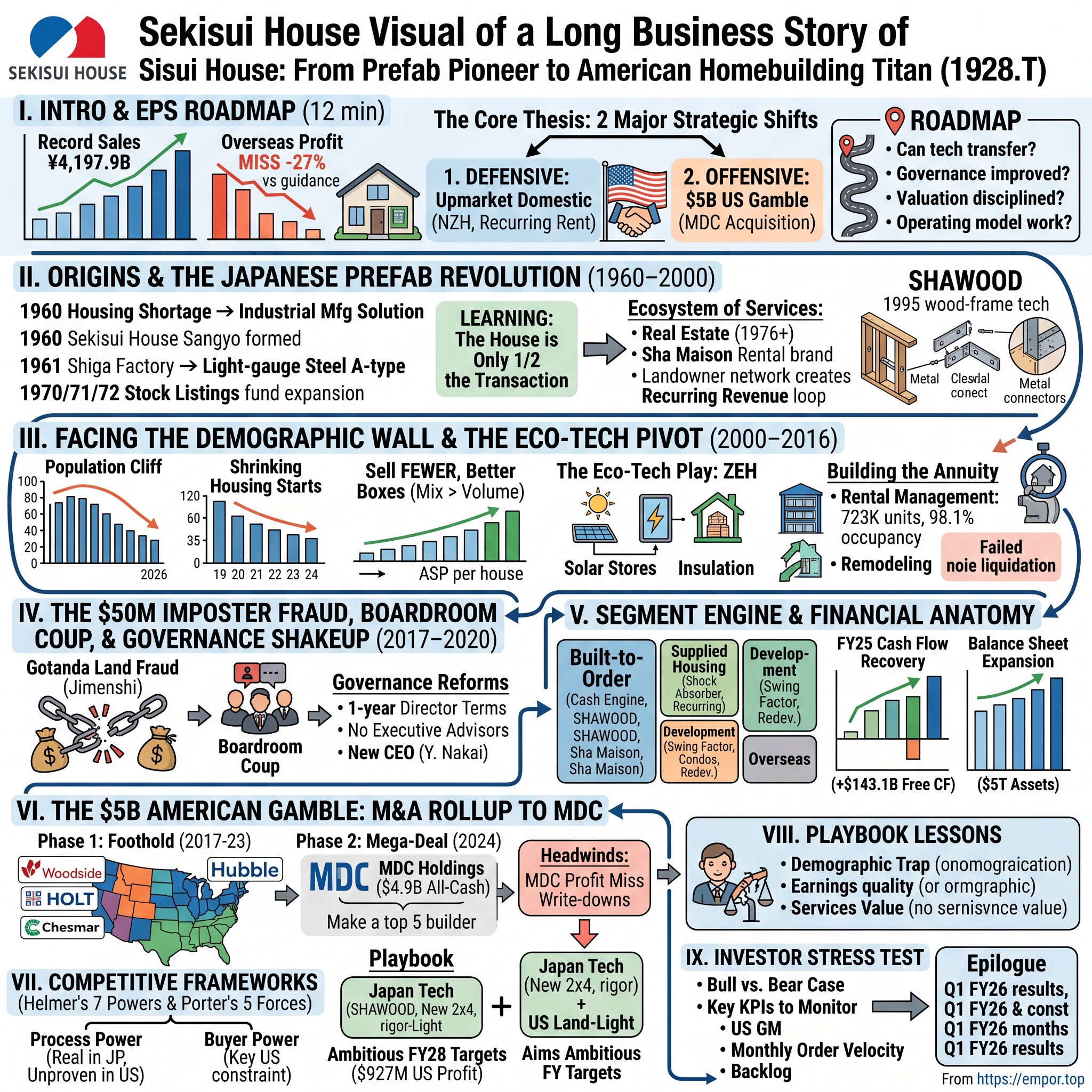
Sekisui House: From Prefabricated Pioneer to American Homebuilding Titan
I. Introduction & Episode Roadmap (12 min)
On March 5, 2026, in Osaka, Yoshihiro Nakai (仲井嘉浩 Yoshihiro Nakai), president of Sekisui House, Ltd. (積水ハウス Sekisui House, Ltd.), presented what should have been a victory lap to institutional investors and analysts. The company had just closed its 75th fiscal year with record net sales of ¥4,197.9 billion and record profit attributable to owners of the parent of ¥232.0 billion. The results marked the company's fourteenth consecutive year of dividend increases and concluded a three-year management plan that exceeded its revenue target by more than ¥1.3 trillion.13
Yet investors had not gathered to celebrate. Buried on page four of the earnings presentation was a line that undercut the growth narrative: operating profit from the Overseas Business — the segment tasked with driving Sekisui House's expansion beyond Japan — came in at ¥39.1 billion. A year earlier, segment operating profit stood at ¥78.9 billion. Against the company's updated September guidance of ¥53.5 billion, the result was a 27% miss.1 While every domestic division beat its target, operating profit for the overseas business — built on roughly $5 billion in acquisitions — was cut in half.
That tension defines Sekisui House's current transition. The company solved a structural challenge that has stymied many Japanese industrial peers by establishing a growth engine outside a shrinking domestic home market. Yet that expansion exposed Sekisui House to distinct overseas cyclical risks.
The scale of Sekisui House remains underappreciated outside Japan. The company employs 32,186 people across 301 consolidated subsidiaries, generates approximately one-third of its revenue internationally, manages more than 700,000 rental apartments, and operates a U.S. homebuilding platform that delivers over 11,000 homes annually across 16 states.41 Consequently, Sekisui House operates simultaneously as a deeply established Japanese industrial company and as one of the largest homebuilders in the United States — two identities that create distinct operational and strategic demands.
The core thesis. Sekisui House (1928.T, listed on the Prime Market of the 東京証券取引所 Tokyo Stock Exchange and the Premier Market of the Nagoya Stock Exchange) has executed two major strategic shifts over the past two decades.4 The first pivot was defensive: faced with a Japanese housing market in multi-decade demographic decline, the company moved upmarket, elevating average selling prices through engineered timber, net-zero-energy building standards, and a recurring rental-housing management business that now covers more than 720,000 units.1
The second pivot was offensive and remains unproven: deploying domestic cash flow into North America, culminating in the $4.9 billion all-cash acquisition of Denver-based MDC Holdings, Inc. in 2024. While the transaction propelled the group into the top five U.S. homebuilders, two years later the segment has yet to earn its cost of capital.61
The questions this analysis evaluates. How did factory-built housing establish a cost and quality advantage in Japan, and can that manufacturing model transfer to foreign markets? What were the operational breakdown and governance consequences of the 2017 地面師 jimenshi land-imposter fraud in 五反田 Gotanda, and has the post-struggle boardroom architecture truly improved oversight? Did Sekisui House negotiate a disciplined valuation for MDC Holdings, or did it pay a peak-cycle premium? Finally, can a corporation built on precision manufacturing, rigorous inspection, and long-term durability successfully export its operating model to a U.S. homebuilding industry dominated by land acquisition costs, construction velocity, and rate-buydown incentives?
In its Seventh Mid-Term Management Plan released alongside the annual results, management posited that Sekisui House will become a "game changer" in U.S. homebuilding by introducing proprietary Japanese construction technology — specifically a re-engineered wood-frame system designated "New 2×4" and its premium シャーウッド SHAWOOD product line — into American subdivisions.3 Evaluating this claim requires examining the origin of Sekisui House's domestic capabilities and determining whether those strengths align with the competitive drivers of the U.S. housing market.
A key reporting convention governs these disclosures. Sekisui House operates on a fiscal year ending January 31; thus, FY2025 refers to the twelve months ended January 31, 2026, while FY2026 denotes the year ending January 31, 2027. Additionally, Sekisui House reports U.S. operational metrics on a calendar-quarter schedule to match U.S. industry peers, creating a minor timing offset between segment disclosures and consolidated financial statements.
Structurally, Sekisui House operates across four distinct divisions, structured so that mature domestic business lines generate cash flow to fund growth segments. This multi-pillar model enabled the company to sustain fourteen consecutive years of dividend increases amid a contracting Japanese market while funding its record $4.9 billion overseas acquisition. However, this structure can also obscure regional weakness, buffering consolidated earnings when international operations underperform.
 Subscribe on LinkedIn
II. Origins & The Japanese Prefabricated Revolution (1960–2000) (18 min)
In 1960, Japan faced a housing shortage that traditional carpentry could not solve. Urban migration outpaced hand-framed construction, surviving wooden buildings posed severe fire risks, and the nation sat on highly active seismic zones. The response was to shift housing from bespoke construction to industrial manufacturing.
In August 1960, 積水化学工業 Sekisui Chemical Co., Ltd. — a plastics and industrial-materials firm — incorporated a subsidiary with ¥100 million in capital, named Sekisui House Sangyo Co., Ltd., to commercialise pre-engineered housing.4 Its initial product, the Sekisui House A-type, featured a light-gauge steel frame stamped and welded in a factory, transported to site, and assembled in days rather than months. In July 1961, the company opened its Shiga Factory in 滋賀 Shiga Prefecture, and in October 1963, it dropped "Sangyo" to become Sekisui House, Ltd.4
This approach represented a fundamental structural shift. Traditional stick-built housing relies on custom, site-specific labor subject to weather conditions and individual craftsmanship. Factory-built manufacturing standardizes production tolerances on an assembly line, verifies structural integrity before dispatch, and converts on-site work into rapid assembly. In an economy facing labor shortages and surging housing demand, this industrial model enabled scalable growth.
A technical corporate restructuring from this period still appears in regulatory filings. In March 1969, an entity named Showa Shokusan renamed itself Sekisui House, Ltd., and in May 1969, absorbed the original operating company in a reverse merger designed to adjust share par values. While the newer legal entity survived, operational continuity was uninterrupted, and official corporate histories treat the founding 1960 business as the continuous enterprise.4
Capital markets quickly rewarded the expansion. The stock listed on the Second Section of the Tokyo and Osaka exchanges in August 1970, graduated to the First Section in June 1971, and added a Nagoya listing in August 1972 — three market promotions in two years that funded factory expansion across Ibaraki, Yamaguchi, Shizuoka, Hyogo, and Miyagi over the next two decades.4 Sponsored American Depositary Receipts began trading in March 2001, and in April 2022, the company moved to the Tokyo Stock Exchange Prime Market and Nagoya Stock Exchange Premier Market under the exchange's market restructuring.4
The evolution of the original Shiga plant illustrates how Sekisui House managed its manufacturing footprint. Opened in July 1961, the plant operated continuously for nearly half a century before production was suspended in March 2009 — retired not because prefabrication had failed, but because a newer, consolidated factory network proved more efficient than the founding site.4 In this capital-intensive model, manufacturing capacity represents an overhead cost that must align with domestic market demand, requiring disciplined capacity rationalization.
Learning that the house is only half the transaction. A second, equally durable strategic realization emerged from distribution rather than manufacturing. Japanese buyers purchasing custom detached homes typically acquire land simultaneously, arrange long-term financing, and require ongoing maintenance, remodeling, and property management across generations. Selling only the building captures a single transaction; providing land sourcing, financing, property management, and ongoing service captures a multi-decade revenue stream.
Sekisui House systematically built this ecosystem. Beginning with Sekiwa Real Estate, Ltd. in March 1976, the company established a regional network of real-estate subsidiaries — expanding into Kansai in 1977, Kyushu in 1980, Chubu in 1981, Chugoku in 1982, and Tohoku in 1983 — to secure local land access and landowner relationships.4 These relationships provided the foundation for its second major product line: シャーメゾン Sha Maison, the group's rental-apartment brand.
The Sha Maison business model operates through property management rather than asset ownership. Sekisui House sells constructed rental units to individual landowners — often farmers or families holding urban land subject to steep Japanese inheritance taxes — because developing rental housing significantly lowers assessed land values for tax purposes. The landowner secures tax optimization and rental yield, while Sekisui House receives the initial construction contract and a multi-decade property-management mandate.
This structure established a recurring customer loop. Traditional homebuilders must continually acquire new customers for every sale. By targeting landowners who hold substantial real estate and face recurring inheritance-tax planning needs, Sekisui House built an enduring client base for repeated development cycles.
Each completed Sha Maison project functions as an asset under management, generating recurring property-management fees, remodeling opportunities, and tenant relationships that can convert into future detached-home buyers. Management now formalizes this network as the "Sekisui House Economic Sphere," with its Seventh Mid-Term Management Plan outlining customer touchpoints across sales, after-sales service, remodeling, asset inheritance, and financial products.3 While modern corporate disclosures use ecosystem terminology, the underlying operational infrastructure was built in the 1970s and 1980s.
The depreciation problem that became a moat. This strategy adapted to a unique characteristic of post-war Japanese real estate. Unlike Western residential markets where maintained homes generally appreciate, Japanese residential structures historically lost financial value over time. Successive revisions to seismic codes rendered older building stock functionally obsolete, tax policy amortized wooden housing over twenty-two years, and consumer preferences strongly favored new construction. Consequently, residential structures depreciated toward land value within a single generation.
Rather than competing on lowest-cost construction, Sekisui House positioned itself at the premium end of this market. By engineering structures to exceed mandatory seismic standards and providing documented component quality alongside long-term inspection programs, the company commanded higher selling prices and better value retention. In 1995, Sekisui House acquired Sekisui House-W Co., Ltd. via merger, acquiring the wood-frame technology that became its SHAWOOD product line: engineered laminated timber joined with proprietary metal connectors rather than traditional joinery, bringing factory precision to a high-end wooden house.4
SHAWOOD represents the core construction technology Sekisui House plans to expand internationally. Traditional Japanese wooden construction depends on manual joinery cut into solid timber — an artisan process that is labor-intensive and variable. Conventional American residential construction relies on site-cut dimensional lumber fastened with nails, which prioritizes speed over tight tolerances.
SHAWOOD bridges these methods by using dimensionally stable engineered timber connected by precision-machined metal joints. This approach shifts structural performance from manual job-site craft to factory-controlled engineering, enabling verifiable structural standards, consistent mass production, and extended multi-decade structural warranties — essential requirements for selling premium timber housing in earthquake-prone regions.
By 2000, Sekisui House had established three core competitive pillars: an industrial manufacturing system, a landowner-focused real estate network, and a premium brand strategy centered on structural durability. Its primary strategic challenge over the subsequent decades would be managing long-term structural changes in domestic Japanese housing demand.
III. Facing the Demographic Wall & The Eco-Tech Pivot (2000–2016) (22 min)
Every Japanese boardroom in the mid-2000s was handed the same chart, and it looked like a cliff. The population peaked and turned down. Household formation followed. New housing starts, which had run around 1.5 million units a year in the bubble-era late 1980s and were still comfortably over a million into the 2000s, began a grind lower that has never meaningfully reversed — Japanese monthly housing starts have averaged roughly 97,000 units since 1960 against a March 1972 peak above 195,000, and by May 2026 the monthly figure was 57,877.13 For a company whose entire industrial base was sized for volume, this was an existential arithmetic problem.
The obvious response — cut price, chase share, fill the factories — was also the wrong one, and Sekisui House declined it. The strategy that emerged instead can be summarised in one sentence: if you cannot sell more houses, sell more expensive houses, and get paid twice for each one.
Selling fewer, better boxes. The mechanism was product mix. SHAWOOD was pushed as the flagship of a premium range; three- and four-storey construction was promoted in dense metropolitan land markets where the same footprint could carry far more value. The evidence that this worked is visible in a single number that investors should watch more closely than revenue.
In FY2025, Sekisui House's average selling price per custom detached house on a delivery basis was ¥56.42 million, up from ¥52.48 million a year earlier — a 7.5% increase in price per unit.1 Custom detached house revenue was essentially flat at ¥478.9 billion, but gross margin rose a full point to 25.0% and operating profit rose 4.3% to ¥48.0 billion.1 Flat revenue, higher margin, higher price per unit: that is mix at work, not volume.
The eco-tech play, explained simply. The lever that made premium pricing stick was energy. A ネット・ゼロ・エネルギー・ハウス Net Zero Energy House, or ZEH, is conceptually straightforward: insulate and seal the building so well that it needs very little energy, then generate at least as much energy on-site — typically rooftop solar, sometimes paired with a residential fuel cell — as the household consumes over a year.
For a homeowner, the pitch is a utility bill near zero and, in Japan's climate, a house that is quiet, dry and thermally even. For a builder, the pitch is far more interesting: ZEH specification adds real cost, but it is sold as a lifetime saving, which means the builder captures a price increase against a benefit the customer receives from the utility company rather than from the builder.
Sekisui House pushed this harder and earlier than anyone in its peer group, branding its version Green First. The adoption numbers are genuinely striking: 96% of its detached houses in the year to March 2025 met the Green First ZERO (ZEH) standard, and even in rental housing — where the economics are harder because the landlord pays for the equipment and the tenant enjoys the lower bill — the Sha Maison ZEH ratio reached 77%.1 That second figure is the more impressive one, because it shows the company solved a genuine split-incentive problem rather than simply upselling homeowners.
Building the annuity. The third leg was recurring revenue, and this is where Sekisui House quietly diverges from most listed homebuilders anywhere in the world. Rather than treating property management as a service afterthought, the group industrialised it. Its rental-housing management business ended FY2025 with 723,000 units under management at an occupancy rate of 98.1%, generating ¥712.6 billion of revenue and ¥68.9 billion of operating profit — with gross margin improving to 16.0% from 14.5%.1 Add the remodeling business, which services the group's own installed base of houses and apartments, and the combined "Supplied Housing" model produced ¥900.5 billion of revenue and ¥96.9 billion of operating profit in FY2025, at a 10.8% operating margin.1
The analytical point is not that these are large numbers. It is that they are uncorrelated numbers. New-home demand swings with rates, sentiment and tax policy; the rent roll on 723,000 occupied apartments does not. Sekisui House can therefore run a cyclical construction business on top of a non-cyclical services business, which is why it has been able to raise its dividend fourteen years running through a market that has been structurally contracting the entire time.1
There is a subtler advantage buried in that occupancy figure. At 98.1%, vacancy across the managed portfolio is under two percent — a level that in most rental markets would be considered a data error. It is achievable because the buildings are new, are located on land the group itself sourced, and are managed by an organisation that also built them and therefore knows what breaks. Occupancy is the closest thing this business has to a quality score, and it is one of the few operating metrics where a deterioration would show up long before it showed up in profit.
The experiments that did not work. It is worth recording that this period was not a straight line of successes, because the company's own filings quietly record the failures. In February 2020 Sekisui House launched Sekisui House noie Limited, a ready-built detached housing business aimed at a lower price point than the core custom-home range — an attempt to attack the volume end of the market with a different cost structure. It was liquidated in December 2025.4
Around the same time the group has been reorganising its structure almost continuously: the six regional real-estate companies were consolidated under Sekisui House Real Estate Holdings in February 2022 and then restructured again in February 2025, splitting brokerage into a single Sekisui House Real Estate, Ltd. and spinning the rental business into six regional Sha Maison PM companies, while the after-sales business was carved out as Sekisui House Support Plus, Ltd.4
Group headcount at the parent company actually fell from 15,664 to 14,178 in FY2025 as functions moved into subsidiaries.4 None of this is glamorous, and some of it is simply corporate housekeeping — but a company that liquidates its own failed brand and reorganises its distribution twice in four years is at least behaving like one that reviews its portfolio.
The digital layer, and what it is actually for. The same strategic logic — extend the relationship rather than chase the transaction — later produced the technology programme the company calls PLATFORM HOUSE, and it is easy to dismiss as smart-home marketing. The more interesting reading is that Sekisui House is attempting to convert a one-time transaction into an ongoing relationship by instrumenting the house itself — integrating what it calls lifestyle data (sleep patterns, daily rhythm, vital signs) with activity data (movement, services used, local infrastructure) on a platform intended to support health, connectedness and learning services.3 Whether households want this is genuinely uncertain and the revenue is not separately disclosed.
The commercially proven digital work is far more mundane and far more valuable: rental housing operations have been moved online end to end, with self-guided property tours using smart locks, fully electronic applications and contracts now running at 95% of agreements, resident apps handling maintenance requests, and automated move-out procedures.3 That is not a new business; it is the same annuity run at lower cost with less friction — and it is a large part of why rental-management gross margin improved a point and a half in a single year.
The strategy has real limits, and management does not pretend otherwise. Mix improvement is a finite lever — you cannot raise average selling price forever in a market where household incomes are not rising as fast — and the domestic plan for FY2026 through FY2028 assumes almost nothing from it, guiding custom detached house sales from ¥500.0 billion to just ¥514.0 billion over three years at a flat 10.3% operating margin.3
Domestic Japan, in the company's own numbers, is now a stable annuity, not a growth engine. Which is exactly why the search for growth had to go abroad — and why, in 2017, an urgent hunt for land in Tokyo would produce the most embarrassing episode in the company's history.
IV. The $50M Imposter Fraud, Boardroom Coup, & Governance Shakeup (2017–2020) (22 min)
Near JR Gotanda Station in Shinagawa Ward, Tokyo, sat a roughly 2,000-square-metre plot where a long-established inn had once stood — a site of rare central-Tokyo availability that drew intense interest from developers across the city. In 2017, a group of fraudsters impersonating the owners of the land and buildings in Nishi-Gotanda signed a sales contract with Sekisui House and absconded with approximately ¥5.5 billion.9
Japanese real estate has a specific term for this scheme: 地面師 jimenshi, literally "land imposter" or "land shark" — a professional fraudster who claims ownership of property, orchestrates a fraudulent sale to a third party, and disappears with the capital. The Gotanda operation was no impromptu scam; it was organized and executed like a corporate enterprise.
Ruling on November 27, 2024, the Tokyo District Court ordered five defendants to pay ¥1 billion in damages, detailing an operation with dedicated roles: impersonators, document forgers, and handlers who coached the lead imposter to answer detailed questions about property she had never owned. Ringleader Mike Uchida was already serving a twelve-year prison sentence, and negotiator Misao Kaminskas a ten-year term. The court found Uchida had commissioned a forged seal in the landowner's name and personally received at least ¥15 million of the illicit proceeds.9
The mechanics explain how a buyer with a sixty-year history of land acquisition fell victim. Japanese property transactions rely on the official land registry and physical identity documentation — specifically a passport, a registered personal seal (実印 jitsuin), and title deeds. The imposters produced forged versions of all three, coaching an elderly woman to impersonate the owner during contract negotiations.
In a market where prime central-Tokyo land rarely becomes available, scarcity itself served as the weapon. The improbability of the deal heightened the buyer's eagerness, creating internal pressure to close the transaction before competitors could intervene. Speed became the structural vulnerability — a risk factor for an industrial builder whose culture prized rapid project cycles.
The financial loss, while significant, was absorbable against Sekisui House's ordinary profit of over ¥180 billion at the time. The lasting damage lay in what the fraud exposed regarding internal controls and how executive leadership responded.
The board turns on itself. An internal investigation commissioned by then-Chairman 和田勇 Isami Wada identified operational red flags that management had overlooked. When Wada sought executive accountability at a board meeting on January 24, 2018, proposing the dismissal of President 阿部俊則 Toshinori Abe, board insiders holding a majority voted down the motion. Instead of Abe departing, Wada stepped down. The company announced that same day that Wada would step aside, with Abe assuming the chairmanship effective February 1.10
Such an outcome was extraordinary in Japanese corporate governance. A chairman attempting to enforce accountability for a major control breakdown was ousted by the executive team he sought to discipline. Contemporaneous commentary in the Nikkei highlighted the resulting uncertainty surrounding the company's direction and its commitment to transparent governance.10 For institutional investors, Gotanda shifted from an operational fraud story into a fundamental governance test.
Leadership transition amid conflict. Yoshihiro Nakai assumed the presidency in 2018 under these turbulent conditions. Rather than emerging from a standard succession process, Nakai was appointed during an executive factional dispute and spent his initial two years leading a corporation whose former chairman actively campaigned for his removal.
That challenge culminated at the 69th Ordinary General Meeting of Shareholders on April 23, 2020. Wada and sitting director Fumiyasu Suguro spearheaded a proxy contest under the banner "Save Sekisui House," proposing an alternative slate of eleven directors to shareholders, employees, and media.
Incumbent management prevailed. Shareholders approved the company's slate of twelve directors, reappointing Abe as chairman, Nakai as President and Representative Director, and elevating Toshifumi Kitazawa, Satoshi Tanaka, and Toru Ishii to the board. Shareholders also approved ¥500 million in aggregate executive director bonuses while rejecting the dissident proposal.8
Satoshi Tanaka and Toru Ishii remained pivotal figures on the board six years later, serving as Executive Vice President and Senior Managing Officer alongside Nakai during the March 2026 earnings presentation.2 This stability has provided strategic continuity, though it also means the executives who authorized the subsequent overseas expansion remain responsible for assessing its performance.
Structural governance reforms. The resolution of the proxy contest marked the beginning of structural reform rather than a simple defense of the status quo. At the April 2020 meeting, Sekisui House amended its Articles of Incorporation to shorten director terms from two years to one — requiring annual shareholder re-election — and abolished the provision for Executive Advisors.8
Eliminating the advisor (相談役 sōdanyaku / 顧問 komon) role addressed a systemic vulnerability in traditional Japanese corporate governance, where retired executives often retained office space, compensation, and informal veto power outside board oversight — a dynamic that contributed to the Gotanda internal conflict.
Formal governance reforms implemented between 2018 and 2025 introduced a mandatory retirement age of 70 for Representative Directors, expanded female representation on the board, overhauled transaction approval protocols, and established independent outside director chairmanships for the Board, the Audit & Supervisory Board, and the Personnel Affairs and Remuneration Committee, alongside a formal CEO succession plan.3 Executive compensation was restructured in 2020, capping variable bonuses at 0.18% of consolidated ordinary income and introducing performance-linked stock awards.8
Tying executive pay directly to consolidated ordinary income aligned management incentives with group profit performance rather than seniority.8 While modest by Western standards, this reform represented a meaningful shift for Japanese homebuilders in 2020. It also created explicit financial incentives to expand group profitability — context that looms large over the company's subsequent ¥688 billion overseas investment push.
Although governance changes adopted during a proxy battle carry tactical motivations, subsequent practices demonstrate operational change. Sekisui House now publishes detailed Q&A summaries from investor briefings, attributing answers to specific executives and documenting direct analyst inquiries.2
Furthermore, the Seventh Mid-Term Management Plan commits to extending group governance standards globally by establishing risk-management frameworks within international subsidiaries, enforcing a corporate Integrity Code, and updating internal whistleblowing systems.3 Strengthening reporting channels directly addresses the root cause of the Gotanda failure, where early internal warnings failed to escalate to decision-makers.
These governance mechanisms established the disclosure framework through which the company's subsequent U.S. expansion metrics are evaluated.
V. Segment-by-Segment Engine & Financial Anatomy (25 min)
Sekisui House reports results through four distinct business models rather than conventional geographic or product breakdowns. This divisional structure underscores a core strategy: pairing two asset-light businesses that generate reliable cash flow with two asset-heavy divisions that absorb capital in search of higher returns.3 Understanding this balance provides essential context for evaluating the group's FY2025 performance.
Built-to-Order: the engine room. Built-to-Order encompasses contract construction, including custom detached homes, rental housing, commercial buildings, and architectural and civil engineering. In FY2025, the segment generated ¥1,346.0 billion in net sales and ¥157.9 billion in operating profit—an 11.7% operating margin that expanded by 1.1 percentage points despite a slight top-line contraction.1 This combination of steady revenue and expanding margins indicates that the group's domestic premium-pricing strategy continues to yield results.
Rental housing and commercial construction delivered particularly strong results, generating ¥564.8 billion in revenue and ¥87.8 billion in operating profit at a 15.5% margin. Orders grew 2.8%, lifting the order backlog to ¥607.7 billion.1 The average selling price per building for シャーメゾン Sha Maison rental properties rose by ¥16.97 million year-over-year to ¥210.12 million, with three- and four-story structures accounting for 89.6% of rental construction value as the group shifted toward denser urban developments.1 The expanding order backlog provides high revenue visibility for domestic operations entering FY2026.
The architectural and civil engineering business line is primarily driven by 鴻池組 Konoike Construction Co., Ltd., which Sekisui House acquired through Otori Holdings in October 2019 and fully merged in October 2020.4 In FY2025, Konoike contributed ¥22.0 billion in operating profit on ¥302.2 billion in revenue—a 44.9% profit increase despite a 7.0% revenue decline—as favorable project selection and cost pass-through mechanisms expanded architectural gross margin from 9.3% to 13.4%.1
Management cautioned against assuming this profit level represents a permanent baseline. In briefing sessions, executives noted that the ¥22.0 billion result was elevated by completion milestones on large projects and historical price adjustments, estimating the segment's underlying structural run-rate closer to ¥17 billion.2
Supplied Housing: the shock absorber. The Supplied Housing division—comprising rental management and remodeling operations—functions as a key counter-cyclical stabilizer. The segment raised revenue by 3.4% and operating profit by 16.2% in FY2025, delivering high-margin recurring income with minimal capital requirement.1
Development: the swing factor and earnings quality. The Development division oversees real-estate trading, condominiums, and urban redevelopment. In FY2025, the segment served as the primary earnings driver, producing ¥681.9 billion in revenue (up 17.1%) and ¥94.9 billion in operating profit (up 35.1%), exceeding internal targets by nearly 10%.1 Urban redevelopment performed especially well, with operating profit nearly doubling to ¥45.9 billion at a 27.9% margin as the company monetized commercial properties into a receptive domestic investment market.1 Across the entire group, sales of development properties generated ¥152.1 billion in revenue and ¥50.8 billion in profit.1
However, real-estate sales generate transactional profits that depend on capital-market conditions and property yields rather than repeatable construction demand. FY2025 results were further boosted by an unusually high ¥26.1 billion contribution from equity in earnings of affiliates tied to domestic property transactions—a ¥29.1 billion year-over-year swing. Management explicitly advised analysts that this affiliate contribution will not recur in FY2026. Consequently, Sekisui House projected FY2026 ordinary profit to decline 4.2% to ¥314.0 billion and net profit to fall 6.1% to ¥218.0 billion despite projected revenue growth.12 Furthermore, the group's FY2026 plan reduces urban redevelopment revenue by 48.4%.1
To facilitate asset recycling in its Development business, Sekisui House operates a captive distribution channel through its sponsored real estate investment trust, 積水ハウス・リート投資法人 Sekisui House Reit, and an internal asset-management unit. Selling stabilized properties to an affiliated REIT provides capital flexibility, though related-party transactions require disciplined pricing governance. Management maintains a target urban redevelopment asset balance of approximately ¥300 billion, holding a baseline portfolio of roughly ¥200 billion to trade opportunistically as market conditions dictate.2
Cash flow recovery. The FY2025 cash flow statement reflected substantial balance-sheet stabilization following the MDC Holdings transaction. Operating cash flow increased to ¥216.3 billion from ¥62.9 billion in the prior year, while investing cash outflows dropped to ¥73.2 billion from ¥697.7 billion as acquisition outlays normalized. Consequently, free cash flow swung from negative ¥634.8 billion to positive ¥143.1 billion—a ¥777.9 billion net improvement.1 Capital expenditures remained steady at ¥99.6 billion against ¥42.7 billion in depreciation, with management allocating ¥110.0 billion for FY2026.1
This cash flow recovery marks a transition from capital deployment to asset harvest. The surge in free cash flow supports management's commitment to reduce debt by ¥180 billion over the current plan period while maintaining dividend growth, provided U.S. residential inventory turns over as projected.
Overseas operations. The Overseas Business generated ¥1,286.3 billion in net sales—representing approximately 31% of group revenue—but delivered only ¥39.1 billion in operating profit, as segment operating margin compressed from 6.2% to 3.0%.1 U.S. homebuilding, the group's largest revenue unit at ¥1,005.5 billion, registered an operating loss of ¥5.3 billion after goodwill amortization. Before amortization, the unit earned ¥39.5 billion in operating profit, down from ¥96.2 billion in the previous year.1
Group gross profit absorbed ¥19.7 billion in real-estate valuation losses, including ¥13.5 billion within U.S. homebuilding.1 The segment's profitable operations were concentrated in smaller units: master-planned communities achieved a 28.4% operating margin, while U.S. multifamily operations generated ¥15.4 billion in profit on ¥77.6 billion in revenue through the sale of two apartment properties.1
Balance-sheet expansion and capital returns. Total group assets reached ¥5,006.6 billion at the end of FY2025, up from ¥3,352.8 billion two years earlier, reflecting the balance-sheet expansion driven by the MDC acquisition.14 Real estate for sale expanded to ¥3,034.6 billion, with ¥2,327.0 billion located outside Japan.1 Interest-bearing debt stood at ¥1,881.7 billion, with the debt-to-equity ratio improving to 0.88 (0.80 including hybrid bonds) and the equity-to-asset ratio recovering to 42.7% from 40.8%.1 Annual interest expense rose by ¥5.5 billion to ¥39.1 billion, reflecting higher carrying costs for international land holdings.1
Return on equity settled at 11.3%, missing the 11.9% management target and marking a third consecutive annual decline from 11.9% in FY2023 and 11.7% in FY2024.13 While the Sixth Mid-Term Management Plan exceeded its cumulative targets for revenue (by ¥1,337.7 billion) and operating profit (by ¥85.7 billion), it missed its core profitability goal of achieving an ROE of approximately 12% in the final year.3 Total headcount across 301 consolidated subsidiaries stood at 32,186 employees.4
This financial trajectory highlights the market's ongoing valuation of the expansion strategy. Over the five years ending January 2026, Sekisui House delivered a total shareholder return of 200.1%, compared with 222.5% for the dividend-inclusive TOPIX index.4 Despite achieving a 62% increase in revenue and a 51% gain in net profit over that five-year span, the stock underperformed the broader Japanese market—underscoring investor caution regarding the risk profile and capital efficiency of the group's U.S. homebuilding strategy.
VI. The $5B American Gamble: M&A Rollup to MDC Holdings (28 min)
The strategic rationale for expanding into the United States was straightforward. While Japan’s housing market contracts alongside its shrinking population, the U.S. market has experienced fifteen years of under-building relative to household formation, supported by favorable demographic trends and a robust mortgage market. For a homebuilder with advanced manufacturing capabilities and a declining domestic market, international expansion offered a clear growth thesis. The central challenge lay in the execution: securing an appropriate entry valuation and establishing a sustainable operating model.
Phase one: buying a foothold, cheaply and quietly. Sekisui House incorporated North America Sekisui House, LLC in May 2010 and spent seven years studying the market through joint ventures in master-planned communities before acquiring an operating builder.4 Its initial platform acquisition occurred in March 2017, when Woodside Homes Company, LLC became a wholly owned subsidiary.4 Woodside served as an established entry platform: a top-30 U.S. builder operating across Arizona, California, Nevada, and Utah, delivering 1,644 closings and generating $603 million in revenue in 2016 while retaining its brand, executive team, and daily operations after the transaction.11
The subsequent expansion was deliberate and regional. The group acquired The Holt Group through Holt Group Holdings in December 2021 to enter the Pacific Northwest, Chesmar Homes via Chesmar Holdings in July 2022 to enter Texas, and the Hubble Group through Woodside in 2023 to cover Idaho.4 This strategy created a network of four regional builders operating under distinct local management teams without overlapping geographic footprints.
This hands-off integration approach diverged from conventional cross-border M&A practices, where acquirers typically push for rapid operational integration. By maintaining four separately branded builders with autonomous operations, Sekisui House preserved local management expertise—a structure that ultimately proved resilient during subsequent market downturns.
Because homebuilding margins rely heavily on regional land selection and local trade contractor relationships, preserving autonomous decision-making protected operating performance. Centralizing control risks disrupting those localized networks, regardless of the parent company's engineering expertise.
Alongside its homebuilding operations, Sekisui House established two adjacent U.S. business units that provided substantial earnings support. The master-planned community business—which acquires, entitles, and develops large tracts before selling lots to external builders and internal units—achieved a 28.4% operating margin in FY2025, the highest across the entire group. Meanwhile, the multifamily division develops urban apartment towers in cities including Seattle, Oakland, Los Angeles, San Diego, Denver, Charlotte, and Washington, D.C., holding them until stabilization before executing asset sales.13 Although capital-intensive and subject to commercial real estate capitalization rates, these development activities generated the bulk of international profits. However, management has initiated a capital reallocation plan, trimming multifamily holdings to finance land acquisition for homebuilding.
Phase two: the mega-deal. On January 18, 2024, Sekisui House announced an all-cash agreement to acquire Denver-based MDC Holdings, Inc.—parent of Richmond American Homes—for $63.00 per share, representing an equity value of $4.9 billion (approximately ¥688 billion). The purchase price carried a 19% premium over MDC's prior-day closing price and a 41% premium over its 90-day volume-weighted average, backed by a fully committed cash structure without financing contingencies. On a combined basis, the entities delivered 15,067 homes across sixteen states in 2022, elevating Sekisui House to the fifth-largest U.S. homebuilder by annual closings and surpassing its target of delivering 10,000 international homes annually ahead of its fiscal 2025 schedule.67 The transaction closed on April 19, 2024.[^7]
Two structural terms highlighted the buyer's risk profile. First, waiving financing conditions obligated Sekisui House to fund the entire ¥688 billion cash purchase regardless of interim capital market fluctuations. Second, the 41% premium over the 90-day average reflected a high valuation assessment by management that relied on long-term operational synergies rather than immediate market pricing.
Was the price disciplined? At the transaction price, MDC was valued at approximately 1.33 times its projected 2024 book value and 12.8 times earnings, against an expected return on assets of 6.5%. By comparison, peer mid-cap U.S. homebuilders were trading at 1.0 to 1.1 times book value while generating projected returns on assets between 7.5% and 10.5%.14 Sekisui House paid a premium multiple for an asset delivering lower operational returns than its immediate industry peers.
Acquiring immediate national scale required paying a control premium, as top-tier U.S. homebuilding platforms rarely trade at a discount. However, this entry multiple placed a heavy burden on subsequent operational execution.
This pricing dynamic created a noticeable valuation gap: at the close of FY2025, Sekisui House's own stock traded at 9.60 times earnings and roughly 1.0 times book value per share (¥3,300.57).4 The company effectively deployed equity valued at book value to purchase an asset trading at 1.33 times book value with lower baseline returns, making operational performance the sole metric for evaluating the transaction's success.
What the first two years delivered. Initial integration coincided with significant operational headwinds across the U.S. housing market. Total U.S. home deliveries fell 21% from 14,860 units in calendar 2024 to 11,712 units in 2025.1 Performance diverged sharply between operating units: MDC’s deliveries contracted from 9,598 to 6,695 units as its gross margin compressed from 18.6% to 14.1%, whereas the legacy regional builders (Woodside, Holt, and Chesmar) maintained deliveries at 5,017 units compared to 5,262 previously while preserving gross margins at 21.5%.1 Platform-wide monthly order velocity dropped from 1,326 homes in early FY2024 to 736 during the final quarter of calendar 2025.1 Consequently, year-end inventory reached 6,905 homes, including 5,576 uncontracted units already under construction.1
High levels of spec-built inventory—homes started prior to securing a buyer—exposed the platform to elevated carrying costs during a period of sustained high interest rates. To move uncontracted inventory, management relied on sales incentives, mortgage rate buydowns, and inventory write-downs, resulting in ¥13.5 billion in real-estate valuation losses within U.S. homebuilding.1
In briefings following the March 2026 annual results, management attributed MDC's underperformance to two primary factors: an overconcentration of land targeted at price-sensitive entry-level buyers, and land acquired at peak-cycle prices to support a planned 15,000-unit volume target that failed to materialize. Across its U.S. holdings of roughly 52,000 owned and optioned lots, the company plans to shift its segment mix from 40% entry-level, 45% move-up, and 15% premium toward a 20/60/20 distribution over three years.2 Executives acknowledged that MDC’s spec-heavy inventory mismatched actual buyer demand, cautioning that elevated finished inventory would keep gross margins constrained through the first half of FY2026.2
"Japan tech + US land-light," and whether it can work. Sekisui House’s Seventh Mid-Term Management Plan addresses these headwinds through organizational consolidation and product differentiation rather than pure cost reduction. In January 2026, the group consolidated Woodside, Holt, and Chesmar into MDC—renamed SEKISUI HOUSE U.S., Inc. in September 2025—establishing a unified operating unit.4 On this platform, the company is deploying its proprietary building technologies: introducing the premium SHAWOOD brand across twenty projects in five states, alongside a re-engineered framing method designated "New 2×4," which will pilot across eight projects in four states in 2027 before expanding across fourteen states beginning in 2028.3
President Nakai outlined four operational elements intended to differentiate the U.S. product line: introducing rigorous Japanese pre-delivery inspection protocols, incorporating space-efficient floor plans, using higher-grade structural timber, and applying durable exterior cladding materials.2 However, Nakai noted an operational bottleneck: deploying the "New 2×4" system requires training site supervisors to enforce Japanese inspection standards—a process expected to take one to two years, delaying immediate financial contributions.2
The financial targets under the mid-term plan assume significant profit acceleration. Excluding goodwill amortization, U.S. homebuilding operating profit is projected at $230 million in FY2026 before rising to $507 million in FY2027 and $927 million in FY2028—targeting a fourfold expansion over three years as gross margins recover from 16.5% to 21.0% and deliveries grow from 11,712 to 13,600 units.3 Concurrently, management intends to reduce the total overseas capital allocation from ¥2.6 trillion to ¥2.2 trillion by scaling down multifamily holdings from ¥0.7 trillion to ¥0.4 trillion and reallocating capital toward residential lot control.13
While these projections appear ambitious, management clarified to analysts that earnings targets do not assume a rapid market recovery, relying instead on a gradual, single-digit growth in sales volume.2 Anticipated margin expansion depends primarily on clearing discounted spec inventory, increasing the proportion of custom build-to-order homes, and raising average selling prices.
Relying on operational self-help rather than broader market expansion provides a clearer path to margin recovery. However, because earnings growth is heavily back-loaded into the final year of the plan, near-term execution visibility remains limited.
Myth versus reality. Three common assumptions surrounding the transaction warrant examination against reported results.
Myth: Sekisui House acquired MDC at a discounted valuation due to cyclical weakness in U.S. housing. Reality: The company paid a premium relative to MDC’s direct peers for an asset generating lower returns on assets.14 While acquiring immediate scale carried strategic value, the transaction was executed at a full valuation.
Myth: National scale immediately translates into superior operating margins. Reality: Homebuilding economics depend on regional land concentration rather than aggregate national volume. Delivering national scale does not ensure local pricing power, as demonstrated in FY2025 by the margin gap between MDC (14.1%) and Sekisui House's smaller legacy U.S. builders (21.5%).1
Myth: Operating a "land-light" model eliminates land carrying risk. Reality: Controlling land via options reduces capital exposure but leaves option deposits and existing land holdings vulnerable to market shifts; Sekisui House's 52,000-lot inventory included land acquired at peak prices for expected sales volumes that failed to materialize.2 The resulting ¥13.5 billion in valuation write-downs reflected the ongoing risks of land holding during a cyclical slowdown.1
These operational challenges do not invalidate the expansion strategy, but they highlight that the ultimate return on Sekisui House's $5 billion investment remains dependent on multi-year operational execution.
VII. Competitive Frameworks: Helmer's 7 Powers & Porter's 5 Forces (18 min)
Strategy frameworks are useful only when they discriminate—when applying them alters an analytical conclusion. Applied to Sekisui House, they produce a distinct contrast: the company possesses genuine, durable competitive advantages in Japan, yet almost none of that power has transferred to the United States.
Process Power — real, but geographically non-transferable. Hamilton Helmer's Process Power describes an advantage embedded in an organization's operational model that competitors cannot easily replicate because it required decades to develop. Sekisui House holds this advantage in Japan.
This system rests on 65 years of factory production, extensive research facilities, proprietary structural connectors, and an in-house construction workforce trained through a "Crafters" program that expanded from 469 workers toward a target exceeding 1,000.3 The group's digital transformation initiatives extend this operational model through AI-guided bolt-tightening inspections, sensor-based concrete strength monitoring, automated truck-loading schedules, and 3D component fit-testing prior to physical prototyping.3
However, Process Power provides an advantage only relative to a specific competitive landscape. In Japan's home market, this system outperforms fragmented local builders. In the United States, established market leaders are not traditional hand-craftsmen; major production builders like D.R. Horton and Lennar have spent decades industrializing a different operational model centered on construction cycle times, land-lot costs, and even-flow scheduling rather than tight manufacturing tolerances.
Consequently, Sekisui House enters the American market with capabilities in a dimension where established competitors do not actively compete. Whether American homebuyers will pay a premium for factory-precision engineering remains an untested proposition. When asked during briefing sessions whether U.S. buyers might eventually value construction quality in the Japanese manner, President Nakai acknowledged that the outcome was difficult to predict, while maintaining that the company is positioning itself to capitalize on any such shift.2 That response describes a long-term strategic option rather than an established moat.
Cornered Resource — partial, and geographically non-transferable. Proprietary structural joints and materials provide technical protection, but their scope remains limited. The company's most defensible cornered resource is its Japanese landowner network: six decades of relationships with urban landholding families navigating inheritance-tax planning, alongside an installed customer base re-engaged through remodeling, brokerage, asset management, and financial services within what management designates the "Sekisui House Economic Sphere."3 While highly defensive in Japan, this relationship network cannot be exported to foreign markets.
Scale Economies — emerging, but constrained by market leaders. As a top-five U.S. homebuilder delivering more than 11,000 homes annually, Sekisui House commands meaningful purchasing power across lumber, roofing, and appliances. However, industry leaders D.R. Horton and Lennar each deliver several times that annual volume, leaving Sekisui House as a scale challenger in North America rather than a cost leader. Furthermore, by introducing two premium product lines alongside its standard builder offerings, the group is intentionally dividing its U.S. volume—prioritizing product mix over maximum purchasing leverage.
Counter-Positioning — dependent on incumbent response. Counter-positioning occurs when an incumbent cannot adopt a challenger's business model without undermining its own core operations. Sekisui House relies on the premise that major U.S. production builders cannot adopt Japanese-grade timber and inspection standards without inflating home costs in an affordability-driven market focused on monthly mortgage payments. While logical, this strategy assumes that established U.S. builders will feel compelled to respond. If demand for factory-precision premium housing remains limited, major incumbents can ignore the offering, leaving Sekisui House with a differentiated product catering to a niche market.
Evaluating the technology-transfer track record. Operational results from existing U.S. operations offer empirical evidence regarding the speed of technology transfer. Sekisui House currently operates its SHAWOOD line across 20 projects in five states, placing detached homes within master-planned communities developed by its own real estate division.3 The internal collaboration rate between the U.S. homebuilding operations and the master-planned community division reached 13% under the previous mid-term plan, with management targeting 20% under the Seventh Plan.3
These figures indicate that after nearly a decade in North America, proprietary technology deployment remains at pilot scale relative to the platform's 11,712 annual deliveries. Consequently, the group's FY2028 financial targets do not depend heavily on immediate adoption of its "New 2×4" construction system; management noted that initial model homes will open in 2028 and is not projecting a rapid initial sales contribution.2 U.S. technology integration represents long-term optionality rather than the primary driver of near-term earnings targets.
Porter's Five Forces analysis. Assessing industry structure across both geographic markets reveals distinct operational pressures:
- Threat of new entrants remains low in both Japan and the United States. Land entitlement expertise, capital requirements, and specialized factory infrastructure create substantial barriers to entry.
- Supplier power is moderate and mitigated by global timber sourcing and vertical integration, though internal materials affiliates cover only a fraction of total construction volume.
- Buyer power represents the primary constraint in the United States. High mortgage rates have made buyers acutely sensitive to monthly payments, forcing homebuilders to concede margin through mortgage-rate buydowns and price concessions—a dynamic that reduced MDC's U.S. gross margin to 14.1%.1
- Threat of substitutes is limited for single-family homes, though in Japan, existing-home sales and long-term rental housing are gradually gaining market share. Sekisui House hedges this shift through its extensive property-management portfolio.
- Competitive rivalry is intense in both markets. Domestically, Sekisui House competes against major builders including
大和ハウス工業 Daiwa House Industry Co., Ltd.,住友林業 Sumitomo Forestry Co., Ltd., andオープンハウスグループ Open House Group Co., Ltd.In North America, it faces dominant national scale players including D.R. Horton, Lennar, PulteGroup, and NVR.
Branding and switching costs. Helmer's remaining two powers offer limited competitive protection:
- Brand power commands a recognized price premium in Japan, where consumers associate Sekisui House with long-term structural durability. In contrast, corporate brand equity does not transfer to the United States, where homebuyers recognize regional builder brands such as Richmond American, Woodside, or Chesmar rather than the Japanese parent company.
- Switching costs are virtually non-existent in single-family homebuilding, where purchasing a home is a discrete transaction. A notable exception exists within the domestic rental management division, where property owners who contract management to Sekisui House face high operational friction when switching providers. High portfolio retention—evidenced by a 98.1% occupancy rate—creates a durable annuity stream that generates steady cash flow for the broader group.
Domestic competitive positioning. Within Japan, Sekisui House occupies a specialized, high-margin position rather than market-share dominance relative to peers 大和ハウス工業 Daiwa House Industry Co., Ltd., 住友林業 Sumitomo Forestry Co., Ltd., and オープンハウスグループ Open House Group Co., Ltd.:
- Daiwa House operates at significantly larger total scale, backed by extensive diversification into logistics and commercial real estate.
- Sumitomo Forestry competes directly in premium wooden housing while establishing its own substantial U.S. homebuilding platform, demonstrating that exporting Japanese timber-construction expertise to North America is an industry-wide strategy rather than an exclusive Sekisui House initiative.
- Open House Group targets urban land acquisition, smaller footprints, and lower price points, capturing market share in the entry-level domestic segment that Sekisui House vacated.
By ceding volume-driven segments in Japan, Sekisui House successfully protected domestic gross margins. Consequently, domestic market share is a secondary metric compared to margin stability and recurring services cash flow.
Strategic synthesis. Evaluating Sekisui House through these strategic frameworks highlights a central corporate paradox: the group's strongest competitive advantages are concentrated in a mature domestic market with limited growth prospects, whereas its international expansion division—the primary driver of projected growth—operates where its structural advantages are least established. The Seventh Mid-Term Management Plan represents a multi-year effort to transplant Japanese operational capabilities into North America. Financial results through FY2025 demonstrate that while the domestic foundation remains cash-generative and resilient, the international growth thesis remains unproven.
VIII. Playbook: Business & Investing Lessons (15 min)
1. Escaping a demographic trap requires two moves, not one. The instructive element of Sekisui House's strategy is that domestic mix elevation and international expansion function not as alternatives, but as sequential, interdependent phases. Elevating average selling prices and operating margins in Japan generated the cash required to finance its U.S. expansion; management's strategy explicitly identifies its two asset-light domestic businesses as the ¥540 billion source of funds that flows into development and overseas investment.3
Companies that skip domestic cash-flow optimization and rely directly on leverage for cross-border acquisitions lack a margin of safety when foreign markets turn. Conversely, companies that focus exclusively on domestic optimization risk gradually refining themselves into irrelevance. For investors, the primary test is verifying whether a firm's domestic engine is genuinely self-funding before attributing value to international growth plans.
A broader strategic principle applies: when a company expands abroad to escape a contracting home market, the critical question is not whether the target market offers greater scale—it almost always does—but what specific operational capability the acquirer transfers that local incumbents lack. If the primary transfer is capital, the buyer operates as a financial investor and merits a financial valuation multiple. If the transfer involves a distinct operational capability, an industrial integration thesis exists. Sekisui House offers a capability-driven thesis, though its execution at scale in the United States remains unproven.
2. Governance reform is most credible when it is structural and inconvenient. The Gotanda land fraud highlighted the distinction between public apologies and structural institutional reform. Reducing director terms to one year and eliminating the Executive Advisor provision from the Articles of Incorporation represented changes that directly constrained the discretion of incumbent leadership.8 Beyond formal policy metrics, a practical test of transparency is whether management continues publishing detailed Q&A records of direct investor questioning during periods of operational underperformance; Sekisui House has maintained this disclosure practice.2
3. Cross-border industrial M&A must transfer a process, not just consolidate a P&L. Financial disclosures across Sekisui House's U.S. platform demonstrate that its lightly integrated regional acquisitions—Woodside Homes, the Holt Group, and Chesmar Homes—sustained gross margins at 21.5% through the housing downturn, whereas its transformative MDC Holdings acquisition saw gross margins compress to 14.1%.1 This divergence stemmed less from integration speed than from initial land positioning and exposure to entry-level buyer segments.
In a cyclical, land-intensive industry, initial asset quality and geographic exposure outweigh post-merger integration adjustments. Consequently, operational synergy claims require specific execution mechanisms—such as construction cycle times, warranty expenses, procurement savings, or inspection labor efficiency—tied to explicit implementation timelines. Sekisui House has established one such milestone: piloting its proprietary "New 2×4" construction system across U.S. projects in 2027, subject to training job-site supervisors to Japanese quality standards.23 Tracking execution against this timeline offers a clearer gauge of integration progress than relying on short-term earnings charts.
4. Land-light is a discipline, not a slogan — and it is measurable. Carrying un-entitled land through a housing downturn poses a severe risk to homebuilders, as non-amortizing land holdings incur ongoing interest costs. Evaluating a land-light commitment requires monitoring capital allocation trends rather than executive messaging.
Under its Seventh Mid-Term Management Plan, Sekisui House intends to reduce total overseas investment from ¥2.6 trillion to ¥2.2 trillion by FY2028 while expanding U.S. homebuilding sales volume—requiring the company to divest capital from multifamily developments and master-planned communities faster than it deploys funds into residential lots.13 Management explicitly acknowledged this capital reallocation risk, stating that executing an effective asset exit strategy is "extremely important" based on lessons from its previous management plan, and committing to balance new capital outlays against demonstrated exit capabilities.2
5. Read the quality of earnings before the size of earnings. Sekisui House's record FY2025 financial results included a ¥29.1 billion year-over-year increase in equity-method income driven by domestic property sales, offset by ¥19.7 billion in valuation charges in the opposite direction, primarily within U.S. homebuilding.1 Because non-recurring asset sales and inventory write-downs reflect transactional timing rather than ongoing operational performance, isolating underlying cash flows is essential. Management's explicit guidance detailing which earnings drivers repeat and which do not provides investors with a clear signal regarding underlying earnings power.2
6. A services annuity attached to a cyclical business is worth more than the sum of its parts. Most residential homebuilders operate as purely cyclical enterprises, generating high returns during expansions but experiencing severe earnings compression during downturns—a volatility profile reflected in depressed valuation multiples. By integrating a large-scale property management and after-sales division alongside its construction operations, Sekisui House altered its financial behavior across economic cycles.
A homebuilder supported by steady, fee-based service income can absorb land carrying costs during housing contractions, sustain dividend payments, and maintain product development investments while competitors retrench. This recurring income stream provides strategic flexibility, ensuring that cyclical losses—such as those experienced in U.S. homebuilding during FY2025—remain manageable operational challenges rather than solvency threats. Evaluating cyclical industrial companies requires determining whether non-cyclical revenue streams are sufficiently large to fund core operations through the trough of a cycle.
7. Watch what a management team volunteers, not what it is forced to concede. During its March 2026 earnings briefings, management proactively disclosed several cautious adjustments: noting that the architectural construction unit's underlying run-rate was closer to ¥17 billion than the reported ¥22 billion result; projecting an FY2026 profit decline due to non-repeating real estate gains; clarifying that January–February U.S. order growth exceeded internal budgets but lagged prior-year levels; and withholding preliminary monthly margin figures while cost reviews remained incomplete.2
By highlighting operational headwinds alongside record earnings, leadership established realistic market expectations. For a corporation whose governance credibility was severely tested during the 2017 Gotanda land fraud, establishing transparent disclosure practices represents an important step in rebuilding institutional trust.
IX. Investor Stress Test: Bull vs. Bear Case & Key KPIs (18 min)
The activist's case, made properly. Imagine a concentrated shareholder writing to the board in mid-2026. The letter would not lead with strategic ambition; it would lead with capital allocation arithmetic. Sekisui House deployed roughly ¥688 billion in cash to acquire MDC Holdings, funded substantially through debt—including ¥352.5 billion in corporate bonds issued in FY2024 and another ¥140.0 billion in FY2025. That borrowing pushed annual interest expense to ¥39.1 billion and lowered the group's equity ratio to 40.8% before it recovered to 42.7%.1
Two years after the transaction was announced, the acquired U.S. business has recorded an operating loss after goodwill amortization, delivered 30% fewer homes than prior to the acquisition, and absorbed ¥13.5 billion in inventory write-downs.1 Meanwhile, Sekisui House shares trade at roughly book value, and the company's five-year total shareholder return has lagged the broader TOPIX index.4
The letter's second paragraph would target the structure of management's financial targets. Of the ¥1,170 billion in cumulative operating profit projected under the Seventh Mid-Term Management Plan for FY2026 through FY2028, the final year alone accounts for ¥450 billion. Within that trajectory, U.S. homebuilding operating margin is planned to expand from 0.3% to 8.2% over two years.3 Back-loaded targets complicate management accountability, as early shortfalls can readily be attributed to cyclical timing.
The third paragraph would challenge capital return policy. The mid-term plan allocates ¥300 billion to shareholder returns over three years, establishing a minimum annual dividend of ¥145 per share and targeting a payout ratio of at least 40%.3 When asked directly during investor briefings whether this capital allocation leaves room for share repurchases, management clarified that buybacks are deliberately omitted from the primary framework, noting they consider repurchases "unlikely" and would evaluate them only if operational performance deviates significantly from the plan.2
For a company trading near 1.0 times book value, that policy invites scrutiny. Management's counterargument rests on balance-sheet discipline: ¥180 billion is earmarked for debt reduction, and with international operations generating 30% to 40% of group revenue, overall earnings carry higher cyclical volatility.2 Both perspectives reflect valid capital allocation philosophies; a critical shareholder would emphasize that the group committed ¥688 billion to acquire an external asset at 1.33 times book value while hesitating to buy back its own shares trading at book value.
A partial response is already on record: during the first quarter of FY2026, Sekisui House canceled 11.7 million treasury shares, reducing total issued shares from 663.1 million to 651.4 million.5 While share cancellation retires existing inventory rather than deploying new cash for market repurchases, it permanently shrinks the equity base.
The bull case. Four factors support a positive investment outlook. First, the domestic services annuity remains highly resilient: the Supplied Housing division expanded operating profit by 16.2% during a year when overall Japanese housing starts contracted, while the Built-to-Order segment expanded operating margins despite flat top-line sales.1 Second, the U.S. housing slowdown reflects cyclical interest-rate headwinds rather than a structural collapse in demand; the underlying American housing deficit persists, and Sekisui House controls approximately 52,000 lots positioned to appreciate as mortgage rates normalize.2
Third, margin recovery relies primarily on internal operational adjustments within management's control—clearing discounted spec inventory, shifting product mix from entry-level toward move-up housing, and increasing the proportion of custom build-to-order homes—rather than requiring an aggressive market surge.2 Fourth, the group's legacy U.S. builders provide an operational benchmark: Woodside, Holt, and Chesmar sustained a combined 21.5% gross margin through the same market conditions that reduced MDC's margin to 14.1%, demonstrating that the U.S. platform can deliver targeted returns when land selection is disciplined.1
The bear case. Conversely, three key risks underpin the cautious thesis. First, the financial projections require a fourfold expansion in U.S. operating profit over three years while simultaneously reducing total overseas assets—demanding concurrent profit growth and debt deleveraging within a cyclical industry.3
Second, currency translation introduces earnings volatility: FY2025 results were reported at an average exchange rate of ¥150.43 to the U.S. dollar, whereas the FY2026 forecast assumes ¥145.00.1 With approximately one-third of group revenue generated abroad, yen appreciation mechanically reduces translated international earnings. Third, domestic housing contraction remains a continuous headwind: monthly Japanese housing starts in the high 50,000s stand at less than one-third of their 1972 peak, requiring ongoing product-mix enhancement merely to preserve domestic earnings.13
The return-on-equity decomposition illustrates these operational requirements. Management's roadmap to its FY2028 target requires net profit margin to expand from 5.5% to approximately 6.0% and asset turnover to rise from 0.86 times to at least 1.0 times, while financial leverage declines from 2.39 times to roughly 2.0 times.3 Achieving this goal requires operational efficiency and asset turns to improve sufficiently to offset planned balance-sheet deleveraging. Raising asset turnover by nearly a sixth in three years requires accelerating sales velocity while trimming non-core holdings—an ambitious operational target that leaves little margin for execution error.
Material risk factors. Four primary risks warrant close monitoring: * Input costs and trade policy: As a major consumer of lumber, steel, and manufactured components across North America and Asia, the group remains vulnerable to building-material tariffs and supply-chain disruptions that can compress gross margins independently of consumer demand. * Labor constraints: Deploying the "New 2×4" framing method is explicitly contingent on training field supervisors to enforce Japanese quality inspection standards.2 Given persistent shortages and high costs in U.S. construction labor, supervisor training represents the primary operational bottleneck for the rollout schedule. * Cost of capital and interest expense: Carrying ¥1,881.7 billion in interest-bearing debt and ¥39.1 billion in annual interest expense exposes the company to interest-rate changes, making Japanese rate normalization a direct cost consideration.1 * Data security and privacy: The PLATFORM HOUSE initiative relies on capturing biometric and daily lifestyle data; accordingly, the Seventh Mid-Term Management Plan designates information security as a primary operational risk requiring upgraded governance protocols.3
Technology exposure presents a distinct profile: physical homebuilding is insulated from direct software disintermediation. Instead, artificial intelligence serves primarily as a cost-efficiency tool, with Sekisui House deploying automated systems across site inspections, architectural design, and logistics scheduling to support margin expansion.3
An additional accounting consideration involves Japan's updated lease accounting standard. Management confirmed to analysts that discussions with auditors remain ongoing regarding the treatment of operating lease assets.2 While implementation will expand balance-sheet assets and liabilities, the precise impact on the net debt-to-EBITDA metric evaluated by credit rating agencies has not been finalized, and the Seventh Plan's financial targets explicitly exclude this accounting adjustment.3
Credit rating divergence. Evaluation by rating agencies reflects a notable split in perspective. Sekisui House holds domestic credit ratings of AA from Japan Credit Rating Agency (as of January 21, 2026) and AA− from Rating and Investment Information (as of January 8, 2026), but carries a BBB+ rating from S&P Global Ratings (as of March 23, 2026).12 This three-to-four notch divergence highlights differing analytical priorities: domestic agencies emphasize the steady cash flows of the domestic property-management portfolio, whereas global agencies place greater weight on the leverage incurred to acquire cyclical U.S. homebuilding assets.
Key performance indicators. Evaluating operational execution across upcoming quarterly disclosures requires monitoring three core metrics:
- U.S. homebuilding gross margin (excluding valuation losses) and monthly order velocity. This metric serves as the primary gauge of international recovery. Management established the margin baseline at 16.5% in FY2025, targeting annual recoveries to 17.0%, 19.0%, and 21.0% across the three mid-term plan years, supported by an order velocity averaging approximately 1,040 homes per month to reach 12,500 annual orders in FY2026.23
- Domestic Built-to-Order backlog and average selling price. The domestic order backlog reached ¥1,257.4 billion at the close of FY2025 (up ¥62.5 billion year-over-year), while average selling price per custom detached house rose to ¥56.42 million.1 Order backlog reflects domestic demand pipeline strength, whereas average selling price indicates whether product-mix elevation continues to generate margin expansion.
- Debt repayment period (net debt to EBITDA) and overseas investment balance. Management prioritizes net debt relative to EBITDA over debt-to-equity ratios to align with credit rating agency methodologies.2 Tracking this ratio alongside total overseas assets—which stood at ¥2,618.0 billion at the end of FY2025 and are targeted to decline to ¥2.2 trillion by FY2028—provides a clear measure of balance-sheet deleveraging and capital discipline.13
X. Epilogue & Conference Call Roadmap (12 min)
On June 4, 2026, Sekisui House reported its results for the first quarter of fiscal 2026, presenting a sharp contrast between its domestic and international divisions. Consolidated net sales edged up 1.7% to ¥908.9 billion, operating profit climbed 26.2% to ¥76.1 billion, and net profit attributable to owners rose 75.2% to ¥58.5 billion.5 The earnings expansion was driven almost entirely by domestic operations. Operating profit in the Development business surged 157.9%, bolstered by a 528.4% increase in condominiums and a 130.3% rise in urban redevelopment.5 Conversely, net sales in the Overseas Business fell 14.4% to ¥220.6 billion, and the segment swung to an operating loss of ¥4.2 billion from a ¥4.8 billion profit in the prior-year period.5 Management maintained its full-year earnings guidance.5
This single reporting period illustrates the company's broader operational dynamic: the domestic cash-generative annuity and Japanese property developments are currently supporting the North American expansion, rather than international growth driving group profitability.
Core disclosures and documentation. Evaluating Sekisui House's strategic position relies primarily on three disclosures. The fiscal 2025 results presentation from March 5, 2026, provides detailed supplementary U.S. homebuilding data—including deliveries, average selling prices, gross margins, and monthly orders broken down between MDC Holdings and legacy builders, as well as an inventory split between contracted and uncontracted homes.1
The Seventh Mid-Term Management Plan, released concurrently, details segment-level targets and a capital allocation framework that assigns ¥440 billion to growth investments, ¥180 billion to interest-bearing debt reduction, and ¥300 billion to shareholder returns out of a ¥5.6 trillion investment program split between ¥1,850 billion in Japan and ¥3,750 billion overseas.3 Finally, the accompanying briefing Q&A summary provides critical context on how management addresses operational friction and market skepticism.2
Evaluating the plan against its predecessor. Comparing the Seventh Mid-Term Management Plan against its predecessor illustrates changing corporate priorities. The Sixth Plan, launched in March 2023, targeted ¥10,026.0 billion in cumulative net sales, ¥858.0 billion in operating profit, and a return on equity reaching roughly 12% by its final year. While the group exceeded its top-line and operating profit targets—delivering ¥11,363.7 billion in net sales and ¥943.7 billion in operating profit—ROE declined steadily to finish at 11.3%.3
This historical record reflects a management team that surpassed revenue and operating profit goals through asset acquisitions while missing its capital efficiency metrics—a typical outcome for an organization expanding through debt-funded acquisitions. In response, the Seventh Plan targets cumulative net sales of ¥13,905.0 billion, operating profit of ¥1,170.0 billion, and an ROE in the high 12% range by fiscal 2028, while committing to balance-sheet deleveraging.3 Consequently, management's primary objective has shifted from top-line expansion to capital efficiency and margin recovery.
Management responses and analytical friction. Recent briefing disclosures indicate a management team willing to acknowledge operational challenges, though timing projections remain cautious. Addressing MDC Holdings' underperformance, executives cited internal structural factors—such as land overconcentration in entry-level segments—rather than relying solely on macroeconomic explanations. Similarly, when discussing expected profit declines in fiscal 2026, leadership highlighted the non-recurrence of prior equity-method property gains.
Regarding early fiscal 2026 trading, management disclosed that January and February U.S. orders exceeded internal targets by roughly 10% but lagged prior-year levels. When asked about gross margins for those initial months, executives declined to provide preliminary figures, noting that detailed cost reviews remained ongoing.2 This cautious disclosure approach provides a measured baseline for evaluating operational guidance.
Key analytical friction points over upcoming quarters center on three core issues: whether expanding U.S. homebuilding gross margins from 16.5% toward 21% is achievable without a broad housing recovery, whether scaling down total overseas assets while expanding U.S. sales volume is structurally achievable, and whether upcoming lease-accounting rule changes will require adjusting net debt leverage targets. Management has identified sales promotions scheduled for May and October 2026 as critical milestones for reducing finished inventory.2
Indicators of strategic inflection. Assessing whether Sekisui House's international strategy is succeeding requires tracking specific operational indicators rather than relying on top-line targets. Constructive indicators include U.S. monthly orders returning above the 1,040-unit run-rate required to achieve fiscal 2026 volume goals, U.S. homebuilding gross margin (excluding valuation losses) printing above 17% in the second half of the year, and an accelerating shift in lot inventory toward move-up housing.
Conversely, adverse indicators include subsequent real-estate valuation write-downs, total U.S. inventory remaining near 7,000 homes with uncontracted spec units exceeding 80%, or a plateau in domestic Built-to-Order backlog while North American operations continue absorbing cash flow.
Progress against these metrics can be verified through a predictable reporting schedule. Sekisui House publishes quarterly financial results alongside presentation materials, conducts institutional investor briefings, and subsequently releases English-language analyst Q&A transcripts, followed by its annual general meeting in late April and the subsequent release of its annual securities report and integrated Value Report.14
The strategic stakes. Beyond segment metrics, Sekisui House's strategy tests whether industrial manufacturing standards can be exported across international housing markets. While Japanese corporations successfully exported production philosophies in automotive and electronics manufacturing, homebuilding presents distinct structural barriers: land acquisition, site labor, building codes, and resale market conventions remain intensely localized. Sekisui House is conducting this cross-border test with approximately ¥2.6 trillion in deployed capital.1
Final reflection. Domestically, Sekisui House established a defensible business model: an industrial builder that positioned housing as a durable, premium asset, while channeling stable cash flows from property management into mitigating domestic demographic decline. Having completed its domestic transition, the company's remaining challenge lies in exporting that manufacturing discipline to North America—an expansion executed at 1.33 times book value during a U.S. housing deceleration, with financial targets heavily back-loaded toward fiscal 2028.
While management has acknowledged these integration friction points, operational success remains unproven. Downside risk is cushioned by a fee-generating portfolio of over 720,000 managed apartments and a fourteen-year record of dividend growth, whereas upside potential requires successfully monetizing Japanese housing technology within the U.S. market. The trajectory of Sekisui House over the coming three years depends on whether its operational discipline can deliver target margins in American subdivisions.
References
-
FY2025 (February 1, 2025 through January 31, 2026) — Summary of Consolidated Financial Results — Sekisui House, Ltd., 2026-03-05 ↩↩↩↩↩↩↩↩↩↩↩↩↩↩↩↩↩↩↩↩↩↩↩↩↩↩↩↩↩↩↩↩↩↩↩↩↩↩↩↩↩↩↩↩↩↩↩↩↩↩↩↩↩↩↩↩
-
Summary of the Q&A Session — FY2025 Financial Results and the 7th Mid-Term Management Plan Briefing — Sekisui House, Ltd., 2026-03-05 ↩↩↩↩↩↩↩↩↩↩↩↩↩↩↩↩↩↩↩↩↩↩↩↩↩↩↩↩↩
-
Seventh Mid-Term Management Plan 2026-2028 — Sekisui House Group, 2026-03-05 ↩↩↩↩↩↩↩↩↩↩↩↩↩↩↩↩↩↩↩↩↩↩↩↩↩↩↩↩↩↩↩↩↩↩↩
-
Annual Securities Report, The 75th Fiscal Year — Sekisui House, Ltd., 2026 ↩↩↩↩↩↩↩↩↩↩↩↩↩↩↩↩↩↩↩↩↩↩↩↩
-
Consolidated Financial Results for the Three Months Ended April 30, 2026 — Sekisui House, Ltd., 2026-06-04 ↩↩↩↩↩
-
Sekisui House and M.D.C. Holdings Announce Combination to Create a Top Five Homebuilder in the U.S. — PR Newswire, 2024-01-18 ↩↩
-
Japan's Sekisui House to Buy US Homebuilder MDC Holdings in $4.9B Deal — Reuters, 2024-01-18 ↩
-
Notice of Resolutions of the 69th Ordinary General Meeting of Shareholders — Sekisui House, Ltd., 2020-04-23 ↩↩↩↩↩
-
'Tokyo Swindlers' Ordered to Pay Sekisui House ¥1 Billion in Damages Over Land Fraud — Tokyo Reporter, 2024-11-28 ↩↩
-
Land Scam Sparks a Boardroom Coup at Japan's Sekisui House — Nikkei Asia ↩↩
-
Sekisui House Grows US Footprint with Woodside Homes Acquisition — Construction Dive, 2017 ↩
-
What The $4.9 Billion Blockbuster Sekisui House Purchase Of MDC Means — HousingWire, 2024-01-18 ↩↩
 LinkedIn
 WhatsApp
 Reddit
 Hacker News
 Email
Email Kindle
 RSS Feed
 Spotify
 Apple Podcasts
 Amazon Music
 Audible
 YouTube