China Coal Energy: The Engine of China's Energy Baseline
I. Introduction & Episode Roadmap
On the morning of July 20, 2026, a short filing landed on the Shanghai Stock Exchange's disclosure system. 中国中煤能源集团有限公司 China National Coal Group Corporation — the central state-owned parent — announced it would spend between RMB 50 million and RMB 100 million buying more shares of its own listed subsidiary over the following twelve months, through open-market bidding and block trades, with no fixed price band.1 It was the second such programme in as many years; the previous one, running from April 2025 to April 2026, had absorbed 3.71 million shares at a cost of roughly RMB 50 million.2
By the standards of global capital markets, these figures are rounding errors. A hundred million renminbi is roughly what 中国中煤能源股份有限公司 China Coal Energy Company Limited earns in eighteen hours of a normal year. But the gesture matters more than the arithmetic. It is a signal, in the grammar of Chinese state capitalism, that the owner believes the market has mispriced the asset — and that Beijing's 国企市值管理 market value management doctrine for state-owned enterprises now carries real weight.
That is the core puzzle worth examining. China Coal Energy — 1898.HK in Hong Kong, 601898.SH in Shanghai — is the country's second-largest state-owned coal producer. In 2025, it extracted 135.1 million tonnes of self-produced commercial coal, sold 255.8 million tonnes in total after including traded third-party volumes, and generated roughly RMB 29.8 billion in operating cash flow on revenue of RMB 148.1 billion.3 It stands as one of the physical foundations of the world's second-largest economy. It is also a fossil-fuel extractor operating amid the largest energy transition in human history, in a country installing more solar capacity per year than the rest of the world combined.
Is it a reliable cash generator, or a value trap wrapped in a dividend?
The reality is that the dilemma is misframed. Over the past decade, the Chinese state deliberately reshaped the economics of coal mining through administrative pricing, converting a violently cyclical commodity business into something resembling a regulated utility — complete with earnings stability and capped upside.
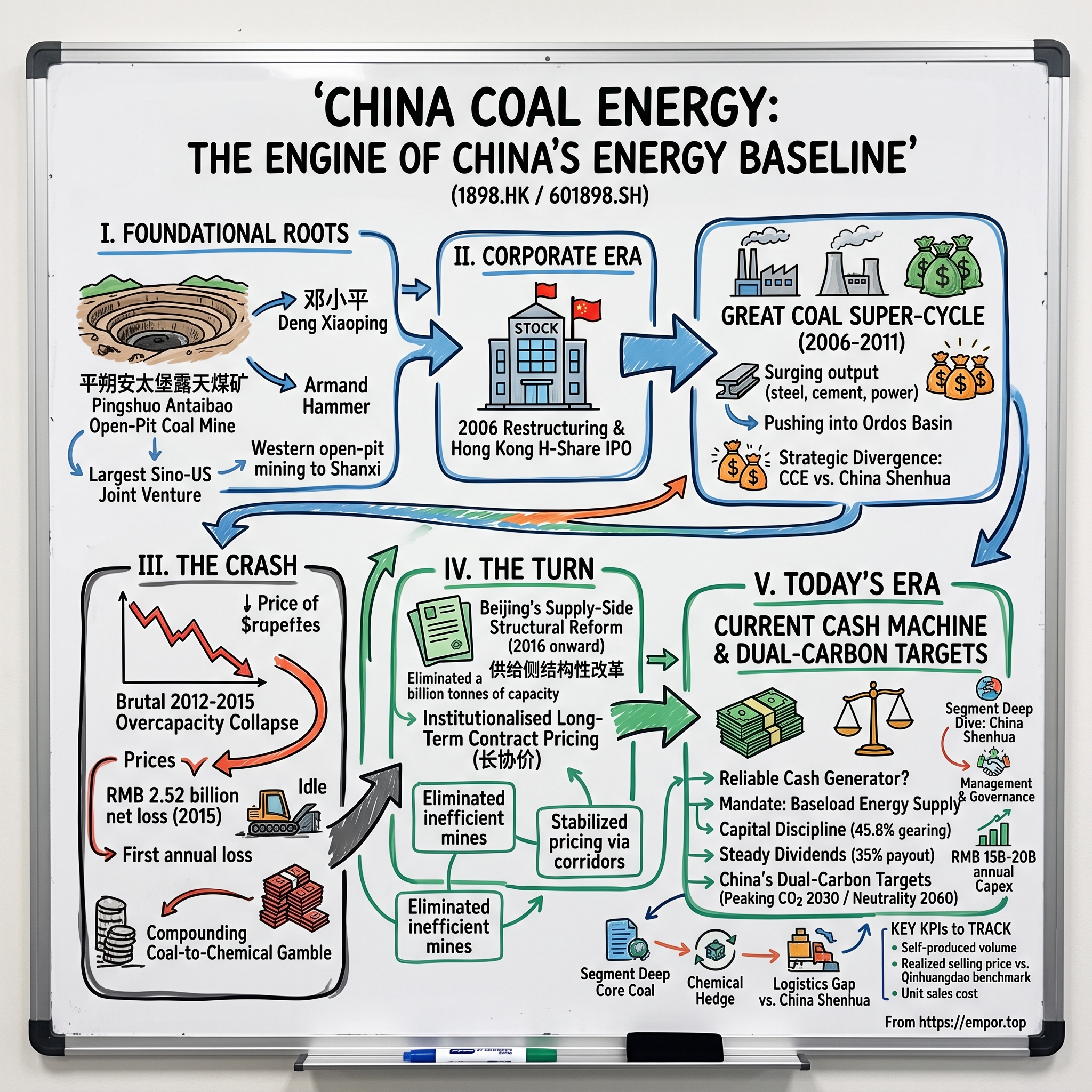
The arc of this story runs through five distinct eras.
It begins in the 1980s, when 邓小平 Deng Xiaoping and American oilman Armand Hammer established the largest Sino-foreign joint venture of its era — the 平朔安太堡露天煤矿 Pingshuo Antaibao Open-Pit Coal Mine — introducing Western open-pit mining to Shanxi Province. Next came the corporate era: the 2006 restructuring and Hong Kong H-share IPO, timed alongside China's urbanisation super-cycle. Then followed the crash — the brutal 2012–2015 overcapacity collapse that pushed the company into its first annual loss since listing, just as massive coal-to-chemicals investments came online into a depressed market. The narrative then turned with Beijing's 供给侧结构性改革 supply-side structural reform from 2016 onward, which eliminated a billion tonnes of capacity and institutionalised 长协价 long-term contract pricing. Finally, today's era is defined by capital discipline, steady dividends, and an ongoing tension between the company's mandate to supply baseload energy and China's 双碳 dual-carbon targets of peaking carbon emissions by 2030 and reaching carbon neutrality by 2060.
Two analytical threads run throughout this analysis. The first is a constant market benchmark: China Coal Energy versus 中国神华能源股份有限公司 China Shenhua Energy, the industry leader that owns integrated rail and port networks, allowing it to retain a higher margin on every tonne mined. The second is what constitutes an economic moat when that moat was constructed by state regulators — and how shareholder returns fare when the state decides those margins are too wide.
Evaluating this business requires looking beyond reported headline figures. China Coal Energy's top-line revenue is significantly expanded by a high-volume trading operation that buys and resells third-party coal at thin margins. Its listed operating segments also suggest greater economic diversification than exists in practice. The single most important variable in its financial model — the realized price per tonne — is set less by open-market dynamics than by annual state policy guidance. Investors who focus solely on headline revenue or segment counts risk misjudging the business; those who track self-produced tonnage, realized price per tonne, and unit production cost will see the true underlying engine.
The story begins with an open-pit mine in northern Shanxi and an eighty-five-year-old American entrepreneur who refused to back down.
 Subscribe on LinkedIn
II. Foundational Roots: Pingshuo, Armand Hammer, and the Birth of China Coal
Picture the loess plateau of northern Shanxi in the early 1980s: dun-coloured, wind-scoured, treeless, and dotted with hillside villages. Beneath it lay one of the earth's richest coal deposits — thick, shallow, low-sulphur seams ideal for surface stripping rather than deep tunnelling. China knew the resource was there, but lacked the machinery, mine-planning expertise, and capital required to extract it at scale.
Enter Armand Hammer. By the time he first flew to Beijing in 1979 at the invitation of 邓小平 Deng Xiaoping, Hammer was already a legendary figure: a physician turned trader who had negotiated with Vladimir Lenin's Soviet government in the 1920s, spent decades turning Occidental Petroleum into an energy giant, and maintained personal channels across Moscow, Washington, and Beijing.4 China's 改革开放 reform and opening-up policy was barely a year old. Deng needed foreign technology and capital to build a flagship project capable of proving the policy's viability.
Their joint venture became the largest Sino-U.S. commercial deal of its era: an estimated US$580 million project to mine an immense open pit at Antaibao, 310 miles west of Beijing. Occidental and its American partner, Omaha-based contractor Peter Kiewit Sons, contributed roughly US$340 million, primarily in heavy machinery and engineering expertise, while China provided approximately US$240 million. The 30-year agreement specified an eventual transfer to Chinese management. With proven reserves estimated at 1.4 billion tonnes, Antaibao opened in 1987 as one of the world's largest open-pit coal operations.5
The operational shift was immediate. American mine planners introduced draglines, 170-tonne haul trucks, and an engineering philosophy that treated coal extraction as a bulk-materials problem governed by horsepower and precise sequencing. At the time, Chinese coal mining was overwhelmingly underground, labour-intensive, and dangerous. Antaibao established a modern alternative: massive scale, low stripping ratios, mechanized continuous extraction, and structured multi-year mine planning.
The partnership proved short-lived. Following Hammer's death in December 1990, Occidental withdrew from the capital-intensive project, leaving Antaibao as a wholly Chinese-operated asset.6 For Occidental shareholders, the project had functioned largely as a diplomatic bridge. For China, it delivered a world-class open-pit mine and trained a generation of Chinese engineers inside a modern Western operational framework.
That human inheritance proved far more durable than the physical equipment. Pingshuo engineers advanced into leadership roles across the national group, embedding operational practices then rare in Chinese heavy industry: multi-year sequence planning over quarterly quota targets, continuous optimization of stripping ratios, and maintenance scheduled around equipment availability. Pingshuo expanded to include the Anjialing and East open pits alongside Antaibao. It remains a major production hub today, which explains why management's disclosure that output reductions at Pingshuo contributed to a 2026 thermal coal shortfall carries genuine analytical weight. A 40-year-old open pit inevitably moves past its most accessible upper seams.
These assets and technical teams formed the core of what was eventually consolidated into China National Coal Group, a central state-owned enterprise supervised directly by 国务院国有资产监督管理委员会 SASAC, the State-owned Assets Supervision and Administration Commission of the State Council.7 Over the next two decades, the group secured major production bases across Shanxi, Inner Mongolia, Shaanxi, and Xinjiang — the four provinces holding the vast majority of China's economically extractable coal reserves.
This consolidation history explains the company's structure today. When SASAC was established in 2003, it was tasked with transforming the fragmented remnants of industrial ministries — including the Ministry of Coal Industry, dissolved in 1998 — into commercial state-owned enterprise groups. Coal assets were dispersed across multiple provinces, combining modern mines with obsolete facilities under mixed provincial and central oversight. Rather than building a fully integrated system, the central government assembled a portfolio: a geographically spread set of mining rights, an equipment manufacturing division, engineering design institutes, and coal-chemical initiatives, but without the unified transport infrastructure that competitor China Shenhua possessed. Most of China Coal's structural strengths and constraints stem directly from this setup.
The operational advantages of open-pit mining remain visible in the company's cost structure. Surface mining requires heavy upfront capital investment in stripping and equipment, creating high operating leverage as costs are spread across massive volumes. It is also significantly safer and less labour-intensive than underground mining. By year-end 2025, the company reported raw coal labour productivity of 35 tonnes per worker-shift — a figure it cited as industry-leading — and noted that 18 mines and 96 longwall faces had achieved China's "intelligent mine" certification.8
For investors, this heritage requires careful evaluation. China Coal's competitive position rests on its state-assigned asset base: mining rights covering 26.52 billion tonnes of resources, 13.82 billion tonnes of recoverable reserves, and an approved annual mining capacity of 291 million tonnes — an endowment assembled over four decades under government direction that cannot be replicated.9 The central investment question is whether management can convert this public resource base into sustainable cash returns for minority shareholders rather than purely volume output for the state.
The initial test of that balance arrived when the state prepared to list a portion of the enterprise on public capital markets.
III. Restructuring, H-Share IPO, and the Great Coal Super-Cycle (2006–2011)
By 2006, listing China's state-owned industrial champions offshore had become standard policy. The template was well established: carve the profitable operating assets out of a sprawling ministry-descended conglomerate into a joint-stock company, leave social functions and legacy liabilities with the unlisted parent, and sell a minority stake to international investors in Hong Kong. The listed vehicle gained cleaner economics and access to global capital, while the parent secured cash, a public market valuation, and international investor oversight.
China Coal Energy followed this exact playbook. It listed H shares in Hong Kong in December 2006, raising roughly US$1.9 billion in one of the year's largest Asian resource offerings.10 An A-share listing on the Shanghai Stock Exchange followed in early 2008 under the code 601898.SH, completing the dual-listed structure it retains today.11
The timing proved optimal for the issuer. In 2006, China was in the steepest phase of its industrial expansion. Steel production grew at double-digit annual rates, alongside surging output in cement, aluminium, glass, and chemicals—all powered by coal. Thermal power generation supplied roughly 80 percent of Chinese electricity and expanded at an unprecedented pace. With demand outstripping supply, coal prices surged and industry margins expanded.
To capitalize on demand, China Coal pushed aggressively into the Ordos Basin across Inner Mongolia and Shaanxi. Geologically, these fields feature thick, shallow, flat seams under sparsely populated land, allowing low-cost extraction. A modern Ordos site can match the output of a traditional Shanxi operation with a fraction of the workforce. Shifting production toward the lowest point on the national cost curve was strategically sound, though it introduced a structural constraint: Ordos coal sits roughly 1,000 kilometres from coastal demand centers, making profitability heavily dependent on long-distance rail transport.
How management allocated the resulting cash flow proved far more controversial. Rather than focusing strictly on low-cost mining expansion or capital returns, China Coal launched an aggressive, debt-financed expansion into coal-to-chemicals. The strategy involved gasifying its own coal to produce methanol, then converting that methanol into ethylene and propylene to produce polyethylene and polypropylene plastics.
The strategic logic appeared compelling at the time. Most global olefins are derived from petroleum or natural gas, resources in short supply in China. By using abundant domestic coal as a feedstock, coal-to-olefins promised import substitution, vertical margin capture, and alignment with national energy-security goals. When crude oil prices were high, the profit spreads looked lucrative.
However, the capital intensity was immense. A world-scale coal-to-olefins complex requires gasification islands, air-separation units, synthesis loops, and polymer processing facilities built in arid western regions. Capital expenditures per tonne of output far exceed those of traditional oil-fed steam crackers, and construction timelines span many years. Investing heavily in coal-to-olefins amounted to a highly leveraged, long-term wager on elevated crude oil prices and wide chemical spreads.
China Coal committed to this strategy at the peak of the commodity cycle, funding massive projects with debt. While framed as visionary vertical integration during the boom, the heavy capital load created severe vulnerability when market conditions turned.
This capital allocation highlighted a key strategic divergence with market leader China Shenhua Energy. While China Coal invested in chemical manufacturing, Shenhua directed its windfall into heavy-haul railways, coastal ports, and power plants—integrating forward into logistics and power generation. Both companies sought to escape commodity price volatility. Shenhua chose to control transport infrastructure to the customer, securing steady, regulated-style returns. China Coal chose chemical processing, remaining exposed to volatile oil-to-coal price spreads. Securing major rail corridors required state route allocations that were less accessible to a second-tier state enterprise, making Shenhua's path difficult to replicate.
The cycle established a defining pattern in China Coal's capital management: treating peak cash flows as a mandate for large-scale industrial buildouts rather than balance-sheet preservation or capital returns. While administrative reforms later constrained this tendency, capital discipline remains a central focus for investors evaluating the company during periods of high cash generation.
By 2012, the super-cycle peaked, and coal prices collapsed.
IV. The Great Coal Crash & The Coal-Chemical Gamble (2012–2015)
The benchmark that defined the crisis was Qinhuangdao spot pricing—the benchmark for 5,500-kilocalorie thermal coal loaded at China’s primary coal port, against which the entire domestic market was quoted. At the peak of the boom, it traded above RMB 800 per tonne. By late 2015, it had collapsed below RMB 400. For a producer whose cash cost ranged between RMB 250 and RMB 350 per tonne depending on the mine, that drop eliminated operating margins across much of the asset base.
Multiple pressures converged simultaneously. Chinese industrial growth decelerated as post-2009 economic stimulus faded, while real estate activity cooled. Concurrently, the delayed supply response to a decade of elevated prices materialized. Thousands of small mines across Shanxi, Inner Mongolia, Guizhou, and Shaanxi—many poorly regulated—came online into a weakening market. Because coal is an unbranded bulk commodity with no switching costs and complete substitutability, excess supply drove market prices down toward the marginal producer's cash cost, as operators resisted shutting down cash-generating assets.
The resulting industry downturn was severe: of fifteen listed Chinese coal companies, ten reported or pre-announced losses for 2015, representing two-thirds of the sector.12 China Coal Energy was among the hardest hit. Revenue in 2015 fell 16.1 percent to RMB 59.27 billion, yielding a net loss attributable to shareholders of RMB 2.52 billion—its first annual loss since listing.13 Management attributed the loss to a severe supply-demand imbalance across the domestic market.
Compounding the core coal downturn, major coal-chemical projects approved during the boom—including the 中煤陕西榆林能源化工 China Coal Shaanxi Yulin Energy Chemical complex and the 中煤蒙大新能源化工 China Coal Mengda New Energy Chemical project in Inner Mongolia—began commercial operations just as global crude oil prices plummeted from over US$100 per barrel in mid-2014 to under US$30 by early 2016. The economic logic of coal-to-olefins depends on maintaining a cost advantage over oil-based feedstocks per unit of carbon. As oil prices collapsed, that price spread compressed sharply. Rather than providing a counter-cyclical hedge, the new plants introduced immediate depreciation charges, interest expenses, and squeezed operating margins.
Evaluating this strategy requires distinguishing standalone capital allocation from portfolio design. Measured strictly as a standalone investment over the decade following approval, the coal-chemical build destroyed shareholder value, requiring heavy capital outlays at peak construction costs and generating high depreciation during an industry trough. Viewed as an integrated portfolio, however, the facilities absorb self-produced coal, capturing low-cost feedstock during coal downturns and widening product spreads when oil prices rise. This created a functional, if capital-intensive, natural hedge. In practice, China Coal acquired a strategic option at high cost, incurring leverage and construction risks that weighed on return on invested capital for nearly a decade before yielding steady benefits.
The company navigated the downturn primarily through its status as a central state-owned enterprise. While private and provincial miners faced credit contractions, China Coal maintained access to state bank lending facilities. It deferred non-essential capital expenditure, extended project construction timelines, and relied on parent-level balance-sheet support, whereas higher-cost private operators across Shanxi and Inner Mongolia were forced into bankruptcy or restructuring.
The extent of industry distress prompted direct intervention by the central government. By 2015, widespread operating losses, wage arrears across mining regions, and escalating industrial debt posed broader risks to the domestic banking system. In response, policymakers introduced debt-for-equity swap frameworks during 2015 and 2016, converting bank liabilities at coal enterprise parents into equity stakes held by state asset management corporations. This mechanism alleviated balance-sheet pressure at the group level and stabilized listed entities, reinforcing a structural principle of Chinese economic policy: coal production functions as core financial and energy infrastructure, backed by state intervention during systemic crises.
Consequently, China Coal Energy’s survival through this major industry contraction reflected its state ownership structure as much as its underlying operational efficiency. The implicit sovereign backstop that protects the enterprise during severe market downturns represents the same institutional framework that caps upside realization during commodity booms and directs corporate capital toward national policy priorities.
The crisis also underscored the accounting mechanics of reported production costs. A coal producer’s unit cost per tonne reflects a combination of direct cash extraction costs, depreciation schedules, resource taxes, environmental restoration liabilities, safety levies, and the drawdown or accrual of specialized safety production reserves. Throughout the 2012–2015 collapse, sector participants utilized asset impairments, parent-level asset transfers, and reserve adjustments to navigate reporting periods. As a result, changes in unit cost metrics do not strictly reflect operational efficiency shifts, requiring detailed examination of underlying line-item adjustments—a nuance that remains relevant when evaluating disclosures in 2025.
Within a year of reaching that market trough, state policymakers initiated structural reforms that fundamentally altered industry economics.
V. Supply-Side Reform & The Long-Term Contract Revolution (2016–2020)
In February 2016, the State Council issued a directive that ultimately proved more consequential to China Coal Energy's financial trajectory than any operational decision made inside the company. The policy framework, known as 供给侧结构性改革 supply-side structural reform, set out to eliminate hundreds of millions of tonnes of inefficient, unsafe, and unlicensed coal capacity over three to five years. The final reduction eventually exceeded one billion tonnes.
In standard commodity cycles, excess capacity exits slowly and painfully. Because individual producers aim to maintain operations as long as revenue covers cash costs, oversupply often persists for years. China bypassed this market dynamic by enforcing capacity closures through administrative order, establishing strict timelines and holding provincial governors personally accountable for compliance. The result was a state-directed industry restructuring executed at national scale.
The economic fallout was structured and intentional. The closures concentrated almost entirely among small and mid-sized private producers, leaving central state-owned enterprises largely untouched. Market share shifted rapidly from fragmented regional operators to leading state entities, including 中国神华 China Shenhua, China Coal Energy, and 陕西煤业股份有限公司 Shaanxi Coal Industry. Consolidation that typically requires a decade of market attrition occurred within three years, granting major state producers expanded market control without acquisition costs.
Implementation, however, proved blunt. The most aggressive mechanism was the 276-workday rule introduced in 2016, which restricted mines from operating beyond 276 days per year, effectively cutting national production capacity by roughly one-sixth. Coal prices doubled within months, placing power generators under severe financial strain and prompting regulators to relax the restriction for compliant large miners by late 2016. The intervention demonstrated the state's capacity to alter market balances rapidly, while illustrating the policy volatility inherent in Chinese energy markets.
A second administrative intervention reshaped the company's long-term business model.
Historically, Chinese power generators suffered severe margin compression during coal booms due to capped electricity tariffs, while coal miners faced severe distress during industry downturns. To stabilize both sectors, the 国家发展和改革委员会 NDRC institutionalized annual long-term supply contracts starting in 2017. These contracts utilized a 基准价+浮动价 benchmark-plus-floating pricing formula, combining a fixed baseline for 5,500-kilocalorie thermal coal at northern ports with a floating component linked to published market indices.
Under this framework, a producer selling a commodity with spot prices swinging between RMB 400 and RMB 1,500 per tonne delivers the vast majority of its output within a narrowed band of roughly RMB 650 to RMB 750 per tonne. That structure trades away peak-cycle windfalls in exchange for a floor beneath market downturns, converting a volatile commodity revenue stream into something far closer to a regulated utility tariff.
China Coal Energy accepted this trade as part of its mandate as a central state enterprise responsible for national energy security. The contract framework has been refined continuously. For 2026, regulators renamed the mechanism 电煤保供中长期合同—coal-for-power supply-guarantee medium- and long-term contracts—making its supply-security function explicit, while maintaining the benchmark price for 5,500-kilocalorie thermal coal at RMB 675 per tonne.14 Major producers must commit at least 75 percent of their approved capacity to these contracts annually, maintaining delivery compliance of at least 80 percent monthly and 90 percent on a quarterly and annual basis.15 The 2026 rules also introduced a monthly pithead price-adjustment mechanism across Shanxi, Shaanxi, and Inner Mongolia based on four regional mine-mouth indices, introducing modest responsiveness to local market conditions after years of rigid price controls.16
Alongside these regulatory changes, China Coal Energy streamlined its operations. Management retired high-cost underground seams and concentrated production into large, modern, low-cost assets, including the Dahaize mine in Shaanxi, the Muduchaideng and Naerta mines in Inner Mongolia, and the Xiaohuigou mine in Shanxi. Free cash flow was directed primarily toward balance-sheet repair rather than speculative capital expenditure. By late 2025, the company's gearing ratio had edged down to 45.8 percent from 46.3 percent a year earlier, while annual finance costs fell 16.15 percent to RMB 2.00 billion as debt levels declined and interest rates eased.17
China Coal Energy's evolution from a loss-making cyclical producer into a cash-generative quasi-utility was driven primarily by national policy rather than internal innovation. Operational execution remained disciplined, but the durability of the company's earnings rests on a state-constructed regulatory architecture—one that can be modified whenever broader policy priorities shift.
The stability of that system faced its first major test in the autumn of 2021, when widespread power shortages brought the tension between price controls and supply security into sharp focus.
VI. Energy Crisis, Benchmark Price Caps, and Current Cash Machine (2021–Present)
In September and October 2021, more than 20 Chinese provinces rationed electricity. Factories in Guangdong operated on three-day workweeks, traffic lights failed in parts of the northeast, and households in Liaoning and Jilin endured rolling blackouts. The crisis stemmed from a rapid post-pandemic industrial recovery, strict local enforcement of energy-intensity targets, and surging coal prices that far outpaced regulated power tariffs, making power generation financially unfeasible for utility operators.
As thermal coal spot prices reached unprecedented highs, Beijing intervened decisively. Regulators ordered producers to maximize output and compressed expansion approval timelines from years to weeks. Simultaneously, the National Development and Reform Commission capped prices by expanding long-term contract coverage and establishing explicit price bands, treating transactions outside those bounds as regulatory violations.
For China Coal Energy, the mandate was unequivocal: 保供—guarantee supply. The company operated its mines at full capacity to fulfill long-term contracts and maintain stability for the power grid and municipal heating networks, acting as a public utility under direct policy instruction rather than a profit-maximizing commodity producer.
This episode served as a real-world stress test for investors. It demonstrated that during supply crises, the state will compel maximum output regardless of mine-level economics, enforce price caps to prevent windfall profits, and rapidly approve new production capacity after years of restriction. While economically logical from a systemic standpoint, these interventions shift economic value from equity holders to power consumers—a policy risk that remains a core consideration for valuation models.
This dynamic defines the contemporary investment thesis. The administrative price corridor caps upside potential: during the 2021–2022 commodity surge, China Coal Energy captured steady, bounded profits rather than unrestricted windfalls. Conversely, when spot prices softened across 2024 and 2025, the long-term contract framework protected realizations by keeping most sales anchored to benchmark rates.
The 2025 financial results illustrated this downside protection. Revenue stood at RMB 148.06 billion, while net profit attributable to shareholders reached RMB 17.88 billion—a modest 7.3 percent year-on-year decline—yielding a total profit of RMB 26.59 billion and a weighted average return on equity of 11.43 percent.18 Although the average selling price of self-produced commercial coal dropped by RMB 77 per tonne, net earnings fell by only single digits. Management offset price pressure by reducing unit sales costs by RMB 30.22 per tonne to RMB 251.51—a 10.7 percent reduction driven by operational efficiencies alongside temporary drawdowns from accumulated safety-production reserves.19 Self-produced commercial coal output reached 135.1 million tonnes, down 1.8 percent, with total self-produced sales of 136.4 million tonnes.20
A single-digit drop in net profit during a period when realized coal prices fell RMB 77 per tonne demonstrates that earnings volatility has decreased substantially compared to the pre-2016 era.
Market developments in mid-2026 highlighted the trade-offs inherent in the pricing framework. Spot coal prices rallied firmly in the first half of the year. During its May 2026 investor briefing, the company reported that benchmark Qinhuangdao 5,500-kcal thermal coal closed the month at RMB 854 per tonne—up RMB 41 for the month and RMB 165 year-to-date, with lower grades tracking similar gains. Management projected June prices to trade between RMB 850 and RMB 900 per tonne, noting recent stabilization around RMB 863.21 With spot prices hovering near RMB 860 per tonne against a long-term contract benchmark of RMB 675, uncontracted volumes captured substantial premiums that insulated contracted output could not match.
Concurrently, operational disruptions constrained volume. Management disclosed that raw coal output during the first five months of 2026 declined year on year due to complex geological faulting, changing underground ground conditions, and mandatory safety inspections following industry-wide incidents, though May production recovered sequentially and monthly volumes were projected to improve.22 First-quarter financial results reflected these headwinds: revenue fell 10.95 percent to RMB 34.19 billion, and net profit attributable to shareholders decreased 3.19 percent to RMB 3.84 billion.23 Self-produced coal revenue declined 8.4 percent despite a RMB 4 per tonne increase in realized prices, confirming a volume-driven contraction. Unit sales costs rose RMB 8.94 per tonne, or 3.3 percent, as reduced tonnage spread fixed depreciation and amortization over fewer units while safety-reserve drawdowns reversed.24
Addressing the production shortfall during a June investor call, management stated that the company was working to recover lost tonnage within safety parameters and maintained its full-year self-produced coal target of 131 million tonnes.25 Subsequent monthly operational updates will provide a direct test of that commitment.
Capital allocation remains cautious relative to industry peers. For 2025, China Coal Energy distributed an interim dividend of RMB 0.166 per share totaling RMB 2.20 billion, alongside a final dividend of RMB 0.217 per share, bringing its full-year payout ratio to approximately 35 percent.26 Shareholders approved the final distribution on June 26, 2026, with payment scheduled for August 28.27 When asked whether distribution rates might expand, management signaled that payouts would be calibrated annually to reflect capital requirements and operating conditions, maintaining a broadly stable ratio.28
This modest payout policy forms a central argument for skeptical investors, particularly when contrasted with industry benchmarks. China Shenhua Energy committed to distributing at least 65 percent of annual net profit from 2025 through 2027, proposing a final 2025 dividend of RMB 1.03 per share totaling RMB 22.34 billion.29 China Coal Energy’s payout ratio represents roughly half that commitment, reflecting ongoing capital expenditure demands across its project portfolio, whereas Shenhua's primary infrastructure footprint is fully built out.
Myth versus reality
Three prevailing market assumptions regarding the company warrant examination against empirical data.
Myth: "China is rapidly phasing out coal, making thermal miners declining assets." While China leads global renewable energy installations and coal's proportional share of electricity generation continues to decline, overall consumption volumes remain resilient. National raw coal output during the first half of 2026 reached 2.37 billion tonnes, edging down 1.7 percent year on year—a minor adjustment relative to a production base that has doubled since 2005. The concurrent rise in domestic spot prices indicates steady underlying demand. Chinese coal demand is undergoing a plateau rather than a rapid collapse, driven by the electric grid's structural requirement for dispatchable baseload power.
Myth: "Long-term supply contracts guarantee corporate profitability." Regulated pricing mechanisms establish revenue floors for contracted volumes, but they do not secure net profitability. Profitability remains dependent on production volumes and unit extraction costs—the exact operational levers that pressured first-quarter 2026 earnings. Price guarantees offer limited value when physical output declines, particularly as fixed overhead costs inflate per-tonne operational expenses across reduced production volumes.
Myth: "State-owned enterprise disclosures lack operational transparency." China Coal Energy maintains a disclosure frequency that compares favorably with international mining majors, releasing monthly production figures, hosting monthly investor briefings, and publishing meeting transcripts. Operational data is accessible; the primary opacity resides in capital governance, including project approval criteria, parent-group transfer pricing, and multi-year dividend policy targets. Investors receive detailed operational metrics, but limited visibility into strategic governance decisions.
VII. Segment Deep Dive: Core Coal vs. Downstream Chemicals & Equipment
Beneath China Coal Energy’s corporate structure sit four primary operating segments built atop a single resource base. Because these divisions exhibit vastly different economic characteristics, evaluating the consolidated enterprise requires analyzing each segment's distinct operational drivers.
The coal engine
Coal operations generate roughly four-fifths of total revenue and the overwhelming majority of operating profit. Within this division, two separate activities—self-produced coal extraction and third-party trading—are reported together, though they operate on entirely different business models.
Self-produced commercial coal represents the core driver of corporate profitability, running at 135 million to 136 million tonnes annually. The product mix consists primarily of thermal coal supplied to power generators and heating utilities, alongside a smaller volume of higher-value coking coal for steel producers. Metallurgical coking coal follows distinct market dynamics: it is priced according to steel mill demand rather than power generation requirements, carries no long-term contract price protections, and experiences sharper margin fluctuations.
China Coal's coking coal operations are concentrated within its 华晋 Huajin assets in Shanxi Province. Management attributed the production shortfall in early 2026 primarily to the Wangjialing mine operating on a single longwall face—a temporary operational constraint rather than a structural market shift. Consequently, coking coal introduces earnings variability that state regulatory mechanisms have largely smoothed out of the thermal coal portfolio, making this segment a key beneficiary of any eventual recovery in Chinese industrial construction.
The second component of the coal division is third-party trading. Total coal sales reached 255.8 million tonnes in 2025 against self-produced sales of 136.4 million tonnes, indicating that nearly 120 million tonnes of resold third-party volume moved through the company's trading channels. While trading expands top-line revenue, it contributes minimally to net income due to narrow distribution margins on unbranded commodities. Trading serves operational functions—deepening customer relationships, fulfilling supply contracts during mine maintenance, and providing market intelligence—but tracking resold volume alongside self-produced tonnage risks misinterpreting underlying cash generation.
On cost performance, the unit sales cost for self-produced commercial coal stood at RMB 251.51 per tonne in 2025.30 This metric places the company in the lower half of the domestic cost curve, though above low-cost peers. Reported unit sales costs incorporate direct cash extraction expenses, depreciation, resource taxes, environmental restoration provisions, and safety levies. The key determinant of profitability remains the spread between unit costs and realized selling prices, which management cautioned would face margin pressure in 2026 as production volumes moderate.
A persistent structural constraint facing the segment is transport logistics. Competitor China Shenhua operates a fully integrated rail-port-power network, controlling dedicated railway lines and coastal berths at Huanghua and Tianjin. This infrastructure allows Shenhua to capture freight margins internally when shipping coal from the Ordos Basin to southern coastal demand centers. By contrast, China Coal relies predominantly on the public rail network managed by 国家铁路集团 China State Railway Group, paying third-party freight tariffs.
This logistical gap is reflected in comparative financial performance. In 2025, China Shenhua generated RMB 52.85 billion in net profit on revenue of RMB 294.9 billion from 332.1 million tonnes of commercial coal output.31 China Coal produced 135.1 million tonnes—roughly 41 percent of Shenhua's output—and recorded RMB 17.88 billion in net profit, or 34 percent of Shenhua's earnings. Shenhua's proprietary transport and power assets account for much of that earnings premium. Because vertical integration into transport retains substantial value across long haul distances, China Coal's lack of dedicated freight infrastructure remains a fundamental reason its valuation trades at a persistent discount to the sector leader.
The chemical hedge
Coal-chemical manufacturing generates approximately 10 percent of revenue and a comparable share of operating profit, serving a strategic hedging function within the broader business model.
The manufacturing process converts coal into raw synthesis gas, which is purified and processed into synthetic ammonia—subsequently converted into urea fertilizer or ammonium nitrate—or into methanol. Methanol is then routed through methanol-to-olefins reactors to produce ethylene and propylene, which are polymerized into polyethylene and polypropylene plastics.32
This arrangement provides a structural hedge: input costs are anchored to domestic coal, while end-product pricing tracks international crude oil benchmarks. In 2025, the company produced 6.06 million tonnes of major coal-chemical products (up 371,000 tonnes year on year) and sold 6.36 million tonnes (up 514,000 tonnes).33 Market conditions in mid-2026 illustrated this dynamic: with elevated global crude oil prices, management reported in May 2026 that polyolefin selling prices approached RMB 9,000 per tonne (a year-on-year increase of roughly RMB 1,600), while urea prices held above RMB 1,800 per tonne under national supply-guarantee guidelines.34 Enhanced chemical segment profitability in the second quarter of 2026 helped offset volume weakness in coal operations.
However, two operational caveats apply. First, the hedge depends on a favorable oil-to-coal price spread; during periods of depressed oil prices and elevated coal costs—such as 2014–2015—both legs of the business experience margin compression. Second, the division requires ongoing capital commitment. Civil construction for the Shaanxi Yulin Phase II expansion, designed to add 900,000 tonnes of annual polyolefin capacity, was substantially completed during 2025. The broader Yulin deep-processing facility—budgeted at RMB 23.9 billion to produce 2.2 million tonnes of annual methanol capacity and 900,000 tonnes of polyolefins—is targeted for commissioning in December 2026, alongside the Tuke "liquid sunshine" green methanol demonstration project scheduled for November 2026.35 Assessing whether this capital expenditure cycle yields returns above the cost of capital will require evaluating operational performance across a full commodity cycle.
Equipment and the rest
The coal mining equipment division, operating primarily through China Coal Equipment and specialized subsidiaries including 中煤北京煤矿机械 China Coal Beijing Coal Mining Machinery, accounts for a low single-digit percentage of overall revenue. In 2025, the segment recorded RMB 9.21 billion in industrial production value, secured RMB 11.3 billion in new orders, and booked RMB 1.05 billion in export orders.36 The division manufactures heavy longwall mining machinery, including hydraulic roof supports, armored face conveyors, and continuous haulage systems.
While modest in scale, the segment fulfills dual functions: supplying equipment for the group's internal mine automation and intelligent-mining initiatives, while selling machinery to third-party domestic coal miners. A new-order total exceeding annual production value indicates stable backlogs, while international orders provide exposure to overseas mining equipment markets.
Power generation and financial services complete the corporate portfolio. Power operations generated 18.0 billion kilowatt-hours in 2025, primarily through pithead power plants fueled by coal gangue and washing rejects—low-calorific waste materials with negative transport economics.37 By placing power generation directly adjacent to coal washing facilities, the company converts waste materials into electricity for transmission over the power grid, avoiding rail freight expenses.
In contrast, the group's finance company acts as an internal treasury with assets of approximately RMB 105 billion, managing intra-group lending, liquidity settlement, and capital pooling.38 Because central treasury operations concentrate cash resources across group entities, its governance practices warrant rigorous inspection by minority shareholders.
In sum, China Coal Energy functions fundamentally as a coal producer with an embedded chemical hedging option, while trading, equipment, power, and treasury operations represent secondary components relative to self-produced coal volume and realized pricing.
VIII. Management, Governance, & Capital Allocation
At the top of both the listed company and its parent stands Wang Shudong (王树东), born in October 1964 in Chifeng, Inner Mongolia, and a senior engineer holding a master's degree from North China Electric Power University (华北电力大学). He was elected chairman of the listed company's fifth board of directors on March 28, 2023, and subsequently assumed the roles of party secretary and chairman at China National Coal Group.39
Wang's background as a power-sector engineer rather than a traditional mining engineer reflects the company's strategic posture. Rather than focusing solely on extraction, management emphasizes integrating coal, power, heat, and chemicals into a single value chain to capture margins across multiple operational stages.
Serving simultaneously as chairman of both the listed subsidiary and its controlling parent is standard practice among Chinese central SOEs, creating a structural governance tension. The parent holds roughly 58 percent of total issued capital—comprising direct A shares alongside a small H-share stake held via a wholly owned Hong Kong subsidiary—under SASAC supervision.40 Public minority shareholders hold the remaining float. When state priorities—such as emergency supply mandates, price controls, or capital deployment directives—conflict with minority shareholder returns, policy directives consistently take precedence.
However, alignment between state and minority interests has improved under SASAC's evolving evaluation framework. Central SOE executives are now assessed on return on equity, operating cash flow, and market value management—metrics directly aligned with equity investor priorities. In response, the company has published annual action plans for quality improvement and return enhancement, committing to interim dividends and a minimum payout ratio of 30 percent alongside mid-year progress reports.41 These disclosures provide a verifiable baseline for tracking corporate execution.
The nature of this executive alignment differs fundamentally from Western corporate governance models. Senior management at central SOEs are appointed through state evaluation processes led by SASAC and the parent company's party committee, with executive careers advancing within the state administration rather than the commercial talent market. Executive compensation lacks equity-based incentives, such as stock options or performance shares tied to total shareholder return, relying instead on an administrative scorecard. Consequently, management prioritizes the specific metrics governed by this scorecard. Incorporating market value management into executive evaluations represents a meaningful alignment tool, though non-financial mandates—such as operational safety, energy supply security, and employment stability—continue to override capital returns during policy conflicts.
Since the 2016 reforms, capital allocation has followed a consistent hierarchy. Free cash flow has been prioritized toward mine safety, intelligent-mining upgrades, debt reduction, and selected project completions, with remaining funds allocated to shareholder dividends. This discipline has reduced corporate gearing and annual interest expenses while avoiding speculative acquisitions.
Capital discipline, however, remains partial as reinvestment spending accelerates. Construction in progress reached RMB 26.27 billion at year-end 2025—a 44.3 percent year-on-year increase.42 Planned capital expenditure for 2026 stands at RMB 21.3 billion across coal, coal-fired power, chemicals, and renewable energy, with coal projects receiving the largest share. Management guided that annual capital outlay will remain between RMB 15 billion and RMB 20 billion through the 15th Five-Year Plan period (2026–2030), driven by ongoing asset upgrades and major mine development.43 Commissioning for the 2.4-million-tonne annual capacity Weizigou mine and the 4-million-tonne Libi mine is targeted for late 2026, while preliminary development continues on a 20-million-tonne second phase at Dahaize.44
Reinvesting RMB 15 billion to RMB 20 billion annually against operating cash flow of roughly RMB 30 billion means the company reinvests half to two-thirds of its cash generation rather than harvesting its asset base. This ongoing reinvestment explains why China Coal Energy's dividend payout ratio hovers near 35 percent, compared to China Shenhua's 65 percent baseline floor. Critical observers argue that a mature resource producer facing a long-term demand plateau should prioritize capital returns over capacity expansion, particularly regarding unproven green chemical and renewable projects. Conversely, expanding low-cost capacity at tier-one assets like Dahaize secures long-term cost advantages at a time when new mining rights are virtually unobtainable.
Evaluating operating performance also requires examining the structural quality of reported cost reductions. Management reported a unit sales cost reduction of RMB 30.22 per tonne for 2025. However, during the June 2026 investor briefing, management attributed the cost reversals in early 2026 partly to the normalization of special safety reserve drawdowns. This adjustment indicates that a portion of the 2025 cost reduction reflected reserve accounting mechanics rather than permanent reductions in cash operating expenses, introducing accounting noise into reported unit margins.
Related-party transactions represent another structural risk factor. China Coal Energy sells coal to, purchases equipment from, and conducts financial services with entities controlled by its unlisted parent. The parent's finance company manages deposits and lending across group affiliates. Although these arrangements are disclosed, subject to annual spending caps, and reviewed by independent non-executive directors under Hong Kong Listing Rules, transfer pricing on internal coal sales and equipment procurement involves management discretion. Additionally, internal treasury operations concentrate financial exposure within affiliated entities whose standalone creditworthiness is not independently visible to public investors.
From an accounting and audit standpoint, disclosure standards remain stable. The listed company files under both Hong Kong and mainland reporting regimes, receives unqualified audit opinions, and maintains a clean history regarding financial restatements. Its parent holds a domestic credit rating backed by regular tracking reviews, with the listed entity's latest rating updated in May 2026. Key accounting judgments center on standard resource-sector variables: useful-life assumptions for mining assets, the adequacy of environmental restoration provisions under stricter regional ecological regulations in Inner Mongolia and Shaanxi, and carrying-value impairment tests for coal-chemical facilities that depend on long-term olefin price spreads.
Management credibility is supported by consistent operational disclosure. The company conducts monthly investor briefings—an unusually high disclosure frequency for global resource companies—and provides detailed explanations during operational downturns. For instance, management explicitly identified single-face operations at the Wangjialing mine and reduced output at Pingshuo as the specific drivers of the 2026 thermal coal shortfall, rather than citing broad market conditions.45 This level of transparency during operational challenges offers investors a reliable basis for assessing executive disclosures.
IX. The Playbook: Strategic & Investing Lessons
Step back from the company and five transferable lessons emerge — the kind that apply well beyond Chinese coal.
0. The prior lesson, which frames the rest: know who built the advantage. Most competitive-strategy analysis implicitly assumes that a company's edge was created by the company and can therefore be defended by it. That assumption is wrong here, and recognizing when it is wrong is itself a transferable skill. It applies to regulated utilities, licensed banks, spectrum holders, port concessionaires, and any business whose economics rest on a permission rather than a product. For all of them, the durability question is not "can a competitor replicate this?" but "will the grantor keep granting it, and on what terms?" Those are entirely different analytical exercises requiring different evidence.
1. A contract can be a moat, but only as long as someone enforces it. The single most valuable asset China Coal Energy owns is not a mine. It is a book of long-term supply contracts, priced on a formula, with mandated minimum volumes and enforced compliance rates. That contract book converts commodity risk into something closer to an infrastructure annuity. The critical qualification is that this moat was not built by the company and cannot be defended by it. It exists because the Chinese state decided that energy price stability was worth more than allocative efficiency. If that judgment changes — if a future NDRC decides producers are over-earning and lowers the benchmark, or decides the market should clear freely and removes the floor — the moat changes with it. Investors should think of the contract system as a policy asset with an indefinite but revocable term, not as a competitive advantage in the traditional Porterian sense.
2. Vertical integration into a differently priced product is a real hedge — and an expensive one. The coal-to-chemicals strategy works as insurance because the input and output are priced off different underlying commodities. The uncomfortable lesson is about cost. This insurance was purchased through eight-to-ten-year, multi-billion-renminbi greenfield construction programs financed with debt at the top of a cycle. The premium turned out to be roughly a decade of depressed returns on invested capital. A generalizable rule: when a hedge requires enormous illiquid capital investment with long lead times, the hedge's option value must be weighed against the risk that the world changes before the plant starts operating. It usually does.
3. Cornered resources become more valuable the moment the regulator stops issuing new ones. China's coal mining rights are, for practical purposes, closed to new entrants. Provincial and national authorities have spent a decade eliminating capacity rather than approving it, and any new large mine requires environmental, safety, water, and resource approvals that are effectively unavailable to non-state actors. The existing rights therefore have scarcity value that rises even as the commodity's long-term demand curve flattens. This is the classic profile of a terminal-value asset: a shrinking end market, but supply shrinking even faster. The investment question is which curve declines more steeply, and the answer varies by decade and by region.
4. State ownership is a two-sided coefficient, not a discount. The "SOE discount" is usually described as a governance penalty. That is only half right. State ownership genuinely does suppress the valuation multiple: capital gets directed toward national objectives, payout ratios are set with reference to the parent's needs, and minority interests rank second when they conflict with policy. But that same ownership provided the balance-sheet lifeline that carried the company through 2015 while private peers failed, and it delivered a supply-side restructuring that handed the survivors a consolidated market at no cost. The right way to model this is not as a fixed discount, but as a compression of the distribution of outcomes on both ends. What SASAC's market value management push is genuinely attempting is to raise the middle of that distribution without widening either tail — through payout discipline, ROE targets, and parent share purchases. Whether administrative encouragement can durably re-rate an equity remains one of the more compelling open questions in emerging-market investing, and it is not yet settled.
A fifth observation, about how to read state-directed businesses generally. The most useful discipline when analyzing a company like this is to separate three layers that ordinarily blur together: what the assets are worth, what the policy regime allows the company to earn on them, and what share of those earnings reaches minority shareholders. In a normal competitive market, these three questions collapse into one because ownership of the asset implies the right to its cash flows. Here, they genuinely come apart. The reserve base is world-class. The policy regime deliberately truncates the returns on it in both directions. And the distribution to minorities is a policy variable set annually against the parent's priorities. An investor who models only the first layer will overpay; one who models only the third will never buy anything. The work lies in holding all three at once.
The place to test all of these principles is in a structured competitive analysis.
X. Analytical Frameworks, Risk Radar, & Bull vs. Bear Case
Hamilton Helmer's 7 Powers
Scale Economies — strong, but shared. Fixed costs in modern coal mining are enormous, encompassing automation systems, washing facilities, safety infrastructure, environmental restoration obligations, and depreciation on multi-billion-renminbi mine developments. Spreading those expenses across 135 million tonnes of self-produced coal yields a clear unit-cost advantage over a 5-million-tonne regional operator. However, China Shenhua spreads its fixed costs across 332 million tonnes while operating captive rail and port logistics. Consequently, China Coal holds scale economies relative to smaller industry peers, but remains at a structural scale disadvantage compared to the market leader.
Cornered Resource — the strongest of the seven. With 13.82 billion tonnes of recoverable reserves and 291 million tonnes of annual approved capacity concentrated in Shanxi, Inner Mongolia, and Shaanxi, China Coal holds mining rights that cannot be replicated. State authorities no longer issue new large-scale coal mining permits, making this asset base the most defensible element of the business—a franchise that cannot be bought at any price.
Process Power — moderate and improving. By the end of 2025, 18 certified intelligent mines and 96 intelligent longwall faces demonstrated real operational capabilities, matched by a decade of running commercial-scale coal-to-olefins facilities.46 However, process power requires capabilities that competitors cannot easily copy. Because domestic peers are adopting identical automation roadmaps from the same mining equipment suppliers, these advances represent industry-wide efficiency gains rather than a proprietary competitive moat.
Counter-Positioning — absent, and structurally so. China Coal is the incumbent fossil-fuel producer. Solar, wind, energy storage, and nuclear generation are the challengers, supported by falling cost curves. A legacy coal producer cannot counter-position against renewable entrants; the structural pressure flows entirely in the opposite direction.
Switching Costs, Branding, Network Economies — essentially nil. Coal is sold on technical specification and energy content rather than brand identity, allowing buyers to switch based on price and calorific value. What appears to be customer stickiness reflects mandatory long-term supply contracts rather than commercial switching costs or network effects.
Porter's Five Forces
Threat of new entrants: near zero. High capital requirements create a barrier, but administrative permitting forms an absolute wall. The 国家能源局 National Energy Administration and provincial authorities tightly control mine approvals, pursuing a decade-long policy of industry consolidation. This represents the most protected force in the company's operating environment.
Bargaining power of buyers: low, by regulation rather than by nature. Power generators purchase undifferentiated thermal coal in large volumes and would hold substantial leverage in an open market. However, the state-mandated contract pricing framework neutralizes buyer power while simultaneously capping producer margins. Regulators set the pricing corridors rather than buyers or sellers. Conversely, coking coal buyers—primarily steelmakers—operate outside this framework, negotiating aggressively in a structurally oversupplied steel market.
Bargaining power of suppliers: low. The company controls its primary inputs through owned coal reserves, an internal mining equipment manufacturing arm, and a central treasury operation. Labor relations operate through non-adversarial, state-aligned unions. The main supplier vulnerability sits in rail transportation, where China State Railway Group acts as a monopoly freight provider—a significant and persistent cost constraint.
Threat of substitutes: the defining long-term force. China's renewable energy deployment has driven the marginal cost of solar power below the fuel cost of coal-fired generation. Yet physical grid realities provide a counterweight: intermittent renewable output and expensive grid-scale storage leave power networks reliant on coal plants for dispatchable baseload power, grid inertia, and municipal winter heating. In the first half of 2026, national raw coal output fell 1.7 percent year on year to 2.37 billion tonnes—a modest decline that coincided with rising domestic spot prices, indicating that demand remained resilient relative to supply.47 The long-term direction favors substitution, but the pace remains gradual.
Competitive rivalry: moderate and orderly. Major state-owned producers—China Shenhua, China Coal Energy, and Shaanxi Coal Industry—do not engage in price competition. Supply volumes are allocated predominantly through long-term contracts, preserving stable market shares within a regulated oligopoly. The primary competitive dynamic pits coal against alternative energy sources rather than competing coal miners against one another.
The three-way peer comparison
Evaluating China Coal Energy requires looking beyond its status as the nation's second-largest coal producer, which overstates its position in some areas while understating it in others.
Against China Shenhua, China Coal is smaller across operational metrics and lacks dedicated logistics infrastructure. Shenhua's integrated coal-rail-port-power network captures margins across four connected segments while providing an internal hedge: when coal prices rise, mining profits expand while power margins contract, and vice versa. This operational structure and lower capital expenditure burden enable Shenhua to guarantee a minimum dividend payout ratio above 65 percent. China Coal functions as a less vertically integrated equivalent, justifying a persistent valuation discount.
Against Shaanxi Coal Industry, the dynamic shifts. As a provincial SOE, Shaanxi Coal concentrates its extraction in northern Shaanxi's shallow, high-calorific Jurassic coal seams, yielding some of the lowest unit mining costs in China. While Shaanxi Coal delivers superior mine-level margins, China Coal offers geographic diversification across four major producing provinces, an integrated coal-chemical division, an equipment manufacturing business, and the regulatory backing of a central SOE—an advantage when securing permits and accessing credit during market downturns. Shaanxi Coal serves as a higher-beta play on coal prices, whereas China Coal operates as a more diversified, policy-anchored enterprise.
Ultimately, China Coal is neither the sector's lowest-cost miner nor its most integrated operator. Its investment thesis depends on scale, reserve longevity, state policy protections, and relative valuation rather than operational outperformance.
Risk radar
Regulatory price intervention. Pricing mechanisms limit both downside risk and upside potential. If regulators lower benchmark rates, expand contract obligations, or enforce narrower price bands during an economic slowdown, operating margins would compress with no administrative recourse available to management. This represents the most immediate regulatory risk.
Volume and geology. Geological faulting, changing underground conditions, and mandatory safety inspections reduced output in early 2026. Because a significant portion of mining expenses represents fixed overhead, production shortfalls inflate unit extraction costs and compress operating margins simultaneously.48 Output remains subject to physical geology rather than administrative targets alone.
Decarbonisation and displacement. Under China's 双碳 dual-carbon targets, coal's share of the national energy mix will decline over time. However, overall electricity demand growth can keep absolute coal consumption flat even as its market share shrinks. Furthermore, demand reductions will impact high-cost regional mines first, insulating efficient pithead operations.
Water and environment in chemicals. Coal-to-olefins manufacturing consumes substantial water in arid western provinces. Stricter water quotas, rising environmental compliance costs, or potential carbon pricing on coal gasification would directly squeeze chemical segment margins.
Safety. Major mining accidents cause human tragedy and direct financial losses while triggering mandatory operational suspensions and region-wide safety audits. Management cited industry-wide safety inspections as a key factor in its 2026 production shortfall, illustrating how safety incidents at peer mines create broader operational disruptions.
Import competition. Seaborne coal imports fluctuate based on the spread between domestic and international prices. When international prices fall, imported coal enters coastal markets, displacing inland domestic supply. In June 2026, thermal coal imports increased 27.9 percent year on year, while coking coal imports rose 33.8 percent.48 State policy manages import volumes through tariffs, customs timing, and quota guidelines. A flexible import policy increases competitive pressure on inland producers that pay high rail freight rates to reach coastal utilities.
Capital allocation drift. The primary capital allocation risk involves the steady deployment of cash flow into policy-aligned industrial projects that yield below-market returns on invested capital.
Bull vs. bear
The bull case rests on four pillars: 1. Long-term contracts provide a reliable revenue floor, demonstrated in 2025 when a RMB 77 per tonne drop in realized coal prices resulted in only a single-digit decline in net profit. 2. The company's unreplicable reserve position remains protected by strict state permitting limits. 3. The coal-chemical division provides a functional hedge, capturing elevated polyolefin prices driven by global crude oil markets while utilizing low-cost domestic coal feedstock. 4. Corporate governance alignment has improved, evidenced by parent-level share purchases, SASAC's market value management mandates, and an established payout floor of at least 30 percent supported by interim dividends. If second-half production recovers alongside firm spot prices, 2026 earnings should reflect realized price gains.
The bear case highlights structural constraints: 1. The logistics deficit compared to China Shenhua permanently reduces margin capture by billions of renminbi annually. 2. Annual capital expenditures of RMB 15 billion to RMB 20 billion—against roughly RMB 30 billion in operating cash flow—cap the dividend payout ratio at roughly half of Shenhua's level, while funding green chemical projects with unproven commercial track records. 3. Global ESG mandates restrict institutional capital allocations to thermal coal producers, limiting valuation multiple expansion regardless of underlying cash generation. 4. Fixed-cost leverage creates upward unit-cost pressure during production volume shortfalls. 5. Long-term energy policy mandates a gradual reduction in coal consumption, casting uncertainty over terminal asset valuations.
Where the two cases actually collide is on duration rather than near-term cash generation. China Coal Energy is positioned to generate substantial cash flow over the near term. The core debate centers on long-term terminal value in the 2030s and the appropriate discount rate for policy-governed cash flows—a divergence that explains why the stock trades at a depressed valuation multiple and why its state parent views the shares as undervalued.
XI. Epilogue & Key KPIs to Track
There is a satisfying symmetry to this story. It opens in the early 1980s with an American oilman and a Chinese vice-premier standing over a pit in the Shanxi loess, importing foreign technology because China had none of its own. It arrives, four decades later, at a company that exports mining equipment, certifies its own intelligent mines, and runs some of the largest coal-to-olefins complexes on Earth—while its controlling shareholder buys stock on the open market to signal that the market has mispriced the asset.
What China Coal Energy is not is a growth story or a technology play. It is a real-economy cash engine occupying a specific and unglamorous position: the baseload stabiliser for an electricity grid being rebuilt around intermittent renewables faster than any power system in history, and one that cannot yet function without coal. That position is genuinely valuable and genuinely finite. The company's own strategic response—integrating downstream into chemicals, keeping costs at the lower end of the cost curve, returning cash steadily, and avoiding the aggressive leverage of the early 2010s—is coherent. Whether it proves sufficient depends almost entirely on variables outside management's control: NDRC benchmark pricing, the velocity of renewable displacement, and global crude oil prices.
Underneath these dynamics lies a quieter question that the company has never publicly addressed: what is its plan for the 2040s? Every major Western coal producer has been forced to articulate a terminal strategy—whether running off assets to maximize capital returns, transitioning exclusively to metallurgical coal, or diversifying into adjacent sectors. China Coal Energy's published strategy extends only through the current five-year plan, focusing on expanding existing operations alongside peripheral green-chemical demonstration projects. That is a defensible posture for a state enterprise tasked with national energy security over the coming decade, but a less satisfying framework for equity investors valuing long-term cash flows. The absence of an articulated terminal plan is itself a key valuation input.
For investors evaluating the company's disclosures, the signal-to-noise ratio requires careful filtering. Headline revenue is expanded by high-volume, low-margin trading operations, while segment counts obscure core economic drivers. Three core metrics, published monthly and annually, provide the true measure of operational health:
1. Self-produced commercial coal sales volume (自产商品煤销量, million tonnes). This metric excludes third-party traded volumes that generate minimal net margin. Self-produced volume reflects operational uptime, geological conditions, and regulatory safety constraints. The production headwinds in early 2026 illustrated how quickly volume shortfalls can compress earnings, making the company's full-year target of 131 million tonnes the primary operational benchmark to monitor.
2. Realised selling price of self-produced commercial coal (自产商品煤平均售价, RMB per tonne), evaluated against the Qinhuangdao benchmark. The spread between realized pricing and spot benchmarks reflects contract execution. A narrowing spread during spot rallies confirms that long-term contracts are capping upside realization; a widening spread during market declines demonstrates downside price protection. Realized prices must be analyzed relative to benchmark spreads rather than in isolation.
3. Unit sales cost of self-produced commercial coal (自产商品煤单位销售成本, RMB per tonne). This metric serves as an operational efficiency test, absorbing labor, materials, resource taxes, environmental provisions, safety levies, and capital expenditure depreciation. It also reflects accounting adjustments; for instance, the unit cost reduction in 2025 was aided by safety reserve drawdowns that management noted would normalize in 2026. A falling unit cost during volume contractions warrants scrutiny, whereas stable unit costs during rising safety outlays indicate genuine cost discipline.
Evaluating these three metrics alongside the RMB 675 per tonne contract benchmark and planned capital expenditures provides a clear view of financial performance, rendering much of the remaining disclosure secondary.
Ultimately, these operational metrics proxy a fundamental question: whether China Coal Energy operates primarily as a commercial enterprise or a policy instrument. Over the past decade, it has functioned as both, with the balance shifting according to state priorities. During the 2021 energy crisis, it operated as a state instrument, running at maximum capacity under supply mandates and price caps. By 2025, it behaved more like a commercial business, reducing unit costs, maintaining production volumes, and distributing a third of net earnings to shareholders. The parent group's open-market share purchases in 2026 indicate that state authorities now favour a higher equity valuation to support broader market value management objectives.
Whether this commercial emphasis persists remains to be tested. The outcome will be determined by observable operational markers: whether dividend payout ratios expand, whether capital outlays moderate as major project developments conclude at year-end 2026, and whether management maintains detail in its operational disclosures. Long-term variables—such as total electricity demand in 2035, terminal asset values, and crude oil prices—remain beyond corporate control, making near-term execution and capital discipline the primary basis for investment evaluation.
References
-
Sale of coal mine in China rumored in wake of Hammer's death — The Baltimore Sun, 1990-12-15 ↩
-
State-owned Assets Supervision and Administration Commission of the State Council (SASAC) ↩
-
China Coal Energy Company Limited — Official Investor Relations Portal ↩
-
HKEXnews — Hong Kong Exchanges and Clearing Limited Disclosure Portal ↩
-
China Coal Energy Earnings Call Balances Growth And Strain — The Globe and Mail / TipRanks ↩
-
中煤能源(601898.SH):2026年一季报净利润为38.44亿元、同比下降3.19% — 新浪财经, 2026-04-28 ↩
-
China Coal Energy Sets Final 2025 Dividend and Clarifies Tax Treatment — The Globe and Mail / TipRanks ↩
-
China Coal Energy Company (HKG:1898) Dividend History, Dates & Yield — StockAnalysis ↩
-
China Shenhua posts audited 2025 results and plans RMB22.34bn dividend amid industry risks — The Globe and Mail / TipRanks ↩
-
China Shenhua Boosts 2025 Earnings, Dividends and Asset Scale Under Value Enhancement Plan — TipRanks ↩
-
National Energy Administration (NEA) — China Energy Statistics ↩
-
National Development and Reform Commission (NDRC) — Policy Announcements ↩
 LinkedIn
 WhatsApp
 Reddit
 Hacker News
 Email
Email Kindle
 RSS Feed
 Spotify
 Apple Podcasts
 Amazon Music
 Audible
 YouTube