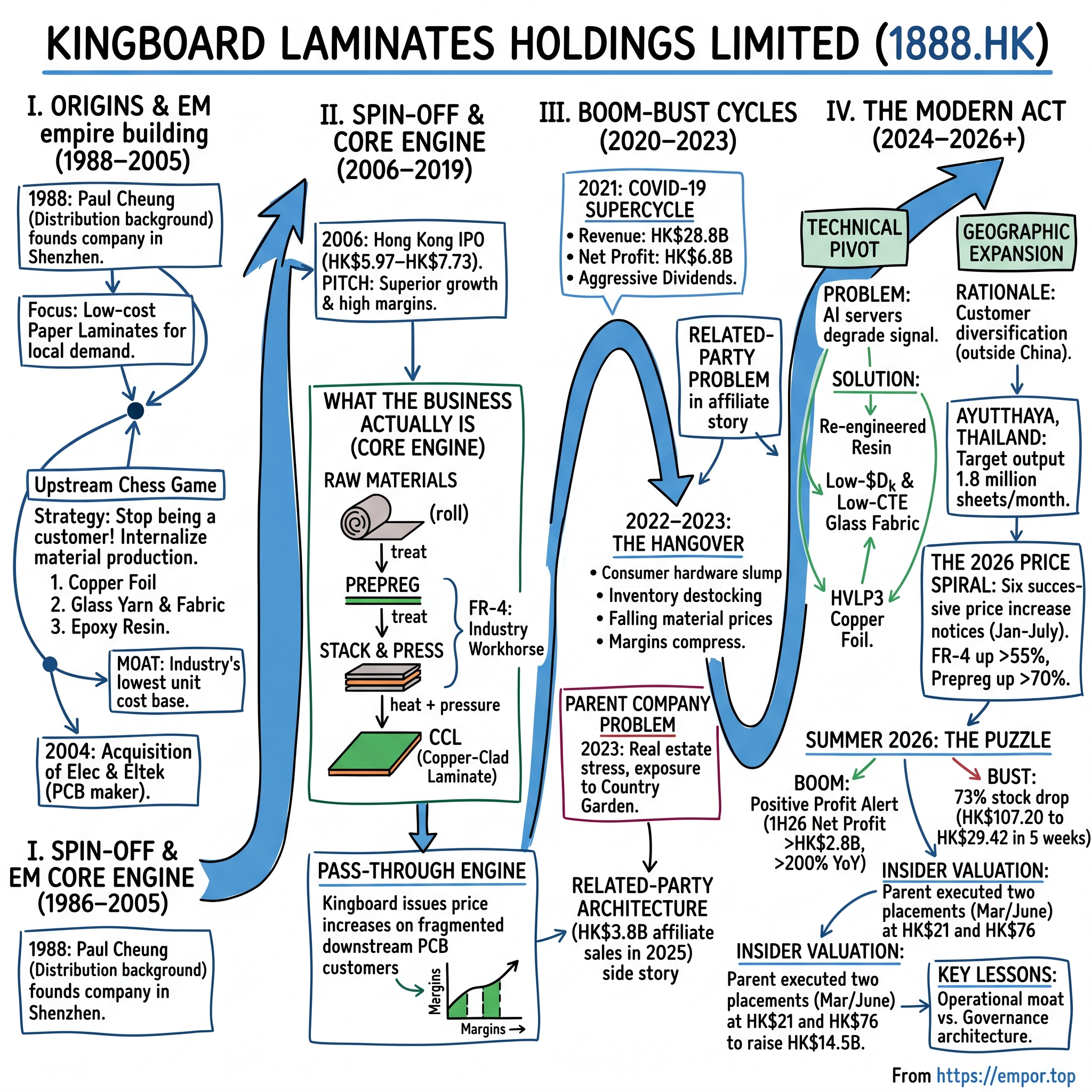
Kingboard Laminates: The Unrivaled Titan of Electronics' Foundational Material
I. Introduction & Episode Roadmap
On the morning of July 22, 2026, something unexpected occurred on the Hong Kong Stock Exchange. Shares in a company posting the highest profits in its 38-year history opened at HK$49.00 and closed at HK$40.26—an 18% one-day drop on volume of nearly 170 million shares. It was not an isolated tremor. Over five weeks, 建滔積層板控股有限公司 Kingboard Laminates Holdings Limited fell from an intraday peak of HK$107.20 on June 25 to HK$29.42 by the close on July 31—a 73% drawdown that wiped out nearly three-quarters of the market capitalization of a company whose disclosed operational metrics were accelerating.
Eight days after that initial plunge, on July 30, the company issued a positive profit alert, forecasting net profit for the six months ended June 30, 2026, to exceed HK$2.8 billion—a year-on-year increase of more than 200%. The board attributed the surge to a tight market for laminates and upstream raw materials, including electronic fiberglass yarn, electronic fiberglass fabric, and copper foil, where unit prices and sales volumes both rose significantly. Management explicitly credited its own "strong and comprehensive vertical integration business model."1
This creates the central puzzle of the story: why does a company report triple-digit profit growth only to see its stock market value cut in half?
The answer lies outside the income statement, inside the share register.
A secondary factor also explains the divergence: when markets price a cyclical business at the top of a cycle, they are not valuing current earnings so much as betting on how long those peak conditions will last. In the summer of 2026, that duration assumption was abruptly reset. On March 18, 2026, parent company 建滔集團有限公司 Kingboard Holdings Limited placed 130 million shares at HK$21.00 apiece, cutting its stake from 71.10% to 66.95%.2 Three months later, on June 17, a wholly owned subsidiary of the parent sold an additional 155 million shares at HK$76.00, lowering the holding from 66.62% to 61.70%.3 Same asset, same controlling family, and a 262% higher price on the second transaction within twelve weeks. Together, the two placements raised approximately HK$14.5 billion in cash for the parent—signaling clearly how insiders valued the stock at HK$76.4
That dynamic illustrates the core paradox of Kingboard Laminates. It operates as one of the most cash-generative industrial enterprises in Asia at the foundational level of the electronics supply chain, yet it is controlled by a family holding company whose strategic priorities do not always align with those of minority shareholders. Investors holding 1888.HK acquire exposure to an advantageous cost structure alongside a governance architecture controlled firmly by the founding family.
What this business actually is. Stripped of industry jargon, Kingboard Laminates manufactures the base sheets from which printed circuit boards are cut. Woven glass cloth is saturated with epoxy resin, layered together, faced with thin copper foil, and cured under elevated heat and pressure. The resulting material is 覆銅板 copper-clad laminate, or CCL. Circuit pathways are formed by etching away the unneeded copper.
Every smartphone, server, electric vehicle inverter, and 5G base station depends on this material. In 2025, the group shipped laminates at a monthly run-rate of approximately nine million sheets.5 It remains an indispensable yet largely unseen segment of global manufacturing—an industry overlooked until supply constraints emerge.
The four threads of this story. First, the upstream cost moat: a thirty-year effort to internalize the production of 銅箔 copper foil, 玻璃纖維布 glass fabric, 環氧樹脂 epoxy resin, and 牛皮紙 kraft paper, transforming a commodity processor into a low-cost industry leader. Second, the pass-through engine: how concentrated upstream capacity and a fragmented downstream customer base allow Kingboard to issue price-increase notices that reset broader industry pricing, with 2026 presenting an extreme test of this dynamic. Third, the parent-company problem: how the 2022–2023 downturn in electronics combined with real estate stress at the parent-company level, leaving a complex structure of related-party transactions. Fourth, the modern pivot: a strategic expansion into AI-grade materials, including low-dielectric glass yarn and HVLP copper foil, alongside a new manufacturing base in Thailand.
A note on how this company talks to investors. Kingboard Laminates does not conduct quarterly earnings calls, host investor days, publish Q&A transcripts, or release strategic presentation decks. The company reports twice yearly through official Hong Kong Stock Exchange filings, where the chairman's business review typically spans a few hundred words. External analysis relies primarily on these regulatory documents, customer price notices reported in trade media, and occasional voluntary disclosures. Consequently, management projections in this account are treated as corporate statements rather than established outcomes.
One myth to retire immediately. The common market description of Kingboard as the world's leading CCL manufacturer holds true for volume, but no longer applies neatly to revenue value. Data from industry analyst Prismark indicates that Taiwanese specialist 台光電子 Elite Material Co.—which entered the high-speed CCL segment in 2017—captured approximately 18.9% of the total global CCL market by 2026, surpassing both 生益科技 Shengyi Technology and Kingboard due to surging AI server demand. Elite Material also held an estimated 38.6% of the global high-speed CCL segment as of its second-quarter 2026 disclosure.6 While Kingboard maintains its position as the global volume leader and ranks among the top producers by total revenue, the highest-margin segment of the market is currently led by a competitor.
Understanding how a Hong Kong enterprise established its position at the base of the global digital supply chain requires returning to a Shenzhen factory floor in 1988.
 Subscribe on LinkedIn
II. Origins & Empire Building: The Kingboard Genesis (1988–2005)
In 1988, Shenzhen was eight years into its life as a Special Economic Zone and still looked the part—a sprawling construction site where agricultural fields were giving way to factory shells and migrant workers arrived by the trainload. Hong Kong manufacturers were crossing the border in waves, chasing labor that cost a tenth of Kwun Tong rates. Most produced toys, garments, or plastic housings. 張國榮 Cheung Kwok Wing—Paul Cheung—set up a plant to manufacture something far less glamorous and far more strategic: the raw board stock from which circuit boards are cut.
Cheung was not an engineer. He had spent more than thirteen years selling and distributing electronic components, laminates among them, before founding the group.7 That distribution background mattered more than any technical credential because it explained the company's defining strategy. A distributor sees the entire supply chain: who is short, who is long, where margin pools, and who holds leverage in a negotiation. Cheung had watched Hong Kong board makers get squeezed for years by upstream suppliers—mostly Japanese and Taiwanese—who controlled copper foil and glass cloth. He founded Kingboard not to be a better converter, but to stop being a customer.
He did not act alone. The founding team included Chan Wing Sun, Chang Cheng Hai, and Ho Yin Sang. The initial laminate plant opened in 深圳 Shenzhen in 1988, with paper laminate production beginning the following year.8 Paper laminate represents the low end of the market—cheap phenolic board used in radios, calculators, and appliance controllers. It required modest capital and forgiving process control, making it an ideal entry point for developing operational expertise.
The learning curve compounded quickly as the underlying market expanded. Through the 1990s, the Pearl River Delta became the world's electronics assembly hub, and every assembler required board materials. Kingboard Chemical listed on the Hong Kong Stock Exchange in 1993, giving Cheung public equity that he used to fund upstream expansion.
The chess game. The logic was arithmetic before it was strategic. In a standard sheet of FR-4 laminate, raw materials dominate the cost structure—copper foil is the single largest line item, followed by glass fabric and yarn, then epoxy resin. When materials account for roughly two-thirds of production costs and are purchased entirely at market rates, a manufacturer remains a price-taker with a narrow conversion spread and no protection during a downturn. Internalizing production changes three dynamics simultaneously: the cost floor drops below that of merchant buyers, supply remains secure when materials run short (a recurring issue in glass fabric), and the company captures both the raw-material margin and the conversion margin.
Executing that integration required fifteen years and substantial capital across copper foil electrolysis, glass yarn kilns, weaving looms, and resin synthesis. Kingboard built these facilities across 廣東 Guangdong, later concentrating specialty capacity in 清遠 Qingyuan, 韶關 Shaoguan, and 連州 Lianzhou. Each step was individually conventional, yet collectively transformative. While competitors could replicate individual nodes, few possessed the balance sheet or patience to build all of them.
Why the sequencing mattered. This strategy stood out in its historical context. Through the 1990s, the prevailing playbook for Hong Kong industrialists in the Pearl River Delta was asset-light: rent a factory shell, hire migrant labor, purchase inputs, ship finished goods, and keep capital off the balance sheet to enable a quick exit if policies shifted. Kingboard took the opposite approach. Glass yarn kilns are continuous furnaces that must run for years without interruption, copper foil electrolysis requires immense electrical power alongside strict environmental compliance, and resin synthesis carries heavy chemical permitting burdens. Every integration step reduced operational flexibility and heightened the financial cost of missteps.
The bet succeeded because underlying demand expanded rapidly. China's printed circuit board output compounded for two decades as global electronics assembly relocated to the delta, creating sustained demand for locally delivered laminate. Kingboard built capacity into a market that continually outgrew it. Had demand remained flat, the strategy would have yielded a heavily indebted firm with idle furnaces. For investors evaluating capacity expansions in 2026, the underlying wager remains unchanged—only its scale has grown.
A structural feature that persists. One consequence of this vertical build recurs throughout Kingboard's history: its upstream plants were sized to supply internal laminate lines while selling surplus output into the merchant market. This merchant channel—external sales of copper foil, glass fabric, yarn, resin, and bleached kraft paper—provides a second, independent profit engine that outperforms laminates during material shortages, as occurred in 2025 and 2026. Crucially, Kingboard sells key inputs to competing laminate converters—a model viable only for an operator confident in maintaining the industry's lowest conversion costs.
Downstream expansion followed. In 2004, Kingboard Chemical acquired 依利安達 Elec & Eltek International, a PCB manufacturer founded in 1972 and listed in Singapore, expanding the group into high-density interconnect and advanced multilayer boards.9 That transaction established a structure that continues to shape the investment case: the parent company owns both the primary material producer and major corporate customers of that material. Kingboard Laminates sells material directly to its own affiliates—a setup with lasting implications for disclosure quality.
The 2006 carve-out. By the mid-2000s, the laminate business faced a classic conglomerate challenge: it grew faster and earned higher margins than its parent, yet the market valued the group at a conglomerate discount. The solution was a spin-off. Kingboard Laminates Holdings Limited listed on December 7, 2006. Priced on November 30 between HK$5.97 and HK$7.73 per share, the offering comprised 750 million shares—representing roughly 25 percent of the company, four-fifths of which were existing shares sold down by the parent. The transaction raised up to approximately US$819 million including the over-allotment option. Goldman Sachs served as sole bookrunner, with CICC as joint arranger. The deal valued the company at 9.7 to 12.6 times estimated 2007 earnings, with the deal size expanded from an initial target of roughly US$400 million following a sharp three-week rally in the parent's shares. The pitch to investors was straightforward: laminates offered superior growth and higher margins, with organic growth expected around 20% a year.10
That transaction established a playbook the founding family has repeated since. The parent monetized a minority stake in a business it retained control over, pricing the equity at a market peak while retaining roughly three-quarters of the equity and full operational control. Twenty years later, in March and June 2026, the parent executed similar share placements twice.
The timing of the 2006 listing underscored management's market timing. December 2006 represented the late stage of a global economic cycle; within two years, the global financial crisis severely depressed worldwide electronics demand, leaving IPO investors with an extended recovery period. Selling equity into market strength reflects a consistent structural pattern within the enterprise.
The spin-off provided Kingboard Laminates with its own balance sheet, dividend policy, and public shareholder base, though operational control remained firmly with the parent. Nor did the restructuring alter the physical and economic fundamentals of the business, which remain central to its performance.
III. The Core Engine: Copper-Clad Laminates (CCL) Economics & Moats
Walk into a laminate plant, and the first physical reality is heat. Rolls of woven glass cloth—resembling coarse, translucent fabric—unspool into a bath of epoxy resin before climbing through a vertical treater tower where solvents flash off and the resin partially cures into a stiff, tacky sheet called 半固化片 prepreg. The prepreg is stacked—sometimes four layers, sometimes twenty—and a copper foil thinner than kitchen film is laid across the exterior. The stack enters a hydraulic press under hundreds of tonnes of pressure and temperatures reaching several hundred degrees Celsius for one to two hours. The finished output is a rigid board with a mirror-bright copper skin.
The plywood analogy. Laminate functions as industrial plywood for electrical circuitry. Glass cloth acts as the wood grain, supplying stiffness and dimensional stability. Epoxy resin serves as the binder, insulating the assembly and dictating its thermal behavior. Copper foil forms the conductive veneer that becomes circuit wiring. The ubiquitous "FR-4" designation simply denotes flame-retardant glass-epoxy grade 4—the industry workhorse that is stable, inexpensive, well understood, and used in the vast majority of printed circuit boards globally. Cheaper paper and composite epoxy material (CEM) grades sit below it for appliance controllers and low-density consumer goods. Above it sit specialized grades—high-frequency, low-loss, and low-dielectric substrates—addressed later in this analysis.
Where the money actually sits. Kingboard reports three operating segments—laminates, properties, and investments—a structure that reveals a clear operational reality. In the year ended December 31, 2025, laminates generated HK$20,225.3 million of the group's HK$20,400.2 million in total revenue—roughly 99% of top-line sales—and delivered HK$2,761.0 million in segment profit. Properties contributed HK$77.6 million in revenue while incurring a segment loss of HK$32.6 million. The investment portfolio, composed primarily of listed securities, generated HK$597.2 million in segment profit on HK$97.3 million in revenue.11
Two analytical conclusions follow. First, Kingboard operates essentially as a single-business company with two side operations: a property division that acts as a modest financial drag, and an investment portfolio that generated nearly a fifth of 2025 pre-tax profits through mark-to-market gains rather than manufacturing operations. Investors valuing the core franchise must treat that investment line as volatile and non-operating, capable of significantly altering reported results—in 2024, the same portfolio posted a segment loss of HK$53.5 million.11 Second, retaining a property division inside an industrial materials producer reflects legacy diversification habits, representing the type of non-core asset that capital allocation discipline would ordinarily isolate or divest.
Within the core division, 2025 revenues split between laminates and upstream materials at HK$18,366.1 million, and specialty resin at HK$1,570.1 million.11 While Kingboard does not break out specific revenue figures for FR-4 versus paper grades or third-party material sales, its directional reporting is clear: the group deliberately expanded the share of high-value-added products within its sales mix throughout 2025.
The three product tiers, in plain terms. Glass epoxy laminate—FR-4 and its variants—serves as the main profit engine, supplying smartphones, servers, automotive electronics, and high-density interconnect boards with both volume and technical differentiation. Paper and CEM grades represent a lower tier: composite substrates built on paper or paper-glass hybrids that provide adequate performance for appliance controllers, power adapters, and low-density consumer items. While these lower grades represent a shrinking share of total market demand, they remain profitable because the underlying production equipment is fully depreciated. Finally, the merchant materials tier sells surplus copper foil, glass fabric, yarn, resin, and kraft paper to external buyers. This channel provides operational flexibility: when laminate demand softens, upstream production can be sold directly into the open market rather than idled, while during material shortages, external sales command premium margins.
What the manufacturing process implies about competition. The physical constraints of laminate production dictate industry competitive dynamics. Treater towers operate continuously and carry high restarting costs, hydraulic presses require heavy capital investment and long installation leads, and glass kilns must remain lit once fired. Because the marginal cost of producing an additional sheet is low while the cost of idling capacity is high, mainstream FR-4 markets have historically experienced sharp price competition during downturns, as producers prefer selling at narrow spreads over shutting down lines. Kingboard's integrated cost structure helps insulate it during these periods, while also making overall earnings highly sensitive to capacity utilization.
The 7 Powers audit. Examining the business through Hamilton Helmer's framework clarifies which durable competitive advantages exist in practice.
Scale economies are substantial and measurable. Kingboard operates one of the largest laminate production footprints globally, with the broader group managing more than sixty manufacturing plants.12 Fixed overhead—including kilns, treaters, presses, and effluent treatment facilities—is spread across immense production volumes.
In 2025, depreciation stood at HK$915.3 million against HK$4.2 billion in EBITDA, while total group headcount rose from 9,900 to roughly 10,800 employees.11 Scale provides the cost cushion that allows Kingboard to remain profitable at price levels that push higher-cost competitors into operating losses.
Process power is plausible but difficult to audit independently. Decades of proprietary resin formulation, foil thinning, and weaving techniques represent genuine operational expertise, though these methods remain undisclosed and unpatented. Management attributes its efficiency to lean manufacturing, increased automation to control labor costs, and ongoing operational refinements.11 This represents a plausible, albeit unquantified, operational advantage.
Cornered resource represents a key and frequently overlooked moat element. The primary bottleneck is not copper, which trades as a global commodity, but specialized manufacturing machinery.
Electronic-grade glass fabric requires specialized weaving looms, where global equipment supply is tightly constrained. Industry reporting in 2026 indicated that worldwide loom production from the leading Japanese supplier ran at approximately 100 units per month, with delivery lead times extending toward 2030.13
The strategic implication is substantial. Competitors cannot enter or expand electronic glass fabric capacity without access to looms, regardless of available capital or prevailing market margins. Kingboard already maintains an extensive installed base of looms and kilns, securing preferential access to critical manufacturing assets—a core factor preventing rapid supply arbitrage during market upcycles.
Switching costs provide an additional layer of retention. Every laminate grade used in high-reliability applications must undergo qualification by the PCB fabricator and formal re-qualification by the end customer—a process taking several months for consumer electronics and up to several years for automotive or telecommunications infrastructure. Once specified into a bill of materials, laminate suppliers are difficult to displace. Kingboard notes that its high-end grades have secured certifications from major global Tier-1 automotive component suppliers as well as domestic and international telecommunications clients.11 Consequently, establishing market share in incumbent-dominated segments like AI servers requires extended validation cycles.
The pass-through engine. The pricing mechanics of the CCL industry rely on structural concentration. The global laminate market is concentrated among a small group of major producers holding roughly half of global supply, whereas the downstream PCB market is fragmented across thousands of smaller fabricators operating with limited raw material inventory. When underlying copper and glass fabric costs rise, Kingboard issues broad price adjustment notices across the market rather than negotiating individually. Because input cost pressures are transparent across the supply chain, these price increases generally hold—and because Kingboard produces its own copper foil, glass fabric, and resin, price increases apply to an internalized cost base that rises far less than market spot rates.
This dynamic allows input cost inflation to drive margin expansion. In 2025, rising copper prices prompted the group to implement multiple laminate price increases, while profit from the electronic fiberglass yarn and fabric segment alone expanded 70% year-on-year to exceed HK$600 million. Group gross margin expanded from 17.7% to 19.6%, and laminates-division EBITDA rose 22% to HK$3,676.6 million despite revenue growth of just 10%.11
Operating leverage of this magnitude—profit expanding at double the rate of revenue—demonstrates tangible pricing power stemming from vertical integration. Pure converters facing identical raw material cost increases typically experience margin compression rather than expansion.
However, this pass-through mechanism operates symmetrically during industry downcycles, as falling material prices and excess capacity test operating margins across the supply chain. Evaluating how Kingboard navigates these downturns requires examining its position against key industry competitors.
IV. Industry Structure & Competitive Benchmarking
Consider the electronics supply chain as an hourglass. At the wide top sit raw commodities—copper cathode, silica sand, petrochemical feedstock—traded globally by thousands of suppliers. At the wide bottom sit thousands of PCB fabricators, tens of thousands of component assemblers, and the ultimate brand owners. In the narrow waist, through which all material flows, sit roughly a dozen producers that matter in copper-clad laminate.
This geometry defines industry economics: concentration at the waist, fragmentation on both sides. Concentrated waist capacity explains why CCL manufacturers have historically earned superior returns compared to the PCB shops they supply, and why supply constraints at the waist trigger price increases across downstream markets.
The scoreboard has changed. For most of the past two decades, industry rankings placed Kingboard first by volume and Shengyi second, with Nan Ya and Taiwanese specialists behind. Indeed, Shengyi has been described as the world's second-largest CCL manufacturer by sales volume since 2013.12 However, that framing no longer reflects market realities at the top. Driven by artificial intelligence demand, the global CCL market expanded from roughly $16.0 billion in 2025 toward an estimated $21.5 billion in 2026—a single-year expansion of about one-third. Within that shifting market, 台光電子 Elite Material Co. captured approximately 18.9% share to take the overall top position by revenue, while Taiwanese manufacturers collectively held around 37.4% of the global market by 2025.6
This shift highlights a critical competitive reality: the fastest-growing, highest-margin segment of Kingboard's industry was captured by a specialized entrant that entered high-speed laminates only in 2017, operating at a fraction of Kingboard's total volume.
The field.
台光電子 Elite Material Co. (2383.TW) represents the AI cycle's primary beneficiary. By focusing early on halogen-free and ultra-low-loss substrates, the company reached the top global position in high-speed CCL by 2023 and held approximately 38.6% of that segment by mid-2026.6 Its advantage stems not from lower manufacturing cost, but from early qualification inside accelerator supply chains, where design wins in one platform generation compound into the next.
台燿科技 Taiwan Union Technology Corp. (6274.TW), founded in 1974, operates as the other primary Taiwanese high-speed specialist, maintaining strength in data-center networking and server substrates.12 Industry coverage through 2026 consistently identified Elite Material and TUC as the two leading competitors targeting AI-grade CCL.14
生益科技 Shengyi Technology (600183.SH), founded in Dongguan in 1985, serves as Kingboard's closest mainland analogue—a large, broad-based producer strong in telecommunications and automotive boards, though materially less vertically integrated upstream.12 Shengyi has advanced its high-speed material qualifications faster than Kingboard.
南亞塑膠 Nan Ya Plastics (1303.TW) represents a vertically integrated peer: as part of the Formosa Plastics group, it synthesizes resin, weaves glass fabric, and electrolyzes copper foil much like Kingboard. Its main limitation is corporate structure—laminate operations form one unit inside a massive petrochemical conglomerate, competing internally for capital allocation.12
Rogers Corporation (ROG) occupies a distinct niche, supplying ultra-high-frequency RF materials for radar, aerospace, and specialized wireless systems at production volumes far below Kingboard's scale, but at prices Kingboard cannot approach.12
Two additional suppliers complete the landscape. Isola, established in 1912 and based in Arizona, remains a specialized Western supplier at modest scale. Ventec International, founded in Suzhou in 2000, occupies the thermally conductive and specialty niches.12 While neither alters global market share dynamics, their presence illustrates an industry reality: Western incumbents were not simply displaced by cheaper Asian producers; rather, the manufacturing center of gravity shifted to where circuit boards are fabricated and remained there.
Why Taiwanese specialists captured the high end. The rise of Taiwanese specialists reflects positional advantages rather than purely technical superiority. Taiwan sits inside the AI accelerator and server ODM ecosystem—working alongside design houses, substrate fabricators, and system integrators. Substrate qualification requires months of collaborative iteration among engineering teams operating in the same time zone and industrial clusters. Elite Material entered high-speed CCL in 2017 just as that transition began, scaling alongside it.6 In contrast, Kingboard's historical customer base concentrated among mainland PCB fabricators supplying consumer and industrial electronics. Close proximity to high-growth customer ecosystems creates compounding advantages that raw unit-cost leadership cannot easily replicate.
Where Kingboard genuinely wins. Kingboard retains three tangible structural strengths: the industry's lowest unit production costs in mainstream FR-4 due to upstream integration, massive volume throughput capable of fulfilling sudden large orders that specialists cannot absorb, and an internal raw-material buffer. In 2025, management cited that buffer as the explicit reason for maintaining stable output "during periods of materials shortage," enabling the group to capture price increases at two levels of the chain simultaneously.11
Where Kingboard genuinely struggles. Kingboard's primary vulnerability is qualification speed in high-speed tiers. Disclosures highlight this execution lag. In its 2025 interim report, management stated that its upgraded R&D center had "successfully developed various high-frequency, high-speed products for GPU motherboards in AI servers."5 In the annual report six months later, the phrasing shifted: the group reported that it had "successfully developed various high-frequency, high-speed products capable of meeting the core material requirements for high-reliability application scenarios such as AI servers, new energy vehicles and energy storage systems," and had "secured product certification among end-users," with named certification wins in automotive and telecom.11
Comparing those disclosures reveals that specific, named certifications were secured in automotive and telecommunications, whereas AI server disclosures remained focused on development capabilities rather than verified platform design wins. While development progress is evident, these statements do not equal the 38.6% high-speed market share reported by Elite Material. Investors must distinguish between material development and commercial revenue contribution.
Myth versus reality. Three common market assumptions require clarification against official disclosures. Myth one: Kingboard is the undisputed global number one. Reality: while Kingboard remains among the largest by volume and total revenue, the 2026 revenue crown moved to a Taiwanese specialist, and the high-speed segment is not close.6 Myth two: Kingboard's AI exposure comes from selling directly into AI servers. Reality: corporate disclosures indicate that the primary mechanism is the opposite—the group is monetizing the scarcity of traditional materials created when competitors redirected capacity to AI grades.11 Myth three: the parent company owns roughly three-quarters of the equity. Reality: after two share placements in 2026, the parent holding stood near 61.7%, and the direction of travel has been downward.3
The structural nuance that matters most. Kingboard's 2026 earnings growth was driven less by winning AI platform design sockets and more by supplying merchant inputs to an undersupplied broader market. When competitors reallocated weaving looms and glass yarn capacity toward high-margin AI substrates, supply for standard electronic fiberglass yarn and fabric tightened. Kingboard's annual report describes this mechanism directly: existing capacity for traditional electronic fiberglass yarn and fabric was redirected to AI-related products, "creating a tight supply of traditional materials," which "led to multiple price increases during the year."11
Kingboard successfully monetized the industry-wide tightness in commodity materials created by the AI transition. However, because this profit stream depends on structural material shortages, its durability remains linked to broader supply-demand cycles. That brings the analysis to the historical pattern of how the company performs when supply tightness eases.
V. Boom-Bust Cycles, Financial Mechanics, & Inflection Points (2015–2023)
A historical chart of Kingboard Laminates' net profit illustrates the operational reality of the business better than any corporate presentation. The trajectory does not steadily climb upward; it surges, plummets, and recovers in sharp, cyclical swings.
The quiet middle years. Establishing a baseline requires looking back to the late 2010s, when Kingboard operated as a steady, unglamorous industrial producer. Annual revenue hovered in the low-to-mid teens of billions of Hong Kong dollars, while net profit sat between HK$1 billion and HK$2 billion, tracking Chinese electronics output.15 The stock traded at single-digit earnings multiples while paying a substantial dividend—a standard valuation for a cyclical manufacturer managed by a controlling family. That period defined the company's baseline: without market shortages, the business generates dependable but modest returns. Everything beyond that baseline is dictated by the cycle.
The 2020–21 supercycle. The COVID-19 pandemic generated unprecedented demand across the electronics industry, as millions of households simultaneously acquired laptops, monitors, routers, and tablets. Automotive demand rebounded sharply from early 2020 lows directly into a global semiconductor shortage, while copper prices rallied from pandemic lows to multi-year highs under the combined forces of monetary stimulus and energy-transition demand.
For a vertically integrated laminate producer, these factors created ideal operating conditions: sales volumes, product prices, and input-cost pass-through expanded in tandem. In 2021, group revenue reached roughly HK$28.8 billion, net profit climbed near HK$6.8 billion, and gross margin expanded well above 30%—an exceptional figure for a commodity converter.15 Following its historical practice, the company distributed dividends aggressively during the peak.
Then the hangover. The 2022–2023 downcycle proved as severe as the preceding boom was lucrative. Consumers who purchased hardware in 2020 paused buying in 2022, while smartphone sales contracted. Having double-ordered during supply shortages, the electronics supply chain faced excess inventory and sharply curtailed new orders. Destocking propagated upstream from device assemblers to circuit board fabricators, reducing laminate orders and depressing factory capacity utilization.
Group revenue fell to roughly HK$22.4 billion in 2022 and roughly HK$16.8 billion in 2023, while net profit dropped to HK$1.9 billion and then to HK$0.9 billion.15 Between the 2021 peak and the 2023 trough, net earnings dropped by nearly 87%, while gross margin compressed from the low thirties to the mid-teens.
This shift illustrates the reverse side of the pass-through mechanism. During a market contraction, Kingboard holds raw material inventory acquired at elevated copper prices while selling finished laminate at falling market rates. Vertical integration—highly protective during upcycles—becomes a fixed-cost burden during downturns: continuous glass kilns and copper electrolysis lines carry substantial idling costs, causing upstream margins to evaporate.
This dynamic provides vital context when evaluating 2026 performance metrics. The same integrated structure that drives triple-digit profit growth during shortages causes steep profit declines during gluts. Kingboard operates as a high-beta cyclical enterprise, though its genuine structural moats can mask that volatility during upswings.
Notably, the company maintained dividend distributions and capital expenditure throughout the downturn. Continuing investments through cyclical troughs demonstrates long-term planning, setting Kingboard apart from peer industrials that cut capital outlays during downturns.
The property contagion. While the core manufacturing operations absorbed the industry downturn, a separate vulnerability emerged from the parent company's balance sheet. Parent entity Kingboard Holdings Limited had extended credit to mainland developer 碧桂園 Country Garden. Following Country Garden's financial distress in 2023, the debt was partially settled in equity, with the developer issuing new shares to Kingboard at HK$0.77 per share—a 15.4% discount to the preceding market close—to settle a debt tranche exceeding HK$300 million. In February 2024, Kingboard Holdings issued a profit warning forecasting a net profit drop of up to 45% for full-year 2023, down to no less than HK$2.02 billion, primarily due to credit loss provisions on its Country Garden exposure. Parent company shares fell 4% following the disclosure.16
For shareholders of Kingboard Laminates (1888.HK), two implications stand out. First, the primary credit loss occurred at the parent level, demonstrating functional corporate separation. Second, the episode highlights why governance structures require close inspection. Kingboard Laminates maintains its own property operations and investment portfolio; full-year 2025 financial statements recorded a HK$52.1 million fair-value loss on investment properties, alongside a management commitment to maintain a prudent stance with no new land acquisitions.11 While halting land acquisitions aligns with operational focus, maintaining property development activities alongside a HK$1.5 billion equity portfolio introduces financial risks distinct from core industrial operations.
The related-party architecture. The most significant disclosure in Kingboard Laminates' 2025 financial results appears in the segment footnotes rather than the summary metrics. Sales to affiliated subsidiaries controlled by parent company Kingboard Holdings reached HK$3,801.8 million in 2025, representing more than 10% of total group revenue, compared with HK$3,764.6 million in 2024.11 In practice, approximately one-fifth of total sales flows to entities under common corporate control.
This arrangement reflects the integrated ownership of both laminate production and downstream PCB fabrication, fully disclosed in financial filings and audited by Deloitte Touche Tohmatsu.11 However, it also means a notable portion of reported revenue and operating margin relies on internal transfer pricing established within a family-controlled group rather than arm's-length commercial negotiations.
During market shortages, when external laminate prices rise rapidly, transfer pricing terms directly impact value allocation between entities. If affiliated customers purchase at prevailing market rates, minority shareholders of Kingboard Laminates benefit relative to parent entity shareholders; if lower affiliate rates apply, the dynamic reverses. Because corporate filings do not break out gross margins on affiliate sales compared to third-party customer sales, investors cannot independently determine the precise margin impact.
The industry downcycle concluded, but the related-party architecture remains in place. Examining the management and governance structures behind these decisions forms the next phase of the analysis.
VI. Current Management, Ownership, & Capital Allocation Record
The board list accompanying every Kingboard Laminates announcement reads less like a modern corporate governance disclosure than a family register. Following the March 2026 annual results, the executive directors were Cheung Kwok Wa, Cheung Kwok Keung, Cheung Kwok Ping, Lam Ka Po, Cheung Ka Ho, and Zhou Pei Feng. Lo Ka Leong served as non-executive director, alongside independent non-executives Zhang Lu Fu, Kung Peter, Ho Kwok Ming, and Yung Hoi Yan.11 Four of the six executive directors share the founding family surname.
The chairman. 張國華 Cheung Kwok Wa chairs the company and signs its corporate filings. His public profile remains minimal by design. Management does not host investor days, conduct quarterly earnings calls with analyst Q&A, or publish strategic presentation decks. Kingboard Laminates reports financial results twice a year through formal filings, where the chairman's business review typically spans a few paragraphs. Without conference call transcripts to parse, investors face a structural information deficit that demands a wider margin of safety.
Evaluating management requires assessing execution over time, where the record presents a distinct contrast between operational discipline and shareholder alignment.
Narrative consistency. Comparing corporate disclosures between the 2025 interim and annual reports reveals consistent operational tracking. The interim report noted that the first low-dielectric fiberglass yarn kiln at Qingyuan commenced production in the first half of 2025, with three additional kilns scheduled for the second half and a six-kiln specialty facility planned for 2026.5 The full-year annual report confirmed the initial kiln was operational, scheduled three more for the first half of 2026, and raised project targets to twelve total specialty yarn kilns.11 Similarly, the Shaoguan expansion—designed for an annual capacity of 70,000 tonnes of electronic fiberglass yarn and 96 million meters of fabric—was reported on schedule for the second half of 2026 across both documents.511 Operational targets were consistently restated and expanded as market demand strengthened, reflecting realistic project planning rather than promotional guidance.
Cost control through internal infrastructure. Beyond core laminate capacity, corporate filings reveal how management embeds cost discipline into physical operations. Across the broader group, approximately HK$1 billion had been invested in distributed rooftop solar by the end of 2025, generating roughly 240 million kilowatt-hours of electricity annually alongside HK$300 million in thermal energy recovery facilities. For Kingboard Laminates specifically, solar capital expenditures reached approximately HK$650 million to generate around 150 million kilowatt-hours per year—yielding roughly HK$120 million in annual electricity savings at prevailing rates, complemented by HK$180 million in heat recovery infrastructure.11 In an enterprise where furnaces and hydraulic presses run continuously, energy represents one of the largest controllable operational expenses after raw materials. Permanently lowering base energy overhead illustrates the group's long-standing focus on compounding cost advantages.
Capital allocation. Capital allocation reflects a conservative balance sheet strategy, funding capacity expansion primarily through operating cash flow rather than debt. The group invested approximately HK$1.3 billion in capital expenditures during 2025 while ending the year with net gearing at 16%, up from 9% in 2024.11 However, the liability structure shifted noticeably toward short-term debt, with short-to-long-term borrowing ratios moving from 51:49 at year-end 2024 to 85:15 by late 2025.11 While short-term borrowing reduced interest expenses in a declining rate environment, it introduced refinancing exposure during market turns.
Dividend distributions have remained consistent across industry cycles. For full-year 2025, the board declared an interim dividend of 15.0 Hong Kong cents, a final dividend of 25.0 cents, and a special final dividend of 28.0 cents—totaling 68.0 cents per share against reported earnings of 78.2 cents per share, representing an 87% payout ratio.11 The payout structure expanded the ordinary dividend by 25% while reducing the special dividend from 30.0 cents to 28.0 cents. Structuring distributions to raise the recurring dividend modestly while flexing discretionary top-ups with underlying cash flow demonstrates a deliberate focus on dividend sustainability.
Ownership shifts and insider sales. The defining governance event of 2026 involved a substantial reduction in parent company ownership. Following share placements in March and June 2026, parent entity Kingboard Holdings reduced its equity stake to approximately 61.70%.3 Management cited identical objectives for both transactions: increasing trading liquidity, broadening the shareholder base, and expanding the public float.23
While expanding trading float can support institutional inclusion—supported by the stock's addition to the Hang Seng SCHK Electronics Theme Index upon its launch on December 18, 2025—the execution timing raised governance concerns.11 Selling 130 million shares at HK$21.00 followed by 155 million shares at HK$76.00 within twelve weeks allowed the parent to monetize equity near peak market valuations, with the second sale occurring eight days before the stock reached its all-time intraday high. Domestic financial reporting indicated the two placements raised approximately HK$2.73 billion and HK$11.78 billion respectively, identifying the equity supply as a primary catalyst for the subsequent share price drop.4 Executive director Cheung Ka Ho separately sold one million shares on July 20, 2026, during the drawdown.4
Institutional impact. The rapid share price decline highlights the risks of concentrated institutional trading in mid-cap Hong Kong equities. Domestic media reports indicated that a flagship fund managed by Dacheng Fund Management built a position in Kingboard Laminates during the second quarter of 2026 exceeding RMB 3.7 billion—representing nearly 15% of the fund's net asset value—before the stock dropped over 60%, driving a 34% drawdown for fund investors.4 The transaction underscores how concentrated institutional buying absorbed insider equity sales before trading liquidity contracted.
Board changes. Separate filings recorded routine board changes. Executive director Emily Cheung Chun Ming resigned effective February 28, 2026, to focus on family commitments, with filings confirming no disagreement with the board.17 In a closely held family enterprise, board composition and succession planning remain key long-term governance variables.
Evaluating Kingboard Laminates requires balancing operational execution against governance practices. Management has consistently delivered on industrial expansion targets and unit-cost discipline for three decades. However, the timing of parent-level share sales during 2026, combined with minimal direct investor communication, underscores the ongoing governance risks facing minority shareholders.
VII. The Modern Act: AI Hardware Boom & The Thailand Expansion (2024–2026)
Understanding the shift in Kingboard's operations between 2024 and 2026 requires addressing a physical constraint central to the artificial intelligence buildout: at ultra-high operating frequencies, printed circuit board material absorbs and degrades signal transmission.
Why AI servers broke the old materials. As electronic signals travel along copper traces on a circuit board, energy bleeds into the surrounding insulating substrate. At the megahertz frequencies common a decade ago, signal loss was negligible. At current accelerator processing speeds—where single graphics processing units exchange data across adjacent nodes at rates previously reserved for supercomputer interconnects—the circuit board itself becomes an active source of signal attenuation. Two physical parameters govern this performance: the dielectric constant ($D_k$), which dictates how much the substrate slows and bends the signal, and the dissipation factor ($D_f$), which measures energy lost as heat. Under standard FR-4 materials operating at 112 gigabits per second, signals degrade into unreadable noise before traversing the board.
Overcoming this physical barrier requires simultaneous modifications across all three primary laminate components. Epoxy resin formulations must be re-engineered to minimize electrical loss. Glass yarn must be melted using modified chemical compositions to yield low-$D_k$ and low-coefficient-of-thermal-expansion (low-CTE) glass fabric, limiting dimensional distortion under the intense heat generated by high-density AI processor packages.
Finally, copper foil surfaces must be manufactured to near-perfect smoothness. At high frequencies, electrical current crowds onto the outer skin of a conductor rather than flowing through its core. The microscopic surface roughness that enables standard copper foil to adhere to resin—an advantage at lower operating speeds—acts as resistance at high frequencies. This reality spurred the development of hyper-very-low-profile (HVLP) copper foil, where each successive product generation features a flatter surface profile while maintaining physical adhesion to the resin matrix.
This material transition inherently favors vertically integrated manufacturers. Pure converters purchasing inputs on the merchant market remain constrained by external supplier developments. Conversely, an integrated producer synthesizing resin, melting glass, and electrolyzing foil can co-develop inputs internally. Kingboard highlighted this capability in its disclosures, noting that "through coordinated development across its vertical industrial chain, the Group has also developed HVLP3 copper foil for AI servers and ultra-thin VLP copper foil for IC packaging substrates."11
What actually got built. Beyond strategic declarations, execution is visible in capital deployments with specific capacity metrics and timelines. The group's initial kiln producing low-$D_k$ electronic fiberglass yarn—operating at an annual capacity of 500 tonnes in Qingyuan, Guangdong—began production in the first half of 2025. Kingboard subsequently developed second-generation low-$D_k$ and low-CTE yarn, positioning itself among the few global laminate manufacturers mastering low-CTE fiberglass production, with those materials securing customer qualifications in high-end IC packaging substrates. Three additional 500-tonne kilns were scheduled to open in the first half of 2026, alongside plans for eight further units, expanding the specialty park to twelve kilns.11
To address broader industry shortages in standard materials, Kingboard expanded its Shaoguan complex to deliver 70,000 tonnes of yarn and 96 million meters of fabric annually.11 To complete upstream coverage, the group scheduled a new Guangdong copper foil plant with 21,000 tonnes of annual capacity focused on high-frequency, low-loss RTF and HVLP foil for production in mid-2027, following a Lianzhou expansion that added 1,500 tonnes per month upon reaching full operation in the first half of 2025.115
These capital commitments demonstrate a multi-year effort funded from internal cash flow to advance up the technical value curve, providing tangible operational evidence beyond temporary commodity price increases.
The 2026 price spiral. In early 2026, Kingboard's pass-through pricing engine operated at maximum intensity. Across the first six months of the year, the group issued six successive price-increase notices, with the sixth arriving just twenty days after the fifth. A uniform 10% increase on laminates and prepreg in April was followed by a May 27 announcement raising laminates by 10% and prepreg by 20%. On June 16, management raised prices across all thicknesses of FR-4 and prepreg by 15%. On July 6, Kingboard added another 15% increase on prepreg and FR-4 sheets thicker than 1.3 millimeters, raised CEM-1 and 22F grades by 10%, and increased copper foil processing fees by RMB 5 to 8 per kilogram. Cumulatively, standard FR-4 laminate prices surged more than 55% over the year, while prepreg prices rose over 70%.18
Management attributed these adjustments to elevated copper prices and tightening glass fabric supply.18 Industry data corroborated both factors.
London Metal Exchange copper prices reached an all-time peak of US$14,527.50 per tonne on January 29, 2026, and remained above US$13,400 through July.19 Meanwhile, standard 7628-specification electronic glass fabric reached RMB 7.4 per meter by early June—roughly double its third-quarter 2025 trough—amid a monthly supply deficit of 8 to 9 million meters and depleted spot inventories.1318 Standard FR-4 sheet prices escalated from approximately RMB 70 to RMB 260 over the same timeframe.18
The scale of these adjustments illustrates the dynamics of market leverage. While copper prices rose significantly, laminate prices expanded at a far higher rate. Because Kingboard's price increases outpaced raw input cost inflation, the pass-through mechanism shifted from cost recovery to direct margin expansion.
Financial results reflected this pricing power. Management forecast first-half 2026 net profit to exceed HK$2.8 billion—compared to HK$933.3 million in the prior-year period—ahead of formal interim disclosures scheduled for August 24, 2026.15 In a July 23 report following the equity drawdown, Citigroup projected first-half net profit near HK$4 billion, noting that the stock had dropped approximately 60% from its peak to trade at a mid-single-digit earnings multiple below historical averages.20 The report also cited commentary from competitor 南亞新材 Nanya New Material indicating that electronic glass fabric supply constraints could persist into late 2027.20
Thailand: the geographic hedge. Parallel to its technical roadmap, Kingboard expanded international manufacturing at its facility in Ayutthaya province, Thailand, operating as Kingboard Laminate Manufacturing (Thailand). This expansion addresses customer diversification mandates as global original equipment manufacturers and PCB fabricators seek production outside mainland China, matching parallel regional investments by Kingboard's own PCB affiliates. The group added 400,000 sheets per month of Thai capacity in 2024, reaching a monthly output of one million sheets by year-end. Two additional phases of 400,000 sheets each are designed to bring total Thai capacity to 1.8 million sheets monthly—a scale management projects will establish the facility as the largest laminate plant in Southeast Asia.5
Evaluated against group monthly shipments of approximately nine million sheets, a fully operational Thai plant represents roughly 20% of total volume. While not fundamentally altering the group's operational center of gravity, this overseas capacity offers strategic flexibility against shifting international trade policies. Because the company does not disclose separate financial results for Thai operations, progress toward the 1.8 million sheet target must be monitored through physical capacity milestones rather than segmented filings.
What Thailand does not solve. The structural limits of this geographic hedge remain distinct. A conversion plant in Ayutthaya continues to rely on copper foil, glass fabric, and epoxy resin supplied overwhelmingly from Kingboard's primary manufacturing hub in Guangdong. Without localized upstream material production in Southeast Asia, the Thai facility functions as a downstream assembly node dependent on Chinese raw inputs. While this structure satisfies country-of-origin criteria for finished laminate, it leaves broader supply chain concentration unchanged. Management has not announced upstream capital commitments in Thailand.
Reading the 2026 numbers correctly. First-half 2026 financial performance reflects the confluence of three distinct drivers: expanding shipment volumes, sharply higher unit selling prices, and upstream material spreads widening faster than conversion margins. While volume growth reflects structural capacity additions, elevated pricing and spread expansion depend on industry-wide supply imbalances that manufacturers are actively deploying capital to resolve. Consequently, peak first-half earnings demonstrate the operating leverage of vertical integration under constrained supply conditions rather than a permanent baseline for normalized profitability.
VIII. Porter's 5 Forces, Skeptical Stress Test, & Risk Radar
Setting aside price-increase notices and profit alerts, a rigorous evaluation requires asking a colder question: where are the structural vulnerabilities in this business?
The five forces, honestly scored.
Supplier power is genuinely low—but for a more specific reason than simple vertical integration. Kingboard still purchases copper cathode at prevailing market prices. What it avoids buying on the open market are the processed intermediate inputs where supply bottlenecks concentrate: copper foil, glass fabric, yarn, and epoxy resin. In 2026, when the industry's primary constraint proved to be electronic glass fabric rather than raw copper, that distinction proved immensely valuable. Supplier power over Kingboard remains low precisely where it is highest for unintegrated competitors.
Buyer power is moderate and asymmetric. Thousands of mid-tier printed circuit board fabricators hold virtually no bargaining power—they accept posted price adjustments or cease production. Conversely, the handful of Tier-1 customers building artificial intelligence server boards hold significant leverage because they define qualification specifications and can single-source a laminate grade for an entire platform generation. Kingboard's pricing power diminishes as it moves up the technical value curve. The higher-margin business it seeks comes attached to structurally stronger buyers.
Substitutes are close to non-existent for rigid boards in the foreseeable future. Alternatives exist at the margins—such as ceramic substrates, flexible polyimide films, and long-term glass-core substrates for advanced packaging—but none threatens the primary rigid copper-clad laminate volume pool. This remains the most defensible of the five competitive forces.
New entrants face steep structural barriers, which market conditions in 2026 made explicit. The primary hurdle is not capital, which remains abundant across Chinese industry, but time. Weaving loom lead times extend for years, and qualification cycles require quarters to complete. Time barriers cannot be bypassed with financial capital alone.
Rivalry splits into two distinct arenas. In mainstream FR-4 laminates, competition is intense, price-driven, and periodically destructive—explaining the severity of the 2022–2023 industry downturn. In high-speed grades, rivalry is currently less intense, but Kingboard is not the chief beneficiary, as incumbent specialists hold the key platform design wins.
The activist's brief. A skeptical investor evaluating the enterprise would highlight three primary concerns.
The first involves corporate governance and related-party sales. Beyond the concentration of sales to parent affiliates, trade receivables warrant close inspection: gross trade receivables of HK$5.33 billion at the end of 2025 carried a credit-loss allowance of HK$482.2 million—roughly 9% of the total—while debtor days stretched from 82 to 96 and the working capital cycle lengthened from 116 days to 132.11 While stretched payments are common during price spikes, a 9% credit-loss allowance signals underlying financial friction among downstream circuit board makers.
The second concern is the AI acceleration gap. The bear thesis contends that Kingboard is monetizing a commodity material shortage created by the AI buildout while the premium AI margins accrue to Taiwanese specialists. If glass fabric supply normalizes—and Kingboard itself is adding 96 million meters of capacity—commodity spreads will compress, leaving Kingboard with expanded volume in lower-margin tiers. A clear verification step would be the direct disclosure of revenue generated from high-speed and low-dielectric grades, which management has not yet provided.
The third issue is balance-sheet portfolio complexity. A materials manufacturer maintaining investment properties, real estate development assets, and a HK$1.5 billion listed equity portfolio deploys capital outside its primary industrial core. That equity portfolio contributed to earnings in 2025 after creating a drag in 2024, but neither result reflects the operational health of the underlying laminate franchise.
The risk radar, ranked by structural impact.
Cycle reversal represents the primary risk. The sharp earnings contraction between 2021 and 2023 serves as a historical baseline rather than a tail event. Prices that expanded over 55% in six months can decline just as rapidly. During a downturn, Kingboard carries inventory acquired at elevated copper prices—standing at 66 days of stock at the end of 2025—against falling selling prices.11 Because raw material inventory costs lag falling market prices, margin compression occurs before cost relief materializes.
Supply responses are the most likely trigger for a cyclical turn. Industry participants are adding glass fabric and yarn capacity, with Kingboard's Shaoguan project and competing domestic expansions scheduled to open in the 2026–2027 window. High profitability historically incentivizes the capacity additions that end supply tightness.
Geopolitical concentration creates ongoing exposure. Potential restrictions on advanced electronics inputs pose risks, and the Thai expansion provides only a partial hedge. Mainland China generated the vast majority of group revenue in 2025—roughly HK$18.8 billion out of HK$20.4 billion total—with other Asian countries accounting for about HK$1.4 billion and Europe and the Americas combined representing under HK$200 million.11 For a manufacturer whose customers seek geographic diversification, this revenue concentration remains a key consideration.
Execution risk in specialty materials is real but contained. Producing low-dielectric and low-coefficient-of-thermal-expansion yarn requires precise chemical processing. Kingboard brought its initial kiln online and reported subsequent phases on schedule, while its specialty copper foil facility is slated for mid-2027. Delays would slow the product mix upgrade without impairing core operations.
Tax and regulatory adjustments represent modest headwinds. Specific mainland subsidiaries benefit from High-New Technology Enterprise status with a 15% preferential tax rate versus the 25% standard rate, expiring by 2028, while the group accounts for global minimum top-up taxes under temporary IFRS guidelines.11 These policy factors represent minor claims on future earnings.
Refinancing risk remains low. Net gearing of 16%, supported by HK$1.6 billion in cash and strong operational cash flow, provides balance-sheet stability despite a shift toward short-term borrowings.
A key variable to monitor is contract realization. Kingboard's price notices establish list prices, but actual transaction prices, contract terms, and volume commitments are undisclosed. Downstream fabricators absorbing a 55% price increase over twelve months will seek price concessions as supply constraints ease, making realized pricing a critical variable.
The disclosure scorecard. Assessing overall transparency, Kingboard provides clear disclosures regarding balance sheet position, segment revenues, dividend payouts, gearing, working capital, headcount, and capital expenditure, alongside an unqualified audit opinion with no going-concern or restatement issues.11 However, disclosures lack detailed segment breakdowns: management provides no revenue splits by product tier, no price-versus-volume bridges, no geographic profitability metrics, no breakdown of AI-grade sales, no separate reporting for Thai operations, and no disclosed gross margins on HK$3.8 billion in affiliate sales. For an enterprise undergoing a strategic product mix transition, these omission areas limit external analysis.
Every one of these threads converges on a single question, which is where the investment case must be stated plainly.
IX. Investment Playbook, Bull vs. Bear Case, & Key KPIs
Strip everything else away, and the debate over Kingboard Laminates reduces to a single core question: is 2026 a cyclical peak or a fundamental re-rating?
Why Kingboard wins from here.
The primary bull argument centers on cost position—the most empirically supported claim in the story. Vertical integration across copper foil, glass fabric, fiberglass yarn, and resin is not a theoretical strategy; it represents thirty years of accumulated capital investments that yielded concrete results in 2025, when profits from the fiberglass segment expanded 70% while laminate revenues grew 10%.11 A producer that captures margins across multiple tiers of the value chain out-earns standalone converters across every market regime and maintains the cushion to survive downcycles that eliminate marginal capacity. This cost moat remains durable because its protective barriers—multi-year equipment lead times and proprietary process control—are measured in time rather than capital alone.
The second argument relies on cash generation and distribution through industry cycles. Kingboard maintained dividend distributions through the severe 2022–2023 downturn and has consistently returned the majority of earnings to shareholders. The 2025 payout structure, combining an expanded ordinary dividend with a flexible special dividend, demonstrates a board commitment to sustained capital returns.11
The third driver is the specialty material pivot, backed by tangible operational deployments rather than strategic declarations: commissioned kilns, disclosed production metrics, schedules restated consistently across consecutive reporting periods, and a fully funded copper foil facility.511 If even a fraction of the twelve-kiln specialty expansion translates into qualified high-speed volume, the group's product mix shifts structurally rather than purely cyclically.
The fourth factor, the Thai manufacturing expansion, provides strategic optionality. It offers a valuable geographic hedge if global supply chains continue to bifurcate, while remaining an incremental operational detail if trade flows remain stable.
Why the case may break.
The principal bear risk is that 2026 earnings represent an unsustainable peak. Profit expansion driven by temporary material shortages naturally contracts when supply tightness eases, and producers across the industry are deploying capital to expand capacity. Valuation metrics applied to peak-cycle earnings risk overstating normalized earning power.
Peak 2026 earnings are best understood as a temporary windfall that Kingboard was uniquely equipped to capture, rather than a permanently elevated operating baseline. Discerning between temporary pricing spreads and structural earning power requires applying distinct valuation multiples to each.
The second risk stems from product mix concentration. Kingboard's operational center of gravity remains mainstream FR-4 laminates. Meanwhile, the fastest-growing, highest-margin high-speed segment is led by a Taiwanese competitor holding an estimated 38.6% market share.6 Furthermore, Kingboard's disclosed qualification wins remain concentrated in automotive and telecommunications applications rather than major artificial intelligence accelerator platforms.11 Without explicit disclosure of high-speed material revenues, the extent of AI market participation remains unverified.
The third risk involves corporate governance. A controlling parent company that monetized approximately HK$14.5 billion across two share placements within twelve weeks—executing the second at 3.6 times the price of the first, just days before the stock peaked—has signaled its strategic priorities.234 Combined with annual affiliate sales exceeding HK$3.8 billion without disclosed transfer-pricing mechanics, an absence of quarterly earnings calls, and non-core property and investment holdings, the valuation discount applied by public markets reflects identifiable structural risks.11
The 7 Powers and 5 Forces verdict, combined. Kingboard possesses two of Hamilton Helmer's 7 Powers unambiguously: scale economies and a cornered resource in specialized glass-weaving equipment, supported by meaningful customer switching costs from product qualification and potential process power.
Conversely, the company lacks network effects, brand equity, or counter-positioning advantages against Taiwanese high-speed specialists, who built agile operating models optimized specifically for high-speed substrate tiers. Under Porter's Five Forces framework, Kingboard operates within a highly favorable industry geometry at the narrow waist of the supply chain, constrained primarily by price competition within its core commodity laminate segment.
Ultimately, Kingboard operates as an enterprise with genuine, identifiable moats inside an inherently cyclical industry. Both characteristics define the investment profile, and market disagreements largely stem from investors emphasizing one aspect while discounting the other.
What a bear would need to be right about. The bear thesis does not assume Kingboard is an inefficient operator. Instead, it requires two conditions to unfold simultaneously: that global glass fabric and yarn shortages resolve within eighteen to twenty-four months as new industry capacity comes online, and that Kingboard's high-speed material qualifications proceed too slowly to offset compressing commodity price spreads. Both conditions are plausible; the first depends on scheduled industry capacity additions, while the second hinges on corporate disclosures that management has not yet provided.
What a bull would need to be right about. Symmetrically, the bull thesis requires that artificial intelligence demand for advanced substrates expands fast enough to absorb incoming global supply, and that Kingboard successfully converts its twelve-kiln specialty program and mid-2027 copper foil facility into qualified, revenue-generating high-speed products rather than additional commodity tonnage. Management disclosures confirm the capital commitment and strategic intent, though commercial revenue outcomes remain to be demonstrated.
The three KPIs that matter.
First, the laminate margin spread. Beyond top-line revenue or shipment volume, the key metric is the spread between raw input costs and realized laminate selling prices, reflected in gross margins and laminates-division EBITDA margins each half-year. This spread reveals whether the pass-through engine is expanding or compressing, serving as an early indicator of cyclical turns before shipment volumes shift.
Second, high-speed and low-dielectric revenue penetration. While Kingboard does not currently disclose segment revenues for advanced materials, tracking this metric is critical. Explicit quantification of revenue from AI-grade, low-dielectric, and low-coefficient-of-thermal-expansion substrates will indicate whether the structural product mix shift is occurring. In the interim, key proxies include the count of operational specialty kilns against the twelve-unit target and any additional end-customer platform certifications beyond current automotive and telecommunications wins.
These two indicators provide essential insight into corporate trajectory: the first defines the company's position within the current industry cycle, while the second demonstrates whether high-margin specialty products are dampening the severity of future downcycles. Core operational metrics like total revenue, headcount, gearing, and dividend distributions remain downstream of these underlying drivers.
Third, Thailand's monthly output against the 1.8 million sheet target. Monthly production volumes at the Ayutthaya facility offer the clearest measure of execution on international capacity goals.
This output metric also indicates whether international customers are actively redirecting procurement beyond mainland China or simply seeking supply-chain options—a distinction that has dictated capital returns across global manufacturing over recent years.
None of these metrics requires complex valuation modeling. All three are verifiable through Kingboard's semi-annual regulatory disclosures—which, in the absence of investor calls or management presentations, represent the primary authoritative information available to public investors.
X. Epilogue & Strategic Lessons
In the summer of 1988, a former electronic components distributor opened a small plant in Shenzhen to press paper-based phenolic board for radios and calculators. He had no proprietary technology, no consumer brand, and no high-profile client roster. He operated on a single core insight: the primary profit pool in the electronics supply chain did not reside where most market participants were looking.
Nearly four decades later, that thesis has been validated in physical manufacturing terms. In 2026, when the artificial intelligence buildout strained global supplies of electronic glass fabric, companies controlling kilns and looms captured substantial pricing power and expanding margins, while unintegrated converters faced severe cost inflation. Kingboard controlled the kilns.
Yet that operational trajectory requires objective evaluation. The same four decades produced an enterprise whose net earnings swung by factors of five or more within a two-year window, a corporate structure in which roughly one-fifth of revenue flows to parent-controlled affiliates on undisclosed transfer-pricing terms, and a controlling shareholder that sold HK$14.5 billion worth of stock into the strongest equity market in the company's history. High-performing business operations and attractive minority investment outcomes remain distinct categories, and Kingboard provides a clear case study in the gap between them.
The first lesson concerns where value concentrates in a commodity chain. The standard strategy in commoditized manufacturing is to move downstream toward branding, product differentiation, and direct customer relationships. Kingboard moved upstream, succeeding because industry bottlenecks migrated. Bottlenecks in physical manufacturing relocate over time to whichever node features the longest equipment lead time and the lowest substitutability. A specialized weaving loom with order lead times extending toward 2030 offers a more defensible moat than a marketing budget. Strategic advantage lies not in occupying a visible downstream node, but in controlling the inputs that become scarce.
The second lesson involves the structural cost of vertical integration. Operating leverage is inherently symmetric. The same fixed-cost structure that drove triple-digit profit expansion during the 2026 material shortage produced an 87% net earnings collapse during the 2021–2023 destocking downcycle. Heavy industrial assets do not idle without financial penalty. Investors benefiting from margin expansion during supply shortages accept corresponding margin compression during gluts. Evaluating an integrated manufacturer requires assessing normalized earnings power at mid-cycle rather than peak conditions at cycle extremes.
The third lesson centers on geographic optionality. Developing manufacturing capacity in Thailand while expanding facilities in Guangdong reflects a calculated hedge against global supply chain fragmentation. The trade-off requires deploying capital at lower initial utilization rates. The strategic return, if trade barriers harden, is continued access to international customers that might otherwise disqualify mainland-only suppliers. Manufacturing agility has evolved into a core strategic variable; where a factory sits cannot be adjusted incrementally after supply lines shift.
The fourth lesson, underscored by the 2026 share price collapse, highlights the distinction between operational execution and governance outcomes. Kingboard Laminates executed its industrial expansion targets through the first half of 2026—bringing capacity online, implementing price adjustments, and forecasting first-half net profit to exceed HK$2.8 billion—yet its equity market capitalization fell 73% over five weeks as the controlling parent monetized equity near peak valuations and investors expanded the governance discount. In a closely held enterprise, controlling shareholder capital allocation exerts as much influence on investor outcomes as operational performance.
Ultimately, Kingboard Laminates functions as a highly efficient yet inherently cyclical industrial producer: a low-cost manufacturer of foundational electronic materials, protected by capital-intensive cost and equipment moats, managed by a founding family that expanded capacity aggressively and monetized equity opportunistically, and valued by a market pricing both dynamics.
The foundational materials inside millions of digital devices originate on its hydraulic presses—a market reality that has endured for nearly four decades. Whether that industrial position yields durable returns for minority shareholders depends on two unresolved variables: the trajectory of laminate prices as industry material shortages normalize, and the speed with which high-margin, AI-grade substrates translate into verified commercial revenues.
References
-
Positive Profit Alert — Kingboard Laminates Holdings Limited, 2026-07-30 ↩↩
-
Voluntary Announcement — Placing of Shares in the Company by Kingboard Holdings Limited — Kingboard Laminates Holdings Limited, 2026-03-18 ↩↩↩
-
Voluntary Announcement — Placing of Shares in the Company by Kingboard Investments Limited — Kingboard Laminates Holdings Limited, 2026-06-17 ↩↩↩↩↩
-
建滔积层板(01888)遭股东大额减持 大成基金加仓后股价大跌 — Economic Observer, 2026-07-29 ↩↩↩↩↩
-
Interim Results Announcement for the Six Months Ended 30 June 2025 — Kingboard Laminates Holdings Limited, 2025-08-25 ↩↩↩↩↩↩↩↩
-
AI Computing Power Reshapes PCB Industry: Taiwan's Elite Material Dominates Global CCL Market — BigGo Finance, 2026-07 ↩↩↩↩↩↩
-
Mr Paul Cheung Kwok Wing — Honorary University Fellows — The University of Hong Kong ↩
-
Kingboard Holdings Limited — Parent Group Official Corporate Portal ↩
-
Elec & Eltek International Company Limited — Company Profile — ResearchInChina ↩
-
Kingboard Laminates boosts IPO size — FinanceAsia, 2006-11 ↩
-
Annual Results Announcement for the Year Ended 31 December 2025 — Kingboard Laminates Holdings Limited, 2026-03-16 ↩↩↩↩↩↩↩↩↩↩↩↩↩↩↩↩↩↩↩↩↩↩↩↩↩↩↩↩↩↩↩↩↩↩↩↩
-
Top 15 Rigid CCL Manufacturers in the World — PCBAAA ↩↩↩↩↩↩↩
-
Elite Material, TUC race ahead in AI CCL push — DIGITIMES, 2026-07-20 ↩
-
Kingboard Laminates Holdings Ltd (1888.HK) Company Profile & Financials — Reuters ↩↩↩
-
Kingboard faces Country Garden hit — The Standard, 2024-02-20 ↩
-
Resignation of Executive Director — Kingboard Laminates Holdings Limited, 2026-02-27 ↩
-
Copper prices have hit record highs, but smelters face mounting strategic pressures — International Energy Agency, 2026 ↩
-
花旗:建滔积层板(01888)股价过度受压 重申"买入"评级 — Sina Finance, 2026-07-23 ↩↩
 LinkedIn
 WhatsApp
 Reddit
 Hacker News
 Email
Email Kindle
 RSS Feed
 Spotify
 Apple Podcasts
 Amazon Music
 Audible
 YouTube