China Tourism Group Duty Free: The Monopoly King of Global Travel Retail
I. Introduction & Episode Roadmap
On a humid Saturday morning in February 2026, security staff at the 三亚国际免税城 Sanya International Duty Free Complex in Haitang Bay did something they had not done in nearly four years: they started metering entry at the doors. Inside, the line at the Chanel counter folded back on itself twice. By the time the day's tills closed, a single shopping complex on a tropical island off China's southern coast had generated more than RMB 200 million in sales and welcomed 92,000 visitors — marking the highest single-day performance in the building's history.1
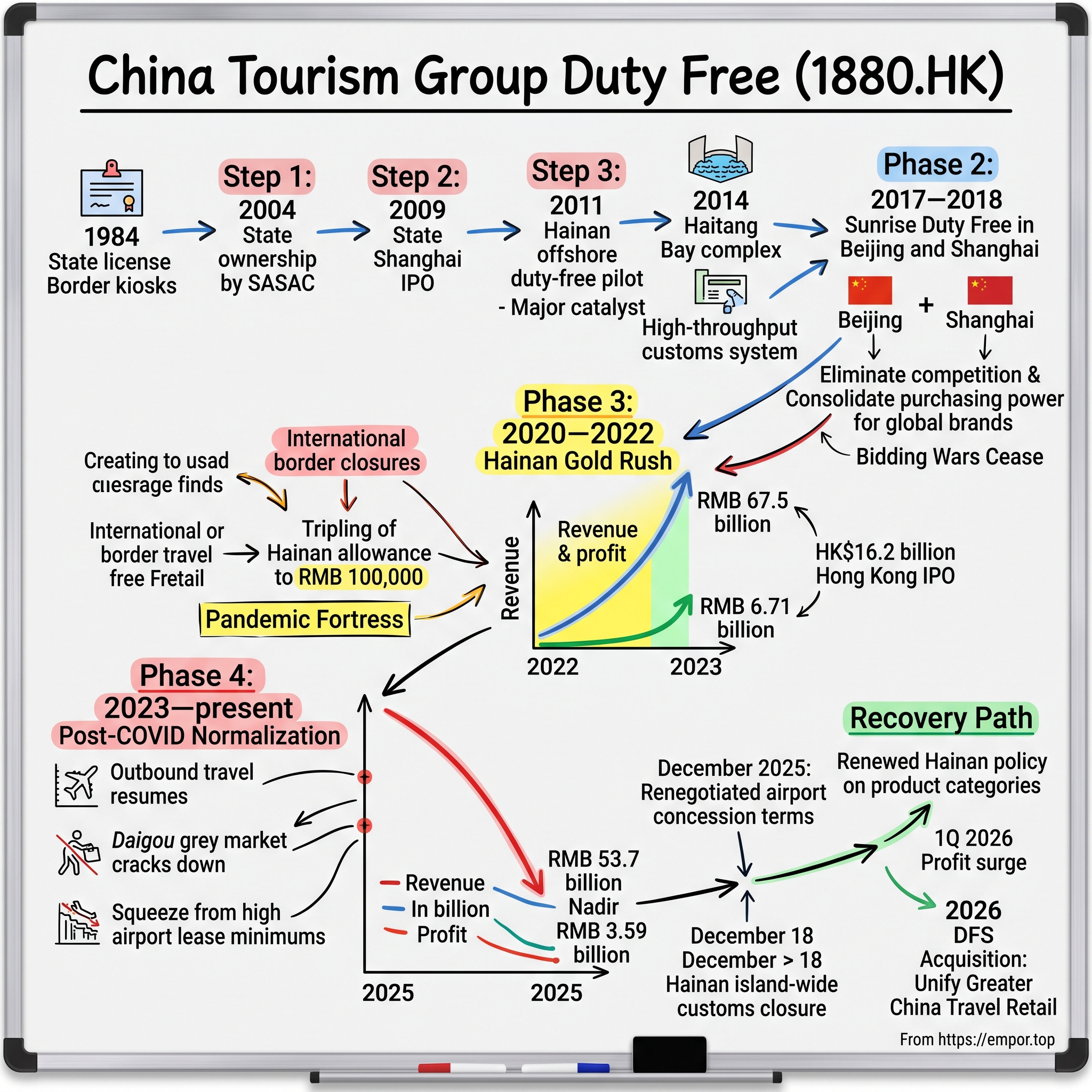
Four years earlier, that scene would have seemed ordinary. Two years earlier, it would have appeared implausible. Between those two points, 中国旅游集团中免股份有限公司 China Tourism Group Duty Free Corporation Limited — listed in Hong Kong as 1880.HK and in Shanghai as 601888.SH, and known commercially through its operating arm, 中国免税品集团 China Duty Free Group (CDFG) — shifted from being the world's largest travel retailer to one of the most visible casualties of China's broader consumption slowdown. Revenue peaked at RMB 67.5 billion in 2023 before declining for two consecutive years to RMB 53.7 billion in 2025.23 Over the same period, net profit attributable to shareholders fell 47%, dropping from RMB 6.71 billion in 2023 to RMB 3.59 billion in 2025 — a sharp contraction for an enterprise operating as a state-protected monopoly.23
That divergence between protected market position and halved profitability highlights the central dynamics of the company's business model.
First, what is actually being sold here
Duty-free retail is a ubiquitous sector that remains frequently misunderstood. Its economic case hinges on a specific regulatory mechanism.
When goods cross an international border, governments typically impose three distinct charges: import tariffs, value-added taxes, and — on luxury items such as cosmetics, watches, and spirits — consumption taxes. In China, these combined levies historically added between 25% and over 50% to the landed cost of imported premium goods. A duty-free operator functions as a merchant authorized under customs supervision to sell specified products without collecting these charges to eligible travelers.
Economically, the retailer neither manufactures, designs, nor invents new distribution models. Instead, it monetizes a tax differential granted by the state. Gross margins derive from the spread between wholesale purchase prices from global brands and retail prices offered to consumers, which typically sit 20% to 40% below domestic department store rates. The critical asset is neither prime real estate nor brand equity, but regulatory authorization.
Consequently, two fundamental questions dictate the industry's economics: how wide is the price differential, and which entities receive authorization? Every major operational shift reflects these core variables.
The thesis
The core investment framework for CTG Duty Free aligns with Hamilton Helmer's concept of a Cornered Resource — an advantage rooted in preferential access to a scarce asset rather than superior operational capability. Here, the scarce asset is the state licence. For four decades, the Chinese state largely concentrated the right to sell tax-exempt goods on domestic soil within a single enterprise. Purchasing leverage with global beauty conglomerates, bonded logistics infrastructure, and flagship retail complexes were subsequently constructed around that central regulatory privilege.
However, cornered resources remain subject to the authority of the granting entity, which can reallocate access. That dynamic unfolded directly beginning in December 2025.
The strategic trajectory follows four primary phases:
Phase 1 (1984–2016). A State Council-sanctioned administrator of border kiosks and diplomatic shops gradually expanded into commercial retail, listed in Shanghai, and positioned itself to capture China's primary duty-free policy initiative: offshore shopping in 海南 Hainan.
Phase 2 (2017–2018). The acquisition of 日上免税行 Sunrise Duty Free in Beijing and Shanghai eliminated costly competitive bidding and consolidated China's two largest international airport gateways. This transition shifted CDFG from a passive licence holder into a high-volume buyer with bargaining leverage over major suppliers including L'Oréal, Estée Lauder, and 資生堂 Shiseido.
Phase 3 (2020–2022). International border closures during COVID-19, combined with a tripling of the Hainan duty-free shopping allowance, redirected domestic luxury demand to Hainan retail locations. Revenue and net income expanded rapidly, elevating the company to the world's largest travel retailer and supporting a HK$16.2 billion listing in Hong Kong — the city's largest initial public offering of 2022.4
Phase 4 (2023–present). Following the reopening of international borders, outbound travel resumed, the 代购 daigou grey market contracted, and high airport lease minimums squeezed gateway margins. The company spent three years renegotiating concession terms before Hainan's 封关运作 island-wide customs closure on 18 December 2025 and updated offshore shopping policies helped stabilize baseline retail demand.56
Underlying this structural cycle is a crucial corporate governance dynamic. In December 2025, CTG Duty Free utilized its board representation to prevent its 51%-owned subsidiary from bidding to renew airport concessions held since 1999, prompting minority investors, including 中信集团 CITIC Group, to evaluate legal remedies.7
The narrative begins where the licence originated.
 Subscribe on LinkedIn
II. Foundations & The Monopoly Engine (1984–2016)
Picture the transaction that defined this company's first two decades: a Chinese seaman docking at a port in 1987, walking into a small state-run shop, and buying a carton of foreign cigarettes and a bottle of brandy with foreign-exchange certificates. That was the business. Not luxury retail—rationed access to imported goods, administered on behalf of the state.
CTG Duty Free traces its authority to 1984, when the State Council approved a single national enterprise to run duty-free operations across China.8 The mandate mattered far more than the physical shops. In an economy where imports carried punitive tariffs and consumption taxes, the authorization to sell tax-exempt merchandise was a substantial economic privilege, and the state granted it exclusively to one entity. For roughly two decades, the enterprise operated as an administrative agent: managing small outlets at border crossings, onboard sales on international flights, and diplomatic stores. Quotas took precedence over merchandising. Nobody was building category management capabilities at a border post in Manzhouli.
The transformation from administrator to commercial merchant occurred in three distinct steps.
Step one was ownership. In 2004, the duty-free business was folded into the state conglomerate that became 中国旅游集团 China Tourism Group, supervised by 国务院国有资产监督管理委员会 State-Owned Assets Supervision and Administration Commission (SASAC).8 This was no mere organizational detail. It established the direct reporting line that continues to govern the company's strategic priorities in 2026—explaining why capital allocation is frequently framed around national policy initiatives, such as the Hainan Free Trade Port, rather than purely around returns on incremental capital.
Step two was public capital. The Shanghai listing in 2009 provided the company with tools a ministry-affiliated trading arm previously lacked: an equity currency, public margin accountability, and the capital required to fund inventory and store buildouts at scale.8 Duty-free retail is deceptively capital-intensive; a retailer purchases luxury goods months before a tourist arrives in Sanya, carrying that inventory in a bonded warehouse until point of sale. A public balance sheet made that inventory model viable.
Public status also imposed operational discipline. Once quarterly financial results became public, the gap between a store moving inventory and one accumulating unsold goods became visible to external investors. While the listed entity of that era remained primarily a travel-services group with a duty-free division attached—duty-free operations would not generate the overwhelming majority of earnings until the following decade—the commercial infrastructure was established. Over the subsequent years, the company began negotiating directly with global brand owners rather than relying on regional distributors, curating category assortments rather than accepting passive allocations, and optimizing store layouts.
Step three was the policy shift that altered the retail landscape. In 2011, China launched the 海南离岛免税 offshore duty-free pilot in Sanya and Haikou. The economic policy was straightforward: affluent Chinese consumers were traveling to Hong Kong, Seoul, and Paris to purchase luxury items, resulting in tax revenue and domestic consumption leaking overseas. The pilot sought to test whether providing equivalent tax-free pricing domestically without requiring overseas travel would retain that spending within mainland borders.
The mechanics required a novel administrative apparatus. Conventional duty-free retail requires a shopper to depart the country as the legal trigger for waiving import duties. Hainan's pilot instead designated departure from the island as the qualifying event. A domestic tourist flying from Sanya back to Shanghai was treated, for tax purposes, as an outbound passenger. To prevent tax-exempt merchandise from leaking back into the mainland market, the state established a real-time verification system: every transaction was linked to an individual passenger's identity document and flight record, monitored against an annual per-person spending allowance, with merchandise delivered directly to airport departure gates.
That operational complexity created a high barrier to entry. The company functions not merely as a retailer, but as an integrated co-processor within China's customs framework. Every product unit resides in a bonded warehouse until released against a validated passenger record and reconciled to a confirmed departure. Operational errors in this environment constitute customs compliance failures rather than simple inventory miscalculations.
The policy results materialized rapidly following initial scale. The opening of the Haitang Bay complex in 2014 served as the primary proof point: a purpose-built luxury destination stocked with beauty and watch collections comparable to international shopping districts. Chinese consumers were traveling abroad primarily to access price differentials; once those tax-free price differentials were established domestically, consumer volume followed.
However, that dynamic carried a structural implication: when consumer demand is driven primarily by tax differentials rather than brand affinity or store experience, customer retention remains tied directly to the breadth of the price gap.
By 2016, CTG Duty Free operated a lopsided franchise. It possessed a national mandate and an expanding offshore retail hub in Hainan, yet it lacked control over China's primary international airport gateways in Beijing and Shanghai, which remained held by competing operators. Securing control of those international gateways would form the battleground for its next phase of expansion.
Every structural advantage enjoyed during this foundational era was granted through state regulatory policy. While exceptionally valuable during periods of exclusive access, those advantages remain subject to the regulatory conditions under which they are renewed.
III. The M&A Masterstroke: Securing the Gateways (2017–2018)
There is a specific kind of corporate strain that comes from bidding against a rival for an asset neither party can afford to lose. Airport duty-free concessions are the purest example. The airport owns a physical bottleneck—every departing international passenger must pass through a single corridor—and it auctions the right to sell to them. The winner pays a Minimum Annual Guarantee: a floor rent owed whether or not a single passenger shows up, plus a sales commission that, in the 2017–2018 Chinese market, ran as high as 18% to 36% of revenue depending on category.9
That auction structure transfers most of the economic surplus from retailer to landlord. It operates like renting a gold mine on a lease requiring a fixed fee plus a third of whatever is extracted: the tenant manages inventory, hires staff, absorbs currency fluctuations, and assumes fashion risk on unsold inventory, while the landlord monetizes the corridor.
Because airport concessions are awarded through competitive tender, the market price of the lease is set by whichever bidder holds the most optimistic traffic projections. In a two-bidder market where both parties view a flagship terminal presence as essential, the winner's curse becomes the default outcome rather than a tail risk.
In China's two most lucrative airport hubs, the auction pitted CDFG against a rival with deep operational roots.
日上免税行 Sunrise Duty Free had been operating at Shanghai's airports since 1999, making it the first foreign-invested airport duty-free enterprise in China.7 It controlled concessions at Beijing Capital and both Shanghai gateways—the terminals where outbound Chinese luxury shoppers and inbound business travelers concentrated. Each time a concession came up for renewal, CDFG and Sunrise bid each other into escalating rent terms, while 上海机场 Shanghai Airport and 首都机场 Beijing Capital International Airport collected the surplus.
Sunrise was not merely a passive competitor; it was a foreign-invested enterprise that had built China's most sophisticated airport retail operation over two decades. Having established dominant positions in Beijing and Shanghai when international retail licenses were rare, its shareholders were unlikely to surrender those hubs through a price war.
The resolution came not from higher bidding, but through consolidation.
In 2017, CDFG acquired 51% of Sunrise Duty Free (Beijing). In March 2018, it acquired 51% of Sunrise Duty Free (Shanghai) for approximately RMB 1.505 billion, a purchase that generated RMB 822 million of goodwill on the balance sheet.[^10]10 On a standalone trailing-multiple basis, paying that price for a concessionaire with heavy lease obligations and no owned real estate appeared high.
However, assessing the transaction solely on standalone cash flows overlooked its two strategic impacts.
First, CDFG eliminated its primary domestic counterparty. With Sunrise brought into the fold, no major domestic rival remained to compete for tier-one Chinese airport concessions. The bidding wars ceased because there was no second bidder left to drive up minimum guarantee thresholds—a structural shift that altered every subsequent concession negotiation across Chinese airports.
Second, CDFG consolidated purchasing power across global brand suppliers. Global beauty conglomerates—such as L'Oréal, Estée Lauder, and Shiseido—allocate travel-retail inventory and wholesale pricing based on scale, negotiating account by account. Prior to 2018, China's travel-retail channel was divided among multiple buyers. Post-acquisition, a single entity controlled procurement across Hainan, Beijing Capital, and Shanghai Pudong and Hongqiao—representing the majority of duty-free demand from Chinese luxury consumers globally.
The financial benefit appeared in gross margins rather than top-line growth alone. Improved volume rebates, favorable wholesale pricing, and exclusive product allocations lifted gross margins across the entire store network, including offshore Hainan locations unrelated to the airport leases. That purchasing scale reinforced the company's regulatory license, generating returns well above what the initial acquisition multiple suggested.
The merger also delivered operational capabilities. Sunrise brought two decades of operational experience in high-throughput airport retail. Airport environments demand rapid conversion: travelers often have only minutes between security clearance and boarding, requiring immediate visual clarity, rapid replenishment, and tight inventory management to prevent lost sales. The merchandising cadence and logistics systems developed by Sunrise at Shanghai Pudong since 1999 were integrated across CDFG's broader network.
Crucially, consolidation eliminated the rival bidder without removing the landlord's structural leverage. Airports retained their location bottleneck and continued to negotiate assertively. Minimum Annual Guarantees signed in the late 2010s assumed uninterrupted growth in international passenger traffic and per-passenger spending. Within two years, both assumptions broke simultaneously, transforming fixed floor rents from manageable operational costs into severe margin pressures.
First, however, the industry entered an unprecedented growth phase.
IV. The Hainan Gold Rush: Policy Catalyst & Pandemic Fortress (2020–2022)
In the spring of 2020, the Chinese government faced a structural bottleneck in consumer spending. Roughly 150 million annual outbound trips halted abruptly, trapping tens of billions of dollars in overseas luxury spending—historically directed to Tokyo, Seoul, Hong Kong, and Paris—within domestic borders while domestic retail suffered under mobility restrictions.
The policy response, announced on 29 June 2020 and effective 1 July, aggressively expanded the Hainan duty-free framework. The annual per-person offshore duty-free allowance rose from RMB 30,000 to RMB 100,000. Eligible product categories expanded from 38 to 45 to include liquor and consumer electronics. Crucially, the RMB 8,000 single-item price cap was eliminated, and per-purchase quantity limits were removed across most categories.11
For travel retailers, these changes fundamentally altered basket economics. Eliminating the single-item cap enabled tax-free purchases of high-end merchandise, such as RMB 60,000 watches, while tripling the overall allowance effectively removed basket size constraints for affluent shoppers. With international borders closed, Hainan became the sole domestic venue offering tax-advantaged luxury goods.
CTG Duty Free positioned itself ahead of the policy shift. In May 2020, it acquired a 51% stake in 海南省免税品有限公司 Hainan Duty Free Co., bringing under its control the provincial operator running the Haikou Riyue Plaza and Qionghai Bo'ao stores, alongside its 51% interest in the Haikou Meilan Airport duty-free shop.12 This acquisition converted a potential regional competitor into a consolidated subsidiary weeks before the policy expansion took effect.
The policy change created a captive retail market with no direct domestic alternatives. Group revenue rose from RMB 52.6 billion in 2020 to RMB 67.68 billion in 2021, while net profit attributable to shareholders climbed 57% to a record RMB 9.65 billion.13 Surpassing global peers Dufry and Lotte Duty Free, CDFG became the world's largest travel retailer by sales—achieving the top global ranking during a period when international travel was severely restricted, illustrating how completely Hainan's retail volume had decoupled from conventional travel trends.
Capital expansion matched the surges in sales volume. The Sanya complex was expanded into a luxury mall hosting global fashion houses including Chanel, Dior, Gucci, Cartier, and Hermès. In October 2022, the company opened 海口国际免税城 Haikou International Duty Free City, a multi-billion-renminbi development constructed on reclaimed port land that ranked among the world's largest standalone duty-free facilities.
Designed as a premier destination rather than a traditional transit outlet, the Haikou complex reflected capital allocation scaled against peak border-closure demand. However, the facility opened just as border restrictions began to ease and demand dynamics shifted, illustrating the structural risks of deploying long-term physical capital against a cyclical demand surge.
In August 2022, the company capitalized on its elevated valuation by issuing 102.8 million H-shares at HK$158 per share. The offer raised HK$16.2 billion (approximately US$2.1 billion) in Hong Kong's largest initial public offering of the year, establishing an A+H dual-listing structure when trading commenced on 25 August.414
From a corporate treasury perspective, the offering represented effective capital markets timing, raising hard-currency equity at peak earnings sentiment to fund ongoing infrastructure expansion. For secondary market investors purchasing at the issue price of HK$158, however, the transaction highlighted the operational risk of confusing temporary demand bottlenecks caused by travel restrictions with permanent structural growth.
Myth versus reality: the "consumption repatriation" story
Analyzing CTG Duty Free's pandemic-era performance requires evaluating two competing market interpretations.
The prevailing market narrative in 2021 posited that Hainan's tax policy had successfully achieved permanent "consumption repatriation." Under this view, domestic tax parity was sufficient to retain luxury spending within mainland borders permanently, allowing CDFG to compound earnings long after international travel resumed. Market sentiment reflected this optimism, with equity analysts projecting peak sales growth indefinitely and domestic investors dubbing the company the "duty-free Moutai."
The alternative interpretation viewed Hainan's revenue surge as a temporary effect of consumer travel restrictions. With outbound international travel suspended, Hainan operated as the sole legal domestic channel for tax-advantaged luxury goods. Under this framework, elevated retail traffic reflected a lack of alternatives rather than an enduring shift in consumer preference.
While borders remained closed, financial results supported both hypotheses equally. However, two underlying factors signaled vulnerability. First, a significant portion of Hainan purchasing volume was driven by 代购 daigou resale arbitrage rather than organic end-consumer demand, making sales sensitive to price margin spreads rather than brand affinity. Second, the company committed substantial capital to fixed retail infrastructure sized for peak pandemic run-rates.
The resolution of these opposing theories could not occur while travel restrictions remained in place. It would be tested directly once international borders reopened.
V. Post-COVID Normalization & The Airport Rent Reset (2022–2024)
The reopening of international travel did not arrive as a sudden shock, but as a steady, grinding erosion of Hainan's captive customer base.
Through 2023 and 2024, as international flight capacity out of China gradually recovered, affluent Chinese consumers resumed traveling abroad to purchase luxury goods at their points of origin. A depreciated Japanese yen made Tokyo especially attractive for Chinese shoppers, while tax-refund counters reopened across Seoul, Paris, and Milan. Hainan, which had served as the sole domestic alternative during the pandemic, became just one destination among many.
The resulting data reflected a severe demand contraction rather than a temporary slowdown. Island-wide offshore duty-free sales monitored by Haikou Customs dropped to RMB 30.94 billion in 2024, down 29.3% year on year. Total shoppers fell 15.9% to 5.68 million, while total units sold plummeted 35.5% to 33.08 million.15
The sharp divergence between shopper volume and unit volume revealed a fundamental shift in purchasing patterns. Because items sold fell more than twice as fast as tourist headcount, the contraction was driven less by declining visitor numbers than by the sudden disappearance of bulk buyers who previously purchased dozens of identical items per trip.
Those bulk buyers were professional 代购 daigou arbitrageurs. Under China's offshore duty-free rules, the annual RMB 100,000 tax-free allowance attaches to the individual traveler rather than the transaction. Arbitrage networks monetized these allowances by paying travelers to fly to Hainan, using their personal quotas to buy high-turnover cosmetics at duty-free prices, and reselling the merchandise on mainland e-commerce platforms below domestic retail prices. The business model relied entirely on capturing the state-created tax differential.
Throughout 2023 and 2024, the 海关总署 General Administration of Customs (GACC) and Hainan provincial authorities systematically dismantled these arbitrage networks through criminal prosecutions, buyer blacklists, and mandatory identity checks at airport pickup counters. While the enforcement campaign eliminated grey-market distortions, it also removed a massive volume layer that had artificially inflated channel sales—particularly in core beauty categories where CDFG carried heavy supplier minimum commitments. Consequently, average spend per shopper collapsed from over RMB 10,000 during the pandemic peak to between RMB 6,000 and RMB 7,000.
Although daigou sales represented low-quality revenue—consuming inventory and allowance quotas without building end-consumer brand equity—their removal permanently reset the company's baseline sales volume. As a result, evaluating post-pandemic performance against 2021 sales figures misinterprets an illegal arbitrage surge as a sustainable operational baseline.
CTG Duty Free's corporate financials mirrored the broader Hainan contraction. Group revenue declined 16.38% to RMB 56.47 billion in 2024, while net profit attributable to shareholders dropped 36.44% to RMB 4.27 billion.[^17] Profit fell more than twice as fast as revenue, exposing the earnings vulnerability of a fixed cost structure anchored by inflexible airport concession rents.
The trap, and the escape
Pre-pandemic airport concession contracts had been structured under the assumption of uninterrupted growth in international passenger traffic. These agreements bound CDFG to pay fixed Minimum Annual Guarantees regardless of actual retail sales. When international passenger volume returned without matching pre-pandemic per-capita spend—and as domestic e-commerce narrowed airport price differentials—the company was caught between fixed floor rents sized for a boom and retail revenues reflecting a slump.
In December 2023, CTG Duty Free executed supplemental lease agreements with Shanghai Airport and the commercial division of Beijing Capital International Airport.1617 The restructuring replaced rigid rent floors with variable formulas tied directly to passenger traffic and actual turnover, while reframing landlord relationships around joint merchandising initiatives, store redesigns, and shared promotional calendars.
Equity analysts characterized the revised concession terms as "incrementally favourable," as they converted a potential solvency threat into a manageable variable cost.17 For investors, the primary benefit was structural risk mitigation: gateway operations shifted from exposing the company to unhedged downside during traffic downturns to capping maximum concession losses.
However, lease restructuring alone could not restore operational profitability at underperforming hubs. In 2025, CDFG's Shanghai regional operations generated RMB 12.01 billion in revenue—down 25.1% year on year—and posted a net loss of RMB 208 million.18 Lowering rent floors reduced cash drain, but it did not alter the fundamental lack of retail demand at international gateways.
The nadir
The low point of this operational contraction occurred in the second quarter of 2025. For the first half of 2025, group revenue fell 9.96% to RMB 28.15 billion, gross profit dropped 12.23% to RMB 8.99 billion, and net profit attributable to shareholders decreased 20.81% to RMB 2.60 billion.1936 Second-quarter net profit dropped to RMB 662 million—the lowest quarterly earnings in nearly eight years—bringing the cumulative decline in the company's A-share market capitalization to approximately RMB 640 billion from its peak.37
That market capitalization decline surpassed the company's total cumulative revenue generated throughout the pandemic boom. Equity markets fundamentally re-evaluated the enterprise, shifting its valuation from a permanent growth franchise to a policy-dependent, cyclical retail business.
In response, management implemented targeted operational adjustments. The company expanded its "duty-free plus" initiative by entering duty-paid product categories, launching exclusive co-branded merchandise, and introducing the proprietary CDF Health line, while achieving a roughly 10% improvement in inventory turnover.19 Although a RMB 533 million inventory write-down in 2025 indicated that inventory adjustments lagged demand shifts in certain product lines, faster turnover demonstrated improved supply-chain responsiveness.
Meanwhile, addressing the persistent structural losses in Shanghai would require a far more decisive corporate intervention than renegotiating lease terms.
VI. Business Anatomy, Segment Economics & Management
A walk through the ground floor of the Sanya complex on a weekday illustrates the company's dual business model. The entrance is dominated by high-density beauty counters—Lancôme, Estée Lauder, La Mer, SK-II—staffed heavily and brightly lit, where shoppers carry baskets to purchase items in volume. Deeper inside, the architecture shifts: ceilings rise, lighting dims, and luxury boutiques like Chanel, Cartier, and Hermès operate behind dedicated thresholds with appointment queues and low customer-to-staff ratios.
These two environments represent distinct operational models sharing a single facility. The front of the store is a high-turnover consumables business relying on unit volume, supplier rebates, and rapid inventory replenishment. The back is a low-frequency luxury operation driven by product allocation, brand exclusivity, and high average order values. CTG Duty Free relies on the front of the store as its primary profit engine and the back as its core margin driver, with each zone reacting to different macroeconomic pressures.
Behind the regulatory framework and corporate history, the company operates across four distinct retail channels and several core product categories.
The channel stack
Hainan offshore duty-free remains both the primary revenue engine and a key structural vulnerability. In 2025, the Hainan region generated RMB 28.54 billion in revenue, accounting for 53.15% of the group total. This was divided among the Sanya complex at RMB 19.83 billion, Haikou International Duty Free City at RMB 5.80 billion, and the Hainan Duty Free subsidiary at RMB 3.31 billion.18 Because Hainan carries substantially lower concession fees than airport hubs, it has historically generated a disproportionate share of operating profit. However, the region's gross margin fell 0.82 percentage points in 2025 to 22.91%, landing below the group's overall average.18 This margin compression underscores that Hainan's earnings advantage stems from lower occupancy rent rather than premium pricing, as the company has increasingly resorted to retail discounting to protect market share on the island.
Airport gateway concessions provide broad brand visibility and move high volumes of cosmetics, but operate under challenging unit economics because airport landlords extract a substantial portion of retail surplus. During the first half of 2025, airport duty-free sales declined roughly 13% year on year despite a 20% increase in international passenger traffic, as average spending per shopper remained constrained between RMB 80 and RMB 120.19 This divergence between rising passenger volume and falling sales demonstrates that the channel's core challenge is not foot traffic, but a narrowing price differential between airport duty-free outlets and domestic e-commerce platforms.
Online duty-paid retail, operating through the cdf会员购 CDF Member Go platform, was created as a pandemic-era sales outlet but now poses a strategic dilemma. While the platform drives transaction volume, it competes directly with brand owners' direct-to-consumer channels, leading management to curb promotional activity to safeguard offline price positioning. The channel remained weak through the first half of 2025 amid intense price competition from rival e-commerce platforms during the June 618 shopping festival.19 Consequently, online duty-paid sales function primarily as a defensive measure to retain customer engagement, trading margin for retention rather than serving as an independent growth driver.
Downtown, border, and overseas stores represent the company's newest expansion vector. Following an August 2024 policy that authorized downtown duty-free locations across eight major cities—Guangzhou, Chengdu, Shenzhen, Tianjin, Wuhan, Xi'an, Changsha, and Fuzhou—and opened six existing city outlets to outbound travelers starting 1 October 2024, CDFG secured multiple tenders and began opening 市内免税店 downtown duty-free stores through 2025, including flagship locations in Shenzhen and Guangzhou.202122 Operating on a pre-departure ordering model, the format allows travelers to purchase merchandise up to 60 days before departure and collect their items at port departure gates.20
Product mix reflects a similar concentration. 香化 Beauty and cosmetics accounts for roughly 60% to 65% of total sales, 精品 fashion and luxury goods contributes 20% to 25% at higher gross margins, and tobacco, wine, and food make up the remainder. While less prominent, tobacco and spirits generate reliable cash flow at border and airport outlets, where import duties and consumption taxes create some of the widest price differentials in the product portfolio.
This heavy reliance on cosmetics exposes the business to structural changes in global beauty pricing. Travel retail cosmetics thrive on three conditions: compact product size for easy transport, recurring replenishment demand, and wide international price differentials set by brand owners. If major beauty conglomerates like L'Oréal and Estée Lauder align global price tiers and redirect consumers toward their direct-to-consumer channels, duty-free price advantages narrow. Selling cosmetics at a 12% discount rather than a 35% savings diminishes the channel's value proposition.
Furthermore, domestic market dynamics present an ongoing challenge. Domestic Chinese skincare and cosmetics brands have captured market share by offering competitive pricing that avoids import levies altogether. Younger consumers purchasing domestic brands operate outside the tax-exempt framework that CTG Duty Free monetizes, creating a structural shift in consumer preference that regulatory policy changes cannot fully offset.
The people, and what their turnover says
Corporate governance exhibits frequent executive turnover. 王轩 Wang Xuan assumed the chairmanship in October 2023. By the sixth board election announced on 10 June 2026, 范云军 Fan Yunjun—a former senior executive at China Mobile and China Unicom—was named chairman, alongside 常筑军 Chang Zhujun as general manager and 王月浩 Wang Yuehao as deputy general manager and Party secretary, with Wang Xuan remaining as a director.23 Domestic financial media highlighted that the company cycled through three chairmen in approximately two years.
A notable governance detail in the June 2026 board filing was that none of the nominated director candidates held shares in the company.23 While typical for an enterprise supervised by SASAC, this ownership structure aligns executive incentives primarily with national policy priorities—such as developing the Hainan Free Trade Port, supporting domestic consumption repatriation, and expanding downtown duty-free networks—rather than direct per-share equity returns. When national policy goals align with corporate earnings, public shareholders benefit; when policy directives require capital deployment into long-term infrastructure, return metrics can diverge.
Despite executive changes, capital allocation has remained disciplined. For 2025, the company declared total dividends of RMB 0.70 per share—comprising an RMB 0.25 interim payout and a proposed RMB 0.45 final dividend, totaling approximately RMB 935 million—representing a 40.5% payout ratio.3 CTG Duty Free closed 2025 holding approximately RMB 33.7 billion in cash and cash equivalents with no material interest-bearing debt.24 Furthermore, 2025 operating cash flow reached RMB 6.06 billion—down 23.69% year on year—continuing to exceed reported net profit.18 Balance-sheet strength and conservative leverage have provided resilience, though recent corporate developments indicate a shift in capital deployment strategy.
VII. Strategic Position & The "Why Win / Why Not" Story Spine
Understanding the company's strategic position in mid-2026 requires examining an eleven-day period in December 2025—the most consequential fortnight in its corporate history since the Sunrise acquisitions.
6 December 2025. At a board meeting of Sunrise Duty Free (Shanghai), directors appointed by CTG Duty Free—which holds a 51% controlling stake—voted unanimously against authorizing the company to bid for the 2026–2033 duty-free concessions at Shanghai Pudong and Hongqiao airports. They also declined to sign the required bid authorization and undertaking documents. Without those signatures, Sunrise Shanghai could not submit a valid tender prior to the 9 December deadline, effectively disqualifying an operator that had managed those airport concessions since 1999.725
The minority shareholders in Sunrise Shanghai were CITIC Group at 33.32% and Shanghai Airport Group at 15.68%. According to reporting by Caixin, CTG Duty Free sought to assume the gateway concessions directly amid an informal policy discouraging foreign partnership in domestic duty-free operations. Minority investors were reported to be evaluating legal remedies regarding the loss of their equity value.7
18 December 2025. Municipal authorities published the tender results. CDFG secured the concession packages covering Shanghai Pudong Terminal 2 and the S2 satellite hall, alongside the entire international area of Shanghai Hongqiao Terminal 1. Dufry—operating under parent company Avolta—won the concessions for Pudong Terminal 1 and the S1 satellite hall. Both operating agreements run from 1 January 2026 to 31 December 2033.26
The revised fee structure replaced previous minimum annual guarantees and uncapped sales commissions with fixed monthly rents per square meter—RMB 3,090 at Pudong T2/S2, RMB 3,141 at Pudong T1/S1, and RMB 2,827 at Hongqiao. Commission rates were lowered to 8–24% at Pudong and 8–22% at Hongqiao, compared to historical rates of 18–36%. Furthermore, Shanghai Airport invested up to RMB 98 million to acquire 49% equity stakes in the operating joint ventures established with each winning retailer.26
30 December 2025. CDFG signed the concession agreement for Beijing Capital's Terminal 3, covering 10,647 square meters of international departure and arrival zones from 11 February 2026 through 10 February 2034. The contract set a first-year guaranteed operating fee of RMB 480.27 million—subject to annual traffic-based adjustments—and established a sales commission starting at 5% that increases by one percentage point annually through year four before fixing.27
Examined together, these three developments present a structural shift distinct from both optimistic and pessimistic market forecasts.
On the operational side, a 5% opening commission at Beijing's primary international terminal represents a major reduction from historical rates. Shanghai's commission ceiling was similarly reduced by roughly one-third. Airport operators accepted variable risk-sharing formulas over rigid floor rents, allowing future recoveries in international passenger spending to flow to CDFG's net income at higher incremental margins than at any point in the preceding decade.
On the structural side, Avolta's entry into Shanghai Pudong ended the single-operator gateway model that the Sunrise acquisition established. Beijing's tender terms explicitly restricted any single bidder to one terminal package, signaling that Chinese airport landlords intend to maintain dual-tenant competition to secure favorable commercial terms. Consequently, while the state monopoly license remains intact, exclusive gateway control has been visibly diluted.
Running the frameworks honestly
Cornered Resource remains CDFG's foundational advantage, though it is now conditional rather than absolute. While state licensing continues to restrict new market entrants, regulatory authorities and airport operators have demonstrated a willingness to divide concessions among licensed entities to sharpen competitive dynamics.
Scale Economies has emerged as a complementary structural advantage. As the largest domestic procurement platform for travel-retail cosmetics and luxury inventory, CDFG commands significant purchasing leverage. The acquisition of DFS assets extends this procurement scale into Hong Kong and Macau.
Process Power provides a durable operational barrier. The company's deep integration with GACC administrative systems for real-time allowance tracking, bonded warehousing, and airport pickup logistics requires extensive institutional development that new licensees cannot easily replicate.
Switching costs and branding represent negligible competitive advantages within travel retail. Consumers incur virtually zero switching costs, routinely comparing prices in Sanya against overseas options on smartphones. Furthermore, retail foot traffic is driven by global luxury brand equities rather than store banner recognition. CDFG monetizes state-sanctioned price differentials rather than proprietary brand equity.
Under Porter's five forces, entry barriers remain high due to strict licensing regimes. Supplier power is substantial: global luxury conglomerates set worldwide pricing policies and direct-to-consumer strategies that can narrow duty-free price advantages. Buyer power is high, supported by instant digital price transparency across international retail and cross-border e-commerce. Internal rivalry has intensified as regional operators expand, with 海南省发展控股 Hainan Development Holdings holding approximately 7.1% of the Chinese duty-free market, 海南旅投 Hainan Tourism Duty Free at 4.6%, Shenzhen Duty Free at 3.8%, and 王府井 Wangfujing Group entering as a licensed operator, against CDFG's 78.7% national market share.28
Compared to international peers, CDFG's market share masks key operational nuances. Avolta brings multi-jurisdictional concession experience and operational footprint diversification into Shanghai Pudong. In South Korea, 롯데면세점 Lotte Duty Free and 신라면세점 Shilla Duty Free possess extensive experience in downtown duty-free formats designed to serve outbound Chinese consumers. While CDFG maintains home-market regulatory protections, its operational performance in open gateway competition is now directly benchmarked against international peers in Shanghai.
Why it wins from here
The primary evidence supporting a medium-term operational recovery appears in recent transaction data. Hainan's island-wide customs closure took effect on 18 December 2025, converting the island into a special customs zone under a "first-line liberalization, second-line control" regime that exempts most imported goods from import duties, VAT, and consumption taxes.5 Additionally, updated offshore duty-free rules enacted on 1 November 2025 expanded eligible product categories to 47—adding pet supplies and portable musical instruments—permitted domestic Chinese goods in offshore stores, granted eligibility to international departing travelers, and allowed island residents unlimited immediate pickup transactions across 15 categories.6
During the six months following the policy's implementation through 30 April 2026, offshore duty-free sales reached RMB 22.22 billion—a 22.6% year-on-year increase—as 2.973 million shoppers (up 9.4%) purchased 17.45 million items (up 5.5%).29 Deconstructing these figures illustrates the underlying quality of the channel recovery: total spending grew roughly two and a half times faster than shopper headcount and four times faster than item volume, demonstrating that consumers shifted toward higher-value merchandise rather than simply purchasing larger quantities. Following two years of product mix deterioration toward lower-priced cosmetics, this basket-size recovery represents a key operational inflection point.
First-quarter 2026 financial results reflected this operational improvement: group revenue rose 0.96% year on year to RMB 16.91 billion, while net profit attributable to shareholders surged 21.18% to RMB 2.35 billion, supported by gross margin expansion to 33.63% and a 28.26% revenue increase in Hainan to RMB 12.59 billion.3018 The first-half 2026 preliminary report confirmed sustained margin expansion, showing revenue down slightly by 1.99% to RMB 27.59 billion while net profit grew 19.49% to RMB 3.11 billion.31 Profit growth alongside stable top-line revenue indicates that lease cost restructuring has improved operating leverage.
The third growth vector centers on urban duty-free expansion. The downtown format allows outbound travelers to purchase items up to 60 days prior to departure for airport pickup, converting impulse travel purchases into planned shopping. CDFG secured municipal tenders across Guangzhou, Shenzhen, Xi'an, and Fuzhou and began opening stores through 2025.2223 However, store-level productivity remains unproven, as pre-departure shopping requires overcoming consumer collection friction. Until detailed store economics are disclosed, downtown concessions represent a low-cost option rather than a confirmed growth driver.
Why it may not
Four operational factors present structural risks to the investment thesis:
Supplier disintermediation. Continued price harmonization and direct-to-consumer expansion by global beauty and luxury conglomerates threaten to compress the tax-free price differentials that support travel-retail sales volume.
Consumer demand softness. Broader domestic discretionary spending remains constrained, leaving retail volume dependent on policy expansions rather than organic consumer confidence.
Outbound price competition. Currency movements, particularly a weak Japanese yen, maintain international price advantages that encourage Chinese consumers to spend overseas rather than domestically.
Policy equalization. As Hainan's island-wide customs closure matures, tax-exempt availability across the broader island economy could dilute the relative value proposition of dedicated offshore duty-free stores. Furthermore, the issuance of urban duty-free licenses provides regulatory authorities with a mechanism to distribute retail concessions to competing operators over time.
VIII. Playbook: Business & Investing Lessons
There is a photograph that circulated in the trade press after the March 2026 closing ceremony: executives from a Chinese state conglomerate, a French luxury group, and the family of an American entrepreneur who founded a duty-free business in Hong Kong in 1960, standing together on a stage. Sixty-six years of travel-retail history, three continents, and an industry's balance of power visibly rearranging itself.
That image is a fitting summary of what this company's forty-year arc actually teaches. It is not a story about retail brilliance. It is a story about how permission, contracts, and counterparties determine returns in a business where the merchandise is identical everywhere. Five strategic lessons travel well beyond this single company.
Lesson 1: Control the bottleneck, but check who owns the toll booth. The classic reading of airport and duty-free retail is that whoever controls the choke point where captive affluent consumers pass captures enormous surplus. That is half true. The retailer controls the sale; the airport controls the access. In a bidding market, the party controlling access captures most of the economics. CDFG spent a decade learning that owning the sale is only valuable if you also control the terms of access — which is why the 2023 renegotiations and the 2025 tender structure matter more to long-run returns than any single year's sales growth.
Lesson 2: M&A can be a margin tool rather than a revenue tool. The Sunrise acquisitions are the cleanest case study available of buying a competitor primarily to change your own cost curve. The revenue consolidation was almost incidental. What the deal bought was the end of an auction and the beginning of a supplier negotiation conducted from a position of monopsony. When evaluating any consolidation deal, the question worth asking is not "what does the target earn?" but "what does the target's disappearance do to the prices the buyer pays and receives?"
Lesson 3: Contract structure is a risk-management decision, not a procurement detail. The single largest destroyer of value in this company's recent history was not competition or consumer weakness. It was the shape of a lease. Fixed minimum guarantees converted a cyclical revenue business into something resembling a levered one, and it took two years of negotiation to undo. For any business dependent on concessions, franchises, or take-or-pay commitments, the fixed-versus-variable split in the contract is a first-order investment variable. Investors should read lease terms with the same seriousness they bring to the income statement.
Lesson 4: An e-commerce channel that exists to defend price is not a growth channel — and pretending otherwise is expensive. CDFG's duty-paid online platform generated real cash during lockdowns and then became a structural problem: every renminbi of aggressive online discounting undermines the perceived value of the offline duty-free proposition and irritates the brand partners whose allocations underpin the whole model. Management subsequently curtailed promotional activity. But the episode illustrates a general trap — a channel launched as a crisis measure acquires internal constituencies and keeps running long after its rationale expires.
A fifth lesson, still being written. The DFS transaction is the newest data point. On 19 January 2026, CTG Duty Free agreed to acquire DFS's travel retail business in Hong Kong and Macau — nine core stores — plus DFS intangible assets and brand rights for exclusive use in Greater China, for consideration of up to US$395 million, with the estimated price at completion around US$294 million.3233 Alongside it, LVMH's Delphine SAS and the Miller family's Shoppers Holdings HK subscribed for new H-shares at HK$77.21 apiece — roughly an 11.66% discount — for approximately HK$924 million in total. The deal completed on 19 March 2026.3234
Read that structure carefully, because it is strategic. LVMH exited an underperforming Greater China retail operation, took equity in the buyer, and thereby converted a shrinking owned-retail exposure into a stake in the dominant Chinese distribution platform. CTG acquired brand assets, prime Hong Kong and Macau locations, and a strategically motivated shareholder that also happens to be one of its largest suppliers. Executive director Luke Chang called the closing "not the finish line, but the launchpad for deep integration."32 Whether the transaction is accretive remains unproven, though the first-half 2026 flash report claimed the acquisition had already delivered positive integration results.31 That claim deserves verification against full interim financial accounts rather than unexamined acceptance.
The generalizable point is about who sells and why. When a global luxury operator decides that owning travel retail in Greater China is no longer the right way to reach Chinese consumers, and chooses instead to hold equity in the distributor, that is a considered judgment about where value accrues in the chain. It can be read two ways. Optimistically, it represents a supplier validating the buyer's platform with its own capital. Skeptically, it represents a supplier concluding that owned retail in this market earns a poor return and electing to be paid in wholesale margin and equity rather than store-level profit. Both readings are consistent with the facts as disclosed, and investors ought to weigh both.
And the meta-lesson, which applies to the entire story: when a business is built on a privilege, watch the privilege, not the sales line. Revenue tells you what happened last quarter. The terms of the licence, the shape of the lease, and the number of parties holding the same permission tell you what the next eight years will look like.
IX. Analysis, Stress Test & Bear vs. Bull Case
Imagine an activist investor with a meaningful H-share position sitting across from the board in Hong Kong. What do they put on the table?
The governance question that will not go away
They start with Sunrise Shanghai. A controlling shareholder used its board control to prevent a 51%-owned subsidiary from competing for the contracts that constituted essentially its entire business, and then bid for and won those contracts itself.725 Whatever the policy rationale, the transfer of value from the subsidiary — and therefore from minority shareholders like CITIC Group and Shanghai Airport Group — to the parent is clear.
Then they turn to the accounting consequences. In 2025, the company recorded RMB 882 million in total asset impairments. That included an RMB 533 million inventory write-down and an RMB 338 million goodwill impairment against Sunrise Shanghai — a direct write-off of a portion of the RMB 822 million in goodwill created by the 2018 acquisition.310 Management argued that excluding the goodwill charge, fourth-quarter attributable net profit rose by more than 150%.35 An activist investor would frame it differently: the impairment was the predictable arithmetic consequence of a decision the company itself made, and stripping it from the core earnings narrative obscures operational reality. It was not an external shock, but the deliberate winding down of a subsidiary.
The rest of the stress test
Overbuilt capacity. Hainan carries an expansive footprint of retail floor space — including the Sanya complex, Haikou International Duty Free City, and the Hainan Duty Free stores — built out during the 2020–2022 boom for sales volumes that have not returned. Island-wide sales in 2025 remained well below 2021 levels, even before the November policy reset. Carrying costs across that physical footprint remain a fixed drag on profitability until revenue per square meter recovers.
Discounting as a share-defense tool. The company holds over 85% of the Hainan offshore market, gaining nearly a percentage point in the first half of 2025.19 However, Hainan's gross margin declined that same year.18 Expanding market share while compressing gross margins is the classic signature of price-driven defense. While management frames this as market leadership, it reflects competitive pressure shifting onto the profit and loss statement rather than appearing in market share metrics.
Management accountability. Having cycled through three chairmen in roughly two years, operating under an executive team with no equity ownership, and following a strategic agenda largely shaped by state policy, governance remains a focal point. The central question for investors is straightforward: who is accountable for the capital deployment decisions made between 2020 and 2022, and how is strategic continuity maintained when leadership changes every eighteen months?
Second-quarter 2026 deceleration. The preliminary flash report shows second-quarter 2026 revenue fell 6.30% year-on-year to RMB 10.69 billion, while net profit rose 14.50% to RMB 758 million — marking a noticeable step down from first-quarter growth momentum.31 This deceleration raises questions as to whether first-quarter performance was largely driven by a temporary Spring Festival surge and initial policy launch rather than a lasting demand recovery.
Second-layer diligence: the items below the headline
A few secondary line items sit below the headline figures and warrant close scrutiny as detailed financial accounts are released.
Impairment judgment, not just impairment amount. The 2025 goodwill write-down against Sunrise Shanghai was partial rather than complete — an RMB 338 million charge against RMB 822 million in carrying value.310 Given that the subsidiary lost the airport concessions that formed its core business, the valuation assumptions supporting the remaining balance merit critical examination. Assessing the recoverable value of an entity whose primary operating contracts have expired requires careful scrutiny. Similarly, an RMB 533 million inventory write-down during a period of offshore retail recovery raises valid questions regarding how much slow-moving luxury stock remains carried on the balance sheet at cost.
The research and development line item. Operating expenses in 2025 included a reported 352.74% surge in research and development spending — an unusual spike for a traditional travel retailer.38 While the absolute figure remains modest relative to group revenue, likely reflecting investments in digital loyalty platforms, supply-chain technology, and proprietary product lines, a jump of that magnitude during a period of cost containment warrants scrutiny — especially as the administrative expense ratio rose 0.58 percentage points to 4.11% alongside declining overall revenue.18
Related-party corporate architecture. While the Shanghai restructuring was the most visible instance, the structural dynamic is broader. CTG Duty Free operates within a state-owned enterprise framework, competes for airport concessions against entities tied to municipal airport authorities, and now manages Shanghai joint ventures in which the airport landlord holds a 49% equity stake.26 While this structure aligns stakeholder interests during periods of expansion, it introduces complex governance questions regarding transfer pricing, promotional expense sharing, and capital deployment during downturns. Minority H-share investors possess limited legal recourse relative to typical listed retailers, rendering the December 2025 restructuring an informative precedent.
Shareholder structure and strategic alignment. For investors evaluating the share register, the equity subscriptions by LVMH and the Miller family introduced strategic shareholders whose commercial priorities as brand suppliers may differ from those of purely financial investors.34 A major brand owner may favor price discipline and brand equity preservation over high-volume discounting aimed at maximizing near-term retail sales. While this alignment can act as a stabilizing influence for long-term valuation, it introduces an additional variable into board-level strategy.
The bull case, stated at its strongest
The company controls approximately 78.7% of China's national duty-free market and over 85% of Hainan's offshore sales, having successfully renegotiated its most burdensome concession contracts.28 The restructured commission tier at Beijing Capital Terminal 3 and the revised fee framework in Shanghai position airport operations for expanding operating leverage for the first time in a decade. Meanwhile, Hainan's updated policy framework is demonstrating results, highlighted by average basket sizes expanding faster than visitor headcounts. The acquisition of DFS assets expands its footprint across Hong Kong and Macau while adding a major brand supplier as an aligned strategic shareholder. Supported by roughly RMB 33.7 billion in cash and cash equivalents with no material interest-bearing debt, the company maintained a 40.5% dividend payout ratio through the lowest point of its earnings cycle.243 Net profit is recovering even on flat top-line revenue — the classic indicator of a successful fixed-cost restructuring.
The bear case, stated at its strongest
The company's competitive moat was granted by state regulation, and regulatory authorities have begun distributing market access to competitors — evidenced by Avolta securing Pudong Terminal 1, new rules mandating split terminal concessions in Beijing, and downtown duty-free licenses awarded across multiple operators. Hainan's relative pricing advantage continues to narrow as the island's broader trade and tax regime liberalizes. Furthermore, the grey-market daigou volume that artificially inflated revenue during peak years has been permanently removed. Global beauty conglomerates, which supply 60% to 65% of total sales, are actively narrowing cross-border price gaps to protect their direct-to-consumer channels. Group revenue peaked in 2023 and has yet to resume structural top-line growth. Finally, corporate governance actions during the Sunrise Shanghai restructuring established a clear precedent regarding how the parent entity weighs minority shareholder interests against broader strategic goals.
Where the evidence actually points
A balanced assessment reveals that the bull and bear arguments address different time horizons. Over the near term, empirical evidence points toward operational recovery: policy incentives in Hainan are generating measurable spending increases, lease restructuring has contractually lowered fixed overhead, and net profit growth has materialized across consecutive reporting periods. Over a longer investment horizon, however, the structural erosion of market exclusivity remains a defining trend. The company's long-term profitability will depend increasingly on its purchasing scale and supply-chain execution rather than pure regulatory protection. That represents a fundamentally different investment framework than the one that drove valuations in 2021, requiring a correspondingly disciplined underwriting approach.
X. Epilogue & Key KPIs to Watch
Over the first three days of January 2026 — two weeks after Hainan's island-wide customs closure took effect and two months into the updated offshore policy — duty-free sales reached RMB 712 million. Year-on-year, item volume climbed 52.4%, shopper headcount rose 60.6%, and total purchase value surged 128.9%.39 Yet on 5 January, the first A-share trading day of the new year, the stock fell 4.52%, pulling back after a roughly 20% rally since the customs closure took effect.40
That sequence provides a fitting conclusion to this story. The operational recovery was real and measurable, but equity markets had already priced in much of the gain during the preceding three weeks. What investors must underwrite going forward has fundamentally shifted. The key question is no longer how fast Hainan can grow, but what a monopoly is worth once the state that granted it begins distributing market access to competitors.
In 2021, the investment case required minimal qualification: the company possessed a regulatory monopoly, strong policy tailwinds, and no domestic competition. By 2026, the framework is far more nuanced. State licensing protections are consciously easing, policy revisions carry both benefits and trade-offs, and investment returns depend on whether the purchasing scale and logistics infrastructure developed during the boom remain defensible.
For long-term investors, three key performance indicators carry the most signal.
1. Hainan spend per shopper. Rather than headline island sales or tourist arrivals, spend per shopper serves as the cleanest measure of whether consumers are trading up or responding to retail discounts, isolating underlying demand from policy-driven footfall. The 2020–2022 boom elevated average spending above RMB 10,000, before the enforcement campaign against grey-market 代购 daigou arbitrage drove it down to between RMB 6,000 and RMB 7,000. Post-November 2025 data showing purchase value expanding significantly faster than shopper headcount provides the initial signal of durable product mix improvement. If that trend stalls, Hainan's recovery risks proving to be a temporary policy stimulus.
2. Blended gross margin. The group recorded a gross margin of 32.75% in 2025, which expanded to 33.63% in the first quarter of 2026.18 This single metric reflects three operational dynamics: supplier rebate terms, the discounting intensity required to preserve market share in Hainan, and the category mix between high-turnover 香化 cosmetics and high-margin 精品 luxury boutiques. If market share is being defended through price cuts, gross margin compression will signal the shift long before it appears in market-share disclosures.
3. Selling expense ratio. The group's selling expense ratio stood at 16.17% in 2025, up 0.12 percentage points year on year.18 With airport concessions in Shanghai and Beijing operating under restructured fee models starting in 2026, this ratio serves as the primary test of contract execution. If airport revenues recover and the selling expense ratio declines, the operating leverage thesis is confirmed. If sales recover without a corresponding drop in this ratio, the revised concession terms offer less margin relief than anticipated.
Secondary indicators—such as store openings, loyalty program metrics, and downtown license awards—provide context, but these three metrics demonstrate whether the core business engine is generating sustainable returns.
The final outlook is neither triumphant nor dismissive. CTG Duty Free remains the dominant operator in the global travel-retail sector, supported by scale in procurement and customs logistics that competitors cannot easily replicate. However, the operational contraction from 2023 through 2025 demonstrated that state-granted privileges establish a regulatory baseline rather than a guaranteed return. Entering the second half of 2026 with restructured airport contracts, an expanded store footprint, new executive leadership, and an evolving regulatory landscape, the company faces a structural test: whether the enterprise built around a state monopoly has developed an operational model capable of succeeding without one.
References
-
中国中免2025年报2026一季报点评:政策红利释放带动公司经营情况恢复 — 新浪财经/山西证券, 2026-05-15 ↩
-
中国中免2024年营收564.74亿元同比降16.38%,净利润42.67亿元同比降36.44% — 新浪财经, 2025-03-28 ↩↩
-
CTG Duty Free Raises $2.1 Billion in Hong Kong Listing — Bloomberg Law, 2022-08-18 ↩↩
-
Hainan's island-wide customs closure and why it matters to foreign investors — Norton Rose Fulbright ↩↩
-
Hainan Unveils New Offshore Duty-Free Policy: Expanded Categories and Broader Benefits — TropicalHainan.com ↩↩
-
Shanghai Duty-Free Battle Pits State Giant Against Foreign Partner — Caixin Global, 2025-12-09 ↩↩↩↩↩
-
China Tourism Group Duty Free Corporation Limited — Official Corporate & Investor Relations Website ↩↩↩
-
Hainan to raise duty-free shopping quota to 100,000 yuan — China.org.cn, 2020-06-30 ↩
-
CTG Duty-Free sets dual sails in the A+H era with successful Hong Kong listing — The Moodie Davitt Report, 2022-08 ↩
-
China Tourism Group Duty Free Corporation Limited — Announcement, HKEXnews, 2023-12-26 ↩
-
China Duty Free Group parent strikes "incrementally favourable" revised rental agreements for Beijing and Shanghai Pudong & Hongqiao airports — The Moodie Davitt Report, 2023-12 ↩↩
-
【山证消费】中国中免(601888.SH)2025年报2026一季报点评 — 新浪财经, 2026-05-15 ↩↩↩↩↩↩↩↩↩
-
China Tourism Group Duty Free post sharp fall in H1 sales and profits — The Moodie Davitt Report, 2025-08 ↩↩↩↩↩
-
China announces new downtown duty-free opportunities — DFNI, 2024-08-28 ↩↩
-
Downtown duty-free shopping in China gets policy boost — The State Council of the People's Republic of China, 2024-08-28 ↩
-
China Duty Free Group unveils new downtown stores in Shenzhen and Guangzhou — DFNI, 2025-08-27 ↩↩
-
China Duty Free Group 2024–2025: What the Consumption Whitepaper Reveals About China's Evolving Duty-Free Market — China Trading Desk ↩↩
-
China Tourism Group Duty Free, DFS and LVMH finalise acquisition and share subscription agreement — The Moodie Davitt Report, 2026-03 ↩↩↩
-
中国中免:收购DFS大中华区旅游零售业务相关股权及资产的估计代价为2.94亿美元 — 每日经济新闻, 2026-03-19 ↩
-
China Tourism Group Duty Free sounds upbeat note after strong Q4 despite full-year revenue and profits fall — The Moodie Davitt Report, 2026-03 ↩
-
中国中免2025年报解读:研发费用暴增352.74% 经营现金流大降23.69% — 新浪财经, 2026-03-30 ↩
 LinkedIn
 WhatsApp
 Reddit
 Hacker News
 Email
Email Kindle
 RSS Feed
 Spotify
 Apple Podcasts
 Amazon Music
 Audible
 YouTube