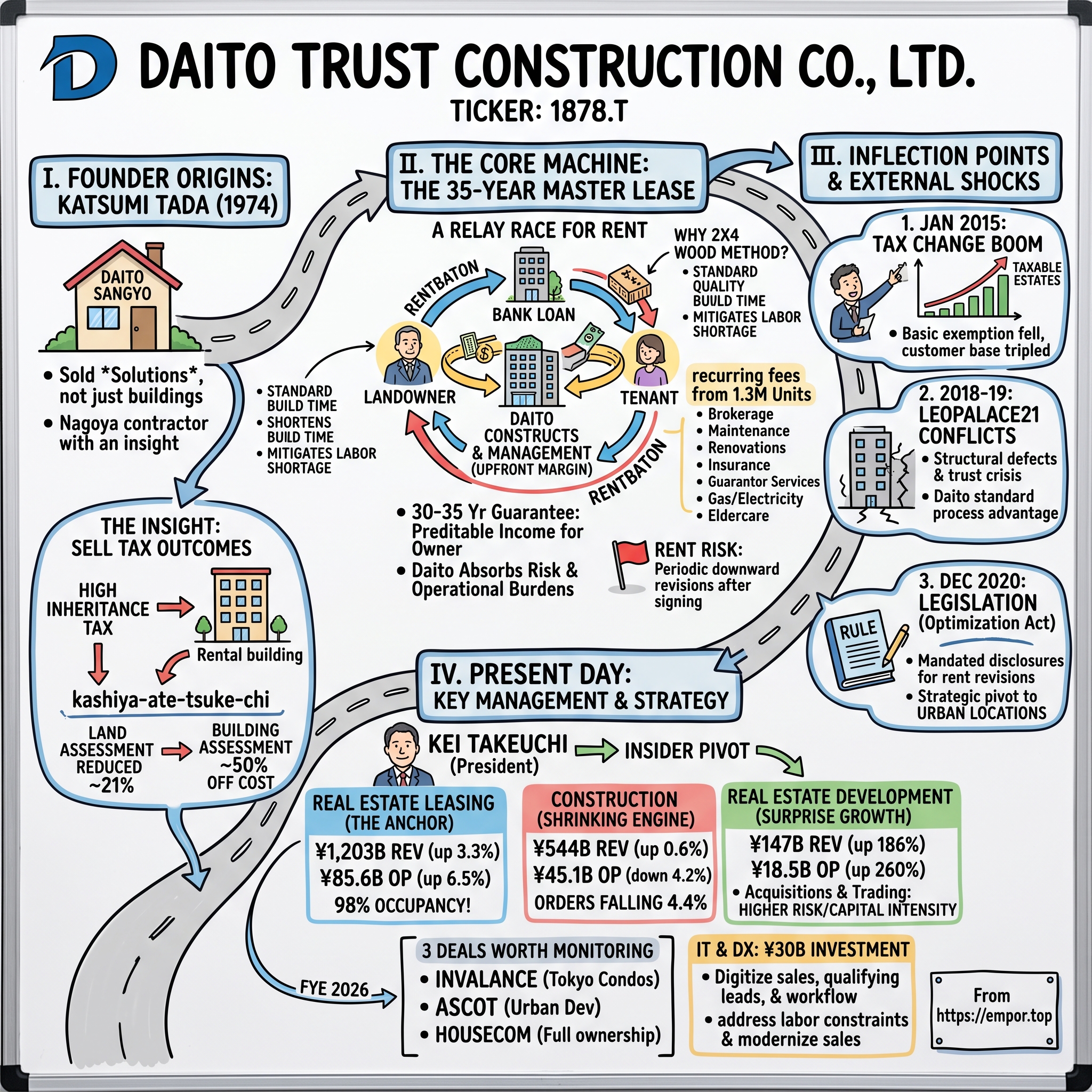
Daito Trust Construction: The Engine of Japan's Landowner Empire
I. Introduction & Episode Roadmap
Picture a two-lane road on the edge of a Japanese city in the mid-1990s. On one side, a rice paddy. On the other, a paddy that used to be a paddy — now a cream-colored, two-story wooden apartment building with eight units, external staircases, a bicycle rack, and a small parking lot. The farmer who owns it is in his seventies. He did not want to become a landlord. He did not have the ¥80 million to build the structure. He is not managing it, marketing it, or collecting the rent. And yet, every month, a fixed sum arrives in his bank account, and when he dies, his children will inherit an estate whose taxable value is a fraction of what it would have been had he simply kept the field.
Multiply that building by roughly 1.3 million units and you have 大東建託株式会社 Daito Trust Construction Co., Ltd. (1878.T), a company that most non-Japanese investors have never heard of, and that generated ¥1.98 trillion in revenue and ¥135.3 billion in operating profit in the fiscal year ended March 2026 — both company records.12
Here is what makes Daito genuinely unusual as a business object. It is classified as a construction company. It behaves like an asset manager. Its actual product is neither a building nor a fund — it is a decision. Specifically, the decision by an elderly, land-rich, cash-poor Japanese household to convert an illiquid, heavily taxed asset into a leveraged, tax-advantaged, income-producing one, using someone else's balance sheet expertise and someone else's guarantee. Daito sells that decision door to door, builds the physical manifestation of it, takes a construction margin up front, and then keeps earning on the same asset for the next three decades through a master lease, a tenant brokerage, a maintenance contract, an LP gas meter, and an insurance policy.
That is the core operation. It is also where the tension lives. A company that earns a rich margin at the moment of sale, and then bears the multi-decade obligation created by that sale, has a structural incentive problem baked into its business model. Japanese regulators noticed. So did landowners. So did the courts.
The scale, stated plainly
Daito's rental management arm has ranked first in Japan for managed rental units for 29 consecutive years, with 1,294,332 units under management as of March 31, 2025 — a figure that is roughly 1.8 times that of the second-place group.3 Residential occupancy on a rent basis stood at 98.0% for the year ended March 2026.4 The leasing segment alone produced ¥1,203.1 billion in revenue, making it, on its own, one of the larger real estate services businesses in Asia.1
But scale is not the core thesis. Plenty of Japanese companies are large and structurally unprofitable. The core thesis question is narrower: does this cash flow persist, and who captures it?
The core proposition — and the skeptic's version
Management's version: Daito is a comprehensive land-utilization platform with an unmatched installed base, an annuity-like leasing engine, and a growing urban development arm.
The skeptic's version: Daito is a construction company that has learned to book a leasing business on top of an origination business, whose new-order volume is shrinking, whose master-lease obligations run 30-plus years against rents it can only cut by negotiating with the very customers it sold to, and which is now spending its balance sheet buying urban development inventory to replace growth it can no longer generate in the suburbs.
Both versions are supported by the same financial statements. The analysis that follows seeks to determine which view the evidence favors — and, more usefully, what conditions must hold for each to be true.
Roadmap
The story unfolds in five sections. First, the origin: a Nagoya contractor and a peculiar feature of Japanese estate law. Second, the machine itself — how a 35-year master lease actually works, and what it costs. Third, the segment economics, including the parts that do not show up in headline figures. Fourth, the three external shocks that shaped the modern company: a tax change, a competitor's collapse, and a statute written specifically about businesses like this one. Fifth, the present — 竹内啓 Kei Takeuchi's capital allocation, three acquisitions worth examining, and the bull-versus-bear framework, ending with the key metrics that resolve the debate.
Start where every Japanese land story starts: with tax.
 Subscribe on LinkedIn
II. Founder Origins & The Landowner Thesis
In June 1974, a 28-year-old from Mie Prefecture named 多田勝美 Katsumi Tada registered Daito Sangyo in Chikusa Ward, Nagoya, with ¥1 million in capital.5 Tada was neither an architect nor a developer, nor was he heir to a family fortune. Born in July 1945, he joined auto-parts manufacturer Koito Manufacturing straight out of school in April 1964 before transitioning into construction sales.6 The original business was conventional: winning contracts to build commercial structures — warehouses, small factories, and tenanted buildings — for landowners in the Nagoya region.
What separated Tada from hundreds of regional contractors was a reframing that appears obvious only in hindsight. A contractor sells a building. Tada realized his customers did not want buildings; they wanted a solution to a problem they were reluctant to discuss. They were wealthy on paper but squeezed in practice, as suburban land values rose while their agricultural income stagnated.
The insight: sell the tax outcome, not the structure
Japan taxes inherited estates aggressively, and it values different asset classes differently for tax purposes. Cash is assessed at face value. Idle land is assessed at roadside land-value estimates, which hover close to market rates. However, land with a rental building on it is legally classified as 貸家建付地 kashiya-ate-tsuke-chi. Its assessed value is reduced by a formula that multiplies the self-use land value by one minus the borrowed-land right ratio, multiplied by the standard 30% borrowed-house ratio, multiplied by the proportion of units actually rented. In a typical residential area with a 70% borrowed-land ratio, that formula reduces the land's assessed value for estate tax purposes by roughly 21%.7
The building provides additional tax relief. A newly constructed apartment block is assessed not at its construction cost but at its fixed-asset valuation — typically about half the construction outlay — and then discounted by another 30% under the borrowed-house factor because tenants occupy the units.7 Consequently, ¥100 million in cash, taxed at full value, is transformed into a physical asset assessed at roughly ¥35 million.
The structural leverage completes the arrangement. Because the landowner borrows from a commercial bank to construct the building, the loan is recorded as an estate liability, deducting at face value from the taxable base. The asset side is marked down by statute, while the liability side remains unadjusted. In this framework, debt functions not as a risk multiplier, but as a tax minimization tool.
Tada compressed this complex arithmetic into a straightforward proposition for aging landowners: the bank provides funding, Daito constructs the building, estate tax liabilities fall, and property management is handled externally.
This structure targeted a specific demographic. The typical Daito client was not liquid or wealthy in the conventional sense. They were families holding ancestral farmland that urban expansion had encircled, leaving them with multi-million-yen land holdings that generated minimal income and could not be partially liquidated to pay estate taxes. Forced land sales at distressed valuations to meet tax obligations represented a recurring failure mode in Japanese estate planning. Daito's offering mitigated that specific outcome, making leverage palatable to risk-averse landowners.
The uncomfortable symmetry
Examined critically, this model creates a structural asymmetry that underpins its ongoing controversy. The tax reduction is immediate and certain, governed by statutory valuation formulas. The economic return on the apartment building, by contrast, is long-term and uncertain, dependent on tenant demand over thirty years in regional municipalities facing population decline.
When a client exchanges a certain tax benefit for an uncertain, long-term operational risk — guided by a counterparty that collects its margin upfront during construction — conflict is structurally built into the transaction. Discontent emerges not necessarily from misrepresentation, but because the tax benefits materialize at signing while operational challenges manifest years later. Subsequent legal disputes, regulatory scrutiny, and reputational challenges trace directly to this underlying economic structure.
The 1980 promise that became the whole company
A central vulnerability in the pitch was vacancy risk. If unit occupancy dropped, debt service would falter. In March 1980, Daito addressed this by establishing the Daito Mutual Aid Society, a vacancy-guarantee scheme promising landowners fixed income regardless of occupancy rates.5
This guarantee shifted Daito's fundamental business model. By guaranteeing rental income, Daito transitioned from a construction contractor into a long-term risk-bearing counterparty. The company had to prioritize ongoing tenant demand, site selection, and building design, because vacancy losses fell directly onto its own balance sheet. Managing this exposure required developing in-house leasing, marketing, and property management capabilities. What began as an owner incentive forced the company to vertically integrate.
Reflecting this strategic shift, the company renamed itself 大東建託 Daito Kentaku in April 1988, combining the characters for "build" and "entrust."5 It listed on the Nagoya Stock Exchange's second section in March 1989, relocated its headquarters to Tokyo in April 1990, moved to the Nagoya first section in September 1991, and joined the Tokyo Stock Exchange first section in February 1992.5
Daito subsequently internalized every post-construction service: establishing a finance subsidiary in 1993, launching the Housecom rental brokerage in 1994, taking over direct property management in 1999, and adding gas supply services in 2001 and 2002.5 These expansions allowed Daito to control operational variables affecting occupancy while capturing incremental margins across the asset lifecycle.
The policy shock that supplied the customers
External regulatory changes accelerated adoption. Following the collapse of Japan's asset bubble, the government revised the 生産緑地法 Productive Green Land Act in 1992. The previous long-term farming continuation framework had been abolished in 1991; under the 1992 framework, designated urban agricultural land retained low farmland property tax rates and inheritance tax deferrals only if owners committed to a binding 30-year agricultural obligation.8
Landowners in urban promotion zones faced three distinct paths: commit to thirty years of farming for modest yields, forfeit the designation and absorb residential-rate property taxes, or construct rental housing funded by debt to secure guaranteed income while lowering estate tax valuations.
Daito targeted this third option. Its salesforce conducted extensive door-to-door solicitation — 飛び込み営業 tobikomi eigyō — visiting agricultural households across suburban Japan. This intensive sales methodology created a distribution network that competitors found difficult to replicate through traditional marketing.
However, this high-pressure sales culture created labor issues. A 2007 case at the Fujieda branch was recognized by the labor bureau in 2010 as work-related after the employee logged 80 to 120 hours of monthly overtime, and the company settled with the family in October 2011 for ¥35 million; further deaths and harassment allegations were reported through 2017, the year employees formed the company's first labor union.9 For investors, these events highlight whether an aggressive, labor-intensive sales model remains viable in an evolving Japanese labor market.
This operational tension remains central to Daito's long-term outlook as current management seeks to modernize its distribution model. Evaluating that transition requires examining the underlying mechanics of Daito's core master-lease offering.
III. The Core Engine: The 35-Year Master Lease & Structural Economics
Imagine the contract as a relay race with four runners and one baton, where the baton is the tenant's rent.
A landowner signs. Daito's design team produces a standardized two-by-four wooden apartment building — engineered, repeatable, and manufactured rather than crafted. Daito's finance arm arranges the bank loan. Daito constructs the building and books construction revenue upfront. Upon completion, Daito's leasing subsidiary, 大東建託パートナーズ Daito Trust Partners, signs a 一括借上げ ikkatsu kariage master lease: it rents the entire building from the owner, typically for 30 to 35 years, at a discount to expected market rent. Daito then sublets the individual units to tenants through its consumer brand いい部屋ネット E-Heya Net.
The owner's economics are structured to be predictable: a fixed monthly receipt, a bank debt payment, and the remaining spread. No tenant calls, no vacancy anxiety, and no leasing commissions. Daito absorbs those operational burdens.
Why "two-by-four" is a business decision, not a construction detail
While easily overlooked, the choice of construction method directly explains Daito's margins and risk profile.
Traditional Japanese wood construction — 在来工法 zairai kōhō — is a post-and-beam system. A skilled carpenter joins vertical posts to horizontal beams, carrying structural loads through those joints. It is flexible and craft-oriented, meaning building quality depends heavily on individual carpenter skill.
The two-by-four method, adapted from North American framing, relies instead on load-bearing panels — floors, walls, and roof assembled from standardized dimensional lumber into a rigid box. Structural loads distribute across surface panels rather than timber joints. In practice, components are precut off-site to exact specifications, assembly sequences remain identical across projects, and quality control can be standardized across job sites.
For a company building thousands of units annually via a nationwide field organization rather than a permanent workforce of master carpenters, this construction method transforms quality control from a personnel-dependent variable into a repeatable system. It shortens build times, mitigates exposure to Japan's shrinking pool of skilled construction labor, and reduces the risk of structural defects spreading unnoticed across a portfolio. It also establishes a clear architectural boundary: standardized panel construction suits suburban walk-up apartments, but cannot be deployed for high-rise urban developments.
Where the money actually comes from
The spread between tenant payments and owner payouts powers the leasing engine, but it represents only part of the revenue model. The installed base of 1.3 million units serves as a recurring distribution channel that Daito monetizes across multiple lines: brokerage fees on tenant placement — where the company executed 345,229 tenant placements in the fiscal year ended March 2026 — along with building maintenance, unit turnover renovations, tenant insurance, guarantor services, unit electricity and LP gas supply, and on-site eldercare and childcare facilities.10
Where a conventional property manager collects a standard management fee of a few percent of rent, Daito captures the sublease spread alongside fee-equivalent economics from multiple ancillary services attached to the same doorway. Unit origination serves as customer acquisition; adjacent services capture long-term wallet share.
The mechanism, in plain terms
In operational terms, the structure resembles an airline operating as its own aircraft lessor. Daito leases the entire structure from the property owner at a fixed rate and sells individual seats to tenants. When occupancy remains high, Daito retains the margin upside; if units sit vacant, Daito remains obligated to pay the owner. With residential occupancy on a rent basis reaching 98.0% in the fiscal year ended March 2026, portfolio utilization has remained consistently high through economic downturns, demographic shifts, and the COVID-19 pandemic.4
This stability reflects product positioning: Daito offers standardized rental housing at competitive price points within its target local markets, backed by a proprietary nationwide brokerage network. Demand for entry-level rental housing exhibits low cyclicality, giving the segment utility-like cash flow characteristics.
The catch, and it is a real one
The long-term master lease contains a structural vulnerability. Contracted rents are not fixed for 35 years; they undergo periodic revisions, typically every two to five years. As structures age, local demographics shift, or competing units enter the market, tenant rents can decline faster than Daito's master-lease obligations to owners.
To protect its operating margin when market rents fall, Daito must negotiate reductions in the guaranteed rent paid to the landowner. Consequently, decades after the original agreement, the company must return to the owner to revise lease terms downward.
Japanese legal precedent adds complexity to these renegotiations. Under the Land and Building Lease Act, sublease operators are legally classified as tenants. Historically, courts granted operators statutory tenant protections to seek rent reductions — a doctrine landowners viewed critically, as the master-lease provider promising income stability could invoke tenant rights to adjust its obligations.
This dynamic illustrates a key conflict in the business model: the entity setting initial rent projections, constructing the building, and booking upfront construction profits is the same party that later re-evaluates those rent assumptions. Unlike an independent third-party appraiser, Daito operates with an inherent dual role.
A secondary effect impacts landowner capital structures. Landowner bank loans are typically amortized over 30 years based on initial rent schedules. When guaranteed rents are reduced, bank debt service requirements remain unchanged. The resulting margin compression directly reduces the landowner's net equity cash flow. As a result, long-term rent risk is partially transferred back to individual landowners holding single-property debt obligations, while Daito maintains portfolio-wide diversification across 1.3 million units. Over a multi-decade horizon, the master lease functions as a contractual shock absorber rather than an absolute transfer of market risk.
For landowners seeking tax mitigation with limited alternative uses for suburban acreage, a leveraged rental asset with master-lease backing can remain a rational choice. However, evaluating Daito's long-term earnings durability requires recognizing that lease guarantees maintain viability through periodic renegotiation, defending leasing spreads in softening rental markets.
The tenant side, which nobody models
On the tenant acquisition side, E-Heya Net provides a structural distribution advantage. As one of Japan's largest rental brokerages, Daito participates broadly in market-wide tenant searches, allowing it to direct qualified prospective tenants toward its managed inventory. Having executed 345,229 tenant placements in the fiscal year ended March 2026, Daito operates a centralized demand-allocation mechanism across its housing supply.10
This integration explains how a property portfolio concentrated in aging suburban markets maintains 98% occupancy. By controlling both the listing platform and the brokerage channel, Daito can adjust pricing, promotional incentives, and placement placement dynamically across its portfolio — an operational capability unavailable to independent landlords managing smaller holdings. Scale in this context reduces structural vacancy, directly supporting recurring revenue.
In response to market shifts, management has adjusted its underwriting criteria for new orders, prioritizing transit-accessible, higher-density locations where market rents decay more slowly, while scaling back development on isolated rural parcels. This strategic pivot is reflected in current order books, though urban land acquisitions require higher upfront capital commitments.
These operational trade-offs shape the consolidated financial picture: a steady leasing expansion, a construction segment maintaining profitability on lower volumes, and a rapidly expanding third division.
IV. Segment Breakdown & Financial Economics
The fiscal year ended March 2026 serves as an instructive case study. Each of Daito's three primary segments told a distinct story, and together they illustrate how the company's operational model is evolving.
Real estate leasing: the anchor
Leasing revenue reached ¥1,203.1 billion, an increase of 3.3%, while operating profit grew 6.5% to ¥85.6 billion.1 This segment generates roughly 61% of consolidated revenue and represents the group's largest profit pool prior to corporate overhead.
The segment operates on an operating margin of roughly 7.1%. For a division frequently described as an annuity engine, this margin is notably narrow—and that thinness is central to its economics. Daito passes the vast majority of tenant rents through to property owners, retaining a spread that represents a small percentage of a large cash pool. Consequently, leasing profit is heavily leveraged to occupancy rates in both directions. A single percentage point decline in occupancy reduces leasing profit disproportionately, because the master-lease rents owed to landowners remain fixed. This operational asymmetry represents the company's most critical financial sensitivity, though it is absent from top-line metrics.
Because operating profit grew faster than revenue in the fiscal year ended March 2026, the sublease spread expanded modestly. This expansion aligns with occupancy rising to 98.0% alongside rent growth in urban markets.4 While a single year does not establish a long-term trend, it provides empirical evidence against the thesis that sublease spreads face immediate structural erosion.
Construction: the profit engine that is quietly shrinking
Completed construction revenue rose 0.6% to ¥544.3 billion, while operating profit fell 4.2% to ¥45.1 billion.2 Gross margin on completed construction reached 25.4%, up 0.1 percentage points, indicating that the operating profit decline stemmed from elevated personnel and overhead expenses below the gross line.210
The more critical indicator is order volume. New construction orders fell 4.4% to ¥570.5 billion, and the order backlog shrank 2.3% to ¥783.6 billion.2
This contraction forms the foundation of the bear thesis. Construction orders serve as the leading indicator for Daito's multi-decade business model: orders convert into completed structures, which expand the managed portfolio, generate leasing fees, and feed the long-term service stream. With order values declining 4.4%—and unit volumes falling at a steeper rate as Daito shifts toward higher-priced, urban projects—the pipeline feeding the core annuity is contracting.
Management attributes this decline to deliberate selectivity, emphasizing site quality, unit pricing, and margin protection over volume.4 The stable 25.4% gross margin during a period of falling order volume supports this explanation, reflecting disciplined project selection rather than market share loss under price pressure. However, strategic selectivity and structural headwinds are not mutually exclusive. Daito can intentionally constrain order intake while simultaneously facing market boundaries on suburban expansion. Furthermore, the drop in operating profit on flat revenue demonstrates that cost inflation has outpaced pricing power beneath the gross margin line.
Development: the ¥147 billion surprise
Real estate development revenue grew 186.5% to ¥147.1 billion, while segment operating profit rose 259.8% to ¥18.5 billion.1 This expansion was driven largely by the consolidation of Ascot Corp. and increased sales of income-producing properties, involving the acquisition, refurbishment, and resale of residential assets.411
The development division delivered an operating margin of roughly 12.6%—comparable to the construction segment—and generated the majority of the group's net operating profit growth. However, property trading introduces a distinct risk profile. Profit recognition occurs at the point of asset sale, producing earnings that are inherently cyclical, subject to market timing, and far more capital-intensive than Daito's traditional fee-for-service model.
Reading the segments as one machine
Examined collectively, the three segments function as a sequential financial engine. A newly contracted building yields an immediate gross profit margin during construction, enters the managed portfolio to produce a multi-decade sublease spread, and generates recurring fees through tenant placement brokerages, turnover renovations, utility connections, and insurance policies.
These business lines operate on opposing time horizons. Construction profits reflect current origination activity, whereas leasing profits represent the cumulative compounding of past originations. When new construction slows, construction earnings adjust within one to two fiscal years, while leasing earnings continue to grow on portfolio momentum. As a result, consolidated operating metrics can remain robust long after origination activity slows, or appear depressed well into an operational recovery. Evaluating Daito solely on headline operating profit can obscure underlying shifts in business momentum.
The part that does not fit in three buckets
Combining the three main divisions accounts for roughly ¥1,894 billion of revenue against ¥1,984.7 billion in consolidated revenue, leaving approximately ¥90 billion generated by ancillary financial and service operations—including construction financing, property insurance, LP gas and electricity distribution, eldercare services, and hotel operations in Malaysia.1 Summing the segment operating profits yields roughly ¥149 billion compared to ¥135.3 billion in consolidated operating profit, indicating that corporate overhead and intersegment eliminations account for approximately ¥14 billion.
The cash flow tell
The group's cash metrics reveal the impact of this operational shift. For the fiscal year ended March 2026, net income reached ¥99.0 billion, while operating cash flow stood at ¥40.5 billion.112
An operating cash conversion rate of roughly 41% reflects the capital requirements of real estate development rather than a pure rental service business. The divergence stems from working capital requirements, specifically the acquisition and holding of property inventory for resale. Total assets reached ¥1.37 trillion, with an equity ratio of 36.5%.12
This shift represents a notable evolution in Daito's capital structure. Historically, the company operated a capital-light model where landowners and commercial lenders carried property assets and underlying debt. The pivot into property development requires Daito to deploy its own balance sheet, absorb debt obligations, and assume property price risk. While this strategy addresses slowing suburban construction volume, it fundamentally alters the company's cash flow profile.
This transition raises a central question: how a historically conservative entity adopted a higher-risk balance sheet strategy. The explanation lies in three major external shocks.
V. Inflection Points: Tax Booms, Scandals, and Regulatory Scrutiny
Some companies are shaped by their founders. Daito was shaped by the Japanese Diet, a competitor's structural engineer, and the Ministry of Land, Infrastructure, Transport and Tourism — roughly in that order.
Inflection 1: January 2015, and the day the customer base tripled
On January 1, 2015, Japan's inheritance tax basic exemption fell from ¥50 million plus ¥10 million per statutory heir to ¥30 million plus ¥6 million per heir.13 For a household with three heirs, the tax-exempt estate boundary dropped from ¥80 million to ¥48 million — a ¥32 million reduction in tax-free estate value overnight.
The effect was immediate and substantial. The number of Japanese estates subject to inheritance tax rose from roughly 56,000 in 2014 to roughly 103,000 in 2015.13
Consider the commercial implications. Daito's core sales pitch depended on a single qualifying question: will this estate face an inheritance tax liability? For decades, the realistic answer for most middle-class households owning a suburban plot was no. Through a single legislative change, it became yes for nearly twice as many families. Daito's addressable customer base did not merely expand through market share gains; it was expanded by statute in a single year.
The resulting surge in rental housing construction occurred nationwide and, in hindsight, proved excessive. Regional financial institutions, seeking loan growth in a zero-interest-rate environment where commercial corporate lending offered minimal yields, enthusiastically financed these developments. From a lender's perspective, apartment loans backed by land collateral provided both origination volume and secured positions. Consequently, multi-family construction expanded even in regional municipalities experiencing population decline. Daito captured a significant share of this expansion, alongside regional peers that later faced severe operational strain.
Two structural factors compounded this supply increase. First, development concentrated primarily where land availability was highest rather than where housing demand was strongest, as suburban and regional landowners possessed unused agricultural plots. Prime urban parcels had already been developed, making marginal construction sites in 2016 disproportionately rural. Second, the master-lease guarantee structure relieved landowners of local demand underwriting; because monthly rental payouts were contractually guaranteed, local tenant absorption was managed by the master-lease provider rather than the property owner.
This historical expansion highlights a critical consideration for evaluating long-term growth: a substantial portion of Daito's mid-2010s order expansion stemmed from a policy-driven windfall rather than organic market penetration. Because statutory tax adjustments do not repeat regularly, that expansion created a regional housing supply overhang that the market spent subsequent years absorbing. Evaluating the company's underlying growth requires normalizing for that legislative cycle, while recognizing that current order volume trends reflect the digestion of past oversupply.
Inflection 2: 2018–2019, when a rival's walls came down
In May 2018, レオパレス21 Leopalace21 — a direct competitor operating a similar build-and-sublease model — disclosed that apartment structures it had constructed violated Japan's Building Standards Act. Specifically, fire- and sound-rated boundary walls between units and above ceiling spaces were omitted across numerous properties. An initial inspection of a product series constructed between 1994 and 1995 revealed that 168 out of 184 inspected units lacked the required boundary walls.[^14]
The scope of the non-compliance widened significantly. On February 7, 2019, Leopalace21 disclosed construction defects across 1,324 apartment buildings spanning 33 prefectures, affecting 14,443 tenants.[^14] The firm contacted 7,782 tenants across 641 structures with inadequate ceiling fireproofing to coordinate temporary relocation.[^14] Consequently, Leopalace21 recognized ¥43 billion in extraordinary losses for property repair costs for the fiscal year ended March 31, 2019.[^14]
This industry crisis altered competitive dynamics. While the immediate market reaction heightened landowner skepticism across the entire build-and-sublease sector, it simultaneously elevated construction quality control from an overlooked operational detail into a central commercial criterion.
Daito was positioned to navigate this shift due to its standardized two-by-four wood-frame construction methodology. Standardized panel framing offers higher auditability than bespoke on-site joinery, as component specifications remain identical across projects, utilizing factory-precut lumber subject to systematic quality checks. When institutional trust across the sector waned, operators maintaining centralized quality control frameworks retained commercial viability.
Nevertheless, structural defect risk remains an inherent exposure for large-scale residential builders. While Daito avoided major structural compliance failures, maintaining process discipline across high-volume construction portfolios represents an ongoing operational requirement rather than a permanent guarantee.
Inflection 3: December 2020, when the government wrote a law about this business model
The combination of the Leopalace construction scandal, widespread landowner litigation regarding periodic master-lease rent reductions, and high-profile regulatory investigations into improper loan documentation at regional lenders prompted direct legislative intervention in the sublease sector.
The Act on Optimization of Rental Housing Management Business was enacted on June 19, 2020. Provisions specifically governing master-lease contracts took effect on December 15, 2020, following the publication of implementing regulations and enforcement guidelines on October 16, 2020.14
The statute prohibited misleading sales representations in sublease solicitations — explicitly banning assertions that guaranteed rent levels remain fixed permanently — and mandated formal, written pre-contract disclosures detailing that master-lease rent payments are subject to periodic downward revision.
This statutory framework shifted Daito's underwriting standards. Requiring explicit written disclosure of potential rent adjustments made long-term contract viability dependent on originating properties in locations with durable rental demand. Consequently, Daito reallocated its sales focus toward transit-accessible and urban-adjacent sites while reducing development activity on isolated rural parcels, prioritizing portfolio credit quality over raw order volume.
This strategic pivot directly accounts for the contraction in total construction order volume in subsequent years. Rather than pursuing suburban volume growth regardless of location quality, Daito constrained its suburban origination criteria — a shift that explains why a company generating record consolidated revenues from a 1.3-million-unit management portfolio has increasingly deployed capital into urban real estate development.
VI. Current Management, Capital Allocation & M&A Strategy
竹内啓 Kei Takeuchi became representative director and president on April 1, 2023, succeeding 小林克満 Katsumitsu Kobayashi.15
Born on November 29, 1965, in Toyama Prefecture, Takeuchi graduated from the Faculty of Business Administration at Asahi University and joined Daito in April 1989—the year the company first listed.15 He managed the metropolitan sales division, became a director and executive officer heading tenant sales in June 2014, was appointed senior managing director in April 2018, and led both the real estate and construction divisions before taking the top position.15
That career path is instructive. Takeuchi built his career in sales and construction—the two core functions of traditional Daito. He was not an outsider recruited to dismantle the model. This makes the strategic evolution under his leadership notable: a company insider is overseeing a gradual pivot away from the business that built his career.
What management has committed to, in its own numbers
In May 2024, Daito published a medium-term management plan covering the three fiscal years through March 2027. The plan set final-year targets of ¥2,050 billion in revenue, ¥142 billion in operating profit, and a 20% return on equity, supported by ¥60 billion in capital investment, with over ¥30 billion designated for information technology and digital transformation.16
For the fiscal year ending March 2027, management's explicit guidance mirrors these plan targets exactly: ¥2,050 billion in revenue, ¥142 billion in operating profit, and ¥108 billion in net income.12
Aligning long-term guidance directly with a published plan invites two contrasting interpretations.
The constructive interpretation is that management sets conservative targets and delivers on them. Operating profit grew 13.8% in the fiscal year ended March 2026, and management raised full-year guidance in January 2026 across revenue, operating profit, and net profit, citing momentum in the development business from acquiring and refurbishing residential properties for resale.11
The cautious interpretation is that guidance identical to a multi-year target reflects commitment-anchored planning rather than a bottom-up operational forecast. Composition is key: while the original plan relied on core construction and leasing, recent profit delivery relied heavily on a real estate development division that nearly tripled its profits through property trading and M&A. Reaching financial targets by altering segment mix achieves the top-line number, but through a different risk profile than initially outlined.
Regarding capital efficiency, net income of ¥99.0 billion on an equity base derived from a 36.5% equity ratio against ¥1.37 trillion in total assets kept return on equity near the 20% target.112 A sustained high-teens return on equity places Daito in the top tier of Japanese building and real estate firms, a sector historically noted for low capital returns.
Shareholder returns and the balance sheet
Daito targets a 50% consolidated dividend payout ratio, delivering 50.3% for the fiscal year ended March 2026 with a year-end dividend of ¥82 per share.116 On January 30, 2026, alongside its earnings revision, the board authorized a share buyback of up to ¥25 billion for up to 9 million shares, representing approximately 2.7% of outstanding stock, running through January 31, 2027.11 Additionally, the company executed a five-for-one stock split effective October 1, 2025, with a record date of September 30, 2025, designed to lower the minimum investment threshold and expand the retail shareholder base.[^18]
Daito consistently returns about half of its net income via dividends, supplemented by share repurchases. However, distributing 50% of earnings when operating cash conversion stands at 41% means capital returns are partially supported by balance-sheet liquidity rather than pure operational cash flow. While a 36.5% equity ratio provides near-term balance-sheet stability, accumulating real estate trading inventory alongside rising debt constraints how long a fixed payout ratio can be maintained without adjusting balance-sheet leverage.
What the ¥30 billion of IT spending is actually for
The most significant allocation in Daito's medium-term plan is not a headline financial metric, but its capital deployment: allocating over half of its ¥60 billion three-year investment budget to digital transformation.16 For an entity historically operating a capital-light model where property owners held assets and commercial banks provided funding, allocating ¥30 billion to technology indicates where management identifies operational bottlenecks.
The underlying constraint is labor. Daito's traditional sales model relied on an extensive direct sales force conducting high-pressure door-to-door solicitation, an operational structure facing recruitment challenges and labor scrutiny. Digitizing lead qualification, tax inheritance simulations, contract workflows, tenant onboarding, and property maintenance is designed to sustain contract origination with a leaner workforce. Management's stated focus on digital systems and labor reforms addresses the structural workforce pressures highlighted in past labor disputes, framing workforce management as a capital allocation priority.916
The operational efficacy of this investment remains to be proven. Automating multi-decade real estate and tax advisory transactions for elderly landowners presents greater execution complexity than standard consumer e-commerce. Furthermore, management has not yet disclosed specific productivity metrics—such as contract volume per salesperson, origination costs, or processing cycle times—to evaluate return on software investment.
Management credibility, tested against the record
Evaluating management execution requires comparing public communication against reporting transparency over time.
Daito has maintained consistent messaging regarding capital return policies and medium-term guidance, openly acknowledging contractions in construction order volume rather than obscuring core trends. In January 2026, when management raised full-year forecasts for the fiscal year ended March 2026, it attributed the increase directly to asset turnover in the development segment rather than claiming a broad market recovery. Furthermore, President Takeuchi highlighted that residential occupancy reached 97% in December 2025 and improved into the peak leasing season during the fourth quarter, offering verifiable operational updates.11
Conversely, management's explanation that lower construction volume stems primarily from selective order underwriting remains unverified. Disciplined selectivity and weakening suburban demand yield identical top-line order contractions in financial reporting. Without supplementary disclosure on bid participation rates, project win ratios, or per-unit origination margins, external observers cannot independently verify whether order declines reflect strategic discipline or softening market demand.
Three deals worth benchmarking
インヴァランス Invalance Ltd. (November 2020). On October 19, 2020, Daito's board resolved to acquire 97.10% of the voting rights in Invalance, a developer of investment condominiums founded in 2004 and focused on Tokyo's 23 wards, with approximately 4,800 managed units and occupancy exceeding 98%. The acquisition price was not disclosed, and the transfer was completed on November 2, 2020.17
Strategically, the acquisition signaled an implicit acknowledgment of growth limits in Daito's traditional suburban single-landowner model. Invalance targets urban professionals purchasing individual investment condominium units—representing a distinct customer base, product format, and sales channel. Modest in purchase price, the transaction served as a clear strategic signal.
アスコット Ascot Corp. (announced January 31, 2025). Daito launched a tender offer at ¥260 per share—a 20% premium over the previous closing price—valuing the company at approximately ¥35.1 billion, alongside acquiring stock acquisition rights at ¥105 per unit. The offer ran from February 3 to March 18, 2025, with settlement commencing March 26, 2025.18
Ascot develops design-oriented, small-scale condominiums and commercial offices in central Tokyo. Paying a 20% premium for control of a listed urban developer reflected standard market pricing. The underlying logic addresses an operational gap: Daito's suburban sales apparatus cannot easily source urban parcels, and building central Tokyo real estate relationships organically requires significant lead time. While Ascot generated recent operating profit growth in Daito's real estate development segment, acquiring property inventory also reduced cash conversion.
株式会社ハウスコム Housecom Corporation (delisted January 30, 2025). Daito had maintained a separate public listing for its rental brokerage subsidiary, Housecom, since the 1990s—a dual-listing arrangement (親子上場 oyako jōjō) that created governance conflicts between parent and minority shareholders. On October 29, 2024, Daito executed a share exchange agreement to acquire full ownership, exchanging 0.08 Daito shares per Housecom share. Housecom delisted on January 30, 2025, and the transaction took effect on February 1, 2025.195
This transaction resolved a structural governance conflict where parent and subsidiary shareholders held competing interests regarding intercompany pricing and resource allocation. Consolidating Housecom eliminated corporate friction while unifying tenant brokerage operations under full parent control.
Collectively, these acquisitions reflect distinct strategic objectives: Invalance provided low-cost entry into urban markets, Ascot acquired urban property development capabilities at the expense of working capital, and Housecom eliminated parent-subsidiary governance friction. Together, they demonstrate pragmatic operational adjustments, though not an M&A-driven growth engine capable of replacing the core origination business.
The central question remains whether these initiatives reinforce Daito's primary business model. Evaluating that durability requires examining the components of its competitive advantage.
VII. Competitive Moat: Hamilton Helmer's 7 Powers & Porter's 5 Forces
Evaluating Daito's competitive moat requires testing what would prevent a well-capitalized entrant from replicating its business model.
Standardized two-by-four apartment construction is not proprietary, tax incentives are statutory and universally accessible, and master-lease guarantees are widely offered by industry peers. What insulates Daito is less obvious and significantly harder to replicate.
Applying Helmer's 7 Powers
Scale economies — the primary power. Managing 1.3 million units confers purchasing leverage across multiple cost structures simultaneously. Bulk procurement discounts apply to framing lumber and fixtures across thousands of standardized structures, maintenance and turnover renovations are contracted at national scale, and utility distribution generates recurring fees across a captive meter base, all while fixed platform costs are amortized over an unprecedented installed base. The gap between Daito and its peers illustrates this advantage: 1,294,332 managed units compared to 721,293 for the Sekisui House group, roughly 676,000 for Daiwa Living, about 546,000 for Leopalace21, and approximately 282,000 for Token Corporation.3 Operating at 1.8 times the scale of its nearest competitor in a high-fixed-cost industry provides a structural cost advantage rather than an incremental edge.
Switching costs — high, driven by contractual entanglement. A landowner under a Daito master lease faces substantial exit barriers: a 30-year bank loan underwritten against guaranteed rent, a sublease framework under which Daito holds statutory tenant protections, and active tenancy managed by Daito's subsidiary. Terminating the relationship requires the property owner to simultaneously refinance debt, secure new tenants, and contract independent property management. While this creates durable customer retention, it stems from structural friction rather than brand preference—a dynamic that introduces regulatory risk when statutory protections face political scrutiny.
Network economies — present but modest. The E-Heya Net brokerage platform benefits from two-sided density, where higher listing volume attracts prospective tenants, enabling faster unit fulfillment that reinforces owner guarantees. However, because Japanese rental searches are largely dominated by open aggregator platforms and Daito primarily lists its own managed inventory, this advantage functions more as scale-driven marketing efficiency than a true network effect.
Process power — a core competitive differentiator. Daito's advantage relies on five decades of refining a repeatable operational sequence: identifying land-rich households, evaluating parcel-level demographic demand, underwriting sustainable rent levels, arranging project financing, and standardizing construction workflows. While individual components are reproducible, integrating these steps across a nationwide field organization executed thousands of times annually remains difficult to replicate.
Counter-positioning, branding, cornered resource — largely absent. Daito possesses no proprietary raw inputs, commands minimal brand pricing power, and operates a business model that peers actively imitate. Major competitors like Sekisui House and Daiwa House execute similar strategies. Assertions that Daito commands the majority of Helmer's seven powers overestimate its competitive insulation.
Porter's five forces, applied honestly
Rivalry: high and rational. In construction origination, Daito competes directly with 積水ハウス Sekisui House, 大和ハウス工業 Daiwa House Industries, 旭化成ホームズ Asahi Kasei Homes, and in adjacent sectors 長谷工コーポレーション Haseko Corporation. These well-capitalized developers compete aggressively for project originations; however, Daito's post-construction management scale yields operational economics that individual peers cannot match on comparable properties.
Buyer power: asymmetric across time. Prior to contract execution, landowners hold considerable leverage and can evaluate competing proposals. Once signed, buyer leverage diminishes substantially due to long-term master-lease commitments and debt obligations—a structural imbalance that ultimately prompted regulatory intervention.
Supplier power: rising, presenting operational pressure. Japan's construction sector faces severe labor constraints from an aging workforce and strict labor caps on overtime hours, alongside elevated building material costs. The construction segment's operating profit fell 4.2% on flat revenue while maintaining gross margins, indicating that inflationary pressure is concentrated in personnel and overhead expenses below the gross line.2 Labor and subcontractor supply constraints represent the primary force eroding segment margins.
Threat of substitutes: low in the short term, ambiguous over longer horizons. While housing demand remains essential, demographic shifts alter unit requirements. An aging population requires smaller, accessible, service-integrated rental units rather than traditional suburban two-bedroom layouts. Daito's legacy portfolio was built for 1990s demographic profiles, meaning retrofitting or replacing units over multi-decade horizons will require long-term capital allocation that is not currently reflected in standard financial models.
New entrants: low. Assembling a 1.3-million-unit property management platform supported by a nationwide direct-sales network presents formidable barriers to entry. The primary impediment is not initial capital or technology, but five decades of field infrastructure and institutional presence.
War-gaming the rivals
Evaluating competitive dynamics requires assessing how specific industry peers interact with Daito's core business model.
Sekisui House, managing approximately 721,293 units, represents the only competitor operating at a comparable scale, approaching the market as a premium homebuilder expanding into rental housing.3 Its key advantages include brand equity and established relationships with higher-net-worth landowners. However, its premium positioning limits its ability to compete directly at the lower price points that drive Daito's occupancy rates, preventing Sekisui from moving down-market without compromising its core brand.
Daiwa House Industries, whose Daiwa Living arm manages roughly 676,000 units, poses a significant structural threat due to its broader diversification across logistics, commercial, and residential sectors, allowing it to fund long-term initiatives.3 Conversely, this multi-segment strategy means rental housing competes for internal capital allocation against higher-margin divisions such as logistics.
Leopalace21, managing approximately 546,000 units, operates a portfolio and business model closely resembling Daito's.3 Its prior compliance and structural crises underscored systemic risks within the sublease sector while highlighting the relative stability of Daito's quality controls.
Asahi Kasei Homes competes through its Hebel Haus lightweight-concrete product, offering technical durability and fire resistance at a higher cost structure that targets a distinct market segment. Haseko Corporation operates primarily as a condominium construction specialist rather than a sublease manager, competing with Daito for labor and materials rather than landowner originations.
The synthesis indicates that no single competitor is positioned to dismantle Daito's core franchise. Instead, primary business risks stem from macroeconomic trends: shrinking pools of qualifying landowners, rising borrowing costs, and weakening regional demand. The central competitive challenge is not a rival firm, but a landowner's decision to leave agricultural land unmanaged—an option that becomes increasingly attractive as rental yield spreads compress.
In summary, Daito's competitive moat remains intact, rooted in scale economies and process integration concentrated in property servicing rather than unit origination. This distinction is critical, as property servicing represents the stable recurring base, whereas new construction origination faces structural volume headwinds.
VIII. Bull vs. Bear Case & Material Risk Radar
Both sides present compelling arguments, reflecting a business in the middle of a structural transition.
The bull case
The installed base acts as an inflation-linked utility. Japanese residential rents, stagnant for two decades, are rising alongside broader inflation and wage growth. The Bank of Japan's July 2026 Outlook Report projected core inflation accelerating to "clearly above" 2% from the second half of fiscal 2026, driven by wage pass-through, energy prices, and currency weakness.20 Daito manages roughly 1.3 million rental units featuring periodic price adjustment mechanisms. In an inflationary environment, sublease spreads widen because guaranteed rents paid to property owners adjust slowly, whereas tenant rents reset more quickly upon unit turnover. The 6.5% growth in leasing operating profit on 3.3% revenue growth provides early operational evidence of this expansion.1
Occupancy has proven resilient across economic cycles. Maintaining a 98.0% residential occupancy rate across 1.3 million units through both a global pandemic and long-term demographic decline represents the firmest operational result in the company's financial record.4 It reflects an established execution track record rather than a forward projection.
Capital discipline leads peer group standards. A 50.3% dividend payout ratio, a ¥25 billion share buyback, a five-for-one stock split to expand retail participation, and the elimination of a parent-subsidiary listing demonstrate a corporate governance posture that leads most Japanese sector peers.111[^18]19
The urban pivot logically addresses suburban constraints. If suburban order volume faces structural caps, acquiring urban land-sourcing capabilities is a logical strategic response, and Daito secured those assets at a standard market valuation.18
The bear case
The origination pipeline is contracting. New construction orders falling 4.4% and the order backlog shrinking 2.3% serve as clear leading indicators of slowing origination.2 The leasing business relies on a steady influx of new structures to expand its asset base. If new construction continues to decline, managed unit growth will eventually stall, turning the platform's fixed-cost leverage into a margin headwind.
Demographic headwinds are structural and predictable. Japan's total population is contracting, and household formation in non-metropolitan regions is declining at a faster rate. Daito's managed portfolio remains heavily concentrated in suburban and regional locations where long-term housing demand is softening. High current occupancy indicates that existing properties are well-positioned today, but it does not guarantee demand for those same locations decades into the future.
Rising interest rates directly squeeze landowner economics. The Bank of Japan raised its policy rate to 1% in June 2026 and maintained that stance on July 31, 2026, in an 8-1 vote, with board member Hajime Takata dissenting in favor of a 1.25% rate.20 Landowner order conversions depend heavily on the spread between property yields and borrowing costs. As benchmark rates rise from zero toward 1% or higher, that yield spread compresses, creating a direct headwind for new construction sales.
Cash conversion metrics reflect increased capital intensity. Net income of ¥99.0 billion generating only ¥40.5 billion in operating cash flow highlights this structural challenge.112 Expanding into real estate development transforms a capital-light service platform into an inventory-holding developer during a period of rising interest rates, even as the company maintains a 50% payout commitment. Combined, these factors place accumulating pressure on balance-sheet liquidity.
Ancillary service margins face regulatory tightening. High-margin adjacencies, particularly LP gas distribution, face direct regulatory restrictions. A revised ordinance under Japan's LP gas law took effect on July 2, 2024, prohibiting excessive benefits from gas retailers to property and construction firms, banning the recovery of equipment costs through tenant gas tariffs, and mandating price disclosure prior to lease signing.21 Restricting the practice of bundling landlord equipment costs into tenant utility bills creates a margin headwind within the group's ancillary service division.
Sales force model faces labor market constraints. A distribution framework centered on intensive field sales, with a documented history of overwork and workplace harassment claims, faces recruitment challenges in a tight labor market.9 Management's push toward process digitization and work-style reforms acknowledges that the historical direct-sales model cannot simply be operated with higher intensity.
Second-layer items worth a line each
A few secondary factors sit outside the core debate but warrant ongoing monitoring:
Construction defect tail risk. Industry precedents demonstrate that systematic building-code non-compliance discovered years post-completion can trigger tens of billions of yen in repair liabilities and widespread tenant relocations.[^14] Standardized panel construction lowers execution risk, but structural compliance remains a permanent, low-probability exposure.
Sublease accounting estimates. Sublease revenue recognition relies on long-term assumptions regarding rent adjustments and occupancy levels. While independent auditors have issued clean opinions, master-lease provisioning remains a critical accounting area for monitoring financial reporting quality.
Balance sheet trajectory. Expanding property development inventory and a growing asset base mechanically compress capital ratios, though an equity ratio of 36.5% still leaves adequate buffer.12 The critical trend is structural: holding significant trading inventory increases balance-sheet exposure in a non-zero interest rate environment.
Geographic concentration. Excluding minor hotel operations in Malaysia, Daito's earnings are generated almost entirely within Japan, exposing performance directly to domestic demographic trends, regulatory shifts, and monetary policy.
The activist stress test
Consider how the business model responds to institutional investor scrutiny. A critical engagement letter would likely focus less on broad strategy and more on balance-sheet allocation:
"Daito presents itself as an asset-light management platform earning recurring annuity fees, yet operating cash flow stands at just 41% of net income, capital ratios are drifting lower, and recent earnings growth was driven primarily by property trading. At the same time, the company is distributing half its earnings while repurchasing shares. Is Daito a cash-generative service provider or a capital-intensive property developer? The market is valuing the firm as the former while operations are increasingly funded like the latter."
The strongest counterargument rests on the leasing segment's standalone operating profit of ¥85.6 billion, which grew 6.5% across the existing 1.3 million units without relying on construction cross-subsidies.1 This recurring income stream operates independently of property trading results.
However, that defense addresses current earnings rather than future trajectory. The core strategic challenge centers on growth: leasing expansion requires new unit additions, new additions depend on construction orders, construction volumes are contracting, and real estate development was acquired to fill the earnings gap.
The underlying reality is twofold: the existing property management platform provides a durable, high-margin cash flow base, but future growth relies increasingly on balance-sheet deployment rather than organic suburban origination.
IX. Strategic Playbook & Business Lessons
Strip away the Japanese specifics and three transferable lessons remain — each with a caveat that the specifics supply.
Lesson 1: Build the business around the regulation, not against it
Most companies treat tax and regulatory codes as constraints to be minimized. Daito treated Japan's inheritance tax as a product specification. The company did not lobby to change the code; it built a fifty-year enterprise, and eventually a ¥1.98 trillion revenue base, around solving one precisely defined pain the code created for one precisely defined customer.1
The caveat is the whole point: regulatory arbitrage is a business built on someone else's decision, and that decision can be revisited. The same legislature that expanded Daito's customer base in January 2015 wrote a statute specifically constraining how this industry sells in December 2020.1314 A company whose demand is manufactured by policy has policy as its largest and least hedgeable exposure. Daito experienced both sides of that dynamic within a single decade.
Lesson 2: Pair the high-margin transaction with the low-churn annuity — and understand which one you actually own
The structural elegance lies in the pairing: a roughly 25% gross margin at the construction moment, followed by three decades of leasing spreads, brokerage fees, maintenance, gas, and insurance on the same building.21 Selling the transaction funds the acquisition of the annuity, while the annuity smooths the transaction's cyclicality.
The caveat that Daito's own numbers supply is that the two halves have very different qualities and growth trajectories, which a consolidated income statement obscures. The transaction half carries the higher margin and is shrinking; the annuity half carries the thinner margin and actually persists. Any enterprise running this structure is best analyzed as two distinct businesses, because they will not turn at the same time.
Lesson 3: Fix governance before you are forced to
Daito unwound its Housecom parent-subsidiary listing in early 2025 through a share exchange, voluntarily and ahead of any mandate.19 Japanese corporate history is littered with companies that defended parent-subsidiary listings until the exchange, foreign shareholders, or an activist made the position untenable — and then unwound them from a weaker negotiating position at a worse price.
The generalizable point is that governance defects have an expiry date, and the cost of fixing them rises over time. Acting early is less a signal of virtue than a sign that management can distinguish between a problem it controls and a problem that will soon control it.
The lesson management has not yet demonstrated
There is a fourth lesson available here, and Daito has not earned it yet: what a company does when its original growth mechanism slows. The 2015 tax change and the 2020 statute were discrete policy shocks that Daito absorbed well. A slow demographic contraction alongside rising interest rates represents a different test — a compounding drag rather than a single event. The urban pivot is management's current answer, but it remains just two acquisitions and one strong year old. That provides insufficient evidence to declare success or failure.
Which is why the ultimate case turns on a small number of observable metrics.
X. Epilogue & The 3 KPIs to Watch
A long-term evaluation of Daito Trust Construction can be tracked through three core metrics. Operational milestones, segment realignments, and acquisition headlines remain downstream of these fundamental indicators.
1. Occupancy rate (入居率) on a rent basis
This is the load-bearing metric. The master-lease guarantee represents a fixed payout obligation to property owners, whereas tenant rent provides the variable revenue stream to cover it. Occupancy is where these two forces intersect. Because guaranteed payouts do not decline when occupancy drops, leasing profits are highly leveraged to this operational rate in a manner obscured by aggregate segment margins.
For the fiscal year ended March 2026, residential occupancy on a rent basis stood at 98.0%.4 Analysts should track both the national trajectory and regional dispersion. High average occupancy across metropolitan assets can mask localized deterioration in peripheral suburban catchments. Disclosing only consolidated national figures provides limited visibility into regional portfolio health.
2. Construction orders (受注高) and the resulting managed-unit growth
The primary leading indicator for future performance is new construction order volume rather than completed construction revenue. Completed revenue reflects contract decisions executed up to two years earlier, whereas new orders capture real-time landowner demand under prevailing interest rates and sales conditions. In the fiscal year ended March 2026, new construction orders fell 4.4% to ¥570.5 billion, while the order backlog contracted 2.3%.2
The direct operational consequence of order volume is net growth in managed rental units. Daito managed 1,294,332 units as of March 31, 2025.3 The recurring leasing engine expands only through unit growth. If new construction orders continue to shrink and managed unit growth plateaus, the leasing division risks transitioning from an expanding annuity into a stagnant or depleting asset base, fundamentally altering the company's valuation framework.
3. Cash conversion — operating cash flow against net income
Cash conversion serves as a primary diagnostic tool for assessing Daito's strategic transition. For the fiscal year ended March 2026, net income reached ¥99.0 billion, but generated ¥40.5 billion in operating cash flow, alongside an equity ratio of 36.5%.112
If operating cash conversion recovers toward historical norms as property development inventory is sold, the strategic pivot demonstrates effective capital redeployment—funding a new revenue stream through a temporary working capital allocation. Conversely, if cash conversion remains depressed while property inventory and debt obligations accumulate, Daito transitions from a capital-light services provider with a 50% dividend payout commitment into an inventory-holding developer reliant on leverage in a rising interest rate environment.
In summary, occupancy indicates whether the existing leasing base remains stable, construction orders determine whether that base can expand, and cash conversion reveals the capital cost required to sustain growth.
Final reflection
Daito Trust Construction presents a distinctive case study in corporate strategy because its underlying economics differ from its conventional industry classification. Originating as a regional Nagoya contractor, the firm identified that its clients sought estate tax mitigation rather than structural development. By introducing master-lease rent guarantees, Daito scaled an installed management base large enough to distribute portfolio risk efficiently. The result is a business generating near-20% returns on equity in a construction sector characterized by lower capital efficiency, anchored by a multi-decade rental income stream.
However, the origination model faces structural pressures. The statutory tax incentives that drove historic customer expansion have undergone regulatory tightening, the suburban landowner demographic is aging, borrowing costs are rising for the first time in decades, and the company is deploying its balance sheet into urban real estate development where it lacks a long-standing structural moat.
The core management platform remains a durable cash-generative asset. However, future expansion depends on balance-sheet deployment and development execution, with the capital cost reflected in current cash conversion performance. Evaluating Daito requires distinguishing between the steady cash flows of its legacy management portfolio and the capital requirements of its urban growth strategy.
References
-
Summary of Financial Results for the Fiscal Year Ended March 31, 2026 (Japanese GAAP, Consolidated) — Daito Trust Construction via Japan IR, 2026-04-30 ↩↩↩↩↩↩↩↩↩↩↩↩↩↩↩↩
-
過去最高益を更新、増収増益/大東建託26年3月期 — R.E.port / 東京都宅建協会, 2026 ↩↩↩↩↩↩↩↩↩
-
大東建託グループが29年連続1位獲得、管理戸数ランキング2025 — 大東建託パートナーズ, 2025-08-07 ↩↩↩↩↩↩
-
大東建託(1878)、売上高1.98兆円でも建設受注高4.4%減:賃貸・開発で増益を読む理由 — note (HR7), 2026 ↩↩↩
-
決算:大東建託が一転最終増益 26年3月期上方修正、株主還元も拡充 — 日本経済新聞, 2026-01-30 ↩↩↩↩↩
-
Daito Trust Construction Posts Higher FY2026 Profit and Steady Dividends Amid Modest Growth Outlook — The Globe and Mail, 2026 ↩↩↩↩↩↩
-
賃貸住宅管理業務適正化の新法による「サブリース契約の適正化」は12月15日施行 — 商事法務ポータル, 2020-10-20 ↩↩
-
大東建託がIT/DX関連に300億円投資、2026年度までに 新中期経営計画発表 — BUILT (ITmedia), 2024-05-07 ↩↩↩↩
-
大東建託、不動産開発企業のインヴァランスより持分取得、連結子会社化へ — 日本M&Aセンター M&Aニュース, 2020-10-19 ↩
-
大東建託、子会社のハウスコムを株式交換により完全子会社化 — 日本M&Aセンター M&Aニュース, 2024-10-29 ↩↩↩
-
BOJ holds rates at 1%, warns of core inflation exceeding 2% target — CNBC, 2026-07-31 ↩↩
 LinkedIn
 WhatsApp
 Reddit
 Hacker News
 Email
Email Kindle
 RSS Feed
 Spotify
 Apple Podcasts
 Amazon Music
 Audible
 YouTube