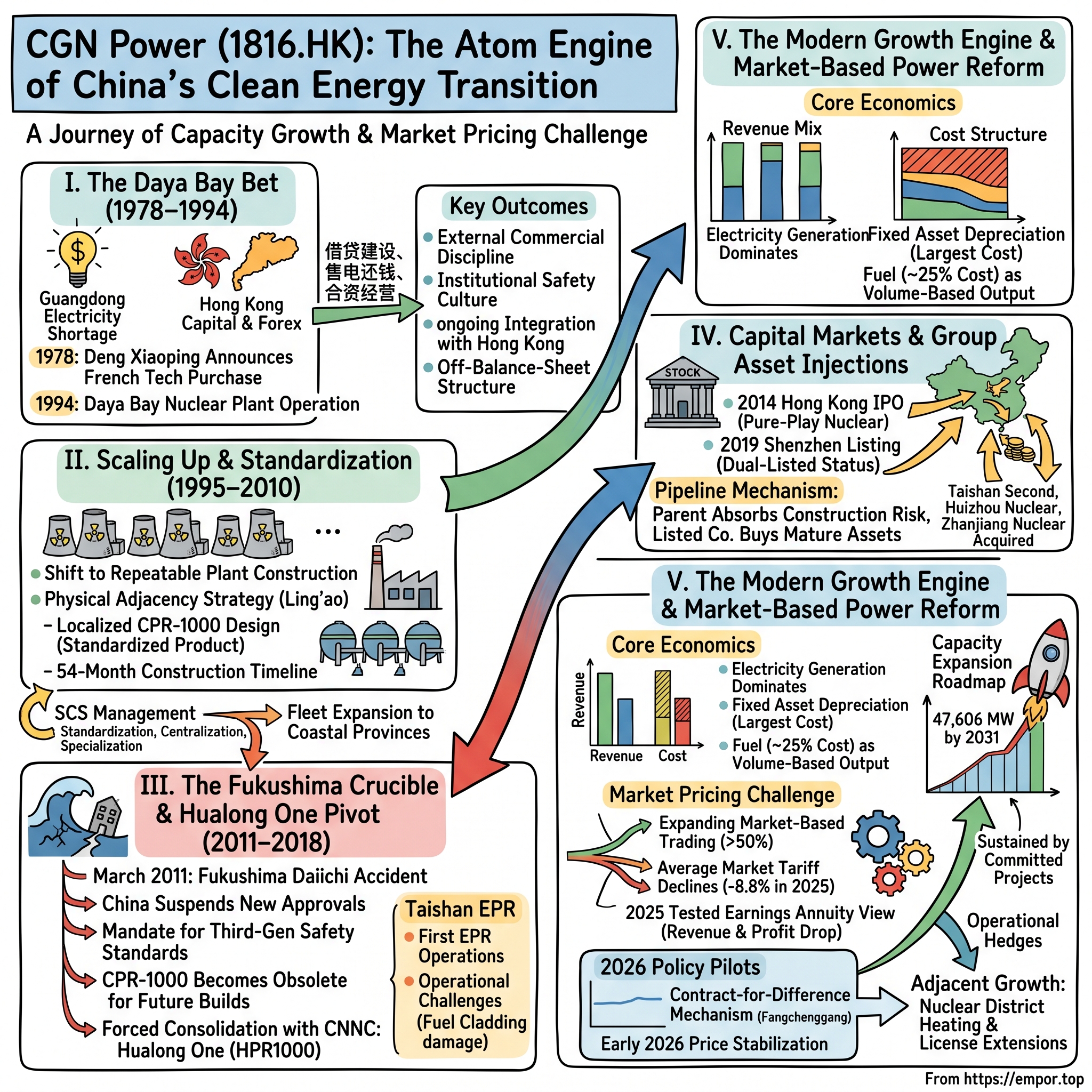
CGN Power: The Atom Engine of China's Clean Energy Transition
I. Introduction & Episode Roadmap
On a Friday afternoon in late July 2026, China's 国务院 State Council executive meeting signed off on four nuclear power projects—eight reactors representing over RMB170 billion in committed capital. Among them was Taipingling Phase III in Guangdong, featuring six Hualong One 2.0 units rated at 1,217 megawatts each, projected to generate over 55 billion kilowatt-hours annually upon completion.1 The designated operator was 中国广核电力股份有限公司 CGN Power Co., Ltd.
There was no ribbon-cutting and no executive presentation. The announcement appeared as a brief line item in a State Council readout, reflecting how the company has historically operated: making large capital commitments quietly and executing them across decades.
This structure defines CGN Power. It serves as the listed commercial generation arm of 中国广核集团 China General Nuclear Power Group, a central state-owned enterprise supervised by 国务院国有资产监督管理委员会 SASAC. The parent entity held 58.89% of the listed company as of March 31, 2026.2 CGN Power's operational fleet—28 units totaling 31,838 megawatts at the end of 2025—accounted for 51.15% of mainland China's installed nuclear capacity.23 Including 20 units totaling roughly 24.2 gigawatts under construction or managed on behalf of its parent, the company controls 56,060 megawatts of nuclear capacity, representing 44.47% of the national total.2
Nearly half of China's operational atomic fleet sits inside a single entity listed in Hong Kong and Shenzhen. That scale forms the foundation of the business.
The hook. The origin story contrasts sharply with its present scale. In 1978, Guangdong province faced persistent rolling blackouts while China lacked foreign currency reserves. In December 1978, 邓小平 Deng Xiaoping announced that China would purchase nuclear power equipment from France. Within a year, Hong Kong's 中華電力 China Light & Power agreed to take a minority stake in a joint venture that would sell most of its output to Hong Kong in Hong Kong dollars to service foreign debt.4 The resulting project was 大亚湾核电站 Daya Bay Nuclear Power Plant. At startup, its domestic content rate stood at roughly 1%, requiring the import of nearly all materials, down to floor tiles and cement.4 Forty-eight years later, the successor entity exports its proprietary reactor specifications into China's national build program while pouring first concrete across six sites simultaneously.
Why it matters to global investors. Nuclear generation in China holds a distinctive operational position: it generated 4.82% of national electricity in 2025 despite comprising just 1.6% of installed capacity. This efficiency stems from a fleet capacity factor of 93.11% and 7,858 utilization hours—roughly double that of thermal power, four times that of wind, and seven times that of solar.35 Under the 新型能源体系建设"十五五"规划 15th Five-Year Plan for the New Energy System released in June 2026, Beijing established a target of approximately 110 gigawatts of operating nuclear capacity by 2030, compared to 62.5 gigawatts at year-end 2025.63 Meeting this 47.5-gigawatt expansion requires substantial construction, with CGN Power positioned to build roughly half of the required capacity.
However, 2025 tested the long-standing view of the company as an earnings annuity. Revenue declined 4.1% to RMB75,696.6 million, while net profit attributable to shareholders dropped 9.9% to RMB9,765.4 million—even as power output increased by 2.36%.5 Generating more electricity while generating less revenue highlights an underlying shift in market pricing dynamics that forms the core analytical focus of this study.
The roadmap. Six central themes structure this analysis. First, the origins: how French technology transfer, funded through Hong Kong electricity sales, established the operating practices that continue to shape the organization. Second, Fukushima: how the 2011 disaster suspended China's expansion, rendered CGN's previous reactor design obsolete, and compelled the joint development of 华龙一号 Hualong One. Third, capital architecture: the 2014 Hong Kong initial public offering, the 2019 Shenzhen listing, and the ongoing asset transfers from parent to listed company. Fourth, unit economics: the primary drivers of profit margins, emphasizing the role of asset depreciation and value-added tax refunds relative to fuel costs. Fifth, competitive landscape: comparing CGN Power against primary peers, notably 中国核电 China National Nuclear Power, alongside newer license holders. Sixth, investment thesis: evaluating key growth drivers and risks, centered on power market reform and the transition away from administrative tariffs toward market-based electricity pricing.
Understanding that shift requires examining the company's historical foundation to trace how its structural origins influence its adaptability to market-driven pricing.
 Subscribe on LinkedIn
II. Origins & The Daya Bay Bet (1978–1994)
In 1979, the Pearl River Delta faced severe electricity shortages, forcing factories in Guangdong province to shut down several days a week. Across the border, Hong Kong possessed surplus generating capacity and convertible foreign currency—two resources mainland China urgently required.
Addressing that imbalance led to a novel financial arrangement. In November 1979, Lord Kadoorie, chairman of China Light & Power (CLP), led a delegation to Guangzhou for the first formal discussions on a joint-venture nuclear power plant.4 Over the next three years, negotiators established a framework codified by the State Council in December 1982 under the principle of 借贷建设、售电还钱、合资经营—borrow to build, sell electricity to repay debt, and operate as a joint venture.4
Because China lacked the state budget to fund the roughly $4 billion project—its foreign exchange reserves at the time were smaller than the capital requirement—the project was capitalized offshore.4 Foreign banking syndicates provided loans backed by a contracted revenue stream in Hong Kong dollars. This was secured through a take-or-pay agreement with CLP, which also held a 25% equity stake in the venture.47 French vendors supplied the technology, featuring twin pressurized water reactor units built by Framatome, with Électricité de France serving as architect-engineer.
This financing and operational design produced four lasting structural effects that remain visible in CGN Power's operations and financial reporting.
External commercial discipline. With roughly 75% of power generation contracted to a Hong Kong utility and debt held by international commercial banks, operational availability became a financial mandate rather than merely an engineering goal. Daya Bay entered commercial operation in February 1994. Over its initial 15 years, the plant generated approximately RMB 5 billion in annual net profit while fully servicing $5.3 billion in foreign principal and interest on schedule.4 The project served as a foundational template for modern project finance across Chinese state-owned enterprises.
Institutional safety culture. Beginning in 1989, CGN's predecessor sent 115 engineers to France and the United Kingdom for specialized operator training at a cost of approximately $260,000 per person—a major capital allocation for a Chinese state entity at the time.4 Internally dubbed the 黄金人 ("golden ones"), these engineers brought back standardized Western operational procedures, including rigorous configuration management, formal feedback systems, and detailed deviation logging. That procedural framework continues to shape CGN Power's reporting. In its 2025 annual report, the company cited 577 nuclear emergency drills, a third consecutive year of quantitative quality-assurance assessments across all plants, and zero International Nuclear and Radiological Event Scale (INES) Level 2 or higher incidents across its entire operational history.5
Ongoing commercial integration with Hong Kong. Historically, about 70% of Daya Bay's generation was exported south across the border, a share that expanded toward 80% under a 2014 agreement, while CLP subsequently acquired a 17% equity stake in CGN's Yangjiang plant.7 This relationship provided CGN with an external commercial counterparty that conducted independent operational and financial audits.
Off-balance-sheet corporate structure. Because Daya Bay was structured as a joint venture rather than a wholly owned subsidiary, CGN Power maintained a hybrid ownership model across its broader fleet, comprising both consolidated subsidiaries and equity-accounted associates. For example, the six-unit Hongyanhe plant in Liaoning generated 49,150 gigawatt-hours of on-grid power in 2025—representing over 20% of total group output—yet remains unconsolidated on the top line.5 Instead, its earnings flow through investment income, which totaled RMB2,263.1 million from associates and joint ventures in 2025.5 Consequently, evaluating CGN Power solely on consolidated revenue understates its total operational output and earnings base.
While Daya Bay established operational standards and financial discipline, it demonstrated an ability to import and manage foreign technology rather than indigenous engineering capability, as domestic content remained near zero at commissioning.4 Transitioning from an operator of imported technology into an independent nuclear technology developer required a decades-long localization and fleet expansion effort.
III. Scaling Up & The Standardization Crucible (1995–2010)
Following the commissioning of Daya Bay, CGN shifted from bespoke project financing toward repeatable plant construction. Construction on Ling'ao Phase I began in 1997 on a site immediately adjacent to Daya Bay, entering commercial operation in January 2003. Phase II broke ground in 2005.8 Physical adjacency allowed the new units to share existing infrastructure, including simulators, maintenance teams, spare parts warehouses, and emergency response organizations. This clustering model established CGN's ongoing strategy of organizing its fleet into large multi-unit bases rather than isolated single-unit sites.
Out of Ling'ao emerged the design that anchored CGN's expansion over the next decade. The CPR-1000 was an improved, localized derivative of the French M310 platform.7 Rather than representing a fundamental shift in reactor physics, the CPR-1000 served as a standardized product: a frozen design capable of repeated replication. This standardization allowed supply chains to mature, construction crews to execute consistent workflows, and regulators to review uniform documentation. Ling'ao Unit 3, the first CPR-1000, connected to the grid in July 2010 and entered commercial service that September following a reported 54-month construction period.8
A 54-month construction timeline represented roughly one-third of the build duration typical of contemporary third-generation nuclear projects in Europe and North America. This execution speed relied less on labor cost advantages than on strict design freezes combined with serial construction.
CGN subsequently replicated this standardized blueprint across coastal provinces outside Guangdong. The company constructed multi-unit bases using the same platform at Ningde in Fujian, Hongyanhe in Liaoning, and Yangjiang in Guangdong. This geographical expansion underpins CGN Power's modern reporting of on-grid generation across four primary provinces: Guangdong, Guangxi, Fujian, and Liaoning.5
Alongside the CPR-1000 deployment, CGN pursued a parallel technology track. At Taishan, CGN partnered with Électricité de France (EDF) to construct two European Pressurized Reactors (EPRs)—then among the largest reactors ordered globally and the flagship of Western third-generation technology. The project joint venture, Taishan Nuclear Power Joint Venture Co., Ltd. (TNPJVC), was owned 51% by CGN, 30% by EDF, and 19% by Guangdong Energy Group.9 This dual-track strategy allowed CGN to generate cash flow by mass-producing the proven second-generation-plus platform while acquiring technical expertise in frontier reactor design.
Fleet expansion unlocked structural economies of scale. Operating near-identical units enabled centralized fuel procurement, standardized outage management, an internal engineering division, and lower corporate overhead per megawatt. The commercial output of this engineering infrastructure remains visible in CGN Power's financial reporting: construction, installation, and design services generated RMB11,341.0 million in revenue in 2025.5
CGN formalized this operating model as 三化管理 SCS management—standardization, centralization, and specialization. The framework emphasizes design uniformity, centralized corporate functions, and dedicated specialist teams across facilities. During 2025, CGN engineers expanded the deployment of its proprietary "Wukong" generator rotor inspection robots across Daya Bay, Ningde, and Fangchenggang, while deploying remote machining and automated welding tools to replace high-radiation valve seats in primary loops online. At Yangjiang Unit 2, this specialized tooling reduced outage critical path time by 120 hours.5 Eliminating 120 hours of outage downtime preserves roughly one gigawatt-day of saleable output, illustrating how standardized technical capabilities protect revenue across a multi-reactor fleet.
By 2010, CGN possessed a standardized reactor design, operational footprints across four provinces, a joint venture in third-generation technology, and an expanding project pipeline. That expansion trajectory changed abruptly in March 2011, when a devastating earthquake and tsunami struck the Fukushima Daiichi nuclear facility in northeastern Japan.
IV. The Fukushima Crucible & The Pivot to Hualong One (2011–2018)
The March 2011 Fukushima Daiichi accident caused no physical damage to any Chinese reactor, but it abruptly altered the trajectory of China's nuclear power industry.
Within days of the disaster, the State Council suspended approvals for new nuclear projects and ordered a comprehensive safety review across all operating and under-construction units nationwide. The moratorium lasted roughly 18 months, interrupting new project approvals for CGN—a company whose strategy relied on the volume replication of a standardized reactor design.
The regulatory outcome proved far more consequential than the temporary suspension. Chinese regulators mandated that all future construction meet third-generation safety standards, requiring passive safety features capable of managing a prolonged station blackout without external electrical power or manual intervention. CGN’s core design workhorse, the CPR-1000, was a second-generation-plus platform. The reactor design that CGN had spent a decade perfecting and standardizing became obsolete for future project approvals.
Operating facilities underwent extensive retrofits, including reinforced flood barriers, mobile emergency diesel generators, hardened containment venting systems, and supplementary cooling water supply lines. While these modifications required direct capital expenditures, the core challenge lay in reactor design architecture rather than the immediate retrofit bill.
The shift to third-generation safety standards reflected a fundamental change in engineering philosophy. The Fukushima accident occurred not because the reactors failed to shut down, but because a shut-down reactor continues to generate decay heat for days. Removing that heat requires continuous coolant circulation, which traditionally depends on electrically driven pumps. When the tsunami disabled both the external grid connections and the backup diesel generators at Fukushima, cooling capability was lost.
Third-generation designs address this vulnerability by replacing mechanical redundancy with physical passivity. Rather than relying solely on additional backup diesel generators, passive architectures incorporate gravity-drained water tanks, natural circulation heat exchangers, and convective containment cooling systems that operate without electrical power or operator intervention. Because CGN’s existing order book relied on active, pump-driven cooling systems, the company faced a complete redesign of its future project pipeline.
Simultaneously, China's second major nuclear operator, 中核集团 CNNC / China National Nuclear Corporation, was developing its own competing third-generation platform, the ACP1000, while CGN developed the ACPR1000+. To avoid fragmented domestic deployment and confusion in export markets, state regulators required the two state-owned enterprises to consolidate their designs into a single national platform. The merged reactor design—combining elements of CNNC's ACP1000 and CGN's ACPR1000+—was designated 华龙一号 Hualong One and marketed internationally as the HPR1000.7
Hualong One features a pressurized water reactor rated at roughly 1,100 to 1,200 megawatts, utilizing a double-shell containment structure, a 177-fuel-assembly core, and a 60-year design life. Its safety architecture combines active electrical systems with passive gravity and natural-convective systems to maintain cooling during power loss.
This forced integration required both companies to relinquish design independence in exchange for a unified national standard that regulators could review once and approve repeatedly. In effect, the standardization framework CGN had developed with the CPR-1000 was elevated to a national industrial policy level.
CGN designated Fangchenggang Units 3 and 4 in Guangxi as its reference project for the Hualong One. Unit 3 entered commercial operation on March 25, 2023, while Unit 4 completed its 168-hour demonstration run and entered commercial service in May 2024, completing CGN's initial Hualong One deployment.10[^11] The project experienced schedule adjustments, with CGN acknowledging in January 2022 that pandemic-related disruptions had delayed original startup targets.10
Parallel to its Hualong One deployment, CGN achieved a significant operational milestone at Taishan. Taishan Unit 1 entered commercial operation in December 2018, followed by Unit 2 in September 2019, making them the world's first operating European Pressurized Reactors (EPRs) years ahead of flagship European projects in France and Finland.7
However, operational challenges followed. In July 2021, Taishan Unit 1 was removed from service after elevated primary-circuit radioactivity was traced to fuel rod cladding damage affecting five out of more than 60,000 fuel rods in the core.9 The unit remained offline for approximately 12 months for inspection and repairs, reconnecting to the grid in August 2022 following approval from the National Nuclear Safety Administration (NNSA).11 While no radiation was released into the environment, the extended outage on a high-capacity unit—which carries CGN's highest approved tariff at RMB0.4350 per kilowatt-hour—demonstrated how unexpected operational downtime on a high-value asset directly impacts financial performance.5
The capital demands of retrofitting the operating fleet, developing Hualong One, and commissioning complex third-generation reactors required an expanded corporate financing structure, setting the stage for CGN Power's public stock listings and subsequent asset transfers of parent-level assets.
V. Capital Markets Debut, Dual Listing, & Group Asset Injections
CGN Power Co., Ltd. was incorporated as a joint stock company on March 25, 2014.2 It listed on the Hong Kong Stock Exchange less than nine months later.
Priced at HK$2.78 per share—the top of its target range—the initial public offering raised approximately HK$24.5 billion (roughly $3.16 billion), with trading commencing on December 10, 2014.122 Marketers framed the transaction as the year's largest Hong Kong listing and one of its most heavily oversubscribed: a pure-play nuclear generator offering contracted power generation, regulated tariffs, an established construction pipeline, and a parent entity with operational assets ready for future injection.
That asset pipeline served as the central investment thesis.
The company's ownership structure illustrates the sector's distinctive competitive landscape. As of March 31, 2026, the share register showed CGN Group holding 58.89%, H-share public investors holding 21.00%, other A-share holders taking 10.00%, Guangdong Hengjian Investment Holdings retaining 6.79%, and primary domestic competitor CNNC Group owning 3.32%.2 Having a direct rival on the register reflects a market where the central state holds controlling stakes in both major operators, mandated the joint development of their primary reactor design, and routinely rotates executive leadership between the two groups.
The architecture. The operational split between parent and listed vehicle isolates public equity from early-stage development risks. New nuclear installations face their highest capital risk during development and construction—when cost overruns, schedule adjustments, and regulatory revisions occur without generating operating revenue. Under this model, the unlisted parent entity absorbs initial construction risks, while CGN Power retains options to purchase completed or near-operational facilities. This framework shields public equity from upfront construction drag while offering the parent a path to monetize mature assets.
This pipeline mechanism remains active. In January 2025, CGN Power purchased 100% of Taishan Second Nuclear from its parent for approximately RMB1,203.9 million.5 In October 2025, it acquired an 82% equity interest in Huizhou Nuclear along with 100% stakes in Huizhou Second Nuclear, Huizhou Third Nuclear, and Zhanjiang Nuclear for approximately RMB9,375.4 million, recognizing revaluation gains of roughly RMB1,486.5 million and RMB126.0 million on the Huizhou entities.5 In its first-quarter 2026 investor presentations, management listed ongoing asset acquisitions from the controlling shareholder as a priority.2
This acquisition structure requires careful analytical adjustments. First, revaluation gains resulting from intra-group acquisitions represent accounting adjustments under related-party transfers rather than arm's-length market valuations. Second, because financial reporting rules require restating historical periods to incorporate newly injected entities—as seen in the restated 2024 comparative figures within the 2025 annual report—headline year-on-year growth rates reflect a portfolio expanded through state-directed asset transfers rather than pure organic operational growth.5
The A-share leg. On August 26, 2019, CGN Power completed a secondary listing on the Shenzhen Stock Exchange at RMB2.49 per share, raising RMB12.574 billion in the year's largest mainland IPO and creating the first dual-listed pure nuclear generator.13 The transaction aimed to tap domestic onshore capital markets, where mainland investors often apply different valuation multiples to regulated infrastructure assets than offshore institutions. However, the valuation spread between A-shares and H-shares has persisted.
CGN Power continues to utilize onshore capital markets for project funding. In July 2025, the company issued 49.0 million A-share convertible bonds in Shenzhen at a par value of RMB100 each, raising RMB4,900.0 million to reimburse capital previously deployed into Lufeng Units 5 and 6.5 With those bonds entering their conversion period, potential conversion into equity introduces a modest share dilution mechanism that could affect future dividend distribution calculations per share.5
The sanctions overhang. On August 14, 2019, twelve days before the Shenzhen listing, the U.S. Department of Commerce added China General Nuclear Power Group and three affiliates—CGNPC, China Nuclear Power Technology Research Institute, and Suzhou Nuclear Power Research Institute—to its Entity List, citing allegations concerning the acquisition of advanced nuclear technologies.14 The designation imposed strict export licensing requirements with a presumption of denial for U.S.-origin items.
The operational impact on domestic power generation remained limited because CGN Power relies on localized French derivatives, indigenous technology platforms, Chinese supply chains, and nuclear fuel sourced through domestic and Kazakh suppliers. However, trade restrictions curtailed the company's international expansion into Western markets. In the United Kingdom, the Bradwell B project in Essex—conceived as a showcase for the Hualong One in a developed economy—was paused, while the British government removed CGN from the Sizewell C project in November 2022.15 While CGN retained its minority stake in Hinkley Point C, it has not provided additional capital funding since reaching its agreed investment ceiling in early 2023.15
While this corporate structure secures operational asset injections domestically, geopolitical constraints set boundaries on foreign deployment. Evaluating how these structural dynamics translate into underlying financial performance requires analyzing unit economics and margin drivers.
VI. Industry Structure, Segment Economics & Competitive Benchmarking
Underneath its reactor fleet, CGN Power operates across three distinct business segments.
Electricity generation dominates operations. Sales of power, including commissioning revenue, reached RMB61,757.1 million in 2025, representing 81.6% of total operating revenue.5 Construction, installation, and design services contributed RMB11,341.0 million—accounting for roughly 15% of total revenue—and grew 4.6% during a year when generation revenue contracted 6.3%.5 Ancillary activities, including housing rentals and technical support services, accounted for the remaining RMB217.6 million.5
The regulatory perimeter. Nuclear operating licenses in China remain restricted to a small group of central state-owned enterprises: CGN, CNNC, 国家电力投资集团 SPIC / State Power Investment Corporation, and 中国华能集团 China Huaneng Group. Safety licensing is overseen by the 国家核安全局 National Nuclear Safety Administration, siting and project approval by the 国家发展和改革委员会 NDRC and 国家能源局 National Energy Administration, and final project authorization by the State Council.
The July 2026 project approvals illustrated this state-managed portfolio approach: CNNC secured Jinqimen Phase II in Zhejiang, CGN received Taipingling Phase III in Guangdong, and SPIC gained approval for Laiyang Phase I in Shandong as the launch platform for the commercial deployment of its 国和一号 Guohe One design.1 Meanwhile, China Huaneng Group—traditionally a thermal power generator—has entered the sector through minority joint-venture partnerships, such as acquiring an equity stake alongside CNNC in the Xiasu project in Fujian approved in April 2025. This structure introduces supplementary balance sheets into a capital-intensive national build program, slightly broadening sector investment while preserving the core duopoly between CGN and CNNC.
The head-to-head. The primary benchmark for CGN Power is CNNC's listed generation subsidiary, 中国核电 China National Nuclear Power (601985.SS). At the end of 2025, CNNC's listed entity operated 26 nuclear units representing 25,000 megawatts of capacity, alongside 19 units totaling 21,859 megawatts under construction or approved.16 By comparison, CGN Power operated 28 units totaling 31,838 megawatts, giving it an operating fleet approximately 27% larger by capacity, while maintaining a project pipeline of comparable scale.5
The financial performance of the two peers diverged in 2025. CNNC's listed arm increased revenue by 6.22% to RMB82,075 million and net profit by 6.00% to RMB9,304 million, whereas CGN Power's revenue fell 4.11% and net profit declined 9.9%.165 This divergence stemmed primarily from asset mix. CNNC's listed vehicle maintains a substantial renewables portfolio, where on-grid generation volumes grew 31.34% in 2025, buffering the impact of nuclear tariff adjustments.16 In contrast, CGN Power operates as a concentrated nuclear play, leaving its financial performance more directly exposed to shifts in power market pricing.
Cost structure and unit economics. Evaluating the operating cost of power generation clarifies CGN Power's financial architecture. Of the RMB38,602.1 million in direct generation and sales expenses incurred in 2025, nuclear fuel accounted for RMB9,656.5 million, fixed asset depreciation comprised RMB11,728.9 million, and spent fuel management provisions totaled RMB4,378.2 million.5
This breakdown highlights two key structural features of nuclear unit economics. First, fuel accounts for approximately 25% of operating generation costs—higher than the global industry benchmark of 12% to 15%, yet low enough that uranium price volatility exerts far less margin pressure than coal price fluctuations do on thermal power plants. Second, depreciation represents the single largest cost component, reflecting a capital structure heavily front-loaded by initial construction expenditures. As reactors complete their accounting depreciation schedules, unit operating costs per kilowatt-hour drop substantially, expanding long-term operating margins.
Balance sheet leverage presents another key operational dynamic. Finance costs reached RMB4,523.4 million in 2025 against interest expenses of RMB4,801.7 million, supported by RMB271,943.2 million in total borrowings—a 15.7% increase year over year.5 Consequently, the asset-liability ratio expanded to 65.2% from 61.2%, debt-to-equity rose to 142.6% from 119.5%, and interest coverage narrowed to 3.5 times from 3.7 times.5 Although debt levels increased, liquidity remains robust: China Chengxin reaffirmed CGN Power's domestic AAA credit rating in September 2025, supported by RMB20.8 billion in cash reserves and approximately RMB432.2 billion in unutilized bank credit facilities.5
Nuclear utilities also carry specialized long-term liabilities. Operators in China are required to fund backend spent fuel management, with provisions accrued based on generation volumes. CGN Power's spent fuel provision rose 7.8% to RMB4,378.2 million in 2025, driven by Yangjiang Unit 6 and Taishan Unit 2 completing five years of commercial operation—the regulatory threshold at which spent fuel fee contributions begin.5 This five-year exemption grants newly commissioned reactors an initial period of lower operating costs before backend liability payments take effect.
Tax policy creates a complementary lifecycle effect. Under Ministry of Finance circular 财税[2008]38号, Chinese nuclear generators receive phased value-added tax (VAT) refunds under a "levy first, refund later" scheme: 75% of VAT paid is refunded during a unit's first five years of commercial operation, 70% from years six through ten, 55% from years eleven through fifteen, and zero thereafter.17 CGN Power recorded RMB1,560.7 million in VAT refunds within other gains in 2025, up from RMB1,418.0 million in 2024.5 Because VAT refunds step down over time while fixed asset depreciation costs remain fixed until full write-off, fleet margin trajectories reflect a dynamic balance between diminishing tax subsidies and eventual depreciation roll-offs.
Overall, China's nuclear sector functions as a tightly regulated duopoly characterized by high capital entry barriers, disciplined capacity allocation, and stable administrative market sharing. However, as power market reforms expand market-based electricity trading across Chinese provinces, realized tariffs are increasingly determined by competitive market dynamics rather than fixed administrative benchmarks.
VII. Current Management, SOE Governance, & Capital Allocation Record
On December 11, 2025, CGN Power's board received a written resignation from executive director and president 高立刚 Gao Ligang, citing mandatory retirement age. During the same meeting, the board appointed 庞松涛 Pang Songtao as president, effective immediately, with a term running through December 31, 2027.18
This executive change illustrates the governance mechanics of a Chinese central state-owned enterprise (SOE). The chief executive of a company managing over half of China's operational nuclear capacity was replaced based on a fixed age threshold on a single day, with a successor who had already been installed as general manager of the parent group two months earlier.
Chairman 杨长利 Yang Changli continues to lead the board. His career trajectory reflects the interconnected leadership structure of Chinese nuclear utilities: Yang spent decades inside primary competitor CNNC before transferring to head CGN. In a sector where SASAC periodically rotates senior executives between state-owned entities, such leadership transfers establish bounded competitive boundaries between nominal rivals. Yang also serves on the 中国人民政治协商会议 Chinese People's Political Consultative Conference (CPPCC), where he advocates for scientific innovation and technological self-reliance—policy priorities that directly align with the company's research and development expenditures.19
President Pang Songtao, born in 1971, brings over thirty years of technical and operational experience in the nuclear sector. His career includes deputy general manager roles in CGN's nuclear power operations division and at CGN Nuclear Power Operations, preceding his appointment as general manager of the parent group in October 2025.18 Pang's background centers on plant operations and outage management—a critical specialization given that fleet availability and outage schedules directly shape the company's near-term earnings stability.
Chief Financial Officer and Board Secretary 尹恩刚 Yin Engang provides financial continuity through the ongoing power market tariff transition. Yin appeared alongside Yang and Pang at the 2025 annual results presentation in Shenzhen on March 26, 2026, where executive management detailed corporate strategy, reviewed 2025 financial performance, and outlined operational priorities for 2026.20
Governance and alignment. Management shareholdings at central state-owned enterprises remain nominal by design. Executive incentive structures are tied to SASAC performance evaluations—which emphasize operational safety, fleet utilization, net profit, and return on equity—rather than stock-based compensation. Consequently, the primary corporate mandate prioritizes executing national energy policy while maintaining baseline financial returns, rather than maximizing equity value. While these objectives typically align, tension can emerge when state goals—such as lowering wholesale power tariffs to bolster industrial competitiveness—conflict with short-term margin expansion.
Capital allocation and operational record. An analysis of capital deployment and management communications reveals four key operational patterns:
Dividends have remained consistent, though absolute payouts contracted alongside net income. Under its 2021–2025 dividend distribution plan, CGN Power committed to maintaining reasonable increases from its 2020 baseline payout ratio of 42.25%.5 The company fulfilled this commitment by steadily expanding its payout ratio to 43.44% in 2021, 44.09% in 2022, 44.26% in 2023, 44.36% in 2024, and a proposed 44.47% for 2025.2 However, because net earnings declined in 2025, the dividend per share fell by 9.5%, from RMB0.095 to RMB0.086.25 Management highlighted this contraction in its first-quarter 2026 investor presentation, pointing out that the per-share dividend reduction was slightly smaller than the overall net profit drop.2 Since its 2014 Hong Kong initial public offering, cumulative dividend distributions have reached RMB36,760.5 million.5 Looking ahead, the company's stated dividend floor remains at no less than 30% of net profit—providing a formal baseline below the roughly 44% historical payout level.5
Capital expenditures remained rigid despite earnings pressures. Fixed asset investment rose 6.9% to RMB35,983.2 million in 2025, even as net operating cash flow contracted 20.1% to RMB29,970.5 million.5 CGN Power bridged this funding gap through debt expansion, with net financing cash inflows swinging to RMB6,676.9 million from a net outflow in 2024.5 While maintaining capital deployment during an earnings contraction supports long-term capacity buildouts under national energy mandates, it simultaneously increases balance sheet leverage during periods of softening power prices.
Financial disclosures have maintained analytical consistency. In August 2025, management attributed a 16.3% first-half profit decline to lower average market tariffs, lower timing-related value-added tax (VAT) refunds, and higher operating costs.29 By year-end 2025, realized power market prices had fallen 8.8%, while full-year VAT refunds rebounded to RMB1,560.7 million from RMB1,418.0 million in 2024, demonstrating that early tax refund delays reflected intra-year timing dynamics rather than a structural loss of tax policy support.5 Throughout these disclosures, management framed tariff compression as a structural market evolution rather than a temporary disruption. Where favorable policy developments occurred—such as the mechanism-price pilot at Fangchenggang—management cited specific provincial frameworks rather than issuing broad assurances.22
Guidance focuses on operational benchmarks rather than financial forecasts. CGN Power refrains from providing formal earnings guidance, publishing operational milestones instead, including scheduled refueling outages, unit commissioning timelines, and market-trading participation rates. For 2026, management scheduled 19 refueling outages—including six major ten-year inspections—and targeted commercial operations for Huizhou Units 1 and 2 alongside Cangnan Unit 1, while committing to an average utilization hour target no lower than the trailing three-year average.5
The primary operational test facing management is whether the company can execute these unit commissioning milestones on schedule while navigating broader power market tariff adjustments.
VIII. The Modern Growth Engine & Market-Based Power Reform
Navigating power market reform represents CGN Power's most significant structural challenge since the post-Fukushima safety overhaul, driven not by operational failures but by a fundamental shift in how electricity is priced across China.
Historically, the company's output was sold at fixed administrative tariffs set by provincial regulators. Those benchmark tariffs remained unchanged in 2025, spanning RMB0.4056 per kilowatt-hour at Daya Bay, RMB0.4143 at Ling'ao, RMB0.4153 across Lingdong, Yangjiang, and Ningde Units 1–2, RMB0.4350 at Taishan, RMB0.4063 at Fangchenggang, RMB0.3823 and RMB0.3749 across the two Hongyanhe tranches, and RMB0.3590 for Ningde Unit 4.5
However, an increasing share of generation is sold outside these administrative benchmarks. In 2025, market-based trading accounted for approximately 56.2% of CGN Power's total on-grid generation, representing a 5.3 percentage point increase year over year.5 Simultaneously, the average market-based tariff realized by the company declined approximately 8.8% compared to 2024.5 This combination—expanding market exposure paired with lower realized market prices—explains why net profit fell 9.9% in 2025 even as total electricity output grew by 2.36%.
Provincial market structures vary significantly across CGN Power's footprint. Facilities outside Guangdong—including Fangchenggang Units 1–4 in Guangxi, Ningde Units 1–4 in Fujian, and Hongyanhe Units 1–6 in Liaoning—sell 100% of their output directly into competitive power markets.25 In contrast, Guangdong functions as a partial buffer against spot price volatility. In 2025, ten units across Ling'ao, Lingdong, and Yangjiang participated in the Guangdong market under a framework that established 7,500 utilization hours as a baseline benchmark, with approximately 27.3 billion kilowatt-hours designated as annual market-based generation—leaving Guangdong's marketized proportion at 36.6% in the first quarter of 2026, compared to 100% market exposure across the company's other three operating provinces.52
Under the Guangdong framework, provincial energy authorities preserve baseline tariff protections on core utilization hours, exposing only incremental generation to market clearing prices.5 As CGN Power's largest operating hub, Guangdong benefits from strong local demand, with provincial power consumption expanding 4.93% in 2025.5 However, if ongoing national market harmonization reduces these provincial benchmark protections, CGN Power's earnings would face broader exposure, as Guangdong remains the primary site of its remaining regulated volume.
National power market integration continues to advance. Market-traded electricity reached 64.0% of total national consumption in 2025, supported by continuous spot market operations across 28 provinces. On February 11, 2026, the General Office of the State Council released implementation guidelines targeting the initial establishing of a unified national power market by 2030 and full completion by 2035.5 Following the market reform template established for renewable generators under NDRC Document 136 in February 2025, nuclear power generation is being progressively integrated into competitive market clearing mechanisms.21
What changed in 2026, and the pricing dynamics to watch. A key policy development emerged in 2026 with the introduction of a market trading pilot at Fangchenggang structured around a contract-for-difference mechanism. Under this pilot, a defined allocation of on-grid volume settles at a fixed "mechanism price" tied to the unit's approved tariff, while remaining output clears at market rates. Based on this structure, management expects Fangchenggang's blended settlement tariff in 2026 to exceed its 2025 level.22
This pilot indicates that nuclear market integration does not inevitably result in lower realized tariffs. Operational data from early 2026 aligns with this stabilization: CGN Power's average market-based tariff, including VAT, reached RMB0.3617 per kilowatt-hour in the first quarter of 2026, compared to RMB0.3600 in the first quarter of 2025 and RMB0.3946 in the first quarter of 2024.2 Following sharp tariff compression between 2024 and 2025, market pricing showed initial signs of stabilization in early 2026.
First-quarter 2026 operational performance. Despite price stabilization, financial results in the first quarter of 2026 reflected volume constraints. On-grid generation declined 10.11% year over year to 50.957 billion kilowatt-hours, revenue fell 13.25% to RMB16,319 million, and net profit attributable to shareholders decreased 9.33% to RMB2,741 million.2 Rather than tariff compression, this quarterly decline stemmed primarily from scheduled fleet maintenance. CGN Power conducted eight refueling outages totaling 316 outage days during the quarter, compared to six outages totaling 164 days in the first quarter of 2025, as facilities at Ling'ao, Lingdong, Taishan, Ningde, and Hongyanhe underwent extended or scheduled shutdowns.232
Consequently, average fleet utilization fell to 1,699 hours in the first quarter of 2026, down from 1,802 hours in the same period of 2025 and 1,893 hours in 2024.2 Despite lower top-line revenue, gross profit margin expanded by 1.28 percentage points to 39.37%.24 Expanding its operational footprint, CGN Power achieved first grid connection for two new reactors during the quarter: Huizhou Unit 1 on February 13, 2026, and Cangnan Unit 1 on March 12, 2026.23
This quarterly performance highlights a distinction in CGN Power's operational drivers: while 2025 results were primarily constrained by tariff adjustments, first-quarter 2026 performance reflected scheduled outage cycles affecting fleet availability.
Evaluating demand-side catalysts. While market commentary often links nuclear generation to technology demand from artificial intelligence data centers and green hydrogen production, CGN Power's disclosures reflect a more conservative commercial focus. The company reported preliminary studies evaluating energy storage, seawater desalination, and integrated computing centers, alongside active deployments in nuclear district heating—including the Hongyanhe demonstration project completing its fourth heating season, advancing construction at Wafangdian, an upcoming deployment in Shandong, and preliminary assessment of industrial steam applications in Guangxi and Fujian.5 To date, CGN Power discloses no direct revenue from dedicated data center power purchase agreements. Instead, customer diversification is primarily evident in its retail sales channel, where 449 retail agency clients consumed approximately 25,537 gigawatt-hours of electricity in 2025.5
Capacity expansion roadmap. Behind its operating fleet, CGN Power maintains an extensive construction pipeline. Six reactors commenced main construction during 2025: Lufeng Unit 1 in February, Huizhou Unit 3 in June, Zhaoyuan Unit 1 and Cangnan Unit 3 in November, and Ningde Unit 6 and Lufeng Unit 2 in December, while State Council approvals for Taishan Phase II and Fangchenggang Phase III were granted in April 2025.5 Under management's capacity roadmap, total managed operating capacity is projected to expand from 31,838 megawatts in 2025 to 35,450 megawatts in 2026, 39,058 megawatts by 2028, and 47,606 megawatts by 2031.2 This pipeline represents a nearly 50% expansion in operating capacity over six years, backed by projects already approved or under active construction.
This growth trajectory provides substantial operational visibility for a commercial power utility. However, sustaining this expansion depends on external inputs that extend beyond CGN Power's direct manufacturing capabilities.
IX. Upstream Fuel Supply & Optionality Bets
Sustaining CGN Power's expanding reactor fleet requires a reliable supply of natural uranium—a commodity in which China maintains limited domestic reserves.
CGN Power does not purchase natural uranium directly on the open spot market. Instead, nuclear fuel is secured through the parent group's central procurement network, which links to 中广核矿业 CGN Mining Company Limited (1164.HK), the group's listed uranium resource platform. CGN Mining holds 49% equity stakes in two Kazakh joint ventures with Kazatomprom—Semizbay-U and Ortalyk—that extract uranium from low-cost in-situ recovery deposits. In 2025, combined natural uranium production across these two entities reached 2,699 tonnes, slightly exceeding operational targets, with production costs ranging between US$31 and US$37 per pound of U3O8 depending on the deposit.25
The low cost of in-situ recovery stems from its extraction method. Rather than excavating open pits or underground shafts, operators inject a liquid solution underground to dissolve uranium directly within the ore deposit before pumping the uranium-bearing solution back to the surface. By eliminating heavy excavation and rock processing, the process requires significantly less energy per pound recovered than conventional mining.
For CGN Power, this procurement architecture does not make fuel inexpensive—nuclear fuel accounted for RMB9,656.5 million in direct operating expenses in 2025—but it insulates operations against spot market volatility. By anchoring fuel supply to group-held resources, volatile commodity prices are converted into predictable, long-term contracted inputs. Because domestic competitors operate under similar procurement arrangements, this structure provides a baseline buffer rather than an exclusive competitive advantage, functioning primarily at the parent group level rather than within the listed entity itself.
This supply framework carries regulatory risk. In December 2025, Kazakhstan enacted amendments to its Subsoil and Subsoil Use Code that could alter foreign equity ownership structures when existing mining licenses come up for renewal.26 For a fuel procurement chain reliant on 49% joint-venture stakes in Kazakh operations, this represents a tangible regulatory exposure that bears monitoring through CGN Mining's financial disclosures.
Evaluating adjacent growth initiatives. Assessing emerging business opportunities requires distinguishing between direct operational initiatives and group-level holdings.
Nuclear heating and industrial steam represent direct extensions of core generation. The demonstration district heating project at Hongyanhe completed its fourth heating season in 2025, while a similar facility in Shandong is under construction to launch alongside new unit commissioning.5 The commercial logic relies on capturing thermal energy that would otherwise be discharged, channeling process steam or district heat to local customers at low incremental capital cost. While financially minor today and not separately disclosed, these applications improve overall thermal efficiency.
Medical isotopes represent a group-level venture rather than a direct asset of the listed company. CGN's medical isotope operations are housed within a separate listed subsidiary, 中广核核技术发展股份有限公司 CGN Nuclear Technology Development (000881.SZ), which completed construction and initiated trial operations at a cyclotron production facility in Mianyang, Sichuan, in December 2025 to produce germanium-68, copper-64, zirconium-89, and iodine-123.27 Because these assets sit outside CGN Power (1816.HK), they represent parent-level technological capability rather than direct earnings for public shareholders unless formally transferred.
Plant life extension and capacity uprating offer high-return capital deployment. At Daya Bay, technical modifications have already expanded output: Unit 1's operating license was formally updated in December 2025 to raise its rated capacity from 984 megawatts to 1,026 megawatts, bringing total station capacity to 2,052 megawatts.5 Extending operational licenses from 40 toward 60 years across mature reactors would permit continued generation without requiring new land acquisition, containment structures, or grid interconnections, relying primarily on regulatory approval and safety re-evaluations.
Categorizing operational optionality. These adjacent opportunities fall into three distinct analytical categories that warrant different valuation treatments.
District heating and industrial steam function as core operational hedges. By monetizing thermal energy from existing assets with modest additional capital investment, non-electric heat sales establish a revenue stream outside competitive power markets. This strategy underpins management's framing of comprehensive nuclear energy utilization as a countermeasure against "the impact of market-oriented electricity system reform on the economic efficiency of nuclear power projects."5 These applications serve as a defensive mechanism to stabilize returns amidst wholesale power market volatility.
Medical isotopes remain external to the listed entity, offering no direct cash flow contribution to CGN Power unless formally acquired through future asset injections.
Capacity uprating and license extensions represent asset optimization with established regulatory mechanisms. The approved capacity expansion at Daya Bay demonstrates that safety authorities will authorize higher output when engineering assessments support it.5 While a formal regulatory framework for extending reactor operational lifespans from 40 to 60 years remains under development in China, successful renewals would unlock substantial incremental asset value without requiring new construction capital.
Ultimately, CGN Power maintains a secured upstream fuel pipeline through parent arrangements, developing non-electric thermal applications to buffer power tariff volatility, and low-capital growth potential through asset life extensions. Evaluating how these operational dynamics translate into long-term market leadership requires examining the company's competitive moat and structural position within China's evolving energy landscape.
X. Helmer's 7 Powers & Porter's 5 Forces Analysis
Competitive frameworks are useful only when permitted to deliver uncomfortable conclusions. Applied to CGN Power, they reveal a moat that is both formidable and narrow.
Hamilton Helmer's 7 Powers.
Cornered Resource—the primary power, and it is not technology. CGN Power's decisive assets are its operating licenses, approved coastal plant sites, and grid interconnections. Chinese nuclear siting is restricted to coastal locations for cooling water access, requiring multi-year seismic, hydrological, and demographic reviews culminating in State Council approval. CGN holds bases at Daya Bay, Yangjiang, Taishan, Lufeng, and Huizhou in Guangdong, Fangchenggang in Guangxi, Ningde in Fujian, Hongyanhe in Liaoning, Cangnan in Zhejiang, and Zhaoyuan in Shandong.2 These sites cannot be replicated by capital alone. This position represents a granted rather than earned asset, making it exceptionally strong yet politically contingent.
Scale Economies—high and demonstrable. Fixed corporate safety, licensing, engineering, and fuel-procurement overheads are spread across 28 operating units and 20 under construction. A key example is the fleet-level outage optimization program: CGN established a Hualong One fleet excellence team that completed 20 pilot optimization projects and applied them during Fangchenggang Unit 4's initial outage.5 Applying fleet-wide learning across identical units creates a cost curve that smaller competitors cannot replicate.
Process Power—high, with a structural caveat. Decades of operational experience have yielded strong safety metrics, with over 85% of World Association of Nuclear Operators (WANO) peer-review indicators achieving top-quartile performance and zero unplanned reactor shutdowns across all 28 units in 2025.285 However, process power in nuclear operations is uniquely fragile: a single major safety event can severely compromise it.
Switching Costs—moderate, and frequently overstated. Grid operators rely heavily on non-intermittent baseload power, and replacing gigawatts of nuclear generation requires utility-scale storage that remains economically unviable at scale. However, this stickiness is a property of the asset class rather than CGN specifically. While a grid operator cannot easily substitute nuclear power, it can readily switch between CGN and CNNC.
Counter-Positioning—none. CGN's business model is structurally identical to its state-owned peers. Nothing in its commercial approach imposes a strategic dilemma on CNNC or SPIC.
Network Economies—none. Electricity transmission generates no network effects, as power does not gain value as additional consumers join the grid.
Branding—negligible commercially. CGN's reputation influences regulators, provincial governments, and institutional lenders, but holds little weight with electricity consumers. In an increasingly marketized power sector, wholesale buyers select suppliers primarily on price.
Net assessment: two strong powers (cornered resources and scale economies), one strong but fragile power (process power), and four absent or negligible powers. This structure defines a real competitive moat, but a narrower one than the "regulated monopoly" narrative suggests—and both primary powers remain conferred directly by the state.
Porter's Five Forces.
Threat of new entrants—extremely low. Capital intensity exceeding $2 billion per gigawatt, construction cycles spanning five to seven years, and strict licensing rules prevent new entrants. The July 2026 State Council approvals allocated all eight units among the three incumbent state-owned enterprises, although Jinqimen Phase II included private capital participation as a minority partner—a structural precedent worth monitoring, but not a direct entry route.1
Bargaining power of buyers—moderate and rising. This force has shifted most significantly. Where grid companies once acted as administrative buyers paying fixed tariffs, over half of CGN's generation now clears in provincial markets where industrial buyers set prices. An 8.8% decline in average realized market tariffs in 2025 directly reflects this expanding buyer power.5
Bargaining power of suppliers—low to moderate. The parent group controls fuel fabrication and engineering inputs, while joint-venture mines in Kazakhstan buffer uranium price volatility, subject to regulatory risks under Kazakh subsoil laws.
Threat of substitutes—low for baseload generation, but the definition of baseload is evolving. Solar and wind undercut nuclear power on levelized cost and continue expanding rapidly, with solar reaching 30.9% of national installed capacity in 2025, up from 26.5%.5 Nuclear power retains its advantage in dispatchability, but as grid-scale battery storage costs decline, that competitive buffer narrows over time.
Competitive rivalry—structurally low. Capacity additions are allocated by the state rather than contested in open markets, and national development targets accommodate all planned additions. Rivalry occurs in site allocation and technology selection rather than price competition.
Synthesis: CGN Power maintains a competitive position that is highly defensible yet structurally narrow—protected from commercial rivals, but deeply exposed to regulatory decisions and market design reforms.
XI. Bear vs Bull Stress Test & Investor Risk Radar
The bear case, argued at its strongest.
Tariff compression represents a structural transition rather than a temporary cycle. Between 2024 and 2025, CGN Power's realized market tariff fell 8.8% while its marketized share rose above 56%.5 Extrapolating a widening marketized proportion into a national unified power market by 2030 suggests that administratively approved benchmark tariffs could become a shrinking legacy floor rather than a permanent revenue foundation. While the mechanism-price pilot at Fangchenggang is constructive, it remains limited to a single province and year, with terms set by the same regulatory authorities directing broader market reform. This structure effectively converts explicit administrative tariffs into implicit price targets without guaranteeing rate levels.
Balance sheet leverage is expanding during a period of softening cash flow. Total borrowings expanded 15.7%, pushing the asset-liability ratio up by more than three percentage points while interest coverage narrowed, operating cash flow dropped 20.1%, and capital expenditures grew 6.9%.5 While manageable for a regulated utility, these figures collectively reflect a balance sheet bridging the gap between a policy-mandated build program and a softer pricing environment. If wholesale tariffs remain depressed while the construction pipeline is funded, the policy dividend floor of 30%—rather than the roughly 44% historically paid—becomes the operational baseline.5
Fleet availability risk remains a recurring earnings variable. First-quarter 2026's 316 outage days demonstrated how quickly a maintenance-heavy quarter compounds a weak price environment.2 The 2026 operational plan schedules six ten-year inspections—the longest and most disruptive outage category.5 These operational cycles underscore that nuclear generation earnings carry inherent quarter-to-quarter volatility.
Related-party asset transfers carry structural governance limits. CGN Power's capacity growth relies heavily on purchasing operational assets from its controlling shareholder at group-negotiated valuations funded through public equity and debt. Prior-period restatements make organic operational performance harder to isolate.5 With the controlling shareholder holding a 58.89% stake, minority shareholders lack direct mechanisms to influence transaction terms.2
Operational safety tail risk remains an overhang. While a low-probability event, the Taishan fuel cladding episode demonstrated that a single unit can remain offline for a full year. A more severe nuclear incident anywhere in China could pause project approvals nationwide—mirroring the 2011 regulatory moratorium when the company operated a fraction of its current fleet.
The bull case, argued at its strongest.
Capacity growth rests on committed projects rather than speculative forecasts. The expansion from 31,838 megawatts to 47,606 megawatts by 2031 relies on units already approved, with most under active construction.2 Few global power utilities offer a comparable 50% capacity expansion already permitted and funded.
Policy support is explicitly quantified. A national target of roughly 110 gigawatts of operating nuclear capacity by 2030 compared to 62.5 gigawatts at year-end 2025 implies sustained annual approvals, with CGN securing allocations in every approval round since 2022.631
Unit economics provide structural protection in competitive dispatch. With fuel accounting for roughly a quarter of generation costs, depreciation forming the largest expense line, and capacity factors exceeding 90%, CGN's marginal operating cost approaches zero while total costs remain largely fixed and sunk.53 In power markets that clear on marginal cost, the lowest-marginal-cost dispatchable generator maintains structural dispatch priority even if wholesale prices decline.
Early market tariff indicators show signs of stabilization. First-quarter 2026 market tariffs of RMB0.3617 per kilowatt-hour ticked slightly above the RMB0.3600 recorded a year earlier, while management expects Fangchenggang's blended 2026 settlement price to increase.222 If contract-for-difference mechanisms expand to other provinces, the initial phase of tariff compression may be nearing completion.
Domestic cost competitiveness is established, even as foreign expansion remains constrained. Chinese third-generation capital costs per kilowatt represent a fraction of Western projects like Vogtle or Hinkley Point C. However, the export narrative warrants skepticism specific to CGN: Hualong One exports to Pakistan were executed by CNNC, while CGN's flagship export proposal at Bradwell B remains paused following its removal from Sizewell C.15 CGN's cost advantage is currently monetized domestically, making foreign deployment an unpriced option rather than a core valuation driver.
Myth versus reality. Four consensus assumptions regarding the company warrant re-examination against official filings.
Myth: Nuclear generation is insulated from market risk because fuel costs are negligible. Reality: Fuel accounts for roughly a quarter of electricity generation costs rather than the 12% to 15% frequently cited, and the 2025 earnings contraction stemmed entirely from output price compression rather than input commodity costs.5
Myth: Depreciated nuclear plants function as pure margin-expansion assets. Reality: While depreciation roll-offs reduce operating expenses, they coincide with the phase-out of fifteen-year value-added tax refunds and the onset of spent fuel management fees after five years of operation.175
Myth: Hualong One provides CGN with an active global export franchise. Reality: CGN's third-generation export initiative has yet to construct a foreign unit. Hualong One deployments in Pakistan were led by CNNC, while CGN's UK initiative at Bradwell B has been paused following its removal from Sizewell C.15
Myth: State nuclear approval targets guarantee fixed volume allocations for CGN. Reality: Approvals are distributed among state operators at regulatory discretion, with technology choices diversified across Hualong One and SPIC's Guohe One, while the July 2026 approvals introduced private capital as a minority partner in one project.1
What would falsify each case. The bull case weakens if the 2026 mechanism-price pilot fails to expand beyond Guangxi, if Guangdong's baseline tariff protections are removed in favor of full market clearing, or if commissioning timelines for Huizhou, Cangnan, and Lufeng slip significantly beyond management targets. Conversely, the bear case breaks if realized market tariffs stabilize across the four primary operating provinces through 2027, if the contract-for-difference framework becomes the national default mechanism for nuclear power, and if upcoming units enter commercial service on schedule—allowing funded capacity growth to flow directly into earnings without tariff offsets.
The risk radar, ranked by expected impact rather than drama.
The highest-probability material risk remains ongoing power market reform with unfavorable tariff clearing outcomes—a moderate-impact, high-probability factor already visible in 2025 results. Second is execution and availability risk: outage extensions, commissioning delays at Huizhou, Cangnan, and Lufeng, and construction cost management across six simultaneous site starts—a moderate-impact, moderate-to-high-probability risk illustrated by first-quarter 2026 outage schedules. Third is financing and capital-cost risk: expanding leverage during an intensive construction cycle, partially buffered by a AAA domestic credit rating, substantial undrawn bank credit lines, and a declining onshore interest rate environment.524 Fourth is geopolitical and supply-chain exposure: Entity List restrictions limiting Western technology access and foreign expansion, alongside Kazakhstan's subsoil code revisions affecting joint-venture uranium mining licenses—a moderate-impact, moderate-probability, slow-moving factor.1426 Fifth, carrying low probability but maximum operational severity, is a major nuclear safety incident. Finally, underlying all operational factors is state-owned enterprise governance: a corporate structure where the controlling shareholder serves simultaneously as counterparty, supplier, asset vendor, and regulatory authority.
CGN Power represents a high-visibility capacity growth narrative constrained by uncertain power market pricing, with its balance sheet absorbing the structural transition.
XII. Playbook: Key Strategic & Investing Lessons
Lesson 1: Absorption beats invention—provided the absorption is completed. CGN Power did not invent pressurized water reactors. It imported foreign technology, sent 115 engineers abroad for specialized training, and spent two decades converting imported designs into a standardized domestic product line—evolving from the M310 to the CPR-1000, ACPR1000+, and ultimately Hualong One.47 The decisive advantage came not from the initial licensing agreements, but from enforcing strict design freezes to replicate standardized units rather than customizing individual builds. Ling'ao Unit 3's reported 54-month construction timeline demonstrated the commercial value of that execution discipline.8 For investors, technology transfer yields durable competitive advantages only when paired with rigorous design standardization.
Lesson 2: Structural placement of construction risk defines the public asset. The corporate architecture dividing CGN Group and CGN Power—where the unlisted parent absorbs early-stage development risks while the listed company acquires mature, de-risked assets—insulates equity investors from initial construction drag. However, this structure creates an ongoing dependency on related-party transactions with a controlling shareholder on both sides of every deal. The RMB9.4 billion acquisition of Huizhou Nuclear and related entities in October 2025 highlights both sides of this trade-off: expanding operating capacity without development risk, but relying on internal asset transfers rather than arm's-length market transactions.5
Lesson 3: An inflation-sheltered annuity remains vulnerable to price reform. A nuclear utility's cost structure offers strong protection against fuel inflation, as nuclear fuel represents roughly a quarter of direct operating expenses. However, 2025 underscored the boundary of that protection: fixed operating costs cannot preserve profit margins when realized electricity prices compress. Capital-intensive businesses with high fixed costs function as earnings annuities only as long as realized tariffs remain stable.
Lesson 4: In a state-managed sector, regulatory alignment defines the market. Key commercial variables in CGN Power's business model—including project approvals, coastal site allocations, baseline tariffs, power trading rules, tax refund schedules, and operating license renewals—are determined by government authorities. Maintaining close alignment with state energy policy provides a durable growth engine, enabling CGN Power to secure allocations in every nuclear project approval round since 2022.1 Concurrently, this creates structural concentration risk, as operational performance remains tied to state policy decisions without regulatory diversification.
Lesson 5: Commercial capabilities must be built alongside engineering execution. For decades, CGN Power operated with a limited customer base, selling output primarily to provincial grid operators at fixed administrative tariffs. As power market reforms expand, the company has established electricity sales subsidiaries across four provinces, managed 449 retail agency clients in 2025, and shifted its commercial focus toward securing generation quotas, optimizing market-trading types, negotiating tariffs, and expanding inter-provincial transmission volume.5 Transitioning from an administrative baseload generator into an active power merchant represents a major organizational shift. Developing commercial marketing capabilities equal to its technical plant management remains an unproven operational requirement.
Lesson 6: Separate the asset-class thesis from the company-specific thesis. Broader attributes that make nuclear generation compelling—such as dispatchable zero-carbon baseload capacity, high utilization factors, and strong state policy backing—apply equally to peers like CNNC and SPIC. CGN Power's differentiated investment case relies on company-specific factors: its position as China's largest operational nuclear operator, a substantial inventory of approved coastal sites, baseline tariff protections across its core Guangdong fleet, and a track record of executing multi-unit construction projects. Evaluating the company requires analyzing these specific operational advantages rather than relying on general sector dynamics.
III. Epilogue & What to Watch
At the end of 2025, CGN Power employed 22,928 people with employee expenses totaling RMB12,902.0 million.5 Its 28 reactors generated 232,648 gigawatt-hours of on-grid electricity—comparable to the annual power consumption of a mid-sized European nation—while operating at a capacity factor of roughly 93% and averaging 7,767 utilization hours, up 57 hours from 2024.528 Across the entire operational fleet, not a single unit experienced an unplanned shutdown during the year.28 Yet despite this operational execution, net profit declined by nearly RMB1.1 billion compared to the prior year.
This divergence between technical performance and financial results underscores the primary strategic question facing investors. CGN Power's operational reliability across thirty years of reactor management is well established. The central variable over the coming decade is how a kilowatt-hour of clean baseload power will be priced as China's national power market structure continues to evolve.
The pipeline. Sixteen units are under construction with another four managed for the parent entity, representing approximately 24 gigawatts of prospective capacity.5 Huizhou Units 1 and 2 alongside Cangnan Unit 1 are scheduled for commercial operation during 2026, with the two Huizhou units achieving grid connection in February and March and Cangnan following.523 Further target commercial startup dates include Lufeng Unit 5 in 2027, Lufeng Unit 6 in 2028, Ningde Unit 5 in 2029, and six additional units scheduled for 2030.2 State Council approval of Taipingling Phase III on July 31, 2026, extends this development pipeline into the 2030s.1
The three KPIs that matter. Three core operational metrics dictate the financial trajectory.
First, average utilisation hours and the outage schedule. This volume metric represents the primary operational variable directly controlled by management. The company targeted full-year 2026 fleet utilization at no less than its trailing three-year average while scheduling 19 refueling outages, including six ten-year inspections.5 First-quarter 2026 utilization fell to 1,699 hours—down from 1,802 hours in the first quarter of 2025 and 1,893 hours in 2024—making second-half fleet availability critical to meeting management's annual benchmark.2
Second, the realised market tariff versus the approved tariff. This price input has driven recent top-line compression. Key benchmarks to track include average market-based transaction tariffs—which registered at RMB0.3946 per kilowatt-hour in the first quarter of 2024, RMB0.3600 in the first quarter of 2025, and RMB0.3617 in the first quarter of 2026—alongside the market-traded share of total generation, which reached 56.2% in 2025.25 A pivotal question is whether the contract-for-difference mechanism piloted at Fangchenggang will expand to other operating provinces and establish a tariff floor.22
Third, on-time commissioning of the new units. Capacity expansion drives the growth thesis, but added volume translates into earnings only when units are commissioned on schedule. Tracking commercial operation dates for Huizhou, Cangnan, and Lufeng against published targets, alongside monitoring fixed asset investment relative to delivered operating capacity, provides the key gauge of pipeline execution.25
What would change the frame entirely. Two potential catalysts outside current base-case projections could fundamentally alter the investment thesis. The first is regulatory: a formal national framework for extending reactor operating licenses from 40 to 60 years would grant decades of low-marginal-cost generation from legacy assets whose initial capital costs were amortized long ago. The second is commercial: a signed, long-term power purchase agreement with a major industrial or computing counterparty at a fixed or premium price. While management has cited the "nuclear power plus computing center" model only as preliminary research, executing a firm commercial contract would provide tangible evidence that clean baseload electricity can command a market premium, clarifying long-term tariff visibility far more effectively than provincial policy pilots.5
Final thought. CGN Power originated as a financial arrangement—a mechanism for a capital-constrained nation to import French nuclear technology backed by Hong Kong dollar electricity revenues. Nearly five decades later, the company manages half of China's operational nuclear capacity and leads roughly half of its ongoing construction pipeline. Yet throughout its history, CGN Power has never determined the price of its own output. Daya Bay's revenue was anchored by a long-term agreement with a Hong Kong utility, fleet tariffs were subsequently dictated by state administrative benchmarks, and pricing is now determined increasingly through competitive provincial markets. Operating reactors remains an engineering strength; navigating power tariffs defines the investment outcome.
References
-
China approves 4 new nuclear power projects with total investment expected to exceed $25 billion — Global Times, 2026-07-31 ↩↩↩↩↩↩↩
-
CGN Power Co., Ltd. — 2026 First Quarter Results Presentation — CGN Power, 2026-04-30 ↩↩↩↩↩↩↩↩↩↩↩↩↩↩↩↩↩↩↩↩↩↩↩↩↩↩
-
全国核电运行情况(2025年1-12月)— National Nuclear Safety Administration, 2026-02-06 ↩↩↩↩↩
-
CGN Power Co., Ltd. — Annual Results Announcement for the Year Ended December 31, 2025 — HKEXnews, 2026-03-25 ↩↩↩↩↩↩↩↩↩↩↩↩↩↩↩↩↩↩↩↩↩↩↩↩↩↩↩↩↩↩↩↩↩↩↩↩↩↩↩↩↩↩↩↩↩↩↩↩↩↩↩↩↩↩↩↩↩↩↩↩↩↩↩↩↩↩↩↩↩↩↩
-
新型能源体系建设"十五五"规划 — National Development and Reform Commission / National Energy Administration, 2026-06-25 ↩↩
-
Nuclear Power in China Country Profile — World Nuclear Association, 2026 ↩↩↩↩↩↩
-
Chinese CPR-1000 nuclear reactor generates power for first time — Power Engineering, 2010 ↩↩↩
-
Fuel failure confirmed at Taishan 1 — World Nuclear News, 2021 ↩↩
-
First CGN Hualong One reactor enters commercial operation — World Nuclear News, 2023-03-25 ↩↩
-
Chinese EPR resumes power supply after extended outage — World Nuclear News, 2022-08 ↩
-
Clifford Chance advises on CGN Power's jumbo IPO — Clifford Chance, 2014-12 ↩
-
中国广核登陆A股 成首家同时在A股和H股上市核电企业 — China News Service, 2019-08-26 ↩
-
Addition of Certain Entities to the Entity List — US Federal Register / Bureau of Industry and Security, 2019-08-14 ↩↩
-
Is this the end of the road for Bradwell B? — Blackwater Against New Nuclear Group, 2025-01 ↩↩↩↩
-
中国核电2025年营收净利润实现双增长 — Securities Times (证券时报), 2026-04-29 ↩↩↩
-
财政部 国家税务总局关于核电行业税收政策有关问题的通知(财税〔2008〕38号)— Ministry of Finance, 2008-05-19 ↩↩
-
中广核电力(01816)委任庞松涛为核安全委员会委员、总裁及授权代表 — Sina Finance, 2025-12-11 ↩↩
-
两会核声丨全国政协委员、中广核董事长杨长利:推进原创性科技创新 加快实现高水平科技自立自强 — China Nuclear Energy Association ↩
-
年度上网电量超2326亿千瓦时!中广核电力公布2025年度业绩 — Sina Finance, 2026-03-26 ↩
-
国家发展改革委 国家能源局关于深化新能源上网电价市场化改革 促进新能源高质量发展的通知(发改价格〔2025〕136号)— The State Council of the PRC, 2025-02-09 ↩
-
中国广核:预计2026年防城港核电综合结算电价较2025年有所提升 — National Business Daily (每日经济新闻), 2026-05-13 ↩↩↩↩
-
中国广核电力股份有限公司关于2026年第一季度运营情况的公告 — Shanghai Securities News (上海证券报), 2026-04-10 ↩↩↩
-
CGN Mining Slightly Exceeds 2025 Uranium Production Plan and Maintains Active Trading Book — The Globe and Mail, 2026 ↩
-
Kazakhstan's Revised Subsoil Code Threatens CGN Mining's Uranium Stakes as Contract Renewals Loom — MINEX Forum ↩↩
-
中广核同位素基地竣工试产 国产医用同位素供应实现新突破 — Science and Technology Daily (科技日报), 2025-12-30 ↩
-
中国广核2025年净利润97.65亿元,拟10派0.86元 — Securities Times (证券时报), 2026-03-25 ↩↩↩
-
CGN Power Earnings: Weak Average Tariff Continues to Pressure Profit — Morningstar, 2025-08 ↩
 LinkedIn
 WhatsApp
 Reddit
 Hacker News
 Email
Email Kindle
 RSS Feed
 Spotify
 Apple Podcasts
 Amazon Music
 Audible
 YouTube