 Chat with
this content: Summary, Analysis, News...
Chat with
this content: Summary, Analysis, News...
 Subscribe on LinkedIn


Kajima Corporation: 185 Years Building Japan and Beyond
I. Introduction & Episode Roadmap
Picture Tokyo before the skyline, before the neon, before the bullet trains. A city still called Edo, where samurai still walked the streets and Japan was still largely closed to the outside world.
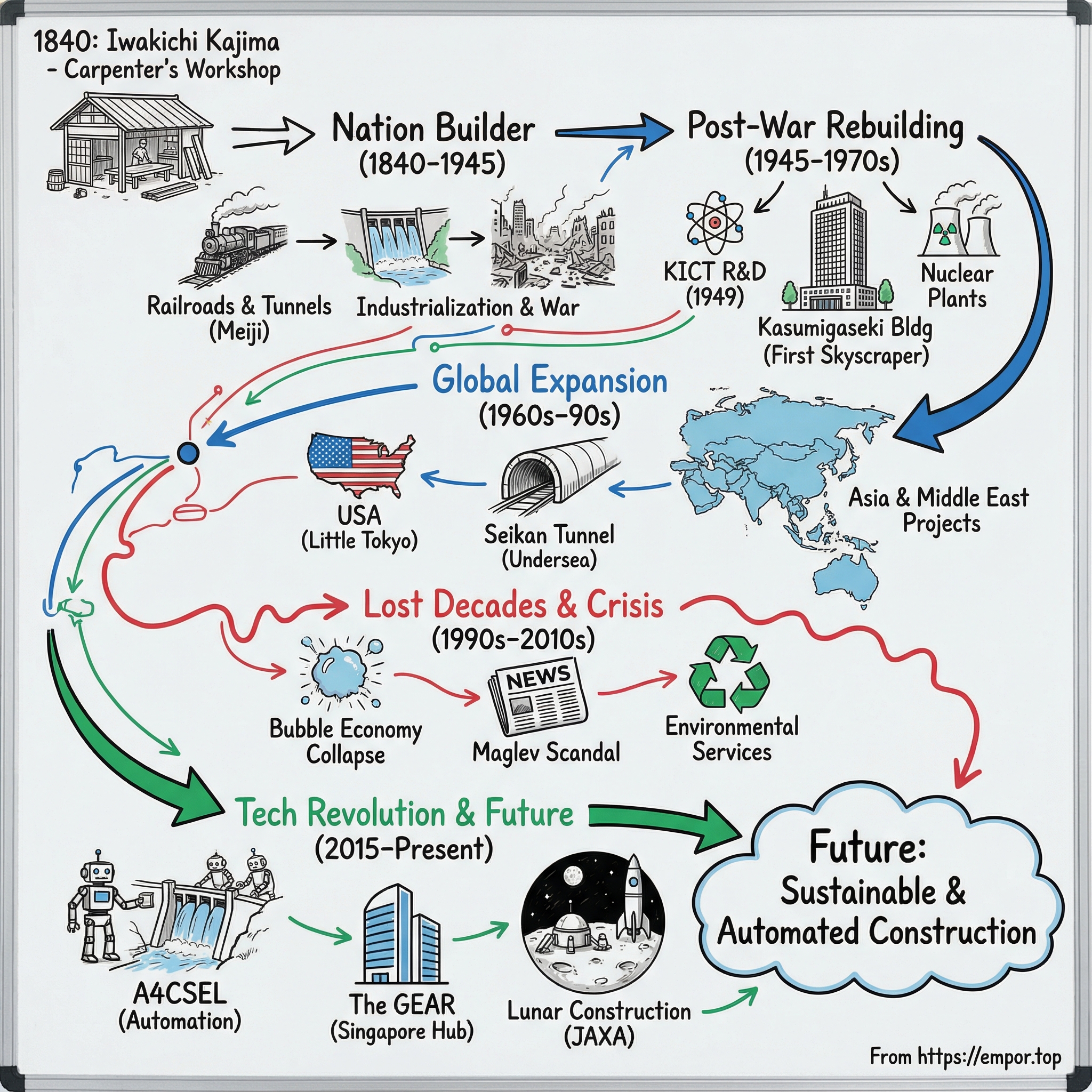
In 1840—nearly three decades before the Meiji Restoration—a carpenter named Iwakichi Kajima opened a workshop in the Nakabashi district. On paper, it was just a tradesman setting up shop. In reality, it was the first page of a story that would run through the building of modern Japan, the shocks of war and reconstruction, and the globalization of Japanese industry—eventually reaching all the way to construction technology designed for the Moon.
Today, Kajima Corporation is one of Japan’s oldest and largest builders, headquartered in Motoakasaka, Minato, Tokyo. But that clean corporate summary hides the real mystery: how does a carpentry business founded under the Tokugawa shogunate turn into a global construction and development powerhouse with work across continents?
That’s the question that anchors this episode, because construction is supposed to be the opposite of timeless. It’s cyclical. It’s competitive. It’s often treated like a commodity. And yet Kajima has endured for 185 years—through the Meiji Restoration, Japan’s industrial surge, wartime mobilization, postwar rebuilding, the bubble economy and its collapse, and now the slow-motion stress test of demographic decline. Along the way, it didn’t just participate in Japan’s transformation; it poured the concrete, bored the tunnels, and raised the steel that made it visible. Think of projects like the Kasumigaseki Building, Japan’s first high-rise, and the Seikan Tunnel, the undersea link between Honshu and Hokkaido.
Kajima today spans civil engineering and building construction, design, real estate development, and a deep bench of in-house research and engineering capabilities. It has also taken on major infrastructure work far beyond Japan, with projects across Asia and other global markets.
And the bigger themes here go beyond one company. We’ll dig into how engineering excellence can become a moat in a business that doesn’t look like it should have one. We’ll look at what happens when an industry built on relationships runs headlong into scandal and antitrust scrutiny. We’ll unpack Japan’s “Big Five” general contractors and how an oligopoly can shape competition. And we’ll close with the most forward-looking part of the story: automation—Kajima’s push to turn construction sites into something closer to factories, and what that means for the future of building.
Because if you want to understand Kajima, you’re really studying the craft of institutional survival: how a company keeps its identity intact while reinventing itself, generation after generation, as the world changes around it.
II. The Origins: From Carpenter to Nation-Builder (1840–1945)
The Founding Vision
In 1840, in Edo’s busy merchant districts—where workshops competed with food stalls and the soundtrack was all hammers, saws, and shouted orders—Iwakichi Kajima opened a carpentry shop. He wasn’t just a capable tradesman. He was known as an inventive carpenter and designer, and the work stayed in the family: his sons carried the craft forward as Japan began to tilt, slowly at first, toward a new era.
The timing could not have been better. Japan in 1840 was still largely sealed off from the world; Commodore Perry’s “Black Ships” wouldn’t arrive for another thirteen years. But the pressure was building. And when the Meiji Restoration arrived in 1868 and the country began its rapid pivot from feudal society to industrial state, Kajima’s successors were standing right where the wave would break: close to the capital, already trusted as builders, ready to scale.
That modernization drive created an insatiable appetite for construction—factories big enough to feed new industries, civic buildings that signaled a new government, and the hard stuff that would tie the islands together: railroads and tunnels. Japan wasn’t just trying to grow; it was trying to catch up to Western powers that had been industrializing for generations. That kind of national project needs more than ambition. It needs contractors who can actually execute.
Kajima did something that signaled where it wanted to play. It built what is described as Japan’s first European-style commercial building: an office for the Hong Kong-based trading house Jardine Matheson & Company. Then, in 1880, it entered railroad construction under the name Kajima Gumi. That was a step-change—from carpentry to industrial infrastructure, from local work to projects connected to international commerce. Jardine Matheson was a major player in Asian trade, and meeting its standards mattered. It wasn’t just a job; it was credibility.
From there, Kajima Gumi quickly gained a reputation in exactly the kind of work that separates builders from builders: railroad bed construction and tunneling. These projects weren’t headline-grabbing, but they were unforgiving. Japan’s terrain made rail construction a technical challenge—grading, drainage, and tunnel engineering were make-or-break details. Kajima leaned into that difficulty, and in doing so, began building something like a moat: expertise that was hard to replicate.
Building the Infrastructure of Modern Japan
As Japan industrialized, the demand kept coming. Rail lines expanded across the country. Industrial centers grew. Western-style government buildings rose as visible proof that Japan was remaking itself. Kajima Gumi took on more and more industrial and infrastructure work as the nation’s buildout accelerated.
In the 1920s, Kajima Gumi began constructing hydroelectric dams, moving deeper into large-scale civil engineering. Then, on February 22, 1930, it became a public company, capitalized at three million yen. Incorporating at the onset of the Great Depression might sound like a terrible idea—unless your market is largely domestic and anchored by long-horizon infrastructure spending. In Japan, public works continued, and Kajima’s move reflected both confidence and momentum.
With private shareholders came more capital, and with more capital came larger projects and a bigger operating footprint. Kajima Gumi increasingly functioned not as a local builder but as an industrial contractor—organized, scaled, and capable of handling complex jobs.
But the 1930s also pushed Japan into a far more dangerous direction. Right-wing elements within the military gained power and pursued a neo-mercantilist vision, paired with colonial expansion across East Asia and the western Pacific. A “quasi-war economy” followed, with major industrial projects designed to strengthen Japan’s capacity for conflict. Like many firms of the era, Kajima Gumi sought to keep itself apart from politics—but it operated within a national economy that was being reorganized for war.
The war years are an unavoidable and complicated part of any long-lived Japanese industrial story. Kajima survived the conflict, but it emerged into a country shattered by destruction. Cities were in ruins. Industry was crippled. The population was exhausted. For Kajima—as for essentially every Japanese enterprise—the next chapter wasn’t about returning to normal. It was about rebuilding from near zero.
What Kajima’s first century really produced wasn’t just a list of projects. It produced durable advantages: technical skill in demanding civil engineering work, a hard-earned reputation for quality and reliability, and deep relationships with government clients. Those assets would matter enormously in what came next, because postwar Japan would become the largest construction opportunity in the country’s history.
III. Post-War Reconstruction & The Rise of Japan's "Big Five" (1945–1970s)
Rebuilding a Nation
When Allied forces occupied Japan in August 1945, the country faced an almost unimaginable rebuilding job. Major cities lay in ruins. Hiroshima and Nagasaki carried the scars of atomic weapons. The economy had buckled. People were exhausted, hungry, and unsure what came next.
For Kajima, survival now depended on reinvention. The company was reorganized under the commercial laws introduced during the occupation and, in 1947, reestablished as the Kajima Construction Company. Then, in 1949, it made a move that looks obvious only in hindsight: it created the Kajima Institute of Construction Technology, or KICT.
KICT was a private research institute—an industry first in Japan—set up so Kajima could develop new materials and engineering methods instead of only executing whatever work happened to be available. Based in Tokyo’s Chuo ward at the time, it employed 233 specialists. That headcount matters less than what it signaled: in a moment when the entire country was desperate for speed and volume, Kajima decided that the real edge would come from better technology.
Also in 1949, Kajima was incorporated, a major step in formalizing its corporate structure. With that foundation, it expanded quickly and became a significant player in postwar reconstruction.
By 1950, Kajima was already reaching beyond Japan for know-how, forming a joint venture with U.S. contractor Morrison-Knudsen for construction work in Okinawa. In 1952, it began building Kyushu Electric Power Company’s Kamishiiba Dam, Japan’s first arch dam. The Morrison-Knudsen partnership, in particular, gave Kajima exposure to American construction management at a time when U.S. engineering practices set the global standard.
The Super General Contractors Emerge
Out of this reconstruction boom came something distinctive about Japan’s construction industry: the rise of the “super general contractors,” often shortened to “super zenecons.”
Kajima became one of the core five alongside Shimizu, Obayashi, Taisei, and Takenaka. These firms formed the nucleus of Japan’s construction sector—large enough to take on enormous, technically complex projects, and broad enough to offer end-to-end capability. Collectively, they covered a wide range of business areas and operated at a scale that set them apart from the rest of the market.
Their dominance wasn’t the result of a single policy or moment. It developed naturally from the realities of modern construction: big projects require big balance sheets, deep technical benches, and long relationships—especially with government clients. Over time, the market became moderately concentrated, with Kajima and a few peers effectively forming a technology-intensive oligopoly.
And the way Japanese construction is structured reinforced this. Major projects are typically awarded as lump-sum contracts to a main contractor. That general contractor sits at the top of a pyramid: it manages the schedule, cost, quality, financing, and client relationship, while layers of specialized subcontractors handle specific pieces of the work.
That pyramid can be incredibly effective. It can also get “cozy.” The same stability that made Japan’s rapid rebuilding possible would later create real trouble—something we’ll come back to when we reach the maglev scandal. But in the decades after the war, this system delivered exactly what Japan needed: execution capacity at national scale.
The Technological Edge
Kajima’s bet on R&D paid off fast, because the projects Japan needed weren’t just larger—they were more complex.
In the early 1950s, Kajima began designing nuclear reactor complexes, work that forced the company to expand its research capabilities. In 1956, the institute was relocated to the Tokyo suburb of Chofu. The next year, Kajima built Japan’s first nuclear reactor, the Number 1 reactor at the Japan Atomic Energy Research Institute’s complex in Ibaraki Prefecture.
That project was a technical leap. Nuclear construction demands extreme precision, rigorous materials expertise, and quality control far beyond conventional building. Pulling it off put Kajima at the frontier of what construction could be in Japan.
Over the decades that followed, Kajima accumulated deep expertise and talent in this area. The company became a leader in Japan’s nuclear power plant construction, building more than 60 percent of the country’s plants.
Then came a very different kind of landmark: the Kasumigaseki Building, completed in 1968 and widely regarded as Japan’s first modern office skyscraper. It wasn’t just tall—it was symbolic. It marked the moment Tokyo started to look like a global capital.
The building sits in the heart of the government and business district, designed by Yamashita Sekkei and constructed by Kajima using an all-steel frame and prefabrication techniques that also made future adaptations easier. Its rise was made possible by 1960 revisions to Japan’s Building Standards Act, which relaxed height limits in select earthquake-resistant zones. The result was a 36-story tower with three underground levels, the tallest building in Japan until 1970.
In a country defined by earthquakes, going vertical isn’t simply a matter of steel and ambition. It’s a seismic engineering problem. Kajima’s success at Kasumigaseki demonstrated it could solve the kinds of challenges that kept others grounded.
And Kajima didn’t stop there. In 1974, the institute built an “earthquake simulator.” A year later, Kajima added a hydraulics laboratory, strengthening its position in dams, breakwaters, and ocean platform construction.
What took shape in these decades wasn’t just a portfolio of postwar projects. Kajima was establishing a repeatable formula: invest early in research, win the most technically demanding jobs, and deepen long-term relationships—especially with public-sector clients. Those choices became the company’s long-running advantage, and they still echo through Kajima’s strategy today.
IV. The Global Expansion Era (1960s–1990s)
Going International
By the 1960s, Japan’s postwar rebuilding was giving way to something else entirely: the surge that would become the “Japanese economic miracle.” Kajima had grown into a modern contractor with a serious research bench, and it started to ask the obvious next question. If we can build at the frontier at home, why not take that capability overseas?
In 1964, Kajima established Kajima International, Inc. (KII) in Los Angeles. That same year, Kajima reached the global No. 1 ranking in construction based on total contract value, and it constructed facilities for the 1964 Tokyo Olympic Games. It was a neat encapsulation of the moment: winning on the world stage in Tokyo, while planting a flag in the United States.
Los Angeles wasn’t a random choice. KII’s first mission was to redevelop Little Tokyo in downtown LA—an area with deep significance for Japanese Americans, especially after wartime internment had dispersed the community. It wasn’t just a commercial real estate play. It was a culturally loaded project that gave Kajima a foothold in the world’s largest construction market.
At the same time, Kajima was taking on more work across Asia—buildings and dams in Burma, Vietnam, and Indonesia. The pattern mirrored Japan’s broader overseas push: Japanese firms followed industrial clients as they expanded abroad and, in developing countries, often worked alongside Japan’s foreign aid efforts.
In 1970, the company changed its name to Kajima Corporation, a rebrand meant to match its widening scope and international ambitions. The message was simple: this wasn’t just a domestic builder anymore.
Then came a project that signaled Kajima was willing to operate far outside its comfort zone. The East German government gave Kajima full responsibility for building the International Trade Center Building in East Berlin—without the usual restrictions or demands that local companies be included. In Cold War East Germany, that was highly unusual. Kajima won on technical credibility, and the fact that the government waived typical local-participation requirements says a lot about the reputation it had earned.
From there, the map kept expanding. Work followed in the United States, Turkey, Algeria, and Zaire. Kajima was no longer simply “Japan’s contractor.” It was becoming a contractor that happened to be Japanese.
Engineering Marvels
If the 1960s and 70s were about getting overseas, the 1980s were about proving Kajima could do the hardest work anywhere. The defining example was the Seikan Tunnel—an undersea link between Honshu and Hokkaido beneath the Tsugaru Strait.
The Seikan Tunnel stretches 53.85 kilometers, with 23.3 kilometers running under the seabed. After decades of planning and construction, it opened on 13 March 1988. At peak, as many as 3,000 workers were involved. The work was dangerous—cave-ins, flooding, and other mishaps took a total of 34 lives. Even today, it stands as one of the twentieth century’s most formidable engineering feats.
Kajima served as a co-contractor on Lot (5) Ryōhi alongside Kumagai Gumi and Tekken Construction. Undersea tunneling through difficult geology forces a company to learn fast: ground control, water management, logistics, and precision execution under extreme risk. The know-how gained here wasn’t a trophy. It was an asset Kajima could reuse.
In 1982, Kajima was awarded the Deming Prize for engineering excellence, recognition of a systematic approach to quality management that’s more often associated with manufacturing than construction. Since then, Kajima has continued to receive recognition for its achievements. It also built a substantial intellectual property base—almost 1100 Japanese patents, including 72 registered in foreign countries.
And the 1990s kept the marquee projects coming. Kansai International Airport opened in 1994. The Nagano Olympic Memorial Arena, M-Wave, was completed in 1996. In 1998, the Akashi Kaikyo Bridge opened. An airport on an artificial island, an Olympic arena, and the world’s longest suspension bridge—each one a different technical challenge, each one a signal that Kajima could operate at the edge of what was buildable.
The American Dream
Kajima’s U.S. story had its own rhythm, tied closely to waves of Japanese investment.
When Japanese automakers began building major production facilities in the United States in the 1980s—Mazda/Ford in Flat Rock, Michigan; Mitsubishi Motors/Chrysler in Normal, Illinois; Subaru/Isuzu in Lafayette, Indiana—Kajima was often the builder. That fit was natural: these plants demanded extremely precise specifications to support Japanese production systems, and Japanese manufacturers trusted a Japanese contractor to deliver them.
When Japanese investment cooled in the 1990s, Kajima adjusted. It localized operations and began winning work from major U.S. companies. Japanese construction management practices—especially tight quality control and disciplined coordination on site—translated better than many expected, and American clients took notice.
Then, starting around 2000, the growth engine shifted again. As the U.S. IT industry expanded, Kajima built many data centers and mission-critical facilities. These projects reward the same capabilities Kajima had been sharpening for decades: exacting requirements, complex systems integration, and a low tolerance for error.
From an investor’s perspective, this era proved Kajima could export its strengths. But it also surfaced the trade-offs. Overseas markets were more competitive, margins thinner, and execution complicated by distance and culture. Japan—stable relationships, familiar procurement, predictable demand—still anchored profitability, even as Kajima’s ambitions went global.
V. The "Lost Decades" and Strategic Pivots (1990s–2010s)
Japan's Construction Winter
Then the floor dropped out.
In 1991, Japan’s asset bubble burst—and what followed became the “Lost Decades,” a long stretch of stagnation that rewired the incentives and economics of the country’s construction business.
During the boom, land prices and real estate values had climbed into the surreal. Developers and contractors rode a seemingly endless wave of projects, financed by banks that were just as convinced the party would never end. When it did end, it ended brutally: land values fell, developments stalled or died midstream, and companies that had expanded aggressively suddenly found themselves carrying too much debt in a market that no longer wanted what they were selling.
By the late 1990s, the downturn pushed Kajima into a move that looks like a side business only until you realize it was a survival strategy. It expanded into environmental services—waste treatment, water treatment, soil rehabilitation, and environmental consulting.
This wasn’t Kajima abandoning construction. It was Kajima redefining what “construction” could mean. The common thread was engineering and execution in complex, regulated environments—but the demand drivers were different, and far less tied to the rise and fall of Japanese real estate.
The pain, though, was real. In 1999, Kajima reported a loss of roughly $2.6 billion tied to debt disposal, and management responded with what it called the “New Three Year Plan.” A year later, in 2000, it formalized the pivot by establishing an environmental division.
The plan meant doing the hard things companies often try to postpone: disposing of bad assets, restructuring operations, and narrowing focus back to what Kajima could do better than anyone else. In an era when plenty of Japanese firms drifted along without truly confronting the damage, Kajima’s willingness to take the hit—and move—helped set it up to recover.
Kajima wasn’t alone in this. Japan’s Big Five contractors survived the construction winter largely because they had options. Their size gave them staying power, government infrastructure spending helped stabilize demand when private development collapsed, and their technical depth kept them in the game for specialized work that smaller firms couldn’t credibly bid on. International business didn’t always deliver the same profitability as Japan, but it did diversify the revenue base when the home market turned hostile.
Asia Rising
While Japan was stuck in slow motion, much of Asia was accelerating.
China was emerging as the world’s factory. Southeast Asia was industrializing. Urbanization and rising incomes created a new wave of demand for infrastructure, factories, offices, and housing. And Kajima already knew the playbook, because it had seen an earlier version of this pattern: Japanese manufacturers expanding abroad, then pulling their trusted suppliers and contractors with them.
In the 1980s, Kajima’s construction business in Southeast Asia grew as companies in electronics, machinery, and automotive invested across the region. They needed plants built to Japanese specifications, with Japanese-grade quality control—and Kajima was a natural fit.
In the 1990s, Kajima moved up the stack. It took on major urban redevelopment projects in Indonesia and Singapore, expanding from industrial facilities into commercial real estate development. That was an important evolution: not just building projects for a fee, but participating in the higher-margin world of development.
By the early 2010s, Kajima was delivering large projects across multiple regions. In 2010, it completed the D-Runway at Tokyo International Airport and Resorts World Sentosa in Singapore. In 2011, it completed the Dubai Metro and the KaTRI research and administration building. Resorts World Sentosa was a particularly clear signal that Kajima could manage complex, high-profile work outside Japan; the Dubai Metro showed it could compete in the Middle East, a market long dominated by European and American contractors.
China was the other obvious prize, and Kajima re-entered it formally in 2003 by establishing Kajima Corporation (China), in response to China’s accession to the WTO. The opportunity was enormous, but so were the risks: intense local competition and complex political and business dynamics. Kajima’s strategy was to avoid the commodity end of the market and focus on high value-added, technically demanding manufacturing facilities—such as pharmaceutical production facilities—where its engineering edge could still command a premium.
Across the region, Kajima also built a local footprint through subsidiaries, including Kajima India Pvt. Ltd. in Gurgaon, Thai Kajima Co., Ltd. in Bangkok, and Kajima Vietnam Co., Ltd. in Ho Chi Minh City—platforms that supported work ranging from urban infrastructure to real estate.
If the bubble era showed how quickly construction can inflate, the Lost Decades showed how quickly it can punish complacency. Kajima’s response—diversifying into environmental services, leaning harder into Asia, and targeting higher-value projects—wasn’t flashy. It was adaptive. And it’s a big reason the company entered the modern era not as a relic of Japan’s boom years, but as a builder still capable of changing shape when the world forces it to.
VI. The Maglev Scandal: A Defining Crisis (2017–2018)
The Raid
In December 2017, the temperature dropped—and so did the mood across Japan’s construction industry.
That month, prosecutors from the Tokyo District Public Prosecutors Office, working alongside investigators from the Japan Fair Trade Commission, arrived at the Tokyo offices of some of the country’s biggest contractors with search warrants in hand. Among them: Kajima and Shimizu. Days later, the dragnet widened to Taisei and Obayashi.
The target wasn’t a minor public works contract. It was the Linear Chuo Shinkansen, the maglev line backed by Prime Minister Shinzo Abe’s government as a national showcase—an ultra-fast connection designed to get passengers from Tokyo to Nagoya in about 40 minutes, at speeds around 500 kilometers per hour.
Markets reacted immediately. Kajima’s shares fell as much as 4.6 percent, and Shimizu’s dropped as much as 3.7 percent, even as the broader Nikkei index was up that day. The message was clear: this wasn’t a routine compliance issue. This was prosecutors walking into the heart of Japan’s “super contractor” system.
The Charges
The Japan Fair Trade Commission filed a criminal accusation with the Public Prosecutor-General against what it called the “Super 4”: Taisei, Kajima, Obayashi, and Shimizu—four of the country’s biggest firms by turnover.
According to the JFTC, the companies agreed on who would win bids and then bid at prices that ensured the designated winner would take the contract. The contracts involved construction work for new terminal stations tied to the maglev project ordered by Central Japan Railway Company, known as JR Central.
The commission said the conduct went beyond occasional information-sharing. It determined that the firms exchanged bid-price information and effectively preselected winners for 21 contracts worth about 210 billion yen, beginning in 2011—restricting competition in the process. Investigators also alleged the companies shared sensitive details, including estimated costs, for station construction work at Shinagawa and Nagoya.
The case didn’t stay abstract. Prosecutors arrested a former Taisei executive and a Kajima official on suspicion of bid rigging related to the project. The scandal had names, faces, and handcuffs—exactly the kind of visibility Japan’s construction giants try to avoid.
The Stakes
What made the maglev scandal resonate wasn’t just the project’s size. It was how familiar the allegations sounded.
Bid coordination—often referred to as dango—has long been a shadow story in Japanese business, not only in construction. Supporters argue that informal coordination helps distribute work, reduces ruinous competition, and stabilizes an industry that relies on long-term capacity. Critics argue it does the opposite of what public procurement is supposed to do: it inflates costs and turns “competitive bidding” into theater.
In this case, executives at Obayashi and Shimizu told prosecutors that the four companies had fixed bidding to divide maglev projects among themselves. They reportedly admitted violations of Japan’s Anti-Monopoly Law to the Fair Trade Commission.
Kajima and Taisei, by contrast, continued to deny wrongdoing and signaled they would fight the allegations with both the commission and prosecutors.
The Aftermath
The outcomes split the group in two.
Obayashi and Shimizu admitted their involvement in bid rigging. Obayashi issued a statement accepting responsibility and promising “preventive measures and other additional steps to regain trust promptly.” Both companies benefited from lower fines because they voluntarily reported to the commission and used leniency provisions.
Kajima and Taisei were also indicted, but denied the charges. Individuals were charged as well, including Taisei’s former managing director Takashi Okawa and Kajima’s civil engineering sales division manager Ichiro Osawa.
Okawa, then 70, and Osawa, then 63, were sentenced to 18 months in prison, suspended for three years, for violating the antimonopoly law. Their companies were ordered to pay 250 million yen each in fines. Later, in December 2020, the JFTC issued cease-and-desist orders and surcharge payment orders to the companies, including Kajima.
And yet, the deeper story is what didn’t happen. Kajima’s business didn’t crater. It continued to win major contracts, implying that clients—especially government and infrastructure clients—still trusted Kajima’s ability to execute, even as the legal and reputational cloud hung overhead.
For investors, the scandal is less about a single fine and more about what it reveals about corporate governance and market structure in Japan. Practices like dango persist because they’re embedded in how stable, relationship-driven industries operate—and because enforcement, while real, doesn’t always change the underlying economics.
The practical takeaway is uncomfortable but important: the risk here isn’t necessarily an immediate financial hit. It’s the ongoing exposure—reputational, legal, and regulatory—that can flare up again, especially when prosecutors decide they want to make an example out of an industry that has historically operated as a closed club.
VII. The Technology Revolution: A4CSEL and the Future of Construction (2015–Present)
The Labor Crisis That Sparked Innovation
Walk through a Japanese construction site today and one thing jumps out fast: the workforce is getting older.
Roughly a third of construction workers in Japan are 55 or older, while only about one in ten are under 29. A huge share of the industry’s most experienced people are expected to retire within the next decade, but the pipeline behind them is thin.
The headcount trend tells the same story. Employment peaked at about 6.85 million in 1997. By 2018, it had fallen to around 5 million—roughly a quarter fewer workers. A government survey later showed the decline continuing to about 4.85 million by 2021.
And the problem isn’t just demographics. Construction has a branding problem. In Japan it’s long carried the “3K” label: kitanai (dirty), kitsui (tough), and kiken (dangerous). That perception has been hard to shake, and it pushes younger workers toward cleaner, safer, and more prestigious paths in IT, finance, and services.
For Kajima and the rest of the Big Five, that adds up to something close to an existential threat. Unlike manufacturing, construction has historically been stubbornly difficult to automate. Every project is different, every site comes with its own constraints, and so much of the work has depended on human judgment—experience, intuition, craftsmanship.
Or at least, that was the assumption.
Kajima’s response wasn’t to nibble around the edges with a few new tools. It was to try to redesign the production system of construction itself.
A4CSEL: The Quad-Accel System
Kajima’s answer is A4CSEL (pronounced “quad-accel”), a construction production system built around the automated operation of construction machinery.
The core idea is simple to say and hard to pull off: operate multiple automated machines with a small number of people, in a way that’s both safe and efficient. Kajima describes it as converting construction from a “qualitative” craft—work driven by on-the-spot judgment—into a “quantitative” system grounded in production engineering.
And it all comes back to one phrase Kajima repeats like a mission statement: “transforming the construction site into a factory.”
That’s the ambition. Factories win through standardization, automation, and continuous improvement. Construction sites have traditionally been the opposite: bespoke, variable, and dependent on skilled labor that can’t be swapped out easily.
A4CSEL works by transmitting job data, based on optimized plans, to general-purpose construction machines that have been modified for automation. Kajima positions it as the world’s first construction production system designed around the simultaneous operation of many automated machines with fewer operators.
The system began showing up in real work in 2015, with automatic vibration rollers introduced at the Gokayama Dam. From there, Kajima expanded the roster of A4CSEL-capable machines and applied them at sites including the Oita River Dam and the Koishiwara River Dam.
Breaking Records
A big promise is one thing. Proof is another.
At the Naruse Dam in Akita Prefecture, Kajima put A4CSEL to the test at full scale. In May 2022, the project placed about twice the previous maximum monthly volume of concrete, breaking a Japanese record that had stood for 62 years.
Then in fiscal year 2023, Kajima automated a key bottleneck: it succeeded in automatically supplying CSG directly from the manufacturing plant to the embankment via a long-distance conveyor belt. That matters because it pushes automation upstream and downstream—closer to an end-to-end production line, not just automated machines doing isolated tasks.
The system also changes the safety equation. Automated machinery can operate on the embankment continuously—day and night aside from refueling. At peak, work continued for about 70 hours across three days and nights. And because no one is allowed inside the automated construction area, accidents caused by contact between people and heavy equipment are eliminated.
Kajima even tested what “construction as a factory” looks like operationally. In October 2021, automated machinery at three sites was centrally controlled from a control room at Kajima’s headquarters in Minato, Tokyo. Across those sites, twenty automated machines were operated remotely by just four A4CSEL operators. Kajima’s vision is that, eventually, automated equipment across Japan could be run remotely—potentially via telework—or even, someday, from much farther away.
From Dams to Tunnels
Dams are a great proving ground, but tunnels are where the danger spikes.
A4CSEL for Tunnels aims to raise safety, productivity, and quality in mountain tunnel construction by automating and remote-controlling excavation operations—so the most hazardous work around the tunnel face can be done unmanned and more efficiently.
Development started with a mockup tunnel opened in 2018, where Kajima established the fundamental technologies needed for automated and remote work. From 2021, the technology was demonstrated in the Kamioka Test tunnel under conditions intended to mirror real construction. In 2024, all six steps of the process were automated and remote-controlled, marking the completion of “A4CSEL for Tunnels.”
Kajima reports that optimizing drilling patterns and explosive volumes reduced overbreak by 60% and cut cycle time by 20% compared to manual operations—exactly the kind of incremental operational win that compounds over the life of large projects.
To the Moon
Then Kajima did something that sounds like a marketing stunt until you realize it fits the logic perfectly.
If you can automate construction enough that people don’t need to be in the dangerous zone—or even on the jobsite—why stop at Earth?
Since 2016, Kajima has collaborated with the Japan Aerospace Exploration Agency (JAXA) on a project exploring whether A4CSEL could be used to build a manned base on the Moon.
Kajima began joint research with the JAXA Space Exploration Innovation Hub Center focused on improving construction efficiency. In March 2019, using A4CSEL, the team demonstrated a sequence of automated construction tasks for installing a habitation module—expected to serve as a base for manned lunar exploration—at the Kajima Seisho Test Field. The demonstration, showing the feasibility of autonomous driving in a lunar construction scenario, attracted global attention.
One of the big concerns is latency. A lunar base would likely be built by remotely controlling machinery from Earth or a space station, but communication delay could make real-time control difficult and drag down productivity. So the work has emphasized both autonomous driving and remote control robust enough to handle lunar conditions—extreme temperature swings, regolith, and lower gravity.
Kajima, JAXA, and multiple universities have been developing that capability, with the stated aim of having the necessary software and hardware ready to use within the next 15 to 25 years.
For investors, A4CSEL is more than a clever response to labor shortages. If it scales and travels—across project types, across geographies—it could reset the competitive map. A contractor that can deliver higher productivity with fewer workers, while improving safety and maintaining quality, doesn’t just win bids. It changes what “world-class” construction even means.
VIII. Modern Era: Sustainability, Singapore Hub & Global Strategy (2020s)
The GEAR: Kajima's Innovation Lab
On August 4, 2023, at Changi Business Park, Singapore’s Minister of State Low Yen Ling cut the ribbon on a new facility meant to signal where Kajima wanted to go next.
Later that month, on August 16, Kajima officially opened The GEAR—short for Kajima Lab for Global Engineering, Architecture & Real Estate. It’s both Kajima’s regional headquarters and its Asia-Pacific innovation hub, and notably, its first and only overseas innovation center.
Inside, The GEAR is built like a test kitchen for the built world: five specialized laboratories and eighteen testbed zones where Kajima can push on sustainable construction materials, advanced building systems, occupant well-being, and intelligent technologies. The facility also works alongside the Kajima Technical Research Institute of Singapore, with a shared focus on the big macro forces reshaping construction everywhere: climate change and urbanization.
The Singapore decision wasn’t an accident, either. Nearly a decade earlier, the late Dr. Shoichi Kajima had tasked the company with establishing a headquarters there—drawn to Singapore’s reputation for execution, its role as a gateway to the region, and the credibility that comes from operating in a global business hub with strong rule of law.
Technology Transfer and Open Innovation
Then Kajima doubled down.
In September 2024, it established The GEAR by Kajima Pte Ltd, a new Singapore subsidiary designed to drive innovation and capability development across construction and the built environment. The mandate is twofold: operate as Kajima’s dedicated technology services business, and serve as an open innovation platform.
That’s a meaningful shift in posture. Kajima’s technical edge has historically been proprietary—built over decades and closely guarded. The GEAR’s model implies Kajima sees a new path to advantage: not just owning the best tools, but setting standards, building partnerships, and becoming the platform others plug into.
As the company put it: “In August 2021, we established Kajima Ventures in Singapore as a stage-agnostic, mission-driven corporate venture fund and later this year, we will be launching our first corporate accelerator program at The GEAR, where we will work with the most promising early-stage startups. We believe startups with energy and creativity will have a positive impact on our culture.”
Sustainability Investments
That same “build the future, don’t just talk about it” mindset also shows up in how Kajima is investing.
Eavor Technologies Inc., a geothermal energy company, entered into an agreement with Kajima Corporation to receive a direct investment. The fit is straightforward: Kajima wants to strengthen its position in the energy transition in Japan and beyond, and the deal ties into Kajima’s Environmental Vision of Triple Zero 2050—its framework built around carbon neutrality, a circular economy, and a nature-positive society.
Eavor’s closed-loop geothermal approach is positioned as clean, dispatchable baseload energy, with a low ecological footprint—attributes Kajima connects directly to those Triple Zero goals. In Kajima’s words, “Changing electrical power sources to renewables is a major vehicle towards Carbon Neutrality. At Kajima we anticipate a vast potential in Eavor's closed-loop geothermal systems,” stated Michiya Uchida of Kajima.
Stepping back, the Eavor investment is a good lens on Kajima’s sustainability strategy. It isn’t limited to shrinking emissions on jobsites. It’s also about placing bets on technologies that could change the energy system the construction industry ultimately depends on.
For investors, the pattern across The GEAR, open innovation, and sustainability investing points to a company trying to shape its next era on purpose. The outcomes are still uncertain, but the intent is clear: Kajima is positioning itself for a future where the edge comes as much from technology, partnerships, and decarbonization as it does from concrete, steel, and manpower.
IX. Playbook: Business & Investing Lessons
The Secrets of 185-Year Survival
How does a company make it to 185 years without becoming a museum piece? Kajima’s history hints at a few repeatable moves—less about luck, more about building systems that keep working as the world changes.
Family Legacy to Corporate Transformation: Kajima remained under family management from the beginning, but it didn’t treat succession as a romantic tradition. It treated it as a practical problem to solve.
When Seiichi Kajima’s marriage produced no sons, his daughter Ume married Morino Suke, a career diplomat and scholar. He was adopted into the family and took the Kajima name. This Japanese practice—adopting capable adults into a founding family—keeps the line intact while bringing in fresh talent and outside perspective. In other words: continuity without stagnation, a surprisingly modern answer to the succession failures that wipe out many family businesses.
The R&D Moat: Kajima’s most durable advantage isn’t a single project or a lucky cycle. It’s the decision, in 1949, to build the Kajima Institute of Construction Technology so the company could develop its own materials and engineering methods. As the first private research institution of its kind in Japan, it set a precedent inside the company: don’t just bid on work—earn the right to win the hardest work.
Construction can look commoditized from a distance. Up close, the projects that really matter—technically demanding, high-risk, high-visibility jobs—reward firms that can solve problems others can’t. That’s where premium pricing and repeat business come from, and Kajima has spent decades making that capability systematic.
Relationship-Based Business Model: Kajima also grew up inside an industry structure that favored stability. The Big Five system created long-running relationships with government agencies and major corporates, and in many cases, that meant predictable pipelines and less brutal price competition than you’d see in a fragmented market.
That same relationship-driven ecosystem is exactly what made the industry vulnerable to antitrust scrutiny, as the maglev case showed. But as a business model, it also explains why these companies can feel unusually resilient: relationships, reputation, and track record become competitive assets.
The Japanese Model
In Japan, general contractors typically take lump-sum contracts for civil engineering and building projects and act as the main contractor responsible for delivering the entire job. They sit at the top of a layered pyramid: managing schedule, cost, quality, and coordination while specialized subcontractors execute much of the work.
Another key difference from many Western markets is that major Japanese construction firms often provide in-house design services. Kajima pairs that with a real estate development division, which allows it to handle the full lifecycle: project startup, planning, and design through construction, operation, maintenance, and renewal. That end-to-end capability can capture more value per project, and it gives clients a real reason to stick with a firm they trust—because switching isn’t just changing a builder, it’s changing the whole delivery engine.
Lessons from Crisis
The maglev scandal is a reminder that governance risk is real in relationship-heavy industries—and that “normal practice” can suddenly become a legal and reputational crisis when regulators decide to draw a line.
It also shows how slowly the underlying competitive structure changes. In markets dominated by a small group of players, the tension between cooperation and antitrust enforcement never fully disappears. For investors, the practical lesson is to watch regulatory signals and compliance posture closely, while recognizing that the core economics of an oligopoly tend to be sticky—even after a very public shock.
X. Porter's Five Forces & Hamilton's 7 Powers Analysis
Porter's Five Forces
Threat of New Entrants: LOW
Breaking into Japan’s large-scale construction market is brutally hard. The Big Five operate at a size that’s difficult to finance, difficult to staff, and difficult to insure—especially on the kind of technically demanding work that actually matters. Just as important, this is an industry where relationships are an asset class. Credibility with government agencies and major corporates isn’t something a new entrant can buy quickly; it’s built over decades of delivering projects that can’t fail.
And now the operating environment is getting even tougher. The workforce is aging, retirements are outpacing new entrants, and the April 2024 overtime curbs reduce available labor hours. To keep capacity from collapsing, contractors are being pushed toward autonomous earthmoving, remote-controlled equipment, and increasingly software-driven planning. That technology isn’t just a productivity tool—it’s another barrier to entry, because it demands capital, data, and operational know-how that newcomers typically don’t have.
Bargaining Power of Suppliers: MODERATE
Materials and equipment are meaningful cost drivers, and commodity volatility can squeeze margins. But Kajima’s scale gives it leverage: it can negotiate, lock in supply, and benefit from long-standing relationships where both sides have incentives to keep the partnership stable.
Bargaining Power of Customers: MODERATE TO HIGH
Government clients are a major source of demand and they bring real power to the table through procurement rules and price pressure. That said, for complex, high-stakes projects, the buyer’s options narrow fast. When the job requires deep engineering capability and a track record under scrutiny, “just pick a cheaper contractor” stops being a realistic alternative.
Threat of Substitutes: LOW
If a society needs tunnels, bridges, dams, and buildings, it needs construction. Prefabrication and modular methods can change how work gets done, but they don’t replace the need for builders—they’re process innovations, not substitutes for the underlying service.
Competitive Rivalry: MODERATE
Japan’s top end is an oligopoly in practice, with Kajima competing most directly with Obayashi, Shimizu, and Taisei. The maglev scandal showed the industry’s unhealthy side: coordination that crosses legal lines. But day to day, competition is still real—especially on marquee projects where winning means years of revenue and reputational momentum. Differentiation comes down to technical capability, execution quality, and relationship management.
Hamilton's 7 Powers Analysis
Scale Economies: Kajima’s size shows up in procurement leverage, equipment utilization, and the ability to fund long-horizon R&D. Systems like A4CSEL aren’t weekend projects; they’re investments smaller competitors can’t easily replicate.
Network Effects: There aren’t classic consumer-style network effects here, but there is an ecosystem effect. As a top-tier main contractor, Kajima sits at the apex of a subcontractor pyramid. That position tends to attract strong specialty partners, which in turn improves execution—an indirect network benefit that compounds over time.
Counter-Positioning: Automation like A4CSEL creates the possibility of a genuine model shift. If automated production is meaningfully more productive and safer, incumbents face a dilemma: adopt it and disrupt their existing labor-based operating model, or resist it and risk falling behind.
Switching Costs: Long-term customer relationships create practical switching costs. Clients that know Kajima’s methods—and have built their own processes around how Kajima delivers—take on real risk and friction when they move to a different contractor.
Branding: In B2B construction, brand is reputation under pressure. Kajima’s history on high-visibility, technically difficult projects builds trust that translates into future awards, especially where failure is politically or operationally unacceptable.
Cornered Resource: Specialized engineering talent—seismic know-how, nuclear facility experience, and deep project execution capability—is scarce and slow to develop. That human capital is a real constraint for the whole industry, and a meaningful advantage for firms that can attract and retain it.
Process Power: Kajima’s advantage isn’t just what it builds; it’s how it builds. Quality systems, operational discipline, and now automation-oriented production methods can become process advantages that are hard for competitors to observe from the outside—and even harder to copy.
Bull Case
The bullish view on Kajima is built on a few reinforcing trends. Japan still faces huge construction needs—disaster resilience upgrades, replacement of aging infrastructure, and potential maglev-related demand all support a long runway of work. At the same time, automation could shift the basis of competition: if A4CSEL-style systems deliver sustained productivity and safety gains, Kajima can win more complex work with fewer people, which is exactly what the labor market is forcing the industry to do. Add in selective growth outside Japan—especially in Southeast Asia—and the result is a company with a stable domestic core and optionality abroad. Finally, the concentrated market structure can help dampen price wars and protect margins, even in a cyclical industry.
Bear Case
The bear case is mostly macro, execution, and governance. Japan’s demographic decline doesn’t just tighten labor supply; over time it can also shrink domestic demand as the population falls and development slows. Overseas markets can be less forgiving, with tougher competition and structurally lower margins than Japan. Automation may not pay back as hoped—construction has a long history of resisting neat, factory-like transformation. And the maglev scandal is a reminder that regulatory and reputational shocks can reappear in an industry where relationships and “customary practices” sometimes clash with antitrust enforcement.
Key KPIs to Monitor
For investors tracking Kajima’s performance, focus on:
-
Gross Profit Margin in Construction Segment: Recent margin improvement has been supported by large-scale project contributions and better profitability on major building work. The exact numbers matter less than the direction and durability—watch whether margins can stay elevated versus prior cycles, which would signal real pricing power and/or operational gains.
-
Order Backlog Composition: The backlog mix—domestic vs. overseas, public vs. private, and civil engineering vs. building construction—acts like a forward-looking map of risk and opportunity. It tells you where Kajima is leaning, what kind of work it’s winning, and how visible future revenue really is.
Tracked over time, these KPIs show whether Kajima is actually converting its strategy—technology-led differentiation plus selective international growth—into sustained performance, while keeping the domestic core profitable and defensible.
Conclusion: Building the Future
In 1840, when Iwakichi Kajima opened his carpentry shop, Japan was still a feudal society, largely closed to the outside world. Today, Kajima is developing technology meant for something that would have sounded like science fiction to Edo-era builders: construction work that could support a base on the Moon.
That span—from workshop to lunar ambitions—captures what’s most distinctive about Kajima. It didn’t survive 185 years by doing one thing well and repeating it forever. It survived by evolving with each wave of Japan’s history: moving from traditional carpentry into railroads and tunnels, from postwar reconstruction into advanced civil engineering, from complex facilities like nuclear-related work into a modern push toward automation.
And this next era may be as demanding as any before it. Japan’s demographic decline is squeezing the labor pool construction relies on. Climate pressure is raising expectations for how buildings are made, what materials are used, and what carbon footprint gets left behind. And automation is no longer a nice-to-have R&D project—it’s becoming the way the industry keeps functioning at all.
Kajima’s answer so far is clear: bet on transformation. A4CSEL is an attempt to make construction behave more like manufacturing. The GEAR in Singapore is a bet on global innovation and partnerships. Sustainability investments are a bet that the next generation of infrastructure will be judged not just by what it costs and how fast it’s delivered, but by the world it helps create.
Whether those bets work will shape the next chapter of the company. Kajima has the history and the engineering credibility to make them plausible. But they’re still bets.
Financially, the company has been delivering momentum. In the first half of FY2025, Kajima reported revenue of ¥1.3729 trillion, operating profit of ¥108.6 billion, and net profit of ¥77.3 billion—its highest second-quarter results on record. It also said it expected consolidated net income of 155.0 billion yen, reaching a long-term medium-term-plan target ahead of schedule.
The numbers suggest the current playbook is working. The harder questions are the ones that will decide durability: Can Kajima scale automation beyond showcase projects and turn it into a repeatable advantage? Can it win internationally in markets that don’t come with the same relationship stability as Japan? And can it attract the next generation of talent to an industry still fighting its reputation?
For investors, Kajima is a rare kind of construction company: a proxy for Japan’s ongoing infrastructure needs, with real optionality from technology. The risks remain—demographics, governance and regulatory scrutiny, and the sheer difficulty of changing how construction gets done. But if there’s one thing Kajima’s story makes hard to dismiss, it’s this: when the world changes, this company has a habit of changing with it.


 RSS Feed
 Spotify
 Apple Podcasts
 Amazon Music
 Audible
 YouTube