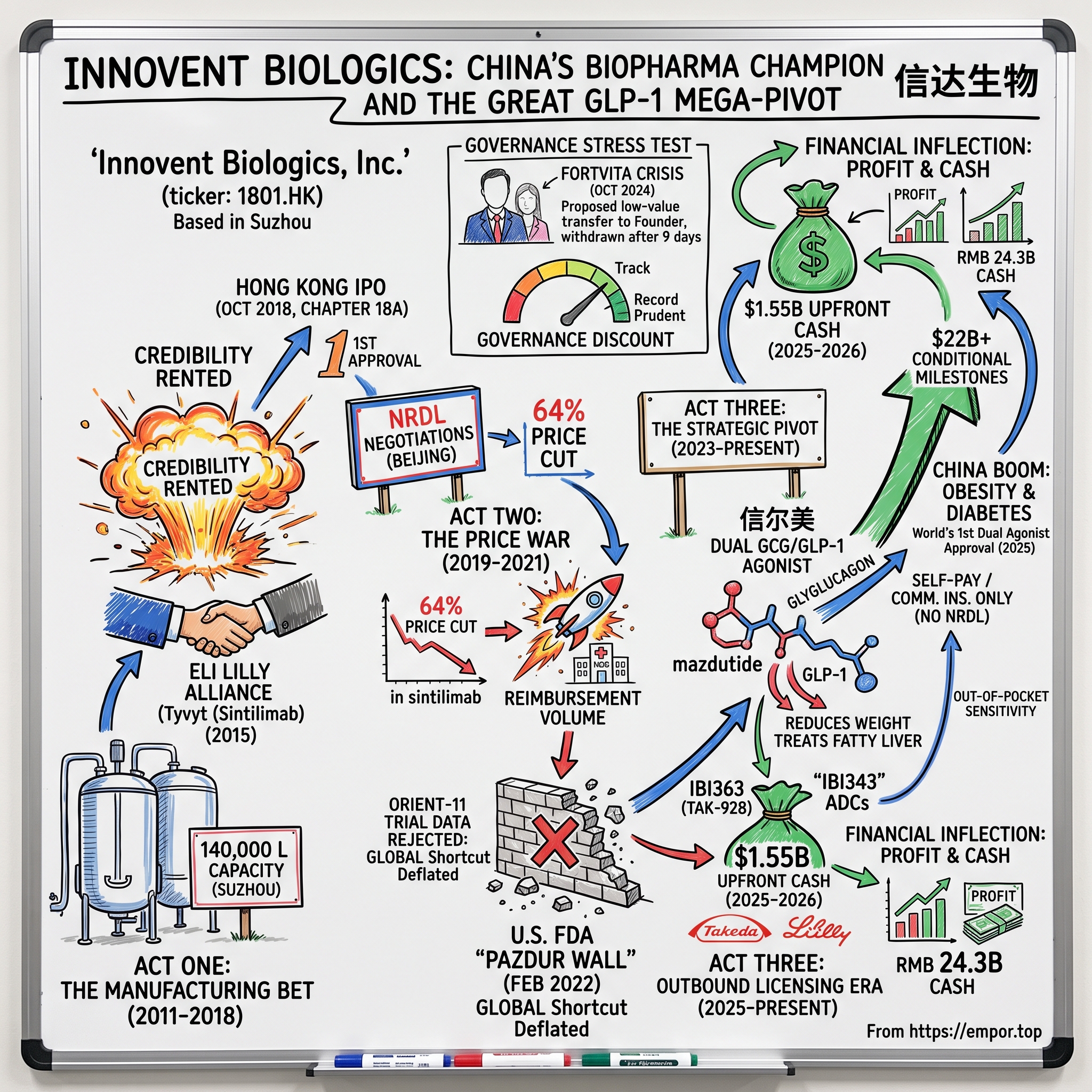
Innovent Biologics: China's Biopharma Champion and the Great GLP-1 Pivot
I. Introduction & Episode Roadmap
In March 2026, in an earnings presentation spanning dozens of slides, Innovent Biologics (信达生物) reported something unprecedented in its financial history: a full year of net profit. Revenue for 2025 reached RMB 13.0 billion, up 38.4% year on year, driven by product sales of RMB 11.9 billion. Net profit under IFRS reached RMB 814 million, or RMB 1.72 billion on the company's adjusted basis, with gross margin reaching 87.2%. Cash and short-term financial assets stood at roughly RMB 24.3 billion, or about US$3.5 billion.1
For a company that had listed in Hong Kong eight years earlier with no approved products, no revenue, and under a listing rule designed specifically for pre-revenue biotech, this marked the moment the core experiment proved viable—at least in the narrow sense of bottom-line accounting.
That is the surface narrative. A more complex dynamic lies beneath.
Innovent (1801.HK, listed on the Hong Kong Stock Exchange) is a Suzhou-headquartered biopharmaceutical company with 18 approved commercial products, a manufacturing infrastructure boasting 140,000 liters of bioreactor capacity—which the company estimates represents roughly a fifth of China's total biologics manufacturing capacity—and about 8,000 employees.1 In late July 2026, its shares traded near HK$87, giving it a market capitalization of roughly HK$151 billion within a 52-week range of HK$70 to HK$109.2 By revenue, it stands as one of the largest homegrown innovative biopharmaceutical companies in China.
The company's trajectory spans three distinct acts, each offering a lesson in how Chinese biotech operates.
Act one was the manufacturing bet: build Western-standard antibody production capacity at Chinese cost structures before having commercial products, then leverage that capacity to secure a global partnership. Eli Lilly made that bet in 2015, forging an alliance that propelled Innovent from a Suzhou industrial park to one of the largest biotech initial public offerings of 2018.
Act two was the price war. In late 2019, Innovent broke ranks with rival PD-1 developers, both domestic and multinational, accepting a roughly 64% price cut to become the first—and for a year, the only—PD-1 antibody covered by China's National Reimbursement Drug List.1112 It traded unit margin for volume. But in February 2022, the U.S. Food and Drug Administration's Oncologic Drugs Advisory Committee voted 14 to 1 that Innovent and Eli Lilly must conduct a new clinical trial before receiving approval in the United States.1415 The core premise of developing drugs cheaply in China for high-margin U.S. commercialization deflated rapidly.
Act three—the critical pillar of the current investment case—is the strategic pivot from oncology price competition to metabolic disease. In 2019, prior to the global boom in GLP-1 therapies, Innovent licensed Greater China rights to Eli Lilly's candidate molecule, mazdutide. In 2025, it launched mazdutide (玛仕度肽) in China, positioning its non-oncology portfolio as the primary growth driver in 2026.
Three core tensions define this narrative, each requiring critical evaluation.
The first is the China biopharma paradox: world-class manufacturing efficiency and rapid clinical execution balanced against a single dominant buyer—the National Healthcare Security Administration (NHSA, 国家医保局)—which extracts 50% to 70% price reductions in exchange for national hospital access. This leaves manufacturers with high volume, low unit pricing, thin margins, and relentless annual renegotiations.
The second is the globalization question. Following the FDA's 2022 advisory vote, the key issue was not whether Chinese biotechs could discover viable molecules, but whether they could capture their international commercial value. Innovent's strategy in 2025 and 2026 focused on out-licensing territorial rights to partners like Takeda (武田薬品工業) and Eli Lilly in exchange for substantial upfront cash payments—a pragmatic approach, but also a concession regarding independent global commercialization.
The third is governance. In October 2024, Innovent proposed transferring a 20% stake in its offshore pipeline subsidiary to an entity controlled by its founder and chief executive at a valuation institutional investors rejected as unjustifiably low. Following a sharp sell-off in the stock, the board withdrew the proposal nine days later.3940 That episode remains a key benchmark for evaluating management's approach to corporate governance and shareholder alignment.
The story begins where it all started—with a founder who had already developed two approved drugs before building Innovent.
 Subscribe on LinkedIn
II. Founder Context & The Pre-Innovent Backstory
The résumé reads like three separate careers stacked on top of each other.
Yu Dechao—who publishes and signs contracts as Michael Yu—earned a PhD in genetics from the Chinese Academy of Sciences and completed postdoctoral research in pharmaceutical chemistry at the University of California, San Francisco. He spent the late 1990s and early 2000s in U.S. biotech as vice president of research and development at Calydon, an oncolytic-virus developer acquired by Cell Genesys in 2001, and later at Applied Genetic Technology Corporation.4 In 2006, he returned to China as president and chief executive of Chengdu Kanghong Biotech.4
What sets Yu apart is not his international background but his commercial track record. He is the only scientist in China to have invented and commercialized two Class 1 innovative drugs: Oncorine (安柯瑞), the world's first approved oncolytic virus therapy, and Conbercept (朗沐), an anti-VEGF eye drug for wet age-related macular degeneration that became a major domestic blockbuster.4 He holds more than 60 patents, including 38 US patents.4
Two inventions, two companies, two distinct modalities—yet in neither case did he own the underlying business or its long-term equity value.
That distinction proved decisive. By 2011, Yu had twice demonstrated he could take a novel molecule from concept through Chinese regulatory approval to commercial launch—a track record shared by very few executives in China at the time. However, he had not built the surrounding enterprise; external shareholders owned the manufacturing facilities, commercial operations, and balance sheets.
The structural opportunity in the Chinese pharmaceutical market was clear. In 2011, domestic production was heavily skewed toward generic chemical drugs operating on narrow commodity margins, with quality standards that varied by province. High-end biologics—such as monoclonal antibodies for oncology, autoimmune disease, and ophthalmology—were almost entirely imported, priced for Western healthcare systems, and unaffordable for most Chinese patients, with a full course of treatment often costing multiple years of an average urban income. Consequently, physicians frequently relied on older chemotherapy regimens.
Yu framed Innovent's mission directly: to develop and produce high-quality biopharmaceuticals that ordinary people can afford.5 Beyond its role as a core company slogan, this objective established a strict cost-discipline mandate. To make biologics accessible to patients paying largely out of pocket, minimizing cost of goods, maximizing bioreactor yields, and spreading fixed overhead across a growing portfolio became central to the business model.
Innovent established operations in BioBAY within the Suzhou Industrial Park, a Singapore-backed development zone west of Shanghai that offered infrastructure, tax incentives, and a concentration of returning Chinese scientists with process-development expertise from firms like Genentech and Amgen. The founding team combined Western chemistry, manufacturing, and controls (CMC) discipline—ensuring complex biologics meet consistent regulatory standards batch after batch—with rapid domestic clinical trial execution.
Rather than starting with a single discovery-stage molecule and outsourcing development like many Western biotechs, Innovent's core proposition rested on an operational arbitrage between Western process engineering and domestic clinical execution. This strategy drove the company's decision to allocate early capital directly into large-scale, in-house manufacturing infrastructure.
This background also informs Innovent's broader operating style and corporate governance trajectory. Having spent the first half of his career developing high-value assets within external corporate structures, Yu prioritized operational self-reliance and direct control over manufacturing capacity. That perspective drove Innovent's early investments in proprietary bioreactor capacity—a key operational asset—while also highlighting the governance dynamics that re-emerged during the 2024 proposal to transfer offshore pipeline assets into a founder-controlled entity.
III. The Early Scale Bet & The Landmark Eli Lilly Alliance (2011–2018)
Around 2014, Innovent began committing substantial capital to stainless-steel bioreactors at its Suzhou facility—despite having no approved drugs, no revenue, and no immediate commercial timeline.
That early focus on scale separated Innovent from most Chinese biotechs established around 2011. Monoclonal antibody manufacturing operates on steep fixed-cost economics. A 2,000-liter batch and a 15,000-liter batch incur comparable overhead for quality control, environmental monitoring, compliance documentation, and specialized staffing; the defining difference is the volume of purified antibody produced per run. As production scale, cell-culture titers, and facility utilization rise, unit costs fall sharply. In a market where single-payer price negotiations would later trim margins significantly, lowering cost per gram was a structural necessity for long-term profitability.
Innovent built for its anticipated long-term volume rather than its immediate needs. By 2026, the company operated a reported 140,000 liters of capacity across two sites—comprising approximately 60,000 liters of antibody capacity alongside antibody-drug-conjugate lines at its initial facility, and 80,000 liters at a second site supporting both internal products and contract manufacturing.1 While the company's estimate that this represents roughly one-fifth of China's total biologics capacity is unverified by independent audits, the financial impact of this operational scale is evident in its expanding gross margins.
The Lilly alliance: renting credibility
In 2015, manufacturing infrastructure alone was insufficient without institutional credibility. Emerging Chinese biotechs faced a persistent hurdle: demonstrating to international regulators, corporate partners, and investors that production facilities in Jiangsu province met global standards comparable to those in Western markets. Validating those standards required rigorous auditing by an established global partner.
In March 2015, Eli Lilly and Innovent established a strategic biologics collaboration, expanding the agreement in October 2015 to cover three additional oncology antibodies.7 The core asset was an anti-PD-1 monoclonal antibody that became sintilimab, marketed in China as Tyvyt (达伯舒). Lilly provided capital, co-development expertise, and international quality assurance teams to inspect and align Innovent’s Suzhou manufacturing lines with global standards.
The partnership provided Innovent with crucial market validation alongside capital. A major co-development alliance between a top-tier global pharmaceutical firm and a four-year-old Chinese biotech with no approved products was virtually unprecedented in 2015. This endorsement established a stronger foundation for Innovent's subsequent discussions with international regulators, investors, and peer companies. The partnership remained long-standing, expanding to seven distinct research and development collaborations over eleven years by February 2026.67
However, securing global credibility required sharing commercial economics. Sintilimab was co-developed, with its ex-China rights assigned to Lilly. Similarly, mazdutide—the asset driving Innovent's current growth trajectory—was licensed in from Lilly for Greater China rights only. Consequently, Innovent's primary commercial franchises have relied on structural arrangements where an international partner controls rights outside its domestic market.
December 2018 and the Chapter 18A window
Innovent achieved its initial commercial milestone in late 2018, when China's National Medical Products Administration approved Tyvyt for relapsed or refractory classical Hodgkin's lymphoma.8 Although a narrow indication, the regulatory clearance transitioned Innovent from a clinical-stage business into a commercial-stage drug developer.
Two months prior to approval, public capital markets opened a critical funding route. In April 2018, the Hong Kong Stock Exchange introduced Chapter 18A, allowing pre-revenue biotech firms to list and offering an alternative to U.S. exchanges. Innovent joined the initial wave of listings, pricing its initial public offering at HK$13.98 per share and issuing 236.35 million shares for gross proceeds of HK$3.16 billion. Including the over-allotment option, total gross proceeds reached approximately HK$3.8 billion, or US$485 million, with shares rising 19% on their October 31, 2018 debut.910
The offering helped validate the Chapter 18A listing framework, earning industry recognition including IFR's Asia-Pacific IPO of the Year for 2018 by demonstrating that Hong Kong public markets could successfully value clinical-stage biotechnology assets.10
In October 2018, public investors were effectively underwriting an operational foundation: a large-scale manufacturing plant, a co-development alliance with Lilly, a founder with a proven track record, and an imminent narrow oncology approval. Under Chapter 18A rules, companies were not required to demonstrate existing revenue or commercial profitability—only an advanced clinical asset and backing from sophisticated investors. While this regulatory shift sparked a broad wave of Chinese biotech listings between 2018 and 2021, many subsequent issuers struggled as sector valuations adjusted. Innovent stood out as one of the few Chapter 18A issuers to convert early clinical capital into a self-funding commercial enterprise.
Innovent entered 2019 equipped with manufacturing capacity, an international partner, a public listing, substantial cash reserves, and a single approved drug for a specialized indication. The next phase of its expansion, however, would be shaped by state healthcare policy and national pricing negotiations in Beijing.
IV. The Oncology Boom & The Brutal NRDL Price Wars (2019–2021)
Every year, in a conference room in Beijing, representatives of major pharmaceutical companies sit across from officials of China's National Healthcare Security Administration (NHSA, 国家医保局) facing a straightforward demand: offer their lowest possible price.
The process differs sharply from Western price negotiations. The NHSA establishes an undisclosed reserve price prior to bidding. Companies submit confidential bids; if an offer exceeds the reserve price twice, the drug is excluded from the reimbursement list. In practice, exclusion cuts off access to China's public hospital system, where the vast majority of cancer patients receive treatment. It represents monopsony purchasing power deployed with strict procedural limits.
In November 2019, four PD-1 antibodies entered negotiations: Merck's Keytruda, Bristol Myers Squibb's Opdivo, Junshi Biosciences' (君实生物) toripalimab, and Innovent's sintilimab. Only one secured inclusion.
Innovent accepted a price cut of roughly 64% and became the first—and for a year, the only—PD-1 inhibitor included on the 2019 National Reimbursement Drug List.1112 Multinational developers declined to match the pricing. Accepting a benchmark price that low in China risked undermining global pricing structures across higher-margin international markets. That decision left Innovent with approximately twelve months of exclusive reimbursed access across the world's largest market for PD-1 therapies.
What the trade actually was
At its core, the agreement represented a strategic trade-off: sacrificing unit margin for volume.
Prior to reimbursement, patients paid for PD-1 therapies out of pocket, limiting the target market to urban households capable of funding annual treatment costs running into tens of thousands of dollars. National reimbursement made the drug accessible across public hospitals from tier-1 megacities to tier-4 municipalities, with public insurance covering most of the cost. The accessible patient population expanded exponentially.
Two structural factors enabled Innovent to execute this strategy. First, unlike multinational competitors, Innovent had no established global reference price to defend outside China. Second, its early investment in large-scale, in-house manufacturing lowered unit production costs sufficiently to preserve viable gross margins even after a 64% reduction. A developer reliant on contract manufacturing or Western production cost structures would have risked selling at a loss.
The pricing decision was fundamentally driven by manufacturing economics. By leveraging its cost structure, Innovent systematically expanded sintilimab's market footprint. Over subsequent reimbursement rounds, Innovent and Lilly secured national coverage for major first-line indications—including non-squamous and squamous non-small cell lung cancer and hepatocellular carcinoma—transforming a single narrow indication into a core oncology franchise.13
Building a distribution machine
Securing reimbursement coverage is only the first step; converting list placement into sales requires localized execution. China's hospital landscape comprises thousands of distinct institutions, each requiring provincial listings, hospital formulary approvals, and local clinical engagement. Between 2019 and 2021, Innovent established a nationwide commercial organization to drive penetration across both major urban medical centers and regional hospitals.
To maximize the efficiency of its field force, Innovent expanded its commercial product portfolio. Surrounding Tyvyt, the company launched biosimilars of major off-patent biologic therapies—including bevacizumab (达攸同 Byvasda), rituximab (达伯华 Halpryza), and adalimumab (苏立信 Sulinno). It also added in-licensed targeted oncology therapies, such as the FGFR inhibitor pemigatinib and the BCR-ABL inhibitor olverembatinib (co-promoted with Ascentage Pharma). By the end of 2024, Innovent's commercial portfolio encompassed 15 approved products.3
While biosimilars offer lower margins than novel therapies, they align directly with Innovent's core strengths: low-cost manufacturing and an established distribution network. Amortizing fixed sales infrastructure across additional products increased sales force productivity and total revenue per representative without generating a proportional rise in operating overhead.
The economics investors have to internalize
The financial dynamics of the domestic market differ fundamentally from Western pricing models. Following national negotiations, an annual course of PD-1 therapy in China costs approximately RMB 30,000 (about US$4,200), compared to roughly US$150,000 per year in the United States. This structural price differential dictates operational strategy: clinical development budgets must remain disciplined, commercial teams must maintain high sales productivity per representative, and manufacturing operations must operate at ultra-low unit costs. Furthermore, single-payer reimbursement rules subject commercial drugs to regular price reassessments.
The thing the 2019 decision did not solve
While the 2019 reimbursement agreement expanded patient volume, it also accelerated market saturation. By 2021, five domestic PD-1 inhibitors had secured national reimbursement—including BeiGene's (百济神州) tislelizumab and Hengrui Medicine's (恒瑞医药) camrelizumab—triggering intense competition over pricing and indication coverage. Innovent's initial exclusivity lasted roughly a year, after which the PD-1 class functioned largely as a commoditized market where market share depended on indication expansion and hospital-level commercial execution rather than therapeutic differentiation.
This competitive shift shaped Innovent's subsequent strategy. In the domestic market, early entry on a validated target provides only a temporary advantage. Sustained profitability requires either defensible cost leadership or novel therapeutic mechanisms that are difficult to replicate—a rationale that underpinned Innovent's scale manufacturing investments and its later push into multi-specific antibodies, such as dual agonists and PD-1/IL-2 fusion proteins.
A comparison with BeiGene highlights contrasting strategic paths in Chinese biotech. BeiGene invested heavily in establishing a direct U.S. commercial infrastructure and executing global clinical trials to capture Western market pricing, incurring substantial operating losses in the process. Innovent, by contrast, relied on licensing partnerships to access international markets, avoiding the capital requirements of an independent overseas commercial organization. Each approach carries distinct risk profiles and capital efficiency trade-offs.
To escape domestic pricing pressure and capture higher unit margins, Innovent sought regulatory access in the United States—a strategy that soon encountered regulatory headwinds at the FDA.
V. The "Pazdur Wall": US FDA Rejection & Re-evaluating Globalization (2022)
On February 10, 2022, the U.S. FDA's Oncologic Drugs Advisory Committee convened virtually to review sintilimab in combination with chemotherapy for first-line non-squamous non-small cell lung cancer. The application was supported by ORIENT-11, a Phase 3 trial conducted entirely in China.[^14]
Eli Lilly, which held ex-China commercial rights, framed its case around trial quality, positive clinical endpoints, and commercial pricing. Crucially, Lilly signaled plans to offer sintilimab at a substantial discount to incumbent PD-1 therapies in the United States, positioning the asset as a mechanism to introduce price competition into a market facing rising healthcare costs.
The advisory committee rejected the proposal, voting 14 to 1 that additional clinical data were necessary to demonstrate applicability to the U.S. population and U.S. medical practice before approval.1415 The promised price discount failed to sway the panel.16
What the FDA actually said
Richard Pazdur, director of the FDA's Oncology Center of Excellence, emphasized broader clinical and regulatory policy. He argued that relying on data from a trial conducted in a single foreign country represented a step backward for the racial and ethnic diversity the agency was working to establish in oncology clinical trials.15
Beyond trial demographics, the panel highlighted two core technical objections. First, ORIENT-11 used chemotherapy alone as its control arm. By 2022, the U.S. standard of care had shifted to anti-PD-1 therapy combined with chemotherapy, meaning the trial demonstrated efficacy against an outdated control rather than current clinical practice. Second, the agency noted clinical differences between Chinese and U.S. patient populations, including variation in smoking history, EGFR mutation prevalence, and available subsequent lines of treatment.
The FDA issued a complete response letter in March 2022.17 Eli Lilly subsequently returned the ex-China commercial rights to Innovent, ending the most prominent effort to bring a China-developed oncology therapy to the U.S. market.18
The shockwave
The regulatory decision resonated across the biopharmaceutical sector. Between 2020 and 2021, valuations for Chinese biotech companies relied heavily on a cross-border arbitrage thesis: execute rapid Phase 3 development in China at a fraction of Western costs, then leverage those data for U.S. regulatory approval and premium Western pricing. The advisory committee vote effectively eliminated that regulatory shortcut.
Valuations for Hong Kong-listed biotech equities contracted sharply throughout 2022. Companies across the sector were forced to re-evaluate their international pipelines against a more rigorous and costly framework: multiregional clinical trials designed from inception alongside Western regulators, evaluated against current standards of care, and including diverse patient enrolment outside China.
The strategic reset — and how to judge it
Innovent adapted its strategy over the subsequent four years across both domestic and international operations.
Domestically, the company expanded its commercial footprint by securing additional indication approvals, broadening its product portfolio, deepening hospital reimbursement coverage, and initiating a strategic shift toward metabolic therapies. Internationally, Innovent pivoted away from exporting late-stage PD-1 inhibitors into crowded Western markets. Instead, it redirected early-stage R&D toward potentially differentiated assets, including bispecific antibodies and antibody-drug conjugates, while committing to multiregional clinical trial designs from project inception.
A key benchmark of this strategic shift occurred in August 2025, when the FDA cleared the investigational new drug application for MarsLight-11—Innovent's first global multiregional Phase 3 study—evaluating the bispecific antibody IBI363 in immunotherapy-resistant squamous non-small cell lung cancer.19 Three and a half years after its initial U.S. regulatory setback, Innovent initiated a global trial aligned with FDA requirements, utilizing an asset developed in-house.
The FDA's policy stance also altered the broader sector's capital structure and deal dynamics. Following the 2022 vote, public markets applied a valuation discount to overseas pipelines held by Chinese biotechs, reflecting the higher cost and longer timelines required for independent global development. In response, many Chinese developers elected to out-license ex-China territorial rights to multinational partners rather than fund international commercialization independently—a structural trend reflected in Innovent's subsequent transaction strategy.
The 2022 advisory committee decision served as a defining turning point. It highlighted the structural limits of relying on cost arbitrage for overseas expansion, pushing Innovent to pursue a dual track: maintaining scale and cost leadership in China while advancing differentiated assets in global clinical trials. Balancing the capital requirements of both strategies remains a central financial consideration for the company.
Which brings the story to the asset intended to fund that broader ambition.
VI. The Second Growth Engine: CVM & The Great GLP-1 Mega-Pivot (2023–Present)
In 2019—a year before semaglutide entered widespread public awareness and four years before Novo Nordisk became Europe's most valuable company—Innovent licensed Greater China rights to an early-stage peptide from Eli Lilly that Lilly had not prioritized. Although financial terms were not disclosed, the broader context was clear: obesity drug development had long been considered a high-risk area marked by historical product withdrawals and failed clinical trials. At the time, an early-stage dual-receptor candidate was far from an obvious commercial asset.
That molecule became mazdutide (玛仕度肽), and it has emerged as Innovent's core growth asset.
What the drug actually does, in plain terms
Most approved obesity therapies target the glucagon-like peptide-1 (GLP-1) receptor. GLP-1 acts as a primary satiety signal, delaying gastric emptying and signaling fullness to the central nervous system to suppress calorie intake.
Mazdutide pairs GLP-1 agonism with a second mechanism: glucagon receptor activation. While glucagon typically opposes insulin by raising blood glucose, it also increases energy expenditure and promotes lipid mobilization from the liver. In combination, GLP-1 activation reduces caloric intake while glucagon agonism modestly increases energy output and directly targets hepatic fat—a therapeutic profile distinct from single-agent GLP-1 agonists.
This dual mechanism provides a differentiated clinical profile, combining substantial weight reduction with specific benefits in fatty liver disease, a common and under-treated comorbidity in China. However, dual agonism also introduces clinical considerations. Glucagon activation can elevate heart rate and liver enzymes, resulting in a narrower therapeutic index between efficacy and tolerability than single-receptor agents.
The evidence base
Innovent established its clinical dataset specifically within Chinese patient populations.
In the GLORY-1 Phase 3 trial, 610 Chinese adults with obesity or overweight accompanied by comorbidities were randomized to receive 4 milligrams of mazdutide, 6 milligrams of mazdutide, or placebo over 48 weeks. Patients on the 4 mg and 6 mg doses achieved mean weight reductions of 12.05% and 14.84%, respectively, compared to a 0.47% reduction in the placebo group, with approximately half of the high-dose cohort losing at least 15% of body weight. Liver fat content decreased by up to 80%.21 The findings were published in The New England Journal of Medicine.21
The GLORY-2 trial evaluated a higher 9 mg dose in adults with moderate-to-severe obesity, demonstrating body weight reductions of up to 20.1%.22 The National Medical Products Administration (NMPA) accepted a supplemental application for this dose for regulatory review.26
In October 2025, Innovent reported results from DREAMS-3, a Phase 3 head-to-head trial comparing the dual agonist against semaglutide in type 2 diabetes. At 32 weeks, 48.0% of patients treated with mazdutide reached a composite endpoint of glycated hemoglobin (HbA1c) below 7.0% alongside at least 10% weight loss, compared to 21.0% of patients receiving semaglutide. Mean weight reduction reached 10.29% for mazdutide versus 6.00% for semaglutide.24 Readouts from two Phase 3 diabetes studies were subsequently published back-to-back in Nature.25
While these trials demonstrate superior efficacy over semaglutide on composite endpoints in Chinese patients over 32 weeks, key questions remain. The dataset does not establish comparative efficacy against tirzepatide—a key dual-receptor benchmark—nor does it yet include long-term cardiovascular outcomes data, which represent a primary standard for commercial adoption in Western metabolic markets.
Launch and the reimbursement trap
China's NMPA approved mazdutide for chronic weight management in June 2025—marking the world's first regulatory approval of a dual GCG/GLP-1 agonist for obesity—and expanded approval to glycemic control in type 2 diabetes on September 19, 2025.2023 The drug launched commercially in China under the brand name Xinermei (信尔美).
However, the commercial model operates under specific regulatory constraints. Under National Healthcare Security Administration guidelines established in 2020, treatments prescribed for lifestyle or weight-loss indications are explicitly excluded from the National Reimbursement Drug List.29 As a result, mazdutide's obesity indication cannot access the public hospital reimbursement machinery that drove volume expansion for oncology therapies like Tyvyt. Instead, it functions as an out-of-pocket, self-pay therapy distributed through hospital clinics and retail channels.
This exclusion creates distinct commercial trade-offs. Operating outside national reimbursement insulates the product from mandatory NHSA price reductions and annual renegotiations, granting Innovent greater pricing autonomy. Conversely, commercial demand relies on discretionary consumer spending, making revenue sensitive to broader macroeconomic conditions and household confidence.
The commercial landscape evolved in December 2025 when the NHSA and the Ministry of Human Resources and Social Security published the 2025 NRDL alongside China's inaugural Commercial Health Insurance Innovative Drug Catalogue (Category C). Effective January 1, 2026, this framework covers 19 innovative therapies outside basic insurance, establishing an initial pathway for private commercial insurance reimbursement for self-pay medicines.2728
Concurrently, mazdutide's type 2 diabetes indication qualifies for basic public insurance coverage. This provides access to standard reimbursement channels and a broader patient population in a country with nearly 150 million adults living with diabetes.43
The financial inflection
The strategic shift into cardiovascular and metabolic therapies is reflected in Innovent's reported financial results. In 2024, the company recorded its first positive non-IFRS net profit of RMB 331.6 million and non-IFRS EBITDA of RMB 411.6 million, supported by an 84.9% gross margin and cash reserves of RMB 10.2 billion.3 Growth accelerated in the first half of 2025, with revenue rising 50.6% and net profit reaching RMB 1.21 billion.31 For the full year 2025, adjusted EBITDA reached RMB 1.99 billion, while selling and administrative expenses dropped by 2.9 percentage points to 48.0% of revenue.1
The trajectory of the operating expense ratio highlights the company's operating leverage. While a selling and administrative expense ratio near 48% remains elevated relative to global pharmaceutical peers—where SG&A typically ranges from the twenties to low thirties—it reflects the fixed costs of maintaining nationwide hospital coverage alongside initial marketing investments for a consumer-facing brand. The 2.9 percentage point reduction alongside 38.4% top-line revenue growth indicates expanding operational efficiency, though sustaining this margin improvement will depend on whether commercialization requires ongoing direct-to-consumer advertising.
Commercial performance in self-pay metabolic therapies is also subject to distinct patient adherence dynamics. Unlike oncology treatments, where therapy continues until disease progression, chronic weight-management therapies are elective and self-administered. Globally, real-world retention rates for injectable anti-obesity medications decline over time due to treatment costs, side effects, or patients discontinuing therapy after reaching target weight. Because weight rebound frequently follows treatment cessation, long-term revenue stability depends heavily on 12-month patient persistence rather than initial prescription volume—a metric Innovent does not currently report separately.
Additionally, Innovent does not break out mazdutide sales figures in its financial disclosures, describing product performance qualitatively as robust.1 Given mazdutide's central role in the company's growth narrative, the absence of segment revenue breakdown leaves market analysts relying on varied external estimates.
Beyond mazdutide, Innovent's general biomedicine franchise includes SYCUME for thyroid eye disease, SINTBILO (tafolecimab)—China's first domestically developed anti-PCSK9 monoclonal antibody for hypercholesterolemia—and PECONDLE for autoimmune conditions.1 The company also presented clinical data for mazdutide in Chinese adolescents at the 2026 American Diabetes Association conference and initiated a Phase 3 registration trial in adolescent obesity.45
This expanded cash flow generation strengthens Innovent's balance sheet, supporting internal pipeline investments while enhancing its standing in international commercial partnerships.
VII. M&A, Licensing Strategy, & Global Pipeline Architecture
For a decade, Innovent's dealmaking ran in one direction: capital and candidates flowed in from overseas partners, domestic commercial rights went to Innovent, and global upside remained with the licensor. In 2025, that direction reversed, altering the company's financial structure.
The in-licensing era, and its bill
The August 2022 transaction with Sanofi represented the high-water mark of the traditional in-licensing model—and a cautionary case study in clinical development risk.
Sanofi invested €300 million in Innovent equity at HK$42.42 per share, representing a 20% premium to the 30-day average, with an option to invest an additional €300 million on similar terms. In exchange, Innovent acquired Chinese development and commercialization rights to two oncology assets, led by tusamitamab ravtansine, a first-in-class CEACAM5-targeting antibody-drug conjugate then in global Phase 3 trials for second-line lung cancer, with Sanofi eligible for up to €80 million in development milestones alongside China royalties.32
Sixteen months later, on December 21, 2023, Sanofi discontinued the global tusamitamab ravtansine program after the CARMEN-LC03 Phase 3 trial missed its primary endpoint of progression-free survival.33
The outcome highlights the core risk of in-licensing: acquiring territorial rights to external assets leaves the licensee exposed to clinical trial failure without controlling global development. Innovent retained Sanofi's equity investment—preserving capital raised at a premium valuation—yet the underlying asset evaporated. A similar risk profile applies, in reverse, to mazdutide: Innovent's primary growth driver remains an in-licensed candidate restricted to Greater China under undisclosed licensing terms.
Conversely, the in-licensed portfolio has delivered steady commercial returns, including Incyte-originated pemigatinib, co-promoted olverembatinib, and five small-molecule targeted oncology therapies that entered the national reimbursement list in 2025 and drove commercial sales through 2026.301 This model converts discovery risk into commercial execution risk—a domain where Innovent's domestic distribution network excels—without yielding global intellectual property rights.
2025: the year Innovent became a seller
The company's transaction strategy shifted substantially during 2025.
On October 22, 2025, Innovent announced a global strategic partnership with Takeda covering IBI363, its PD-1/IL-2α-bias bispecific fusion protein, and IBI343, its CLDN18.2 antibody-drug conjugate, alongside an option on an early-stage EGFR/B7H3 ADC.34 The agreement marked one of the largest outbound licensing deals from China at the time: $1.2 billion upfront, including a $100 million equity investment at HK$112.56 per share—a substantial market premium—with development and sales milestones bringing the headline total to approximately $11.4 billion. Within the United States, the parties agreed to share profits and losses on IBI363 on a 40/60 basis in Innovent's and Takeda's favor, respectively.35 The transaction closed in December 2025.36
Four months later, on February 8, 2026, Innovent and Eli Lilly established their seventh collaboration: $350 million upfront and up to roughly $8.5 billion in milestones. Under the agreement, Innovent leads domestic discovery and clinical development through Phase 2 for selected oncology and immunology candidates, while Lilly assumes responsibility for global development and commercialization outside Greater China, paying tiered royalties to Innovent.646 Innovent's shares rose as much as 8.6% following the news.46 Management framed the arrangement as an evolution beyond traditional licensing toward an end-to-end innovation engine.7
Management reported total 2025 outbound transaction value above $22 billion, accounting for more than a tenth of all Chinese outbound biopharmaceutical licensing that year.1
Evaluating those headline figures requires distinguishing between committed upfront capital and conditional milestone payments. Total deal values sum every potential milestone payable if candidates succeed across all indications—a threshold achieved by a small minority of clinical programs. The immediate, bankable financial reality rests on upfront capital: approximately $1.55 billion in cash and premium equity received across the Takeda and Lilly transactions within five months. That cash influx represented nearly a fifth of Innovent's market capitalization entering 2026 and accounted for most of its cash balance expansion.
Structurally, the pivot reflects a pragmatic strategic choice. Rather than funding independent commercial infrastructure in Western markets—the capital-intensive path pursued by peers such as BeiGene—Innovent invents and validates candidates in China, then out-licenses global commercialization to established partners in exchange for upfront cash, milestones, royalties, and selective profit-sharing arrangements. This approach directly incorporates lessons from the FDA's 2022 advisory vote by sharing international clinical development costs with partners holding established regulatory and commercial networks.
Out-licensing global commercial rights also alters internal research incentives. When early-stage assets are partnered at proof of concept, pipeline value depends on multinational licensing interest rather than long-term commercial revenues. This dynamic encourages R&D allocation toward novel mechanisms with clean early clinical data, while reducing exposure to protracted late-stage trials required to build large commercial franchises.
Concurrently, Innovent holds roughly $3.5 billion in cash and short-term financial assets.1 While management intends to allocate capital toward global clinical development rather than share buybacks or dividends, deploying a cash reserve of this magnitude requires a clear capital allocation framework to maintain institutional investor alignment following the governance scrutiny of late 2024.
What is actually in the pipeline
IBI363 (also designated TAK-928) serves as the primary candidate in Innovent's proprietary research portfolio. The molecule fuses PD-1 blockade with an engineered, alpha-biased interleukin-2 (IL-2) cytokine, seeking to overcome historical safety limitations of IL-2 therapy. While native IL-2 stimulates T-cell responses to shrink tumors, its non-selective receptor binding causes severe systemic toxicity. By attenuating binding to the receptor subunit linked to toxicity while targeting PD-1-expressing cells within the tumor microenvironment, IBI363 aims to activate immune responses in non-responsive, immunologically "cold" tumors.
At the 2026 American Society of Clinical Oncology (ASCO) Annual Meeting, updated clinical follow-up in immunotherapy-resistant non-small cell lung cancer showed that over 40% of patients in the 3 mg/kg cohort achieved overall survival beyond 24 months in a heavily pretreated population.37 Preliminary first-line combination data with chemotherapy demonstrated encouraging response rates in patients with low or negative PD-L1 expression, with toxicity mainly attributable to the chemotherapy backbone.38 While these early-phase findings involve small patient cohorts, Phase 3 trials are underway to evaluate a candidate management estimates could address a multi-billion-dollar commercial market.1
IBI343, a CLDN18.2-targeting antibody-drug conjugate, is in Phase 3 evaluation for pancreatic cancer, with an interim analysis in third-line gastric cancer scheduled during 2026.1 IBI324, a VEGF/ANG2 bispecific antibody partnered with Ollin, advanced toward global Phase 3 trials following Phase 1b results, while IBI3009, a novel ADC candidate, is co-developed with Roche.1
By mid-2026, Innovent's operational structure comprises three distinct segments: a reimbursed, volume-driven domestic oncology base that generates steady cash flow; a expanding general biomedicine portfolio—led by mazdutide—operating in self-pay and insured metabolic markets; and an out-licensed global pipeline monetized primarily through upfront payments and milestone structures.
VIII. Stress Test: Capital Allocation, Governance, & The Fortvita Crisis
On October 25, 2024, Innovent filed a corporate disclosure that appeared routine on first inspection: an offshore subsidiary would issue new equity to an outside investor.
The subsidiary was Fortvita, the offshore vehicle holding Innovent's international pipeline assets. The subscriber was Lostrancos, a Cayman Islands entity controlled by Innovent founder, chairman, and chief executive Michael Yu, who served as Lostrancos's sole director and held a substantial majority of its shares. Lostrancos agreed to pay US$20.5 million for a 20.39% equity stake in Fortvita, implying a total valuation of approximately US$80 million for the entire offshore entity.4041
Institutional shareholders ran the numbers and immediately raised objections.
Why the market reacted the way it did
The investor pushback centered on economic substance rather than regulatory compliance; Hong Kong listing rules permit connected transactions subject to disclosure and independent shareholder approval.
At the time of the announcement, Innovent held more than RMB 10 billion (roughly US$1.4 billion) in cash and short-term financial assets.3 Management's rationale—that an international development vehicle required separate funding and aligned management incentives—conflicted with the parent company's substantial liquidity. Funding Fortvita's US$20.5 million requirement internally would have drawn minimally on balance sheet cash while preserving full equity upside for public shareholders.
The valuation raised sharper concerns. Fortvita held the ex-China rights to early-stage assets comparable to those that Takeda would partner twelve months later for $1.2 billion upfront. An $80 million total valuation for Fortvita's entire asset portfolio diverged dramatically from management's public messaging regarding its global commercial potential, leading institutional investors to characterize the proposal as asset stripping.
Governance concerns intensified when exchange filings revealed that Yu had sold 3.25 million shares of his personal Innovent holding on September 30 and October 2, 2024—just days before the Fortvita transaction was disclosed.41 While no regulatory finding of wrongdoing was made and the transactions may have been unrelated, the timing created severe optics issues: a chief executive reducing parent-company equity immediately prior to acquiring a fifth of its primary international asset portfolio at a deeply discounted valuation.
Markets reacted swiftly. Innovent's shares dropped 12.54% on October 28, erasing approximately HK$9 billion (US$1.15 billion) in market capitalization in a single trading session, and continued to decline the following day.41
The retreat
On November 3, 2024—nine days after the initial disclosure—Innovent formally canceled the subscription agreement, stating that feedback indicated divergent shareholder opinions regarding the deal structure.3940 The stock rebounded following the announcement of the withdrawal.41
How to weigh this today
Evaluating the Fortvita episode requires considering three distinct perspectives:
First, a constructive interpretation holds that management proposed an asset-carveout structure common in venture-backed biotechnology—housing international assets in a dedicated subsidiary to align management equity incentives—misjudged public market sentiment in Hong Kong, and promptly reversed course within nine days. Rapid withdrawal demonstrated flexibility compared to corporate boards that spend months defending contested transactions.
Second, a critical interpretation questions why the transaction was put forward initially. A board aligned with minority shareholders would unlikely endorse an $80 million valuation for global rights when the parent entity maintained RMB 10 billion in cash reserves. From this perspective, canceling the agreement reflected a reaction to equity price declines rather than a fundamental realignment of governance principles.
Third, an empirical interpretation focuses on subsequent execution. The major outbound licensing deals with Takeda in 2025 and Eli Lilly in 2026 were executed directly at the listed-company level, ensuring that upfront cash payments, equity premiums, and profit-sharing rights accrued to Innovent's public shareholders. Regardless of whether this reflected an internal governance shift or market constraints, the economic outcome for minority investors proved significantly more favorable than the proposed private vehicle structure. Nevertheless, maintaining a governance discount in valuation metrics remains a prudent analytical baseline until management establishes a longer track record of transparent capital allocation.
An accounting judgment worth understanding
In evaluating Innovent's financial reporting, the discrepancy between IFRS net profit of RMB 814 million and non-IFRS adjusted net profit of RMB 1.72 billion exceeds RMB 900 million—a spread larger than the audited bottom line itself.1 Non-IFRS adjustments are common across biotechnology firms and primarily reflect non-cash share-based compensation and fair-value changes in financial assets. However, relying exclusively on adjusted figures treats equity compensation as a non-operating expense. For a company relying on stock grants to recruit R&D talent in a competitive market, share issuance dilutes existing equity over time. Consequently, IFRS net profit serves as a conservative valuation anchor, while non-IFRS metrics reflect management's view of operational cash flow. Evaluating both numbers and tracking the divergence between them is essential for assessing true earning power.
Innovent's disclosure transparency presents a mixed picture. Results disclosures arrive promptly, clinical updates are detailed, and key clinical trial findings are published in peer-reviewed journals such as The New England Journal of Medicine and Nature rather than confined to press releases.2125 Conversely, the company does not disclose individual product revenue for mazdutide—its primary growth asset—and frequently highlights total potential milestone figures that include unearned, conditional payments. On strategic guidance, management has maintained consistent long-term targets: achieving RMB 20 billion in annual revenue by 2027 and advancing five molecules into global Phase 3 trials by 2030—targets first outlined in 2024 and restated in 2025, with the clinical pipeline goal expanded to encompass more than 15 assets in active development.31
While multi-year consistency in long-term goals represents a basic standard, maintaining stable guidance provides a useful baseline for assessing management execution.
With capital allocation and governance considerations evaluated, the key remaining question is whether Innovent's operational fundamentals and commercial trajectory justify its public market valuation.
IX. Strategic Frameworks: Porter's 5 Forces & Hamilton Helmer's 7 Powers
Stripping away the narrative leaves a fundamental structural question: is Innovent a good business, or simply a well-run company navigating a difficult industry?
Porter's Five Forces, applied to Chinese biopharma
Threat of new entrants — low to moderate. Launching an integrated Chinese antibody producer in 2026 is far harder than it was in 2011. Building compliant manufacturing at scale requires hundreds of millions of dollars in capital, regulatory oversight has professionalized, and the commercial infrastructure needed to reach thousands of hospitals cannot be rented overnight. Conversely, entering as a virtual biotech requires no manufacturing footprint at all: an asset can be licensed, run through contract research organizations, and out-licensed to a global partner before ever building a plant. That virtual pipeline path, however, is heavily crowded and competes directly for the same out-licensing dollars on which Innovent relies.
Bargaining power of buyers — extreme. This remains the industry's defining force. As a monopsonist purchasing healthcare for over a billion citizens, the National Healthcare Security Administration consistently trades hospital access for steep price concessions. Private commercial insurance offers little counterweight, though the Category C catalogue represents an initial effort to establish one. Every reimbursed product in Innovent's portfolio faces periodic price renegotiations, where price adjustments move exclusively downward.
Bargaining power of suppliers — low to moderate. Cell culture media, single-use consumables, chromatography resins, and bioreactor hardware originate from a concentrated group of Western suppliers. This creates pricing exposure and supply-chain vulnerabilities amid geopolitical friction and export controls. Growing domestic substitution has capped this risk, though it has not eliminated it entirely.
Threat of substitutes — high and rising. Innovent's historical core relies on monoclonal antibodies produced in stainless-steel bioreactors. However, the broader biopharmaceutical sector is shifting toward antibody-drug conjugates, multispecific antibodies, cell therapies, and—most critically for the metabolic franchise—oral small-molecule GLP-1 agonists. Chemical manufacturing makes oral small molecules far cheaper to produce than biologics, while eliminating the need for injections. If oral obesity candidates succeed at scale, they threaten to erode the long-term value of injectable peptide manufacturing infrastructure.
Competitive rivalry — extreme. China's innovative biopharmaceutical sector is marked by rapid, correlated crowding around validated targets. The PD-1 class expanded from five entries to more than a dozen, and that same competitive crowding is now accelerating across obesity, antibody-drug conjugates, and bispecific antibodies.
Hamilton Helmer's 7 Powers: what Innovent actually has
Process Power — the strongest claim, with evidence. Innovent's 87.2% gross margin, achieved despite years of NHSA price cuts and the commercial launch of a self-pay consumer product, provides strong empirical evidence of a low unit cost per gram of antibody.1 Gross margin expanded by 2.1 percentage points in 2024 and an additional 2.3 percentage points in 2025 amid intensifying domestic price competition.31 This process power is real, difficult to replicate quickly, and expands alongside capacity utilization. However, it remains modality-specific, protecting antibody manufacturing rather than synthetic peptides or small molecules.
Cornered Resource — real but rented. Securing Greater China rights to the world's first approved dual GCG/GLP-1 agonist prior to the global obesity boom represents a classic cornered resource. Yet two caveats apply. First, the asset is held under an in-license agreement with undisclosed terms rather than outright ownership, and rights are restricted to Greater China. Second, this competitive position is time-limited: competing candidates, such as Hengrui's HRS9531 (partnered with Kailera), demonstrated body weight reductions of up to 19.2% in a 567-patient Chinese Phase 3 trial as the program advanced toward a regulatory filing in China.44
Scale Economies — genuine. Maintaining a nationwide commercial organization amortized across 18 commercial products lowers the marginal distribution cost for each incremental launch. The steady decline in the selling and administrative expense ratio serves as the primary financial indicator of this operational leverage.1
Counter-Positioning — the historical engine, now contested. Developing therapies under Chinese cost structures while adhering to international quality standards allowed Innovent to accept price reductions that Western incumbents could not match without undermining their global pricing models—the structural driver behind Innovent's 2019 PD-1 pricing strategy. However, counter-positioning erodes when global incumbents adapt. Multinational drugmakers writing multi-billion-dollar licensing checks for Chinese-originated assets reflects global industry adaptation to this cost differential.
Branding, Network Economies, Switching Costs — largely absent. Physicians shift between antibody therapies based on price, clinical trial updates, and treatment guidelines. Clinical drug distribution carries no network effects, and switching costs remain low. The primary exception lies in the consumer obesity market, where the Xinermei brand is establishing consumer recognition—a factor that could provide a commercial buffer as generic alternatives eventually enter the market.
Net assessment: Innovent's competitive position rests on two durable structural advantages—manufacturing cost discipline and commercial distribution scale—complemented by a time-limited asset lead in mazdutide. This creates a defensible business, though not an insulated moat comparable to software or financial exchanges. Sustaining this market position requires continuous capital reinvestment and operational execution across evolving therapeutic modalities.
X. The Investment-Story Spine & Current Risk Radar
Why this company wins from here
The bull case rests on four legs, each supported by empirical evidence rather than corporate narrative.
Cost position. The manufacturing infrastructure and expanding gross margin trajectory represent the most verifiable operational advantage in the business. In a single-payer market where official policy targets continuous price reductions, remaining the low-cost producer is an essential condition for long-term survival. Innovent has demonstrated that structural advantage consistently since 2019.
Distribution as a launch multiplier. The company's capacity to translate regulatory reimbursement into rapid commercial uptake was demonstrated again in the first quarter of 2026, when total product revenue exceeded RMB 3.8 billion—up more than 50% year on year—driven substantially by five targeted oncology therapies newly added to the national reimbursement list.42 Converting reimbursement access into hospital revenue within a single quarter represents a repeatable commercial asset that enhances Innovent's appeal as a domestic partner for multinational drugmakers, continuously supporting its in-licensing pipeline.
The metabolic tailwind. China's overweight and obese adult population numbers in the hundreds of millions, alongside nearly 150 million adults living with diabetes.43 Within this expanding market, mazdutide holds a first-in-class regulatory position, supported by head-to-head Phase 3 clinical trial data demonstrating superior composite outcomes compared to semaglutide in Chinese patients.24
Self-funding. A transition to sustained bottom-line profitability, paired with approximately US$3.5 billion in cash and short-term financial assets—largely generated through upfront partnership payments—allows Innovent to fund global Phase 3 trials internally without resorting to dilutive equity offerings.1 In a biotechnology sector where equity dilution historically erodes shareholder value as rapidly as clinical setbacks, self-funding capability provides crucial financial resilience.
What could break the case
The GLP-1 price war is arriving on schedule. Semaglutide's Chinese patent protection expired in 2026, years ahead of its 2031 to 2032 expiration dates in Western markets, prompting approximately sixteen domestic developers to advance generic candidates, with several reaching Phase 3 trials.43 Widespread generic entry historically drives sharp price reductions. Although mazdutide's dual-receptor mechanism supports premium pricing over single-agent GLP-1s, competing against low-cost generic semaglutide alters the commercial landscape. Combined with rival dual agonists such as Hengrui's candidate and imported branded therapies from Eli Lilly and Novo Nordisk, commercial competition is intensifying before market penetration matures.
Self-pay demand is discretionary. Because national insurance guidelines exclude obesity management from public reimbursement, mazdutide's weight-loss revenue relies on out-of-pocket consumer spending during a period of cautious household expenditure. While the Category C commercial insurance framework provides a potential secondary avenue, coverage remains limited. Unlike reimbursed oncology therapies, metabolic sales carry consumer demand exposure that pharmaceutical models rarely incorporate.
The reimbursement ratchet never stops. Every reimbursed oncology therapy faces periodic national price renegotiations. To maintain top-line growth, expansion in patient volume must consistently offset downward price adjustments, even as market saturation narrows the scope for rapid volume gains.
Global execution remains unproven. Innovent has yet to bring a multiregional Phase 3 trial to completion independently. MarsLight-11 represents its initial global pivotal effort, while out-licensing international rights introduces corporate dependencies: multinational partners such as Takeda and Eli Lilly control the clinical timelines, indication sequences, and ultimate commercial execution for assets underlying the company's highest pipeline valuations.
Geopolitical headwinds. Evolving U.S. legislative initiatives targeting Chinese biotechnology entities create lingering policy risk. Heightened regulatory scrutiny could raise political and compliance costs for Western drugmakers partnering with Chinese originators, regardless of clinical data.
Capacity risk cuts both ways. Large-scale bioreactor infrastructure provides a structural cost advantage only when utilization rates remain high. While contract manufacturing services help absorb fixed overhead, CDMO operations operate at lower margins and face intense domestic competition. Furthermore, if pipeline expansion pivots toward synthetic peptides, oral small molecules, or in-licensed assets, dedicated antibody manufacturing capacity risks underutilization.
A lingering governance discount. Although public market valuations partially reflect the attempted Fortvita restructuring, establishing institutional trust requires a sustained track record of transparent, minority-aligned capital allocation.
Myth versus reality
Myth: Innovent is building an independent global commercial footprint comparable to Western pharmaceutical majors. Reality: Innovent operates as a dominant domestic commercial entity paired with an R&D engine that monetizes international rights by out-licensing assets to multinational partners. While capital-efficient, this model places ultimate overseas commercial upside with partners, establishing a lower valuation ceiling than an integrated global biopharma.
Myth: Mazdutide holds an uncontested commercial monopoly in Chinese metabolic care. Reality: It is a first-in-class dual agonist entering a market facing low-cost generic semaglutide alongside competing domestic dual agonists, operating in a weight-management indication excluded from national public insurance reimbursement.
Myth: Outbound partnership announcements in 2025 added 22 billion dollars directly to the balance sheet. Reality: Financial transformation came from approximately US$1.55 billion in upfront cash and premium equity investments. The remainder consists of conditional development and sales milestones that depend entirely on long-term clinical success.
Myth: Annual net profit demonstrates that the business model is permanently de-risked. Reality: Bottom-line profitability confirms that domestic operating leverage has materialized. Sustaining those margins requires reducing selling and administrative expenses as a percentage of revenue while concurrently funding global Phase 3 clinical trials.
The three things worth tracking
1. General biomedicine revenue and segment disclosure. This franchise—comprising mazdutide alongside cardiovascular, ophthalmology, and autoimmune therapies—represents Innovent's primary source of non-reimbursed growth and pricing autonomy. Granular reporting serves as a key indicator: management's willingness to report mazdutide sales separately will signal commercial performance, whereas continued aggregation obscures individual asset traction.
2. The interplay between gross margin and operating expense ratios. Tracking gross margin evaluates whether manufacturing cost advantages persist as product mix shifts toward synthetic peptides and licensed drugs. Simultaneously, monitoring selling and administrative expense ratios tests whether commercial infrastructure delivers true operating leverage or requires permanent direct-to-consumer marketing spend. Evaluated together, these metrics determine whether achieving the RMB 20 billion revenue target for 2027 converts into durable earnings expansion.1
3. Global Phase 3 trial readouts. Key clinical benchmarks include the MarsLight-11 trial in immunotherapy-resistant lung cancer and the interim Phase 3 analysis for IBI343 in gastric cancer.191 These data readouts will determine whether conditional milestone payments convert into realized cash and whether Innovent's post-2022 R&D reset yields internationally competitive innovation.
XI. Epilogue & Playbook Lessons
Fifteen years after a scientist with two approved drugs began building bioreactors in a Suzhou industrial park, Innovent has reached a position shared by few Chinese biotechs: it commercializes 18 products, generates net profit, maintains several billion dollars in cash, and partners with major global pharmaceutical firms on its clinical pipeline.1
Three broader lessons apply beyond the company itself.
Manufacturing is a strategy, not a cost center. In healthcare systems where a single payer dictates pricing, manufacturing cost and process capabilities determine survival through severe price cuts. Innovent's decision to accept a 64% price reduction in 2019 reflected a calculated leverage of its cost structure to generate margin where higher-cost competitors could not. Its 87.2% gross margin—achieved despite subsequent price renegotiations—demonstrates the durability of that low-cost manufacturing foundation. For businesses facing monopsonist buyers, the cost curve is often a more critical strategic metric than the initial product profile.
Optionality is cheapest before consensus forms. Innovent acquired Greater China rights to mazdutide in 2019, when obesity therapeutics carried a history of clinical failures and dual glucagon/GLP-1 agonism remained unproven commercially. That transaction did not require predicting the current metabolic boom; it required acquiring a plausible mechanism at a modest valuation before broad industry consensus emerged. The commercial return on that single license now rivals the output of the company's internal research portfolio. However, the same opportunistic licensing strategy also brought in assets like tusamitamab ravtansine, which was discontinued following a Phase 3 trial failure. Opportunistic pipeline expansion remains a portfolio strategy where clinical failures must be accounted for alongside commercial successes.
Public markets can enforce discipline when regulatory frameworks enable it. The proposed Fortvita restructuring was withdrawn nine days after its announcement because Hong Kong's disclosure rules exposed the transaction's terms, prompting institutional shareholders to drive a sharp single-day sell-off. Rather than signaling broad governance maturity, the outcome illustrates how specific listing rules and active institutional investors can limit value dilution in a company where the founder retains substantial control. Management's capital allocation choices continue to warrant institutional scrutiny.
Innovent enters the second half of 2026 pursuing two parallel strategies. Domestically, it must defend its low-cost commercial position against ongoing reimbursement price cuts while scaling a self-pay metabolic franchise amid cautious consumer spending. Internationally, it is testing whether its internal discovery engine can generate assets that global pharmaceutical partners will fund through late-stage development—and whether those candidates can succeed in the multiregional Phase 3 trials mandated by global regulators.
Innovent has demonstrated the commercial viability of its domestic model, delivering net profitability and positive cash flow. Whether it can convert early-stage global partnerships into validated, late-stage commercial therapies remains the central open question defining its long-term valuation.
References
-
Innovent Announces 2025 Annual Results and Business Updates — PR Newswire, 2026-03-26 ↩↩↩↩↩↩↩↩↩↩↩↩↩↩↩↩↩↩↩↩↩
-
Innovent Biologics Inc (1801.HK) Stock Quotes & Corporate Profile — Reuters ↩
-
Innovent Announces 2024 Annual Results and Business Updates — PR Newswire, 2025-03-26 ↩↩↩↩↩
-
Michael Yu – Founder, Chairman and CEO, Innovent Biologics, China — PharmaBoardroom ↩
-
Innovent Announces Strategic Collaboration with Lilly to Develop New Medicines Globally in Oncology and Immunology — PR Newswire, 2026-02-08 ↩↩
-
Lilly strikes $8.8bn-plus alliance with China's Innovent — pharmaphorum, 2026-02-09 ↩↩↩
-
NMPA Approves TYVYT (Sintilimab Injection) for Relapsed/Refractory Classical Hodgkin's Lymphoma — Innovent Biologics, 2018-12-27 ↩
-
China's Innovent Biologics Aims to Raise $420 Million in Hong Kong — Caixin Global, 2018-10-16 ↩
-
Innovent Receives IFR Asia-Pacific IPO of the Year 2018 and IFR Asia Review Hong Kong Equity Issue of the Year 2018 Awards — PR Newswire, 2019 ↩↩
-
TYVYT (Sintilimab Injection), an Innovative PD-1 Inhibitor Jointly Developed by Innovent and Lilly, is Included in the New Catalogue of the National Reimbursement Drug List — PR Newswire, 2019-11-28 ↩↩
-
China gives Merck, BMS cold shoulder on reimbursement list as PD-1 battle enters new phase — Fierce Pharma ↩↩
-
Innovent and Lilly Announce Successful Expansion of Sintilimab in China National Reimbursement Drug List to Include Three Additional First-Line Indications — Eli Lilly and Company ↩
-
FDA Advisory Committee Votes to Recommend Additional Data for Sintilimab Submission — PR Newswire, 2022-02-10 ↩↩
-
In a 14:1 vote, ODAC nixes a PD-1 drug developed in China; data not generalizable to U.S. population — The Cancer Letter, 2022-02-11 ↩↩↩
-
Unswayed by a discount pledge, FDA adcomm rejects Lilly's PD-1 drug — pharmaphorum, 2022-02 ↩
-
Lilly Announces Complete Response Letter for Sintilimab in Combination with Pemetrexed and Platinum Chemotherapy for the First-Line Treatment of People with Nonsquamous Non-Small Cell Lung Cancer — Eli Lilly and Company, 2022-03 ↩
-
Eli Lilly dumps Innovent's PD-1 after FDA rebuff, nixing high-profile Chinese cancer drug — Fierce Pharma ↩
-
Innovent Biologics Announces U.S. FDA IND Approval for the First Global MRCT Phase 3 Study (MarsLight-11) of IBI363 (PD-1/IL-2α-bias) in Squamous Non-Small Cell Lung Cancer — PR Newswire, 2025-08 ↩↩
-
Innovent Announces Mazdutide, First Dual GCG/GLP-1 Receptor Agonist, Received Approval from China's NMPA for Chronic Weight Management — PR Newswire, 2025-06 ↩
-
Phase 3 Clinical Study of Mazdutide in Chinese Adults with Overweight or Obesity (GLORY-1) Published in The New England Journal of Medicine — PR Newswire, 2025 ↩↩↩
-
Mazdutide 9 mg Achieves Up to 20.1% Weight Loss in Chinese Adults with Obesity, GLORY-2 Study Meets Primary and All Key Secondary Endpoints — PR Newswire, 2025 ↩
-
Innovent Announces Mazdutide Received Approval from China's NMPA for Glycemic Control in Adults with Type 2 Diabetes — PR Newswire, 2025-09-19 ↩
-
Innovent's Mazdutide Shows Superiority in Glycemic Control with Weight Loss over Semaglutide in a Head-to-head Phase 3 Clinical Trial DREAMS-3 — PR Newswire, 2025-10-26 ↩↩
-
Two Phase 3 Clinical Results of Mazdutide in Chinese Adults with Type 2 Diabetes Published Back-to-Back in Nature — PR Newswire, 2026 ↩↩
-
Mazdutide 9mg Supplementary Application Accepted for Review by China's NMPA — PR Newswire, 2025 ↩
-
国家医保局 人力资源社会保障部印发2025年版国家基本医疗保险药品目录和商业健康保险创新药品目录 — National Healthcare Security Administration, 2025-12-07 ↩
-
China has Renewed the National Reimbursement Drug List and Released the First Commercial Reimbursement List for Innovative Drugs — CMS China, 2025 ↩
-
China releases 2025 NRDL and first commercial insurance drug list — Pharmaceutical Technology, 2025 ↩
-
Innovent Announces Inclusion of Seven Innovative Drugs including TYVYT New Indication and SYCUME in China's National Reimbursement Drug List — PR Newswire, 2025-12 ↩
-
Innovent Announces 2025 Interim Results and Business Updates — PR Newswire, 2025-08 ↩
-
Sanofi and Innovent Biologics enter strategic collaboration to accelerate development of oncology medicines and expand presence in China — Sanofi, 2022-08-04 ↩
-
Sanofi announces end of program evaluating tusamitamab ravtansine after a 2L NSCLC Phase 3 trial did not meet a primary endpoint — Sanofi, 2023-12-21 ↩
-
Innovent Biologics Announces Global Strategic Partnership with Takeda to Bring Innovent's Next Gen IO Backbone Therapy and ADC Molecules to the Global Market — PR Newswire, 2025-10-22 ↩
-
Takeda pays Innovent $1.2B upfront, offers whopping $10B-plus in biobucks for cancer assets — Fierce Biotech, 2025-10 ↩
-
Innovent Biologics Announces Closing of Global Strategic Partnership with Takeda for Next-Generation IO and ADC Therapies — PR Newswire, 2025-12 ↩
-
2026 ASCO: Innovent Presents Long-Term Follow-up Results from the PoC Study of IBI363 (TAK-928) in Advanced Immunotherapy-Resistant Non-Small Cell Lung Cancer — PR Newswire, 2026-06 ↩
-
2026 ASCO: Innovent Presents Preliminary PoC Data of IBI363 (TAK-928) in First-line Advanced NSCLC — PR Newswire, 2026-06 ↩
-
Innovent Biologics — Termination of the Fortvita Subscription Agreement — HKEXnews, 2024-11-03 ↩↩
-
Innovent Backpedals After Investor Outcry Over Cheap Asset Sale to CEO — The Bamboo Works, 2024-11-04 ↩↩↩
-
Chinese Drugmaker Innovent Rallies After Ditching Sale of Unit's Shares to Founder — Yicai Global, 2024-11 ↩↩↩↩
-
Innovent Biologics Posts Q1 2026 Total Product Revenue Over RMB3.8 Billion — Reuters, 2026-04-30 ↩
-
Chinese drugmakers prep for looming semaglutide generics horizon — Pharmaceutical Technology ↩↩↩
-
Hengrui Pharma and Kailera Therapeutics Report Positive Topline Data from Phase 3 Obesity Trial in China of Dual GLP-1/GIP Receptor Agonist HRS9531 — GlobeNewswire, 2025-07-15 ↩
-
Innovent to Present Multiple Clinical and Preclinical Results of Mazdutide and Next-Generation Obesity & Metabolic Pipeline at the 2026 ADA Scientific Sessions — PR Newswire, 2026 ↩
-
Innovent Deepens Eli Lilly Tie-Up With Potential $8.9 Billion Drug Deal — Caixin Global, 2026-02-10 ↩↩
 LinkedIn
 WhatsApp
 Reddit
 Hacker News
 Email
Email Kindle
 RSS Feed
 Spotify
 Apple Podcasts
 Amazon Music
 Audible
 YouTube