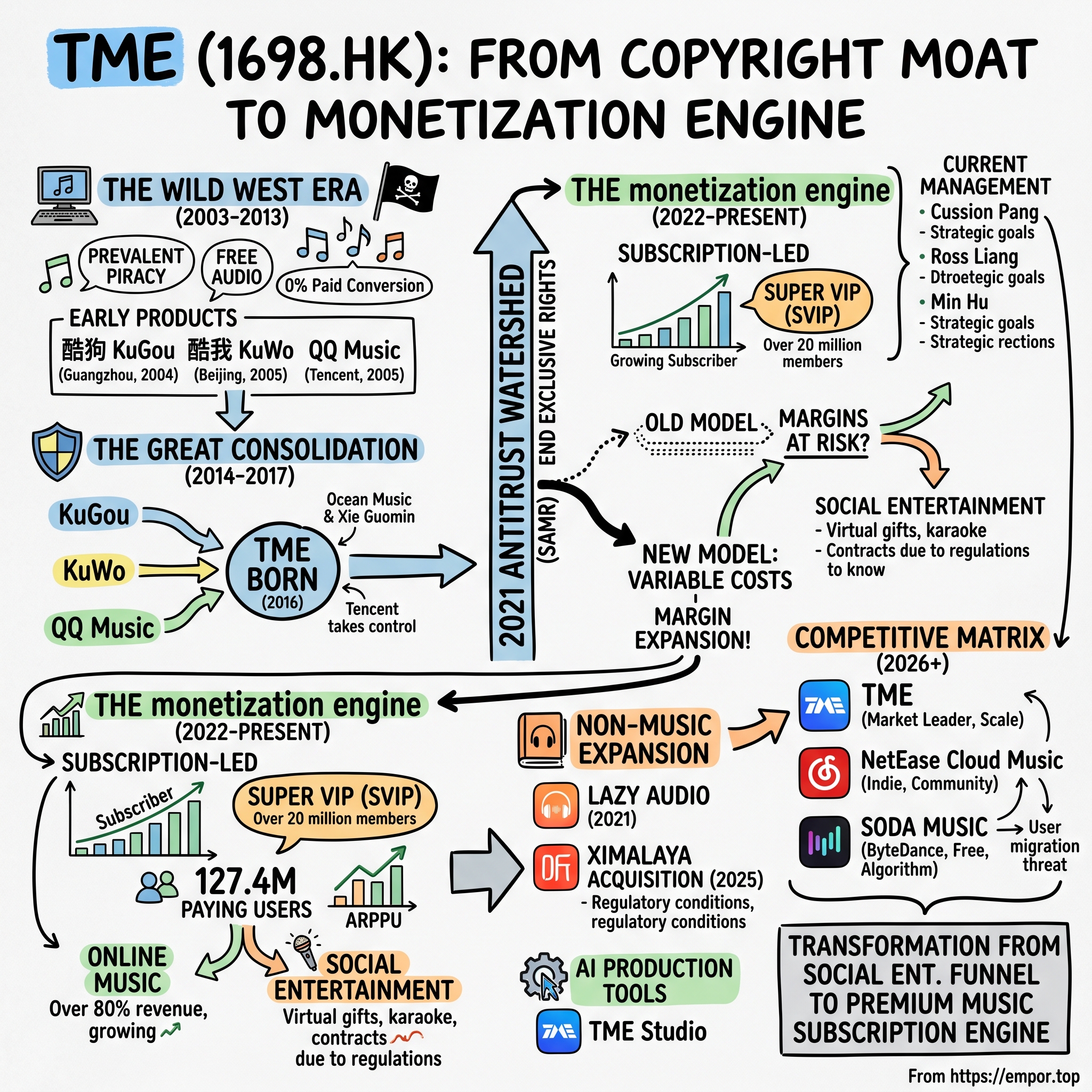
Tencent Music Entertainment Group (1698.HK): From Copyright Moat to Monetization Engine
I. Introduction & Episode Roadmap
On the morning of March 17, 2026, Tencent Music Entertainment Group published full-year 2025 results that appeared triumphant at first glance: revenue rose 15.8% to RMB 32.90 billion, driven by a 22.9% increase in online music revenue, while gross margin expanded to a record 44.2% and net profit jumped 66.4% to RMB 11.06 billion.1
Yet the stock fell more than 20% that day and roughly 25% over the following week. Morgan Stanley downgraded the shares from Overweight and cut its price target from $25 to $12.30, citing underestimated risk from a rival app unfamiliar to many Western investors.3
That disconnect—between an income statement signaling a compounder and a market valuation reflecting structural risk—captures the central challenge for 腾讯音乐娱乐集团 Tencent Music Entertainment Group in 2026. Over a decade, the company built the most complete legal music catalog in China. When antitrust regulators stripped away its exclusive licensing rights in 2021, TME unexpectedly saw its economics improve, driving margins to record levels. Yet just as that high-margin subscription model solidified, 字节跳动 ByteDance mounted a formidable challenge with a free streaming app that reached 156 million monthly users.3
Why "the Spotify of China" is the wrong frame
Comparing TME directly to Spotify is misleading. Spotify built a subscription-first model before expanding into advertising. TME took the reverse route: historically, it operated primarily as a live-streaming and social entertainment tipping business anchored by music apps. As recently as 2022, social entertainment—driven by virtual gifts sent to hosts on 全民K歌 WeSing and Kugou/Kuwo live rooms—generated more revenue than online music itself.14
Today, that social entertainment business has contracted significantly. Social entertainment and other revenue fell 7.3% in 2025 to RMB 6.18 billion, accounting for less than one-fifth of group revenue.1 In its place, TME has transitioned into a subscription-led music platform, ending 2025 with 127.4 million paying music subscribers, monthly average revenue per paying user (ARPPU) of RMB 11.9, and a premium 超级会员 Super VIP tier exceeding 20 million members.1
The three tensions that run through this story
First, the regulatory crucible. In July 2021, the 国家市场监督管理总局 State Administration for Market Regulation (SAMR) fined 腾讯 Tencent Holdings a nominal RMB 500,000 and ordered TME to relinquish all exclusive music licensing agreements with global record labels within 30 days.6 While consensus initially viewed the decision as the destruction of TME's competitive moat, relinquishing exclusivity dramatically reduced content licensing costs, proving central to its subsequent margin expansion.
Second, the monetization engine. Through paywall expansion, service tiering, and the growth of Super VIP memberships, TME increased its paying user conversion rate from under 4% historically to roughly a quarter of its user base, even as total active users contracted.
Third, the disintermediation threat. 汽水音乐 Soda Music, ByteDance's algorithm-driven free streaming app launched in June 2022, reportedly reached 156 million monthly active users by spring 2026, surpassing 网易云音乐 NetEase Cloud Music to become China's third-largest music service.3 Over the same period, TME's online music monthly active users declined 5% year-over-year to 528 million.1
What follows is the full arc: how a market once dominated by piracy transitioned into a licensed commercial ecosystem, how three competing apps consolidated into a single industry leader, how regulatory intervention reshaped TME's cost structure, and whether its monetization engine can sustain growth against a rival prioritizing user acquisition over immediate profitability. The transformation begins with an era when digital music in China was entirely free.
 Subscribe on LinkedIn
II. The Wild West of Chinese Digital Music (2003–2013)
Picture a Chinese internet café in 2006: rows of desktop machines, cigarette smoke, and on nearly every screen a media player with a search box. Type in a song title, press enter, and within seconds an MP3 file—ripped from a CD, uploaded anonymously, hosted on an untraceable server—was downloading. It cost nothing, infringed copyrights systematically, and served as the primary way nearly all of China listened to recorded music.
The paid conversion rate for digital music in China during this era rounded to zero. Global record labels largely wrote off the market, viewing a population of over a billion as generating virtually no revenue. 百度 Baidu's MP3 search vertical was for years one of the most-used features on the Chinese internet, indexing links to unlicensed audio files across the web. While record labels sued, they mostly lost or won judgments too small to alter industry practice.
The contenders take shape
Into that vacuum came products built by software engineers who recognized that in a market unwilling to pay for content, the winning strategy was owning the player rather than the rights.
酷狗音乐 KuGou Music, founded in Guangzhou in 2004, began as peer-to-peer file-sharing software. Its interface was unapologetically mass-market—bright, feature-dense, and cluttered—embedding itself among demographics largely ignored by product managers in Beijing and Shanghai: factory workers, residents of third- and fourth-tier cities, and students on low-cost laptops. 酷我音乐 KuWo Music followed in Beijing in 2005 with a similar peer-to-peer model and target audience.
腾讯 Tencent approached the market from a different angle. QQ Music launched in 2005 not as a standalone destination, but as an integrated feature within the QQ desktop messenger—then the default social network of the Chinese internet. Music served primarily as a user retention tool. Crucially, Tencent already possessed a functional payment ecosystem to monetize engagement: the 绿钻 Green Diamond VIP membership. Part of a broader system of colored-diamond subscriptions, Green Diamond allowed users to purchase avatar decorations, chat-room privileges, and virtual status symbols.
That dynamic laid the foundation for TME's eventual subscription model. While Chinese users in 2007 refused to pay for audio files, millions were willing to pay a few yuan per month for social status among peers. Over a decade, Tencent trained an entire generation of internet users to buy digital goods. When paywalls were eventually introduced for music streaming, TME did not need to build billing infrastructure, user trust, or recurring payment habits from scratch; it simply migrated an established consumer behavior to audio content.
Operation Sword changes the rules
The structural break in the industry came from state regulation rather than market forces. China's 国家版权局 National Copyright Administration had conducted periodic anti-piracy campaigns under the banner 剑网行动 Operation Sword since 2005, but its 2015 directive marked a decisive shift. Regulators issued strict orders requiring music platforms to remove all unlicensed works, resulting in millions of tracks being taken down within months. For the first time, hosting pirated music shifted from a minor litigation risk into a major threat to business operations.
Overnight, a licensed content catalog transformed from an unnecessary cost center into the primary engine of user retention. If listeners could no longer find pirated tracks, the platform holding exclusive legal rights captured the traffic. Universal Music Group, Sony Music Entertainment, and Warner Music Group—the three major global labels that had long treated China as unmonetizable—suddenly found Chinese tech platforms competing aggressively for licensing rights.
That competition produced the industry's initial competitive moat: exclusive digital distribution rights. Beyond granting streaming privileges, these contracts allowed platforms to act as exclusive master distributors with sole authority to sub-license content to rivals. While rare in Western streaming markets—where major platforms shared substantially identical catalogs—exclusive licensing became the central competitive weapon in China, turning catalog aggregation into the industry's most valuable strategic asset.
III. The Great Consolidation: Ocean Music & The Birth of TME (2014–2017)
The most consequential figure in the commercialization of Chinese digital music was neither a product manager nor a record executive, but a lawyer.
谢国民 Xie Guomin built 海洋音乐 China Music Corporation (Ocean Music) on a single premise: formal copyright enforcement in China was inevitable. While competing platforms focused on user interface design and download speeds, Xie systematically acquired distribution rights. Throughout the early 2010s, CMC accumulated exclusive digital rights to a catalog that grew into tens of millions of tracks, contracting with record labels eager to monetize catalog rights they had previously deemed unenforceable.
Xie then acquired distribution channels to match his content portfolio. CMC absorbed music services KuGou and KuWo, bringing under single ownership the two most popular music applications in China outside Tencent's ecosystem. By 2016, KuGou held roughly 28% of the Chinese streaming market and KuWo held 13%, compared to QQ Music's 15%.8
The strategy created an entity that controlled both critical music rights and a massive listener base. When Operation Sword mandated copyright compliance in 2015, CMC became simultaneously the market's largest streaming competitor and its primary content licensor, forcing rival services to pay licensing fees to a direct competitor.
July 2016: Tencent stops fighting and starts buying
Tencent responded with a strategy it has repeatedly deployed in consolidating sectors: acquiring the market leader rather than engaging in a prolonged bidding war.
On July 15, 2016, Tencent announced it would merge QQ Music with China Music Corporation, valuing CMC at approximately US$2.7 billion and taking control of the combined entity.8 The three applications—QQ Music, KuGou, and KuWo—continued operating as independent brands. Tencent explicitly framed the transaction as paving the way for an eventual IPO of the merged company.8
The combined business controlled roughly 56% of China's music streaming market on day one.8 The strategic objective centered on curbing licensing costs. During 2015 and early 2016, Tencent's music division and CMC had repeatedly outbid each other for label catalogs, inflating non-refundable advance payments to major record companies. Eliminating its primary rival bidder capped minimum guarantee commitments across the industry.
Maintaining three separate application brands preserved distinct user segments. QQ Music catered to higher-income, urban consumers integrated into the WeChat ecosystem. KuGou focused on mass-market users in lower-tier cities, while KuWo established a presence in automotive infotainment systems. Operating separate platforms allowed the company to tailor pricing structures, paywalls, and promotional strategies to distinct demographics rather than enforcing a uniform product model.
December 2017: the Spotify swap
The final step in consolidating the market prior to public listing was a cross-equity exchange. In December 2017, Spotify and Tencent announced a strategic collaboration under which each side acquired a minority equity stake in the other's music business, with Tencent and TME taking shares in Spotify and Spotify taking shares in TME.[^9]
For Spotify, then months away from its direct listing, the deal provided structural exposure to China without direct operational risk. For TME, the stake represented a valuable balance-sheet asset while establishing international standing during licensing negotiations with global record labels.
That structural positioning supported TME's initial public offering. On December 14, 2018, TME sold 82 million American Depositary Shares on the New York Stock Exchange, raising approximately US$1.1 billion, with roughly half the shares sold by existing holders and each ADS representing two Class A ordinary shares.9 Tencent simultaneously took a small private placement alongside the offering, reinforcing that this was a controlled subsidiary going public rather than a company leaving the nest.9
The transaction details reflected a disciplined entry onto public markets. The offering priced at the bottom of its marketed range and was reduced in size amid volatile conditions for Chinese equities in late 2018. In addition, secondary share sales accounted for roughly half of the offering, providing liquidity to early investors and CMC-era shareholders. TME debuted as a rare profitable Chinese internet company, though its financial results relied on an unexpected foundation:
Its primary profits did not come from music streaming.
IV. The Dual-Engine Business Model: Online Music vs. Social Entertainment
For its first several years as a public company, Tencent Music Entertainment Group operated two distinct business models under one corporate roof: a high-volume streaming service with minimal monetization, and a social live-streaming business that generated nearly all its profits.
Engine One: online music, the funnel that wouldn't convert
The online music segment commanded massive user scale, maintaining 576 million online music monthly active users (MAUs) as late as the fourth quarter of 2023 across its three primary applications.14 However, converting those listeners into paying customers proved extraordinarily difficult. In 2018 and 2019, the paying user conversion rate hovered in the low single digits, meaning roughly 96 out of every 100 listeners generated revenue solely through occasional advertising impressions.
While Western analysts viewed that low conversion rate as a vast untapped market—reasoning that approaching Western subscription rates would trigger massive growth—industry operators viewed the dynamic more pragmatically. The obstacle was not consumer unfamiliarity with subscriptions, but rather a free tier that offered comprehensive music catalogs, light ad frequency, and acceptable audio quality. Without meaningful feature restrictions on free listening, users had little incentive to subscribe.
Engine Two: social entertainment, the cash machine nobody wanted to discuss
Instead, group profitability relied on social entertainment services. Through 全民K歌 WeSing, users could record karaoke performances and receive virtual gifts from listeners. Similarly, live-streaming rooms on KuGou and KuWo featured hosts who performed, interacted with fans, and collected virtual gifts ranging from digital flowers to high-value animated tokens. TME retained a commission on every virtual transaction. Because digital items carried virtually no content licensing costs, the segment operated at high gross margins, but revenue depended heavily on a concentrated group of high-spending users.
That spending concentration invited severe regulatory scrutiny. Beginning in 2020, Chinese regulators implemented comprehensive restrictions on live-streaming tipping, including spending limits, cooling-off periods, real-name user verification, prohibitions on minor participation, and bans on competitive leaderboards designed to incentivize gift spending.
The resulting contraction was swift. Social entertainment revenue fell 19.8% in 2022 and dropped another 34.2% in 2023 to RMB 10.43 billion.14 That sharp decline dragged total group revenue down by 2.1% in 2023.14 By 2025, social entertainment revenue had fallen to RMB 6.18 billion, representing roughly 40% of its 2022 level.1
What management did with the hole
Rather than attempting to circumvent regulatory restrictions, TME allowed the social entertainment segment to contract and systematically reoriented its strategy toward music subscription monetization. Online music services revenue expanded 38.8% in 2023, 25.5% in 2024, and 22.9% in 2025, reaching RMB 26.73 billion.14131 Consequently, online music shifted from generating approximately one-third of total revenue in 2021 to accounting for more than 80% by 2025.
This business mix transformation produced an unexpected margin trajectory. Standard industry logic suggested that substituting high-margin virtual gifting with content-cost-bearing subscription revenue would compress overall margins. Instead, group gross margin widened from 31.0% in 2022 to 35.3% in 2023, 42.3% in 2024, and 44.2% in 2025—an expansion of more than 13 percentage points over three years.141
Myth versus reality
Evaluating TME's evolution requires dismantling three common market misconceptions that shaped its valuation.
Myth: TME is the Spotify of China and should be valued on identical metrics. In reality, the two platforms operate under fundamentally different cost and revenue structures. Spotify's gross margins are tightly constrained by payout ratios to major labels across a uniform subscription price tier. In contrast, while TME generates under two dollars in monthly ARPPU per subscriber, it monetizes the same catalog investment across multiple channels—including advertising, digital album sales, sub-licensing, live performances, karaoke, and long-form audio. TME functions not as a pure subscription utility, but as a diversified music monetization platform where subscriptions represent the anchor rather than the sole revenue driver.
Myth: The collapse of social entertainment reflected operational failure. In practice, the segment's decline was driven by industry-wide regulatory mandates outside management's control. While top-line growth stagnated—with group revenue declining 2.1% in 2023 and growing just 2.3% in 2024—bottom-line profitability expanded substantially.1413 Net profit rose 36.0% in 2023 and 36.2% in 2024, demonstrating that earnings growth during the transition was driven by a fundamental shift toward higher-quality, structurally profitable music revenue.1413
Myth: Subscriber conversion grew primarily because Chinese consumer willingness to pay reached Western levels. In reality, conversion gains were driven largely by stricter paywall enforcement and reduced features on the free tier rather than organic shifts in consumer sentiment. Because paywall optimization hits a natural boundary when users are presented with viable free alternatives, this distinction became critical when competition intensified in 2025.
Crucially, TME's margin expansion was not driven by subscription growth alone. It stemmed equally from a dramatic restructuring of content costs following regulatory intervention that removed what was once considered the company's central competitive advantage.
V. The 2021 Antitrust Watershed: SAMR Dismantles the Copyright Moat
On July 24, 2021, the 国家市场监督管理总局 SAMR published an administrative penalty decision concerning Tencent's 2016 acquisition of China Music Corporation. The headline fine was RMB 500,000—the statutory maximum for failing to declare a concentration for merger review, and a negligible sum for a company of Tencent's scale.617
The fine, however, was not the point; the remedies were.
SAMR ordered Tencent and its affiliates to terminate exclusive copyright agreements with upstream rights holders within 30 days and prohibited them from entering new ones.6 The order barred TME from demanding exclusive licensing terms superior to those offered to competitors, and it restricted the use of prepaid, non-refundable minimum guarantee payments as a competitive weapon. Exclusive arrangements with independent artists remained permissible but were capped at three years, with a narrow carve-out for new-release windows.67
At the time, Tencent's ecosystem was estimated to control north of 80% of China's exclusive music library rights.6 The market's interpretation was straightforward: the competitive moat was gone, 网易云音乐 NetEase Cloud Music would gain access to the same catalog, and product differentiation would collapse into price competition. TME's shares—already caught in a broader drawdown across Chinese internet equities—sold off sharply.
The counter-intuitive economics
That consensus reading was directionally understandable but economically backward, for a reason that explains much of TME's subsequent margin expansion.
Exclusivity is not free. To hold an exclusive license on a major label's catalog in China, TME had to outbid every potential rival. That bidding took the form of minimum guarantees—large, non-refundable advance payments required regardless of actual stream counts. In a conventional revenue-sharing arrangement, a platform pays content creators a percentage of generated revenue. Under a minimum guarantee, the platform writes a check upfront and absorbs the loss if listening activity fails to justify the expense.
Because catalog exclusivity served as the industry's primary battleground, guarantee commitments ratcheted upward with every renewal cycle. Record labels ran genuine auctions and TME consistently won them, effectively paying top price for content it required to maintain user engagement.
SAMR ended those auctions by decree. Once no platform could legally hold exclusive rights, no platform had a reason to bid a premium for them. Licensing terms migrated toward the structure standard in most global markets: revenue-sharing tied directly to consumption. TME's content costs shifted from fixed obligations set in advance to variable expenses that scaled alongside realized revenue.
Fixed costs that remain rigid when usage disappoints can devastate streaming economics. Variable costs that rise only alongside revenue allow a platform to compound earnings. Intending to reshape market structure, the regulator inadvertently handed TME immense operating leverage.
The honest counter-argument
Declaring the ruling an unalloyed benefit, however, oversimplifies a complex strategic shift. A rigorous investment thesis must consider three crucial counterweights.
First, the counterfactual remains unknowable. Without regulatory intervention, TME might have successfully negotiated lower guarantees over time as its scale increased and record labels grew more dependent on the Chinese market.
Second, the ruling removed a barrier that protected TME's subscriber base, not just its cost structure. The subsequent recovery of NetEase Cloud Music, and later the rapid rise of Soda Music, were both enabled by a market where catalog access no longer dictates app choice. TME captured immediate cost relief, but the competitive cost arrived later—a challenge central to the company's outlook.
Third, the decision did not insulate TME from ongoing regulatory oversight. The same agency that restructured TME's licensing framework in 2021 attached five binding behavioral conditions to its major transaction in 2026, including explicit commitments on pricing and free content tiers. Regulatory risk remains an active operating parameter rather than a legacy event.
Ultimately, the antitrust ruling forced a fundamental question: if catalog access can no longer serve as a differentiator, what will? TME's answer defined its core product strategy for the next four years.
VI. The SVIP Super-Engine & Paywall Optimization (2022–Present)
Building a paywall in a market accustomed to free content presents an immediate operational dilemma: lock away the entire catalog and listeners defect; leave too much accessible and none will pay. TME spent four years systematically testing track accessibility and feature restrictions to identify the optimal balance.
Building the wall in inches
The mechanics were incremental. TME gradually shifted selected tracks behind the paywall—prioritizing new releases before restricting deep catalog tracks from popular artists. The platform separated download privileges from streaming access, gated higher-bitrate audio behind paid subscriptions, and segmented lyrics, audio effects, and playback controls into free and premium tiers. Every adjustment was calibrated against user churn to expand paywall coverage without triggering mass departures.
The financial results through 2023 and 2024 were clear. Paying subscribers grew 19.8% in 2023 to reach 100.9 million, and expanded another 13.4% in 2024 to 121.0 million.1413 Simultaneously, monthly ARPPU rose from RMB 8.5 in 2022 to RMB 10.0 in 2023 and RMB 11.1 in 2024.1413 Expanding the subscriber base while simultaneously raising average revenue per user represents a rare double expansion in consumer subscriptions, indicating enhanced user monetization alongside paywall tightening.
The SVIP bet
Rather than imposing broad price hikes across its standard subscriber base, TME introduced a premium tier designed for dedicated music enthusiasts.
Positioned above standard membership at a substantially higher monthly price, 超级会员 Super VIP (SVIP) bundles high-margin, specialized features: master-quality audio streams, spatial and Dolby Atmos mixes, priority concert ticketing, expanded download limits, and advanced AI listening tools. While casual listeners derive limited utility from these features, audiophiles and high-intent fans view them as essential upgrades.
Architecturally, SVIP allows TME to expand ARPPU while insulating standard membership pricing from consumer pushback or regulatory scrutiny. Rather than implementing a blanket price increase across 120 million subscribers—a move that would risk heightened churn—the company offered an upgraded tier to a self-selecting minority willing to pay nearly twice the standard fee. SVIP adoption accelerated rapidly, crossing 10 million members in the third quarter of 2024 and exceeding 20 million by the end of 2025, effectively doubling over roughly five quarters.31
By the end of 2025, total paying users reached 127.4 million, pushing monthly ARPPU to RMB 11.9.1 Consequently, annual music subscription revenue grew 16.0% to RMB 17.66 billion.1
Reading the deceleration honestly
Examining the underlying trajectory reveals a distinct deceleration. Paying user growth slowed sequentially from 19.8% in 2023 to 13.4% in 2024, and dropped to 5.3% in 2025.14131 Concurrently, online music MAUs contracted 5% year-over-year to 528 million in the fourth quarter of 2025.1 By the first quarter of 2026, membership services revenue growth had moderated to 6.6%.2
On the first-quarter 2026 earnings call, management attributed this top-line softness not to existing subscribers downgrading tiers—noting that SVIP retention remained stable—but to heightened competitive pressure at the free and ad-supported entry point of the funnel. CEO 梁柱 Ross Liang highlighted this pressure on KuGou, characterizing its demographic as particularly sensitive to pricing and promotional incentives.35 While consistent with the operational data, this explanation underscored that low-tier user engagement was migrating toward competing platforms.
Long-form audio: from bolt-on to bet-the-balance-sheet
To hedge against potential saturation in music subscriptions, TME expanded into non-music spoken-word content.
The initial expansion was targeted. In January 2021, TME acquired 懒人听书 Lazy Audio, a Shenzhen-based audiobook and podcast platform founded in 2012, for RMB 2.7 billion (approximately US$417 million), primarily in cash.10 The transaction leveraged favorable audio economics: audiobooks extended user session times and bolstered paywall value without incurring the competitive royalty bidding associated with major record labels.
The subsequent move represented a far larger strategic commitment. On June 10, 2025, TME agreed to acquire 喜马拉雅 Ximalaya, China's leading long-form audio platform, for approximately US$2.4 billion—comprising up to US$1.26 billion in cash and roughly 175.3 million Class A ordinary shares, representing about 5.2% of TME's equity.11 Ximalaya had previously disclosed 303 million monthly active users for 2023 in its listing application.11
SAMR granted conditional regulatory approval on May 12, 2026, allowing the acquisition to close on May 18.11 The approval conditions imposed strict operational mandates: TME was prohibited from entering new exclusive licensing deals for online audio, required to maintain Ximalaya's existing free content offerings, and barred from bundling automotive music and audio packages.11 Executive Chairman 彭迦信 Cussion Pang characterized long-form audio as an essential content format that played a complementary role to the company's core music operations.11
However, the transaction carries notable balance-sheet risk. TME committed approximately 17% of its market capitalization—utilizing equity issued near multi-year valuation lows—for a platform operating in a sector with lower monetization rates than music and subject to binding regulatory restrictions on pricing and content tiering. The ultimate return on this acquisition depends on whether Ximalaya's user base can be monetized at subscription rates comparable to music, an outcome TME has yet to demonstrate through disclosed operating metrics.
AI: tool, threat, and sewage
TME's internal artificial intelligence platform—including TME Studio and its 启明星 Venus production tools—provides automated mastering, stem separation, lyric generation, and creator workflow assistance. On its fourth-quarter 2025 earnings call, management reported that over 10 million users had utilized its AI production utilities; on the subsequent first-quarter 2026 call, executives framed generative AI as complementary to human artistry, contending that popular AI-assisted reinterpretations could direct listener traffic back to original master recordings.45
At the same time, management acknowledged the risks posed by unconstrained AI content. Liang highlighted an industry-wide surge in AI-driven copyright infringement, noting that TME removed more than 250,000 policy-violating tracks in 2025.53 Company executives also pointedly observed that competing platforms were expanding their catalogs using low-cost AI audio carrying unverified copyright clearance.4
This dynamic introduces a structural challenge for music streaming platforms. As generative tools reduce the marginal cost of audio production toward zero, sheer catalog volume—already diminished as a competitive advantage following SAMR's antitrust intervention—becomes increasingly commoditized. Under these conditions, differentiation depends on playlist curation, copyright enforcement, and premium intellectual property. On the first-quarter 2026 call, Pang asserted that human creativity and high-quality catalog rights remain the primary drivers of long-term platform value.5 Whether that premium positioning can successfully isolate TME from low-cost content competition remains an open question.
VII. Current Management, Governance, & Capital Allocation
In April 2021 — three months before SAMR's decision landed — TME reshuffled its leadership in a way that reads, in hindsight, like a company preparing for a different kind of war.
The architect and the product man
彭迦信 Cussion Kar Shun Pang became Executive Chairman, having sat on the board since May 2014 and previously served as CEO. Pang's formation was in the deal-making and rights-negotiation side of the business: he was central to the CMC integration, to the label relationships that defined the exclusivity era, and to the regulatory engagement that followed. His public register is measured and institutional. On the Q1 2026 call he anchored the story on intellectual property rather than user counts, arguing that "premium IP remains central to deeper engagement and greater wallet share."5
梁柱 Zhu Liang, known in English materials as Ross Liang, took the CEO role in the same reshuffle. Liang came from the product side of Tencent's ecosystem, and his tenure has been defined by three things: recommendation and personalization, the tiered membership architecture that produced SVIP, and — more recently — an unusually blunt public vocabulary about market conditions. His Q1 2026 characterization of "disorderly price competition within the industry" is not the language of a CEO managing a narrative; it is closer to an appeal for market discipline.5
胡敏 Min Hu, Shirley Hu, serves as CFO and has presided over the margin expansion that defines the post-2021 period. Her framing on calls is consistently operational — SVIP adoption and retention attributed to "refined operations and innovative benefits" — and the guidance she has given has generally been conservative relative to results, with one important exception discussed below.5
Control, and what secondary listing status means
Governance here is straightforward, in the sense that there isn't much of it available to minority shareholders.
Tencent Holdings holds a majority of TME's economic interest and, through a dual-class structure with Class B shares carrying enhanced voting rights, a supermajority of votes.15 As of December 31, 2025 the company had roughly 3.15 billion ordinary shares outstanding, split between Class A and Class B.15 The board includes Tencent executives James Mitchell and Brent Irvin alongside independent directors.15 Every material decision — capital allocation, strategy, the Ximalaya consideration structure — is Tencent's to make.
One correction to a common misconception is worth making precisely, because it affects who can own the stock. TME listed Class A shares on the Main Board of the Hong Kong Stock Exchange on September 21, 2022, by way of introduction — no new capital raised — under code 1698.18[^17] That is a secondary listing. The NYSE-listed ADSs, each representing two shares, remain the primary listing.1819 Secondary-listed issuers face different index-inclusion and Stock Connect eligibility treatment than dual-primary ones, which constrains the mainland southbound buyer base. Investors who assume 1698.HK is fungible in every respect with a dual-primary Hong Kong listing are assuming something the filings do not say.16
The capital allocation record
On the return-of-capital question, behavior has been better than most Chinese internet peers and better than management's own early rhetoric implied.
In March 2025 the board authorized a US$1 billion share repurchase program running 24 months, and declared an annual cash dividend of roughly US$273 million for fiscal 2024.13 For 2025, the dividend rose to US$0.24 per ADS, approximately US$368 million in aggregate, paid in April 2026.12 On the Q1 2026 call, management said it intends to complete the two-year repurchase program as scheduled.5
The balance sheet is genuinely fortress-grade. Cash and equivalents stood at RMB 38.04 billion at December 31, 2025.1 Including term deposits and short-term investments, total liquidity was RMB 41.00 billion — about US$5.94 billion — at the end of the first quarter of 2026, after the Ximalaya cash outlay.2 Against a market capitalization in the mid-teens of billions of dollars in mid-2026, a very large fraction of the enterprise is cash.19
There is also a hidden asset most models miss. During the first quarter of 2025, TME received a 2% equity interest in Universal Music Group through a distribution-in-kind from an associate, recognizing a RMB 2.37 billion non-cash gain on deemed disposal.1 TME now holds that UMG interest directly.1 It is a meaningful, marketable stake in its own largest supplier — and a reminder that reported net profit growth of 66.4% for 2025 was substantially flattered by a one-off. Adjusted net profit, which strips it out, grew 25.0% to RMB 9.59 billion.1 The gap between those two numbers is exactly the kind of thing a careful reader should always separate.
An accounting flag worth noting
One item deserves explicit mention because it caused real damage. TME's fourth-quarter 2025 effective tax rate was 70.5%, which is the primary reason reported EPS of RMB 1.41 missed consensus of roughly RMB 1.54 despite revenue beating.4 A tax-driven miss is not an operational deterioration, and analysts who marked down the business on that line misread it. But a company with a history of volatile effective tax rates — driven by the mix of PRC subsidiary profits, preferential tech-enterprise rates, and withholding on repatriation — owes investors clearer forward guidance on the line than TME has provided.
Management credibility, measured by behavior
Judged over a five-year window rather than a single quarter, the record is mixed in an instructive way.
On the positive side, the narrative has been unusually consistent across filings, calls and presentations. The pivot from social entertainment to music subscription was articulated in 2021 and 2022 as a deliberate strategic choice, and every subsequent year of results has matched that framing — the segment shrank on schedule, the music segment grew on schedule, and margins expanded roughly as management said they would. There has been no unexplained strategy reversal, no attempt to redefine the segment reporting to disguise the decline until the change of 2026, and no aggressive leverage taken on to paper over the transition. When guidance has been given, it has generally been conservative: management guided 2026 gross margin to be flat-to-slightly-lower, which is a low bar deliberately set.4
On the negative side, three behaviors warrant scrutiny. The first is the disclosure withdrawal, discussed in detail in the next section. The second is the willingness to spend US$2.4 billion on Ximalaya — partly in equity issued near multi-year lows — within weeks of emphasizing capital discipline and completing dividend increases; issuing 5.2% of the company at a depressed price is a real cost to existing holders that management has not quantified against expected returns.11 The third is a tendency, visible in the language of recent calls, to attribute pressure to industry conditions — "disorderly price competition," AI-driven piracy, competitors inflating catalogs with low-cost content — rather than to TME's own product position.54 Those characterizations may all be accurate. They are also, structurally, external attributions for an internal user decline, and investors should apply the usual discount to explanations that locate the problem outside the company.
The governance picture, then, is a controlled subsidiary with disciplined capital returns, an under-appreciated asset portfolio, and limited minority influence. Which is a tolerable structure when the operating business is compounding — and a much less comfortable one when a competitor is taking your users.
VIII. Competitive Matrix & Industry Structure
For eight years, Chinese music streaming functioned as a two-player industry with a stable hierarchy. Tencent Music Entertainment Group brought scale, catalog depth, and strong balance-sheet liquidity, while NetEase Cloud Music cultivated a distinct community. That equilibrium broke when ByteDance entered with a fundamentally different operating model.
NetEase Cloud Music: the smaller, sharper rival
网易云音乐 NetEase Cloud Music did not compete for mass-market scale. Instead, it built differentiation around social engagement and editorial curation: active user comment sections beneath tracks, hand-curated playlists, and a dedicated indie artist platform. By the end of 2025, that program surpassed one million registered independent artists who contributed more than 5.6 million tracks.12 The platform's user base skews younger and highly engaged, maintaining daily-to-monthly active user ratios above 30%.12
NetEase Cloud Music's 2025 financial results reflected a deliberate prioritization of profitability over top-line expansion. Total revenue contracted 2.4% to RMB 7.76 billion as management scaled back social entertainment operations, lowering that segment's revenue from RMB 2.6 billion to RMB 1.8 billion under a more prudent operational strategy.12 Core online music services, however, expanded 12.0% to RMB 6.0 billion, driven by membership subscription revenue rising to RMB 5.1 billion.12 Consequently, gross margin expanded to 35.7%, while net profit reached RMB 2.75 billion.12
Two comparative metrics stand out for investors. First, NetEase Cloud Music's gross margin trailed TME's by roughly 8.5 percentage points in 2025, illustrating the margin penalty of amortizing content costs over a smaller user base. Second, NetEase's membership subscription revenue grew faster in 2025 than TME's subscription service did in the first quarter of 2026. The smaller competitor continues to expand its core subscriber base effectively despite TME's market dominance.
Soda Music: the competitor that doesn't want your money
汽水音乐 Soda Music launched in June 2022 as a free, ad-supported application that applied 抖音 Douyin's vertical-swipe, algorithm-driven interface to full-length audio tracks.3
After operating as a niche service for two years, the platform expanded rapidly when ByteDance altered its licensing structure. Beginning in 2024, rights holders renewing catalog agreements for Douyin—China's primary short-video music discovery platform—were required to bundle distribution rights to cover Soda Music as well.3 Record labels seeking promotional reach on short video were effectively forced to license their content to ByteDance's standalone audio app, expanding Soda's catalog to roughly 50 million tracks without requiring separate competitive bidding.3
User adoption accelerated dramatically as a result. Soda Music reached roughly 50 million monthly active users by mid-2024, expanded to 120 million by September 2025—a year-over-year surge exceeding 90%—grew to 140 million by early 2026, and reached a reported 156 million by spring 2026, surpassing NetEase Cloud Music to become China's third-largest music streaming service.3
The strategic threat to TME stems less from catalog pricing than from ecosystem control. Douyin serves as China's primary engine for music discovery. When a track trends on short video, listeners seek the full-length song. Historically, that traffic flowed onward to QQ Music or KuGou. Soda Music captures that demand entirely within ByteDance's ecosystem, threatening the top-of-funnel traffic pipeline TME relied upon for a decade.
User migration data reflects this shift. Analyst reports identified more than 21 million users transitioning between Soda Music and TME platforms, with cross-platform switching increasing over 60% year-over-year.3 TME's 5% decline in online music monthly active users during the fourth quarter of 2025 represents the direct operational impact of this shift.1
Because Soda Music operates as a free, ad-supported service without immediate subscription targets, TME must defend a paid subscription business against an unmonetized competitor. That structural asymmetry heightened market sensitivity when TME curtailed detailed quarterly operational disclosures in late 2025.
TME's defense, and whether it is adequate
Management's competitive response relies on four primary initiatives.
The most robust defense is the expansion of the Super VIP tier. If Soda Music primarily attracts price-sensitive, ad-supported users who are unlikely to convert into paying subscribers, immediate subscription revenue remains insulated. The growth of SVIP membership to over 20 million indicates that TME's highest-value subscribers remain engaged.1 Management affirmed that competitive pressure has concentrated among free-tier users rather than existing subscribers downgrading tiers.5 Nevertheless, a shrinking free-user base threatens to constrain top-of-funnel conversion over time.
The second plank centers on offline live events and artist intellectual property. Offline performance revenue delivered triple-digit year-over-year growth in the first quarter of 2026, supported by new initiatives such as an artist fan-club membership launched with 汪苏泷 Silence Wang.52 Non-membership music revenue—encompassing advertising, digital album sales, sub-licensing, and live events—grew 28.0% to RMB 1.94 billion in the first quarter of 2026, outpacing core subscription growth.2 This shift highlights TME's gradual evolution beyond digital streaming into broader music monetization.
The third plank relies on integration with Tencent's broader ecosystem. Management points to WeChat mini-programs, Video Accounts, and social sharing tools as structural advantages that provide a seamless transition from music discovery to playback.5 However, ByteDance's integrated discovery-to-streaming funnel on Douyin and Soda Music provides a direct alternative that aligns closely with how popular music currently viralizes in China.
The fourth plank involves strategic partnerships with major record labels. TME renewed catalog licensing agreements with Warner Music and Believe in 2025, followed by renewals with JVR Music, Linfair Records, and Rock Mobile in early 2026. These deals incorporated spatial audio enhancements for classic catalogs and established 30-day windowing agreements for select releases through a partnership with TF Entertainment.45 These temporary exclusivity windows represent permissible differentiation within the post-2021 regulatory framework.
Whether these combined initiatives will fully offset competitive pressure on user acquisition remains the central question facing the company.
War-gaming the next three years
Looking forward, three primary operational scenarios outline TME's potential trajectory over the medium term.
The stabilization scenario. In this outcome, Soda Music's expansion reflects incremental audio consumption rather than direct displacement of TME's core applications. Soda's active user growth plateaus after absorbing Douyin's most price-sensitive audience, allowing TME's free-user base to stabilize. Paying subscriber growth resumes a mid-single-digit pace, while non-subscription lines propel total revenue growth into double digits. Under this path, gross margins remain firm, share repurchases reduce equity overhang, and recent quarterly disclosure reductions prove to be administrative adjustments rather than indicators of structural deterioration.
The market-share erosion scenario. Here, Soda Music continues to capture active users, forcing TME to rely on low-monetization tiers on KuGou to preserve reach. Paying subscriber growth stagnates, causing subscription revenue expansion to slow to low single digits. While live performances and long-form audio integration from Ximalaya sustain overall group revenue, earnings quality shifts toward capital-intensive, less recurring revenue streams. Gross margins contract modestly as content costs adjust, aligning with trends observed in the first quarter of 2026.
The disintermediation scenario. In this downside case, ByteDance builds a formal subscription monetization engine atop Soda Music and leverages Douyin to sign independent artists directly. TME's platform risk shifts toward operating as a legacy catalog repository serving an aging subscriber base. Although representing a tail risk, this scenario contributed to the severe valuation contraction following TME's earnings release in March 2026.3
Distinguishing among these trajectories depends on two key empirical indicators: whether TME maintains net paying-subscriber growth, and whether ByteDance chooses to introduce direct subscription monetization at Soda Music.
IX. Strategic Frameworks: Helmer's 7 Powers & Porter's 5 Forces
Strategic frameworks are useful only when they can be falsified. Applied rigorously to Tencent Music Entertainment Group in 2026, several strategic advantages that appeared durable three years ago now grade materially lower.
Helmer's 7 Powers, graded against current evidence
Scale economies — strong, and evidenced. Content licensing under revenue-sharing terms is a variable cost, but the underlying infrastructure is fixed: engineering, recommendation algorithms, rights administration, and the baseline music catalog required to operate. Spreading those fixed investments across 127.4 million paying subscribers rather than a smaller user base explains why TME's gross margin sits roughly 8.5 percentage points above that of NetEase Cloud Music.112 This scale advantage represents TME's clearest, most quantifiable edge, and it remains the least vulnerable to Soda Music—because ByteDance's app is not yet attempting to run an independent, subscription-driven profit-and-loss statement.
Switching costs — moderate, and softer than usually claimed. A decade of curated playlists, favorited tracks, and user listening history creates real friction against leaving, explaining why TME's core paying subscriber base has remained sticky. However, that friction is asymmetric: it retains long-standing users while doing little to hold younger listeners whose music discovery happens primarily through short video. The 5% contraction in online music monthly active users illustrates what weak switching costs look like at the margin.1
Network effects — weak, and weakening. WeSing's virtual karaoke rooms and WeChat music sharing produce localized network value, but social entertainment is a contracting revenue line, and one-to-many link sharing functions as a distribution channel rather than a true network effect. Music streaming has historically lacked strong direct network effects, and TME is no exception.
Cornered resource — largely gone. Exclusive catalog rights served as TME's defining strategic advantage from 2016 through 2021, but SAMR's antitrust ruling dismantled that moat. What remains is narrower: the Tencent Musician Program's independent creator pipeline, three-year independent-artist exclusive agreements permitted under regulatory rules, and short new-release promotional windows. While meaningful, these do not constitute a structural barrier to entry. Meanwhile, TME's direct 2% equity stake in Universal Music Group represents a valuable financial asset rather than a cornered operational resource.1
Counter-positioning — real, and underrated. TME's multi-app portfolio—operating QQ Music, KuGou, and KuWo as distinct brands—is its most frequently overlooked strategic power. A single-brand competitor must adopt a unified pricing structure and brand identity. In contrast, TME can enforce strict paywalls on QQ Music while defending KuGou's mass-market audience with freemium tiering and ad-supported entry points, matching the multi-tier strategy management detailed in early 2026.5 A specialized rival attacking KuGou's price-sensitive user base cannot simultaneously target QQ Music's premium subscribers without undermining its own positioning. The limitation of this structure is that it protects primarily against symmetric streaming competitors; it provides less defense against a rival heavily subsidized by a short-video engine that does not require standalone music profitability.
Branding and process — neither constitutes a durable power in this market. TME's consumer application brands are functional rather than aspirational, while its algorithmic recommendation capabilities are matched or exceeded by ByteDance's data infrastructure.
Porter's Five Forces, 2026 edition
Supplier power: high, structurally, but capped by regulation. Three global major record labels alongside a handful of prominent domestic rights holders control the core catalog driving listener demand, and these suppliers cannot be disintermediated. SAMR's 2021 antitrust order and the regulatory conditions imposed on the 2026 Ximalaya acquisition both prevent rights holders from extracting exclusivity premiums, creating a rare instance where regulatory intervention restrains supplier power. Nevertheless, catalog renewal cycles remain a critical risk window: should record labels secure higher revenue-share percentages during contract renewals, TME's gross margin expansion could stall without any operational misstep by management.
Buyer power: individually negligible, collectively acute. No individual subscriber possesses bargaining power. Collectively, however, Chinese consumers demonstrated across fifteen years an unwillingness to pay for digital audio when accessible free alternatives existed—and Soda Music represents that free alternative, backed by a licensed catalog. CEO Ross Liang's characterization of KuGou's free-tier users as highly sensitive to pricing and promotions serves as a direct illustration of buyer power exerting operational pressure.5
Threat of new entrants: low in the abstract, realized in practice. Licensing complexity, minimum guarantee commitments, and technical infrastructure deter traditional startups. They do not, however, deter ByteDance, which entered the market by bundling standalone streaming rights into ongoing Douyin licensing negotiations. The traditional barrier to entry successfully blocks small startups while remaining transparent to platform-scale tech conglomerates.
Threat of substitutes: high and rising. Music competes for consumer time against short-form video, mobile gaming, and live streaming. Short video has established itself as China's dominant digital attention sink, and it now features a direct, integrated music streaming application.
Rivalry: intensifying and, per management, disorderly. What functioned for years as a rational two-player market has evolved into a three-player dynamic in which a new entrant is acquiring market share through free access and cross-platform traffic subsidies—evidenced by Douyin committing 2.5 billion units of promotional traffic support to independent music creators through a joint program launched with Soda Music in September 2025.3 CEO Ross Liang's public commentary regarding "disorderly price competition" provides explicit confirmation that industry pricing discipline has fractured.5
The net framework read: TME's cost-side advantages remain structurally solid and empirically supported, but its demand-side powers are considerably softer than market consensus assumed entering 2025. That dynamic represents a clear, testable thesis—and it provides the baseline for evaluating TME's valuation and long-term outlook.
X. Skeptical Investor Stress Test & Risk Radar
If an activist or short-seller were building a bear case on Tencent Music Entertainment Group in mid-2026, four areas would face the closest scrutiny.
1. The disclosure withdrawal
Governance presents the most immediate vulnerability, as it is where market trust experienced a direct fracture.
During the fourth-quarter 2025 earnings call, management announced it would discontinue quarterly disclosures of online music monthly active users, paying subscribers, and ARPPU, transitioning to an annual total-paying-user metric instead. The Executive Chairman explained that the company's "focus has moved beyond paid subscribers and ARPU."4
The stated rationale—that a multi-tiered membership structure and expanding non-subscription revenue streams make a single ARPPU figure less representative—is coherent on its merits. The timing, however, raised critical questions. The company ceased disclosing subscriber and active user metrics in the exact quarter those metrics turned negative, precisely when investors required transparency to evaluate a rising competitive threat. Regardless of management's intent, the observable outcome is a controlled subsidiary reducing disclosure on deteriorating operating metrics while its user acquisition funnel is under pressure.
This represents an analytical risk rather than a governance moral judgment, and it carries a real cost: it forces investors to rely on third-party app analytics and management assertions rather than reported financial disclosures. Restoring quarterly metrics if growth resumes would signal that disclosures were adjusted for operational convenience rather than long-term reporting principles.
2. Structural and geopolitical risk
TME operates through a variable interest entity (VIE) structure—relying on contractual arrangements rather than direct equity ownership of Chinese operating companies—because Chinese law restricts foreign ownership in value-added telecommunications and online content services. VIE risk remains an unresolved structural reality; it appears in the risk factors of every China ADR and has never been definitively adjudicated in court.15
The company's shares carry the additional overhang of U.S. audit oversight history under the Holding Foreign Companies Accountable Act framework. Furthermore, the secondary rather than dual-primary status of TME's Hong Kong listing means that if a U.S. listing ever became untenable, the transition would be far less seamless than for peers that completed a primary conversion.[^17]16 While these represent tail risks, they explain why a China ADR with substantial balance-sheet liquidity trades at a persistent valuation discount.
3. The ARPPU ceiling and the funnel underneath it
Monthly average revenue per paying user of RMB 11.9 is roughly US$1.65—a small fraction of Western streaming rates.1 The bullish narrative has long framed this disparity as an inevitable convergence opportunity.
The skeptical perspective contends that the gap reflects structural willingness-to-pay constraints in a consumer market where household spending tightened through 2024 and 2025, and that primary ARPPU gains were already harvested by converting core music fans to Super VIP memberships. Substantially raising standard membership pricing while a well-capitalized free alternative gained over 100 million users in eighteen months presents clear operational risk.
A more direct version of the bear thesis targets the conversion funnel itself rather than pricing metrics. Paying subscribers are converted from the broader free-user base. A free-user population contracting by 5% annually mathematically constrains future subscriber growth, regardless of paywall optimization. The deceleration in paying subscriber growth—from 19.8% in 2023 to 13.4% in 2024 and 5.3% in 2025—illustrates that structural constraint taking effect.14131
4. Content disintermediation and AI supply shock
The most severe structural threat to TME is not merely user migration to Soda Music, but the potential reorganization of the music value chain around discovery.
If independent artists and major record labels conclude that releasing music through Douyin and Soda Music generates superior audience reach compared to TME, TME's platform risks shifting from an essential music destination to a passive catalog utility. Coupled with generative AI tools lowering the marginal cost of audio production toward zero, the scarce asset shifts decisively from catalog ownership to audience attention routing—an area where ByteDance, rather than Tencent, holds a dominant position in China.
TME's counter-investments—expanding offline live events, artist fan clubs, merchandising, and acquiring Ximalaya—represent strategic attempts to build revenue lines independent of streaming discovery. While logically aligned with market shifts, whether these initiatives can fully compensate for potential core streaming disintermediation remains unproven.
What is not a first-order risk
Balance sheet risk is minimal: TME faces no meaningful refinancing pressure and maintains liquidity worth a large fraction of its market value.2 Social entertainment, having contracted roughly 60% from its historical peak, is no longer large enough to drive major group-level downside; its 11.0% year-over-year decline in the first quarter of 2026 reduced total group revenue growth by approximately one percentage point.2 The primary risks facing the company are competitive and structural rather than balance-sheet financial distress.
XI. Playbook, Thesis & Key KPIs
What this business teaches
Losing a legal monopoly can improve a business. The 2021 SAMR ruling removed TME's most-cited competitive advantage—and simultaneously dismantled the mechanism by which record labels extracted the value that advantage created. The lesson generalizes: when a company's moat requires continuously outbidding rivals for an essential input, that moat may be little more than a transfer payment to suppliers disguised as a competitive shield. Investors must examine who actually captures the economics before assuming catalog exclusivity is an asset.
Segmentation beats across-the-board price increases. TME expanded its monthly average revenue per paying user primarily by introducing a premium tier that an enthusiastic minority self-selects into, rather than raising prices on its broader audience. Broad price hikes risk subscriber churn and regulatory backlash; a segmented Super VIP tier creates pricing power without either.
Regulatory adaptation is an operational capability. Management absorbed a nearly 60% contraction in its cash-generating social entertainment segment without relying on panicked acquisitions or debt, while expanding group gross margin by more than 13 percentage points. That execution provides concrete proof of organizational resilience, offering a far stronger signal than any strategic presentation.
Narrative discipline underpins management credibility. The same executive team that successfully navigated regulatory restructuring responded to its first major competitive shock by curtailing operational disclosures. Both facts belong in the investment evaluation.
The three KPIs that actually matter
With quarterly user metrics no longer disclosed, tracking TME requires a revised analytical discipline focused on three core indicators.
1. Total paying users, disclosed annually. As the sole official metric remaining for funnel health, this annual year-end figure provides a critical signal: whether the paid subscriber base can continue expanding while the broader free user base contracts. Investors must monitor both the year-end total and management commentary on net additions.
2. Music subscription revenue growth versus non-subscription music revenue growth. This contrast offers the single most informative comparison in TME's financial reporting. Subscription growth measures the core streaming franchise, whereas non-subscription growth—encompassing advertising, digital album sales, offline live performances, sub-licensing, artist fan-club memberships, and IP monetization—signals whether TME is successfully evolving beyond digital streaming into a broader music entertainment group. In the first quarter of 2026, music subscription revenue grew 6.6% year-over-year while non-subscription music revenue surged 28.0%.2 A widening growth gap confirms that business diversification is taking hold; a narrowing gap indicates that the entire franchise is decelerating in tandem.
3. Online music gross margin. This metric provides the clearest measure of whether scale economies endure through upcoming record label renewal cycles, and whether the integration of Ximalaya proves accretive or dilutive to content economics. Group gross margin expanded from 35.3% in 2023 to 44.2% in 2025, though management guided 2026 gross margins to be flat to slightly lower.1414 Maintaining gross margins above 44% alongside revenue growth would challenge key elements of the bear thesis. Conversely, erosion toward 40% would indicate that record label supplier power is reasserting itself during contract renegotiations.
The bull case
The bull case does not require TME to defeat Soda Music; it simply requires TME to retain its paying subscriber base.
Under this thesis, user departures are concentrated among ad-supported listeners who were unlikely to convert into subscribers, making their loss financially negligible. The paying base—anchored by more than 20 million Super VIP members whose retention management characterizes as strengthening—remains resilient because high-intent listeners prioritize comprehensive catalog depth, master audio quality, and concert access over a free, short-video-adjacent streaming service.15 Meanwhile, non-subscription offerings such as live performances deliver rapid growth, the Ximalaya acquisition unlocks a second spoken-word audio category with over 300 million users, gross margins remain firm above 44%, a direct 2% Universal Music Group stake alongside RMB 41 billion in liquidity provides valuation support, and steady share repurchases reduce the share count.1121
The bear case
The bear case centers on a fundamental reality: conversion funnels are not optional.
Every paying subscriber originally entered as a free listener. A free user base contracting by 5% annually, facing a competitor that added approximately 100 million users in 18 months through direct access to China's dominant short-video discovery engine, threatens to starve subscriber acquisition over time. The slowdown in paying-user growth to 5.3% in 2025, followed by 6.6% membership revenue growth in the first quarter of 2026, indicates that this top-of-funnel pressure is already materializing.12 Furthermore, upcoming record label contract renewals across three well-capitalized streaming bidders could raise revenue-sharing ratios and compress gross margins. At the same time, an influx of AI-generated audio threatens to commoditize catalog value, while annual dividend and buyback commitments of roughly RMB 2.4 billion appear modest relative to a US$2.4 billion acquisition paid partly in undervalued equity.11 Finally, the withdrawal of quarterly operational disclosures ensures that investors will detect any further operational deterioration only after the fact.
The central synthesis remains balanced: TME's cost structure and operational discipline are demonstrably strong, but its user acquisition funnel is under clear competitive pressure. Both dynamics exist simultaneously, explaining why the stock trades at a valuation reflecting its net cash and why market debate over its trajectory remains sharply divided.
XII. Epilogue & Conclusion
There is a structural symmetry to this narrative.
TME was built in an era when digital music in China was free, created by companies that recognized the path to monetization lay in owning the software player and selling status symbols to its user base. The business model gained value as state enforcement made legal copyrights mandatory, and it achieved dominance by outbidding competitors for catalog exclusivity. When regulators stripped away that exclusivity, TME discovered that defending exclusive rights cost far more than the moat was worth. Freed from bidding auctions, the company constructed the monetization engine it had needed all along: 127.4 million paying subscribers, gross margins in the mid-40% range, a fortress balance sheet, and the beginnings of a disciplined dividend and repurchase program.1
Yet a new competitor arrived offering free music streaming, funded by a corporate parent whose core business model does not require standalone music profitability—recreating conditions strikingly similar to the market TME entered two decades ago.
Management contends that the market has fundamentally evolved: that paying subscribers constitute a distinct cohort from free users, that premium intellectual property and human creativity serve as durable differentiators, and that a music enterprise can be sustained through live events, fan engagement, and long-form audio rather than relying solely on capturing the default streaming destination.511 That thesis is operationally coherent and backed by capital, with early non-subscription revenue growth providing tangible supporting evidence.
What the strategy lacks, as yet, is definitive proof. The data required to evaluate it—annual paying-subscriber totals, the divergence between subscription and non-subscription growth, and online music gross margin trends through upcoming record label renewal cycles—will emerge slowly, within a reporting framework management has deliberately reduced.
For investors, TME occupies a complex position: an enterprise with undisputed historical margin expansion, measurable top-of-funnel competitive pressure, and a valuation reflecting a market that has discounted past earnings growth to focus on user acquisition risks. Which factor ultimately determines long-term performance remains an open question. What remains clear is what to watch—and for a company that has reduced its reporting cadence, an objective analytical framework provides the most reliable guide.
---and provides the most reliable guide.
References
-
Tencent Music Entertainment Group Announces Fourth Quarter and Full-Year 2025 Unaudited Financial Results — PR Newswire / Tencent Music, 2026-03-17 ↩↩↩↩↩↩↩↩↩↩↩↩↩↩↩↩↩↩↩↩↩↩↩↩↩↩↩↩↩
-
Tencent Music Entertainment Group Announces First Quarter 2026 Unaudited Financial Results — PR Newswire / Tencent Music, 2026-05-12 ↩↩↩↩↩↩↩↩↩↩
-
Tencent Music investors see ByteDance's Soda as a major threat. What is it, and why are they so worried? — Music Business Worldwide, 2026 ↩↩↩↩↩↩↩↩↩↩↩↩↩
-
Earnings call transcript: Tencent Music Q4 2025 misses EPS, stock drops — Investing.com, 2026-03-17 ↩↩↩↩↩↩↩↩
-
Tencent Music Enter Gr Q1 2026 Earnings Call: Complete Transcript — Benzinga, 2026-05-12 ↩↩↩↩↩↩↩↩↩↩↩↩↩↩↩↩↩↩
-
China regulator fines Tencent Music, orders it to relinquish exclusive music rights — Reuters, 2021-07-24 ↩↩↩↩↩
-
China Orders Tencent to Give Up Exclusive Music Licensing Rights — The Wall Street Journal, 2021-07-24 ↩
-
Tencent to merge QQ Music service with China Music Corp to create streaming giant — South China Morning Post, 2016-07-15 ↩↩↩↩
-
Tencent Music Entertainment Group $1.1 billion IPO and NYSE listing — Davis Polk, 2018-12-14 ↩↩
-
Tencent Music Entertainment Group Announces Acquisition of Lazy Audio — Tencent Music Investor Relations, 2021-01-15 ↩
-
Tencent Music completes $2.4B acquisition of audio platform Ximalaya — Music Business Worldwide, 2026-05-18 ↩↩↩↩↩↩↩↩↩
-
NetEase Cloud Music Inc. Reports Fiscal Year 2025 Financial Results — PR Newswire / NetEase Cloud Music, 2026-02-11 ↩↩↩↩↩↩
-
Tencent Music Entertainment Group Announces Fourth Quarter and Full-Year 2024 Unaudited Financial Results — PR Newswire / Tencent Music, 2025-03-18 ↩↩↩↩↩↩↩↩
-
Tencent Music Entertainment Group Announces Fourth Quarter and Full-Year 2023 Unaudited Financial Results — PR Newswire / Tencent Music, 2024-03-19 ↩↩↩↩↩↩↩↩↩↩↩↩↩
-
Tencent Music Entertainment Group Filings (CIK 001-38751) — US Securities and Exchange Commission ↩↩↩↩
-
Tencent Music Secondary Listing on Hong Kong Stock Exchange — Financial Times, 2022-09-21 ↩↩
-
SAMR Administrative Penalty Decision on Tencent's Acquisition of China Music Corporation — State Administration for Market Regulation (SAMR), 2021-07-24 ↩
-
Tencent Music Entertainment Group Press Releases and Investor Materials — Tencent Music Investor Relations ↩↩
-
Tencent Music Entertainment Group (1698.HK) Stock Quote & Company Overview — Bloomberg ↩↩
 LinkedIn
 WhatsApp
 Reddit
 Hacker News
 Email
Email Kindle
 RSS Feed
 Spotify
 Apple Podcasts
 Amazon Music
 Audible
 YouTube