Postal Savings Bank of China: The World's Biggest Retail Banking Moat
I. Introduction & Episode Roadmap
Somewhere in a township in 甘肃 Gansu province, there is a single-storey building with a green sign. Inside, a clerk sells stamps, weighs parcels, hands over pension payments, and takes a farmer's cash deposit — all at the same counter. The building belongs to 中国邮政集团 China Post Group. The deposit, however, belongs to a Hong Kong- and Shanghai-listed commercial bank with RMB 18.68 trillion in assets.
That single counter is the entire investment case for 中国邮政储蓄银行 Postal Savings Bank of China, and also its entire controversy.
PSBC serves more than 680 million personal customers through roughly 40,000 outlets — a customer base close to half of China's population, and a branch network larger than any bank on Earth.1 It holds RMB 16.54 trillion of customer deposits, of which RMB 14.69 trillion, or 88.82%, comes from ordinary households, according to the 2025 annual report published in April 2026.2326 No other systemically important bank in the world is that retail-heavy. And it carries the lowest non-performing loan ratio among China's "Big Six" state banks — 0.95% at the end of 2025.2
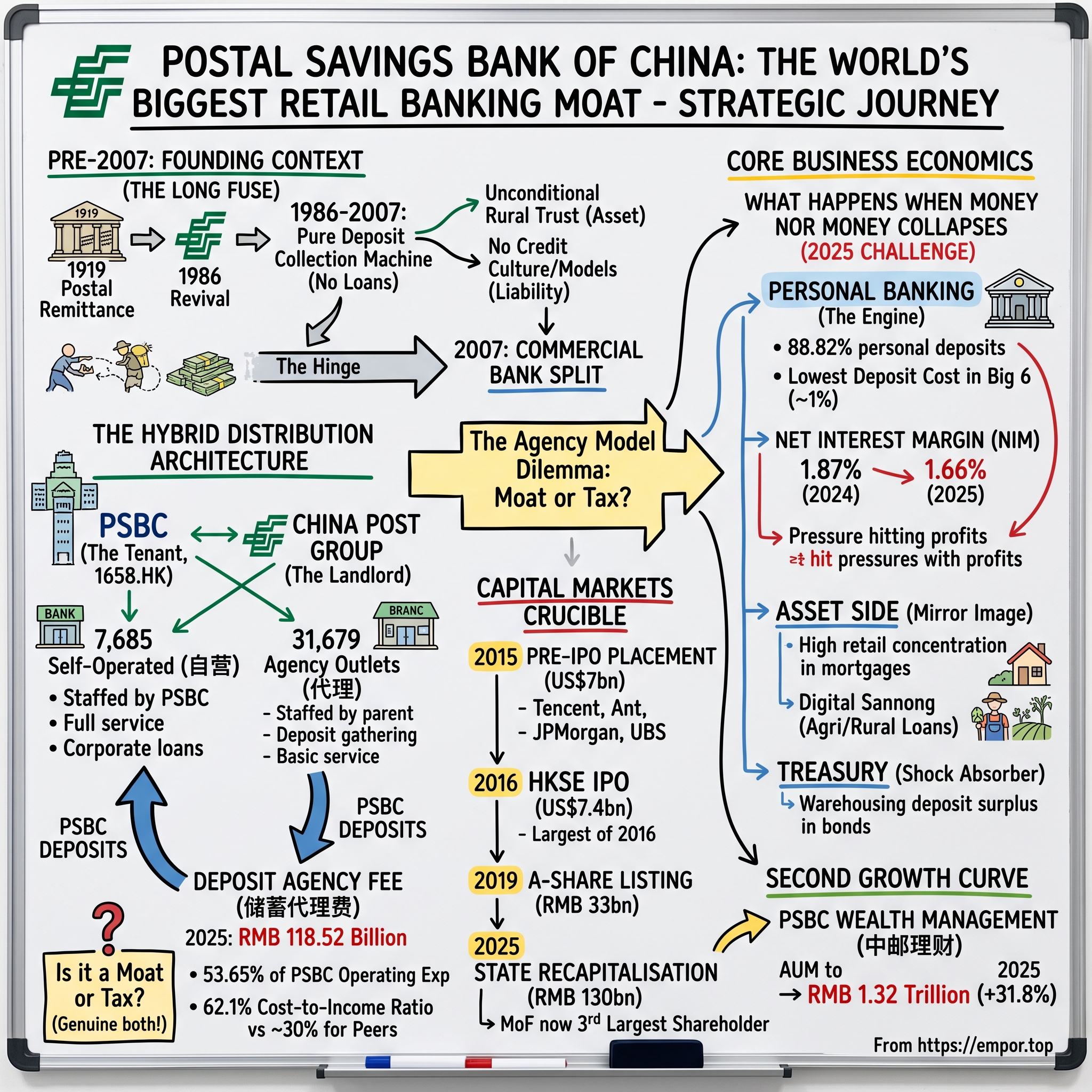
Here is the paradox. Only about one-fifth of those outlets actually belong to PSBC. As of end-2023 the bank counted 39,364 outlets, of which just 7,685 were self-operated (自营网点) and 31,679 were agency outlets (代理网点) owned and staffed by the parent postal group.4 PSBC rents its distribution. And in 2025 the rent came to RMB 118.52 billion — a deposit agency fee (储蓄代理费) that swallowed 53.65% of the bank's entire operating expense base and pushed its cost-to-income ratio to 62.1%, versus roughly 30% at the other five state giants.5
Read that again, because it reframes everything. In 2025 PSBC paid its parent RMB 118.5 billion for access to post-office counters, and earned RMB 87.4 billion in net profit for its own shareholders.25 The landlord out-earns the tenant.
Is that a moat or a tax? That is the question this story exists to answer, and the honest answer is: it is genuinely both, and which one dominates depends on a contractual formula that has been renegotiated four times in four years.
The arc runs like this. First, the long fuse — a postal remittance service born in 1919 to move money home to villages that no bank would serve, suspended in 1953, revived in 1986, and for two decades operated as a pure deposit-collection machine that made no loans at all.1 Then the 2007 split that turned a savings window into a commercial bank, and locked in the hybrid distribution architecture. Then the 2015 pre-IPO placement that brought 腾讯 Tencent, 蚂蚁金服 Ant Financial, JPMorgan, UBS, DBS, Temasek and others onto the register at a moment when Chinese banks still looked like growth assets.6 Then the capital-markets decade: the largest IPO of 2016, an A-share listing in 2019, and in 2025 the largest single financing in the bank's history — a RMB 130 billion state recapitalisation that changed the shareholder register itself.7
And finally the part that actually matters today: what happens to a bank built on cheap household deposits when the price of money collapses. PSBC's net interest margin fell from 1.87% in 2024 to 1.66% in 2025.2 Its provision coverage ratio dropped from 286.15% to 227.94% in a single year while net profit inched up 1.05%.23 Those two facts sit uncomfortably together, and no amount of narrative about rural distribution makes them go away.
We will test the moat rather than assume it. We will treat management's claims as claims, and look at what the contracts, the filings and the earnings calls actually show. And we will end with the two or three numbers that tell you, quarter by quarter, whether the thesis is holding.
It starts, improbably, with overseas Chinese labourers trying to send money home.
 Subscribe on LinkedIn
II. Imperial Mail to Rural Vault: The Pre-2007 Founding Context
The problem that created postal savings in China was not a banking problem. It was a logistics problem.
In the early twentieth century, a labourer from 广东 Guangdong working in Southeast Asia who wanted to send money to his mother in a village had essentially no options. Foreign banks clustered in the treaty ports. Native banks and merchant houses (钱庄) served merchants, not peasants. The only institution with physical reach into the countryside was the post office — because the post office had to go everywhere by definition. Mail is a universal-service obligation; banking is not.
So in 1919 the postal system began offering 邮政储金, postal savings deposits, alongside remittance.1 The logic was almost embarrassingly simple: if you already have a clerk in every county collecting letters, you already have a teller. The infrastructure cost of adding a deposit book to a mail counter is close to zero. This is the founding insight of the whole enterprise, and it has never changed. Everything PSBC is today is a hundred-year elaboration of "the post office is already there."
The service was suspended in 1953 as the planned economy absorbed private finance, leaving the postal system to handle remittances only.1 It came back in 1986, in the early reform era, under an arrangement that would look bizarre to any Western banker: postal savings offices collected household deposits and handed essentially all of them to 中国人民银行 the People's Bank of China at an administered rate, earning a spread for the collection service.1
Sit with what that meant. For roughly two decades, China's largest retail deposit network was a bank that did not bank. It took no credit risk. It made no commercial loans. It underwrote nothing. Its entire skill set was opening passbooks, counting cash, and not losing money. Its risk management department, in any meaningful sense, did not need to exist.
That has two consequences that echo through the modern story.
The first is cultural and it is an asset. Two decades of taking deposits and never failing anyone built something no marketing budget can buy: unconditional trust among rural households, the elderly, and migrant families. When a farmer in a county town chooses where to keep savings, the calculation is not about yield. It is about whether the institution will still be there, and whether the person behind the counter is someone they recognise. PSBC still counts more than 308 million customers in the senior-citizen segment.2 That is not a customer list, it is a habit formed over forty years.
The second is institutional and it is a liability. An organisation that spent twenty years not lending had, in 2007, no credit culture, no underwriting bench, no risk models, and no corporate banking franchise. Everything on the asset side of PSBC's balance sheet had to be built from scratch, in public, under a state mandate. Some of the caution investors now praise as conservative underwriting started life as simple inexperience.
Meanwhile the macro logic had inverted. As WTO-era China urbanised, rural savings collected through post offices were being funnelled upward into the central bank and, ultimately, into urban and industrial credit. County businesses, agricultural cooperatives and small merchants — the people whose deposits were being collected — could not borrow against them. The countryside was net-funding the cities.
The policy answer was to convert the collection network into a lender, under the banners of 普惠金融 inclusive finance and, later, 乡村振兴 rural revitalisation. That decision is the hinge of the entire company. It also created the structural question that has never been fully resolved: if the state wants a bank to lend where commercial banks will not, who bears the cost of that mandate — the state, the parent, or the minority shareholders?
It is worth dwelling on how strange the starting position was, because it explains the shape of the business two decades later. Most banks begin as lenders and then fight for deposits; deposits are the scarce input, and the entire competitive game is about paying as little as possible for them. PSBC began with the deposits already in hand and had to go find something to do with them. That inversion is why it has spent its whole commercial life with far more funding than lending capacity, why it warehouses the surplus in bonds and interbank markets, and why its margin has always been thinner than its funding cost advantage would suggest. A bank with the cheapest liabilities in the country and nowhere obvious to deploy them is not a straightforward money machine — it is a distribution asset in search of an asset-side business model.
It also explains a subtler point about mandate. When the state converted the network into a lender, it was not simply granting a licence; it was assigning a job. Serving 三农 — agriculture, rural areas and farmers — urban and rural residents, and small enterprises was written into the institution's purpose, and remains the way the bank describes itself today.1 Investors evaluating PSBC as though it were a freely optimising commercial bank are evaluating something that has never existed.
In March 2007, the split happened.
III. The 2007 Split & The Hybrid Agency Model (代理网点 vs 自营网点)
On 20 March 2007, Postal Savings Bank of China was formally established, carving the commercial banking business out of the postal system.1 The date was chosen with some care — it fell on 二月二 "the dragon raises its head," an auspicious day in the lunar calendar. State-owned enterprise founding ceremonies are rarely accidental.
What was not carved out is the interesting part.
A conventional bank separation would have transferred the branches. PSBC's did not. The bank took the deposits, the licence, the balance sheet and the obligation to lend — but the physical network stayed split. A minority of outlets became PSBC's own: staffed by bank employees, offering the full product set including corporate lending, wealth management, and complex credit. The large majority remained China Post Group property, staffed by postal workers, operating under a delegation agreement to sell PSBC deposit products and a narrow band of simple financial services.4
Think of it as a franchise system where the franchisor owns the brand, the balance sheet, and the risk — and the franchisee owns the buildings and the people. Except the franchisee is also the controlling shareholder, which is where things get complicated.
The commercial logic, considered in isolation, is elegant. Building 30,000 branches from scratch in Chinese townships would have required an enormous capital outlay in land, leases, fit-out, and vault infrastructure — followed by decades of depreciation, maintenance, and, crucially, permanent staff with permanent pension liabilities. Instead PSBC converted what would have been capital expenditure into a variable operating expense that scales with the deposits actually collected. No branch appears on PSBC's balance sheet. No teller appears on its headcount. If deposit growth slows, the fee bill grows more slowly too.
That trade delivered something no competitor could buy at any price: instant, total physical coverage of the county economy. 中国农业银行 Agricultural Bank of China has deep rural roots and 中国工商银行 ICBC and 中国建设银行 China Construction Bank have vastly bigger corporate franchises, but none of them has a counter in every township, because none of them has a legal obligation to deliver mail there. The postal universal-service mandate is what makes the network economically viable at the bottom of the pyramid; PSBC simply rides on top of it.
This is the "cornered resource" in the classic sense, and it is worth being precise about why it is hard to copy. A rival cannot replicate it by spending money, because the binding constraint is not capital — it is that there is only one national postal network, it is state-owned, and it is contractually committed to one bank. That is a structurally stronger position than a cost advantage.
But the elegance has a price, and the price is control.
PSBC does not employ the people who sell its products at four-fifths of its outlets. It does not set their pay. It cannot easily fire them, retrain them at will, or reassign them to higher-value work. When the bank's strategy calls for shifting a rural depositor from a passbook into a wealth management product — the single most important revenue upgrade available to it — the execution depends on a postal employee whose employer is a different company with a different P&L. Agency outlets are also restricted in what they may sell; they are deposit-gathering and basic-service points, not full-service branches.
So the structure is best understood as a bargain: PSBC bought unmatched reach at the cost of unmatched dependence. It gets the deposits of half of China without owning the distribution, and in exchange it hands the parent a claim on its revenue that is senior, contractual, and enormous.
For nearly a decade that bargain sat inside a wholly state-owned entity, where the transfer was economically neutral — money moving from one state pocket to another. The moment it stopped being neutral was the moment outside shareholders arrived.
IV. The $7 Billion Pre-IPO Drama & Digital Blueprint
By 2012, PSBC had converted into a joint-stock company, 中国邮政储蓄银行股份有限公司, the standard pre-listing structure for a Chinese state bank.1 But a joint-stock conversion is plumbing. The real event came three years later.
On 9 December 2015, PSBC announced it had sold a 16.92% stake for RMB 45.1 billion — roughly $7 billion at the time — to ten strategic investors.6 It was the largest single private equity financing by a Chinese financial institution, and the roster reads like a snapshot of what global capital believed about China in 2015.
Six were international financial institutions: UBS, JPMorgan Chase, DBS Bank, the Canada Pension Plan Investment Board, Temasek, and the International Finance Corporation. Two were domestic state champions: 中国人寿 China Life Insurance and 中国电信 China Telecom. And two were the internet giants that had just finished rewiring how Chinese people move money: 蚂蚁金服 Ant Financial and 腾讯 Tencent.6
Then-president 吕家进 Lü Jiajin framed the selection criteria as strategic synergy, transaction pricing, financial strength and brand influence, and described the ambition as importing "capital, mechanisms, resources, technology and talent."6 That phrasing is worth pausing on. The capital was the least interesting part — a bank with RMB 6 trillion of deposits does not need $7 billion of equity for the money. What it needed was everything the first three words of the list imply: governance mechanisms, and technology.
Consider the counterparties from their own side. Ant and Tencent had, through 支付宝 Alipay and 微信支付 WeChat Pay, effectively disintermediated the payment layer of Chinese banking. They did not need PSBC's branches. What they wanted was a licensed balance sheet with unrivalled reach into exactly the demographic their apps had not yet fully converted — rural, elderly, cash-preferring. What PSBC wanted was the opposite: the ability to underwrite a farmer without sending a loan officer to inspect his fields.
That last point is the substantive part of the deal and it is easy to under-appreciate. Traditional micro-lending to farmers fails on unit economics: the loan is small, the borrower has no credit file, no audited accounts and often no formal collateral, and the cost of manual due diligence exceeds the interest income. The only way the business works is if the assessment can be done from data rather than from a site visit — cross-referencing government agricultural subsidy records, tobacco bureau purchase data, grain procurement volumes, and transactional history into a score that a mobile terminal can compute in the field in minutes.
Did the strategic investors deliver on that promise? Partially, and with a long lag. The measurable outcome is visible more than a decade later: PSBC ended 2025 with RMB 2.51 trillion of agriculture-related loans and RMB 1.80 trillion of inclusive small-and-micro enterprise loans.2 Those are not portfolios you can build by hand. But it would be generous to credit them to the 2015 shareholders specifically; Chinese banking as a whole digitised over the same period, and PSBC's own IT investment did the heavy lifting.
On valuation, the placement was struck at roughly book value in an environment where Chinese bank shares were beginning a long derating. With hindsight, the strategic investors bought into a business whose return on equity has fallen from the mid-teens of that era to 8.67% in 2025.2 They did not get a bargain in the conventional sense. What they got was optionality on a customer base — and for the two internet companies, a relationship with the distribution network they could not build.
For public investors the more durable legacy of December 2015 is governance. The instant outside institutions owned a sixth of the bank, every yuan of the agency fee stopped being an internal transfer and became a related-party transaction subject to disclosure, independent director review, and interested-party abstention. That machinery is what would later force the parent to the negotiating table.
Nine months after the placement, PSBC went to Hong Kong.
V. Capital Markets Crucible: The 2016 HKSE IPO & 2019 A-Share Listing
September 2016 was not a friendly moment to sell a Chinese bank to the world.
Global investors had spent two years worrying about Chinese credit quality, shadow banking, local government debt, and the reliability of reported NPLs. Into that scepticism PSBC launched what became the world's largest IPO of the year, raising $7.4 billion.7 The shares priced at HK$4.76, near the bottom of the indicative range.7
The mechanics of the deal told you more than the headline. Roughly 77% of the offering was pre-committed to six cornerstone investors, and those cornerstones were overwhelmingly Chinese state-owned enterprises — led by China Shipbuilding Industry Corporation at about $2.2 billion and Shanghai International Port Group at about $2.1 billion, with HNA Group, State Grid, China Chengtong and China Great Wall Asset Management filling out the book.8
Strip away the ceremony and the substance is this: a Chinese state bank was floated largely by being bought by other Chinese state entities. International long-only funds were present but not enthusiastic, and their hesitation was rational rather than ideological. Two concerns dominated. First, PSBC's net interest margin was structurally thin because its loan-to-deposit ratio was low — it had far more deposits than it could prudently lend, so a large share of assets sat in low-yielding interbank and government paper. Second, governance: a bank that pays its controlling shareholder a fee larger than its own profit is, from a minority investor's seat, an unsolved problem.
The debut, on 28 September 2016, was the tell. The shares closed at HK$4.77 — one Hong Kong cent above the issue price, and the high of the day — on turnover of HK$4.6 billion across more than 1.2 billion shares.28 For the largest new listing since Alibaba's New York flotation two years earlier, a one-cent gain is not a result. It is the market politely declining to form a view.
That reception set a valuation pattern that has never really broken. Nearly a decade on, PSBC's H-shares still trade at a substantial discount to the A-shares and well below stated book value — a persistent gap that reflects, in roughly equal measure, international scepticism about Chinese bank asset quality, the structural governance question posed by the agency fee, and the simple fact that a bank earning single-digit returns on equity does not deserve to trade at book.2930 The compensation offered in exchange has been yield: PSBC's 2024 distribution worked out to a dividend yield in the region of 4–5% on the H-shares.29
Three years later, on 10 December 2019, PSBC completed the structure with a Shanghai A-share listing at RMB 5.50 per share.9 The base deal raised about RMB 28.45 billion, rising to roughly RMB 32.71 billion after full exercise of the over-allotment option.9 That over-allotment — the "greenshoe" — was the first used in a Chinese A-share IPO in about a decade, and it functioned as an explicit price-support mechanism: if the shares broke issue price within thirty days, underwriters could deploy up to roughly RMB 4.3 billion buying stock at no more than RMB 5.50.9 The controlling shareholder separately committed to buying at least RMB 2.5 billion of A-shares within twelve months.9
This was financial engineering in the service of a political outcome. Chinese retail investors had been burned by large bank listings before; a broken deal on a company whose name is on 40,000 post offices would have been a public relations problem, not just a market one. The greenshoe plus the parent's commitment amounted to a promise that the sponsor would not walk away. It worked — the stock traded above issue price in the weeks that followed.9
Then came the capital story that actually mattered, and it arrived six years later.
On 30 March 2025, China announced a RMB 500 billion recapitalisation of four large state banks through special treasury bonds, with PSBC among the recipients.10 PSBC's share was executed in June 2025 as a RMB 130 billion A-share private placement at RMB 6.21 per share to the Ministry of Finance, 中国移动 China Mobile and 中国船舶集团 China State Shipbuilding — 20.934 billion new shares, of which the finance ministry took 18.934 billion.11 Vice president and board secretary 杜春野 Du Chunye called it the largest financing since the bank's establishment and said it would lift the core tier-one capital adequacy ratio by about 1.5 percentage points.12
The register changed materially. China Post Group's holding fell from 62.82% to 51.87%, and the Ministry of Finance appeared as the third-largest shareholder at 15.77%.13 The parent subsequently bought 103 million shares over the following year, restoring its stake to 51.92%.13
Two readings are available, and both are true. The generous one: the state chose to inject core capital into PSBC ahead of a credit-expansion cycle, removing a genuine constraint — by end-2025 the capital adequacy ratio stood at 14.52% with core tier one at 10.53%.23 The sceptical one: a bank earning 8.67% on equity that must issue new equity at a discount to book value is diluting existing holders to fund policy-directed lending, and the fact that the buyer was the finance ministry rather than the market is itself the evidence that private capital would not have paid the price.
Either way, the balance sheet was now armoured. The question was what it would earn.
VI. Core Business Deep Dive: Segment Economics & Segment-Level Data
If you want to understand PSBC's economics, forget the loan book for a moment and look at the liability side. This is a deposit franchise that happens to own a bank, not the other way round.
Personal banking: the engine, and the constraint
Personal deposits of RMB 14.69 trillion at end-2025 represented 88.82% of all customer deposits — a retail concentration with no real analogue among the world's large banks.2 The strategic consequence is that PSBC's funding is extraordinarily stable and extraordinarily cheap. Its total customer deposit cost fell 29 basis points to 1.15% in 2025, and by the first quarter of 2026 president 芦苇 Lu Wei told analysts the rate had come down to roughly 1% — 1.01% on personal deposits, 0.94% on corporate.214
That is the whole ballgame. In a rate-cutting cycle, the bank with the cheapest and stickiest liabilities loses margin most slowly. PSBC's 2025 net interest margin of 1.66% was the highest among the six large state banks, and management claimed a 36 basis point advantage over comparable peers.15 Lu Wei's framing on the results call was plain: stable deposit sources, a very low deposit interest cost among listed banks, "a very good cost advantage."15
Test the claim, though. The margin fell 21 basis points year on year, from 1.87%.2 Interest-earning asset yields dropped to 2.84% from 3.32%, with the loan yield falling 61 basis points to 3.17%. Deposit costs simply cannot fall as fast as loan yields when deposit costs are already near 1% — there is a floor under what you can pay a household, and PSBC is close to it. Its funding advantage is real, but it is an advantage in rate of decay, not an immunity. The gap to peers narrows every time the floor binds harder on PSBC than on banks that started with more expensive funding.
The asset side is the mirror image of the liability side: small, dispersed, and slow. Personal loans made up 50.2% of the book at end-2025.14 The composition is retail mortgages, personal micro-loans to farmers and cooperatives, consumer credit and small business operating loans. Average ticket sizes are tiny, which produces genuine risk dispersion — no single borrower can hurt this bank — but also means the cost of originating and servicing each yuan of loan is high.
The critical structural fact is that PSBC has always had more deposits than it can prudently lend. Loans of RMB 9.65 trillion against deposits of RMB 16.54 trillion works out to a loan-to-deposit ratio around 58%, far below peers.3 The surplus is deployed in interbank markets and government and policy-bank bonds. In a falling-rate world that surplus has been a friend — bond portfolios generated gains, and total non-interest income grew, with net fee and commission income up 16.15% to RMB 29.37 billion in 2025.3 But it is a low-yielding friend. A bank that cannot convert deposits into loans is, in margin terms, running with a permanent handbrake.
Corporate banking: the deliberate absence
PSBC's corporate franchise is the smallest of the Big Six relative to its balance sheet, and management has leaned into the "five major articles" of policy finance — technology, green, inclusive, pension and digital lending — rather than chasing scale. By end-2025 technology loans exceeded RMB 950 billion across more than 100,000 tech enterprises, and green loans passed RMB 1 trillion.15
What is more revealing is what it avoided. Corporate real estate exposure was RMB 253.09 billion at end-2024 with a 1.94% NPL ratio, improving to 1.58% in 2025.27 Set against a RMB 9.65 trillion loan book, developer lending is a rounding error. The joint-stock banks and city commercial banks that funded the property boom took write-downs PSBC never had to take — not because it was smarter, but because it was late, under-banked in cities, and pointed at a different customer. Corporate loan NPLs finished 2025 at 0.54%, which management characterised as industry-leading.14
Treasury: the shock absorber
The financial markets business exists mostly to warehouse the deposit surplus, and it is where the 2025 earnings actually came from. In a year when net interest income was squeezed, non-interest lines carried the growth. That is a legitimate business, but investors should be clear-eyed that bond-driven revenue is mark-to-market and cyclical: it flatters results when yields fall and reverses when they rise. Treating it as a durable second growth curve requires evidence across a full rate cycle that does not yet exist.
Which brings us to the line item that dwarfs all of these.
VII. The Economics of the Deposit Agency Fee (储蓄代理费)
Every year, PSBC's income statement carries a charge that no other listed bank in the world carries, and it is the single largest determinant of how much of this franchise's economics reach outside shareholders.
How it works
Under the 委托代理协议 delegation agreement signed with China Post Group in September 2016 — just before the Hong Kong listing — PSBC pays the parent a fee calculated on the average daily balance of RMB personal deposits gathered at agency outlets, using tiered rates that differ by deposit tenor.17 The tiering matters enormously. Demand deposits, which are cheap for the bank, carry a high agency rate; long-dated time deposits, which are expensive, carry a very low one. Recent disclosure put the demand tier around 1.943% and the three-year tier around 0.019%.5
The economic intent is to pay the postal network for what it is genuinely good at — gathering low-cost transactional balances — and to avoid paying it to gather expensive money. The unintended consequence is that the composite rate PSBC actually pays depends on the deposit mix, and Chinese households have spent the past several years shifting from demand into term deposits. That mix shift alone changes the bill without anyone renegotiating anything.
The passive adjustment mechanism, and why it is the crux
The 2016 agreement contained two safety valves. An active adjustment, which either side can propose. And a passive adjustment (被动调整机制), which triggers automatically: when the average net interest spread of the four largest state commercial banks moves beyond a defined threshold relative to a trailing ten-year baseline — initially set at 24% — the parties have six months to renegotiate rates.17
Read plainly, that clause is a shareholder protection. It says: if the industry's economics deteriorate, the landlord must share the pain. Without it, PSBC's margin would be a residual — asset yields falling, agency fee fixed, minorities absorbing the entire squeeze.
The history of the clause is the history of management's credibility on this issue, so here is the record.
The composite rate declined from 1.42% in 2016 to 1.29% in 2021, a 9.15% cumulative reduction over six years — gradual, unremarkable.17 In September 2022 the passive mechanism was triggered for the first time, and the parties cut the rates on two-, three- and five-year deposits by 15, 20 and 20 basis points while raising demand and one-year rates by 3 and 2 basis points. Applied to 2021 balances, that would have reduced the fee from about RMB 93.4 billion to RMB 92.4 billion — a saving of roughly RMB 1 billion.17 A gesture, not a rescue.
The serious move came in late September 2024, when a second passive adjustment cut the composite rate from 1.24% to 1.08%, a 16 basis point reduction worth roughly RMB 15 billion a year on then-current balances.1819 That was the first adjustment large enough to matter to earnings.
Then, in the first quarter of 2025, PSBC used the active mechanism for the first time, taking the composite rate down a further four basis points to about 1.04%.12 Vice president 徐学明 Xu Xueming was explicit on the 2024 results call about the distinction: the previous year's move had been the passive model, triggered by industry conditions, while this one was chosen.12 And on 28 March 2026 the bank announced a second active cut — a 3.86% proportional reduction across tiers on deposits of three years and shorter, taking the composite rate from 1.05% to 1.01%, retroactive to 1 January 2026, and expected to save approximately RMB 4.57 billion in the year.20 The related-party control committee and independent directors pre-approved it; affiliated directors abstained.20
Myth versus reality
The bull-side myth is that the agency fee is a cheap, flexible substitute for branch capex. The reality is more mixed, and the 2025 numbers make it uncomfortable.
Myth: the fee is falling. Reality: the rate is falling, the bill is roughly flat. In 2025 the composite rate dropped 10 basis points to 1.05% and agency deposits grew 8.12% — so total agency fees fell just 1.33%, to RMB 118.52 billion.515 Volume growth almost entirely offsets rate cuts. Every negotiation victory is partly consumed by the network doing its job.
Myth: this is an opex-versus-capex story about efficiency. Reality: it is a distribution story about who captures the spread. Strip the agency fee out and PSBC's cost-to-income ratio would land near its peers' 30%; with it, the ratio is 62.1%.5 One credible reading is that the bank's reported net interest margin overstates its economics, because roughly a hundred billion yuan of what is functionally a funding cost is booked below the margin line as an operating expense. Analysts making that adjustment arrive at an economic spread far below the headline 1.66%.5 That is a legitimate accounting judgment worth flagging: the presentation is compliant, but the headline NIM is not comparable to peers without adjustment.
Myth: minority shareholders are captive. Reality: partially false, and improving. Four rate reductions since 2022, two of them initiated rather than triggered, plus a formal contractual trigger, plus abstention by interested directors, is more protection than a sceptic would have predicted in 2016. The mechanism has demonstrably worked.
But it has limits worth naming. The fee is still the largest single claim on this bank's revenue. The counterparty is the controlling shareholder with 51.92% of the votes.13 And the cuts have arrived only when the bank's margin was already under visible pressure — which is to say, the parent shares pain, but only after the pain is public.
The other thing the fee buys is the network's growth, and that network's most valuable unrealised asset is what those depositors could be sold next.
VIII. Hidden Engine: PSBC Wealth Management (中邮理财) & Digital Sannong
There is a specific moment PSBC has been chasing for a decade. A depositor walks into a county outlet to roll over a term deposit. The rate on offer is now barely 1%. The clerk suggests a fixed-income wealth management product instead. The customer, who has never bought a financial product with a floating net asset value, has to decide whether to trust it.
Multiply that conversation by hundreds of millions and you have the entire fee-income strategy.
中邮理财 China Post Wealth Management, the bank's wealth management subsidiary, was established in 2019 as part of the industry-wide regulatory push to move wealth products off bank balance sheets into separately capitalised entities. Its scale inflected in 2025: assets under management reached RMB 1.32 trillion at year-end, up RMB 317.9 billion or 31.82% — the fastest growth among the six large state banks' wealth management arms.2122
That growth rate is the most genuinely encouraging operating datapoint in the recent PSBC story, and it deserves both credit and scrutiny.
The credit: it validates the core cross-sell thesis. Retail assets under management across the bank passed RMB 18 trillion at end-2025, growing 9.64%.2 Fee and commission income growing 16.15% while net interest income was compressing is exactly the diversification a rate-squeezed bank needs.3 Chairman 郑国雨 Zheng Guoyu's stated strategy — consolidating the interest margin as the "first growth curve" while building non-interest business as the "second growth curve" — is at least being reflected in the numbers rather than only in the slides.15
The scrutiny: RMB 1.32 trillion of wealth AUM against RMB 14.69 trillion of personal deposits is a penetration rate under 10%. The runway is enormous, but so is the reason it exists. PSBC's customer base is old, rural, and conservative — precisely the cohort least willing to accept net-asset-value fluctuation. Much of the recent growth also came in a period of falling bond yields, which flattered fixed-income product returns. The honest test of this franchise has not happened yet: it will come the first time a large cohort of county depositors opens the app and sees a negative number.
There is also an execution wrinkle unique to this bank. The staff best placed to have that conversation sit in agency outlets and work for the parent, and agency outlets are limited in the products they can sell. The wealth build-out therefore leans disproportionately on the roughly 7,700 self-operated branches and on digital channels — which means the 40,000-outlet network is a deposit-gathering asset far more than it is a wealth-distribution asset. Investors should not assume the two are the same thing.
The digital Sannong engine
On the credit side, the technology story is more mature and more differentiated. The operational unlock was giving field staff mobile terminals that could complete a rural credit assessment on the spot, pulling data that is peculiar to the Chinese county economy — agricultural subsidy records, procurement and purchase data from bureaus that buy crops, grain yields, transaction histories — and scoring a loan in minutes rather than days.
The plain-language explanation of why this matters: a farmer has no salary slip, no audited accounts and often no formal title to pledge. Traditional credit assessment is a person driving to a village to look at the fields, which costs more than the loan earns. Data-based assessment replaces the drive with a query. That, and only that, makes a RMB 2.51 trillion agricultural loan book with acceptable loss rates arithmetically possible.2
There is a second-order effect that is easy to miss. Once underwriting becomes data-driven, the constraint on growth stops being loan officers and becomes data access — and data access, in the county economy, runs through local government bureaus. That is a relationship business, and it is one where a bank whose branches sit inside post offices has an advantage that has nothing to do with banking. The postal network is a piece of state infrastructure with standing in every township government. Rivals arriving with a laptop and a lending target do not have that standing.
Management has pushed this further into artificial intelligence, applying it across marketing, credit approval and customer service.2 The claim is efficiency; the evidence is thin so far, and AI-assisted underwriting in an untested credit cycle is a risk as much as an advantage — models trained on a decade of rising rural incomes have never seen a rural downturn. Investors should treat "AI-enabled" in a Chinese bank's annual report as a description of ambition rather than an audited operating improvement until it shows up in either the cost-to-income ratio or the loss rate, and at PSBC it has done neither yet.
The proof, in the end, is in the loss rates. And that is where the competitive picture gets interesting.
IX. Strategic Position & Framework Analysis (7 Powers & 5 Forces)
War-game this business. You are the strategy head of a large Chinese joint-stock bank and you have been told to take share in the county economy. What do you do?
You cannot buy the distribution — there is one national postal network and it is contractually spoken for. You can build branches, but the economics of a full branch in a township of 20,000 people do not clear, which is precisely why the incumbents left. You can go digital-only, but your target customer is 68 years old, prefers cash, and trusts a counter more than an app. You can buy deposits with price, but PSBC funds at roughly 1% and your funding costs more, so you would be buying negative-spread money. You can lend aggressively into agriculture, but you have no subsidy or procurement data and no field infrastructure, so your credit losses will be worse.
That is a genuinely hard problem, and its difficulty is the honest measure of the moat.
Applying Helmer's 7 Powers
Cornered resource is the primary power and it is real. The exclusive delegation over roughly 31,700 postal agency outlets is not replicable by capital expenditure, because the scarce asset is the postal universal-service network itself.4 Even Agricultural Bank of China, the closest competitor by rural DNA, cannot put a banker inside a post office.
Scale economies apply, but with an asterisk. IT, compliance, model development and centralised risk management are spread over more than 680 million customers.1 That is genuine operating leverage on the fixed-cost base. But the largest cost line — the agency fee — is explicitly variable and rises with deposits.5 So PSBC has scale economies on technology and diseconomies of a sort on distribution, which is the opposite shape from a normal bank and explains the anomalous cost-to-income ratio.
Switching costs are behavioural rather than contractual, and they are strongest exactly where the bank is strongest: agricultural subsidy receipts, pension payments and family remittances all land in PSBC accounts, and the elderly rural customer who has used one passbook for thirty years is not shopping for basis points. This is durable, but it is also a depreciating asset in a literal demographic sense. The 308 million senior customers are the most loyal cohort and the one that will shrink.2
Counter-positioning, notably, is absent. PSBC does nothing that competitors cannot do because it would cannibalise them; it does things they cannot reach.
Applying Porter's Five Forces
Supplier power is the dominant force, and it is unusual because the supplier is also the owner. China Post Group is the sole provider of agency distribution and holds 51.92% of the equity.13 Classic hold-up risk is mitigated — but not eliminated — by the contractual adjustment mechanism, independent director review, and the interested-party abstention protocol. The evidence that it is genuinely constrained is the four rate reductions since 2022; the evidence that it is not fully constrained is the RMB 118.5 billion still flowing.5
Threat of substitutes is moderate and asymmetric. Alipay and WeChat Pay have effectively won the transaction layer, including in the countryside. What they have not won is the store-of-value layer for conservative households, and they cannot take cash deposits at a counter. The substitution risk that should worry investors is not payments — that battle is over and PSBC lost it — but the gradual migration of savings into money-market and wealth products distributed by platforms, which attacks the deposit franchise itself.
Rivalry among incumbents is moderate but intensifying at the margin — and here the consensus narrative needs correcting, because it is where the "rural monopoly" framing is weakest.
PSBC dominates rural deposits. It does not dominate rural lending. Agricultural Bank of China ended 2025 with about 23,100 outlets, 56% of them in counties and townships, and a county loan book of RMB 10.9 trillion — larger than PSBC's entire loan book of any description.31 On inclusive small-and-micro lending, the segment most associated with PSBC's identity, it was the smallest of the big five at end-2024, with RMB 1.63 trillion against China Construction Bank's RMB 3.41 trillion and Agricultural Bank's RMB 3.23 trillion — and it was growing at roughly 12% while ABC, ICBC and Bank of China each grew above 29%.32
So the state banks have collectively marched into inclusive finance, lifting their share of that market from 31.65% in 2020 to 42.77% by the end of 2024, while rural financial institutions' share fell from 33.92% to 26.87%.32 The victims of that squeeze are the rural credit cooperatives and rural commercial banks, not PSBC. But the competitive pressure is unmistakably arriving in PSBC's home territory, brought by rivals with lower absolute funding costs at the group level and no agency fee to pay.
One genuinely encouraging counterpoint sits inside the same data. PSBC's average rate on new inclusive small-and-micro loans was 4.16% — the highest among the six, against 3.23% at Bank of Communications and 3.24% at Bank of China.32 The bank is being paid more for the same nominal category of lending. That is real evidence of pricing power in a business everyone else treats as a policy obligation, and it partially rebuts the bear claim that inclusive mandates are uniformly value-destructive. It also suggests PSBC is lending to genuinely smaller, riskier borrowers that peers cannot reach — which is the moat working, and the credit risk arriving, at the same time.
Buyer power is low for depositors individually and rising for borrowers, as good county-level credits become contested. Barriers to entry are essentially absolute — banking licences of this scale are not issued.
The net assessment: the moat on the liability side is strong, structural and hard to attack. The moat on the asset side is much thinner and is being competed away. That asymmetry is why deposit growth keeps beating margin, and why the equity return has drifted down even as the franchise has grown.
Frameworks describe the machine. People decide what it does with the machine.
X. Management, Governance, & The Skeptical Investor Stress Test
PSBC has cycled through its senior leadership at a pace worth noticing. The chair changed in early 2025; the presidency changed in early 2026; the chief compliance officer post was filled in May 2026, last among the Big Six.23
Turnover at this rate in a Chinese state bank is not, by itself, a scandal — senior appointments rotate across institutions by design, and a chairman moving from one large bank to another is a career pattern, not a departure. But it does have an analytical consequence investors should price: institutional memory on the single most important negotiation this company conducts — the agency fee — sits increasingly with the parent, which does not rotate its people to the same degree. Continuity in the risk function is the meaningful exception, and it is probably not a coincidence that the risk function is where the bank's record is strongest.
郑国雨 Zheng Guoyu, born 1967, took the chair in February 2025 as chairman and non-executive director. He holds an MBA from 华中科技大学 Huazhong University of Science and Technology and is a senior economist by professional rank, with a long commercial banking career before arriving. His public strategic signature is compact and repeated: 坚决向轻型银行转型 — "resolutely transform toward a light bank" — which he unpacked at the March 2026 results briefing as six upgrades spanning specialisation, lightweight operations, comprehensive services, ecosystem building, refined management and digitalisation, and a shift from scale-driven to value-driven development.15
That phrase is doing real work, and it is worth decoding for what it concedes. A "light bank" means growing revenue that does not consume capital — fees, wealth management, transaction banking — rather than growing the loan book. Coming immediately after a RMB 130 billion capital raise, it is an implicit acknowledgment that the balance-sheet-growth model has hit diminishing returns.
芦苇 Lu Wei, born 1971, became executive director and president in February 2026, succeeding 刘建军 Liu Jianjun, and additionally took the newly mandated chief compliance officer role in May 2026 — the last of the Big Six to fill that regulator-required post.23 He holds a master's in accounting from Deakin University in Australia, and his public emphasis has been on funding cost, asset-liability structure and margin defence.1415
姚红 Yao Hong is executive director, vice president and chief risk officer — the longest-standing continuity in the senior team and the architect of the underwriting standards behind the bank's asset quality record.23 徐学明 Xu Xueming (vice president) has fronted the agency fee explanations, 杜春野 Du Chunye (vice president and board secretary) the capital story, 牛新庄 Niu Xinzhuang (vice president and chief information officer) the technology build, 杨西琳 Yang Xilin the financial markets business, and 梁世栋 Liang Shidong the retail business as retail business director.23
Assessing credibility by behaviour, not by slides
On narrative consistency, the record is reasonably good. Liu Jianjun told the 2024 results briefing that 2025 would still face downward margin pressure from LPR cuts and mortgage repricing.12 That was correct — the margin fell 21 basis points.2 A year later Lu Wei said the bank would "strive to stabilise the margin as soon as possible," and set 2026 loan increment guidance of RMB 750–800 billion, roughly flat with 2025 and about one percentage point above industry growth, alongside a target of RMB 700 billion in self-operated deposit growth and 300,000 new corporate customers.1615 Specific, falsifiable targets are a good sign. Investors can mark them.
On willingness to explain misses, management has been unusually direct about where the pain is. Yao Hong identified personal lending as the pressure point rather than deflecting to macro conditions, and the bank has disclosed granular deterioration data — personal loan NPLs at 1.42% against corporate at 0.54%, non-housing consumer loan NPL generation of 2.00% and credit card generation of 3.06% in 2025, both improved year on year, and a fall in personal operating loan 90-day-plus delinquency from 1.19% to 0.64%.14 That level of disclosure is above the Chinese banking norm.
The stress test
A sceptical long/short investor would press on four things.
First, and hardest: is this a commercial bank or a funding vehicle for the postal group? The bear framing is that PSBC exists to monetise a network whose real owner takes RMB 118.5 billion off the top — more than the bank earns for its own shareholders — and that everything else is commentary.5 The counter-evidence is the four rate cuts, two of them voluntary, and the governance machinery that produced them.17181220 The fair verdict is that minority protection exists and has been exercised, but it operates as a brake on extraction rather than an end to it, and it has never been tested by a parent under acute financial stress of its own.
Second: earnings quality. Net profit grew 1.05% in 2025 while the provision coverage ratio fell from 286.15% to 227.94%.2 Releasing provisions to support profit is legal, disclosed and common — but it means reported earnings growth was substantially cushioned rather than earned, and the buffer that made PSBC look safest among the Big Six has been drawn down by nearly 60 percentage points in a year. The outdated consensus that PSBC runs coverage above 300% is simply no longer accurate. The NPL generation rate of 0.93% and rising NPL ratio — 0.90% at end-2024, 0.95% at end-2025, 0.99% at the end of the first quarter of 2026 — suggest the drawdown was not optional.1524
Third: dilution and returns. Issuing RMB 130 billion of equity at RMB 6.21 per share, below book value, to fund lending that earns 8.67% on equity is value-transfer arithmetic that deserves an explanation management has not fully given.112
Fourth: alignment. Executive shareholding is minimal, which is standard for Chinese state banks, and incentives are tied to a mix of returns, asset quality, policy lending targets and dividend delivery. The dividend has been held at a 30% payout, with RMB 26.22 billion distributed for 2025.3 That is a real commitment consistently met. It is also, notably, the one metric where the interests of the state, the parent and minority holders align perfectly.
What could break the case is largely knowable in advance.
XI. Material Risk Radar
Margin compression is the base-case risk, not a tail risk. Every LPR reduction repriced PSBC's loan book faster than its deposit book, and the deposit book is now close to its floor at roughly 1%.14 The mechanism is arithmetic: when your funding already costs almost nothing, further policy easing transmits almost entirely to your asset yields. The first quarter of 2026 showed the margin at 1.65%, a further slight decline from the 2025 full-year level, even as net interest income grew 7.32% on volume.24 Growing net interest income by lending more at lower spreads is a strategy with a natural limit.
Mortgage repricing and prepayment. Chinese households have been repaying mortgages early to escape rates set in a higher-rate era. For PSBC, whose personal housing loan book stood at RMB 2.38 trillion at end-2024, each prepayment retires a relatively high-yielding asset and forces redeployment into lower-yielding corporate loans or government bonds.27 This is a slow, persistent drag that does not show up as a credit event but shows up in the margin every quarter.
Agency fee renegotiation friction. The mechanism has worked four times, but there is a structural asymmetry investors should hold in mind: China Post Group's postal operations are not a high-margin business, and the agency fee is a material source of group income. The lower PSBC's margin goes, the more the fee cuts hurt the parent's own financials — meaning the parent's willingness to concede is not unlimited, and the point of maximum need for PSBC's minorities is the point of maximum resistance from its controller. The 2026 cut saves about RMB 4.57 billion against a bill of over RMB 118 billion.205 That ratio tells you the size of the lever relative to the load.
Rural and retail credit quality. This is the risk the bull case tends to wave away, and the data no longer supports waving. Personal loans are half the book and carry an NPL ratio nearly three times the corporate book's.14 Non-housing consumer credit is generating NPLs at 2% and credit cards at over 3%.14 These are not crisis numbers, and both improved year on year — but the portfolio has never been tested by a genuine rural income shock, and the micro-loan model's dependence on data-driven underwriting means model performance and credit performance are now the same thing.
Policy-directed lending. PSBC is required to grow inclusive finance, agricultural and technology lending regardless of the return on that capital. RMB 1.80 trillion of inclusive small-and-micro loans and RMB 2.51 trillion of agriculture-related loans are not purely commercial allocations.2 The risk is not that these loans default en masse; it is that they are priced below what a private lender would charge, permanently capping returns.
Concentration in a single counterparty relationship. Roughly four-fifths of the outlet network and a majority of deposits depend on a delegation agreement with one entity.4 There is no plan B, and there cannot be one.
Absent from this list, deliberately: technology disruption of the payment franchise, which already happened and is priced in; and foreign geopolitical exposure, which for a domestically funded, domestically lending Chinese retail bank is minimal.
XII. Bull vs. Bear Case & Key Investor KPIs
The bull case
The core of it is a funding cost that no domestic competitor can match, attached to a distribution network no competitor can replicate, pointed at a customer base that has barely begun to buy anything beyond deposits.
The evidence is concrete rather than rhetorical. Deposits at roughly 1%.14 The best margin among the six state banks and, on management's telling, 36 basis points ahead of comparable peers.15 Asset quality that remains the sector's best despite deterioration, with corporate NPLs at 0.54% and virtually no developer exposure to speak of.1427 A wealth management arm compounding above 30% off a small base with less than 10% penetration of its own deposit customers.212 A recapitalised balance sheet with capital adequacy at 14.52%.3 A 30% payout ratio that has been maintained through the margin squeeze.3 And a first quarter of 2026 in which revenue grew 7.61% and the bank crossed RMB 19 trillion in assets, RMB 17 trillion in deposits and RMB 10 trillion in loans.2425
Layer on the direction of the agency fee — 1.42% in 2016 to 1.01% in 2026 — and the bull argument is that shareholders are steadily reclaiming economics from the parent while the franchise keeps compounding.1720
The bear case
The bear does not dispute the franchise. The bear disputes who gets paid.
Return on equity has fallen to 8.67% and return on assets to 0.49%, and the direction has been consistently downward.2 The agency fee bill barely fell in 2025 despite a rate cut, because volume growth offset it.515 Reported earnings growth of about 1% was supported by a provision coverage drawdown of nearly 60 percentage points, which is a one-time-per-cycle lever, not a strategy.2 The NPL ratio has risen for two consecutive reporting periods.24 Policy lending mandates cap asset pricing. And the equity base was expanded by RMB 130 billion below book value.11
Run the two frameworks together and the picture sharpens. The cornered resource is the strongest of PSBC's powers, but it is a cornered resource owned by the supplier — which is precisely the Porter force with the most bargaining power in this industry structure. In most businesses a cornered resource accrues to the equity holder. Here the resource and the counterparty are the same entity, and the equity holder's share of the surplus is set by a negotiated formula rather than by competition. That single observation explains why a bank with a world-class distribution advantage produces a below-average return on equity, and why the agency fee — not the loan book, not the margin, not the technology programme — is the variable that determines how good this investment can be.
The synthesis a fundamental investor should hold: PSBC's franchise is genuinely excellent and its shareholder economics are structurally mediocre, and the entire investment question is whether the gap between the two narrows. It has narrowed since 2022. It has not narrowed fast.
The three KPIs that matter
Everything above compresses into a small number of things worth tracking each reporting period.
1. Net interest margin (净息差), read against the deposit cost ratio. The single number that determines whether the funding advantage is holding. Watch the two components separately — asset yield and deposit cost — because the story is entirely about whether deposit repricing can keep pace with loan repricing. Management's stated goal is stabilisation "as soon as possible."16 Stabilisation, not expansion, is the bar.
2. The composite deposit agency fee rate (储蓄代理费率), and the absolute fee bill. Track both, because they can move in opposite directions — as they did in 2025, when the rate fell 10 basis points and the bill fell only 1.33%.15 The rate tells you about governance; the bill tells you about economics. A year in which the absolute fee falls meaningfully while deposits still grow would be the strongest possible evidence that minority interests have real leverage.
3. NPL ratio together with provision coverage (不良贷款率及拨备覆盖率). These must be read as a pair, never separately. A stable NPL ratio achieved while coverage falls is deterioration disguised as stability. Coverage went from 286.15% to 227.94% in one year while the NPL ratio rose.2 The question for the next several reporting periods is whether coverage stabilises — which would mean credit costs are being genuinely absorbed — or continues to fall, which would mean the buffer is doing the work that earnings should.
XIII. Epilogue & Playbook Lessons
There is a version of this story that is purely triumphant, and it is not quite honest.
The triumphant version says: a mail service built the largest retail deposit franchise on Earth by putting a bank counter where no bank would go, and in doing so avoided every trap that caught its peers — no developer loans, no local government financing vehicle exposure, no wholesale funding fragility. All of that is true, and it is genuinely remarkable. The bank that never learned to lend recklessly because it spent twenty years not lending at all turned out to be the one still standing when the property cycle turned.
The more complete version adds that owning the customer is not the same as owning the economics. PSBC has 680 million customers and pays a controlling shareholder more each year than it earns. It has the sector's cheapest funding and a below-average return on equity. It has the best asset quality and a shrinking provision buffer. It has a moat that is real and a set of shareholder returns that has been drifting down for a decade.
Three lessons generalise beyond this company.
Distribution in underserved markets is a durable advantage — but check who owns it. Physical proximity to customers that digital-only competitors cannot reach is one of the most defensible positions in finance. The question an investor must always ask is whether the company owns that proximity or rents it, and on what terms, because the answer determines who captures the surplus. Here the answer is written into a delegation agreement, and it is the most important document the company has.
Converting capex to opex trades balance-sheet efficiency for margin, and the trade is not free. PSBC never had to build 30,000 branches. It also never stops paying for them. Variable cost structures look brilliant when volumes fall and look expensive when volumes rise — and deposits, for this bank, only ever rise.
A safer balance sheet is worth paying for, but the market has to be willing to pay. Serving hundreds of millions of small, conservative depositors produced exactly the risk dispersion the theory promises. Whether that safety translates into shareholder returns depends on the price of the deposits, the price of the loans, and the size of the claim standing ahead of the equity.
Nearly forty thousand green signs. Six hundred and eighty million customers. One counter in a Gansu township where a clerk sells stamps and takes deposits for a bank that does not own the room. The moat is the room. The question, permanently, is what the rent will be.
References
-
Postal Savings Bank of China Reports Steady 2025 Results — BigGo Finance, 2026-03-27 ↩↩↩↩↩↩↩↩↩
-
Postal Savings Bank of China Raises US$7.4bn in Landmark Hong Kong IPO — South China Morning Post, 2016-09-28 ↩↩↩
-
China Postal Savings Bank $8.1 billion IPO mostly covered by cornerstone investors — CNBC, 2016-09-13 ↩
-
China to boost 4 major state-owned banks with 500 billion yuan capital injection — CGTN, 2025-03-31 ↩
-
Postal Savings Bank of China Raises 130 Billion Yuan Via Private Placement — MarketScreener, 2025 ↩↩↩
-
代理费率调整、息差走势、资产质量⋯⋯邮储银行管理层回应市场关注热点 — 每日经济新闻, 2025-04-02 ↩↩↩↩↩
-
邮储银行获控股股东增持 总资产首破18万亿 净息差1.66%领跑国有六大行 — 新浪财经, 2026-04-13 ↩↩↩↩
-
直击业绩会|邮储银行2025年净利润同比增长1.05%,董事长郑国雨:坚决向轻型银行转型 — 每日经济新闻, 2026-03-30 ↩↩↩↩↩↩↩↩↩↩↩↩
-
中邮理财唐倩华:2025年理财规模强势增长 "+"策略成第二增长曲线 — 中国证券报·中证网, 2025-12-22 ↩
-
Financial Reports — Postal Savings Bank of China Investor Relations ↩
-
Postal Savings Bank of China (1658:HK) Stock Quote & Financial Analysis — Bloomberg, 2026-07-26 ↩
-
普惠金融新战事:农行、建行角逐行业头把交椅,国有大行"挤出效应"明显 — 21世纪经济报道, 2025-04-14 ↩↩↩
 LinkedIn
 WhatsApp
 Reddit
 Hacker News
 Email
Email Kindle
 RSS Feed
 Spotify
 Apple Podcasts
 Amazon Music
 Audible
 YouTube