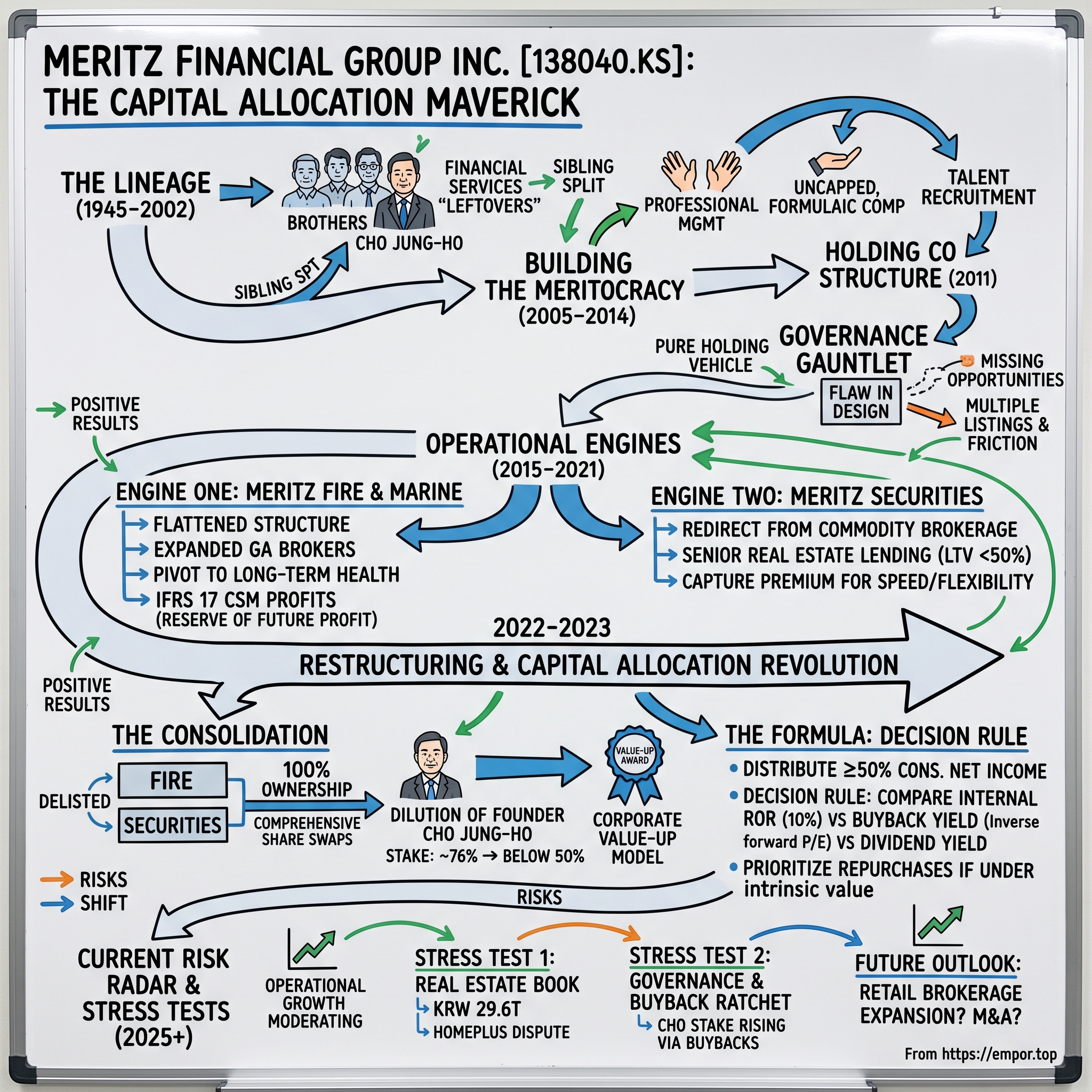
Meritz Financial Group: Korea's Capital Allocation Maverick
I. Introduction & Episode Roadmap
On a November afternoon in 2025, the chief executive of a South Korean financial holding company addressed an audience of analysts in Yeouido, delivering an announcement that would be standard practice in developed capital markets but remained unusual in South Korea. He confirmed that the group would maintain the corporate return policy it had established three years prior.
Kim Yong-beom, Vice Chairman and CEO of 메리츠금융지주 Meritz Financial Group Inc., announced that the company would extend its medium-term shareholder return policy for an additional three years, continuing to distribute 50% of consolidated net income to investors. He outlined the quantitative rationale: the group's buyback-and-cancellation yield — the inverse of its forward price-to-earnings ratio — stood at 13.3%, well above its internal hurdle rate of 10%. So long as the buyback yield exceeded that required rate of return, the company would prioritize repurchasing its own shares. He noted that Meritz had maintained its 10% hurdle rate unchanged since 2013, adding that any future adjustment would be disclosed publicly to shareholders in advance.1
This disciplined framework contrasts with the traditional capital management approach of Korean financial conglomerates, aligning more closely with the capital allocation strategies of corporate holding companies in North America.
Why This Company Matters
Meritz serves as an instructive natural experiment on the "Korea Discount" — the persistent valuation gap between the earnings of South Korean listed entities and market pricing. Benchmark KOSPI equities have historically traded near a price-to-book ratio of 1.0, trailing both developed and emerging market peers due to low corporate profitability, family-centric governance structures, and modest shareholder distributions.2 Standard corporate practices often compounded this discount: parent companies frequently listed separately, spun off their most profitable subsidiaries, and conducted duplicate public offerings, harvesting capital from retail investors while diluting the equity value of the parent company's shareholders.
Meritz reversed this model. In November 2022, the group announced plans to absorb its two listed operating subsidiaries — 메리츠화재 Meritz Fire & Marine Insurance and 메리츠증권 Meritz Securities — into the holding company through comprehensive share swaps, delist both subsidiaries, and allocate at least 50% of consolidated net income to shareholder returns going forward.3 Completing the transaction required issuing new holding company stock, which reduced the controlling shareholder's ownership stake from roughly 76% to below 50%.4
The Scale, and What It Is Made Of
Financial results initially reflected this restructuring. For 2025, Meritz reported record consolidated net income of KRW 2.3501 trillion on total assets of KRW 135.5 trillion, achieving a group return on equity of 22.7% and a shareholder payout ratio of 61.7% — well above its 50% baseline.5 In February 2025, the company's market capitalization surpassed that of 신한금융지주 Shinhan Financial Group, making it South Korea's second-largest financial holding company following a five-year period in which its share price rose more than 1,100%.[^6]
A sustained return on equity in the low twenties across market cycles distinguishes Meritz within the domestic sector, where Korean listed companies overall have averaged a return on equity of roughly 7%.2 Meritz achieved these returns without a banking license, retail deposit funding, or corporate backing from a major chaebol conglomerate. Rather than relying on preferential capital access, the group generated returns by underwriting non-life insurance policies priced higher than market consensus, expanding senior debt financing to real estate developers, and reducing its outstanding share count through repurchases.
However, return on equity can be elevated either through net income expansion or through equity base reduction. Evaluating Meritz requires assessing how much of its profitability stems from operational earnings versus balance sheet contraction.
By mid-2026, operational growth had moderated. Consolidated net income increased 0.7% in 2025. During the first four and a half months of 2026, the company's stock declined 4.7% despite a broad rally in the South Korean equity market, and it subsequently traded roughly 25% below its February 2026 peak.6 Meanwhile, Meritz Securities lost its top return-on-equity ranking among domestic brokerages to two competitors. In July 2026, the group's largest single credit exposure — a senior real estate loan exceeding KRW 1.1 trillion extended to the hypermarket chain Homeplus — shifted from a fully secured classification to the center of a bankruptcy court dispute.7
The Route
The narrative begins with the breakup of a major Korean shipping and aviation conglomerate and the founder's youngest son who inherited its financial services operations. It traces how he established an organizational model driven by performance-based compensation rather than corporate hierarchy.
The analysis examines the group's two core operating units: a non-life insurer that prioritized underwriting profitability over market share, and a brokerage that became South Korea's largest private senior lender to commercial real estate developers.
It then dissects the 2022–2023 corporate restructuring and its capital allocation formula before testing that model against current operational risks: real estate credit exposures, underwriting loss ratios, the governance dynamics of repurchasing shares in a founder-controlled firm, and the group's growth prospects within a mature domestic market.
 Subscribe on LinkedIn
II. Hanjin Lineage & The Youngest Son's "Leftovers" (1945–2005)
In November 1945, three months after the end of World War II, a mechanic named 조중훈 Cho Choong-hoon founded a trucking business in Incheon with a single vehicle. Over the next five decades, that enterprise expanded into 한진그룹 Hanjin Group—a sprawling conglomerate spanning Korean Air, Hanjin Shipping, and Hanjin Heavy Industries that formed the logistical backbone of South Korea's rapid industrialization. Hanjin operated as a traditional chaebol: capital-intensive, heavily debt-financed, physically massive, and tightly controlled by a founding family whose decisions carried more weight than formal board resolutions.
That growth model reflected the incentives of South Korea's postwar development era. Industrial groups expanded by channeling government-directed credit into heavy physical infrastructure—ships, aircraft, shipyards, and factories. Corporate success was measured primarily by asset scale and physical capacity, which conferred political standing and secured continued access to credit. Return on capital was a secondary priority. While this framework accelerated national economic development, it also left corporate balance sheets highly leveraged and vulnerable to macro shocks, as the 1997 Asian financial crisis ultimately demonstrated.
The Sibling Split
Following the patriarch's death in 2002, his four sons divided the conglomerate along lines that reflected the traditional hierarchy of South Korean industrial families. The eldest sons inherited the group's flagship assets: the national airline, the container shipping line, and the shipyards—businesses associated with substantial asset scale and national prestige. The youngest son, 조정호 Cho Jung-ho, received the financial affiliates—the segment of the holdings no other sibling sought.8
At the time, South Korea's financial sector was viewed with modest expectations. In 2002, a domestic non-life insurer operated essentially as a distribution network collecting premiums to invest in government bonds, growing roughly in line with national GDP. A mid-sized brokerage was seen as a cyclical commission business reliant on retail trading activity. Neither asset class commanded the prestige or strategic weight of a global shipping line or commercial airline fleet.
The starting scale of these financial assets was comparatively small. The insurance unit, Oriental Fire & Marine Insurance, possessed a history predating Hanjin itself. Founded on October 1, 1922, as Chosun Fire & Marine Insurance, it was the first insurance company to operate in Korea and the first to list its shares after the Korea Stock Exchange opened in the 1950s.9 By 2005, however, it held KRW 2.7 trillion in assets and carried a market capitalization of KRW 170 billion—ranking fifth in a non-life sector dominated by 삼성화재 Samsung Fire & Marine Insurance. The brokerage was smaller still, with KRW 631.5 billion in assets and a market value of KRW 150 billion.[^11]
The brokerage unit's corporate history underscored its peripheral role within the broader conglomerate. Originally incorporated in February 1973 as Hanil Securities, it was renamed Hanjin Investment & Securities in October 1990 and listed in January 1992. It was rebranded as Meritz Securities in March 2000 and formally separated from Hanjin Group the following month—five years before the insurance affiliate followed.10 The financial operations had long operated on the periphery of the group; the 2002 succession arrangement formalized their separation.
Rebranding as a Statement of Intent
Cho completed the separation in 2005, severing the remaining financial affiliates from Hanjin and unifying them under the Meritz name.[^11] The new brand name—derived from "merit"—was designed to signal an organizational shift toward professional management and performance-based advancement rather than family lineage.
In shedding its legacy identity, the insurance unit abandoned eight decades of brand recognition in its home market. In a sector where consumer trust and institutional longevity are primary selling points, abandoning an established name carried operational risks. The decision reflected management's calculation that the Hanjin brand association carried greater corporate liabilities than advantages, making an independent identity preferable.
The strategic landscape facing Meritz in 2005 imposed strict competitive constraints. Mid-tier non-bank financial institutions occupied a vulnerable market position. Major banking groups such as KB, Shinhan, and Hana dominated domestic finance with low-cost deposit funding, widespread branch networks, and captive corporate relationships. In non-life insurance, Samsung Fire held a commanding market position backed by South Korea's largest industrial conglomerate. Lacking the balance sheet scale for a price war, the distribution network for mass market reach, or a top-tier corporate brand, Meritz focused on operational agility, disciplined risk pricing, and performance-aligned compensation to recruit and retain key talent.
The Counterfactual
Subsequent developments highlighted a stark divergence between Hanjin's core industrial assets and its financial spin-off. Hanjin Shipping, once the world's seventh-largest container carrier, entered court receivership in 2016 and was liquidated. Hanjin Heavy Industries fell under creditor control following prolonged shipbuilding losses. Korean Air survived, but remained a capital-intensive business exposed to jet fuel price volatility, geopolitical shifts, and global travel disruptions. In contrast, the financial entities inherited by Cho Jung-ho achieved sustained returns on capital over the following two decades.
This divergence underscored a fundamental contrast in capital management. While traditional Korean conglomerates prioritized physical scale, employee headcount, and capacity expansion to maintain political standing and debt access, Meritz prioritized return on equity and capital efficiency—establishing an operational philosophy that guided the group's development over the next two decades.
III. Building the Meritocracy & Establishing the Holding Structure (2005–2014)
Yeouido, Seoul's financial island, is a small place. When a firm changes how it pays people, everyone knows within a week — and in the late 2000s, what everyone knew about Meritz was that it had started buying talent the way an American hedge fund buys talent: with a formula, in public, without a ceiling.
Cho Jung-ho's contribution to Korean corporate practice was not a product or a strategy. It was an abdication. A controlling shareholder in a Korean financial group is normally the operating center of gravity — approvals flow upward, decisions wait for the chairman's schedule. Cho did the opposite. He stepped back from day-to-day management, handed operating authority to professional executives, and tied their economics and their teams' economics to measured performance rather than tenure, cohort year, or proximity to the family.
The mechanism was blunt: explicit, formulaic revenue-share compensation. Top producers in underwriting, corporate finance, and sales were paid a defined slice of what they generated, with no artificial cap — which meant that in a good year, a desk head could out-earn the chief executive. In an industry where compensation had been governed by hiring year and hierarchy, this was closer to defection than innovation.
Competitors described Meritz as a mercenary shop. The characterization was accurate and, from Meritz's side, entirely the point: a firm that cannot win on cost of funding must win on the marginal quality of the people making credit and underwriting decisions, and the cheapest way to acquire those people is to offer them a better split than an incumbent's HR committee will approve.
The economics of that trade are worth spelling out, because they are counterintuitive to anyone who reads compensation as pure cost. If a securities firm pays a team 40% of what it generates instead of a fixed salary, its cost base becomes variable rather than fixed — the firm pays a great deal in good years and very little in bad ones. That structurally lowers the operating leverage of a cyclical business. It also solves an adverse selection problem: producers who believe in their own numbers self-select into a revenue-share arrangement, and those who do not, do not apply. The incumbent competing against this cannot simply match the offer for one team without triggering a repricing of its entire workforce. That asymmetry is why a small firm can raid a large one and the large one cannot retaliate symmetrically.
The residual risk in that design is equally clear and surfaces only years later. Revenue-share pay rewards origination in the year of origination, while credit and underwriting losses surface over the life of the exposure. Any firm running this model is implicitly betting that its risk controls are strong enough to stop a producer from writing a bad deal for a good bonus. Meritz's entire subsequent history — the senior-only lending discipline, the willingness to lose insurance market share rather than underprice — is best read as the answer to that structural problem rather than as a separate strategy.
The Two Hires
Two hires anchored the machine. In 2010, Choi Hee-moon — who goes by Alexander Hi-moon Choi — took over Meritz Securities and began pushing it out of commodity brokerage and into structured finance.11 In 2011, Kim Yong-beom joined as chief financial officer of the securities arm and was elevated to lead it.12
Kim's background matters because it explains the intellectual posture that later produced the capital allocation framework. Born on January 3, 1963 in Gyeonggi Province, he studied business administration at Seoul National University and began his career on a securities analysis desk at Daehan Life Insurance. He moved to CSFB Securities, where he built arbitrage strategies linking foreign exchange and bond derivatives, and became the firm's youngest director at 34. He then ran fund management at Samsung Fire & Marine and bond management at Samsung Investment Trust before Meritz recruited him.13 This is a derivatives-and-fixed-income career, not a sales or general-management career. People who come up that way tend to think in terms of expected value, hedge ratios, and the price of optionality — and they tend to be allergic to decisions justified by precedent. His profile describes a manager who dislikes authority and formality and prizes fast decisions; Meritz's later habit of publishing its own discount rate assumptions and inviting shareholders to hold it to them is that same instinct pointed at the capital account.
The Holding Company, and the Flaw Built Into It
The structural piece arrived in March 2011, when Meritz Financial Group Inc. was established as a holding company — classified under Korea's Financial Holding Companies Act as an insurance holding company, and operated as a pure holding vehicle with no business of its own beyond owning and directing its subsidiaries.14 The stated purpose was capital efficiency: pool the group's capital at the top and push it toward whichever subsidiary offered the best marginal return.
Here is the problem, and it is the seed of everything that follows in 2022. The holding company owned only part of each subsidiary, and both subsidiaries were separately listed. That meant every capital reallocation decision had to clear a governance gauntlet — minority shareholders at the subsidiary level with their own claims, board approvals at three companies, tax friction on dividends moving upward, and the ever-present accusation that the parent was favoring one set of shareholders over another. Kim would later put it plainly: with all three companies listed, investment took time, and Meritz had missed opportunities because of it.3
So the first decade produced two of the three ingredients. It produced a culture that could originate high-return assets faster than its competitors, and it produced a structure that could theoretically move capital to those assets. What it did not yet produce was the willingness to break the structure that was slowing the whole thing down.
IV. The Operational Engines: Long-Term Insurance & Senior Real Estate Debt (2015–2021)
In 2015, Meritz Fire & Marine reported net income of 169.0 billion South Korean won (KRW), up from KRW 114.8 billion in 2014. Despite the gain, it remained a fifth-tier player in a domestic non-life market where industry leaders generated profits in the trillions of won. Upon taking charge of the insurer, Kim Yong-beom initiated an operational restructuring that reshaped the group's primary earnings engine.15
Engine One: The Insurer That Quit Chasing Market Share
Kim flattened the traditional three-tier organizational structure—headquarters, regional offices, and local branches—by connecting headquarters directly to sales offices, eliminating an administrative layer and its associated overhead. Concurrently, the insurer expanded distribution through General Agencies—independent multi-carrier brokers capturing domestic market share—by offering competitive commission structures, with first-year incentives reaching up to 300% of annual premiums on long-term policies. Meritz also expanded its captive agent network from 9,569 agents in 2015 to over 30,000 by early 2021, becoming the first domestic property-casualty insurer to cross that threshold. By opening managerial roles to top-performing agents, the company bypassed the cohort-based seniority systems standard in traditional Korean corporate hierarchies.15
The company made an equally decisive pivot in its product mix. Meritz reduced its focus on auto insurance—a highly regulated, low-margin segment with volatile loss ratios—and directed capital toward long-term personal health and protection insurance. While auto insurance prioritizes volume over margin, long-term health policies offer higher profitability where disciplined underwriting compounds over time. Under IFRS 17, the accounting standard adopted by South Korean insurers in 2023, the value of this strategy became explicit: long-term protection policies create a Contractual Service Margin (CSM), representing unearned future profit recognized on the balance sheet at sale and released into net income over the policy lifecycle.
In practical terms, CSM functions as a reserve of future profit. When an insurer writes a profitable long-term policy, it defers immediate income recognition, logging the estimated lifetime margin as balance-sheet CSM. That balance is amortized into quarterly earnings over time while new policy sales replenish the inventory. If policy volume expands and actual claims align with actuarial assumptions, earnings follow a steady, predictable trajectory. Conversely, if claims exceed expectations or policy lapses rise, the CSM balance is written down, directly reducing future profits.
Financial performance tracked this operational shift. Net income rose from KRW 169.0 billion in 2015 to KRW 237.2 billion in 2016 and KRW 384.6 billion in 2017. By the first half of 2020, the combined ratio—claims and operating expenses expressed as a percentage of earned premiums, where figures below 100% indicate underwriting profit—improved by 6.2 percentage points year over year to 100.7%. Over the same period, return on equity reached 22.8%, leading the domestic non-life sector, while long-term insurance market share stabilized between 16% and 17%, second only to Samsung Fire & Marine.15
This trajectory reflected a structural reduction in acquisition costs alongside expanding distribution. Gaining market share by undercutting premium prices typically triggers elevated loss ratios in subsequent years. Meritz expanded its market share while simultaneously lowering expense ratios and raising return on equity, indicating that the independent broker channel was lower-cost than traditional branch networks without diluting underwriting standards. The ultimate test of this underwriting discipline—whether profitability reflected superior risk selection or favorable early-cycle claims—unfolded during the 2023–2025 underwriting cycle.
Industry commentary often attributed Meritz's growth primarily to offering higher broker payouts than competitors. While commission data confirms that Meritz offered top-tier compensation, high commissions alone can be duplicated quickly by rival firms, as several competitors attempted in subsequent years with mixed results on their loss ratios. Had payout scale been the sole differentiator, Meritz's return profile would have rapidly converged with broader industry averages.
Because independent agencies operate as economic intermediaries focused on maximizing broker revenue, aggressive payouts risk incentivizing high policy churn and elevated lapse rates. Sustaining profitability through this channel required balancing competitive broker commissions with policy structures that maintained customer retention over multi-year horizons. Controlling lapse behavior proved central to preventing distribution expansion from devolving into an unprofitable subsidy, a concern that eventually prompted South Korean financial regulators to cap upfront commission structures across the sector.
Meanwhile, the group was developing a second growth engine within its securities arm.
Engine Two: The Brokerage That Became a Senior Lender
Meritz Securities pursued an alternative strategy to generate high returns on capital. During the 2010s, domestic retail brokerages engaged in a commission price war to capture trading volume. Chief Executive Choi Hee-moon redirected Meritz Securities away from retail brokerage toward corporate credit, mezzanine financing, and real estate project financing, positioning the firm as a primary lender to commercial property developments during South Korea's real estate expansion.
The firm's core risk management decision centered on capital seniority. While competing institutions sought higher yields by taking subordinated debt or equity stakes, Meritz focused almost exclusively on senior debt, enforcing conservative loan-to-value (LTV) ratios and requiring construction-completion guarantees from solvent contractors or trust companies. Senior debt yields less upside during successful developments, but lower equity and mezzanine tranches absorb initial losses during distress, protecting senior debt holders' claims on collateral. Meritz sought to generate elevated returns on senior debt not by taking credit subordination risk, but by capturing a premium for underwriting speed, structural flexibility, and rapid deal execution compared to traditional commercial banks.
In South Korean real estate financing, development projects typically begin with high-risk bridge loans to fund land acquisition before site approval or construction begins. Once permits are granted, bridge debt is refinanced into longer-term project financing loans, usually backed by construction-completion guarantees. Meritz structured its portfolio to minimize exposure to unpermitted land acquisition by enforcing maximum LTV limits—often below 50% of appraised collateral value—and requiring completion guarantees. In 2026, management informed analysts that every real estate project finance exposure on its balance sheet maintained a mandatory completion guarantee from a qualified contractor or trust company, mitigating construction-cost inflation risks across its active project sites.16
This lending strategy was demonstrated during the domestic credit tightening of late 2022 and early 2023. Following a default on municipally guaranteed debt associated with the Legoland Korea theme park development, South Korea's short-term commercial paper and corporate bond markets experienced severe liquidity contraction. When Lotte Engineering & Construction faced refinancing hurdles on maturing project-finance debt, Meritz Financial Group structured a KRW 1.5 trillion joint liquidity facility in January 2023. Under the arrangement, Lotte affiliates provided KRW 600 billion in subordinated first-loss equity, while Meritz entities supplied senior funding to refinance maturing asset-backed commercial paper.17 The Governor of the Financial Supervisory Service publicly commended the arrangement for addressing developer liquidity while maintaining commercial terms.
The transaction reflected Meritz's core credit thesis: deploying balance-sheet liquidity at elevated yields into tight capital markets while securing senior position priority supported by substantial first-loss equity cushions provided by the borrower.
Driven by its credit origination business, Meritz Securities generated an operating profit of KRW 1.09 trillion in 2022, exceeding the operating earnings of Mirae Asset Securities, South Korea's largest brokerage by assets.[^11] However, deploying capital at scale into real estate project financing also concentrated the group's credit exposure to macro property downturns, creating asset quality questions that persisted over subsequent years.
V. The Landmark 2022–2023 Capital Allocation Revolution
By late 2022, Meritz Financial Group faced a structural contradiction: three separately listed corporate entities, substantial earnings, and market valuations that reflected neither.
The South Korean holding-company discount reflects specific structural frictions. When a parent company holds a majority stake—such as 60%—in a separately listed subsidiary, equity markets typically value the parent's holdings at a 50% to 70% discount to market price. Investors price in the assumptions that parent shareholders cannot easily access subsidiary capital, that trapped capital primarily serves subsidiary-level operations, and that controlling family incentives may diverge from public minority interests. Double taxation on inter-corporate dividends moving up to the parent company and the administrative friction of coordinating capital across three distinct shareholder registers further impair parent valuation.
On November 21, 2022, Meritz proposed consolidating its corporate structure by eliminating its listed operating subsidiaries.
The group announced a comprehensive share swap. Meritz Financial Group, which then held 59.5% of Meritz Fire & Marine Insurance and 53.4% of Meritz Securities, moved to acquire the remaining minority shares by issuing holding company stock. The exchange ratios were set at 1.2657378 holding company shares for each share of Meritz Fire, and 0.1607327 shares for each share of Meritz Securities. Both subsidiaries were subsequently delisted to consolidate ownership under a single parent entity.3 Meritz Fire completed its share swap and was delisted in February 2023; Meritz Securities followed, and the consolidated holding company relisted on April 25, 2023.18 To fund the exchanges, the parent company issued 46,672,948 new shares for the insurance swap and 36,629,088 new shares for the securities swap.14
To reinforce the structural consolidation, management established a formal capital return policy: the combined group committed to distributing at least 50% of consolidated net income to shareholders annually. This represented a substantial shift from prior distribution rates, which stood at 27.6% for the holding company, 39.7% for the non-life insurer, and 39.3% for the brokerage.3
The Dilution
The governance aspect of the restructuring centered on its impact on controlling shareholder Cho Jung-ho. Issuing new parent shares to acquire minority interests diluted the founding family's equity position, reducing Cho's stake in the holding company from 75.81% to 46.94%.4 At the time of the announcement, Vice Chairman Kim Yong-beom informed the market that Cho's ownership would drop to roughly 47%, projected that tax obligations could eventually reduce it below 20%, and stated that no family succession was planned.3
Cho framed the alignment on the group's corporate communications platform, stating that the value of a single share held by the controlling shareholder is equal to that of a share held by a public investor.19
From an analytical standpoint, the transaction represented an exchange of ownership percentage for absolute economic value. While Cho surrendered roughly 29 percentage points of his equity stake without direct precedent among major Korean industrial families, he exchanged majority control of a discounted corporate structure for a major position in a more highly valued combined entity. As the group's market capitalization expanded, Cho's registered stock holdings subsequently reached approximately KRW 12.2 trillion, placing him among South Korea's wealthiest equity holders.4 The restructuring aligned controlling shareholder incentives with public investor returns by expanding the total value of the enterprise.
The Formula
Beyond the structural consolidation, Meritz formalized a quantitative capital allocation framework. Rather than setting discretionary payout targets, management established a clear decision rule comparing three potential uses of capital: the after-tax return on internal reinvestment, the share buyback-and-cancellation yield—calculated as the inverse of the forward price-to-earnings ratio—and the dividend yield. Capital is directed toward whichever option yields the highest expected return. If the stock trades below management's estimate of intrinsic value, the group prioritizes share repurchases; if pricing approaches intrinsic value, it allocates returns toward cash dividends.
The policy relies on a fixed internal required rate of return, or cost of equity, set at 10% and maintained without adjustment since 2013. During the third-quarter 2025 earnings call, analysts questioned why management maintained a static 10% hurdle rate amid shifting interest rate environments. Kim Yong-beom clarified that the hurdle rate incorporates an inflation component to preserve purchasing power alongside a risk premium to protect against principal loss. He noted that the group distrusts standard consumer price index metrics due to underlying basket selection choices, and therefore maintains a deliberately elevated, unadjusted hurdle rate rather than modifying its baseline calculation across economic cycles.1
This static benchmark serves as an operational constraint, preventing management from lowering hurdle rates during market downturns to justify marginal investments.
What the Market Did
Equity markets responded with a substantial re-rating. By the third quarter of 2025, Meritz reported a cumulative total shareholder return of 174.5% following the policy's 2023 implementation, with its forward price-to-earnings ratio expanding from approximately 3x to 8x.1 The company's market capitalization reached KRW 9.5 trillion upon relisting in April 2023, ranking it as South Korea's fourth-largest financial holding company;[^11] by February 2025, its market capitalization rose to KRW 23.84 trillion, second in the domestic financial sector only to KB Financial Group.[^6]
Meritz was subsequently highlighted as a primary model for South Korea's Corporate Value-up Program. Launched by the Financial Services Commission in 2024 and modeled on the Tokyo Stock Exchange's 2023 governance reforms, the initiative encourages listed firms to disclose explicit plans for capital efficiency, supported by a dedicated Value-Up Index, exchange-traded funds, and legislative reforms.2 In May 2025, Meritz received the Financial Services Commission Chairman's award for value-up excellence.14
However, macro analyses, including assessments by the ASEAN+3 Macroeconomic Research Office (AMRO), emphasize that broader Korean equity market recovery remained narrow and heavily reliant on the technology sector, with most listed companies continuing to trade below book value with returns on equity trailing historical averages.2 While corporate governance reforms yielded initial valuation gains for Meritz, sustained shareholder returns ultimately depended on underlying operational earnings and credit execution as market participants priced in the company's capital allocation model.
VI. Financial Structure & Segment Deep Dive
Unlike many South Korean financial groups characterized by complex cross-shareholdings, partially owned affiliates, and multi-tiered listed subsidiaries designed to preserve controlling family authority, Meritz operates a streamlined corporate architecture following its 2023 restructuring. This structural simplicity limits capital leakage and creates clear transparency across operating units.
At the apex sits a pure listed holding company with no direct operational business, overseeing three wholly owned core subsidiaries and several specialized entities.
Directly under Meritz Financial Group are Meritz Fire & Marine Insurance, Meritz Securities, and Meritz Alternative Investment Management. Meritz Capital and the Indonesian insurer 메리츠코린도보험 Meritz Korindo Insurance operate as secondary subsidiaries. As of March 31, 2026, the group operated 276 offices, consisting of 245 Meritz Fire branches, 18 Meritz Capital branches, 10 Meritz Securities offices, and a single overseas location.14 This distribution profile underscores the group's operational footprint: a heavy retail insurance distribution system coupled with a capital-efficient corporate finance and investment banking arm, rather than a broad retail bank network.
The Insurance Engine
Meritz Fire generated consolidated net income of KRW 1.6929 trillion in 2025.14 That placed the unit second in the South Korean non-life insurance sector—behind Samsung Fire's KRW 2.018 trillion, but ahead of DB Insurance's KRW 1.535 trillion, KB Insurance's KRW 778.2 billion, and 현대해상 Hyundai Marine & Fire Insurance's KRW 561.1 billion.20 Hyundai Marine's sharp earnings decline from former trillion-won levels reflected broader underwriting headwinds across the domestic market in 2025, highlighting Meritz's relative underwriting resilience.
At the end of the first quarter of 2026, Meritz Fire's Contractual Service Margin (CSM) balance reached KRW 11.29 trillion, expanding by KRW 188.0 billion during the period. The quarter's movements included KRW 440.3 billion in new business CSM additions and KRW 88.8 billion in interest accretion, offset by a KRW 36.9 billion downward adjustment and KRW 304.1 billion released into net income through amortization.16 The new business CSM multiple—measuring expected margin generated per unit of new premium—stood at 12.6 times, reflecting sequential and year-over-year expansion.
Two aspects of this trajectory warrant analytical focus. First, new business additions surpassed amortization releases, indicating that unearned profit reserves expanded faster than they were recognized in current income—a requirement for long-term underwriting growth. Second, the CSM adjustment line was negative. Because CSM adjustments reflect changes in underlying actuarial assumptions, persistent negative revisions erode future profit reserves. While the KRW 36.9 billion adjustment remained minor relative to the KRW 11.29 trillion total balance, this metric serves as the primary indicator for potential underwriting performance deterioration in older policy vintages.
Under IFRS 17 accounting rules, CSM values depend heavily on insurer assumptions regarding lapse rates, loss ratios, and discount rates. As South Korean regulators have tightened actuarial guidelines, Meritz management stated during its first-quarter 2026 conference call that the company would absorb all pending regulatory revisions—including deferred loss-ratio changes for simplified insurance policies—in a single second-quarter adjustment. Management anticipated limited earnings impact, noting that its internal accounting models had already incorporated conservative parameters, such as setting new-coverage loss ratio assumptions above 90% and non-indemnity renewal assumptions at 100%, exceeding regulatory baseline guidelines.16
Capital adequacy remained strong. Meritz Fire recorded a preliminary Korean Insurance Capital Standard (K-ICS) ratio of 240.7% at the end of the first quarter of 2026, compared with the 100% regulatory minimum.16 On the same call, the group chief risk officer specified that management targets an operational solvency ratio of 180% to support new underwriting growth and maintain its shareholder distribution policy while preserving a buffer above an internal emergency threshold of 150%.16 This operating policy leaves approximately 60 percentage points of capital surplus above the group's working baseline.
On November 21, 2025, rating agency AM Best affirmed Meritz Fire's Financial Strength Rating of A (Excellent) and Long-Term Issuer Credit Rating of "a" (Excellent) with a stable outlook. The agency highlighted the insurer's robust balance sheet, peer-leading solvency levels, and a 2024 return on equity of 30.5%. However, AM Best noted that the company maintains a notable allocation to higher-yielding fixed-income assets, including real estate debt, and cautioned that any material credit weakness at the holding company level could exert downward pressure on the rating.21
The Securities Engine
Meritz Securities reported consolidated net income of KRW 766.3 billion in 2025, representing a 10% increase.14 Earnings accelerated in the first quarter of 2026, with consolidated net income reaching KRW 254.3 billion, up 35.7% year over year. Standalone net income rose 30.2% to KRW 300.4 billion—or KRW 233.1 billion when excluding subsidiary dividends from Meritz Capital, representing a 52.4% increase.16 Meritz Capital, which operates installment-credit and leasing businesses, generated net income of KRW 116.3 billion in 2025 and KRW 47.0 billion in the first quarter of 2026, a 66.0% quarterly gain driven by higher investment returns and credit provision reversals.1416
The business model of Meritz Securities differs significantly from traditional retail brokerages. Revenue is heavily weighted toward corporate finance and asset management, with retail brokerage and wealth management accounting for roughly 10% of operating revenue, compared with 48% from asset management and 23% from corporate finance.6 While this structural concentration supported high returns on capital over the prior decade, it created a relative drag during the 2025–2026 market expansion, when surging retail equity trading volumes disproportionately benefited competitor brokerages with large retail market shares.
Key risk metrics present contrasting signals. In the first quarter of 2026, the unit's consolidated net capital ratio stood at 1,638%, providing a substantial buffer above the 100% regulatory minimum. Concurrently, its substandard-and-below loan ratio was 4.2%, which marked an improvement from earlier periods but remained elevated compared to peer securities firms.16
This combination reflects a well-capitalized institution maintaining a private credit portfolio with an elevated proportion of non-performing assets. While the firm's capital reserves absorb credit impairments without threatening overall solvency, ongoing workouts of troubled exposures consume capital and administrative resources. The ultimate economic impact depends on loan recovery rates during restructuring processes, as highlighted by the contested credit exposure involving the Homeplus retail chain.
The Holding Company
At the holding company level, balance sheet metrics reflect steady expansion. Consolidated assets reached KRW 144.4 trillion at the end of the first quarter of 2026, representing a 6.6% increase from the prior year-end, while total equity stood at KRW 11.8 trillion despite ongoing share retirements. The double leverage ratio—measuring parent investments in subsidiaries relative to parent equity—remained modest at 112.1%.16 For the quarter, book value per share rose 18.0% year over year to KRW 64,348, while earnings per share grew 17.1% to KRW 3,926.
The divergence between per-share earnings growth of 17.1% and overall consolidated net income growth of 9.6% demonstrates the mechanical impact of the group's share repurchase program. By systematically reducing the total share count, equity repurchases accelerate per-share financial metrics faster than underlying net income expansion, amplifying per-share returns while placing greater long-term reliance on core operational execution.
VII. Competitive Analysis: Hamilton Helmer's 7 Powers & Porter's 5 Forces
A competitive analysis reveals that Meritz possesses fewer defensible moats than its elevated returns might suggest—though the advantages it does hold remain difficult for rivals to duplicate due to structural constraints rather than technical barriers.
The Powers That Are Real
Counter-positioning is the primary power, and it is a power over rivals' incentives, not their capabilities. Meritz's competitors could replicate its capital allocation policy immediately. They choose not to because doing so would require controlling families to accept dilution, forgo spinning off and separately listing growth subsidiaries, and subordinate total asset expansion to per-share value. Korean financial conglomerates have historically been evaluated by total assets, a metric that rewards empire-building. Meritz optimizes for earnings and book value per share. A competitor adopting Meritz's policy would have to explain to its board why it was voluntarily shrinking its share count and relinquishing the option to monetize subsidiaries. That dynamic represents classic counter-positioning: incumbents recognize the superior strategy but rationally decline to adopt it.
The limitation of counter-positioning is that its value diminishes as broader market reforms take hold. South Korea's Corporate Value-up Program was designed to encourage listed companies to adopt the capital efficiency practices Meritz embraced voluntarily. Chief Executive Kim Yong-beom acknowledged this reality during the third-quarter 2025 conference call when asked why the stock had underperformed: as governance reforms reduced the overall "Korea discount," companies previously trading at severe valuation discounts experienced larger relative rebounds than Meritz, which already traded at a narrower discount due to its transparent distribution policy.1 In effect, Meritz's primary edge was acting early on structural reforms that are now becoming industry standard.
Process power in underwriting and origination is the more durable asset. Meritz has developed two institutional capabilities that are difficult to acquire quickly: structured discipline in real estate credit—characterized by rigorous collateral valuation, strict LTV enforcement, mandatory completion guarantees, and rapid execution—and underwriting discipline in long-term health insurance. Neither capability can be summarized in an employee handbook; both rely on experienced deal teams supported by a compensation framework that rewards underwriters for declining unprofitable risk.
The evidence for this process power appears in loss ratio divergence across market cycles. On the third-quarter 2025 earnings call, Meritz Fire management argued that industry-wide underwriting losses reflected aggressive price-cutting and unprofitable policy sales from late 2022 through early 2025, concentrated in the general agency channel, and projected that those policy vintages would depress peer profitability for years. In contrast, Meritz Fire reported a cumulative third-quarter long-term gross risk loss ratio of 93.0%—up 4.7 percentage points year over year—while keeping its expected-versus-actual variance positive.1 By the first quarter of 2026, the company reported that its long-term protection sales through general agencies rose 30% year over year despite a contracting broader market, as competitors who had sold underpriced coverage were forced to raise rates or restrict underwriting.16
Management's thesis is that Meritz rejected unprofitable volume for three years, absorbed the temporary market share penalty, and is now writing higher-margin business while competitors manage legacy policy losses. This narrative has remained consistent across earnings calls and offers a clear testable hypothesis: whether Meritz's underwriting margin advantage over peers persists through 2026 and 2027 as policy vintages from 2023 and 2024 mature.
Scale economies at the capital level are genuine but modest. Consolidated parent ownership allows the group to reallocate capital dynamically between insurance float, brokerage trading operations, and share repurchases based on real-time marginal returns, eliminating minority shareholder friction and dividend tax leakage. First-quarter 2026 execution demonstrated this integration: group affiliates jointly funded a KOSDAQ venture capital fund ahead of an expected initial public offering wave, while Meritz Securities co-invested with insurance and capital units in venture and strategic-technology transactions.16 This structure provides a tangible operational advantage over financial groups with separately listed subsidiaries, though it does not constitute an unassailable moat around core operating units.
Notably absent from Meritz's competitive profile are network effects, brand dominance, and customer switching costs. Policyholders switch insurers based on premium pricing, while real estate developers borrow from institutions offering the fastest execution. The group's retail brokerage initiatives aim to build switching costs through its new MOUM platform, designed to drive user retention via an artificial-intelligence-mediated global investment network rather than traditional trading software.16 Whether an information-based platform can create meaningful customer lock-in remains unproven.
Porter's Five Forces
Rivalry is high and intensifying. In non-life insurance, Samsung Fire maintains superior scale and brand equity, while DB Insurance led the industry in new contractual service margin additions for 2025. In the securities sector, first-quarter 2026 results highlighted shifting competitive dynamics: Meritz's group return on equity of 25.4% expanded by 0.8 percentage points, whereas Korea Investment reached 29.4% and Mirae Asset hit 29.1%, ending Meritz's multi-year run as the sector's return leader. Korea Investment's net income jumped 99.6% and its brokerage unit rose 75.1%, compared with Meritz's group profit growth of 9.6%.6 Meritz mitigates rivalry by bypassing commodity market segments, but that refusal also limits its participation during retail market expansions.
Supplier and distribution power is high, and rising. General agencies function as primary intermediaries in domestic insurance distribution, and Meritz secures distribution access through top-quartile commission payouts and efficient policy issuance. Regulatory authorities responded by introducing a 1,200% cap on first-year general agency commissions taking effect in 2026, with a multi-year commission payout model scheduled for 2027. Meritz management projected that these rules would temporarily contract the market by limiting price and acquisition expense competition, and warned of potential short-term expense increases in 2026 ahead of the transition.1 In response, Meritz is expanding internal distribution channels—including tele-underwriting, telemarketing, and its captive partner network—a logical but gradual transition.
Buyer power is moderate. Commercial real estate borrowers pay premium interest rates for underwriting speed and structural flexibility. However, management noted that real estate project finance recovery remains sluggish due to regional market divergence, slowing project origination, and liquidity pressures among smaller developers, prompting the group to redirect capital toward corporate finance where capital demand remains robust.1 In traditional investment banking—including debt capital markets, equity underwriting, and acquisition finance—Meritz operates as a price taker. Addressing analyst concerns that expanding into traditional investment banking could compress returns, the chief executive of Meritz Securities stated that lower per-deal margins in competitive markets can be offset by higher deal velocity and by syndicating client capital alongside firm capital to minimize equity committed per transaction.1
That explanation warrants critical evaluation. Sustaining returns by employing client capital to reduce firm equity per transaction relies on balance sheet leverage and deal structuring rather than pricing power. This strategy represents a fundamental shift from relying primarily on senior creditor priority across real estate loans.
Threat of new entrants is low. Statutory licensing rules, K-ICS capital requirements, and regulatory oversight by the 금융감독원 Financial Supervisory Service present significant barriers to entry. Product substitution poses a more immediate risk, as domestic savers shift capital from traditional insurance products into direct equity investments and transition from domestic brokerages to international trading platforms.
The composite competitive picture reveals an institution with one fading strategic advantage, one core underwriting capability undergoing active market testing, and intensifying competition across both primary operating segments.
VIII. Skeptical Investor Stress Test & Current Risk Radar
On July 13, 2026, all 67 Homeplus retail stores in South Korea suspended operations.22
For the country's second-largest hypermarket chain—owned since a 2015 leveraged buyout by MBK Partners, which acquired it from Tesco in a KRW 7.2 trillion transaction financed with KRW 4 trillion in acquisition debt—the closure marked the end of a 16-month court-supervised rehabilitation that began in March 2025. The Seoul Bankruptcy Court terminated proceedings after concluding there was no viable plan to raise the KRW 200 billion in emergency operating funds deemed necessary for survival. More than 13,000 employees faced job losses, while roughly 100,000 suppliers, vendors, and tenant merchants faced immediate financial exposure.22
Standing at the center of the restructuring crisis was Meritz—the company's largest creditor, holding senior claims backed by Homeplus real estate.
This was not a theoretical stress test, but an active market default.
Stress Test 1: The Real Estate Book
Consider the scale of the group's real estate lending. At the end of the first quarter of 2026, total real estate exposure stood at KRW 29.6 trillion, comprising KRW 25.7 trillion in domestic loans and KRW 3.9 trillion overseas. Senior debt accounted for 91% of the portfolio, with an average loan-to-value ratio of approximately 47%. Net quarterly provisions and reserves were negative KRW 11.6 billion, as write-backs exceeded new provisions, while impairments on beneficiary certificates fell to KRW 5.8 billion, down KRW 9.6 billion year over year.16 Three months earlier, total exposure reached KRW 28.3 trillion, with a 90% senior share, an average loan-to-value ratio near 47%, KRW 29.4 billion in net provisions, and KRW 22.9 billion in impairments.1
Measured against group equity of KRW 11.8 trillion, total real estate exposure equaled roughly 2.5 times the firm's equity capital base. While the senior positioning and sub-50% loan-to-value ratios align with management's stated risk guidelines, a portfolio-wide average of 47% obscures single-borrower concentration.
Homeplus represents the group's primary credit concentration. Meritz originally extended roughly KRW 1.3 trillion in senior debt against Homeplus retail properties, an exposure that stood at KRW 1.1652 trillion by the end of the third quarter of 2025 after the sale of a store location repaid KRW 51.5 billion in principal and permitted a KRW 10.5 billion provision reversal.1 On an earnings call that quarter, management took an unequivocal stance, assuring investors that the loans were fully secured by high-quality commercial real estate collateral, that complete principal and interest recovery was expected regardless of asset sale outcomes, and that further financial impact would remain minimal.1
By mid-2026, the financial arithmetic had grown far more complex. Meritz had recovered approximately KRW 260 billion of its principal, while internal valuations for the roughly 60 store properties were marked down from about KRW 4 trillion at origination to roughly KRW 1.5 trillion—reflecting the secular decline in offline retail and the erosion of going-concern value during legal proceedings.7 Meritz held the underlying properties as trust assets isolated from the main bankruptcy estate, securing priority rights to liquidation proceeds over public-interest claims such as unpaid wages, taxes, and vendor liabilities, which together grew from KRW 332.8 billion in March 2025 to nearly KRW 1.1 trillion by May 2026.7
A high-stakes standoff ensued over emergency financing. To keep the court restructuring active, the court required KRW 200 billion in debtor-in-possession financing. Meritz initially offered KRW 100 billion while demanding personal guarantees from MBK Partners and its chairman, Michael ByungJu Kim—a condition MBK publicly labeled extraordinary before eventually accepting.22 On July 16, 2026, the boards of Meritz Fire, Meritz Securities, and Meritz Capital approved the complete KRW 200 billion financing facility, backed by MBK's joint guarantee. This enabled Homeplus to submit its court appeal on July 20, extending its legal restructuring window toward a statutory September 4 deadline.[^25]
For investors, the key takeaways from the Homeplus dispute extend beyond immediate credit losses. The senior trust structure may protect principal, given that the revised KRW 1.5 trillion collateral valuation still covers outstanding claims. Instead, the episode highlights three broader structural considerations. First, commercial real estate appraisals in illiquid markets can decline by more than 60% from origination, demonstrating that a 47% average portfolio loan-to-value ratio offers protection only as long as collateral valuations remain stable. Second, full principal recovery is an assertion about ultimate realization, not duration; carrying a KRW 1.1 trillion non-performing asset that requires fresh capital injections depresses return on equity long before triggering loan write-downs. Third, using senior creditor status to demand personal guarantees during a high-profile corporate bankruptcy demonstrates aggressive credit enforcement, but it also risks regulatory and reputational friction when thousands of jobs and vendor livelihoods are involved.
Meritz maintains a clear disclosure record regarding this exposure, offering granular updates on loan balances, provisions, and collateral valuations across consecutive earnings calls, including direct responses to retail investor queries.1 The critical metric for shareholders is whether management maintains its firm posture on full principal recovery or begins hedging its guidance as court deadlines approach.
Stress Test 2: Governance and the Buyback Ratchet
A critical, yet often overlooked, dynamic involves the mechanics of the group's ownership structure. Following the corporate share swaps in 2023, controlling shareholder Cho Jung-ho's equity stake stood at 46.94%. By the end of 2025, Cho and ten related parties held 98,353,032 shares, representing 56.13% of the 175,221,773 outstanding shares.14 Filings from late 2025 confirmed that Cho and his daughter, Cho Hyo-jae, controlled over 56% of the company's equity.
Cho did not purchase additional shares to expand his ownership stake. Instead, routine share buybacks and cancellations mathematically increase the proportional ownership of all remaining shareholders. Because Cho was already the largest equity holder, his relative ownership stake expanded most in absolute terms—funded entirely through corporate cash flow.
This mechanical ownership increase intersected with the group's 2025 capital distribution strategy. Meritz omitted its annual cash dividend for 2025, ending a 14-year streak of cash payouts, and funneled its entire KRW 1.45 trillion capital return budget into share repurchases and cancellations. Management justified the decision using its established allocation formula, arguing that with the stock trading below intrinsic value, buybacks offered a higher financial return than cash dividends.23 Total distributions reached a record 61.7% of net income, bringing the three-year average payout ratio from 2023 through 2025 to 55.5%, comfortably exceeding its 50% baseline commitment.24
While the capital allocation model is logically coherent and rigorously applied, governance analysts raise three structural concerns. First, allocating 100% of capital returns to share buybacks automatically increases the controlling family's ownership concentration while providing zero liquid income to minority shareholders who may prefer cash distributions. Second, share repurchases are substantially more tax-efficient for a long-term controlling shareholder than cash dividends, meaning the theoretical capital allocation model aligns neatly with the founder's personal tax position. Third, continued share cancellations of KRW 1 trillion to KRW 1.5 trillion annually against a KRW 20 trillion market capitalization steadily concentrate ownership with the controlling group. Management has not disclosed an upper ceiling or policy threshold for controlling ownership.
Meritz defends its approach through policy transparency, citing public disclosure of its decision rules, hurdle rates, and allocation criteria. CEO Kim Yong-beom reaffirmed that the 50% distribution baseline will remain intact even as return spreads fluctuate, noting a single exception: a transformative acquisition capable of enhancing long-term shareholder value, which would require public disclosure prior to any payout reduction. He clarified that no acquisitions were under consideration.1 Investors will monitor whether this acquisition clause eventually serves as an operational exception to the distribution model.
Governance risks also surround leadership succession. Cho has stated publicly that he will not pass management control to his children.4 However, a 56% controlling stake without an explicit succession plan presents long-term tax and governance questions, particularly under South Korea's heavy estate tax regime, which Kim noted could eventually reduce the family stake below 20%. Operational leadership has been institutionalized: following the 2023 management restructuring, Kim Yong-beom transitioned to the holding company and Choi Hee-moon shifted to asset management, while Kim Joong-hyun assumed leadership of Meritz Fire and Jang Won-jae took charge of Meritz Securities.11 While executive management demonstrates strong technical depth during market briefings, the firm's overarching capital allocation model remains tied to its controlling shareholder's personal philosophy.
The Current Risk Radar
Operational earnings growth has stalled. Consolidated net income rose just 0.7% in 2025, reaching KRW 2.3501 trillion compared to KRW 2.3334 trillion in 2024.25 Full-year return on equity came in at 22.7%, trailing the 25.9% annualized rate recorded through the third quarter and indicating lower fourth-quarter profitability.51 While per-share earnings expanded at double-digit rates, that growth was driven almost entirely by share count reduction. With net income flat and payout ratios exceeding 60%, per-share growth relies increasingly on balance sheet contraction rather than operational expansion.
Underwriting margins face combined cyclical and regulatory headwinds. In the first quarter of 2026, Meritz Fire's underwriting profit fell 7.0% to KRW 334.6 billion, driven by rising claims for respiratory illnesses and specialized cancer therapies. Actual claims exceeded actuarial assumptions, producing a negative variance of KRW 8.8 billion, though management described the deficit as transient quarterly noise and maintained its forecast for positive full-year variance.16 Non-underwriting performance helped cushion the decline: investment profit rose 13.0% to KRW 296.2 billion on portfolio equity gains.16 Investment gains have compensated for weakening underwriting income for two consecutive quarters. While management expects loss ratios to normalize as older policy vintages expire, broader market conditions suggest underwriting margins across the property-casualty sector remain constrained.
Secondary business lines face persistent margin pressure. The auto insurance division continues to generate underwriting losses due to elevated claim frequency and repair costs, while commercial property lines suffered losses from industrial fires and a major wildfire in North Gyeongsang Province.116 Although management intentionally minimized auto and commercial lines within its product portfolio, these legacy segments remain a drag on aggregate underwriting results.
Macroeconomic and interest rate risks are tightly hedged, supported by detailed risk reporting. During the first-quarter 2026 earnings call, the group chief risk officer outlined specific risk-mitigation measures in response to Middle East geopolitical tensions: overseas asset over-hedges were closed, sovereign bond put options were acquired to buffer against interest rate spikes, and no construction projects in the real estate portfolio experienced inflation-driven work stoppages. Real estate project loans remained fully backed by completion guarantees from solvent contractors or trust entities. Regarding maritime shipping exposure near the Strait of Hormuz, the insurer held 16 active hull and cargo policies in the region with zero incurred losses, full reinsurance coverage, and maximum per-event net retention capped below $2 million.16 This detailed reporting underscores an active, institutionalized risk management function.
Formulaic compensation structures create dual incentives. Uncapped performance bonuses drive deal origination and underwriting quality, but if risk controls weaken, the same incentive model can encourage excessive deal volume. In its 2025 annual report, Meritz highlighted internal control management as one of its top three institutional priorities, conducting a comprehensive audit across all operating units while warning against administrative complacency.14 Elevating internal risk controls to a primary strategic focus indicates management's recognition of the operational risks inherent in high-incentive compensation models.
Expansion into retail brokerage carries execution risks. A zero-commission marketing campaign launched in late 2024 helped Meritz Securities capture a leading market share in foreign equity trading, expanding domestic trading volumes 14-fold between 2024 and 2025.16 However, the fee-free promotion for U.S. equities ended for new clients in early 2026, while domestic fee discounts remain in effect. Furthermore, the firm's new MOUM wealth management platform enters a saturated digital market, testing whether an institution operating just ten physical branches can build a lasting retail franchise. Equity analysts have expressed doubt regarding the short-term earnings contribution of this retail expansion.6
IX. Playbook: Business & Capital Allocation Lessons
Every corporate entity that outperforms its sector for a decade attracts a playbook, though most such narratives are constructed backward from favorable outcomes. A rigorous analysis separates what Meritz intentionally executed from what merely coincided with favorable market conditions, while identifying the boundaries where each strategic lesson ceases to apply.
Stripped of market-specific details, Meritz's trajectory yields several transferable principles for corporate capital allocation and institutional design.
1. Collapsing double listings converts a valuation discount into a re-rating, once. The 2022–2023 corporate restructuring demonstrated that eliminating parent-subsidiary shareholder conflicts can re-rate an equity valuation from roughly 3 times forward earnings to approximately 8 times.1 This shift delivered a substantial one-time valuation gain, achievable by any holding company willing to accept controlling-stake dilution. However, such structural discounts close only once. Subsequent valuation performance depends entirely on underlying operational execution, which presents the primary challenge for Meritz in 2026. Investors buying into a corporate governance re-rating after the structural discount has closed are left holding a standard financial institution dependent on operational earnings growth.
2. Buybacks are arithmetic, not sentiment — and the decision rule must be published to be credible. Meritz's primary contribution to capital allocation practice is less the share repurchases themselves than the public disclosure of its decision rule: a fixed 10% required rate of return, evaluated against the inverse of the forward price-to-earnings ratio, paired with a commitment to announce any formulaic adjustments to shareholders in advance.1 This framework establishes binding operational discipline; a management team that publicly commits to repurchasing shares when the buyback yield exceeds 10% cannot easily justify repurchases at a 6% yield.
Fixing the hurdle rate rather than adjusting it alongside market interest rates reflects a deliberate choice to accept predictable model variance. A cost of equity that fluctuates with bond yields would direct a company to curtail buybacks during high-rate environments and accelerate them during rate-cutting cycles—rendering capital allocation pro-cyclical at the precise moment management discretion is most vulnerable to market sentiment. A static hurdle rate provides a rigid benchmark that sacrifices dynamic flexibility for institutional commitment. However, a pure repurchase strategy quietly concentrates ownership among non-selling equity holders, requiring corporate boards to evaluate whether such concentration aligns with long-term governance objectives.
3. Uncapped, formulaic compensation attracts talent that corporate hierarchy cannot retain. The Meritz experiment illustrates a specific dynamic within tenure-based corporate cultures: when incumbent institutions compensate employees based on seniority, a challenger offering formulaic, output-linked pay can acquire top-tier producers at a relative cost advantage because incumbent HR frameworks prevent symmetrical counteroffers. This mechanism produced measurable operational outcomes, including a captive agent network that expanded more than threefold, top-producing sales agents ascending to managerial roles, and industry-leading average compensation levels.15
The prerequisite for adopting this model is constructing robust risk controls prior to deployment. Output-linked compensation on multi-year risk books rewards immediate origination while underwriting losses emerge over longer horizons. Meritz counters this exposure through strict underwriting parameters and by penalizing volume-driven risk selection. Underwriting oversight represents the single point of failure in this structure, explaining why internal control management was elevated to a top corporate priority rather than delegated solely to risk personnel.
4. Seniority is a yield strategy, not a safety strategy. Meritz's primary innovation in corporate credit was recognizing that in a market where institutions reach for yield by moving down the capital structure, equivalent returns can be generated by remaining at the top of the capital stack and pricing execution speed. This required enforcing high coupons, first-lien positions, sub-50% loan-to-value ratios, mandatory completion guarantees, and substantial first-loss equity buffers. The Homeplus default illustrates both aspects of this framework: the senior trust structure protected Meritz's claims ahead of KRW 1.1 trillion in public-interest liabilities, even as the underlying collateral valuation was marked down from KRW 4 trillion to KRW 1.5 trillion.7 Senior creditor priority protects principal during debt restructurings, but it does not prevent multi-year workouts from depressing return on equity.
5. Legal isolation provides stronger protection than financial covenants during defaults. The critical technical feature of the Homeplus credit facility was not the initial loan-to-value ratio, but the legal isolation of the underlying collateral as trust assets separated from the debtor's bankruptcy estate.7 Financial covenants are frequently renegotiated during court restructurings, whereas priority claims established outside the bankruptcy estate remain enforceable. For lenders operating across complex insolvency regimes, the primary diligence focus is determining where a claim sits once a court assumes control of the borrower's assets.
6. Transparent executive communication lowers the cost of capital. Meritz structures its earnings briefings so that the holding company chief executive opens the call, subsidiary executives directly address operational questions, and an explicit session addresses pre-submitted queries from individual shareholders. During the third-quarter 2025 call, an investor asked whether Meritz would issue equity at elevated valuations, referencing strategies outlined in The Outsiders; management provided a detailed response explaining why the theoretical principle is sound but difficult to execute in South Korea, where equity dilution announcements trigger severe market discounts that require extreme overvaluation before a rights offering creates per-share value.1 Publicly evaluating capital allocation decisions on their financial merits reduces information asymmetry and lowers the cost of equity in a market where corporate disclosure is frequently treated as a regulatory formality.
7. Publishing capital return targets creates an escalating performance benchmark. Meritz established a 50% baseline shareholder distribution policy and subsequently delivered payout ratios of 51.2% in 2023, 53.2% in 2024, and 61.7% in 2025.124 While consistently exceeding distribution commitments builds market credibility, it also raises baseline investor expectations. Reverting to the mandatory 50% threshold during an operational downturn would be interpreted by equity markets as a dividend cut—highlighting the structural commitment required to maintain an explicit capital allocation frameworks companies face when managing explicit capital distribution commitments.
X. Epilogue & The Investment Case: Bull vs. Bear
As of late July 2026, Meritz Financial Group carries a market capitalisation in the neighbourhood of KRW 20 trillion, having traded between roughly KRW 98,000 and KRW 149,800 over the preceding year.26 The stock is well off its February peak. The company that spent three years as the most celebrated governance story in Korea is now, by the market's revealed preference, an ordinary large financial.
The Bull Case
The compounding loop is still intact and still unusual. A group ROE in the low-to-mid twenties, sustained across a decade, paired with a formal commitment to return more than half of profits and a demonstrated willingness to exceed it, mathematically produces per-share growth well above earnings growth. Book value per share grew 18.0% in the first quarter of 2026 against 9.6% net income growth — that gap is the machine working.16
The insurance franchise has real evidence behind its quality claim. Second place in Korean non-life profitability in a year when the third and fourth players fell sharply, an 11-trillion-plus CSM balance providing multi-year earnings visibility, a new business multiple improving rather than deteriorating, a K-ICS ratio 60 points above the company's own management target, and GA long-term protection new business growing 30% while the market contracts.2016 If management's read is right — that the industry is digesting bad 2023–24 vintages that Meritz declined to write — then Meritz's relative position improves over the next two years without it doing anything new.
The securities arm is diversifying away from the exposure that scares people. Corporate finance profit rose 45% year over year in the third quarter of 2025; the group is deliberately shifting allocation from real estate PF toward corporate lending, domestic and US equities, alternatives, and venture capital, and the equity book is producing results — Meritz Fire's equity-type assets grew roughly KRW 330 billion in the first quarter of 2026 and generated about KRW 91 billion of gains.116
And the capital allocation framework has survived a genuine test. When the share price tripled, the honest thing to do would have been to reduce buybacks. Management's answer, when challenged directly, was that expected EPS grew faster than the price, so the relative attractiveness of repurchase versus internal investment had not materially changed.1 Whether or not one accepts the conclusion, the reasoning was shown rather than asserted.
The Bear Case
Growth has stopped. Consolidated net income rose 0.7% in 2025.25 The entire per-share story now depends on share count reduction, and share count reduction has a natural limit: the founder's stake. Buybacks that push family ownership from 56% toward 60%+ eventually collide with float, index eligibility, and governance optics.
The ROE crown is gone. Losing the return leadership to Korea Investment and Mirae Asset in a single quarter, while those rivals grew earnings 75–100% against Meritz's 9.6%, is not a rounding error.6 It reflects a structural choice: Meritz built a corporate-finance-and-principal-investment firm during a decade when that was the right thing to build, and the current cycle rewards retail brokerage franchises Meritz does not have. Building one now, from ten branches and a free-commission promotion, is expensive and unproven.
Real estate remains 2.5x group equity. The Homeplus revaluation demonstrated that Korean commercial collateral can lose more than half its appraised value, which means the portfolio-average LTV of 47% offers less protection in a genuine property downturn than the headline implies — a broad 50%+ decline in Korean commercial values would begin testing senior positions directly, not just the junior tranches beneath them.167 The Homeplus outcome, which will become clearer as the appeal and the September statutory deadline play out, is the single most informative near-term data point on whether Meritz's underwriting claims survive contact with a genuine liquidation.
Insurance has cyclical pressure in both directions at once: the GA commission cap arriving in 2026 and the multi-year payout system in 2027 will compress the distribution economics Meritz built its share on, while loss ratios across the industry deteriorate from the 2023–24 vintages and Meritz's own long-term risk loss ratio has risen 4.7 points.1 Management expects the market to shrink. A shrinking market with regulated commissions is a worse business than the one Meritz mastered.
And the growth ceiling is arithmetic. A group earning KRW 2.35 trillion a year in a domestic market where PF origination is weak, developers are illiquid, and insurance is contracting has to find something to do with its capital. Management said on the 3Q25 call that it is exploring overseas insurance opportunities — still early-stage assessment of market characteristics, product lines, entry options, and profitability, with no commitment.1 It also left an M&A escape hatch in the shareholder return policy. Neither is a plan yet. The risk for shareholders is not that Meritz does nothing; it is that a company with 22% ROE and no obvious high-return domestic deployment eventually does something expensive to avoid doing nothing.
The Three KPIs That Actually Matter
Everything above compresses into three things worth tracking each quarter. Meritz publishes all three, which is itself a mark of the disclosure culture.
1. The buyback-and-cancellation yield versus the 10% required return, alongside shares outstanding. This is the master variable. It was 13.3% at the third quarter of 2025 and 14.6% at the first quarter of 2026.116 When the gap narrows toward zero, the capital allocation logic mechanically shifts toward cash dividends or internal investment, and the per-share compounding rate falls. Watching share count decline against the founder's rising percentage tells you how much runway the current policy has left.
2. Meritz Fire's long-term risk loss ratio and expected-versus-actual variance. This is the truth serum on the entire underwriting-discipline thesis. Management's central claim — that it declined bad business for three years and will now show a structurally better loss ratio than peers as their vintages sour — is either visible here or it is not. The variance figure turning negative in the first quarter of 2026 is the first real crack; whether the full-year number stays positive, as management guided, is the test.16
3. Group real estate credit cost: net provisions plus beneficiary certificate impairments, read against exposure and senior share. Not the exposure number alone, which is a stock, but the flow of credit cost through the income statement. This ran to net write-backs in the first quarter of 2026 — an excellent print — after positive provisioning through 2025.116 Homeplus will move this line one way or the other, and it is where the difference between "senior and safe" and "senior and stuck" will show up first.
References
-
Meritz Financial Group 3Q25 Earnings Call Transcript — Meritz Financial Group, 2025-11-14 ↩↩↩↩↩↩↩↩↩↩↩↩↩↩↩↩↩↩↩↩↩↩↩↩↩
-
Narrowing the Korea Discount: Stock Market Reform via Corporate Value-up — ASEAN+3 Macroeconomic Research Office (AMRO) ↩↩↩↩
-
Meritz Securities and Fire Delisting… "Holding Company Returns 50% of Net Profit to Shareholders" — The Asia Business Daily, 2022-11-21 ↩↩↩↩↩
-
How Meritz Chair Cho Jung-ho became Korea's No. 2 stock rich — The Korea Herald ↩↩↩↩
-
불장에 소외된 메리츠금융…실적 제자리에 주주환원도 '이젠 평범' — Investchosun, 2026-05-18 ↩↩↩↩↩
-
Homeplus Nears Bankruptcy: Meritz Debt Recovery Analysis — Seoul Economic Daily, 2026-07-14 ↩↩↩↩↩↩
-
Meritz carries out reshuffle for group synergy — The Korea Herald ↩↩
-
Yong-Beom Kim: Positions, Relations and Network — MarketScreener ↩
-
2025년 (주)메리츠금융지주 현황 (Meritz Financial Group 2025 Annual Report) — Meritz Financial Group, 2026-03-31 ↩↩↩↩↩↩↩↩↩
-
김용범 메리츠화재 부회장 취임 6년…만년 손보사 5위에서 1위 넘본다 — Aju Business Daily, 2021-08-18 ↩↩↩↩
-
메리츠금융지주 2026년 1분기 경영실적 Earnings Call Transcript — Meritz Financial Group, 2026-05-15 ↩↩↩↩↩↩↩↩↩↩↩↩↩↩↩↩↩↩↩↩↩↩↩↩↩
-
Lotte desperate to secure cash to dispel concerns over liquidity crisis — The Korea Times, 2023-04-09 ↩
-
Meritz Financial's insurance subsidiary takeover Asia's largest in H2 2022 — S&P Global Market Intelligence, 2023-03-06 ↩
-
Meritz Financial Group — Corporate Identity and Shareholder Principle ↩
-
삼성화재, 2년 연속 '2조 클럽' 달성…2025년 연간 보험사 리그테이블 — 한국금융신문, 2026-03-13 ↩↩
-
AM Best Affirms Credit Ratings of Meritz Fire & Marine Insurance Co., Ltd. — AM Best, 2025-11-21 ↩
-
How $133 mil. funding dispute between MBK, Meritz pushed Homeplus toward collapse — The Korea Times, 2026-07-13 ↩↩↩
-
메리츠금융, 3년 연속 당기순이익 '2조 클럽' 달성…주주 가치 제고 지속 — 한국금융신문, 2026-02-11 ↩↩
-
Meritz Financial Group (KRX:138040) Stock Price & Overview — StockAnalysis.com ↩
 LinkedIn
 WhatsApp
 Reddit
 Hacker News
 Email
Email Kindle
 RSS Feed
 Spotify
 Apple Podcasts
 Amazon Music
 Audible
 YouTube