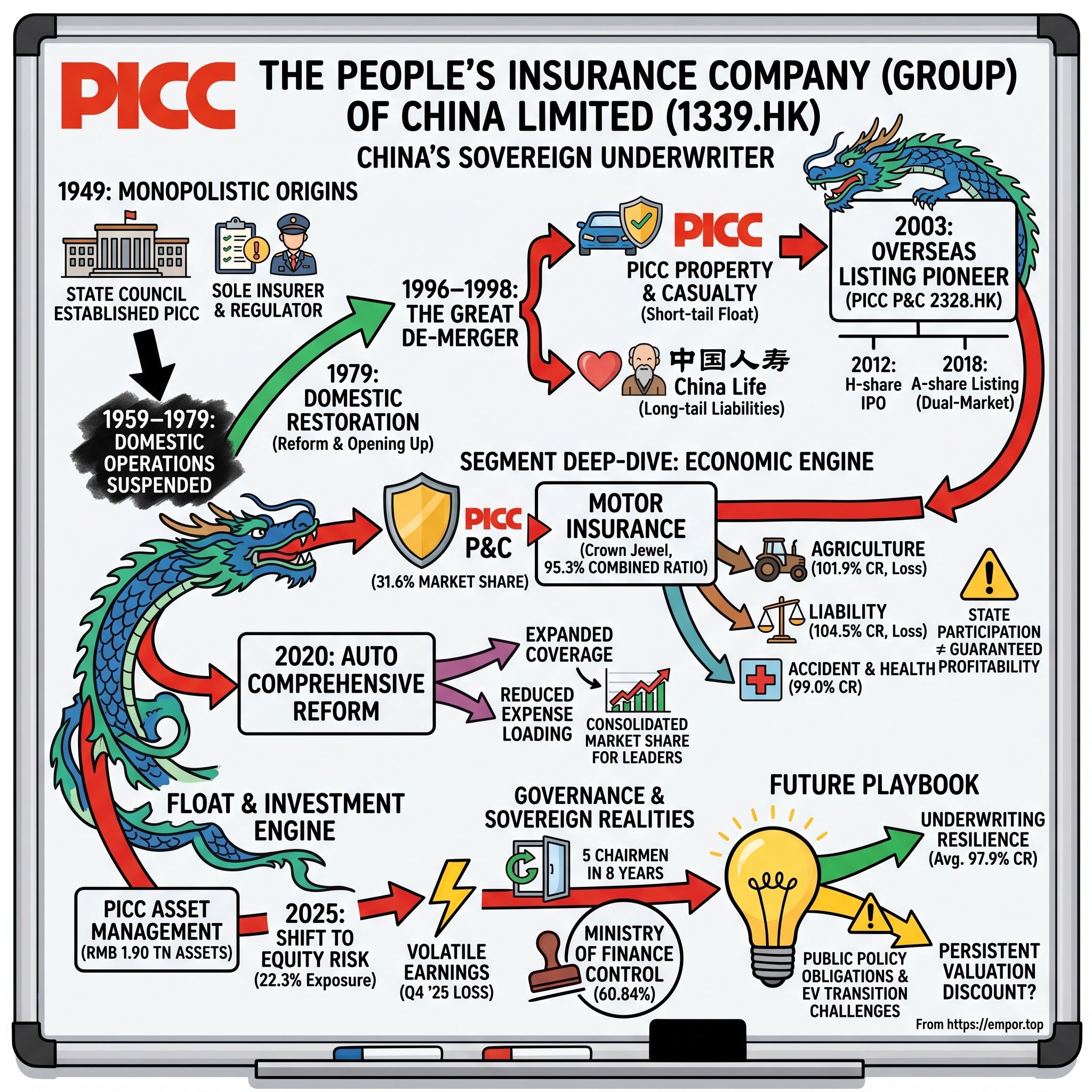
The People's Insurance Company (Group) of China Limited (1339.HK): China's Sovereign Underwriter
I. Introduction & Episode Roadmap
On the last trading day of 2025, accountants inside the Beijing headquarters of 中国人民保险集团 The People's Insurance Company (Group) of China closed the books on a record year. Premiums reached RMB 738.3 billion, total assets exceeded RMB 2 trillion for the first time, net profit attributable to shareholders rose 8.8% to RMB 46.6 billion, and return on equity stood at 16.1%.1
Examined in isolation, however, the fourth quarter presented a sharp contrast. Between October and December 2025, PICC Group posted a net loss attributable to shareholders of RMB 176 million, compared to a net profit of RMB 20.3 billion in the third quarter alone.1 Operational performance remained intact, but Chinese equity markets declined, pulling down the value of the company's expanded stock portfolio. Under current accounting standards, those mark-to-market fluctuations flow directly into the income statement.
That quarterly loss within a record year highlights the dual nature of the business. PICC operates effectively as two entities under a single holding company. The first is a dominant property and casualty underwriter in China, which generated RMB 12.4 billion in underwriting profit in 2025 prior to investment returns.1 The second is a RMB 1.9 trillion investment portfolio exposed to equity market volatility, tied to life and health insurance subsidiaries that hold a combined 4.2% share of China's personal insurance market.1
The group is dual-listed, trading as 1339.HK in Hong Kong and 601319.SH in Shanghai. Its main operating asset, property and casualty subsidiary 中国人保财险 PICC Property and Casualty, trades separately under ticker 2328.HK. PICC Group holds 68.98% of the property and casualty unit, 80.00% of 中国人保寿险 PICC Life, 95.45% of 中国人保健康 PICC Health, and 100% of 中国人保资产 PICC Asset Management.1 This corporate structure raises a persistent valuation question: if the primary property and casualty business is separately listed, what is the rationale for holding the parent entity?
The broader paradox lies in the group's valuation relative to its market position. Founded in October 1949 as a state entity, PICC was established as a government institution rather than a commercial competitor.1 Decades later, the company commands 31.6% of China's property and casualty insurance market, exceeding the combined market share of its second- and third-largest competitors across most product lines.1 Equity markets, however, have not assigned a premium to that market share. H-shares traded near HK$5.46 prior to August 2026, approximately 28% below their 52-week high and below the group's first-quarter 2026 book value per share of RMB 7.2.2 The Ministry of Finance holds 60.84% of the equity, while the National Council for Social Security Fund holds 12.68%.1 With low public float and majority state ownership, the stock has traded at a persistent structural discount.
The scale of the operation underscores its systemic role in China's financial system. Total operating income grew 7.6% to RMB 669.0 billion in 2025, placing PICC among the world's largest insurance groups by revenue and positioning it at 141st on the 2025 Fortune Global 500 list, up 17 places from the previous year.1 During 2025, the company paid out RMB 472.9 billion across more than 200 million claims.3 These figures reflect an institution operating as core financial infrastructure.
Four central themes define this business analysis.
First is the institutional evolution: how an organization that originally served as both China's sole insurer and its industry regulator transitioned into a listed financial holding company, leaving behind legacy structural traits. Second is the economic asymmetry between short-tail property and casualty float and long-tail life float in a falling interest rate environment. Third is an evaluation of PICC's underwriting moat, specifically testing whether regulatory motor reform or state-subsidized agricultural insurance (农业保险) provides a durable competitive advantage when examined through financial disclosures. Fourth is corporate governance: the implications of state control by the Ministry of Finance, a tenure record of five chairmen over eight years, and an executive pipeline where the most recently departed chairman assumed leadership of the primary insurance regulator.1315
This analysis evaluates PICC by separating three distinct elements often conflated in state-owned enterprise assessments: the quality of the underlying insurance operations, the efficiency of capital allocation, and the strength of corporate governance. At PICC, these three areas yield divergent conclusions, making a combined assessment essential for investors.
Understanding these dynamics requires examining the company's origins following the establishment of the People's Republic of China.
 Subscribe on LinkedIn
II. Monopolistic Origins & The Great De-Merger (1949–1996)
Nineteen days after Mao Zedong declared the founding of the People's Republic from the Tiananmen rostrum, on October 20, 1949, the State Council established 中国人民保险公司 the People's Insurance Company of China.7 It was not a startup. It was a department. Housed under 中国人民银行 the People's Bank of China, PICC was simultaneously the national insurance regulator, the national reinsurer, and the only company legally permitted to write a policy anywhere in the country. If an enterprise or individual insured a factory, a ship, or a crop in China between 1949 and 1959, they insured it with PICC, because there was no alternative and the concept of an alternative did not exist.
Then the state decided it did not need insurance at all.
The logic was internally consistent, if catastrophic in retrospect. In a fully planned economy, every enterprise is owned by the state. If a state-owned factory burns down, the state absorbs the loss and rebuilds it from the central budget. Charging one state pocket a premium to pay another state pocket a claim is, in that framework, an accounting ritual with extra steps. So in 1959, domestic insurance operations in China were suspended altogether.7 PICC survived only as a shell handling foreign trade coverage — marine cargo, export credit, the thin membrane where the planned economy touched the outside world. For twenty years, one of the world's most populous countries operated with essentially no domestic risk-transfer market.
This is not merely a colorful historical detail. It explains something structural about Chinese insurance today: the industry has no pre-war institutional memory to draw on, no century-old mutuals, no families who have bought from the same broker for four generations. Every actuarial table, every claims process, and every distribution relationship in modern China was rebuilt from scratch after 1979 — and PICC led that rebuilding.
That year, as Deng Xiaoping's 改革开放 reform and opening-up took hold, the State Council issued the notice restoring domestic insurance business.7 PICC reopened branch offices in provinces where nobody under forty had ever seen an insurance policy. Life insurance restarted in 1982. Through the 1980s, the company was again a monopoly by default, producing something more valuable than near-term profit: a physical distribution network that reached into administrative units the size of a rural township, alongside a loss database covering floods, typhoons, truck collisions, and grain harvests across every province. That data asset compounds silently and remains difficult to replicate — a key factor when evaluating competitive advantage.
The rebuilding decade also established the political identity of the company. When Chinese policymakers wanted crop coverage extended to a province, a strategic export credit facility established, or a disaster relief mechanism organized, the instrument they selected was PICC. That was not a contract won in commercial competition; it was an administrative assignment. Decades later, the same institutional reflex operates, serving as the origin of both the company's mandated franchises and its mandated obligations — two sides of a single coin that recur throughout this analysis.
The monopoly ended by regulatory mandate, not market force. 中国平安 Ping An Insurance was founded in Shenzhen in 1988 and 中国太保 CPIC in Shanghai in 1991. By the mid-1990s, regulators concluded that a single institution acting as insurer, reinsurer, and supervisor was untenable. On July 23, 1996, PICC was restructured into 中国人民保险(集团)公司 the China People's Insurance (Group) Company, with three specialist subsidiaries covering property, life, and reinsurance.7 Two years later, on October 7, 1998, the State Council went further and dissolved the group entirely: the three subsidiaries were separated as independent companies — the property arm keeping the PICC name, the life arm becoming 中国人寿 China Life Insurance, the reinsurance arm becoming 中国再保险 China Re.7
The timing was deliberate. China was negotiating its entry into the World Trade Organization, and a financial system in which a single state institution wrote both the regulatory rules and the commercial policies was unacceptable to trading partners seeking market access. Separating supervision from underwriting, and underwriting from reinsurance, was an essential condition for joining the global economy. What appears in hindsight as a portfolio restructuring was, at the time, a geopolitical prerequisite.
It is tempting to view this unbundling as an exceptionally fortunate event in the company's history. The split assigned PICC the short-tail business — motor, property, cargo, and liability — where policies are written, claims are paid within months, and float turns over rapidly. It assigned China Life the long-duration savings portfolio, where policies sold during the high-interest-rate environment of the 1990s carried guaranteed returns that became a multi-decade liability as Chinese bond yields fell. When the negative-spread problem burdened the Chinese life insurance sector in the 2000s, PICC operated on the other side of that financial firewall.
Calling this outcome strategic foresight, however, would be overstated. The 1996–1998 separation was driven by regulatory principles rather than portfolio strategy, and PICC's subsequent decision to re-enter the life and health insurance markets demonstrates that management never viewed the divested lines as an unmitigated relief.
What the split did provide was a decade of undisturbed focus for the property business in a market on the verge of unprecedented motorization. China's civilian vehicle fleet expanded dramatically over the following quarter-century, with every vehicle requiring compulsory liability coverage by law. PICC entered that expansion backed by an extensive branch network, established claims infrastructure, and strong brand recognition, free from the burden of a legacy life insurance liability book.
By 2003, the company possessed an operating profile attractive to international capital — and Beijing prepared to offer a stake to external investors.
III. The Overseas Listing Pioneer & Dual-Market Restructuring (2003–2018)
In November 2003, a Chinese state-owned financial institution rang the bell in Hong Kong for the first time. PICC Property and Casualty listed under ticker 2328, becoming the first mainland financial firm to list overseas — an event whose significance lay less in the capital raised than in the precedent established.7 Every disclosure standard, auditor sign-off, and quarterly briefing with skeptical investors in Central represented uncharted territory. China Life and Ping An followed within months, but the template for how Chinese financial institutions would engage global capital markets was established on PICC's paperwork.
Standing among the cornerstone investors was AIG, which acquired a strategic stake during the offering. That relationship warrants attention because its outcome diverged from standard strategic partnership narratives. AIG gradually accumulated a position reaching roughly 26.4% of PICC P&C, making the American firm the largest shareholder in China's dominant non-life underwriter.9 Under pressure from activist investor Carl Icahn to simplify its corporate structure, AIG began unwinding the holding. The company sold approximately US$500 million in shares in March 2015, followed in December 2015 by an offering of 355 to 365 million shares priced at HK$16.08 to HK$16.38 — a discount of 4.3% to 6.1% below the last traded price — with an upsize option pushing the transaction near US$1 billion.9
The divestment carries a distinct irony. AIG exited an insurer whose market dominance and underwriting metrics it understood thoroughly, driven by an American activist campaign rather than operational developments in China. Investors tracking the stock will note that PICC P&C traded near HK$16.40 in mid-2026 — roughly where AIG sold a decade earlier in nominal terms.18 While cumulative dividends provided a positive total return over that period, the share price trajectory underscores that market leadership does not automatically translate into persistent capital appreciation.
Re-bundling the empire
Having been divided by regulatory directive in 1998, PICC spent the subsequent decade reassembling its operating footprint. The 2003 corporate restructuring established a holding company above the property and casualty unit while creating China's first licensed insurance asset management company.7 Personal lines expanded as life insurance resumed operations through PICC Life, followed by health coverage through PICC Health. Management's commercial rationale rested on cross-selling: leveraging county-level branch networks so that a customer purchasing motor insurance could be offered critical illness coverage.
This corporate reconstruction culminated on the Hong Kong Stock Exchange in December 2012, when PICC Group conducted its initial public offering. The group raised HK$24 billion — approximately US$3.1 billion — marking Hong Kong's largest IPO that year.8 The offering priced near the lower bound of its marketed range, with demand driven primarily by domestic state-owned enterprises and retail investors, while international institutional participation remained cautious.8 A decade after PICC P&C's listing served as a landmark international event, the parent company's offering attracted a predominantly domestic capital base with foreign institutions acting as passive observers. That distribution pattern — Chinese capital anchoring state issuances while global investors maintain conservative exposure — has persisted as a structural factor influencing H-share valuations.
The group completed its dual-market listing in November 2018 by issuing A-shares in Shanghai under ticker 601319.1 The structure provided two distinct listing venues and investor bases with differing risk tolerances, alongside a majority shareholder in the Ministry of Finance whose strategic objectives extended beyond purely commercial returns.
Beyond corporate restructurings, a fundamental shift in reporting standards redefined how investors evaluate PICC's financial statements. Under accounting standards adopted ahead of recent reporting periods, insurers transitioned from recognizing total written premiums as top-line revenue to reporting insurance service revenue — representing the portion of premiums earned as coverage is delivered over time. For PICC in 2025, insurance service revenue reached RMB 570.7 billion against total collected premiums of RMB 738.3 billion.1 Simultaneously, fair-value accounting rules required mark-to-market fluctuations in equity holdings to flow directly through the income statement rather than being deferred on the balance sheet. Consequently, reported top-line figures no longer equal cash inflows, and quarterly earnings fluctuate with equity market movements — providing the necessary accounting context for the net loss recorded in the fourth quarter of 2025.
Two reforms that reshaped the industry
The regulatory framework governing Chinese property and casualty insurance underwent a structural transformation on September 19, 2020, when the auto insurance comprehensive reform took effect.10 Although frequently described as a mandatory rate reduction, the policy altered competitive dynamics across three dimensions.
First, the reform expanded compulsory traffic liability coverage limits, raising total coverage from RMB 122,000 to RMB 200,000 per vehicle while increasing death and disability coverage from RMB 110,000 to RMB 180,000. Second, it transitioned commercial motor insurance from an administrative approval model to a product filing regime, expanding pricing latitude for underwriters. Third, it reduced the maximum permitted expense loading on commercial motor policies from 35% to 25%.10 Regulators explicitly framed the objective around delivering lower premiums, broader coverage, and improved service quality.
In practice, the lower expense cap constrained the industry's distribution budget. Smaller insurers lacking recognized brands or extensive branch networks had historically relied on higher commission payments to brokers and auto dealerships to capture volume. Restricting expense loadings eliminated that commercial strategy. Policyholders benefited directly: by year-end 2021, the average premium per vehicle fell roughly 21% to RMB 2,761, with 87% of drivers receiving lower rates.10 Underwriting margins shifted toward market leaders capable of absorbing a 10 percentage-point expense reduction through lower operational cost structures — a structural advantage held primarily by PICC due to its scale.
Regulators extended this policy approach to non-motor lines in October 2025, when the National Financial Regulatory Administration issued enforcement rules governing expense compliance, effective November 1, 2025.19 The directive required reported expense filings to strictly match actual distribution outlays, banned disguised commission payments channeled through advertising or technical service fees, and instructed property insurers to de-emphasize volume growth and market share in internal performance evaluations.19 Industry commentary characterized the measure as an effort to curb destructive price competition across commercial lines.
While agricultural insurance is often highlighted alongside motor underwriting as a core franchise, its financial performance and state subsidy structure present distinct complexities analyzed in Section IV. What both regulatory interventions demonstrate is a consistent structural mechanism: policy adjustments in Chinese insurance frequently consolidate market share among scale leaders by removing high-cost fringe competitors. That dynamic provides an operational advantage to the dominant underwriter, though one defined and recalibrated by state regulatory priorities.
IV. Segment Deep-Dive: Proportionality & Economic Engine
Picture a claims adjuster in a county seat in Henan on a July afternoon. Hail has flattened a wheat field, a delivery van has gone into a ditch, and a warehouse roof has partially collapsed. Three claims, three lines of business, one adjuster, one motorbike. Whoever can put that adjuster in that county at acceptable cost owns the economics of Chinese property insurance. That, stripped of jargon, is what PICC's moat actually is — and what the segment numbers reveal is that the moat is far more concentrated in one line than the corporate narrative suggests.
The crown jewel, and where its profits actually come from
PICC P&C wrote RMB 555.8 billion of gross premiums in 2025, up 3.3%, holding 31.6% of the Chinese property and casualty market.1 For scale, the whole sector took in roughly RMB 1.76 trillion that year, and Ping An's property arm — the clear number two — wrote about RMB 343.2 billion.20 PICC's share is not merely the largest; it is larger than any single competitor by more than half again.
The headline result was excellent. Insurance service revenue rose 5.4% to RMB 511.6 billion, the combined ratio improved 0.9 percentage points to 97.6%, underwriting profit rose 75.6% to RMB 12.4 billion, and net profit rose 21.4% to RMB 40.3 billion.1 For the uninitiated, the combined ratio is the single number that matters in property insurance: claims plus expenses divided by premiums earned. Below 100% means you make money before investing a cent of the customer's cash. PICC's three-year average sits at 97.9%, which is the more honest figure to anchor on, because single years are noisy.1
But dig one level down and something important appears. Of that RMB 12.4 billion of underwriting profit, motor insurance alone contributed RMB 14.3 billion at a combined ratio of 95.3%.1 In other words, motor earned more than the entire company, and the rest of the book was a net drag. Accident and health scraped a RMB 615 million profit at 99.0%. Agriculture — the line most often described as PICC's protected franchise — ran at 101.9% and lost RMB 1.05 billion. Liability insurance was worse: 104.5%, a RMB 1.75 billion underwriting loss. Commercial property lost money too, at 101.0%.1
This is the most important analytical fact in the entire story, and it flatly contradicts the consensus framing. The 2025 result was not a diversified conglomerate of protected policy lines throwing off cash. It was a motor insurance company subsidising a portfolio of policy-adjacent lines that, priced as they currently are, do not cover their own claims. State-mandated participation is not the same thing as state-guaranteed profitability, and agriculture in 2025 is the proof. Extreme weather drove catastrophe claims above what the subsidised premium structure could absorb, and PICC — as the designated national provider — had no ability to simply decline the exposure.
Motor, electric vehicles, and the loss model problem
Motor premiums crossed RMB 300 billion for the first time in 2025, reaching RMB 305.7 billion, up 2.8%, with private cars rising to 74.7% of the book.6 That mix shift matters: private cars have lower loss ratios than commercial fleets, so a rising private-car share flatters the combined ratio independently of underwriting skill.
The live question is electrification. PICC wrote RMB 67.1 billion of new-energy vehicle premiums in 2025, up 31.9%, insuring 15.56 million electric vehicles, up 34.3%.6 Industry-wide, Chinese insurers covered 43.58 million NEVs and collected roughly RMB 190 billion in NEV premiums — meaning PICC's share of the electric book, at roughly 35%, actually exceeds its overall market share.12 The industry as a whole lost about RMB 5.6 billion underwriting NEVs in 2025, with average premium per vehicle falling around RMB 180 to RMB 4,360.12
Why do electric cars break insurance models? Three mechanisms, and they compound. Claim frequency is higher — instant torque, quieter cabins, and a driver population skewed toward ride-hailing usage all raise accident rates. Repair costs are higher, because battery packs are structurally integrated, specialist repair networks are thin, and a modest impact can total a vehicle that would have been panel-beaten if it ran on petrol. And bodily injury claims are rising. At the 2025 results conference in late March 2026, PICC P&C's Party Secretary Zhang Daomin laid out exactly these three problems, while arguing that claim frequency was trending down as driver habits matured and mandatory automatic emergency braking systems spread, and projecting improved NEV margins in 2026.4
That is a testable claim rather than a fact, and it is the right kind of guidance to hold management to. If NEV penetration keeps rising faster than pricing adjusts, motor's 95.3% combined ratio compresses — and since motor is carrying the entire underwriting result, there is very little cushion elsewhere.
Where the rest of the book earns its keep
If motor is the profit engine and policy lines are the drag, what is everything else doing? Two things, and both are strategic rather than financial.
The first is float and franchise. Agriculture generated RMB 54.6 billion of insurance service revenue in 2025 and liability another RMB 38.5 billion — nearly RMB 93 billion of premium volume that, even at a small underwriting loss, delivers investable cash and, more importantly, delivers relationships with every county government in China.1 Those relationships are what makes the motor and commercial book accessible in places where a competitor has no office. Judged as a standalone product line, agriculture is unprofitable. Judged as customer acquisition for a national franchise, the accounting looks different — though this is precisely the kind of argument companies make when a segment loses money, and it should be treated as a hypothesis rather than a conclusion.
The second is the shift toward personal non-motor lines. Non-motor rose to 45.0% of PICC P&C's book in 2025, up 0.3 percentage points, with commercial non-motor growing notably faster than motor and personal non-motor growing quickly.1 Accident and health, at RMB 61.8 billion of revenue and a 99.0% combined ratio, is the largest of these — a business that barely breaks even on underwriting but generates recurring, renewable customer contact.1 The strategic logic is sound; the financial evidence that it creates value is still thin.
The life and health problem, and an unexpectedly good year
PICC Life and PICC Health together hold just 4.2% of China's personal insurance market — a rounding error next to China Life or Ping An.1 The strategic rationale for owning them has always been cross-sell; the financial reality for a decade was dilution of a superior property franchise.
2025 was, on the reported numbers, a genuinely strong year for both. PICC Life grew premiums 18.8% to RMB 126.0 billion, with first-year regular premiums up 32.4% and new business value — the actuarial present value of profit on newly written policies, and the truest measure of a life insurer's productivity — up 64.5% on a comparable basis to RMB 8.2 billion.1 The surrender rate fell from 3.6% to 1.7%, which is a meaningful signal that the book is stickier and less bancassurance-churned than it was.1 PICC Health grew premiums 15.5% to RMB 56.3 billion, lifted new business value 22.5% to RMB 7.4 billion, and grew net profit 42.8% to RMB 8.2 billion, helped by long-term care insurance premiums rising 75.4% and an internet health book of RMB 20.4 billion.1
Two cautions belong alongside that. First, new business value is an assumption-driven number; the annual report discloses that on 2024 economic assumptions the figures would have been slightly different, which is a reminder that this metric moves with discount rates as well as with sales.1 Second, and more substantively, PICC Life's product mix moved in a direction that raises questions. Ordinary, fixed-rate life insurance premiums surged 66.1% to RMB 92.9 billion while participating products — where policyholders share investment risk with the insurer — collapsed 51.0% to RMB 16.2 billion.1 Selling more guaranteed-rate liabilities into a falling-yield environment is precisely the trade that hollowed out Chinese life insurers in the 1990s. Management has narrowed the duration mismatch — the modified duration gap shortened by 1.93 years at PICC Life and 0.74 years at PICC Health during 2025 — but the asset-liability question does not go away.1
PICC Health deserves a closer look than its size suggests, because it is the one part of the group doing something genuinely differentiated. Its book is now led by medical insurance at RMB 30.4 billion and long-term care at RMB 10.0 billion, the latter growing 75.4% in a single year.1 Long-term care matters strategically: China's demographics guarantee decades of demand, and the state has been piloting policy-backed long-term care schemes that require a licensed insurer as administrator. The company also built the largest internet health insurance book among Chinese life-sector insurers, and set up a dedicated health management subsidiary that served more than 9.52 million customer instances in 2025 with service revenue of RMB 509 million.1
The 惠民保 Huiminbao supplemental medical schemes — city-level, government-endorsed, low-premium plans that top up basic state medical insurance — sit adjacent to this. They are high-volume, thin-margin, and politically valuable; they put an insurer's brand in front of an entire municipal population at a price point of tens of yuan per year. PICC participates widely. The honest assessment is that Huiminbao is a distribution and relationship asset rather than a profit centre, and no insurer has yet demonstrated that it converts reliably into higher-margin private health sales.
The investment engine, and the risk it now carries
PICC Asset Management oversaw RMB 1.90 trillion of investment assets at end-2025, within group managed assets of RMB 4.58 trillion, including RMB 1.14 trillion of third-party money.1 The portfolio produced total investment income of RMB 92.3 billion, up 12.4%, for a total investment yield of 5.7%.1
Here the outline's framing needs correcting: the group did not shift away from equities toward bonds in 2025. It did close to the opposite. Directly held stocks rose from RMB 60.2 billion to RMB 166.2 billion, taking listed equity from 3.7% to 8.7% of the portfolio, while total fair-value equity exposure went from 18.2% to 22.3% and fixed income fell from 67.9% to 64.5% of assets.1 Government bonds did rise as a share of the book, to 27.9%, so duration was extended — but the headline story of 2025 was a large, deliberate increase in equity risk.
The consequences are visible in the earnings quality. Equity investments generated RMB 42.0 billion of income in 2025 versus RMB 36.6 billion from the entire fixed-income book.1 And net investment yield — the recurring interest and dividend component, stripped of mark-to-market gains — fell to 3.6% from a restated 4.0%.1 The company earned more in total while earning less predictably. That is the mechanism behind the fourth-quarter loss, and it recurred in the first quarter of 2026, when group profit attributable to shareholders fell 31.4% to RMB 8.8 billion despite the property business posting a 94.2% combined ratio and RMB 7.2 billion of underwriting profit. Total investment income for that quarter was just RMB 8.9 billion, an unannualised yield of 0.5%.2
Underwriting is the stable business. Investing is now the swing factor. Which means the questions of how much capital sits where, and who decides, move to the centre of the story.
V. Industry Structure, Porter's 5 Forces & Hamilton Helmer's 7 Powers
Run a war game. A well-funded challenger with a modern technology stack and no legacy branch network is granted a Chinese property and casualty licence. Where does it attack?
It cannot attack on price in motor insurance, because expense loadings are capped and the incumbent's cost base is lower.10 It cannot attack in agriculture, because premium subsidies are administered province by province and the primary counterparty is a local government that already works with PICC. It cannot attack in catastrophe-exposed commercial property, because it lacks the historical loss database to price the risk and the capital to absorb it. The challenger is left with urban private motor policies in tier-one cities and niche digital lines — precisely where every Chinese insurtech over the past decade has concentrated, and precisely why the top three underwriters still generate the majority of industry profits.
Reading PICC through Hamilton Helmer's 7 Powers
Scale economies represent the company's primary power, demonstrated in the expense ratio rather than the loss ratio. In 2025, PICC P&C's expense ratio fell 2.2 percentage points to 23.6%, while its loss ratio rose 1.3 percentage points to 74.0%.1 The year's underwriting improvement stemmed entirely from spreading fixed operational costs and enforcing commission discipline rather than lower claims payouts. Fixed IT, actuarial, and claims infrastructure amortised across a distribution network covering virtually every county in China creates a measurable cost advantage. Management quantified group-wide cost reductions at RMB 16.1 billion for the year.1
Process power provides a second advantage. Seventy-seven years of localized loss data — tracking flood patterns by township, crop failure rates across drought cycles, and collision frequencies by vehicle type — cannot be replicated by a new entrant relying on capital alone. PICC's historical footprint translates directly into balance-sheet value: anti-fraud claims models identified high-risk cases and reduced losses by roughly RMB 1.7 billion in 2025, while 96.7% of private-car policyholders transacted through online channels.1
Cornered resource is where the standard narrative overreaches. PICC holds quasi-exclusive national positions in policy-backed agriculture and major infrastructure projects. However, a cornered resource constitutes a true Power only if it generates above-normal returns; in 2025, both agriculture and liability lines generated underwriting losses. PICC maintains a mandated position rather than a highly profitable franchise in policy-directed lines. That status confers volume, political access, and investable float, but it does not guarantee underwriting margins.
Counter-positioning does not apply to this market structure. As the incumbent, PICC benefits from low-cost distribution through local government relationships. While a challenger is not blocked by structural business-model conflicts from copying those relationships, establishing them requires decades of presence. That dynamic reflects scale and switching costs rather than counter-positioning.
Branding provides an essential trust premium. In a market where policyholders cannot easily evaluate long-term claims-paying solvency, a state-owned insurer established in 1949 commands institutional trust. The company's digital front end served approximately 110 million customer instances and wrote over RMB 140 billion in premiums in 2025 — a direct distribution channel enabled by brand recognition.1
Porter's five forces, honestly scored
Threat of new entrants: low. Capital requirements under C-ROSS Phase II impose strict solvency floors. When second-phase solvency rules took effect, average comprehensive solvency across the industry dropped from 232.1% at year-end 2021 to 197.4% by the third quarter of 2024, while average core solvency fell from 219.7% to 135.1%.21 Fourteen insurers issued capital supplement or perpetual bonds in 2024 alone, raising over RMB 140 billion combined with equity injections, prompting regulators to extend the implementation transition period through the end of 2025.21 A new entrant must fund those capital requirements before writing a policy.
Bargaining power of buyers: moderate, and rising in motor. Compulsory traffic liability coverage creates a captive customer base, but the 2020 auto reform increased price transparency and widened the no-claims discount window from one year to at least three.10 Private motor insurance has become a price-sensitive product.
Bargaining power of suppliers: low. High underwriting volume allows PICC to establish standardized vehicle repair tariffs and medical reimbursement schedules. The main exception involves electric vehicles, where vehicle manufacturers control service networks and proprietary battery diagnostics, shifting bargaining power back toward suppliers — an operational challenge acknowledged by management.4
Threat of substitutes: low. Self-insurance remains impractical for most Chinese households and small businesses, while compulsory coverage lines cannot be substituted by law.
The primary long-term substitute exists upstream in risk prevention. PICC's strategic disclosures highlight the expansion of 风险减量 risk-reduction services — deploying sensors, site inspections, and preventive engineering — as a core growth initiative.1 Over extended horizons, improved vehicle safety technologies and automated building monitors reduce aggregate loss exposure. Autonomous driving technology represents the most direct evolution of this trend; while its full impact remains a multi-year consideration, it represents a structural factor for long-term motor insurance investors.
Rivalry: intense in urban motor, structurally muted elsewhere. Ping An's property arm grew premiums 6.6% in 2025 compared to PICC's 3.3%, outstripping market growth for a second consecutive year.20 That difference reflects a quantified shift in market share. While PICC maintained underwriting discipline over volume growth in 2025, maintaining that balance against faster-growing peers remains an ongoing test.
Head to head with the other two
Comparing China's top three non-life insurers highlights distinct strategic profiles. Ping An's property arm operates as a technology-focused competitor, growing faster than the broader market for two consecutive years by leveraging its retail customer ecosystem and proprietary pricing models.20 CPIC ranks third, operating a model similar to PICC's but at smaller scale. PICC's primary advantage rests on physical distribution reach and scale-driven cost efficiency.
That operational distinction defines geographic performance. In tier-one cities, where policyholders compare quotes online and repair facilities are dense, PICC's county-level physical network provides minimal differentiation against Ping An's digital customer acquisition platform. In rural counties, where claims adjusters must cover vast distances and local governments administer agricultural subsidies, PICC's physical presence provides a structural advantage. Overall market share metrics aggregate thousands of these localized markets, where incremental share gains by Ping An suggest urban market expansion is outpacing rural market growth.
For investors, this dynamics reframes the investment thesis. PICC is not defending a uniform national monopoly against uniform challengers. Instead, it maintains a cost advantage across rural and mid-tier markets while facing intense competition in high-density urban centers. That distribution footprint provides a stable operational foundation, while long-term value creation depends on how effectively management reinvests generated underwriting cash flows.
VI. Capital Allocation, M&A Benchmarking & Float Strategy
In 2016, PICC P&C took a step unusual for a pure-play property insurer: it acquired Deutsche Bank's 19.99% stake in 华夏银行 Hua Xia Bank — 2.136 billion shares — for a reported RMB 23.0 billion to RMB 25.7 billion, becoming the bank's second-largest shareholder.22 Around the same time, group subsidiaries accumulated significant stakes in 兴业银行 Industrial Bank, with PICC P&C and PICC Life holding 6.45% and 6.7% respectively.23 Management framed the rationale around two objectives: acquiring a direct distribution channel for insurance products and capturing attractive investment returns.22
A decade later, evaluating those transactions offers insight into the group's capital allocation philosophy.
Financially, the stakes have delivered substantial accounting income. Long-term equity investments stood at RMB 177.1 billion at year-end 2025, generating RMB 13.9 billion in profit from associates and joint ventures.1 Relative to group net profit attributable to shareholders of RMB 46.6 billion, roughly 30% of the group's bottom line originates from equity-accounted holdings in institutions PICC does not operationally control. That reliance represents a notable feature for an organization whose commercial identity centers on underwriting.
Strategically, the initial bancassurance logic has yielded mixed results. While cross-selling was the primary justification, PICC's life insurance arm holds a modest 4.2% market share and has spent recent periods deliberately curtailing its reliance on bank distribution channels in favor of regular-premium individual sales.1 Total cross-entity synergy premiums across the group reached RMB 25.6 billion in 2025, growing 8.7% but accounting for just 3.5% of total group premiums.1 Consequently, these banking assets function primarily as high-yielding equity investments classified under associate accounting rather than integrated operating engines.
This capital deployment carries clear balance-sheet trade-offs. Under C-ROSS Phase II regulations, minority equity holdings incur high capital charges, while non-controlling stakes neither consolidate operating earnings nor provide direct cash access to the parent entity. Absent detailed disclosures comparing alternative deployments — such as long-duration government bonds or higher capital returns to shareholders — evaluating the net risk-adjusted return for minority investors remains a key consideration.
Float in a low-yield world
Chinese insurers face a structural macro challenge: matching long-duration liabilities written in higher-interest environments with lower legacy asset yields. PICC's 2025 response relied on a dual track, pairing increased equity exposure with expanded purchases of long-dated government bonds.
During the 2025 annual results conference, Vice President Cai Zhiwei outlined a three-part asset strategy: extending fixed-income duration, expanding allocations to high-dividend equities held through the Other Comprehensive Income (OCI) accounting classification, and developing alternative asset classes.4 The OCI classification is an important accounting mechanism. Equities designated at fair value through OCI absorb asset price volatility directly into balance-sheet equity rather than routing mark-to-market changes through profit and loss; only dividend income is reported on the income statement. Categorizing dividend-paying equities under OCI transforms volatile asset positions into stable reported income streams without altering underlying market risk.
While this approach aligns with standard regulatory practices adopted across Asian insurance markets, reported earnings stability relies significantly on accounting designations. At year-end 2025, the group held RMB 169.0 billion in FVOCI equity investments alongside RMB 409.7 billion in mark-to-market trading assets, exposing reported profit directly to equity market movements.1 The earnings contraction recorded in the first quarter of 2026 illustrated the impact of unhedged market fluctuations on group income.
Alternative assets represent the third component of the portfolio strategy. The group expanded its securitisation activities in 2025, completing the largest inter-institutional REITs issuance among Chinese insurers, entering commercial mortgage-backed securities markets, and participating in the regulator's pilot scheme for long-term insurance capital allocation.1 These instruments offer predictable, inflation-linked cash flows aligned with insurance obligations. However, private alternative assets present valuation illiquidity and complex risk profiles, requiring ongoing credit monitoring through market cycles.
Dividends: correcting the consensus
PICC is frequently characterized as a high-payout defensive yield holding, but recent financial results present a more conservative distribution profile. For 2025, the board recommended a final dividend of RMB 0.145 per share totaling RMB 6.412 billion, following an interim payout of RMB 3.317 billion, bringing full-year distributions to RMB 9.729 billion.1 Against attributable net profit of RMB 46.6 billion, the full-year payout ratio stands near 21% — below market assumptions of 30% or higher. At H-share prices prevailing in mid-2026, the implied dividend yield sits in the low-to-mid single digits.17
This conservative payout reflects internal capital structures. Because PICC Group owns 68.98% of its main property and casualty subsidiary, nearly 31% of dividends distributed by the primary operating unit flow to minority shareholders before reaching the parent holding company. Concurrently, the life insurance subsidiary maintains a core solvency ratio of 134.0% — compared to the group's overall core solvency ratio of 201.3% — requiring retained earnings to support its capital buffer.1 While group comprehensive solvency appears robust at 249.9%, capital distribution capacity remains constrained by subsidiary-level solvency constraints.1
Policy directives further influence capital deployment choices. On July 20, 2026, PICC published a joint statement alongside Ping An and CPIC — coinciding with a China Securities Regulatory Commission symposium on market stability — pledging to act as a "value discoverer" and "ballast stone" for domestic capital markets while committing long-term capital to strategic emerging industries and value equities.16 This declaration reflects state expectations for large institutions to support broader capital market stability alongside commercial underwriting objectives — a dual mandate closely connected to the holding company's corporate governance and executive leadership structure.
VII. Current Management, Governance & Sovereign Realities
On July 23, 2026, the Central Organisation Department of the Communist Party announced that 谭炯 Tan Jiong would become Party Secretary of PICC Group.14 By corporate convention, the chairmanship follows once administrative formalities conclude. Born in June 1966 in Hanchuan, Hubei, Tan holds degrees in English and international finance from Wuhan University alongside a doctorate in economics, arriving at PICC following leadership roles across four distinct institutions: twenty-eight years at Bank of China, a vice-president role at Industrial and Commercial Bank of China starting in 2016, a government appointment as vice-governor of Guizhou province in 2019, and most recently a senior post at China Development Bank.14
What stands out in that biography is what it lacks: direct insurance experience. Tan is a career banker and provincial administrator assuming control of a two-trillion-yuan underwriter. Within China's state-owned enterprise system, such transfers are standard practice; senior financial executives routinely rotate among commercial banking, policy lending, regional administration, and financial regulation. For equity investors evaluating execution risk, however, the appointment underscores that top leadership brings expertise in credit allocation and government policy rather than actuarial science or claims operations.
The revolving chair
The broader governance question centers less on who holds the top post than on how frequently it turns over. Domestic financial commentary summarized the leadership pattern as 八年五帅 — five chiefs in eight years — reflecting an average tenure of just two years per chairman.15 罗熹 Luo Xi served as chairman from September 2020 until his removal in February 2023 following internal friction surrounding his "excellence insurance" strategy. 王廷科 Wang Tingke succeeded him but departed after roughly fifteen months. 丁向群 Ding Xiangqun took office in October 2024 before resigning effective May 31, 2026 — completing a tenure of approximately eighteen months.1315
The operational impact of this executive churn is evident in the company's organizational performance. Market analysts noted that corporate strategy swung sharply over a short span — transitioning from the high-growth "excellence insurance" initiative to a policy-oriented functionality-first approach — generating strategic fatigue across frontline branch networks.15 For an underwriter whose competitive moat relies on the seamless execution of a nationwide distribution and claims network, frequent strategic shifts create tangible operational friction.
Ding Xiangqun's departure highlighted the institutional links between state enterprises and regulatory bodies. On May 29, 2026, Ding was appointed Party Committee Secretary of the National Financial Regulatory Administration (NFRA) — the primary regulator overseeing PICC — a position designated at full ministerial rank. Two days later, Ding formally resigned as PICC's executive director, chairman, and head of the board's strategy and investment committee.13 Ding's executive path had previously spanned China Pacific Insurance (CPIC), China Development Bank, the Guangxi provincial government, and the Anhui provincial Party leadership.13 While this mobility illustrates standard career progression within the state apparatus, it also highlights the reporting lines governing central financial enterprises, where a corporate chairman can transition directly into leading the industry regulator.
By contrast, day-to-day operational management has provided greater continuity. President 赵鹏 Zhao Peng, who also serves as vice chairman, has overseen daily operations since November 2023, serving alongside both Wang Tingke and Ding Xiangqun.14 At the March 2026 board meeting convened to approve the annual report, where 11 of 12 directors attended in person, Zhao held a delegated proxy vote — a procedural detail reflecting that operational continuity has rested primarily in the president's office rather than the chairman's desk.1
Ownership, oversight and incentives
A key distinction in PICC Group's ownership structure involves the specific state bodies on its equity register: Central Huijin Investment holds no shares in the group. Instead, the Ministry of Finance serves as the controlling shareholder with a 60.84% stake, followed by the National Council for Social Security Fund at 12.68% and Hong Kong Central Clearing nominees representing 19.69%.1 Regulatory oversight is exercised separately by the NFRA. Under this arrangement, the state's economic ownership and regulatory authority reside in distinct branches of government — a setup that differs from arm's-length commercial governance models common in international equity markets.
Executive compensation at state-owned financial enterprises is governed by statutory caps, aligning managerial incentives with a dual commercial and public mandate. In the chairman's 2025 message to shareholders, annual performance was framed through both financial profitability and policy execution: the group underwrote 3,648 trillion yuan in total insurance liabilities and distributed 472.9 billion yuan in claim payments — both leading the domestic industry — while channeling 1.37 trillion yuan of insurance float into state-designated economic initiatives, an increase of 17.6%.1 These operational figures function as national policy metrics, presented in corporate filings alongside conventional profitability measures.
Product development is structured around state financial priorities, specifically the "five major articles" policy framework spanning technology, green, inclusive, pension, and digital finance.1 This orientation generated targeted underwriting offerings, including supply-chain coverage for computing infrastructure, co-insurance pools for low-altitude aviation and commercial space projects, and municipal insurance for major sporting events.1 While these initiatives expand PICC's product scope, corporate disclosures blend commercially viable expansion with policy-driven coverage, making it difficult for outside analysts to isolate the underwriting profitability of individual specialized lines.
Internal operational reform represents another core management focus. The group outlined six restructuring tracks covering corporate governance, strategic control, frontline empowerment, shared customer resources, digitalization, and compensation systems, while shifting wage budgets toward frontline sales and claims personnel.1 Digitalization delivered measurable operational changes: an artificial intelligence platform entered customer-facing pilots, automated outbound communication systems logged over 40 million customer contacts during the year, and PICC Health cut claims processing time by a factor of five through process redesign.1 Whether these digital deployments generate a durable cost advantage or merely offset technology investments by peers remains an open question for long-term efficiency analysis.
Credibility: what the record actually shows
Evaluated on operational execution and guidance delivery, management's recent record demonstrates measurable progress alongside notable volatility.
In the first half of 2025, PICC Property and Casualty reported a decade-best interim combined ratio of 95.3%, driving underwriting profit up 53.5% to 11.7 billion yuan.11 However, the full-year combined ratio of 97.6% revealed significant margin compression in the second half, driven by agricultural catastrophe claims and year-end reserve adjustments. Addressing these headwinds at the annual results briefing, PICC P&C executive Zhang Daomin cited structural losses across non-motor commercial sectors, linked operational recovery to the November 2025 regulatory expense reforms, and offered explicit guidance: targeting a combined ratio improvement of more than two percentage points across commercial property, employer liability, and general liability lines in 2026.4 Delivering on this specific benchmark will serve as an immediate test of underwriting discipline when 2026 mid-year financial results are released in late August.
Financial disclosure consistency provides a secondary benchmark for management transparency. In August 2025, interim filings highlighted the strong underwriting margin alongside a group comprehensive solvency ratio of 276%.11 By year-end, comprehensive solvency fell to 249.9% — a 26-percentage-point decrease over six months that reflected higher capital consumption from an expanded equity investment portfolio.1 While full financial figures were disclosed in annual filings, the shift in capital adequacy was not featured prominently in executive commentary. This reporting pattern highlights the necessity for investors to conduct independent period-over-period evaluations when analyzing state-owned financial institutions.
The central caveat remains strategic continuity. At the annual results conference, then-Chairman Ding outlined a core corporate strategy positioning property insurance as the group's ballast, life insurance as the growth engine, investment management as the return driver, and technology as the accelerator, while President Zhao set premium growth targets in line with national GDP expansion alongside strict underwriting discipline.45 Six weeks after articulating that multi-year vision, Ding departed. In an organization where strategic priorities are frequently tied to executive tenure, maintaining long-term operational continuity remains the critical variable for investors.
VIII. Investment-Story Spine: Bull vs. Bear Case & Skeptical Investor Stress Test
Stripping the narrative to its core elements reveals three key arguments on each side. Before examining them, however, four common assumptions about PICC warrant scrutiny against the company's financial disclosures.
Myth versus reality
Myth: Agricultural insurance represents a protected, high-margin franchise for PICC. Reality: In 2025, the segment posted an underwriting loss of RMB 1.05 billion with a combined ratio of 101.9%.1 The franchise scale is genuine, but under current subsidized pricing structures and elevated catastrophe frequency, profitability is absent.
Myth: PICC functions as a high-payout dividend stock with a yield exceeding 6%. Reality: Full-year 2025 distributions totaled RMB 9.729 billion, representing roughly one-fifth of attributable profit rather than the third often assumed.1 While the yield remains respectable, the payout ratio stays conservative due to capital requirements retained at the life insurance subsidiary.
Myth: The group is de-risking its investment float by shifting from equities into fixed income. Reality: Listed equity holdings nearly tripled in 2025 as fixed income declined as a proportion of total portfolio assets.1 Portfolio reallocation moved toward equity risk rather than away from it.
Myth: Central Huijin Investment acts as PICC's controlling shareholder. Reality: The equity register confirms the Ministry of Finance holds 60.84% and the National Council for Social Security Fund holds 12.68%.1 This distinction is vital, as direct fiscal ownership carries policy mandates that differ from commercial sovereign wealth fund management.
Two consensus views do hold up under scrutiny: PICC maintains a measurable, durable scale advantage in property and casualty underwriting, and Chinese regulatory reforms consistently consolidate market share among industry leaders.
Why this wins from here
The primary bull thesis rests on a proven underwriting engine. A three-year average combined ratio of 97.9% — maintained through regulatory reform, weather events, and motor repricing — demonstrates structural cost efficiency rather than favorable cyclical conditions.1 This mechanism operates primarily through the expense ratio, which fell to 23.6% in 2025 even as loss ratios increased, producing an operating buffer that expands under regulatory caps.1 Performance in the first quarter of 2026 reinforced this resilience, delivering a 94.2% combined ratio and 7.5% growth in underwriting profit despite investment income headwinds.2
Second, personal lines are beginning to reduce their historical drag on group performance. New business value expanded across both subsidiaries, PICC Life's surrender rate halved, and first-year regular premiums outpaced overall premium growth, while PICC Health posted a 42.8% earnings gain driven by its specialized digital and long-term care channels.1 Personal insurance accounted for over 60% of the group's incremental premium growth in 2025.1 Sustained momentum across these lines offers a concrete operational path toward narrowing the historical conglomerate discount.
Third, valuation presents a clear asymmetric setup. Trading near HK$5.46 prior to August 2026, the H-shares stood roughly 28% below their 52-week peak and well beneath the first-quarter 2026 book value per share of RMB 7.2, reflecting a discount driven primarily by mark-to-market portfolio volatility rather than core operational weakness.217 For value investors, this disconnect creates potential upside if equity markets stabilize while core underwriting continues to compound.
What could break it
The principal bear concern centers on heightened equity market exposure across the investment portfolio. Listed stock holdings expanded from RMB 60.2 billion to RMB 166.2 billion in 2025, converting a portion of the float into equity market beta.1 Results from the fourth quarter of 2025 and the first quarter of 2026 highlighted this sensitivity, as mark-to-market portfolio declines directly impacted group earnings.12 Concurrently, recurring investment yield compressed to 3.6%, creating potential margin pressure as the life insurance arm continues writing fixed-rate guaranteed liabilities.1
Second, public policy obligations can override pure commercial objectives. Joint market-stabilization pledges in July 2026, RMB 1.37 trillion in capital deployed into state-designated sectors, and unprofitable government-directed agricultural underwriting together illustrate how sovereign priorities influence operational choices.161 For minority shareholders, these public policy obligations create structural friction that contributes to the stock's persistent valuation discount.
Third, core market share faces competitive and executive pressures. Main rival Ping An's property insurance subsidiary outpaced PICC's premium growth rate for two consecutive years, signaling steady market share gains in urban centers.20 When paired with executive turnover averaging five chairmen across eight years, leadership instability risks disrupting long-term strategic execution.15
A fourth structural challenge affects H-share investors directly. Although H-shares and A-shares represent identical underlying cash flows, Hong Kong-listed shares trade at a persistent discount driven by international capital flows and geopolitical risk sentiment. Offshore investors possess minimal governance influence over state-owned holding structures, leaving H-share valuations disproportionately exposed to macro sentiment regardless of underlying operational performance.
The activist stress test
Applying an activist investor framework highlights two fundamental structural questions.
Why hold the parent entity when the primary subsidiary trades separately? This represents the central relative-value question in the equity structure. Because PICC Property and Casualty (2328.HK) generates the majority of group underwriting profits and trades independently, holding the parent entity (1339.HK) requires evaluating the additional assets. PICC Group provides a 68.98% stake in the property unit, alongside a 4.2% market share in life and health insurance, substantial equity stakes in commercial banks, and a holding-company corporate structure. Proponents argue that purchasing the parent at a wider valuation discount offers discounted exposure to property underwriting while retaining free optionality on personal insurance improvements. Skeptics contend that holding-company discounts reflect the lower risk-adjusted returns of bank holdings and non-controlling subsidiary structures. Evaluating this parent-subsidiary spread remains essential for relative-value allocation.
Can the personal insurance subsidiaries be separated or ring-fenced? From an activist perspective, divesting or ring-fencing PICC Life would allow the property business to increase capital distributions while providing public markets with a pure-play commercial underwriter. In practice, however, PICC Life's core solvency ratio of 134.0% positions it as a capital consumer dependent on parent balance-sheet support.1 Moreover, with the Ministry of Finance holding 60.84% of PICC Group and maintaining a sovereign policy mandate, a corporate split remains unlikely.1 Capital retention at the parent level reflects institutional design rather than a temporary governance oversight.
A third challenge involves disclosure granularity. While PICC reports underwriting combined ratios by line — providing greater operational visibility than many international peers — it does not publish segment-level returns on capital, disclose specific solvency charges attached to its major bank holdings, or provide a detailed reconciliation bridging subsidiary dividend payments to parent distributable cash. The absence of these three metrics limits the ability of institutional investors to fully evaluate capital allocation efficiency.
IX. Material Risk Radar & Critical Operating KPIs
Every insurance company represents a calculation that the future will resemble the past closely enough for underwriting pricing to hold. Five primary operational and market risks present potential challenges to that assumption at PICC.
Yield compression and asset-liability mismatch. Yield compression represents the dominant financial risk. The mechanism is straightforward: a life insurer writes a policy with a guaranteed return, invests the premium, and earns the interest spread. When reinvestment yields fall below guaranteed rates, that spread inverts and holding the liability becomes costly. PICC's exposure expanded in 2025 as ordinary fixed-rate life sales surged while participating products shrank.1 Mitigating factors exist—the duration gap narrowed materially across both life subsidiaries, and the portfolio remains modest relative to major life peers—but the trend requires ongoing monitoring.1
Catastrophe and climate volatility. Weather impact has moved from a tail risk to a current-period earnings driver. Agricultural underwriting recorded an operating loss in 2025, and the shift from a 95.3% first-half combined ratio to a 97.6% full-year result was primarily driven by weather events.111 Geographic diversification cannot fully insulate PICC from these losses, given its role as the national primary insurer, while policy-line premiums remain administratively set. Structurally, the company absorbs systemic Chinese climate risk on behalf of the state.
Investment credit and asset quality. The investment portfolio includes RMB 180.6 billion in other fixed-income assets, a category covering tier-two capital instruments, wealth management products, trust products, and asset management vehicles.1 These instruments represent primary channels through which Chinese insurers hold indirect credit exposure to real estate and local government financing vehicles. PICC discloses aggregate totals without a detailed underlying breakdown, and fixed-income investment impairments registered a negative RMB 1.1 billion in 2025 following a positive contribution the prior year.1 The independent auditor issued an unqualified opinion with no accounting restatements reported for the year—a positive signal, though not a substitute for granular asset disclosures.1
Data security and technology execution. After serving more than 210 million customer instances through integrated digital platforms in 2025—a 61.5% increase—and deploying artificial intelligence models into customer-facing operations, PICC manages one of the largest personal data repositories in Chinese financial services.1 China's personal information protection and data security regulations are strict and actively enforced. A major data security failure at a state-owned insurer would carry severe regulatory and reputational penalties beyond immediate operational costs. While no security breaches have been reported, compliance risk scales alongside digital expansion, and current disclosures on technical controls remain high-level.
The electric vehicle transition. As detailed in Section IV, underwriting models calibrated on internal combustion loss histories struggle to accurately price rapidly expanding electric vehicle fleets. The primary risk lies in timing: PICC's market share in electric vehicles exceeds its overall motor market share, leaving its underwriting results directly exposed to how industry-wide electric vehicle claims adjust.612
Cash generation as an operational buffer. Providing a counterweight to these operational headwinds, operating cash flow expanded 34.9% in 2025 to RMB 118.7 billion, driven by robust premium collection.1 Generating operating cash at more than double reported attributable profit provides substantial flexibility to absorb underwriting losses without drawing down core capital. However, first-quarter 2026 operating cash flow contracted 58.0% year on year, which management attributed to business expansion outlays and quarterly timing differences in benefit disbursements.2 While single-quarter cash flows exhibit seasonality, full-year cash generation remains a key metric to track.
Executive continuity risk. Leadership rotation represents a primary operational variable for a group that experienced five chairmen over eight years, with a sixth taking office in mid-2026.15
The three numbers that actually matter
Evaluating PICC's performance requires focusing on three primary operational metrics.
PICC P&C's combined ratio. This metric reflects the core health of property and casualty underwriting, published quarterly by the listed subsidiary and detailed by product line. The critical baseline is roughly 98%, matching the three-year historical average. Decomposition provides clearer insight into performance quality: tracking whether margin gains stem from the expense ratio—which reflects structural scale advantages—or the loss ratio, which is subject to weather patterns and claims volatility. In 2025, underwriting margin expansion was driven entirely by expense ratio reductions.1
Net investment yield. Unlike total investment yield, which fluctuates with mark-to-market equity valuations and reflects broader stock market movements, net investment yield measures the recurring interest and dividend income needed to cover long-term liability costs. This metric fell to 3.6% in 2025.1 Its trajectory over coming periods will determine whether personal insurance lines contribute positive spread income or create ongoing margin drag.
Comprehensive solvency ratio at the subsidiary level. While the group comprehensive solvency ratio of 249.9% appears strong, capital allocation and dividend distribution capacity are bounded by PICC Life's core solvency ratio of 134.0%.1 Capital adequacy across a financial holding company is effectively constrained by its most capital-intensive subsidiary.
Focusing on these three regularly reported metrics provides a clear picture of underlying operational health. Total investment yield is deliberately excluded from this core list; although it drives short-term share price swings, it reflects equity market volatility rather than core insurance execution.
X. Playbook: Business & Investing Lessons
Five core lessons emerge from this corporate history, with broad application across global financial markets.
Physical density is a real moat in financial services, and it hides in the expense ratio. In a digital-first era, the standard instinct treats physical branch networks as legacy overhead. PICC's 2025 performance demonstrated the opposite: the company's entire underwriting margin improvement stemmed from spreading fixed operational costs across a nationwide footprint even as loss ratios deteriorated.1 That principle applies to any industry where service delivery requires local presence. The competitive advantage does not manifest primarily in top-line revenue growth; it appears in the structural ability to endure price wars that erode subscale competitors. Evaluating an underwriter requires decomposing the combined ratio into its loss and expense components before judging overall profitability.
Short-tail float outperforms long-tail float in a falling-rate environment — provided underwriting remains profitable. The traditional thesis for insurance float asserts that holding policyholder funds before paying claims creates structural value. That premise is incomplete. Long-duration life liabilities carry fixed contractual costs that create severe spread compression when reinvestment yields drop below guaranteed rates. By contrast, short-tail property float turns over rapidly, reprices annually, and — when the combined ratio stays below 100% — represents float the underwriter is effectively paid to hold. PICC's internal segment results illustrate this contrast: in 2025, the property and casualty unit generated RMB 40.3 billion in net profit on a book that reprices every twelve months, whereas the life subsidiary earned RMB 11.8 billion on long-duration policy commitments.1 Evaluating float requires assessing the duration and contractual cost of liabilities, not merely total asset scale.
In state-owned enterprises, the valuation discount is the price of the franchise, and it rarely disappears. Investors frequently approach state-owned enterprises expecting a re-rating catalyst, such as a subsidiary spin-off, a dividend payout increase, or corporate governance reform. PICC's structure demonstrates that the valuation discount and the competitive advantage are two sides of the same coin. The mandated agricultural franchise and state-backed distribution reach exist because the Ministry of Finance controls the institution. The conservative dividend payout ratio, public policy mandates, and frequent executive turnover stem from that identical ownership structure. While investors may conclude the trading discount is wide, expecting it to eliminate entirely requires assuming state control will recede — an assumption unsupported by empirical evidence.
Regulatory interventions act as competitive filters, consistently favoring market leaders. The initial market reaction to mandated price reductions assumes industry-wide margin destruction. However, the 2020 auto insurance reform reduced average vehicle premiums by roughly a fifth while consolidating market share among top underwriters, because its 25% expense loading cap constrained high-cost subscale competitors.10 The same dynamic recurred following the November 2025 non-motor expense compliance rules.19 Rather than asking whether a regulatory change lowers prices, analysts should evaluate which cost structure the regulation constrains. Capping expense loadings systematically penalizes higher-cost competitors, accelerating industry consolidation toward scale leaders.
Accounting standards alter reported financial statements without changing underlying business economics. PICC's core property underwriting operation delivered strong performance in the fourth quarter of 2025, yet mark-to-market accounting rules forced the parent company to report a quarterly net loss. The underlying insurance mechanics remained sound; only the reporting framework changed. Assessing financial institutions requires distinguishing economic line items from accounting artifacts. At PICC, primary economic indicators comprise underwriting profit by segment, recurring net investment yield, and operating cash generation. Short-term mark-to-market fluctuations on the equity portfolio reflect market volatility rather than core operational health.
A final, crucial lesson emerges from PICC's trajectory: market dominance does not guarantee superior shareholder returns. Although PICC has maintained the leading position in Chinese property insurance throughout the industry's modern era, equity returns have lagged what market leadership alone would imply. Market share reflects competitive scale within an industry; long-term investment performance depends on capital allocation efficiency, corporate governance, and the valuation paid for cash flows.
XI. Outro & Guidance for Downstream Writers
The primary evidence for analyzing PICC lies less in headline annual report summaries than in the divergence between management's prepared remarks and its responses during earnings calls. Four strategic threads warrant continued observation.
First is agricultural underwriting. While management publicly frames policy-directed lines as a strategic franchise, 2025 disclosures revealed an agricultural combined ratio exceeding 100%, generating an underwriting loss.1 The key question for future reporting periods is whether premium rates on subsidized policies will be permitted to adjust toward technical adequacy, or whether underwriting losses represent an ongoing cost of the public mandate.
Second is the underwriting economics of electric vehicles. Management's claim that claim frequency is trending downward and that 2026 margins will improve remains a testable proposition, with interim results due later in August 2026 offering an initial baseline.4 Observers will monitor whether the motor combined ratio remains near 95% as new-energy vehicle penetration rises, and how management frames any margin compression.
Third is portfolio allocation under current accounting standards. The shift toward equities, alongside the use of Other Comprehensive Income (OCI) designations to mitigate reported earnings volatility, represents a significant financial pivot for the group.14 Tracking the distribution between trading assets and fair-value OCI holdings across reporting periods will provide clearer insight into true balance-sheet risk appetite than high-level strategic disclosures.
Fourth is the structural relationship between the parent holding company and its separately listed property and casualty subsidiary. Because PICC P&C (2328.HK) publishes independent financial statements, investors receive two sets of disclosures for the same underlying underwriting operations. Minor variances in combined ratio calculations and profit definitions between parent and subsidiary filings reflect differing reporting scopes, requiring careful reconciliation around key benchmark thresholds such as 97.5%.
For seventy-seven years, PICC has served as the primary institution absorbing physical risk in China, covering agricultural losses, industrial property damage, motor collisions, and natural disasters. The group functions as core financial infrastructure through which the Chinese state manages national risk transfer.
Whether core financial infrastructure constitutes an attractive investment opportunity remains a nuanced question supported by mixed evidence over recent periods. Underwriting operations exhibit structural discipline, while the investment portfolio exhibits heightened mark-to-market volatility and executive leadership experiences frequent turnover. These conditions coexist, leaving PICC's long-term investment case dependent on which of these three forces ultimately dictates performance over the coming decade.
References
-
PICC Group 2025 Annual Report Summary (601319.SH) — Shanghai Stock Exchange / CNINFO, 2026-03-26 ↩↩↩↩↩↩↩↩↩↩↩↩↩↩↩↩↩↩↩↩↩↩↩↩↩↩↩↩↩↩↩↩↩↩↩↩↩↩↩↩↩↩↩↩↩↩↩↩↩↩↩↩↩↩↩↩↩↩↩↩↩↩↩↩↩↩↩↩↩↩↩↩↩↩↩↩↩↩↩↩↩↩↩
-
PICC Group 2026 First Quarter Report — PICC Group Investor Relations, 2026-04-29 ↩↩↩↩↩↩
-
直击中国人保业绩会:将更加专注主业、错位发展 — 21st Century Business Herald, 2026-03-30 ↩
-
净利增长25.5%,综合成本率进一步降低!人保财险2025:头雁领航,质效双升 — Tencent News, 2026-03-28 ↩↩↩
-
PICC raises $3.1 billion from Hong Kong's biggest IPO this year — FinanceAsia, 2012-12-03 ↩↩
-
AIG offering $1b stake in Chinese insurer PICC P&C — South China Morning Post, 2015-12-07 ↩↩
-
中国银保监会关于实施车险综合改革的指导意见(2020年第34号国务院公报)— The State Council of the People's Republic of China, 2020-09 ↩↩↩↩↩↩
-
万亿保险新掌舵人官宣:谭炯出任中国人保党委书记 — 21st Century Business Herald, 2026-07-23 ↩↩↩
-
PICC Group (1339.HK) Company Profile & Market Data — Reuters ↩↩
-
PICC P&C (2328.HK) Company Profile & Market Data — Reuters ↩
-
“偿二代”二期过渡期延长一年至2025年底 — 21st Century Business Herald, 2024-12-20 ↩↩
-
人保集团2015净赚277亿 “暂不考虑增持华夏、兴业” — 21st Century Business Herald, 2016-03-30 ↩
 LinkedIn
 WhatsApp
 Reddit
 Hacker News
 Email
Email Kindle
 RSS Feed
 Spotify
 Apple Podcasts
 Amazon Music
 Audible
 YouTube