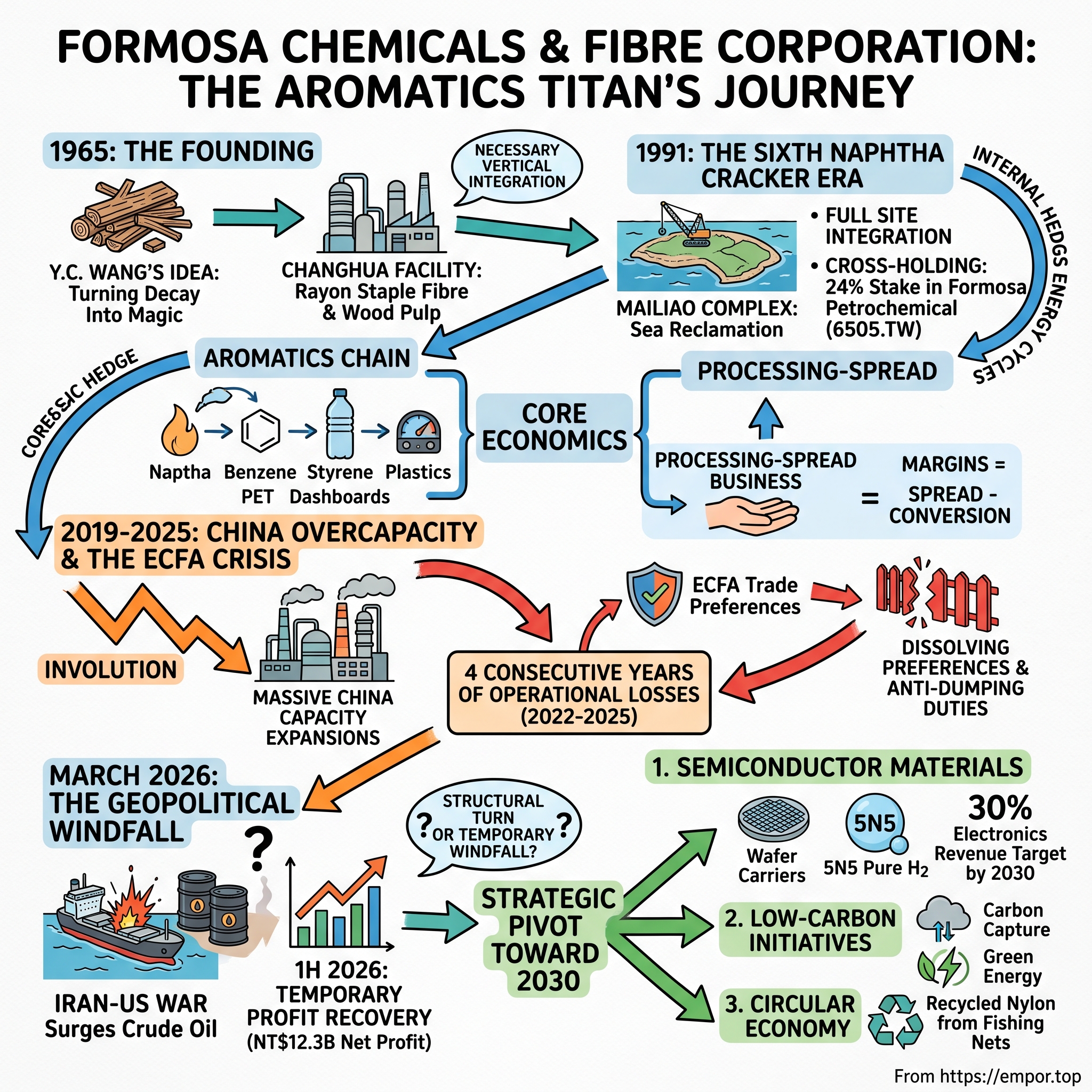
Formosa Chemicals & Fibre Corporation: The Aromatics Titan Navigating China's Petrochemical Involution
I. Introduction & Episode Roadmap
On March 24, 2026, Formosa Chemicals & Fibre Corporation (台灣化學纖維股份有限公司) took a step rarely seen in its long history: it declared force majeure to halt contractual deliveries to overseas customers and redirected available feedstock to domestic buyers in Taiwan.1 Twenty-four days earlier, on February 28, a war between the United States and Iran disrupted shipping in the Persian Gulf—the primary transit route for Asian petrochemical crackers sourcing naphtha, liquefied petroleum gas, and condensate.2 Dubai crude oil, which closed 2025 at approximately $62 a barrel, surged past $128 by the end of the first quarter of 2026.1
For a company coming off the first full-year net loss in its history as a listed entity, the global market upheaval provided immediate financial relief. Formosa Chemicals & Fibre—traded under ticker 1326.TW on the Taiwan Stock Exchange (臺灣證券交易所)—reported a net loss of NT$5.797 billion for 2025, or NT$0.99 per share, as mainland Chinese overcapacity triggered what its chairman described as severe below-cost price competition across nearly all product lines.34 However, the Middle East conflict abruptly altered industry supply dynamics. Low-cost inventory held on the company's balance sheet surged in value while long-depressed processing spreads widened. In the first half of 2026, FCFC generated NT$12.338 billion in net profit after tax—yielding NT$2.11 per share—on revenue of NT$168.904 billion.5 The company's stock price, which had hit a low in the mid-NT$20 range over the preceding twelve months, rallied to a three-year high, gaining more than 25% in a single week.67
That rapid shift in fortune highlights the central strategic paradox facing the company.
The core strategic paradox. FCFC was built on the classic twentieth-century petrochemical playbook: construct world-scale capacity, integrate backward to secure raw materials, maximize energy efficiency through co-generation, and operate inside an industrial cluster large enough to capture shared economies of scale. In 2018, that strategy generated NT$48.8 billion in net profit.3 Yet the model relies on a critical premise: that regional scale and operational efficiency confer durable pricing power. Between 2019 and 2025, massive capacity expansions in mainland China undermined that assumption, rendering scale in Taiwan far less effective in securing margins. Scale shifted from a protective competitive moat into a heavy fixed cost.
For investors, the central question is not operational efficiency—where FCFC maintains strong process engineering and cost controls—but whether operational efficiency alone can offer a durable competitive advantage when state-driven industrial policy rather than return-on-capital targets dictates market capacity. Furthermore, markets must evaluate whether FCFC's recent profitability reflects a structural turn or merely a temporary geopolitical windfall that will dissolve once Middle Eastern trade routes normalize.
What this story covers. The narrative traces FCFC from its 1965 origins as a rayon mill utilizing regional wood waste to its expansion on reclaimed land in Mailiao (麥寮), where it grew into an aromatics and styrenics producer. It analyzes the company's financial structure, detailing four consecutive years of operational losses prior to the recent geopolitical disruption. It examines the dual headwinds of Chinese petrochemical overcapacity and the erosion of preferential trade terms under the Cross-Straits Economic Cooperation Framework Agreement (ECFA, 海峽兩岸經濟合作架構協議). It reviews capital allocations to non-core ventures, including a steel mill in Vietnam and a domestic battery initiative. It profiles Chairman Hong Fu-yuan (洪福源), an engineer who joined FCFC in 1970 and is now steering the commodity producer toward higher-value semiconductor materials.8 Finally, it evaluates both the bull and bear investment theses through competitive framework models, identifying the key operating metrics that will determine FCFC's long-term trajectory.
The company's story begins with an urgent industrial challenge in early 1960s Taiwan: securing basic domestic textile supply.
 Subscribe on LinkedIn
II. Founding & Historical Context: Rayon, Waste Wood, & The Y.C. Wang Engine
In the early 1960s, logging operations across the mountain slopes of central Taiwan left behind immense quantities of wood offcuts, branches, and stumps—materials with no commercial market that were routinely left to rot or burn. Down in the valleys, Taiwan's nascent textile industry faced a fundamental raw material bottleneck, hampered by a lack of domestic cotton and wool alongside scarce foreign exchange reserves required for imports. Post-war industrial growth was hitting a resource limit.
Y.C. Wang (王永慶) recognized that these discarded forestry by-products could serve as the feedstock for synthetic textiles.
By 1965, Wang had established himself as a prominent industrialist. After running a small rice shop as a teenager and later expanding into timber, he used U.S. aid financing in the 1950s to build Taiwan's first polyvinyl chloride (PVC) plant. That venture became Formosa Plastics Corporation (台塑), and the broader conglomerate it spawned—Formosa Plastics Group (台塑集團)—grew into a foundation of the Taiwanese economy.9 Wang's management philosophy was rooted in rigorous operational discipline: scrutinizing individual cost line-items, requiring every industrial by-product to be monetized, and viewing material waste as an operational failure. The group's motto—"turning decay into magic" (化腐朽為神奇)—reflected the core rationale behind Formosa Chemicals & Fibre Corporation: converting discarded wood into commercial rayon fibre.
FCFC broke ground on March 16, 1965, in Changhua (彰化), establishing a wood-pulp and rayon operation that rapidly expanded downstream into spinning, weaving, dyeing, and finishing.10 Y.C. Wang founded the company alongside his younger brother, Y.T. Wang (王永在). Their partnership—the elder brother focusing on institutional discipline and strategy, the younger on construction and execution—guided the group's expansion for four decades.
Why Vertical Integration Was Never a Strategy Deck
The Changhua facility was fully integrated from its inception out of necessity rather than design trends. Without vertical integration, the company would have been exposed to price volatility at every stage of a supply chain where Taiwanese manufacturers possessed minimal market leverage. Purchasing external pulp exposed operations to pulp suppliers, while selling unrefined staple fibre left margins vulnerable to independent spinners. FCFC mitigated these risks by manufacturing its own pulp, producing its own fibre, spinning its own yarn, and weaving its own fabric. This push to control adjacent steps and capture intermediary margins laid the groundwork for the company's eventual entry into refining decades later.
The company's expansion systematically followed the production chain. Beginning in 1973, FCFC constructed facilities for nylon raw filament, processed filament, and nylon weaving.10 Throughout the 1970s, the company emerged as Taiwan's primary supplier of synthetic textile fibers, supporting the rapid global export of Taiwanese apparel. In the 1980s, the group deepened its downstream integration through affiliates such as Formosa Taffeta (福懋興業), which converted FCFC yarn into technical fabrics.
A pivotal strategic shift occurred in 1987 when FCFC constructed a purified terephthalic acid (PTA) plant at its Longde site.10 Although initially conceived as backward integration to secure polyester feedstock, the move marked FCFC's entry into bulk petrochemicals. Producing PTA required paraxylene, which depended on an aromatics complex fed by naphtha from an oil refinery—establishing a chain of capital commitments that steadily drew the company deeper into upstream refining.
The Culture That Outlived the Products
By 1990, FCFC had constructed a polystyrene plant in Xingang, followed by an acrylonitrile butadiene styrene (ABS) facility on the same site in 1994.10 Rayon staple fibre—the company's founding product—became a minor revenue contributor as the core business shifted toward bulk plastics and chemical feedstocks.
While the product portfolio evolved, the company's core operational discipline endured. Three primary practices established at Changhua became permanent fixtures of FCFC's operating model. First, a relentless focus on process yield, where minor efficiency gains in converting feedstock into finished output significantly impact margins at world-scale volumes. Second, systemic co-generation—capturing waste heat and steam from chemical processes to power adjacent units—which lowered overall energy costs. Third, a centralized cost-control system requiring plant managers to justify operating expenses line-by-line to executive leadership using standardized reporting formats developed by Y.C. Wang.
These operational controls historically enabled FCFC to navigate industry downturns effectively. However, as subsequent developments demonstrated, internal cost efficiency provides limited protection when state-subsidized competitors maintain production regardless of market returns. Operational excellence remains a powerful advantage against commercially driven peers, but loses efficacy against market participants operating without strict profit mandates.
That structural market shift was still decades away in 1991, when Formosa Plastics Group began constructing its offshore petrochemical complex in Yunlin County.
III. The Sixth Naphtha Cracker Era: Evolving into an Aromatics & Plastics Colossus
The site chosen for Formosa Plastics Group's expansion did not exist on any map—it had to be built from seawater.
In the late 1980s, Mailiao Township (麥寮鄉) in Yunlin County (雲林縣) was an impoverished stretch of coastal Taiwan known primarily for oyster farming and population outflow. The group required roughly 2,600 hectares of industrial land and a deep-water harbor. However, dense, mountainous Taiwan—where an emerging environmental movement was actively contesting industrial development—offered no suitable sites. Formosa Plastics Group resolved the shortage by dredging and reclaiming land from the Taiwan Strait throughout the early 1990s in one of the largest private civil-engineering projects in Asian industrial history. Y.T. Wang personally supervised much of the construction. The Sixth Naphtha Cracker (六輕) complex began commercial operations in stages during the late 1990s, expanding into a petrochemical hub with roughly 24 million metric tons of annual capacity operated jointly by Formosa Plastics, Nan Ya Plastics, Formosa Petrochemical Corporation (台塑石化), FCFC, and several joint ventures.11
For FCFC specifically, Mailiao represented a fundamental transformation rather than a routine expansion.
Why One Site Changes the Arithmetic
A complex of this scale fundamentally alters a chemical producer's underlying economics. In the chemical industry, the term "integration" is often used loosely, but at Mailiao it represents a tangible structural cost advantage.
Consider a standalone polystyrene manufacturer elsewhere in Asia. The merchant producer purchases styrene monomer on the open market, pays freight and insurance to transport feedstock to its facility, holds buffer inventory against delivery disruptions, purchases power from the local grid, burns commercial fuel to generate steam, and sells finished goods into a market where rivals operate on similar cost structures. Its overall cost structure is simply the prevailing market price of raw materials plus internal conversion expenses, leaving operational efficiency as its sole competitive lever.
By contrast, placing that same plant inside the Mailiao complex changes the economic arithmetic. Styrene monomer arrives via pipeline from an adjacent processing unit just one kilometer away, reducing freight expenses nearly to zero and minimizing working capital tied up in inventory. Electricity and steam originate from on-site co-generation plants fueled by refinery by-products from neighboring units. Gaseous and liquid by-products—such as hydrogen, off-gases, and heavy distillates—are consumed internally as feedstock by adjacent facilities rather than sold on merchant markets. Furthermore, exothermic waste heat from one reaction loop preheats feed streams in another. While each efficiency gain yields only a modest percentage savings on its own, their cumulative impact across the integrated production chain enabled a resource-scarce island without domestic crude reserves to compete globally in bulk petrochemical exports.
This operational synergy was the primary rationale behind the group's decade-long land reclamation project. Formosa Plastics Group was constructing an integrated industrial ecosystem where the marginal cost of each subsequent processing step declined. Because the site was permitted and built in an era before environmental regulations tightened, Mailiao remains a unique, unrepeatable asset on the island—a structural footprint that no competitor in Taiwan can replicate.
The Chess Move: Buying a Piece of Your Own Supplier
In 1995, FCFC committed capital to Mailiao and simultaneously invested in Formosa Petrochemical Corporation (FPCC), the group entity created to own and operate the complex's refinery and naphtha crackers.10 FCFC holds roughly 24% of FPCC (6505.TW), while sister companies Formosa Plastics and Nan Ya Plastics hold comparable stakes—giving the three core group entities combined ownership of approximately three-quarters of the refiner.12
This corporate cross-holding forms a central pillar of FCFC's financial structure. Rather than purchasing naphtha and aromatics feedstock from FPCC strictly at arm's length, FCFC acts as a major equity owner of its primary supplier. When crude oil prices rise and refining margins expand, FPCC's earnings flow back to FCFC as dividends and equity-method income, cushioning the input-cost squeeze experienced by FCFC's downstream chemical plants. Conversely, when petrochemical processing spreads widen while crude prices soften, downstream chemical earnings support group results. The equity stake functions as a permanent internal hedge across energy cycles. At the same time, it complicates standalone financial analysis, as a significant portion of FCFC's reported profits stems from refining equity returns rather than direct chemical manufacturing.
Within the Mailiao complex, FCFC constructed an extensive aromatics and styrenics production chain, encompassing benzene, paraxylene, styrene monomer, purified terephthalic acid (PTA), phenol, and acetone.10
What FCFC Actually Makes, in English
The production process begins with naphtha, a light distillate fraction of crude oil. Cracking and reforming naphtha yields aromatic hydrocarbons—specifically benzene, toluene, and xylenes. Paraxylene (PX) is a specific xylene isomer produced primarily to manufacture PTA; combining PX with acetic acid and oxygen yields PTA, which is then reacted with monoethylene glycol to produce polyester. Synthetic textile fibers, PET beverage bottles, industrial carpeting, and tire cord all rely on PX as their foundational building block.
Styrene monomer (SM) is produced by reacting ethylene with benzene. Polymerizing SM creates polystyrene, widely used in food packaging, insulation, and consumer appliance housings. Combining SM with acrylonitrile and butadiene produces acrylonitrile butadiene styrene (ABS)—a durable, impact-resistant plastic utilized in automotive dashboards, electronics casings, and consumer goods. Combining phenol and acetone yields bisphenol-A, the key precursor for polycarbonate, a clear, high-strength plastic used in automotive headlamp lenses, safety eyewear, and electronic housings.
The underlying economics of this portfolio are straightforward. FCFC essentially operates as a processing-spread business rather than a branded product company. It purchases raw feedstocks at prevailing market prices, processes them through capital-intensive facilities, and sells commodity chemicals at global market rates. Gross margins depend almost entirely on the processing spread—the price differential between output chemicals and raw feedstocks—minus energy and conversion costs. Because standard commodity chemicals carry no consumer branding or switching costs, profitability is determined by global supply and demand balances that lie outside the company's direct control.
Riding China's Super-Cycle, and Building Inside It
Throughout the 2000s and early 2010s, global market conditions heavily favored Asian producers. China's rapid industrialization and urbanization drove demand for appliances, automobiles, and consumer electronics at a pace that outstripped its domestic chemical manufacturing capacity. Positioned nearby with world-scale production lines, Taiwanese chemical producers served as primary suppliers, enjoying wide aromatics and styrenics processing spreads that generated robust earnings for FCFC.
To secure market share and reduce logistics costs, FCFC expanded directly into mainland China, establishing Formosa Chemicals Ningbo (寧波台化) in Zhejiang Province. The Ningbo complex currently operates with an annual capacity of approximately 450,000 metric tons of ABS, 200,000 metric tons of polystyrene, and 510,000 metric tons of polypropylene. In aggregate, Ningbo's polymer capacity exceeds FCFC's domestic production footprint in Taiwan, where the Hsin-Kang and Mailiao plants produce roughly 410,000 metric tons of ABS and 320,000 metric tons of polystyrene annually.13
Initially, this expansion represented standard market-seeking foreign direct investment designed to eliminate tariffs, lower shipping costs, and serve downstream mainland manufacturers directly. Over the longer term, however, the investment placed a substantial portion of FCFC's core polymer capacity inside the very jurisdiction that would later drive massive domestic capacity expansions and regional price competition.
IV. Segment Breakdown & Core Business Economics
Between 2022 and 2025, Formosa Chemicals & Fibre Corporation faced a striking operational reality: its consolidated operating income was negative for four consecutive years.3
The core process of purchasing feedstock, converting it into aromatics, polymers, and fibres, and selling the output resulted in losses at the operating line throughout that period. FCFC recorded consolidated operating losses of NT$5.29 billion in 2022, NT$3.05 billion in 2023, NT$1.55 billion in 2024, and NT$4.04 billion in 2025.3 Yet the company maintained positive net profit in three of those four years, reporting NT$7.36 billion in 2022, NT$8.55 billion in 2023, and NT$379 million in 2024.3
That divergence stemmed from FCFC's cross-holdings. Dividend distributions and equity-method investment income from Formosa Petrochemical Corporation and other group affiliates offset manufacturing losses to yield an accounting profit. In 2025, however, those investment cushions proved insufficient, resulting in FCFC's first full-year net loss as a listed company.4
This pattern underscores a critical structural feature of FCFC's financial profile: for much of the 2022–2025 period, the company's reported net earnings derived primarily from its role as an equity investor rather than as an operational chemical manufacturer.
The Shape of the Revenue Base
Consolidated revenue reached a peak of NT$407.9 billion in 2018 before tracking cyclical swings, registering NT$379.9 billion in 2022, NT$332.6 billion in 2023, NT$348.6 billion in 2024, and NT$287.0 billion in 2025.3 Approximately half of consolidated revenue originates from parent operations in Taiwan, with the remaining balance generated by subsidiaries, including the Ningbo complex, Vietnamese operations, and Formosa Taffeta.
Within the parent company, revenue distribution reflects where operational risk is concentrated. Petrochemicals and aromatics—including benzene, paraxylene, styrene monomer, purified terephthalic acid, phenol, and acetone—represent the largest segment and primary earnings engine. Plastics and polymer resins constitute the second-largest category. Synthetic fibres and textiles, the founding business line, now represent the smallest revenue contribution to the parent company.10 Power and co-generation utilities operate alongside these units, serving primarily as a cost-management mechanism rather than a primary revenue generator.
The interaction among these operating segments reveals key insights into FCFC's financial dynamics.
The Founding Business, Sixty Years On
The role of the fibre and textile segment has inverted over time.
While synthetic fibres defined FCFC during its first three decades, the segment now represents the smallest revenue share within the parent company. On a bulk commodity basis, traditional products such as rayon staple fibre and standard nylon-6 filament face intense price competition from regional producers in mainland China, India, and Southeast Asia that operate with lower conversion costs.
Conversely, specialized niches within the fibre division offer higher margin potential. The division houses FCFC's recycled-nylon initiative, which benefits from brand-driven demand from apparel customers seeking sustainable materials. It also encompasses high-tenacity industrial yarns used in airbag fabrics, tire cord, and technical textiles—products selected based on technical specifications and safety certifications rather than spot commodity pricing.
At the group level, Formosa Taffeta (福懋興業) extends this value chain by processing FCFC yarn into finished woven, dyed, and technical fabrics, contributing directly to consolidated results. This corporate structure reflects FCFC's historical evolution as an integrated industrial chain, where sequential processing steps are distributed across distinct legal entities.
For financial analysts, this structure presents a reporting challenge. Because legacy commodity fibres and higher-margin specialty yarns are reported as a single segment, aggregate figures obscure the performance of the growing specialty business.
The Chain Inside the Chain
FCFC's aromatics units serve a dual purpose: supplying merchant markets with benzene and paraxylene while providing internal feedstock for the company's downstream styrenics and PTA plants. Benzene produced at Mailiao feeds on-site styrene monomer production, which is then processed into polystyrene and ABS at Mailiao and Hsin-Kang. Similarly, phenol serves as an essential input for polycarbonate production.
This vertical integration creates a distinct margin structure. Capturing value at multiple stages along a single processing chain provides partial earnings insulation when an individual processing spread narrows; if the styrene monomer-benzene spread compresses, FCFC can still capture margins on upstream benzene production. However, when processing spreads across the entire aromatics complex contract simultaneously—as occurred when mainland Chinese capacity expansions hit the market—the entire integrated chain experiences margin compression. In 2025, simultaneous margin declines across multiple aromatics products depressed overall manufacturing earnings.
The Utilities Cushion, Fairly Described
FCFC operates high-efficiency co-generation plants at its Mailiao and Changhua sites, generating both electricity and high-pressure process steam. Producing process steam as a co-product of power generation is substantially cheaper than operating standalone boilers. Surplus electricity is sold to Taiwan Power Company (Taipower, 台灣電力) under regulated tariffs, providing a steady revenue stream insulated from crude oil price volatility.
While co-generation lowers internal conversion costs by several percentage points, it does not confer market pricing power or prevent operating losses during severe industry downturns. Furthermore, because a significant portion of FCFC's utility capacity relies on coal, energy efficiency advantages are increasingly counterbalanced by emerging carbon pricing liabilities in Taiwan.
The Investment Portfolio as Business Segment
In addition to its stake in Formosa Petrochemical, FCFC holds equity positions in Formosa Ha Tinh Steel Corporation in Vietnam and a 20% stake in Formosa Smart Energy Tech Corporation (台塑新智能), the group's battery and energy storage venture.[^14]14 A substantial portion of FCFC's balance sheet is thus allocated to non-operated assets whose returns depend on global steel cycles and energy storage adoption rather than chemical processing spreads.
Performance in the first half of 2026 illustrates the interplay between operational manufacturing and non-operating investment returns. FCFC's consolidated operating results swung from a loss of NT$2.967 billion in the first half of 2025 to an operating profit of NT$5.041 billion in the first half of 2026.5 Over the same period, equity-method income and dividend distributions from group affiliates contributed an additional NT$5.095 billion in non-operating profit, matching the operational manufacturing result.5 Momentum moderated in the second quarter of 2026, as operating profit fell 38.4% sequentially to NT$1.921 billion due to scheduled maintenance turnarounds on aromatics and styrene monomer units, alongside persistent Chinese oversupply in polystyrene, ABS, and polypropylene.5
These results highlight that FCFC's bottom line remains equally reliant on core chemical manufacturing and non-operating equity returns from Formosa Petrochemical's refining operations.
Evaluating FCFC's long-term outlook requires examining the structural headwinds that caused these regional chemical spreads to compress in the first place.
V. The China Overcapacity Shockwave & The ECFA Crisis
In 2019, a refinery commissioned in Dalian defied standard petrochemical expansion logic. Hengli Petrochemical (恆力石化), a firm that began as a polyester spinner, brought online a 400,000 barrel-per-day refinery purpose-built to maximize aromatics rather than transportation fuels—creating a massive facility designed to produce paraxylene directly for its own downstream polyester chain. Within roughly two years, Rongsheng Petrochemical's (榮盛石化) Zhejiang Petrochemical (浙江石油化工) complex on Zhoushan Island expanded even further, achieving a scale that made it one of the largest integrated refining and petrochemical sites on earth. Wanhua Chemical (萬華化學), historically an isocyanates specialist, added crackers and polyolefins.
None of these were incremental additions. They represented the deliberate execution of a national industrial policy: China had been importing tens of billions of dollars annually in paraxylene, purified terephthalic acid, and chemical intermediates, and Beijing decided to end that reliance.
From Best Customer to Worst Competitor
For Taiwan, the consequence was a category shift rather than an incremental change in degree. For two decades, mainland China had served as the reliable destination absorbing Taiwanese aromatics and styrenics exports at attractive prices. Within a few years, mainland China transitioned from import dependence to complete self-sufficiency in paraxylene, PTA, styrene, and standard resin grades—and then into a net exporter, flooding surplus volume into the same Southeast Asian, Indian, and Middle Eastern markets where Taiwanese producers sought shelter.
The result is what Chinese industry terms involution (內卷): a state of fierce, value-destroying internal competition in which every producer works harder, cuts prices further, and gains no ground. In petrochemicals, involution keeps world-scale plants running at negative cash margins because the assets are new, the debt is held by state-linked banks, local governments prioritize employment and regional output, and shutting down is politically more costly than incurring operating losses. Chairman Hong Fu-yuan has been notably direct on this point, attributing the company's 2025 net loss directly to mainland overcapacity and the aggressive price competition it triggered across product lines.4
That candor stands out as a key indicator of managerial credibility. Commodity chemical executives routinely describe structural oversupply as a routine destocking cycle; Hong did not.
This operational reality is reflected in the company's product commentary. By mid-2026, even as aromatics spreads recovered, FCFC's plastics business was still reporting elevated customer inventories, aggressive below-cost Chinese exports, and deferred orders—prompting the company to curtail output and await genuine restocking demand.15 When a world-scale, fully integrated producer chooses to run polymer plants below capacity because marginal volumes are unprofitable, it provides undeniable proof that scale alone no longer provides a competitive moat in those product lines.
The Tariff Wall Goes Up
Regional overcapacity alone posed a severe challenge. What made the crisis structural was the concurrent dismantling of the preferential trade terms that had supported Taiwan's petrochemical exports for over a decade.
The Cross-Straits Economic Cooperation Framework Agreement (ECFA), signed in 2010, granted a defined "early harvest" list of Taiwanese goods preferential tariff access to the mainland market. Petrochemicals featured prominently on that list, functioning for years as an implicit margin buffer that enhanced Taiwanese producers' competitiveness against South Korean and Japanese rivals.
Beijing subsequently systematically unwound those preferences. On December 21, 2023, China announced the suspension of tariff concessions on twelve Taiwanese petrochemical products, including propylene and paraxylene, effective January 1, 2024; Taiwan's Ministry of Economic Affairs called the decision regrettable.16 On May 31, 2024—eleven days after President William Lai's inauguration—China announced a second suspension covering 134 items, effective June 15, spanning petrochemicals, textiles, machinery, steel, and transportation equipment.17 Taipei protested the action as a unilateral, politically motivated move inconsistent with World Trade Organization norms.17 Across those two announcements, 146 ECFA product categories lost their preferential status.18
Separately, and with greater immediate impact on FCFC's higher-value lines, China imposed a 9% anti-dumping duty on Taiwanese polycarbonate imports starting April 20, 2024, scheduled for a five-year term.19 Polycarbonate represents one of FCFC's premium resin offerings; a duty of that magnitude on a commodity-adjacent material creates a near-insurmountable handicap against domestic Chinese producers facing no tariffs.
Management's Read, Tested Against the Outcome
On June 2, 2024, Hong Fu-yuan told reporters that the affected FCFC product lines were styrene-acrylonitrile, high-impact polystyrene, and polycarbonate, estimating the direct annual tariff impact at approximately US$6.9 million.19 FPCC's chairman offered a similarly restrained assessment regarding base oils.19
Two years later, that management framing yields a mixed verdict under scrutiny. Narrowly speaking, executive commentary was accurate: US$6.9 million in incremental duties was not material relative to a consolidated revenue base approaching NT$350 billion. However, that figure understated the underlying transmission mechanism. The primary damage from a commodity tariff is rarely the duty paid on continuing shipments; it is the export volume abandoned due to lost price competitiveness, and the margin compression accepted when redirecting those displaced volumes into already-saturated secondary markets. Taiwan's ECFA-covered exports to China dropped to US$13.1 billion in 2025—representing just 13.1% of total Taiwanese exports to the mainland, the lowest share since the agreement took effect and down from 26.3% in 2016.18
Management's disclosure was factually precise on the narrow metric chosen, yet incomplete regarding the structural reality. That discrepancy reflects standard corporate communication—quantifying immediate costs while leaving broader strategic headwinds unquantified. Investors should view claims of "limited direct impact" from company leadership as narrowly accurate but analytically insufficient.
Myth vs. Reality
Three widely repeated narratives obscure the dynamics of this downturn, each leading to flawed investment conclusions.
Myth: The suspension of ECFA trade preferences broke Taiwan's petrochemical industry. Reality: Tariff revocations served as an accelerant rather than the primary cause. A trade preference offers value only when a producer is fundamentally cost-competitive; a tariff differential of a few percentage points cannot explain a transition from world-class profitability to four consecutive years of operating losses. The core driver was massive capacity expansion. Had ECFA remained entirely intact through 2025, FCFC would still have been selling into a market where its primary historical customer had transformed into a major net exporter. Distinguishing cause from accelerant is critical for valuation: restoring trade preferences would help at the margin, but it cannot restore historical processing spreads.
Myth: The war-driven 2026 earnings recovery signals a cyclical bottom. Reality: On an income statement, a geopolitical supply shock can temporarily mimic a demand recovery, but the underlying implications are opposite. Regional prices rose in the first half of 2026 because raw feedstocks became scarce, not because end-user demand recovered—which explains why FCFC's polymer division continued to curtail plant operations even as headline revenue grew, and why half-year top-line expansion was driven almost entirely by price rather than volume.515 A demand-led cyclical trough leads to sustained margin recovery; a supply-driven shock unwinds as trade flows normalize. None of the structural fundamentals regarding mainland capacity, cost structures, or policy incentives changed between 2025 and 2026.
Myth: Chinese industrial overcapacity will self-correct through market-driven plant closures. Reality: Rationalization may eventually occur, but on a timeline decoupled from standard cash-margin thresholds. In market-driven economies, high-cost facilities shut down when revenues fail to cover variable operating costs. In a state-guided system, newly built assets carry debt backed by state-linked lenders, and local government authorities prioritize employment and economic output over enterprise-level returns. As a result, industrial involution has endured far longer than consensus forecasts predicted. The mechanism providing temporary margin relief in 2026 was not domestic Chinese capacity rationalization, but rather an external geopolitical disruption that hampered Middle Eastern export supply.4
The overarching reality is that FCFC simultaneously lost a trade shield and gained a massive regional competitor in its core market. The tariff protection dissolved precisely when competitive pressure peaked. That convergence explains why 2025 broke a six-decade record of profitability—and why the capital allocation choices of the preceding decade face intense scrutiny.
VI. Capital Deployment, M&A, & Conglomerate Investments
Every capital allocation decision appears logical when made, only to be judged by the market environment that unfolds later. FCFC's portfolio provides a clear case study, as the company has made three major strategic investments over the past decade that have yielded markedly different results.
Ningbo: The Right Move, Made Slightly Too Late
The strategic rationale for expanding at Ningbo was straightforward: if Beijing raises trade barriers against Taiwanese imports, establish production inside those barriers. FCFC expanded its Ningbo facility under a government-aligned policy framework—teng long huan niao (騰籠換鳥), or "emptying the cage to change the birds"—phasing out lower-value lines to construct acrylonitrile butadiene styrene (ABS) and purified terephthalic acid (PTA) capacity utilizing advanced process technology.
Assessed today, the tariff-circumvention goal succeeded while the return objective failed. Manufacturing inside mainland China neutralized ECFA tariff suspensions and anti-dumping duties on those specific product lines. However, it placed that capacity squarely inside the most oversupplied polymer market in the world, competing against domestic producers with lower capital costs, cheaper labor, local government subsidies, and frequently no mandate to earn a commercial return on capital. In effect, FCFC paid to bypass a tariff wall only to enter a regional price war.
This highlights a classic category error in commodity capital allocation: attempting to solve a market-access barrier through physical capacity additions when the underlying problem is structural oversupply. Adding production capacity to a market already saturated with surplus volume secures market access only at the expense of profit margins.
Formosa Ha Tinh Steel: The Long Shadow
The Vietnamese steel venture represents a more contentious capital commitment with a longer history.
Conceived as Vietnam's largest foreign-invested industrial project, Formosa Ha Tinh Steel constructed an integrated blast-furnace steel complex along the country's north-central coast, funded by FCFC alongside other Formosa Plastics Group entities. The facility's early operation was severely marred by a 2016 marine pollution incident off the central Vietnamese coast that killed fish populations, sparked widespread public protests, and resulted in a US$500 million settlement—a financial and reputational crisis that continues to influence regional regulatory scrutiny.
Financially, the asset has remained a drag on group performance. The venture posted a loss of approximately US$322 million in 2022, followed by a loss of roughly US$654 million in 2023 as global steel demand softened and Chinese steel exports flooded Southeast Asia.20 In response, Formosa group entities restructured their equity holdings, with FCFC reducing its stake from 21.25% to 14.75% as each of the four core group companies trimmed its exposure.[^14]
From an activist investor's perspective, the capital deployment is difficult to defend. FCFC committed shareholder funds to a non-operated Vietnamese blast-furnace complex in an industry where it lacked operational expertise, exposing capital to the same Chinese overcapacity dynamic depressing its core chemical business—and then paid to reduce its ownership stake. The strategic rationale for a chemical producer owning a steel manufacturing plant was never clearly established for public market investors, representing diversification into correlated industrial risk rather than a true economic hedge.
Management's defense rests on group-level strategy: Ha Tinh serves as a foundational industrial asset for Formosa Plastics Group, FCFC's equity participation reflected conglomerate alignment rather than independent capital allocation, and Vietnam's long-term steel demand may eventually validate the facility. While both perspectives carry weight, the underlying financial reality remains clear: FCFC's minority shareholders absorbed the cost of an investment decision driven by group-level priorities.
Formosa Smart Energy: Optionality, Honestly Sized
The group's newest venture is Formosa Smart Energy Tech Corporation (台塑新智能), capitalized at NT$17 billion. Formosa Plastics, Nan Ya Plastics, and Formosa Petrochemical each hold 25% equity stakes, FCFC holds 20%, and Formosa Biomedical holds the remaining 5%.14 The company was established to manufacture lithium iron phosphate (LFP) battery cells, energy storage systems, and associated grid hardware.
The venture has achieved initial operational milestones. Its Changbin facility produced its first large battery modules in December 2024, and by 2025 had completed 13 energy storage installations totaling more than 460 megawatt-hours. Management set a 2026 revenue target of NT$10 billion—a fourfold increase from NT$2.5 billion in 2025—citing order visibility through 2030 and plans for a second-phase expansion to raise cell capacity above 5 gigawatt-hours by mid-2028.14
Viewed objectively, the venture represents long-term strategic optionality rather than an immediate earnings driver. FCFC's 20% stake in an enterprise targeting NT$10 billion in annual revenue is modest for a company generating nearly NT$170 billion in half-year sales. Furthermore, LFP battery cell manufacturing is dominated by Chinese incumbents with massive scale and cost advantages, replicating the structural competitive pressures seen in bulk chemicals. The primary value of the venture lies not in becoming a major profit center overnight, but in securing a domestic position in Taiwan's power grid expansion, where local content rules and government procurement preferences provide insulation from global spot pricing.
Dividends: The Clearest Signal Management Sends
Formosa Plastics Group has historically maintained high dividend payout ratios, a policy FCFC upheld for decades until severe earnings compression challenged the practice.
Following its net loss in 2025, FCFC's board resolved to distribute a cash dividend of NT$0.60 per share, drawing directly on retained earnings—a decision ratified by shareholders at the annual general meeting on May 27, 2026.21 Paying dividends out of accumulated reserves during a loss-making period sends a distinct signal: management indicated to the market that it viewed the 2025 loss as a cyclical trough rather than a permanent impairment, choosing to maintain its long-standing payout record.
Investors evaluate this capital distribution through two distinct lenses. Optimistically, the payout demonstrates balance-sheet strength and management confidence, reinforced by the operational turnaround visible in early 2026. Realistically, it reveals a corporate culture prioritizing historical dividend continuity even while calling on shareholders to fund an expensive strategic transition into semiconductor materials and clean energy. Distributing capital reserves while simultaneously emphasizing the need for business model transformation highlights a strategic tension FCFC has yet to fully reconcile in public.
Reconciling that tension falls to an executive leader who has served the company since 1970.
VII. Current Management, Leadership Culture, & Strategy Pivot
The 2021 annual general meeting of FCFC was expected to be routine. Instead, Wang Wen-yuan (王文淵)—chairman of FCFC, president of Formosa Plastics Group, and nephew of founder Y.C. Wang—announced from the podium that it would be the last annual meeting he presided over, handing the chairmanship to his vice chairman.22
With that statement on July 23, 2021, the Wang family completed its withdrawal from front-line management across all four core Formosa entities, formally transferring operational control of a conglomerate synonymous with family leadership for half a century to professional managers.22 The executive stepping into the role was Hong Fu-yuan (洪福源).
The Insider's Insider
Hong was born in 1945 and joined FCFC in 1970.8 Over a career spanning more than fifty-five years at the company, he rose from chemical engineering and operations roles through plastics division management and executive-office coordination to become vice president, president, and vice chairman, joining the board in 1988.8 By the time he assumed the chairmanship, he was the board's longest-serving member and had effectively overseen daily operations for years. Industry media at the time characterized him as the executive who understood Wang Wen-yuan best.8
His response to taking the chair reflected Formosa's disciplined corporate culture: he remarked that the work and responsibilities remained unchanged, with only the job title differing.8 In a corporate culture where operational metrics outweigh executive titles, the statement epitomized the organization's pragmatic ethos.
For investors, two distinct leadership traits stand out. First, Hong articulated FCFC's strategic pivot long before external headwinds made it urgent, urging a transition away from commoditized markets toward differentiated, high-value materials alongside carbon-reduction and circular-economy initiatives.8 The strategy was not a narrative improvised during a downturn. Second, he has maintained direct communication regarding operational setbacks, describing the company's 2025 net loss as unsatisfactory without attempting to minimize the result.4
Regarding executive compensation, FCFC does not disclose granular equity-linked incentive structures common among Western listed peers. Management remuneration is governed by Formosa Plastics Group's traditional framework tied to aggregate enterprise and group performance metrics. Consequently, public disclosures provide limited visibility into direct contractual alignment between executive wealth and per-share value creation.
The Turn, and How Management Explains It
The most concrete operational claim Hong asserted in 2026 involved a strategic adjustment implemented in the second quarter of 2025, which he stated produced measurable results beginning in the third quarter.4 Management outlined a three-stage recovery: a return to profitability in the third quarter of 2025 at approximately NT$0.30 per share, a roughly break-even fourth quarter, and earnings exceeding NT$1.00 per share in the first quarter of 2026.4
Financial disclosures corroborate that sequence. FCFC reported a net loss attributable to owners of NT$5.5 billion through the first nine months of 2025 compared to a full-year net loss of NT$5.797 billion, confirming that fourth-quarter performance was near flat.23 In the first quarter of 2026, FCFC posted net earnings of NT$1.07 per share on revenue of NT$81.75 billion, generating pre-tax profit of NT$7.3 billion compared to NT$200 million in the preceding quarter.24
However, separating internal management execution from external market forces requires careful analysis. The strategic measures—sourcing alternative feedstocks, adjusting plant operating rates, curtailing output on unprofitable product lines, and scheduling maintenance during narrow processing spreads—reflected disciplined cost control. Yet the first quarter of 2026 coincided with a Middle East conflict that drove Dubai crude from approximately $62 to over $128 per barrel, generating significant inventory gains for Asian chemical producers.1 Across Formosa Plastics Group, the four primary listed entities reported combined post-tax net income of NT$44.894 billion for the quarter—a 523% sequential surge.1 When an entire regional sector experiences a simultaneous earnings surge, attributing the turnaround primarily to internal strategy overstates management's control.
A balanced evaluation suggests that internal operating discipline halted manufacturing losses in the third quarter of 2025 before the geopolitical shock occurred, whereas the magnitude of the 2026 financial rebound was overwhelmingly driven by external market conditions.
What the Company Says When It Is Not Presenting Results
Management's forward guidance during 2026 offered a more tempered assessment than headline quarterly earnings alone might suggest.
At the annual general meeting, President Lu Wen-chin (呂文進) acknowledged improved processing spreads during early 2026 but attributed the margin expansion to supply disruptions rather than end-market demand. Lu noted that conflict-related damage to Gulf shipping and energy infrastructure created supply constraints outside mainland China, enabling Chinese regional production to absorb shortfalls and expanding Asian processing spreads—a dynamic that informed FCFC's "cautiously optimistic" outlook.4 Rather than signaling a fundamental recovery in consumer demand, the commentary described a temporary margin expansion resulting from global supply chain disruptions.
Second-quarter guidance remained similarly cautious, with executive management projecting lower sales volumes alongside stable processing margins to deliver earnings comparable to the first quarter.4 Actual performance aligned closely with those projections. FCFC and its sister entities subsequently scheduled maintenance turnarounds on aromatics and PTA units while managing reduced naphtha allocations from Formosa Petrochemical, prioritizing raw material security and stable facility operations over market share expansion.29
This communication pattern demonstrates notable consistency. Across loss-making quarters, temporary supply shocks, and operational turnarounds, management has consistently cited the same structural variables—regional capacity, feedstock availability, and processing spreads. By avoiding shifting explanations between cyclical downturns and unexpected rallies, executive leadership maintains credibility with institutional investors—a factor that lends weight to its strategic planning even as its long-term transformation targets face rigorous market testing.
Transformation: Three Arrows, and What Would Falsify Them
At FCFC's 2026 annual general meeting and its inaugural exhibition at COMPUTEX Taipei in May 2026—marking the first appearance by a Formosa Group petrochemical entity at Taiwan's premier technology trade show—Hong detailed a strategic pivot aimed at bridging bulk chemical manufacturing with the semiconductor supply chain.212526
The strategy rests on three primary operational initiatives:
First, FCFC introduced a "chemical kitchen" model, partnering with specialty chemical developers to perform small-batch, high-mix custom synthesis utilizing FCFC's existing industrial infrastructure. Initial development targets include polyimide monomers, advanced photoresist materials, and perovskite battery inputs.2125 The initiative seeks to leverage FCFC's permitted land, chemical reactors, utility hookups, and safety protocols—assets that early-stage specialty chemical firms cannot easily construct—while partner entities provide proprietary molecular formulations and customer qualification pipelines, effectively repositioning capital-intensive assets into a specialty production platform.
Second, the company is developing electronic-grade low-carbon hydrogen and specialty process gases. FCFC targets ultra-high-purity 5N5 hydrogen for semiconductor wafer processing, projecting commercial availability by the third quarter of 2027 with an estimated carbon intensity of 0.52 kilograms of CO₂ equivalent per kilogram of hydrogen—approximately 5% of mainstream production emissions.25 Because hydrogen is generated as an operational by-product within FCFC's existing chemical loops, the raw feedstock carries minimal incremental cost and an inherently lower carbon profile. Dedicated processing facilities are scheduled for completion during the 2027–2028 timeframe.26
Third, FCFC is expanding high-value composite polymer production—including PC/ABS blends, modified polycarbonate, aromatic nylon, and polyether ether ketone (PEEK) engineered for drones, robotics, AI servers, and wafer handling. In particular, the company targets mass production of high-purity metallocene polypropylene for front-opening unified pods (FOUP) and front-opening shipping boxes (FOSB) by late 2026, claiming position as the world's third qualified supplier.2527 In addition, FCFC is marketing its industrial land, power substations, and multi-source electrical connections to artificial intelligence data center operators, seeking to monetize utility infrastructure that new market entrants cannot easily acquire.25
Underpinning these initiatives is an established circular-materials program. FCFC developed chemical recycling processes that depolymerize discarded nylon-6 fishing nets and oyster lines into caprolactam monomer, enabling repolymerization into virgin-grade nylon resin. Operating in partnership with Taiwan's Ocean Conservation Administration and Chiayi County authorities, the recovered material supplies FCFC's Hsin-Kang recycling facility, with finished technical yarns supplied to global apparel brands including Patagonia.28
To measure progress, management established an explicit target: generating approximately 30% of consolidated revenue from electronics-related applications by 2030.27
Evaluating this target against financial realities highlights the magnitude of the required transition. FCFC generated NT$348.6 billion in consolidated revenue in 2024.3 Achieving a 30% revenue share from electronics applications would require over NT$100 billion in annual high-value materials sales within four years from a baseline that remains small and unsegmented in current reporting. While specialty gases, FOUP-grade resins, and custom composites command high gross margins, they represent low-volume specialty markets compared to bulk commodity chemicals. Reaching NT$100 billion in annual revenue from specialty materials sold by the kilogram rather than commodity polymers shipped by the metric ton represents a formidable operational challenge.
Investors can monitor execution through a clear operational test: whether FCFC establishes separate reporting for high-value electronic materials in future financial disclosures, and whether that segment demonstrates revenue compounding consistent with the 2030 target. If corporate communications remain focused on qualitative project announcements while reported revenue lines remain dominated by bulk commodity chemicals, market expectations for a strategic re-rating will outpace fundamental business transformation.
VIII. Playbook: Business & Investing Lessons
Strip away company-specific details, and FCFC serves as a clear case study in modern industrial economics: what happens to a highly efficient, low-cost manufacturer when competitors emerge who do not optimize for profit?
The 7 Powers, Honestly Scored
Hamilton Helmer's Strategy 7 Powers framework evaluates the structural conditions that enable a company to earn returns above its cost of capital over the long term. Applied to FCFC, the analysis underscores the structural limits facing traditional commodity producers.
Scale economies — historically decisive, now largely neutralized. Mailiao's initial competitive advantage extended beyond sheer size to encompass full site integration, a deep-water harbor, shared utilities, and dedicated pipelines that minimized internal transit costs. That structural advantage proved real and durable for two decades. While those integrated physical assets remain intact, regional competitors have matched them. Mainland Chinese complexes in Zhoushan and Dalian are equally integrated, newer, and operate on an equivalent or larger scale. A structural feature shared by major regional rivals ceases to function as a competitive moat; it becomes an entry-level requirement.
Process power — the strongest remaining edge, yet structurally limited. Six decades of operational refinement—yield optimization, catalyst management, waste-heat integration, and strict maintenance turnarounds—embedded deep institutional knowledge across FCFC's workforce. That operational discipline helped limit FCFC's annual operating losses to low single-digit billions of NT dollars during a severe downturn that forced less efficient Asian peers to idle capacity. However, process power in commodity markets secures operational survival rather than pricing leverage; it lowers unit conversion costs, but it cannot move market clearing prices.
Cornered resource — real but narrowing. Reclaimed industrial land adjacent to a deep-water harbor, operating permits granted before environmental regulations tightened, and integrated utility infrastructure constitute an asset base that cannot be replicated in Taiwan today. FCFC's strategic pivot explicitly seeks to monetize this infrastructure by offering site access, power, and utility connections to data-center operators and specialty chemical partners alongside chemical production. This approach repurposes appreciating land and utility assets within a challenging chemical market.
Counter-positioning — an emerging bet, currently unproven. A central thesis of FCFC's transformation involves building a traceable post-consumer supply chain that mega-refiners cannot easily replicate. While a 400,000 barrel-per-day petrochemical complex is engineered around uniform hydrocarbon streams, collecting discarded fishing gear across regional ports and depolymerizing it into caprolactam requires a specialized logistics network operating at modest volumes. Should environmental regulations or brand commitments make recycled content mandatory, that operational asymmetry could yield premium pricing. At present, however, circular materials remain a small revenue contributor relative to core bulk production.
Brand, network economies, and switching costs — largely absent. Bulk benzene and paraxylene carry no consumer brand recognition or network effects. While qualifying specialized PC/ABS formulations and semiconductor-grade materials creates genuine switching costs for electronics and technology customers—providing the strategic rationale for FCFC's pivot—the company has not yet established dominant market share in those high-value segments.
Porter's Five Forces: A War-Game
Rivalry: extreme and structurally persistent. Industry rivalry is driven less by the total number of producers than by competing business objectives. When state-backed market participants make production and capacity decisions based on employment goals, regional output, and supply chain security rather than commercial return-on-capital targets, standard market-clearing mechanisms fail to eliminate loss-making supply. Consequently, regional overcapacity and margin compression endure far longer than conventional cyclical models anticipate.
Buyer power: high in bulk commodities, moderate in specialized niches. Commodity buyers purchasing purified terephthalic acid or standard resins operate with complete price transparency and negligible switching costs. Conversely, technology manufacturers qualifying custom polymer blends or high-purity process gases face stringent qualification standards and supply-chain integration, making vendor switching costly. FCFC's strategic transition aims to reallocate output toward customers where switching costs mitigate buyer leverage.
Supplier power: managed internally, yet vulnerable to external shocks. Cross-holdings in Formosa Petrochemical Corporation convert what would otherwise represent a major external supply dependency into an integrated equity relationship. However, geopolitical supply disruptions demonstrate the limits of that internal hedge: when FPCC faced Middle Eastern feedstock constraints in 2026, it reduced light-oil deliveries to FCFC, requiring maintenance turnarounds on aromatics and styrene units.29 Equity ownership in a primary refiner hedges margin volatility across market cycles, but it cannot offset physical raw-material shortages caused by international conflict.
Threat of substitutes: moderate and rising. Mechanically and chemically recycled resins are gradually displacing virgin polymers in packaging and textiles, driven by brand sustainability commitments and international regulations. Rather than defending legacy product lines against substitution, FCFC's strategy incorporates chemical recycling and low-carbon hydrogen production directly into its portfolio.
Threat of new entrants: low in greenfield capacity, high in state-driven expansion. High capital intensity, strict environmental permitting, and long construction timelines discourage new private entrants from building greenfield naphtha crackers in mature markets. However, the relevant competitive threat originated not from independent market entrants, but from national policy initiatives seeking domestic industrial self-sufficiency.
The Commodity Trap
The generalizable lesson from FCFC's experience is clear: in commodity manufacturing, superior cost controls dictate which firms survive an industry downturn, but they do not guarantee attractive returns on capital. Industry returns are ultimately determined by the marginal producer's financial discipline. When marginal producers operate without strict profit mandates, market prices can remain below total economic cost until physical capacity is permanently decommissioned.
For an established commodity producer like Formosa Chemicals & Fibre Corporation, navigating this environment requires either transitioning into differentiated, high-value specialty materials or monetizing industrial infrastructure that competitors cannot replicate. FCFC's current strategy pursues both pathways simultaneously—and the market continues to evaluate its ability to execute that transformation at scale.
IX. Bear vs. Bull Stress Test & Current Risk Radar
As of late July 2026, Formosa Chemicals & Fibre Corporation stood as one of the most actively debated large-cap equities on the Taiwan Stock Exchange. Its share price had roughly tripled from its twelve-month low, foreign institutional ownership had reached approximately 38%, and consensus earnings estimates had swung from a projected full-year loss of roughly NT$0.82 per share in August 2025 to a projected profit—with one FactSet survey showing estimates revised upward to NT$3.05 per share.2730 Trading at a price-to-book ratio near 1.0 alongside a trailing price-to-earnings multiple in the mid-30s, the stock's valuation reflected market expectations for earnings recovery and strategic transformation rather than legacy operating results.27
The central investment debate hinges on whether those expectations reflect a durable structural turn or a temporary valuation anomaly.
The Bull Case: The High-Value and Green Re-rating
The cycle has genuinely turned, revealing structural supply constraints. Proponents of the bull thesis argue that the Middle East conflict exposed fundamental supply vulnerabilities across the Asian petrochemical chain. Disruption across roughly 37 to 39 critical energy facilities in nine countries removed an estimated 9% of global refining capacity and left Iran's petrochemical complex largely non-operational.2 Middle Eastern shipments of naphtha, liquefied petroleum gas, and chemical intermediates fell far short of regional expectations, and restoring damaged refining capacity—such as Bahrain's Sitra facility, which was not expected to reach full capacity before late 2026—will require years rather than months.2 FCFC management projects that supply deficits outside mainland China will persist, allowing regional markets to absorb Chinese surplus capacity and gradually easing domestic price competition.4
Product-level spreads show tangible operational recovery. Paraxylene processing spreads widened from approximately $151 per metric ton in early May 2026 to $355 by month-end, allowing FCFC to return three aromatics reforming units to full operation.15 Although paraxylene spreads moderated to roughly $311 per metric ton by mid-July, management maintained a constructive second-half outlook, pointing to scheduled third-quarter maintenance turnarounds across Asian aromatics units and peak summer gasoline demand in the United States while projecting crude oil prices near $70 per barrel—a level that tempers feedstock cost swings while preserving downstream margins.31 Meanwhile, purified terephthalic acid spreads stabilized around RMB 530 per metric ton as Chinese plant operating rates hovered between 60% and 65%, facilitating inventory drawdown.15
Strategic transformation features concrete milestones and timelines. Unlike general corporate commitments to high-value manufacturing, FCFC's pivot specifies verifiable targets: commercializing metallocene polypropylene for wafer carriers by late 2026, supplying electronic-grade hydrogen by the third quarter of 2027, and expanding modified polycarbonate and PEEK production for robotics, artificial intelligence servers, and drone components.2527 The company's inaugural showcase at COMPUTEX in May 2026 underscored its intent to commercialize specialty chemical solutions directly for technology customers.
Financial buffers provide downside protection. Regulated utility power sales to Taipower, dividend income from Formosa Petrochemical Corporation, and a resilient balance sheet—which sustained cash payouts through a loss-making fiscal year—provide financial stability that highly leveraged regional competitors lack.
The Bear Case: Structural Margin Compression Dressed as Recovery
Earnings gains reflect a temporary supply shock rather than structural recovery. Skeptics emphasize that excluding war-driven crude oil surges and inventory revaluations, FCFC's core manufacturing operations remain under pressure. Second-quarter 2026 operating income declined 38.4% sequentially even as consolidated net profit remained elevated due to affiliate investment distributions.5 Should Middle Eastern shipping routes normalize and crude prices stabilize, the mainland Chinese overcapacity that triggered regional margin compression will resume export pressure, as Chinese cost structures and industrial policy mandates remain unchanged.
Core polymer lines continue to incur operational losses. Although aromatics spreads improved, FCFC's plastics segment has continued to contend with high customer inventories, low-cost Chinese competition, and deferred orders, forcing output curtailments.15 Because polymer manufacturing represents the bridge to high-value specialty materials, persistent price weakness in standard resin grades directly impedes the company's broader strategic pivot.
Specialty materials transition faces intense competition and long qualification timelines. Entering semiconductor-grade process gases, electronic polymers, and specialty composites requires displacing established Japanese, South Korean, and Western chemical suppliers with long-standing customer certifications. Semiconductor qualification cycles frequently span multiple years. While qualifying as a supplier for wafer-carrier polypropylene marks a technical milestone, the immediate revenue impact remains modest relative to the target of generating 30% of consolidated sales from electronics applications by 2030.
Near-term carbon liabilities precede low-carbon revenue gains. Taiwan introduced its carbon fee framework in 2026, setting a base rate of NT$300 per metric ton for industrial facilities emitting over 25,000 metric tons annually—affecting approximately 281 companies across 500 facilities—with discounted rates of NT$50 or NT$100 per ton reserved for entities meeting voluntary reduction targets.3233 Official advisory panels have proposed raising base rates to between NT$1,200 and NT$1,800 per ton after 2030.33 Given FCFC's reliance on coal-fired co-generation plants, these regulatory fees—combined with the European Union's Carbon Border Adjustment Mechanism on export shipments—impose immediate cost increases before low-carbon product lines reach commercial scale.
Non-core equity investments present ongoing financial drag. Formosa Ha Tinh Steel remains a capital-intensive, loss-making asset exposed to regional steel overcapacity and tightening international trade restrictions, including anti-dumping measures in the United States and Europe.20
Comparative peer performance highlights structural industry headwinds. FCFC's performance aligns closely with privately held peer Chi Mei Corporation (奇美實業), which faces identical exposure across ABS, polystyrene, and Chinese polycarbonate anti-dumping duties.19 The parallel outcomes across both producers demonstrate that low processing spreads stem from broader regional overcapacity rather than firm-specific operational failures. Conversely, sister company Nan Ya Plastics offers a contrasting model: Nan Ya spent decades building an electronic-materials franchise in copper-clad laminates and printed circuit board substrates, enabling it to capitalize on artificial intelligence infrastructure demand while FCFC absorbed styrenics losses.1 That precedent illustrates both the feasibility of transitioning into high-value electronics materials and the extended multi-decade timeframe required to establish market leadership.
Governance and portfolio complexity hamper independent valuation. From an institutional investor perspective, four structural issues complicate valuation. First, portfolio complexity spanning chemical manufacturing, oil refining, steel making, battery development, and textiles hinders sum-of-the-parts financial analysis. Second, current financial disclosures do not isolate electronics-grade or high-value materials revenue, preventing independent verification of transformation progress. Third, extensive related-party transactions with Formosa Petrochemical mean feedstock transfer pricing reflects group-level allocation decisions rather than pure market mechanisms. Fourth, distributing cash dividends out of capital reserves during a loss-making fiscal year while soliciting capital for a long-term strategic pivot creates competing capital allocation priorities.
Material Risk Radar
Chinese supply dumping represents the highest-impact operational threat, directly compressing processing spreads regardless of internal manufacturing efficiency. Geopolitical and trade policy risk presents a dual dynamic in 2026: Middle Eastern supply disruptions provide short-term margin relief, whereas the unwinding of ECFA tariff preferences and mainland anti-dumping duties structurally impair long-term export economics. Carbon pricing risk imposes a predictable, escalating cost burden on FCFC's energy-intensive utility and chemical infrastructure. Associate liability risk tied to Formosa Ha Tinh Steel remains a persistent, though largely recognized, balance-sheet drag. Execution risk surrounding the high-value pivot will determine whether recent earnings represent a temporary cyclical rebound or a permanent business model transition, requiring a commodity producer to master multi-year customer qualification processes and custom technical sales.
The Three KPIs That Matter
Evaluating FCFC's trajectory centers on three key operating metrics:
1. Processing spreads. Tracking paraxylene-to-naphtha, styrene monomer-to-benzene, and ABS-to-feedstock price differentials relative to internal breakeven thresholds provides the most immediate indicator of whether regional overcapacity is structurally resolving or merely temporarily masked by geopolitical conflict.
2. Electronics and high-value revenue disclosure. Whether FCFC establishes dedicated segment reporting for electronic-grade materials and specialty polymers will determine whether progress toward its 2030 target of 30% electronics revenue share can be independently verified.
3. Standalone operating margin excluding investment returns. Consolidated gross and operating margins—calculated prior to affiliate dividend distributions and equity-method investment income—provide the definitive test of core manufacturing profitability, distinguishing operational chemical earnings from passive equity returns.
X. Epilogue & Final Reflections
A striking historical symmetry links the company's origin to its present transition.
In 1965, FCFC was founded on a simple proposition: converting an unwanted waste stream—discarded wood offcuts from mountain forestry—into a commercially needed textile input. Six decades later, the company's most credible circular product line relies on the same core principle: recovering discarded fishing nets and oyster lines, depolymerizing them into caprolactam monomer, and supplying recycled nylon resin to global apparel brands seeking to satisfy strict sustainability commitments.
Between those two points lies a significant industrial evolution. FCFC participated in reclaiming land from the sea at Mailiao, constructed an integrated petrochemical complex, and established itself as a major regional producer of aromatics and styrenics on an island without domestic crude oil reserves. At its peak in 2018, that integrated commodity strategy generated NT$48.8 billion in net profit.3
Yet industrial markets offer no lasting premium for legacy achievements once underlying economics shift. The world-scale capacity that made Mailiao formidable is now standard across East Asia; the preferential tariff terms that supported Taiwanese exports to mainland China have been largely revoked; and the primary export customer that once absorbed marginal volume has transformed into a state-supported competitor dictating regional spot prices. While geopolitical conflict in the Middle East brought substantial financial relief in early 2026, temporary geopolitical windfalls do not alter structural supply-and-demand imbalances.
FCFC's strategic pivot requires repositioning a commodity producer's foundational assets—permitted industrial land, utility connections, power co-generation, process engineering expertise, waste hydrogen streams, and chemical reactors—into a platform for specialty materials sold by technical specification rather than spot commodity volume. While the strategic logic is coherent, tangible commercial evidence remains sparse. The distance between securing vendor qualification for wafer-carrier polypropylene and generating 30% of consolidated revenue from electronics applications by 2030 represents the central question facing investors.
FCFC's long-term trajectory will not be determined by expanding bulk chemical capacity. It will depend on whether future income statements disclose meaningful, high-margin revenue from specialized materials that regional overcapacity cannot easily duplicate.
References
-
Middle East Conflict Cripples Energy Infrastructure and Petrochemical Supply — ChemAnalyst, 2026 ↩↩↩
-
Formosa Chemicals & Fibre (TPE:1326) Financials & Income Statement — StockAnalysis ↩↩↩↩↩↩↩↩
-
台化股東會/董事長洪福源:去年Q2調整經營策略後 今年已看到成效 — 聯合新聞網, 2026-05-27 ↩↩↩↩↩↩↩↩↩↩
-
上半年狂賺逾123億甩開虧損 H1EPS衝高!台化爆量強攻 演繹價揚+轉投資谷底大反攻 — 民生頭條, 2026-07 ↩↩↩↩↩↩
-
公司簡介 Company Introduction — Formosa Chemicals & Fibre Corporation ↩↩↩↩↩↩↩
-
Formosa Plastics Group Mailiao Complex, Taiwan — Offshore Technology ↩
-
Products — Formosa Chemicals & Fibre Corp. Plastics Division ↩
-
China's suspension of select ECFA tariff reductions 'regrettable': MOEA — Focus Taiwan, 2023-12-21 ↩
-
Taiwan protests after China announces more tariff cut suspensions — Focus Taiwan, 2024-05-31 ↩↩
-
ECFA exports to China fall to new low — Taipei Times, 2026-06-30 ↩↩
-
China's tariff cut suspensions to have limited impact: Formosa company — Taipei Times, 2024-06-02 ↩↩↩↩
-
Formosa Ha Tinh Steel suffers 2022 loss of $320 mln in Vietnam — The Investor, 2024-07 ↩↩
-
Formosa Chemicals and Fibre Incurs Nine-Month Loss of NT$5.5 Billion — MarketScreener, 2025 ↩
-
台化首度參展 COMPUTEX 2026!洪福源喊切入半導體材料拚轉盈 — TechNews 科技新報, 2026-05-27 ↩↩↩↩↩↩
 LinkedIn
 WhatsApp
 Reddit
 Hacker News
 Email
Email Kindle
 RSS Feed
 Spotify
 Apple Podcasts
 Amazon Music
 Audible
 YouTube