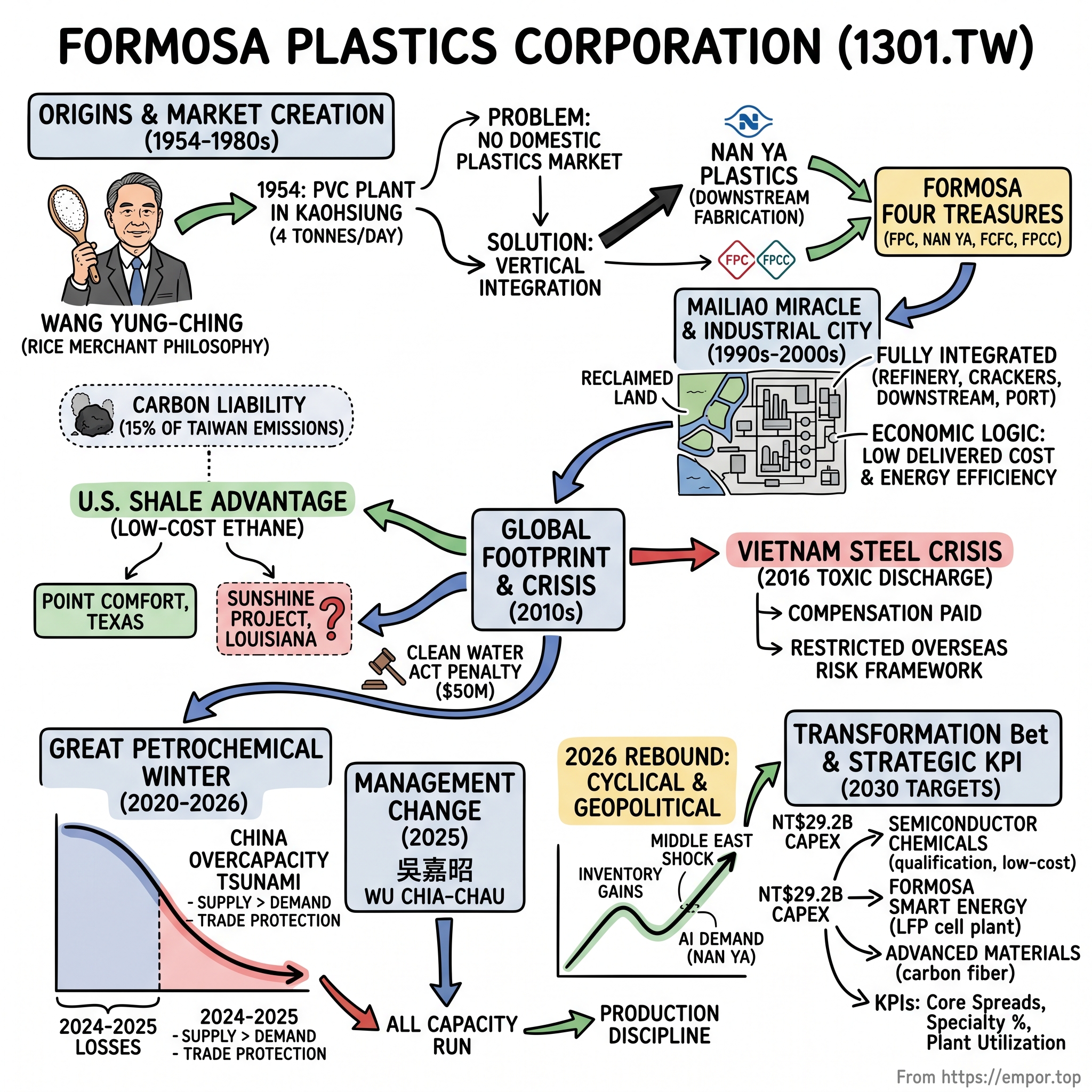
Formosa Plastics Corporation: The Petrochemical Titan at the Crossroads of Global Overcapacity
I. Introduction & Episode Roadmap (10 min)
On the morning of May 28, 2026, in a Taipei conference hall, the chairman of one of Asia's most historic industrial conglomerates stood before shareholders and apologized.
郭文筆 Kuo Wen-bee had a difficult figure to contextualize. 台灣塑膠工業 Formosa Plastics Corporation—the enterprise that laid the foundation for Taiwan's plastics sector and anchored a group that at its peak generated nearly one-tenth of the island's export economy—had lost NT$10.05 billion in 2025, yielding a loss per share of NT$1.58. It was the second consecutive annual loss in a corporate history extending back to 1954 that had, prior to 2024, never recorded an annual deficit.12
And yet, the board had approved a cash dividend of NT$0.50 per share, funded not from current earnings but from capital surplus—the accumulated paid-in reserves built over seven decades of profitable operations.2 It was a revealing act: a company distributing funds from its past because current operations could not support the payout.
Kuo did not linger on contrition. He pivoted to the first quarter of 2026, which produced NT$3.27 billion in after-tax profit—roughly 64 times the NT$50 million earned in the same period a year earlier—and stated that Formosa Plastics would return to profitability for the full year.3 Two months later, that guidance appeared conservative. When the four listed flagships known as the 台塑四寶 Formosa Four Treasures reported preliminary first-half results in July 2026, their combined net profit reached NT$108.45 billion, reversing a combined loss of roughly NT$21.3 billion from the first half of 2025.4
Is this a structural crisis or the strongest six-month recovery in years? Both descriptions are accurate, and untangling their interplay is central to evaluating the company's trajectory.
Formosa Plastics remains one of the world's largest manufacturers of polyvinyl chloride (PVC)—the essential resin used in water piping, window frames, cable insulation, and vinyl flooring—alongside polyethylene, polypropylene, caustic soda, acrylic esters, and superabsorbent polymers. Operating at the base of the industrial supply chain, it converts raw hydrocarbons into intermediate chemicals for downstream manufacturing. That position enabled seven decades of stable, long-term compounding. It is also the primary reason the company has faced severe operational headwinds over the past three years.
The operational reality presents a clear dichotomy. Formosa's 2024–2025 financial decline was structural: rapid petrochemical capacity expansion in China transformed the country from Formosa's primary export customer into its most aggressive competitor. By contrast, the 2026 rebound has been largely cyclical and geopolitical—triggered by a Middle East supply disruption that elevated prices for crude, naphtha, ethylene, and propylene. This price movement generated inventory gains and expanded refining margins for the group while coinciding with an AI-driven demand surge for electronic materials at sister company 南亞塑膠 Nan Ya Plastics.35 Crucially, these short-term catalysts do not eliminate the broader Chinese capacity overhang. Management noted to analysts in June 2026 that more than 5 million tonnes of new Chinese polyethylene capacity, 4 million tonnes of polypropylene, and over 1.2 million tonnes of ethylene-vinyl acetate (EVA) were still scheduled to enter service in the second half of 2026.6
The analysis unfolds across several key phases.
The narrative begins in Kaohsiung in 1954 with a U.S. aid loan, a former rice merchant, and a PVC facility whose initial capacity was cited as economically unviable—followed by the counterintuitive strategy that saved it: when market demand for raw resin proved insufficient, founder 王永慶 Wang Yung-ching established downstream fabrication businesses to consume the output. The focus then shifts to 麥寮 Mailiao, where the group reclaimed more than 2,200 hectares from the Taiwan Strait to build one of the world's largest single-site petrochemical complexes, analyzing the true economic value of that physical integration versus its market perception. Across the Pacific, in Point Comfort, Texas, and St. James Parish, Louisiana, shale-gas feedstock advantages collided with regulatory and legal challenges that have kept a $9.4 billion project stalled for nearly a decade. In Hà Tĩnh, Vietnam, a 2016 toxic discharge incident became a defining industrial environmental crisis in Southeast Asia, permanently altering how the group assesses overseas operational risk.
Subsequent sections evaluate segment economics to clarify core profit drivers; examine cost curves against peers including 萬華化學 Wanhua Chemical, Westlake Corporation, and 信越化學 Shin-Etsu Chemical; and assess expansion efforts in semiconductor chemicals, solar-grade EVA, and lithium iron phosphate batteries based on current operating scale rather than long-term projections. The study also reviews management disclosures across successive analyst calls for consistency, applies strategic frameworks including Helmer's 7 Powers and Porter's Five Forces, and outlines bull and bear investment cases—highlighting governance questions regarding capital surplus dividend distributions alongside substantial listed cross-shareholdings.
It begins with rice.
 Subscribe on LinkedIn
II. Origins & The Upstream-Downstream Creation Playbook (1954–1980s) (25 min)
The founding legend of Formosa Plastics begins with a scale used to measure grain.
Wang Yung-ching, born in 1917 into a tea-farming family in present-day New Taipei, left school at fifteen to work as a rice delivery boy. He borrowed NT$200 from his father to open his own rice shop. As local business tradition records, he differentiated his enterprise by sifting grit and husks from the grain before sale, delivering directly to customer homes, refilling storage bins so older rice remained on top, and tracking household consumption cycles to anticipate restocking needs. These operational habits reflected the philosophy of the industrial enterprise he later built: meticulous attention to unit metrics, service as a mechanism for customer retention, and a refusal to treat basic commodities as undifferentiated products.7
By the early 1950s, Wang had accumulated capital in the timber trade. Post-war Taiwan was pursuing industrial development supported by American economic aid, and government planners sought an entrepreneur to lead a local plastics project. In 1954, Wang secured a U.S. economic-aid loan under $1 million and established the entity that became Formosa Plastics to produce polyvinyl chloride (PVC) powder in Kaohsiung.7 The plant's initial design capacity was roughly four tonnes per day—a scale so modest that industry accounts frequently characterize it as among the least economically viable PVC facilities operating globally at the time.8
The commercial challenge followed immediately upon startup.
When the Kaohsiung facility began production, resin sales stalled. Taiwan in the late 1950s lacked a downstream plastics processing infrastructure; domestic manufacturers lacked the extruders, calendering machinery, and compounding capabilities required to convert raw PVC powder into commercial goods. Producing raw material without an established domestic market, Formosa faced mounting inventory and partner dissent.
Wang responded with a strategy that became a cornerstone of Taiwanese industrial growth. Rather than cutting prices or curtailing production, he expanded output while establishing 南亞塑膠 Nan Ya Plastics Corporation in 1958 to absorb the resin.8 Nan Ya converted raw PVC into pipes, films, artificial leather, and flooring. Where independent buyers remained too small or technically unprepared to purchase intermediate materials, the group extended operations further downstream into finished consumer goods.
In modern terms, this move represented vertical integration, but its primary function was market creation under structural constraints. Upstream chemical facilities rely heavily on high capacity utilization to absorb substantial fixed capital costs; operating a polymerization unit or cracker at 60 percent capacity sharply increases per-tonne production costs, whereas running near full capacity secures cost competitiveness. By internalizing downstream processing, Wang eliminated market demand risk for the upstream chemical asset, ensuring high capacity utilization and overall economic returns even if downstream margins remained narrow.
This vertical model defined the group's long-term structure, establishing the core companies known in Taiwan as the 台塑四寶 Formosa Four Treasures: Formosa Plastics Corporation producing basic resins, VCM, olefins derivatives, and chlor-alkali chemicals; Nan Ya Plastics converting resins into fabricated products and later electronic substrates such as copper-clad laminates; 台灣化學纖維 Formosa Chemicals & Fibre Corporation manufacturing aromatics, PTA, ABS, and synthetic fibers; and 台塑石化 Formosa Petrochemical Corporation providing refining and naphtha cracking operations for the group. Each company maintains an independent public listing, cross-holds equity in affiliated units, and participates in intra-group supply agreements.
This cross-shareholding structure forms a critical component of Formosa Plastics' financial profile. An investment in Formosa Plastics (1301.TW) represents an operating chemical producer combined with an equity portfolio in affiliated listed flagships, generating substantial equity-method investment income. During periods when core manufacturing margins contract, investment returns from affiliates can determine whether the company reports an operating net loss or profit. Subsequent sections return to this structural feature when examining financial disclosures.
Complementing this structural integration was Wang's management framework, known as the "thin-meat" doctrine (瘦肉理論, or thin-margin management). Derived from the analogy of a lean carcass requiring precise butchery, the framework mandated rigorous cost accounting across every facility, unit, and shift. Operating budgets were recalculated annually rather than rolled forward, and plant managers were required to detail material consumption variances at granular technical levels. Executive oversight included regular working lunch reviews (午餐會報), where management teams underwent detailed operational audits.
Whether this operational culture provides a durable competitive edge in 2026 remains a central question. Granular cost management continues to support plant maintenance efficiency and turnaround schedules, contributing to historically higher asset utilization rates in Taiwan compared to regional peers. However, operational discipline provides a relative advantage primarily among producers with similar structural cost bases. Superior operating efficiency alone cannot overcome structural feedstock disadvantages against Chinese coal-to-olefins facilities benefiting from regional power subsidies or U.S. Gulf Coast producers accessing low-cost ethane feedstock. This tension between operational execution and structural cost positioning remains central to evaluating the modern company.
Understanding how Formosa built its physical cost structure—and where its geographic constraints emerged—requires examining its signature domestic infrastructure project on the coast of Yunlin County.
III. The Mailiao Miracle & Industrial Integration (1990s–2000s) (30 min)
In the late 1980s, Formosa Plastics sought to build a naphtha cracker in Taiwan, but faced formidable state and political resistance.
The proposed Sixth Naphtha Cracker—known as 六輕 (Liouching) because it would be Taiwan's sixth such facility—was designed to break the state oil monopoly's control over ethylene supply. Every Taiwanese plastics fabricator, including Formosa, was required to buy ethylene and propylene from state-owned CPC Corporation. That arrangement left the entire downstream industry dependent on a single supplier that also competed against them in finished markets. Founder Wang Yung-ching's solution was to build an independent cracker.
The political environment, however, had shifted dramatically. Following the end of martial law in 1987, public opposition to environmental pollution emerged as a powerful democratic force. When Formosa proposed building in Yilan County on Taiwan's northeast coast, County Magistrate 陳定南 Chen Ting-nan publicly debated Wang on television and rejected the project. A subsequent proposal in Changhua County failed as well. In response, Wang threatened to move the entire project to mainland China—an option that alarmed government authorities in Taipei enough to serve as a high-stakes negotiating lever during a delicate period in cross-strait relations.
The eventual solution was unprecedented: if local authorities would not allocate land, Formosa would reclaim it from the sea. Beginning in 1991 off the coast of Mailiao, at the estuary of the Zhuoshui River in Yunlin County—then one of Taiwan's poorest and least industrialized regions—the group reclaimed 2,255 hectares of seabed.9 The resulting industrial park cost approximately US$19 billion to construct and became the largest single-site petrochemical complex in the world.10
Mailiao functioned not as a conventional manufacturing plant, but as a fully integrated industrial city. The complex encompasses a crude oil refinery with a capacity of roughly 540,000 barrels per day, naphtha crackers producing about 2.94 million tonnes of ethylene annually, and more than 50 downstream processing units covering olefins, plastics, and synthetic fibers. To maintain operational self-sufficiency, the site includes co-generation power plants, seawater desalination facilities, heavy equipment manufacturing shops, and its own deepwater commercial port, 麥寮港 Mailiao Port, allowing raw crude to arrive and finished products to depart without relying on third-party transport facilities.910
The economic logic behind this physical configuration demonstrates the practical value of complete vertical integration.
Consider two competing ethylene processors. Producer A purchases ethylene from an external vendor, requiring the gas to be chilled or pressurized, transported 50 kilometers by pipeline or tank truck, stored, and finally polymerized. Producer B cracks naphtha on-site and feeds gaseous ethylene directly through a 300-meter pipeline into an adjacent polymerization unit. Because ethylene is gaseous at ambient conditions, long-distance transport requires costly refrigeration, pressurized tanks, specialized shipping infrastructure, and inevitable transmission losses. The delivered-cost difference per tonne between Producer A and Producer B can exceed the entire operating margin during a market downturn. At Mailiao, that same co-location principle extends across ethylene, propylene, vinyl chloride monomer (VCM), chlorine, and caustic soda, minimizing transport overhead and material losses across the entire production chain.
Co-location also yields substantial energy efficiencies. Chemical processing requires massive amounts of power and industrial steam. By generating electricity on-site through co-generation facilities and capturing exhaust heat as process steam, Mailiao achieved higher total thermal efficiency than facilities relying on commercial grid power and standalone boilers. For decades, this setup provided a thermal and electricity cost base that grid-dependent competitors could not match.
While Mailiao secured low delivered costs, logistic independence, and protection from state supply monopolies, the complex also generated structural liabilities that became apparent over the following two decades.
The first constraint involves carbon intensity. Formosa Plastics Group accounts for roughly 15 percent of Taiwan's total greenhouse gas emissions—an exceptionally high concentration for a single corporate group that directly stems from operating a coal-fired, heavily integrated mega-complex.11 As global regulatory regimes implement carbon pricing and industrial decarbonization mandates, Mailiao's co-generation power structure transforms from a low-cost operational advantage into a growing carbon liability.
The second constraint involves feedstock economics. Mailiao relies on cracking naphtha, a crude-oil derivative. While naphtha was the standard regional feedstock when the facility was planned in 1991, the relative cost structure shifted after 2010. The U.S. shale boom made ethane—a natural gas liquid—the world's lowest-cost ethylene feedstock, while Chinese producers built extensive coal-to-olefins capacity in Inner Mongolia and Xinjiang after 2015. Because a naphtha cracker's competitiveness depends on crude oil remaining inexpensive relative to natural gas and coal, Formosa's primary domestic asset has faced a structural cost disadvantage for much of the past fifteen years. Reflecting this shift, Formosa Petrochemical has retrofitted one of its Mailiao crackers to process imported ethane feedstock—a physical modification that underscores the reduced competitiveness of the original naphtha-only design.11
For more than half a century, strategic decision-making rested with the founding patriarchs.
Wang Yung-ching died in October 2008 at age 91 during an inspection visit to the group's U.S. operations in New Jersey. His younger brother and co-founder Wang Yung-tsai, who personally supervised Mailiao's construction, passed away in 2014.7 Their deaths left the conglomerate facing a succession transition common to family-founded industrial empires: managing a sprawling corporate asset base across second- and third-generation family members, complex offshore trust arrangements, and no single designated successor.
To prepare for leadership transition, the founders established a two-tier governance structure in 2001 that separated ownership oversight from operational management. Day-to-day operations were delegated to an executive committee comprising senior managers from the four flagship companies, while family members maintained oversight through an administrative council. For years, 王文淵 Wang Wen-yuan, the founder's nephew, bridged both bodies by serving simultaneously as chairman of the oversight council and president of the operating committee.
That leadership structure shifted on August 15, 2025. Wang Wen-yuan, then 78, stepped down as group president in favor of 吳嘉昭 Wu Chia-chau, then 81. Wu, a veteran executive who had served as president of Nan Ya Plastics since 2006 and its chairman since 2013, became the first non-family member to hold the group's top executive post.12
Wu took office during a period of acute operational stress, as all four listed flagships recorded net losses in the first half of 2025. Prior to his appointment, Wu led a cross-company transformation task force focusing on specialty product development, decarbonization, energy efficiency, and digitalization.12 Elevating a career professional manager over family heirs signaled a strategic focus on operational execution. The long-term impact on capital allocation remains to be evaluated, but an initial NT$29.2 billion capex reallocation toward semiconductor chemicals and healthcare applications indicates an emerging shift away from traditional bulk commodity expansion.3
Even before this domestic succession, however, the group had already initiated its largest overseas expansion—crossing the Pacific to leverage cheap ethane feedstocks unlocked by the U.S. shale revolution.
IV. Global Footprint & Inflection Points: U.S. Shale & Vietnam Steel (2010s) (25 min)
Along Lavaca Bay near Point Comfort, Texas, Formosa Plastics has manufactured chemicals since the early 1980s. For decades, the site operated as a standard overseas subsidiary until global energy geology intervened.
The American shale boom of the 2010s reshaped global petrochemical economics beyond what operational discipline alone could offset. Hydraulic fracturing unlocked vast reserves of natural gas and ethane—a liquid hydrocarbon that cracks into ethylene more cheaply and with higher yields than crude-derived naphtha. U.S. Gulf Coast ethane crackers purchase feedstock priced off domestic natural gas, which traded at a fraction of crude oil on an energy-equivalent basis throughout the 2010s and 2020s. When that price spread widens, American producers secure a structural cost advantage of hundreds of dollars per tonne over Asian naphtha-based facilities regardless of plant-level management efficiency.
Formosa recognized this structural shift early. Formosa Plastics Corporation U.S.A. expanded aggressively at Point Comfort and in Baton Rouge, Louisiana, adding ethane cracking, polyethylene, and derivative chemical capacity. The strategic rationale was clear: an Asian producer facing a widening naphtha cost disadvantage could hedge its corporate margin profile by acquiring low-cost ethane assets at the bottom of the global cost curve.
The strategic pivot yielded tangible benefits, albeit unevenly. During the June 2026 conference call, management highlighted U.S. operations as a key performer, contributing approximately NT$3 billion in a single quarter and exceeding internal projections at a time when domestic Taiwanese plant utilization had dropped sharply.5 For a conglomerate facing domestic headwinds, the American assets provided the structural buffer they were designed to deliver.
However, the U.S. expansion strategy encountered severe friction in Louisiana.
The Sunshine Project, or how to spend a decade not building a plant.
In 2015, Formosa announced plans for an integrated chemical complex in St. James Parish, Louisiana—a 2,400-acre site along the Mississippi River in an industrial corridor often called Cancer Alley by local residents and environmental advocates. Branded as the Sunshine Project, the multi-phase facility was designed to produce ethylene, propylene, ethylene glycol, and derivative polymers at an estimated capital cost of $9.4 billion.13 It represented one of the largest planned industrial investments in American history.
The project stalled in pre-construction permitting. Local and national environmental groups challenged the complex's air permits, which a Louisiana state judge vacated in September 2022. Although a state appeals court reinstated the permits in January 2024,14 air approvals were not the primary obstacle. Construction required a federal wetlands permit from the U.S. Army Corps of Engineers, which ordered a full environmental impact statement in 2021—a review process spanning multiple years.15 Reporting indicated the project had been paused for four years while Formosa engaged with federal regulators, with no public clarity on when the environmental review would conclude.16 The complex remained unbuilt as of mid-2026.
From an investment perspective, this prolonged delay presents contrasting implications.
On one hand, a decade of pre-construction expenditure, legal fees, land carrying costs, and administrative oversight generated zero operational revenue. Unlike peers such as Westlake Corporation and Dow, which expanded U.S. capacity primarily through brownfield debottlenecking, targeted acquisitions, and existing site expansions, Formosa pursued a greenfield megaproject strategy. That approach underestimated U.S. regulatory and environmental litigation risks. The group's domestic playbook—leveraging scale and capital to navigate local opposition—did not translate to the U.S. legal framework.
On the other hand, halting construction before committing major capital limited financial damage. With global petrochemical markets facing excess supply, uncommitted capital of $9.4 billion effectively preserved strategic optionality. Formosa avoided carrying heavy depreciation charges on underutilized assets. Had the Sunshine Project come online during the market downturn of 2024 and 2025, operating losses likely would have expanded significantly. While this outcome stemmed from regulatory delays rather than intentional market timing, it limited downside pressure on the balance sheet.
Point Comfort and the price of nurdles.
Meanwhile, at its existing Texas site, Formosa faced distinct regulatory and environmental hurdles. A campaign led by local activist Diane Wilson and volunteers, who documented plastic resin pellet discharges—known as nurdles—in Lavaca Bay, resulted in a federal Clean Water Act lawsuit. In December 2019, a federal court approved a $50 million settlement, the largest ever in a citizen-brought Clean Water Act suit, establishing a trust for local environmental remediation and imposing a binding zero-discharge standard with daily financial penalties for non-compliance.1718 Wilson was subsequently awarded the Goldman Environmental Prize for the campaign.19
While the monetary settlement was manageable for the group, the legal precedent demonstrated that community oversight and federal judicial enforcement could impose binding operational restrictions on foreign multinationals in the United States, generating persistent reputational exposure.
Hà Tĩnh: the disaster that reset the risk framework.
The regulatory challenges in North America were surpassed by a major operational crisis in Southeast Asia in April 2016.
Formosa Ha Tinh Steel (台塑河靜鋼鐵)—a Formosa-led joint venture representing over $10 billion in investment and Vietnam's largest foreign direct investment project at the time—released toxic wastewater off the coast of Hà Tĩnh province during facility commissioning. The discharge caused widespread marine mortality along more than 200 kilometers of coastline, disrupting local fishing economies and prompting rare public protests across the country. Formosa accepted responsibility and paid $500 million in compensation.
The financial penalty was survivable, but the strategic ramifications proved far-reaching. The Hà Tĩnh incident fundamentally altered how the group evaluates overseas project risks, marking a shift from founder-era assumptions that scale, capital investment, and employment generation could offset community opposition toward a recognition that environmental compliance is a strict constraint. The group's subsequent caution regarding U.S. permitting and its integration of environmental metrics into executive oversight reflect this broader shift in risk management.
The steel complex has since developed into a major manufacturing asset, producing approximately 5.68 million tonnes of steel billets on $2.91 billion in revenue in 2025, and 3.13 million tonnes on $1.56 billion in revenue during the first half of 2026, with long-term plans to expand annual capacity toward roughly 14.8 million tonnes through additional blast furnaces.2021 However, the business remains highly cyclical, recording a net loss equivalent to roughly $654 million in 2023.20 For Formosa Plastics shareholders, the steel venture functions as a non-core associate holding outside chemical manufacturing—highly cyclical, capital-intensive, and carrying ongoing reputational and legal oversight.
By the end of the 2010s, Formosa Plastics operated with an established Asian manufacturing base, a profitable U.S. ethane hedge, an ongoing regulatory stalemate in Louisiana, and restructured risk protocols following the Vietnam crisis. However, none of these developments fully prepared the company for the rapid structural transformation about to occur in its largest export market.
V. The Great Petrochemical Winter & China's Supply Tsunami (2020–2026) (30 min)
For roughly three decades, the most reliable assumption in Taiwanese petrochemicals was that mainland China would absorb whatever regional plants produced.
China's construction boom consumed vast quantities of PVC for pipes, window frames, and flooring. Its manufacturing base absorbed polyethylene and polypropylene, while its textile mills ran on imported fiber intermediates. Taiwanese producers—benefiting from shared language, geographic proximity, and preferential cross-strait tariffs—served as primary suppliers. In a direct sense, Mailiao was built to feed this Chinese industrial expansion.
Then Beijing prioritized domestic chemical production.
The policy driver was national self-sufficiency. Identifying feedstock import dependence as a strategic vulnerability, Chinese policymakers directed state and private capital toward building domestic capacity. Private mega-refiners—including Hengli Petrochemical, Rongsheng Petrochemical, Zhejiang Petrochemical, and 萬華化學 Wanhua Chemical—constructed integrated refining-to-chemical complexes at an unprecedented scale. Simultaneously, coal-rich inland provinces established coal-to-olefins facilities, converting cheap domestic coal into ethylene and propylene. Supported by local power and land subsidies, these plants prioritized regional employment over strict economic returns, creating a cost structure opaque to international competitors.
The consequences unfolded in three distinct waves.
Wave one: export demand collapsed. As Chinese self-sufficiency across basic polymers expanded rapidly, imports from Taiwan, South Korea, and Japan were displaced. A primary destination for Formosa's bulk output rapidly contracted.
Wave two: China became an aggressive exporter. Having built capacity far beyond domestic needs, Chinese producers redirected surplus volumes into Southeast Asia and India at prices that set regional market clearing levels. The scale was immense: China exported roughly 1.33 million tonnes of PVC to India in 2024 alone, accounting for more than half of its total PVC exports.22 India responded in August 2025 when its trade authority recommended anti-dumping duties on suspension-grade PVC imports.23 Crucially for Formosa, those recommended duties targeted imports not just from China, but also from Indonesia, Japan, South Korea, Thailand, the United States, and Taiwan.23 Trade protection in Formosa's key growth market proved to be an additional barrier rather than a shield.
Wave three: end-market demand collapsed. China's property downturn severely curtailed construction activity, the primary end market for global PVC. As housing starts dropped and developers defaulted, construction-linked polymer demand fell sharply. The massive supply expansion and the demand collapse hit the market simultaneously from the same source.
The financial math was brutal. Petrochemical margins depend on the spread between product prices and feedstock costs. When Chinese oversupply capped polymer prices while crude oil kept naphtha costs elevated, margins for naphtha-based producers compressed sharply. In 2024, Formosa Plastics posted a net loss attributable to shareholders of NT$1.27 billion, as combined profits across the four Formosa flagships dropped roughly 81% to NT$8.37 billion on revenue of NT$1.47 trillion.24 Management cited weak demand and Chinese overcapacity, while noting that prospective U.S. tariff policies could impede recovery.24
The downturn deepened in 2025. Through the first nine months of 2025, Formosa Plastics recorded an operating loss of NT$5.14 billion—compared with NT$2.78 billion a year earlier—and a net loss of NT$7.18 billion, as revenue fell 10% to NT$134.31 billion and gross margin shrank from 5% to roughly 3%.25 The full year ended with revenue down 12% to about NT$175.4 billion and a pre-tax loss of roughly NT$10.2 billion,262 capped by a fourth-quarter pre-tax deficit of NT$2.88 billion.6
The gap between operating losses and net results highlights the underlying severity. A 3% gross margin indicates that basic production barely covered variable costs before accounting for fixed overhead and depreciation—effectively operating near cash break-even. Unlike in 2024, when equity income from affiliates offset core losses, affiliate returns provided no relief in 2025 because all four listed flagships recorded net losses during the first half of the year.12
In response, management departed from a core founding principle. For decades, the group adhered strictly to full capacity utilization (全開全銷, or "run everything, sell everything"), reflecting Wang Yung-ching's belief that high volume was necessary to absorb fixed costs. However, under negative product spreads, high utilization simply converted working capital into unpayable inventory. Formosa broke with tradition by lowering operating rates, extending maintenance turnarounds, and curtailing unprofitable lines. By the first quarter of 2026, plant utilization reflected this disciplined selection: PVC and superabsorbent polymers operated above 90% capacity, whereas high-density polyethylene (HDPE) and linear low-density polyethylene (LLDPE) were throttled to between 60% and 80%.5 This operational shift marked a strategic pivot, acknowledging that the market downturn was structural rather than temporary.
This context frames the sharp financial rebound observed in 2026. In the first quarter of 2026, Formosa Plastics posted revenue of NT$41.99 billion—up 2.1% sequentially though down 11.1% year-over-year—and returned to a pre-tax profit of NT$3.38 billion.6 The recovery was driven not by Chinese capacity rationalization, but by geopolitical supply shocks. Conflict in the Middle East disrupted crude and naphtha flows while damaging regional petrochemical infrastructure—affecting roughly five million tonnes of polyethylene and 4.5 million tonnes of polypropylene capacity, according to company estimates—which drove ethylene and propylene prices higher.13 Producers with lower-cost inventory realized substantial inventory gains while refining margins expanded, enabling Formosa to increase product prices in April 2026.27
These gains accelerated in the second quarter. The four flagships reported a combined second-quarter net profit of NT$64.28 billion, up 45.5% sequentially, bringing their combined first-half net profit to NT$108.45 billion.4 Formosa Plastics generated first-half earnings per share of NT$2.19, while Nan Ya Plastics—benefiting from strong demand for AI-related electronic substrates and copper-clad laminates—reported record earnings per share of NT$5.17.4
Yet these profit numbers mask ongoing operational constraints. During the second quarter of 2026, Formosa Plastics operated at approximately 60% capacity—down from the first quarter due to feedstock constraints—though management projected utilization would recover toward 80% in the third quarter as raw material supplies normalized.56
Strong earnings achieved at 60% capacity reflect external price spikes and affiliate equity income rather than fundamental structural improvement. The 2026 rebound represents a cyclical recovery fueled by inventory gains and affiliate contributions. It bolsters liquidity, but does not resolve the Chinese capacity overhang. Management acknowledged this reality to analysts, cautioning that Chinese additions would continue exerting market pressure through 2027.6
Assessing the company's long-term earnings durability requires examining the underlying performance across individual operating segments.
VI. Segment-Level Deep Dive & Core Economics (35 min)
Stripping away the holding-company structure reveals that Formosa Plastics operates essentially as four primary commodity divisions alongside targeted higher-value initiatives.
The Plastic Division — chlorine, salt, and the two-sided molecule.
Polyvinyl chloride (PVC) represents the core identity of Formosa Plastics, governed by an economic relationship inherent to chlor-alkali manufacturing. PVC production relies on vinyl chloride monomer (VCM), synthesized from ethylene and chlorine. Chlorine is produced through the electrolysis of brine—passing electricity through saltwater—a process that inevitably yields caustic soda in a joint production ratio of roughly 1.1 tonnes of caustic soda per tonne of chlorine. A manufacturer cannot produce one chemical without generating the other.
As a result, an integrated chlor-alkali PVC producer operates two businesses with linked production mechanics but divergent end markets. Chlorine feeds PVC production for construction materials, whereas caustic soda is consumed in alumina refining, pulp and paper, textiles, and semiconductor processing. When construction activity declines and PVC spreads compress, caustic soda prices can remain resilient due to independent industrial demand. That dynamic materialized during the recent downturn: during the June 2026 investor call, management identified caustic soda and acrylic esters—rather than PVC or polyethylene—as the primary profit drivers for the first quarter of 2026.5 Operational analysis for the quarter indicated that PVC and polyethylene combined accounted for approximately 43% of total revenue while both product lines remained unprofitable.28
This operational reality highlights a central challenge: products representing over 40% of top-line revenue have struggled to achieve profitability, shifting earnings reliance onto co-products, specialty downstream chemicals, U.S. operations, and equity returns from affiliates.
Competitive dynamics reinforce this pressure. In global PVC markets, Formosa competes against 信越化學 Shin-Etsu Chemical—whose U.S. subsidiary Shintech operates as the world's largest PVC producer backed by low-cost American ethane and integrated chlor-alkali units—and Westlake Corporation, which shares similar Gulf Coast feedstock and energy advantages. Against these low-cost peers, a Taiwanese naphtha-based PVC facility occupies a mid-to-high position on the global cost curve. Against Chinese coal- and calcium-carbide-based producers operating on subsidized regional power, Formosa acts as a price taker. Furthermore, Formosa's caustic soda revenue faced headwinds during the period due to scheduled plant maintenance and Chinese tariff restrictions.6 Consequently, the core PVC franchise lacks pricing power in international markets.
The Polyolefin Division — where the primary swing factor lies.
High-density polyethylene (HDPE), linear low-density polyethylene (LLDPE), and polypropylene face even greater commoditization than PVC, operating under extensive global capacity additions. While LLDPE revenue rose 22.1% during the reported period, ethylene-vinyl acetate (EVA) represents a more strategically significant product line.6
EVA serves as the encapsulant film in solar photovoltaic panels, sandwiching solar cells to protect them over a multi-decade operating life. Solar-grade EVA requires high chemical purity to prevent panel efficiency degradation, commanding a price premium over commodity EVA used in footwear and packaging. Formosa's EVA revenue expanded 7.3% during the period, driven by solar panel manufacturers accelerating purchases ahead of anticipated tariff adjustments.6
However, the growth outlook for solar-grade EVA remains constrained. The solar supply chain is heavily concentrated among Chinese manufacturers facing their own structural overcapacity, with China scheduled to bring more than 1.2 million tonnes of new EVA capacity online in the second half of 2026 alone.6 Rapid capacity additions threaten to compress margins in high-value niches, while demand pulled forward by tariff deadlines risks softening sales in subsequent quarters.
The Chemicals Division — steady income contributor.
The Chemicals Division encompasses acrylic acid and esters, superabsorbent polymers (SAP), acrylonitrile, and methyl methacrylate (MMA). SAP—used in personal hygiene products such as diapers and incontinence items—benefits from demographically driven, recession-resistant demand, enabling Formosa's production lines to operate above 90% utilization in the first quarter of 2026.5 Acrylic esters also served as a major profit contributor during the quarter.5 While less prominent than solar or semiconductor materials, this segment has delivered more consistent profitability than the core plastics portfolio, though ongoing regional capacity expansion across Asia continues to cap margin expansion.
Advanced Materials and Fibres — long-term optionality.
The Advanced Materials and Fibres division produces carbon fiber for industrial applications, wind turbine blades, and hydrogen storage tanks. Although these product lines yield attractive gross margins, their contribution to overall corporate revenue remains small. They represent strategic optionality rather than near-term earnings drivers.
Where this leaves the cost curve.
Three primary feedstock pathways currently compete for global market share. U.S. ethane crackers utilize natural gas liquids derived from shale production, maintaining the lowest cost position globally whenever oil prices remain elevated relative to natural gas. Chinese coal-to-olefins facilities process domestic coal, operating with cost structures influenced by regional coal prices and local government support. Taiwanese and South Korean naphtha crackers utilize crude oil derivatives, leaving their cost competitiveness directly linked to the crude-to-gas price ratio.
The Middle East supply disruptions in 2026 temporarily altered market dynamics by elevating crude prices and reducing regional output, lifting derivative chemical prices faster than naphtha feedstock costs in select supply chains. While this movement improved Formosa's short-term financial performance, it did not alter the company's fundamental position on the global cost curve. As regional supply normalizes and product spreads revert toward historical averages, naphtha-based producers face renewed structural cost pressure—making third-quarter plant utilization guidance of roughly 80% a key operational metric alongside product spreads.5
In response to these cost curve pressures, management has increasingly sought to shift capital away from low-margin commodity expansion toward higher-value specialty products.
VII. Emerging Material Bets & Sizing Speculative Optionality (20 min)
During extended industry downturns, commodity producers routinely announce strategic pivots into specialty chemicals. The critical analytical question is not whether management outlines a pivot, but whether the capital reallocation is large enough to alter corporate economics and specific enough to verify against operating results.
Formosa Plastics has disclosed unusually detailed targets, providing a clear benchmark for evaluation.
At the May 2026 shareholder meeting, the company detailed a NT$29.2 billion capital expenditure program focused on semiconductor chemicals, clean technology, and healthcare materials, alongside expansions in carbon fiber, synthetic fibers, and hexene.3 During the June investor call, management quantified these initiatives, citing more than 50 transformation projects underway at Formosa Plastics Corporation alone. These projects target over NT$30 billion in incremental output value and are projected to contribute 10% to 20% of company profits by 2030, while raising the portfolio's differentiated product share from 50% toward 60% by the end of 2026.63 Across all four group flagships, the program encompasses 113 transformation projects targeting roughly NT$38.6 billion in combined annual benefit by 2030.4
This capital program represents a gradual portfolio mix shift rather than a total corporate transformation. Commodity resins and basic industrial chemicals still generate the vast majority of top-line revenue, and management’s long-term targets limit specialty contributions to a minority of earnings by 2030. Formosa Plastics remains fundamentally a commodity producer.
Nevertheless, several underlying initiatives carry greater strategic credibility than typical commodity-chemical pivots due to structural advantages embedded within the group's manufacturing infrastructure.
1. Semiconductor-grade chemicals: leveraging integrated streams.
Semiconductor fabrication requires extensive volumes of ultra-pure process chemicals—including sulfuric acid, hydrofluoric acid, hydrochloric acid, hydrogen, and isopropyl alcohol (IPA)—for wafer cleaning and surface preparation. While the underlying chemical formulas are conventional, electronic-grade specifications demand purity measured in parts per trillion, making advanced distillation, ultra-clean packaging, and customer qualification the primary barriers to entry.
Formosa’s structural advantage stems from its existing scale at Mailiao, where it already manufactures industrial-grade versions of these base molecules. Upgrading an established chemical stream to electronic grade requires significantly less capital than constructing greenfield facilities. On the June 2026 call, management claimed its production cost for electronic-grade chemicals was roughly half that of standalone peers.5 While this assertion awaits independent verification, the strategy mirrors the vertical integration framework established during Nan Ya's founding: capturing downstream margin from an internally supplied feedstock.
Execution is proceeding through joint ventures and targeted operating units, including an isopropyl alcohol expansion, a joint venture with Daikin Industries producing electronic-grade hydrofluoric acid—with plans for a second-phase expansion and potential public listing—and a German subsidiary operating a recycled-IPA unit serving 台積電 TSMC, where management projected earnings would roughly double following expansion.5 The recycled-IPA model generates dual revenue streams from a single molecule, collecting fees for spent solvent collection while selling purified product back to foundry customers.
This market positioning introduces distinct competitive dynamics. Serving Taiwan’s concentrated foundry ecosystem creates high switching costs through rigorous customer qualification processes that commodity resin lines lack. However, it also exposes chemical suppliers to customer concentration risks, tying operating returns directly to foundry capital expenditure cycles and commercial terms.
2. Photovoltaic-grade EVA: margin enhancement under supply constraints.
As noted in segment evaluations, converting commodity ethylene-vinyl acetate lines to high-purity solar encapsulant grade allows Formosa to capture higher realized prices without committing capital to new cracking capacity. However, rapid capacity expansion across China's solar supply chain limits the long-term defensibility of this pricing premium.
3. 台塑新智能 Formosa Smart Energy: targeted battery cell optionality.
Through its advanced energy subsidiary, the group committed over NT$16 billion to construct Taiwan's largest lithium iron phosphate (LFP) cell manufacturing facility in Changhua's Changbin Industrial Park. The 5-gigawatt-hour project completed its initial 2.1-gigawatt-hour phase in the third quarter of 2024, creating approximately 900 jobs.29 A planned NT$10 billion second phase, designed to add 2.9 gigawatt-hours of cell capacity and 2.9 gigawatt-hours of battery modules, is scheduled for completion around 2027.30
LFP chemistry offers operational advantages for utility-scale energy storage and commercial transit, combining lower raw material costs and longer cycle life with enhanced thermal stability relative to nickel-based chemistries. As Taiwan expands grid storage to support renewable energy integration and nuclear decommissioning, domestic sourcing preferences provide a captive local market.
However, global battery economics remain dominated by Chinese producers such as 宁德时代 CATL and 比亚迪 BYD, operating with manufacturing footprints measured in hundreds of gigawatt-hours. A 5-gigawatt-hour facility cannot achieve global cost parity against top-tier producers, operating instead as a niche supplier for domestic applications. Sized as a small fraction of group capital expenditure, the venture functions as a disciplined strategic option on Taiwan's energy transition rather than a global scale play.
4. 台勝高 Formosa Sumco Technology (3532.TW): capital intensity in electronic materials.
The silicon wafer joint venture with Japan's Sumco Corporation produces 8-inch and 12-inch semiconductor wafers, with 12-inch substrates generating over 70% of revenue from foundry and memory customers.31 Long regarded as the group's primary exposure to semiconductor growth, the venture recently highlighted the financial risks inherent to electronic materials expansion.
Earnings per share at the venture declined from NT$3.35 in 2024 to NT$1.58 in 2025, followed by a net loss of NT$0.18 per share in the first quarter of 2026—its first quarterly deficit in several years. This margin compression was driven primarily by depreciation overhead from a NT$28.3 billion 12-inch wafer facility in Mailiao, announced in 2021, which entered its depreciation schedule in early 2026 and pushed operating results below breakeven.31 Concurrently, Sumco Corporation reduced its equity stake in the joint venture from 45.05% at year-end 2024 to 43.25% at year-end 2025.31
The venture's financial trajectory underscores a broader structural reality: expanding into semiconductor materials does not eliminate exposure to capital cycles. While electronic materials offer higher switching costs and customer stickiness than commodity resins, advanced wafer manufacturing remains a capital-intensive, depreciation-heavy business subject to severe cyclical fluctuations during demand digestion periods.
Consequently, assessing Formosa Plastics' long-term outlook requires examining not only the capital allocated to these emerging ventures, but also how management communicates and executes these strategic priorities across industry cycles.
VIII. Primary Sources, Transcripts & Management Credibility (20 min)
Evaluating Formosa Plastics Corporation requires examining its primary disclosure framework.
Formosa Plastics conducts quarterly institutional investor conferences (法人說明會) through Taiwanese brokerages, providing presentation decks and webcasts. Recent sessions occurred on March 13, 2026, and June 26, 2026, following calls in September and December 2025.28 Material announcements, financial statements, and board resolutions are submitted to the Taiwan Stock Exchange’s Market Observation Post System, which serves as the authoritative primary repository.32 Consolidated annual reports and sustainability filings are published on the company's investor relations portal,[^33][^34]33 while annual general meetings—the forum for dividend approval and formal shareholder interaction—take place in late May.2
Tracking management's disclosures across two years reveals a clear evolution in how leadership has characterized corporate underperformance.
In late 2024, management framed operational headwinds as primarily macroeconomic and cyclical, citing weak demand, falling crude oil prices, broader oversupply, and risks that changing U.S. tariff policies could delay recovery.24 While the company publicly warned of ongoing volatility,34 the underlying message treated the downturn as a standard cyclical trough.
By the May 2026 shareholder meeting, executive commentary had shifted toward structural realities. Leadership attributed the 2025 net loss to excess global petrochemical capacity originating from both China and the United States, aggressive regional pricing, sluggish Chinese domestic demand, and trade barriers.23 This shift acknowledged a structural transformation rather than a temporary cycle, implicating the industry-wide buildout—including U.S. ethane additions—in regional oversupply.
By the June 2026 investor conference, disclosures became increasingly quantitative. Management detailed specific Chinese capacity additions expected across individual product lines for the second half of 2026, indicated that market pressure would likely persist through 2027 as project commissioning schedules slipped, and characterized the sector recovery as L-shaped—suggesting the acute operational trough had passed, but full margin normalization would require extended time.628 Management further quantified downstream destocking, noting that Indian PVC customers were holding approximately 600,000 tonnes of inventory compared to typical operational levels of 450,000 to 500,000 tonnes.5
This communicative progression—from broad macroeconomic attribution to structural acknowledgment and specific, quantitative timelines—reflects growing transparency. By framing expectations around an extended recovery timeline while projecting full-year profitability, executive leadership established concrete benchmarks for operational performance.
However, three key aspects of management's narrative present strategic and analytical tensions.
First, the underlying composition of the 2026 recovery. Chairman Kuo's forecast of full-year profitability relies significantly on external catalysts: elevated crude oil prices resulting from Middle East supply disruptions, unexpected outages at regional competitor facilities, and non-operating investment income from affiliates.3 While management disclosed that second-quarter margin expansion stemmed from lower-cost inventory gains and affiliate equity contributions,2 an analytical asymmetry remains. Executive communications characterized 2025 losses as structural, yet the 2026 profit rebound was largely driven by temporary supply disruptions. Consequently, the baseline run-rate earnings power of core chemical manufacturing may align more closely with 2025 operating conditions than second-quarter 2026 headline results.
Second, capital distribution choices amidst operating deficits. The board's decision to distribute a cash dividend of NT$0.50 per share from capital surplus following a NT$10.05 billion net loss highlights contrasting capital allocation perspectives.2 From a supportive viewpoint, maintaining a payout signals balance-sheet strength and ongoing commitment to shareholder returns during an industry trough. Conversely, funding distributions from paid-in capital while core operations generate negative cash flow effectively returns capital rather than distributing operational yield, raising questions about capital conservation during a prolonged structural downcycle. Furthermore, the board authorized monetizing a portion of its Nan Ya Plastics equity stake to bolster liquidity,5 combining cross-shareholding divestments with capital surplus distributions.
Third, capital allocation clarity around the U.S. expansion. Institutional analysts have repeatedly queried the status and capital commitments for the $9.4 billion Sunshine Project in Louisiana, yet management has not disclosed a definitive decision or updated timeline. Although federal environmental review delays from the U.S. Army Corps of Engineers remain outside the company's direct control, multi-year delays leave substantial strategic uncertainty. Expanded disclosure regarding cumulative capitalized expenditures and formal criteria for project continuation or cancellation would enhance corporate reporting transparency.
More broadly, Formosa Plastics' capital allocation record reflects a mix of strategic successes and persistent structural frictions. Expanding into U.S. ethane cracking provided a critical cost buffer that actively contributed to recent earnings. Abandoning full capacity utilization in favor of production discipline marked a necessary operational shift away from long-standing founding doctrine. Additionally, targeted investments in specialty chemicals represent a disciplined portfolio rebalancing. Conversely, adapting to China's rapid chemical self-sufficiency occurred slowly, the Louisiana megaproject remains stalled after a decade of planning, and the conglomerate's complex architecture—encompassing four listed flagships, extensive cross-shareholdings, and a cyclical, capital-intensive steel associate in Vietnam—continues to generate a corporate complexity discount.
Regarding executive governance, Kuo Wen-bee serves as chairman of Formosa Plastics Corporation, while Wu Chia-chau has directed overall group management as president since August 2025, with executive compensation linked to group operating profitability and sustainability benchmarks. A notable operational indication occurred in July 2026, when group management approved a 4.5% wage increase—exceeding the union's 3.66% request—alongside enhanced housing and meal subsidies, representing the largest raise since 2022, enacted immediately following the disclosure of strong first-half earnings.35 This decision demonstrates a management practice of distributing financial gains to workforce stakeholders during earnings recoveries, while signaling executive confidence in near-term operational stability.
Evaluating whether this operational confidence translates into durable competitive advantages requires applying formal strategic frameworks.
IX. Strategic Frameworks: 7 Powers & 5 Forces (20 min)
Evaluating Formosa Plastics through the lens of structural advantage yields a clear and largely challenging picture.
Hamilton Helmer's 7 Powers
Scale Economies — medium and weakening. Mailiao remains the world's largest single petrochemical complex, and within Taiwan and much of Southeast Asia that scale is decisive.10 But scale economies only confer power when a competitor cannot match that scale. Chinese integrated refining-to-chemicals complexes built over the last decade equal or exceed Mailiao, while Middle Eastern producers combine scale with feedstock at prices no Asian cracker can approach. Formosa has scale, but it no longer possesses differential scale.
Process Power — genuinely high, and genuinely insufficient. The thin-meat operating culture is not marketing. It shows up in maintenance costs, turnaround duration, and historical asset utilization. It is also the hardest power for a competitor to copy because it is embedded in decades of accumulated institutional practice rather than in physical equipment. The limitation is simple arithmetic: process excellence might be worth tens of dollars per tonne, whereas the feedstock gap between naphtha and subsidized coal or cheap ethane is worth multiples of that figure. Superior process power on an inferior cost curve produces a company that loses money more efficiently than its neighbors.
Counter-Positioning — essentially absent. PVC is PVC. A polyethylene pellet from Mailiao is chemically indistinguishable from one made in Ningbo or Houston. There is no business model a competitor cannot imitate without harming an existing franchise, because there is no differentiated franchise to protect. The one area where counter-positioning could emerge is the semiconductor chemicals expansion—where an incumbent specialty producer might struggle to match an integrated giant's feedstock cost—but that remains a hypothesis awaiting operational proof rather than an established power.
Cornered Resource — medium, and narrower than it appears. The proprietary deepwater port, co-generation assets, and physical integration of Mailiao are real and cannot be replicated in Taiwan, where environmental permitting alone would prove impossible today. The Sumco joint venture provides access to wafer technology unavailable to most chemical producers.31 However, a cornered resource must confer differentiated economics, and Mailiao's infrastructure primarily confers cost parity with global peers who enjoy their own structural advantages, rather than superiority over them.
Switching Costs — low in the core, rising at the edge. Commodity resin buyers switch suppliers based strictly on delivered price. In electronic-grade chemicals, however, qualification with a semiconductor foundry is a multi-year process and customer displacement is rare—representing the first genuinely sticky customer relationships in the company's portfolio. This provides the strongest analytical justification for the specialty pivot, though it currently attaches to a small share of total revenue.
Branding — negligible. Basic chemical molecules do not carry brand premiums. If anything, the Formosa name carries negative equity in specific jurisdictions following the Hà Tĩnh environmental incident and the Texas pellet litigation.
Network Economies — none. Network effects do not apply to this business model.
Porter's Five Forces
Threat of new entrants — low. A world-scale integrated complex costs upward of $10 billion and, in most developed jurisdictions, faces permitting timelines measured in the better part of a decade—as Formosa's own Louisiana experience demonstrates more vividly than any theoretical argument.1315 The irony is sharp: the high barrier protecting Formosa's Asian assets is the same barrier blocking its American growth.
Supplier power — high. Formosa is a price taker on crude oil and naphtha, possessing no leverage over OPEC+ or global natural gas markets. Its only structural mitigations are feedstock flexibility—hence the ethane retrofit at Mailiao—and geographic diversification into low-cost feedstock regions.11
Buyer power — high. Downstream converters purchase on delivered price with minimal switching friction. During 2025 and 2026, this dynamic was evident as Indian customers deferred purchases and accumulated inventory well above normal operating levels.5 Buyers who can afford to wait hold pricing power.
Threat of substitutes — medium to high, and rising slowly. Bioplastics and recycled polymer content continue to gain market share, driven more by regulatory mandates and brand-owner commitments than by unit cost. In construction, PVC competes against alternative materials whose relative attractiveness shifts alongside metal prices. Substitution remains a slow-acting force, but it operates in a single direction and compounds as carbon pricing regimes expand.
Competitive rivalry — extremely high. This is the dominant industry force, rendering the other four secondary. When a substantial share of global capacity is operated by state-supported producers whose shutdown decisions depend on regional employment and economic policy rather than pure operating margins, the normal self-correcting mechanism of a commodity cycle—where high-cost producers exit, supply tightens, and prices recover—breaks down. That structural imbalance sits at the heart of the bear case and represents the central strategic question for investors.
This leads directly into the stress test.
X. The Bull vs. Bear Case & Key Investor KPIs (20 min)
Two intelligent investors can look at Formosa Plastics in mid-2026 and reach opposite conclusions from identical facts. Here is each case at its strongest.
The bear case: this is not a cycle, it is a repricing.
The skeptical argument begins with how commodity markets clear. In a functioning commodity market, sustained operating losses force high-cost capacity to shut down. However, a meaningful portion of Chinese petrochemical capacity is embedded in provincial industrial ecosystems where facility closures cause local unemployment, stranded municipal debt, and political friction. Provincial support—such as subsidized power, cheap land, and tolerated financial losses—can keep unviable plants operating long past the point where a purely commercial producer would exit. If that dynamic continues, the traditional market-clearing cycle fails to function, keeping the price ceiling on PVC and polyolefins permanently lower than historical levels. Formosa's 2025 gross margin of roughly 3% would then represent a baseline reality rather than a temporary trough.25
The second bear pillar is carbon. Taiwan's carbon fee regime initiated collection in 2026, based on 2025 emissions, applying to entities emitting above 25,000 tonnes annually with a headline rate around NT$300 per tonne and preferential rates of NT$50 and NT$100 for companies meeting reduction targets.3637 For a group responsible for roughly 15% of Taiwan's national emissions, even a modest per-tonne rate aggregates into a material recurring cost with an upward trajectory.11 Compounding this burden is the European Union's Carbon Border Adjustment Mechanism, whose expanding scope toward chemicals imposes a structural competitive penalty on carbon-intensive, naphtha-based crackers relative to lower-emissions gas-based producers.38 Taiwan's petrochemical industry association has publicly urged government officials to weigh this added burden given the sector's fragile financial condition.36
The third pillar centers on capital efficiency. Critics highlight roughly a decade of pre-development in Louisiana yielding no permits or construction start date; a Vietnamese steel associate that generated heavy losses during prior downturns and carries ongoing legal exposure; a silicon wafer venture that posted its first quarterly loss as new facility depreciation took effect; a dividend funded from capital surplus; and the monetization of a cross-shareholding to support cash flow.203125 An activist investor would frame these issues into a single question: is Formosa Plastics a well-run operating enterprise trapped inside an inefficient holding structure, and would shareholders be better served by structural simplification—divesting non-core associates, clarifying cross-shareholdings, and returning capital transparently rather than through accounting mechanisms?
The bull case: cyclical extremes are cyclical, and the balance sheet buys time.
The optimistic argument does not dispute Chinese overcapacity; it disputes its permanence.
Capacity downcycles routinely feel permanent at their trough. Chinese producers are also sustaining heavy operating losses, prompting Beijing to signal policy reforms aimed at retiring outdated units, while new project commissioning schedules have slipped—a trend management expects will ease supply pressure after 2027.6 Meanwhile, regional demand continues to expand as infrastructure build-out across India and Southeast Asia generates incremental demand for petrochemical materials.3 If even a modest share of high-cost global capacity retires while demand grows, product spreads can recover sharply. In a business with high fixed costs, the swing from below-cash-cost operations back to normal margins provides immense earnings leverage, offering a preview of the profit swings demonstrated during the first half of 2026.4
The second bull pillar is balance-sheet strength and underlying asset value. Formosa Plastics holds substantial ownership stakes in Formosa Petrochemical, Nan Ya Plastics, and Formosa Sumco—listed securities with observable market values that are not captured when valuing the company solely on depressed chemical operating profits. Nan Ya's record first-half performance, driven by AI-related electronic materials, flows partially back to Formosa Plastics through equity accounting.4 The company weathered two consecutive loss years while continuing to invest and distribute a dividend—a level of balance-sheet durability few global commodity chemical producers can match.
The third pillar relies on the specialty mix shift. If the differentiated-product share moves from 50% toward 60% by the end of 2026, and if transformation projects deliver their targeted 10% to 20% profit contribution by 2030, the revenue stream becomes structurally less cyclical.36 Expanding electronic-grade chemical production attaches the company directly to Taiwan's semiconductor industry, creating customer switching costs that its legacy commodity business never possessed.
The honest synthesis.
The bull and bear cases do not carry equal evidentiary burdens. The bear case requires only that current market conditions persist. The bull case requires two unproven developments: global capacity rationalization and a specialty mix shift executed at scale. The 2026 profit recovery, while substantial, provides evidence for neither; it was driven by Middle East supply disruptions, inventory timing, and affiliate equity income, delivered while company plants ran at roughly 60% capacity.5
That distinction does not make the bull case incorrect, but it leaves it unproven—shifting the analytical burden onto concrete, observable metrics rather than management narrative.
The KPIs that actually matter.
Investors tracking Formosa's outlook can focus on three core metrics.
1. The PVC spread over naphtha and ethylene. This spread serves as the fundamental barometer—measuring the per-tonne margin between finished PVC prices and raw feedstock costs. It determines whether Formosa's primary product line yields operating profit or loss, serving as the cleanest signal of whether Chinese overcapacity is easing or entrenching. Every broader narrative regarding the company remains downstream of this margin.
2. The high-value and differentiated product share. Management established a specific, verifiable benchmark: raising differentiated products from 50% toward 60% of revenue by the end of 2026, alongside a 2030 profit contribution goal.36 Investors should track whether the disclosed ratio moves toward this target and verify that product definitions remain consistent over time, as achieving targets through criteria redefinition does not represent genuine progress.
3. Capacity utilization at Mailiao and U.S. operations. Utilization rates reflect the intersection of market demand, raw material availability, and management's production discipline. The dispersion across product lines is as revealing as the overall level: during the first quarter of 2026, PVC facilities ran near 90% utilization while polyethylene operated at 60% to 80%, before overall utilization dropped to roughly 60% in the second quarter due to feedstock constraints, with guidance pointing toward 80% in the third.56 Monitoring whether the recovery to 80% materializes alongside positive product spreads provides the most direct test of whether the 2026 recovery reflects lasting operational strength.
XI. Lessons & Epilogue (15 min)
Seventy-two years separate the four-tonne-a-day PVC plant in Kaohsiung from the industrial complex built on reclaimed land at Mailiao. That history yields three broader lessons that extend well beyond the petrochemical industry.
The limits of vertical integration. Formosa Plastics stands among the most thoroughly integrated industrial enterprises globally. Through affiliates and subsidiaries, it maintains access to a crude oil refinery, a deepwater commercial port, co-generation power plants, an extensive pipeline network, and downstream converters for much of its output. That integration mitigates the operational risks it was designed to address: supplier pricing leverage, logistics overhead, feedstock interruptions, and transfer-pricing inefficiencies. However, it offers no protection when foreign competitors build systemic excess capacity. Vertical integration compresses internal supply-chain costs, but it cannot elevate market clearing prices for commodities sold below cost by subsidized rivals. For investors, vertical integration provides operational efficiency, not an unassailable moat.
Creating your own customer. Establishing Nan Ya Plastics to consume upstream resin remains one of the group's defining operational insights, a model repeated in its modern semiconductor chemical expansion by upgrading industrial streams into electronic-grade products for nearby foundries. When the primary constraint on an upstream chemical asset is an absent domestic market rather than active competition, creating downstream demand often yields higher returns than discounting raw materials into weak markets. Executing this strategy requires substantial capital reserves and long-term patience, serving as a distinct source of process power.
The cost of geopolitical reversal. The strategic shift with the greatest impact was one Formosa did not anticipate. For three decades, corporate expansion rested on the assumption that China would remain a net importer of Taiwanese petrochemicals. When a primary export market transforms into an aggressive competitor through state-supported industrial policy, asset-heavy chemical producers face severe structural friction. Capital-intensive facilities with multi-decade operational lifespans cannot be quickly repurposed. Exporters must instead pursue difficult operational adjustments: curtailing output, pruning unprofitable product lines, shifting toward specialty grades, and awaiting market rationalization. Formosa initiated this rebalancing late in the cycle, but execution is now underway.
Where does that leave the company on July 31, 2026?
Formosa Plastics enters the second half of 2026 in a stronger financial position than it held eighteen months earlier, though largely due to external catalysts rather than core operational restructuring. First-half earnings reflected Middle East supply disruptions and affiliate equity income that operating improvements alone could not have generated. Underlying constraints persist: plant utilization remains suppressed, core PVC and polyethylene product lines operate near or below profitability, and significant new Chinese capacity is scheduled to enter service in the second half of 2026.6 Meanwhile, the company's specialty chemical expansion represents a targeted, measured portfolio adjustment rather than an immediate resolution to commodity oversupply.
The core strategic questions remain open: Will global petrochemical overcapacity eventually rationalize, or has state industrial policy permanently altered the commodity cycle's self-correcting mechanism? Can a naphtha-based producer absorb expanding carbon costs while gas-based competitors face lower regulatory burdens? Will the $9.4 billion Louisiana investment, stalled in regulatory review for a decade, eventually generate operating returns or require a substantial write-down? And can an enterprise founded on operational efficiency survive in a global market that no longer offers a premium for manufacturing excellence alone?
When faced with weak resin demand in 1958, founder Wang Yung-ching created his own customer base. The challenge facing Formosa Plastics in 2026 is far more complex: the downstream market is established, but its largest regional buyers now manufacture their own raw materials. How Formosa adapts its vast industrial footprint to this structural reality represents the next chapter in its corporate history.
References
-
〈台塑股東會〉去年虧百億仍發股息 董座喊話:下半年業績不淡 今年有望轉盈 — 鉅亨網, 2026-05-28 ↩↩↩↩↩↩↩↩
-
Taiwan's Formosa Plastics expects return to profit on higher prices — Taiwan News, 2026-05-28 ↩↩↩↩↩↩↩↩↩↩↩
-
台塑四寶上半年狂賺千億元!重押半導體材料宣告「特化帝國」成形 — TechNews 科技新報, 2026-07-13 ↩↩↩↩↩↩
-
2026/06/26 台塑 (1301.TW) 法說會:Q2 本業順利轉虧為盈,強力轉型 AI 與半導體化學品 — vocus, 2026-06-26 ↩↩↩↩↩↩↩↩↩↩↩↩↩↩↩↩
-
【台塑法說會重點內容備忘錄】未來展望趨勢 20260626 — 富果 Fugle, 2026-06-26 ↩↩↩↩↩↩↩↩↩↩↩↩↩↩↩↩
-
About No.6 Naphtha Cracker Complex — Formosa Petrochemical Corporation ↩↩
-
About Us — Locations — The Sixth Naphtha Cracker Complex — Formosa Plastics Group ↩↩↩
-
Tech, non-tech sectors mixed on carbon fee scheme — Taipei Times, 2024-10-09 ↩↩↩↩
-
Louisiana Court Ruling Reverses Lower Court Decision and Upholds Air Permits for Formosa Plastics' Massive Petrochemical Complex in Cancer Alley — Earthjustice, 2024-01 ↩
-
Army Corps Orders Environmental Review of Proposed Formosa Plastics Plant in Louisiana's 'Cancer Alley' — DeSmog, 2021-08-18 ↩↩
-
St. James environmental advocates feel 'left out' after recent pro-industry votes — Louisiana Illuminator, 2025-05-06 ↩
-
Formosa Plastics to pay $50 million in Texas Clean Water Act lawsuit — Texas Tribune, 2019-10-15 ↩
-
A Victory for Citizen Science along the Gulf Coast: Nurdles, Zero Discharge, and $50M — Impact Fund ↩
-
Formosa Ha Tinh overcomes difficulties, seizes opportunities, and creates new momentum for growth — Vietnam.vn, 2026 ↩
-
China's PVC Exports to India Face Major Blow! Preliminary Anti-Dumping Duty Reaches $167/ton — ECHEMI ↩
-
Final finding issued recommending anti-dumping duties on imports of PVC Suspension Resin from China PR, Indonesia, Japan, Korea RP, Taiwan, Thailand and the USA — TPM, 2025-08-14 ↩↩
-
Formosa Plastics annual profit slips to NT$8.37bn — Taipei Times, 2025-01-11 ↩↩↩
-
Formosa Plastics (1301) Earnings: Net Loss Widens to NT$7.18 Billion in 9M, Revenue Down 10% Y/Y — Smartkarma ↩↩
-
Taiwan's Formosa Plastics to raise product prices amid rising oil costs — Taiwan News, 2026-04-01 ↩
-
台塑新智能投資全台最大磷酸鋰鐵電芯廠動土開工,逾160億元打造國產電池產業鏈,為彰化創造900工作機會 — 彰化縣政府 ↩
-
Market Observation Post System (MOPS) — Taiwan Stock Exchange ↩
-
Formosa Plastics Corporation (1301) Stock Profile & Market Data — Taiwan Stock Exchange ↩
-
Formosa Plastics anticipates volatility — Taipei Times, 2024-12-07 ↩
-
Formosa Plastics Group to raise wages 4.5%, exceeding union demands — Taipei Times, 2026-07-15 ↩
-
Taiwan's Carbon Fee to Begin Collection in 2026: Market Implications of Preferential Rates and Carbon Leakage Risk Adjustments — RESET Carbon ↩↩
-
Taiwan's major emitters race to cut carbon costs ahead of 2026 fee launch — DIGITIMES, 2025-12-02 ↩
-
How the EU's CBAM Is Impacting Indonesia and Taiwan — Earth.org ↩
 LinkedIn
 WhatsApp
 Reddit
 Hacker News
 Email
Email Kindle
 RSS Feed
 Spotify
 Apple Podcasts
 Amazon Music
 Audible
 YouTube