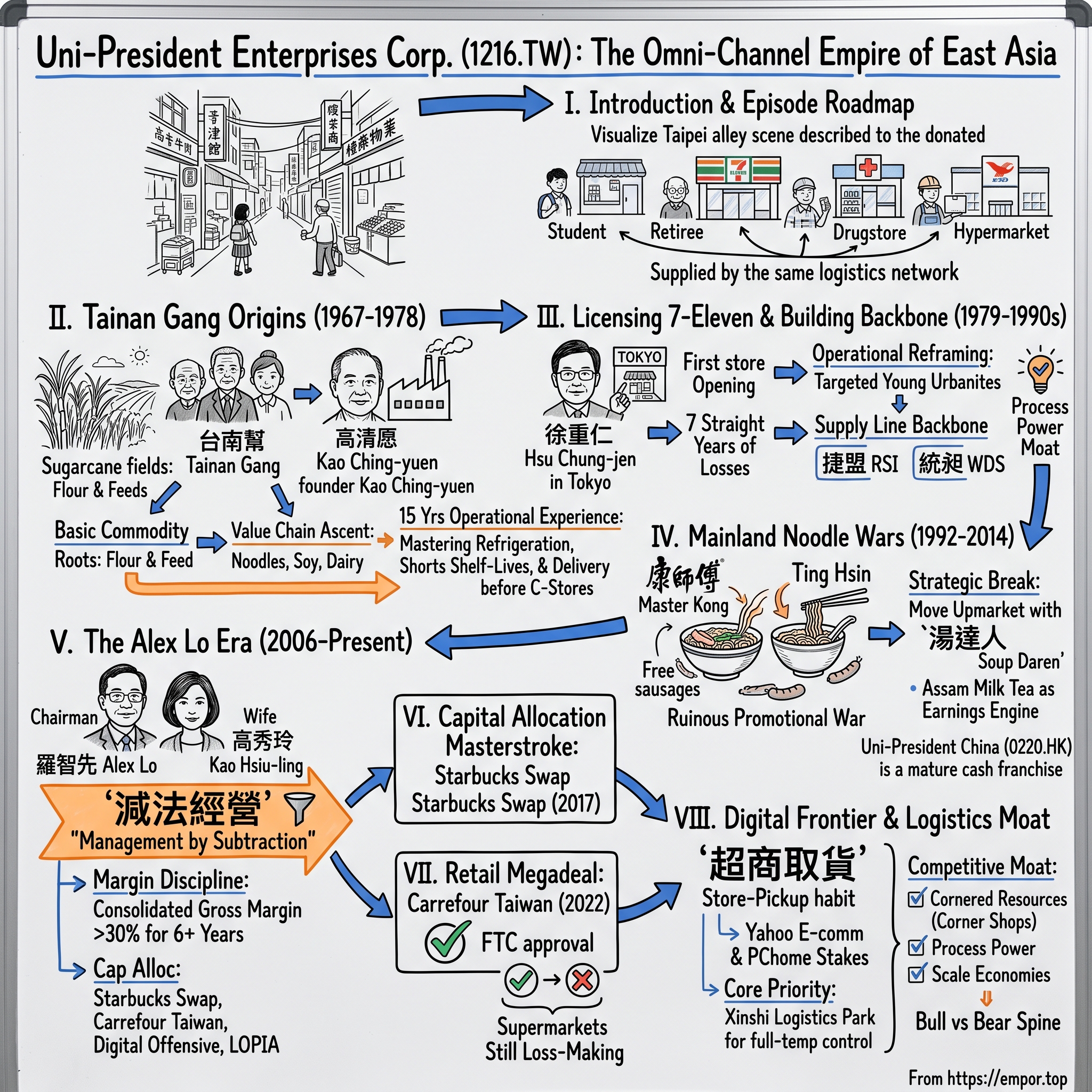
Uni-President Enterprises Corp.: The Omni-Channel Empire of East Asia
I. Introduction & Episode Roadmap
There is a particular kind of Taiwanese evening that explains this company better than any income statement. It is nine o'clock on a humid Tuesday in a Taipei alley. A convenience store glows on the corner—fluorescent, spotless, open. Inside, a student pays an electricity bill at the counter. A retiree collects a parcel ordered that morning. An office worker buys a tea egg from a simmering pot and an Assam milk tea from the chiller. Across the street, a drugstore is still open. Two blocks away, a hypermarket is restocking for tomorrow. The trucks that filled all three shelves came from the same logistics network, and a meaningful share of what sits on those shelves was manufactured by the same company that owns the shelves.
That company is 統一企業 Uni-President Enterprises Corp. (1216.TW), and the ordinariness is the point. In 2025, the group reported consolidated revenue of NT$672.86 billion, up 2.3% year over year, with net income attributable to shareholders of NT$19.63 billion and earnings per share of NT$3.45.1 It is one of Taiwan's largest listed companies by revenue—though notably, its market capitalization slipped from above NT$500 billion and a top-20 ranking to above NT$400 billion and a top-30 ranking over the course of a single year, a demotion Chairman 羅智先 Lo Chih-hsien (Alex Lo) acknowledged directly in the 2025 annual report.6 That gap between operational scale and market affection is the tension this story has to resolve.
The bull framing, often voiced by sell-side desks in Taipei, is that Uni-President is not merely a packaged food company. It is infrastructure for physical commerce: it manufactures goods, owns the trucks that transport them, owns the refrigerated warehouses that store them, and owns the retail real estate where they are sold. Its footprint includes roughly 7,000-plus 7-Eleven stores in Taiwan;3 62 hypermarkets and 233 supermarkets acquired from Carrefour;4 600 康是美 Cosmed drugstores and 600 Starbucks Taiwan cafés, both milestones reached in May 2026;5 and a cold-chain network no rival has replicated. On that view, digital disruption cannot route around the company because the last mile in Taiwan is the company.
The bear framing is less romantic and, as of mid-2026, harder to dismiss. Group profit fell 5.1% in 2025 despite record revenue.6 The e-commerce assets bought in 2024 required restructuring charges. The Carrefour supermarket format has lost money every year under Uni-President ownership.24 Taiwan's population is shrinking and aging. And a competitor, 全聯 PX Mart, has quietly assembled a larger grocery footprint than the one Uni-President paid NT$29 billion to acquire.25
So the question this analysis tests is not whether Uni-President is big. It plainly is. The question is whether owning every layer of the consumer journey actually compounds capital—or whether it mostly compounds complexity.
The story runs in four movements. First, the industrial origins in Tainan from 1967, and the licensing bet on 7-Eleven that nearly got cancelled by its own board. Second, the mainland China expansion and the ruinous instant-noodle war against 康師傅 Master Kong. Third, the Alex Lo era and the doctrine of 減法經營 "management by subtraction"—a margin filter applied ruthlessly to a sprawling empire. Fourth, the capital-allocation decade: selling half of Starbucks in East China at the top, buying Carrefour Taiwan, buying into Taiwanese e-commerce, and, most recently, buying a Japanese fresh-food supermarket operator. The report then war-games the moat, stress-tests management, and lays out what would have to be true for either case to win.
 Subscribe on LinkedIn
II. Tainan Gang Origins & Founding Context (1967–1978)
Picture the sugarcane flats of Tainan County in the mid-1960s. Taiwan was still a largely agricultural economy running on American aid and an import-substitution industrial policy. Commercial power in the south sat not in Taipei boardrooms, but in a loose confederation of textile families and merchants known as the 台南幫 Tainan Gang—executives who built Tainan Spinning and a network of affiliated ventures on relationships, mutual guarantees, and an aversion to leverage.
高清愿 Kao Ching-yuen was not born into that world; he entered it through the factory floor. Kao lost his father young, left school early, and started as a child labourer, working his way up through the textile trade until he became a trusted operator inside Tainan Spinning.8 What he acquired there was not capital but credit—the willingness of older Tainan Gang figures to back him.
In 1967, at age 38, Kao left to found Uni-President Enterprises, pooling roughly NT$32 million from 44 shareholders and inviting senior industrialist 吳修齊 Wu Hsiu-chi to serve as chairman while Kao ran the business as general manager.8 The arrangement reflected the group's governance culture: the founder took the operating role and gave the ceremonial leadership to his elder. Deference and hierarchy were not decorative elements in the company; they formed the operating system, later making the eventual succession to a son-in-law both possible and complex.
The initial plants—flour milling and animal feed, which began production in 1968 in Hsuehchia, Tainan—were basic commodity operations.8 Yet the industrial logic was sound, explaining the shape of the business that followed. Flour and feed are commodity conversion businesses: thin margins, high volume, and strict working-capital discipline. What they generate is velocity—cash cycling through the business constantly—and relationships with farmers, bakers, and food processors across southern Taiwan.
From that base, the company systematically climbed the value chain into instant noodles, soy sauce, dairy, and beverages through the 1970s.9 Each step took the same wheat and distribution relationships and added brand equity to them. 統一麵 Uni-President Instant Noodles turned a commodity grain into a branded staple, while dairy transformed a perishable input into a cold-chain competency the company would rely on decades later.
That early focus on dairy proved strategically critical. Managing dairy and chilled beverages forced the company to master refrigeration, hygiene protocols, short shelf lives, and delivery schedules decades before cold-chain logistics became a standard industry discipline. Uni-President did not purchase this capability outright; it absorbed the operational cost as part of running a milk business. By the time convenience stores made daily chilled replenishment a primary competitive advantage, the company had already accumulated fifteen years of operational experience.
Two cultural elements from this period remain central to the modern investment thesis. The first is the corporate motto—sincerity, truthfulness, innovation, progress. While such statements often appear boilerplate, Taiwan's food industry faced severe adulteration scandals in the 2010s, making consumer trust an essential, if fragile, economic asset. The same Taiwanese business families that dominated food manufacturing were frequently involved in those scandals, leaving a lasting impression on consumers. Brand trust in this context is not an automatically compounding moat, but a dormant liability that can be triggered by a single quality failure.
The second element is the conservative balance sheet inherited from the Tainan Gang. Uni-President historically funded expansion through operating cash flow and maintained a dividend payment streak spanning more than four decades—a track record management still cites in investor materials.7 Consequently, Uni-President has rarely been forced to sell assets under distress, creating the flexibility required to execute favorable divestments, such as its later Starbucks transaction.
The primary investor takeaway from the founding era lies not in history, but in capital structure: Uni-President's cost-of-capital advantage stemmed from organizational culture rather than financial engineering—supported by patient shareholders, low leverage, and a willingness to fund long-gestation businesses. That tolerance was soon put to the test by the single most consequential decision in the company's history.
III. Licensing 7-Eleven & Building Taiwan's Retail Backbone (1979–1990s)
In the mid-1970s, a Taiwanese graduate student in Tokyo developed an unusual daily habit. 徐重仁 Hsu Chung-jen was studying distribution economics at Waseda University, and near his lodgings a new kind of shop had opened—small, brightly lit, open extended hours, and operated through a central logistics system rather than a shopkeeper's intuition. He would enter and watch for hours, observing what consumers bought, when they bought it, and how shelves were replenished.11
Hsu returned to Taiwan with his master's degree in 1977, was introduced to Kao Ching-yuen, and began sketching a chain-store blueprint for Uni-President.12 It was a counterintuitive proposal. Taiwanese neighborhoods were already saturated with 雜貨店 mom-and-pop grocery stores—family-run, embedded in the community, cheaper, and accustomed to extending informal credit. A small-format convenience store offered no obvious advantage on price or basic assortment.
Uni-President established a superstore division in 1978, licensed the 7-Eleven brand from Southland Corporation in 1979, and opened its first store in 1980.10 Seven straight years of losses followed.10
The operational missteps were instructive rather than mysterious. The initial strategy targeted household shoppers, placing small-format outlets in direct competition with traditional grocers and wet markets on price and assortment—a battle convenience stores are structurally ill-equipped to win. Store layouts were ineffective, inventory turnover was slow, and suppliers refused to make frequent, small-volume deliveries to scattered locations, leaving shelves either empty or burdened with slow-moving stock.
Inside the group, the retail venture became a significant financial drag, prompting board members to urge Kao to abandon it. Kao's decision to absorb the division's losses under his personal authority as chairman is often romanticized in corporate lore, but it warrants cold analytical scrutiny: it was an unproven bet that consumer behavior would shift and that Taiwanese shoppers simply did not yet recognize the value of convenience.
Turnaround required an operational reframing rather than a simple discovery. Uni-President pivoted its target demographic from household shoppers to young, single, time-poor urban workers. Stores standardized on 24-hour operations and shifted inventory toward high-margin, immediate-consumption items—chilled beverages, ready-to-eat meals, and tobacco—where impulse purchasing minimized price sensitivity and convenience outweighed distance. Under Hsu's operational leadership, the chain achieved profitability in 1986 at approximately the 100-store threshold.10
The group's most durable advantage, however, was built behind the store. Supplying thousands of small outlets with fresh food multiple times per day presented a multi-temperature logistics challenge that no third-party operator in Taiwan could manage. Uni-President solved it internally by establishing dedicated distribution entities: 捷盟行銷 Retail Support International for ambient goods and 統昶行銷 Wisdom Distribution Service for chilled and frozen tiers. This created a distinct form of process power—an operational edge embedded in organizational routines that competitors could not easily replicate or acquire overnight.
On 10 June 1987, Uni-President spun off its retail division into an independent entity, 統一超商 President Chain Store Corp. (PCSC), which listed on the Taiwan Stock Exchange in 1997 under ticker 2912.TW.10 While the corporate separation created the group's most valuable asset, it also introduced a persistent holding-company discount for the parent company that remains central to its valuation dynamics.
The operational model can be understood through a simple contrast: a traditional grocer functions as a warehouse with a cash register, whereas a 7-Eleven operates as a retail display terminal at the end of a factory supply line. The store carries minimal buffer inventory, enabling small footprints and strong store-level economics, provided the supply line operates without interruption. Everything Uni-President subsequently built—from automated distribution centers to central commissaries for lunchboxes and rice balls—was designed to keep that supply line moving.
Through the 1990s, the group leveraged this retail infrastructure as a distribution network for additional licensed formats, including Cosmed drugstores, Mister Donut, and Starbucks Taiwan, established in 1998 as a joint venture with Starbucks Corporation. Each banner capitalized on the same underlying logistics network and site-selection capabilities.
For investors, the initial seven-year loss period is often framed as a lesson in corporate patience. A more rigorous analysis highlights the importance of asset sequencing: Uni-President succeeded not merely by enduring sustained losses, but by constructing a multi-temperature distribution network that eventually rendered those early losses irrelevant. Long-term capital commitment without an emerging structural moat results in capital erosion—a distinction that is critical when evaluating the group's current loss-making investments in e-commerce and supermarket formats.
IV. The Mainland Noodle Wars: Master Kong vs. Uni-President China (1992–2014)
In 1992, as Deng Xiaoping's southern tour reopened mainland China to foreign investment, Uni-President expanded across the Taiwan Strait. On paper, the company held a strong hand: established brands, deep manufacturing capacity, and a quarter-century of packaged-food experience. In practice, it was outmaneuvered from the start by another Taiwanese competitor.
頂新 Ting Hsin International Group, led by the Wei brothers from Changhua, had arrived slightly earlier and made a single product decision that reshaped Chinese consumer habits: 康師傅 Master Kong braised beef noodles. Ting Hsin recognized that the mainland instant-noodle market was not simply a larger version of Taiwan's. It required a different flavor profile, a bowl format for on-the-go convenience, and a national distribution network reaching down to county-level towns. Master Kong established that distribution first, securing the default position in the market.
Uni-President spent two decades playing catch-up across a vast territory where logistics costs varied wildly by city tier and regional taste preferences fragmented demand. Distribution costs diluted profit margins, while the product catalog bloated as the company attempted to serve every regional niche.
This struggle culminated in a period that fundamentally reshaped management's approach to growth. Between 2011 and 2014, the two rivals engaged in an escalating promotional war over a commodity category. Growth was pursued not through product innovation, but through aggressive giveaways—most famously, free sausages taped to noodle packages. Master Kong alone distributed tens of millions of sausages in an effort to outspend its rival.13 Both companies burned substantial capital defending market share in a category with eroding unit economics, as rising disposable incomes and the rapid growth of food-delivery platforms began displacing instant noodles.
Uni-President's eventual pivot represented a clear strategic break. Rather than competing below the RMB 5 mass-market price point, the company moved upmarket with 湯達人 Soup Daren, a premium soup noodle priced above standard offerings. The strategy proved effective: Soup Daren grew at triple-digit rates through 2014 and 2015, surpassing RMB 500 million in sales.14 Concurrently, the beverage portfolio—anchored by 阿薩姆奶茶 Assam Milk Tea, green tea, and later lemon tea—emerged as a second earnings engine less vulnerable to price competition.
The financial vehicle supporting this expansion was created during the same era. 統一企業中國 Uni-President China Holdings listed on the Hong Kong Stock Exchange on 17 December 2007, offering shares in a range that valued the mainland business at up to roughly HK$16.5 billion and raised up to about US$531 million.15 The listing provided the group with a dedicated China equity currency and established separate public reporting, giving investors unusual transparency into the mainland operations of a Taiwanese conglomerate.
The destruction of capital during the noodle wars illustrates a broader structural principle. Low-end instant noodles in China lacked switching costs and meaningful brand differentiation, while shelf placement depended largely on slotting fees and promotional subsidies. Under those conditions, promotional spending failed to build enduring brand equity; it merely rented market share for the duration of the campaign. Both companies were effectively funding market position while classifying the expenditure as growth investment. As food-delivery applications made hot restaurant meals widely accessible, that rented market position applied to a shrinking overall market.
The recent performance of Uni-President China reflects this shift toward capital discipline. In 2025, the unit reported revenue of RMB 31.71 billion, up 4.6% year over year, with gross margin expanding to 33.2% and net profit attributable to shareholders rising 10.9% to a record RMB 2.05 billion. The board proposed a final dividend of RMB 47.47 cents per share, distributing virtually all of the year's profits.16 Management framed the performance around portfolio optimization and the concentration of resources on high-potential brands rather than volume expansion.16
This payout strategy highlights a fundamental transformation in the unit's economic role. A business that once spent heavily to capture national volume in a commodity category now generates mid-single-digit revenue growth, expands margins, and returns nearly all earnings to shareholders. It operates as a mature, cash-generative franchise rather than a high-growth expansion engine. For the parent company, mainland China accounts for roughly one-fifth of consolidated revenue—a stable source of repatriable cash, but no longer a driver for higher valuation multiples.
The central lesson management extracted from the mainland noodle wars—to avoid price wars lacking a clear path to structural victory—became the guiding philosophy for the subsequent decade. It also provided a strategic rationale for declining to enter aggressive price competition in other segments, even when defensive reinvestment was warranted.
V. The Alex Lo Era: "Management by Subtraction" & The Profit Pivot (2006–Present)
羅智先 Lo Chih-hsien (Alex Lo) met 高秀玲 Kao Hsiu-ling, the founder's daughter, in high school. He married her at age 29, joined Uni-President as an external affairs section chief, and served in the United States for a decade before returning to Taiwan. That background shaped an unusual corporate leader: a family insider by marriage rather than blood, possessing both the distance to challenge the founding generation's operating assumptions and the organizational legitimacy to do so.
Lo became general manager in 2007 and assumed the chairmanship on 12 November 2013, succeeding Kao Ching-yuen and consolidating executive leadership. His wife took charge of the group's retail and design-oriented operations.
Lo introduced an operating doctrine known as 減法經營 ("management by subtraction"), which inverted a common East Asian conglomerate reflex. Where many family-controlled groups equated scale with revenue and headcount, Lo argued that a sprawling product catalog signaled operational indiscipline. In his view, every low-margin stock-keeping unit consumed shelf space, factory capacity, working capital, and management focus that higher-margin lines could put to better use.
The primary mechanism was a strict gross-margin filter. Product lines, individual items, and occasionally entire subsidiaries that failed to clear a roughly 30% gross-margin threshold were pruned or eliminated. In mainland China, the company drastically trimmed its product count to focus on a few core noodle and beverage franchises, while in Taiwan, it shed underperforming categories.
The operational results reflect this focus. Consolidated gross margin has held above 30% for six consecutive years, reaching a five-year high of 33.08% in 2025 and expanding further to 33.78% in the first quarter of 2026—marking the third consecutive year of year-on-year first-quarter margin gains.17 For a conglomerate where convenience-store retail generates roughly half of revenue and food manufacturing accounts for about a third, this profitability structurally exceeds what most pure-play peers in either sector achieve alone, blending manufacturing margins with high-margin retail service income.
However, subtraction is a framework for optimizing an existing portfolio rather than driving new growth. Over the past five years, management has pursued major additions: acquiring Carrefour Taiwan, buying Yahoo Taiwan's e-commerce operations, investing in PChome, and taking a stake in a Japanese supermarket operator. Several of these entities remain loss-making. When questioned by investors at the May 2026 annual general meeting, Lo maintained that the group evaluates performance holistically rather than on an asset-by-asset basis, noting that new partners require time to adjust and arguing that certain synergies manifest in e-commerce performance rather than in a subsidiary's own financial statements.31
While strategic holism is a plausible defense, it marks a departure from the strict financial discipline that defined Lo's early tenure. A manager who built his reputation on refusing to fund businesses below a 30% gross margin threshold is now asking shareholders for patience on a portfolio of lower-margin or loss-making assets. That shift may ultimately deliver strategic value, but it represents a clear evolution in capital allocation that management has chosen not to explicitly acknowledge.
Capital returns, by contrast, have remained steady. The company maintained its 2025 dividend at NT$3.00 per share—representing an 86.9% payout ratio and yielding approximately 4.2% based on its year-end share price of NT$71.20.2 Management continues to target payout ratios above 70% while balancing strategic investment.7 Foreign institutional investors held approximately 35.6% of outstanding shares as of late November 2025, compared to director and supervisor holdings of about 9.9%32—a shareholder base that prioritizes predictable cash returns and could penalize any margin erosion.
The subtraction era established the group's current margin profile. The addition era must now demonstrate that its expanding footprint can compound capital rather than dilute it—a test that began most directly with an asset sold out of a French boardroom.
VI. Capital Allocation Masterstroke: The Starbucks Swap & Regional M&A (2017–2021)
Capital allocation rarely offers a clearer demonstration of strategic discipline than the Starbucks restructuring of July 2017. The transaction serves as a primary case study for how Uni-President evaluates growth versus operational control.
Prior to the deal, Uni-President and PCSC jointly held a 50% stake in the East China Starbucks joint venture—covering Shanghai, Jiangsu, and Zhejiang, comprising roughly 1,300 stores in mainland China's most affluent coffee market.17 Separately, Starbucks Corporation held a 50% interest in the Taiwan operation, with Uni-President holding the remaining half.
The agreement, announced on 27 July 2017, unwound the cross-holdings. Starbucks acquired the remaining 50% of the East China operation for approximately US$1.3 billion in cash—the largest single acquisition in Starbucks' history at the time—giving the American parent full ownership as it targeted more than 5,000 mainland stores.1718 Concurrently, Uni-President and PCSC purchased Starbucks' 50% stake in the Taiwan business for approximately US$175 million, taking 100% ownership in their home market.17
The strategic logic hinged on contrasting asset profiles. Uni-President surrendered a minority stake in a capital-intensive, high-growth mainland business where it lacked operational control and faced impending domestic competition. In return, it received US$1.3 billion in cash—outnumbering the purchase price for the Taiwan unit by a seven-to-one ratio—and gained complete ownership over a mature, cash-generative asset embedded directly within its domestic retail ecosystem.
The transaction demonstrated management's preference for asset control and predictable cash generation over minority growth exposure. Subsequent developments supported the move: while Starbucks' mainland operations encountered intense price competition throughout the early 2020s, Starbucks Taiwan expanded under sole ownership to reach 600 stores by May 2026, anchoring the group's retail expansion alongside Cosmed, which reached the same 600-store milestone.5
Subsequent regional acquisitions present a more mixed track record.
In December 2018, Uni-President paid over NT$7 billion for a 74.8% controlling stake in South Korean beverage manufacturer Woongjin Foods, originally established in 1976 in South Chungcheong Province as a ginseng-drink producer.[^19] Management framed the deal as an entry into Northeast Asian product development and sourcing, aiming to export categories such as rice drinks and plum juice across Greater China and Southeast Asia. In January 2024, after increasing its stake to 79.32%, the group launched a tender offer for the remaining 20.68% at KRW 2,300 per share to secure complete ownership.19
However, Woongjin Foods has yet to prove itself as a material value creator. Uni-President does not report standalone segment returns for the Korean business, making cross-border product synergies difficult for outside investors to verify. While acquiring full ownership simplifies governance and aligns with the group's preference for operational control, available evidence suggests the deal has yielded far lower returns than the Starbucks restructuring.
The group's expansion in the Philippines provides a clearer strategic fit. Through PCSC, Uni-President holds controlling ownership of Philippine Seven Corporation, the master franchisee for 7-Eleven in a market characterized by favorable demographics that Taiwan lacks—specifically, a young, growing, and rapidly urbanizing population. Philippine Seven ended 2024 with 4,130 stores and set a target of 5,000 stores by 2026, having added approximately 500 outlets in 2025 alone.20
Although its contribution to current net income remains modest, Philippine Seven is strategic: it represents the primary international market where Uni-President can replicate its convenience-store supply-chain playbook against expanding demographic tailwinds rather than a mature home market.
Overall, the 2017–2021 period highlights a management team capable of executing highly favorable transactions when reallocating capital between control and growth positions, but less proven in generating high returns from overseas brand acquisitions. That dynamic set the stage for the largest capital commitment in the group's history.
VII. The Retail Megadeal: Buying Carrefour Taiwan & The Hyper-Local Platform (2022–2023)
In 2022, Carrefour SA Chief Executive Alexandre Bompard conducted a portfolio review guided by a single directive: exit markets where the French retailer could not achieve market leadership or deploy capital at scale. Taiwan—profitable and well-managed, but geographically isolated and small within Carrefour's global footprint—landed on the exit list. The transaction was distinctive because the buyer was already at the table: Uni-President had served as Carrefour's local joint-venture partner for decades, holding a 40% stake.
On 19 July 2022, Carrefour announced the sale of its remaining 60% stake to the Uni-President group for NT$29 billion (roughly US$970 million), granting the Taiwanese conglomerate complete ownership.2122 The transaction split the equity purchase across two listed entities: Uni-President Enterprises acquired 49.5% for approximately NT$23.9 billion, while PCSC took 10.5% for roughly NT$5.1 billion.22 Bidding interest from rival suitors—including Far Eastern Group, Carlyle, and CVC—indicated that the asset was actively contested rather than priced at a distress discount.
A nine-month antitrust review followed. On 5 May 2023, Taiwan's Fair Trade Commission conditionally approved the acquisition.23 The regulatory scrutiny reflected a structural conflict: Uni-President, already a dominant food manufacturer and convenience-store operator, was acquiring one of Taiwan's largest hypermarket and supermarket chains, creating potential leverage over food suppliers seeking physical retail shelf space.
The FTC's remedies directly addressed this vertical dominance. The group was prohibited from leveraging its distribution footprint to discriminate against suppliers without legitimate justification. Presicarre—the Carrefour Taiwan operating entity—was required to preserve its preferential commercial terms for small and medium suppliers with under NT$1 million in annual trading volume, with prohibitions against altering terms to their detriment. Regulators also imposed limits on interlocking directorships between group entities and the Carrefour Taiwan board, alongside an annual compliance reporting obligation due every 1 June.23
For investors, these remedies impose a permanent constraint on the deal's primary vertical synergy: the freedom to systematically prioritize proprietary products on group shelves. While the remedies do not impede core operations, they cap the financial value extracted from vertical integration and establish an ongoing regulatory mechanism that future enforcement could tighten.
The operational performance following the transaction highlights ongoing integration challenges.
Uni-President had expanded its grocery presence prior to full ownership. In June 2020, the joint venture acquired 224 Wellcome supermarkets from Dairy Farm International for €97 million, rebranding them as Carrefour supermarkets in February 2021.24 That expansion doubled down on neighborhood supermarket formats, which have generated persistent losses.
The hypermarket unit generated NT$59.53 billion in revenue in 2023 while recording a net loss of NT$1.37 billion. It subsequently stabilized, posting net income of NT$570 million in 2024 and NT$445 million in 2025 on steady revenue of approximately NT$58.7 billion, supported by shuttering six underperforming outlets.24 The supermarket division, however, has remained unprofitable since acquisition, logging net losses of NT$362 million in 2023, NT$412 million in 2024, and NT$286 million in 2025, even as annual revenue gradually reached NT$15.47 billion.24
Three years after the buyout, the combined retail grocery operation generates roughly NT$74 billion in annual revenue while lingering near total operational breakeven. Measured against the NT$29 billion purchase price, return on invested capital remains well below the profitability thresholds established during Alex Lo's initial portfolio optimization.
Management has responded by shifting focus away from volume growth. On the first-quarter 2026 investor call, executive leadership attributed sequential improvement in the retail division to reduced promotional discounting and selective store closures—applying the "management by subtraction" doctrine to an asset acquired during an expansionary cycle.7
In December 2025, Uni-President executed another major structural shift by terminating its 38-year-old brand licensing agreement with Carrefour SA.34 The decision was driven by financial considerations: an operating unit generating nearly NT$80 billion in annual revenue was paying hundreds of millions of NT dollars annually in brand royalties to a former parent.28 Effective 1 July 2026, the 62 hypermarkets were rebranded as 萬家福 Prosperity Plaza and the 233 supermarkets as 樂家康 Uni-Prosperity, following completion of the operational transition across all 295 locations by 30 June 2026.428
The rebranding process imposed immediate transition costs. Alex Lo cited one-off renaming expenses, alongside raw coffee-bean cost inflation and e-commerce restructuring charges, as the primary factors driving the group's 5.1% drop in net profit for 2025.1
Strategically, eliminating the French brand relies on the premise that consumer loyalty attaches to location, assortment, and store convenience rather than international branding. Eliminating royalty payments lowers the segment's cost structure, but the long-term impact on store traffic will require several quarters to assess, particularly as competition in Taiwan's supermarket format intensifies.
VIII. Digital Frontier & Hidden Growth Drivers: E-Commerce, Cold-Chain & Logistics
Taiwan is a challenging market for pure e-commerce, but an ideal setting for hybrid retail—and the fundamental explanation is geography. The island is dense, compact, and blanketed with convenience stores. Home delivery to high-rise apartments when no one is home is expensive and inefficient. In contrast, delivery to a 7-Eleven three minutes away, where a customer collects a package while picking up dinner, is cheap and nearly universal. Taiwan's 超商取貨 store-pickup habit is among the most entrenched last-mile consumer behaviors in any developed economy.
That structural dynamic handed Uni-President a formidable physical asset—yet for years, the company lacked a coherent strategy to monetize it beyond collecting basic handling fees. Competing digital platforms used the group's retail store network as neutral infrastructure while capturing the direct customer relationship, the transaction data, and the merchant fees.
The 2024 digital offensive aimed to close that gap. In February 2024, the group initiated a transaction for Yahoo Taiwan's e-commerce operations. The Fair Trade Commission approved the joint venture in July, giving Uni-President an 80% stake while Yahoo retained 20%, and the deal closed on 19 September 2024.27 Next, on 24 October 2024, PChome Online agreed to a private placement granting Uni-President a roughly 30% stake and two board seats for approximately NT$1.96 billion, with the capital arriving in January 2025.26
The condition of these acquired assets represents the core challenge. PChome, once Taiwan's e-commerce pioneer, had become a chronic loss-maker: it posted a net loss of NT$181 million in the first half of 2024, capping ten consecutive quarters of losses since late 2021, while nine-month revenue fell 8.55% year over year to NT$26.56 billion—its weakest showing in six years.26 By 2025, PChome held roughly 7.0% of Taiwan's e-commerce market, trailing momo at 22.5% and the combined Shopee and Coupang share at approximately 27%.25
Stripped of marketing narrative, Uni-President acquired the third and fourth players in a market dominated by an established domestic leader and two aggressive, heavily funded foreign platforms. The bull thesis—that physical pickup infrastructure, combined with retail catalogs and member data, yields a defensible digital moat—assumes Uni-President can outperform veteran e-commerce specialists. That capability remains unproven. Given the group's robust cash generation, the financial outlay represents a manageable strategic option rather than a high-risk gamble, but it remains an option rather than a proven blueprint—a point reinforced by the e-commerce restructuring charges recognized in 2025.1
A far more defensible, if less public, growth driver lies in the group's logistics infrastructure. Uni-President operates Taiwan's largest multi-temperature distribution network, relying on Retail Support International for ambient merchandise and Wisdom Distribution Service for chilled and frozen supply chains, alongside specialized service providers. The essential edge is operational frequency: fresh food moves to thousands of stores multiple times daily through an unbroken cold chain stretching from processing plants to store shelves. The network functions much like a circulatory system—operating on strict schedules to transport fresh items manufactured in the morning onto shelves hundreds of kilometers away by afternoon, before cycling unsold stock off those shelves at night.
Management has systematically reinforced this advantage through capital deployment. In Chairman Alex Lo's 2026 New Year address, leadership outlined three core priorities: deepening retail channels, integrating the ecosystem through the uniopen co-branded card platform, and upgrading physical logistics—highlighting the newly completed Xinshi Logistics Park as the group's first facility featuring year-round, full-temperature control following a three-year construction effort.29 Reflecting this commitment, group capital expenditure reached NT$8.24 billion in the first quarter of 2026 alone.7
The OPENPOINT loyalty program serves as the digital layer connecting these physical touchpoints, reporting approximately 18 million registered members as of September 2025 against a total island population of roughly 23 million.5 Whether this scale generates genuine cross-selling synergies or functions merely as a standard discount scheme remains one of the group's least transparent metrics. In practice, a near-universal membership base offers minimal competitive differentiation: when virtually every consumer holds an account, membership loses selection value, and program economics depend strictly on whether point liabilities are offset by higher incremental basket size—a calculation Uni-President does not disclose alongside its point-circulation figures.
This physical-digital integration strategy faces an additional structural constraint. Store-pickup networks create an operational cost advantage for Taiwanese e-commerce as a whole, but not a distinct demand driver for any single storefront. Consumers select e-commerce platforms based on product selection, pricing, and search user experience, choosing their preferred pickup point only at checkout—and every major platform leverages the same convenience-store networks. For Uni-President's e-commerce platforms to capture market share, they must compete directly with momo and Shopee on core marketplace features, even as the group's physical store network continues collecting fee income by servicing those same competitors. Operating a profitable logistics tollbooth is a sound business, but it is fundamentally distinct from controlling the entire e-commerce ecosystem.
A smaller element of vertical integration rounds out the operational structure. Packaging and metal container subsidiary 統一實業 Tone Yi Industrial (9907.TW) supplies beverage operations across Taiwan and mainland China. As a cyclical, capital-intensive manufacturing business, its financial performance fluctuates: in the first quarter of 2026, the packaging segment—representing roughly 3% of total group revenue—saw revenue decline 22% and operating profit fall 51% due to temporary disruptions from equipment renovations.7 While Tone Yi provides vital supply security, its lower-margin profile occasionally drags on overall group margin expansion.
Across these diverse initiatives, the strategic pattern is clear. Where Uni-President invests in physical infrastructure under its direct control, the evidence of sustainable competitive advantage is compelling. Where it acquires stakes in digital platforms battling dedicated e-commerce specialists, the value proposition remains speculative. This distinction provides the proper framework for evaluating the group's segment economics.
IX. Financial Anatomy & Segment Breakdown
To understand Uni-President's actual economic engine, one must look past the corporate title to where its revenue is generated.
In the first quarter of 2026, convenience stores and distribution accounted for approximately 57% of consolidated revenue, food and grain manufacturing roughly 30%, and packaging about 3%, with the remainder spread across auxiliary operations.7 The analytical framing is straightforward: Uni-President functions primarily as a major retailer that owns a large food manufacturer, rather than a food processor operating retail outlets. Roughly six out of every ten revenue dollars stem from selling third-party merchandise alongside its own proprietary goods.
President Chain Store Corp. (PCSC)—encompassing 7-Eleven Taiwan, the Philippine operations, and affiliated retail banners—generated NT$350.73 billion in revenue in 2025, up 3.7%, with net income slipping 2.7% to NT$11.21 billion.2 That single subsidiary represents more than half of group revenue and the majority of group profit. While PCSC remains the crown jewel, it also accounts for Uni-President's persistent conglomerate discount: equity investors seeking pure-play exposure to the convenience-store franchise can purchase 2912.TW directly rather than holding a parent company burdened by loss-making supermarkets and an unproven e-commerce portfolio.
The mainland China food and beverage division contributed RMB 31.71 billion in revenue and RMB 2.05 billion in net profit, representing roughly one-fifth of consolidated revenue when converted.16 The grocery business acquired from Carrefour adds approximately NT$74 billion in annual revenue while operating near breakeven.24 Packaging, drugstores, coffee chains, financial services, and the South Korean beverage business make up the balance.
One line item warrants scrutiny because it flattered recent results. Record first-quarter 2026 net income of NT$6.55 billion—up 26.9% year-on-year and 121% quarter-on-quarter, yielding earnings per share of NT$1.15—was driven not only by core operations but also by elevated investment income from financial subsidiaries, including Uni-President Securities.17 Brokerage earnings are inherently cyclical and lower in quality than recurring store-level operating income. Financial models should isolate these financial gains rather than project them forward.
The expansion of gross margins provides the strongest empirical support for management's efficiency strategy. Consolidated gross margin expanded from roughly 30% in the early 2010s to 33.08% in 2025 and 33.78% in the first quarter of 2026.17 Two structural drivers enabled this improvement: the pruning of low-margin SKUs in the food manufacturing division under "management by subtraction," and an increasing revenue contribution from high-margin retail service fees—including bill processing, parcel handling, ticketing, and fresh food service, all of which carry far higher margin profiles than packaged food.
Yet gross margin expansion has not translated into net profit growth. Consolidated revenue rose 2.3% in 2025 while net profit fell 5.1%.16 The earnings drag sits below the gross profit line: surging coffee bean input costs, e-commerce restructuring charges, and one-off store rebranding expenses. While restructuring and rebranding outlays are temporary, commodity price inflation across coffee, dairy, wheat, and PET resin represents an ongoing feature of the operating environment, testing the group's pricing power over time.
Cash generation remains the anchor of the investment thesis. Annual operating cash flow consistently exceeds NT$40 billion, fully funding store remodeling, logistics automation, and a 43-year unbroken dividend record backed by management's target of paying out over 70% of earnings.7 The 2025 dividend payout ratio reached 86.9%, surpassing that target.2 However, this generous return profile introduces an important capital allocation question: is the group returning high levels of cash because organic reinvestment opportunities are constrained, or is it shielding a yield-seeking domestic shareholder base while funding acquisitions through leverage? The LOPIA supermarket investment in Japan was explicitly financed through a combination of internal cash reserves and bank borrowings,30 indicating that debt-funded expansion is playing an increasing role.
Two accounting and structural nuances require careful consideration when analyzing the group. First, because of the consolidated holding structure, a substantial portion of group revenue and net income is attributable to non-controlling interests in PCSC, Uni-President China, and Tone Yi. Consequently, consolidated group revenue of NT$672.86 billion generated net income attributable to parent company shareholders of only NT$19.63 billion.1 Headline sales figures significantly exaggerate the earning power available to parent equity holders, rendering price-to-sales comparisons against single-entity peers uninformative. Second, the carrying value of the Carrefour grocery acquisition remains on the balance sheet attached to a segment earning negligible operating profit.24 Although management has disclosed no impairment and points to the store rebrand as its turnaround catalyst, failure to restore supermarket profitability over the medium term would make impairment testing a tangible operational risk rather than a hypothetical concern.
Revenue momentum heading into the second half of 2026 remains steady but modest. June 2026 consolidated revenue reached NT$58.3 billion, up 4.6% year-on-year, bringing first-half revenue to NT$349.97 billion, a 3.2% increase.33 Evaluated against management's long-term target of NT$700 billion in group revenue, current growth rates indicate that reaching the benchmark will occur through incremental organic operational gains rather than a rapid step-change expansion.
This raises the central question of whether that operational grind is protected by an enduring competitive moat.
X. Competitive Moat & Strategic Frameworks
A rigorous analysis of Uni-President's business reveals a competitive moat that is real and deep, yet narrower than corporate marketing suggests.
Process power represents the group's strongest competitive claim. Operating a multi-temperature distribution network that supplies thousands of small-format stores multiple times daily requires organizational capabilities built over four decades. A new entrant cannot simply purchase this infrastructure; competitors can only attempt to replicate it slowly. While 全家 FamilyMart Taiwan (5903.TW) has spent decades building out its own capability, it has not closed the gap. In 2025, Uni-President maintained a 49.8% share of Taiwan's convenience-store channel, compared to FamilyMart's 23.6% and 萊爾富 Hi-Life's 5.8%, with the top two players controlling over 70% of the market.25 A sustained two-to-one lead over its nearest rival points to a structural advantage rather than short-term operational execution.
Scale economies in procurement logically follow from that market share and formed the core rationale behind the Carrefour acquisition. However, empirical evidence remains weaker than theoretical claims. If combined purchasing power across convenience stores, hypermarkets, supermarkets, drugstores, and cafés yielded substantial supplier concessions, those savings should be reflected in grocery profitability; yet the retail grocery operation has hovered near breakeven for three years.24 Furthermore, conditions imposed by Taiwan's Fair Trade Commission explicitly restrict the group from extracting preferential commercial terms from small suppliers.23 While scale is undisputed, converting that scale into superior operating margins remains unproven.
Cornered resource stands out as the most underrated advantage in the portfolio. Uni-President's real estate footprint—securing prime corner locations across neighborhoods, transit hubs, university campuses, and rural townships—was assembled over four decades at historical lease rates and cannot be duplicated at modern commercial rents. This physical network is genuinely scarce and highly durable, although its value applies specifically to the convenience-store format, offering little structural advantage in large-format hypermarkets or online retail.
Counter-positioning and network effects represent the weakest elements of the moat thesis. While the store-pickup logistics network provides substantial utility, it operates as neutral infrastructure rented to all market participants, including the group's direct e-commerce rivals. Digital platforms such as Shopee and momo rely on the same convenience-store pickup system. Controlling the physical channel does not grant control over consumer purchasing decisions, and the group's e-commerce results demonstrate that owning distribution provides no inherent advantage in becoming a successful digital merchant.
Applying Porter's Five Forces framework yields a similarly divided verdict.
Threat of new entrants is minimal within convenience retail, where capital, real estate, and logistics barriers are prohibitive and Taiwan's store density—roughly one 7-Eleven for every 3,000 residents—leaves little room for expansion. However, new entrants have successfully disrupted adjacent formats. Japanese supermarket operator LOPIA entered Taiwan in 2023 and established a strong consumer following in premium meats before Uni-President moved to acquire a controlling stake.30 Similarly, foreign e-commerce platforms entered the market at scale and captured market share rapidly.25
Supplier power is generally low, but it is constrained as much by regulatory oversight as by market dynamics.23
Buyer power is negligible on an individual level but formidable collectively. Taiwanese shoppers readily switch retail formats when motivated by price, as demonstrated by the growth of PX Mart and Costco.25 Loyalty in convenience retail stems from physical proximity rather than brand affection, rendering it effective for small, immediate-consumption baskets but weak for major grocery purchases.
Substitutes and rivalry represents the area of greatest strategic pressure. PX Mart's acquisition of 大潤發 RT-Mart—rebranded as 大全聯 in August 2025—secured a 41.7% share of Taiwan's combined supermarket and hypermarket channel in 2025, compared with Costco at 28.3% and the former Carrefour business at 14.1%.25 Consequently, Uni-President spent NT$29 billion to position itself as the third-largest player in a format where the market leader holds nearly three times its market share and the runner-up is a membership warehouse operating with lower cost structures.
Management's strategic response has been to purchase differentiation rather than build scale. On 30 April 2026, PCSC's board approved a NT$2.05 billion strategic partnership with Japan's OIC Group, taking a 51% stake in Taiwan LOPIA's supermarket business for NT$1.91 billion to control retail operations, alongside a 49% stake in the associated food-processing entity for NT$147 million while leaving product development under Japanese management.30 LOPIA operated 11 stores in Taiwan at the time of the announcement with a target of expanding to 30 or 50 locations, awaiting regulatory clearance from the Fair Trade Commission with closing planned before the end of 2026.30
This deal structure—securing control over distribution while ceding authority over product craft—represents a pragmatic approach to transaction design and a tacit acknowledgement that the group's internal fresh-food merchandising was insufficient to compete on quality alone. While expanding to 30 or 50 premium locations is unlikely to reshape a grocery channel dominated by a rival with a 41.7% market share, it allows the group to defend high-margin consumer segments.
A final structural element is notable for its absence: Uni-President possesses no meaningful switching costs across its portfolio. Consumers face zero friction in choosing a FamilyMart location, shopping at PX Mart over a group-owned hypermarket, or purchasing from Shopee instead of the group's e-commerce platform. Customer retention must be earned daily through location convenience and competitive pricing. This marks a fundamental distinction between retail conglomerates and software or financial franchises with comparable margin profiles: Uni-President's moat resides entirely within its physical supply chain, not in contractual customer lock-in.
A composite moat assessment reveals a split profile: exceptionally strong in convenience retail and cold-chain logistics, moderate in packaged food manufacturing, and weak or unproven in grocery retail and e-commerce. Equity valuations should weigh these segments individually rather than treating the group's omni-channel footprint as a unified competitive moat.
Beyond competitive dynamics, cross-strait political exposure represents a distinct risk factor. Uni-President's mainland manufacturing operations and Hong Kong-listed subsidiary expose the group to geopolitical tensions that purely domestic Taiwanese retailers avoid. Any material escalation in cross-strait friction could directly impact the mainland business, complicate dividend repatriation, and subject the parent company to consumer backlash across both markets. While management does not quantify this exposure in disclosures and analysts cannot readily model it, this risk helps explain why a consumer staples conglomerate with strong domestic cash generation can trade at a valuation discount relative to Asian peers.
XI. Management Credibility, Governance & Activist Stress Test
Evaluating Uni-President through the lens of governance and management credibility requires assessing execution over time rather than corporate declarations. In that light, Chairman Alex Lo's leadership record presents a distinct contrast between two operational eras.
On strategic consistency, the discipline established during his first decade remains visible. The group's commitment to avoiding destructive price wars has been consistently communicated to investors and maintained in practice—including on the first-quarter 2026 earnings call, where management again framed its strategy in China as avoiding margin-dilutive price competition in favor of premiumization.7
The group's disclosure quality also compares favorably with many regional conglomerates. When net profit declined in 2025, Lo explicitly pointed to three specific factors—rising coffee bean costs, e-commerce restructuring charges, and one-off Carrefour rebranding expenses—rather than citing broad macroeconomic headwinds.1 Management similarly addressed the company's market-capitalization decline directly in the 2025 annual report.6
Furthermore, guidance discipline remains grounded in realistic operational benchmarks: reaching NT$700 billion in group revenue, maintaining dividend payout ratios above 70%, and keeping consolidated gross margin above 30%. The company has consistently delivered on the margin and payout targets.
The core governance challenge, however, centers on capital allocation during the recent expansion phase—the primary focus of any activist stress test.
The capital allocation question. Between 2022 and 2026, the group committed approximately NT$29 billion to acquire Carrefour Taiwan, nearly NT$780 million for Yahoo Taiwan's e-commerce operations, about NT$2 billion for a stake in PChome, and NT$2.05 billion for LOPIA.3130 Yet the acquired retail grocery operations linger near operational breakeven,24 while the e-commerce assets required immediate restructuring charges.1 An activist investor would challenge management to demonstrate the aggregate return on capital achieved during this acquisition drive, applying the same financial rigor that defined the earlier "management by subtraction" period. Because the group does not disclose segment-level returns on capital and Lo has explicitly rejected evaluating performance on an asset-by-asset basis,31 this lack of granular return transparency represents a key governance vulnerability.
The conglomerate discount question. Uni-President holds controlling stakes in several separately listed entities—including President Chain Store Corp., Uni-President China, and Tone Yi Industrial—alongside unlisted retail, logistics, and financial subsidiaries. Sum-of-the-parts valuations suggest the parent company trades at a persistent discount to the look-through value of its underlying holdings. Management has taken no structural steps to address this gap, and the group's fall from Taiwan's top-20 listed companies by market capitalization to the top-30 during 20256 indicates that public markets are widening, rather than narrowing, the holding-company discount.
The related-party and regulatory question. As a vertically integrated food manufacturer controlling major physical retail channels, Uni-President faces ongoing conflict-of-interest scrutiny. Recognizing these risks, Taiwan's Fair Trade Commission imposed structural remedies and mandated annual compliance reporting.23 This regulatory framework represents an ongoing operational constraint, and any future regulatory tightening regarding retail shelf-space allocation remains a permanent tail risk.
The governance structure question. Independent directors hold five of the board's seats, representing roughly 35.7% of the total, while foreign institutional investors own approximately 35.6% of outstanding shares compared to insider holdings near 9.9%.32 Practical control, however, remains concentrated among founding-family interests and legacy Tainan Gang affiliates. While insider wealth is directly aligned with equity value and dividend income, this concentrated ownership structure—combined with the absence of a detailed, public succession plan—adds a structural discount factor. With Lo in his seventies, leadership continuity represents an unaddressed long-term question for institutional shareholders.
To test management's thesis, two primary investor objections require examination against disclosed operational results.
First, is the group absorbing ongoing cash burn from legacy e-commerce investments? Management contends that the capital deployed is small relative to annual cash flow and that commercial benefits accrue across the broader retail ecosystem rather than within standalone subsidiary financial statements.31 Factually, the outlay is easily covered by the group's annual operating cash flow. However, because ecosystem synergies are not separately reported in disclosures, the argument cannot be independently verified by external analysts.
Second, can the expanded grocery footprint achieve store-level returns comparable to convenience retail? Management's response relies on operational restructuring: eliminating aggressive promotional discounting, closing underperforming stores, terminating brand licensing royalties, and integrating cold-chain logistics.728 While store closures, reduced discounting, and royalty eliminations are reflected in current financial reports, the retail grocery division remains near breakeven,24 leaving supply-chain integration as the untested variable for margin expansion.
The key personnel question. Executive talent transitions also highlight operational risks. Hsu Chung-jen, who led the expansion of the convenience-store franchise over thirty-five years, ultimately departed the group and subsequently took a senior leadership role at PX Mart—the competitor that built Taiwan's leading grocery network.1112 In specialized retail, institutional knowledge departs alongside key executives, giving Uni-President's principal competitor direct access to operational expertise developed within the group.
Finally, when asked in May 2026 regarding market speculation that the group might spend approximately NT$13 billion to acquire a major restaurant operator, Lo declined to address acquisition rumors while offering a candid assessment of the sector, observing that retail is a business where market feedback is immediate and unforgiving.31 That pragmatic recognition of operational friction provides a grounded perspective on the execution challenges facing the group's expanded platform.
XII. Earnings Call & Transcript Navigation Guide for Investors
Analyzing Uni-President requires navigating a disclosure landscape fragmented across three publicly traded entities and two languages. Several key investor communications offer critical context for evaluating management's strategy.
The 2022 Carrefour deal announcement and subsequent investor communications. In these filings, management defended a NT$29 billion valuation, detailed the equity split between the parent company and PCSC, and set expectations for regulatory review.2122 Comparing those initial projections against the actual outcome—conditional regulatory approval with strict supplier protections and interlock limits,23 alongside subsequent operating losses in grocery24—provides a clear test of management's original deal thesis. The divergence between initial synergy promises and subsequent operational adjustments, such as curtailing promotions, closing locations, and terminating brand royalties, highlights the real-world friction of integrating large-format retail.
The 2017 Starbucks transaction materials. These disclosures articulate why management chose full ownership of a mature Taiwanese coffee chain over a 50% interest in a rapidly expanding East China operation.1718 While official statements emphasized geographic focus, the decision reflected an early, accurate assessment of mounting competitive intensity in mainland China's coffee market. Contrasting this rationale with the 2022 Carrefour acquisition reveals a tension in capital allocation: the Starbucks swap exited an overseas growth market to consolidate cash flows at home, whereas the Carrefour transaction expanded the domestic footprint into a struggling retail format.
Uni-President China's annual and interim analyst calls. The Hong Kong-listed subsidiary provides significantly more detailed segment disclosures than the Taiwanese parent. Its 2025 financial performance—featuring top-line expansion, gross margin recovery, record net profit, and a near-100% dividend payout ratio—illustrates management's playbook for mature assets.16 Management commentary on palm oil, wheat, and PET resin input costs, alongside pricing discipline and Soup Daren sales volumes, provides concrete evidence of how the broader group enforces margin control.
PCSC investor materials and shareholder meetings. Disclosures from President Chain Store Corp. offer detailed operational metrics on the group's primary profit engine, including same-store sales growth, average daily per-store revenue, capital expenditure on logistics automation, and Philippine unit economics.36 The expansion of the Philippine 7-Eleven network20 represents the group's clearest international unit-growth driver, with primary updates provided through PCSC rather than parent-level filings.
The parent company's quarterly conferences. The mid-2026 briefings summarize consolidated operations, outlining segment-level growth, retail restructuring, capital deployment, and dividend payout targets.7 Notably, disclosures reveal a distinct rhetorical contrast: mature, profitable operations are discussed through precise financial metrics, whereas e-commerce initiatives are described using qualitative goals like building a seamless online-offline retail ecosystem. This analytical asymmetry highlights where management's strategy remains aspirational rather than metric-driven.
Comparing disclosures across the group requires accounting for distinct reporting calendars, currencies, and ownership structures. Because public shareholders hold minority interests in PCSC and Uni-President China, parent-level consolidated figures do not map directly onto subsidiary segment metrics. A rigorous analysis evaluates each listed entity independently, relying on parent company accounts primarily to examine unlisted operations—including hypermarkets, cold-chain logistics, drugstores, coffee shops, and Woongjin Foods in South Korea—where standalone filings are unavailable.
For statutory disclosures, Taiwan's Market Observation Post System serves as the primary repository for regulatory filings, including monthly revenue reports.35[^38]37 For a consumer staples conglomerate, these monthly updates provide an early signal of shifts in retail volume and demand trends prior to quarterly earnings releases.
XIII. Investment Story Spine: Bull vs. Bear Case & Key KPIs
Before evaluating the numbers, three widely held assumptions about the company deserve empirical testing, as each has hardened into market consensus.
Myth: Uni-President operates as an omni-channel monopoly across Taiwan. Reality: the company commands a near-monopoly in convenience stores while remaining a challenger in grocery retail—a distinction underscored by its NT$29 billion Carrefour buyout. The group holds 49.8% of the convenience store channel, but captures only 14.1% of the combined supermarket and hypermarket format, trailing PX Mart at 41.7% and Costco at 28.3%.25 In e-commerce, its platforms lag significantly behind momo and foreign marketplaces.25 The "omni-channel empire" label reflects management ambition rather than actual multi-channel dominance.
Myth: The physical distribution moat shields the company from digital disruption. Reality: the moat has protected physical store locations rather than the surrounding consumer spending pools. As Taiwanese e-commerce expanded over two decades, Uni-President earned parcel-handling fees instead of retail merchandise margins. Simultaneously, food-delivery platforms in Taiwan and mainland China eroded the ready-to-eat meal occasions that convenience stores historically dominated. Protecting a physical channel does not prevent competitors from establishing alternative routes to the consumer.
Myth: Chairman Alex Lo's margin discipline applies uniformly across the entire group. Reality: management's subtraction doctrine has disciplined the legacy manufacturing catalog, but has not yet produced visible results among assets acquired since 2022. While consolidated gross margin expansion is documented, returns on recent acquisitions remain subdued. Reconciling legacy operational efficiency with recent M&A drag represents the central analytical challenge for investors.
Stripping away narrative claims leaves three core operational metrics to evaluate whether the group's strategy is generating value.
Consolidated gross margin. This metric serves as a direct indicator of whether margin discipline persists and whether the group can pass through raw material inflation. Gross margin expanded from approximately 30% in the early 2010s to 33.08% in 20251 and 33.78% in the first quarter of 2026.7 A plateau or decline alongside revenue growth would signal that the group is sacrificing price for volume—reversing a decade-and-a-half commitment. Continued expansion indicates that high-margin retail services continue to enrich the revenue mix.
7-Eleven Taiwan same-store sales growth and daily per-store revenue. With store count exceeding 7,000 outlets in a population of 23 million, footprint expansion is near saturation;3 organic top-line growth must depend on increasing daily store velocity. This indicator isolates underlying consumer demand from physical store additions, offering the clearest test of whether convenience stores are expanding their share of consumer spending against supermarkets, delivery services, and digital merchants.
Operating margin of the retail grocery division. Operating performance across the former Carrefour business serves as the benchmark for the group's expansion phase. Three years post-announcement, hypermarkets generate modest profits while supermarket formats continue to record net losses.24 With brand royalty payments eliminated as of July 2026 and promotional discounting curtailed, operational excuses are exhausted. Sustainable margin expansion would support the omni-channel thesis, whereas ongoing breakeven would confirm that the NT$29 billion acquisition purchased revenue volume rather than capital returns.
The bull case relies on three core tenets. First, the convenience-store network operates as a defensive utility anchored by process capabilities, prime real estate, and a 49.8% channel share maintained over decades.25 Second, this retail position generates consistent cash flow, supporting a 43-year dividend record, an 86.9% payout ratio in 2025,2 and a dividend yield exceeding 4% based on 2025 year-end equity pricing.7 Third, the group holds strategic options: Philippine Seven provides store network growth supported by favorable demographics,20 Woongjin Foods in South Korea enables cross-border product sourcing, a 51% stake in Taiwan LOPIA secures entry into premium grocery formats,30 and e-commerce equity stakes represent low-cost options on store-pickup logistics.
The bear case emphasizes structural headwinds and execution drag. Demographic decline in Taiwan compresses overall food volume and, as Chairman Alex Lo acknowledged, shifts consumer demand toward single-person households while weakening large-basket hypermarket demand.4 Furthermore, the Carrefour acquisition has yet to earn its cost of capital,24 while digital assets remain subscale relative to capitalized e-commerce rivals.25 In grocery retail, the group occupies third place behind a consolidated domestic market leader and a foreign warehouse chain.25 In addition, recent earnings growth was assisted by cyclical investment income from securities brokerage operations,7 while a complex holding structure spanning three listed entities and family-controlled governance perpetuates a holding-company valuation discount.
The strategic risk radar highlights several specific variables over broad macroeconomic trends. Raw material inflation poses an immediate margin threat—with coffee bean cost spikes explicitly cited as a factor in 2025 earnings contraction,1 alongside price exposure to wheat, dairy, palm oil, and PET resin across food manufacturing and mainland operations. Demographic aging exerts a steady drag on volume. Operational execution risks across retail grocery and e-commerce restructuring remain active. While strong operating cash flow mitigates financing risk, funding acquisitions partially through bank debt represents a departure from conservative historical balance-sheet practices.30 Finally, digital disruption operates indirectly: e-commerce and food-delivery platforms continue to capture incremental consumer spending occasions historically served by physical convenience stores.
In summary, Uni-President functions as two distinct entities under a single ticker: a highly defensible, cash-generative convenience retail utility with a four-decade operational moat, funding a portfolio of recent, capital-intensive diversifications into retail channels where the group lacks market leadership. Whether this capital allocation strategy represents prudent portfolio extension or value-dilutive diversification depends on operating trajectory over the coming quarters.
Bull case invalidation triggers: a sustained contraction in consolidated gross margin, persistent negative same-store sales growth in convenience retail, or expanding losses across rebranded supermarket locations.
Bear case invalidation triggers: the retail grocery division achieving a mid-single-digit operating margin, e-commerce assets stabilizing into a profitable third earnings pillar, and Philippine Seven expanding into a material contributor to group net income.
XIV. Playbook & Business Lessons
Own the pipes, but know which pipe. The durable insight of Uni-President's history is that manufacturing consumer goods is a decent business, but controlling their distribution is a great one. Yet the company's own results draw a sharper distinction than the corporate slogan suggests. Owning small-format convenience distribution—where frequency, freshness, and prime physical locations create genuine scarcity—has produced decades of superior returns. Owning large-format grocery distribution, where price is the primary competitive weapon and victory belongs to the lowest-cost operator, has not. Vertical integration creates economic value only when the integrated layer is genuinely scarce.
Subtraction is a discipline, not a strategy. The gross-margin filter transformed a sprawling conglomerate into a materially more profitable enterprise, as demonstrated by six consecutive years of gross margins above 30%.1 Yet a filter only specifies what to eliminate; it provides no guidance on what to build. The central tension at Uni-President today is that a leadership team historically defined by pruning has spent five years executing acquisitions without articulating a comparably rigorous hurdle rate for its newest ventures.
Sell growth at a peak multiple to someone who needs it more. The 2017 Starbucks restructuring remains the clearest example of capital allocation discipline in the company's history: exchanging a non-controlling minority stake in a capital-intensive mainland growth market for sole ownership of a mature cash generator at home, capturing a seven-to-one cash consideration differential.17 The discipline lay not merely in selling, but in recognizing that a 50% interest lacking operational control carries far less value than it holds for a strategic partner capable of full consolidation.
Patience only pays when something is compounding underneath. The seven initial years of convenience-store losses entered corporate lore because a multi-temperature distribution network was quietly compounding throughout that period.10 The narrative risk is that this historical patience now serves to justify tolerating unproven, loss-making ventures. Long-term capital commitment creates value only when an underlying moat is accumulating. For physical cold-chain infrastructure, that asset creation is tangible; for subscale e-commerce market share, it is not.
Kill the royalty when you own the economics. Terminating a 38-year brand licensing agreement that imposed hundreds of millions of NT dollars in annual fees on a wholly owned business28 represents pragmatic capital allocation. Executing the change required absorbing a one-time restructuring charge and accepting short-term rebranding friction to secure a permanent structural reduction in operating costs—a trade-off many management teams routinely defer.
A distribution moat protects the channel, not the products moving through it. Uni-President's operational record provides a clear limit to its distribution thesis. Controlling Taiwan's dominant convenience network failed to prevent foreign e-commerce platforms from gaining market share, did not stop PX Mart from consolidating grocery retail, and could not protect the group's instant noodles during the mainland market wars. Channel control is worth precisely the toll generated by physical throughput. Investors who mistake distribution reach for universal pricing power across manufactured products risk overvaluing the franchise.
Buy the capability you lack, not the scale you already have. The LOPIA transaction structure—securing channel control while leaving product development under Japanese management30—reflects greater strategic sophistication than the Carrefour acquisition. By targeting specialized fresh-food merchandising rather than raw store count, the deal acquired an operational capability the group lacked internally. Adding volume alone is simple to model but frequently dilutes returns; acquiring distinctive operational capabilities is harder to evaluate, yet far more likely to build enduring equity value.
XV. Epilogue & Outro
On 1 July 2026, shopfront signs across nearly 300 Taiwanese stores changed for the first time in a generation. The French branding that had defined part of Taiwan's retail landscape since the late 1980s came down, replaced by two local banners chosen by a conglomerate headquartered in Tainan—a company that began nearly six decades ago milling flour for local bakers with NT$32 million raised from 44 shareholders and ceremonial leadership borrowed from the textile trade.
That historical arc is compelling, but it represents the simpler chapter of the corporate story. The harder question is what lies ahead.
Uni-President enters the second half of 2026 with first-half revenue of NT$349.97 billion, up 3.2%,33 gross margins near multi-year highs, a dividend record spanning four decades, and a convenience-store network that remains one of the most defensible retail franchises in Asia. Yet it also carries a retail grocery division that has failed to earn its purchase price, an e-commerce portfolio trailing in third and fourth place, a shrinking domestic population, and a market capitalization that dropped out of Taiwan's top 20.6
What to watch next is narrower than management's growth narrative suggests. The primary focus is not the group's NT$700 billion revenue target—top-line scale was never the primary constraint. Investors must watch whether the renamed grocery banners can transition from breakeven to sustainable operating profit now that royalty payments have ended and underperforming locations have been shuttered. Watch whether the Yahoo Taiwan and PChome investments stabilize into a viable digital platform rather than an expensive defensive hedge or a candidate for future impairment. Watch the Philippine store expansion, the sole market where the convenience-store playbook operates alongside demographic tailwinds. And watch the LOPIA integration, which serves as the first major test of whether management can operate a high-end retail format it did not build internally.
The founding-era insight still holds: in a compact, dense, aging island economy, control over physical real estate and multi-temperature cold-chain logistics remains a formidable economic asset that digital software has not dissolved. What six decades of history cannot settle is the fundamental capital allocation question—whether the cash generated by a dominant core business is being reinvested into high-return franchises or merely expanding corporate complexity. On that verdict, Uni-President's numbers have yet to deliver a final answer.
References
-
統一股東會:這些原因拖累去年獲利 今年Q1業績佳期待全年有表現 — 鉅亨網 Anue, 2026 ↩↩↩↩↩↩↩↩↩↩↩↩↩
-
Taiwan 7-Eleven store count exceeds 7,000 — Taiwan News, 2025-04-22 ↩↩
-
New brand names for Carrefour Taiwan unveiled as retailer exits market — Focus Taiwan, 2026-06-30 ↩↩↩
-
【統一法說會重點內容備忘錄】20260605 — 富果直送 Fugle, 2026-06-05 ↩↩↩↩↩↩↩↩↩↩↩↩↩↩↩↩
-
Uni-President Enterprises Corp. Official Website & Corporate Portal — Uni-President Enterprises Corp. ↩
-
Uni-President China IPO May Raise Up to $531 Million — Bloomberg, 2007-11-26 ↩
-
Uni-President China Posts Record 2025 Profit and Raises Payout as It Sharpens Focus on Premium Growth — TipRanks, 2026-03 ↩↩↩↩
-
Starbucks to Acquire Remaining Shares of East China JV — Starbucks Stories, 2017-07-27 ↩↩↩↩↩
-
Starbucks Makes Its Biggest Acquisition, Buying China JV Stakes For $1.3B — Forbes, 2017-07-27 ↩↩
-
統一代子公司凱友投資發布重訊:向持有Woongjin Foods 20.68%股權股東提出收購要約 — 鉅亨網 Anue, 2024-01-29 ↩
-
PhilSeven targets 5,000 7-Eleven stores by 2026 as new chair and president take over — Manila Bulletin, 2025-07-17 ↩↩↩
-
Carrefour Sells Its Stake in Carrefour Taiwan to Uni-President — Carrefour SA Press Release, 2022-07-19 ↩↩
-
Taiwan Food Conglomerate Uni-President to Buy Carrefour Stake for $1.9 Billion — Reuters, 2022-07-19 ↩↩↩
-
Uni-President Group takeover of Carrefour Taiwan conditionally approved — Focus Taiwan, 2023-05-05 ↩↩↩↩↩↩
-
統一併購頂好超市踢鐵板?家樂福超市年年虧改名拼轉運 — 自由財經 Liberty Times Net ↩↩↩↩↩↩↩↩↩↩↩↩
-
2026台灣最新零售版圖:全聯登超市龍頭、超商雙雄囊括7成天下 — 數位時代 BusinessNext, 2026 ↩↩↩↩↩↩↩↩↩↩↩
-
PChome gives 30% stake to Uni-President in private deal — Taipei Times, 2024-10-25 ↩↩
-
FTC approves Uni-President-Yahoo e-commerce joint venture deal — Focus Taiwan, 2024-07-17 ↩
-
統一集團董事長羅智先:統一營運 三個強化 — 經濟日報 Economic Daily News, 2026-01-01 ↩
-
統一超20.54億入股LOPIA!一筆投資拆兩家、51%對49% — 數位時代 BusinessNext, 2026-04-30 ↩↩↩↩↩↩↩↩
-
統一傳砸百億搶親肯德基、必勝客?羅智先回應了 — 今周刊 Business Today, 2026-05-20 ↩↩↩↩↩
-
統一6月、上半年營收雙高 統一超表現備受期待 — 經濟日報 Economic Daily News, 2026-07 ↩↩
-
Carrefour supermarket name to disappear from Taiwan next year — Taiwan News, 2025-12-20 ↩
-
Market Observation Post System (MOPS) — Taiwan Stock Exchange (Ticker: 1216) ↩
-
President Chain Store Corp. (PCSC) Official Investor Relations — President Chain Store Corp. ↩
-
Uni-President Enterprises Corp. Financial Statements & Investor Relations — SP88 Financial Archive ↩
 LinkedIn
 WhatsApp
 Reddit
 Hacker News
 Email
Email Kindle
 RSS Feed
 Spotify
 Apple Podcasts
 Amazon Music
 Audible
 YouTube