China Resources Mixc Lifestyle Services: The Crown Jewel of Chinese Commercial Operations
I. Introduction & Episode Roadmap
On the evening of March 30, 2026, in a Hong Kong conference room, the chairman and president of a company holding virtually no real estate assets outlined why Chinese commercial property management was shifting into an operational business model.
The context was significant. Six years earlier, that claim would have drawn skepticism. Chinese shopping malls functioned primarily as financing vehicles—concrete structures built to justify land acquisitions, sold at discounts to support adjacent residential developments, and managed by developers who viewed operations largely as rent collection and facility maintenance. By 2026, many of the developers that built them faced bankruptcy, restructuring, or delisting.
Against this backdrop, 华润万象生活 China Resources Mixc Lifestyle Services Limited (1209.HK, HKSE) reported that its 135 operated shopping malls generated RMB 266.0 billion in tenant retail sales in 2025—a 23.7% increase during a year when total Chinese retail sales of consumer goods grew 3.7%.1 Revenue reached RMB 18.02 billion, up 5.1%, while core net profit rose 13.7% to RMB 3.95 billion. The company distributed 100% of that core profit to shareholders for the third consecutive year, maintaining a balance sheet with zero bank loans and zero other borrowings as of December 31, 2025.2
This combination of rising retail throughput, expanding profit margins, zero debt, and full dividend payouts contrasts sharply with the broader distress across Chinese real estate.
The thesis, and the question underneath it
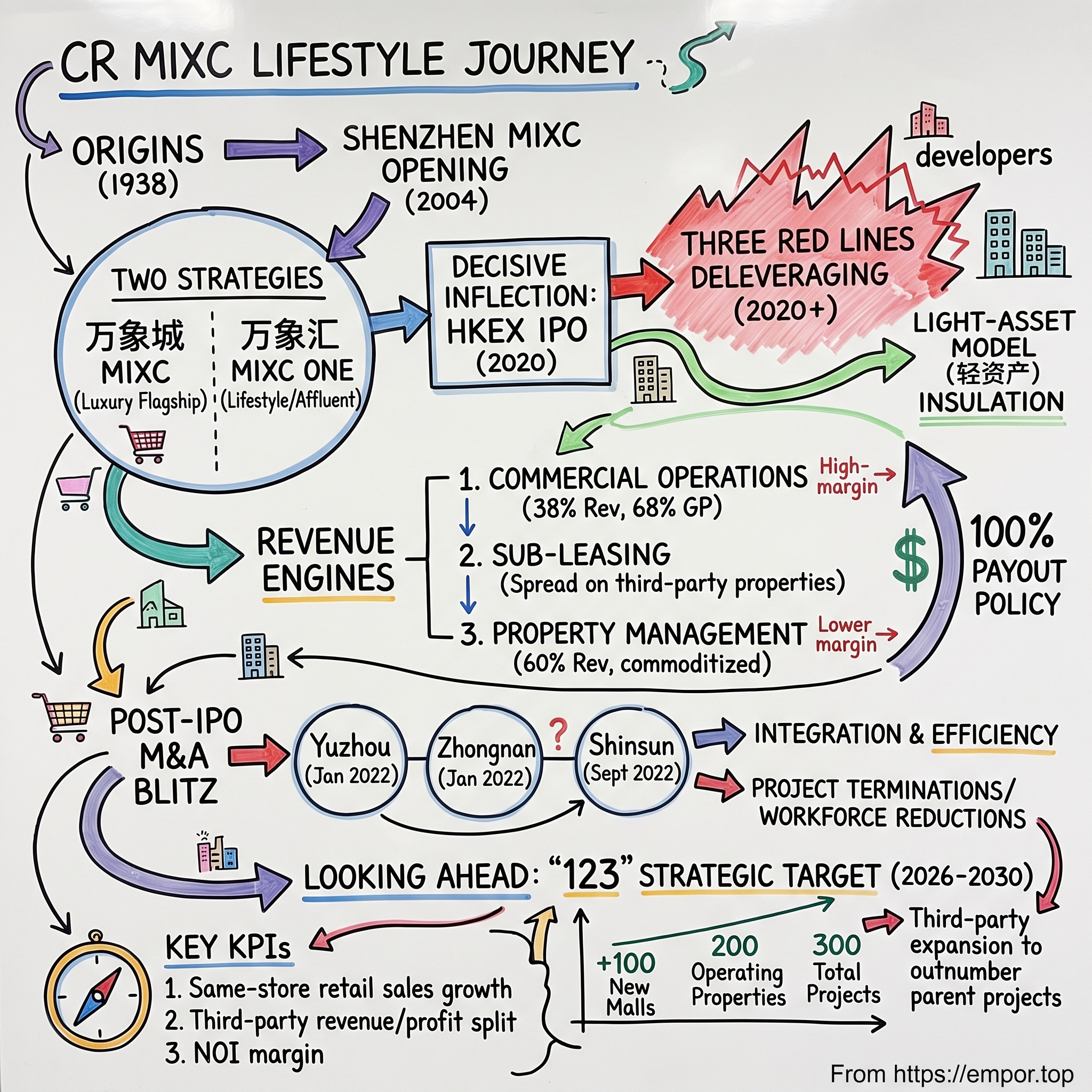
The conventional narrative attributes this performance to Mixc Lifestyle's "light-asset" (轻资产) model. The company does not purchase land, construct buildings, or hold shopping centers on its balance sheet. Instead, it provides operational services—including tenant sourcing, brand positioning, marketing, loyalty program management, and facility management—primarily to its 70% parent owner, 华润置地 China Resources Land, as well as third-party property owners. When Beijing's 三道红线 three red lines deleveraging campaign disrupted private developers beginning in 2020, Mixc Lifestyle remained insulated from property-level debt liabilities.
While accurate, that explanation leaves key operational and structural drivers unexplored.
Three central questions govern the company's valuation outlook. First, whether its competitive moat stems from proprietary operational capabilities or from its parent company's development pipeline and state-owned enterprise (SOE) backing. Second, how much of its top-line growth reflects organic market share gains versus the mechanical addition of new mall openings. Third, how the business adapts as parent-project handovers moderate—a transition already reflected in company disclosures.
The operational footprint remains substantial. As of year-end 2025, the group managed 426 million square metres of gross floor area across its property management segment, operated 233 office buildings, and held 83.07 million members in its 万象星 MIXC STAR ecosystem, representing a 36% year-over-year increase.1 Total headcount stood at 37,704 employees, down from 42,046 a year earlier—an operational shift relevant to subsequent margin analysis.2
What we'll cover
The analysis begins with the group's origins, tracing China Resources from its 1938 foundation in Hong Kong supplying medical goods to anti-Japanese bases to its landmark 2004 Mixc mall in Shenzhen. It then examines the mechanics of the light-asset business model and the sources of its operating margins. Subsequent sections evaluate the company's December 2020 IPO timing, its distressed M&A strategy, and a segment-level breakdown of luxury commercial hubs versus residential property management. Finally, the study assesses corporate governance, executive incentives, competitive positioning using Helmer's 7 Powers and Porter's Five Forces, key downside risks, and the primary metrics required to evaluate long-term performance.
 Subscribe on LinkedIn
II. Parentage & Genesis: China Resources Group & The Mixc Blueprint
In 1938, in British-colonized Hong Kong as Japanese armies advanced through southern China, a trading firm named Liow & Co. began operations. While ostensibly engaged in general commerce, its primary mandate was collecting donations from overseas Chinese and political sympathizers to procure medical and military supplies for anti-Japanese bases on the mainland. Established under the direction of 周恩来 Zhou Enlai and 陈云 Chen Yun and led by Yang Lianan, the firm was restructured in 1948 and renamed China Resources—a title intended to evoke a land rich in resources.4
This background provides essential context for the corporate origins of Mixc Lifestyle. Its ultimate parent, 华润集团 China Resources Group, has operated for nearly nine decades as a state enterprise embedded within a market economy. Headquartered in Hong Kong and accustomed to both Chinese regulatory and global commercial systems, the group was restructured into a modern enterprise in 1983, listed its first public entity in the 1990s, and in 2003 was designated a central state-owned enterprise under the direct oversight of the State-owned Assets Supervision and Administration Commission (国务院国有资产监督管理委员会 SASAC).4
What central-SOE status actually buys
Market commentary frequently cites state ownership as a generic explanation for the performance of Chinese public companies. A rigorous evaluation requires identifying the specific operational and financial mechanisms involved.
Central state-owned enterprise parentage provides three distinct advantages. First, it lowers the parent company's cost of capital, enabling continued land acquisition and property development during industry downturns. In 2025, 华润置地 China Resources Land reported a weighted average cost of debt of 2.72%, down 39 basis points year over year—placing its borrowing costs among the lowest in the real estate sector.18 Second, municipal governments are more inclined to award prime, transit-oriented sites to a counterparty backed by state solvency. Third, distressed developers, local government platforms, and transit operators are more willing to grant long-term management contracts to an operator whose parent company carries minimal counterparty risk.
These factors represent distribution and durability advantages rather than operational moats. Whether the company possesses superior operational capability remains a distinct question, the answers to which trace back to its initial retail project in Shenzhen.
December 2004: the mall nobody wanted
The site was a former flower and bird market in Shenzhen's Luohu district. China Resources cleared the land and constructed City Crossing, a mixed-use complex anchored by a shopping center named 万象城 MIXC—a name suggesting a combination of all phenomena. The venue opened on December 9, 2004.5
While conventional retrospectives present the project as a farsighted bet on Chinese luxury consumption, contemporaneous accounts document substantial initial difficulties. Kong Xiaokai, a regional general manager at the time, noted that one year prior to opening, the development team had secured only one major tenant commitment.5
Rather than relying on organic demand, management conducted a targeted leasing campaign. The team prioritized mid-tier European menswear brands, including Hugo Boss, Zegna, and Dunhill, calculating that an established tenant cluster would attract higher-tier luxury houses. The strategy proved effective. Over the subsequent two decades, the flagship location secured major luxury tenants including Louis Vuitton, Gucci, Hermès, Prada, Dior, Fendi, Cartier, and Bulgari, while hosting mainland China's first Miu Miu store and major regional flagship locations for Gucci and Prada.5 The facility later underwent major architectural renovations by Make Architects, incorporating circulation and storefront designs inspired by the Pearl River Delta.6
The operational lesson differs from the popular narrative. The success of the initial MIXC project resulted not from macroeconomic forecasting, but from a structured, multi-year tenant acquisition strategy supported by a patient, state-backed balance sheet. In an industry where developers typically prioritize rapid lease-up schedules, the willingness to leave retail space vacant until securing optimal anchor tenants served as a key operational differentiator.
Two brands, two economies
To capture China's evolving retail landscape, China Resources developed a dual-track commercial strategy. Rather than relying exclusively on flagship luxury destinations, the group established two distinct mall formats tailored to different demographic tiers and regional economic profiles.
The luxury flywheel, and the thing outsiders got wrong about China
The second stage of the MIXC expansion focused on geographic distribution, where China Resources established an advantage as European luxury brands expanded across China.
Major luxury conglomerates, including LVMH, Kering, Richemont, and Hermès, selectively controlled their store footprints throughout the 2000s and 2010s to preserve brand exclusivity. Because uncontrolled expansion risks diluting luxury prestige, each house maintains strict criteria regarding which Chinese cities qualify for retail locations and which specific properties are acceptable. These entry decisions change slowly, and once a mall secures anchor status, competing developers face high barriers to displacing it.
International operators often underestimated the pace at which regional Chinese cities would meet luxury criteria. While foreign market entrants initially viewed provincial capitals like Zhengzhou, Hefei, and Nanchang as secondary markets, China Resources leveraged its parent network to identify rapidly growing metropolitan areas with expanding high-income populations. By delivering retail properties that met global luxury standards early, the company established prime locations before competitor networks expanded.
This positioning created a self-reinforcing commercial network. When a luxury brand establishes a city flagship at a MIXC location, competing houses frequently seek space in the same property to benefit from aggregated consumer traffic. Increased foot traffic drives higher tenant sales volume, which justifies larger store formats and premium fit-outs, enhancing the operator's leverage in subsequent city negotiations. This network effect operates primarily at the individual property and brand relationship level rather than across the broader portfolio—an important distinction when evaluating the transferability of this competitive advantage across new project additions.
Two brands, two economies
By the 2010s, China Resources formalized its commercial segmentation. 万象城 MIXC remained the flagship luxury format for tier-one cities and major provincial capitals, while 万象汇 MIXC ONE (alongside its MIXC World and PLACE variants) was established as a regional lifestyle format targeting young affluent and mass-market consumers. As early as 2013, management outlined plans to expand the luxury format across fourteen additional cities while developing approximately twenty regional lifestyle malls.5
The non-luxury segment has represented a significant driver of overall growth. In 2025, tenant retail sales at non-luxury MIXC malls grew 26.9% year over year, compared to 18.5% growth at luxury locations—indicating that the broader consumer format expanded faster than the flagship luxury portfolio.1
The commercial capabilities developed in Shenzhen—including tenant leasing networks, retail design standards, and property management protocols—were housed within the parent development company for sixteen years. Converting these capabilities into an independent commercial entity required decoupling asset management and operations from underlying property ownership.
III. The Business Model Decomposition: Light-Asset Operations vs. Heavy Real Estate
Understanding what Mixc Lifestyle sells requires looking past real estate ownership.
Consider the hospitality model: one company owns the physical building and absorbs the mortgage, while a separate operator licenses its brand, manages food and beverage concepts, runs loyalty programs, recruits staff, and collects a management fee alongside a percentage of revenue. The property owner assumes capital risk and claims residual profits; the management company collects fee streams with minimal capital deployment.
Mixc Lifestyle operates as a commercial property manager under a similar framework—with the distinction that its primary property-owning client is also its controlling shareholder.
Three revenue engines, three very different economics
Commercial operational services. Mixc Lifestyle sources tenants, sets the brand mix, manages marketing and membership programs, and oversees day-to-day mall operations in exchange for management fees typically structured against landlord rental income. In 2025, this line—shopping mall operations proper—generated RMB 3.275 billion of revenue at an 82.0% gross margin.1 That software-like gross margin attached to an operational business reflects the fee structure: direct contract costs consist primarily of personnel, while revenue scales alongside the property's rent roll.
Sub-leasing. The company takes long leases on third-party properties, upgrades and repositions them, and sub-leases the space at a spread. This segment expanded fastest in 2025, rising 35.7% to RMB 1.059 billion, though its 65.6% gross margin compressed by 3.8 percentage points year over year.1 Sub-leasing introduces balance-sheet exposure to the light-asset model: four properties—including Shenzhen Buji MIXC ONE, Lanzhou MIXC, and a portion of Shenzhen Bay MIXC—are recognized as investment properties under HKFRS 16, with corresponding lease liabilities generating RMB 111.0 million in finance costs in 2025.2 While the company carries no bank borrowings, these long-dated lease obligations distinguish its balance sheet from a purely debt-free operation.
Property management. The volume business covers facility management, security, cleaning, and engineering across residential communities, offices, hospitals, universities, industrial parks, and municipal spaces. Generating RMB 10.847 billion in revenue in 2025—representing 60% of group revenue—it operated at an 18.0% gross margin, functioning as top-line volume rather than the primary profit engine.1
Turnover rent, explained without the jargon
The mechanism behind the commercial segment allows operator fees to expand faster than physical footprint.
Traditional commercial leases in China mirrored office contracts: a fixed monthly rent per square metre with scheduled indexation, collected regardless of tenant sales volume. The property owner effectively functioned as a space lender. Turnover rent—a percentage-of-sales model that MIXC helped establish in China—complements or replaces fixed base rent with a formula where the tenant pays whichever amount is higher: base rent or an agreed percentage of retail throughput.
This contractual structure aligns landlord and tenant incentives. Under fixed leases, property owners collect the same baseline whether storefronts are crowded or quiet. Under turnover rent formulas, property income shifts with tenant retail sales, giving operators a direct financial incentive to optimize foot traffic, tenant mix, marketing calendars, and evening dining activity.
For Mixc Lifestyle, management fees tied to landlord rental income capitalize on this dynamic. When operational improvements elevate mall sales, the property owner's rental collections expand, automatically raising Mixc Lifestyle's management fee without additional capital expenditure. Conversely, retail slowdowns transmit directly into operator revenues, albeit with a lag.
The margin asymmetry is the whole story
Segment metrics illustrate the mechanics of the profit model. Commercial management generated 38% of 2025 revenue but delivered 68% of gross profit. Conversely, property management provided 60% of revenue while contributing 30% of gross profit.1
Consequently, aggregate revenue growth offers an incomplete picture of financial performance. Group revenue expanded 5.1% in 2025, while gross profit grew 13.3% and core net profit rose 13.7%.1 Revenue mix shifts drove these results: a 10.1% expansion in the high-margin commercial segment paired with 1.1% growth in low-margin property management expanded the blended gross margin by 2.5 percentage points to 35.5%. Operational efficiency provided additional support, as property management gross margins widened by 1.5 percentage points to 15.9%, supported by the termination of lower-margin contracts and headcount reductions.12 Evaluating the company solely on top-line growth risks misinterpreting its margin trajectory.
Capital intensity: close to zero, with an asterisk
Mixc Lifestyle closed 2025 with RMB 15.58 billion in total cash, zero bank loans, and a gearing ratio—defined as total liabilities divided by total assets—of 46.0%, up 3.3 percentage points due to dividend payment timing.2 Operating cash flow covered 103.3% of core net profit for the year; under the company's adjusted "effective net cash flow" metric—which reinstates receivables offset against M&A debt assumptions and adds interest inflows—coverage reached 1.1 times.2
Two operational factors warrant attention. The "effective net cash flow" figure is a non-HKFRS company-defined metric that adjusts headline reporting. Additionally, cash conversion displays intra-year seasonality: first-half 2025 operating cash flow covered 64.8% of core net profit, compared to 92.2% in the prior-year period, reflecting the collection of approximately RMB 400 million in accumulated developer affiliate receivables during early 2024 versus second-half scheduling in 2025.3 Management's commitment during its interim briefing to exceed 100% full-year conversion was subsequently met, providing an operational benchmark that will be evaluated against broader corporate targets in subsequent sections.
The commercial and operating structure set the foundation for an independent listing, leading to the company's public debut in December 2020.
IV. The Decisive Inflection: Spinoff, HKEX IPO, & The "Three Red Lines" Great Divergence
In August 2020, officials from the People's Bank of China and the Ministry of Housing and Urban-Rural Development convened the country's largest property developers—including 恒大 Evergrande, Vanke, and 碧桂园 Country Garden—to introduce restrictive leverage rules.
The 三道红线 three red lines established three strict balance-sheet thresholds: liabilities-to-assets below 70%, net debt-to-equity below 100%, and cash-to-short-term debt of at least 1.0 times. Breaching any metric restricted access to new bank borrowing, with developers given until 2023 to achieve full compliance.8
For an industry built on two decades of expanding leverage, the policy fundamentally altered developer solvency and liquidity across the sector.
Assembling the thing that would be sold
The carve-out that created 1209.HK involved a multi-year internal reorganization that reflected how parent management evaluated its operating assets.
Prior to 2020, 华润置地 China Resources Land operated two distinct service divisions. The commercial operations unit managed tenant leasing, marketing, and mall management across an expanding national portfolio. The residential property management unit provided facility services to housing estates completed by the parent. The two businesses operated independently, serving different client segments with distinct cost structures, margin profiles, and competitive landscapes.
Combining them into a single entity offered strategic scale despite structural trade-offs. The commercial division alone lacked sufficient volume for a major public listing and experienced project-dependent growth cycles. In contrast, the residential division supplied baseline operational scale and recurring cash flow—qualities that equity markets rewarded with high valuation multiples in 2020. However, this combination created a permanently blended margin structure and a complex investment narrative that reports a high-margin commercial operator alongside a low-margin property management arm.
Leadership alignment preceded the corporate restructuring. Yu Linkang was appointed chairman of the parent's property management business in March 2020, unifying oversight across both divisions prior to their formal combination.2 By August 2020, the board structure was established, setting the stage for the public listing four months later.
Four months later, a listing
On December 9, 2020—sixteen years after the opening of Shenzhen MIXC—China Resources Mixc Lifestyle listed on the Main Board of the Hong Kong Stock Exchange. The company issued 550 million shares at HK$22.30 per share, the top of its offering range, raising net proceeds of approximately HK$12.0 billion. Seven cornerstone investors—GIC, Hillhouse, Ping An, CDH, Matthews, the China Structural Reform Fund, and GLP—subscribed to roughly 226 million shares.7[^7]
While market commentary characterized the offering timing as strategic foresight, it reflected favorable sector conditions that management capitalized on effectively. During 2020 and 2021, Chinese developers frequently spun off service subsidiaries to capture premium valuation multiples—often exceeding 25 times price-to-earnings for service businesses compared to four times for parent developers. Mixc Lifestyle's primary advantage lay in the composition of its asset base: a commercial operations franchise with established retail scale rather than a purely residential service operator.
The divergence, and why it was structural
Over the subsequent three years, market conditions divided Chinese property management companies into two distinct groups based on parent balance-sheet health.
A property manager separated from a real estate developer maintains three critical operational dependencies on its parent entity. It relies on the parent for pre-delivery service receivables, inherits expanded gross floor area from project completions, and faces balance-sheet exposure if parent entities draw on subsidiary cash reserves or pledge subsidiary assets.
For subsidiaries of private developers, all three mechanisms failed simultaneously. Developer defaults led to unpaid receivables, declining completion rates halted pipeline expansion, and financial distress at parent companies led to capital extractions from management subsidiaries. Consequently, public equity markets re-rated private-developer management firms from growth multiples to distressed asset valuations within eighteen months.
In contrast, Mixc Lifestyle's parent company expanded its development pipeline. In 2025, 华润置地 China Resources Land acquired 3.39 million square metres of additional land bank, recorded RMB 233.6 billion in contracted sales to rank third in the industry, and maintained a net gearing ratio of 39.2%.18 This ongoing development activity ensured a steady influx of newly delivered projects and sustained receivable collections.
This operational divergence highlights a key structural reality: Mixc Lifestyle did not fully decouple from the Chinese real estate cycle, but rather anchored itself to a state-backed central enterprise that maintained market access throughout the downturn. While this parent relationship provides significant stability, it represents a structural counterparty advantage rather than an independent operational moat. The company's strategic objective following its IPO became converting this state-backed survivorship position into a self-sustaining commercial franchise.
V. Post-IPO M&A Blitz & Capital Deployment: Bargain Hunting in a Distressed Sector
During 2021, the market for Chinese property management acquisitions expanded rapidly. Flush with initial public offering proceeds, listed managers frequently paid valuation multiples exceeding twenty times forward earnings for portfolios of managed floor space, operating under the assumption that rapid scale expansion was paramount. Despite holding approximately HK$12 billion in capital, Mixc Lifestyle initially abstained from major transactions until financial pressures forced property developers to seek liquidity.
January 2022: two deals in three weeks
On January 5, 2022, Mixc Lifestyle announced its first post-IPO acquisition, agreeing to purchase 禹洲 Yuzhou Property Service for up to approximately RMB 1.1 billion.9 Its Fujian-based parent developer, Yuzhou Group, was experiencing severe liquidity constraints, leaving its property management division as one of its few readily monetizable assets.
Sixteen days later, the company executed a larger transaction. On January 20–21, 2022, Mixc Lifestyle disclosed a two-part deal to acquire 中南 Zhongnan Services: a 100% equity purchase of Changle, Zhongnan's holding entity, for up to RMB 2.3 billion, alongside a direct 1% stake purchase from another shareholder. Zhongnan managed approximately 51.5 million square metres of gross floor area and generated RMB 175.9 million in net profit in 2021, with the seller projecting managed area to exceed 90 million square metres within five years. The transaction prompted Zhongnan to shelve its planned Hong Kong listing, while Mixc Lifestyle's shares increased 7.2% following the announcement.9
Evaluated together, these acquisitions reflected a strategy of delaying capital deployment until distressed sellers accepted lower valuations. During a period when property management M&A announcements routinely prompted stock sell-offs due to default concerns, equity markets responded positively to the Zhongnan transaction, viewing Mixc Lifestyle's state-backed balance sheet as an advantageous foundation for acquiring distressed assets at favorable pricing.
And when the market disagreed
Not all acquisition announcements received market approval. On September 29, 2022, the company disclosed the purchase of Zhuji Xiangsheng and associated payables from Shinsun Lifestyle Services, alongside a 2% equity stake in Zhejiang Shinsun. Mixc Lifestyle's share price fell 4.2% that day to HK$29.50, while Shinsun's stock declined 6.6%.10
The market response indicated that investors evaluated distressed transactions selectively, distinguishing between acquiring high-quality operations at attractive valuations and assuming legacy developer receivables or operational liabilities. This skepticism underscored the risks inherent in acquiring portfolios from distressed developers, where impaired counterparty receivables can persist following ownership transfers.
Integration, and the exits nobody announces
Subsequent portfolio rationalization provided additional insight into management's capital allocation approach. In 2025, the company terminated management contracts for 27 underperforming projects representing 3.46 million square metres of managed floor area.1 Mixc Lifestyle closed the year with 1,437 community-space projects under management, maintaining an overall project retention rate close to 100%.1
This intentional exit from low-margin properties prioritized profitability over total managed area. The property management division's gross margin expanded by 1.5 percentage points in 2025, supported by these project terminations as well as a workforce reduction of more than 4,300 employees.12 While structural efficiency gains and improved pricing contributed to margin expansion, contract terminations represent a finite source of profitability enhancement that cannot be continuously replicated.
The 2025 acquisitions: buying the ecosystem
In 2025, acquisition activity shifted from acquiring physical area to acquiring operational capabilities. In June 2025, the company completed the acquisition of China Resources Networks (Shenzhen) and China Net Data Technology (Guangzhou), the entities operating its underlying membership and loyalty infrastructure. Following integration, the ecosystem membership unit generated RMB 110 million in revenue and RMB 76.71 million in gross profit, while total 万象星 MIXC STAR points issued grew 27.2% to RMB 1.31 billion and co-branded credit card issuances reached 170,000.1
Although current financial contributions remain modest, the acquisition reflects an effort to centralize consumer data across the retail network. Management categorizes the ecosystem segment as an early-stage initiative in corporate disclosures. Consequently, the division's 72.2% top-line expansion reflects growth off a small baseline rather than an established platform model.
Capital returns: the promise that has been kept
Supported by RMB 3.95 billion in 2025 core net profit, the board declared a final dividend of RMB 0.509 per share alongside a special final dividend of RMB 0.341 per share, raising total full-year distribution to RMB 1.731 per share, a 12.7% increase. This distribution represented a 100% payout of core net profit for the third consecutive year, structured as a 60% standard payout and a 40% special dividend. Cumulative dividend payouts since the 2020 listing reached RMB 13.14 billion, reflecting an 86.9% cumulative payout ratio over five years.1
This distribution record offers empirical evidence regarding capital allocation discipline. Despite state ownership, substantial cash balances, and active M&A involvement, management adhered to its commitment to return core profits fully to shareholders, having expanded the interim dividend payout to 100% of core net profit in the first half of 2025.3
VI. Segment Deep-Dive & Economics: The Luxury Retail Engine vs. Residential Volume
Walk into Hangzhou MIXC on a weekend, and the defining feature is not simply the brand roster, but the queue for the members' lounge.
Mixc Lifestyle's operating thesis rests on treating a shopping mall not as a static rent roll, but as an actively managed consumer franchise. The company's 2025 operating results represent the clearest demonstration of that model to date.
The engine: 135 malls and a share-gain problem for its competitors
Total tenant retail sales across the operating portfolio reached RMB 266.0 billion in 2025, representing a 23.7% increase, with same-store sales expanding 12.2%.1 The same-store metric provides the clearest gauge of performance, as overall growth includes fourteen newly opened properties. Generating 12.2% same-store retail growth in a broader Chinese consumer market that expanded by just 3.7% indicates active market share expansion rather than passive macroeconomic participation.
Underlying operational metrics reflect this market position. Average mall occupancy reached 97.2%, up 50 basis points year over year. The platform maintained partnerships with over 18,800 cooperative brands—with more than 9,200 in active operation—and housed 628 international brand stores. Crucially, MIXC locations captured 36% of all key brand store openings planned across China in 2025, alongside half of all new anchor tenant locations and half of high-end cosmetics store openings.1 Property owners' total rental income across the portfolio grew 16.9% to RMB 30.7 billion, while net operating income (NOI) expanded 17.8% to RMB 20.1 billion, yielding an NOI margin of 65.7%.1
These property-level returns serve as the core test of operator value. Because Mixc Lifestyle's commercial fees represent a fraction of landlord rent, the operator validates its pricing by expanding owner NOI faster than self-managed properties could achieve. A 9.6% increase in same-store NOI paired with a 6.8% gain in same-store rental income during 2025 offers concrete evidence supporting that value proposition.1
Myth vs. reality: the "leveraged bet on Chinese luxury" framing
Market consensus frequently characterizes 1209.HK as a direct proxy for Chinese high-net-worth consumer spending. However, full-year 2025 performance data challenges that simplification.
According to Bain & Company's assessment, mainland China's personal luxury goods market contracted by 3% to 5% in 2025, following a 17% to 19% drop in 2024. Category declines were widespread: leather goods fell 8% to 11%, watches dropped 14% to 17%, and apparel declined 5% to 8%, with beauty representing the sole growth segment at 4% to 7%. Simultaneously, domestic purchases rose to 65% of total Chinese luxury spending as a weaker renminbi and narrowing international price differentials repatriated consumer purchases from overseas markets.15
In contrast, Mixc's luxury shopping centers increased tenant retail sales by 18.5% in 2025, with same-store sales expanding 15.3%.1 The divergence between a contracting national luxury market and double-digit same-store growth at Mixc properties cannot be attributed to rising consumer demand. Instead, it reflects a structural combination of spending repatriation and tenant concentration. As luxury consumers shifted purchases back to mainland China and global fashion houses consolidated their domestic retail footprints, remaining sales concentrated within prime tier-one retail hubs—a portfolio segment where Mixc maintains a dominant market share.
This dynamic positions the commercial business primarily as an industry consolidation story rather than a broad consumer tailwind—a model that offers resilience during market downturns but introduces structural limits over time. Having already captured 36% of planned key brand openings nationwide, future growth will increasingly depend on defending established locations rather than replicating past market-share gains.
The ballast: property management, and the value-added services problem
The property management division presents a very different operational picture. Segment revenue rose 1.1% to RMB 10.847 billion in 2025, but internal revenue composition shifted significantly. Core community property management services grew 7.5% to RMB 7.171 billion. Conversely, value-added services to non-property owners dropped 27.7%, while value-added services to community residents fell 26.3%.1
These contractions highlight the indirect impact of China's broader residential property downturn. Non-owner value-added services consist primarily of pre-delivery sales support for developers, directly tracking new home sales. Similarly, community value-added services include property brokerage and home transaction assistance, which depend on secondary market volume. Both revenue streams face structural pressure from depressed residential housing activity that operational adjustments cannot fully offset.
Meanwhile, the urban-space segment—encompassing public parks, industrial zones, stadiums, universities, hospitals, and civic spaces—expanded revenue by 12.0% to RMB 2.040 billion. The segment now accounts for 30% of total managed floor area, operating at a 13.4% gross margin.1
While urban-space expansion provides top-line scale and aligns with the group's central state-owned enterprise positioning, its profitability per unit of revenue is approximately one-fifth that of the commercial management division. Consequently, revenue expansion in urban space mechanically dilutes aggregate group margins even as it increases overall scale—a strategic trade-off management continues to pursue.
Payment collection dynamics in this segment also warrant scrutiny. The urban-space collection rate reached 92.6% in 2025, with a debt recovery rate of 86.5%.1 As municipal and public-sector counterparties face fiscal constraints, lengthened payment cycles create working capital friction that surfaces directly in trade receivables.
The pipeline, and the "123" ambition
As of year-end 2025, Mixc Lifestyle's commercial pipeline comprised 72 shopping mall projects: 32 originating from the parent company and 40 secured from third-party owners.1 For the first time, third-party developments outnumbered parent-supplied projects—marking a clear structural departure from the pre-IPO business model. This pipeline shift directly addresses criticisms raised after 2024 reporting, when market analysts emphasized the group's ongoing reliance on 华润置地 China Resources Land project handovers and projected parent mall deliveries moderating toward approximately six per year.19
To sustain commercial growth as parent handovers normalize, executive leadership outlined the "123" strategic target for the 2026–2030 planning period. The initiative aims to add 100 new shopping malls, reach 200 operating properties, and expand total managed projects to 300 (including pipeline contracts), targeting an opening pace of 10 to 15 malls annually, with fourteen new or renewed properties scheduled for 2026.12 Demonstrating previous progress on third-party expansion, non-parent properties expanded from 5.7% of the commercial portfolio at the start of the prior five-year plan to 37.2% by year-end 2025.12
Achieving the "123" plan represents the central execution test for the stock. Execution requires securing, integrating, and repositioning roughly twenty third-party properties annually—compared to twelve third-party projects opened and thirteen signed in 2025—while preserving the high operating margins characteristic of its core commercial management franchise.
VII. Current Management, Corporate Governance, & Earnings Transcripts Audit
The two executives who led the March 2026 annual results conference bring a combined 55 years of experience within China Resources, offering a study in complementary specialisations.
李欣 Li Xin: the developer
Li Xin, 54, joined China Resources Group in August 1994 as a personnel officer at China Resources National Corporation. He progressed through Chongqing regional subsidiaries before joining 华润置地 China Resources Land in July 2001. Over the next 12 years, he managed regional operations spanning corporate development, Dalian, and Shenyang, becoming senior vice president for the Northeast region in June 2013. He was appointed co-president and East China regional chairman in July 2016, executive director in April 2017, president of CR Land in December 2018, and chairman of CR Land's board in May 2022. Li has served as a director of Mixc Lifestyle since July 2020 and as its non-executive chairman since August 2020, where he chairs the nomination and sustainability committees.2
Li's dual appointment highlights a central governance dynamic: the subsidiary's chairman also heads its 70% controlling shareholder. While this structure aligns Mixc Lifestyle with its parent's development pipeline, it also places the executive representing minority shareholders at the head of the entity sitting on the opposite side of every connected transaction.
喻霖康 Yu Linkang: the operator
Executive Director and President Yu Linkang, 54, led the operational development of the commercial mall platform through an unconventional career path. He began his career in August 1992 managing the food and beverage department at the China Resources Hotel in Beijing. During the late 1990s, he moved into investment management at Longdation Enterprises, later serving as assistant general manager of the Shenzhen Foreign Trade Center and chairman and general manager of a Shenzhen hotel enterprise.2
In November 2004—one month before Shenzhen MIXC opened—Yu was appointed deputy general manager of China Resources (Shenzhen), which became a CR Land subsidiary the following year. He served as general manager of China Resources Shenzhen Bay Development from 2008 to 2011, managed the Wuhan region, and subsequently led CR Land's commercial real estate division. In July 2016, he became CR Land's vice president overseeing commercial operational services, rising to senior vice president in November 2018 and chairman of the property management business in March 2020. Upon the spin-off in August 2020, he assumed the presidency of Mixc Lifestyle and relinquished his CR Land executive roles.2
A hospitality background distinguishes Yu from traditional property developers. This operational orientation explains the company's emphasis on occupancy rates, foot traffic, membership tiers, and VIP lounges as core operational metrics rather than secondary marketing features. It also indicates an institutional bias toward service intensity and scale expansion—the operational mindset that underpins the company's "123" expansion plan.
Incentives: what is disclosed, and what is not
Specific performance metrics governing senior executive compensation—such as explicit targets for core net profit growth, return on equity, or third-party contract wins—are not disclosed in detail. Instead, corporate filings outline a broader incentive structure introduced in 2025. This framework features a "value-by-store, value-by-city" model designed to decentralize profit accountability to individual projects and municipal branches. It includes frontline star ratings, targeted bonuses, periodic project evaluations, and market-benchmarked compensation reviews that management reports place equal weight on financial and non-financial performance.1
Two key structural implications emerge. First, decentralizing profit-and-loss accountability to the store and city level aligns with an operating model whose economics vary substantially between flagship luxury malls and civic park contracts. This operational shift directly facilitated the rationalized exit from underperforming properties. Second, the lack of granular disclosure regarding executive pay targets remains a transparency gap for an enterprise backed by a central state-owned parent. Investors must infer strategic alignment from corporate execution—such as full dividend payouts, disciplined project exits, and headcount optimization—rather than verified contractual mandates.
The narrative across the calls
A comparison of earnings commentary from 2024 and 2025 reveals a strategic shift in executive framing.
In March 2025, discussing 2024 results, management adopted a defensive stance regarding project delivery. Following a record 21 mall openings, both executives and market analysts recognized that annual deliveries would normalize, amid market critique that growth remained heavily dependent on parent project handovers.19
By March 2026, executive commentary pivoted. Management argued that commercial real estate was undergoing market-driven restructuring, shedding fixed-asset characteristics to return to operational fundamentals, with market consolidation favoring operators possessing superior brand, operational, and platform capabilities.1113 This narrative shifted focus from defending parent reliance toward demonstrating operating independence—a position supported by the growing proportion of third-party projects in the pipeline. Management highlighted steady demand across premium and luxury segments, expansion into outlet centers and airport retail, and a 3.6-percentage-point increase in office occupancy to 77.2%, alongside a 19% gain in newly leased area.111
Management disclosures varied in level of detail across operational areas. Disclosures were specific regarding mall opening timelines, dividend distribution schedules, net operating income margins, occupancy rates, third-party revenue and profit contributions, and contract termination counts. Conversely, disclosures provided limited granularity regarding the drivers behind the 12.2% same-store retail sales expansion, which was presented as an aggregate figure without store-level breakdowns to separate repatriated luxury purchases from broader foot traffic gains. Explanations regarding the contraction in value-added services were similarly brief despite full financial disclosure.
The first-half 2025 cash flow performance provided a clear test of management guidance credibility. When interim cash flow conversion dipped to 64.8% of core net profit, management attributed the shortfall to a timing discrepancy involving a RMB 400 million collection from the prior-year period that lacked a first-half 2025 equivalent, while committing to full-year conversion exceeding 100%. The company subsequently achieved a 103.3% full-year conversion rate, validating its interim guidance.31
Connected transactions: large, capped, and running well under
Related-party transactions remain substantial and are reported in detail. Under the amended 2023 Commercial Operational Services Framework Agreement with CR Land—which extends through December 31, 2037—Mixc Lifestyle collected RMB 2,916.2 million in service fees in 2025 against a permitted annual cap of RMB 5,000 million.2
This fee breakdown illustrates the extent of parent dependency. Of the RMB 6.91 billion commercial management segment revenue, approximately RMB 2.92 billion originated from parent-developed properties, indicating that over half was generated independently. This distribution aligns with third-party shopping malls contributing 33.1% of mall revenue and 25.3% of segment pre-tax profit, both marking substantial year-over-year gains.12 In adjacent segments, CR Land value-added services generated RMB 303.0 million in community services and RMB 424.2 million in developer-facing services against annual caps of RMB 700 million and RMB 1,850 million, respectively. Property management fees from China Resources Group affiliates totaled RMB 279.4 million for community spaces and RMB 458.3 million for commercial spaces, against respective caps of RMB 495 million and RMB 1,250 million.2
Executing related-party transactions at one-third to one-half of authorized caps indicates that these limits function as operational headroom rather than rigid transaction targets. However, substantial cap capacity allows the parent entity to adjust intra-group transaction volumes without requiring additional minority shareholder approval, leaving independent directors and the 14-year framework agreement as the primary governance safeguards.
The auditor's flag
KPMG, the company's auditor since its listing, identified the expected credit loss allowance on trade receivables as a key audit matter for 2025. Gross trade and bill receivables reached RMB 2,974 million against an allowance of RMB 238 million, with net receivables accounting for 9.4% of consolidated total assets.2
Corporate disclosures detailed the factors driving this provision. Other operating expenses increased 109.3% to RMB 187.8 million, driven primarily by higher credit impairment provisions as economic pressures delayed collections from certain property clients, extending receivable aging and raising credit loss provisions.2 Average receivable turnover increased to 56 days in the first half of 2025, compared to 47 days at year-end 2024.3
Trade receivables represent the primary balance-sheet metric exhibiting operational pressure within the 2025 financial results. While the credit loss allowance remains modest relative to RMB 3.95 billion in core net profit, receivable aging reflects counterparty liquidity conditions across developer and municipal client segments.
The float question
On November 13, 2025, CR Land completed a secondary placement of 49.5 million Mixc Lifestyle shares at HK$41.70 per share—a 9.58% discount to the preceding closing price of HK$46.12. The transaction generated net proceeds of approximately HK$2.06 billion and reduced the parent's ownership stake to 70.12%. CR Land stated that proceeds would support land acquisition, development expenditures, and working capital, while characterizing the sale as an initiative to expand the subsidiary's public float and trading liquidity.14
The equity placement invites two distinct interpretations. The positive view regards the transaction as a routine mechanism to expand free float and institutional trading liquidity while meeting parent capital requirements. The alternative interpretation views the placement as a partial monetization of a liquid, premium-valued asset to support parent development funding. Although representing 2.17% of total shares outstanding, the transaction confirms that the controlling shareholder evaluates its equity stake as an accessible liquidity source.
VIII. Competitive Strategy, Hamilton Helmer's 7 Powers & Porter's 5 Forces
If you wanted to compete with Mixc Lifestyle, where would you start? Not with capital — Chinese developers have plenty when the state lends. Not with land — municipalities are giving away sites. You would start where the company started in 2003, cold-calling Hugo Boss, and you would discover that the seats you want are already taken.
Where the powers are real
Cornered resource — the strongest claim, with limits. Luxury houses do not open stores freely. They ration doors by city and by tier, because scarcity is the product. Once LVMH, Kering, Richemont or Hermès designates a mall as its city flagship, that designation is close to permanent and its rivals largely cannot buy their way in. The measurable proxy is that Mixc captured 36% of key brands' planned nationwide store openings in 2025, and half of anchor-store and high-end cosmetics openings.1 That is a resource a competitor cannot replicate with money.
The limit: it is a resource held at the building level, not the corporate level. It defends the 135 malls in operation superbly. It transfers only partially to the next hundred, which will be disproportionately in weaker cities and non-luxury formats, where brand rationing is far less binding.
Network effects — real but narrower than described. The mall flywheel — traffic attracts brands, brands attract traffic — is a within-asset effect, not a cross-asset one. A shopper in Hefei does not create value for a mall in Shenyang. Where a genuine cross-asset network is being attempted is membership: 83.07 million members, 2.04 billion annual visits, cross-scenario point redemption up 41.7%, and member spending above RMB 100 billion.1 If a member's points and status become portable across 135 malls and outward into partner ecosystems, that becomes a real switching cost at the consumer level. Today it is a marketing programme with promising engagement metrics, and it should be assessed as such.
Scale economies — demonstrable. Centralised procurement, one leasing negotiation covering a national footprint, one technology stack, and management-and-sales expenses falling to 7.5% of revenue.1 Digital coverage reinforces it: the store management system reaches 100% of projects, the tenant app covers 98% of tenants, and the E-MIXC consumer app runs above 1.35 million daily active users.1 These are cost advantages a sub-scale regional operator cannot match.
Brand power — asymmetric. "MIXC" carries pricing power with municipalities and brands; it carries very little with a residential homeowners' committee negotiating a property management fee. The brand is powerful in exactly one of the company's two large segments.
Counter-positioning — historical, not current. The light-asset model let Mixc Lifestyle trade at a premium while heavy developers de-rated. But every large operator has now converted to light-asset management output — 万达商管 Wanda Commercial Management opened its entire 2025 new-mall cohort as partner-funded, fully-managed light-asset projects.16 Counter-positioning ends when incumbents copy the position, and they have.
Two of Helmer's seven are largely absent: switching costs at the tenant level are moderate (leases end), and process power is a claim the company makes about its operating standards that no outsider can verify from disclosure.
Porter, honestly
Suppliers (property owners and developers) have weak bargaining power in the current market. There is a surplus of vacant and underperforming commercial space and a shortage of operators who can fill it — which is precisely why five of the twelve third-party projects Mixc took on in 2025 were existing operating or under-construction assets handed over for repositioning.1 This is the most favourable force in the analysis, and it is cyclical: it improves as owners get more desperate and weakens if the sector recovers.
Buyers split. Top luxury houses have very high power — they choose the mall. General retail tenants have little. Residential homeowners have low individual power but meaningful collective power at contract renewal, and property management fee increases remain politically sensitive in China.
Substitutes. E-commerce remains the structural threat to physical retail everywhere, and China's is the most developed on earth. Mixc's answer is to convert malls into experience venues — dining, events, cultural programming, over 20,000 membership events and more than 100 city-level events in 2025, with 2.04 billion visits.1 Footfall up 32.7% suggests the answer is working for now. It is also expensive, and it is the kind of advantage that requires continuous reinvestment rather than compounding on its own.
Rivalry is where the two segments diverge most violently. In premier luxury commercial management, the field is small: 恒隆地产 Hang Lung Properties, 太古地产 Swire Properties, Hongkong Land, Beijing SKP and a handful of domestic operators. And the field is not uniformly healthy — 2025 saw three Hang Lung mainland projects post declining performance, including double-digit falls in Wuhan and Shenyang, while Swire's mainland rental income grew about 3%.16 Against domestic peers, 龙湖 Longfor grew retail sales roughly 17% at 96.8% occupancy, and Wanda operated over five hundred plazas at far larger scale but at a very different position on the luxury spectrum.16 Mixc's rental income growth of 16.9% put it at the top of that cohort.
In residential property management, rivalry is brutal and commoditised: thousands of competitors, low switching costs, and price-led tendering. This is the honest reason the group's blended margin will always be a mix of an outstanding business and an ordinary one.
The war-game conclusion: the commercial franchise has a genuine and currently widening advantage, sourced primarily from tenant relationships and secondarily from scale. The property management business has no meaningful moat and is defended by brand reputation and cost discipline alone. An investor buying 1209.HK is buying one excellent business subsidising the growth of an average one — which raises the question of what could break it.
IX. The Skeptical Investor Stress Test & Material Risk Radar
An activist reviewing the business would focus less on retail demand trends and more on three operational questions: parent reliance, trade receivables, and margin sustainability once initial efficiency gains recede.
Stress test one: the luxury shock
What if Chinese luxury sales fall 15% nationally?
The contractual structure provides an initial buffer. Because commercial management fees track landlord rental income—which combines fixed base rents with turnover rent tied to tenant sales—a downturn initially compresses the variable turnover component while preserving base rental income. Given a 97.2% portfolio occupancy rate and prime flagship locations that luxury brands consider strategic, physical vacancy would lag a sales decline substantially.1
The deeper vulnerability is second-order and cumulative. Sustained weak retail sales eventually force lease renegotiations upon renewal, eroding the high 65.7% net operating income margin. With zero bank debt or borrowings, a luxury downturn presents no solvency risk.2 Instead, it poses a valuation risk: if earnings growth decelerates, a market price predicated on expansion rather than current yield will re-rate downward.
Stress test two: the parent
If 华润置地 China Resources Land slows, can third-party expansion carry growth without margin degradation?
This challenge formed the core external critique in 2025, when analysts noted that growth still relied heavily on parent project deliveries and projected parent mall handovers moderating to roughly six annually.19
Full-year 2025 results provided a partial rebuttal. Third-party projects formed the majority of the commercial pipeline, while third-party assets contributed 33.1% of shopping mall revenue and 25.3% of segment pre-tax profit.1 Furthermore, commercial service fees collected from China Resources Land totaled RMB 2.92 billion, representing a minority of overall commercial segment revenue.2
However, the spread between revenue and profit contributions highlights an ongoing structural trade-off. Generating 33.1% of revenue but only 25.3% of pre-tax profit indicates that third-party malls operate at lower average profitability than parent-developed properties. Although both metrics expanded during 2025, this gap quantifies the margin cost of independence. Delivering the "123" strategic plan through third-party expansion could cause aggregate commercial margins to compress even as top-line scale expands.
Within the property management segment, parent dependency is lower, though pipeline expansion follows a similar selective pattern. The company added 35.3 million square metres of contracted third-party gross floor area in 2025, with 80% located in first- and second-tier cities and 76% of new contracts valued above RMB 10 million.1 Management prioritized contract value and location over raw floor area expansion, stabilizing unit economics through a more gradual growth trajectory.
Stress test three: the receivables and the accounting
The sharp rise in credit impairments and KPMG's identification of trade receivables as a key audit matter point to potential balance-sheet friction. An investor scrutinizing reporting quality would highlight three specific concerns: whether the RMB 238 million expected credit loss allowance sufficiently covers RMB 2,974 million in gross receivables as collection cycles lengthen; whether receivables from distressed developer affiliates and municipal urban-space clients carry provisions comparable to commercial trade debt; and whether the non-HKFRS "effective net cash flow" metric—which reinstates M&A offsets and interest inflows—artificially maintains conversion rates above 100%.2
While corporate disclosures explain these adjustments in detail, these items represent areas where accounting assumptions directly influence reported profitability. They require ongoing monitoring rather than immediate alarm.
The risk radar, sized to what actually matters
Consumption and the luxury cycle. Market forecasts from Bain & Company project modest Chinese luxury growth in 2026 alongside ongoing volatility, with recovery varying across product categories and brand tiers.15 While Mixc outpaced national retail sales in 2025 by capturing market share, compounding past market-share gains becomes mathematically harder as its share of total luxury locations increases.
Policy and sentiment. The 共同富裕 common prosperity framework continues to shape Chinese economic policy, impacting the business through consumer sentiment around high-end spending and public sensitivity regarding residential property management fee hikes. While policy shifts have not resulted in direct regulatory intervention, they place a political cap on pricing power.
Labor costs and productivity limits. Total headcount decreased from 42,046 to 37,704 in 2025 even as total managed area expanded by 3.2%.21 While this workforce reduction generated temporary operational efficiencies, property management remains labor-intensive. In an environment of rising minimum wages, extracting further margin expansion from labor reduction will grow increasingly difficult.
Contract renewal risk. The company reported a community-space retention rate near 100% in 2025, backed by stable collection rates and the addition of 69 mid-to-high-end residential projects.1 Nevertheless, residential property management contracts face periodic re-tendering, where price competition can erode fee structures.
Structural concentration. The business operates entirely within China, conducts transactions in renminbi, and remains controlled by a single parent entity holding a 70.1% stake. These factors represent baseline structural features of the investment thesis rather than transient operational risks.
Pipeline execution. Reaching the targets outlined in the "123" plan requires an opening and integration cadence well above recent historical rates. Accelerating project additions into lower-tier markets to meet five-year targets poses the principal risk of diluting the operating margins that define the core commercial franchise.
X. Playbook & Key Investing Lessons
Strip away the specifics of Chinese shopping malls, and four transferable investing lessons remain—each testable against empirical evidence rather than mere assertion.
Lesson 1: Separating the operating business from the asset can reveal value the market could not see
For sixteen years, the MIXC operating franchise sat inside a property developer, valued at multiples typical of a leveraged, cyclical, and capital-hungry real estate builder. Carved out and publicly listed, those same operational cash flows were re-rated as a recurring service business.
The crucial qualifier is that this value re-rating holds only when the operating business can genuinely stand alone. Dozens of Chinese developers spun off property management subsidiaries in 2020 and 2021, only for most of those entities to collapse back to distressed multiples within two years. What those parent companies listed was a captive fee-collection agent for an insolvent developer, not an independent commercial business. While the corporate structure was identical, the underlying assets were not. Investors should evaluate light-asset spin-offs with skepticism, examining what operational capabilities are actually being separated.
Lesson 2: In commercial real estate, the scarce input is the tenant, not the site
Physical retail space can be constructed easily, often supported by municipal incentives across China. However, persuading global luxury houses such as Hermès or Chanel to designate a specific location as a city flagship remains exceptionally difficult, as those brands strictly ration store locations to preserve exclusivity. Consequently, the primary asset in commercial management is a tenant relationship network built over decades, explaining why early leasing efforts in 2003 proved far more consequential than subsequent capital raises.
This dynamic also highlights a key strategic constraint for Mixc. Tenant relationship networks are asset-specific; they transfer imperfectly to new geographic markets and offer limited advantage in mass-market formats where luxury brand rationing does not apply. Expansion into lower-tier cities or non-luxury retail formats represents a move away from the company's core competitive moat, even as it expands top-line revenue.
Lesson 3: Sovereign-adjacent counterparty status is a real financial asset — and it is not a substitute for operating skill
The three-red-lines policy provided a clear natural experiment across the Chinese real estate sector. Companies with similar operational models diverged dramatically based on parent ownership structure. Central state-owned enterprise parentage provided sustained land acquisition, continuous project handovers, resilient trade receivables, and borrowing costs among the lowest in the industry.18
An accurate assessment requires separating survivorship advantages from operational capability. Parent backing ensured corporate survival, but it does not explain operating performance. Evidence of Mixc's operational capability remains distinct and observable: 12.2% same-store retail sales growth against a 3.7% broader market expansion, net operating income margin expansion, and double-digit performance gains at repositioned third-party malls.1 Conflating state support with operational skill risks overvaluing state-backed enterprises that lack underlying commercial execution.
Lesson 4: The best acquisition discipline looks like inactivity, and then like selling
Mixc Lifestyle held approximately HK$12 billion in cash during the 2021 property management M&A surge, deploying capital only when distressed sellers emerged in 2022.9 That patience represents the initial phase of capital discipline.
The subsequent phase proved equally telling. In 2025, the company exited 27 underperforming projects covering 3.46 million square metres and reduced headcount by more than 4,300 employees, directly supporting margin expansion.12 While acquisitive management teams rarely reduce operational volume, Mixc prioritized profitability over total managed area. Public markets validated this selective approach—raising the stock price 7.2% following the Zhongnan acquisition while discounting it 4.2% on the Shinsun transaction, distinguishing between acquiring operational capability at attractive pricing and assuming legacy liabilities.910
As the company pursues its long-term expansion goals, all four lessons converge on a single evaluation metric: whether the operational economics of the next hundred malls can match those of the first hundred.
XI. Synthesis, Key KPIs to Watch, & Bull vs. Bear Case
As of late July 2026, the company had not yet reported first-half results—those were scheduled for August. Sell-side previews published on July 22, 2026, expected first-half core net profit to maintain double-digit year-over-year growth on high-single-digit revenue expansion. Analysts projected commercial segment margin expansion, twelve new mall openings in 2026—with ten scheduled for the second half—twenty new project signings compared to thirteen in 2025, and the continuation of the 100% payout policy. The company's shares traded at HK$38.84 on that date.17 Meanwhile, revenue from value-added services was expected to continue declining, albeit at a moderating pace.
That preview summarizes the core investment debate: a compounding commercial operational engine alongside a flat or contracting residential property management base, with future performance depending on whether the company can accelerate project additions without degrading operating margins.
The three numbers that matter
1. Same-store retail sales growth across operating malls. Total retail sales figures include new store openings and reflect physical pipeline expansion rather than operational competitiveness. Same-store sales growth provides a direct measure of tenant financial health, foot traffic conversion, and turnover-linked rental growth. Higher tenant sales expand owner net operating income (NOI), driving management fee growth across the portfolio. In 2025, same-store retail sales rose 12.2% against broader Chinese retail sales growth of 3.7%.1 The spread between those two figures represents the central metric evaluating operational performance.
2. Third-party contributions to shopping mall revenue and pre-tax profit. In 2025, third-party projects contributed 33.1% of shopping mall revenue and 25.3% of segment pre-tax profit.1 The revenue share measures operational independence from 华润置地 China Resources Land, while the profit gap reflects the financial cost of that independence. A rising third-party revenue share paired with a narrowing profit gap would indicate that Mixc Lifestyle can expand beyond its parent pipeline without margin compression, validating the "123" strategic plan. Conversely, a widening profit gap would suggest that top-line growth is diluting average portfolio quality.
3. Shopping mall NOI margin. Reaching 65.7% in 2025—an increase of 60 basis points—the NOI margin reflects the operator's ability to generate property-level returns for property owners.1 This metric combines tenant positioning, occupancy pricing, cost management, and asset repositioning into a single indicator that cannot be inflated merely by adding new locations.
While occupancy rates, total membership numbers, and managed gross floor area remain useful operational tracking metrics, same-store retail sales growth, third-party profit conversion, and NOI margins serve as the primary drivers of long-term business performance.
The bull case
The bullish thesis centers on industry consolidation across a fragmented, distressed commercial real estate market by an operator combining brand equity, capital resources, and state-backed counterparty status. As real estate stress persists, property owners increasingly outsource commercial management on favorable terms; five of the twelve third-party projects secured in 2025 involved existing operating or under-construction assets transferred for operational repositioning.1 Simultaneously, luxury retail spending has concentrated into prime retail hubs, where Mixc holds a substantial market share—enabling its luxury centers to expand sales despite broader contraction in national luxury demand.151
From a financial perspective, the company operates with zero bank debt, maintains effective cash conversion above 100% of core net profit, distributes 100% of core earnings to shareholders, and generates double-digit commercial growth at a 63.1% gross margin.12 If execution of the "123" plan aligns with targets and third-party project profitability converges toward parent-developed margins, the company represents a defensive compounder delivering full capital return to equity holders.
In strategic terms, the bullish narrative assumes that the company's tenant acquisition relationships represent a transferable operational capability, and that its expanding membership platform converts asset-level traffic into a broader network advantage.
The bear case
The bearish argument rests on three operational constraints, ordered by strategic significance.
Market-share gains face structural limits. A portfolio already capturing 36% of planned key brand store openings across China and operating 54 top-ranked regional malls cannot sustain its historical pace of market-share expansion.1 Once brand concentration reaches maturity, portfolio growth will mirror the broader Chinese retail market—a sector characterized by Bain & Company as modest, volatile, and uneven.15 Current market valuations reflect ongoing share gains rather than market-level baseline growth.
Pipeline expansion risks diluting portfolio economics. Additional project openings under the "123" plan are weighted toward lower-tier cities, non-luxury formats, and third-party management contracts where tenant relationship leverage is weaker and profit margins are lower. Expanding top-line revenue while lowering average property quality risks diluting the premium commercial franchise.
The property management segment remains structurally low-margin. Property management provided 60% of 2025 revenue at an 18.0% gross margin, with value-added services declining 26% to 28% due to depressed residential housing transactions.1 Meanwhile, the expanding urban-space vector operates at a 13.4% gross margin with a 92.6% collection rate.1 Margin gains extracted from workforce reductions and contract exits represent finite operational adjustments that cannot be continuously repeated.
Underpinning these operational challenges is corporate governance structure: a 70% controlling shareholder that executed a secondary equity placement to raise capital, a board chairman heading the parent developer, and connected-transaction annual caps operating at roughly twice actual transaction volumes.142
What would change the picture
Several empirical metrics would clarify the company's trajectory. Three consecutive reporting periods of same-store retail sales growth converging toward national consumer retail averages would indicate that market-share gains have plateaued. A rising third-party revenue share alongside stagnant pre-tax profit contribution would confirm margin dilution. A reduction in the 100% core profit payout ratio—without an explicit capital deployment rationale—would indicate a shift in capital allocation policy. Finally, a significant increase in expected credit loss allowances or a sustained lengthening of receivable collection cycles beyond 2025 levels would signal expanding counterparty credit risk.
Conversely, if Mixc Lifestyle maintains its planned project opening cadence through 2026 and 2027 while achieving profit margins on third-party developments comparable to parent-supplied assets, empirical evidence will validate management's thesis that its competitive moat stems from operational capability rather than parent ownership.
The corporate evolution that began with a Shenzhen leasing team securing menswear tenants in 2003 reflects a combination of operational execution and state-backed balance-sheet support. The execution of its five-year strategy will demonstrate which of those two factors represents the primary foundation of its long-term commercial performance.
References
-
2025 Annual Results Announcement Presentation — China Resources Mixc Lifestyle Services, 2026-03-30 ↩↩↩↩↩↩↩↩↩↩↩↩↩↩↩↩↩↩↩↩↩↩↩↩↩↩↩↩↩↩↩↩↩↩↩↩↩↩↩↩↩↩↩↩↩↩↩↩↩
-
Annual Report 2025 — China Resources Mixc Lifestyle Services, 2026-05-14 ↩↩↩↩↩↩↩↩↩↩↩↩↩↩↩↩↩↩↩↩↩↩↩
-
2025 Interim Results Announcement Presentation — China Resources Mixc Lifestyle Services, 2025-08-27 ↩↩↩↩
-
CR Mixc Lifestyle Successfully Listed on HKEX Today — China Resources Group ↩
-
Chinese developers to focus on debt reduction until 2023 to meet 'three red lines' deadline — South China Morning Post, 2021 ↩
-
CR Mixc Surges After Chinese Firm Reveals Second Property Management Deal in Three Weeks — Yicai Global, 2022-01 ↩↩↩↩
-
China Resources Mixc Drops on Plan to Buy Shinsun Assets — Yicai Global, 2022-09-29 ↩↩
-
观点直击 | 华润万象生活增量时刻:再开100座购物中心 — Guandian via Tencent News, 2026-03-31 ↩↩
-
China Resources Mixc Lifestyle Services' 2025 Revenue Exceeds CNY 18 Billion — BigGo Finance, 2026-03 ↩
-
China developer CR Land seeks US$260 million from stake sale in property services arm — South China Morning Post, 2025-11-13 ↩↩
-
China's personal luxury market contracts 3%–5% in 2025 but shows signs of recovery — Bain & Company, 2026-01 ↩↩↩↩
-
China Resources Mixc Lifestyle Services (1209 HK): 1H26 Results Preview — UOB Kay Hian, 2026-07-22 ↩
-
Announcement of Results for the Financial Year Ended 31 December 2025 — China Resources Land (HKEXnews), 2026-03-30 ↩↩↩
-
年报解读 | 华润万象生活去年新开业购物中心21座,未来几年新开项目或下降 — Tencent News, 2025-03-27 ↩↩↩
 LinkedIn
 WhatsApp
 Reddit
 Hacker News
 Email
Email Kindle
 RSS Feed
 Spotify
 Apple Podcasts
 Amazon Music
 Audible
 YouTube