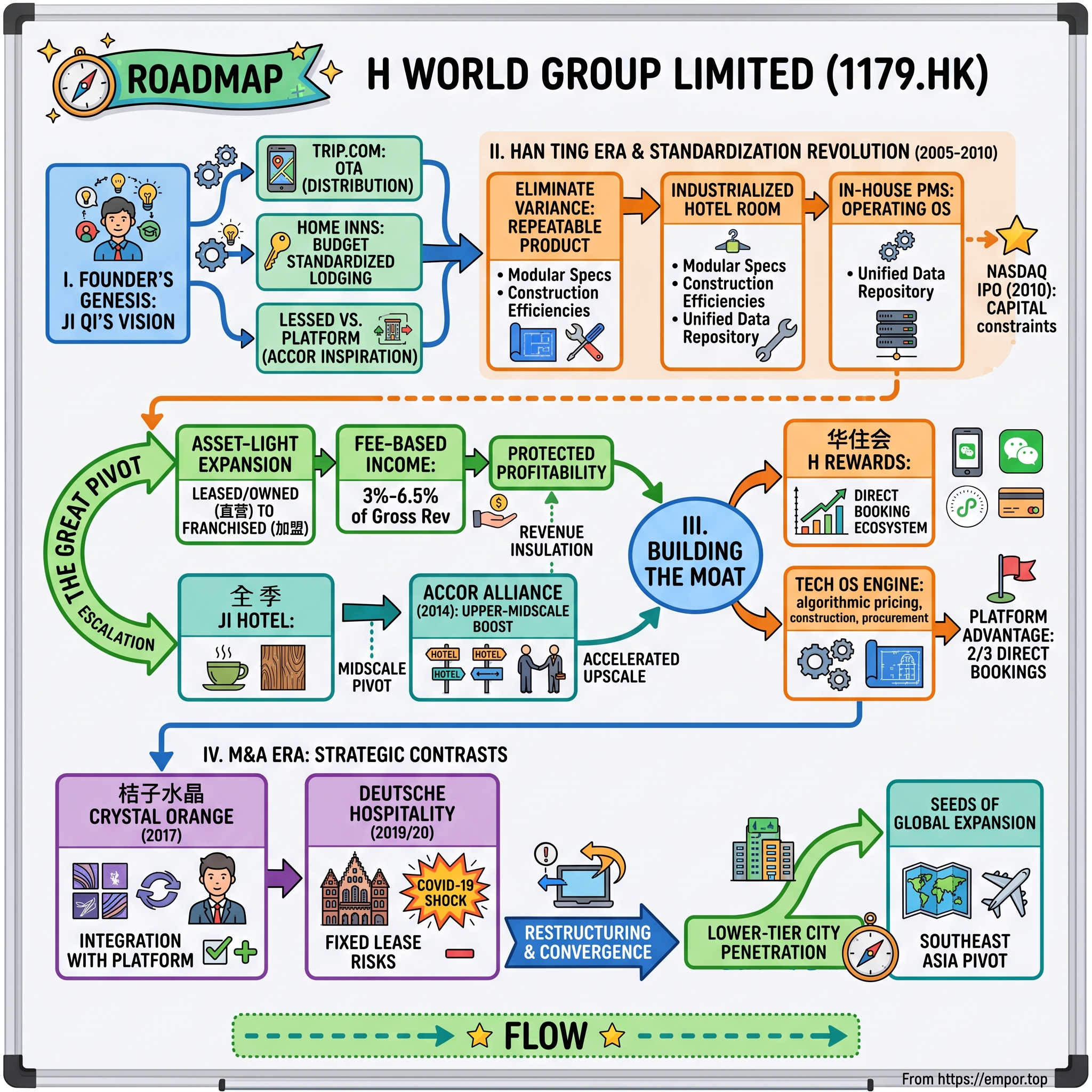
H World Group Limited: The Tech-Powered Hotel Empire
I. Introduction & Episode Roadmap
In August 2005, a middle-aged Chinese entrepreneur who had already taken two companies public on NASDAQ opened a small hotel next to the railway station in Kunshan, a manufacturing town in Jiangsu province about an hour west of Shanghai.1 It offered clean white bedding, reliable hot water, a broadband connection in every room, and none of the smoke-and-mildew atmosphere typical of Chinese budget lodging at the time. The brand was named 汉庭 HanTing, and its founder, 季琦 Ji Qi, was embarking on his third venture.
Twenty-one years later, the enterprise built from that single property operated 13,215 hotels with over 1.3 million rooms (1,303,563) across 1,461 Chinese cities and select international markets, generating RMB 26.4 billion in gross bookings in a single quarter.2 华住集团 H World Group Limited is now one of the four largest hotel operators globally by room count and the most digitally integrated among China's major hospitality groups.
Management and sell-side analysts often argue that H World is less a traditional hotel operator than a distribution and software platform. In this view, the business functions as a franchising engine built on top of a proprietary reservation system, a 300-million-member loyalty program, and a centralized procurement and construction network that allows property owners to convert aging guesthouses into branded, cash-generating assets within weeks.3 Under this model, franchisees own the physical real estate, while H World retains the brand, customer demand, pricing algorithms, and fee streams.
While this platform narrative reflects much of the company's operational reality, the financial performance presents a more nuanced picture. H World's asset-light transition is demonstrably underway: managed and franchised operations generated 69% of gross operating profit in 2025, up from 64% in 2024, while representing 93% of the room base.4 However, core Chinese revenue per available room (RevPAR) declined in 2025, and same-hotel growth—excluding new property openings—remained negative for most of the preceding two years.5 Consequently, top-line expansion has relied primarily on adding rooms rather than earning more per room, raising the fundamental strategic question of whether H World represents a compounding platform or an accelerating unit-expansion treadmill.
The roadmap begins with the founder: Ji Qi's career sequence across 携程集团 Trip.com, 如家 Home Inns, and H World, and the operational lessons that shaped his approach to hotel economics. It then covers the standardization era, during which HanTing industrialized Chinese budget lodging into a repeatable product. The discussion then turns to H World's strategic pivot from leased properties to fee-based franchising, its expansion into mid-to-upscale segments through 全季 JI Hotel, and its 2014 alliance with Accor, which accelerated its premium portfolio growth.
Subsequent sections evaluate the primary competitive moat: 华住会 H Rewards, a loyalty and direct-booking ecosystem designed to limit reliance on Chinese online travel agencies. The analysis then reviews the company's M&A record—contrasting its successful domestic boutique acquisitions with its pre-pandemic German acquisition, which highlighted the structural risks of fixed European leases relative to flexible Chinese franchise contracts. Finally, the article details H World's financial model, lower-tier city expansion, upscale strategy, competitive position via strategic frameworks, and core investment thesis.
The analysis starts with the founder who repeatedly reshaped Chinese hospitality.
 Subscribe on LinkedIn
II. Founder Context: The Serial Entrepreneur — 季琦 Ji Qi
In 1999, during the early wave of China's internet boom, four entrepreneurs established a travel booking platform in a market where credit card adoption was minimal, hotel reservations were largely transmitted via fax, and online price comparison was virtually nonexistent. The founding team comprised 季琦 Ji Qi, an engineer trained at Shanghai Jiao Tong University; 梁建章 James Liang, a technologist who later gained prominence as a demographer; 沈南鹏 Neil Shen, an investment banker who became a leading venture capitalist in Asia; and 范敏 Min Fan, an experienced hotel operator. Together, they founded 携程集团 Trip.com (then Ctrip), with Ji Qi serving as its initial CEO and president.6
Ctrip's rapid commercial growth highlighted a fundamental structural bottleneck in Chinese hospitality: the digital travel agency had built an efficient demand aggregation platform over a fragmented and highly inconsistent supply base. In the early 2000s, Chinese lodging consisted predominantly of state-owned guesthouses, state enterprise (danwei) facilities, and unstandardized independent operators. While Ctrip could capture customer demand and direct bookings, it had no control over room quality or property operations. Furthermore, as an online travel agency (OTA), its business model relied on transaction commissions—collecting a fee on bookings without owning the customer relationship or the underlying asset.
Recognizing that controlling the lodging experience offered superior long-term economics, Ji Qi pivoted from distribution to property development. In 2002, backed by Ctrip with approximately RMB 5 million in seed capital, he founded 如家 Home Inns and served as its CEO.6 Home Inns demonstrated a core thesis that defined Ji Qi's subsequent ventures: China's expanding class of business travelers, engineers, and entrepreneurs sought reliable baseline quality rather than luxury. By offering standardized essentials—clean bedding, reliable hot water, secure access, and affordable rates—Home Inns turned operational predictability into its core product.
After leaving Home Inns, Ji Qi launched HanTing, opening its initial location near the Kunshan railway station in August 2005.1 Rather than simply creating another economy hotel operator, Ji Qi sought to invert the traditional hospitality model. While Home Inns operated primarily as a real estate and operations company that utilized technology, Ji Qi envisioned HanTing as a technology and distribution platform that leveraged real estate. Drawing inspiration from Accor, the French hotel group behind brands ranging from economy ibis to luxury Sofitel, he concluded that enduring enterprise value lay in managing a multi-brand portfolio and a centralized reservation ecosystem rather than holding long-term property leases. Reflecting this broader platform vision, the enterprise formally adopted the Huazhu name in 2012.1
This strategic orientation is reinforced by a corporate governance structure that concentrates power with the founder. Ji Qi has served as executive chairman of the board since August 2009, having also briefly resumed the chief executive role from November 2019 until October 1, 2021.7 His economic interest is structured through a chain of holdings: Winner Crown Holdings Limited, a British Virgin Islands entity wholly owned by Sherman Holdings Limited in the Bahamas, which is held by the Ji Family Trust—a revocable Singapore trust under which Ji Qi and his family are beneficiaries and over which he maintains investment control and revocation rights.8 Paired with a dual-class voting structure, this arrangement ensures Ji Qi retains operational control of H World regardless of shifts in his underlying economic stake. For public equity investors, this structure insulates long-term strategic decisions from short-term market pressures, while simultaneously removing traditional shareholder mechanisms to enforce accountability if executive strategy falters.
Operational leadership is held by 金辉 Jin Hui, who assumed the CEO role on October 1, 2021. Jin's career is anchored entirely in network expansion: he worked as a regional development manager at Shanghai Home Inns Hotels Management from March to December 2004, joined HanTing in 2005, and advanced through roles as director of development, vice president, executive vice president, and president before his appointment as chief executive.7 Having spent nearly two decades overseeing franchise development, Jin's background aligns directly with the primary engine of an asset-light operator: recruiting property owners. However, this executive lineage also reflects an organizational focus on aggressive unit growth—a strategic posture that becomes critical when evaluating whether network expansion is outstripping underlying RevPAR performance.
Concurrently, H World has seen leadership transition in its finance department. Chen Hui stepped down as chief financial officer effective March 18, 2026, and was succeeded by Arthur Yu, whose prior experience includes senior executive roles at Baozun, Jaguar Land Rover, and BT Group.4 A CFO transition occurring alongside slowing headline revenue growth warrants analytical scrutiny, particularly regarding whether financial disclosure standards and forward guidance methodologies remain consistent under new leadership.
Translating the founder's core insight—controlling customer demand rather than physical real estate—into a durable competitive moat required a decade of systematic operational execution, beginning with the industrialization of the hotel room itself.
III. The HanTing Era & The Standardization Revolution (2005–2010)
To understand what HanTing solved, consider the environment in which it launched. In 2006, a business traveler journeying from Guangzhou to a third-tier city in Hubei typically chose among independent guesthouses whose operational standards were unpredictable. Facilities varied widely: some lacked private bathrooms or fire safety exits, while proprietors recorded guest information in paper ledgers. This lack of consistency represented a major friction point for corporate travelers seeking predictable lodging.
HanTing’s initial operational objective was to eliminate this variance. Rooms were built using standardized, modular specifications: identical bedding, bathroom pods, and broadband connections. The core function of this design was industrial efficiency rather than aesthetic distinctiveness. By standardizing physical layouts, the company could streamline site specifications, cost estimates, procurement, construction timelines, and staff training, enabling it to offer customers guaranteed baseline quality sight unseen.
This expansion coincided with favorable macroeconomic conditions. China's urban population was expanding by tens of millions annually, construction of a national high-speed rail network was connecting regional commercial hubs, and a domestic business-travel market was rapidly developing. HanTing positioned its properties near major transit hubs and industrial zones to capture this growing demand.
A key structural differentiator during this period was H World’s decision to develop its property management system (PMS) in-house rather than license third-party software. A hotel PMS serves as the central operating system, managing room inventory, rate structures, guest folios, and housekeeping schedules. While legacy hotel groups typically operated fragmented vendor systems across individual properties, H World ran a single, centralized platform across its entire network. Owning the underlying software architecture established a unified data repository, laying the foundation for centralized reservations, dynamic algorithmic pricing, and integrated loyalty operations.
Financial validation came in early 2010. On March 26, 2010, China Lodging Group, Limited priced its initial public offering on NASDAQ at $12.25 per American depositary share (ADS)—the top of its marketed range. The sale of nine million ADSs, each representing four ordinary shares, raised roughly $110 million in gross proceeds under the ticker HTHT.9 This capital raise followed the 2008–2009 global financial crisis, during which H World maintained network expansion by securing long-term leases on favorable terms while competitors curtailed capital deployment.
However, the public listing also highlighted capital constraints. The $110 million raised was modest relative to the capital required for a nationwide network rollout under a leased model. Continuing to build company-owned or leased properties would require repeated equity dilution or substantial debt. To sustain long-term growth, H World needed to transition toward a capital-light expansion strategy—a shift that dictated its operating model over the following decade.
IV. The Great Pivot: Asset-Light Expansion & Brand Escalation (2010–2016)
In commercial hospitality, operators typically deploy capital through two distinct models. An operator can lease a building directly, fund the property fit-out, hire staff, assume the operational risk, and retain all room revenue. Alternatively, it can partner with a building owner who funds the conversion to brand specifications, installs the operator's management systems, and pays an ongoing fee for brand equity and operational support.
The first approach—leased and owned properties (直营)—generates substantial top-line revenue but leaves profitability vulnerable to demand swings. Because rent is fixed and labor costs are semi-fixed, any drop in room rates flows directly to operating margins. The second model—franchised and managed properties, which H World terms "manachised" (加盟) when it appoints the property's general manager—generates lower revenue per hotel but yields highly stable profits. Under this asset-light framework, corporate expenditures are largely confined to central overhead, which does not scale linearly with each new hotel opening.
H World's transition between these two models represented a pivotal capital allocation strategy. By the end of 2025, leased and owned properties represented just 7% of total rooms, while managed and franchised hotels accounted for 93%.4 The profitability of this fee stream is evident in financial disclosures: in 2025, managed and franchised operations generated RMB 11.7 billion in revenue and RMB 7.6 billion in gross operating profit, delivering a gross operating margin of roughly 65%.10
Under the commercial terms outlined in regulatory filings, manachised franchisees pay an upfront fee ranging from RMB 80,000 to RMB 1,000,000 per hotel, followed by an ongoing monthly fee of approximately 3% to 6.5% of gross revenues. Franchisees also pay for central reservation system usage, technical support, and reimbursement of the H World-appointed hotel manager's compensation.11 Crucially, this fee structure is tied to gross revenue rather than property-level profit. As a result, H World's revenue remains insulated from property-level rent hikes, wage pressures, and operational inflation. Even when a franchisee's operating margins compress, H World's top-line fee collection remains protected.
While this contract structure protects corporate profitability, it creates an inherent incentive alignment challenge. Because franchisor revenues depend on total system sales, the operator has a financial incentive to expand property counts, even if a new hotel cannibalizes sales from an existing nearby franchise. The individual franchisee absorbs the revenue dilution, while the franchisor collects fees from both properties. This structural asymmetry remains a critical factor when evaluating network expansion quality.
Alongside its asset-light pivot, H World expanded into higher-margin market segments between 2010 and 2016. In 2010, the company launched 全季 JI Hotel to target a growing segment of Chinese travelers seeking an upgrade from RMB 150 budget accommodations without paying premium international rates. Featuring natural wood tones, muted color schemes, and lobby tea service inspired by traditional Chinese aesthetics, JI Hotel combined elevated visual appeal with modular construction standards. This allowed the brand to expand at budget-hotel speed while commanding midscale room rates. JI Hotel became the primary growth engine for H World’s midscale portfolio, establishing a repeatable blueprint: industrialize a distinct design concept and scale it through franchising.
To accelerate its upscale positioning, H World pursued strategic partnerships. On December 14, 2014, H World and Accor announced a comprehensive strategic alliance, which closed the following year.12 Under the agreement, Accor acquired a 10.8% equity stake in H World along with a board seat, while H World secured a 29.3% non-controlling stake and two board seats in Accor's luxury and upscale operating platform for Greater China. Operationally, H World acquired master franchise rights for Mercure, ibis Styles, and ibis across mainland China, Taiwan, and Mongolia, while agreeing to jointly develop Grand Mercure and Novotel properties with a five-year target of 350 to 400 hotels.13
Through this transaction, H World effectively compressed its development timeline for midscale and upper-midscale properties. Rather than spending years building brand recognition organically, the alliance integrated five established international brand names directly into H World's distribution engine in exchange for equity participation and governance rights. The deal allowed a rapidly growing domestic operator to leverage global brand equity to accelerate its upper-midscale footprint.
The partnership's subsequent trajectory illustrates the enduring value of distribution access over cross-ownership. In December 2019, Accor monetized half its stake in H World for approximately $451 million.14 Despite this reduction in equity linkage, operational alignment persisted. On June 29, 2026, the two hotel groups announced an expanded agreement providing their combined 430 million loyalty members with cross-access to properties and select benefits across China, Europe, and the Middle East through their respective direct platforms.15 While the equity cross-holding was partially unwound, the core commercial distribution architecture remained intact.
Owning brands, however, is not the same as owning customer demand. Over the subsequent decade, H World turned its attention to controlling distribution itself.
V. Building the Moat: 华住会 H Rewards & The Tech OS Engine
Global hotel operators face continuous margin pressure from online travel agencies (OTAs)—such as Booking.com and Expedia in Western markets, and 携程集团 Trip.com and 美团 Meituan in China. Because OTAs control consumer search traffic, they typically command double-digit room-rate commissions. For a hotel operating at a 25% margin, a 15% commission absorbs the majority of property-level operating profit.
Ji Qi’s experience as a co-founder of Trip.com provided H World with a clear distribution strategy: rather than negotiating commission rates, the company aimed to bypass intermediaries by capturing direct customer demand.
The primary vehicle for this strategy is 华住会 H Rewards, a tiered loyalty program accessible via H World's proprietary mobile application and WeChat mini-program. The program's growth has been driven by systematic top-of-funnel acquisition at physical properties, including front-desk sign-ups, Wi-Fi login portals, and corporate accounts negotiated directly with enterprise employers. As H World expanded its footprint by more than 1,000 properties annually, its customer acquisition capacity scaled alongside the physical network.
H Rewards membership expanded from 199 million members at the end of 2022 16 to 277 million by the end of the first quarter of 2025, ultimately exceeding 300 million later that year.3 During 2025, loyalty members booked 245 million room nights, representing a 21.5% year-over-year increase.17 Growth continued into early 2026, with member-booked room nights rising 10.7% year-over-year to 60 million in the first quarter.2
While market commentary frequently asserts that H World generates 80% of its bookings directly, corporate disclosures indicate a lower proportion. Central reservation system (CRS) contribution—defined as bookings generated through proprietary channels, excluding OTAs—increased from 47% in the first quarter of 2019 to 62% in the same period of 2023.18 CRS contribution reached nearly two-thirds of total bookings for full-year 2024, while member direct bookings accounted for over 65% of reservations in the first quarter of 2025, up 5.4 percentage points year-over-year.17
A two-thirds direct booking rate represents a strong distribution position relative to international peers and independent operators. However, relying on third-party channels for roughly one-third of total bookings means OTA commission costs remain an ongoing operational expense. H World does not separately disclose OTA commission expenses as a percentage of revenue in its financial filings, leaving third-party estimates below 2% unverified.
Supporting the loyalty ecosystem is a centralized technology and operating architecture built around three primary mechanisms:
-
Centralized Yield Management: Because every property operates on H World’s proprietary Property Management System (PMS), the central platform can adjust room rates algorithmically across the entire network in response to real-time regional demand fluctuations, rather than relying on decentralized decisions by individual hotel managers.
-
Industrialized Construction and Renovation: H World utilizes standardized, modular components manufactured off-site to shorten property conversion timelines. For example, the Hanting Inn brand targets lower-tier cities using what management describes as a "light, fast, and economical" renovation model, allowing owners of older properties to modernize facilities with lower capital requirements.19 Shorter conversion timelines reduce carrying costs for franchisees during property build-outs.
-
Centralized Procurement: Procurement for over 1.3 million rooms provides purchasing scale for furniture, fixtures, linen, and operating supplies. Although third-party industry estimates suggest this yields 15% to 20% cost savings for franchisees, H World does not explicitly disclose property-level procurement savings in its financial reports.
Together, these capabilities form the core value proposition for prospective franchisees: proprietary demand generation, algorithmic pricing, accelerated construction timelines, and supply chain scale in exchange for top-line franchise fees and operational compliance. The scale of franchisee adoption is reflected in the development pipeline, which stood at 2,865 contracted but unopened properties as of March 31, 2026.2
With its domestic distribution and operating platform established, H World turned toward multi-brand expansion through strategic acquisitions.
VI. The Aggressive M&A Era & Benchmark Analysis (2017–2022)
Between 2017 and 2020, H World executed two major acquisitions that illustrated both the strengths and the structural limits of its operating strategy. The contrasting outcomes of these two transactions provide a clear case study in how corporate capability and contract design dictate M&A performance in commercial hospitality.
The deal that worked: 桔子水晶 Crystal Orange
By 2016, H World faced a strategic limitation stemming from its own success in lower-tier and budget lodging. While HanTing and JI Hotel delivered scale across the economy and midscale segments, domestic demand was shifting toward design-focused lifestyle properties favored by younger, higher-spending urban professionals. H World’s standardized, cost-optimized operational model was less suited to serving this emerging demographic.
The acquisition of 桔子水晶 Crystal Orange directly addressed this gap. Founded in 2006 and headquartered in Beijing, Crystal Orange operated more than 100 boutique design hotels concentrated in tier-one and tier-two cities, backed by investors including Carlyle Asia Investment. On February 27, 2017, China Lodging Group signed a definitive agreement to acquire 100% of Crystal Orange Hotel Holdings for an initial aggregate consideration of approximately RMB 3.65 billion, or roughly $540 million.20 The transaction closed on May 25, 2017.21
The integration leveraged H World's core platform strengths. Rather than preserving Crystal Orange's standalone infrastructure, H World integrated the property network into its central reservation system, migrated the hotels to its proprietary tech stack, and shifted subsequent network expansion to its franchised and managed model. While design and brand identity originated with the acquired entity, distribution scale and capital efficiency were driven by H World. Today, Crystal Orange serves as one of four core upper-midscale brands driving H World's premiumization strategy—a cluster that generated 17.6% year-over-year growth in the most recent full-year financial disclosures.19
The transaction highlighted a core advantage of H World's platform model: acquiring a boutique brand yields compelling returns when an operator can immediately distribute those rooms across a multi-hundred-million-member loyalty base without incurring incremental customer acquisition costs.
The deal that tested them: Deutsche Hospitality
In November 2019, H World agreed to acquire Steigenberger Hotels Aktiengesellschaft, trading as Deutsche Hospitality—a German hotel group with nearly nine decades of operating history whose portfolio included Steigenberger Hotels & Resorts, MAXX by Steigenberger, Jaz in the City, IntercityHotel, and Zleep Hotels. The acquisition closed on January 2, 2020, for an estimated net purchase price of approximately €719.9 million after cash and working capital adjustments.22
The timing proved challenging. Within ten weeks of closing, the onset of the COVID-19 pandemic halted European travel, exposing two fundamental vulnerabilities in the transaction structure.
First, H World paid a valuation premium. Deutsche Hospitality generated pre-acquisition annual EBITDA of approximately €40 million, placing the transaction multiple in the high-teens enterprise value to EBITDA—well above prevailing European hotel transaction multiples of 11x to 14x. Management defended the valuation as a strategic investment to establish a European operating footprint and capture future Chinese outbound travel demand, positioning the acquisition as a long-term capability rather than an immediate cash generator.
Second, and more critically, the business model proved structurally incompatible with H World’s domestic strategy. Unlike H World's predominantly franchised Chinese network, Deutsche Hospitality operated primarily through long-term fixed leases—the asset-heavy leased and owned model (直营) H World had spent a decade reducing in China. When pandemic travel restrictions eliminated room revenue in 2020, fixed lease obligations remained unchanged. While a revenue collapse at a Chinese franchised property reduces H World’s fee income, fixed European leases created direct cash burn against zero revenue, converting flexible cost structures back into heavy fixed liabilities.
Financial stress materialized rapidly. In April 2020, H World announced it had secured a leverage covenant waiver on its syndicated loan facility alongside preliminary first-quarter operational updates, signaling the liquidity pressure generated by acquisition debt and sudden cash flow reductions.23
Subsequent restructuring required several years. In February 2024, H World rebranded the division as H World International to signal a broader global mandate.24 Management renegotiated lease terms, reduced overhead, and reoriented future development toward franchise contracts. Operating metrics subsequently improved: Legacy Deutsche Hospitality RevPAR expanded 5.9% year-over-year in 2024 and 8.2% in 2025 to €82, with occupancy reaching 70.5%.2510 By the fourth quarter of 2025, blended RevPAR for the segment reached €87 on an average daily rate (ADR) of €120 and an occupancy rate of 72.6%.4
Despite operational progress, the international business continues to represent a modest fraction of the broader enterprise, encompassing 118 hotels compared to 12,740 properties in China. The financial drag remains visible in corporate guidance: for full-year 2026, management projected total revenue growth between 2% and 6%, but estimated growth between 5% and 9% when excluding Deutsche Hospitality.4
The capital markets response
To reinforce its liquidity during the pandemic, H World executed a secondary equity listing. On September 10, 2020, the company launched an initial public offering in Hong Kong, pricing 20,422,150 new shares at HK$297 per share on September 16 to raise gross proceeds of approximately HK$6.065 billion (roughly $783 million). Trading commenced on the Main Board of the Stock Exchange of Hong Kong under the stock code 1179 on September 22, 2020.2627 Beyond bolstering the balance sheet, the dual-primary structure mitigated regulatory and delisting risks facing US-listed Chinese firms under the Holding Foreign Companies Accountable Act.
The corporate structure was aligned under a unified global identity in mid-2022, when the company officially changed its corporate name from Huazhu Group Limited to H World Group Limited and launched its updated corporate identity on September 19, 2022.28 The rebranding underscored management's global expansion ambitions, setting up the key operational test for whether its technology and distribution platform can successfully scale beyond its domestic market.
VII. Financial Anatomy & Segment Economics
Underneath H World's corporate narrative in 2025 were two operational segments with vastly different financial characteristics.
The domestic business—reported as Legacy-Huazhu, or HWC—remains the primary profit driver. Comprising 12,740 hotels at the end of 2025, it generated the vast majority of group revenue and operating income.4 By contrast, the international division—encompassing 118 hotels under Legacy-DH or HWI—contributed a notable portion of revenue but historically strained group operating profitability, showing only modest convergence toward operating breakeven in recent periods.
The group's 2025 headline results require careful contextualization. Total revenue rose 5.9% year-over-year to RMB 25.3 billion, while net income climbed 66.7% to RMB 5.1 billion. Adjusted EBITDA reached RMB 8.5 billion, up approximately 24%, and adjusted net income increased 32.9% to RMB 4.9 billion.410
A 5.9% revenue increase generating a 66.7% surge in net income reflects base-effect distortions alongside operational gains. Net income in 2024 was severely depressed by foreign exchange losses and elevated tax charges, culminating in a drop in fourth-quarter net income to RMB 49 million.25 Evaluating performance against this depressed baseline highlights the utility of adjusted EBITDA—up 24% on 6% top-line growth—as a clearer measure of operating leverage driven by the structural mix shift toward fee-based revenue.
This mix shift represents a pivotal indicator in H World's financial disclosures. Managed and franchised operations expanded from 64% of gross operating profit in 2024 to 69% in 2025, supported by a 23.1% increase in franchised and managed revenue.10 With fee income growing nearly four times faster than overall revenue, the group's earnings profile is becoming increasingly capital-light and resilient to demand cycles.
However, underlying property-level yield highlights operational headwinds. Legacy-Huazhu blended RevPAR fell 1.3% in 2025 to RMB 232, as average daily rate (ADR) remained flat at RMB 290 and occupancy contracted by 1.2 percentage points to 80%.10 Same-hotel performance—evaluating properties operating for at least 18 months to gauge organic demand—showed deeper softness, declining 4.7% year-over-year in the third quarter to RMB 250, and falling 2.5% in the fourth quarter to RMB 222.294
This performance created a sharp divergence between total system volume and unit yield. Gross merchandise value across the network expanded 16.4% to RMB 108.1 billion, and member room nights increased 21.5%.10 Yet the average existing property generated less revenue per available room than in the prior year. Systemwide top-line expansion was driven primarily by network volume, added through approximately 2,444 net new property openings in 2025. This dynamic illustrates the central tension in H World's asset-light model: franchisor revenue compounds as total room count expands, even while individual franchisee per-room economics experience margin compression.
The fourth quarter of 2025 provided an operational inflection point as blended RevPAR turned positive, rising 2.0% year-over-year to RMB 226 on a 4.1% increase in ADR—marking the first positive growth since the second quarter of 2024.419 This momentum continued into the first quarter of 2026, with ADR rising 4.5% and blended RevPAR increasing 3.0%.2 Whether this rebound indicates sustainable consumer demand recovery, portfolio mix enhancement toward higher-tier properties, or simply a favorable prior-year baseline remains a key analytical focus.
Portfolio composition reflects this gradual upward rate trajectory. At the end of 2025, the domestic network comprised 6,030 economy hotels, 5,431 midscale, 1,207 upper-midscale, 166 upscale, and 19 luxury properties.10 Of the 2,444 openings in 2025, economy properties accounted for 42%, midscale represented 44%, and upper-premium brands comprised 14%. While the portfolio is gradually shifting upward, H World remains anchored in the economy and midscale segments.
Evaluating individual franchisee unit economics requires analytical caution. H World does not disclose property-level capital expenditure, payback schedules, or cash-on-cash returns in its regulatory filings. Unofficial industry estimates for a standard 100-to-120-room JI Hotel cite initial construction costs of RMB 6 million to RMB 8 million and a target payback period of approximately three years. While corporate filings confirm the franchisor fee schedule and segment operating margins, franchisee profitability must remain sufficient to support a pipeline of nearly 2,900 contracted properties. Consequently, management's projected 600 to 700 property closures for 2026, alongside 2,200 to 2,300 planned openings, serve as a critical metric for monitoring franchisee health.4
The group's balance sheet provides substantial liquidity and strategic flexibility. H World held RMB 15.8 billion in cash and cash equivalents, with a net cash position of RMB 9.6 billion, as of the first quarter of 2026—a significant turnaround from the liquidity pressures experienced during the 2020 debt negotiations.30 This capitalized posture provides the foundation for the company's next phase of network expansion.
VIII. Current Strategy: Lower-Tier City Penetration & Premiumization
At high-speed rail stations across county-level cities in Anhui or Guangxi, modern station plazas, chain restaurants, and branded hotels have increasingly replaced unorganized local lodging. This lower-tier urban landscape represents H World's primary expansion frontier. CEO Jin Hui has pointed to expanding rail and air networks as key drivers creating accommodation demand in county-level markets, which management views as "a new growth engine for tourism consumption."19
The market dynamics supporting this expansion stem from structural differences in hotel chain penetration. China's hotel chainization rate—the proportion of rooms operating under branded chains rather than independent operators—reached roughly 41% by the end of 2025.31 By comparison, United States chain penetration stands near 70%. The gap is concentrated in lower-tier cities where local supply remains fragmented, unbranded, aging, and constrained by a lack of distribution networks, yield management tools, and renovation capital. For a franchisor operating a national reservation platform, this fragmented supply represents a conversion opportunity rather than a greenfield development market.
H World's long-term network target envisions "2,000 cities, 20,000 hotels," compared with its footprint of 1,461 Chinese cities and roughly 13,100 domestic properties as of early 2026.30 The primary conversion tool is a streamlined product line: Hanting Inn, engineered specifically for property conversions rather than ground-up construction, utilizing modular components that require low upfront capital investment from property owners.32 Because franchisees already hold the physical real estate, H World supplies the renovation specifications, operating software, and customer demand rather than real estate development capital.
Historically, H World's growth narrative prioritized raw unit volume. More recently, corporate strategy has shifted toward network quality. On the first-quarter 2026 earnings call, management responded to oversupply concerns by stating that strategy had shifted "from purely focusing on quantity to focusing high quality growth of the hotel network."33 Under this "brand purification" framework, the company actively closes or converts underperforming locations to protect brand equity. Consequently, its 2026 development plan pairs 2,200 to 2,300 planned openings with 600 to 700 closures, yielding net network expansion of approximately 12% amid substantial gross turnover.4
Whether this quality pivot represents a fundamental strategic evolution or an adjustment to slowing organic performance remains an open question. Supporting the strategy's credibility, property closures are guided explicitly rather than undisclosed, while the upper-midscale portfolio—encompassing IntercityHotel, Grand JI, Crystal Orange, and Mercure—grew 17.6% year-over-year, outpacing overall network expansion and indicating capital allocation toward higher-tier segments.19 Additionally, management stated during the first-quarter 2026 call that upper-midscale RevPAR was running "slightly better than economy and midscale" performance.33 Conversely, persistent negative same-hotel RevPAR throughout most of 2025 indicates that portfolio mix improvements have not yet fully offset broader room-rate pressure across core properties.
Concurrently, H World has reoriented its international expansion toward Southeast Asia rather than expanding aggressively in Europe. By the first quarter of 2026, the group operated six hotels across Vietnam, Laos, and Cambodia—including the initial regional JI Hotel 5.0 in Vientiane—with approximately ten additional properties under development.233 Management affirmed plans to "step up in the overall investment in the Southeast Asian market."
This pivot reflects regional market characteristics: Southeast Asia features an expanding middle class, a fragmented lodging market similar to China's a decade prior, and substantial Chinese outbound tourism that can be routed through the H Rewards network. In contrast to Europe's mature, highly chainized hotel market, Southeast Asia offers higher conversion potential for H World's asset-light franchise model. However, with only six operational properties, Asia-Pacific expansion remains an early-stage growth option. Separately, the group disclosed that H World International operates ten hotels in the Middle East, describing exposure to regional instability as "manageable and non material."33
Capital allocation has shifted toward direct shareholder returns. In 2025, H World returned approximately $760 million to investors—comprising $650 million in cash dividends and $110 million in share repurchases—completing more than 75% of its three-year, $2 billion capital return program.10 Dividends for the second half of 2025 totaled $400 million, representing $0.130 per ordinary share or $1.30 per ADS.4
While management established credibility by executing against its multi-year payout commitments, forward guidance remains unstated. During the first-quarter 2026 earnings call, when asked for 2026 dividend targets, management declined to specify figures, stating only that it would "update with the market in time" while continuing to fund distributions from operating cash flow.33 The absence of an explicit 2026 distribution framework following the completion of its prior program leaves shareholder returns dependent on upcoming quarterly policy announcements.
The ultimate success of this strategy depends on the competitive terrain across China's evolving hospitality market.
IX. Strategic Frameworks: Helmer's 7 Powers & Porter's 5 Forces
Where the powers are real
Network effects. H World's loyalty ecosystem functions as a two-sided platform within Chinese hospitality. Guests join because the network spans 1,461 cities, offering a standardized lodging product across major and regional travel destinations. Franchisees join because the member base supplies immediate occupancy—with central reservation system contribution accounting for roughly two-thirds of bookings, a new franchisee inherits a demand channel that would require an independent operator years to establish.17 Consequently, each added property enhances network coverage for travelers, while each added member strengthens the commercial proposition for property owners.
This fly-wheel mechanism faces potential operational limits. During the first-quarter 2026 earnings call, a Citi analyst questioned whether rapid unit growth might dilute member density, raising concern over whether adding 537 properties in three months spreads member demand too thin. Management countered that "CRS contribution and membership booking has been quite stable" despite the rapid development pace.33 While direct-booking stability provides empirical support during aggressive expansion, any future decline in this ratio would indicate deteriorating network density, making it a critical metric for monitoring platform health.
Scale economies. Operating more than 1.3 million rooms enables H World to distribute software development, reservation infrastructure, brand marketing, and corporate overhead across a portfolio surpassed globally only by Jin Jiang and Marriott. The marginal cost of integrating an additional hotel into the group's property management and reservation systems is minimal. Supply chain procurement scale provides further structural cost advantages, though specific savings pass-through figures remain unquantified in public disclosures.
Process power. The group's operational execution represents its most defensible yet opaque competitive capability. Two decades of operating a unified software architecture across a geographically dispersed, predominantly franchised network have generated deep institutional capabilities: onboarding converted properties within weeks, adjusting district pricing dynamically during demand spikes, and enforcing brand standards across thousands of independent owner-operators. Indirect evidence for this operational advantage appears in H World's ability to maintain network expansion rates above industry averages while sustaining solid operating margins.
Counter-positioning. Historically, H World held a strong structural advantage over state-owned legacy operators like 锦江酒店 Jin Jiang and 首旅如家 BTG Homeinns, whose capital models were bound to physical real estate and asset stewardship. By designing its business around franchising, proprietary software, and direct digital distribution from inception, H World expanded without the legacy cost structures of traditional incumbents.
However, this competitive insulation has largely eroded as Chinese competitors have aggressively adopted capital-light franchising models. Comparative performance metrics underscore this convergence: in the first quarter of 2026, Jin Jiang's domestic limited-service segment reported 3.7% RevPAR growth, H World's domestic operation posted 3.0%, 亚朵 Atour reached 2.4%, and BTG Homeinns recorded 1.7%.31 Because counter-positioning advantages expire once legacy competitors adapt their operational models, H World now operates within a tightly competitive peer group rather than enjoying an uncountered structural moat.
Conversely, several classic strategic powers remain absent. Guest switching costs are negligible, as travelers can move freely between competing brand applications with minimal friction beyond unearned loyalty points. The group possesses no cornered resource or exclusive asset rights. Furthermore, branding power in the strict strategic sense—the capacity to command a sustained price premium for a comparable physical room—remains limited in economy and midscale segments where transparent digital pricing fosters high consumer price sensitivity.
Porter's five forces, honestly assessed
Buyers (guests): moderate to high power. High market transparency allows consumers to compare room rates instantly across Trip.com, Meituan, and direct hotel applications. While H Rewards privileges cultivate loyalty among frequent business travelers, leisure guests remain price-sensitive, placing persistent pressure on average daily room rates.
Suppliers: split. Individual property owners hold minimal bargaining power against a franchisor of H World's scale and depend heavily on central platform demand. Collectively, however, franchisee unit economics represent a primary operational constraint: if property-level payback periods lengthen, contract sign-ups slow, directly impacting network expansion. Property-level labor costs are borne by franchisees, while commercial landlords exert diminishing influence as the corporate leased portfolio declines toward its 7% target floor.
New entrants: low threat at scale, high threat locally. Barring major capital deployment, new entrants cannot easily replicate a national distribution system, a 300-million-member loyalty base, and a 13,000-property network. However, regional chains can challenge market share within specific provinces, while specialized boutique operators can capture design-conscious demographics ahead of standardized corporate rollouts.
Substitutes: low but non-negligible. Short-term residential rentals encounter regulatory barriers in major Chinese cities and generally lack the administrative and invoicing features required by corporate travel departments. The primary substitution risk stems from shifts in corporate behavior: sustained tightening in enterprise travel budgets or broader adoption of virtual meeting tools directly reduces total lodging demand, regardless of relative brand positioning.
Rivalry: high and intensifying. Industry competition represents the most immediate operational challenge. Jin Jiang maintains a larger global room footprint, BTG Homeinns holds a deep economy market presence, and Atour has carved out a leading lifestyle position in the upper-midscale segment—supplemented by an e-commerce retail operation selling sleep products that H World lacks at comparable scale. Meanwhile, international hospitality groups are expanding aggressively into upper-tier segments. Because operators continue adding room capacity during a period of soft existing-hotel RevPAR, rising market supply alongside muted room rates creates ongoing margin pressure at the property level, raising the risk of long-term franchisee turnover.
Ultimately, H World possesses durable platform advantages in distribution and technology, yet operates in a market environment characterized by expanding supply and intensifying peer competition—a fundamental tension shaping both positive and cautious investment perspectives.
X. The Investment Spine: Bull vs. Bear Case & Risk Radar
Myth versus reality
Before evaluating the investment thesis, three widely repeated claims require clarification, as each directly affects how the market values the company.
Myth: H World is the world's third-largest hotel operator. According to HOTELS magazine's ranking of global hotel companies by operational rooms as of December 31, 2024, H World ranked fourth with 1,017,225 rooms across 10,580 properties, trailing Marriott International with 1.68 million rooms, Jin Jiang with 1.44 million, and Hilton Worldwide with 1.25 million—even after crossing the one-million-room milestone with 20.3% annual growth.34 Fourth place remains a notable achievement, but the distinction matters because one of the operators ahead of H World is a direct domestic competitor.
Myth: Over 80% of bookings are direct. As corporate disclosures demonstrate, direct channels account for roughly two-thirds of total reservations.17 While this represents a robust distribution moat relative to peers, it is not total independence from online travel agencies.
Myth: RevPAR growth drives the expansion narrative. The primary driver is unit volume, not yield. Chinese same-hotel RevPAR remained negative through most of 2024 and 2025, turning positive only on a blended basis—which includes new, higher-rated properties—in the fourth quarter of 2025.4 Any investment case built on organic room-rate recovery remains a forward-looking projection rather than an established trend.
The bull case
The optimistic thesis rests on three core pillars that extend beyond top-line RevPAR performance.
First, hotel chain penetration offers a long expansion runway. Advancing China's hotel chainization rate from roughly 41% toward developed-market benchmarks of 70% presents a multi-decade conversion opportunity, particularly across lower-tier cities where H World's low-capital conversion products are structured to operate.31 Even during periods of flat industrywide RevPAR, a franchisor that systematically converts independent properties continues to compound fee income.
Second, fee-based revenues are compounding and structurally insulated. Franchised and managed revenue rose 23.1% in 2025 and 20.3% in the first quarter of 2026, outpacing total revenue growth of 5.9% and 11.1% over the same periods.102 Because contractual fees are calculated on franchisee gross revenues rather than net operating profits, H World's income remains protected from property-level margin compression. Consequently, the adjusted EBITDA margin expanded 3.3 percentage points to 31.0% in the first quarter of 2026.2 Management's 2026 guidance—projecting 12% to 16% growth in fee-based revenue against 2% to 6% overall revenue growth—signals that this structural mix shift remains active.4
Third, strong liquidity supports direct capital returns. A net cash position of RMB 9.6 billion, combined with the execution of over three-quarters of a $2 billion capital return program—including $760 million returned through dividends and buybacks in 2025—provides tangible cash returns while the underlying network expands.3010 Few Chinese consumer enterprises of comparable scale combine a net cash balance sheet with a multi-year shareholder distribution program.
The bear case
The cautious thesis does not dispute these structural strengths, but argues that corporate earnings are being extracted from a compressing per-property yield base.
First, franchisee unit economics represent a primary structural vulnerability. When existing properties experience falling yield per room while new locations continue opening nearby, franchisee operating margins shrink. Because system growth depends on independent property owners deploying substantial capital into conversions—under payback schedules H World does not formally disclose—franchisee profitability is critical to network stability. Guided property closures of 600 to 700 for 2026 reflect the operational consequences of this margin pressure.4 An expanding closure rate or a decelerating pipeline would signal friction in the core unit-expansion engine.
Second, lower-tier urban oversupply presents an immediate threat. Major domestic hotel chains are targeting lower-tier markets simultaneously. In county-level cities, this concentrated expansion can result in multiple branded properties competing for limited regional travel demand. While H World points to protective geographic radii and brand segmentation—placing JI Hotel in commercial hubs and HanTing near transit stations—these measures rely on internal management guidelines rather than standardized, publicly audited policies, and they offer no protection against competitor openings on adjacent blocks.
Third, international expansion remains unproven six years after execution. While H World International shows operational recovery, management guidance identifies the division as a drag on 2026 revenue growth. Furthermore, shifting strategic priority toward Southeast Asia suggests that the European platform has not met initial expansion expectations. Six years after deploying €719.9 million in January 2020, H World has not disclosed a segment-level return on invested capital for the transaction, leaving international capital efficiency difficult to verify independently.
The activist stress test
Evaluating the company from a critical shareholder perspective highlights four key operational and governance challenges.
On capital allocation, the group operates under a founder-controlled dual-class governance structure that previously oversaw a costly cross-border acquisition and subsequent debt covenant waiver. An activist perspective would press management for a granular, segment-level return analysis on H World International alongside a clear strategic mandate—whether to retain, restructure, or divest the European asset—rather than relying on corporate rebranding.
On financial disclosure, while H World provides blended and same-hotel RevPAR metrics, it omits franchisee-level operating margins, detailed property closure classifications, and performance tracking across hotel opening cohorts. Consequently, public filings do not reveal whether properties opened in 2023 and 2024 deliver returns comparable to those opened in 2018—a critical reporting gap for a business model predicated on unit expansion.
On incentive alignment, because franchisor revenues are calculated on franchisee gross top-line sales, H World receives financial incentives to expand property counts even if local density dilutes individual property revenue. Management's strategic pivot toward "quality growth" addresses this issue in messaging; the operational test lies in whether closure guidance is maintained and whether same-hotel RevPAR stabilizes over time.
On management execution, the operational track record shows strong delivery alongside cautious guidance. The company met or exceeded its opening milestones, adding 2,444 properties in 2025 against a target of roughly 2,300, and opening 537 properties in the first quarter of 2026 toward its full-year plan of 2,200 to 2,300 openings.42 Revenue for the third quarter of 2025 exceeded the upper bound of management guidance.29 Furthermore, leadership has explicitly acknowledged negative same-hotel RevPAR trends rather than relying solely on blended figures. However, responses regarding long-term margin durability remain guarded: when asked during earnings calls whether 31% EBITDA margins were sustainable, management cited required investments in technology and brand promotion alongside cost-efficiency efforts, offering limited concrete margin commitments.33
Current risk radar
Demand and pricing sensitivity. Domestic consumer spending remains subdued, with management acknowledging "some fluctuations in overall spending" during earnings calls while expressing cautious optimism regarding occupancy.33 Because hotel properties carry high operational leverage, modest declines in room rates can lead to disproportionate margin compression for franchise owners.
Multi-front operational execution. Pursuing lower-tier market conversions, upper-midscale brand elevation, and Southeast Asian expansion presents three complex strategic operational initiatives simultaneously. This multi-front strategy is occurring alongside key executive transitions, including appointments of a new chief financial officer and a new international chief operating officer in 2026.
Data privacy and regulatory compliance. Managing a loyalty ecosystem exceeding 300 million registered profiles involves significant compliance requirements under China's Data Security Law and Personal Information Protection Law. In August 2018, allegations surfaced that approximately 500 million customer data records were offered for sale online, leading to a Shanghai police investigation, arrests, and formal corporate disclosures.35 The incident also resulted in a U.S. shareholder class action following a drop in share price.36 Given heightened regulatory oversight, data security remains a primary operational risk that expands alongside loyalty membership growth.
Cross-border listing and regulatory exposure. While H World's dual-primary listing in Hong Kong mitigates primary U.S. delisting risks, operating as an international issuer with American Depositary Shares leaves the company subject to evolving cross-border regulatory and audit compliance frameworks.
The three KPIs that matter
Three key performance metrics provide the clearest indication of H World's long-term operational health:
1. Legacy-Huazhu same-hotel RevPAR and rate composition. Same-hotel RevPAR isolates organic performance across mature properties, eliminating the distortion of higher-priced new property openings included in blended metrics. Monitoring whether yield stabilization is driven by occupancy discounting or average daily rate expansion reveals underlying property pricing power.
2. Net hotel additions and property closure rates. While gross property additions highlight expansion momentum, closure rates indicate franchisee economic health. If annual closures exceed management's guidance of 600 to 700 properties, it would signal deteriorating unit economics across the franchisee network.
3. Central reservation system direct-booking contribution. Central booking channels currently generate roughly two-thirds of room night reservations, representing H World's primary competitive moat against online travel agencies. Maintaining or increasing this direct booking ratio during lower-tier city expansion confirms that network density remains effective. A declining direct booking share would indicate that brand density is diluting, increasing reliance on third-party channels.
XI. Playbook: Business & Investing Lessons
Domain mastery compounds across companies, not just within them. Ji Qi's career sequence—building a distribution platform at Trip.com, standardizing budget lodging at Home Inns, and unifying demand and supply at H World—demonstrates how domain expertise accumulates across ventures. Trip.com showed that controlling customer demand captures the highest margins, while Home Inns proved that physical standardization turns lodging into a scalable asset class. H World represents the operational synthesis of both insights. For investors, serial entrepreneurs operating within a single value chain carry distinct advantages over those jumping between industries, as subsequent ventures leverage accumulated structural knowledge rather than unproven confidence.
Own the customer relationship, or become a supplier to whoever does. H World's primary asset is not any single hotel brand, but a distribution engine that gives more than 300 million loyalty members a reason to book directly rather than through an online travel agency. Any business operating behind an aggregator faces a fundamental choice: invest heavily to build direct customer relationships or accept permanent margin extraction by third-party platforms. Generating roughly two-thirds of bookings through central proprietary channels makes H World's franchise proposition compelling to property owners. However, this advantage required fifteen years and a nationwide network of front-desk enrollment points to build—a long capital runway that prevents easy replication and forms the company's central competitive moat.
Asset-light models relocate operational risk rather than eliminate it. Transitioning from leased properties to franchises elevated H World's return on capital and insulated corporate earnings from demand downturns. However, shifting to franchising changes where financial risk resides rather than improving property-level lodging economics. Fixed lease obligations and wage inflation previously absorbed by the corporate balance sheet now rest on thousands of individual franchisees. While this structure protects franchisor cash flows, persistent margin compression at the property level can eventually slow pipeline conversion and increase hotel closures. Consequently, evaluating an asset-light franchisor requires analyzing property-level franchisee unit economics alongside corporate earnings growth.
Cross-border expansion into mature markets requires matching contract structures with corporate risk tolerance. The acquisition of Deutsche Hospitality illustrates the risk of expanding into asset models that conflict with an operator's core strategy. Having spent a decade systematically shifting its Chinese network from fixed leases to fee-based franchise contracts, H World acquired a European portfolio dominated by long-term lease liabilities just weeks before the pandemic halted global travel. When demand collapsed, fixed lease commitments generated substantial cash burn that corporate franchise fees could not offset. Evaluating cross-border acquisitions requires examining how a target company's cost structure behaves under severe revenue stress—and whether its contract architecture aligns with the acquirer's operational strengths.
Falsifiable guidance provides the reliable anchor for management evaluation. H World's most instructive disclosures feature concrete, verifiable metrics: gross opening targets, explicit property closure guidance, and defined capital return commitments. Conversely, qualitative assertions regarding brand elevation and long-term margin sustainability require ongoing empirical testing against disclosed operating results. For investors, weighting management guidance based on its auditability provides a clearer view of execution capability than relying on broad corporate messaging.
XII. Epilogue & Outro
Twenty-one years after opening its first property near the Kunshan railway station, H World operates at an unprecedented domestic scale: over 13,000 hotels, more than 1.3 million rooms, a loyalty program exceeding 300 million members, and a proprietary direct reservation engine that generates roughly two-thirds of systemwide bookings.
Yet as the company enters its third decade, its core expansion model faces new operational realities. For twenty years, network expansion benefited from structural tailwinds: an underpenetrated lodging market, slower state-owned incumbents, and expanding travel demand. Today, Chinese hospitality operates under tighter competitive dynamics. Existing properties face declining same-hotel room yields, major hotel chains compete simultaneously for identical lower-tier city conversions, and H World's historical counter-positioning advantages have been widely adopted across the industry.
What remains is the platform—and a two-sided platform depends entirely on network density and alignment across both sides. If H World maintains its high direct-booking ratio while expanding into unfamiliar lower-tier markets, and preserves attractive franchisee unit economics amid rising property density, its fee-based engine can continue compounding regardless of modest per-room rate fluctuations. If franchisee profitability erodes, however, a franchisor remunerated on gross top-line sales will eventually find system growth constrained by the financial health of property owners outside its direct corporate control.
The international strategy presents a smaller operational footprint but a critical test of business model portability. H World has yet to demonstrate that its core operating engine—modular construction, algorithmic pricing, and direct digital demand generation—can be successfully exported beyond its home market. Its European footprint was acquired rather than organically built, and its European leases created structural drag during demand downturns. Consequently, its nascent Southeast Asian footprint, comprising six operating hotels and ten in development, represents its initial experiment in deploying its asset-light franchise model internationally.
Ultimately, whether H World proves to be a dominant Chinese hotel operator with international assets or a truly global hospitality management platform remains an open question. Present operational evidence indicates that its technology, distribution moat, and compounding fee model remain overwhelmingly anchored in China.
References
-
Hanting Hotel — a hotel brand under the Huazhu Hotels Group ↩↩↩
-
H World Group Reports Q1 Results, Highlighting Asset-light Growth and Expanding APAC Footprint — PR Newswire, 2026-05-15 ↩↩↩↩↩↩↩↩
-
H World Group Highlights ESG Progress in 2025 Sustainability Report — PR Newswire, 2026-05-29 ↩↩
-
H World Group Limited Reports Fourth Quarter and Full Year of 2025 Unaudited Financial Results — GlobeNewswire, 2026-03-18 ↩↩↩↩↩↩↩↩↩↩↩↩↩↩↩↩
-
H World Group Reports Strong Full-Year 2025 Results, Driven by Asset-light Growth — PR Newswire, 2026-03-18 ↩
-
Huazhu Group Limited Announces Change of Chief Executive Officer and Appointment of President — H World Group IR, 2021-09-16 ↩↩
-
Qi Ji — Form 3, Initial Statement of Beneficial Ownership, H World Group Ltd — U.S. Securities and Exchange Commission ↩
-
China Lodging Group, Limited — Prospectus (Form 424B4) — U.S. Securities and Exchange Commission, 2010-03-26 ↩
-
H World 2025 slides: asset-light pivot drives profit surge amid RevPAR headwinds — Investing.com, 2026-03 ↩↩↩↩↩↩↩↩↩↩
-
H World Group Ltd — Annual Report on Form 20-F, FY2024 — U.S. Securities and Exchange Commission ↩
-
China Lodging Group Completes Transaction for Strategic Alliance With AccorHotels — H World Group IR ↩
-
AccorHotels and Huazhu finalize their strategic alliance — Accor Newsroom ↩
-
Accor to sell half its stake in Huazhu for US$451 million — TTG Asia, 2019-12-09 ↩
-
Accor and H World Group Expand Long-Term Partnership Across Direct Booking and Loyalty Platforms — Accor, 2026-06-29 ↩
-
H World Group Limited Reports Fourth Quarter and Full Year of 2022 Unaudited Financial Results — H World Group IR ↩
-
H World Group Accelerates Hotel Expansion and Brand Upgrades in Q1 2025, Strengthens Position as Hospitality Leader — PR Newswire, 2025-05 ↩↩↩↩
-
H World strengthens its direct bookings pie — ChinaTravelNews ↩
-
H World swaps scale for quality in lower-tier cities — ChinaTravelNews, 2026 ↩↩↩↩↩
-
China Lodging Group Enters Into Definitive Agreement to Acquire Crystal Orange Hotels — GlobeNewswire, 2017-02-27 ↩
-
China Lodging Completes Transaction With Crystal Orange Hotels — H World Group IR, 2017-05-25 ↩
-
Huazhu Group Limited Announces the Closing of the Deutsche Hospitality Acquisition and the Signing of a Facilities Agreement — GlobeNewswire, 2020-01-03 ↩
-
Huazhu Group Limited Announces Leverage Covenant Waiver for Existing Syndication Loan and Preliminary Results for Hotel Operations in the First Quarter of 2020 — GlobeNewswire, 2020-04-24 ↩
-
Deutsche Hospitality rebrands to H World International — H World International, 2024-02-29 ↩
-
H World Group Limited Reports Fourth Quarter and Full Year of 2024 Unaudited Financial Results — GlobeNewswire, 2025-03-20 ↩↩
-
Huazhu Group Limited Launches Hong Kong Initial Public Offering — GlobeNewswire, 2020-09-10 ↩
-
Huazhu in $783 Million Offering and Secondary Listing in Hong Kong — Cleary Gottlieb, 2020 ↩
-
Huazhu Group Limited has Changed its Name to H World Group Limited — MarketScreener, 2022 ↩
-
H World Group Limited Reports Third Quarter of 2025 Unaudited Financial Results — GlobeNewswire, 2025-11-17 ↩↩
-
H World Group Q1 2026 Earnings Call Transcript — MarketBeat, 2026-05-15 ↩↩↩
-
China Tourism and Hotel Industry — Market Share Analysis, Industry Trends & Growth Forecasts — Mordor Intelligence ↩↩↩
-
H World Group Reports Q1 2026 Results: Full Earnings Call Transcript — Benzinga, 2026-05-15 ↩↩↩↩↩↩↩↩
-
HOTELS' 325: The world's biggest hotel companies — HOTELS Magazine, 2025 ↩
-
Huazhu Group Limited Provides Updates on Investigation Status of the Alleged Information Leak — GlobeNewswire, 2018-09-17 ↩
-
Chinese Hotel Company Hit With Data Breach-Related Securities Suit — The D&O Diary, 2018-10 ↩
 LinkedIn
 WhatsApp
 Reddit
 Hacker News
 Email
Email Kindle
 RSS Feed
 Spotify
 Apple Podcasts
 Amazon Music
 Audible
 YouTube