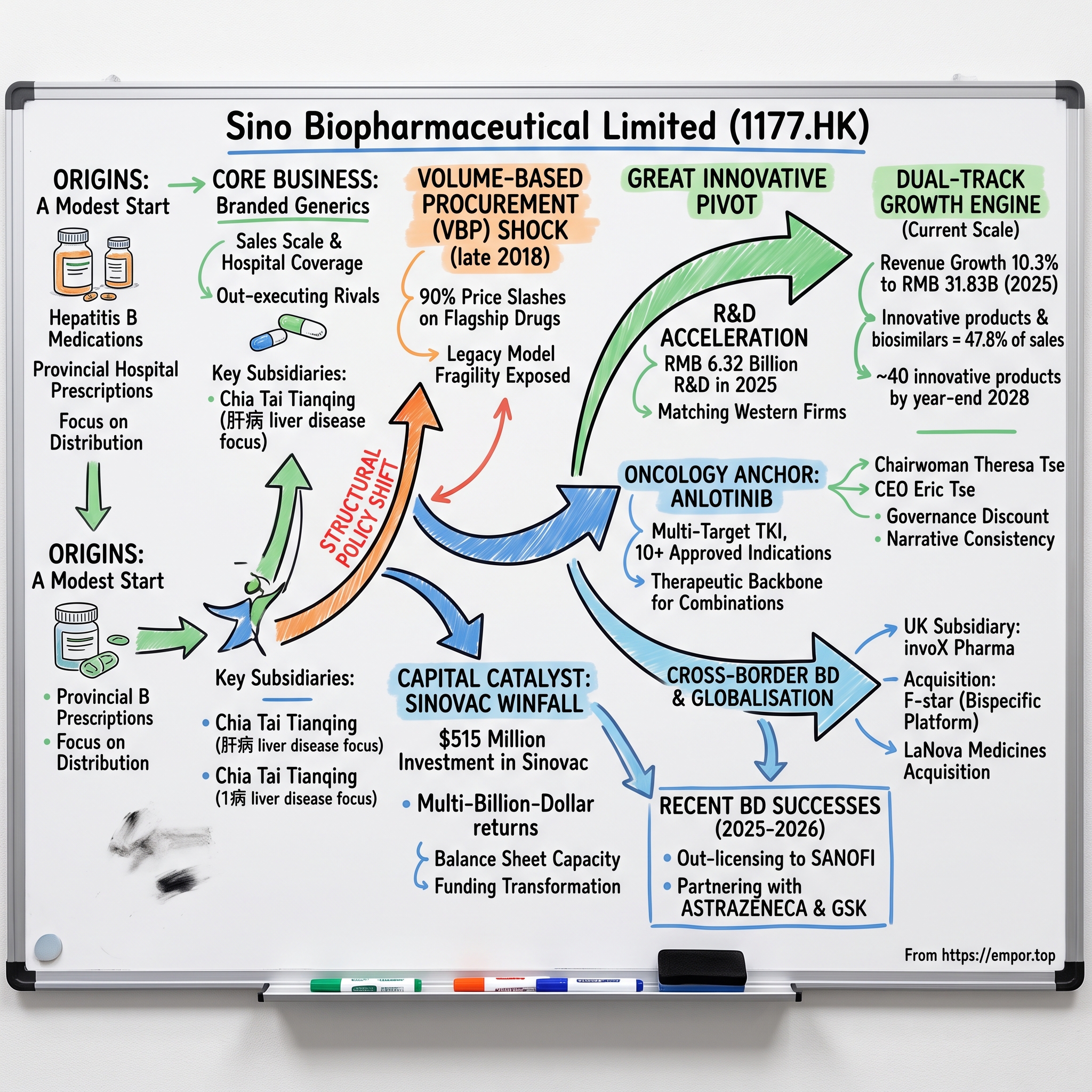
Sino Biopharmaceutical: China's Healthcare Giant and the Great Innovative Pivot
I. Introduction & Episode Roadmap
On July 8, 2026, two of the world's largest pharmaceutical companies announced major transactions with the same Chinese partner on a single day. AstraZeneca acquired global rights outside China to TQC3721, an inhaled respiratory molecule developed in Nanjing, paying $200 million upfront in cash with up to $1.9 billion in potential milestone payments.1 Hours later, GSK granted the same company exclusive Chinese commercialisation rights for Trelegy Ellipta and Anoro Ellipta, two respiratory franchises that generated approximately £3.5 billion globally in 2025.2
Twenty-two years earlier, that partner was a modestly capitalised maker of hepatitis B medications listed in Hong Kong, relying for profits on Chinese provincial hospital prescriptions and a procurement system driven more by distribution relationships than patented science.
That company is 中国生物制药 Sino Biopharmaceutical Limited (1177.HK, listed on the 香港交易所 Hong Kong Stock Exchange), the pharmaceutical arm of the Chearavanont family behind Thailand's 正大集团 Charoen Pokphand Group. Its transformation illustrates how a domestic leader responds when government policy abruptly slashes generic drug prices by as much as 90 percent—and tests whether a firm built on sales distribution can successfully pivot to novel drug discovery.
The company's current scale reflects this shift. For the year ended December 31, 2025, revenue grew 10.3% to RMB 31.83 billion, while gross margin reached 82.1%. Revenue from innovative products and biosimilars rose 26.2% to RMB 15.22 billion, representing 47.8% of total group sales—up from less than 20% five years earlier.34 Research and development spending climbed to RMB 6.32 billion, or 19.8% of revenue, matching the reinvestment rate of many Western biopharmaceutical firms.3
However, reported earnings highlight an underlying tension. Profit attributable to owners from continuing operations reached RMB 2.34 billion, up 22.0%, while the group's non-IFRS "underlying profit" metric was reported at RMB 4.54 billion, up 31.4%.3 Because this RMB 2.20 billion gap exceeds total reported net profit, evaluating the quality of these adjustments is critical to assessing the firm's true earning power.
Four major developments define this strategic evolution:
First, the creation of a powerful domestic branded-generics business anchored by extensive hospital relationships rather than proprietary patents.
Second, the structural policy shift. The introduction of national 集中带量采购 volume-based procurement (VBP), initiated through the "4+7" pilot scheme in late 2018, fundamentally altered the economics of China's off-patent drug market.5
Third, the capital catalyst. A $515 million equity investment in 北京科兴中维 Sinovac Life Sciences—developer of the CoronaVac COVID-19 vaccine—generated multi-billion-dollar returns, providing the balance sheet capacity to fund an accelerated research and development expansion.[^6]6
Fourth, the current dual-track growth engine. This combines an internal oncology portfolio anchored by 安罗替尼 anlotinib with an active cross-border business development strategy. Between 2025 and 2026, this platform secured transactions with Sanofi, AstraZeneca, and GSK, alongside the acquisition of Shanghai-based 礼新医药 LaNova Medicines, whose primary drug candidate had previously been licensed to Merck.789
This narrative examines the company across several key dimensions: its origins within the Chearavanont family's Charoen Pokphand group; the expansion of its legacy generic business; the disruption caused by volume-based procurement; the Sinovac capital deployment; the segment economics of its innovative drug transition; international expansion via its UK subsidiary invoX Pharma; leadership under Chairwoman 谢其润 Theresa Tse and CEO 谢承润 Eric Tse; strategic lessons; a competitive analysis incorporating bear-case risks; and the key operational metrics that will determine its long-term trajectory.
Market valuation reflects this ongoing transition. In late July 2026, the company's shares traded near HK$5.06, representing a market capitalisation of approximately HK$90 billion against a 52-week trading range of HK$4.19 to HK$9.12.10 Despite innovative therapies approaching half of group revenues, the share price remains well below its historical peaks. Resolving the disconnect between an improving product mix and a subdued equity valuation is the central task of this analysis.
 Subscribe on LinkedIn
II. The CP Group Genesis & The Tse Family Empire
The story of Sino Biopharmaceutical begins in an unexpected sector: animal feed.
The Chearavanont family—Chinese-Thai, originally from Guangdong—built Charoen Pokphand (CP) from a Bangkok seed shop founded in the 1920s into one of Asia's largest privately controlled conglomerates, spanning agribusiness, retail, and telecommunications. When 邓小平 Deng Xiaoping opened China to foreign investment in the late 1970s, CP was among the very first foreign enterprises to enter, receiving business licence number 0001 in the Shenzhen Special Economic Zone. That head start mattered less for initial capital than for what it secured: decades of relationships with Chinese provincial governments, ministries, and state enterprises, established long before most multinational corporations opened Beijing offices.
谢炳 Tse Ping, the founder of Sino Biopharmaceutical, operated within that lineage. His core insight in the 1990s was less about breakthrough discovery and more about demographic and structural market realities. China represented roughly a fifth of the global population, had a hepatitis B carrier population in the tens of millions, a rapidly urbanising middle class, and a public hospital system designated for significant spending growth. What the country lacked was a domestic pharmaceutical industry capable of manufacturing modern medications at scale and high quality.
The company Tse Ping assembled was consequently not a traditional research organization, but a licensing and distribution operation backed by manufacturing assets. Its most critical operational pillar became 正大天晴 Chia Tai Tianqing Pharmaceutical Group, a Jiangsu-based subsidiary specializing in liver disease—a therapeutic focus selected with the location strategy of a retail strategist. Hepatitis B in China was not a niche market; it was a primary national epidemiological priority.
Local firms like Chia Tai Tianqing succeeded where Western pharmaceutical companies, despite their deeper drug pipelines, struggled to gain dominant market share for two decades due to three compounding advantages.
First, regulatory patience. Securing drug approvals and pricing in China during the 1990s and 2000s required navigating provincial tendering processes, hospital formulary committees, and region-specific reimbursement catalogues. Multinationals with rigid global compliance frameworks found this environment slow and unappealing, whereas a domestically embedded group leveraging CP's structural relationships found it manageable.
Second, manufacturing permits. Constructing or acquiring compliant production capacity within China was a complex regulatory process that heavily favored established incumbents.
Third, the hospital sales channel. Chinese pharmaceutical distribution was, and largely remains, centered on hospitals. If sales representatives were not physically present in hospitals engaging directly with department heads, products did not move. This was fundamentally a distribution and relationship business rather than a pure discovery model—the precise operational framework an agribusiness conglomerate understood how to scale.
A myth worth correcting
A common narrative attributes Sino Biopharmaceutical's success primarily to Charoen Pokphand's political connections—framing its rise around guanxi rather than commercial execution. That interpretation is incomplete and fails to explain the operational outcome.
Political access was necessary, but far from sufficient. Dozens of domestic pharmaceutical companies enjoyed provincial protection during the 1990s and 2000s, yet most were eventually acquired, restructured, or rendered marginal. Sino Biopharmaceutical set itself apart by treating pharmaceutical sales as an intensive operational challenge rather than a simple relationship exercise—prioritizing headcount, territory design, granular hospital coverage targets, and substantial field-force investment relative to initial product revenues.
A parallel exists in consumer goods: the companies that captured rural Chinese markets during the same period were not necessarily those with superior products, but those willing to build distribution networks into third- and fourth-tier cities years before demand fully matured. Pharmaceutical distribution in China followed identical economics, where revenue followed infrastructure rather than preceding it.
Political access opens doors, but it does not staff thousands of hospital departments.
Listing, and the structure that came with it
Following its initial operational expansion, Sino Biopharmaceutical listed on Hong Kong's Growth Enterprise Market in 2000 and transferred to the Main Board in 2003 under ticker 1177.[^12] The GEM board at the time served smaller, early-stage issuers, making the Main Board transfer a key credibility signal for institutional investors.
The corporate structure that emerged—a Cayman Islands-incorporated, Hong Kong-listed holding company overseeing onshore operating subsidiaries—is standard for Chinese firms raising international capital. However, it establishes a key governance framework: minority shareholders in Hong Kong hold an economic stake in an enterprise whose operations, regulatory oversight, customer base, and political relationships reside entirely in mainland China, with the controlling family retaining approximately half the equity.
This structural reality defines the firm's governance dynamics. It also explains why, when Chinese regulatory authorities fundamentally altered off-patent drug pricing in 2018, the company could not rely on litigation or restructuring, but had to adapt its underlying operating model.
III. Building the Generics Juggernaut: Sales Scale & Hospital Coverage
Consider a county hospital in Jiangsu province around 2012. The hepatology department treats a steady stream of chronic hepatitis B patients requiring long-term antiviral therapy. An attending physician choosing between an expensive imported drug and chemically equivalent domestic generics evaluates price, perceived quality, and hospital formulary inclusion. In practice, the decision often hinges on a sales representative from a single domestic manufacturer who has visited the department monthly for six years.
That distribution engine powered Sino Biopharmaceutical's initial growth, generating highly lucrative returns for over a decade.
The branded-generics playbook
Sino Biopharmaceutical structured its operations around high-volume therapeutic verticals with large Chinese patient populations and standardized clinical practices: hepatology, cardio-cerebral vascular disease, surgery and analgesia, and respiratory medicine. The strategy was uniform across each category: identify an off-patent or expiring-patent molecule, manufacture it to meet national quality certification standards, brand it, and out-execute rivals across the hospital channel.
The competitive edge lay in commercial scale. By 2021, flagship subsidiary Chia Tai Tianqing deployed a sales force exceeding 7,000 representatives covering more than 2,000 general and specialized liver-disease hospitals.11 Group-wide, commercial coverage extended from major tertiary hospitals in Beijing and Shanghai down to prefecture- and county-level facilities—the Tier 3 and Tier 4 institutions where most Chinese patients receive care and where multinational pharmaceutical firms maintained little presence.
The economics, and why they were so good
In pre-2018 China, branded generics yielded gross margins above 80%—profitability that in Western markets typically requires patent protection. In China, market fragmentation provided that defense. Drug procurement was administered at the provincial or municipal level, turning every tender into a localized contest. Prices remained sticky because no individual buyer commanded enough purchasing volume to force meaningful discounts, while switching a hospital department to a competing brand introduced administrative friction.
This system created a formidable commercial engine. 润众 Runzhong, the group's entecavir formulation for hepatitis B, expanded into a franchise generating billions of renminbi annually. Return on equity consistently exceeded 20%, dividend payouts remained steady, and the business presented the profile of an emerging-market compounder with an extensive growth runway.
The hidden fragility in the cost line
A second structural feature of this model explains why the subsequent policy shock proved so disruptive.
An examination of the group's expense structure reveals where capital was allocated. In 2018, the final full year before national volume-based procurement transformed market dynamics, selling and distribution expenses reached approximately RMB 8.08 billion on revenue of RMB 20.89 billion.10 The company spent nearly 39 cents of every revenue renminbi on marketing to healthcare providers, compared to roughly 10 cents on research and development and 20 cents on manufacturing.
This allocation reflected a business model built primarily as a commercial distribution platform with attached manufacturing capabilities. Gross margins remained high because production costs were low, while operating margins remained modest due to substantial commercial expenses.
That structure remained stable as long as prices held, supported by continuous selling expenditure. However, centralized pricing rendered the commercial model vulnerable. Once the central government began allocating fixed volumes at set prices, hospital-level sales efforts for those off-patent products lost their economic utility. The commercial overhead remained fixed even as its underlying purpose vanished.
This dynamic explains how volume-based procurement eroded legacy product value. While a 90% price reduction on a high-gross-margin drug can be mitigated under a variable cost structure, it becomes unsustainable when nearly 40% of revenue supports a field force that policy changes render redundant.
For analysts, the structural lesson is clear: a high gross margin paired with elevated selling expenses signals a commercial distribution advantage rather than a proprietary product moat—and maintaining a distribution moat requires continuous, annual expenditure.
What the model actually was — and was not
The policy shifts of 2018 confirmed that this historical profitability derived not from proprietary science, but from distribution scale within a fragmented purchasing system. High gross margins reflected market friction rather than premium pricing for innovation. While market friction lacks a fixed patent expiration date, protecting it from immediate generic competition, it remains vulnerable to sudden administrative elimination.
An 80% gross margin alone does not guarantee structural defensibility; the underlying driver determines its resilience. Margins grounded in intellectual property can withstand shifts in buyer procurement, whereas margins dependent on buyer fragmentation collapse when procurement is centralized.
In 2018, China centralized its purchasing.
IV. The Great VBP Shock: Shattering the Legacy Model
In a Shanghai bidding room in December 2018, Chinese health authorities introduced a procurement mechanism that fundamentally altered domestic pharmaceutical economics. Rather than allowing individual provinces to negotiate drug purchases with uncertain order volumes, the central government aggregated demand across eleven pilot cities—four direct-controlled municipalities plus seven major urban centers—and launched a winner-takes-most auction for 25 off-patent molecules.5 Winning bidders received guaranteed volume commitments covering the majority of public hospital demand in those cities, while losing bidders were effectively excluded from the public hospital channel.
The scheme consolidated a fragmented national market with thousands of localized negotiations into a single centralized auction, shifting pricing power decisively to the state.
The precondition nobody noticed
This centralized purchasing model depended on a prior regulatory reform that permanently altered off-patent drug valuations. For decades, Chinese physicians justified prescribing premium-priced branded generics over lower-cost alternatives due to quality uncertainty. Variations in dissolution rates, impurity profiles, and manufacturing consistency across domestic suppliers provided a defensible clinical rationale to favor established brands—a dynamic that formed the economic foundation of the branded-generics premium.
In 2016, Chinese regulators addressed this issue by mandating 一致性评价 generic quality consistency evaluation—rigorous bioequivalence testing requiring domestic generic copies to demonstrate clinical equivalence to originator drugs. The evaluation process was capital-intensive, prompting many manufacturers to withdraw uncompetitive candidates rather than fund clinical trials.
For products that passed, the regulatory impact was immediate: the state officially certified that approved generics were therapeutically interchangeable with original therapies. With quality standardized by law, public healthcare authorities could procure off-patent drugs strictly on price without risking clinical outcomes.
By eliminating the informational asymmetry that historically protected branded generics, consistency evaluations transformed off-patent pharmaceuticals into standardized commodities, laying the administrative groundwork for mandatory volume-based procurement.
The price collapse
The resulting bids reflected this new competitive reality. Flagship subsidiary Chia Tai Tianqing reduced its entecavir price by approximately 90% to secure the hepatitis B contract.12 Across the pilot, winning bids fell by an average of more than 50%, with select molecules experiencing even steeper declines.513 One competitor reportedly reduced its entecavir price by 94%.12
For pharmaceutical executives, the auction presented a stark operational binary: accept severe margin compression to maintain production volume, or preserve legacy pricing and forfeit market access entirely. Sino Biopharmaceutical chose volume.
As a result, therapies that had long generated multi-billion-renminbi revenues at elevated gross margins were converted into high-volume, commodity-margin products overnight. When the central government expanded the program nationally in 2019 and introduced successive procurement rounds, price compression spread rapidly across the company's legacy portfolio.
The strategic dilemma
The broader impact extended beyond immediate earnings hits to the long-term durability of the business model. If state-mandated auctions could compress any off-patent molecule's price toward marginal cost upon generic entry, legacy products lacked durable terminal value.
Investors responded by repricing the entire Chinese generic pharmaceutical sector. Rather than adjusting for short-term earnings fluctuations, capital markets marked down the long-term durability of off-patent distribution models. Because generics and biosimilars still accounted for roughly 70% of Sino Biopharmaceutical's revenue as late as 2023, absorbing this structural shift required a multi-year operational transition.14
Management's response
Sino Biopharmaceutical addressed this disruption through three coordinated strategic moves.
First, management abandoned efforts to defend legacy pricing or maintain redundant overhead for off-patent drugs. The sales organization was restructured, reducing field resources dedicated to generic distribution and reallocating commercial capacity toward therapies where pricing remained negotiable.
Second, the group significantly escalated its research commitment. Between 2018 and 2025, annual income-statement R&D expenditure expanded nearly 190%, rising from RMB 2.09 billion on revenue of RMB 20.89 billion in 2018 to RMB 6.04 billion on revenue of RMB 31.83 billion in 2025.10 Over a period when total revenue grew by 52%, research spending expanded at nearly four times that rate.
Third, management established a formal operational benchmark: generating more than half of total group sales from innovative products. This target created a verifiable standard for tracking the portfolio transition. Revenue from innovative products subsequently expanded from 41.8% of group sales in 2024 to 47.8% in 2025, reflecting steady portfolio reallocation.153
Yet, expanding research spending while legacy gross profits contracted presented an acute cash flow challenge. Funding this capital-intensive transformation required a major external liquidity catalyst.
V. The Sinovac Windfall: Funding the Great Transformation
In December 2020, as global demand for COVID-19 vaccines surged, Pfizer and Moderna reported high clinical efficacy for their mRNA candidates, while AstraZeneca's Oxford collaboration remained under regulatory review. In Beijing, 科兴中维 Sinovac Life Sciences was manufacturing CoronaVac—an inactivated-virus vaccine that, despite using traditional technology, offered a crucial logistical advantage: it could be stored in standard refrigeration rather than ultra-cold freezers.
That temperature tolerance proved decisive. Across developing economies lacking specialized cold-chain infrastructure—including parts of Southeast Asia, Latin America, the Middle East, and Africa—a vaccine transportable in standard coolers provided superior distribution utility.
On December 7, 2020, Sino Biopharmaceutical announced that a wholly owned subsidiary would invest approximately $515 million for a 15.03% stake in Sinovac Life Sciences, the Sinovac Biotech subsidiary that developed and manufactured CoronaVac.[^6]6
Reading the bet honestly
This transaction represented a financial commitment rather than a strategic integration. Sino Biopharmaceutical possessed no vaccine platform and acquired no operational control. It took a minority financial stake in a private subsidiary during a period of high clinical uncertainty, in an entity whose parent company was already embroiled in governance disputes. At $515 million, the investment represented a substantial commitment of the group's available capital. Had CoronaVac encountered clinical failures or procurement rejections, the capital loss would have been material without providing offsetting strategic value.
The transaction was fundamentally an opportunistic financial deployment by an operating company with available liquidity and regional market visibility—a speculative investment that ultimately yielded extraordinary returns.
The cash tsunami
CoronaVac subsequently became one of the world's most widely distributed COVID-19 vaccines by volume, temporarily positioning Sinovac Life Sciences among the most profitable pharmaceutical manufacturers globally. The financial impact on Sino Biopharmaceutical's income statement was immediate and substantial. Net profit attributable to owners reached approximately RMB 14.6 billion in 2021—several times the group's historical annual earning capacity and a level unmatched in subsequent periods.10
This capital inflow reshaped the firm's financial trajectory. Subsequent research budgets, international expansion through UK subsidiary invoX Pharma, and corporate acquisitions were all underwritten by returns generated outside the core pharmaceutical business.
The financial contributions persisted beyond the initial pandemic period. As of December 31, 2025, a dividend of approximately RMB 1.35 billion net of tax was received from Sinovac Life Sciences and recognised in the profit and loss statement—serving as the primary driver behind a 140.2% year-on-year increase in first-half 2025 profit from continuing operations.1617 Consequently, a significant portion of reported earnings growth stemmed from equity income in a vaccine manufacturer rather than commercial product sales.
The overhang nobody advertises
This investment carries ongoing structural risk. Sinovac Biotech, the Nasdaq-listed parent entity, experienced intense governance disputes throughout 2025—a multi-party battle involving Vivo Capital, contested share issuances dating to a 2018 private placement, parallel litigation and arbitration in Antigua and Hong Kong, and a $55 per share special dividend held in escrow pending judicial resolution.1819 Although Sino Biopharmaceutical holds its equity at the operational subsidiary level rather than the disputed holding company, this asset represents an earnings stream encumbered by multi-jurisdictional litigation—requiring investors to apply a conservative valuation multiple to these earnings.
Capital allocation: what they did with it
Sino Biopharmaceutical deployed the windfall with notable financial discipline. Annual R&D expenditure expanded steadily to RMB 6.32 billion in 2025, fully funded from internal cash reserves without incurring additional debt or diluting equity.3 By year-end 2025, total liquid fund reserves—comprising cash, non-current bank deposits, and wealth management products—stood at approximately RMB 32.99 billion.3 Concurrently, shareholder distributions increased: the interim dividend rose from HK 3 cents per share in the first half of 2024 to HK 5 cents in the first half of 2025, alongside a full-year distribution of HK 10 cents.173
Crucially, management avoided high-valuation domestic acquisitions during the 2020–2021 Chinese biotech expansion, when asset valuations reached record highs. The company deferred major corporate acquisitions until asset valuations contracted in subsequent years.
The counterfactual that makes the case
Evaluating this capital allocation requires considering the counterfactual scenario. Without the Sinovac windfall, Sino Biopharmaceutical would have faced severe financial constraints entering the 2020s. Its primary generic products were undergoing systematic price reductions under volume-based procurement, while constructing a proprietary innovative pipeline required billions of renminbi in annual research spending—drawn from an operating profit stream under margin compression. This environment frequently forces pharmaceutical firms to curtail research investment to protect short-term reported earnings, leading to structural decline. Industry peer 石药集团 CSPC Pharmaceutical Group illustrates the operational strain caused by this dynamic.24
The Sinovac capital injection eliminated this constraint. It allowed management to expand research spending during a period of core operating pressure without reducing dividends, taking on high-cost debt, or issuing equity at depressed valuations.
The primary strategic takeaway is not that management demonstrated superior predictive foresight, but rather that it successfully capitalized on a highly favorable liquidity event. Management received a rare, substantial capital buffer and deployed it systematically to fund an expensive, multi-year operational transformation.
VI. The Innovative Pivot: Anlotinib, Onco-Immuno Pipelines, & Segment Breakdown
Every pharmaceutical company navigating a major strategic transition relies on an anchor molecule to prove its discovery model. For Sino Biopharmaceutical, that anchor molecule is anlotinib.
What anlotinib actually is, in plain terms
Solid tumors require a continuous vascular supply to grow beyond a few millimeters, recruiting blood vessels by secreting specific chemical signaling factors. Anlotinib—marketed as 福可维 Focus V—is an oral small-molecule multi-target tyrosine kinase inhibitor that blocks key angiogenesis receptors simultaneously, suppressing tumor blood supply pathways.
As an oral therapy rather than an infused monoclonal antibody, anlotinib offers lower manufacturing costs, simplified administration across regional hospitals, and high compatibility in combination regimens. In modern oncology, efficacy frequently depends on combination therapies: combining immune checkpoint inhibitors with anti-angiogenic agents can disrupt tumor vasculature while enhancing immune cell infiltration. Consequently, anlotinib emerged as the core therapeutic backbone for the group's broader oncology pipeline.
Launched in 2018—coinciding with the arrival of national volume-based procurement—anlotinib secured ten approved indications in China by the end of 2025, with active Phase III trials underway in first-line non-squamous non-small cell lung cancer and first-line pancreatic cancer.3
The combination logic, explained simply
Controlling both the primary combination backbone and its partner therapies represents a significant structural advantage in Sino Biopharmaceutical's portfolio.
Immune checkpoint inhibitors, including PD-1 and PD-L1 antibodies, function by removing the immunosuppressive barriers that allow tumors to evade immune detection. Monoclonal antibodies such as penpulimab (targeting PD-1) and benmelstobart (targeting PD-L1) restore the body's immune response against tumor cells.
However, checkpoint inhibitors require immune cells to infiltrate the tumor microenvironment effectively. Anti-angiogenic therapies like anlotinib normalize chaotic tumor vasculature, improving immune cell access while simultaneously restricting the tumor's supply lines.
Beyond the clinical rationale, controlling both assets yields substantial operational efficiencies. Developing combination therapies with external partners requires complex cross-company negotiations over intellectual property, profit sharing, and clinical trial management. In contrast, owning both molecules allows Sino Biopharmaceutical to design, approve, and enroll combination clinical trials internally without partner dependencies.
By controlling both the backbone and partner molecules, Sino Biopharmaceutical converts a clinical hypothesis into an operational execution advantage, accelerating its oncology pipeline development.
The segment picture
Oncology has become the company's primary growth driver. In 2025, oncology sales reached RMB 13.18 billion, a 22.8% increase, representing 41.4% of group revenue.3 The franchise centers on anlotinib alongside penpulimab and benmelstobart, providing internal combination capabilities without reliance on third-party developers.
The surgery and analgesia segment generated RMB 5.03 billion in 2025, up 12.8% to represent 15.8% of group revenue.3 This segment consists of hospital-administered formulations with technical entry barriers, including flurbiprofen cataplasms—where the group maintains market leadership among domestic patch manufacturers—and Putanning, a long-acting meloxicam injection approved by both the US FDA and China's NMPA in May 2025.3 Regulatory approval from the US FDA for a Chinese-manufactured injectable formulation provides an important benchmark of production quality.
Respiratory represents the fastest-growing vertical, significantly bolstered by the 2026 commercial agreements with GSK and AstraZeneca. Meanwhile, the legacy hepatology business has stabilized at lower revenue levels, with research reoriented from antiviral treatments toward liver fibrosis and metabolic liver disease.
The pipeline, counted honestly
As of December 31, 2025, Sino Biopharmaceutical maintained 39 oncology candidates in clinical development or under regulatory review, including one marketing application and 13 Phase III programs; 10 liver and cardiometabolic candidates; 14 respiratory and autoimmune candidates with five in Phase III; and six surgery and analgesia candidates with two under marketing review.3 The NMPA approved four innovative products during 2025.3 Management target guidelines anticipate approximately 20 Category 1 innovative drug approvals between 2026 and 2028, aiming for around 40 innovative products on the market by year-end 2028.3
This multi-year target provides an explicit operational framework for measuring the speed and clinical quality of the company's research execution.
Benchmarking: where this company actually sits
A comparative analysis against domestic biopharmaceutical peers puts this operational transition in perspective.
恒瑞医药 Jiangsu Hengrui Pharmaceuticals recorded 2025 revenue of approximately RMB 32 billion—similar in scale to Sino Biopharmaceutical—driven by RMB 16.34 billion in innovative drug sales and RMB 3.39 billion in high-margin out-licensing revenue, supported by $500 million upfront from GSK and $200 million upfront from Merck.20 Hengrui's July 2025 transaction with GSK encompasses up to 12 development programs with potential total consideration exceeding $12 billion.21
信达生物 Innovent Biologics expanded 2025 revenue by 38.4% to RMB 13.0 billion, achieving its first full year of net profitability alongside an oncology partnership with Pfizer valued at up to $10.5 billion.22 百济神州 BeiGene (operating as BeOne Medicines) generated $5.343 billion in total revenue, up 40%, delivering its first full-year GAAP net profit of $287 million.23 Conversely, 石药集团 CSPC Pharmaceutical Group, a legacy generics peer pursuing a similar strategy, saw 2025 revenue decline 10.4% to RMB 26.01 billion.24
These comparisons show that while Sino Biopharmaceutical matches Hengrui in overall revenue scale, it trails peers like Hengrui and Innovent in monetizing pipeline assets through high-margin international out-licensing. However, its performance significantly outpaces legacy peers like CSPC, demonstrating that its transition into innovative therapies has avoided the top-line contraction affecting traditional generic manufacturers.
Why it might win, and the honest counter
The core competitive thesis relies on commercial execution. Early-stage biotechnology firms with novel molecules often lack commercial infrastructure, forcing them to seek domestic distribution partners. Sino Biopharmaceutical can rapidly deploy internal, acquired, or in-licensed therapies across thousands of hospitals, including lower-tier regional medical centers. Combined with anlotinib as a clinical combination backbone, this commercial network allows the firm to scale new therapies efficiently.
The primary counterargument is that distribution reach provides the strongest advantage in high-volume, price-regulated drug categories—the market segment most vulnerable to state pricing pressure. For truly novel, first-in-class therapies, clinical differentiation outweighs commercial distribution scale, and established biopharmaceutical peers maintain comparable or superior research pipelines.
VII. Globalisation & BD Strategy: invoX Pharma and the F-star Benchmark
In 2021, the company established an office in London to build a permanent presence in Western capital and healthcare markets.
invoX Pharma was created as a wholly owned UK-headquartered subsidiary to serve as the group's international research and business development arm—a legally separate, Western-domiciled entity with independent management empowered to sign licensing agreements, conduct clinical trials, and execute cross-border acquisitions outside China.[^27] The strategic logic was pragmatic: a Chinese parent acquiring a Western biotechnology firm in the current geopolitical environment faced heightened foreign investment scrutiny, whereas a UK-domiciled corporate entity offered a clearer regulatory path.
Regulatory scrutiny followed nonetheless.
The F-star transaction
In June 2022, invoX agreed to acquire F-star Therapeutics, a Nasdaq-listed, Cambridge-based antibody developer, for approximately $161 million in cash at $7.12 per share.2526
F-star offered a technology platform rather than a single clinical product. While conventional antibodies bind to a single target, bispecific antibodies bind two distinct targets simultaneously—either physically connecting an immune cell to a cancer cell or blocking two tumor signaling pathways with one therapeutic agent. F-star engineered these candidates as tetravalent "2+2" bispecific structures, featuring two binding sites for each of two targets, in a format designed to mimic natural antibody pharmacokinetics. This structure provides practical advantages: molecules resembling natural antibodies are typically less expensive to manufacture and better tolerated clinically than exotic engineered constructs. The transaction also secured a Cambridge research facility, providing direct access to European antibody engineering talent.25
The regulatory drama
A transaction expected to close within months required nine months of regulatory review. The acquisition underwent detailed examination by the Committee on Foreign Investment in the United States and under the UK's National Security and Investment Act. Regulatory clearance was granted in early 2023, allowing the transaction to complete in March 2023.2627
While initially viewed as an isolated regulatory delay, the review signaled a broader structural shift. It established that Chinese-controlled acquirers would face rigorous foreign investment reviews even when acquiring mid-sized biopharmaceutical platforms with no military or defense applications—a reality that now governs cross-border life science transactions.
Assessing the outcome, including the parts that did not work
The acquisition price reflected favorable timing, securing F-star during a major biotech market downturn at a valuation far below its prior market peak. Commercial validation followed in July 2023, when an expanded immuno-oncology collaboration with Takeda generated potential milestone commitments of up to $1 billion.28
However, post-merger integration presented operational challenges. invoX subsequently restructured its operations, reducing its workforce by approximately one-third—representing about 60 roles—while narrowing clinical development to focus primarily on FS222, a CD137/PD-L1 bispecific antibody.29 This retrenchment reflected a corporate decision to consolidate resources around its highest-priority clinical program rather than funding a broad multi-asset portfolio.
Ultimately, the transaction delivered an established technology platform and a European research footprint—funded primarily by cash reserves from the Sinovac investment—followed by operational downsizing to control ongoing development expenses.
The in-licensing engine, and the flows going the other way
A more significant strategic evolution occurred as business development transitioned into a two-way transaction model.
In July 2025, the group agreed to acquire the remaining 95% equity stake in 礼新医药 LaNova Medicines that it did not already own for up to $950.9 million in total consideration, representing approximately $500 million net of LaNova's existing cash reserves.730 LaNova was an established discovery firm; eight months prior to the deal, Merck had licensed LM-299, LaNova's PD-1×VEGF bispecific antibody—a candidate targeting tumor vasculature and immune checkpoints—for $588 million upfront and up to $2.7 billion in potential milestones.7 Acquiring LaNova added four technological platforms covering tumor-microenvironment antibodies, difficult-to-drug targets, next-generation antibody-drug conjugates, and T-cell engagers, alongside a Claudin 18.2 antibody-drug conjugate in Phase III clinical development for gastric cancer.30
The deal marked an industry milestone: while Western pharmaceutical corporations had repeatedly acquired Chinese biotech firms, major domestic pharmaceutical companies rarely executed full acquisitions of late-stage domestic biotech developers.8 The transaction highlighted the concentration of capital among leading domestic pharmaceutical groups.
What the acquired platforms actually do
Two of LaNova's four platforms illustrate where oncology research is concentrating and clarify what the $500 million net outlay acquired.
An antibody-drug conjugate, or ADC, combines a targeted monoclonal antibody with a potent cell-killing payload via a chemical linker. Traditional chemotherapy damages both healthy and malignant tissue indiscriminately. An ADC uses the antibody to identify specific proteins expressed primarily on tumor cells, delivering the cytotoxic payload directly to the tumor site. The primary engineering challenge involves designing the chemical linker to remain stable in systemic circulation while releasing the toxic payload once inside the target cell. LaNova's Claudin 18.2 ADC, currently in Phase III trials for gastric cancer, targets a protein that is largely masked in healthy stomach tissue but highly exposed on malignant cells.30
A T-cell engager operates through a different mechanism: a dual-arm bispecific molecule simultaneously binds a tumor cell surface protein and a receptor on a T-cell, physically bringing the immune cell into direct proximity with the target cell to trigger destruction.
Both modalities represent heavily funded areas in global oncology. Acquiring LaNova secured technical capabilities in these core therapeutic classes during a period of depressed private venture valuations. However, entering these popular modalities requires competing directly against established global biopharmaceutical developers, including Daiichi Sankyo, AstraZeneca, and Merck, as well as multiple domestic rivals pursuing identical targets.
Concurrently, out-licensing transactions accelerated. In March 2026, subsidiary Chia Tai Tianqing granted Sanofi exclusive global rights to rovadicitinib—a dual JAK and ROCK inhibitor approved in China in February 2026 for myelofibrosis—for $135 million in upfront cash, up to $1.395 billion in potential milestones, and tiered double-digit royalties.931 This was followed four months later by the major licensing transactions with AstraZeneca and GSK.
For a firm historically built on distributing Western pharmacology in China, out-licensing domestically developed novel therapies to Sanofi and AstraZeneca represents a fundamental shift in business model.
Two financial nuances place these transactions in proper perspective. First, upfront cash receipts remain modest relative to domestic peers: the $135 million from Sanofi and $200 million from AstraZeneca compare to the $500 million single upfront payment Hengrui secured from GSK.20 Second, headline deal values depend heavily on milestone payments that are contingent on multi-year development and commercial success. On upfront cash generation—the clearest measure of immediate transaction value—Sino Biopharmaceutical is an active participant in China's out-licensing expansion rather than its dominant leader.
VIII. Management Credibility & Governance: The Gen-2 Transition
In 2015, a 23-year-old assumed the chairmanship of a company valued in the tens of billions of Hong Kong dollars.
谢其润 Theresa Tse, born in 1992, holds a bachelor's degree in economics from the Wharton School.32 Her father, Tse Ping, stepped down as chairman while remaining senior vice chairman, and she has served as chairwoman since 2015, alongside executive roles at Chia Tai Pharmaceutical Group and, from 2017, a directorship at Chia Tai Tianqing.32
The appointment initially prompted widespread skepticism among institutional investors. Eleven years later, the record warrants a more analytical review. The strategic reorientation from generic drugs to novel discovery, the international expansion structure, the substantial R&D expansion, and the explicit target tracking for innovative product revenues were all implemented under her leadership. While correlation does not prove causation in a family-controlled enterprise where the founder remains on the board, the company's transformation occurred on her watch—and unfolded against a sweeping policy shock that severely disrupted peer firms, such as CSPC Pharmaceutical Group.
Her brother, 谢承润 Eric Tse, joined the executive leadership under more controversial circumstances.
The 2019 share gift
On October 22, 2019, Tse Ping and 郑翔玲 Cheng Cheung Ling transferred approximately 2.7 billion shares—representing roughly one-fifth of the company's total share capital, worth about $3.8 billion—to their then 24-year-old son for no cash consideration.3334 He was immediately named an executive director and a member of the executive board committee, receiving an annual compensation of HK$3.9 million alongside discretionary bonuses.33 Media reports at the time noted that he intended to keep his financial profile low to avoid appearing on global wealth rankings.35
While legally compliant and common among Asian family-controlled conglomerates as a mechanism for intergenerational estate planning, the transaction raised governance concerns due to its opacity. Management disclosed no formal succession framework, independent board review, or operational rationale explaining why a multi-billion-dollar equity transfer was accompanied by an immediate top-tier board appointment. For international institutional investors, the episode reinforced perceptions that public minority shareholders remained secondary to controlling family interests.
That governance discount continues to influence the stock's market valuation.
Eric Tse was subsequently appointed chief executive officer in 2022. Educated at the University of Pennsylvania and Tsinghua University's Schwarzman Scholars program, his tenure has focused on restructuring domestic commercial operations and streamlining internal R&D workflows.36
Testing management by behaviour
Evaluating leadership based on operational conduct rather than executive biography highlights four distinct patterns—two demonstrating capital and strategic discipline, and two revealing transparency concerns.
First, strategic narrative consistency has been maintained. Since the volume-based procurement reform began, management has consistently evaluated its progress using a single primary operational metric: innovative product revenue and its percentage of total sales. Unlike companies that frequently alter key performance indicators to mask operational friction, Sino Biopharmaceutical has adhered to the same benchmark through changing market conditions.
Second, capital allocation has remained disciplined. Management funded R&D expansion primarily through internal cash generation and existing liquidity rather than dilutive equity raises. Dividend payments were maintained and subsequently increased during the restructuring, while major cross-border acquisitions were executed during biotech market downturns rather than at peak valuations.
Conversely, financial results remain heavily reliant on non-operating income. In the first half of 2025, reported profit from continuing operations rose 140.2%—a surge driven largely by dividend receipts from Sinovac Life Sciences rather than core pharmaceutical sales.1716 Highlighting this headline growth rate without equivalent emphasis on its non-operational origin obscures underlying commercial performance.
A more significant reporting anomaly emerges in the second-half 2025 figures. First-half profit attributable to owners from continuing operations reached RMB 3.39 billion.17 However, the full-year figure stood at RMB 2.34 billion.3 This arithmetic indicates that despite higher full-year revenues and expanding gross margins, the company recorded an attributable net loss of roughly RMB 1.0 billion on continuing operations in the second half of the year. Meanwhile, full-year non-IFRS underlying profit reached RMB 4.54 billion compared to RMB 3.09 billion in the first half—implying a second-half underlying profit of RMB 1.45 billion.317 This creates a gap of approximately RMB 2.5 billion in charges excluded from adjusted earnings in a single six-month period, without detailed line-item breakdowns in the summarized results announcement.
Non-IFRS adjustments are standard industry practice, but when adjusted metrics exceed reported net earnings by nearly double during a period marked by major acquisitions and licensing transactions, investors require granular disclosure.
The narrative consistency test
A reliable gauge of executive credibility is whether management maintains consistent reporting standards across varying operating environments.
On this measure, Sino Biopharmaceutical demonstrates stronger consistency than its corporate governance record suggests. In 2024, management highlighted that innovative product sales reached 41.8% of total revenue, growing 21.9%.15 The 2025 interim results reported innovative product revenue growth of 27.2%.17 By full-year 2025, innovative product sales grew 26.2%, expanding to 47.8% of group revenue.3 Management maintained the same core benchmark across three consecutive reporting periods.
This stability contrasts with the common corporate practice of shifting focus toward alternative metrics—such as adjusted EBITDA or cash conversion—when top-line growth decelerates or operating margins compress.
However, forward guidance presents a more complex picture. Management has set explicit targets of securing approximately 20 Category 1 innovative drug approvals between 2026 and 2028, aiming for around 40 marketed innovative products by year-end 2028.3 While providing clear operational benchmarks, these targets are framed around regulatory approvals rather than commercial revenue. Because regulatory approval is a controllable development milestone, whereas post-approval revenue depends on hospital adoption and government reimbursement negotiations, long-term commercial value ultimately hinges on sales execution rather than approval tallies alone.
Ownership and alignment
The Tse family retains a controlling equity stake of approximately 40% to 50% through corporate holding structures and family trusts. High family ownership aligns major shareholders with long-term enterprise value, reducing incentives to prioritize short-term quarterly targets over structural transformation.
However, concentrated ownership also means minority shareholders lack formal mechanisms to influence strategic direction, executive appointments, or capital allocation decisions. Where governance safeguards depend on voluntary compliance and substantial equity can be transferred between family members without external oversight, institutional investors typically apply a persistent corporate governance discount to the equity valuation.
IX. Playbook: Business & Investing Lessons
Four transferable lessons emerge from this history, and they generalise well beyond Chinese pharmaceuticals.
1. When the state takes your margin, do not defend it—redeploy.
The instinct of an incumbent facing structural price compression is to fight: lobby, litigate, cut costs, defend market share, and wait for policy to soften. Sino Biopharmaceutical bid its own flagship product down by roughly 90% and then reallocated the resulting cash flow into a different business.12 Choosing to bid a core franchise into commodity economics—rather than surrendering volume to a competitor while waiting for prices to recover—preserved strategic optionality. CSPC Pharmaceutical Group's 2025 revenue decline illustrates the alternative outcome.24
The generalisable principle: when the mechanism producing a margin has been abolished rather than merely challenged, the value of the legacy asset lies in its cash flow during the decline, not in its defensibility. Harvest it and fund the next phase.
2. Treat windfalls as bridges, not as income.
The Sinovac stake produced a level of profit the operating business could not have generated in a decade of standard execution.10 The common failure mode for unearned capital is well documented: management mistakes luck for skill, builds temporary profits into baseline expectations, and pursues empire-building acquisitions at market peaks.
Instead, Sino Biopharmaceutical used the windfall to fund a specific, pre-existing strategic requirement—the research budget needed to survive a policy shock—and deployed capital into acquisitions during a biopharmaceutical downturn rather than the preceding boom. Investors should evaluate how a company handles unearned windfalls at least as closely as how it manages operating earnings, as capital deployment under sudden liquidity reveals underlying management character.
3. Distribution is a repurposable asset—but only for the right products.
The sales organization built to sell generic hepatitis B medications into thousands of Chinese hospitals did not lose its value when those drugs were repriced. It became the distribution engine for launching oncology, respiratory, and analgesia therapies, and provided the commercial reach that attracted multinational partners seeking Chinese commercialisation rights for established franchises like Trelegy.2
The critical nuance: a distribution network offers maximum value for therapies requiring broad hospital adoption and minimal value for niche treatments. A first-in-class drug prescribed by a few hundred specialists across twenty major medical centers does not require four-tier regional coverage. The commercial moat is real, but its applicability is narrower than standard distribution arguments suggest.
4. Cross-border arbitrage works—until it is legislated against.
Acquiring F-star at the trough of a biotechnology market drawdown—pairing Western discovery platforms with Chinese clinical trial capacity and regional market access—represented disciplined capital allocation.25 However, that regulatory window has narrowed significantly. The Committee on Foreign Investment in the United States and the UK's National Security and Investment Act delayed that transaction by nine months, and cross-border regulatory scrutiny has tightened further since.26
The lasting lesson: regulatory and geographical arbitrage can generate substantial returns, but it remains a wasting asset. Corporate strategies that depend on policy or regulatory gaps must be underwritten on the assumption that those gaps will eventually close.
X. Strategic Analysis, Risk Radar, & Bull vs. Bear Stress Test
The powers, tested
Hamilton Helmer’s economic framework asks what specifically prevents competitors from eroding an incumbent's returns. Applied to Sino Biopharmaceutical, three potential sources of competitive advantage survive scrutiny, while others fall short.
Scale economies and cornered resources — partially confirmed. The company's deep hospital distribution network remains difficult to replicate. Building relationships across thousands of healthcare facilities, including county-level institutions, requires decades of field investment and substantial capital. This infrastructure also doubles as clinical trial recruitment capacity—a key operational advantage in oncology, where rapid patient enrolment accelerates development. However, this is a shared industry advantage rather than a unique moat, as domestic peers such as Hengrui and CSPC maintain comparable commercial reach.
Process power — plausible but unproven. Executing multi-indication clinical trials around an internally owned therapeutic backbone represents a genuine operational capability. Ten approved indications for anlotinib demonstrate repeatable execution rather than an isolated success.3 Whether this process power generates superior long-term returns on invested R&D capital remains unproven based on disclosed financial data.
Counter-positioning — absent. No structural barrier prevents well-funded rivals from deploying similar business development or clinical trial strategies.
Branding and switching costs — largely absent. In a centralized procurement system where state agencies determine pricing and hospital formularies, physician brand loyalty provides minimal competitive defense.
Porter, with the buyer doing most of the work
The competitive structure of China's pharmaceutical market is dominated by a single overwhelming force: buyer power.
Bargaining power of buyers is extreme. The National Healthcare Security Administration functions as a single payer negotiating on behalf of 1.4 billion citizens, using its monopsony leverage to demand steep price reductions.37 The annual 国家医保目录 National Reimbursement Drug List (NRDL) negotiations require deep discounts for formulary inclusion, while volume-based procurement systematically compresses off-patent drug margins. The December 2025 NRDL update added 114 therapies effective January 1, 2026, alongside China's initial Commercial Health Insurance Innovative Drug List covering 19 high-cost therapies—a constructive development that establishes a secondary reimbursement pathway for premium treatments outside basic medical insurance.3839
Rivalry is intense and worsening. Domestic biopharmaceutical development has generated widespread crowding in popular oncology targets. The PD-1/PD-L1 class exemplifies this price competition, where numerous domestic approvals have compressed market prices well below Western levels.
Threat of substitutes is high within therapeutic classes, while supplier power remains low. Barriers to entry for scale capabilities are substantial and rising due to the escalating costs of late-stage clinical trials, which increasingly favors established incumbents.
This structural dynamic creates an industry environment where the state buyer captures most of the economic surplus. Durable advantages derive primarily from operational scale rather than pricing power—making pharmaceuticals a massive, expanding market, but one with a structurally capped return profile.
Risk radar
NRDL price erosion. This dynamic underpins the bear case. Every innovative therapy must eventually undergo state reimbursement negotiations, where inclusion requires immediate price concessions followed by periodic re-negotiations. Consequently, a Chinese innovative drug's lifetime revenue potential is structurally lower than that of its Western counterpart. While expanding patient volume can offset margin compression, volume growth is finite, whereas pricing pressure recurs continuously.
Geopolitical and cross-border friction. Geopolitical risks escalated when the BIOSECURE Act was signed into law on December 18, 2025, as Section 851 of the FY2026 National Defense Authorization Act, restricting US federal agencies from contracting with entities using services from designated Chinese biotechnology companies of concern, with an initial designation list due by December 18, 2026.40 In June 2026, the US Department of Defense added WuXi AppTec to its list of Chinese military companies operating in the United States.41 While Sino Biopharmaceutical is not a contract research or manufacturing organization and avoids direct designation, it operates a UK research arm in invoX Pharma, licenses candidates to Western partners, and relies on cross-border transactions. This regulatory tightening coincides with record Chinese biopharma out-licensing, which reached $137.7 billion in 2025 and approximately $110 billion in the first half of 2026 alone.4243 Escalating national security oversight creates structural friction for continued out-licensing growth.
Clinical execution and crowding. Developing 39 oncology candidates represents a heavy capital commitment in a market characterized by redundant targets.3 Reinvesting 19.8% of revenue into research creates financial drag if approved candidates enter crowded indications subject to aggressive state price negotiations.
Disclosure and accounting judgment. The persistent gap between reported net profit and non-IFRS underlying profit introduces analytical ambiguity. Executing multiple major acquisitions in a twelve-month span introduces complex purchase price allocations, intangible asset amortization, and contingent consideration adjustments—requiring investors to scrutinize line-item financial notes rather than relying on headline summaries.
Asset concentration. Anlotinib and its combination regimens generate a substantial proportion of oncology revenues. A loss of exclusivity, negative clinical trial result, or aggressive reimbursement cut targeting this core backbone would impact financial performance more severely than the total pipeline count suggests.
The bull case
Under the optimistic scenario, innovative products exceed 50% of group revenue during 2026 and approach 60%, following the 47.8% level reached in 2025.3 The 2026–2028 pipeline delivers approximately 20 Category 1 approvals, expanding the commercial portfolio to roughly 40 innovative products and reducing single-asset concentration.3 The cross-border licensing strategy—having secured $135 million and $200 million in upfront payments in consecutive quarters—matures into a recurring, high-margin income stream.91 Acquired platforms from LaNova Medicines, particularly the PD-1×VEGF bispecific program, yield globally competitive assets.7 Simultaneously, in-licensed respiratory franchises from GSK generate high-margin distribution revenue across the existing sales force.2 Exposure to legacy volume-based procurement declines toward 1% of total sales, neutralizing pricing drag while gross margins remain above 80%.14
At a market capitalization of approximately HK$90 billion against RMB 31.83 billion in revenue and RMB 33 billion in gross liquid fund reserves, equity valuations reflect conservative operational assumptions.103
The bear case
In the cautious scenario, the expansion of innovative revenue share reflects a "treadmill" effect: price cuts under NRDL negotiations offset volume growth, producing minimal incremental profit despite a higher proportion of innovative sales. Reported earnings remain dependent on non-recurring Sinovac dividend receipts and upfront licensing fees, while underlying operating profit from core drug distribution grows at modest single-digit rates. A persistent gap between reported and adjusted earnings reinforces investor skepticism, contributing to the stock trading at roughly half its historical high.10
Furthermore, cross-border deal flow slows as the US BIOSECURE designation list takes effect and Western pharmaceutical companies adopt a more conservative stance toward Chinese-origin assets and clinical data. Peer firms such as Hengrui, Innovent, and BeOne grow faster and monetize discovery pipelines more aggressively, capturing dominant market shares in key oncology indications.202223 Finally, the persistent corporate governance discount remains entrenched, as minority shareholders lack structural mechanisms to influence capital allocation or board oversight in a family-controlled enterprise.
What an activist would actually say
An activist investor would find limited actionable leverage due to the Tse family's controlling stake. Standard governance critiques are evident: requiring full reconciliation of the gap between reported and underlying profit, separating core operating earnings from investment income in headline disclosures, detailing the carrying value and legal exposure of the Sinovac stake, publishing return-on-invested-capital metrics for acquisitions, and formalizing independent governance guidelines following the 2019 equity transfer. While these demands represent reasonable governance enhancements, none are enforceable against a controlling family holding roughly half the equity. Consequently, public shareholders must price this structural governance discount directly into their valuation models.
XI. Epilogue & Key KPIs to Watch
Corporate transformations are frequently simplified into clean narrative arcs, but Sino Biopharmaceutical's history is both messier and far more instructive.
The conventional narrative frames the company as a visionary family empire that foresaw market shifts, pivoted early from generics to discovery, and built a Chinese biopharmaceutical champion. The reality is that a distribution engine with elevated margins and no patent protection was hit by a state policy shock that erased its underlying business model. It responded faster and more pragmatically than most domestic peers. It was then handed, through an opportunistic vaccine investment, a financial windfall that generated more profit in a single year than its core business could produce in several—and it systematically deployed those proceeds into a long-term operational transformation. Eight years after the onset of volume-based procurement, Sino Biopharmaceutical generates nearly half its revenue from innovative products, supported by a European technology platform acquired during a biotech downturn, a first-in-class molecule licensed to Sanofi, a respiratory candidate licensed to AstraZeneca, and a commercial respiratory portfolio partnered with GSK.912
Yet it is also an enterprise whose reported profits remain reliant on dividend income and licensing upfronts, whose non-IFRS adjusted earnings exceeded reported net profit by nearly double in 2025, whose equity valuation remains roughly half its historical peak, and whose controlling family transferred $3.8 billion in stock between generations without a disclosed governance process.31033
Both perspectives are factual, and evaluating the firm's long-term value requires balancing both.
The operational transformation has proved resilient enough to navigate a policy shock that devastated comparable generic manufacturers. Whether this pivot ultimately generates superior returns on capital—rather than creating a larger, scientifically advanced, yet equally price-constrained enterprise—remains undecided. The next three years, alongside approximately 20 anticipated drug approvals, will determine the answer.
The three metrics that matter
1. Innovative product revenue—the absolute renminbi expansion alongside percentage share. The percentage of total sales can rise simply because legacy generic revenues shrink, reflecting arithmetic rather than growth. What matters is whether innovative product revenue continues compounding at a mid-twenties percentage rate or higher in absolute terms while gross margins remain stable. If the innovative revenue share crosses 50% while absolute growth slows to the low teens, state reimbursement price cuts are eroding volume gains.
2. Business development cash actually received—upfront payments rather than headline milestone values—measured against annual R&D expenditure. Headline transaction totals represent conditional milestones until realized, whereas upfront payments reflect immediate cash. Measured against approximately RMB 6.32 billion in annual research spending, the $135 million Sanofi and $200 million AstraZeneca upfront payments recovered a meaningful fraction of a single year's research budget.913 If upfront cash receipts become a recurring annual revenue stream, the research budget becomes substantially self-funding while validating the pipeline with international partners. If 2026 marks a temporary peak, elevated R&D spending will compress operating margins rather than drive capital efficiency.
3. The gap between reported and underlying profit, alongside group gross margin. A gross margin of 82.1% serves as the primary metric for tracking whether product mix improvements generate underlying profitability.4 Concurrently, the gap between reported net profit and non-IFRS underlying profit serves as a key benchmark for disclosure transparency. A company completing a genuine operational pivot should demonstrate a narrowing gap over time as non-recurring restructuring costs recede. Conversely, an expanding divergence suggests adjusted metrics are being used to soften operating volatility. Investors should monitor which trajectory unfolds.
References
-
AstraZeneca bets up to $1.9B in respiratory disease collab with Sino Biopharmaceutical — BioSpace, 2026-07-08 ↩↩↩↩
-
AstraZeneca, GSK intensify China ties with Sino Biopharm deals — BioPharma Dive, 2026-07-08 ↩↩↩↩
-
Sino Biopharm (1177.HK) Announces 2025 Annual Results — TradingView News / ACN Newswire, 2026-03-26 ↩↩↩↩↩↩↩↩↩↩↩↩↩↩↩↩↩↩↩↩↩↩↩↩↩
-
Sino Biopharm lifts profit on surging innovative drug sales in 2025 — TipRanks, 2026-03-26 ↩↩
-
4+7: China's New Volume-Based Purchasing Policy — PharmaBoardroom ↩↩↩
-
Sino Biopharm buys 15.03% stake in COVID-19 vaccine-maker Sinovac for $515M — S&P Global Market Intelligence, 2020-12-07 ↩↩
-
Sino Biopharm buys Merck's PD-1xVEGF bispecific partner LaNova for up to $951M — Fierce Biotech, 2025-07-15 ↩↩↩↩
-
Cancer drugmaker LaNova to sell to China's Sino Biopharm — BioPharma Dive, 2025-07-15 ↩↩
-
Sanofi strikes $1.5B global licensing deal for Sino Biopharm's first-in-class JAK/ROCK asset — Fierce Pharma, 2026-03 ↩↩↩↩↩
-
Sino Biopharmaceutical Financial Tearsheet — Financial Times Markets Data ↩↩↩↩↩↩↩↩
-
Genetron Health Announces Exclusive Strategic Partnership with Sino Biopharm Subsidiary for HCCscreen in China — Business Wire, 2021-01-06 ↩
-
Embracing the Change: Strategizing on Volume-based Procurement in China — Simon-Kucher ↩↩↩
-
"4+7" Drug Procurement Reform in China — Center for Global Development ↩
-
Sino Biopharmaceutical Is Pivoting to Oncology but Needs More Innovation to Offset Low Upside — Morningstar ↩↩
-
Sino Biopharmaceutical 2024 Annual Results Announcement — HKEX, 2025-03-26 ↩↩
-
Annual Results Announcement for the Year Ended 31 December 2025 — Sino Biopharmaceutical Limited, 2026-03-26 ↩↩
-
Sino Biopharm (1177.HK) Announces 2025 Interim Results — ACN Newswire, 2025-08-18 ↩↩↩↩↩↩
-
Sinovac Biotech's Infighting Over Billions of Dollars Intensifies — Caixin Global, 2025-07-12 ↩
-
SINOVAC Announces Record and Distribution Dates for Special Cash Dividend — Sinovac Biotech, 2025 ↩
-
Hengrui Pharma Announces Strong 2025 Annual Results — PR Newswire, 2026-03 ↩↩↩
-
GSK signs US$12.5 billion licence deal with Hengrui as China rises in global pharmaceuticals — South China Morning Post, 2025-07 ↩
-
Innovent Announces 2025 Annual Results and Business Updates — PR Newswire, 2026-03-26 ↩↩
-
BeiGene reports first annual profit in 2025, revenue up 40% to $5.343 billion — Futu News, 2026 ↩↩
-
CSPC Pharmaceutical Group 2025 Annual Report: Innovation, R&D, International Expansion, and Financial Performance, 2026-04-29 ↩↩↩
-
invoX Pharma to Acquire F-star Therapeutics, Inc., a Pioneering Next Generation Bispecific Discovery Platform and Clinical Programs — BioSpace, 2022-06 ↩↩↩
-
InvoX Completes $161M Acquisition of F-star Therapeutics After CFIUS Clearance — Fierce Biotech, 2023-03-09 ↩↩↩
-
invoX acquires bispecific firm F-star for $161m — BioProcess Insider ↩
-
F-star and Takeda Expand Immuno-Oncology Deal With Up to $1B in Milestones — Endpoints News, 2023-07-20 ↩
-
Sino Biopharm's invoX to restructure, likely cutting about 60 roles — Endpoints News ↩
-
Blockbuster Deal: $500 Million Acquisition of LaNova Medicines to Further Accelerate Sino Biopharm's Innovation and Internationalization — Sino Biopharm, 2025-07-15 ↩↩↩
-
Baker McKenzie Advises Sino Biopharm on up to US$1.53 Billion Exclusive License Agreement with Sanofi for Rovadicitinib — Baker McKenzie, 2026-03 ↩
-
Chairwoman of the Board, Executive Director: Ms. Theresa Tse — Sino Biopharmaceutical Limited ↩↩
-
Chinese Pharma Moguls Gift 24-Year-Old Son $3.8 Billion in Share Capital — Caixin Global, 2019-10-24 ↩↩↩
-
Sino Biopharmaceutical founders' son gets US$3.8 billion gift in the drugmaker's shares — South China Morning Post, 2019-10-24 ↩
-
A 24-Year-Old Who Parties With Rihanna Gets $3.8 Billion Gift — Bloomberg, 2019-10-23 ↩
-
China has Renewed the National Reimbursement Drug List and Released the First Commercial Reimbursement List for Innovative Drugs — CMS Law, 2025-12 ↩
-
China on the Move: Key Takeaways from the 2025 NRDL Negotiations and Adjustment — Greenberg Traurig, 2026-02 ↩
-
National Security Controls and the Life Sciences Sector: BIOSECURE Act, Section 1260H, and COINS Act Developments — Arnold & Porter, 2026-06 ↩
-
China biotechs 'reshaping' US biopharma as outlicensing deals rise 11%: Jefferies report — Fierce Biotech ↩
-
Record Chinese biotech out-licensing meets rising US scrutiny — South China Morning Post, 2026 ↩
 LinkedIn
 WhatsApp
 Reddit
 Hacker News
 Email
Email Kindle
 RSS Feed
 Spotify
 Apple Podcasts
 Amazon Music
 Audible
 YouTube