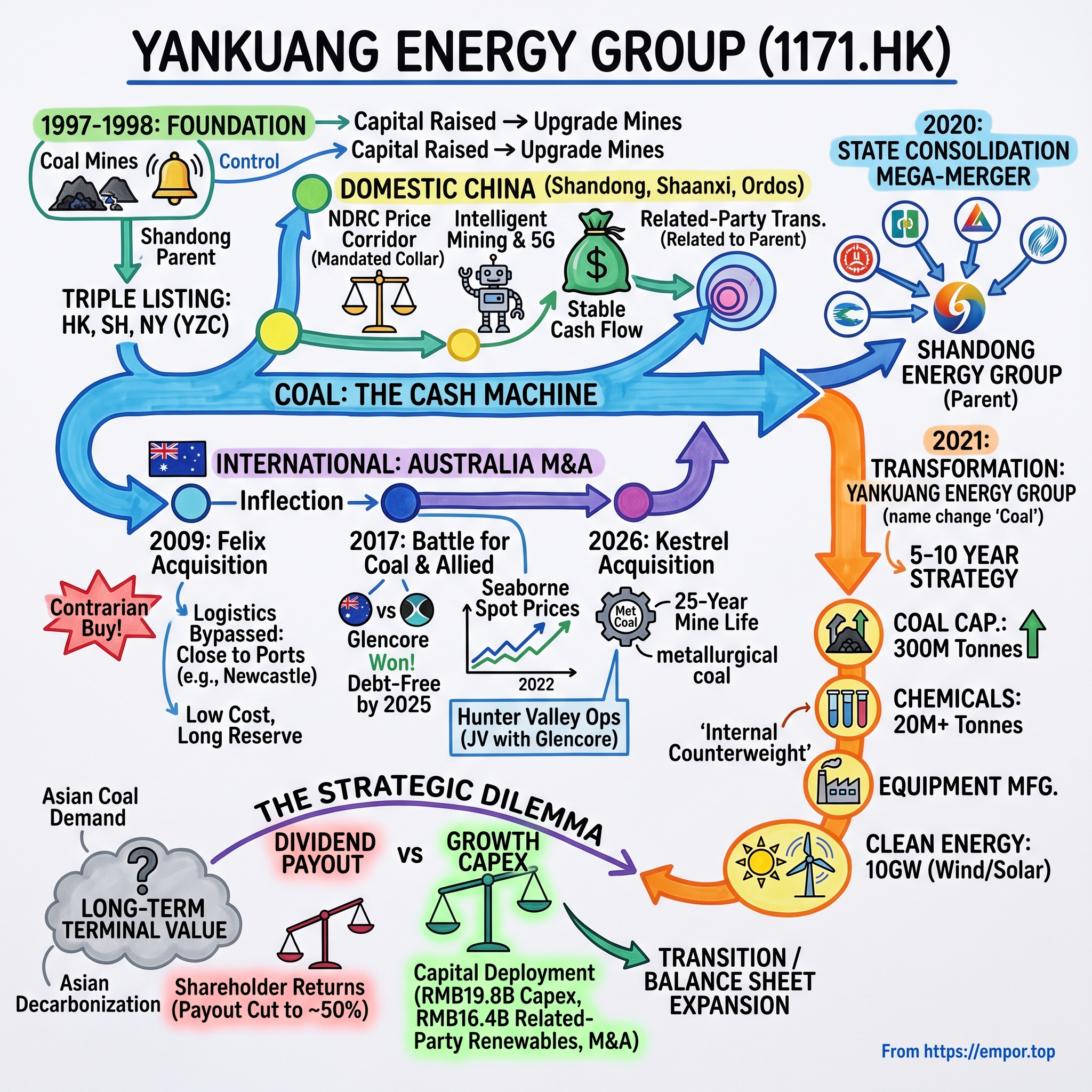
Yankuang Energy: The Strategic Masterclass of China's Global Coal & Chemicals Giant
I. Introduction & Episode Roadmap (0:00 – 12:00)
On a Tuesday morning in late July 2026, in a conference room at 949 South Fushan Road in Zoucheng — a mid-sized city in Shandong province that most global investors could not find on a map — shareholders of a company with a market value in the tens of billions of US dollars gathered to vote on eleven resolutions. One of them authorised the purchase of two power companies from the controlling shareholder for RMB16.4 billion in cash. The other nine set three-year spending caps on everything the listed company buys from, sells to, leases from, insures with, factors receivables through, and borrows money from that same controlling shareholder.[^7]
That single agenda is the whole story of Yankuang Energy in miniature. Here is a company that has, over twenty-five years, executed two of the most audacious cross-border resource acquisitions ever attempted by a Chinese state-owned enterprise, built a low-cost export coal franchise in the Hunter Valley that global mining majors would happily own, and generated cash on a scale that makes it one of Asia's most-watched dividend payers. And here is the same company, on the same day, asking its minority shareholders to bless a web of transactions with a parent that owns just over half its shares and answers to a provincial government.
The company is 兖矿能源集团股份有限公司 Yankuang Energy Group Company Limited, listed in Hong Kong as 1171.HK and in Shanghai as 600188.SS. Until December 2021, it was called 兖州煤业股份有限公司 Yanzhou Coal Mining Company Limited, and it did exactly one thing: dig coal out of the ground in Shandong.
Today it is something considerably stranger and more interesting: a Chinese provincial state-owned enterprise that is simultaneously one of the largest foreign owners of Australian coal, a top-ten Chinese chemicals manufacturer by volume, an aspiring potash miner with projects in Spain and Canada, a builder of mining robots, and — pending a shareholder vote it has just held — an owner of gigawatts of wind and solar generation.
The scale today In the 2025 financial year, Yankuang produced a record 182 million tonnes of saleable coal, up 6.3% year on year, alongside 9.77 million tonnes of chemical products.1 Revenue was RMB133.34 billion. Net profit attributable to shareholders was RMB8.52 billion — down 41.6%, because coal prices fell hard and there is no hiding from that in a commodity business.1 Roughly a third of the group's coal comes from Australia through its 62.26%-owned subsidiary 兖煤澳大利亚有限公司 Yancoal Australia Limited (3668.HK / YAL.AX),2 which ended 2025 with A$2.1 billion of cash and no interest-bearing debt at all.3
That last fact deserves a pause. A coal company that spent US$2.69 billion buying mines in 2017 was, eight years later, debt-free with two billion dollars in the bank. It then turned around in April 2026 and agreed to spend up to US$2.4 billion on a premium metallurgical coal mine in Queensland.4 Whatever else you say about this management team, they do not sit still.
And that restlessness is the analytical crux. Most coal companies in 2026 are run as melting ice cubes: maximise distributions, minimise investment, let the reserves deplete, hand the cash back. Glencore has said as much about its own coal division. Rio Tinto exited entirely. BHP sold down. The consensus playbook among Western miners is managed decline. Yankuang is running the opposite playbook — buying reserves, building capacity, adding adjacencies, and, as of the 2026–2028 shareholder return plan, trimming the payout to fund it. An investor in this stock is not simply taking a view on coal prices. They are taking a view on whether growth capital deployed into a structurally declining commodity, plus diversification into potash and renewables, beats the alternative of harvesting.
There is no obviously correct answer to that. There is only evidence, and the evidence is mixed in ways worth spending an hour on.
Three narrative threads
The global M&A crusader. Twice — in 2009 and again in 2017 — Yankuang bought Australian coal assets at moments when the Western consensus was that coal was finished. Both times it paid prices that contemporaneous critics called reckless. Both times it was, on the arithmetic that has since emerged, right. The interesting analytical question is not whether these were good deals; it is whether the underlying skill is repeatable, or whether a Chinese SOE with patient state-adjacent capital simply has a structurally longer holding period than the listed Western miners it was bidding against. Those are very different investment theses.
State consolidation and transformation. In July 2020, the Shandong provincial government merged Yankuang's unlisted parent with a provincial rival to create a coal producer second only to 国家能源投资集团 China Energy Investment Corporation in national scale.[^15] Eighteen months later, the listed company changed its name, dropped "coal" from its identity, and published a five-to-ten-year strategic outline promising 300 million tonnes of coal capacity, more than 20 million tonnes of chemicals, and 10 GW of wind and solar under China's 双碳 dual carbon framework.5 Four and a half years on, the coal targets are tracking; the clean energy target is being met, as of mid-2026, largely by buying the parent's renewables portfolio rather than building one.
There is a second-order point buried in that consolidation. Before the merger, the two Shandong groups ranked 212th and 295th on the 2020 Fortune Global 500. The merged Shandong Energy Group ranked 70th on the 2021 list.13 Scale of that order changes what a provincial SASAC can ask of its champion — and what it can put inside a listed subsidiary.
The cash machine versus the transition. Yankuang has been one of the highest-payout large caps in Hong Kong. For 2024 it distributed RMB0.77 per share, RMB7.73 billion in total, explicitly framed as 60% of adjusted net profit.5 For 2025 the total fell to RMB0.50 per share, RMB5.02 billion.1 And the proposed shareholder return plan for 2026–2028 sets the reference payout at roughly 50% of net profit after statutory reserves.6 A ten-percentage-point cut to the stated floor, arriving in the same year as a RMB16.4 billion related-party acquisition and a RMB19.8 billion capital expenditure budget,1 is not a coincidence. It is a choice, and it is the single most important thing minority shareholders in this company need to think about.
Let us go back to the beginning — briefly, because the distant past matters here mostly for what it explains about the present.
 Subscribe on LinkedIn
II. Founding Context & The Early SOE Era (12:00 – 27:00)
Drive southwest from Qufu — the birthplace of Confucius — and the North China Plain flattens into a landscape of wheat fields, power pylons, and the low grey headframes of coal shafts. Beneath this ground sits the Yanzhou coalfield: a thick, shallow, remarkably consistent seam of low-sulphur bituminous coal that Chinese geologists mapped in the 1960s and developed as the reform era opened. It was not China's largest coalfield, but it was among the best located — positioned directly alongside Shandong's industrial belt, close to coastal power plants, and adjacent to major ports.
Geography created the business. Yanzhou coal did not need to cross the country on congested railways to reach customers. In an industry where transport can account for a third of delivered costs, proximity to demand provided a structural advantage that operational efficiency in remote Inner Mongolia could not match. That advantage defined Yankuang's domestic franchise and eventually drove its expansion overseas once geological constraints made local growth harder than rail transport.
From work unit to joint stock company. The mining bureau operating the Yanzhou field was restructured into 兖州煤业股份有限公司 Yanzhou Coal Mining Company Limited in 1997, carved out from its state parent as a joint stock company tailored for international capital markets.7 This followed the standard Chinese state-owned enterprise playbook of the late 1990s: inject productive operating assets into a clean vehicle, leave social obligations like schools and hospitals with the parent, and list offshore to raise foreign capital while introducing global governance standards.
In 1998, the company executed a rare simultaneous triple listing in Hong Kong as 1171.HK, in New York as an American Depositary Share programme under ticker YZC, and in Shanghai as 600188.SS.7 The triple listing served both political and financial purposes. Beijing sought to benchmark state resource companies against international investors, leveraging Hong Kong's disclosure standards, US legal discipline, and domestic liquidity in Shanghai.
State oversight remained with the 山东省国有资产监督管理委员会 SASAC of the Shandong Provincial Government, exercised through the unlisted parent company. This structure remains a central feature for investors. While Yankuang maintains operational autonomy at the mine level, its controlling shareholder balances commercial objectives with provincial government priorities, including regional employment, energy security, and fiscal revenue.
For investors, provincial state ownership creates a distinct pattern. Operational management is typically disciplined, with executives evaluated on output, cost control, and safety. Strategic capital allocation, however, is influenced by broader policy goals — influencing asset transfers, capital retention, and corporate restructuring. Operational performance has historically generated strong cash flows, while capital allocation decisions have introduced periodic strategy shifts.
The capital raised from the 1998 listings funded core operational upgrades. Investments targeted underground mechanisation, high-capacity longwall systems, upgraded coal preparation plants, and modern washing infrastructure. Power stations purchase coal based on precise specifications covering calorific value, ash content, sulphur, and moisture. By building advanced washing and blending facilities, Yankuang secured premium pricing and long-term delivery contracts just as Chinese industrial electricity demand expanded.
The US listing ended two decades later. On 24 January 2017, the board voted to delist the ADSs from the NYSE and deregister with the SEC, citing disproportionate compliance costs relative to trading volume.8 The delisting took effect around 16 February 2017.8 The company transitioned from a triple-listed pioneer to a dual-listed A/H share issuer with an over-the-counter US trading mechanism. This reduced SEC disclosure requirements shortly before the company executed its largest overseas acquisition.
The golden decade. During the 煤炭黄金十年 Golden Decade of Coal between 2002 and 2012, rapidly expanding infrastructure investment, urbanisation, and coal-fired power construction drove domestic coal demand ahead of national mine supply. Coal prices surged, generating substantial cash flows across the industry.
Yankuang deployed this cash flow into three major initiatives. First, it expanded advanced underground mining techniques, specifically 放顶煤 top-coal caving. In conventional longwall mining, a shearer cuts coal along a seam while hydraulic roof supports hold up the rock face. In top-coal caving, the machine cuts only the lower portion of a thick seam, allowing the upper coal above the supports to fracture and fall onto rear conveyors under gravity. This technique increased seam extraction efficiency while lowering production costs per tonne. Yankuang became an industry leader in top-coal caving and later deployed the technique across its underground mines in Australia.
Second, the company diversified geographically into Shaanxi province and the Ordos Basin in Inner Mongolia. These regions offered thicker, shallower coal seams with lower extraction costs, offset by longer transport distances to coastal markets.
Third, the group developed an integrated coal chemicals division. As Shandong's initial mining areas matured, provincial planners sought to move up the value chain by converting coal into higher-value chemical products. That boom-era investment established the foundation for Yankuang's nearly ten-million-tonne chemical business today. While coal chemicals require heavy capital expenditure and remain sensitive to oil-to-coal price spreads, the initiative diversified the company beyond raw coal extraction.
The coal boom concluded in 2012 as expanded national capacity and slowing demand growth triggered a four-year price decline. Domestic coal producers faced sharp margin compression, eventually prompting government-mandated capacity reductions and production limits. Yankuang entered this downturn carrying debt from its early Australian expansion, setting up the strategic challenges of its next growth phase.
III. The Australian M&A Campaign: Felix Resources & Yancoal Australia (27:00 – 50:00)
By the mid-2000s, Yankuang's planners faced an uncomfortable geographical reality. Chinese coal demand was expanding rapidly, yet domestic coal production was increasingly concentrated thousands of kilometres away in northern inland provinces. The heavy-haul rail corridors connecting northern mines to southern industrial hubs — such as the Daqin line — were capacity-constrained and heavily rationed. A domestic producer could hold vast coal reserves in Ordos and still struggle to secure rail capacity to reach power generators in Guangdong.
Seaborne imports provided an efficient alternative. Australian coal reached coastal southern China at competitive delivered costs because ocean freight was significantly cheaper per tonne-kilometre than domestic Chinese rail transport. If moving domestic coal across China was blocked by rail bottlenecks, purchasing coal that arrived by sea offered a direct solution.
The core insight behind Yankuang's overseas strategy was not simply acquiring resource reserves, which every major domestic producer sought during the boom. Rather, management recognized that the binding constraint on a Chinese coal company was logistics, not resource, and that the most cost-effective way to bypass domestic bottlenecks was to acquire coal adjacent to an export port. Newcastle, New South Wales, is the world's largest coal export harbor, fed by a dedicated rail corridor through the Hunter Valley. From a delivered-cost perspective, a mine ninety minutes from Newcastle was effectively closer to Guangdong power plants than an inland mine in Ordos.
When the global financial crisis struck in late 2008, commodity prices plummeted. Australian mid-tier miners — highly leveraged, expansion-focused, and suddenly unable to refinance existing debt — were forced to seek capital partners.
The Felix acquisition. Felix Resources was a mid-tier Australian coal producer whose flagship asset was Moolarben, a large open-cut thermal coal project in the Western Coalfield of New South Wales, alongside the Ashton underground mine and the Yarrabee mine in Queensland. In August 2009, Yanzhou Coal reached an agreement to acquire Felix in a transaction valuing the company at approximately A$3.54 billion, backed by the Felix board and its controlling shareholders.9 Broadly cited at A$3.5 billion, the deal represented the largest takeover of an Australian company by a Chinese enterprise at the time.10
Market commentary in Sydney and London expressed skepticism. Financial analysts argued that Yanzhou was paying a full valuation for assets that were still ramping up production, during a period of extreme uncertainty for global thermal coal prices. The prevalent market consensus assumed that a Chinese state-owned enterprise, backed by state-directed financing, was overpaying for strategic national objectives.
That consensus overlooked a fundamental analytical distinction. Market observers evaluated the transaction against short-term forward price curves, whereas Yankuang evaluated it based on reserve life and cost positioning. Moolarben's open-cut deposit offered decades of low-strip-ratio production. For an investor willing to hold an asset over a multi-decade horizon, short-term entry multiples matter far less than a mine's position on the global cost curve. Yankuang's principal advantage in 2009 was not necessarily cheaper capital, but a longer permitted holding horizon — a structural advantage that endures only as long as its controlling shareholder tolerates extended investment cycles.
Regulatory conditions. The Australian Foreign Investment Review Board attached strict undertakings to its approval that fundamentally reshaped the acquiring structure: the Australian operations had to be held through an Australian-incorporated and headquartered entity; that vehicle had to list on the Australian Securities Exchange (ASX) within a specified timeframe; Yanzhou's ownership stake had to be diluted below 70%; the chief executive officer and chief financial officer were required to reside in Australia; and all coal sales had to be marketed at arm's length against transparent international benchmarks.11
This regulatory framework proved highly consequential for capital structure and governance. Rather than blocking Chinese investment, Australian regulators required the assets to operate within a public corporate governance framework characterized by independent minority representation, ASX continuous disclosure rules, and commercial autonomy from the state-owned parent company. As a result, Yankuang's Australian operations developed higher reporting transparency and market discipline than its domestic mainland business — a structural framework established through regulatory mandates rather than voluntary parental initiative.
Building Yancoal Australia. Satisfying the listing requirement presented significant operational challenges. Unfavourable market conditions in 2011 ruled out a conventional initial public offering. In 2012, Yanzhou executed a reverse merger with Gloucester Coal, securing an ASX listing for Yancoal Australia while retaining majority ownership.11 While this satisfied regulatory requirements, Yancoal Australia operated for years with a narrow public float, concentrated minority holdings, and low stock liquidity.
The market cycle subsequently turned down. Between 2012 and 2015, expanding export volumes from Australia and Indonesia outpaced global demand, causing seaborne thermal coal prices to decline steadily. Yancoal Australia faced margin compression, carrying substantial US dollar-denominated acquisition debt while operating costs were denominated in Australian dollars.
This foreign exchange mismatch underscored a key structural dynamic of the business. Yancoal generates revenue in US dollars but pays operational expenses — including labor, fuel, contracting, and royalties — in Australian dollars. When the Australian dollar appreciates against the greenback, unit operating costs rise in US dollar terms and compress profit margins regardless of mine-level efficiency. Between 2011 and 2013, the Australian dollar traded above parity with the US dollar, creating severe cost pressures across Australian mining operations. When the Australian dollar subsequently depreciated beginning in 2014, unit margins recovered significantly due to currency movements rather than underlying operational changes. Foreign exchange swings account for a substantial portion of multi-year margin volatility, making currency fluctuations a key factor when analyzing reported cash costs per tonne.
This phase highlights a core characteristic of Yankuang's operational profile. The 2009 Felix acquisition ultimately succeeded not through market timing, but because the parent group possessed the balance-sheet capacity to absorb losses over a six-year cyclical downturn until commodity prices recovered. This willingness to endure prolonged holding periods reflects balance-sheet strength and state-backed ownership structure rather than pure market foresight. For minority shareholders, investing alongside Yankuang provides access to this patient capital model, while also incurring the risk that similar patience could be extended to underperforming assets.
By 2016, seaborne coal prices began recovering, and Yancoal stabilized its financial position. Shortly thereafter, a major strategic opportunity emerged as Rio Tinto initiated a complete exit from the Australian coal sector.
IV. The Battle for Coal & Allied: Defeating Glencore (50:00 – 72:00)
In January 2017, Rio Tinto announced an agreement to sell Coal & Allied Industries — the holding company for its Hunter Valley thermal coal operations — to Yancoal Australia for up to $2.45 billion. Rio Tinto was executing a broader strategic exit from thermal coal to focus on iron ore, copper, and aluminium, driven in part by institutional investors pushing to divest fossil fuel assets.
The target assets were premier operations. Coal & Allied held Hunter Valley Operations, a major open-cut mining complex, alongside the adjacent Mount Thorley Warkworth mine. Both operations produce high-energy export thermal coal and semi-soft coking coal, feature long reserve lives, and occupy low positions on the global cost curve due to favorable strip ratios and direct rail connections to the Port of Newcastle.
The strip ratio is a critical operational metric for open-cut coal mining profitability. To reach a coal seam, miners must remove the overlying soil and rock, known as overburden. The strip ratio measures how many cubic metres of waste must be moved for every tonne of coal recovered. A low ratio, such as three to one, keeps extraction costs minimal, whereas a high ratio, such as ten to one, significantly increases earth-moving expenses. Hunter Valley deposits feature shallow, thick coal seams that allow low-cost extraction, enabling these mines to maintain positive cash margins even during severe cyclical price downturns. In mining industry terms, a tier-one asset combines these low extraction costs with efficient transport infrastructure.
Glencore then entered the process with a rival offer.
The bidding war. Between 9 and 23 June 2017, Glencore submitted competing proposals that culminated in a $2.55 billion bid. Glencore already operated adjacent mines, giving it significant operational synergies, including shared mining pits, equipment fleets, transport infrastructure, and coal blending capabilities. On a synergy-adjusted basis, Glencore could afford to outbid Yancoal while maintaining target investment returns.
Yancoal countered on 25 June 2017 with a revised offer of $2.69 billion, which Rio Tinto accepted, completing the transaction on those terms.
Rio Tinto accepted Yancoal's offer primarily due to transaction certainty. Glencore's proposal presented antitrust approval risks precisely because of its existing regional footprint, as consolidating adjacent Hunter Valley operations invited regulatory scrutiny from Australian competition authorities. By contrast, Yancoal was an established Australian-listed entity with a proven track record of securing approval from the Foreign Investment Review Board and New South Wales planning authorities. Faced with choosing between a higher-risk execution path and a straightforward closing, Rio Tinto prioritized certainty.
This outcome illustrates a broader dynamic in regulated resource M&A: established regulatory compliance acts as a competitive asset. Yankuang's years of navigating Australian regulatory frameworks, listing rules, and local planning approvals proved decisive in securing the transaction.
Bringing the loser inside the tent. On 27 July 2017, Glencore agreed to acquire a 49% interest in Hunter Valley Operations from Yancoal. Under the agreement, Glencore paid $1.139 billion in cash, assumed a 27.9% share of $240 million in non-contingent royalties owed to Rio Tinto along with 49% of price-contingent royalties, and invested an additional $300 million in Yancoal equity.12[^14] The two companies formed a joint venture governed by a six-member management committee split equally between them. Glencore nominates the general manager for Hunter Valley Operations, Yancoal nominates the financial controller, and Glencore serves as the exclusive marketing agent for HVO coal across major international markets, including Japan and South Korea, outside designated Asian territories.12
This transaction structure effectively solved several strategic and financial challenges for Yancoal. By selling a 49% stake in Hunter Valley Operations to its rival, Yancoal recovered a substantial portion of the acquisition cost in cash while preserving operational synergies in a structure acceptable to competition regulators. Yancoal maintained majority control and financial consolidation, while Glencore secured operational involvement and synergy benefits. However, the governance structure represents a genuine compromise rather than full control. Equal representation on the management committee and a Glencore-appointed general manager constrain Yancoal's operational autonomy, while Glencore's marketing role grants a major competitor direct visibility into Yancoal's export volumes.
Was Coal & Allied overpaid? From the perspective of 2026, the acquisition delivered strong financial returns. Global coal prices surged in 2022 following the invasion of Ukraine, generating unprecedented cash flow across Hunter Valley thermal coal operations. By the end of 2025, even as market prices normalized, Yancoal Australia held A$2.1 billion in cash with zero interest-bearing debt, generating revenue of A$5.95 billion and operating EBITDA of A$1.43 billion during a lower-price environment.3 An asset base acquired for $2.69 billion had fully retired its acquisition debt while supporting substantial shareholder distributions.
However, investors must distinguish between operational strategy and external market conditions. While purchasing low-cost tier-one assets and holding them through market cycles reflects disciplined resource investing, the extraordinary cash flows of 2022 resulted from an unpredictable geopolitical energy crisis. Separating asset-level fundamentals from unexpected market spikes is essential when evaluating whether such returns can be replicated.
This transaction also highlights a fundamental cost-of-capital divergence in global mining. Rio Tinto sold Coal & Allied not due to asset quality, but because its cost of capital had increased as European institutional investors and index providers restricted thermal coal exposure. Yankuang faced no such capital restrictions, creating an arbitrage opportunity where assets shifted from institutional owners facing divestment mandates to state-backed entities with patient capital horizons. Yankuang benefited significantly from this structural shift. However, this divestment cycle is inherently self-limiting as the supply of Western corporate sellers diminishes. The 2026 acquisition of the Kestrel metallurgical coal mine — purchased from private ownership groups with Mitsui maintaining a 20% joint-venture interest — indicates that the pool of available assets is transitioning beyond major Western corporate divestments.4
While the Australian subsidiary established financial independence, major structural changes were taking shape at the parent company level in Shandong.
V. The 2020 Mega-Merger & The 2021 Energy Pivot (72:00 – 90:00)
In Chinese industrial policy, major structural reform frequently arrives via administrative decree rather than market negotiation. In July 2020, Shandong province consolidated its two largest coal enterprises: 兖矿集团 Yankuang Group, the unlisted parent of the Hong Kong-listed entity, and Shandong Energy Group, both controlled by the provincial State-owned Assets Supervision and Administration Commission (SASAC).[^15] With combined annual production estimated at roughly 291 million tonnes, the merged entity became China's second-largest coal producer, behind China Energy Investment Corporation and ahead of 中煤能源 China Coal Energy.[^15]
Completed in July 2020 under the name 山东能源集团有限公司 Shandong Energy Group Co., Ltd.13, the merger reflected a national policy directive to consolidate a fragmented coal industry long plagued by overcapacity, low productivity, and safety hazards.[^15]
From a Western capital markets perspective, administrative consolidation of this scale without a shareholder vote or control premium is rare. A provincial party committee and government combined two industrial giants by policy mandate, leaving the listed subsidiary with a vastly larger controlling shareholder and a new set of strategic directives imposed from above.
For minority shareholders in Hong Kong, this structural shift created a massive unlisted parent company holding extensive coal, power, chemical, and financial assets outside the listed vehicle. In Chinese state-owned enterprise governance, intra-group asset overlaps are typically resolved over time through asset injections into the listed company. The net impact on minority shareholder value depends almost entirely on transaction pricing negotiated between two entities under common control.
The rebranding. In December 2021, Yanzhou Coal Mining formally rebranded as Yankuang Energy Group Company Limited.[^17] Beyond the name change, management introduced a five-to-ten-year strategic development plan structured around four operational pillars.
The coal pillar set an ambition of 300 million tonnes of annual capacity achieved through organic expansion, new mining licences, and parent asset injections, alongside a commitment to construct more than eight intelligent, green mines each producing over 10 million tonnes annually.5
This focus on intelligent mining reflects broader national mandates for underground automation, including remote-operated longwall faces, underground 5G networks, and autonomous haulage. Beyond regulatory compliance and safety improvements, removing personnel from active coal faces generates long-term labor cost savings, helping offset inflationary pressures on unit production costs while creating internal demand for the group's equipment manufacturing arm.
The chemical pillar targeted annual output exceeding 20 million tonnes, converting coal into methanol, acetic acid, polyolefins, caprolactam, and ethylene glycol through subsidiaries such as 鲁南化工 Lunan Chemicals and 陕西未来能源 Shaanxi Future Energy.5 Economically, coal chemistry functions as a structural spread trade: it converts synthesis gas derived from abundant domestic coal into chemical compounds typically derived from imported petroleum, delivering strong margins when coal prices remain low relative to global crude oil.
The third pillar focused on smart equipment manufacturing, producing hydraulic roof supports, automated longwall systems, and digital mining equipment for internal deployment and commercial sale.
The fourth pillar established clean energy targets, calling for 3 million kilowatts of wind and solar capacity by the end of the 14th Five-Year Plan in 2025 and scaling to 10 million kilowatts within five to ten years to align with China's 双碳 decarbonization goals of 碳达峰 carbon peak by 2030 and 碳中和 carbon neutrality by 2060.5
Execution across these pillars has diverged. Coal capacity has expanded ahead of initial projections, while chemical output remains well below the 20-million-tonne long-term ambition. Equipment manufacturing remains a modest contributor. In clean energy, the company reported approximately 3,065 megawatts of wind capacity by 2025 across operating, grid-connected, and under-construction projects, though a significant portion was not yet commercially operational.5
In June 2026, Yankuang Energy moved to bridge its clean energy gap by agreeing to purchase a 100% equity stake in a renewable energy generation company and a retail power sales business from its controlling parent for RMB16.41 billion in cash, comprising RMB15.57 billion for generation assets and RMB845 million for the retail business.23 Because the transaction involved the parent company, it was classified as a discloseable connected transaction under Hong Kong listing rules, requiring approval from independent shareholders with interested directors abstaining.24
Management framed the acquisition as an opportunity to integrate clean energy generation into the listed portfolio, optimize the corporate structure, and complete the power value chain from generation to retail sales using internal cash reserves.23 Integrating generation with a retail distribution license provides strategic flexibility in China's reforming power market, enabling direct sales to industrial end-users at market-based rates rather than fixed grid tariffs.
However, the transaction demonstrates that the 10-gigawatt renewable target announced in 2021 is being achieved primarily through cash purchases of parent assets rather than organic development. While absorbing parent-owned renewables resolves intra-group competition, it signals that strategic growth targets outlined by the listed company often represent broader parent group ambitions executed via balance-sheet transactions rather than greenfield construction.
With the corporate architecture established, the analytical focus shifts to how the group finances these capital commitments and balances growth spending against shareholder distributions.
VI. Core Business Economics & Segment Breakdown (90:00 – 110:00)
A key discipline in analyzing diversified resource companies is simple: size every business segment before evaluating it. An operation generating 5% of earnings deserves no more than 5% of an investor's attention, regardless of how prominently it features in corporate strategy presentations.
By that metric, Yankuang Energy remains fundamentally a coal mining enterprise with auxiliary businesses. Coal operations generate the vast majority of group earnings, while coal chemicals represent a meaningful but secondary contributor. Specialized equipment manufacturing, logistics, and renewable energy remain financially minor today, despite their prominence in management's long-term transformation narrative.
Segment one: domestic Chinese coal. The domestic asset base spans the original Shandong operating areas, Shaanxi province, and the Ordos Basin in Inner Mongolia, expanding significantly over time through strategic acquisitions. These operations are predominantly underground longwall mines, deploying Yankuang's top-coal caving technology across thicker seams to maximize extraction efficiency.
The segment's economics are governed by a mechanism absent in Western coal markets: the long-term pricing framework set by the 国家发改委 National Development and Reform Commission (NDRC). Thermal coal supplied to domestic power utilities is primarily transacted under annual term contracts within a regulated price corridor intended to ensure grid stability and generator solvency. Chinese state-owned miners are expected to allocate a substantial share of domestic production to these long-term contracts.
In effect, this framework operates as a state-mandated collar. In exchange for downside price protection during commodity slumps, miners forgo upside profit spikes during market rallies. When global spot prices surge, Chinese producers bound by long-term contract allocations capture only a fraction of the upside. Conversely, when market prices collapse, the contract floor protects domestic operating margins from the severe downturns experienced in unregulated seaborne markets.
Consequently, domestic Chinese coal operations function more like regulated utilities with commodity exposure than pure cyclical miners. Earnings remain more stable during cyclical downturns but lack the full earnings leverage of unhedged seaborne producers during coal price booms. The regulatory corridor itself represents a key variable, as administrative adjustments to price bounds can alter segment earnings power independent of mine-level efficiency.
Financial results for 2025 highlight these dynamics. The coal segment's gross margin compressed by 7.1 percentage points year-on-year to 35.5% as average realized prices declined faster than operating expenses.1 This margin pressure was partially mitigated by operational cost controls: unit sales cost per tonne fell approximately 7% year-on-year, following a 5.4% decline in 2024 to RMB345.4 per tonne.15 Achieving consecutive years of unit cost reductions during an inflationary period reflects disciplined operational management, with guidance targeting an additional 3% cost reduction in 2026.1
Production volume targets remain central to management's operational plan. For 2026, the company targets 186 million to 190 million tonnes of saleable coal and 9.5 million to 11.0 million tonnes of chemical products, backed by a planned capital expenditure budget of RMB19.8 billion, alongside a long-term goal of adding 70 million tonnes of annual coal capacity by 2031.1 Compared to the 182 million tonnes produced in 2025, near-term organic growth is modest and primarily depends on ramping up recently acquired operations. Meeting the broader 300-million-tonne long-term strategic target will likely require further external acquisitions.
Segment two: Yancoal Australia. In contrast to domestic operations, Yancoal Australia provides direct, unhedged exposure to prevailing seaborne spot prices. Its asset portfolio spans New South Wales and Queensland — including Moolarben, Hunter Valley Operations, Mount Thorley Warkworth, Ashton, and Yarrabee — exporting high-energy thermal and metallurgical coal across Japan, South Korea, Taiwan, and Southeast Asia.
Operating results from the second quarter of 2026 demonstrate the segment's leverage to market pricing and volume fluctuations. Attributable saleable coal production reached a quarterly record of 10.8 million tonnes, representing a 20% sequential increase over the first quarter, alongside run-of-mine output of 17.5 million tonnes.14 Moolarben and Mount Thorley Warkworth expanded saleable output by 23% and 34% respectively, offsetting a 20% decline at Ashton caused by difficult geological strata.14 Average realized coal prices rose 9% quarter-on-quarter to A$160 per tonne, supported by a 14% increase in the Newcastle benchmark index to US$135 per tonne and a 19% gain in the API 5 index — the pricing benchmark for lower-energy Australian thermal coal — to US$96 per tonne.14
Product quality specifications significantly influence Yancoal's realized pricing dynamics. High-energy thermal coal yielding 6,000 kilocalories per kilogram trades at Newcastle benchmark pricing, whereas lower-energy coal around 5,500 kilocalories sells at an API 5 discount. When the price spread between premium and lower-energy grades narrows, producers with substantial 5,500-kilocalorie output experience relative margin expansion. In response to questions during the second-quarter investor call regarding API 5 price exposure relative to industry peers, management cited Moolarben's low operating cost structure combined with strengthening API 5 realization rates as key margin drivers.14
Operating cash costs for 2026 are projected toward the upper bound of the A$90 to A$98 per tonne guidance range, with diesel fuel costs accounting for approximately A$7 per tonne of the 2025 cash cost base of A$92 per tonne.14 The margin spread between realized prices and cash operating costs serves as the primary driver of Australian segment cash flow.
Two structural factors warrant close attention. First, capital intensity is increasing, with 2026 attributable capital expenditure budgeted at A$750 million to A$900 million against target attributable saleable production of 36.5 million to 40.5 million tonnes.3 Management indicated during the second-quarter call that full-year capital outlays would likely track toward the lower end of guidance, with remaining expenditures deferred into 2027.14 Second, financial performance in 2025 reflected sharp cyclical sensitivity: revenue declined 13% to A$5.95 billion while net profit fell 64% to approximately A$440 million, despite achieving record output of 67 million run-of-mine tonnes and 50.8 million saleable tonnes.3 These results highlight that record operational volumes cannot offset major benchmark price corrections in unhedged export markets.
Segment three: coal chemicals. Total chemical output reached 9.77 million tonnes in 2025, representing an 8.5% year-on-year increase, with management targeting 9.5 million to 11.0 million tonnes for 2026.1 Product lines include methanol, acetic acid, caprolactam, polyformaldehyde, liquid paraffin, naphtha, urea, and ethyl acetate.
First-quarter 2026 operational data illustrates management's spread-management approach across product lines. Production volumes diverged across the chemical suite, with methanol, acetic acid, caprolactam, polyformaldehyde, liquid paraffin, and naphtha output expanding, while ethyl acetate and urea production declined significantly.22 Management attributed the reduction in ethyl acetate output to operational adjustments at Yanzhou Lunan Chemical aimed at curtailing production on products with compressed margin spreads.22 Segment profitability depends fundamentally on the spread between domestic coal feedstock costs and crude oil-linked chemical benchmark prices.
Additionally, the chemical segment functions as an internal economic counterweight within the group's portfolio. During coal market downturns, lower feedstock expenses improve chemical processing margins, partially offsetting earnings compression in upstream mining. Conversely, elevated coal prices raise input costs for chemical facilities while boosting mining profitability. Although imperfect due to broader energy market correlations, this vertical integration moderates overall group earnings volatility across commodity cycles.
Segment four: equipment, logistics and clean energy. Mining equipment manufacturing and logistics generate revenue but contribute modestly to total group net income, while renewable energy operations represent a small earnings base relative to core coal operations, even following the pending asset acquisition. Equipment manufacturing enhances supply-chain security and captures internal manufacturing margins, while renewable energy investments provide decarbonization alignment and long-term asset diversification. However, core coal mining and chemical operations remain the principal drivers of consolidated cash flow and shareholder distributions.
VII. Competitive Position & Strategic Frameworks (110:00 – 128:00)
Commodity businesses are often described as the graveyard of competitive advantage. Producers sell undifferentiated products at market-clearing prices to customers ready to switch for a nominal discount. Yet certain resource companies consistently generate returns above their cost of capital across full commodity cycles. Evaluating Yankuang through established competitive frameworks helps explain why.
Hamilton Helmer's 7 Powers
Yankuang plausibly holds two of the seven powers, arguably a third, and lacks the rest.
Cornered resource is the primary power and the most defensible. The Hunter Valley open-cut coal assets—offering low strip ratios, decades of reserve life, and direct rail access to the world's largest coal export harbor—are practically impossible to replicate. Developing a new greenfield thermal coal mine of comparable scale in Australia is politically non-viable under current environmental policies. The competitive moat combines natural geology with a regulatory drawbridge raised behind incumbent operators. This creates a durable structural advantage for as long as demand endures. It also explains why the Kestrel transaction matters strategically: acquiring an existing premium metallurgical asset with 164 million tonnes of marketable reserves and a 25-year mine life represents the primary realistic path to acquiring higher-quality tonnage.4
Scale economies exist but remain bounded. Shared infrastructure, rail contracts, port allocations, and equipment fleets lower unit operating expenses, while the internal equipment manufacturing division captures modest vertical efficiencies. Mining scale, however, is primarily asset-specific rather than firm-wide: an expansive open-cut pit yields low unit costs, but operating two separate mines in different basins provides limited cross-operational synergy.
Process power represents a more contestable assertion. Yankuang's top-coal caving expertise is extensive and successfully deployed across its mine portfolio. However, the technique is well documented, the machinery is commercially accessible, and domestic peers utilize similar methods. While top-coal caving functions as an effective operational capability that lowers unit costs, it reflects accumulated engineering experience rather than a proprietary, defensible moat.
The group lacks branding power, network economies, and customer switching costs, as coal buyers select suppliers strictly on price and chemical specifications. It also lacks counter-positioning; if anything, the company operates on the opposite side of that dynamic, as global policy trends seek to displace thermal coal generation over time.
Porter's Five Forces
Threat of substitutes represents the defining long-term structural force shaping terminal valuation. Renewable generation, nuclear power, and battery storage continue to displace thermal coal in power grids. While the long-term trajectory is established, the pace and cadence of transition vary across markets. Developing Asian power grids—including China, India, Indonesia, and Vietnam—continue to rely on coal for dispatchable baseload power due to limited natural gas infrastructure. Furthermore, metallurgical coal faces a slower substitution timeline, as commercial-scale steelmaking without coking coal remains technically and economically challenging; the Kestrel transaction expands Yancoal's metallurgical exposure to approximately 22% of its portfolio.4 Chairman Li Wei described domestic coal market conditions in the 2024 results presentation as driven by "strong, rigid demand" within China.5 While this framing reflects management's strategic perspective, investors can independently monitor whether Chinese thermal coal consumption plateaus or enters a structural decline over the medium term.
Bargaining power of buyers is moderate and structurally asymmetric. In China's domestic market, buyer power is effectively wielded by state regulators through the National Development and Reform Commission's price corridor. In export markets, Japanese and South Korean power utilities negotiate forcefully on terms, yet remain price-takers relative to global seaborne market balances. Management noted during the second-quarter 2026 investor call that Indonesia's planned launch of a centralized coal marketing mechanism in September had produced minimal observed impact on Chinese coal import volumes to date.14 While effective supply discipline among major thermal coal exporting nations could theoretically support realized export pricing, centralized selling cartels historically face significant execution hurdles.
Rivalry among established producers remains moderate. In China, 中国神华 China Shenhua Energy (1088.HK) serves as the primary benchmark peer—operating with greater scale, integrated rail logistics, and power generation capacity—while 中煤能源 China Coal Energy (1898.HK) provides another domestic benchmark. Yankuang differentiates itself from both peers through its substantial overseas export portfolio. Internationally, Yancoal competes alongside Glencore's coal division—which occupies a dual role as Yancoal's joint-venture partner and export marketing agent—and Whitehaven Coal, which also expanded its metallurgical coal holdings in Queensland.
Threat of new entrants is near zero in Australian thermal coal and strictly constrained in China, where government policy discourages greenfield capacity expansion. This supply restriction represents the most favorable force for incumbent miners, underpinning the core investment case.
However, strict permitting requirements create dual effects for existing operators. Regulatory authorities reluctant to approve new thermal mines also scrutinize mine life extension applications. Consequently, planning submissions such as the Hunter Valley Operations continuation and the Moolarben Open Cut 3 expansion before the New South Wales Independent Planning Commission carry strategic weight beyond their immediate output targets. The regulatory barriers that shield incumbent market share simultaneously restrict organic reserve expansion.
Supplier power remains an ongoing cost factor. Inflationary pressures across skilled mining labor, diesel fuel, explosives, and heavy machinery in New South Wales and Queensland continue to exert upward pressure on operating expenditure guidance.
A peer comparison worth making. Compared to China Shenhua, Yankuang presents a higher-beta financial profile. Shenhua's proprietary railway network and power generation assets smooth earnings and yield an integrated cost advantage that Yankuang lacks domestically. Conversely, Yankuang holds a major Australian export business, providing unhedged exposure to international seaborne pricing independent of domestic Chinese price corridors. This exposure amplifies earnings upside during global commodity rallies while increasing downside volatility during export downturns. Compared to international peers such as Glencore and Whitehaven Coal, which operate pure seaborne portfolios focused on capital return over capacity expansion, Yankuang combines a policy-protected domestic floor with an expanding international reserve base. This dual positioning offers either a unique structural hedge or a conflicting capital allocation strategy, depending on investor perspective.
The synthesis. Yankuang's competitive positioning exhibits supply-side strength alongside structural demand headwinds. The group controls low-cost, non-replicable assets in an industry shielded from new entrants, yet operates within energy markets undergoing long-term transition. Consequently, the central analytical question centers not on the existence of its competitive moat, but on the duration of its asset runway and whether management allocates operating cash flows toward shareholder distributions or group-level capital expenditure—bringing governance into central focus.
VIII. Governance, Management Credibility & Stress Test (128:00 – 145:00)
Every controlled company presents the same fundamental question, and it does not go away no matter how high the quality of the underlying assets may be: when the interests of the controlling shareholder and minority investors diverge, what actually happens?
Most public companies never have to answer that question under bright spotlight. Yankuang Energy has answered it twice — first in 2022, when it attempted to buy out its own subsidiary's minority shareholders, and continuously since 2020, through a steady flow of asset transfers from parent to listed vehicle. The empirical evidence is unusually rich, making it worth examining carefully rather than falling back on standard state-owned enterprise discount shorthand.
The people. Chairman Li Wei (李伟) has led the board since August 2021 — arriving precisely at the moment of the strategic rebranding and long-term outline, owning that corporate agenda personally. His public communication style, as demonstrated in the 2024 annual results presentation held in Hong Kong on 31 March 2025, is measured and policy-anchored: he characterized the international operating environment as likely to become "more complex and severe" while maintaining that China's domestic economy remains stable with coal demand rigid.5 Wang Jiuhong assumed the roles of Party Secretary and General Manager in November 2024 before joining the board as an executive director in May 2025.25 The company maintains a board with independent non-executive directors and, following its annual general meeting on 26 June 2026, established new special committees under its tenth board session.25
At Yancoal Australia, executive leadership operates under greater public disclosure mandated by the Australian Securities Exchange. Sharif Burra, 51, became Chief Executive Officer on 8 September 2025, promoted from within after twelve years across operations, procurement, safety, and business improvement, following an interim tenure under Ning Yue.18 Burra holds a first-class mining engineering degree from Auckland University and an Oxford MBA, while also chairing an industry low-emissions technology assessment committee.18 Chairperson Gang Ru framed the internal appointment as evidence of executive bench strength.18 The Australian executive team conducts quarterly investor calls and fields direct questions from institutional analysts at Barrenjoey, Morgan Stanley, and Bell Potter regarding impairments, planning approvals, and cost guidance — establishing a level of routine market accountability that the Hong Kong parent entity does not match.
The capital allocation record. On the positive side of the ledger, management executed two contrarian overseas acquisitions that generated substantial long-term value, transitioned an Australian subsidiary from heavy leverage to a net cash balance of A$2.1 billion, delivered two consecutive years of unit cost reductions, and demonstrated operational discipline by curtailing unprofitable chemical output rather than chasing volume.
On the negative side, the capital allocation record contains notable warning signs, with the clearest evidence provided by the 2022 privatization attempt. In May 2022, Yankuang proposed to acquire the 37.74% minority stake in Yancoal Australia that it did not already own — representing 498.2 million shares — for A$3.60 per share in convertible bonds, valuing the minority equity at approximately US$1.8 billion.519 At the time of the proposal, Yancoal shares traded publicly at A$5.50.19 The controlling shareholder sought to buy out minority owners in its own subsidiary at a price roughly 15% below prevailing market value during one of the strongest coal market rallies in modern history.19 Glencore, which held a 6.4% stake, signaled it would reject the offer for significantly undervaluing the asset, prompting Yankuang to terminate discussions on 9 September 2022, citing market conditions.195 Glencore subsequently sold its holding separately in July 2022 for US$293 million.5
This transaction attempt offers a clear demonstration of how the controlling shareholder views minority equity value when positioned on the opposite side of a transaction.
The activist stress test
A skeptical long-short investor evaluating Yankuang Energy today would center a bear thesis on four primary vulnerabilities.
First, the extensive scale of related-party transactions. The extraordinary general meeting held in July 2026 asked independent shareholders to approve, alongside the power asset acquisition, nine separate continuing connected transaction agreements with spending caps spanning 2026 through 2028: materials supply, mutual labor and services, insurance fund administration, product leasing, bulk commodity trading, financial leasing and factoring, entrusted management services, Shandong Energy financial services, and Yankuang Energy financial services.[^7] Rather than isolated legacy contracts, these agreements cover nearly every operational touchpoint — establishing a corporate structure where inputs, outputs, equipment leases, insurance, receivables financing, and banking services flow through the controlling shareholder. While each contract is disclosed and voted on individually, the overall arrangement leaves reported operating margins heavily dependent on intra-group transfer pricing choices that outside investors cannot independently audit.
Second, asset acquisition pricing and the restatement accounting that follows. In July 2025, the company completed the acquisition of a 51% interest in Shandong Energy Group Xibei Mining, structured as RMB4.748 billion in cash for a 26% stake alongside a RMB9.318 billion capital contribution, representing a total capital commitment of RMB14.07 billion.16 The transaction structure itself is notable: rather than directing the full purchase price to the selling parent, the majority was injected directly into the target entity as fresh equity. While this capital retention structure is relatively supportive of minority interests, it complicates external calculations of effective acquisition multiples.
Furthermore, because these transactions represent business combinations under common control, accounting standards require the retrospective restatement of prior-period financial results. Consequently, 2025 saleable coal output of 182 million tonnes was reported as 6.3% year-on-year growth, despite the originally published 2024 figure standing at 142 million tonnes.15 Although technically compliant with accounting rules, this treatment blends organic operational performance with retrospectively consolidated parent assets, requiring investors to separate structural injections from underlying mine productivity.
Third, the strategic redirection of capital away from distributions. Consider the concurrent capital commitments: a 2026 capital expenditure budget of RMB19.8 billion, a RMB16.41 billion cash acquisition of parent power assets, a US$2.4 billion metallurgical coal mine acquisition in Australia, and an updated 2026–2028 shareholder return plan that lowers the target payout floor to roughly 50% of net profit after statutory reserves, down from the 60% reference in the previous policy.123465 Although the 2025 total dividend distribution of RMB0.50 per share — totaling RMB5.02 billion — represented over 62% of net profit on the company's reported basis,6 the revised policy signals a clear shift toward capital deployment over cash distributions.
For offshore investors, headline dividend yields are further diminished by tax friction. The 2025 final dividend of RMB0.32 per share, equivalent to HK$0.3679, went ex-dividend on 30 June 2026, with a record date of 9 July and payment on 28 July 2026 — subject to a 10% PRC withholding tax for non-resident enterprise shareholders, rising to 20% for mainland individual investors holding H shares through Stock Connect.26 Consequently, net cash received by offshore investors is materially lower than pre-tax headline calculations suggest.
Fourth, rising regulatory and tax burdens in Australia. Effective 1 July 2024, New South Wales increased coal royalty base rates by 2.6 percentage points, raising open-cut royalties to 10.8% of recovered value, underground royalties to 9.8%, and deep underground royalties to 8.8%.15 Because royalties are assessed on gross top-line revenue rather than net operating profit, they compress profit margins most severely during commodity price downturns. Similarly, Queensland's progressive royalty tiers impose higher revenue taxes during market peaks, directly affecting earnings following the consolidation of the Kestrel mine.
Additional operational and regulatory overhangs. During its second-quarter 2026 investor call, Yancoal disclosed that the Ashton mine is undergoing a staged closure scheduled through early 2028, with expected non-cash accounting adjustments that management noted would not impact dividend distributions — addressing a specific query raised by Morgan Stanley analyst Hannah Young.14 In addition, regulatory applications for the Hunter Valley Operations continuation and the Moolarben Open Cut 3 extension remain before the New South Wales Independent Planning Commission, with decisions anticipated in early September 2026 and later in the year, respectively.14 These decisions represent explicit binary regulatory events determining reserve life across primary operating assets. Regarding the Kestrel acquisition, targeted for completion late in the third quarter of 2026, management confirmed that while Australian Foreign Investment Review Board approval was secured, international competition clearances remained pending — responding to questions from Barrenjoey analyst Glyn Lawcock.14 Meanwhile, at the parent group level, an H1 2026 profit alert published on 15 July 2026 disclosed that operating gains were partially offset by foreign-exchange hedging losses, asset impairments, and provisions associated with tax-related litigation and consumption tax duties.21
The balancing counterargument. A comprehensive evaluation must also acknowledge management's defensive arguments. Related-party transactions are subject to capped limits, disclosure requirements, and independent shareholder approval under Hong Kong listing rules — providing higher procedural oversight than typical unlisted state-owned enterprises. The Xibei Mining transaction transferred tangible operational coal reserves into the listed company rather than holding-company paper assets. Furthermore, the parent group provided a multi-year profit guarantee alongside the renewable power asset transfer, offering downside protection if performance targets are missed. Finally, while the 2022 privatization proposal was priced unfavorably for minority shareholders, it was successfully blocked by independent minority votes, demonstrating that existing governance mechanisms can restrict opportunistic takeover attempts.
The credibility verdict. Yankuang Energy management has generally met its operational volume and cost reduction commitments. However, disclosure regarding growth mechanisms — specifically distinguishing organic development from parent asset acquisitions — remains less transparent. The 2022 privatization attempt demonstrated that the controlling shareholder can act opportunistically toward minority investors when market conditions permit. While these factors do not render the equity uninvestable, they justify the persistent governance discount applied by international capital markets.
IX. Investment Case: Bull vs. Bear & Key Investor KPIs (145:00 – 158:00)
Strip away the narrative, and the investment debate reduces to a question of duration.
The bull case
Cash generation and low-cost asset positioning. Even during periods of pricing weakness, Yancoal Australia generated A$1.43 billion in operating EBITDA on A$5.95 billion in revenue, maintaining a debt-free balance sheet.3 Its capital management policy—distributing at least 50% of net profit after tax or free cash flow, as reaffirmed by Chief Financial Officer Kevin Su on the second-quarter 2026 investor call—is mechanical and transparent.14 A debt-free subsidiary generating reliable cash flow provides a consistent stream of dividends to the Hong Kong parent entity.
The dual-engine structure dampens cyclical volatility. China's regulatory contract framework sets a revenue floor for domestic operations during seaborne price slumps, while the unhedged Australian portfolio captures upside during global commodity spikes. Few global coal producers command both mechanisms. Over a full cycle, this structure should generate less earnings volatility than a pure-play exporter and greater upside than a domestic Chinese utility supplier.
Earnings momentum has improved. In the first quarter of 2026, net profit rose 42.1% year-on-year to RMB3.955 billion on revenue of RMB34.589 billion.20 A profit alert for the first half of 2026 indicated net profit of approximately RMB7.2 billion, up roughly 53%, supported by firm prices for coal and chemical products, operational improvements, and investment income.21 However, the headline figure warrants scrutiny: the same disclosure placed underlying earnings—excluding non-recurring items—at approximately RMB4.5 billion, representing a modest 2% increase.21 The gap reflects a one-off RMB2.843 billion gain from the equity transfer and listing of Inner Mongolia Xintai Coal in the first quarter.6 While headline earnings expanded rapidly, underlying operational gains were incremental.
Reserve life has extended rather than depleted. The acquisition of the Kestrel mine adds 164 million tonnes of marketable reserves and 406 million tonnes of coal resources across a 25-year mine life. As Australia's largest producing underground coal mine, Kestrel yields premium metallurgical coal with high fluidity and low impurity levels that steelmakers cannot easily substitute.4 For an investment thesis focused on resource depletion, securing a quarter-century of high-grade metallurgical coal offers a direct counter-argument.
Non-coal optionality is accumulating. In September 2024, Yankuang announced a US$376 million investment to acquire control of Highfield Resources and the Muga potash project in Spain, featuring 104 million tonnes of proven and probable reserves at 16.1% potassium chloride, intended to combine with the Southey project in Canada toward 3.8 million tonnes of annual capacity.17 While early-stage and capital-intensive, potash mining provides a logical counter-cyclical hedge, as agricultural fertilizer demand is detached from energy decarbonization trends.
The bear case
Terminal value uncertainty dominates. The long-term decline of thermal coal is driven by policy commitments across major Asian economies. The central analytical question is whether current cash distributions adequately compensate investors for holding assets with finite operating horizons. If domestic Chinese thermal coal demand peaks sooner than anticipated—accelerated by rapid solar and nuclear deployment—contract price floors will apply across shrinking volume bases.
Sticky cost structures compress unit margins. Inflation across labor, diesel fuel, explosives, and equipment in Australia has proven persistent, while government royalty rates have increased. During market downturns, sticky operating expenses and higher top-line royalty obligations compress unit margins rapidly.
Capital allocation risk threatens returns. Capital redirected toward parent asset injections, clean energy assets, or coal chemical processing represents funds withheld from shareholder distributions. If returns on newly acquired assets fall below the group's cost of capital—a notable risk in regulated Chinese renewables—reinvested cash will dilute overall return on equity. The reduction in the target payout reference from 60% to roughly 50% reflects this shift toward balance-sheet expansion.65
Structural governance discounts persist. A controlled enterprise operating under nine continuing related-party agreements—and with a documented attempt to acquire minority equity below market value—is unlikely to re-rate permanently based on short-term earnings gains.
Corporate complexity obscures valuation. Yankuang's operations encompass Chinese underground mining, Australian open-cut coal exports, coal chemistry, equipment manufacturing, logistics, financial leasing, power retailing, renewable energy, and international potash development. This structural breadth makes precise financial modeling difficult for independent investors, reinforcing a persistent conglomerate discount.
Myth versus reality
Myth: Outperformance reflects superior M&A market timing. Reality: Financial success reflects balance-sheet holding power. The Felix and Coal & Allied acquisitions succeeded because the parent group could absorb multi-year cyclical slumps until the 2022 energy shock occurred—a capability rooted in state-backed capital structure rather than short-term market timing.
Myth: Clean energy diversification is transforming the core model. Reality: As of mid-2026, renewable expansion relies primarily on cash purchases of parent-owned assets. Even after planned transfers, clean energy will contribute a minor fraction of consolidated earnings, representing portfolio re-allocation rather than a structural pivot.
Myth: High dividend yields are guaranteed. Reality: Shareholder distributions remain policy decisions. Management has lowered its target payout ratio reference while simultaneously directing capital toward asset acquisitions and capital projects.
The KPIs that matter
One — Saleable coal production volume and cash operating cost per tonne, tracked separately for China and Australia. Volume metrics confirm operational growth, while unit costs indicate asset competitiveness. Investors must separate organic mine output from retrospectively consolidated parent acquisitions to assess true productivity trends.
Two — Realized coal prices relative to market benchmarks. Realized pricing against the Newcastle 6,000 kcal index and API 5 in Australia, and domestic benchmarks like the Bohai Rim index in China, measures product blending efficiency, contract positioning, and the cost of regulatory pricing corridors.
Three — Free cash flow conversion and the actual dividend payout ratio. The ratio of realized distributions to free cash flow provides the definitive metric for evaluating corporate governance—verifying whether tier-one asset earnings are returned to minority shareholders or retained for group-level capital programs.
X. Strategic Guidance for Downstream Writer & Earnings Calls (158:00 – 165:00)
For an investor tracking Yankuang Energy between now and subsequent financial results, the critical discipline is knowing which questions move the investment thesis — and where the relevant disclosures appear.
The group reports in two languages under two accounting frameworks across two listed entities in three markets. Although disclosure is voluminous, high-signal information is concentrated in a few specific channels.
Where the real information lives. Yankuang's Hong Kong results presentations, held in late March and late August, convey core corporate strategy: production targets, cost reduction benchmarks, capital expenditure plans, and dividend policy. The 2025 annual report, published on 27 March 2026, serves as the primary document of record.[^32] However, Yancoal Australia's quarterly earnings calls offer a more revealing forum, as Australian Securities Exchange rules require them, sell-side analysts attend, and management answers unscripted questions. The Hong Kong parent entity provides no equivalent venue at the same frequency.
What to press on at the parent. Investors evaluating the parent company should focus on three primary issues where management disclosures are either explicit or noticeably reserved.
First, regarding parent asset injections, management should clarify the independent valuation methods supporting the RMB16.41 billion purchase price for the new energy and power sales businesses, the implied premium to book value, and the target return on invested capital underwritten for the transaction.24 Specific valuation metrics offer clarity, whereas general references to strategic synergies do not.
Second, regarding capital allocation, management should detail how the RMB19.8 billion capital expenditure budget for 2026 is divided among sustaining existing coal capacity, expanding coal production, funding new coal chemical projects, and developing renewable energy, alongside the hurdle rate required for each category.1 While sustaining capital is mandatory, growth capital represents a discretionary choice that warrants explicit return targets.
Third, regarding shareholder returns, management should clarify whether lowering the target payout reference to roughly 50% represents a temporary measure during a heavy acquisition cycle or a permanent adjustment to baseline distributions.6 To date, management has not explicitly categorized this shift.
What to press on at Yancoal. At Yancoal Australia, the primary focus is the integration of the Kestrel mine: whether the transaction completes on schedule, what net earnings the asset contributes, and whether contingent payments — capped at US$550 million over five years if Platts premium low-volatility hard coking coal prices exceed specified thresholds — represent a manageable deferral or a substantial cost during strong metallurgical coal markets.4 In addition, the staged closure of the Ashton mine and pending decisions from the New South Wales Independent Planning Commission represent dated, verifiable operational milestones.14
Comparing the story over time. Tracking performance over time provides valuable analytical perspective. Investors can evaluate the strategic outline published alongside the December 2021 rebranding against subsequent 2024 and 2025 results presentations and the 2026 extraordinary general meeting circular.[^17]5[^7] When output targets are met, investors should evaluate whether growth occurred organically or through asset purchases. Where corporate messaging has evolved, investors should assess whether management explained the adjustments or simply revised the targets. The 2021 outline set long-term targets of 300 million tonnes of coal capacity, over 20 million tonnes of chemical products, and 10 gigawatts of renewable energy. Four and a half years later, coal production aligns with long-term targets, chemical output remains well below targets, and renewable capacity is being met primarily through parent asset acquisitions. This pattern — organic delivery in core coal combined with external purchases or delays in adjacent sectors — provides a key baseline for evaluating future long-term strategic plans.
Reading the two calls against each other. A structural asymmetry in group reporting creates an analytical opportunity for investors. Yancoal's quarterly reports and investor calls take place weeks before the parent entity's semi-annual results, providing detailed coverage of roughly one-third of group coal output, including mine-level production data, realized pricing against published benchmarks, unit cost guidance, permitting status, and unscripted management responses.14 Consequently, investors can evaluate a substantial portion of quarterly operational performance before Hong Kong filings occur, comparing later parent descriptions of Australian operations against earlier subsidiary disclosures. Discrepancies between the two reporting channels would provide a meaningful signal, though disclosures to date have remained consistent.
Where consistency can be tested. Historical commitments offer clear benchmarks for testing management consistency. Projections outlined during the 2017 Coal & Allied acquisition regarding synergies and cash flow from Hunter Valley operations can be evaluated against subsequent Yancoal financial disclosures available through the ASX investor center to measure actual EBITDA generation and dividend distributions.27 Similarly, the 2021 strategic outline provides a baseline for scoring 2025 and 2030 operational targets.[^17] Management teams that deliver on stated targets through projected methods justify greater confidence in future guidance, whereas targets achieved through alternative paths warrant a higher degree of analytical scrutiny.
What would change the assessment. Three potential developments would provide meaningful evidence to re-evaluate the investment thesis.
First, executing a parent asset injection at a clear discount to independent valuation with explicit return metrics, or unforced increases in dividend payout ratios during cash-rich periods, would demonstrate stronger governance alignment with minority shareholders.
Second, a renewed attempt to privatize Yancoal Australia at an opportunistic valuation, or major capital commitments to new business segments without defined hurdle rates, would validate bear-case concerns regarding capital allocation.
Third, on the operational side, delivering a third consecutive year of unit cost reductions amid Australian wage inflation and higher royalty rates would confirm operational cost discipline as an enduring capability rather than a cyclical effect.
Yankuang Energy occupies a strong operational position within an energy sector undergoing long-term transition. Its core assets generate substantial cash flows, and its cost position remains competitive. The central question for investors — which upcoming disclosures will help answer — is whether the controlling shareholder will distribute these cash flows to minority shareholders or direct them toward broader corporate transformation. Both paths reflect viable corporate strategies, but carry distinct implications for minority equity valuation.
References
-
Yankuang Energy Group Company (1171) H2 2025 Results Summary — Quartr, 2026-03-30 ↩↩↩↩↩↩↩↩↩↩↩↩
-
China's Yankuang terminates Yancoal Australia takeover talks — Mining Technology, 2022-09-09 ↩
-
Yancoal Australia Ltd Achieves Record Coal Production and Strong Financial Position — Yahoo Finance / GuruFocus, 2026-02-25 ↩↩↩↩↩
-
Yancoal to acquire interest in Kestrel Coal Mine — World Coal, 2026-04-21 ↩↩↩↩↩↩↩
-
Yankuang Energy Holds 2024 Annual Results Presentation in Hong Kong — Shandong Energy Group, 2025-04 ↩↩↩↩↩↩↩↩↩↩↩↩↩↩↩↩
-
Yankuang Energy Group Company (1171) Investor Relations, Earnings Summary & Outlook — Quartr ↩↩↩↩↩↩
-
Yankuang Energy Group — Official Investor Relations Portal ↩↩
-
Yanzhou Coal Mining Company Limited Announces Intention to Delist from the NYSE — PR Newswire, 2017-01-25 ↩↩
-
Chinese coal miner Yanzhou tables $3 billion offer for Australia's Felix Resources — FinanceAsia, 2009-08-17 ↩
-
Yanzhou Coal to buy Felix Resources for A$3.5 billion — Reuters, 2009-08-13 ↩
-
Case Study: Yancoal Australia Ltd — China's first coal mine in New South Wales — KPMG, 2012-08 ↩↩
-
Glencore agrees to acquire 49% interest in Hunter Valley Operations — Glencore, 2017-07-27 ↩↩
-
Earnings call transcript: Yancoal lifts Q2 2026 output, stock rises 4.4% — Investing.com, 2026-07 ↩↩↩↩↩↩↩↩↩↩↩↩↩
-
Yankuang Energy Acquires Majority Stake in Xibei Mining — The Globe and Mail, 2025-07-12 ↩
-
China's Yankuang Energy Gains After Revealing Plan to Buy Majority Stake in Australian Potash Miner — Yicai Global, 2024-09-24 ↩
-
Yancoal names Sharif Burra as CEO — Mining Weekly, 2025-08-26 ↩↩↩
-
Glencore to reject offer for Yancoal Australia stake as too low — Investing.com / Reuters, 2022-06-02 ↩↩↩↩
-
Yankuang Energy 1Q NP Rallies 42.1% YoY to RMB3.955B — AAStocks Financial News, 2026-04 ↩
-
Yankuang Energy Flags Strong H1 2026 Profit on Coal Price Gains and Investment Income — The Globe and Mail, 2026-07-15 ↩↩↩
-
Yankuang Energy Posts Mixed Q1 2026 Volumes as It Refines Coal Chemicals Portfolio — The Globe and Mail, 2026-04 ↩↩
-
Yankuang Energy to Acquire New Energy Assets from Parent for 16.4 Billion Yuan, Accelerating Transformation — BigGo Finance, 2026-06-03 ↩↩↩
-
Yankuang Energy to Fully Acquire New Energy and Power Sales Units in RMB16.4 Billion Deal — The Globe and Mail, 2026-06 ↩↩
-
Yankuang Energy Shareholders Approve AGM Resolutions, Final Dividend and Governance Changes — The Globe and Mail, 2026-06-26 ↩↩
-
Yankuang Energy Sets Final 2025 Dividend and Clarifies Withholding Tax for H-Shareholders — The Globe and Mail, 2026-06-26 ↩
 LinkedIn
 WhatsApp
 Reddit
 Hacker News
 Email
Email Kindle
 RSS Feed
 Spotify
 Apple Podcasts
 Amazon Music
 Audible
 YouTube