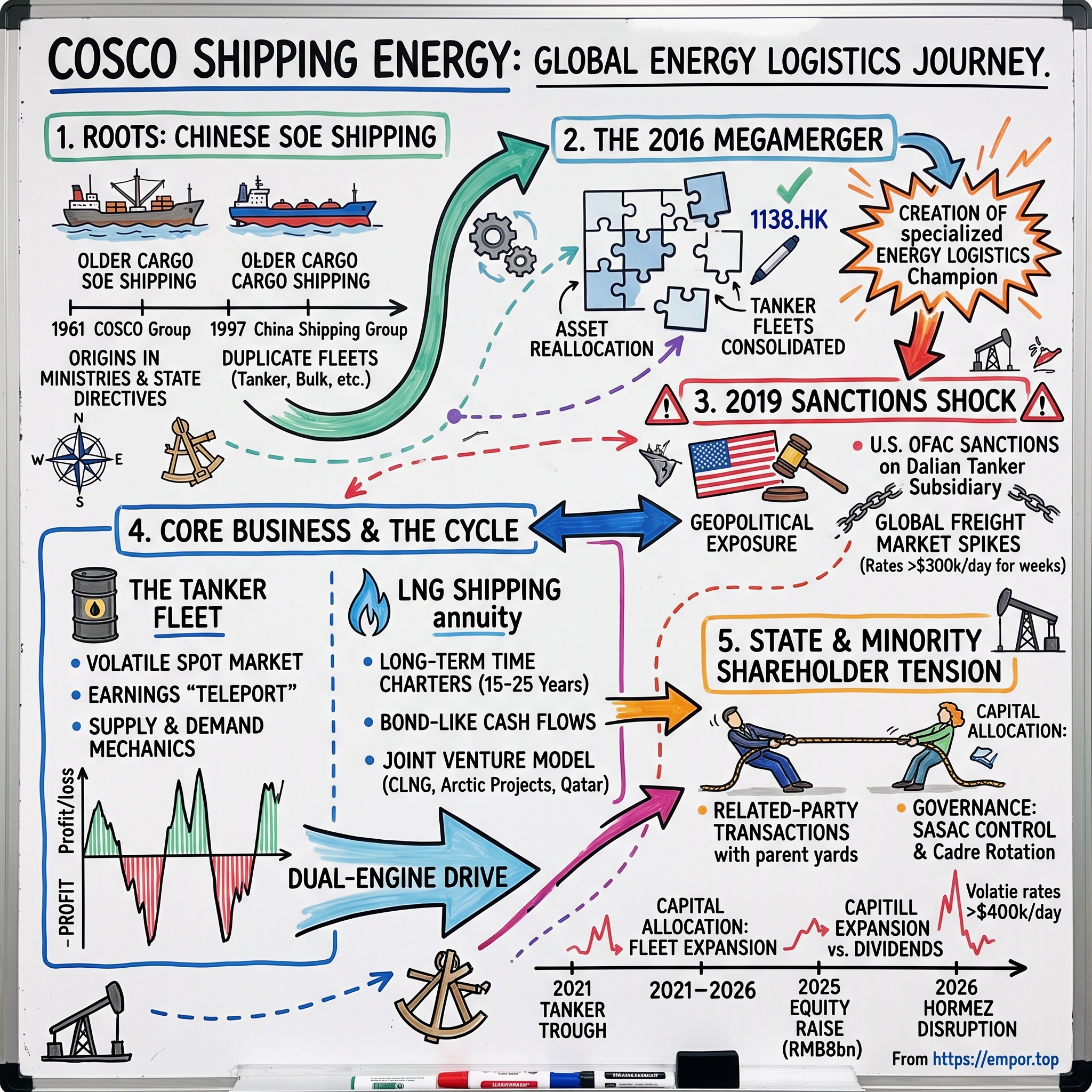
COSCO SHIPPING Energy Transportation: The Leviathan of Global Energy Logistics
I. Introduction & Episode Roadmap
On the last day of February 2026, the most critical stretch of water in the global economy stopped functioning like a shipping lane and began behaving like a battlefield. As military conflict erupted between the United States, Israel, and Iran, navigation through the Strait of Hormuz — the narrow choke point through which roughly a fifth of the world's seaborne oil squeezes daily — was severely disrupted. Within days, the market rate for hauling two million barrels of Middle Eastern crude to China on a Very Large Crude Carrier surged past US$400,000 per day.1
To put that figure in context: a single Very Large Crude Carrier (VLCC), a vessel roughly the length of the Empire State Building laid on its side, was theoretically generating more revenue in a single day than the cost of a mid-sized apartment in most Chinese cities. At those spot rates, a ship with a construction cost of US$120 million could pay for itself in under a year.
The owner with the world's largest concentration of those vessels is COSCO SHIPPING Energy Transportation, a Hong Kong- and Shanghai-listed Chinese state-owned enterprise. At the end of 2025, the company held and controlled 155 oil tankers totalling 22.576 million deadweight tonnes, with another 18 newbuildings and six bareboat-chartered VLCCs awaiting delivery — the largest tanker fleet in the world by capacity.2 Alongside its oil fleet, the company had invested in 87 LNG carriers, 63 of which were operational and locked into long-term time charters.2
Yet in June 2026, management informed shareholders that the headline figure of $400,000 per day was largely a mirage. Because trading volumes during the rate spike were thin, executive management noted that the printed rate "is difficult to reflect objectively the actual income level of shipowners, and the reference value is limited."1 Real fixtures outside the Persian Gulf were clearing closer to $150,000–$200,000 per day.3 While still a formidable sum, that is less than half the headline rate. The divergence between spot rate benchmarks and realized revenue captures the core analytical challenge of evaluating the company.
The central question of this analysis is how a series of Chinese state-owned enterprise restructurings — state-directed asset shuffles driven primarily by industrial policy rather than minority shareholder returns — created the single largest swing player in global crude and gas transport. The follow-on question is whether controlling the world's largest fleet converts into durable capital returns for minority investors, or merely funds the acquisition of more steel.
The core investment thesis hinges on evaluating COSCO SHIPPING Energy's two distinct operating segments. One is international crude tanker shipping, a volatile business where earnings swings led to a net loss of RMB4.99 billion in 2021 before recovering to a net profit of RMB4.04 billion in 2025.2 The second is LNG shipping, where vessels are chartered to state energy firms and global majors for 15 to 20 years at fixed rates, generating stable, bond-like cash flows. Management describes this structure as a dual-engine model. The strategic debate is whether this model provides a structural hedge, or simply combines two un-synergistic businesses under a controlling state shareholder with broad discretion over capital allocation.
The analysis proceeds as follows: the origins of Chinese state shipping and the policy mandate to transport the nation's oil imports on domestic hulls; the 2016 megamerger that created the modern entity; the 2019 U.S. sanctions shock that disrupted global freight markets; the mechanics of the tanker cycle alongside the LNG annuity; an examination of corporate governance, related-party transactions, and capital allocation; and a stress-tested evaluation of the bull and bear cases.
The starting point is understanding where these ships originated.
 Subscribe on LinkedIn
II. The Origins: Chinese SOE Shipping & China Shipping Development (1870s–2015)
There is a tempting founding narrative, but it belongs to a competitor.
In 1872, during the final decades of the Qing dynasty, reformist officials chartered China Merchants' Steam Navigation Company (轮船招商局) — China's first modern shipping enterprise, established to reclaim coastal trade from foreign flags. While it offers a compelling story of maritime self-reliance, it represents the lineage of China Merchants Energy Shipping (招商局能源运输), COSCO Shipping Energy's primary domestic rival.
COSCO Shipping Energy's actual heritage lies in the post-1949 state maritime apparatus: a framework where vessels operated not as commercial profit centers, but as instruments of national logistics deployed by ministry directives and evaluated on delivery volume rather than voyage margin. Out of that system emerged two state-owned giants: COSCO Group (中国远洋运输集团), founded in 1961 to manage the deep-sea ocean fleet, and China Shipping Group (中国海运集团), formed in Shanghai in 1997 through the consolidation of shipping operations in Shanghai, Guangzhou, and Dalian.
The listed entity trading as 1138.HK descends from the China Shipping lineage. Its predecessor, Shanghai Haixing Shipping, issued H shares in Hong Kong in the mid-1990s. By the early 2000s, it operated as China Shipping Development Company Limited, dual-listed with A shares in Shanghai (600026) and H shares in Hong Kong, audited internationally by Ernst & Young and headquartered in Pudong, Shanghai.4 For two decades, the company functioned primarily as a domestic bulk logistics utility — moving coal, iron ore, and crude oil along China's coast, supplemented by a modest international trade.
Its transformation into a specialized energy carrier was driven by a fundamental macroeconomic shift: China's emergence as the world's largest crude importer. In 2025, China imported 578 million tonnes of crude oil, up 4.4% year over year.2 With roughly 90% of those imports arriving by sea, Beijing faced a strategic vulnerability regarding vessel ownership.
Historically, foreign carriers handled the vast majority of these shipments. Analysts examining China's "national oil, national fleet" (国油国运) policy noted that Chinese-controlled tonnage carried less than 50% of the country's seaborne crude imports, while the combined tanker fleet of China's two leading state operators accounted for only about 7.5% of global tanker capacity as of early 2023 — a small share for a nation absorbing roughly a quarter of world crude exports.5 For policymakers treating energy security as a core strategic priority, reliance on foreign tonnage posed clear risks: a naval blockade, diplomatic sanctions, or market disruptions could leave domestic refineries under-supplied.
This policy directive established the framework for COSCO Shipping Energy's business model, creating both structural advantages and operational constraints. On one hand, it provided a guaranteed cargo base through long-term relationships with state oil majors Sinopec (中国石油化工集团) and PetroChina (中国石油天然气集团). By 2025, long-term contracts of affreightment covered roughly 90% of the company's coastal trade.2 Furthermore, domestic coastal shipping remains protected by cabotage laws prohibiting foreign-flagged vessels from trading between Chinese ports, enabling the segment to deliver a 24.8% gross margin in 2025 even as overall transport volumes contracted.2
On the other hand, the strategic mandate obliges the company to balance commercial returns against national policy objectives. A fleet built for energy security requires continuous renewal regardless of market cycles, vessel orders placed with state-owned shipyards, and uninterrupted service during downturns when private operators might lay up tonnage. This tension between policy duties and shareholder value remains a central theme in the company's capital allocation.
The dynamics of China's coastal energy transport market underscore this policy protection. As a closed market under cabotage rules, a select group of domestic carriers handles the movement of crude from offshore fields and import terminals to coastal refineries, as well as refined products from refineries to regional consumer markets.
In 2025, this domestic market moved approximately 98 million tonnes of crude in Medium Range (MR) vessels and larger, an increase of about 4 million tonnes over the previous year.2 Although COSCO Shipping Energy's domestic revenue fell 7.1% due to a 10.3% drop in coastal refined product shipping, the segment still generated a 24.8% gross margin.2
An ability to maintain near-25% gross margins during a volume decline reflects the pricing power inherent in a protected market. While domestic shipping is smaller and slower-growing than international tanker trade, it provides a stable cash flow floor that insulates the company against global shipping volatility.
Prior to 2016, state shipping operations suffered from internal fragmentation. COSCO Group and China Shipping Group maintained duplicate, competing fleets across tankers, dry bulk, container shipping, and port terminals. Both entities targeted the same domestic cargoes, placed overlapping orders at state shipyards, and effectively competed against each other under common state ownership. By 2015, as the global shipping industry endured a prolonged post-2008 downturn, this duplicate structure became unsustainable, setting the stage for a comprehensive state-directed restructuring.
III. The 2016 Megamerger & Restructuring: Creation of COSCO SHIPPING Energy Transportation
The architect of this restructuring was the State-owned Assets Supervision and Administration Commission of the State Council (SASAC; 国务院国有资产监督管理委员会) — the body that holds China's central state-owned enterprises on behalf of the government and periodically reshuffles their asset portfolios.
What SASAC ordered in 2015 and 2016 was not a Western-style merger with takeover premiums, competitive auctions, or activist-driven fairness opinions. Instead, it was an administrative asset reallocation: seven listed entities and dozens of unlisted subsidiaries had their assets unbundled, sorted strictly by cargo type rather than legacy parentage, and reassembled into single-purpose state champions. Container shipping moved to one entity, dry bulk to another, port operations to a third, and all liquid cargo transport — crude oil, refined products, and liquefied natural gas (LNG) — was consolidated under China Shipping Development.
The mechanics were executed with precision. In the first half of 2016, China Shipping Development simultaneously acquired 100% of Dalian Ocean Shipping — COSCO Group's specialist liquid bulk carrier, renamed COSCO Shipping Tanker (Dalian) (大连中远海运油品运输) — and sold 100% of China Shipping Bulk to COSCO's dry bulk arm. The two transactions were mutually contingent: if either failed to secure approval, neither would proceed. Transaction completion occurred on 15 July 2016, with the acquired tanker unit's business registration completed on 25 July and the bulk carrier's on 15 August.6 The renaming of the listed parent to COSCO SHIPPING Energy Transportation Co., Ltd. (中远海运能源运输股份有限公司) was unveiled on 6 June 2016, with its headquarters established in Shanghai.7
In a single restructuring, a mixed-cargo carrier was transformed into a dedicated energy logistics company, bringing China's two largest state-owned tanker fleets onto a single balance sheet.
A critical detail for investors lies in how the transaction was priced. COSCO Group provided a profit guarantee on Dalian Ocean Shipping: based on a valuation report dated 8 March 2016, it guaranteed that the unit would generate a cumulative net profit of RMB819 million over the three years 2016–2018. In 2016 alone, the acquired business reported an audited net profit attributable to the parent of RMB768 million, or 93.81% of the entire three-year promise.6
Clearing nearly 94% of a three-year profit target in twelve months offers two interpretations. A favorable view suggests the tanker market in 2016 outperformed expectations while the seller maintained conservative estimates. A more skeptical interpretation is that the earnings baseline was set conservatively low, a common outcome when the buyer, seller, appraiser, and controlling shareholder all report to the same ultimate parent. In either case, the valuation rested on modest earnings assumptions — beneficial for minority shareholders in this instance, but illustrating that price discovery in state-directed reorganizations differs fundamentally from open-market transactions.
The restructuring produced immediate financial gains. In 2016, the continuing liquid bulk business moved 104 million tonnes of cargo, generating revenue of RMB9.667 billion, while group net profit attributable to shareholders rose to RMB1.923 billion, up 66.65% year over year.6
Contrasting this structure with Western commercial tanker operators highlights a fundamental operational difference. Publicly listed peers like Frontline and Euronav operated primarily as capital market vehicles: highly leveraged and focused on opportunistic asset play — buying vessels at market lows, selling at cyclical peaks, and distributing variable dividends. Their primary competitive advantage was market timing.
By contrast, COSCO SHIPPING Energy's structural advantage was capital permanence. Supported by state-backed banking relationships, the company faced minimal risk of forced asset sales or covenant breaches during cyclical downturns. In an industry where over-leverage during market troughs is a primary cause of insolvency, state backing allows the company to absorb prolonged rate depressions without distress.
However, this insulation also weakens the market discipline that enforces precise capital allocation. Commercial owners face immediate financial penalties for mis-timing vessel acquisitions. Without that pressure, state-backed operators have less incentive to optimize market entry and exit points. By 2026, this divergence remains visible in capital deployment strategies across the industry: while private operators frequently sell aging tonnage into market strength to return capital to shareholders, state-backed carriers continue issuing equity to expand fleet capacity.
Integrating the two operations also presented substantial challenges. Combining the state fleets required reconciling distinct ship management protocols, safety standards, crewing pipelines, and corporate cultures — bridging COSCO's international deep-sea experience with China Shipping's domestic coastal focus. Operational integration progressed slowly; the company did not complete unified fleet operation and management reforms until February 2019, nearly three years after closing the deal.7
Following the merger, management focused on capacity expansion. Between November and December 2017, the company contracted 16 newbuildings with domestic shipyards. In March 2018, it acquired a 51% controlling stake in PetroChina's product tanker fleet, establishing market leadership in domestic refined product transport. Subsequently, in March 2020, the company raised RMB5.1 billion through a non-public A-share placement to fund additional fleet expansion.7
This capital-raising pattern highlights an enduring strategic preference: financing fleet expansion through equity issuance during growth phases.
Before that placement was finalized, however, an unexpected geopolitical action intervened. In September 2019, the United States Treasury imposed sanctions that transformed this domestic consolidation into one of the most severe freight disruptions in modern maritime history.
IV. The 2019 US Sanctions Shock & Global Freight Market Spikes
On 25 September 2019, international chartering desks in London and Singapore operated under the routine assumption that Very Large Crude Carrier capacity was fungible, abundant, and predictably priced. That market structure dissolved overnight.
The U.S. Department of the Treasury's Office of Foreign Assets Control (OFAC) designated COSCO Shipping Tanker (Dalian) Co., Ltd. and an affiliated ship management entity, alongside several other Chinese companies, for transporting Iranian crude oil.8 The Dalian unit was the specialized liquid bulk subsidiary that COSCO SHIPPING Energy had acquired during its 2016 corporate restructuring.
The enforcement action highlighted the extreme operating leverage of global maritime trade. Sanctions do not physically disable a vessel; instead, they deter every commercial counterparty in the supply chain — charterers, oil majors, commodity traders, trade-finance banks, insurers, and flag registries — from engaging with the fleet to avoid forfeiting access to the U.S. financial system. Virtually overnight, a substantial block of global VLCC capacity became commercially unusable as freight buyers lost access to compliant tonnage.
Because global tanker utilization routinely operates near capacity limits at the margin, removing a meaningful share of compliant vessels triggered an exponential surge in freight rates rather than a modest price adjustment.
Reuters reported the sanction designation and its immediate upward pressure on chartering costs, while Caixin documented operational disruptions as international charterers scrambled to secure non-sanctioned vessels.8[^9] The South China Morning Post highlighted a key operational irony: sanctions targeted at a Chinese state-owned carrier escalated shipping costs for China's own energy imports, forcing domestic refiners to pay the same panic-driven freight premiums as international competitors.[^10]
By October 2019, lump-sum charter costs on the U.S. Gulf-to-China trade route touched record highs. Spot earnings for VLCCs on key Middle East export corridors briefly crossed $200,000 to $300,000 per day — levels without precedent in modern tanker history. For several weeks, global seaborne crude transport costs were dictated not by underlying oil supply and demand, but by regulatory compliance directives originating in Washington.
The immediate financial impact on the parent enterprise proved paradoxically positive. For the first nine months of 2019, COSCO SHIPPING Energy generated revenue of approximately RMB10.53 billion and a net profit of about RMB795 million, reversing a net loss from the prior-year period. Because the sanctions applied specifically to individual subsidiaries rather than the listed parent, the group's non-sanctioned fleet — comprising the vast majority of its tonnage — earned the elevated spot rates created by the removal of its sister entity's capacity.
Management executed a three-part response to the crisis. First, it operationally and commercially isolated the Dalian subsidiary, clarifying to charterers that enforcement applied strictly to designated units rather than the listed entity. Second, it maintained operational continuity across its remaining fleet without undertaking distressed corporate restructurings. Third, the regulatory deadlock was addressed through high-level diplomatic channels alongside U.S.–China Phase One trade negotiations. On 31 January 2020, OFAC officially removed the sanctions designations.910 The Treasury provided minimal public rationale, underscoring the diplomatic context of the resolution.
Spot freight rates normalized rapidly following the lifting of sanctions, followed shortly by the demand shock of the COVID-19 pandemic. An initial surge in floating storage demand — where idle tankers were chartered to hold surplus crude — gave way to a severe market contraction. By 2021, COSCO SHIPPING Energy recorded a net loss of nearly RMB5 billion and omitted its dividend payment.2 The sharp downturn re-established the underlying cyclicality of international spot tanker markets.
The 2019 sanctions episode established three lasting structural lessons for evaluating the business.
First, corporate firewalls within state-owned enterprise groups provide incomplete insulation during geopolitical disputes. Charterers evaluating fixture commitments in late 2019 assessed overall counterparty risk rather than strict legal separation, applying a operational discount across the broader corporate group.
Second, the company's position within the Chinese state apparatus serves as both a primary commercial anchor and a central geopolitical exposure. While state integration secures long-term domestic cargo flows, it leaves the international fleet vulnerable to foreign regulatory actions and dependent on broader diplomatic relations for resolution.
Third, the episode demonstrated that compliant tanker capacity functions as a politically restricted asset rather than a standard commodity. This structural supply constraint has become a persistent feature of subsequent shipping cycles. In its 2026 market evaluation, management noted that tightening Western sanctions "have already constrained a significant portion of non-compliant capacity, further straining global available capacity," while rising VLCC fleet concentration has enhanced "the influence and bargaining power of shipowners."2
The regulatory mechanisms that temporarily disrupted the company's commercial operations in 2019 have consequently evolved into structural industry dynamics that support freight rates across its international fleet.
V. Core Business Deep-Dive #1: The Oil Tanker Fleet & Spot Market Cyclicality
Here is the thing nobody tells you about owning oil tankers: the ships are almost irrelevant. Every VLCC built in the last decade in Korea or China does essentially the same job at essentially the same cost. There is no proprietary technology, no brand premium a refiner will pay for, no switching cost worth the name. A tanker is a steel box that moves a commodity, and the freight rate is set by the marginal ship available for the marginal cargo.
Which means the entire economics of the business reduce to one question: is there one more ship than there is cargo, or one less?
When there is one ship too many, rates fall to roughly the cash cost of operating — fuel, crew, port fees — and owners bleed. When there is one ship too few, rates go to whatever the charterer will pay, which in a panic is close to unlimited, because the freight cost of a VLCC cargo is small relative to the value of two million barrels of crude. This is why the sector's earnings do not oscillate gently; they teleport. Consider this company's own five-year record: a loss of RMB4.985 billion in 2021, then profits of RMB1.519 billion in 2022, RMB3.390 billion in 2023, RMB4.043 billion in 2024 and RMB4.037 billion in 2025.2
Before the numbers, a short detour into how freight is actually priced, because the jargon obscures a simple idea.
Crude freight is quoted in Worldscale, a peculiar convention that works like a price index for voyages. Each year, an industry body publishes a notional cost for every conceivable route — the "Worldscale 100" flat rate — and the market then trades as a percentage of it. A fixture at WS 80 means 80% of that reference cost; a fixture at WS 250 means two and a half times. It exists because there are thousands of possible port pairs, and traders needed a common language to compare a Basrah–Ningbo voyage with a Houston–Rotterdam one. Its side effect is that the headline number is meaningless without knowing the year's flat rate, which is why almost everyone converts it into a second measure.
That second measure is Time Charter Equivalent (TCE) — voyage revenue minus voyage costs like fuel and port charges, divided by the days the voyage takes. Think of it as the daily rental income a ship actually clears after paying for the trip. Compare it against the vessel's daily operating cost — crew, insurance, maintenance, typically in the region of $8,000–$12,000 a day for a modern VLCC — and you have the shipowner's margin. When TCE is $20,000, a tanker owner survives. When it is $200,000, the business becomes something closer to a licence to print money for as long as the condition lasts.
One more piece of plumbing worth understanding, because it quietly moves millions. Since the IMO's 2020 sulphur cap, ships must either burn expensive low-sulphur fuel (VLSFO) or install a scrubber — an exhaust cleaning system that permits continued use of cheaper high-sulphur fuel (HSFO). The economics of that choice depend entirely on the price spread between the two fuels, which is volatile and unpredictable. Fuel is by some distance this company's largest single controllable cost: RMB4.96 billion in 2025, or 31.4% of oil shipping operating costs, and it fell 7.0% year on year even as the fleet worked harder — a useful demonstration of procurement scale at a group that also runs marine fuel supply.2
The benchmark route, TD3C, runs from the Middle East to China. Its 2025 average was approximately US$57,500 per day, up 65% year on year, with peaks above $140,000 during the year.2 Then came the first quarter of 2026: an average of US$220,200 per day, roughly 459% above the prior-year quarter, with West Africa–China averaging $121,200 and US Gulf–China $110,600.1 Those are the numbers behind a quarterly net profit of RMB2.173 billion, up 207%.1
The segment structure explains why the whole company moves with those rates. In 2025 the international oil shipping business generated RMB15.087 billion of revenue — about two-thirds of the group — while the protected domestic coastal business contributed RMB5.457 billion at a slightly higher gross margin.2 The international book supplies the torque; the domestic book supplies what management aptly calls a "safety cushion."
What happened between 2025 and Q1 2026 is a masterclass in operating leverage, and worth spelling out because the numbers are counter-intuitive. In the first quarter of 2026 the group's oil tanker segment carried 7.4% less cargo and generated 20.6% fewer tonne-miles than a year earlier. Deployed capacity fell 21.7%. And yet segment revenue rose 28.3%, costs fell 10.1%, and gross margin expanded from 17.5% to 42.2%. International oil shipping gross profit rose 317.6%.1 The company did less work and made vastly more money.
That is the entire tanker business in one paragraph. Volume is not the driver; price is. A shipowner in a tight market can carry less and earn more, because the scarcity that raises the price is the same scarcity that reduces available voyages. It also means the reverse is true and equally violent: no amount of operational excellence saves a tanker owner from a loose market.
So what determines tightness? Three things, and the company's own disclosures allow each to be tested honestly.
Supply. The bull case has long rested on a historically thin orderbook. That claim now needs updating, and the correction matters. As of the end of 2025 there were 156 VLCCs on order globally, equal to 17% of the existing fleet, against just six deliveries and two scrappings during the year.2 Seventeen percent is not a historically low orderbook; it is a normalising one.
At the June 2026 annual general meeting, management put it even more starkly, telling shareholders that more than 200 VLCCs would be delivered over the next four years — roughly a fifth of existing capacity — while still arguing that supply and demand would stay tight for three years.3
Both halves of that statement can be true, and the reconciliation is a matter of timing rather than contradiction. The near-term cushion is real: only about 35 VLCC deliveries are expected across 2026, roughly 3.9% of the fleet, and nearly 20% of the world's VLCCs are now over 20 years old and drifting toward the scrapyard or the shadow fleet.2 Ships ordered today take three years to arrive. But an investor extrapolating today's rates into the 2030s is betting against an orderbook that has already been placed, at prices that assume the boom persists.
Demand, measured in tonne-miles. Freight demand is not barrels; it is barrels times distance. When Europe stops buying Russian crude and buys American or Guyanese instead, the barrel count is unchanged but the voyage triples in length, and the world needs more ships to move the same oil. That rerouting — plus growth from Brazil and Guyana, OPEC+ unwinding production cuts, and India shifting purchases toward "compliant" barrels — is what has lengthened the average voyage.2
The compliant/non-compliant split. This is the mechanism most investors under-weight. A large shadow fleet of ageing, opaquely owned tankers now serves sanctioned Russian and Iranian trade. Every time Western sanctions tighten, some of those vessels become unusable for mainstream cargo, and demand concentrates into the compliant fleet — of which this company is the largest single owner.
On scale: the company held 55 VLCCs at the end of 2024, representing about 34.6% of Chinese VLCC capacity, and describes itself as the world's largest oil tanker owner across all mainstream types.[^13]2 The rival claim from China Merchants Energy Shipping — that it operates the world's largest VLCC fleet specifically — is not contradictory; COSCO Shipping Energy's supremacy is in aggregate tanker tonnage and vessel-type breadth, not necessarily in VLCC hull count alone. Investors should treat "world's largest" claims in this sector as segment-specific marketing.
How does the fleet compare with Western peers on quality rather than quantity? This is where the honest answer is uncomfortable. The group's owned tanker fleet averaged 13.7 years of age at end-2025 (13.3 years including chartered and associate vessels).2 Frontline, by contrast, spent the same period aggressively rejuvenating: selling eight 2015–2016-built ECO VLCCs for $831.5 million and contracting nine latest-generation scrubber-fitted newbuildings for $1,224.0 million.11 Age matters commercially — older ships attract charterer resistance, higher insurance, worse fuel economy and tighter compliance headroom under IMO carbon intensity rules — and it matters financially, because an old fleet requires either heavy replacement capex or accelerating asset sales.
And on realised earnings, the peer comparison should temper enthusiasm. Frontline reported Q4 2025 VLCC spot TCE of $74,200 per day and fixed seven VLCCs on one-year charters at an average $76,900 per day.11 COSCO Shipping Energy does not disclose a comparable realised fleet-wide VLCC TCE figure in its quarterly reporting — a genuine disclosure gap relative to Western peers, and one that makes it harder for an outside investor to judge how much of the benchmark index the company actually captures. Its fleet includes older and smaller vessels, substantial time-chartered-out tonnage (international chartering revenue actually fell 37.5% in 2025 as vessels rolled off) and a large domestic book at regulated economics.2 Index rates are the ceiling, not the result.
The company's structural answer to that gap is the POOL model — placing VLCCs into jointly marketed operating entities so that a larger combined fleet can be scheduled more efficiently, reducing ballast legs where ships sail empty to reposition.2 It is a sensible efficiency play and management has flagged strengthening the POOL brand as a 2026 priority. It is not, however, a moat: pooling is standard practice across the industry.
The real edges are narrower and more concrete: preferential access to Chinese state cargo, cabotage protection at home, bunker procurement scale through the parent group, and slot access at yards under 中国船舶集团 China State Shipbuilding Corporation and the parent's own COSCO SHIPPING Heavy Industry. Those are advantages of position, not of operating skill — and they are worth exactly as much as the state chooses to make them worth.
Myth versus reality
Three claims circulate confidently about this sector and this company. Tested against the filings, only one survives intact.
Myth: the VLCC orderbook is at historic lows of 3–5% of the fleet. Reality: it was, and it isn't. That was roughly true in 2023, when green-fuel uncertainty and full shipyard berths froze ordering. By the end of 2025 the orderbook stood at 17%, and the company's own management has walked shareholders through a four-year delivery schedule equal to a fifth of the fleet.23 The scarcity that drives today's rates is a current condition with a known expiry date, not a permanent feature of the industry. Bulls quoting the 2023 orderbook are quoting a number the market has already invalidated.
Myth: a company this cheap relative to Western tanker peers is mispriced. Reality: the discount has identifiable causes. Lower disclosure than peers, a controlling shareholder that has twice chosen to issue equity rather than distribute cash, substantial related-party procurement, and unhedgeable sanctions exposure are all reasons a rational investor pays less per dollar of earnings. The discount may still be too wide — that is a legitimate argument. But it is not free money sitting on the table because nobody noticed.
Myth: the fleet is a low-cost operator by virtue of being Chinese. Reality: nothing in the cost structure supports this. Seafarer costs for the oil fleet ran RMB2.22 billion in 2025, port costs rose 21.7%, and charter costs — hire paid on vessels the company controls but does not own — rose 17.2% to RMB3.00 billion.2 Fuel is priced globally. Crew wages for internationally trading tankers converge on world rates. The advantage is access to cargo and capital, not a cheaper cost of moving a barrel.
The one consensus claim that does hold up is the compliant-capacity story. That mechanism is real, repeatedly demonstrated, and is doing most of the work in today's rates.
Which is why the second engine matters so much.
VI. Core Business Deep-Dive #2: The Hidden Moat — LNG Shipping & "Dual-Engine Drive"
Natural gas liquefies at minus 162 degrees Celsius, shrinking to roughly 1/600th of its gaseous volume.2 That physical reality defines the liquefied natural gas (LNG) shipping industry: it makes natural gas transportable across oceans, and it makes the vessels extraordinarily complex and expensive to build.
An LNG carrier functions as a floating cryogenic vacuum flask. Its specialized cargo tanks must maintain extreme cold for weeks while the hull flexes across heavy ocean swells, managing boil-off gas with zero allowance for structural failure — a tank breach is not merely an environmental spill, but a severe safety hazard. The maritime industry categorizes these vessels as "three high" assets: high technology, high construction difficulty, and high added value.2 Only a small group of global shipyards possesses the engineering capability to build them, with Hudong-Zhonghua Shipbuilding (沪东中华造船) serving as China's primary builder.
The economics of LNG transport stand in stark contrast to the spot market volatility of crude oil tankers. Because LNG carriers require enormous upfront capital and serve liquefaction facilities representing tens of billions of dollars in infrastructure, charterers cannot afford transit disruptions. Consequently, vessels are typically secured under long-term time charters ranging from 15 to 25 years at fixed daily rates before construction begins. The shipowner's business model resembles a contracted infrastructure utility — generating predictable spread income on a financed asset — rather than a speculative commodity trade. Fleet utilization and rate cycle risks are largely eliminated for the duration of the contract.
The true scale of COSCO SHIPPING Energy's LNG presence is often obscured because much of the fleet operates through off-balance-sheet entities. At the end of 2025, the group held investments in 87 LNG carriers: 63 operational vessels with a combined capacity of 10.662 million cubic meters, 24 newbuildings under construction totaling 4.375 million cubic meters, and one bareboat-chartered ship.2 However, only 15 operational vessels were wholly owned by the group. Forty-eight operational ships were held through joint ventures and associates, alongside 18 of the contracted newbuildings.2
The primary vehicle for these holdings is China LNG Shipping (Holdings) Limited (中国液化天然气运输(控股)有限公司, or CLNG), a 50/50 joint venture with China Merchants Energy Shipping. The co-ownership of China's premier LNG shipping platform by two state-backed competitors underscores the degree to which Beijing treats LNG transport as strategic national infrastructure rather than a commercial battleground. In 2025, CLNG completed 81.11 billion tonne-miles of transport, generating RMB1.203 billion in revenue and RMB1.040 billion in net profit.2 A net margin exceeding 85% resembles a toll-road concession rather than a traditional shipping business, reflecting profit distributions flowing up from underlying vessel-owning joint ventures rather than direct voyage operations.
The underlying vessel-owning structure comprises a network of specialized entities, including the color-coded Arctic Blue, Green, Purple, Red, Orange, Yellow, Indigo, Gold, Silver, and Bronze LNG Shipping Limited, as well as seven 50%-owned ORYX LNG Shipping Corporations.2 The Arctic entities house the group's participation in Russian Arctic gas ventures alongside international partners such as Mitsui O.S.K. Lines (商船三井). The ORYX vehicles support Qatari export projects. Through CLNG and its CSLNG subsidiary, the group has also secured berths in QatarEnergy's massive expansion program at Hudong-Zhonghua, including orders for ultra-large QC-Max class carriers.
However, long-term contracts do not entirely eliminate geopolitical risk. Russia's Arctic LNG 2 project — in which the company acquired equity stakes in three ARC7 ice-class LNG carriers in 2021 — was targeted by U.S. sanctions, severely disrupting the project's specialized fleet deployment, stranding ships at shipyards, and prompting Western partners to exit charters.7 While the company does not disclose the specific financial write-downs, substantial euro-denominated capital remains committed across its Arctic subsidiaries. The episode illustrates the fundamental vulnerability of the segment: an LNG charter remains secure only as long as the underlying export project remains operational and unsanctioned.
Despite those localized disruptions, the LNG segment delivered strong financial results in 2025. Segment revenue reached RMB2.547 billion, an increase of 14.3%, with a gross margin of 49.3% — nearly double the group's overall average. Investment income from joint ventures and associates rose 15.3% to RMB859 million, bringing the segment's total contribution to net profit attributable to shareholders to RMB895 million, up 10.4%.2 This represented approximately 22% of group net profit of RMB4.037 billion, generated almost entirely without spot market exposure. During the year, the company expanded its portfolio by taking delivery of or acquiring 13 additional LNG carriers.2
The first quarter of 2026 demonstrated the stabilizing function of this dual-engine strategy. As geopolitical tensions in the Strait of Hormuz drove extreme volatility in crude tanker freight rates, the LNG segment provided steady earnings growth: segment revenue expanded 18.8%, investment income rose 1.8%, and net profit contribution climbed 16.5% to RMB238 million.1 Executive management emphasized that the entire operational LNG fleet was insulated by long-term time charters, "ensuring strong revenue security and immunity from short-term geopolitical events."1 Operational performance in early 2026 supported that assessment.
Whether this segment constitutes a durable economic moat requires careful distinction between market entry barriers and operational advantages.
The company's primary edge stems from structural access rather than superior ship management. Long-term charters tied to Chinese energy imports are primarily awarded through state-level relationships with domestic energy majors, while shipyard slots at Hudong-Zhonghua are strictly allocated. Independent foreign owners face high barriers to competing for these domestic import contracts. Additionally, the group has developed a dedicated pool of trained LNG mariners through specialized training agreements, addressing what industry analysts view as a key operational bottleneck limiting global LNG fleet expansion.2
Conversely, the financial upside of the LNG segment is structurally constrained. Contracted fixed rates prevent the fleet from capturing market spikes; when ten-year charter rates averaged $70,000 to $80,000 per day in 2025, long-term legacy contracts remained fixed at their initial terms.2 Furthermore, roughly half of the segment's net earnings are derived from equity-method accounting in joint ventures, which contribute cash to the parent balance sheet only when dividends are formally declared. The segment also faces medium-term supply headwinds, with approximately 85 LNG carriers scheduled for global delivery across 2026, while spot charter rates fluctuated at lower levels between $20,000 and $40,000 per day throughout 2025.2
Consequently, the LNG division functions as a stable earnings floor rather than a high-growth engine capable of neutralizing a severe tanker downturn. While contributing 22% of annual net income provides a valuable cash buffer, it cannot fully offset cyclical losses in the core oil fleet. During the 2021 shipping trough, when international tanker operations resulted in a RMB4.99 billion net loss, LNG earnings covered only a fraction of the deficit.
Beyond the main LNG holdings, additional non-consolidated earnings flow from other joint ventures. Shanghai Beihai Shipping, a 40%-owned associate, logged 20.68 billion tonne-miles in 2025, generating RMB2.613 billion in revenue and RMB777.69 million in net profit.2 Combined with CLNG's results, a significant portion of the group's economic profit resides in non-consolidated entities.
This corporate structure has clear implications for financial modeling and cash flow analysis. Consolidated group revenue understates total operational activity, while reported net profit relies heavily on equity-method accounting. For dividend-paying capacity, cash distributions matter more than accounting profit; in 2025, total cash dividends received from associates and joint ventures equaled RMB726 million, well below total recognized equity income.2 Investors evaluating dividend sustainability must monitor actual cash remittances from these entities rather than reported accounting earnings.
The company's smaller specialized segments represent minor operational units. Liquefied petroleum gas (LPG) transport generated RMB277 million in 2025 revenue with a 28.2% gross margin, while chemical shipping recorded RMB333 million in revenue with a 14.4% gross margin.2 Combined, these divisions account for less than 3% of group revenue. Management has framed these operations as foundational elements for an integrated "energy and chemical logistics supply chain," expanding beyond maritime transport into shore storage, logistics terminals, and digital freight platforms under the Yuanhai Jincheng (远海金诚) and Yuanhai Huanyang (远海寰洋) brands.2 While strategically coherent, these initiatives currently function as long-term growth options rather than core earnings drivers.
Evaluating the overall enterprise requires examining how corporate governance and capital allocation determine the distribution of cash flows across both operating engines.
VII. Governance, Management Credibility, & SOE Capital Allocation
On 26 June 2026, inside a Shanghai meeting room, 489 shareholders and proxies gathered for the annual general meeting of a company whose shares had oscillated between HK$6.26 and HK$22.40 over the preceding twelve months. According to one financial publication present, questioning from the floor was rapid and direct: where is the rate pivot? How does management read supply and demand? How is capacity being redeployed?3
Management responded with notable candor. Executives framed spot voyage charters and long-term time charters as complementary mechanisms — balancing immediate rate upside against cash flow visibility — and argued that shareholder returns depend on full-lifecycle profitability across the shipping cycle rather than single-quarter rate spikes.3 They disclosed that the company had reduced its proportion of capacity deployed on Middle East routes, shifting tonnage toward the U.S. Gulf as global trade flows migrated.3 Management also addressed the headline rate of $400,000 per day directly, explaining why thin liquidity made that benchmark unrepresentative of realized income, and presented a four-year delivery schedule showing more than 200 new VLCCs entering the global market to an audience enjoying a cyclical boom.3
This disciplined disclosure contrasts with typical corporate promotion. On the narrow test of market candor — including the presentation of challenging supply metrics — executive communication remains grounded, matching disclosures in the annual report, which highlights the global VLCC orderbook reaching 17% of existing fleet capacity rather than obscuring it.2
Corporate leadership reflects this alignment with state governance. Chairman 任永强 Ren Yongqiang, born in December 1973, holds a doctorate in political economy and holds senior engineer credentials. His professional career traces the institutional framework of Chinese industrial governance: positions across the Tibet Autonomous Region's transport and trade departments, the Ministry of Domestic Trade, the State Economic and Trade Commission, and SASAC, before moving to China Shipping Group and China COSCO Shipping. Ren remains an assistant general manager at the parent group while serving as chairman of the listed subsidiary.2 In practice, he functions as a senior state administrator directing a public shipping enterprise.
Operational leadership has traditionally provided a commercial counterweight. 朱迈进 Zhu Maijin, born in October 1970, is a senior captain and master mariner who rose through ship management at legacy China Shipping, later heading COSCO Shipping Tanker (Shanghai) before assuming the role of general manager for the listed group.2 Direct seafaring and vessel management experience provides practical grounding in an industry where operational execution dictates safety and margins, and the company notes that separating the chairman and general manager positions is an explicit policy to maintain balanced corporate oversight.2
At the June 2026 annual meeting, however, shareholders learned that Zhu had resigned as general manager, with 王明峰 Wang Mingfeng formally appointed as his successor.3 The company published no detailed explanation for the change. Executive turnover at the peak of a shipping cycle warrants close attention, though in state-owned enterprises, senior appointments often reflect state cadre rotation rather than commercial performance. This structural context means leadership shifts carry a different signal than they would at an independent commercial carrier.
The board's governance credentials present a mixed picture. Victor HUANG, chair of the audit committee, is a Hong Kong Certified Public Accountant and former partner at PricewaterhouseCoopers and KPMG, holding independent directorships across several public companies.2 Financial oversight also includes 周崇一 Zhou Chongyi, a professor-level senior accountant recognized as a National Leading Accounting Talent by the Ministry of Finance and holding memberships in the CICPA, CIMA, and AICPA — though she concurrently serves as a deputy general manager in the parent group's financial management department, illustrating the overlapping appointments common across central SOE boards.2
This institutional structure reflects an absolute concentration of ownership. China Shipping Group holds 28.12% directly, while ultimate parent COSCO SHIPPING holds an additional 18.78%; as sole owner of China Shipping Group, the parent group controls a combined 46.90% of total issued capital.1 H shares held via HKSCC Nominees represent 23.60%, across a total base of 90,121 shareholders.1 With effective control vested in the parent, capital allocation decisions rest with the controlling state shareholder.
The equity raise. In late 2025, the company completed a major private placement, issuing 694,444,444 new A shares at RMB11.52 per share, generating gross proceeds of RMB8.0 billion and net proceeds of RMB7.98 billion. On the 24 September 2025 pricing date, A shares were trading at RMB12.27, pricing the placement at a 6% discount. Parent group COSCO SHIPPING subscribed for 347.2 million shares — half the issue, totaling RMB4.0 billion — under an 18-month lock-up, raising its aggregate voting stake from 46.46% to 46.90%. The remaining shares were placed with state funds, state-adjacent reform vehicles, a domestic securities firm, and a provincial railway fund.2
The transaction highlights the dual nature of state capital deployment. Shortly before entering an exceptionally strong freight rate environment, the company issued discounted equity to its controlling shareholder and allied state entities, expanding the share base. Proceeds were earmarked for fleet modernization and gas expansion: six VLCCs (RMB5.748 billion total project cost), two LNG carriers (RMB3.433 billion), and three Aframax tankers (RMB1.737 billion), with the newbuild VLCCs scheduled for delivery between Q3 2027 and Q4 2028.2
From a balance-sheet perspective, the issuance substantially derisked the group's leverage profile. Net debt-to-equity fell from 77% to 42%, while cash reserves surged 147% to RMB14.4 billion.2 Establishing a low-leverage balance sheet heading into a cyclical boom provides resilience against future freight market downturns, reflecting lessons from the 2021 market contraction.
From a minority shareholder perspective, however, the capital raise involved issuing shares at a discount during market strength rather than distress, allocating funds toward shipyard commitments rather than alternative capital return options, such as repurchasing H shares trading below net asset value.
The related-party web. Intercompany transactions form a central component of operational execution. In 2025, the company executed several major related-party agreements across the parent group: - contracted six oil tankers from COSCO SHIPPING Heavy Industry shipyards for RMB3.392 billion in February; - ordered a further nineteen vessels for RMB7.882 billion from the same yard group in December, spanning methanol dual-fuel Aframaxes, LR2s, LR1s, MRs, and an ethylene carrier for delivery between 2027 and 2029;212 - bareboat-chartered six VLCCs from COSCO SHIPPING Development, a sister leasing subsidiary, at an average fixed daily rate of RMB134,871 per vessel for terms up to 240 months, with three vessels featuring TD3C-linked variable hire capped at RMB131 million annually;2 - acquired COSCO SHIPPING LPG Transportation (Shanghai) from an affiliated parent entity for RMB598.29 million — a business that recorded RMB37 million in 2024 revenue;2 - and maintained banking, deposit, lending, clearing, and foreign-exchange services with COSCO SHIPPING Finance under a three-year framework agreement.2
While each transaction was approved by independent directors as being executed on standard commercial terms, the collective result is an extensive internal ecosystem. The listed company orders hulls from parent-owned shipyards, charters vessels from parent leasing entities, maintains treasury deposits with the parent's financial arm, and acquires specialized fleets from affiliated state entities — while the parent serves as controlling shareholder and principal equity subscriber. Investing in the equity requires evaluating not only global freight rate dynamics, but also the structural governance of this intra-group ecosystem.
Dividends. Dividend distributions reflect this capital retention focus. After omitting payouts during the 2021 downturn, dividend per share recovered to RMB0.15 in 2022, RMB0.35 in 2023, RMB0.43 in 2024, and RMB0.38 in 2025 — representing a 46% payout ratio against 2025 earnings per share of RMB0.8262.2 The board also approved an interim dividend mechanism for 2026, reiterating that capital returns will focus primarily on cash distributions.3 While maintaining a ~45% payout ratio demonstrates consistent distribution discipline by state-owned enterprise standards, it differs from independent commercial peers. Frontline, for example, distributed $1.03 per share for the fourth quarter of 2025 alone, returning virtually all adjusted quarterly profit to shareholders.11 Commercial peers distribute peak-cycle earnings immediately, whereas COSCO SHIPPING Energy reinvests a significant share of cash flow into fleet expansion and balance-sheet liquidity.
Management's 2026 operational targets illustrate this strategic orientation. Full-year targets project operating revenue of RMB23.17 billion against operating costs of RMB17.54 billion — a target slightly below 2025 actual revenue.2 With Q1 2026 revenue already reaching RMB7.30 billion, full-year guidance reflects traditional state-enterprise budgeting conservatism. Fleet deployment targets are more indicative of strategic priorities: 4 oil tankers slated for delivery against 20 scheduled disposals in 2026, alongside the addition of 10 LNG carriers and 5 LPG vessels.2 The physical oil fleet will contract slightly in 2026 while gas capacity expands, demonstrating the practical execution of the dual-engine strategy.
The decarbonisation bill nobody can price
Beyond rate cycles, regulatory decarbonization requirements represent a long-term capital allocation factor operating on an independent timeline.
The International Maritime Organization (IMO) has introduced increasingly stringent carbon intensity metrics, notably the Carbon Intensity Indicator (CII) and Energy Efficiency Existing Ship Index (EEXI). Vessels receive annual operational ratings based on carbon emissions per tonne-mile. Under ratcheting standards, older and less fuel-efficient tonnage faces commercial chartering restrictions. For a fleet with an average age approaching 14 years, environmental compliance presents a structural headwind to vessel longevity.
The group has framed its response around long-term sustainability goals — targeting a peak in owned tanker fleet carbon emissions by 2030 relative to a 2020 baseline, and achieving carbon neutrality by 2050 — backed by targeted capital commitments. In 2025, the company ordered eight methanol dual-fuel oil tankers and one LNG dual-fuel ethylene carrier, completed the design of China's first domestic X62 methanol dual-fuel main engine, conducted research into ammonia-fueled vessels, and received approval in principle for a multi-energy MR tanker design.2 Planned initiatives for 2026 include testing rigid wing sails on VLCCs and conducting onboard carbon capture trials.2
Industry-wide technology uncertainty complicates these investments. Alternative propulsion pathways remain unproven at commercial scale: green methanol production requires significant infrastructure buildout, ammonia involves toxicity and handling challenges, and LNG fuel reduces carbon dioxide emissions while raising methane slip concerns. Dual-fuel vessel construction requires substantial capital premiums — methanol dual-fuel Aframaxes were contracted at RMB610 million per unit, compared to RMB456 million for conventional Panamax and LR1 vessels at the same shipyard group.2 Ordering dual-fuel tonnage secures technical flexibility, but committing capital before fuel supply chains mature carries execution risk. Management's 2026 operational plan reflects this caution, categorizing alternative fuel deployment as an ongoing exploratory initiative.2
Decarbonization expenditures represent a growing, multi-year capital requirement that will compete directly with dividend distributions for cash generated during market peaks.
The second-layer diligence file
A complete evaluation of the group's financial condition involves several specific accounting and structural considerations.
Balance-sheet sensitivity. Financial disclosures indicate that a 100 basis point change in interest rates would impact annual pre-tax profit by approximately RMB221 million (based on 2025 figures, up from RMB185 million in 2024), reflecting floating-rate debt exposure across the fleet financing structure.2 Additionally, the company maintained financial guarantees for LNG joint-venture bank borrowings totaling US$237 million at year-end, down from an original US$377.5 million facility established in 2017.2 While off-balance-sheet liabilities remain manageable relative to equity, joint-venture financing retains recourse to the parent group.
Accounting judgment. Financial statements for 2025 included restatements of 2024 comparative figures due to the acquisition of the LPG business from the parent being accounted for as a business combination under common control.2 Under Chinese ASBE and Hong Kong IFRS standards, common-control acquisitions fold historical target financial results into prior periods at book value without goodwill recognition. Consequently, year-over-year growth metrics reflect a restated baseline that incorporates injected assets prior to transaction completion. The same accounting restatement methodology was applied in Q1 2026 financial reporting.1
Management incentives. Executive compensation includes a share option scheme approved in May 2024, with an exercise price of RMB13.00 per share and an exercise window opening in May 2026. Under the program, the chairman holds 283,200 options and the general manager holds 269,300, with aggregate management options representing 0.036% of total issued share capital.2 While providing a direct equity link uncommon among state-owned enterprises, the small grant scale means executive career progression and compensation remain primarily tied to the state personnel management framework rather than equity market performance.
Evaluating how these governance, capital allocation, and structural factors intersect with the global energy transport market forms the basis for assessing the company's long-term investment profile.
VIII. Strategic Frameworks: Hamilton Helmer's 7 Powers & Porter's 5 Forces
Strategic frameworks serve primarily as a discipline to distinguish genuine competitive advantages from structural positioning. Applied rigorously to COSCO SHIPPING Energy, most candidate powers do not hold up.
Scale Economies — partially real. With 155 tankers alongside its gas and chemical carriers, the company dilutes shore-side overhead across a vast fleet while procuring bunker fuel, insurance, and maintenance through its parent group's integrated maritime network.2 Because fuel represents the largest single operating expense — standing at RMB4.96 billion in 2025, or 31.4% of oil shipping costs — procurement scale delivers tangible savings, evidenced by fuel expenditures falling 7.0% in 2025 despite higher operating activity.2 However, maritime scale faces a strict physical ceiling: the marginal cost of an individual voyage for a 155-ship operator is nearly identical to that of a 20-ship owner, as fuel, port fees, and crew wages scale linearly with each vessel. Group scale provides purchasing discounts and scheduling flexibility rather than a permanently lower cost structure.
Cornered Resource — real, and the strongest power in the portfolio. Domestic cabotage laws legally exclude foreign carriers from protected coastal routes, while contracts of affreightment covering roughly 90% of coastal trade secure long-term cargo volumes with Chinese state oil majors and private refiners. Preferred access to shipyard berths across state-owned and parent-affiliated yards provides a key operational advantage during tight ordering cycles. Furthermore, the LNG franchise — encompassing import-linked charters, a 50% equity stake in CLNG, and participation in major Qatari export programs — is administratively allocated through state-level mandates rather than won through open market bidding.2 This advantage provides strong structural protection that foreign competitors cannot replicate, though it remains entirely dependent on ongoing state policy support.
Counter-Positioning — absent. The dual-engine strategy reflects a portfolio diversification choice rather than a counter-positioning power. Strategic counter-positioning requires an operational model that established competitors cannot adopt without impairing their existing business. Commercial Western tanker owners face no structural barrier to acquiring LNG tonnage, and several actively operate mixed fleets. Moreover, generating 22% of net profit from LNG operations is insufficient to alter the group's overall risk profile.
Process Power — weak. Operating an owned fleet with an average age of 13.7 years while commercial peers aggressively modernize, combined with taking nearly three years to integrate fleet management following the 2016 megamerger, indicates standard state-enterprise logistics rather than superior process execution.2
Branding, Network Economies, Switching Costs, Cornered Talent — largely absent. Commodity freight transportation offers minimal brand differentiation or customer switching costs. The single partial exception lies in specialized human capital: the group's dedicated pool of trained LNG mariners constitutes a genuine operational asset in a sector where qualified crew shortages constrain global fleet growth.2
In summary, the company holds one strong, state-derived power in cornered resources, a secondary benefit in procurement scale, and negligible presence across the remaining dimensions. It operates as a scale asset owner with privileged access within a commodity industry rather than a wide-moat commercial enterprise.
Porter's Five Forces, applied to the tanker segment:
Threat of new entrants — moderate and rising. Capital requirements remain substantial, with a newbuild VLCC costing approximately RMB958 million, shipyard berths booked years in advance, and regulatory compliance standards tightening.[^13] However, strong freight environments attract capital, as demonstrated by the global VLCC orderbook reaching 156 vessels.2 Classifying entry barriers as insurmountable overlooks the shipping industry's recurring pattern of speculative capital expansion during market peaks.
Bargaining power of buyers — structurally high. Oil majors, national energy companies, and commodity traders purchase un-differentiated transport services through transparent broker networks using benchmark indices. While increasing concentration among compliant VLCC owners has temporarily strengthened carrier leverage — leading management to note that consolidation is "enhancing the influence and bargaining power of shipowners" — this shift reflects cyclical market tightness rather than a permanent structural reversal.2 Charterers reassert pricing dominance whenever vessel supply expands.
Bargaining power of suppliers — high. Leading shipyards retain strong pricing leverage, as shown by the company contracting newbuild VLCCs at approximately RMB958 million per unit compared to the 2024 industry average of roughly RMB926 million.[^13] Fuel suppliers price strictly off global commodity markets. Furthermore, labor expenditures — with 2025 seafarer costs reaching RMB2.22 billion for the oil fleet and RMB284 million for the LNG segment (up 22.6% year over year) — reflect a competitive market for qualified officers.2 While close ties to parent-affiliated shipyards ensure slot availability, they offer limited pricing tension on hull construction.
Threat of substitutes — low in the medium term. No economically viable alternative exists for long-haul intercontinental crude or LNG transport, as overland pipelines remain geographically rigid and politically vulnerable. The primary long-term substitute is not competing transport infrastructure, but structural demand displacement through vehicle electrification and energy transition policies.
Rivalry — intense, though temporarily muted by market tightness. Major commercial operators — including Frontline, CMB.TECH/Euronav, DHT Holdings, Teekay Tankers, and domestic rival China Merchants Energy Shipping — compete for similar spot cargoes using identical market indices. Because service offerings are largely homogenous, price differentiation is minimal. Supply constraints have temporarily subdued price competition across the compliant fleet, but competitive pressure will resume as vessel availability normalizes.
Synthesizing these strategic forces demonstrates that COSCO SHIPPING Energy possesses a durable, state-allocated advantage in domestic logistics alongside an un-moated international tanker operation. Consequently, the investment thesis depends on freight rate cyclicality, fleet asset values, and capital allocation discipline rather than structural commercial dominance.
IX. Bear vs. Bull Case & Skeptical Investor Stress Test
The company's shares traded between HK$6.26 and HK$22.40 over the past year, changing hands around HK$13.97 in late July 2026 — well off the panic highs of the Strait of Hormuz spike, yet comfortably above where they began.1314 The market is pricing a tension between a durable maritime super-cycle and a temporary rate surge, making both the bull and bear arguments essential to evaluate at full strength.
The Bull Case
One: the compliant-capacity squeeze is structural, not seasonal. The mechanism has been demonstrated three separate times — through the 2019 sanctions on the company's Dalian subsidiary, the post-2022 Western sanctions on Russian oil, and the 2026 Hormuz disruption. Each event removed usable tonnage from mainstream chartering without removing a single hull from the water. Nearly 20% of the global VLCC fleet is over 20 years old, and older vessels are the first to be excluded by charterer vetting and environmental regulations.2 Consequently, the compliant fleet remains smaller than the physical fleet, and that gap continues to widen.
Two: tonne-mile demand is being rewritten, not merely disturbed. Europe's ban on Russian-derived products, expanding Atlantic Basin production from Brazil and Guyana, India's shift toward compliant barrels, and the unwinding of OPEC+ production cuts all lengthen average voyage distances.2 Furthermore, global oil supply is projected to rise by 2.4 million barrels per day in 2026 against demand growth of 850,000 barrels per day — a surplus that is bearish for crude prices but bullish for tankers, as excess barrels must be transported and stored.2
Three: the LNG book provides a genuine earnings floor with visible expansion. Twenty-four carriers under construction on long-term time charters, joining 63 already operational, generate contracted cash flows that arrive regardless of crude tanker volatility — a stability demonstrated during live geopolitical stress in early 2026.21
Four: the balance sheet has been repaired ahead of cyclical strength. Net debt-to-equity stands at 42%, supported by RMB14.4 billion in cash and a fleet plan that reduces tanker count in 2026 while selling 20 older vessels into a strong second-hand market.2 Disposing of aging steel at cyclical highs represents disciplined capital management.
Five: relative valuation offers a margin of safety. The stock trades at a discount to Western tanker peers across most standard metrics despite operating a larger fleet and holding a substantial contracted LNG business. While governance structures and geopolitical exposure justify a discount, current valuation levels reflect modest market expectations.
The Bear Case
One: sanctions exposure remains a permanent, unhedgeable tail risk. The 2019 enforcement action suspended the company's commercial standing in Western chartering markets for four months and required state-level diplomatic intervention to resolve. The Arctic LNG 2 project illustrates similar regulatory friction on the gas side. No corporate compliance program can fully insulate a central state-owned carrier against a broader deterioration in U.S.–China relations.
Two: new vessel supply is entering the market. Management's disclosure of more than 200 VLCC deliveries scheduled globally over four years — representing roughly 20% of existing fleet capacity — is the most critical bearish indicator for the sector.3 Newbuildings contracted at elevated peak-cycle prices will deliver through 2028 and 2029, including the company's own six scheduled VLCC additions.2 Tonnage ordered during market peaks inevitably increases competitive pressure during subsequent downturns.
Three: capital allocation prioritizes fleet expansion over shareholder distributions. In one of the strongest freight environments in decades, the company issued discounted equity to its controlling parent rather than distributing excess cash, while committing over RMB11 billion to newbuildings at parent-controlled shipyards.2 Total capital commitments for vessel construction stood at RMB15.9 billion at year-end 2025, falling due through 2028.2 Minority investors should assume peak-cycle cash flows will be directed toward asset accumulation rather than special dividends, reflecting management's demonstrated capital deployment across the 2020 and 2025 equity placements.
Four: Chinese crude demand growth is decelerating. Although Chinese crude imports grew 4.4% in 2025, long-term demand faces structural headwinds from electric vehicle adoption, a slowing property sector, and a maturing refining industry.2 Tonne-mile growth increasingly relies on trade rerouting rather than underlying volume expansion. A U.S.–Iran diplomatic resolution or a settlement in Eastern Europe normalizing Russian crude flows could shorten trade routes and return shadow-fleet tonnage to mainstream trade, unwinding rate strength rapidly.
Five: an aging fleet creates a substantial renewal liability. With an average tanker age of 13.7 years while commercial peers aggressively modernize, the company faces either heavy capital expenditure or competitive erosion, amplified by IMO carbon intensity rules that progressively penalize older hulls.2 While the methanol dual-fuel program hedges against fuel uncertainty, committing capital to unproven propulsion technologies carries inherent execution risk.
Six: financial disclosures remain less detailed than international peers. The company provides no published fleet-wide realized TCE figures, no dollar-denominated contracted LNG backlog totals, and limited financial detail regarding Arctic project commitments, requiring investors to rely more heavily on aggregate accounting figures.
The Activist's Stress Test
A focused institutional investor would put four specific questions to the board. First, why was equity issued at a discount to the controlling shareholder on the eve of a cyclical upswing rather than returned to all owners? Second, what competitive tender process governs the roughly RMB11 billion in shipbuilding contracts awarded to parent-affiliated shipyards, and how is pricing benchmarked against independent yards? Third, why does the world's largest tanker operator omit realized TCE disclosures when commercial peers publish them quarterly? And fourth, what specific capital framework governs peak-cycle cash returns — a fixed payout floor, a variable dividend, or share repurchases — given that historical payouts have fluctuated between zero and 46% without an explicit target?
The answers to those questions would provide greater insight into future shareholder returns than any short-term freight rate forecast.
The KPIs That Matter
Three operational metrics warrant primary attention:
1. Realized TCE versus benchmark indices. The critical operational metric is the company's achieved daily earnings on international crude voyages relative to key benchmark routes (TD3C, TD15, and TD22) rather than headline spot indices. The ratio between realized earnings and index prints provides the clearest measure of fleet utilization, commercial execution, and route optimization.
2. LNG fleet expansion and contracted charter backlog. Tracking operational vessels moving from 63 toward the 87 total invested, alongside disclosures on charter tenor and contracted revenue, establishes the stability of the earnings floor. Any delivery delays or contract disruptions directly affect this cash flow base.
3. The global VLCC orderbook and net fleet changes. The orderbook ratio relative to global fleet capacity serves as the leading supply indicator. Having expanded from historical lows to 17%, this metric must be tracked alongside the company's net fleet adjustments — where scheduled disposals of 20 vessels against four deliveries in 2026 reflect a tactical shift toward capital discipline.
Broader macroeconomic indicators, short-term oil price swings, and daily index fluctuations remain secondary to these core drivers.
X. Epilogue & Playbook Lessons
There is a photograph that does not exist but should: a Very Large Crude Carrier at anchor off Ningbo, waiting for a berth, its hull streaked with rust from a long voyage around the Cape of Good Hope that would have passed through the Suez Canal three years earlier. It carries crude that once moved from Russia to Europe and now moves from Brazil to China. Its owner is an enterprise created by administrative decree in 2016, sanctioned by the United States in 2019, unsanctioned through diplomacy in 2020, and rendered extraordinarily profitable in early 2026 by a regional conflict in which it played no part.
Three analytical lessons emerge from this trajectory.
The first concerns hybrid business models. The dual-engine construction — pairing volatile spot cyclicality with contracted infrastructure income — provides real operational utility, but the empirical record demonstrates a clear limit: a stabilizer only stabilizes in proportion to its size. At roughly a fifth of net profit, the LNG division smooths a mediocre freight environment and insulates against short-term geopolitical shocks, but it could not prevent a RMB4.99 billion net loss when tanker rates collapsed in 2021. Investors evaluating any stable-plus-cyclical asset model must size the defensive engine against the cyclical engine's trough, not its average performance. The analytical question is not whether the hedge exists, but whether it is large enough to absorb a full market downturn.
The second lesson involves state-backed scale. Privileged market access is a tangible economic asset — cabotage protection, guaranteed domestic cargo flows, shipyard slot allocation, and a state-backed lender of last resort that ensures solvency through deep market troughs. Those advantages carry clear commercial value. However, they arrive tied to strategic obligations: fleet renewal schedules aligned with state policy rather than market timing, procurement routed through affiliated entities, equity issued to the controlling shareholder during market upturns, and geopolitical exposure that corporate compliance functions cannot fully hedge. The appropriate analytical posture is neither to dismiss state ownership as a governance defect nor to extol it as an unassailable moat, but to price it accurately as a bundled package of advantages and constraints that minority shareholders cannot alter or exit.
The third lesson centers on capital allocation in capital-intensive cyclicals, the critical factor determining long-term equity compounding. The fundamental choice for an asset-heavy cyclical enterprise is how to deploy peak cash flows: distribute them directly to shareholders or reinvest in fleet expansion. Independent peers like Frontline operate primarily as cycle-return vehicles, distributing peak earnings through variable dividends. COSCO SHIPPING Energy has repeatedly chosen — in 2020 and again in 2025 — to raise equity capital and expand vessel capacity. Neither model is inherently flawed; counter-cyclical reinvestment can compound value if assets are acquired efficiently and debt remains manageable, and the company's lower net debt-to-equity ratio alongside scheduled disposals of 20 aging vessels in 2026 reflects increased focus on asset rotation.
Ultimately, long-term capital trajectory remains governed by a controlling state shareholder holding a 46.90% stake whose priorities balance national energy security, domestic shipyard utilization, and industrial policy alongside commercial returns on capital. An investor buying the company acquires a direct stake in the world's largest tanker fleet and a growing, contracted LNG platform, alongside a minority position in a central state enterprise. Volatile freight rates dictate short-term share price movements; the state governance structure determines how much of those underlying earnings ultimately reaches minority shareholders.
References
-
First Quarterly Report of 2026 — COSCO SHIPPING Energy Transportation Co., Ltd. (HKEXnews), 2026-04-27 ↩↩↩↩↩↩↩↩↩↩↩
-
Annual Report 2025 — COSCO SHIPPING Energy Transportation Co., Ltd. (HKEXnews), 2026-04-27 ↩↩↩↩↩↩↩↩↩↩↩↩↩↩↩↩↩↩↩↩↩↩↩↩↩↩↩↩↩↩↩↩↩↩↩↩↩↩↩↩↩↩↩↩↩↩↩↩↩↩↩↩↩↩↩↩↩↩↩↩↩↩↩↩↩↩↩↩↩↩↩↩↩↩↩↩↩↩↩↩
-
直击股东会|中远海能:地缘事件推升运价波动,供需关系是市场基石 — 华盛通, 2026-06-30 ↩↩↩↩↩↩↩↩↩↩
-
China Shipping Development Company Limited — Annual Report Corporate Information (HKEXnews), 2002-06-03 ↩
-
关于中远海运能源运输股份有限公司重大资产重组实施情况的持续督导报告 — 巨潮资讯网 (cninfo), 2017-04-12 ↩↩↩
-
U.S. Imposes Sanctions on Chinese Firms over Iranian Oil — Reuters, 2019-09-25 ↩↩
-
U.S. Lifts Sanctions on COSCO Shipping Tanker Unit — Reuters, 2020-01-31 ↩
-
U.S. Lifts Sanctions on COSCO Tanker Unit — gCaptain, 2020-01-31 ↩
-
FRO – Fourth Quarter and Full Year 2025 Results — Frontline plc / GlobeNewswire, 2026-02-27 ↩↩↩
-
COSCO Shipping Energy orders 19 vessels in $1.1b fleet renewal — Baird Maritime, 2025-12-12 ↩
-
COSCO SHIPPING Energy Transportation Co., Ltd. Market Tearsheet — Financial Times, 2026-07-30 ↩
-
COSCO Shipping Energy Transportation Stock Quote (1138:BK) — Bloomberg, 2026-07-30 ↩
 LinkedIn
 WhatsApp
 Reddit
 Hacker News
 Email
Email Kindle
 RSS Feed
 Spotify
 Apple Podcasts
 Amazon Music
 Audible
 YouTube