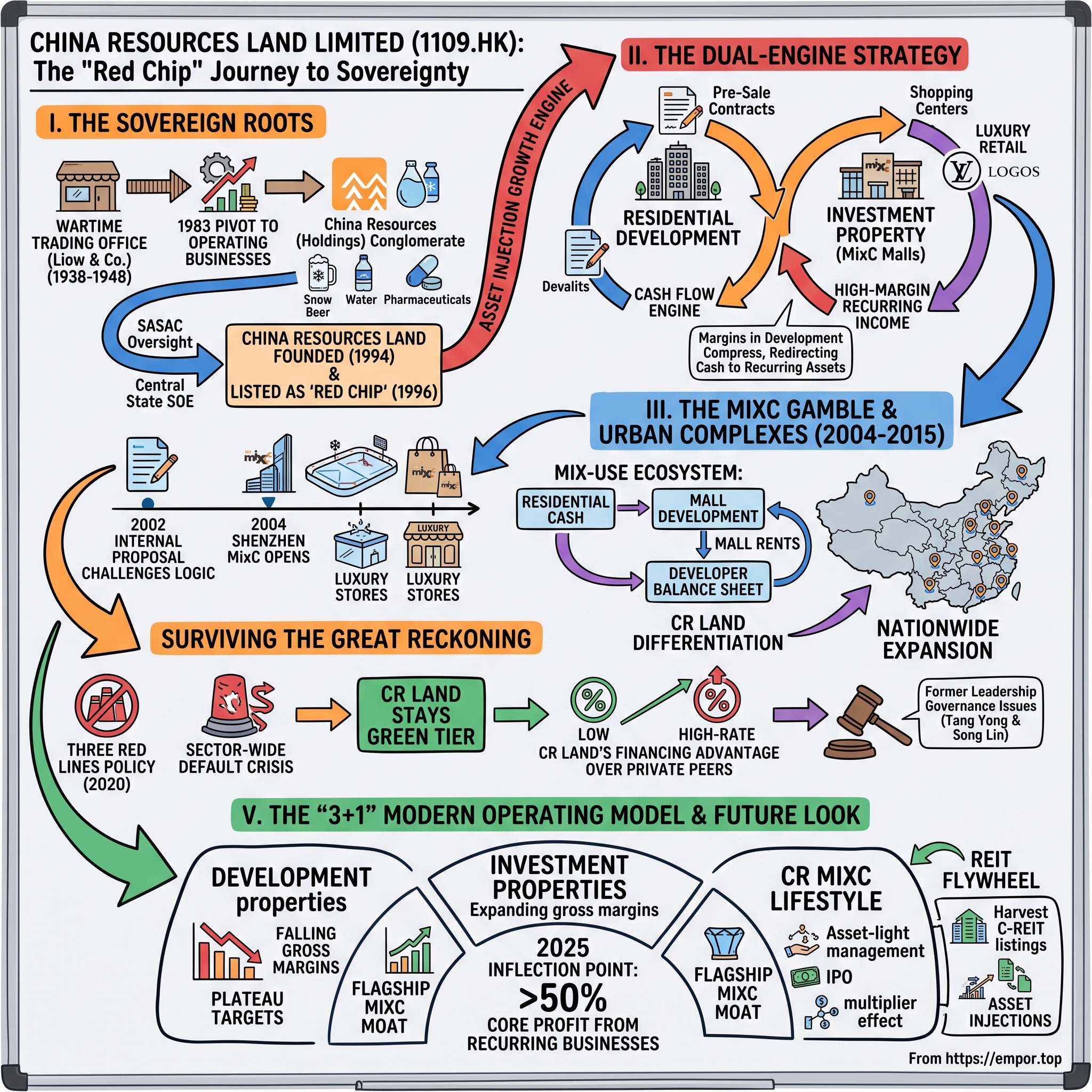
China Resources Land: The Sovereign Red Chip of Chinese Real Estate & Luxury Retail
I. Introduction & Episode Roadmap (0:00 - 15:00)
On a humid Saturday afternoon in Shenzhen's Luohu district, the escalators inside a six-storey mall carry a slow, dense river of shoppers past the vitrines of Louis Vuitton, Chanel, Dior, and Gucci, up toward an Olympic-sized ice rink where teenagers wobble in rented skates under a glass atrium.7 The building opened in December 2004. At the time, the surrounding streets were a mix of low-rise commercial blocks and the tail end of Shenzhen's first-generation boom; the idea that a mainland Chinese shopping centre could host the same luxury brand roster as Hong Kong's Landmark struck most industry observers as a category error.6
Twenty-two years later, that single building — Shenzhen MixC (深圳萬象城) — collected RMB 1.603 billion of rent in a single year, more than any other mall in its owner's portfolio and more than most listed Chinese property companies earn in total recurring income.17 It stands as physical proof of a commercial bet that, at the time it was made, appeared to be an act of institutional recklessness by a state-owned trading conglomerate with no prior background in luxury retail.
The company that made that bet is China Resources Land Limited (華潤置地), listed in Hong Kong under the ticker 1109.HK. In the financial year ended December 2025, it reported consolidated revenue of RMB 281.44 billion, essentially flat against the prior year, and profit attributable to shareholders of RMB 25.42 billion.2 Those two figures represent a notable anomaly across the sector, given that nearly every major peer standing alongside it a decade ago has since defaulted, restructured, or reported losses in the tens of billions.
Consider the contrast. In the same 2025 financial year, China Vanke (萬科) — for two decades the benchmark operator of the Chinese property industry whose management systems peers copied — reported a net loss of RMB 88.6 billion, with contracted sales down 45.5% to RMB 134.1 billion and impairments accounting for roughly three-quarters of its pre-tax deficit.19 China Resources Land, over the same twelve months, booked RMB 233.6 billion of contracted sales and paid a dividend.2
The scale today. CR Land ended 2025 operating 98 self-owned shopping centres, of which 82 ranked in the top three by retail sales within their city or district.13 Those malls generated RMB 239.2 billion of tenant retail sales, up 22.4% year-on-year, and RMB 21.9 billion of rental income for CR Land, up 13.3%.3 Its investment property division — encompassing malls, offices, and hotels — generated revenue of RMB 25.44 billion at a 71.8% gross margin, contributing RMB 9.87 billion in core net profit.12 Its weighted average cost of debt stood at 2.72%, down 39 basis points in a single year — a borrowing rate that Chinese private developers could not match even during market peaks.2
The central paradox. How did a state-owned enterprise — an entity structure conventionally associated with slow decision-making, politically directed capital allocation, and bureaucratic customer service — come to operate what is arguably the most commercially sophisticated mall platform in China? Evergrande (中國恒大) and Country Garden (碧桂園) were the aggressive, entrepreneurial, market-facing developers. Both collapsed. The state-owned enterprise retained the Hermès relationships.
There are two competing explanations, and a thorough assessment involves both. The first is operational: CR Land genuinely built a merchandising and leasing capability that private developers never matched, starting earlier, holding assets longer, and absorbing a decade of sub-scale returns on its initial malls. The second is financial: as a subsidiary of a central state conglomerate ranked 68th in the Fortune Global 500, with roughly 392,000 employees and nine Hong Kong-listed units, its parentage provided onshore credit access at rates that made survival a matter of capital structure rather than pure operating skill.20 Distinguishing between these two drivers is central to evaluating the business, as each carries distinct implications for future performance.
Myth versus reality, up front. Three consensus narratives about this company warrant critical examination.
Myth one: CR Land survived primarily because it is state-owned. Reality: state ownership was necessary but insufficient. Vanke's largest shareholder is a Shenzhen state entity holding roughly 27%, yet Vanke still recorded an RMB 88.6 billion net loss in a single year.19 State backing enables access to refinancing; it does not guarantee that capital was deployed into productive assets. The earnings divergence between CR Land and other state-affiliated developers is largely explained by CR Land's investment property portfolio.
Myth two: shopping malls serve as an uncorrelated hedge against the residential property downturn. Reality: commercial retail rents and residential markets are correlated. Mall rents in China are frequently structured as the higher of a base rent or a percentage of tenant turnover, directly exposing CR Land's rental revenues to consumer sentiment. If a prolonged property slump impairs household wealth and discretionary spending, retail rental growth will track that broader economic drag with a lag rather than insulating the firm.
Myth three: the transition to recurring commercial income is essentially complete. Reality: while recurring operations supplied 51.8% of core net profit in 2025, they accounted for only 15.4% of total revenue.32 The balance sheet, capital allocation, counterparty risk, and operational footprint remain heavily weighted toward residential development. A company can cross a profit-mix threshold while remaining, in capital deployment terms, primarily a homebuilder.
The roadmap. Management promotes a "dual-engine" model (兩輪驅動) — using residential development for cash flow and investment properties for high-margin recurring income — upgraded in recent strategy disclosures to "three growth curves" with the addition of an asset-light management layer via China Resources Mixc Lifestyle Services (1209.HK / 華潤萬象生活) and a public C-REIT channel for capital recycling.3 In 2025, recurring operations generated more than half of core net profit for the first time, contributing RMB 11.65 billion, or 51.8%.3
Crossing the 50% threshold is a milestone, but the driver of that shift requires precise attribution. While recurring core profit expanded 13.1%, total core net profit fell 11.6% to RMB 22.48 billion.[^19] The recurring share increased both because commercial operations grew and because residential development earnings contracted significantly. Evaluating the company requires assessing which trend will dominate going forward — and whether an annual rent roll of roughly RMB 22 billion can support a capital structure originally designed for a higher-volume development model.
Addressing that question requires beginning where the company itself began: not in real estate, but in a wartime trading office in Hong Kong.
 Subscribe on LinkedIn
II. Origins & The Red-Chip Incubator (1994–2003) (15:00 - 32:00)
In 1938, as Japanese forces advanced across eastern China, a trading firm called Liow & Co. (聯和行) opened in Hong Kong. While nominally a commercial business, its primary function was wartime logistics: gathering overseas Chinese donations, procuring medical and military supplies, and transporting them north to resistance bases under the direction of Zhou Enlai (周恩來) and Chen Yun (陳雲).5
That origin established from the start that the organization operated at the seam between the mainland political system and Hong Kong's open commercial economy — trusted by Beijing, yet operating under British colonial commercial law, in Hong Kong dollars, with foreign counterparties. In 1948, the firm was restructured and renamed China Resources, reflecting the concept that China is endowed with abundant natural wealth.5 From the 1950s through the early 1980s, it functioned as the general trading agent for China's import-export corporations in Hong Kong — the primary channel through which food and fuel reached the colony and essential goods entered the mainland.5
The pivot from trading agent to principal owner occurred in 1983, when the completion of the China Resources Building coincided with a restructuring into China Resources (Holdings) Company Limited and a deliberate shift into operating businesses across retail, real estate, and infrastructure.5 In 2003, the group came under the direct supervision of the State-owned Assets Supervision and Administration Commission (SASAC) as a central state-owned enterprise.20
The enterprise that emerged from this evolution is far broader than a property developer. The group operates across six divisions — consumer products, integrated energy, urban construction and operation, healthcare, industrial finance, and technology — encompassing roughly 3,077 entities and household consumer brands such as Snow Beer (雪花啤酒), C'estbon water (怡寶), China Resources Vanguard supermarkets (華潤萬家), and the 999 pharmaceutical line.20
This organizational scale provides an essential structural backing. When a conglomerate parent maintains a diversified earnings base across beer, electricity, pharmaceuticals, and retail, its real estate arm is not the sole entity determining the group's survival. While a standalone developer facing distress must choose between preserving equity and satisfying creditors, a property subsidiary within a broader central state-owned group benefits from a parent with both the balance-sheet capacity and the strategic incentive to prevent a default that would contaminate its other listed vehicles. While not a contractual guarantee, these parent-level capital incentives directly shape how debt markets price the company's credit.
The vehicle. China Resources Land was established in 1994 and listed on the Hong Kong Stock Exchange in 1996 as a red chip — a company incorporated offshore, listed in Hong Kong, and controlled by mainland state entities.[^6] The red-chip structure provided crucial governance and capital advantages. Where a mainland municipal property arm listed in Shenzhen or Shanghai during the 1990s raised renminbi from domestic retail markets with limited institutional discipline, a red chip raised Hong Kong dollars from international institutions, reported under established international accounting standards, and operated under Hong Kong Stock Exchange rules governing connected transactions, providing minority shareholders a formal mechanism to review parent asset sales.
That asset-injection mechanism became the company's growth engine. Through the late 1990s and early 2000s, CR Land expanded primarily by acquiring mainland property projects and land parcels from its parent in Beijing, Shanghai, and Shenzhen. Its original name — China Resources (Beijing) Land — highlighted the initial strategy: wrapping municipal-scale property portfolios in a Cayman Islands holding structure and selling them to global institutional investors.[^6]
The timing coincided with a structural shift in China's economy. In 1998, China abolished the welfare housing allocation system (danwei, 單位) and legalized private ownership of urban residential property. For four decades, urban Chinese households had been assigned housing by state work units. The 1998 reform converted a state benefit into a tradeable asset, creating the world's largest residential property market. Over the subsequent decade, hundreds of millions of urban residents became property owners, directing household savings into real estate.
A developer holding prime land in Tier-1 cities, backed by an offshore listed vehicle and a parent entity capable of sourcing additional land, sat directly in the path of this demand. Market dynamics during this initial phase favored established developers: land was often allocated through direct negotiation rather than competitive auction, while buyers proved eager and relatively price-insensitive. Development margins in the early 2000s were exceptionally high, creating strong incentives to maximize construction volume.
What the early years actually taught management. The conventional narrative portrays CR Land as uniquely farsighted from its inception. A more precise reading suggests CR Land began as a conventional residential developer that recognized earlier than peers the structural limitations of its core market.
Pure residential development in China operated less like a traditional property business and more like a leveraged, hyper-cyclical inventory model. Developers bid for land against competitors with identical market information and access to the same construction contractors, building largely commoditized housing. Developers pre-sold units prior to completion to collect upfront cash, repeating the cycle at higher leverage. Scale yielded procurement savings and credit access, but offered limited operational moat — while open land auctions routinely bid up land costs, transferring developer margins to municipal sellers.
The mechanics of open land auctions meant the winning bidder was often the participant with the most optimistic price assumptions and the lowest required return. In an expanding market, this mechanism siphoned developer returns to local government treasuries; in a contracting market, it left developers with high-cost inventory acquired at peak valuations.
Two decades later, the cost of that underlying model is visible in CR Land's reported figures: the development segment's settlement gross margin fell from a peak of 42.9% in 2018 to 15.5% by 2025.15 This margin compression reflects the long-term economics of residential development as a capital-intensive, low-margin contracting business exposed to land costs outside the operator's control.
Recognizing this structural vulnerability early — and possessing a parent balance sheet patient enough to absorb long payback periods — shaped management's long-term strategy. Rather than exiting residential development, CR Land redirected the rapid cash flow generated by residential pre-sales into commercial assets that generate value through ongoing operations rather than land speculation.
That strategic response materialized in December 2004, when CR Land opened its flagship commercial property in Shenzhen.
III. The Masterstroke: The MixC Gamble & Urban Integrated Complexes (2004–2015) (32:00 - 55:00)
In roughly 2002, an internal proposal for a major site in Shenzhen's Luohu district challenged standard Chinese property development logic. Rather than constructing residential apartments — the asset class that converted land into cash within eighteen months — the plan called for an ambitious mixed-use complex anchored by a luxury shopping mall, a Grade-A office tower, a five-star hotel, and high-end residential units.7 The mall alone would absorb years of upfront capital before generating meaningful rental income. Furthermore, international luxury brands had limited mainland retail footprints at the time, while affluent mainland consumers routinely traveled to Hong Kong for high-end purchases.
CR Land proceeded with the project. Shenzhen MixC opened in December 2004 as CR Land's first urban integrated complex, reshaping commercial expectations across Luohu and the broader city.6 Phase one comprised a retail mall spanning roughly 188,000 square metres alongside a 29-storey Grade-A office tower, while phase two added the hotel and premium residential space.7 The mall also featured China's first commercially operated Olympic-standard ice rink — an inclusion that might have appeared ornamental were it not central to the building's retail engineering.7
Why an ice rink is a leasing strategy. Luxury shopping centers face a structural circulation challenge: premium fashion houses demand ground-floor space near primary entrance corridors. Secondary retailers seek proximity to those anchor brands, leaving upper floors and rear concourses structurally disadvantaged. Left unmanaged, upper levels tend to attract lower-rent operators that can dilute a property's brand positioning. CR Land addressed this by placing major destination anchors — such as an ice rink, a cinema, or a large supermarket — on upper floors and quiet corners. By drawing foot traffic through the entire layout, the operator generated pedestrian flow across upper-level retail bays. This operational discipline proved difficult for private Chinese developers to replicate when building competing malls a decade later.
The cross-subsidy machine. The financial architecture underpinning the model combined two contrasting business models. In China's residential pre-sale system, developers collect most of a property's purchase price before construction finishes, generating early cash inflows. A shopping mall inverts that cash flow profile: capital expenditure is required for three to five years before initial lease payments arrive, and another three to five years may pass before rental income stabilizes as the tenant mix matures. A standalone commercial operator must fund that multi-year gap with equity or high-cost debt.
CR Land solved this cash flow mismatch by co-locating residential and commercial assets on large mixed-use parcels. The company pre-sold the residential and office components rapidly, using those upfront cash proceeds to fund the mall during its development phase. Local governments favored this integrated approach because shopping centers, hotels, and office towers generate long-term tax revenues, local employment, and civic infrastructure in ways pure residential developments cannot. This civic impact enhanced CR Land's competitiveness when bidding for subsequent municipal land parcels, allowing the developer to secure prime land partly through long-term commercial commitments rather than pure cash bids.
This cross-subsidy model effectively redirected near-term cash from residential buyers into long-term commercial balance-sheet assets. For over a decade, the strategy depressed reported return on equity compared to pure-play residential developers. As late as 2017, investment property revenue stood at 8.78 billion Hong Kong dollars, with shopping centres contributing 6.14 billion Hong Kong dollars — a substantial operation, but still a minor share of total group revenue.6
The structural limitation of this cross-subsidy architecture is that it relies on a functioning residential engine. If residential development slows or margins compress, surplus cash flow diminishes, forcing commercial mall pipelines to rely on debt financing or asset sales. The same capital structure that enabled CR Land's commercial expansion created an explicit reliance on residential cash generation — a dependency that later made asset-recycling mechanisms, such as real estate investment trusts, essential to sustaining growth.
Three brands, three customers. As its commercial footprint expanded, management segmented the portfolio into distinct retail formats rather than applying a single template across all markets.
萬象城 MixC serves as the luxury flagship line, positioned in the core of Tier-1 and strong Tier-2 cities, housing international luxury houses — including Gucci, Louis Vuitton, Chanel, Dior, and Prada — and competing directly with SKP, IFS, and Swire's Taikoo properties for top-tier tenant allocations.7 萬象天地 MixC World is an open-street and indoor mall hybrid designed for younger, trend-conscious urban consumers, serving as an architectural landmark in cities like Shenzhen. 萬象匯 MixC ONE operates as a mass-market regional format located in secondary hubs and emerging urban districts, pairing high-street and fast-fashion retailers to generate steady neighborhood foot traffic.
The currency of Chinese mall competition: the 首店 first store. In Chinese retail real estate, securing a brand's first store (首店) in a city or region serves as a major commercial catalyst. Municipal governments track first-store openings as an indicator of regional economic vitality, while consumers frequently travel across metropolitan areas to visit flagship debuts. For landlords, a first store generates outsized foot traffic, media coverage, and tenant prestige, signaling to competing brands that the property represents a premier commercial address.
This leasing dynamic creates a compounding advantage: flagship store allocations attract additional brand commitments. In 2025, Shenzhen MixC World introduced 38 retail first stores, including nine national debuts, during the same year its rental income surpassed 1 billion renminbi for the first time.17 Building that leasing reputation requires years of tenant relationships, whereas poor tenant curation can quickly undermine an asset's position.
National expansion, and what it cost. During the 2010s, CR Land expanded its commercial portfolio across major regional hubs, including Shanghai, Hangzhou, Chengdu, Guangzhou, Wuhan, Shenyang, Chongqing, and Qingdao. The expansion followed a repeatable pattern: acquiring large transit-adjacent mixed-use plots, anchoring the development with a MixC or MixC World property, and selling surrounding residential and office units to fund commercial construction.
This capital allocation required committing balance-sheet capital for five-to-ten-year payoff periods at a time when pure residential development yielded higher immediate accounting returns. The trade-off temporarily reduced return on equity for contemporary shareholders, but built a portfolio of recurring income assets for future periods. Furthermore, multi-format segmentation enabled CR Land to expand within individual metropolitan areas without cannibalizing existing properties — placing a MixC flagship in a city center and a MixC ONE in an outer district using shared local leasing and management infrastructure.
National expansion. Alongside primary land auctions, CR Land cultivated urban renewal projects as a core land-acquisition channel during its nationwide expansion. This included the redevelopment of Shenzhen's Dachong village starting in 2007, which converted roughly 630,000 square metres of dense urban village into a 2.8 million square metre mixed-use district.6 While urban renewal projects require complex stakeholder negotiations and multi-year execution timelines, they allow state-backed developers to acquire high-density urban land at costs below open-auction rates.
By the mid-2010s, CR Land had established a dual-engine structure: a high-volume residential homebuilder paired with an expanding portfolio of prime urban commercial properties held at historical cost. This asset base provided structural resilience when regulatory conditions tightened and residential market dynamics shifted in subsequent years.
IV. The Great Reckoning: Surviving "Three Red Lines" & The SOE Divergence (2016–2021) (55:00 - 1:20:00)
On 20 August 2020, officials from China's Ministry of Housing and Urban-Rural Development and the People's Bank of China convened a symposium in Beijing with the country's largest property developers — including Country Garden, Evergrande, and Vanke — and introduced a regulatory framework that reshaped the industry.[^12]
The Three Red Lines policy imposed three strict balance-sheet metrics: a ratio of liabilities to assets (excluding advance receipts) under 70%, net debt to equity under 100%, and cash reserves at least equal to short-term borrowings. Developers were categorized into compliance tiers based on how many thresholds they breached, with their tier determining the permitted growth rate of interest-bearing debt. A breach of all three metrics prohibited any debt expansion.
Why it worked as a bomb rather than a brake. To understand the scale of the disruption, it is necessary to examine how Chinese property developers operated prior to 2020. High-growth private operators had relied on a high-velocity capital model: pre-selling residential units before construction and immediately reinvesting the upfront proceeds into new land acquisitions. Leverage was layered on top through onshore bank loans, offshore high-yield dollar bonds, trust financing, supply-chain receivables, and off-balance-sheet joint-venture debt structures.
This financing model functioned only as long as pre-sale cash inflows exceeded ongoing liabilities, making continuous revenue growth essential to maintaining solvency. The Three Red Lines capped annual debt growth, which curtailed land purchases and restricted future pre-sale volume, interrupting the sector's capital circulation cycle.
Second-order effects proved even more damaging. Homebuyers, anticipating developer distress, reduced advance payments for uncompleted housing. That erosion of buyer confidence became self-fulfilling: developers deprived of pre-sale cash were unable to complete construction, confirming consumer fears. By 2022, unfinished-project delays and mortgage payment boycotts spread across dozens of cities, dismantling the industry's primary transaction structure of upfront payment for future home delivery.
Evergrande's offshore debt default in late 2021 converted policy tightening into a sector-wide credit crisis that persisted over the subsequent four years. Country Garden, long regarded as a disciplined private major, subsequently defaulted, while Sunac entered debt restructuring. Pre-crisis operating reputations proved poor predictors of survival; state ownership emerged as the primary structural differentiator.
Where CR Land sat. CR Land entered this period in the compliant green tier and maintained that standing throughout the downturn. As a central state-owned enterprise subsidiary, debt growth had never served as the primary constraint on its operational strategy. Access to low-cost onshore bank loans eliminated reliance on offshore high-yield debt markets, while state backing led domestic lenders to treat the firm as a quasi-sovereign counterparty. Furthermore, CR Land held a large portfolio of income-producing investment properties, providing tangible collateral that pure residential homebuilders lacked.
This structural support drove a widening financing cost advantage over private peers. By the end of 2024, CR Land's weighted average borrowing cost fell to 3.11%, down 45 basis points year-on-year to a record low at the time.8 The borrowing rate declined further to 2.72% by the end of 2025.2 In contrast, distressed private developers were either excluded from credit markets entirely or forced to refinance at double-digit yields when capital was available.
In a capital-intensive industry where land is the primary input and project execution spans several years, borrowing costs directly dictate operating feasibility rather than acting as a minor balance-sheet variable. A developer financing at 2.72% evaluates land parcels under fundamentally lower return hurdles than a peer borrowing at double-digit rates. As private developers withdrew from market bidding, land auctions in top-tier cities saw reduced competition, leaving state-backed entities as the dominant remaining buyers.
Credit rating agencies endorsed this relative financial strength. Moody's affirmed CR Land's Baa1 issuer rating and revised its outlook from negative to stable, citing the company's ability to maintain a strong operating and financial profile during market distress, supported by expanding high-margin rental income. The agency projected annual EBITDA of RMB 68 billion to RMB 70 billion against RMB 67 billion in 2024, anticipated debt-to-EBITDA within a 4.5x to 5.5x range, and established a downgrade threshold if debt-to-EBITDA exceeded 5.5x on a sustained basis.26 An investment-grade rating during a severe sector downturn underscores the stability provided by recurring rental income and state parentage, though credit evaluations remain focused on balance-sheet leverage rather than development profit margins.
The acquisition question, and how to test it. Management's narrative suggests that CR Land acquired high-quality land assets at attractive valuations while private competitors withdrew. However, this thesis warrants objective examination: access to low-cost capital and implicit mandates to support municipal land markets can lead to land purchases in a declining sector that may fail to clear return hurdles.
The empirical evidence presents a mixed picture that has become less favorable over time. On the supportive side, CR Land concentrated acquisitions in resilient urban centers: management reported that approximately 80% of 2025 land acquisitions were located in core cities, including Beijing and Shanghai, following a 2024 allocation where Tier-1 cities comprised roughly two-thirds and Tier-2 cities comprised one-quarter of land investments.3 The company also expanded land sourcing through off-auction channels — including joint ventures, mergers and acquisitions, and urban renewal projects — avoiding competitive bidding dynamics that transfer development margins to municipal governments.4
On the cautious side, reported development margins do not yet demonstrate land-acquisition discipline. Settlement gross margins in the development segment continued to compress, reaching 15.5% in 2025, down an additional 1.3 percentage points year-on-year.4 Disclosures for 2025 indicated that while settlement prices rose approximately 10.5%, land costs increased roughly 14%, demonstrating that input price inflation exceeded output price growth even in CR Land's core markets.4 Concurrently, land investment intensity increased: equity land expenditure rose about 28% to RMB 67.37 billion across 33 projects representing a total land value of RMB 91.66 billion, occurring at a time when nationwide home prices continued to decline.4
This capital deployment strategy represents a substantial commitment funded in part by recycling roughly RMB 25.5 billion through inventory optimization.4 Acquiring core-city land during market downturns aligns with counter-cyclical investment logic, but the financial returns will not manifest in reported settlement earnings until roughly 2027 and beyond. Evaluating management's execution requires monitoring settlement margins on these 2024–2025 land vintages as they transition to recognized income.
A note on what "distressed acquisition" really meant. The characterization of this period as an opportunistic asset purchase requires qualification. Chinese urban land is primary inventory sold by municipal governments rather than distressed private holdings. As private developers retreated, land auctions produced uncontested outcomes where parcels cleared at or near municipal reserve prices rather than being bid up. The financial savings stemmed from eliminating competitive auction premiums rather than acquiring land below intrinsic value. While removing auction premiums preserved capital, it represented a more modest advantage than purchasing distressed assets at deep discounts.
Furthermore, municipal governments rely heavily on land sales for fiscal revenue and set reserve prices accordingly. Local authorities facing budget shortfalls frequently maintain high floor prices, allowing land parcels to pass unbid rather than lowering reserve levels. Consequently, state-backed buyers in uncontested auctions interacted with municipal sellers that retained significant regulatory influence and fiscal incentives to protect land values.
And then the rules changed again. In late January 2026, media outlets managed by China's Ministry of Housing and Urban-Rural Development reported that property developers would no longer be required to submit monthly Three Red Lines compliance data, effectively ending the regulatory framework established five years earlier.[^12] Following the report, equity valuations for surviving private developers reacted sharply: Logan Group shares rose up to 40%, China Aoyuan gained over 30%, and the CSI 300 Real Estate Index advanced 5% to a two-month high.[^12]
The retirement of the Three Red Lines framework alters the competitive landscape for CR Land. The regulatory constraints that restricted private balance sheets provided CR Land with a distinct expansion advantage. As credit access and leverage capacity normalize across the sector, CR Land's relative advantage in land acquisition may diminish, refocusing performance evaluation on its underlying operational capabilities.
V. Modern Operations & Segment Breakdown: The "3+1" Engine (1:20:00 - 1:45:00)
A single milestone in CR Land's 2025 annual results highlights the firm's strategic inflection point. For the first time in its history as a listed company, more than half of core net profit — RMB 11.65 billion out of RMB 22.48 billion — originated from recurring businesses rather than residential sales.3[^19] Management had previously signaled to investors at its March 2025 results briefing that the recurring core profit contribution would exceed 45% in 2025, up from 40.7% in 2024.8 The final reported figure reached 51.8%.3
While representing a guidance beat, the underlying composition of that shift warrants close examination.
1. Development properties — the cash engine that is being managed down. Development remains the bulk of total revenue. Consolidated 2025 revenue reached RMB 281.44 billion, up 0.9% year-on-year, with recurring operations supplying RMB 43.28 billion, or 15.4% of the total.2 The remaining RMB 238.16 billion reflected development settlements.
Contracted sales totaled RMB 233.6 billion in 2025, following RMB 261.1 billion in 2024 — which had dropped 15% from the prior year on contracted floor area of 11.34 million square metres.2[^10] Unit economics demonstrate a sharp structural shift: settlement gross margin fell to 15.5% from a peak of 42.9% in 2018, marking a two-thirds compression over seven years.15 Financial analyses of the 2025 performance indicate the development segment is barely profitable after fully allocating financing overhead and administrative expenses — a challenging reality as segment gross margins approach the company's overall cost structure.15
Under its guidance for the 15th Five-Year Plan period (十五五), management aims to cap annual development revenue within a RMB 200–250 billion range while expanding annual rental revenue beyond RMB 30 billion.4 This strategy effectively exits the pursuit of scale expansion in a contracting homebuilding market. Skeptics view this plateau target as a description of market constraints framed as strategic choice rather than a proactive realignment.15
A near-term revenue cushion remains. CR Land closed 2025 with RMB 164.58 billion in contracted-but-unrecognised sales, of which approximately RMB 123.48 billion is scheduled for recognition in 2026.2 While providing top-line revenue visibility, this backlog does not protect profitability, as these units were pre-sold during market price declines on land acquired during higher-cost periods.
This dynamic illustrates the structural accounting delay in Chinese property development. Because developers pre-sell homes before completion, revenue cannot be recognized on the income statement until physical delivery, typically two to three years later. Consequently, current income statements reflect historical land and market conditions, whereas contracted sales indicate current demand. For CR Land, 2026 settlement revenue is largely secured, while 2027–2028 earnings depend on land acquired in 2024 and 2025 at acquisition costs that rose faster than retail housing prices.4
2. Investment properties — the margin moat. Rental operations generated RMB 25.44 billion in revenue in 2025, up 9.2% year-on-year, and delivered RMB 9.87 billion in core net profit, up 15.2%, supported by a 71.8% gross margin that expanded 1.8 percentage points.1 Shopping malls drove this performance, generating RMB 21.9 billion in rent — up 13.3% across 98 self-owned properties — at a record operating profit margin of 63.1%.13
Tenant sales offer a clear measure of underlying commercial performance. Total retail turnover across CR Land malls grew 22.4% to RMB 239.2 billion in 2025, outpacing overall national retail sentiment.1 Because rental growth of 13.3% lagged tenant sales growth of 22.4%, average tenant occupancy cost ratios declined. This spread demonstrates market share gains within consumer retail rather than aggressive rent increases on tenants. Overall portfolio occupancy remained high, holding at 97.3% at the 2025 interim mark.21
Asset concentration remains pronounced. Flagship properties — led by Shenzhen MixC at RMB 1.603 billion, Shenyang MixC (瀋陽萬象城) at RMB 1.375 billion, and Shenzhen MixC World at RMB 1.082 billion — accounted for roughly one-quarter of total shopping mall rental income.17 This heavy weighting in top-tier assets provides a defensible competitive moat while exposing the portfolio to geographic and single-asset concentration risks.
By contrast, non-retail investment properties exhibited weaker operational metrics. At year-end 2025, office occupancy stood at 77.7% and hotel occupancy at 67.3%.4 Chinese Grade-A office markets face ongoing national oversupply and declining effective rents, while hotel assets deliver lower returns relative to their operational requirements. These non-retail segments continue to compress the overall return on investment property assets.
From an operational standpoint, municipal land tenders frequently mandate office towers and luxury hotel construction alongside commercial retail as part of mixed-use master plans. While these requirements represent a structural land cost that sits on the balance sheet, as standalone holdings, these lower-yielding assets consume capital and management bandwidth during periods of institutional market illiquidity.
3. CR Mixc Lifestyle — the asset-light multiplier. In December 2020, CR Land completed the initial public offering of its property and commercial management subsidiary, China Resources Mixc Lifestyle Services, on the Hong Kong Stock Exchange. The offering comprised 550 million shares priced up to HK$22.30, raising approximately US$1.6 billion under joint sponsorship from CCB International, CICC, Citi, and Goldman Sachs.9 At listing, the company ranked fifth among mainland property management firms by revenue and second in commercial shopping mall management.9
The spin-off separated physical property ownership from fee-based management operations. While real estate assets incur ongoing capital depreciation, commercial leasing, tenant curation, and facility management require minimal capital expenditure while yielding higher returns on capital. The standalone structure also enabled Mixc Lifestyle to contract management services to third-party mall owners without requiring direct property acquisitions by CR Land.
Operational results demonstrate this operating leverage. In 2025, CR Mixc Lifestyle reported revenue of RMB 18.02 billion, up 5.06%, while core net profit expanded 13.7% to RMB 3.95 billion.10 Managing 129 shopping malls, the business oversaw RMB 266 billion in total tenant retail sales across self-owned and third-party venues, achieving a 65.7% operating profit margin and increasing loyalty membership by 36% to 83 million.10 Dividend distributions reached HK$1.731 per share, up 12.7%, marking the third consecutive year of distributing 100% of core net profit.10 Management has set an operational target of 200 managed properties by 2030.10
To fund ongoing development operations, CR Land reduced its equity ownership in the subsidiary. The parent company executed a placement of 49.5 million shares (a 2.17% stake) at HK$41.70 per share — representing a 9.58% discount to the preceding closing price of HK$46.12 — lowering its holding to roughly 70.12% and generating net proceeds of HK$2.06 billion for land acquisitions, construction costs, and working capital, with UBS acting as placing agent.22 Public regulatory filings on exchange platforms document these equity changes and connected transactions.[^7]
This equity sale reflects a notable capital allocation decision: CR Land monetized a portion of a high-margin, capital-light management business to fund residential land acquisitions in a lower-margin, capital-intensive segment. Evaluating this rebalancing requires monitoring whether land investments match the returns of the management equity sold.
How mall rent actually gets set — and why it matters here. The mechanics of Chinese retail leases shape the stability of recurring rental income. Commercial leases are structured as the higher of a base rent per square metre or a percentage of tenant turnover. Consequently, rental revenue acts as a direct participant in retail turnover rather than a fixed income stream.
During consumer expansions, this turnover-linked structure captures sales upside automatically, driving the 13.3% rental growth recorded in 2025. Conversely, during retail contractions, rental income can drop without lease terminations or occupancy declines. Therefore, rental revenues represent a variable claim on discretionary consumer spending rather than an inflation-protected bond alternative.
4. The ecosystem businesses — small, and honestly labelled. Auxiliary segments — including long-term rental housing under the Youchao (有巢) brand, senior care services, and urban operations — account for a low-single-digit share of group revenue. Their primary strategic role is developing operating assets with predictable cash flows for eventual capital recycling into public C-REIT platforms.
Rental housing aligns with government policy directives supporting government-subsidized rental housing (保障性租賃住房). Participation provides regulatory support, land access advantages, and C-REIT exit avenues, albeit at modest standalone capital returns. Maintaining these operations within small revenue thresholds balances policy alignment against balance-sheet discipline.
By year-end 2025, CR Land's total assets under management reached RMB 502.2 billion, representing an annual increase of RMB 40.1 billion.3 The company's ongoing evolution centers on managing capital allocation across its residential development, commercial investment, asset-light management, and public REIT channels.
VI. Capital Allocation, C-REIT Flywheel, & Management Credibility (1:45:00 - 2:05:00)
Any evaluation of CR Land's governance must confront a reality that company investor materials rarely emphasize.
On 24 June 2024, the Mianyang Intermediate People's Court in Sichuan sentenced Tang Yong (唐勇) — CR Land's former party secretary, chairman, and chief executive — to 15 years in prison and a RMB 5 million fine for accepting approximately RMB 73.67 million in bribes.13 Tang joined China Resources in 1993 after graduating from Tongji University, advancing through roles as general manager, executive director, senior vice president, and president before assuming the chairmanship in February 2019. He was transferred to China Resources Power that December and was detained in August 2022.13
Tang was not the first senior executive to face prosecution. Song Lin (宋林), former chairman of parent company China Resources (Holdings), was sentenced in June 2017 to 14 years in prison and fined RMB 4 million for bribery and embezzlement, having accepted over RMB 23 million in bribes and misappropriated more than RMB 9.74 million in public assets between 2004 and 2013.23
Two convicted chairmen within a decade — one at the subsidiary and one at the parent — represent a governance record that operating performance alone cannot erase. While these cases demonstrate an active state enforcement mechanism, they also show that agency risks have directly materialized within the group structure. Furthermore, public court proceedings, rather than company disclosures, served as the primary source of details regarding these leadership departures.
The current leadership. Li Xin (李欣) was appointed chairman on 5 May 2022, succeeding Wang Xiangming (王祥明), who had served in the position for two and a half years.14 Li's career has been spent almost entirely within the conglomerate: he joined China Resources Holdings in 1994, transferred to CR Land in 2001, became co-president and East China regional chairman in July 2016, executive director in April 2017, president in December 2018, and chairman and non-executive director of CR Mixc Lifestyle in August 2020 — placing him at the head of both the property owner and the service operator.14 He holds a bachelor's degree from Dongbei University of Finance & Economics and a master's degree in project management from The Hong Kong Polytechnic University.14
That background carries distinct operational and governance implications. A three-decade veteran who directed the East China region during its commercial expansion brings deep operational knowledge and leadership stability during market downturns. However, it also leaves the board chaired by an executive with no external organizational experience, in a structure where the controlling shareholder appoints directors and the chairman simultaneously heads the listed subsidiary that CR Land is partially monetizing. Under these conditions, related-party dynamics require continuous scrutiny.
A fundamental aspect of state-owned enterprise leadership is executive rotation. Chinese central SOE executives are reassigned between group subsidiaries by the parent entity rather than selected through independent board or shareholder processes. Tang Yong's career trajectory illustrates this pattern: he was transferred from CR Land's chairmanship to China Resources Power after approximately ten months in the role.13 Consequently, equity investors are not underwriting a management team with long-term tenure tied exclusively to this single listed entity; they are underwriting the broader talent bench and allocation decisions of the parent conglomerate.
Executive compensation and performance benchmarks follow similar structural priorities. Evaluation metrics at central SOEs prioritize a combination of financial targets, risk management protocols, and state-mandated stability goals over total shareholder return alone. This governance orientation helped prevent CR Land from taking on excessive leverage during peak market expansion in 2018. At the same time, it indicates that when broader policy objectives and minority shareholder returns diverge, internal incentives are not configured to prioritize minority investor interests.
Testing the narrative against the record. Evaluating management performance requires tracking stated objectives against subsequent operational delivery. On key operational metrics, CR Land has met or exceeded its targets. At the March 2025 results briefing, management projected that recurring operations would contribute over 45% of core profit in 2025; the actual reported contribution reached 51.8%.83 Chief Financial Officer Guo Shiqing (郭世清) had framed that target against 2024's 40.7% contribution, a period in which recurring core profit exceeded RMB 10 billion for the first time.8
However, the structural drivers behind this shift require careful context. A rising recurring profit ratio can result from both commercial growth and a contracting residential development segment. In 2025, total core profit declined 11.6%, a factor less emphasized in headline disclosures than the relative expansion of recurring income.[^19] While Chairman Li Xin framed the 15th Five-Year Plan around three coordinated growth curves — prioritizing profitable revenue, cash-backed services, and cash-flow preservation — the rising recurring share occurred alongside contractions in primary residential earnings.4
What the briefings sound like. During results presentations in March 2025 and March 2026, management emphasized recurring profit metrics, reduced funding costs, and local market rankings for flagship malls. Analyst inquiries focused on three core areas: the stabilization timeline for residential gross margins, return hurdles on 2025 land expenditures amid declining property prices, and the breakdown between same-store rental growth and contributions from new mall openings — an important distinction given that seven new shopping centers opened in 2025 alone.1
Management addressed these inquiries by highlighting structural factors, including core-city land concentration, diversified land acquisition channels, and cash-flow management.4 While this strategy reflects a cautious operational stance, current disclosures do not break out separate same-store rental growth figures. Providing a clear same-store performance series would allow market participants to distinguish underlying organic retail growth from portfolio expansion.
Dividend distributions mirrored underlying earnings movements. The board declared a full-year dividend of RMB 1.166 per share for 2025 — including a final dividend of RMB 0.966, down 13.7% — representing an 11.6% full-year reduction from RMB 1.319 per share in 2024.2[^19][^10] This adjustment aligned dividend payouts directly with core net profit declines rather than funding distributions through additional debt. Cumulative dividend distributions since listing have exceeded HK$100 billion.1
The C-REIT flywheel. A significant structural development in CR Land's commercial operations was the establishment of a public capital recycling route for mature commercial properties.
On 14 March 2024, Harvest China Resources Commercial REIT (華夏華潤商業REIT) listed on the Shenzhen Stock Exchange under ticker 180601, raising RMB 6.902 billion at RMB 6.902 per unit across 1 billion units — marking the largest listing among China's initial batch of three consumer infrastructure REITs and the fifth-largest among 34 domestic public REITs at the time.11 The underlying asset, Qingdao MixC (青島萬象城), comprised roughly 300,000 square metres of gross floor area, housed over 500 tenants, maintained occupancy above 98%, and recorded annual footfall growth of 7.6% from 2016 to 2022 alongside 15% annualized revenue growth over the three preceding years.11 Both institutional and retail tranches were oversubscribed.11 Management subsequently reported that the REIT's secondary market price increased 52.3% above its issue price, pushing its market capitalization past RMB 10 billion.3
Earlier, on 9 December 2022, Harvest Youchao Rental Housing REIT (華夏基金華潤有巢REIT) listed on the Shanghai Stock Exchange under ticker 508077, issuing 500 million units with a 67-year term as the first public REIT in China backed by market-operated affordable rental housing.12
The structural importance of the REIT model lies in its capacity for follow-on asset injections. Chinese REIT rules permit managers to issue additional units to acquire further properties from the sponsor. CR Land announced the asset injection of Kunshan MixC ONE on 25 March 2025, submitted the expansion and unit-listing application on 1 October 2025, received formal acceptance on 15 October, and received an inquiry letter from the Shenzhen Stock Exchange on 31 October; an additional pipeline tranche encompassing Hangzhou Xiaoshan, Shenyang Changbai, and Zibo MixC ONE properties was announced on 9 July 2025.24
This asset recycling framework allows a developer to monetize mature commercial holdings. By transferring a stabilized mall into a public REIT while retaining management contracts through CR Mixc Lifestyle, CR Land converts illiquid real estate into cash while maintaining fee income and tenant relationships. The proceeds can then be redeployed into development or new projects without expanding total balance-sheet leverage.
Conceptually, the arrangement resembles an operating business that sells physical real estate assets while retaining management and brand operations. The operator forfeits long-term property value appreciation but gains liquid capital to deploy into higher-return investments, alongside stable management fee streams. Similar sponsor-managed REIT structures operate extensively across international commercial real estate markets.
However, the execution of this model depends on market pricing conditions. Asset recycling remains economically viable only as long as public REIT markets value properties at capitalization rates below CR Land's cost of capital. Initial asset injections have focused on regional MixC ONE properties rather than Tier-1 flagship MixC centers, preserving core assets on the balance sheet. Consequently, current capital recycling relies on mid-tier asset transfers and retail investor demand within China's developing public REIT market. In addition, market analyses of the Qingdao MixC offering noted that the property had posted three consecutive years of net losses prior to listing and had consumed one-third of its land-use term — underscoring that C-REIT valuations depend on distributable operational cash flow under finite land tenure rather than perpetual land ownership.
This dynamic raises a broader strategic question: stripping away low borrowing costs, state parentage, and public REIT channels, what core operational capabilities define CR Land's competitive position?
VII. Competitive Moat & Strategic Frameworks (2:05:00 - 2:20:00)
Evaluating whether China Resources Land holds an enduring competitive advantage requires examining its business through established strategic frameworks — identifying where competitive moats exist, where they break down, and how the company compares against industry peers. A useful analytical approach evaluates how a rival landlord equipped with substantial capital would attempt to displace CR Land from its position in Chinese luxury retail.
1. Cornered resource. A primary barrier to entry is site acquisition. Shenzhen MixC occupies a central position in Luohu assembled during the early stages of Shenzhen's urban expansion; an equivalent parcel cannot be acquired today at any price. This represents a classic cornered resource: preferential access to a finite input — prime, transit-connected, large-format urban land — that capital alone cannot duplicate.
The expenditure required to assemble competing sites illustrates this constraint. CR Land's acquisition of a site at Beijing Chaoyang Station in February 2023 required a land payment of RMB 6.358 billion and a total approved project investment of approximately RMB 11 billion for roughly 275,500 square metres of above-ground gross floor area, with an opening targeted for 2027 — representing a nine-year capital commitment from land acquisition to operation in a corridor that already includes a MixC ONE within one kilometre and a competing shopping center two kilometres away.18
That execution highlights an important limitation: even an established operator acquiring land in prime metropolitan corridors must accept adjacent competition and multi-billion-renminbi capital commitments prior to opening. The cornered resource protects established locations, but it is not easily extensible on demand.
2. Scale economies and the tenant network. The second advantage functions as a two-sided reputational scale mechanism. Global luxury houses prefer locations where high-net-worth consumers already shop alongside peer brands, ensuring sufficient sales density to justify interior investment. Once a property achieves critical mass, new brand commitments accumulate, making it difficult for competing venues to entice tenants with lower rental rates, as rent represents a secondary consideration relative to location and footfall quality.
CR Land's operational metrics reflect this positioning: 82 of its 98 malls ranked in the top three by retail sales within their respective local markets, tenant turnover expanded 22.4% during a period of muted consumer spending, and operator-level loyalty membership expanded 36% to 83 million users.3110 Granular shopper demographic and purchasing data allows the landlord to optimize leasing terms based on actual transaction patterns rather than broad footfall estimates.
However, this advantage is concentrated primarily in the flagship luxury tier. Regional properties, such as a MixC ONE in a secondary district, compete on convenience and local catchment area like standard suburban retail centers, lacking strong tenant lock-in. Furthermore, total retail turnover remains exposed to broader shifts in Chinese domestic luxury consumption relative to overseas travel spending.
3. Process power and operational execution. An essential dimension of competitive advantage is organizational capability in asset repositioning and mall management. Commercial retail assets depreciate over time as tenant mixes, interior designs, and local catchment demographics shift. Sustaining long-term returns requires executing major property renovations and tenant reconfigurations without disrupting ongoing operational income.
Shenyang MixC provides a clear demonstration of this capability. Following a major renovation in 2024 that expanded total floor area by over 100,000 square metres and added premier luxury houses, including Chanel, the property generated RMB 1.375 billion in rental income in 2025, representing a 17% year-on-year increase within a regional economy facing broader structural headwinds.17 This performance demonstrates operational capability in asset optimization beyond initial site selection.
Conversely, mass-market assets exhibit greater operational variance: Beijing Qinghe MixC ONE recorded a slight decline in rental income over the same period.17 This divergence underscores that operational process power produces its strongest results when paired with premier flagship locations.
4. Counter-positioning. CR Land's dual-engine architecture presents a structural barrier to pure-play residential developers. Replicating the model requires absorbing lower initial returns on equity while funding long-gestation commercial assets — an approach unviable for highly leveraged private developers facing short-term debt obligations. However, this counter-positioning applies primarily against private homebuilders rather than state-backed peers such as China Overseas Land & Investment (0688.HK), Poly Developments (600048.SH), or Joy City (000031.SZ), which operate under similar state credit profiles.
5. Competitive forces. Applying Porter's Five Forces framework clarifies broader industry dynamics: * Bargaining power of tenants is low for global luxury brands in flagship MixC centers where location choices are limited, but moderate to high in regional retail where tenant options abound. * Threat of new entrants remains low, constrained by high capital requirements, land availability, and multi-year tenant relationship cycles. * Supplier power — primarily municipal government land supply — remains structurally high due to public auction mechanisms, which CR Land mitigates by sourcing land through urban renewal and off-market transactions. * Threat of substitutes is significant, as e-commerce and livestream channels continue to capture market share from physical retail, driving landlords to emphasize experiential dining, entertainment, and luxury services. * Rivalry among existing competitors remains intense among surviving state-backed and high-quality operators.
6. Peer comparisons. Evaluating CR Land against relevant peers requires focusing on operators that combine residential development with commercial mall portfolios: * China Overseas Land & Investment (0688.HK) shares a similar central state-owned enterprise structure and low funding cost, though its commercial footprint historically weighted more toward office properties. * Poly Developments (600048.SH) maintains larger residential development volume but operates a significantly smaller retail portfolio. * Joy City (000031.SZ) represents a direct state-owned commercial mall operator, though it has experienced lower group profitability, demonstrating that state parentage and recognizable retail brands do not guarantee financial performance. * China Vanke (2202.HK / 000002.SZ), previously an industry benchmark, recorded an RMB 88.6 billion net loss in 2025 as contracted sales fell 45.5%, relying on support from its largest shareholder, Shenzhen Metro (which holds roughly 27%), to maintain liquidity.19 * Longfor Group (0960.HK), a leading private operator pursuing a recurring-income model, generated RMB 63.16 billion in 2025 contracted sales across 5.186 million square metres, while generating approximately RMB 26.77 billion in recurring revenue — split between RMB 14.19 billion in operating income and RMB 12.58 billion in service income.25 Longfor's recurring revenue approaches CR Land's scale despite operating a development business roughly one-quarter the size, highlighting a higher recurring income mix, whereas CR Land retains a larger balance sheet and a lower cost of debt.
7. Limitations of the moat. A complete evaluation also identifies areas where structural moats are absent: * Switching costs do not exist in residential homebuying, where consumer decisions depend primarily on location, pricing, and construction delivery confidence. * Pricing power is limited in residential development, as market prices are governed by local demand and comparable project supply rather than developer brand alone. * Network effects do not apply to real estate assets in a formal economic sense; the clustering of luxury tenants reflects reputational scale rather than network lock-in.
8. Strategic conclusion. CR Land's competitive moat rests on two core elements: a portfolio of irreplaceable urban commercial complexes and an established luxury leasing platform. However, these moated commercial assets sit within a broader corporate structure where residential development continues to generate over 80% of consolidated revenue at compressed settlement gross margins of 15.5%, compared to investment property gross margins of 71.8% and shopping mall operating margins of 63.1%.13 Long-term investment performance depends on whether recurring commercial earnings can expand sufficiently to offset structural margin compression in residential homebuilding.
VIII. Bear vs. Bull Case, Risk Radar, & Investor Playbook (2:20:00 - 2:30:00)
The activist stress test. Imagine a well-prepared sceptic with a presentation deck. The argument would run roughly as follows.
First, the moat is financial, not operational, and it is being withdrawn. For five years, CR Land's decisive advantage was that it could bid for land when almost nobody else could. In January 2026 the Three Red Lines reporting regime effectively ended, and the market immediately re-rated distressed developers by 30–40% in days.[^12] If credit access normalises across the sector, the scarcity premium on a green-tier balance sheet erodes, and CR Land must win on merchandising and land selection alone. Its own margin disclosures suggest that on land selection, it has been paying up: 2025 land costs rose faster than settlement prices.4
Second, the recurring-income story flatters a shrinking business. Recurring profit crossing half of core earnings is presented as a milestone. Mechanically, core profit fell 11.6% and the dividend was cut 11.6%.[^19]2 A ratio improved by denominator decline is not the same as a transition completed.
Third, the balance sheet is moving in the wrong direction while the sector deteriorates. Net gearing rose from 31.9% to 39.2% during 2025, total borrowings reached RMB 281.47 billion against cash of RMB 116.99 billion, and equity land investment rose 28% — into a market where home prices were still falling in the second half.42 Cash to short-term debt at 2.32x remains comfortable, but the direction of travel over a single year is notable.4
Fourth, governance and disclosure. Two chairmen convicted of bribery within a decade; a chairman who simultaneously chairs the listed subsidiary being sold down; a controlling shareholder with policy objectives that are not identical to minority shareholders' returns. Add reported construction-quality complaints across multiple projects — including allegations, raised in critical Chinese coverage of the 2025 report, of structural workmanship failures in Changsha, specification downgrades in Shanghai and persistent leaks in Hangzhou, alongside an allegation that staff were instructed to manufacture confrontations with complaining homeowners.15 These are third-party allegations rather than adjudicated findings, and CR Land has not published a consolidated response to them, but a developer whose long-term brand premium depends on being the trusted builder in a market terrified of unfinished homes cannot treat delivery-quality allegations as a communications problem.
Fifth, non-core drag. Office occupancy at 77.7% and hotel occupancy at 67.3% represent capital tied up in assets earning below the cost of the equity supporting them.4 An activist would ask why these are not being sold, and whether the answer is commercial or political.
Sixth, the related-party escalator. The parent controls the company, the chairman also chairs the listed operating subsidiary, and the group sponsors the REITs into which it sells its own assets. Every transfer between these entities is priced by parties on the same side of the table. The independent valuation and independent director processes exist, but they are approving transactions where the counterparty's interests are represented by the same organisation on both sides.
And the rebuttal an activist would have to answer. The sceptical case is strong on structure and weak on evidence of value destruction. There is no restatement, no going-concern language, no auditor dispute, no covenant breach, and no dividend funded by debt. The dividend was cut in line with earnings rather than defended. The company disclosed its falling margin plainly rather than reclassifying its way out of it. Those are the behaviours of a management team that is not managing the optics — which does not prove the strategy is right, but does raise the bar for arguing that it is being concealed.
The material risk radar. Four risks are mechanically connected to how this business earns money.
Property market duration risk. CR Land's development margin is set by the spread between land bought two to four years ago and homes settled today. Chinese home prices declining through 2025 means the vintages settling in 2027–2028 carry embedded margin compression that is already fixed and cannot be managed away. Extended weakness also raises the probability of inventory write-downs — Vanke's RMB 21.9 billion of asset impairments in 2025, roughly tripling year on year on write-downs in Guangzhou and Shenzhen, illustrates what that looks like when it arrives.19 CR Land has taken a far more conservative land-quality approach, but impairment risk on legacy parcels is real and is an accounting judgement, not an observation.
Luxury consumption deceleration. A material share of mall economics comes from turnover-linked rent, which means CR Land's income participates directly in luxury sales rather than being insulated from them. The 22.4% growth in tenant retail sales in 2025 is strong evidence against this risk for now; it is not evidence about 2027.1 The mechanism to watch is the reversal of the pattern noted earlier — rent growth exceeding tenant sales growth would indicate the landlord is extracting rather than growing.
SOE mandate risk. This is the one that is genuinely unhedgeable. A central SOE can be directed to participate in affordable housing, urban village renovation or distressed-project rescue at returns below its commercial hurdle. Nothing about the disclosure regime would flag this as a directive rather than a decision. The Youchao rental-housing platform is a benign version; a less benign version would be absorbing a failed peer's projects.
Refinancing and rate risk, in reverse. Most companies worry about rising funding costs. CR Land's specific exposure is that a 2.72% cost of debt reflects an unusually loose onshore monetary environment and quasi-sovereign credit status. Both are policy variables. A normalisation of Chinese rates would compress the spread between CR Land's funding cost and the yields on the assets it buys, which is the arithmetic on which the whole accumulate-assets strategy depends.
Substitution risk from online retail. This is the slow one, and it is easy to under-weight because the recent numbers look so good. Chinese e-commerce penetration is among the highest in the world, and livestream commerce has taken further share from physical retail for exactly the categories — apparel, cosmetics, electronics — that historically filled mall floorplates. CR Land's answer is to lean into what cannot be shipped: dining, entertainment, luxury service rituals, and the social function of the mall as a place teenagers go on a Saturday. The 2025 tenant sales growth suggests that answer is working for now. It is a strategy that requires continuous reinvention rather than a defensible position that holds by itself.
Second-layer diligence, briefly. A few items that do not fit neatly into the main narrative but matter to a careful reader.
On credit, the investment-grade affirmation with a stabilised outlook is a meaningful third-party check on the balance-sheet story, and the named downgrade trigger — leverage sustained above 5.5x debt-to-EBITDA — is a concrete tripwire an investor can monitor without waiting for management commentary.26
On accounting judgement, the two areas where discretion is widest are inventory provisioning against land and work-in-progress, and the fair-value treatment of investment properties. A landlord marking malls to fair value books gains that never touch cash; a developer choosing when to write down a parcel controls the timing of its own bad news. CR Land's reported figures have not shown the scale of impairment that peers have taken, which is consistent with a better portfolio and also with a slower marking cadence. Both explanations fit the disclosed data.
On structure, the group now contains a listed parent, a listed operating subsidiary that the parent periodically sells down, and two listed REITs into which the parent sells assets. Each layer is individually justifiable. Collectively they create a related-party map in which the same chairman sits on both sides of several transactions, and in which the price at which assets move between vehicles is set by the sponsor rather than by an arm's-length buyer. This is standard practice in REIT sponsorship worldwide; it still warrants attention to the independence of valuation and the composition of the independent director cohort approving those transfers.
The bull case, stated fairly. The affirmative argument does not require optimism about Chinese property. It requires only that the following hold.
The rent roll is real, growing at low-to-mid double digits, and backed by tenant sales growing faster than rent — evidence of pricing power exercised with restraint rather than exhausted.31 Recurring revenue for the first six months of 2026 rose 7.6% to RMB 26.47 billion, with rental income up 12.6%, sustaining the trend into the current year.16 Contracted sales in the first half of 2026 rose 5.6% to roughly RMB 116.5 billion even as contracted floor area fell 23.2% — meaning CR Land is selling fewer, more expensive homes in better locations, which is precisely what the stated strategy predicts and a rare instance of a Chinese developer growing sales value in a declining market.16
Market share consolidates mechanically as private developers exit; the surviving buyer pool in core-city land auctions is small and largely state-owned. The funding advantage, even if it narrows, does not disappear while the parent stands behind the credit. And the C-REIT channel — with the flagship vehicle trading well above issue and expansion tranches in process — offers a genuine path to recycling capital without further balance-sheet stretch.324
There is also a structural point in the bull case that is easy to miss. The bear argument that the funding advantage disappears if the Three Red Lines regime is gone assumes that credit access is the binding constraint on CR Land's competitors. For most of them it is not. Evergrande, Country Garden and Sunac are not returning to core-city land auctions in 2027 regardless of what the reporting requirements say; their capital structures are being restructured, their brands are impaired with homebuyers, and their delivery credibility is gone. Regulatory relief is worth a great deal to the survivors' equity prices and much less to their actual bidding power.
The synthesis is that CR Land is best understood not as a property developer with a mall division, but as a mall company being funded by the orderly wind-down of a development business. Whether that is an attractive proposition depends almost entirely on the terminal value one assigns to Chinese urban retail and on how much capital the development runoff consumes before it stabilises.
Framed that way, the central uncertainty is not whether the malls are good. The evidence that they are is substantial and multi-year: tenant sales compounding faster than rent, occupancy near full, a repositioning capability demonstrated on an ageing asset in a weak regional economy, and a fee-management arm growing profit at three times its revenue rate. The uncertainty is arithmetic. A rent roll of roughly RMB 22 billion, growing at low-to-mid double digits, has to grow into a balance sheet carrying RMB 281 billion of borrowings and a land bank whose settlement margins are still contracting.324 That is a race between a compounding numerator and a decaying denominator, and the outcome depends on how long the decay lasts.
Where the case breaks. It breaks if development margins fail to stabilise near current levels and instead follow prices lower, forcing impairments that consume the recurring segment's earnings. It breaks if luxury consumption in China structurally relocates offshore or online. It breaks if the state calls in favours for cheap capital, in the form of mandated low-return projects. And it breaks quietly if management, freed from the Three Red Lines discipline, resumes growing the land bank aggressively — the exact behaviour that destroyed its competitors, now available again.
The KPIs that matter. Three metrics, tracked over time, capture nearly all of the variance in this story.
Shopping-centre rental income and occupancy. This is the numerator of the entire transition thesis. Management has targeted rental revenue above RMB 30 billion annually during the 15th Five-Year Plan period, from RMB 21.9 billion of mall rent in 2025.43 The occupancy rate, which has held above 97%, is the leading indicator: a decline there precedes rent decline by roughly a year, because leases roll.21 The most informative version of this metric is the relationship between rent growth and tenant retail sales growth. As long as tenant sales grow faster, the landlord has headroom.
Development segment settlement gross margin. Currently 15.5% and falling for seven consecutive years.415 This single number determines whether the development business is a self-funding runoff or a capital sink. Stabilisation would validate the claim that core-city land selection works. Continued decline through the 2024–2025 land vintages, which begin settling from roughly 2027, would indicate management overpaid during the distressed-acquisition window.
Weighted average cost of borrowing. At 2.72% and at a record low.2 This is the cleanest available proxy for the market's assessment of CR Land's credit and, by extension, the durability of the state-backing premium. It is also the discount rate against which every new mall and every land parcel is implicitly underwritten. If it rises while peers' costs fall, the funding moat is closing.
Everything else — headline revenue, contracted sales rankings, mall counts, membership totals — is downstream commentary on those three.
The story that began with a state trading office moving medicine into wartime China, and ran through a mall in Luohu that nobody thought would work, has arrived at a genuinely unusual place. CR Land is one of very few large Chinese property companies that still gets to make choices rather than merely respond to creditors. What it does with that optionality over the next five years — whether it compounds the rent roll and lets the development business shrink gracefully, or uses cheap capital to rebuild scale in a business that has already demonstrated what it does to those who chase it — is the whole question. The evidence to answer it will show up in three numbers, published twice a year.
References
-
华润置地2025年综合营业额2814.4亿元 股东应占溢利254.2亿元 — 新浪财经, 2026-03-30 ↩↩↩↩↩↩↩↩↩↩↩↩↩↩
-
华润置地发布2025年报:全面激活三大增长曲线,筑牢高质量发展根基 — 新浪财经, 2026-03-31 ↩↩↩↩↩↩↩↩↩↩↩↩↩↩↩↩↩↩
-
2025年华润置地财报点评:年内权益投资增长28%,开发毛利率下降至15.5% — 新浪财经, 2026-03-31 ↩↩↩↩↩↩↩↩↩↩↩↩↩↩↩↩↩
-
China Resources Land's property management unit launches US$1.6 billion IPO in Hong Kong — South China Morning Post, 2020-11-25 ↩↩
-
China Resources Mixc Lifestyle Services' 2025 Revenue Exceeds CNY 18 Billion — BigGo Finance ↩↩↩↩↩
-
China Resources Land Appoints Li Xin Chairman — Mingtiandi, 2022-05 ↩↩↩
-
China Resources Land Growth in Sales Value and Rental Income for May 2026 — The Globe and Mail ↩↩
-
Chinese property developer Vanke's losses widen 79% — China Economic Review ↩↩↩↩
-
China Resources Land — Investing at the Bottom of China's Property Cycle, 2025-11-11 ↩↩
-
China developer CR Land seeks US$260 million from stake sale in property services arm — South China Morning Post ↩
-
China Resources' ex-chairman gets 14 years jail for graft — South China Morning Post, 2017-06-01 ↩
-
Longfor Group Posts RMB63.16 Billion in 2025 Contracted Sales and Buys Shenzhen Land Plot — The Globe and Mail ↩
-
Moody's shifts outlook for CR Land to stable, maintains Baa1 rating — Investing.com ↩↩
 LinkedIn
 WhatsApp
 Reddit
 Hacker News
 Email
Email Kindle
 RSS Feed
 Spotify
 Apple Podcasts
 Amazon Music
 Audible
 YouTube