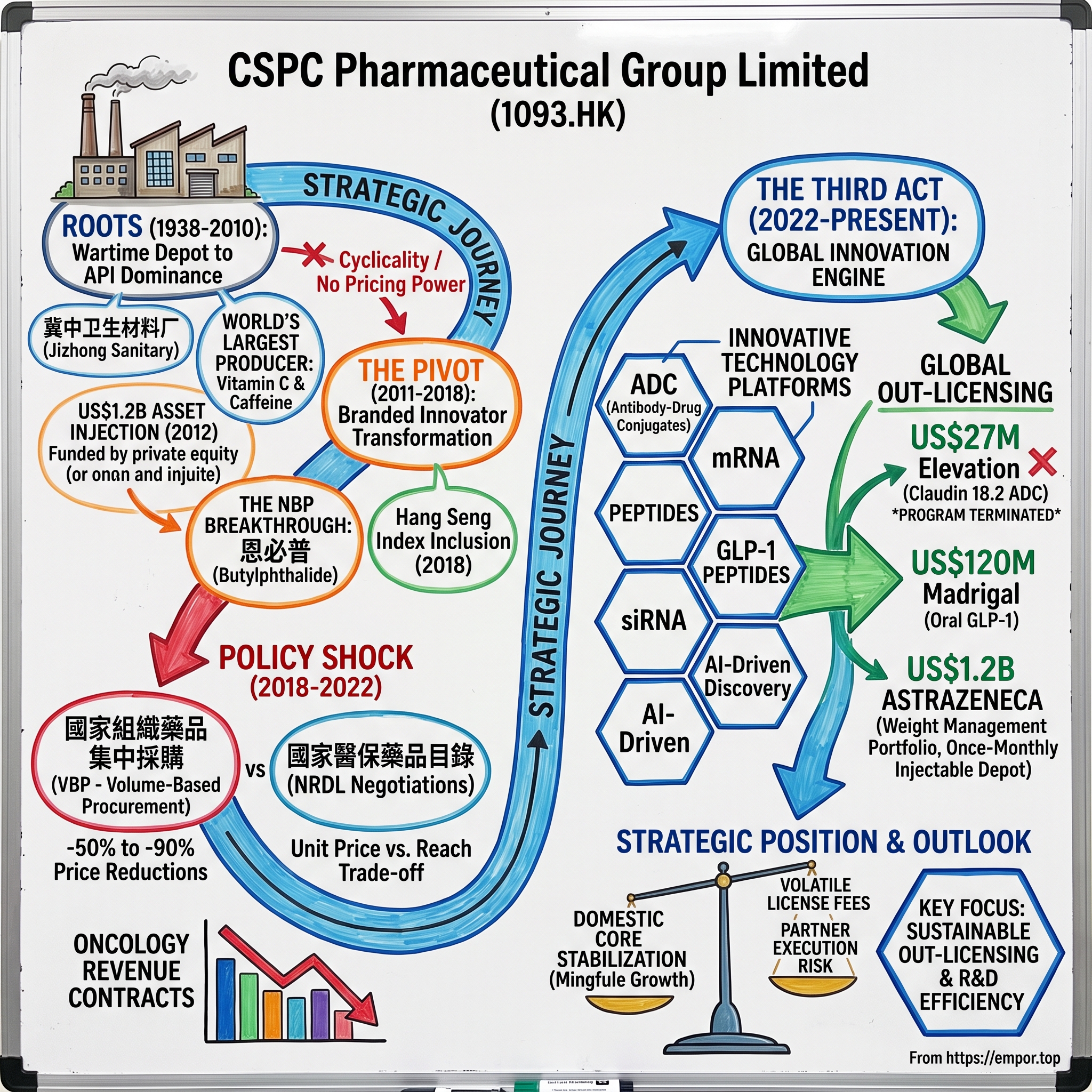
CSPC Pharmaceutical Group: The Transformation of China's Drug Giant
I. Introduction & Episode Roadmap
On 30 January 2026, a Chinese pharmaceutical company headquartered in a provincial industrial hub announced the largest upfront payment ever received by a China-based drugmaker: US$1.2 billion in cash from AstraZeneca for rights to develop a once-monthly obesity injection outside Greater China. The deal's headline value—up to US$18.5 billion including potential development and commercial milestones—exceeded the market capitalization of the receiving company.1
The stock fell more than 10% that day.
That single trading session captures the core tension surrounding 石药集团有限公司 CSPC Pharmaceutical Group Limited (1093.HK, listed on the 香港交易所 Hong Kong Stock Exchange). Over roughly a decade, the business built the internal capabilities to discover novel molecules sought by multinational drugmakers. Yet the market responded to the deal announcement with a sharp sell-off—driven partly by profit-taking after a 38% pre-announcement rally, partly by questions over the asset's clinical competitiveness, and partly by concerns over a core operating business that had contracted for two consecutive years.2
This contrast highlights CSPC's dual identity: a leading innovator in Chinese pharmaceuticals and a prominent casualty of domestic healthcare policy reforms. In 2025, the group's revenue fell 10.4% to 26.0 billion renminbi, marking its third consecutive annual decline from a peak in 2022. Reported net profit attributable to shareholders dropped to 3.88 billion renminbi, while underlying profit—excluding mark-to-market gains and share-based compensation—declined 24.5% to 3.53 billion renminbi.1 Yet during the same period, CSPC signed five out-licensing agreements with a combined headline value of US$28.21 billion, committed 5.81 billion renminbi to R&D—representing 28.2% of its finished-drug revenue—and rose to 19th in Citeline's global ranking of pharmaceutical pipelines.1
These dual dynamics operate simultaneously: domestic revenues face state-enforced price compression, while international assets command premium licensing valuations. The central question is which force will dictate CSPC's long-term trajectory, and what operational evidence will settle the outcome.
The domestic pricing pressure stems from systemic policy shifts. Established in 2018, the 国家医疗保障局 National Healthcare Security Administration (NHSA) consolidated the purchasing power of roughly 1.3 billion insured Chinese citizens into a single procurement agency. Through two primary mechanisms—国家组织药品集中采购 Volume-Based Procurement (VBP) for generic off-patent drugs and 国家医保药品目录 National Reimbursement Drug List (NRDL) negotiations for novel therapies—the agency has systematically lowered pharmaceutical expenditures across China. Five of CSPC's major commercial products have undergone these price reset programs.
CSPC's transition serves as a bellwether for the broader pharmaceutical sector. Over the past three years, global drugmakers facing patent expirations and high development costs have increasingly sourced early-stage molecules from Chinese originators. CSPC ranks among the key Chinese originators driving this shift, distinguishing itself by licensing technological platforms alongside individual drug assets. The company's financial performance over the coming years provides a practical case study in whether cross-border licensing builds durable business models for domestic originators or primarily transfers high-value assets to Western partners.
The analysis unfolds across five movements:
1. Origins: How a wartime medical-supplies unit in Hebei grew into a global low-cost producer of bulk vitamin C and caffeine, illustrating the limits of volume scale without pricing power.
2. The Pivot: How a US$1.2 billion asset injection backed by private equity transformed a commodity supplier into a branded innovator, powered by the stroke drug 恩必普 NBP.
3. Policy Shock: How centralized state purchasing re-architected domestic pharmaceutical margins.
4. Global Out-Licensing: How CSPC commercialized antibody-drug conjugates, mRNA, siRNA, and GLP-1 peptides through multinational partnerships prior to domestic launch.
5. Outlook & Valuation: An examination of segment economics, leadership succession, competitive positioning, and the critical operational evidence that will test the bull case.
The transformation begins with the company's roots—a factory that made bandages.
 Subscribe on LinkedIn
II. Roots: From Wartime Depot to World API Dominance (1938–2010)
In 1938, across the plains of central Hebei, the Eighth Route Army needed gauze, alcohol, and rudimentary medical supplies more than anything else. The unit assembled to produce them was named the 冀中军区卫生材料厂 Jizhong Military Region Sanitary Materials Factory, and CSPC traces its lineage directly to it.3 It was a wartime logistics operation rather than a laboratory, yet the institutional DNA it left behind endured for eighty years: an organization built to manufacture at volume under constraint for a state customer.
By the post-reform decades, that operating culture had produced a globally significant yet thoroughly unglamorous commodity manufacturer. The state-owned chemical plants clustered around 石家庄 Shijiazhuang—a city occupying a position in China's industrial geography similar to Gary, Indiana in the United States—became some of the world's largest producers of bulk active pharmaceutical ingredients: vitamin C, caffeine, and penicillin and cephalosporin intermediates. Enzymatic 7-ACA production came online in 2001, cementing the group's position in antibiotics.3
To understand why this business is both impressive and structurally volatile, consider vitamin C as an economic asset. It is a fermented commodity, chemically identical regardless of manufacturer, sold by the ton into a global market where a handful of Chinese producers supply most of world demand. Customers—vitamin formulators, animal feed producers, and beverage companies—buy strictly on price and delivery reliability. There is no brand equity, no patent protection, and no prescribing physician to persuade. When Chinese producers collectively curtail output or a plant goes offline, prices spike and margins expand for eighteen months. When capacity returns, prices collapse and producers face years of losses. The industry has repeated this cycle for four decades.
CSPC's financial disclosures illustrate this cyclicality. Vitamin C sales rose 15.6% in 2021 on pandemic-era demand and elevated pricing.4 Sales grew another 11.9% in 2025, reaching 2.23 billion renminbi, driven by overseas demand.1 Then in the first quarter of 2026, bulk product revenue dropped 25.7% year over year, a decline the company attributed directly to price falls in vitamin C and penicillin products.5 The same facilities and customer base yielded sharp earnings swings driven by market prices the company could not control.
Yet CSPC departed from its peer group in how it deployed that commodity business. Rather than competing purely on cost, it spent two decades accumulating Western regulatory credentials that most Chinese API producers neglected. The group received an EDQM certificate for caffeine in 2005 and became the first Chinese vitamin C manufacturer to earn EDQM certification in 2006. Its Weisheng subsidiary became the first Chinese vitamin C producer to win EU GMP approval in 2008, and in 2010, a facility passed a U.S. FDA inspection with zero defects.3
Those certifications were far more than routine compliance milestones. Each credential signaled to global procurement managers that the plant operated to a verified standard, granting entry to higher-margin customer segments. Crucially for CSPC's future transition, when the group eventually prepared to file new drug applications in Washington or export complex injectables to Europe, its quality systems were already mature. The company had learned to meet Western regulatory standards long before it had proprietary drugs to sell.
A common misconception in sell-side reports warrants clarification: caffeine is not reported inside CSPC's bulk products segment. The group's disclosed bulk products line comprises vitamin C and antibiotics only; caffeine sits within "functional food and others," alongside the Guoweikang vitamin supplement brand.4 That segment generated 1.77 billion renminbi in 2025.1 The distinction matters for financial modeling and counters the frequent assumption that caffeine represents a high-margin cash engine hidden inside the API division. CSPC has been a major global caffeine producer for decades and received EDQM certification for caffeine as early as 2005,3 but the company does not disclose caffeine revenue, margins, or market share separately. Any specific global caffeine market share attributed to CSPC relies on estimates outside company disclosures.
Into this industrial landscape stepped 蔡东晨 Cai Dongchen. He was not a traditional corporate executive with an elite management background; he earned an MBA from Nankai University later in his career after rising through the operational ranks with extensive technical, marketing, and managerial experience.1 Cai has served as an executive director since April 1997, when four Shijiazhuang pharmaceutical companies merged to form CSPC.13 Three years earlier, in 1994, the listed vehicle had gone public in Hong Kong under the name China Pharmaceutical Group Limited.3
What set Cai apart was an early recognition of the commodity trap. His core strategy—shifting from bulk active ingredients to formulated preparations, and from generic drugs to innovative therapeutics—is now standard rhetoric among Chinese pharmaceutical chief executives. In the late 1990s and early 2000s, however, when API exports were booming and domestic finished-drug marketing remained underdeveloped, reallocating capital away from commodities was a distinctly contrarian move. The company began reorganizing toward preparations manufacturing as early as 2002.3
The pivot was difficult because the API business generated substantial immediate cash flow. While many Chinese industrial peers continuously reinvested in currently profitable commodity lines, CSPC spent roughly fifteen years harvesting API cash flows to fund higher-margin, proprietary drug development. The strategy produced its first major milestone in 2004, when the company unveiled a Class 1 new drug at the Great Hall of the People.3
While Cai has led the organization for three decades, corporate disclosures portray an executive focused on execution rather than public profile. He gives few interviews, maintains no public management manifestos, and occupies four lines of biography in the annual report.1 Capital allocation history shows a consistent pattern: a commitment to building internal capabilities over acquiring them, patience with low near-term returns while technical capacity matures, and a conservative balance sheet with minimal leverage. These operational habits helped the company withstand the administrative repricing of its core domestic revenues years later.
Technical infrastructure developed alongside product lines. CSPC established a postdoctoral program workstation in 1999, earned designation as a National Enterprise Technology Center in 2005, and established a State Key Laboratory of Drug Preparation and Drug Release Technology in 2010.3 For an enterprise deriving most of its cash flow from fermented vitamin C, investing in formulation science reflected a calculated decision that long-term enterprise value would depend on scientific capabilities rather than bulk manufacturing scale.
The commodity era provided CSPC with three enduring assets: world-scale fermentation and chemical manufacturing capabilities, a high tolerance for narrow margins, and internal cash flow to fund a strategic transition. It did not, however, grant the company pricing power. Acquiring that required a breakthrough stroke medication and a complex corporate restructuring.
III. The Great Asset Injection & The NBP Breakthrough (2011–2018)
The molecule at the center of CSPC's transformation came from celery seed.
Butylphthalide—marketed as 恩必普 NBP—was isolated from Chinese celery and developed into China's first Class 1 innovative chemical drug for cerebrovascular disease, an indication of central importance in domestic healthcare. Stroke is China's leading cause of death and disability, with millions of acute ischemic stroke cases presenting annually. CSPC's disclosures state that NBP has benefited more than 40 million patients since its launch.1
The underlying pharmacology explains both the drug's commercial durability and its scientific controversy. When a blood clot blocks a cerebral artery, the immediate tissue core suffers irreversible damage, but the surrounding region—the penumbra—remains ischemic yet viable for a limited window. NBP acts as a neuroprotective agent: rather than dissolving the clot, it aims to improve microcirculation and mitochondrial function within the penumbra, extending the survival window for at-risk tissue. This mechanism offers broad commercial appeal because it applies to a wide spectrum of stroke patients, including those who arrive past the standard therapeutic window for thrombolytic clot-busting treatments.
Yet the therapy remains scientifically contentious for the same reason. Neuroprotection has proven to be a graveyard of failed drug development programs globally—dozens of candidates showed promise in preclinical animal models before failing in human clinical trials—and NBP's clinical evidence base remains overwhelmingly Chinese. Investors must weigh both realities simultaneously: the drug has been administered to tens of millions of patients and is embedded in Chinese clinical guidelines, yet its mechanism belongs to a drug class that Western pharmaceutical developers largely abandoned.
CSPC has continued investing in clinical evidence rather than relying solely on market incumbency. The company launched four "14th Five-Year" research projects around NBP, including the BLESS study in mild stroke and the IMPACT study in cerebral small vessel disease, both initiated in 2025 and designed to support six- to twelve-month treatment regimens.1 This clinical push demonstrates an effort to defend the franchise with data rather than relying purely on sales representatives, though the resulting evidence continues to be generated almost entirely domestically.
Commercially, NBP required an extensive market-building effort. Launched at a price point that Chinese hospitals in the mid-2000s found high, it faced a physician community unaccustomed to the drug class.
To drive adoption, CSPC built a dedicated commercial distribution network. Today, the group fields a professional sales force of more than 10,000 personnel covering medical institutions and retail pharmacies nationwide, with an ongoing push into county-level markets.1 Built initially to market a single neurology therapy to Chinese specialists, this distribution network established the commercial footprint that now makes CSPC an attractive domestic distribution partner.
Establishing that footprint required years of hospital-by-hospital effort. In the late 2000s, commercializing a novel therapy in China meant placing representatives into thousands of individual hospitals—each with its own formulary committee—to convince individual physicians to prescribe an unfamiliar molecule. The process had to be repeated as distribution expanded from tier-one teaching hospitals in coastal cities to secondary and county-level facilities in inland provinces. Without a unified national reimbursement mechanism or central purchasing body to shortcut procurement, expansion proceeded physician by physician over nearly a decade. NBP subsequently accumulated 36 recommendations across professional institutions and clinical guidelines, reflecting the cumulative output of that commercial and medical engagement.1
National reimbursement provided the primary commercial catalyst. Securing inclusion for both the soft capsule and injectable formulations on the National Reimbursement Drug List converted a costly out-of-pocket medication into a state-subsidized therapy, expanding the addressable patient population by an order of magnitude. Reimbursement transformed a niche product into a mainstream blockbuster franchise. However, it also granted state authorities direct pricing leverage over the drug's long-term economics.
Corporate restructuring followed, reshaping the group's financial architecture.
Through the 2000s, the Hong Kong-listed vehicle remained primarily a bulk chemicals producer, while its most valuable finished-drug assets—including NBP—remained outside the listed entity. In 2007, management alongside 弘毅投资 Hony Capital, the private equity arm of 联想控股 Legend Holdings, executed a buyout that privatized the Shijiazhuang group and removed direct state ownership. On 27 June 2012, China Pharmaceutical Group paid US$1.2 billion to acquire Robust Sun Holdings—a CNS-focused finished-drug business—from Joyful Horizon, an entity affiliated with the same private equity sponsor. The stated objective was to expand the finished-drug portfolio and reduce reliance on low-margin intermediates and active pharmaceutical ingredients.6 In 2013, the listed entity was renamed CSPC Pharmaceutical Group Limited.3
Through this transaction, the listed commodity shell absorbed a high-margin branded pharmaceutical business controlled by its major shareholders and financial sponsor. The revenue mix inverted rapidly. Equity markets responded by re-rating the company from a chemical producer to a branded pharmaceutical manufacturer.
Related-party asset injections are common among Hong Kong-listed enterprise groups, though they carry corporate governance trade-offs: controlling shareholders sold assets to an entity they controlled at a valuation they largely determined. Operationally, however, the injected assets delivered. NBP grew into the cornerstone of a central nervous system franchise that generated 7.5 billion renminbi in revenue by 2021,4 generating cash flows that funded the research programs underlying its later international licensing deals. Over a fifteen-year horizon, the 2012 transaction generated substantial minority shareholder value, even as it highlighted the porous boundary between the listed company and its chairman's affiliated entities.
Hony Capital subsequently trimmed its stake through structured equity placements during the mid-2010s. This orderly exit broadened the public float and transitioned the stock from a private-equity-controlled entity to an institutionally held public company, satisfying key liquidity requirements for benchmark index inclusion.
In 2018, CSPC became the first pharmaceutical stock admitted to the flagship Hang Seng Index.37 For an enterprise that began as a bulk vitamin producer, joining Hong Kong's primary benchmark alongside major financial and property conglomerates represented a major capital markets milestone, compelling index-tracking funds to add the stock and elevating CSPC's profile alongside domestic peers 恒瑞医药 Hengrui Pharma and 中国生物制药 Sino Biopharmaceutical.
Index membership brought lower capital costs and broader institutional coverage, but it also introduced passive capital flows driven by macro benchmarks rather than pharmaceutical fundamentals. Unhedged index flows left the shares vulnerable to broader market swings, contributing to the stock's pullback from its 2021 highs and its subsequent range-bound trading.
The group expanded its capital markets presence in 2019, listing its innovative drug subsidiary on the ChiNext board of the Shenzhen Stock Exchange as CSPC Innovation (300765.SZ).31 This structure provided direct access to onshore A-share equity markets and RMB-denominated equity incentives, while introducing multi-entity structural complexity between the parent and subsidiary.
The company achieved a regulatory milestone in December 2019, when 玄宁 Xuanning—levamlodipine maleate, CSPC's single-isomer refinement of amlodipine—received full U.S. FDA approval under the 505(b)(2) pathway, marketed in the United States as Conjupri. It marked the first new drug application from a Chinese pharmaceutical company to secure full FDA approval following standard review.8 While Conjupri generated modest commercial sales in the U.S., the approval validated CSPC's ability to navigate standard FDA review pathways independently.
By 2018, CSPC stood as a Hang Seng constituent backed by a blockbuster neurology franchise, an expanding oncology pipeline, and a proven track record of operational pivots. Shortly thereafter, systemic healthcare reforms introduced centralized procurement policy changes that reshaped the company's core domestic revenue base.
IV. The VBP & NRDL Shockwaves: Facing China's Monopsony (2018–2022)
Every industry faces a defining moment when the identity of its true customer becomes clear. For Chinese pharmaceutical companies, that shift arrived in 2018.
Until then, drug procurement across China was fragmented, provincial, and structurally inefficient. More than 30 provincial tendering systems, each operating under distinct rules, allowed generic medications to sell at vastly different prices in neighboring provinces. Sector economics depended far less on manufacturing efficiency than on the reach and influence of a company's hospital sales force, making commercial marketing expenses—rather than R&D—the dominant budget item.
The establishment of the 国家医疗保障局 National Healthcare Security Administration (NHSA) unified this fragmented market under a single monopsonist buyer. Its primary tool for off-patent drugs, 国家组织药品集中采购 Volume-Based Procurement (VBP), replaced unit-by-unit hospital negotiations with centralized reverse auctions. By aggregating national demand for specific molecules among quality-certified manufacturers, the state awarded guaranteed hospital volume to the lowest bidders. Winning suppliers secured committed hospital volumes with minimal sales expense, while losing bidders were effectively excluded from the public hospital channel. Across successive VBP rounds, reported price reductions routinely reached 50% to over 90%.[^9]
From the state's perspective, VBP did more than lower prices—it dismantled the economic value of massive distribution networks. If sales muscle no longer yields returns on off-patent drugs, a manufacturer's only viable positions become lowest-cost scale or proprietary, non-substitutable innovation. Mid-tier generic producers lacking both advantages faced steady margin erosion and eventual displacement.
For an established producer like CSPC, each procurement round presents a stark binary choice. When a mature, high-margin product is selected for an upcoming tender batch, management must submit a sealed price bid. Bidding too high risks exclusion from the public hospital channel that generates the vast majority of volume—causing revenue to vanish overnight rather than gradually decline. Conversely, bidding too low preserves volume at margins that barely cover production, while price-linkage rules depress reference prices across retail and regional commercial channels. Because consistency evaluations designate competing generic products as bioequivalent, brand equity offers no pricing protection.
The rational strategy is to bid aggressively where low-cost manufacturing scale provides a margin cushion, while surrendering share where costs are uncompetitive. CSPC largely adopted this approach, explaining how the group maintained gross margin stability even as total revenue contracted. Nevertheless, preserving gross margin percentages could not prevent absolute earnings compression.
Operating alongside VBP was the second major policy instrument: annual 国家医保药品目录 National Reimbursement Drug List (NRDL) negotiations. Unlike generic auctions, novel therapies undergo individual negotiations with the NHSA. The structural trade-off pits unit price against patient reach: accepting steep price reductions secures coverage for hundreds of millions of insured citizens, whereas refusing leaves a therapy restricted to a small out-of-pocket market.9
CSPC absorbed sequential pressure from both programs, a dynamic clearly visible across its segmental financial disclosures.
The 恩必普 NBP franchise felt the impact first. After securing NRDL inclusion for both its soft capsule and injectable formulations, newly negotiated price reductions took effect in March 2021. In its annual disclosures, CSPC framed the lower prices as having "greatly improved its affordability and competitiveness," adding that "strong sales volume growth achieved has substantially alleviated the impact of price reduction."4 Financial results confirmed the reality of running faster just to maintain top-line parity: central nervous system segment revenue in 2021 rose 1.8% to 7.54 billion renminbi, with NBP sales flat year over year.4 Rapid volume expansion into secondary and county-level medical institutions succeeded, but only to the extent required to offset lower unit prices.
The contraction in oncology proved far sharper. In 2021, CSPC's oncology portfolio—anchored by 克艾力 Keaili (paclitaxel albumin-bound), 津优力 Jinyouli (PEG-rhG-CSF, China's first domestically developed long-acting white blood cell booster), and Duomeisu—generated 7.71 billion renminbi, expanding 22.5% to briefly surpass central nervous system drugs as the group's largest therapeutic division.4 By 2024, oncology revenue had dropped to 4.40 billion renminbi. By 2025, it fell to 2.20 billion renminbi—a 50.0% single-year decline and a 71.5% drop from its 2021 peak.1
This revenue decline reflected policy re-pricing rather than falling clinical demand. CSPC attributed the drop primarily to Duomeisu's inclusion in the tenth batch of national centralized procurement, followed by additional pressure when the Beijing-Tianjin-Hebei "3+N" regional alliance extended procurement terms to Jinyouli.1 Underlying physical volumes remained intact, but revenue per unit contracted severely. For investors, the division's trajectory illustrates a central vulnerability: a therapeutic franchise built over a decade, growing at over 20% annually, lost nearly three-quarters of its revenue within four years due to centralized purchasing mandates unmitigated by brand reputation or commercial distribution scale.
The anti-infective and cardiovascular divisions experienced similar price erosion over a longer timeline. Anti-infective product sales fell 18.7% in 2025 to 3.32 billion renminbi, driven by lower revenue from Anfulike, azithromycin brand Weihong, and ceftriaxone brand Xianqu.1 In cardiovascular care, aspirin brand Abikang and clopidogrel brand Encun both saw revenue contract following successful VBP bids and subsequent price linkage—the mechanism through which national winning tender prices depress rates across regional and retail channels.1 玄宁 Xuanning, the group's FDA-approved antihypertensive flagship, held sales roughly flat.1 Clearing U.S. regulatory standards provided no insulation against domestic price compression.
Rather than cutting costs uniformly, management increased research spending continuously throughout the revenue squeeze. R&D expenses rose from 2.89 billion renminbi in 2020 to 3.43 billion renminbi in 2021, 3.99 billion renminbi in 2022, 5.19 billion renminbi in 2024, and 5.81 billion renminbi in 2025—an 11.9% increase in a year when total revenue fell 10.4%.1410 By 2025, R&D expenditures represented 28.2% of finished-drug revenue.1 Sustaining absolute R&D growth during a multi-year top-line contraction is rare among global pharmaceutical peers. Whether this capital allocation strategy builds long-term value or overextends resources depends on future clinical candidate returns, but it underscores a multi-year investment cycle.
A skeptical perspective offers an alternative interpretation of this spending pattern. Sustained R&D investment during a downturn may reflect strategic conviction, but it can also stem from capital lock-in: terminating late-stage clinical trials carries substantial financial write-offs and reputational damage, making ongoing trial expenses quasi-fixed costs. Differentiating strategic intent from inertia requires examining portfolio prioritization. CSPC has demonstrated deliberate reallocation: while its program count expanded, the group redirected development capital away from legacy generic formulations and toward eight proprietary technology platforms. Its disclosed development pipeline is heavily weighted toward biologicals, featuring over 90 large-molecule candidates compared with approximately 60 small-molecule compounds and 50 novel formulations.1 This shift points to strategic portfolio restructuring rather than unguided spending expansion.
This R&D focus was accompanied by aggressive operational cost reductions elsewhere. Selling and distribution expenses dropped 25.4% in 2025 to 6.46 billion renminbi from 8.66 billion renminbi, as products entering centralized procurement no longer required extensive field support. Administrative expenses fell 23.5%.1 A key structural offset of VBP is that while centralized tenders compress gross sales, they eliminate the field commercial overhead previously required to maintain hospital volume. Consequently, CSPC's gross margin held at 65.6% in 2025, down 4.4 percentage points year over year,1 demonstrating resilience in underlying manufacturing unit economics.
Group revenue peaked in 2022 at 30.94 billion renminbi, generating reported net profit of 6.09 billion renminbi.10 Subsequent performance reflected a managed contraction as the business accelerated its pivot toward innovative assets insulated from administrative price resets.
Corporate disclosures from 2021 and 2025 reveal a clear evolution in executive communication. The 2021 annual report described a year "full of challenges and uncertainties" in which the group "continued to deliver satisfactory results," focusing on products maintaining sales momentum.4 By contrast, the 2025 business review acknowledged that the group "proactively addressed market challenges brought about by the full rollout of centralised procurement policies," explicitly naming Duomeisu and Jinyouli as the primary drivers of top-line declines and detailing contraction across specific therapeutic categories.1 This transition from generalized policy commentary to itemized disclosures offers investors greater transparency when evaluating operational performance.
V. The Third Act: ADCs, mRNA, GLP-1, and Global Out-Licensing (2022–Present)
If the state will not pay premium prices for your innovation, sell it to someone who will.
That, stripped of strategic language, is the "创新与国际化 Innovation and Internationalisation" dual-engine strategy that now defines CSPC. The company built dedicated innovation vehicles — most visibly 石药集团巨石生物 CSPC Megalith Biopharmaceutical — and set about proving that Chinese-originated molecules could clear the only bar that generates hard currency: a Western pharmaceutical company's own due diligence.
Start with the technology, in plain terms.
An antibody-drug conjugate is a targeting system. Chemotherapy poisons every fast-dividing cell in the body, which is why it causes the side effects everyone associates with cancer treatment. An ADC attaches a chemotherapy payload to an antibody that binds a protein found predominantly on tumour cells, so the poison is delivered where it is needed. The engineering difficulty lies in the three components almost nobody outside the field discusses: the payload's potency, the linker that holds it to the antibody and must not release early in the bloodstream, and the conjugation chemistry that determines how many payload molecules attach and where. Get the linker wrong and you have built a systemic poison with an expensive antibody attached. China has become unusually good at this specific engineering problem, and CSPC has more than ten ADC candidates in clinical stages.1
The commercial model CSPC adopted was to develop these assets to early clinical proof-of-concept in China — where patient recruitment is faster and per-patient trial costs are a fraction of US levels — and then license ex-China rights to Western partners for cash upfronts plus milestones and royalties.
Why does this arbitrage exist at all? Three reasons, none of them mysterious. China has a very large population of treatment-naive cancer patients concentrated in high-volume hospitals, which means a trial that would take three years to enrol in the United States can enrol in one. Clinical trial costs per patient are dramatically lower. And Chinese regulators have, over the past decade, built an approval system modelled closely enough on Western practice that the resulting data packages are legible to the FDA and EMA. The combination lets a Chinese company answer the single most expensive question in drug development — does this molecule do anything in humans — for a fraction of what a Western company would spend, and then sell the answer.
The corollary, which bulls tend to skip, is that the arbitrage is available to every Chinese company simultaneously. It is a national structural advantage, not a company-specific one. What differentiates CSPC from its domestic peers has to be the quality of the molecules it feeds into that system, and that is a much harder thing to underwrite from outside.
The track record is instructive precisely because it is mixed.
The first significant deal came in July 2022, when CSPC Megalith licensed EO-3021 (SYSA1801), a Claudin 18.2 ADC, to Elevation Oncology for US$27 million upfront and up to roughly US$1.15 billion in development, regulatory and commercial milestones.11 Three years later, in March 2025, Elevation discontinued the programme. The Phase 1 data showed an objective response rate of 22.2% and a disease control rate of 72.2% in evaluable gastric and gastroesophageal junction cancer patients — a differentiated safety profile, but efficacy that Elevation's CEO said did not "meet our bar for success" against competing Claudin 18.2 ADCs. The company cut 70% of its workforce.12
That outcome is the single most important reality check in this entire section. CSPC kept its US$27 million. The programme is dead. This is the structural asymmetry of the out-licensing model in both directions: the licensor is paid for optionality, not for success, and the headline "up to US$1.15 billion" was always a number with a very low probability attached.
February 2023 brought a second ADC deal — CRB-701 (SYS6002), a Nectin-4 ADC, licensed to Corbus Pharmaceuticals for US$7.5 million upfront plus up to US$130 million in development and regulatory milestones and up to US$555 million in commercial milestones.[^14] That asset is still alive; CSPC itself enrolled the first subject in a Chinese Phase III trial in second-line-and-beyond cervical cancer in December 2025.1 In February 2025, SYS6005 — a ROR-1 ADC — went to Radiance Biopharma for US$15 million upfront, up to US$150 million in development milestones and up to US$1.075 billion in sales milestones, plus tiered royalties, covering the US, EU, UK and a list of other Western markets.113
Notice the pattern in the upfronts: US$27 million, US$7.5 million, US$15 million. These were small-biotech deals, structured as options, priced accordingly. They validated the science and generated publicity. They did not move the earnings needle.
Then the size of the counterparty changed.
In May 2025, CSPC licensed US commercialisation rights for its irinotecan liposome injection to Cipla USA for US$15 million upfront and up to US$1.05 billion in cumulative milestones.1 In June 2025 came the first AstraZeneca agreement — a strategic research collaboration in which CSPC would deploy its AI-driven, dual-engine discovery platform to generate pre-clinical candidates against multiple targets selected by AstraZeneca, including an oral small molecule for immunological disease. Terms: US$110 million upfront, up to US$1.62 billion in development milestones, up to US$3.6 billion in sales milestones, plus tiered royalties.1
This deal deserves more attention than its headline received, because it is qualitatively different from an ADC out-licence. AstraZeneca was not buying a molecule. It was buying access to a discovery method. CSPC's framing — an "upgrade from overseas expansion for product to overseas expansion for platform and technology" — is self-serving marketing language, but in this instance the deal structure supports it.1 Companies do not pay nine figures upfront for a screening service they could replicate internally.
What does "AI-driven, dual-engine drug discovery" actually mean? Stripped of jargon: the traditional way to find a small-molecule drug is to physically screen enormous libraries of compounds against a target protein and see what sticks, then chemically modify the hits over years. It is slow, expensive, and largely empirical. The computational approach models how candidate molecules would bind to the three-dimensional structure of a target protein and ranks them by predicted fit before anyone synthesises anything, so the chemists start with a much smaller and better-informed set. CSPC describes its system as analysing the binding patterns of target proteins with existing compound molecules to identify those with the highest probability of clinical success.1
Nobody in the industry has yet proven that computational discovery reliably produces better drugs. The honest state of the art is that it produces candidates faster, and in an industry where a year of development time costs tens of millions of dollars, speed alone is worth paying for. The two assets that emerged from this approach and were licensed to AstraZeneca — a lipoprotein(a) disruptor and a MAT2A inhibitor — are the practical evidence that the output is saleable, and the AR notes that CSPC's success here helped set off a broader wave of AI-driven small molecule research among Chinese developers.1
The parallel investment in small nucleic acid therapeutics deserves a mention because it is where the next wave of CSPC's licensing candidates is likely to come from. siRNA drugs work by intercepting the messenger instructions a cell uses to build a specific protein — silence the message and the protein is never made. Because the effect is upstream of protein production, dosing can be extraordinarily infrequent, sometimes twice a year. CSPC has moved PCSK9 and AGT programmes into clinical trials and obtained clinical approvals during 2025 for an Lp(a) siRNA, an ANGPTL3 siRNA for hypertriglyceridemia, and a C5 siRNA for IgA nephropathy, several of them cleared by both Chinese and US regulators.1 Cardiovascular and renal siRNA assets are precisely what large Western pharmaceutical companies are currently shopping for.
The regulatory throughput behind all this is worth quantifying, because it is the operational metric that makes the licensing business possible. In 2025 CSPC obtained 14 manufacturing approvals and 73 clinical trial approvals in China, plus five Breakthrough Therapy Designations, and separately received clinical trial approval for 18 innovative drugs in North America.1 The company also operates what it calls a "dual China-US regulatory submission" strategy, initiating multi-centre trials across Europe and America.1 Filing in both jurisdictions from the start is more expensive and slower than filing in China alone. It is also the only way to make an asset saleable to a Western partner at a premium, because it removes the buyer's biggest objection — that the data package will not travel.
In July 2025, Madrigal Pharmaceuticals took worldwide rights to SYH2086, an oral small-molecule GLP-1 receptor agonist, for US$120 million upfront within a package worth up to US$2.075 billion, with CSPC retaining Chinese rights to other oral GLP-1 assets.1
And then, on 30 January 2026, the deal that changed the arithmetic.
AstraZeneca returned for CSPC's once-monthly injectable weight-management portfolio: eight programmes in total, led by SYH2082, a long-acting GLP-1 receptor/GIP receptor dual agonist entering Phase I, plus three pre-clinical programmes with differing mechanisms and four additional new programmes — together with access to CSPC's sustained-release delivery platform and AI-driven peptide discovery platform. AstraZeneca received exclusive worldwide rights excluding the Chinese mainland, Hong Kong, Macao and Taiwan. CSPC received US$1.2 billion upfront, with up to US$3.5 billion in research and development milestones and up to US$13.8 billion in sales milestones, plus tiered royalties.11415
The technology at the centre is worth explaining, because it is the actual product. Current GLP-1 obesity drugs are weekly injections. The bottleneck to monthly dosing is not the peptide — it is delivery. CSPC's approach uses an injectable depot: a formulation that forms a gel under the skin after injection and releases the peptide slowly over weeks. The company has been building this in situ gel platform across multiple molecules, with long-acting octreotide, semaglutide and leuprorelin all in clinical trials.1 If it works, the competitive claim is not "a better GLP-1" — it is "the same class of drug, one injection a month instead of four." In a market where adherence and discontinuation rates are the dominant commercial problem, that is a legitimate differentiator.
Which brings us back to the 10% share price decline.
Investor scepticism, as reported at the time, rested on three things.
First, mechanics: rumours of a major partnership had circulated since December and had already driven the shares up roughly 38%, so the announcement was an exit event for momentum holders rather than new information.2
Second, the asset. SYH2082 was entering Phase I in a field where Eli Lilly and Novo Nordisk have approved, revenue-generating dual agonists and deep late-stage pipelines. Being years behind on efficacy data while promising a delivery advantage is a real vulnerability, and one that a Phase I start does nothing to resolve.2
Third — and most damaging — governance. In November 2025, executive director Pan Weidong received the maximum RMB5 million penalty from China's securities regulator for trades made in 2023 using non-public information about a planned group restructuring. He had bought 2.74 million shares in ChiNext-listed subsidiary CSPC Innovation through a securities account held by a wholly-owned group subsidiary. Three other former executives were penalised for related trades, and Pan resigned.2
The shares closed that session down 10.20% at HK$9.60, with CSPC Innovation down 15.72%.2
An investor is entitled to ask what an insider-trading case involving a wholly-owned subsidiary's brokerage account says about internal controls at a company now handling billion-dollar cross-border cash flows. It is a fair question, and CSPC's disclosures do not answer it beyond confirming the penalty and the resignation.
Alongside the licensing effort runs a quieter and much less discussed international push: selling CSPC's own products abroad. The company is pursuing marketing authorisation for liposomal amphotericin B in the United States and the European Union, and is advancing product registration and sales in Singapore, Thailand, Russia and Vietnam under the "Belt and Road" framework, including building an academic promotion platform in Southeast Asia.1 This is unglamorous, slow work with none of the headline value of a billion-dollar licence. It is also the only path by which CSPC captures the full economics of a product rather than a royalty. Investors evaluating whether the company is building a durable global business, as opposed to renting out its pipeline, should watch this line — the company does not currently disclose overseas product revenue separately, which is itself a disclosure gap worth noting.
The mRNA programme rounds out the platform story. CSPC developed China's first domestically originated COVID-19 mRNA vaccine, SYS6006, cleared for emergency use in early 2023, with a bivalent update, SYS6006.32, added in December 2023.1[^18]
Commercially, the vaccine was close to irrelevant. It arrived after China's exit wave, when demand had already collapsed. Strategically it bought something far more durable: a working lipid nanoparticle formulation-and-manufacturing capability, developed under emergency conditions and validated by a regulator.
CSPC has since pushed that capability into a varicella zoster mRNA vaccine and an HPV therapeutic mRNA vaccine, both in clinical trials, and claims to be the first in the world to advance an LNP/mRNA-based CAR-T therapy into the clinic, with studies in multiple myeloma, lupus erythematosus and myasthenia gravis.1
That last programme deserves explanation, because if it works it is the most valuable thing in the company. Conventional CAR-T therapy requires extracting a patient's own T-cells, shipping them to a specialised facility, genetically re-engineering them to recognise a cancer, growing them, and infusing them back — a bespoke manufacturing process per patient that costs hundreds of thousands of dollars and takes weeks. Doing the reprogramming inside the body, by injecting an mRNA-loaded lipid nanoparticle that instructs the patient's own T-cells directly, would replace bespoke manufacturing with a vial. It would also extend the approach from cancer into autoimmune disease, where the patient populations are vastly larger. It is early, unproven, and exactly the kind of asset that is worth either a great deal or nothing.
Meanwhile, the cash has started arriving. CSPC confirmed receipt of the US$1.2 billion AstraZeneca upfront in May 2026.16 The accounting consequence landed on 27 July 2026, and it reframed the entire investment case for the current year.
VI. Segment Economics, Management & Capital Allocation
On 27 July 2026, CSPC issued a positive profit alert. First-half profit attributable to equity holders was expected to reach 5.9 billion to 6.2 billion renminbi, up from 2.55 billion renminbi in the first half of 2025. The primary driver was US$840 million—roughly 5.74 billion renminbi—of the upfront payment from AstraZeneca, recognized as licence fee income in the second quarter.16
Beneath that headline figure lay the metric that dictates the long-term outlook: excluding licence fee income entirely, finished-drug sales revenue in the first half of 2026 grew approximately 10% year over year.16 After three years of contraction, the underlying commercial business appeared to stabilize.
That trajectory defines CSPC today: periodic, substantial licensing receipts grafted onto a domestic pharmaceutical business that is recovering from regulatory repricing.
Finished drugs — the operating core. In 2025, finished drugs generated 20.58 billion renminbi, accounting for 79% of group revenue, down 13.3% year over year. Critically, that top-line figure included 1.79 billion renminbi of licence fee income; underlying product sales were 18.80 billion renminbi, down 20.8%.1 Within finished drugs, the central nervous system franchise remained the largest segment at 7.82 billion renminbi despite a 19.0% decline caused by NBP's NRDL price adjustment. However, the neurology portfolio now has a second growth engine.
明复乐 Mingfule, CSPC's tenecteplase, is a clot-dissolving thrombolytic that complements NBP's neuroprotective mechanism: one opens the blocked artery, while the other protects ischemic tissue during reperfusion. Mingfule is also the first thrombolytic in China approved for pre-hospital administration in ambulances—a timing advantage in acute stroke care, where rapid treatment is critical to preserving brain tissue.1
Mingfule expanded substantially in 2025, supported by clinical trial data published in major medical journals: the BRIDGE-TNK study in The New England Journal of Medicine, ANGEL-TNK in JAMA, and TRACE-5 accepted by The Lancet.1 In January 2026, the American Heart Association and American Stroke Association elevated tenecteplase to a first-line intravenous thrombolytic alongside alteplase, validating the therapeutic class internationally even though Mingfule remains approved only in China.1
For a company whose central nervous system division relied for years on a single aging blockbuster, adding a second clinical-stage stroke therapy reduces single-product reliance and demonstrates that CSPC's research organization can commercialize multiple major therapies.
Elsewhere in the portfolio, respiratory products grew 2.0% and other therapies rose 15.5%, while oncology, anti-infectives, cardiovascular, and digestion and metabolism products all contracted.1 Newly launched products expanded—Duoenyi and Enshuxing posted steady gains, and Ansulike emerged as a growth driver in anti-infectives—but their volume growth has not yet scaled sufficiently to offset revenue losses from centralized procurement.1
Bulk products. Bulk product revenue reached 3.66 billion renminbi in 2025, up 2.1%. This was split between vitamin C at 2.23 billion renminbi (up 11.9%) and antibiotics at 1.43 billion renminbi (down 10.2% due to price cuts on penicillin and carbapenem products).1 The segment remains highly cyclical and low-growth—and as demonstrated in the first quarter of 2026, when segment revenue fell 25.7%, vulnerable to sharp price collapses.5 The division functions as a variable-margin cash source rather than a growth driver.
Functional food and others. Revenue reached 1.77 billion renminbi, up 4.5%, driven by the Guoweikang vitamin supplement brand and including caffeine sales.1 The business remains small, stable, and strategically peripheral.
A notable disclosure gap limits granular analysis: CSPC reports revenue by therapeutic category but does not disclose product-level revenue for major individual drugs or operating profit by therapeutic segment. Annual reports do not break out individual sales figures for NBP, Mingfule, or Keaili. Consequently, market estimates of individual product performance rely on therapeutic-area totals and management's qualitative commentary on relative growth.1 Similarly, while group gross margin is disclosed, the lack of segment margin details means the common assertion that finished drugs generate virtually all operating profit remains a logical inference from cost structures rather than a published figure.
Management and the succession. On 19 December 2025, 蔡磊 Cai Lei was appointed Vice-Chairman, executive director, and Chief Executive Officer, succeeding Zhang Cuilong, who stepped down from those roles while remaining on the board.1 Cai Lei, 46, is the elder son of the chairman. He holds a bachelor's degree in biochemistry from Beijing Normal University and a doctorate from the National University of Singapore, joined the group in April 2014, and served as executive president, vice president of the U.S. R&D division, and president of the pharmaceutical products sales division before his promotion.1 His younger brother, Cai Xin, also serves as an executive director.1
The incoming CEO previously managed both U.S. R&D and domestic pharmaceutical sales, placing him at the intersection of commercial execution and pipeline internationalization. Nevertheless, this represents a family succession: the chairman and his two sons all sit as executive directors, and the chairman holds a beneficial interest in approximately 25.31% of the issued shares through a chain of holding companies including True Ally Holdings, Massive Giant Group, and Key Honesty.1 Significant equity ownership aligns family interests with equity value, though it does not ensure independent board oversight.
Related-party transactions warrant scrutiny. In 2025, the group sold a 30.07% equity interest in Beijing Guoxin Huijin to CSPC Holdings Company Limited for 230 million renminbi—a connected transaction, as the chairman holds an indirect interest of over 30% in the buyer.1 While the transaction size is modest relative to group assets, it illustrates ongoing asset transfers between the listed entity and family-controlled vehicles.
Capital allocation. CSPC's capital deployment has remained more conservative than its aggressive R&D strategy suggests. The full-year 2025 dividend rose 11.5% year over year to 29 Hong Kong cents per share, with the final dividend increasing 50% to 15 Hong Kong cents—a payout expansion declared despite a 24.5% decline in underlying profit.1 The group also repurchased and canceled 64.3 million shares for approximately HK$300 million during 2025.1 Capital expenditures decreased from 2.10 billion renminbi to 1.90 billion renminbi, primarily allocated to manufacturing facilities.1 The balance sheet remains virtually unlevered, holding 9.48 billion renminbi in cash and bank deposits plus 2.78 billion renminbi in structured deposits against 329 million renminbi in bank borrowings, yielding a gearing ratio of 1.0%.1 Operating cash flow rose from 4.54 billion renminbi to 5.83 billion renminbi,1 and total headcount stood at approximately 19,700 employees.1
Capital allocation has favored internal R&D, dividends, share repurchases, and facility maintenance over large debt-funded acquisitions or equity dilution.
How to read the accounts. Three technical accounting items affect reported financial results.
First, CSPC reports a non-HKFRS "underlying profit" metric that excludes fair value adjustments on financial assets and employee share-based compensation.1 In 2025, these adjustments moved against reported results: reported net profit of 3.88 billion renminbi included a 296 million renminbi fair value gain and a 66 million renminbi reversal of share-based compensation expenses. Underlying profit was lower at 3.53 billion renminbi, marking a 24.5% year-over-year decline rather than the 10.3% drop in reported net profit.1 While non-GAAP metrics often flatter earnings, CSPC's adjustment presented a conservative view in 2025. However, because fair value fluctuations stem from investments in funds, partnerships, and listed equities, reported net profit can diverge significantly from core operational performance.
Second, upfront licensing payments for rights-to-use agreements are initially recorded as contract liabilities and recognized as revenue only as performance obligations are met. At the end of 2025, the group held 1.28 billion renminbi in upfront fees received in advance.1 The AstraZeneca deal illustrates this accounting mechanic: of the US$1.2 billion cash received, US$840 million was recognized as revenue in the second quarter of 2026, with the remainder deferred.16 Consequently, cash inflows, reported revenue, and net profit fluctuate across reporting periods.
Third, CSPC includes licence fee income directly within the finished drugs segment rather than reporting it as a standalone revenue line. The reported 13.3% decline in finished drugs revenue for 2025 included 1.79 billion renminbi in licensing fees; excluding those fees, core product sales fell 20.8%.1 Evaluating segment revenue without stripping out licensing fees obscures the underlying commercial contraction—and conversely, during periods of large upfront receipts such as mid-2026, exaggerates product growth.
Two additional operational notes complete the corporate profile: Deloitte Touche Tohmatsu serves as the group's auditor, and the company reported no material contingent liabilities at the end of 2025.1 Additionally, CSPC has maintained an 'A' rating in MSCI ESG ratings for five consecutive years—a notable benchmark for a heavy chemical and pharmaceutical manufacturer based in Hebei Province.1
With the pieces on the table, the question becomes whether any of this is defensible.
VII. Strategic Position: Hamilton Helmer's 7 Powers & Porter's 5 Forces
Running a company through formal strategy frameworks forces an observer to distinguish between features that are impressive and traits that are durable. CSPC possesses plenty of the former; the key question is how much of the latter remains.
Hamilton Helmer's 7 Powers
A caveat before applying these frameworks: both were developed to evaluate businesses operating in market economies with dispersed buyers. Applied to a firm whose primary customer is a state agency capable of setting prices by decree, the powers describe present capabilities rather than guaranteed future earnings. A strong score across every power remains vulnerable to an administrative price reduction.
Cornered Resource — real but decaying. NBP was a genuine cornered resource: an exclusive, patent-protected molecule in a major indication with no direct equivalent. That protection erodes on a set timetable. Replacing it is a broader suite of technology platforms—spanning ADC linker-payload chemistry, LNP delivery, in situ gel depots, and AI discovery engines—across eight disclosed innovative R&D platforms with more than 200 innovative drugs and preparations under development and over 160 active clinical trials.1 Proprietary platforms offer a weaker defense than a patented blockbuster because rivals can build competing systems. However, AstraZeneca paid US$110 million and later US$1.2 billion for access to two of CSPC's platforms rather than recreating them internally.1 That counterparty validation demonstrates tangible commercial demand.
Scale Economies — genuine in two places. World-scale fermentation capacity in vitamin C provides a genuine unit-cost advantage, allowing CSPC to endure price downturns that eliminate higher-cost competitors. The company's 10,000-person hospital and retail sales network provides a second scale advantage, creating lower marginal distribution costs for each new therapy introduced.1 However, centralized purchasing has substantially reduced the economic value of that distribution network for off-patent therapies. The commercial team now serves primarily as a vehicle for launching innovative products rather than defending off-patent brands—a narrower competitive advantage than in 2018.
Process Power — moderate to high, and underrated. The group's complex formulation manufacturing is difficult to replicate. Liposomal and albumin-bound nanoparticle therapies—including Duoenyi, Duoenda, the paclitaxel and docetaxel lines, and liposomal amphotericin B—require precise process control beyond the reach of standard generic manufacturers. Duoenda represents the world's first approved mitoxantrone liposomal formulation with multi-country patents,1 while CSPC is pursuing marketing authorization for liposomal amphotericin B in the United States and the European Union.1 Complex injectables remain one of the few off-patent categories where specialized manufacturing commands a premium, as regulators cannot grant straightforward bioequivalence.
Counter-Positioning — the strongest current power, and the most fragile. CSPC's core structural edge lies in its ability to take a molecule from design to human proof-of-concept faster and at significantly lower cost than Western peers before licensing the de-risked asset. Western pharmaceutical companies cannot easily match this model due to higher structural overhead, clinical site costs, and slower patient recruitment timelines. This cost and speed asymmetry forms a classic counter-positioning advantage. Its fragility stems from external dependencies: Western regulators must continue accepting Chinese clinical data, and cross-border commercial relationships must remain politically viable. Neither factor is fully within the company's control.
Switching Costs and Network Effects — essentially absent. When the NHSA selects a winning drug under centralized procurement, hospitals shift volume immediately. Customer stickiness is minimal, leaving CSPC without durable switching costs or network effects in its domestic market.
Branding — limited. Encun, CSPC's clopidogrel brand, was the first Chinese-produced clopidogrel to gain U.S. FDA approval and holds the second-largest sales volume in China behind the originator.1 While this reflects established product reputation, brand recognition did not prevent price compression following centralized procurement bidding.1
Porter's Five Forces
Buyer power — extreme, and the defining fact of the business. A single state buyer dictates pricing for the vast majority of China's pharmaceutical market, routinely imposing price cuts between 50% and 90% without facing commercial purchasing competition.[^9] This monopsony power represents the primary structural constraint on domestic earnings.
A countervailing policy shift has emerged. On 30 June 2025, the NHSA and the National Health Commission jointly issued guidelines to support innovative drug development, establishing a framework covering R&D support, accelerated market access, flexible assessment criteria, and expanded payment mechanisms.1 China approved a record 76 innovative drugs in 2025.1 These measures signal an intentional policy reallocation from mature generics toward novel therapies. While this policy shift offers a strategic tailwind, its financial impact remains dependent on future revenue realization.
Rivalry — intense and rising. Established domestic peers including Hengrui, Sino Biopharmaceutical, 翰森制药 Hansoh Pharma, and numerous specialized biotechnology firms are pursuing similar transition strategies. Competition has expanded from Chinese hospital sales channels to international licensing partnerships. Recent landmark transactions, such as GSK's alliance with Hengrui and Pfizer's US$1.25 billion deal with 3SBio for a PD-1/VEGF bispecific, illustrate the competitive benchmarks CSPC faces in global dealmaking.17
Threat of substitutes — high for generics, moderate for innovative assets. Generic substitution is legally enforced through centralized purchasing design. For NBP, competitive substitutes include alternative neuroprotective agents alongside expanding access to mechanical thrombectomy and rapid thrombolysis, which narrow the therapeutic window where neuroprotection is administered.
Supplier power — low. Backward integration into chemical synthesis and fermentation remains an enduring advantage from CSPC's commodity API origins. Internal raw material production helped preserve gross margins above 65% despite significant pricing adjustments.1
Threat of new entrants — low in the segments that matter. Establishing an ADC technology platform, mRNA manufacturing infrastructure, and a 10,000-person commercial distribution network requires substantial capital and years of execution. While entry barriers into commodity generic drugs remain low, capital requirements in advanced biopharmaceuticals create significant entry barriers.
Where CSPC sits against its peers. The relevant comparison for CSPC is not Western pharmaceutical multinationals, but the select group of domestic drugmakers navigating the same structural transition. Hengrui maintains the largest domestic pipeline and secured a major global partnership with GSK in 2025,17 while Sino Biopharmaceutical has leveraged acquisitions alongside its hepatology presence, and Hansoh established early momentum in out-licensing oncology and metabolic assets. Against these peers, CSPC demonstrates three distinct characteristics: a diversified technology footprint across eight platforms—including ADC, mRNA, siRNA, cell therapy, complex formulations, and AI-driven discovery—rather than concentration in a single modality; large-scale formulation manufacturing inherited from its bulk API history; and a willingness to out-license underlying technology platforms alongside individual drug candidates.1
However, this broad strategy presents trade-offs. Spreading a 5.81 billion renminbi annual research budget across eight technology platforms allocates modest capital to each initiative relative to specialized global competitors. Whether this multi-platform approach creates valuable portfolio optionality or dilutes R&D efficiency remains the central test of CSPC's long-term strategy, answerable only through future clinical and commercial execution.
In summary, state procurement policies have substantially eroded CSPC's traditional domestic moat. The company's emerging moat—a cost and speed advantage in early-stage drug development monetized through multinational partnerships—is operationally validated, currently profitable, and actively contested by domestic peers executing similar strategies. CSPC possesses a clear competitive edge, but maintaining that advantage requires continuous pipeline execution.
VIII. The Bull vs. Bear Case & Investor Stress Test
Late in July 2026, CSPC shares traded around HK$8.55, capitalising the company at roughly HK$98 billion, within a twelve-month range of HK$6.53 to HK$11.63.18 The market, in other words, has spent a year unable to decide what this business is worth — which is the correct response to a company whose profit can more than double on one wire transfer.
The bull case, stated at its strongest.
The first pillar is that the innovation has been externally validated by the most demanding possible referee, twice, by the same company. AstraZeneca is not a small biotech taking a cheap option. It ran diligence on CSPC's AI discovery platform in 2025 and returned six months later to write a US$1.2 billion cheque for the peptide platform and eight programmes.1 Repeat business from a sophisticated buyer is stronger evidence than any single deal, and it says that at least one Big Pharma R&D organisation believes CSPC's platforms produce assets it cannot produce as cheaply itself.
The second pillar is that the cash is real and the accounting has caught up with it. The US$1.2 billion was received in May 2026 and US$840 million recognised in the second quarter, driving first-half profit to an expected RMB5.9–6.2 billion against RMB2.55 billion a year earlier.16 Unlike a milestone-heavy structure that may never pay, this is money in the bank, funding R&D without dilution.
The third pillar is the underlying turn. Stripping licence fees out entirely, first-half 2026 finished-drug sales grew approximately 10%.16 If that holds, the procurement drag has been lapped and newly launched products — Enshuxing, Ansulike, Enyitan, Mingfule, prusogliptin — are large enough to grow the base.
The fourth is the funding structure. A group with RMB12.3 billion of cash and deposits against RMB329 million of borrowings, generating RMB5.8 billion of annual operating cash flow, can fund a RMB5.8 billion research budget indefinitely without touching the equity market.1 Very few pharmaceutical companies attempting a transformation of this scale can say that.
The fifth, and the one bulls lean on hardest, is multiple. A company earning most of its profit from price-controlled Chinese generics deserves a low multiple. A company earning a rising share from proprietary platforms licensed globally in dollars deserves a higher one. Licence fee income has gone from RMB18 million in 2024 to RMB1.79 billion in 2025 to a single quarter of RMB5.74 billion in 2026.116 Management has stated the goal of making out-licensing "one of the stable, recurring revenue streams of the Group."1
The bear case, and the stress test.
Start with that last claim, because it is where a sceptic should press hardest. There is a fundamental tension in describing out-licensing as recurring revenue. Each deal sells rights to an asset once. To make the line recur, you must keep producing new assets of comparable quality and keep finding buyers willing to pay escalating prices. Q1 2026 showed exactly how this behaves in practice: licence fee income of RMB146 million against RMB718 million a year earlier, a 79% collapse, which by itself dragged reported profit down 41.8% to RMB860 million even as profit excluding licence fees fell only 7.3%.5 Investors will spend the next several years watching an earnings line that swings by hundreds of percent on deal timing. That is not a recurring revenue stream; it is a lumpy royalty business with a pipeline attached, and it deserves a different — quite possibly lower — multiple than either a generic business or a product-revenue biotech.
Second, partner execution risk is not theoretical. Elevation Oncology killed EO-3021 outright.12 CSPC keeps the upfront; the milestones evaporate. Any valuation that capitalises headline deal values is capitalising a distribution of outcomes whose modal value is zero. The correct way to read "up to US$18.5 billion" is that US$1.2 billion is a fact and the remaining US$17.3 billion is a lottery ticket whose odds neither company has disclosed.
Third, the flagship obesity asset is behind. SYH2082 is entering Phase I in the most competitive therapeutic area in global pharmaceuticals, where two incumbents have approved products, enormous manufacturing scale, and multi-year late-stage leads.2 CSPC's bet is that monthly dosing beats weekly efficacy leadership. That is a plausible bet. It is not a proven one, and it will not be resolved for years.
Fourth, concentration in the CNS franchise remains the largest single domestic risk. The nervous system area still generates 38% of finished-drug revenue.1 NBP has already absorbed one major NRDL cut and has faced no meaningful generic entry yet. Mingfule's growth partially offsets the risk; it does not eliminate it. Deeper price adjustment or generic entry in butylphthalide would hit the profit pool faster than new products can scale.
Fifth, procurement expansion has not stopped. The 11th batch of national centralised procurement advanced during 2025, alongside successive re-procurement of drugs covered in earlier batches.1 Complex products previously considered protected — liposomes, biologics — are plausible future targets. Any assumption that CSPC's remaining high-margin domestic products are safe is an assumption, not a finding.
Sixth, geopolitics. Every dollar of CSPC's international thesis depends on US and European willingness to license Chinese-originated assets and accept Chinese clinical data. That willingness is currently strong — Chinese out-licensing reached US$135.6 billion across 157 transactions in 20251 — precisely because Western pipelines need the supply. It is also a policy variable that has been subject to congressional attention in the United States and could tighten. A single legislative change could reprice this entire business model across the sector.[^22]
Seventh, governance. The insider-trading penalty against a sitting executive director, the resignation that followed, the penalties against three other former executives, the family's three executive board seats, and the ongoing pattern of connected transactions with chairman-controlled entities constitute a coherent set of concerns rather than isolated events.12 An activist would ask why a company with RMB12 billion of net cash and a depressed multiple returned only HK$300 million via buyback in 2025, and would question whether the board's composition allows genuinely independent scrutiny of related-party deals. Neither question has a published answer.
Eighth, and least discussed, is input-cost and currency exposure. CSPC's bulk business is energy- and fermentation-intensive, and its selling prices are set by a global commodity market it does not control — the reason a 25.7% quarterly revenue swing is possible in that segment.5 On currency, domestic sales are denominated in renminbi while export sales and now the entire licensing stream are in US dollars. The company states that it monitors exposures and hedges when considered necessary, without disclosing hedge positions.1 A US$1.2 billion dollar receipt translated into renminbi accounts introduces translation risk that did not previously exist at this scale; investors should expect foreign exchange lines in the income statement to become noisier. Refinancing risk, by contrast, is close to irrelevant — with borrowings of RMB329 million there is essentially no debt maturity wall to manage.1
Myth versus reality. Four consensus statements about CSPC deserve correcting, and each one changes the analysis.
Myth: the AstraZeneca obesity deal is worth US$4.7 billion. Some coverage cited that figure, others US$18.5 billion. Both describe the same agreement counted differently — US$4.7 billion is the upfront plus development and regulatory milestones; US$18.5 billion adds up to US$13.8 billion of sales milestones that only pay if the drugs become commercial successes.115 Only the US$1.2 billion upfront is contractually certain, and treating any other number as an expected value is a modelling error, not a judgement call.
Myth: caffeine is a high-margin API cash cow inside the bulk segment. As established, caffeine is reported inside functional food and others, and CSPC discloses neither its revenue nor its margin.14 Any model that assigns caffeine a specific profit contribution is assigning a number the company has not published.
Myth: CSPC is a generic drug company being disrupted. The finished-drug portfolio contains genuine first-in-class and first-in-China assets — the world's first approved mitoxantrone liposome, China's first long-acting white blood cell booster, the first domestic tenecteplase for stroke, the first domestic omalizumab biosimilar.1 The accurate description is a company with both an innovative portfolio and a large legacy generic base, where policy has been shrinking the second faster than the first can grow.
Myth: the profit collapse in 2025 was operational. Roughly half the reported deterioration across recent quarters has been the licensing line swinging, not the business deteriorating. In the first quarter of 2026, reported profit fell 41.8% while profit excluding licence fees fell 7.3%.5 Both numbers are true; only the second describes the operating company.
How to hold both. The synthesis is not that one case wins. It is that CSPC has swapped one set of risks for another. The old risk was a single-country, single-buyer generics business with policy exposure. The new risk is a research-and-licensing business with binary clinical outcomes, lumpy revenue recognition, partner dependency and geopolitical exposure — sitting on top of a domestic business that still has policy exposure. The bull case requires believing the platforms keep producing sellable assets. The bear case requires believing the 2026 profit surge is a one-off dressed as an inflection. The evidence to distinguish them will arrive on a specific and knowable schedule.
IX. Playbook & Essential KPIs
What generalises from this story.
Harvest the cash cow to fund its own replacement — and do it before the market forces the transition. CSPC ran this playbook twice. Profits from bulk vitamin C and antibiotics funded the pivot into finished drugs and NBP. Later, cash flows from NBP and the oncology portfolio funded the ADC, mRNA, and peptide platforms. The second execution is instructive precisely because of its timing: the company increased R&D spending every year through a three-year revenue contraction, reaching 28.2% of finished-drug revenue in 2025.1 The most cost-effective time to fund a strategic shift is while the legacy core remains profitable; waiting for revenue to collapse leaves little margin for error.
In a monopsony, the middle is uninhabitable. When a single buyer sets prices, returns for competent, mid-sized producers of undifferentiated drugs tend toward zero. The only defensible positions are lowest-cost manufacturing scale—which CSPC maintains in bulk fermentation—or proprietary, non-substitutable innovation. Chinese healthcare policy has tested this reality at national scale, with the results visible in CSPC's oncology segment: revenue fell from 7.71 billion renminbi in 2021 to 2.20 billion renminbi in 2025.14 Brand reputation, distribution reach, and domestic clinical history provided no defense against administrative price cuts.
A sales force is an asset only for as long as selling is allowed to matter. CSPC spent fifteen years building a 10,000-person commercial organization that served as a primary competitive advantage for a decade. Volume-based procurement did not destroy the sales force; it eliminated the economic rationale for deploying field representatives behind off-patent products. The broader lesson is that distribution moats depend on a market structure that rewards sales persuasion. When a centralized regulator replaces persuasion with reverse auctions, distribution advantages evaporate without operational missteps.
Sell the arbitrage while it exists. CSPC's cross-border licensing strategy is fundamentally a trade on the cost and execution speed differential between Chinese and Western clinical development. That cost advantage is real today and is being monetized aggressively across the Chinese pharmaceutical sector. However, arbitrages eventually narrow. Investors evaluating this theme must assess whether a drugmaker uses licensing proceeds to build enduring assets—such as proprietary platforms, advanced manufacturing, or direct Western commercial infrastructure—or simply harvests transient spreads.
Distinguish cash from revenue from deal value. The landmark AstraZeneca agreement represents US$18.5 billion of headline milestone value, US$1.2 billion of upfront cash, US$840 million of second-quarter recognized revenue, and an unproven long-term economic value.116 Four distinct numbers describe a single transaction. Much of the confusion surrounding Chinese out-licensing deals stems from conflating these measures.
The three KPIs that matter.
One: finished-drug sales revenue excluding licence fee income. This figure offers the clearest gauge of whether the core commercial business is expanding. CSPC now discloses this baseline, reporting approximately 10% growth on this basis for the first half of 2026, compared with a 20.8% decline in underlying product sales in 2025.116 Stripping out volatile licensing fees answers the central operating question: are newly launched products scaling fast enough to offset state procurement cuts? If underlying product growth turns negative while upfront payments inflate headline profit, top-line recovery remains incomplete.
Two: out-licensing cash actually received, separated from headline deal value. Rather than focusing on announced potential totals, investors should track upfront cash collected plus realized milestone payments on a deal-by-partner basis. Historical execution provides context: US$27 million received from Elevation for a program that was subsequently discontinued, US$110 million and US$1.2 billion from AstraZeneca, US$120 million from Madrigal, and US$15 million each from Radiance and Cipla.111 The conversion rate from total potential milestones to collected cash defines the true economics of the licensing model and will indicate whether early-stage collaborations generate exercise fees or stall.
Three: central nervous system revenue trajectory, and specifically the NBP-versus-Mingfule product mix. The CNS division represents the group's largest domestic profit concentration and remains exposed to potential price adjustments and eventual generic competition. The critical question is whether Mingfule's volume growth can return the division to growth as NBP matures.1 Because CSPC does not report standalone NBP sales, overall CNS segment revenue, combined with qualitative disclosures on product performance, serves as the best available proxy. A CNS franchise regaining momentum behind a second major therapy would reduce single-drug risk; continued contraction would indicate the transition remains constrained by legacy erosion.
CSPC's interim financial results for the six months ended 30 June 2026 are scheduled for publication on 20 August 2026.16 That report will provide the first complete disclosure on all three metrics: underlying product sales trajectory, the accounting recognition of the AstraZeneca upfront payment, and commercial momentum for the group's second stroke therapy. For an organization that spent decades mastering low-cost bulk manufacturing before pivoting to high-value asset licensing, the upcoming earnings release offers a clear baseline to evaluate progress.
References
-
CSPC Pharmaceutical Group Limited — Annual Report 2025 ↩↩↩↩↩↩↩↩↩↩↩↩↩↩↩↩↩↩↩↩↩↩↩↩↩↩↩↩↩↩↩↩↩↩↩↩↩↩↩↩↩↩↩↩↩↩↩↩↩↩↩↩↩↩↩↩↩↩↩↩↩↩↩↩↩↩↩↩↩↩↩↩↩↩↩↩↩↩↩↩↩↩↩↩↩↩↩↩↩↩↩↩↩↩↩↩↩
-
Big Deal, Bigger Doubts: CSPC Slides After $18.5B Pact With AstraZeneca — Sahm Capital / Bamboo Works, 2026-02-12 ↩↩↩↩↩↩↩
-
CSPC Pharmaceutical Group Limited — Annual Report 2021 ↩↩↩↩↩↩↩↩↩↩
-
CSPC Pharmaceutical Group's Q1 Net Profit Tumbles as Sharp Decline in BD Revenue Drags Down Performance — 36Kr, 2026 ↩↩↩↩↩
-
China Pharma Group Pays $1.2 Billion for Robust Sun Holdings — BioSpace, 2012-06-27 ↩
-
Hang Seng Indexes Company — Index Review Results and Constituent Changes ↩
-
FDA Drug Approvals — Conjupri (levamlodipine maleate), NDA 212895, approved 2019-12-19 ↩
-
China Healthcare Reform: NRDL Negotiations and Price Cuts for Blockbuster Innovative Drugs — Caixin Global, 2022-11-20 ↩
-
CSPC Megalith Biopharmaceutical and Elevation Oncology Exclusive License Agreement for EO-3021 (SYSA1801) — Elevation Oncology Investor Relations, 2022-07-28 ↩↩
-
Elevation Oncology to Discontinue Development of EO-3021; Advancing EO-1022, While Evaluating Strategic Options — PR Newswire, 2025-03-20 ↩↩
-
Radiance Biopharma Out-Licenses Clinical-Stage ROR-1 ADC SYS6005 from CSPC Megalith — Radiance Biopharma, 2025-02-18 ↩
-
AstraZeneca enhances its weight management portfolio through collaboration agreement with CSPC Pharmaceuticals — AstraZeneca Press Releases, 2026-01-30 ↩
-
AstraZeneca signs $18.5bn weight loss drug deal with CSPC — Pharmaceutical Technology, 2026-01-30 ↩↩
-
CSPC Pharmaceutical Group Limited — Positive Profit Alert, 2026-07-27 ↩↩↩↩↩↩↩↩↩↩
-
CSPC Out-Licensing Strategy in ADCs and Advanced Modalities — Fierce Pharma, 2024-03-12 ↩↩
-
CSPC Pharmaceutical Group Limited (1093.HK) — Company Overview and Market Data — Reuters ↩
 LinkedIn
 WhatsApp
 Reddit
 Hacker News
 Email
Email Kindle
 RSS Feed
 Spotify
 Apple Podcasts
 Amazon Music
 Audible
 YouTube