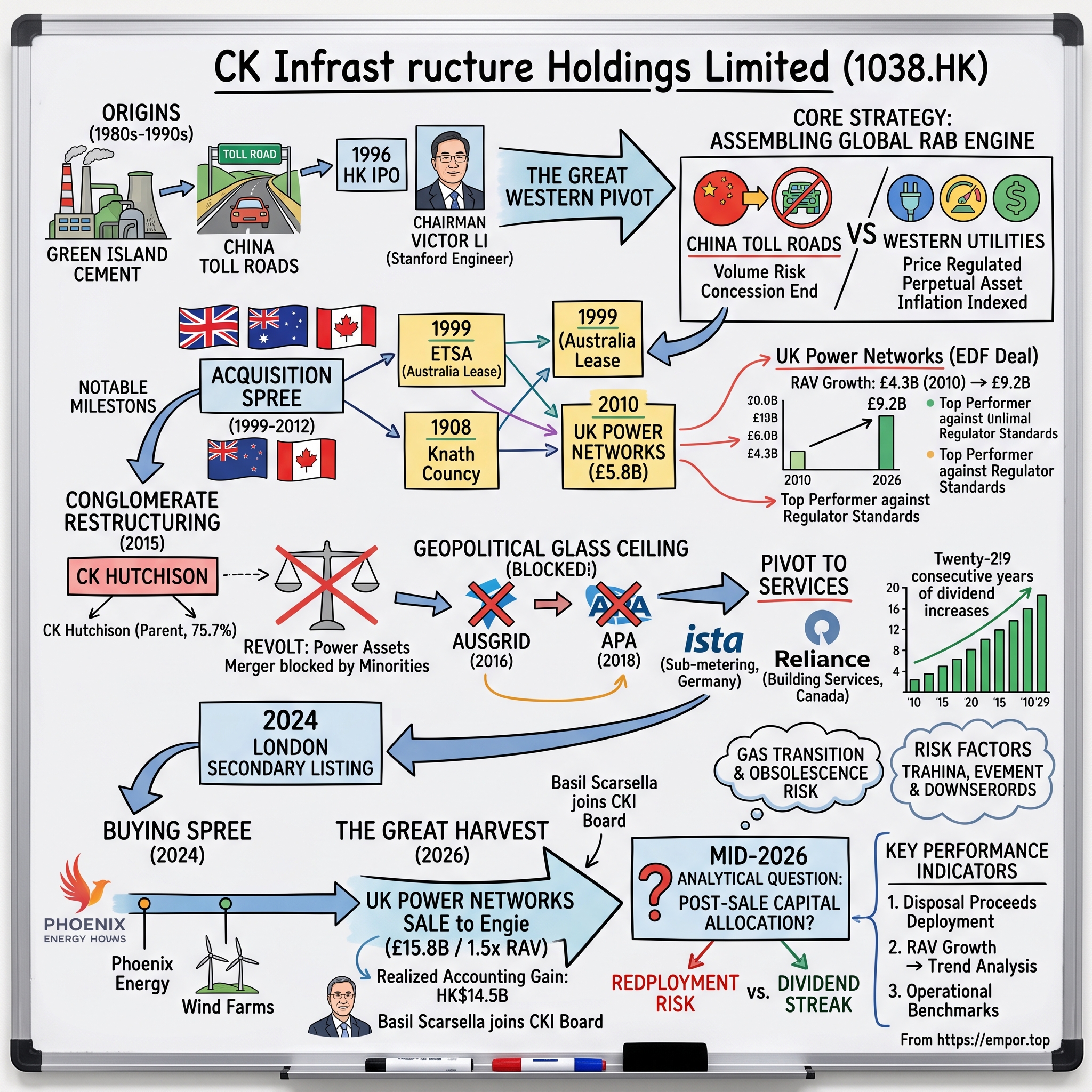
CK Infrastructure Holdings: Li Ka-shing's Regulated Utility Empire & The World's Greatest Bond Proxy
I. Introduction & Episode Roadmap
On the morning of 7 May 2026, a set of share certificates changed hands in London, transferring ownership of the single most valuable asset in the Li Ka-shing empire's infrastructure portfolio. Three licensed electricity distribution networks — covering London, the South East, and the East of England, serving 8.5 million customer connections and roughly a fifth of Britain's electricity demand — passed from a Hong Kong consortium to French state-backed utility Engie.1 The physical assets remained unchanged. Basil Scarsella, who had managed the business since the Hong Kong consortium acquired it in 2010, remained in his role. Only the ultimate ownership shifted.
For sixteen years, UK Power Networks served as the cornerstone asset of 長江基建集團有限公司 CK Infrastructure Holdings Limited (1038.HK in Hong Kong, CKI in London). The acquisition transformed CKI from an entity focused on Hong Kong cement and Guangdong toll roads into one of the largest private operators of regulated infrastructure across major English-speaking economies. In February 2026, its owners agreed to sell the company.2
That decision provides a starting point for analyzing CKI, as it challenges the long-standing market consensus. Investors long viewed CKI as a permanent-capital buyer that acquires regulated monopolies to hold indefinitely, collecting inflation-indexed distributions to fund uninterrupted annual dividend growth. That track record is well documented: 2025 marked CKI's twenty-ninth consecutive year of dividend increases since listing in July 1996, with full-year dividends per share reaching HK$2.61.3 However, the group's two largest strategic moves over the prior eighteen months were major divestments. UK Rails — the Eversholt rolling-stock leasing business — was sold in January 2026, returning £1.1 billion in cash to the consortium.3 UK Power Networks followed at an enterprise value of approximately £15.8 billion, representing roughly 1.5 times its regulated asset value.2 CKI alone received cash consideration of £4.219 billion and expected an effective accounting gain of around HK$14.5 billion.3
The central analytical question in mid-2026 is no longer just the strength of CKI's asset moat, but how the business compounder operates after selling its primary cash-generating asset.
The core financial baseline reflects a conservative holding-company balance sheet paired with leveraged operating units. Profit attributable to shareholders was HK$8.265 billion in 2025, up 2% year on year, on revenue of HK$41.68 billion.34 Net debt to net total capital at the holding-company level stood at 8.9% as of 31 December 2025 — a modest ratio for a utility holding structure. On a look-through basis, accounting for CKI's share of debt within underlying operating entities, the ratio reached 48.5%.3 This divergence between parent-level and asset-level debt is a central feature of CKI's financial architecture. S&P has maintained an "A-" or higher credit rating on CKI continuously since 1997, reaffirming its "A/Stable" rating in February 2025.3 Market capitalisation stood at HK$161.9 billion in March 2026.3
For three decades, CKI's core investment proposition has relied on a structured playbook: acquiring regulated natural monopolies in stable common-law jurisdictions where regulators benchmark allowed returns on inflation-indexed asset bases; funding acquisitions with long-dated debt supported by parent credit strength; and generating excess returns by outperforming regulatory cost benchmarks.
While historically reliable, this model faces growing structural constraints: geopolitical friction closing key markets to further consolidation, energy transition risks surrounding gas distribution networks, and the capital deployment challenge of reinvesting £4 billion of transaction proceeds when attractive, high-quality regulated assets remain scarce.
The roadmap for this analysis covers: first, CKI's origins in cement and toll roads leading to its 1996 Hong Kong listing prior to the handover; second, its strategic pivot from volume-based Chinese infrastructure assets to price-regulated Western utilities; third, the core mechanics of regulated asset base economics; fourth, the 2015 conglomerate restructuring proposal and subsequent shareholder vote; fifth, regulatory and political boundaries in Australia and the United Kingdom; sixth, the 2024 secondary listing in London and the 2026 asset sales; followed by an assessment of management execution, operating strategy, downside risk scenarios, and key performance metrics.
The trajectory begins with concrete.
 Subscribe on LinkedIn
II. Origins of the Empire: Cement, Toll Roads, and the 1996 Spin-off (1980s–1998)
On the reclaimed land at Tap Shek Kok in Hong Kong's western New Territories sits a cement plant that has been grinding limestone since the colonial era. 青洲英泥 Green Island Cement is an unglamorous operation of dust, kilns, barges, and contractors focused primarily on delivery reliability. In the 1980s and early 1990s, however, it served as a highly lucrative cash generator as Hong Kong underwent rapid urban expansion.
Public housing projects, new town developments in Sha Tin and Tuen Mun, Mass Transit Railway (MTR) extensions, and the Airport Core Programme — which included the Chek Lap Kok reclamation, the Tsing Ma Bridge, and the Western Harbour Crossing — drove immense demand for construction materials. Supplying cement and aggregates into this expansion effectively provided a steady return on the city's physical growth. 長江實業 Cheung Kong (Holdings), the property flagship led by 李嘉誠 Li Ka-shing, held this cement business alongside a growing portfolio of joint-venture toll roads and bridges in Guangdong, Hebei, and Henan, built to meet Mainland China's rapid highway development needs during Deng Xiaoping's economic reforms.
By the mid-1990s, these industrial and infrastructure assets clashed with Cheung Kong's core property development business. They required heavy capital investment, operated on long time horizons, and commanded market valuations based on different metrics than Hong Kong residential real estate. Consequently, in May 1996, Cheung Kong created a dedicated corporate entity for these holdings, listing it on 17 July 1996 at HK$12.65 per share.3 Management was entrusted to Li Ka-shing's elder son, 李澤鉅 Victor Li Tzar-kuoi, then in his early thirties — a Stanford-trained civil engineer who had gained operational experience in Canada. He assumed the position of chairman in May 1996 and has led the company throughout its thirty-year history.5
The IPO timing proved strategic. CKI listed twelve months before the July 1997 transfer of Hong Kong's sovereignty to China — during a period when local markets were pricing in political risk — and eighteen months prior to the Asian Financial Crisis. Entering that volatile period as a newly listed infrastructure company with an unlevered balance sheet and tangible physical assets provided CKI with significant financial insulation.
A crucial strategic realignment followed. Management evaluated its asset base and determined that volume-based Chinese toll roads — despite being marketed as high-growth assets — offered fundamentally weaker economic terms than price-regulated electricity distribution networks in mature markets.
The comparative economics highlighted the core differences between the two business models. A toll road depends on traffic volume, which fluctuates with gross domestic product growth, fuel costs, competing expressways built by local authorities, and potential political resistance to toll increases. Furthermore, toll road concessions have finite lifetimes, after which assets revert to government ownership without inflation indexation or guaranteed returns.
In contrast, a regulated electricity distribution network operates as an essential monopoly with inelastic demand. Because building duplicate power lines underground is economically non-viable, competition is virtually nonexistent. Under British and Australian regulatory frameworks, authorities set allowed revenues based on the company's asset base, adjust that base for inflation, and lock in these terms for multi-year regulatory periods. The operator essentially leases distribution infrastructure under long-term regulatory contracts.
This distinction — volume risk and concession expiration versus price inflation indexation and perpetual asset bases — drove CKI's strategic pivot. Over the subsequent twenty-five years, CKI systematically shifted its portfolio toward regulated utilities. Although Chinese toll roads remained in the portfolio, their contribution shrank to a minor fraction of earnings: in 2025, the Hong Kong and Mainland China division generated HK$68 million in profit, representing a 48% decline driven by weak Mainland cement volumes and lower Hong Kong concrete prices.3 Consequently, less than 1% of the group's total business contribution now originates from the foundation assets held at its listing.
To execute this transition, CKI sought markets with established legal frameworks and fully privatized utility monopolies — turning its focus toward English-speaking, common-law jurisdictions overseas.
III. The Great Western Pivot: Assembling the Global RAB Engine (1999–2010)
In 1999, the government of South Australia placed its state-owned electricity distributor, ETSA Utilities, up for a 200-year lease. To most of the global infrastructure market at the time, this was a modest transaction in a regional market. For a Hong Kong company with no prior experience in Western utility regulation, it served as an initial test.
CKI won the lease and established a long-term operating presence. Over the subsequent decade, the group and its affiliate 電能實業 Power Assets Holdings (0006.HK, then trading as Hongkong Electric) acquired Powercor and CitiPower in Victoria, later adding United Energy, Australian Gas Networks, and Multinet Gas.3 By the mid-2010s, CKI's Australian portfolio covered a substantial portion of the electricity and gas distribution networks across two of the country's most populous states.
This Australian experience introduced CKI to the mechanics of Western utility regulation: formulating regulatory proposals, negotiating expenditure allowances with economic authorities, and managing operations where major reviews occur before regulatory bodies every five years rather than through open market competition. This operational skill set proved directly transferable to Britain, which offered a far larger market.
Britain had privatized its electricity, gas, and water networks during the 1980s and 1990s under regulators Ofgem and Ofwat, creating a framework designed to attract private capital into monopoly infrastructure while maintaining consumer rate protections. By the early 2000s, an initial generation of owners — including banks, conglomerates, and foreign utilities — sought to exit. CKI acquired Northern Gas Networks in 2005, serving the North of England, followed by Wales & West Utilities in 2012.3 Both fitted a specific profile: essential pipe networks with predictable allowed revenues and opportunities for operational efficiency.
Then came the transaction that fundamentally changed the company's scale.
2010: buying Britain's best grid from a distressed seller
In 2010, French state utility Électricité de France faced balance-sheet pressures following heavy capital commitments, including investments in British nuclear assets. Its UK electricity distribution business, serving London and the South East, represented a high-quality, non-core asset capable of generating immediate liquidity.
On 30 July 2010, a consortium comprising CKI, Hongkong Electric, and the Li Ka Shing Foundation made an irrevocable offer to acquire 100% of EDF's UK network operations for a total consideration of £5.8 billion, including assumed debt.6 Bloomberg valued the transaction at approximately $9.1 billion.7 CKI and Hongkong Electric each took 40% equity stakes, while the Li family's charitable foundations held the remaining 20%.6
The acquisition price reflected a premium over baseline asset metrics. The transaction was valued at a 27% premium to the networks' regulated asset value as of 1 April 2010, and approximately 8.1 times estimated 2010 EBITDA for the combined operations.6 Competing bidders, including an Abu Dhabi sovereign-backed group, withdrew at lower valuation thresholds.
The investment thesis rested on two operational factors in regulated utility economics: expanding the underlying asset base and operating the network below the regulator's cost allowances. Because EDF had run the networks as a subsidiary within a broader state utility, a dedicated operator focused on reducing operating expenses, lowering outage minutes, and improving customer service metrics could generate returns above the regulatory baseline over the lifecycle of the asset.
Subsequent financial performance validated this framework. Between the 2010 acquisition and the 2026 exit, UK Power Networks' regulated asset value grew from £4.3 billion to £9.2 billion — a 114% increase. Equity consideration rose from £2.553 billion at entry to £10.548 billion at exit, representing a 313% gain.3 Internal net debt grew at a far slower rate, increasing from £3.2 billion to £5.3 billion over the same sixteen-year period.3 Including distributions received throughout the holding period, the consortium estimated that the investment generated roughly six times its original equity outlay.8
Operational benchmarks supported the financial results. Throughout CKI's ownership, UK Power Networks consistently ranked as the top-performing operator in the UK electricity distribution sector against regulatory standards.3 While operational efficiencies contributed to these returns, lower interest rates during a prolonged period of quantitative easing also supported long-duration infrastructure valuations across the industry.
The 2010 transaction demonstrated CKI's strategy of acquiring monopoly utility assets from motivated sellers seeking liquidity — a deployment model that the group executed across major Western markets before eventually executing divestments in 2026.
IV. Deep Dive: Regulated Utility Economics & The CKI Advantage
Evaluating whether CKI represents an exceptional operating business or simply a well-timed beneficiary of macroeconomic trends requires examining its underlying economic engine.
The RAB model in plain English
Consider a hypothetical sole access road into a municipality where local authorities prohibit competing construction. Rather than permitting unrestricted pricing, the council establishes a framework. It calculates total invested capital—the regulated asset base, or RAB—and allows the operator to charge rates that cover three components: efficient operating costs, depreciation to recover capital over the asset's useful life, and a set return on the RAB reflecting investor capital costs.
That mechanism forms the core of a regulated utility, where the RAB serves as the foundational metric. In Britain, Ofgem governs energy networks under five-year RIIO price controls and Ofwat conducts five-year water reviews; in Australia, the Australian Energy Regulator determines five-year pricing cycles. In each cycle, regulators set allowed revenues, expenditure allowances, and baseline equity returns.
Two structural mechanisms enhance this economic framework beyond basic stability.
The first is inflation indexation. The RAB adjusts upward with inflation—historically the Retail Prices Index (RPI) and currently Consumer Prices Index including owner occupiers' housing costs (CPIH) in Britain. This indexation aligns regulated networks with inflation-linked bonds offering equity upside. During the British inflation surge of 2022–2023, nominal RAB valuations rose mechanically alongside revenue allowances. Because underlying debt financing was largely fixed and long-dated, inflation expanded asset values while reducing the real burden of liabilities—a dynamic underpinning CKI's classification as a bond proxy.
The second mechanism is operational incentive structures. Regulators establish a total expenditure—"totex"—benchmark estimating the cost an efficient operator requires to maintain and expand the network. Operators outperforming the benchmark retain a share of cost savings, while those exceeding allowances absorb a portion of overruns. Regulators supplement totex with output incentives, rewarding lower outage durations and penalizing poor customer service, emergency response delays, or environmental non-compliance.
Consequently, a regulated utility's total return derives from three sources: the baseline allowed return granted by regulators, operational outperformance against benchmark targets, and any favorable spread between assumed regulatory debt costs and actual borrowing costs. CKI's strategy focuses on optimizing all three levers.
Does the third lever still work?
This financing advantage warrants scrutiny, as it represents a frequently cited yet rarely evaluated element of CKI's investment narrative. The core thesis posits that CKI's "A" credit rating allows the group to secure financing below the regulatory cost-of-debt benchmark, capturing the spread.
Regulatory mechanics, however, have evolved. Ofgem and the AER now index allowed debt costs to prevailing market rates annually, narrowing the financing spread accessible to individual operators. Meanwhile, recent regulatory decisions show allowances rising alongside higher base interest rates. In Ofgem's RIIO-GD3 final determinations for Northern Gas Networks and Wales & West, published in December 2025 for the price control commencing 1 April 2026, the real allowed cost of debt increased from 1.88% to 3.15%, while allowed return on equity rose from 4.30% to 6.12%.3 Conversely, the AER's 2025–2030 decision for SA Power Networks reduced the allowed cost of debt from 4.87% to 4.66%, while increasing the allowed equity return from 4.56% to 8.33%.3
While a financing edge persists, it has narrowed. The primary driver of returns across the current regulatory cycle is the industry-wide upward revision of allowed equity returns to match higher risk-free interest rates—a market tailwind benefiting all regulated network operators rather than a unique CKI capability. CKI's distinct operational differentiation appears more clearly in benchmark performance: Northumbrian Water ranked as the top overall performer across Ofwat's financial and non-financial criteria, remaining the sole water utility in Great Britain with zero serious pollution incidents over the three consecutive years to July 2025, while Northern Gas Networks ranked first in seven of Ofgem's eight customer service metrics for gas distribution.3 These independently verified metrics provide concrete operational evidence beyond management claims.
Myth versus reality: the "guaranteed return" story
A widespread misconception regarding regulated utilities is that regulators guarantee corporate profits. In practice, regulators guarantee only a framework, within which operators face three key structural risks.
First, regulators can reduce allowed returns. During prior British regulatory cycles, allowed equity returns were set at levels challenged by the industry, requiring appeals to the Competition and Markets Authority (CMA). Northumbrian Water followed this path regarding Ofwat's PR24 determination. On 10 March 2026, the CMA established Northumbrian Water's allowed return on capital at 4.20%—an increase from Ofwat's final determination of 4.03% appointee weighted average cost of capital (WACC).3 Although successful, securing this adjustment required over a year of formal litigation.
Second, capital expenditure obligations can expand faster than compensating returns. Northumbrian Water's PR24 total expenditure allowance increased 74% over the prior period to £6.70 billion.3 Expanding the asset base increases long-term earning potential only if capital is deployed efficiently, on schedule, and without penalty—introducing substantial execution risk.
Third, political pressures can override regulatory mechanics. The British water sector faced intense public scrutiny through 2026 over sewage spills and balance-sheet leverage, highlighted by financial distress at Thames Water. This environment heightened political scrutiny surrounding foreign, leveraged ownership of critical UK water infrastructure—a systemic risk outside standard regulatory compensation formulas.
Where the money actually comes from
The 2025 financial breakdown clarifies CKI's operational focus. Of HK$9.77 billion in total business contribution before central costs, the United Kingdom portfolio generated HK$3.983 billion, or approximately 41%, encompassing electricity distribution, water and sewerage via Northumbrian Water, gas distribution through Northern Gas Networks, Wales & West, and Phoenix Energy, and rolling stock leasing through Eversholt.3 The 36.01% holding in Power Assets contributed HK$2.246 billion, or roughly 23%, acting as a gateway to a global portfolio anchored by a 33.37% stake in Hong Kong's primary electricity supplier.3 Australia delivered HK$1.784 billion, representing about 18%. Continental Europe contributed HK$961 million—a 58% increase driven by solid results at German sub-metering unit ista alongside a tax credit from reduced German corporate tax rates. Canada added HK$528 million, New Zealand contributed HK$200 million, and Hong Kong and Mainland China generated the HK$68 million noted earlier.3
Below the operating business contribution, treasury activities and central overheads reduced net earnings by HK$1.067 billion in 2025, up from HK$863 million due to higher net finance costs and corporate overheads, alongside HK$438 million in distributions on perpetual securities.3
These figures highlight two key analytical takeaways. First, CKI functioned primarily as a UK-centric portfolio with international holdings attached rather than a broadly balanced global conglomerate; following the UK Power Networks divestment, the UK share drops substantially. Second, earnings growth in 2025 stemmed from unregulated European services and a non-recurring tax adjustment rather than the underlying regulated core, which remained flat. This performance mix underscores where near-term earnings momentum currently resides.
This structural composition sets the context for CKI's subsequent efforts to consolidate its corporate hierarchy—and the regulatory and shareholder resistance that followed.
V. M&A Expansion, Conglomerate Restructuring, and the Failed Power Assets Merger (2011–2015)
The first half of the 2010s marked CKI's most acquisitive era, culminating in a notable rejection from public shareholders.
The expansion accelerated in 2011 with the acquisition of Northumbrian Water, a regulated water and sewerage utility serving North East England alongside water supply in Essex and Suffolk. Under regulated asset base principles, water represented a logical portfolio addition—another index-linked asset base governed by a British regulator. However, water operations differ significantly from power networks. Water utilities carry complex environmental obligations, including pollution control, storm overflow management, and river quality standards, placing them under greater political scrutiny than power distribution networks.
In January 2015, CKI acquired Eversholt Rail Group, one of Britain's three major rolling stock leasing companies, for £2.5 billion.9 This acquisition represented a deliberate move beyond price-regulated utilities. Rolling stock companies do not operate under a regulated asset base; instead, they own passenger trains and lease them to train operating companies under long-term commercial contracts. While the model aligns with core infrastructure traits—long-life physical assets, predictable contracted cash flows, and high entry barriers—its financial returns depend on contractual terms and residual asset values rather than regulatory determinations. CKI later noted that Eversholt maintained consistent distributions across roughly ten years of ownership.3
The 2015 restructuring
Meanwhile, CKI's corporate parent underwent a broader reorganization. Over decades, Li Ka-shing's empire had evolved into a complex network of cross-holdings between 長江實業 Cheung Kong and 和記黃埔 Hutchison Whampoa, creating operational overlap and a persistent conglomerate discount. In 2015, the group reorganized its holdings into two distinct entities: 長江和記實業 CK Hutchison Holdings (0001.HK) assumed control of non-property operating assets, including ports, retail, telecommunications, energy, and infrastructure, while 長江實業集團 CK Asset Holdings (1113.HK) focused on real estate. Following this restructuring, CK Hutchison held a 75.67% profit-sharing interest in CKI.3
The reorganization clarified the group's overarching structure, though it established a controlling shareholder holding three-quarters of CKI's equity—an arrangement that supports long-term strategic planning while prompting minority investors to apply a holding discount.
The revolt
With parent-level operations simplified, management turned to streamlining CKI's structure. CKI and Power Assets had co-invested in matching asset stakes for fifteen years. Following the separate listing of 港燈電力投資 HK Electric Investments (2638.HK) in 2014, Power Assets held substantial cash reserves. Merging CKI and Power Assets aimed to consolidate the group's infrastructure holdings into a single vehicle while deploying Power Assets' liquidity into new opportunities.
In September 2015, CKI submitted a proposal to acquire Power Assets through an all-share exchange, initially offering 1.04 CKI shares for each Power Assets share before raising the terms to 1.066 CKI shares.10
Independent shareholders rejected the proposed terms. Because Power Assets held substantial cash reserves, minority investors argued that swapping liquid capital for CKI shares exposed them to operating asset risks and market price fluctuations. Proxy advisory firms supported this view, with Institutional Shareholder Services recommending an exchange ratio between 1.09 and 1.20 CKI shares, while Glass Lewis also advised shareholders to vote against the transaction.10
At the extraordinary general meeting in November 2015, the transaction required 75% approval from independent shareholders to proceed. The measure received 50.77% support, with 49.23% voting against, effectively terminating the proposal.10
Following the vote, CKI's board accepted the result without launching a revised offer, attempting a squeeze-out, or seeking to override minority sentiment. Regulatory rules subsequently barred a renewed merger attempt for twelve months.10 Instead of combining corporate entities, CKI institutionalized a joint-consortium model, partnering with Power Assets and CK Asset on subsequent asset acquisitions.
This consortium approach provided access to affiliate balance sheets for major acquisitions without requiring full corporate integration, though it maintained a multi-layered structure for external investors to analyze.
While joint bidding addressed capital deployment requirements, it could not insulate the business from mounting regulatory and political pressures across key international markets.
VI. The Geopolitical Glass Ceiling & The Non-Regulated Services Pivot (2016–2023)
On 11 August 2016, Australian Treasurer Scott Morrison blocked a transaction that CKI was positioned to secure. The New South Wales government had offered a 99-year lease for a 50.4% stake in Ausgrid, the primary electricity network serving Sydney. CKI and Power Assets, competing against China's State Grid Corporation, had submitted the preferred bid valued at more than A$10 billion.11
Morrison rejected both bidders on national security grounds without elaborating, stating to reporters that he was the only person present with the requisite security clearance to review the classified underlying rationale.11 Industry commentary focused on Ausgrid's connectivity to government and defence infrastructure.
The broader significance lay in the regulatory precedent. Despite two decades of operating under British and Australian framework compliance as a commercial Hong Kong-listed entity, CKI was subjected to the same foreign ownership restrictions applied to Chinese state-owned enterprises.
Two years later, Australia reinforced this policy stance at a larger scale. In June 2018, CKI led a A$13 billion bid for APA Group, Australia's dominant gas transmission operator. On 8 November 2018, Treasurer Josh Frydenberg issued a preliminary determination that the acquisition would be contrary to the national interest, citing foreign ownership concentration across Australia's gas infrastructure—noting that APA transported 56% of national gas transmission volumes, including 74% of pipelines in New South Wales and Victoria.12 The Foreign Investment Review Board had split on the decision, which was formally finalized on 20 November 2018.12 Frydenberg clarified that the ruling did not imply an adverse assessment of CK Group specifically.
Britain subsequently established similar oversight mechanisms through the National Security and Investment Act 2021, granting the UK government review and intervention powers over acquisitions across seventeen sensitive sectors, including energy, water, and transport.
These regulatory decisions highlighted a structural constraint for CKI: in its primary growth markets, further acquisition of major regulated utility monopolies faced foreign investment oversight boundaries that financial terms alone could not overcome. This barrier remains a central operational constraint for the group.
The pivot to services
In response to these regulatory limits, CKI shifted its M&A strategy toward asset-light or non-critical service businesses that shared infrastructure traits—such as contracted cash flows and high barriers to entry—without triggering national security reviews.
In 2017, CKI and CK Asset acquired German sub-metering provider ista for €4.5 billion, with CKI taking a 35% equity stake.13 The business differs from traditional network utilities; rather than earning a regulated return on an asset base, it installs sub-meters on apartment radiators and water pipes across Europe and collects fee income for consumption billing. Demand is supported by regulatory mandates, such as Germany's heating cost ordinance requiring individual metering. The capital-light model benefits from high customer retention—since switching providers requires physical hardware replacement across multi-family buildings—and operational leverage. In 2025, ista reported strong performance, lowering costs through organizational restructuring and process automation, while acquiring Dutch energy consultancy Flink and German smart metering firm SGW-Metering.3
Also in 2017, the consortium acquired Canadian building services provider Reliance Home Comfort from Alinda Capital Partners for an equity consideration of C$2.82 billion, with CKI holding a 25% stake.14 Reliance leases water heaters, heating, ventilation, and air conditioning equipment to residential customers under long-term contracts. This model generates recurring, contracted revenues with low customer churn. Reliance has subsequently served as CKI's expansion platform in North America, completing two US home services acquisitions in 2025 and expanding into Washington and Alabama as its fourth and fifth American state markets.3
The European services portfolio also includes Dutch Enviro Energy, an energy-from-waste operator in the Netherlands. Its Rozenburg facility resumed waste intake following an operational disruption caused by a late-2023 fire, with new turbines being installed and electricity generation scheduled to resume in 2026—illustrating that non-regulated industrial operations carry facility operational risks distinct from regulated distribution networks.3
This strategic pivot involved trade-offs. CKI acquired these service companies at higher valuation multiples than its traditional network utilities while forfeiting inflation-indexed regulated asset bases. In exchange, the group secured commercial growth potential free from foreign investment screening constraints. In 2025, when CKI's core regulated portfolios experienced flat performance, Continental European services delivered the highest regional growth within the group. However, the addition of non-regulated service businesses means CKI no longer represents a pure regulated utility monopoly portfolio.
By 2024, facing acquisition limits in major utility markets, CKI turned toward capital structure and listing strategy to unlock shareholder value.
VII. The 2024 London Stock Exchange Listing & Recent M&A
On 19 August 2024, CK Infrastructure shares began trading on the Main Market of the London Stock Exchange alongside its existing Hong Kong listing.15 CKI was the first company admitted under the UK's overhauled listing rules, which took effect three weeks earlier on 29 July 2024, and the first to enter the Financial Conduct Authority's new international secondary listing category.1516
The secondary listing was an introduction rather than a capital-raising event, designed to reposition the company for a European investor audience. Although more than half of CKI's operating profit originated from British assets, its primary listing in Hong Kong subjected the stock to a broader conglomerate valuation discount driven by regional geopolitical tensions, Mainland real estate distress, and capital outflows from Hong Kong. A London listing positioned CKI alongside UK utility peers such as National Grid, Severn Trent, and United Utilities, exposing the stock to institutional analysts and investors focused directly on regulated asset base growth.
Two years after the secondary listing, the market impact remains mixed. Trading volume in London has remained thin compared to Hong Kong, and CKI's shares have continued to trade at a discount to sum-of-the-parts estimates of its regulated assets. While a secondary listing broadens geographic access, it does not alter corporate governance: CK Hutchison's 75.67% controlling stake remains a structural cap on valuation multiples across trading venues. Nevertheless, establishing a formal London presence and analyst coverage likely strengthened CKI's market positioning when negotiating subsequent divestments of British assets to European buyers.
The 2024 buying spree
The secondary listing coincided with an active period of capital deployment. In April 2024, a consortium comprising CKI, Power Assets, and CK Asset acquired Phoenix Energy, Northern Ireland's largest natural gas distribution network, for approximately US$941 million in total enterprise value, consisting of £312.6 million in equity and £444.4 million in net debt.17 Phoenix covers 78% of Northern Ireland's gas connections, serving 48% of the population; CKI noted that the unit delivered immediate profit contributions post-acquisition while participating in Northern Ireland's renewable gas strategy.317
In August 2024, a CKI-led consortium acquired 32 operating onshore wind farms across England, Scotland, and Wales from Aviva Investors for approximately US$448.5 million, representing 175 megawatts of total capacity and 137 megawatts net attributable.18 CKI and CK Asset each acquired 40% equity stakes, with Power Assets holding 20%.18 Rather than funding greenfield project pipelines, the group selected fully operational renewable assets with established cash flows—eliminating planning, construction, and merchant development risks in a manner consistent with its historical preference for operational infrastructure over development projects.
2025–26: the great harvest
Following this deployment phase, CKI shifted toward major asset divestments.
In January 2025, reports indicated CKI was exploring a sale of Eversholt Rail at a valuation approaching £4 billion.19 Following review by the UK Competition and Markets Authority, the transaction completed in January 2026, delivering £1.1 billion in total cash proceeds to the consortium at completion.320
A larger transaction followed on 25 February 2026, when CKI, Power Assets, and CK Asset agreed to sell 100% of UK Power Networks to French utility Engie.1 Engie reported an enterprise value of approximately £15.8 billion and an equity value of £10.5 billion—equivalent to 1.5 times estimated regulated asset value as of late March 2026 and roughly 10 times projected 2027 EBITDA.2 CKI and Power Assets each received £4.2192 billion in cash consideration, with CK Asset receiving £2.1096 billion.3 Engie funded the acquisition through approximately €5 billion in debt and hybrid securities, an equity placement of up to €3 billion, and a planned €4 billion asset disposal program through 2028.2
CKI submitted the sale to independent shareholders at a special general meeting on 27 April 2026, where it received overwhelming approval, with 2,128,168,363 votes—or 99.99995% of votes cast—in favor.21 Transaction completion took place on 7 May 2026.1
Reading the sale
The 2026 divestment represents the execution of an exit strategy initiated several years earlier under different market conditions. In March 2022, a financial consortium led by Macquarie and KKR—including APG, China Investment Corporation, Ontario Teachers' Pension Plan, and PSP Investments—entered advanced negotiations to acquire UK Power Networks at a valuation reaching £15 billion.22 Discussions collapsed in July 2022 when CKI adjusted its price expectations upward to reflect accelerating UK inflation, leading the consortium to withdraw.23
By retaining the asset through 2026, CKI captured four additional years of inflation-indexed regulated asset base expansion and annual operational cash flows before securing an enterprise value of £15.8 billion from a strategic buyer. While the higher nominal price represents a modest valuation increase after accounting for intervening inflation and higher interest rates, it enabled the group to complete a long-planned portfolio realization.
Management framed the transaction as a disciplined capital decision. Co-Managing Director Andrew Hunter stated that the consortium accepted an unsolicited, highly attractive offer that served shareholder interests.8 Chairman Victor Li provided broader context regarding the group's asset strategy during the Eversholt divestment, noting that active buying and selling drive business growth and that accumulating cash reserves supports major future transactions while minimizing parent-level leverage.20 This approach underscores CKI's role as a capital recycling operator rather than a perpetual asset owner.
However, management has not yet specified how the transaction proceeds will be deployed. Asked in late April 2026 regarding potential special dividend distributions, Hunter indicated the board would evaluate capital allocation options post-completion, noting that maintaining strong liquidity provides flexibility during periods of market volatility.8 Nearly three months after closing the transaction, CKI has made no formal capital distribution announcement, leaving cash deployment as a central factor in evaluating its post-sale strategy.
VIII. Current Management, Incentives, and Capital Allocation Record
Victor Li Tzar-kuoi, aged 61, has chaired CKI since its May 1996 listing while simultaneously leading CK Hutchison and CK Asset.5 A Stanford-trained civil engineer, Li has governed the group with a methodical emphasis on risk control. The consistency of this approach is evident in the company's balance sheet discipline: the aversion to parent-level debt articulated in 2026 reflects a continuous policy that has kept parent-level gearing below 20% across the group's disclosed history, and in single digits for most of that period.3
At the start of 2026, CKI adjusted its senior executive structure in a realignment pointing toward succession planning. 甘慶林 Kam Hing-lam, 79, who served as Group Managing Director from the company's May 1996 listing through December 2025, became Deputy Chairman and Co-Managing Director in January 2026. Andrew John Hunter, 67, an executive director since December 2006, assumed the Co-Managing Director role alongside him, while Chief Financial Officer Chan Loi Shun, who joined as CFO in January 2006, added the position of General Manager.5 Frank John Sixt, an executive director since May 1996 and Group Co-Managing Director and Finance Director of CK Hutchison, continues to direct CKI's treasury and financing architecture.5
This executive structure offers deep institutional memory, as senior leadership and independent directors average decades of tenure. While this longevity ensures operational continuity, governance analysts note that long-serving independent directors may face questions regarding board independence from the controlling Li family.
Concurrently, the board added operational experience in July 2026 by appointing Basil Scarsella as a non-executive director.24 Scarsella, 70, led UK Power Networks from its late-2010 acquisition through its May 2026 sale, after managing Northern Gas Networks from 2005 to 2010 and SA Power Networks from 1998 to 2005. Appointing the veteran utility operator to the board at a director's fee of HK$100,000 annually enables CKI to retain deep operational expertise across British and Australian regulated networks.24 With CKI evaluating options to redeploy £4 billion in transaction proceeds, Scarsella's presence provides direct operational oversight for future network investments.
The capital allocation record, examined
CKI's capital allocation track record centres on its long-term dividend distribution. Full-year dividends per share increased from HK$0.16 in 1996 to HK$2.61 in 2025, marking twenty-nine consecutive years of dividend growth through multiple macroeconomic downturns.3 Cumulative dividends paid since listing total HK$45.40 per share—approximately 3.6 times the original HK$12.65 initial public offering price. An investor who purchased shares at listing and reinvested all distributions generated a total shareholder return of roughly 15 times, representing an annualized return of approximately 9.7% as of March 2026.3
This track record, however, requires qualification. The pace of dividend growth has moderated substantially in recent years, with the 2025 increase reaching 1.2% and half-year distributions rising by increments of just one or two Hong Kong cents over the prior five years.3 While this maintains the multi-decade growth streak, the expansion remains nominal and trails inflation. The streak reflects management's commitment to distribution continuity rather than accelerating earnings power.
In addition, the group's leverage metrics reflect distinct holding-company and operational layers. Group net debt to total capital stood at 8.9% at the end of 2025—up from 7.8% in 2024—with net debt of HK$13.485 billion against total equity of HK$137.852 billion.3 However, on a look-through basis that incorporates CKI's proportionate share of ring-fenced, non-recourse debt within underlying operating entities, leverage reached 48.5%.3 This structural division protects the parent company from asset-level operational debt, though financial analysis must account for total look-through obligations when evaluating overall economic leverage.
Management's commitment to capital discipline is supported by its acquisition record. During the 2015–2021 period of low interest rates, when competing private equity and infrastructure funds paid elevated multiples above regulated asset values, CKI refrained from major competitive bidding wars and built cash reserves following regulatory rejections in Australia. Management's stated policy—to maintain investment discipline without adopting a "must-win" approach—matches its historical execution during periods of inflated asset valuations.3
The group's recent transactions highlight a shift in market perception regarding its long-term strategy. By divesting Eversholt Rail and UK Power Networks—the latter sold to Engie at 1.5 times regulated asset value compared to CKI's 2010 purchase price at a 27% premium—CKI demonstrated that it operates as an active capital recycler rather than a perpetual owner of utility assets. This execution aligns with management's stated philosophy that strategic buying and selling drive long-term business growth, positioning the company as an opportunistic asset manager focused on realized equity returns.
IX. Playbook: Business & Investing Lessons from CKI
1. Inflation indexation is the primary driver in regulated infrastructure. The reason a regulated network outperforms an unregulated toll road across a multi-decade holding period stems less from monopoly power itself and more from asset base indexation. A monopoly with fixed nominal prices becomes a wasting asset during inflationary periods. Conversely, a monopoly whose asset base expands alongside the price level—financed by fixed-rate, long-dated debt—transfers wealth from lenders to equity holders whenever inflation surprises to the upside. When evaluating any infrastructure asset, the central question is not whether competition exists, but who bears inflation risk.
2. Outperforming a regulator requires operational efficiency, not lobbying. The baseline allowed return is granted to every industry participant—it represents table stakes rather than an edge. Excess returns depend on outperforming total expenditure benchmarks and securing service incentives through unglamorous, engineering-led execution. CKI's most compelling evidence of operational capability lies not in its transactions, but in the third-party benchmarks its networks hold: best UK electricity distribution performer, top of Ofwat's performance report, and first in seven of eight gas customer service metrics.3 When assessing any regulated business, examining the regulator's own benchmarking tables reveals far more than reading the income statement.
3. Patience is effective only when backed by the willingness to abstain. Between the APA transaction rejection in 2018 and the Phoenix Energy acquisition in 2024, CKI completed no transformational deal across its core regulated markets. Discipline is simple to promise on earnings calls but demanding to maintain over six years. The true test of capital discipline is not management rhetoric on valuation, but whether leadership can demonstrate extended periods of intentional inactivity.
4. Permanent capital is a strategy, not an identity. The most useful insight provided by the 2025–26 divestments is the dismantling of the permanent-holding assumption. CKI sold when a strategic buyer with a lower cost of capital and a policy mandate—a European utility consolidating regulated grids—valued the asset higher than CKI's internal return requirements could justify. Recognizing when an asset is worth more to another owner is a rarer skill than acquiring well, distinguishing disciplined capital allocators from asset collectors.
5. Beyond a certain scale, foreign ownership of critical national infrastructure becomes a political constraint. The Ausgrid and APA rejections were not driven by price, governance, or operating track record; CKI was already an established incumbent operating comparable Australian assets with a two-decade compliance history, yet both bids were blocked on policy grounds. Any investment thesis relying on a foreign owner consolidating critical infrastructure in a Five Eyes economy must explicitly account for this political ceiling. Pricing power cannot clear a national security objection.
6. Corporate complexity creates a persistent valuation discount. CKI's joint-consortium bidding structure—with CK Asset and Power Assets taking matched slices of major transactions—addressed capital deployment challenges after 2015. However, it also produced a corporate hierarchy requiring investors to model three listed entities and a web of economic interests ranging from 6% to 100% across dozens of assets. Public markets routinely discount structures that are difficult to model, and that holding discount has proven persistent.
X. Strategic Analysis: 7 Powers, Risk Radar, & Bull vs. Bear Case
Competitive structure: Porter, applied to a wire
Applying Porter's five forces framework to a regulated electricity distribution network yields a stark conclusion: four of the five forces exert minimal pressure, while the fifth dominates the business.
The threat of new entrants is virtually non-existent. Duplicate underground cabling in London or parallel gas mains in Yorkshire would require prohibitive capital expenditure, and regulators would not issue competing operating licences. The threat of substitutes remains low, though long-term heat electrification poses a gradual risk to gas distribution networks. Buyer power is negligible for individual consumers, who cannot negotiate distribution tariffs or select an alternative network operator. Supplier power is moderate—contractors and equipment manufacturers enjoyed pricing power during recent global grid expansions, but these outlays are treated as pass-through costs within regulatory expenditure frameworks.
The defining force is the economic regulator, an entity absent from Porter's original taxonomy. In regulated utilities, the regulator replaces market competition, establishing administrative mechanisms to return monopoly surpluses to consumers. Every major value driver in the business stems from periodic administrative determinations. Consequently, the regulatory calendar governs the company's financial outlook, as reflected in CKI's disclosure highlighting that its British water and gas networks, alongside most Australian and New Zealand assets, completed or entered regulatory resets across 2025 and 2026.3
Helmer's 7 Powers: which ones are real
Cornered resource — real and durable. The distribution licences represent the primary cornered resource. They cannot be replicated, eroded by competition, or bypassed, making them the most defensible advantage in the portfolio.
Scale economies — real but bounded. Centralized procurement, shared engineering, and unified IT systems across millions of connection points generate genuine unit-cost reductions, as evidenced by CKI's operational rankings. However, economic regulators monitor these savings and absorb them into lower future allowances through periodic benchmarking. Scale advantage in a regulated utility thus yields a temporary operational lead rather than a permanent structural margin.
Switching costs — real in non-network services. High switching costs exist primarily within the group's non-regulated service operations rather than its utility networks, where consumers have no switching options. Changing sub-metering providers requires a building owner to physically replace hardware on every radiator across a property, generating substantial retention that supports ista's operational performance.
Counter-positioning, network economies, branding, and process power — absent. These powers do not apply in any meaningful sense. Electricity distribution networks exhibit no network effects, brand equity commands no pricing premium, and operating processes can be replicated by competent peers.
The group's historical financing advantage is best characterized as a cyclical edge rather than a structural power. The edge remains meaningful when regulators rely on fixed historical cost-of-debt benchmarks, but it narrows when regulators index debt allowances annually, as Ofgem and the AER now practice.
Risk radar
Redeployment risk — the dominant near-term risk. CKI holds several billion pounds in cash proceeds following its recent asset sales and has committed to redeploying capital into accretive acquisitions. Management identifies a deal pipeline driven by maturing private equity funds and corporate carve-outs, where reduced buyer competition has improved pricing dynamics.3 However, capital allocation carries asymmetric risk: a cash-rich company with a controlling shareholder and explicit acquisition ambitions facing foreign investment limits in key jurisdictions risks overpaying for assets. While CKI demonstrated capital discipline between 2018 and 2024, maintaining un-deployed cash nearly three months post-sale generates a temporary return drag compared to the regulated returns generated by sold assets.
Earnings hole and the dividend streak. UK Power Networks represented the group's largest cash-generating asset. Its divestment creates a profit shortfall in 2026 and 2027 that requires successful capital redeployment to fill. In the interim, maintaining CKI's multi-decade dividend growth streak depends on management's willingness to fund distributions from cash reserves.
Regulatory reset risk. Northumbrian Water required an appeal to the Competition and Markets Authority to secure a 4.20% allowed return on capital under the PR24 review, alongside a 74% increase in total expenditure obligations.3 Similarly, the British gas networks entered the RIIO-GD3 regulatory period on 1 April 2026 with higher allowed returns accompanied by baseline expenditure increases of 12% and 24% across the two networks.3 Higher allowed returns enhance profitability only if capital programs are executed on budget.
UK water sector political risk. Broader financial and environmental distress across the British water sector heightens the likelihood of stricter regulatory oversight, higher performance penalties, and restrictions on capital distributions across all sector participants, including high-performing operators like Northumbrian Water.
Energy transition and gas grid obsolescence. CKI operates gas distribution networks in Britain (Northern Gas Networks, Wales & West, and Phoenix Energy) and Australia (Australian Gas Networks and Multinet). As home heating transitions toward electrification, throughput across gas pipelines will decline while fixed asset costs must be recovered from a shrinking customer base. Regulators typically respond by accelerating depreciation schedules, which increases near-term cash flow while reducing long-term asset value. While CKI acquired GWE Biogas to support renewable gas integration, the long-term commercial viability of hydrogen and biomethane blending at scale remains unproven.3
Foreign exchange. CKI reports in Hong Kong dollars, which are pegged to the US dollar, whereas its operating cash flows are generated in British pounds, Australian dollars, euros, and Canadian dollars. Currency fluctuations directly impact reported earnings and net asset values, with sterling-denominated transaction proceeds temporarily elevating cash-conversion exposure.
Concentration in Power Assets. Approximately 23% of CKI's business contribution originates from its 36.01% equity stake in Power Assets, whose portfolio closely mirrors CKI's direct holdings.3 This overlapping ownership structure creates duplicate asset exposure and contributes to the holding company's persistent valuation discount.
The bull case
The primary bullish argument rests on CKI's balance sheet positioning. Entering the second half of 2026 with substantial cash reserves, single-digit parent gearing, an "A" credit rating, and proven patience, CKI is well-positioned as closed-end infrastructure funds raised during the 2010s reach maturity and seek exits.3 Liquidity-seeking sellers meeting a disciplined, low-cost capital buyer mirror the conditions that enabled the 2010 acquisition of EDF's UK networks.
Second, regulatory determinations across key jurisdictions have shifted in favor of asset owners. Regulators in Britain and Australia have raised allowed equity returns significantly: real allowed equity returns for British gas distribution rose from 4.30% to 6.12%, SA Power Networks' nominal return increased from 4.56% to 8.33%, and draft AER determinations for Victorian electricity networks rose from 5.04% to 7.97%.3 Higher allowed returns applied to inflation-indexed asset bases represent a highly favorable operating environment for CKI's retained networks.
Third, underlying asset bases continue to expand mechanically. Regulators' determinations project rising regulated asset values across CKI's retained UK and Australian utility networks through 2028.3
Fourth, non-regulated service businesses offer independent growth potential. Operational restructurings at ista and Reliance's expansion in the United States demonstrate earnings growth unconstrained by multi-year regulatory review cycles.
The bear case
The central bearish argument is that CKI has divested its primary earnings generator without demonstrating a clear path to asset replacement.
CKI must redeploy several billion pounds in cash into a market where prime regulated assets face foreign ownership restrictions in Australia and Britain, command high valuations in competitive auctions, or offer lower asset quality. Returning capital through a special dividend would benefit shareholders but permanently reduce the group's earnings base—an option management has formally deferred.8 Consequently, uninvested cash reserves generate an ongoing return drag.
Second, CKI's dividend growth has slowed to nominal increments. A 1.2% annual dividend increase trails inflation across all operating jurisdictions. Preserving the multi-decade growth streak through minimal increases reflects a commitment to narrative continuity rather than underlying earnings expansion.
Third, CKI's look-through net debt to total capital of 48.5% leaves the group exposed to higher refinancing costs across operating units as lower-cost debt matures.3 While regulators index allowed debt costs, adjustments occur with a lag and may not fully offset higher borrowing expenses.
Fourth, the holding company discount appears structural. CKI's 75.67% controlling ownership by CK Hutchison, combined with co-investment structures alongside affiliated listed entities, maintains a multi-tiered corporate hierarchy that public markets discount. The London secondary listing has not eliminated this valuation gap, as investors seeking direct utility exposure can hold single-tier peers such as National Grid, Severn Trent, or United Utilities.
Fifth, recent divestments demonstrate that CKI's assets command higher valuations under alternative ownership structures. Engie's acquisition of UK Power Networks at 1.5 times regulated asset value highlights the gap between private transaction multiples and CKI's public market valuation, supporting activist arguments that capital distribution or further asset realizations would unlock greater shareholder value than holding-company reinvestment.
XI. Epilogue, KPIs to Watch, & Final Verdict
Thirty years after listing as a Hong Kong industrial holding company backed by cement operations and Guangdong toll roads, CKI has completed a full strategic cycle. By 2024, more than half of its operating profit originated from British assets. Then, in early 2026, the group divested its two largest UK businesses—Eversholt Rail and UK Power Networks—realizing an accounting gain of roughly HK$14.5 billion on UK Power Networks and appointing its long-serving chief executive, Basil Scarsella, to the parent board.
The group enters the second half of 2026 holding substantial liquidity, an established portfolio of gas, water, and electricity distribution networks across four continents, and a history of balance-sheet discipline—yet with no explicit capital deployment plan announced to the market.
While significant cash reserves afford strategic flexibility during periods of market volatility and asset sales by distressed sellers, CKI's central investment narrative has fundamentally shifted. For a quarter-century, the thesis hinged on compounding cash flows from inflation-indexed regulated assets. For the immediate future, the core analytical question turns on capital allocation: how management redeploys its transaction proceeds.
Three key performance indicators will determine the trajectory of the post-divestment business:
First, the redeployment of disposal proceeds—focusing on asset quality, valuation multiples, and regulatory frameworks. The evaluation hinges not merely on transaction volume, but on the entry multiple relative to regulated asset value, the jurisdiction's political stability, and whether cash flows feature inflation indexation under transparent regulatory oversight. Acquiring assets at elevated multiples or in jurisdictions with weak regulatory protections would undermine the capital discipline thesis. Conversely, measured capital deployment or an eventual capital return to shareholders would signal continued adherence to value creation.
Second, regulated asset value (RAV) growth across the retained portfolio. As allowed revenues derive directly from the underlying asset base, RAV expansion serves as the primary organic growth metric across CKI's remaining networks—including Northumbrian Water, Northern Gas Networks, Wales & West Utilities, and Phoenix Energy in the United Kingdom; SA Power Networks, Victoria Power Networks, United Energy, Australian Gas Networks, and Multinet in Australia; and Wellington Electricity in New Zealand. These figures, reported directly by underlying operating units, reveal the baseline compounding speed of the residual portfolio.
Third, operational performance against regulatory benchmarks. Beyond baseline allowed returns granted to all market participants, outperformance depends on total expenditure ("totex") efficiency and service incentive rewards. Independent annual assessments published by regulators—such as Ofgem and Ofwat in Britain and the Australian Energy Regulator—provide verifiable, objective measures of operational execution.
A balanced evaluation of CKI lies between the uncritical view encouraged by its twenty-nine-year dividend growth streak and the structural discount applied to its conglomerate architecture. Over three decades, the company has demonstrated a consistent ability to acquire undermanaged utility assets from motivated sellers, improve operational efficiency against regulatory benchmarks, and realize substantial gains upon exit. Independent regulatory performance rankings validate these operational capabilities.
Nevertheless, the model faces evolving structural constraints. Geopolitical and foreign investment barriers restrict major consolidation across primary growth markets in Australia and Britain, declining long-term gas volume demand presents structural questions for its gas distribution holdings, and competition from pension funds and strategic buyers with lower return thresholds elevates asset prices across the sector.
CKI's historical foundation was built on managing physical utility assets. In mid-2026, its future growth depends entirely on how effectively management deploys its accumulated cash reserves.
References
-
Sale of UK Power Networks Holdings Ltd — London Power Networks plc RNS via Investegate, 2026-05-07 ↩↩↩
-
ENGIE announces the acquisition of UK Power Networks, UK's best-in-class electricity distribution network — ENGIE Newsroom, 2026-02-25 ↩↩↩↩
-
2025 Annual Results Investor Presentation — CK Infrastructure Holdings Limited, 2026-03-18 ↩↩↩↩↩↩↩↩↩↩↩↩↩↩↩↩↩↩↩↩↩↩↩↩↩↩↩↩↩↩↩↩↩↩↩↩↩↩↩↩↩↩↩↩↩↩↩↩↩
-
CK Infrastructure profit inches up in 2025 before UK disposals — AJ Bell, 2026-03-18 ↩
-
Board and Key Personnel — CK Infrastructure Holdings Limited ↩↩↩↩
-
CKI and HK Electric Completed Acquisition of EDF Energy's UK Networks Business — CK Hutchison Holdings press release ↩↩↩
-
Li Ka-shing Group Bids $9.1 Billion for EDF U.K. Grid — Bloomberg, 2010-07-29 ↩
-
CKI-led consortium's disposal of UK Power Networks for £16.8b approved by shareholders — The Standard, 2026-04 ↩↩↩↩
-
Agreement to sell Eversholt Rail Group to CK Investments S.à r.l. — Eversholt Rail Limited, 2015-01 ↩
-
Li Ka-shing rejected: Power Assets minority shareholders block CKI merger — South China Morning Post, 2015-11-24 ↩↩↩↩
-
Morrison blocks Chinese bids for NSW power grid — The Conversation, 2016-08-11 ↩↩
-
Treasurer uses FIRB powers to reject CKI's $13 billion bid for APA Group on 'national interest' grounds — Cooper Grace Ward, 2018-11 ↩↩
-
CKP and CKI to Acquire Reliance Home Comfort for CAD 2.82 Billion — Astatine Investment Partners, 2017-03-31 ↩
-
Latham Advises CK Infrastructure on Secondary Listing in London — Latham & Watkins, 2024-08 ↩↩
-
Hong Kong's CK Infrastructure gets approval for secondary listing in London — South China Morning Post, 2024-08 ↩
-
Consortium of 3 Li Ka-shing firms acquires Phoenix Energy, Northern Ireland's largest natural gas distribution network, for US$941 million — South China Morning Post, 2024-04-24 ↩↩
-
Li Ka-shing's CK Infrastructure Holdings acquires 32 UK wind farms for US$448.5 million — South China Morning Post, 2024-08-14 ↩↩
-
Hong Kong's CKI Is Said to Weigh Sale of UK's £4 Billion Eversholt Rail — BNN Bloomberg, 2025-01-23 ↩
-
CKI-led sale of UK Rails approved, expected to complete this month — The Standard, 2026-01-14 ↩↩
-
Results of Special General Meeting — CK Infrastructure Holdings Limited RNS via Investegate, 2026-04-27 ↩
-
Tycoon Victor Li Nears £15 Billion Sale of UK Power Networks — Bloomberg, 2022-03-03 ↩
-
KKR pulls plug on £15bn bid for UK Power Networks — Private Equity Wire, 2022-07-04 ↩
-
Appointment of Non-executive Director — CK Infrastructure Holdings Limited RNS via Investegate, 2026-07-17 ↩↩
 LinkedIn
 WhatsApp
 Reddit
 Hacker News
 Email
Email Kindle
 RSS Feed
 Spotify
 Apple Podcasts
 Amazon Music
 Audible
 YouTube