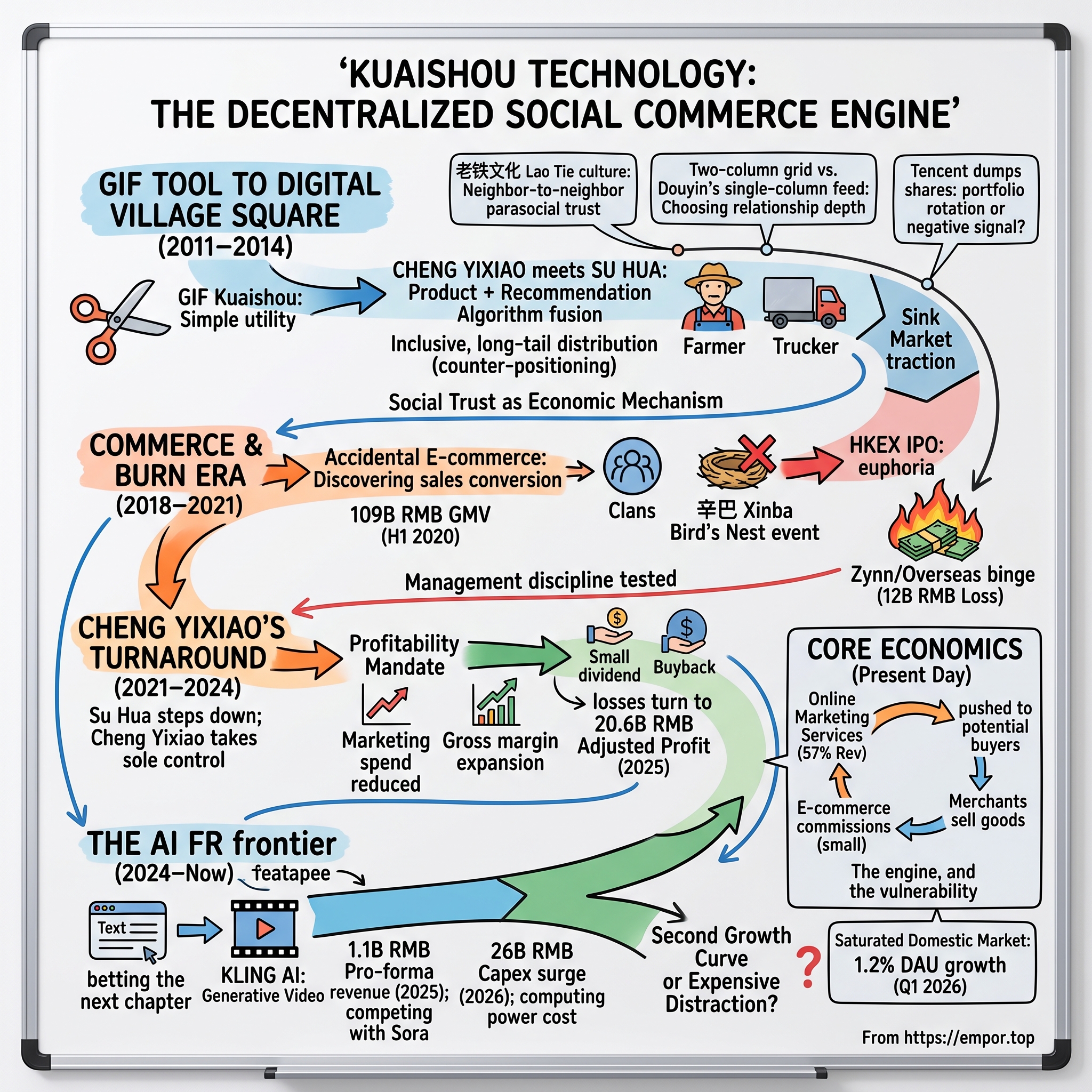
Kuaishou Technology: The Decentralized Social Commerce Engine
I. Introduction & Episode Roadmap (10 min)
On the evening of July 2, 2026, after the Hong Kong market had closed, 快手科技 Kuaishou Technology filed a dense, lawyerly announcement with the Stock Exchange of Hong Kong. Buried inside the Listing Rules jargon was one of the most consequential corporate decisions in the company's fifteen-year life: it was carving its generative-video AI business, 可灵 AI Kling AI, into a separate legal entity, selling roughly a sixth of it to outside investors for as much as RMB 20.4 billion, and valuing that unit at USD 15 billion before the new money arrived.1
To put that in perspective: on the day the filing landed, the entire parent company — 400 million-plus daily users, a marketplace that moves more than RMB 1.6 trillion of goods a year, RMB 143 billion of annual revenue — was worth roughly HK$180–200 billion. Investors were being asked to believe that a two-year-old AI video model, generating a little over RMB 1 billion of revenue in 2025, was worth a meaningful fraction of the empire that built it.12
Four days later, 腾讯 Tencent — Kuaishou's earliest strategic backer, its long-time ally, and the company whose 视频号 Shipinhao is arguably Kuaishou's most dangerous competitor — dumped 273 million Kuaishou shares in a single block trade, cutting its stake from 15.68% to about 9.37% and ceasing to be a substantial shareholder.3 The stock fell 12% the next day.3 Tencent had just helped fund Kling's independence and simultaneously reduced its exposure to the parent. Read that sequence twice; it is the single most instructive thing an investor can know about Kuaishou in mid-2026.
This is the story of how a free app for making animated GIFs became the second-largest short-video platform in the world's largest internet market, built a live-streaming commerce business on a foundation of parasocial trust rather than algorithmic virality, burned through billions chasing a global dream it could not win, executed one of the more impressive profitability turnarounds in Chinese internet history, and then bet its next chapter on generative AI at exactly the moment its core business stopped growing.
The scale of the engine today. In 2025, Kuaishou's flagship app averaged 410.2 million daily active users and 724.6 million monthly active users, with the average user spending about 126 minutes a day inside the app in the fourth quarter — over two hours, every day.2 Total revenue reached RMB 142.8 billion, up 12.5%, with e-commerce gross merchandise value of RMB 1,598.1 billion, up 15.0%.2 Adjusted net profit was RMB 20.6 billion.2 These are not the numbers of a challenger. They are the numbers of an incumbent.
The narrative arc. Phase one, from 2011 to 2018, was the grassroots square: 程一笑 Cheng Yixiao's egalitarian product instinct fused with 宿华 Su Hua's search-engine engineering, producing a platform that took root in 下沉市场 the sink market — China's third- and fourth-tier cities, county towns, and villages — and generated a culture the users themselves named 老铁文化 Lao Tie culture. Phase two, from 2018 to 2021, was the commerce and burn era: accidental e-commerce became a strategic pillar, the company bought A站 AcFun, listed in Hong Kong at a euphoric valuation, and then set fire to a large chunk of the proceeds chasing global users. Phase three, from 2021 to 2024, was the turnaround: Cheng Yixiao took sole control, marketing spend was cut hard, and enormous losses became multi-billion-renminbi profits. Phase four, from 2024 to now, is the AI frontier — and it is far from settled.
The themes worth holding onto. Counter-positioning against an opponent with better content and more money. Social trust as an economic mechanism — one that is real, measurable, and also finite. Management discipline that was genuinely earned and is now being tested again by a capital-expenditure cycle nobody in Chinese internet asked for. And the central open question of 2026: whether generative AI is Kuaishou's second growth curve or an expensive distraction dressed up as one.
One framing device is worth establishing up front, because it recurs. Kuaishou has repeatedly won by doing the thing the industry considered obviously wrong — serving poor users, dispersing traffic away from stars, refusing to optimize for watch time — and has repeatedly lost money doing the thing the industry considered obviously right. The single most useful question to ask about any Kuaishou strategy is therefore not "is this a good idea" but "is this a consensus idea." As of mid-2026, the company's largest bet is squarely consensus.
 Subscribe on LinkedIn
II. The Origins: From GIF Tool to the Digital Village Square (2011–2014) (20 min)
In 2011, a former Hewlett-Packard and 人人网 Renren engineer named Cheng Yixiao launched a small mobile app called GIF 快手 GIF Kuaishou. It did exactly one thing: it let people turn a few seconds of camera footage into an animated GIF they could share on Chinese social platforms.4 There was no feed, no algorithm, no monetization plan. It was a utility — the digital equivalent of a good pair of scissors.
Cheng was, by temperament, a product person rather than an empire-builder. He was not from Beijing's elite technology circles. His interest was in what ordinary people actually did with a phone camera, which in 2011 China meant something very different from what it meant in San Francisco. Smartphones were spreading down the income curve far faster than broadband had, and hundreds of millions of people who had never owned a personal computer were about to get a camera, a screen, and a data connection all at once.
The trouble with a tool, as every founder eventually learns, is that a tool has no gravity. Users come, accomplish a task, and leave. There is nothing to compound. By 2012 Kuaishou had become a first mover in enabling people to create, upload, and view short videos on mobile devices, but it still lacked the thing that turns software into a business: a reason to come back.4
The introduction that changed everything. The pivotal moment came in 2013, when the venture capitalist 张斐 Zhang Fei — then at Morningside Venture Capital, the firm later known as 五源资本 5Y Capital — introduced Cheng to 宿华 Su Hua. Su Hua was a different kind of engineer entirely: a search and recommendation specialist who had worked at Google and 百度 Baidu, someone who thought in terms of ranking functions, distributed systems, and click-through prediction. He joined in 2013, became CEO, and Cheng moved into the chief product officer seat.4 That division of labour — Su Hua running the machine, Cheng running the experience — held for the next eight years.
It is worth pausing on Zhang Fei, because he reappears in this story in a way few venture introductions ever do. Thirteen years after making the introduction, Zhang Fei sat as an independent non-executive director of Kuaishou, and a company wholly owned by him subscribed for shares in the Kling AI spin-off — a transaction the company had to disclose as a connected transaction under Chapter 14A of the Listing Rules.1 The man who assembled the founding team is still buying pieces of what it built. Investors can read that as conviction or as a governance question; both readings are defensible, and section eleven returns to it.
The bargain, and the philosophy underneath it. In 2013 the pair relaunched the product as a short-video social platform.4 The technical work was Su Hua's: build a recommendation system that could match hundreds of millions of videos to hundreds of millions of people. But the philosophy governing that system was Cheng's, and it was deliberately contrarian.
Most content platforms, then and now, optimize for the best content. That sounds obviously correct until you follow the logic: "best" means most-watched, most-watched means most-promoted, and most-promoted means the top 1% of creators absorb the overwhelming majority of attention. You get television with extra steps — a star system, with the platform as the studio.
Kuaishou's founders chose the opposite. They deliberately spread distribution across the long tail of ordinary creators rather than concentrating it on a few stars. The company has described this as an inclusive, community-first distribution philosophy rather than a published formula, and the precise weighting has never been disclosed — the frequently cited figure that 70% of recommendation weight went to long-tail creators is platform lore, not a company disclosure, and should be treated as such. What is verifiable is the outcome. A farmer in 河南 Henan filming himself repairing a tractor, a trucker narrating a night drive across 内蒙古 Inner Mongolia, a woman in a county town demonstrating how she makes chili oil — these people got real audiences of a few thousand, then a few tens of thousands, and those audiences came back.
There is a second, less romantic reason the strategy worked, and it is worth stating because it is the part that actually compounds. A star system is expensive. When distribution concentrates on a handful of creators, those creators capture the economics — they negotiate, they demand guarantees, and eventually they leave for whoever pays more. A platform built on ten thousand mid-sized creators has no single point of leverage against it. Kuaishou's egalitarianism was a philosophy, and it was also, whether by design or by luck, a supplier-power strategy.
Why the sink market mattered. In 2013 the consensus in Chinese technology was that the valuable user lived in Beijing, Shanghai, Shenzhen, or Guangzhou, earned an urban professional salary, and could be sold premium advertising. Kuaishou's traction came from precisely the opposite demographic — third- and fourth-tier cities, county towns, rural areas. Investors at the time regarded this as a defect. The users were poorer, the content was unpolished, the advertising yields would be lower.
That criticism was correct on unit revenue and wrong on almost everything else. What Kuaishou discovered was that a lower-income user with two hours a day and a genuine emotional attachment to a creator is not a worse asset than a high-income user with fifteen distracted minutes. Attention is the raw material; income only determines which monetization channel you use to convert it.
老铁文化 Lao Tie culture. The community named itself. 老铁 lao tie is northern Chinese slang — roughly "iron brother," the friend who would actually show up for you. On Kuaishou it became both a greeting and an ethic. Creators addressed their audiences as lao tie. Audiences responded in kind. The relationship was not fan-to-celebrity; it was closer to neighbour-to-neighbour, mediated by a screen.
The mechanics of how this happened are worth spelling out, because they explain why it was defensible. On a star-driven platform, a viewer's relationship is with the content. Change the content and the viewer follows it elsewhere. On Kuaishou, a viewer's relationship was with a specific person who replied to their comments, remembered their handle, and appeared at roughly the same time each evening. The content was almost incidental — a vehicle for a recurring appointment with someone familiar.
That distinction has a direct economic consequence: it determines what a competitor has to replicate in order to take the user. Better production values will not do it. More money will not do it. What is required is either buying the creator or persuading the viewer to abandon a relationship, and both are far more expensive than outbidding on content.
For investors, the analytical point is this: Kuaishou did not build a content platform that happened to have social features. It built a social graph that happened to distribute video. Content platforms are vulnerable to whoever has better content. Social graphs are vulnerable to whoever has your friends. Those are entirely different competitive exposures — and within three years, a very well-funded opponent was going to test which one Kuaishou actually had.
III. The Anti-ByteDance Algorithm: "Lao Tie" Culture and Decentralized Distribution (2014–2018) (25 min)
In late 2016, 字节跳动 ByteDance launched 抖音 Douyin. It was, from the first build, a different species of product — and the contrast between the two apps is one of the cleanest natural experiments in consumer internet history.
Open Douyin and you get one video, full screen, playing immediately with sound. Swipe up, get another. There is no choosing. The algorithm decides, and it decides for maximum immediate engagement. Open Kuaishou in that era and you got a two-column grid of thumbnails: dozens of options, and you had to tap one. That single design difference cascaded through everything.
Why the grid mattered more than it looked. Douyin's single-column feed maximized watch time per minute and gave the platform total control over distribution. Because the platform controlled distribution absolutely, it could concentrate attention on the most polished, most viral, most advertiser-friendly content — and it could insert advertising into a stream users had no ability to route around. It is, structurally, a broadcast network with a machine-learning programming director.
Kuaishou's two-column grid deliberately gave that control away. Requiring a tap meant the user expressed intent, which meant a creator's thumbnail and their existing relationship with a viewer mattered. Combined with heavy prominence for the "Following" feed, the design pushed users toward repeat consumption of the same creators rather than an endless parade of strangers. Kuaishou traded engagement-per-minute for relationship depth.
That trade had a specific commercial consequence, and it showed up first in live streaming. Kuaishou launched live streaming in 2016 as a natural extension of the platform, letting users interact with creators in real time.4 The monetization was virtual gifting: viewers buy tokens and send digital gifts to a streamer, the platform takes a cut, the streamer takes the rest.
Here is the thing about virtual gifting — it is a tipping economy, and tipping is a function of relationship, not content quality. Nobody sends money to a stranger because the cinematography was good. They send money because they feel known, or because they want to be seen supporting someone they consider a friend. Kuaishou's community architecture was, almost accidentally, the optimal substrate for it. By the fourth quarter of 2017, Kuaishou Flagship had become the world's largest single live-streaming platform by virtual gifting revenue.4 In January 2018 the app's daily active users passed 100 million.4
For most of that period, live streaming was effectively the entire business model. The company only began meaningfully exploring other monetization channels, including online marketing services, from 2017 onward.4 A one-revenue-stream business at that scale is a strategic vulnerability — as Kuaishou would discover a decade later when regulation, demographics, and competition combined to put live streaming into structural decline.
The unit economics nobody outside China quite believed. Western investors have consistently underestimated virtual gifting, largely because the Western analogue — tipping a streamer a few dollars — is a marginal behaviour. In China it became a genuine consumer category. The economics are unusually attractive for the platform: there is no inventory, no fulfilment, no refund cycle, and the platform recognizes its share of gross billings with very high incremental margin.
It is also, crucially, revenue that does not depend on advertiser budgets. Through 2018 and 2019, while Douyin was building the advertising machine that would eventually dwarf Kuaishou's, Kuaishou had a self-funding revenue stream that required no enterprise sales force and no brand relationships. That bought the company time it could not otherwise have afforded — and it is the reason a smaller platform survived long enough to build a marketplace.
What Douyin actually did to Kuaishou. By mid-2020, Douyin had roughly 600 million daily active users against Kuaishou's approximately 320 million — nearly double.5 Douyin won on total scale, decisively. But it won by playing a different game rather than by beating Kuaishou at its own.
This is the counter-positioning argument in its cleanest form, and it deserves scrutiny rather than acceptance. The standard telling is that Douyin could not copy Kuaishou's decentralized model without destroying its own advertising economics. The more precise version is that Douyin had no reason to. A centralized feed generates higher advertising yield per user-minute because the platform controls inventory absolutely. Deliberately dispersing attention to long-tail creators would have reduced the concentration that makes that inventory valuable. Douyin's constraint was economic self-interest, not technical inability — and self-interest is a weaker moat than incapability. If Douyin ever concludes that relationship-based commerce is worth more than advertising yield, the barrier is a spreadsheet, not a rewrite.
The AcFun detour. In June 2018 Kuaishou acquired 弹幕视频网 AcFun, the pioneering Chinese anime-comics-games video site that had been losing ground badly.6 The disclosed value was never fully published; reported estimates clustered in the low hundreds of millions of dollars, and Kuaishou said AcFun would retain its own brand, operations, and staffing.6
The strategic logic was legible: Kuaishou's user base skewed rural, older, and lower-income, while AcFun's skewed urban, young, and culturally sophisticated. Buying it was an attempt to purchase a demographic Kuaishou could not organically grow.
It did not work. AcFun never seriously threatened 哔哩哔哩 Bilibili, which went on to become the dominant destination for exactly that audience. Judged as a standalone investment, the acquisition returned little. Judged as tuition, it taught Kuaishou something more valuable than the price: cultural communities are not transferable assets. You cannot buy a subculture and bolt it onto a different subculture. That lesson shows up later in how Kuaishou handled its overseas businesses — and, arguably, in how it is now structuring Kling AI as a legally separate company rather than a division.
By 2018, then, Kuaishou had a hundred million daily users, the world's largest gifting business, a demographic nobody else wanted, and a rival with twice its scale. What it did not yet have was any idea that its users were about to invent its next business without being asked.
IV. The Live-Stream E-Commerce Explosion & M&A Expansion (2018–2021) (30 min)
The best business lines are usually discovered, not planned, and Kuaishou's e-commerce business is a textbook case. Sometime around 2017, creators on the platform started doing something the company had not designed for: they began selling things.
A woman streaming from a clothing wholesale market in 广州 Guangzhou would hold up a jacket, quote a price, and tell her viewers where to buy it — pasting a 淘宝 Taobao link or a 有赞 Youzan storefront into the chat. A man in a factory town would demonstrate a knife, then direct his lao tie to an external page. The money left the platform entirely. Kuaishou captured none of it.
What management noticed was the conversion rate. Sales conversion on those streams was extraordinary — not because the products were remarkable, but because the recommendation came from someone the viewer had followed for two years and genuinely trusted. Kuaishou had spent five years building parasocial trust and monetizing it at the rate of virtual roses. It turned out the same trust converted at the rate of actual merchandise.
Closing the loop. In 2018 Kuaishou formally commenced its e-commerce business, building 快手小店 Kuaishou Store as an integrated marketplace so that discovery, transaction, and payment could all happen inside the app.4 In August 2019 it launched 快手极速版 Kuaishou Express, a lightweight version of the app aimed at lower-spec phones and thinner data plans, which itself passed 100 million daily active users by August 2020.4
The growth that followed was violent. E-commerce GMV went from RMB 97 million in 2018 to RMB 59.6 billion in 2019 — a 600-fold increase in a single year — and reached RMB 109 billion in the first half of 2020 alone.5 By the eleven months ended November 30, 2020, GMV exceeded RMB 330 billion, making Kuaishou the world's second-largest live-streaming e-commerce platform by that measure.4
The monetization paradox. Here is what makes those numbers analytically interesting rather than merely large: Kuaishou barely charged for any of it. Commission rates on the platform ran below 1% during that period as the company deliberately subsidized merchant participation.5
Management was making an explicit trade — buy supply now, monetize later. That is the correct playbook for a marketplace in a land-grab, and it worked: merchants came because Kuaishou was cheaper than every alternative, and buyers came because merchants were there. But it also established an expectation among sellers that Kuaishou was the low-cost channel, and expectations set during a land-grab are expensive to revise. Eight years later, that decision still constrains what the company can charge, a point section seven examines in detail.
The clans, and the concentration problem. As GMV compounded, so did a governance problem the company had not anticipated. Top live-stream sellers organized into 家族 "families" — clan structures with a patriarch anchor at the top and dozens of affiliated streamers beneath, sharing supply chains, traffic, and negotiating leverage.
The most powerful was built by 辛巴 Xinba, whose real name is 辛有志 Xin Youzhi and who commanded roughly 71 million followers.7 Xinba's operation could move enormous volumes of merchandise in single sessions — after a suspension, one comeback stream reportedly generated some US$300 million in sales over twelve hours.8 When one seller can independently move that kind of volume, the relationship between platform and merchant inverts. The platform stops setting rules and starts negotiating them.
Then came the reckoning. In late 2020, Xinba promoted a bird's nest beverage during live sessions in September and October; laboratory analysis found the product to be, in substance, syrup and water with none of the claimed nutritional content.7 Regulators fined the operating company RMB 900,000, Xinba publicly apologized and paid out roughly RMB 62 million in customer compensation at three times purchase price, and Kuaishou suspended his account and an affiliate's for 60 days.7
The episode crystallized the structural risk in trust-based commerce. Kuaishou's entire commercial thesis was that viewers buy because they believe the person selling. The corollary is that every fraudulent sale does not merely cost one refund — it withdraws from the platform's shared reservoir of credibility. Douyin, selling largely on content and price, has less trust to lose. Kuaishou has more.
Management's response over the following years was to systematically dilute clan power: promoting mid-tier and long-tail merchants, pushing brand and shelf-based commerce, and reducing dependence on a handful of mega-anchors. That was a genuine and difficult structural choice — it meant accepting slower near-term GMV in exchange for a more governable ecosystem. The evidence suggests it worked; concentration risk of the 2020 variety has not recurred at comparable scale.
A second-order lesson from the clan era. The episode also revealed something about how platform power actually works. Kuaishou's leverage over Xinba was never contractual — it was the ability to withhold traffic. When one seller commands 71 million followers, withholding traffic hurts the platform's GMV as much as the seller's revenue, which is precisely why the relationship had inverted in the first place.
The eventual fix was structural rather than punitive: rather than confront the clans, Kuaishou spent years building enough mid-tier supply that no individual anchor mattered. That is a slow, unglamorous solution, and it is a reasonable proxy for how this management team handles problems generally — they tend to change the underlying distribution of the system rather than fight the symptom.
Where Kuaishou fit in the e-commerce landscape. The company was not primarily attacking 阿里巴巴 Alibaba's Tmall or 京东 JD.com, which are branded, search-driven, intent-based marketplaces. Its natural supply was unbranded and white-label goods sourced factory-direct — the same pool that powered 拼多多 Pinduoduo. The difference was the demand mechanism: Pinduoduo grew through price and social sharing; Kuaishou grew through a person on camera telling you why this thing was worth buying. One is search commerce, the other is discovery commerce, and they compete for wallet but not for the same moment of consumer intent.
By late 2020 Kuaishou had a hundred-billion-renminbi marketplace, a defensible position in a demographic the giants had ignored, and a rival growing faster. It also had a burning need for capital — because the war for daily active users had already begun, and it was about to get very expensive.
V. The HKEX IPO & The Battle of Big Spenders: Zynn, Overseas Binge, and the Douyin Rivalry (2021) (25 min)
In June 2019, Su Hua sent a company-wide memo that has become part of Chinese internet folklore. The company named for speed — 快手 literally means "quick hand" — had, in his assessment, become slow: a comfortable organization of thousands of people, growing pleasantly while a competitor doubled past it. The memo declared a new operating posture and a hard target.
The campaign was called K3, and its objective was blunt: 300 million daily active users before the 2020 Spring Festival, plus RMB 15 billion of advertising revenue that year.5 To get there, Kuaishou abandoned its historic reluctance to buy growth. It pushed hard into southern China, where its northern-flavoured culture had never taken root, and it paid roughly RMB 3 billion for the rights to be the exclusive short-video partner of the 春节联欢晚会 Spring Festival Gala — the single most-watched broadcast on Earth — running a red-envelope campaign to convert viewers into app installs.5
The scorecard was split. Kuaishou hit the user target. It badly missed the revenue target, delivering about RMB 7.4 billion of advertising revenue against the RMB 15 billion goal — roughly half.5 That gap is the most important management-credibility datapoint in the company's pre-IPO history, and it says something specific: Kuaishou could buy attention but had not yet built the machinery to sell it. Users were purchasable; advertiser demand was not.
The listing. Kuaishou went public in Hong Kong in early 2021, into what was arguably the most euphoric window Chinese technology equities have ever seen. It sold 365 million shares at HK$115 apiece, raising HK$42 billion, or about US$5.4 billion — pricing at the very top of the marketed range, the largest internet IPO globally since Uber in 2019.9 The retail book was oversubscribed more than 1,200 times, with investors placing a reported US$162 billion of orders.9
On February 5, 2021, the shares opened at HK$338 — a 194% jump from the offer price.10 The company was briefly worth well over US$150 billion. Almost nobody who bought at the open has made money since; the stock traded around HK$46 in early July 2026 before Tencent's block sale.3
For long-term investors, the IPO is worth studying not as a triumph but as a warning about what a listing price actually represents. Kuaishou raised real, permanent capital at a valuation that reflected February 2021 sentiment about Chinese internet growth, not February 2021 evidence about Kuaishou's economics. The company was, at that moment, deeply unprofitable. The question that mattered was what it would do with US$5.4 billion of other people's money.
The answer, initially, was: set a lot of it on fire. Kuaishou's global ambition was to be to TikTok what Kuaishou was to Douyin — the alternative that won a different demographic. It ran two vehicles: Kwai, targeting Latin America, Southeast Asia, and the Middle East, and Zynn, a US-facing app.
Zynn's growth strategy was to pay people. Users received cash rewards for watching videos and for referring friends, a tactic that shot the app into the top three most-downloaded on the US iOS App Store. It also drew immediate scrutiny. The app was pulled from Google Play after reports that it was riddled with videos stolen from other platforms, and subsequently from Apple's store on similar grounds. Engagement collapsed once the payments were the only reason to be there: monthly active users fell to roughly 200,000 by June 2021 from about 3 million the previous August. Kuaishou announced on August 4, 2021 that it would shut Zynn down, with closure on August 20.11
What the overseas burn actually cost. The scale becomes clear in the segment disclosure. In 2021, Kuaishou's overseas segment posted an operating loss of RMB 11.99 billion.12 Group-wide, selling and marketing expenses that year reached RMB 44.18 billion against revenue of RMB 81.08 billion — 54.5% of every renminbi of revenue went to acquiring and retaining users.1213 The full-year adjusted net loss was RMB 18.85 billion and the operating loss RMB 27.70 billion.12
Sit with that for a moment. A company that generated RMB 81 billion of revenue spent RMB 44 billion on marketing. This is not a business with a cost problem; it is a business that had temporarily stopped being a business and become a customer-acquisition program with a video app attached.
The honest assessment of management here is mixed and should be stated plainly. Su Hua and Cheng Yixiao correctly identified that scale mattered and that losing the DAU war to Douyin was an existential risk — the K3 campaign, whatever its revenue miss, delivered a user base that still underpins the company today. But the overseas program was capital deployed without evidence. Zynn had no product-market fit, no differentiated proposition, and a growth mechanism that provably did not retain users. That money is gone, and it was IPO proceeds — the most expensive capital a company ever raises, because it is sold once at a price that never comes back.
There is a defence worth acknowledging. In 2021, the possibility that TikTok's international trajectory could be replicated by a second Chinese short-video company was not obviously absurd — TikTok itself had gone from nothing to global ubiquity in about three years, and the capital markets were rewarding companies that tried. Kuaishou was not alone in believing a land-grab window was open.
But the specific execution is harder to defend than the strategy. Paying users to watch videos does not test whether a product has value; it tests whether people will accept money. Zynn's collapse the moment payments stopped was not a surprise outcome — it was the predictable outcome of a growth mechanism that generates a metric rather than a habit. That distinction is one Kuaishou, of all companies, should have understood: its entire domestic franchise was built on habit that nobody paid for.
What happened next is the more interesting part of the story, because companies rarely correct this cleanly.
VI. The Great Pivot: Cheng Yixiao's Profitability Mandate & Capital Allocation Overhaul (2021–2024) (30 min)
On October 29, 2021 — eight months after the euphoric listing, with the share price already deep underwater and losses running at record levels — Kuaishou announced that Su Hua would cease to serve as chief executive officer. Cheng Yixiao, the co-founder who had built the original GIF tool and defined the product philosophy, took the CEO role with immediate effect and responsibility for day-to-day operations and business development. Su Hua remained chairman and an executive director, focusing on long-term strategy. The weighted voting rights of both founders were unchanged.14
Two years later, in October 2023, Su Hua stepped down as chairman as well, leaving Cheng Yixiao as both chairman and chief executive with consolidated operational and board control.[^15]
The timing invites two readings. The generous one: a product founder took over precisely when the company needed product-led efficiency rather than growth-at-any-cost, and the handover was orderly. The skeptical one: this was one of a cluster of Chinese technology founders stepping back from operational roles during a period of intense regulatory attention on platform companies, and the sequencing was not entirely voluntary. Both are plausible; the company's own disclosure supports only the first. What is not ambiguous is the result, and results are what investors can actually underwrite.
The weighted voting rights question. Kuaishou is incorporated in the Cayman Islands and controlled through weighted voting rights, with Class A shares carrying super-voting power held by the founders.1 The standard defence of dual-class structures is that they insulate management from short-term market pressure during long-horizon transformations. In Kuaishou's case, that defence has some empirical support — the 2021 to 2024 turnaround required accepting slower user growth, and a board answerable to a quarterly market might not have allowed it.
The standard criticism also applies, and it applies with more force in 2026 than it did in 2022: when a founder-chairman-CEO with super-voting control decides to carve out the company's most exciting asset into a separate entity, grant himself equity in that entity, and take it public separately, minority shareholders in the parent have essentially no mechanism to object. Hold that thought for section eleven.
Execution: what actually changed. The turnaround was not subtle, and it was not a single lever. Kuaishou reorganized from functional silos into business units with their own profit-and-loss accountability — domestic, overseas, e-commerce, commercialization, local services — which meant that for the first time, the people spending money on user acquisition were the same people who owned the resulting revenue.
The financial trajectory tells the story. Marketing intensity fell from 54.5% of revenue in 2021 to 39.4% in 2022, and to 32.2% by 2023.1215 Gross margin rose from 42.0% in 2021 to 44.7% in 2022 and 50.6% in 2023 — driven substantially by improving revenue mix toward higher-margin advertising and by better bandwidth and server cost efficiency per user.1215 The overseas segment's losses were cut from nearly RMB 12 billion to RMB 6.64 billion in 2022, then to RMB 2.8 billion in 2023 — a 58% reduction in a single year — as pan-global cash subsidies were abandoned and the effort was concentrated where Kwai had genuine traction.1215
The bottom line inverted. From a 2021 adjusted net loss of RMB 18.85 billion, the group posted a 2022 adjusted net loss of RMB 5.75 billion, and then in 2023 delivered adjusted net profit of RMB 10.3 billion on revenue of RMB 113.5 billion, with statutory net profit of RMB 6.4 billion.1215 In 2024 it went further: revenue of RMB 126.9 billion, gross margin of 54.6%, and adjusted net profit of RMB 17.7 billion — up 72.5% year over year.16
What this proves and what it does not. The proven part is real and should not be understated: Kuaishou demonstrated that its user engagement was organic rather than purchased. That is the single most important finding of the entire turnaround. If the 400 million daily users had been bought and rented, cutting marketing spend by twenty-two percentage points of revenue would have caused a user exodus. It did not — daily actives kept growing through the cuts, reaching 379.9 million in 2023 and 399.4 million in 2024.1516 Users stayed because they wanted to. That is the empirical evidence for the trust-and-community thesis, and it is far more persuasive than any amount of management narrative.
The unproven part matters too. Cutting costs from a wildly inefficient base is the easiest form of margin expansion there is. It demonstrates discipline, not durable competitive advantage. The harder question — can Kuaishou grow revenue faster than costs when there is no more fat to cut — was deferred, not answered. In 2026 it is being asked directly.
Capital returns. In May 2024 the board announced an on-market repurchase program of up to HK$16 billion of Class B shares over 36 months, running until the conclusion of the 2027 annual general meeting.17 In 2025 the company repurchased 56.78 million shares for approximately HK$3.12 billion, and cumulatively had bought back 174.84 million shares for HK$8.35 billion by mid-2026.23 Alongside the 2025 results, the board recommended the company's first-ever dividend: a final dividend of HK$0.69 per share, roughly HK$3.0 billion in total, paid on or around July 28, 2026.2
A note on how to read the buyback. Kuaishou, like most Chinese internet companies, issues a substantial volume of share-based compensation, which is the principal reason adjusted net profit runs above statutory net profit — the RMB 20.6 billion adjusted figure for 2025 compares with RMB 18.6 billion statutory.2 A repurchase program that merely offsets dilution is not the same as one that shrinks the share count, and investors should look at diluted shares outstanding rather than at repurchase headlines to judge which is happening.
Initiating a dividend is a genuine signal. It converts a promise of future discipline into a recurring cash obligation and it tells the market that management considers the business durably cash-generative. Whether that signal survives contact with a doubling capital-expenditure budget is now the live question — and it is the question that dominates the present-day story.
VII. Today's Empire: Core Economics, Segment Breakdown & Industry Structure (Present Day) (35 min)
To understand Kuaishou in 2026, start with a deceptively simple observation: it makes most of its money selling advertising to the merchants who sell on its own marketplace. That circularity is the engine, and understanding it explains nearly everything about the company's economics — including its vulnerabilities.
Online marketing services: the actual business. In 2025, online marketing services generated RMB 81.5 billion, 57.1% of total revenue, growing 12.5%.2 This is the profit engine, and the majority of it is not brand advertising. It is performance advertising bought by merchants who want their live streams and short videos pushed to more potential buyers inside Kuaishou.
The mechanism is worth explaining in plain terms, because it is the source of both the company's operating leverage and its reported "low" take rate. A merchant sells RMB 100,000 of goods on Kuaishou. Kuaishou charges a small commission on that — historically very small. But to reach the buyers in the first place, the merchant bought RMB 8,000 of ads inside Kuaishou. That advertising spend is recorded as online marketing services revenue, not e-commerce revenue. The company's tool for this, 全站推广 site-wide promotion, lets merchants set a target return on ad spend and hands the optimization to the algorithm — the merchant states an outcome, the machine buys the traffic.
So when observers describe Kuaishou's e-commerce take rate as roughly 1.4%, they are measuring only one channel. The economically meaningful figure is total revenue extracted per unit of GMV across both commissions and closed-loop advertising, which is materially higher — and Kuaishou does not disclose it as a single number.
Myth versus reality on the take rate. This deserves a direct correction, because it is the most common analytical error made about this company. The widely repeated bull argument holds that Kuaishou's e-commerce take rate is around 2.5% and heading toward an industry standard of 3.5% to 4.0%, with the increment flowing straight to operating profit. The company's own disclosures do not support that framing. In 2025, "other services" revenue — the line that contains e-commerce commissions, and also merchant tools, logistics services, and other items — was RMB 22.2 billion against GMV of RMB 1,598.1 billion.2 That ratio is under 1.5%, and it is not purely commission.
More importantly, management is actively discussing moving the other way. On the first-quarter 2026 call, management described integrating e-commerce with advertising distribution to expand traffic, buyers, and merchant count, and explicitly acknowledged that these structural adjustments could pressure monetization rates in the near term while building the merchant ecosystem.18 That is management telling investors it is choosing supply growth over extraction — the same trade made in 2019. Investors modelling take-rate expansion as the near-term bull driver are modelling something the company has said it is not currently prioritizing.
E-commerce and other services. At RMB 22.2 billion in 2025, this segment grew 27.6% — the fastest-growing of the three, though from the smallest base.2 The GMV underneath it, RMB 1,598.1 billion, grew 15.0%.2 The gap between 27.6% revenue growth and 15.0% GMV growth tells you monetization per unit of GMV did rise in 2025. The first-quarter 2026 commentary suggests that trend is being deliberately paused.
Live streaming: the cash cow in structural decline. Virtual gifting delivered RMB 39.1 billion in 2025, 27.4% of revenue, up 5.5% for the year — but the fourth quarter was already down 1.0% year over year.2 In the first quarter of 2026, live streaming revenue fell 13.5% to RMB 8.5 billion.19
That is not noise; that is a trend. Several forces compress it simultaneously: regulatory tightening on tipping practices and real-name verification, a softer consumer environment in exactly the income brackets where Kuaishou is strongest, and competition for the same discretionary spending from short dramas and games. Management has consistently framed live streaming as a business managed for ecosystem health and cash generation rather than growth. That framing has been consistent across calls, which is to management's credit — but consistency about a declining business is not the same as a plan to stop the decline.
The first quarter of 2026: where the story gets uncomfortable. Revenue grew 3.4% to RMB 33.7 billion — the slowest growth since listing.1920 Gross margin fell to 51.2% from 54.6%.19 Adjusted net profit fell 26% to RMB 3.4 billion, a 10.0% margin.19 Domestic segment operating profit dropped to RMB 3.1 billion from RMB 4.3 billion, and the overseas segment swung back to a small operating loss of RMB 31 million after a modest profit a year earlier.19
The core commercial business — online marketing plus e-commerce — still grew 10.7%.18 Strip out live streaming's decline, and the underlying franchise is healthier than the headline suggests. But that is precisely the problem with an aging cash cow: it does not decline politely in the background, it drags the consolidated numbers with it. And the gross margin compression was not caused by live streaming at all. It was caused by the cost of computing power for AI.
User metrics: growth has essentially stopped. Daily actives rose 2.7% in 2025 and 1.2% year over year in the first quarter of 2026, to 412.7 million.219 Monthly actives jumped 8.4% to 771.7 million in the quarter — a wider funnel, but the ratio of daily to monthly users fell, which is what happens when you acquire users who visit occasionally rather than daily.19 Time spent has remained roughly stable around two hours.219
The honest read: Kuaishou's Chinese user base is saturated. There is no meaningful DAU growth left to harvest domestically. Every future renminbi of domestic revenue must come from monetizing existing attention better, not from more attention.
The competitive board. Against Douyin, Kuaishou remains the smaller player by a wide margin. ByteDance is private and publishes no audited GMV; industry reporting placed Douyin's e-commerce GMV at roughly RMB 3.5 trillion for 2024, which would be more than double Kuaishou's — treat that as a third-party estimate rather than a disclosed figure.21 Kuaishou's genuine relative advantages are in repeat purchase behaviour among lower-tier consumers and in lower merchant acquisition cost, both consequences of the relationship graph.
Against Tencent's 视频号 Shipinhao, the threat is structural rather than competitive in the usual sense. Shipinhao lives inside WeChat, which means it acquires users at essentially zero marginal cost from an app that already has effectively all of China. It has been gaining share of attention, particularly among older and less digitally native users — precisely Kuaishou's demographic. What Shipinhao lacks is the merchant supply chain and the operational depth in live commerce that Kuaishou spent eight years building. That gap is real but it is being closed with Tencent's balance sheet behind it.
Against the traditional marketplaces, Kuaishou's positioning as discovery commerce remains coherent. Alibaba and JD.com are where a consumer goes having already decided to buy a washing machine; Kuaishou is where a consumer discovers they want a set of kitchen knives they were not thinking about ninety seconds earlier. Those are different budgets drawn from the same wallet, which is why Kuaishou's growth has never required taking direct share from search commerce.
The limit of that argument is average order value. Discovery commerce skews toward low-ticket, impulse-priced goods, and Kuaishou's consumer base skews toward the income brackets least able to absorb high-ticket impulse purchases. GMV growth therefore has to come from frequency and buyer count rather than basket size — a harder arithmetic than it sounds, and one that shows up directly in the bear case.
The January 2026 regulatory tightening applies across all of these players, and it is not cosmetic — it has already touched Kuaishou directly.
The regulatory overhang. New Supervision and Management Measures for Live Streaming E-commerce, issued by 国家市场监督管理总局 SAMR and the 国家互联网信息办公室 Cyberspace Administration of China, took effect on February 1, 2026, imposing obligations across platforms, brands, and streamers and pulling more livestream selling activity under the Advertising Law.22 Separately, SAMR disclosed on January 30, 2026 that an investigation into Kuaishou Shop had found multiple serious violations of the E-commerce Law, including failures of information disclosure, charging unreasonable fees to merchants, inadequate consumer safety protections, insufficient handling of intellectual property infringement claims, publication of illegal advertisements, and facilitation of misleading promotions; enforcement action in December 2025 imposed total confiscation and fines of RMB 26.69 million and ordered immediate remediation.23
The fine is trivial against a RMB 143 billion revenue base. The findings are not. "Charging unreasonable fees to merchants" is a regulator commenting directly on the mechanism by which Kuaishou monetizes its marketplace. New platform rules also require advance public notice periods before changes that materially affect merchant rights, and push platforms toward collecting and reporting merchant income for tax purposes.22 Both raise the friction of take-rate expansion. This is a material constraint on the bull case, and it should be weighted accordingly.
VIII. Emerging Vectors: Kling AI, Short Dramas, and Local Services (Sizing Future Optionality) (25 min)
In June 2024, Kuaishou released something nobody outside China expected from a company known for videos of farmers and truckers: a text-to-video generative model that could hold its own against OpenAI's Sora.24
可灵 AI Kling AI. The technology, explained without jargon: you type a sentence, or upload a still image, and the model produces a video clip. Underneath, Kling uses a diffusion transformer architecture — the same broad family as modern image generators — combined with a proprietary 3D variational autoencoder that compresses space and time together, so the model reasons about how objects move across frames rather than generating each frame independently. That is why generated video holds physical plausibility instead of dissolving into visual soup. At launch it could produce up to two minutes of 1080p video at 30 frames per second.25
The strategic insight was not the model. It was the distribution. Sora was announced in February 2024 and remained inaccessible to the public for months; Kling let people actually use it almost immediately.25 Shipping beat benchmarking. Kuaishou also had two structural advantages no Western lab could easily replicate: an enormous proprietary corpus of short-form video, and a captive commercial user base of millions of merchants who need video advertising produced cheaply and constantly.
The company shipped aggressively — successive model versions through 2025, then Kling 3.0 in February 2026, supporting multimodal inputs and outputs across text, image, audio, and video, simultaneous audio-visual generation, and motion control.2026 The app reached the number one App Store position across 42 markets, including Brazil and Germany.20
The financial materiality check. This is where investors need to be careful, because the growth rates are spectacular and the base is small. Kling's revenue for the fourth quarter of 2025 was in the low hundreds of millions of renminbi, with December monthly revenue exceeding USD 20 million — roughly a USD 240 million annualized run rate.2 By January 2026 the annualized run rate topped USD 300 million, and by March it reached approximately USD 500 million on first-quarter revenue exceeding RMB 650 million, growth above 300% year over year.182027 For full-year 2025, the Kling entity's pro-forma revenue was approximately RMB 1.1 billion.1
So: a business growing over 300% annually, with a half-billion-dollar run rate, inside a company doing RMB 143 billion of revenue. Kling contributed under 2% of 2026 first-quarter group revenue. Management has called it the "second growth curve" and expects 2026 Kling revenue to more than double.27 That is a defensible ambition. It is not yet a material earnings contributor, and investors should size it accordingly.
The cost side, which is the part that moved the stock. Generative video is extraordinarily compute-hungry — every generated clip consumes GPU time, so unlike software, the cost of goods sold scales directly with usage. Success and cost rise together.
On the fourth-quarter 2025 call in March 2026, management guided 2026 group capital expenditure to approximately RMB 26 billion, up about RMB 11 billion from roughly RMB 15 billion in 2025, covering computing resources for Kling and other foundation models plus data-centre infrastructure.27 The market's reaction was immediate and negative: shares fell as much as 14% on March 26, 2026, and analysts recalibrated toward lower margins.2829 Chief financial officer 金秉 Jin Bing subsequently noted the company had built procurement and inventory buffers ahead of rising computing-power prices.20
Management's counter-argument, delivered consistently, is that despite roughly RMB 15 billion of capital expenditure in 2025 the group still produced nearly RMB 12 billion of free cash inflow, and that it aims to remain free-cash-flow positive at group level in 2026 even with the higher spend.27 That is a specific, falsifiable commitment, and it is exactly the kind of statement investors should track quarter by quarter. Failing it would be a serious credibility event.
The strategic case for spending is genuine rather than rhetorical: Kling's models directly lower content production costs for Kuaishou's own merchants, generating advertising creative and virtual presenters at a fraction of human cost. If that works, AI capital expenditure is not a separate bet — it is an input cost reduction for the core advertising business. The falsification test is straightforward: if merchant advertising spend and click-through rates improve measurably while creative costs fall, the integration thesis holds. If Kling revenue keeps compounding while core advertising growth stays in the high single digits, then Kling is a standalone software business that happens to be owned by a short-video company — interesting, but not synergistic.
Micro-short dramas. Kuaishou was an early mover in 微短剧 micro-short dramas — one-to-two-minute episodic serials, typically melodramatic, consumed in vertical format and monetized through paywalls, in-app purchases, and advertising. Its 星芒短剧 Xingmang label sits alongside ByteDance's and Tencent's competing offerings in a genre that has grown into one of China's largest entertainment categories. The AI connection is direct: by March 2026, AI-assisted production had cut costs for comic-style short plays enough that peak daily marketing spend on the category exceeded RMB 20 million.20 Short dramas are best understood not as a separate segment but as a high-yield use of inventory and a demand driver for advertising — and as a genre where competition has intensified enough to pressure returns.
本地生活 Local life services. Kuaishou sells restaurant deals, group buys, and travel coupons, competing against 美团 Meituan and Douyin. GMV has grown, with lower-tier cities contributing the bulk of the increase, and management has explicitly avoided subsidy warfare, tightening cost control in in-store dining and favouring high-return products. The segment remains small — well under 5% of platform revenue — and is not separately disclosed. The correct way to read it is as a defensive holding action for user time and transaction frequency rather than a future profit pool. Meituan's density advantage in delivery logistics is not something a video app dislodges with coupons.
There is also a competitive question that the spin-off structure makes sharper. Kling's addressable market is global, which means its competitors are not Douyin but OpenAI, Google, Runway, and a growing field of specialists — several with more compute, more capital, and deeper research benches. Kuaishou's historical advantages, a Chinese social graph and a lower-tier merchant base, transfer to none of that. What does transfer is speed of productization and a willingness to charge money early, which so far has been enough. Whether it remains enough in a field where model capability resets every few months is genuinely unknown, and no amount of current growth answers it.
Overseas. Following the retrenchment, Kwai concentrated on Brazil and Latin America. The results validate the discipline: the overseas segment's full-year 2025 operating loss was RMB 76 million, essentially breakeven, against RMB 934 million in 2024 — and a fraction of the near-RMB 12 billion bled in 2021.216 Overseas revenue in the first quarter of 2026 was RMB 1.162 billion, about 3.4% of group revenue, with a small operating loss.19 This is a well-executed cleanup of a bad decision. It is not, on current evidence, a growth engine.
IX. Helmer's 7 Powers & Porter's 5 Forces Analysis (20 min)
Frameworks are only useful when applied adversarially — the test is not whether a company has a power, but whether that power still holds under current conditions. Applied honestly to Kuaishou in 2026, the results are mixed.
Counter-positioning: was real, is now largely spent. The classic form of this power is that an incumbent cannot copy a challenger's model without damaging its own economics. Kuaishou's decentralized distribution and relationship-first design did exactly that against Douyin's centralized feed for roughly five years. But counter-positioning is inherently temporary — it protects a challenger while it builds. Kuaishou has finished building. Douyin, meanwhile, developed its own robust e-commerce infrastructure and its own merchant ecosystem without abandoning its feed model, which suggests the incompatibility was less absolute than the theory implied. Today Kuaishou's structural distinctiveness is a demographic and cultural position, not an economic model Douyin cannot replicate. It is defensible. It is no longer a wall.
Network effects: genuine, but bounded geographically and demographically. The two-sided loop is real — creators attract niche buyers, buyers attract factory-direct suppliers, and supply depth attracts more creators. The evidence is in merchant behaviour: management reported the number of active merchants using marketing placements rose 33% year over year in the first quarter of 2026, and monthly active paying users grew over 20%.18 Merchants are voting with their budgets. But the effect is strongest in lower-tier and rural China and has not travelled — the network did not transfer to the United States, and it works in Brazil only because Kwai rebuilt it locally. A network effect that stops at a border is a regional moat, which is exactly what Kuaishou has.
Switching costs: high for merchants, low for viewers. A seller who has spent three years accumulating 200,000 followers on Kuaishou cannot export that graph. Leaving means starting over. That is a genuine, high switching cost, and it explains merchant stickiness through periods when Kuaishou's fee structure was unfavourable. Viewers face almost no switching cost at all — Douyin, Shipinhao, and 小红书 Xiaohongshu are one tap away and free. The asymmetry means Kuaishou's supply side is far more locked in than its demand side, and demand is where attention erosion would show up first. Watch time spent per daily user, not merchant count, for early warning.
Scale economies: real in infrastructure, uncertain in AI. Serving billions of video streams has enormous fixed costs and low marginal costs, which is why gross margin expanded from 42% to 55% as revenue grew without proportional infrastructure spend.122 But generative AI inverts this. Every Kling video generated costs real GPU time — the marginal cost of an incremental unit is significant and, given rising computing prices, potentially increasing.20 The first quarter of 2026 already showed gross margin compressing by more than three percentage points.19 Investors should not assume the historical scale-economy pattern extends to the AI business; the evidence so far suggests it does not.
Cornered resource: absent. It is worth naming a power Kuaishou does not have. There is no exclusive asset here — no patent estate, no irreplaceable licence, no locked-up supply that competitors cannot obtain. Kuaishou's video corpus is large and proprietary, and it is a genuine input to Kling's training, but Douyin's is larger. Any argument that Kuaishou wins generative video because of data access has to explain why the company with more data does not win instead.
Brand and process. Kuaishou has a genuine brand within its demographic — it means something specific and trusted to a Chinese county-town consumer. That does not translate into pricing power over merchants, which is where brand would need to show up financially. Process power, in the sense of hard-to-replicate organizational capability, is arguably visible in the speed with which Kling shipped and iterated relative to better-funded Western labs. That is worth noting but too recent to underwrite.
Porter, applied. Buyer power is moderate to high and rising: viewers can leave costlessly, and merchants now have a regulator explicitly scrutinizing platform fees, which strengthens their hand.23 Supplier power — creators and brands — has fallen since the clan era, deliberately, though a small number of top anchors still carry disproportionate GMV. Threat of new entrants is genuinely low; the combination of infrastructure, content moderation capability, regulatory licensing, and an accumulated social graph makes a new domestic short-video entrant implausible. Threat of substitutes is the sharpest force: Shipinhao acquires attention at zero marginal cost from inside WeChat, and private-domain WeChat commerce competes directly for the trust-based selling Kuaishou pioneered. Rivalry is severe and now three-front — advertising, e-commerce, and generative AI — against opponents with deeper pockets.
The synthesis: Kuaishou's competitive position is defensible but narrowing. Its strongest powers protect the supply side of a saturated domestic market. Its weakest exposure is on the demand side, in a category where a competitor with structurally free distribution is gaining. That is not a broken thesis, but it is a thesis with a clock on it.
X. Playbook: Key Strategic & Investing Lessons (20 min)
Strip away the specifics of Chinese short video and a handful of transferable lessons remain — each with a limit worth naming.
1. Trust converts better than reach, but trust is a depleting asset. Kuaishou's central discovery was that a recommendation from someone a viewer has followed for years converts at rates that polished advertising cannot match. That is why an app full of unpolished rural content built a RMB 1.6 trillion marketplace. But trust is a shared reservoir. The Xinba episode demonstrated that a single high-profile fraud damages the platform's entire credibility, not just one seller's, and the SAMR findings on consumer protection show regulators now treat that reservoir as something they will police.723 Businesses built on trust have higher conversion and higher tail risk simultaneously. Both facts belong in the model.
2. The hardest capital-allocation skill is stopping. The overseas program was a well-funded bet on a thesis that did not hold, and management ran it hard for two years before killing it. What distinguishes Kuaishou from the many companies that make similar mistakes is what happened next: overseas losses were cut by more than 99% from peak to near-breakeven, without abandoning the business entirely where it worked.122 That is the difference between admitting an error and overcorrecting into a second one. For investors evaluating any management team, the useful question is not "have they made bad bets" — everyone has — but "how quickly and cleanly did they stop, and did they preserve the salvageable part."
3. Serving the market everyone ignores is a real strategy, until it becomes the market everyone wants. Kuaishou's lower-tier positioning was a genuine advantage for a decade because the giants were optimizing for urban advertising yield. That window has closed. Pinduoduo, Douyin, and Shipinhao all now compete directly for the same consumers. Underserved markets are not permanently underserved; they are underserved until they are large enough to be worth serving. The advantage from being early is the relationships you built while nobody was looking — which is why Kuaishou's merchant graph, not its demographic focus, is what actually endures.
4. AI integrated into an existing revenue workflow is a different investment from AI as a product. The strategically coherent version of Kuaishou's AI bet is that Kling generates advertising creative for its own merchants, lowering their costs and raising their spend — AI as an input to an existing profit pool. The version currently being executed is closer to AI as a standalone product business, now legally separated, externally financed, and headed toward its own listing.1 These are not the same bet and they do not carry the same risk. The first is a margin story with a natural hedge; the second requires Kling to win a global market against OpenAI, Google, and a field of well-funded specialists, with compute costs rising and no guarantee of durable differentiation. Investors should be clear about which one they are underwriting.
5. Accounting for optionality requires reading the terms, not the headline. The Kling financing is the clearest recent illustration. Reported as a landmark AI fundraise at a USD 15 billion valuation, its actual terms include investor redemption rights carrying an 8% annual return if a listing does not arrive by the specified dates, backed by joint and several liability across the Kling group companies.1 Equity that must be repurchased at a guaranteed return on a fixed timetable behaves, economically, more like debt than like equity.
None of that makes the transaction improper — redemption rights are standard in Chinese pre-IPO financings and the disclosure was complete. It does mean that an investor who models Kling as "RMB 20 billion of free capital plus a 68% stake in an USD 18 billion asset" is modelling only the favourable branch. The unfavourable branch is a repurchase obligation on a business that consumes compute faster than it generates cash.
The meta-lesson threading through all of them: Kuaishou's history is a sequence of correct contrarian bets followed by expensive consensus bets. The GIF pivot, the long-tail algorithm, the lower-tier focus, and closed-loop commerce were all contrarian and all worked. The overseas expansion was consensus — everyone was chasing TikTok's trajectory — and it failed. Generative video is, as of 2026, firmly consensus. That does not make it wrong. It does mean the burden of proof is higher.
XI. The Investment Thesis: Bull vs. Bear Case & Investor Stress Test (20 min)
Here is the position as it actually stands in late July 2026: a company generating over RMB 20 billion of adjusted annual profit, paying its first dividend, buying back stock, with growth decelerating to low single digits, margins compressing, its largest strategic shareholder having just halved its stake, and its most exciting asset legally separated from the parent.2319
The bull case, stated at its strongest.
The core commercial business still grew 10.7% in the first quarter of 2026 while total revenue grew 3.4%, meaning the franchise is masked by a declining legacy line rather than genuinely stalling.1819 Merchant adoption is expanding — a third more merchants buying marketing placements year over year, paying users up over 20% — which is evidence of a healthy two-sided marketplace, not a decaying one.18 Monetization per unit of GMV rose in 2025, and management has deliberately paused that expansion to build supply, which implies the lever exists and is being held in reserve rather than exhausted.218
Kling is growing over 300% annually at a half-billion-dollar run rate, and outside investors — including Tencent, and reportedly other major Chinese technology groups — validated a USD 15 billion pre-money valuation with roughly RMB 20 billion of cash.120 If Kling lists successfully, the parent still owns roughly 68% of it, a stake whose value could rival a substantial portion of the parent's own market capitalization.1 And the company remains free-cash-flow generative through a heavy investment year, on management's stated intention.27
The bear case, stated at its strongest.
Domestic daily active users grew 1.2% in the most recent quarter — the franchise is saturated.19 Live streaming, more than a quarter of revenue, is in double-digit decline.19 Gross margin fell over three percentage points on AI compute costs, and capital expenditure is set to rise roughly 73%, from about RMB 15 billion to RMB 26 billion.1927 Adjusted profit fell 26% year over year in the first quarter.19 Analysts have modelled 2026 revenue growth of roughly 4% to 4.5% with declining margins and a mid-to-high-teens decline in adjusted earnings.28
Meanwhile Shipinhao continues taking attention with zero user-acquisition cost from inside WeChat, targeting exactly Kuaishou's older and lower-tier demographic. Regulation has tightened materially, with a regulator having explicitly cited unreasonable merchant fees at Kuaishou Shop — which directly constrains the take-rate expansion the bull case depends on.2223 And consumer purchasing power in third- and fourth-tier cities places a real ceiling on average order values, which is the arithmetic constraint on GMV growth that no amount of merchant onboarding solves.
The activist stress test. A skeptical investor would go straight to the Kling transaction, and would find several things worth pressing on.
First, the redemption rights. Under the shareholders' agreement, every investor in Beijing Kling was granted the right to require the company to repurchase its equity if Kling fails to complete an IPO before the later-of-dates ending October 30, 2031, or fails to complete certain operational milestones within nine months of payment. The repurchase price is the original investment plus 8% simple annual interest, and the Kling group companies assume joint and several liability for it.1 In substance, a meaningful portion of that RMB 20 billion is a debt-like instrument accruing 8% a year, contingent on a listing that has not happened. That is not how equity financing is usually characterized in a press release, and investors should understand it as contingent leverage sitting inside a consolidated subsidiary.
Second, the incentive grants. On the same date, Cheng Yixiao — chairman and CEO of the listed parent, and chairman of the board of Beijing Kling — received 961,759 equity awards, approximately 1.00% of Kling's enlarged registered capital, for nil consideration, with a three-year disposal restriction and clawback if he leaves within six years.1 Total initial grants to Kling employees were about 7.45% of enlarged registered capital, and the aggregate scheme mandate is 15%.1
There is a legitimate argument for this: a spun-out AI business competing for scarce talent needs subsidiary-level equity, and locking the founder in for six years aligns him with the venture's success. There is an equally legitimate objection: minority shareholders in the listed parent are being diluted at the level of the group's most valuable growth asset, and the person deciding the structure — who controls the parent through weighted voting rights — is also a personal recipient. Both parties to that judgement are the same party.
Third, the connected-transaction density. Companies controlled by two of Kuaishou's own independent non-executive directors, including Zhang Fei, subscribed alongside Tencent-controlled entities and a company controlled by family members of a director of a Kuaishou subsidiary.1 All were disclosed properly and fall within exemptions from independent shareholder approval under the Listing Rules.1 Disclosure is not the issue. The issue is that a valuation whose independence is partly justified by "arm's length negotiations with sophisticated institutional investors" includes among those investors the company's own directors and its largest strategic shareholder.1
Fourth, and most pointedly: Tencent invested in Kling and then, four days later, sold two-thirds of its position in the parent at a 6% discount to market.324 The cleanest interpretation is a portfolio rotation from a mature internet asset into a generative-AI asset. That interpretation is not flattering to the parent. Tencent knows this company as well as any outside party possibly could.
Management credibility, assessed on behaviour. The record is genuinely mixed rather than uniformly good or bad, and both halves matter.
On the positive side, the 2021 to 2024 turnaround was promised and then delivered, with the cost line moving in the direction management said it would, quarter after quarter, for three consecutive years.121516 The overseas retrenchment was executed rather than merely announced. The first dividend and the buyback program converted stated discipline into cash actually leaving the company.217 Narrative consistency has been reasonable: live streaming has been described as a managed, cash-generative business rather than a growth line for several years running, which means the current decline is not a surprise management failed to flag.
On the negative side, the K3 revenue target was missed by roughly half, and the overseas expansion consumed billions before ROI hurdles were applied.512 More recently, a management team that spent three years teaching investors to value it for capital discipline announced a 73% increase in capital expenditure, and the market's 14% single-day reaction suggests the shift was not adequately prepared.2729 Whether that reads as decisive redeployment into a genuine opportunity or as a reversion to growth-at-any-cost depends entirely on whether the free-cash-flow commitment holds.
What would falsify each case. The bull case breaks if group free cash flow turns negative in 2026 despite management's stated intention, if core commercial revenue growth decelerates below high single digits, or if Kling's revenue growth slows sharply while compute costs keep climbing. The bear case breaks if time spent per daily user holds above two hours while merchant counts keep compounding, if monetization per unit of GMV resumes rising once the current supply-building phase ends, and if Kling's listing crystallizes value at or above the private mark. All of these are observable within four to six quarters, which is unusually clean for a thesis this contested.
XII. Epilogue, Key KPIs & What to Watch (10 min)
Fifteen years after a small app for making GIFs, the fundamental question about Kuaishou has inverted. For most of its life the question was whether a decentralized, relationship-first community could survive assault by the most aggressive recommendation engine ever built at consumer scale. That question has been answered: it survived, it reached over 400 million people a day, and it converted human trust into one of the largest marketplaces on Earth.
The question now is different and harder. It is whether a company whose entire advantage was built on human relationships can win in a domain — generative AI — where the advantages are compute, capital, and research talent, and where its competitors include the best-funded laboratories in the world. Nothing in Kuaishou's history suggests it is the natural winner of that fight. Its own history suggests the opposite: this company has won when it went where nobody else was looking and lost when it chased where everyone else was going.
That may be too pessimistic. Kling has shipped faster than better-resourced rivals, monetized earlier than nearly all of them, and now has RMB 20 billion of third-party capital and a path to its own listing.1 But the honest framing is that Kuaishou has placed a large, expensive, consensus bet, funded partly with instruments that behave like debt, at exactly the moment its core business stopped growing. Both facts are true simultaneously, and any serious view of the company has to hold them together.
The three KPIs that matter most.
First, average daily time spent per daily active user. Not user count — time. Daily actives are saturated and will not tell you much, but time spent is the leading indicator of whether Shipinhao and Douyin are winning the attention war. Every future renminbi of domestic revenue is a claim on that time. If it erodes meaningfully below the roughly two-hour level while merchant counts still look healthy, the erosion is happening on the demand side first, and merchant metrics will follow with a lag.
Second, e-commerce GMV growth alongside total commercial revenue per unit of GMV. Not the reported take rate in isolation, which measures only one channel, but the relationship between marketplace volume and the combined revenue Kuaishou extracts through both commissions and closed-loop advertising. Management has said it is deliberately holding monetization back to build supply; the test is whether that restraint converts into faster GMV and then higher extraction, or whether it simply becomes permanent.
Third, group free cash flow against the capital-expenditure plan, read together with Kling's revenue run rate. Management has committed to remaining free-cash-flow positive at group level in 2026 while spending roughly RMB 26 billion.27 That is the single most falsifiable promise the company has made. Tracked alongside Kling's run rate, it answers the central question directly: is the AI investment generating returns on a timeline that the core business can fund, or is it a compute bill arriving faster than the revenue behind it?
What would change the picture in either direction. On the constructive side: evidence that Kling's models measurably reduce merchant creative costs while lifting advertising conversion would convert the capital-expenditure story from a cost problem into a margin story, and would make the integration argument something more than a slide. A successful Kling listing at or above the private mark would crystallize value and remove the redemption overhang simultaneously.
On the destructive side: a quarter in which time spent per user falls meaningfully, or in which core commercial revenue growth drops toward the low single digits, would suggest the domestic franchise is not merely saturated but eroding — and an eroding base cannot fund a compute build-out. A missed free-cash-flow commitment would compound it by damaging the one asset this management team spent three years rebuilding, which is its credibility on capital discipline.
The bigger structural question sits behind all of it. Kuaishou's identity for fifteen years was a company that understood people the rest of the industry could not be bothered to understand. Generative video is a domain where understanding people confers very little advantage and access to capital and compute confers almost all of it. The company is now, in effect, competing in two different games with two different rulebooks, using one balance sheet.
Kuaishou proved something genuine about the internet — that a platform built for people the industry dismissed could outlast the assault of a superior algorithm and become a profit machine. What it has not yet proved is that the same instincts translate to a business where the moat is measured in gigawatts.
References
-
Discloseable Transactions and Connected Transactions in Relation to the Subscription, the Grant of the Redemption Rights and the Adoption of the Subsidiary Share Participation Schemes — Kuaishou Technology / HKEXnews, 2026-07-02 ↩↩↩↩↩↩↩↩↩↩↩↩↩↩↩↩
-
Kuaishou Technology Announces Fourth Quarter and Full Year 2025 Financial Results — PR Newswire, 2026-03-25 ↩↩↩↩↩↩↩↩↩↩↩↩↩↩↩↩↩↩↩↩↩
-
Kuaishou shares tumble as Tencent slashes stake after US$3b Kling AI deal — South China Morning Post, 2026-07-07 ↩↩↩↩↩↩
-
History and Corporate Structure — Kuaishou Technology Listing Document, HKEXnews, 2021 ↩↩↩↩↩↩↩↩↩↩↩
-
In Depth: IPO-Bound TikTok Rival Kuaishou Continues to Play Second Fiddle — Caixin Global, 2020-12-04 ↩↩↩↩↩↩↩
-
Video-Streaming App Kuaishou Buys Rival Acfun — Caixin Global, 2018-06-06 ↩↩
-
Regulator Fines Livestream Operator for Selling Fake Bird's Nests — Caixin Global, 2020-12-24 ↩↩↩↩
-
Comeback king: China's disgraced live-streaming 'sales king' sells US$300 million in 12 hours — South China Morning Post, 2021 ↩
-
Chinese Video App Kuaishou Raises $5.4 Billion in Hong Kong IPO — Bloomberg, 2021-01-29 ↩↩
-
Kuaishou, TikTok's Chinese nemesis, surges 194% on IPO debut — TechCrunch, 2021-02-04 ↩
-
Kuaishou to shut down video app Zynn — TechNode, 2021-08-05 ↩
-
Kuaishou Technology Announces Fourth Quarter and Full Year 2022 Financial Results — StockTitan, 2023-03-28 ↩↩↩↩↩↩↩↩↩↩↩
-
Kuaishou Technology Announces Fourth Quarter and Full Year 2021 Financial Results — PR Newswire, 2022-03-29 ↩
-
Kuaishou Announces Management Roles Adjustment: Su Hua to continue to serve as Chairman of the Board while Cheng Yixiao to serve as CEO — PR Newswire, 2021-10-29 ↩
-
Kuaishou Technology Announces Fourth Quarter and Full Year 2023 Financial Results — PR Newswire, 2024-03-20 ↩↩↩↩↩↩
-
Kuaishou Technology Announces Fourth Quarter and Full Year 2024 Financial Results — StockTitan, 2025-03-25 ↩↩↩↩
-
Kuaishou Technology Announces HK$16 Billion On-market Share Repurchase Program — PR Newswire, 2024-05-22 ↩↩
-
Kuaishou Technology (KUASF) Q1 2026 Earnings Call Highlights — Yahoo Finance / GuruFocus, 2026-05 ↩↩↩↩↩↩↩
-
Kuaishou Technology Announces First Quarter 2026 Unaudited Financial Results — PR Newswire, 2026-05-27 ↩↩↩↩↩↩↩↩↩↩↩↩↩↩↩↩
-
Kuaishou beats estimates as Kling AI video generator's revenue jumps 300% — South China Morning Post, 2026-05 ↩↩↩↩↩↩↩↩
-
Merchant-led livestreams take over Douyin e-commerce — DaoInsights ↩
-
China tightens regulation of livestreaming e-commerce, online trading platforms — State Council Information Office, 2026-01-07 ↩↩↩
-
China regulatory update: enforcement trends in the platform and digital economy — CMS China ↩↩↩↩
-
Kuaishou Unveils Proprietary Video Generation Model 'Kling;' Testing Now Available — PR Newswire, 2024-06-06 ↩↩
-
What to know about this new Chinese text-to-video AI model — MIT Technology Review, 2024-06-19 ↩↩
-
Kling AI Launches 3.0 Model, Ushering in an Era Where Everyone Can Be a Director — Kuaishou Technology, 2026-02 ↩
-
Kuaishou Earnings Call: AI Bets Drive Next Phase — TipRanks, 2026-03-25 ↩↩↩↩↩↩↩↩
-
Kuaishou Technology: Downgrade To Hold As Near-Term Setup Is Poor — Seeking Alpha, 2026 ↩↩
-
Kuaishou shares fall as AI spending overshadows solid earnings — KrASIA, 2026-03-26 ↩↩
 LinkedIn
 WhatsApp
 Reddit
 Hacker News
 Email
Email Kindle
 RSS Feed
 Spotify
 Apple Podcasts
 Amazon Music
 Audible
 YouTube