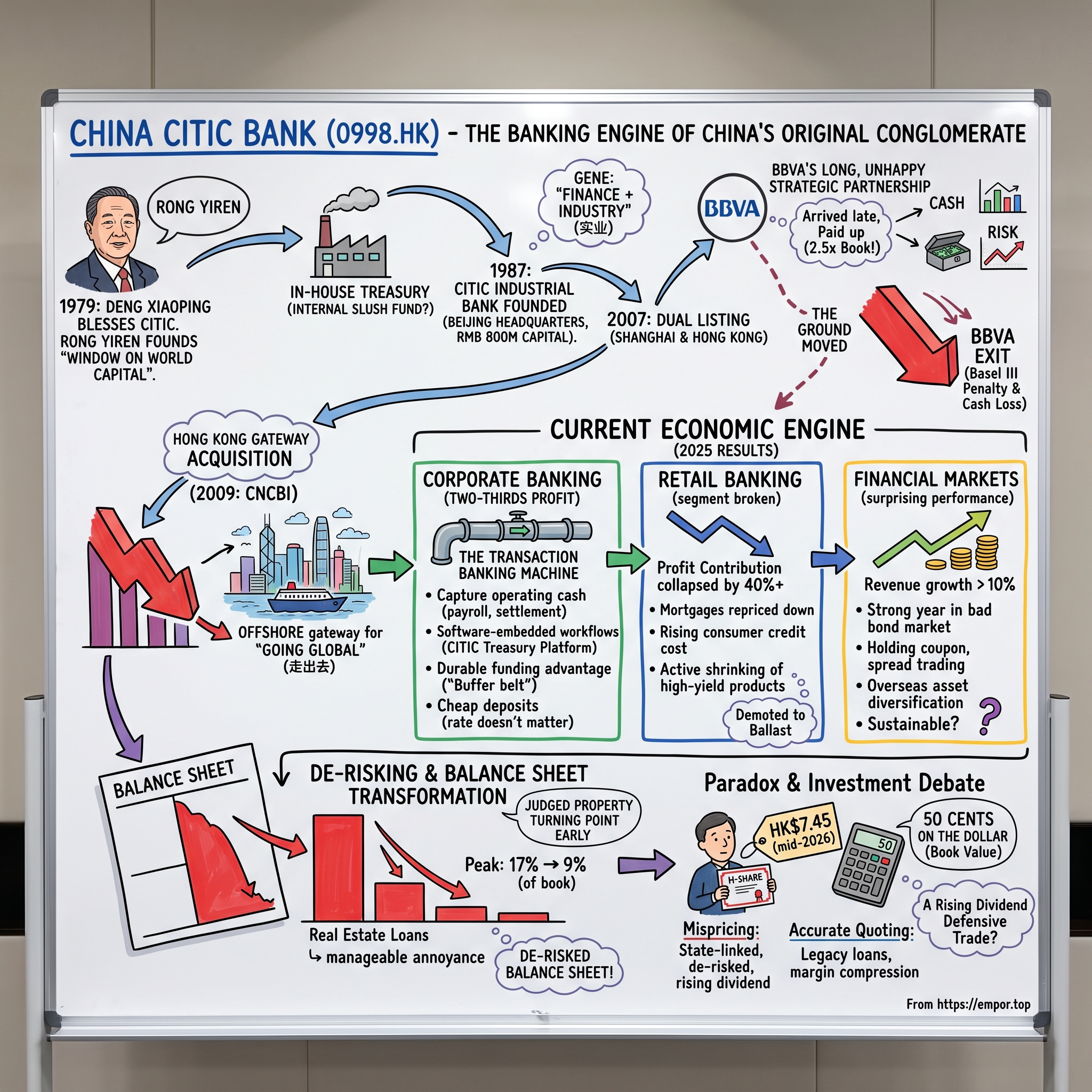
China CITIC Bank: The Banking Engine of China's Original Conglomerate
I. Introduction & Episode Roadmap
On the morning of March 23, 2026, a row of executives in dark suits filed into a conference room at 中信银行 China CITIC Bank's Beijing headquarters for a two-hour results briefing that was simultaneously livestreamed to anyone who cared to watch.1 The chairman, 方合英 Fang Heying, opened not with a boast about scale but with a sentence that reads like a fortune cookie and functions like a strategy document: what the bank pursues, he said, "has never been running fastest with the wind — it is walking steadiest against it."2
It is a revealing line, because the wind has been very much against Chinese banking for five years. And yet on that morning the bank could report that its total assets had crossed RMB 10 trillion for the first time — roughly USD 1.4 trillion — after growing 6.28% in 2025.3 Net profit attributable to shareholders reached RMB 70.618 billion, up 2.98%, on operating income of RMB 212.475 billion that actually fell 0.55%.4 Profit grew while revenue shrank. That single arithmetic fact is the entire story of Chinese banking in the mid-2020s, and unpacking it is most of what this piece is about.
Here is the paradox that makes China CITIC Bank interesting to a long-term investor. It is the banking arm of 中信集团 CITIC Group, the conglomerate 邓小平 Deng Xiaoping personally blessed in 1979 as China's window onto world capital.[^5] It sits seventh or so among Chinese banks by assets. Its parent, through 中信金融控股 CITIC Financial Holdings and concert parties, owns 67.30% of the shares — this is not a company that will ever be taken over, restructured by an activist, or forced to change course by a proxy fight.[^6] And its H-shares changed hands in late July 2026 around HK$7.45, giving it a market capitalisation near HK$415 billion against a book value that implies the market pays roughly fifty cents for each dollar of stated equity.[^7]
That discount is the question. Is it a mispricing — a state-linked lender with a de-risked balance sheet, a genuine funding-cost advantage, and a rising dividend that the market refuses to credit? Or is it an accurate quotation of what the market thinks a Chinese joint-stock bank's book value is actually worth once you adjust for the loans that have not yet gone bad, the margin that has not yet finished compressing, and the fact that the controlling shareholder's interests and the minority shareholder's interests are aligned only by coincidence?
The bank's own answer to the discount is instructive. In 2025 it published a formal Valuation Enhancement Plan, created a market-value management committee under senior management, and — remarkably — wrote market-capitalisation performance into its internal appraisal system.1 The share price responded: A-shares rose 15% and H-shares 36% in 2025, a fourth consecutive year of beating the market.1 Note what that rally did to the headline attraction. A 36% run in the H-shares mechanically compressed the dividend yield. On a full-year 2025 payout of RMB 21.201 billion — RMB 3.81 per ten shares, split between an interim and a final — the H-share yield at the late-July 2026 price sits nearer 5.5–6% than the 6.5%-plus that had been the standing pitch a year or two earlier.5 The "high-dividend defensive" trade has already partially worked. That matters for anyone arriving now.
The strategic dilemma underneath is structural. A national joint-stock commercial bank (股份制商业银行) like CITIC is caught in a vice. Above it sit the Big Six state megabanks — 中国工商银行 ICBC, 中国建设银行 CCB, 中国农业银行 ABC and the rest — whose tens of thousands of branches and quasi-sovereign standing give them retail deposits at prices a mid-sized rival cannot match. Beside it sits 招商银行 China Merchants Bank, which spent two decades building the retail and private-banking franchise that made it the sector's valuation darling. CITIC has neither the deposit monopoly nor the retail brand. What it has instead is a conglomerate parent with a full stack of financial licences and a sprawl of industrial businesses, and a two-decade insistence that corporate transaction banking — the unglamorous plumbing of payments, settlement, cash management and supply-chain finance — is where a bank of its size can actually win.
This piece traces that argument from its origin. We start with 荣毅仁 Rong Yiren, the "Red Capitalist" whose family textile fortune survived the revolution and who was handed the job of building China's first window to foreign capital, and with the in-house treasury he spun out in 1987. We move to the capital-markets decade: the 2007 dual listing, the Spanish bank BBVA's long and ultimately unhappy strategic partnership, and the Hong Kong acquisition that gave CITIC an offshore gateway. We then take apart the current economic engine segment by segment, including a retail book whose profit contribution collapsed by more than 40% in a single year. We examine the de-risking programme that took property from 17% of the loan book to 9%. We assess a management team that has had three presidents in eighteen months. And we close with the competitive war-game, the bull and bear cases tested against evidence rather than assertion, and the small number of metrics that actually decide whether this works.
Start where the story starts: with a man who had been denounced, rehabilitated, and then asked to build capitalism.
 Subscribe on LinkedIn
II. Founding Context & Conglomerate DNA (1979–2006)
In 1979, China had no meaningful mechanism for accepting foreign investment. It had no investment bank, no merchant bank, no legal vehicle through which a Japanese or American firm could put capital into a Chinese project and expect to get a return. It also had almost no one with practical experience of how such a thing worked — a generation of Chinese businessmen had been dispossessed, re-educated, or destroyed.
Almost no one. 荣毅仁 Rong Yiren was the son of one of Shanghai's great pre-revolutionary industrial families, a textile and flour-milling dynasty. He had stayed after 1949 rather than fleeing to Hong Kong or Taiwan, handed his mills to the state, and served as a vice-mayor of Shanghai before being swept aside during the Cultural Revolution. Deng's calculation in bringing him back was unsentimental: the reform programme needed someone who could sit across a table from a foreign counterparty and speak the language of contracts, equity, and return on capital without needing a translator for the concepts. In 1979 the State Council approved the founding of the China International Trust and Investment Corporation — CITIC — with Rong as its chairman.[^5]
CITIC's mandate was extraordinarily broad and extraordinarily vague: attract foreign capital, import advanced technology, and learn modern corporate practice. In effect it was a sovereign venture-capital arm and a foreign-trade merchant bank in one, and it grew by accretion — leasing, real estate, steel, energy, telecoms, publishing. The conglomerate DNA that defines the group today was not a strategy so much as a consequence of being the only entity permitted to do a very large number of things.
By the mid-1980s the sprawl had created an obvious internal problem. CITIC's businesses generated and consumed foreign exchange, needed project finance, and required a settlement capability that the existing state banking system was not organised to provide. In late 1984 Rong asked for permission to build a bank inside the CITIC system to handle foreign-exchange banking comprehensively. Approval came from the State Council and the 中国人民银行 People's Bank of China, and on April 14, 1987, Rong personally held a press conference at the Beijing International Building to announce the establishment of 中信实业银行 CITIC Industrial Bank, headquartered in Beijing with registered capital of RMB 800 million.6 He took the honorary chairmanship himself.
The word 实业 — "industrial," in the sense of real enterprise rather than financial abstraction — was not decoration. The bank existed to finance the group's industrial ventures and the enterprises around them. That is the founding gene, and it is worth holding onto, because forty years later management still markets the franchise as 金融+实业, "finance plus industry," and still argues that its edge lies in serving corporate balance sheets rather than household ones.
The trajectory from in-house treasury to national bank was neither fast nor clean. Through the 1990s CITIC Industrial Bank expanded branch by branch across major cities while carrying the burden common to all Chinese lenders of that era: loans made for reasons that were political, relational, or simply directed from above, with credit assessment as an afterthought. The clean-up of Chinese bank balance sheets in the late 1990s and early 2000s — asset management company carve-outs, recapitalisations, the wholesale rewriting of underwriting standards — was a national project, and CITIC went through its own version of it.
The 1990s were, for CITIC Industrial Bank, a decade of physical expansion. Branches opened city by city — Shanghai in 1988, then the coastal manufacturing centres, then the interior provincial capitals — each one a licence negotiated, a building acquired, a staff recruited from a labour pool with almost no commercial banking experience. The business model in that period was straightforward and, by later standards, primitive: take deposits from state enterprises and municipal bodies, lend to projects that carried official endorsement, and earn the wide administered spread that the central bank's rate framework guaranteed. There was very little credit analysis in the modern sense because there was very little credit risk in the modern sense — the state stood behind both sides of most transactions, and when it did not, nobody found out until much later.
The reckoning came at the end of that decade. The Asian financial crisis of 1997–98, and the subsequent national audit of Chinese bank balance sheets, revealed that a generation of directed lending had produced non-performing loan ratios across the system that would have been fatal in any market economy. The state's response — carving bad assets out into four dedicated asset management companies, recapitalising the big banks with foreign exchange reserves, and rewriting the loan classification framework from a two-tier system to the five-category standard used internationally — was the founding act of modern Chinese banking. CITIC went through its own version of that surgery: recognising legacy exposures, tightening approval authority, and separating the bank's credit decisions from the parent group's project ambitions. That last separation is the one that mattered most and was the hardest to make, because the bank's entire reason for existing had been to fund the parent's ambitions.
The bank changed its name to 中国中信银行 China CITIC Bank at the end of 2005.7 Dropping 实业 was more than cosmetic. It signalled the end of the in-house-treasury identity and the start of a positioning as a full-service national commercial bank — one that would soon need to explain itself to public shareholders. The rebranding coincided with the modernisation of credit underwriting, the recognition and disposal of legacy state-directed non-performing loans, and the internal reorganisation required before any Chinese bank could plausibly file a listing prospectus.
For an investor, the useful takeaway from this period is not nostalgia. It is that China CITIC Bank's competitive position was structurally determined before it ever sold a share to the public. It was born corporate. It never had the rural and urban branch inheritance that gives the Big Six their retail deposit base, and it never had the entrepreneurial retail-first culture that 招商银行 China Merchants Bank built from its Shenzhen origins. Everything CITIC has done since — the transaction-banking obsession, the settlement-driven deposit strategy, the conglomerate cross-sell — is an attempt to build a durable franchise on the one flank where it started with an advantage.
By 2006 that franchise needed capital, and capital in that era meant two things: a foreign strategic partner to validate the governance story, and a listing to monetise it.
III. Capital Deployment, Foreign Alliances, & M&A Strategy (2006–2015)
For a stretch of the mid-2000s, buying a minority stake in a Chinese bank was the most fashionable trade in global finance. Bank of America had taken a slice of CCB. Goldman Sachs and Allianz had gone into ICBC. Royal Bank of Scotland was in Bank of China. The pitch was irresistible: pay two-and-a-half times book for a piece of the largest untapped banking market on earth, bring your risk systems and product expertise, and ride the re-rating.
Banco Bilbao Vizcaya Argentaria — BBVA, Spain's second-largest bank — arrived late and paid up. In November 2006 it committed €989 million for two positions: 5% of China CITIC Bank itself, at a cost of roughly €501 million, and 15% of the Hong Kong-listed CITIC International Financial Holdings.8 That second piece is the tell. BBVA was not simply buying exposure to mainland lending; it was buying into the offshore vehicle as well, betting on cross-border corporate flows between a Chinese conglomerate's client base and a European bank's Latin American and Iberian network.
Five months later, on April 27, 2007, China CITIC Bank listed simultaneously in Hong Kong and Shanghai, raising approximately USD 5.4 billion in what was that year's largest global equity issue.9 The reception was a period piece. The Hong Kong line traded up 14% on debut; the Shanghai line very nearly doubled.10 The A/H gap that opened on day one — mainland retail investors paying dramatically more than international institutions for the identical economic claim — has been a permanent feature of the stock ever since, and it is the reason any discussion of "the" valuation or "the" dividend yield of this company requires you to specify which listing you mean.
BBVA leaned in. It progressively lifted its holding, reaching roughly 15% of the bank.11 For a few years the arrangement was presented as a three-way alliance — the mainland bank, the Hong Kong platform, and the Spanish partner — and the strategic logic held together on paper.
Then the ground moved under it, twice.
The first shift was the eurozone sovereign debt crisis. Spanish banks spent 2011 through 2013 fighting for their own survival, and non-core minority stakes in distant markets became luxuries. The second shift was regulatory and more permanent. Basel III's treatment of significant investments in the capital of other financial institutions meant that a stake above 10% in another bank carried a punitive capital charge. A passive minority holding in a Chinese lender had gone from a strategic asset to an expensive one, and no amount of partnership rhetoric could change the arithmetic.
The exit came in two tranches and tells two different stories. In October 2013 BBVA sold 5.1% back into the CITIC orbit for approximately €944 million, deliberately reducing its position to 9.9% — just under the Basel threshold.12 The transaction crystallised a modest cash loss, but the accompanying write-down was the real event: BBVA marked the remaining holding to market and took a charge running into the billions of euros against its 2013 earnings. Then in January 2015 it disposed of a further 4.9%, not to CITIC but to the Chinese property group 新湖中宝 Xinhu Zhongbao, for HK$13.136 billion — around USD 1.69 billion — booking a net capital gain of roughly €400 million on that specific tranche.1314
Read those two tranches together and you get the honest lesson, which is less dramatic than "foreigners lost money in China" and more useful. BBVA's economic outcome was not catastrophic in cash terms; the second sale was profitable. What failed was the strategic premise. A foreign minority holder in a state-controlled Chinese bank has no path to control, limited influence over credit policy, no ability to force capital discipline, and an exposure whose value is set by Chinese macro cycles and Chinese regulatory decisions rather than by anything the partner does. When the partner's own capital regime turns hostile, the position has no defenders. That is the structural limit of foreign minority ownership in a state-dominated banking system, and it applies with equal force to a portfolio investor buying H-shares in 2026 — you are a passenger, and the driver is the controlling shareholder.
While the foreign alliance was unwinding, CITIC was building something more durable offshore. The seed had been planted decades earlier: 嘉华银行 Ka Wah Bank, a Hong Kong institution with roots stretching back to 1920s Guangzhou, ran into severe trouble in the mid-1980s, and in June 1986 CITIC Group injected HK$350 million to rescue it.15 The bank was renamed CITIC Ka Wah Bank in 1998 and became 中信银行(国际)China CITIC Bank International — CNCBI — on May 10, 2010.
The consolidating move came in 2009. China CITIC Bank agreed to acquire 70.32% of CITIC International Financial Holdings — the parent of the Hong Kong bank — from CITIC Group and an affiliated vehicle for HK$13.563 billion, at HK$3.35 per share, a price of about 1.43 times book value.[^19] The deal was signed on May 8, 2009, approved by shareholders in June, and completed on October 23 of that year.
Strategically this was the right shape of transaction, and it deserves credit as such. Chinese corporates were entering the 走出去 "going global" phase: building overseas, buying assets abroad, needing offshore dollar funding, letters of credit, and treasury services that a purely onshore bank could not supply. Owning a licensed Hong Kong bank turned CITIC into an onshore-offshore gateway rather than a domestic lender with a representative office. By the end of December 2025, CNCBI operated 21 branches and two business banking centres in Hong Kong alongside an international footprint, with total assets of HK$550.61 billion.16
But note the governance texture, because it recurs. This was a related-party acquisition: the listed bank bought an asset from its own controlling shareholder, at a premium to book, using shareholder capital. It may well have been a fair price and a good asset. The point for a sceptical investor is that in a structure where the parent controls two-thirds of the votes, the mechanism by which such prices get tested is weak. That is a permanent feature of this company, and it will show up again in 2026 with a small acquisition in Yunnan.
By the mid-2010s, then, CITIC had capital, a listing, an offshore arm, and no foreign partner. What it needed next was an actual answer to the question of how a mid-sized bank makes money when the state giants own the cheap deposits.
IV. Business Segments & Economic Engine
Strip a bank down to its physics and there are only two questions: what does it pay for money, and what does it earn on money. Everything else — products, apps, branch design, brand campaigns — is machinery for improving one of those two numbers.
China CITIC Bank's answer, developed over roughly a decade, is unusual in its single-mindedness. It has essentially conceded that it cannot beat the megabanks on the price of retail deposits and has instead attacked the problem from the corporate side: capture the operating cash of enterprises — the money that sits in a company's account because that is where its payments clear and its supply chain settles — and you get deposits that are cheap not because you offered a better rate but because the customer is not thinking about the rate at all.
The 2025 segment numbers show both how well that has worked and what it has cost.
Corporate banking produced operating income of RMB 98.829 billion, up RMB 3.593 billion on the prior year, and segment profit of RMB 54.324 billion, up RMB 4.495 billion.5 Corporate loans reached RMB 3.29 trillion, growing 13.24% — an aggressive expansion at a time when many peers were struggling to find borrowers they wanted.17 Corporate banking now accounts for roughly two-thirds of the bank's profit.
Retail banking produced operating income of RMB 79.367 billion, down 7.37%, and segment profit of RMB 5.303 billion — a fall of RMB 3.927 billion, or 42.55%.5 Retail's share of group profit contribution collapsed from 11.4% to 6.3%.5 This is the single most important number in the 2025 accounts and the one management spent the least time volunteering.
Financial markets produced operating income of RMB 33.691 billion and profit of RMB 26.938 billion, up RMB 3.151 billion — a genuinely strong year in a bond market that hurt most competitors.5
Let us take the corporate engine first, because it is where the actual argument lives.
The transaction banking machine
The jargon term is 交易银行 transaction banking. The plain-English version: instead of lending a company money and hoping it comes back, you become the pipe through which the company's money moves. You run its payroll, its supplier payments, its receivables collection, its cash pooling across subsidiaries, its trade documentation. You install software that sits inside the treasurer's daily workflow — CITIC's internally built 天元司库 treasury platform is the flagship — and once a large enterprise has wired its accounting systems, its approval chains and its subsidiary structure into your platform, moving to a competitor is a multi-quarter IT project that no chief financial officer undertakes for a few basis points.
The payoff is on the liability side. Fang Heying gave an unusually granular account of it at the 2026 briefing. Corporate demand deposits were 46% of the bank's corporate deposit base, which he claimed ranked in the top two among comparable joint-stock banks; retail demand deposits were 27%, up 3.2 percentage points over two years. High-cost funding — three-year, structured and agreement deposits combined — was under 32% of the total, more than four percentage points below comparable peers.1
He was careful about the vocabulary, and the care is worth noticing. He explicitly declined to call this a moat: "calling it a moat would be an overstatement," he said, settling instead on "a wide buffer belt."1 For a Chinese bank chairman on a livestream, that is a striking piece of restraint, and it is more analytically honest than most of what gets said at these events. A funding-cost advantage is real, measurable and useful. It is also erodible, because deposit pricing is heavily influenced by regulatory self-discipline mechanisms and by what the megabanks decide to do.
The evidence that the advantage exists is reasonably strong. Management stated that the bank's corporate deposit cost ran about 20 basis points better than the comparable joint-stock average, that its corporate loan-deposit spread was roughly 50 basis points ahead of that peer group, and that as of the 2025 interim report its overall liability cost was within one basis point of the average of the five largest state banks.1 If that last claim holds up in cross-checked disclosure, it is the most important competitive fact about this company — a joint-stock bank funding itself at megabank cost is a genuinely different animal.
Where does the corporate volume come from? Partly from a state-adjacent client roster that is difficult to replicate. The bank is a central-SOE subsidiary itself, holds close to 1,200 fiscal agency qualifications and over 7,000 special-qualification accounts, reports cooperation coverage of 99% of central state-owned enterprise groups, and counts 25 central SOEs where the business relationship exceeds RMB 10 billion.1 Partly it comes from policy alignment: technology loans reached RMB 1.07 trillion in 2025, up 14.75%, green loans exceeded RMB 750 billion, up 24.83%, and manufacturing became the largest single industry exposure at 21% of the loan book.31
That policy alignment cuts both ways, and it is where an independent reader should apply pressure. Lending into sectors the state is promoting is commercially attractive when those sectors are genuinely growing and credit-worthy. It is dangerous when a bank's loan growth target and the government's industrial policy converge and the underwriting becomes an exercise in hitting an allocation. Vice President 谷凌云 Gu Lingyun addressed this directly at the briefing, insisting the bank pursues the 五篇大文章 "five major articles" policy priorities not "to pad indicators or polish data" but through system and capability building.1 That is precisely the claim one would expect management to make, and it is unfalsifiable in the moment. The falsification arrives later, in the asset quality of technology and green loan cohorts as they season. Nobody has that data yet.
Retail: the segment that broke
Now the uncomfortable part. A retail bank whose profit contribution falls from 11.4% to 6.3% of the group in a single year has had something go badly wrong, and the arithmetic points to two culprits operating simultaneously.
The first is pricing. The retail loan yield fell to 4.15%, down 72 basis points year on year.5 That is what happens when mortgage books reprice downward under national policy, when consumer lending competition intensifies, and when a bank deliberately shrinks its highest-yielding unsecured product.
The second is credit cost. Personal loan NPLs rose to 1.01%, up 8 basis points, and the credit card NPL ratio rose to 2.62%, up 12 basis points, on a bad-loan balance of RMB 12.118 billion.51 Vice President 金喜年 Jin Xinian was refreshingly direct about it: retail risk pressure is an industry-wide phenomenon and "we are no exception."1
His segmentation of the retail book was the most useful disclosure of the entire briefing. Mortgages — 47.5% of retail assets — have stabilised, with an NPL ratio of 0.41%, down 8 basis points, and a new-formation rate of 0.29%, down 47 basis points from the two-year peak. Consumer loans, including the 信秒贷 instant-credit product and auto lending, showed rising stock NPL ratios but falling new formation, with 信秒贷 posting three consecutive quarters of improvement. And then the honest admission: property-collateralised business loans and credit cards "are still in the process of stabilising — this is our difficulty, and it is the key to the next stage of asset quality management."1
That is a specific, checkable, non-evasive answer, and it is the kind of thing that should raise rather than lower an investor's assessment of management candour. It also tells you the retail damage is not finished. More than 70% of the bank's 2025 write-off resources went to clearing retail bad loans.1
The wealth management side has fared better. Retail assets under management grew 14.29% in 2025, and Vice President 谢志斌 Xie Zhibin reported that the personal deposit cost rate fell 33 basis points year on year and that AUM balance ranked second among comparable joint-stock peers for a fifth consecutive year.13 Wealth and private banking fee income grew over 12%, with segment profit up over 15%.1 The post-资管新规 New Asset Management Rules transition — from implicit-guarantee wealth products to net-asset-value transparent funds — has been navigated, and the bank now sells net-asset-value products through 信银理财 CITIC Wealth Management alongside group-affiliated product.
But the strategic reality is unchanged: on high-net-worth asset gathering, CITIC is a strong second-tier player competing against China Merchants Bank's entrenched franchise. Management's own framing — retail should "contribute steadily" while corporate "carries the load" — is an accurate description of a segment that has been demoted from growth engine to ballast.
Financial markets: the surprise performer
The treasury and markets business had the year nobody expected. In a bond market that weakened through 2025 with two-way volatility, most peers reported negative revenue growth in this segment. Vice President 胡罡 Hu Gang laid out why CITIC did not: the bank's bond-business non-interest income fell 15% against a peer decline of 24%, and its spread income through the fair-value-through-OCI account was 2.12 times the comparable peer average.1 It underwrote RMB 500 billion of government bonds, ranking first among joint-stock banks, and its foreign-exchange market-making volume exceeded USD 4 trillion, up 21%.1 Bond turnover reached RMB 750 billion, a 240% increase, with terminal counterparties rising from 400 to 900.1
Hu guided to financial markets revenue growth above 10% in 2026 and described a strategy of holding coupon, trading the government bond and policy bank bond exposure for spread, and diversifying into overseas assets — non-USD investment share has already risen above 39%.1
An investor should treat this segment with appropriate suspicion. Trading and investment income is inherently the most volatile and least repeatable line in a bank's P&L, and a business that beat peers in a bad year can lag them in a good one. When revenue growth increasingly depends on a markets desk, earnings quality declines even as earnings rise. Management is explicitly leaning here — "financial markets to grow revenue" is one of the four pillars of the 2026 operating framework — which is a rational response to net interest income falling, and simultaneously a reduction in the predictability of the earnings stream.
The small stuff, sized honestly
Two ventures deserve mention proportionate to their weight, which is small.
百信银行 CITIC aiBank, the joint venture with 百度 Baidu launched in 2017 as China's first direct bank with independent legal-entity status, ended 2025 with total assets approaching RMB 130 billion — a bit over 1% of group assets. Revenue grew 28.15% to RMB 5.929 billion, but net profit fell 30.58% to RMB 453 million while marketing expenditure doubled to RMB 370 million, and the NPL ratio rose to 1.84%, a five-year high, with provision coverage down to 225.17% from 303.76% in 2023.18 It was also fined RMB 11.2 million for improper lending management.5 The optionality argument — AI underwriting, consumer micro-lending, a digital-native cost structure — remains intact in theory. The 2025 results are what customer acquisition through paid marketing into a deteriorating consumer credit cycle looks like in practice. It does not move group valuation and it is not currently a proof point for anything.
In June 2026 the bank picked up 14.52% of 云南红塔银行 Yunnan Hongta Bank for RMB 981 million, becoming its fourth-largest shareholder after a Kunming state investment vehicle exited; the transfer completed on June 26.19 The interesting details are the price and the target. CITIC paid roughly 48.54% of the target's end-2025 net asset value — about half of book — for a bank whose distinguishing feature is exclusive focus on financing China's tobacco supply chain, from growers to 中国烟草 China Tobacco's Yunnan operations, and whose net interest margin actually rose from 1.04% in 2023 to 1.1% in 2025 while the industry's fell.20 It is a tiny transaction. It is also a small, legible piece of evidence about how this management team thinks: buy a niche deposit franchise with a captive industrial ecosystem at half of book, rather than chase scale at par.
The common thread across all three business lines is that CITIC's economics now depend overwhelmingly on the corporate franchise holding while retail heals. Which raises the question of how the balance sheet got clean enough to survive the last shock — and whether it is clean enough for the next one.
V. De-Risking & Balance Sheet Transformation (2018–2023)
There is a moment in every credit cycle when a bank's management has to decide whether to believe its own loan book. For Chinese banks, that moment arrived in stages between 2017 and 2021, and the response separated the institutions that would spend the 2020s digesting from the ones that would spend them writing off.
The first stage was regulatory. Beginning around 2017, Chinese supervisors attacked the shadow banking complex — the trust channels, the wealth-management-product conduits, the interbank structures through which credit risk had migrated off balance sheets and out of the provisioning framework. Simultaneously, regulators enforced a hard rule that had previously been applied with discretion: any loan more than 90 days overdue must be classified as non-performing. That single change forced a great deal of previously invisible deterioration onto the visible page. For a bank with a large corporate book, it was a stress test conducted in public.
The second stage was property. Chinese banks spent 2015 through 2020 lending enthusiastically to private developers, and 2021 through 2024 discovering what that meant. The industry-wide defaults of the largest private developers — and the ripple through their construction supply chains and pre-sale buyers — produced the single largest credit event in modern Chinese banking.
Here CITIC's record contains its strongest concrete claim, and it is the one piece of evidence that most supports the bull case. Jin Xinian described it plainly at the 2026 briefing: the bank judged the turning point in the property market comparatively early, adjusted its credit strategy accordingly, and took real estate loans from a peak of 17% of the book down to 9%.1 "The impact of real estate on our asset quality has been smaller than comparable peers," he said — a specific, testable claim about relative positioning rather than an assertion of general prudence.1
The residue is still visible and worth quantifying. Real estate non-performing loans stood at RMB 7.955 billion at end-2025, an increase of RMB 1.659 billion, with the sector NPL ratio rising 46 basis points to 2.67%.5 So property is still generating bad loans. What has changed is the denominator: a 2.67% bad-debt rate on 9% of the book is a manageable annoyance; the same rate on 17% would have been a capital event. Getting the exposure down before the crisis fully arrived is the substance of the achievement, and it is a decision, not luck.
The headline asset quality numbers follow from that. The NPL ratio finished 2025 at 1.15%, down one basis point — the seventh consecutive annual decline, for a cumulative fall of 0.62 percentage points over seven years.1 Provision coverage was 203.61%, down 5.82 percentage points but above 200% for a fourth consecutive year, and cumulatively 32 percentage points higher across the five years of the 14th Five-Year Plan — some 22 percentage points more improvement than the comparable peer average as of the third quarter of 2025.1
The forward-looking indicators, which matter more than the stock, also improved. The combined NPL-plus-special-mention ratio was 2.77%, down 3 basis points; the overdue loan ratio was 1.43%, down a substantial 37 basis points.1 Credit cost fell to 0.89%, down 6 basis points and down 0.75 percentage points over five years.1
And here is the crucial mechanical point that explains the paradox in the introduction. The reason profit grew 2.98% while revenue fell 0.55% is that the provision line stopped consuming as much of the income statement. Impairment as a share of revenue fell 1.2 percentage points; operating costs were cut by RMB 2.25 billion, taking the cost-income ratio down 0.88 percentage points.1 Meanwhile the bank recovered RMB 37.2 billion of non-performing loans during the year, including RMB 12.9 billion recovered on previously written-off accounts — money that flows straight back to the bottom line.1 It also proactively exited more than RMB 50 billion of exposure to clients it had classified as low-quality.1
Every part of that is real and creditable. It is also, definitionally, a source of earnings growth with a floor. Provisions cannot fall forever; recoveries on written-off loans depend on there being a stock of written-off loans worth chasing; cost cuts compound only so far. A bank generating profit growth from falling credit costs against falling revenue is running a race with a finish line. Management knows this — Fang's formulation of the transition "from stabilising spreads to stabilising revenue" is an acknowledgment that the next phase has to come from the top line.21
The unfinished business is 地方政府融资平台 LGFVs — local government financing vehicles. These are the off-budget entities through which municipalities financed infrastructure for two decades, and the national debt-resolution programme has been swapping, extending and restructuring their obligations. CITIC discusses this less specifically than it discusses property. The 2026 forward plan commits to "continuing to adjust and optimise the structure of real estate and local government financing platform business," which is a sentence that acknowledges an ongoing exposure without sizing it.1 Detailed LGFV exposure by province and by tier was not disclosed at the briefing. For a bank whose entire asset-quality narrative rests on early recognition, the relative opacity here is the most legitimate target for a sceptic. Extensions at below-market rates are not defaults, but they are a transfer of economics from the lender to the borrower, and they show up as margin compression rather than as credit cost — which makes them nearly invisible in the metrics investors watch.
The other half of the de-risking story is the one management most enjoys telling: the conglomerate as a risk-disposal mechanism. Because CITIC Group owns 中信证券 CITIC Securities, 中信建投 China Securities, 中信信托 CITIC Trust and asset-management capability alongside industrial businesses in heavy equipment and elsewhere, the bank can route a distressed exposure into a group-affiliated restructuring rather than simply writing it down. Fang listed "collaborative risk resolution driven by AMC and trust core capabilities" as one of ten formalised group cooperation models.1 The bank recovered RMB 24.4 billion on-balance-sheet and through asset management channels in 2025.1
This is a real capability and a genuine differentiator versus a standalone joint-stock bank. It also carries an obvious governance question that no one asked on the call: when a bad asset moves from the listed bank to an affiliate of the controlling shareholder, who determines the transfer price, and how would a minority shareholder know whether it was fair? The answer, structurally, is that they would not. That is not an allegation of anything; it is a description of the information environment, and it belongs in any honest assessment of why this stock trades where it does.
Which brings us to the people making these calls — and to a leadership situation considerably less settled than the strategy documents suggest.
VI. Current Management, Governance, & Incentives
In April 2023, 方合英 Fang Heying moved one seat over. He had been president of China CITIC Bank; he became chairman, succeeding 朱鹤新 Zhu Hexin, who departed for the State Administration of Foreign Exchange.22 The mainland financial press labelled him a reformist. What he actually is, on the evidence, is a lifer.
Fang joined the CITIC system decades ago and worked his way up through branch and risk roles before reaching head office. He is not a parachuted policy official; he is the kind of executive who can recite the bank's deposit structure from memory and does, at length, on a livestream. His public register is idiosyncratic in a way that is genuinely revealing. At the 2026 briefing he built a whole passage around a Chinese homophone — the character 重 read as chóng, "again," and as zhòng, "heavily" — to make the point that structural adjustment is an "old tune" that must be played again and harder.1 He compared the liability business to a proverb about striking a loud drum with a heavy mallet, then extended the pun to insist the drum must be struck repeatedly.1 By 2026 he had turned sixty, and the arithmetic of Chinese state-sector retirement ages is an item on any investor's watchlist.
This is a man who has been saying the same thing for a long time and has found ever more elaborate ways of saying it. Consistency of narrative is one of the better tests of management credibility, and Fang passes it. He traced the lineage himself: the push into transaction banking dates back six years, the "Treasury No. 1 Project" three years, the ambition to be a leading transaction and settlement bank two years.1 Gu Lingyun described the same continuity in terms of successive strategic frameworks — the "342 Core Strengthening Action," then the "Five Leading Banks" framework of the 2024–2026 plan, now the 三三战略 "Three-Three Strategy" for the 15th Five-Year Plan period.1 The claim is that the strategy "has neither raced ahead nor fallen behind, and has never taken a detour."1 That is self-serving, but the documentary record does support the underlying point: this bank has not rewritten its story every eighteen months in the way that flailing managements do.
The Three-Three Strategy itself is worth decoding, because underneath the sloganeering it is a coherent claim. Three "excellences": wealth management, investment and trading, comprehensive financing. Three "leaderships": payment and settlement, cross-border financial services, and digital-intelligent banking. Fang's own gloss is the useful bit — he framed these six capabilities as an upgrade of the three primitive functions of banking. Wealth management extends deposits. Comprehensive financing and investment-trading extend lending. Payment, settlement and cross-border extend remittance. Digital-intelligent banking, he said, is "a reshaping at the genetic level."1
Now the part that complicates the tidy leadership picture. China CITIC Bank has had three presidents in eighteen months. 刘成 Liu Cheng, who moved up from deputy president when Fang became chairman, subsequently left the bank.23 芦苇 Lu Wei was appointed president in February 2025 and resigned in December 2025, moving to China Post Group and then to the presidency of 中国邮政储蓄银行 Postal Savings Bank of China, with regulatory approval in February 2026.24 The presidency then sat vacant for roughly five months.25 On May 20, 2026, the board approved 吕天贵 Lyu Tiangui as president for a three-year term, subject to approval by the 国家金融监督管理总局 National Financial Regulatory Administration.26
Lyu is another insider, and his background is a signal. Born in October 1972, holding an MBA from Sichuan University and qualified as a senior accountant, he spent more than two decades at CITIC Bank across the credit card centre, retail banking, and private banking, rose to vice president overseeing retail, technology and operations, and then served as party secretary and chairman of CITIC Trust before returning.2627 His appointment was accompanied by 沈强 Shen Qiang's elevation to vice president, expanding the senior team to "one president, seven vice presidents."27
Two readings are available and both deserve airtime. The charitable one: appointing a retail specialist to run the bank at the precise moment retail profit has collapsed is exactly the right allocation of executive attention, and his stint at CITIC Trust deepens the group-coordination capability that management markets as its edge. The sceptical one: three presidents in a year and a half, with a five-month vacancy in the middle, is not a sign of a stable management system. It is a sign that senior Chinese banking appointments are made in a cadre-rotation system in which the listed entity's continuity is not the controlling variable. Executives at Chinese state-linked banks are moved between institutions and into regulators by decisions taken well above the board. Investors in this stock own an operating franchise; they do not own the right to choose or retain who runs it.
On capital allocation, the behavioural record is better than the governance structure would predict. The dividend has ratcheted up rather than lurched: board secretary 张青 Zhang Qing confirmed a full-year 2025 cash payout of RMB 21.201 billion, lifting the ratio to 31.75% — up 1.25 percentage points on 2024 and 1.05 points above the 30.70% struck at the interim.1 The bank has now paid an interim dividend two years running and has written a floor into its policy: a minimum cash distribution of at least 10% of net profit attributable to shareholders.28 Small, repeated, delivered increases are a more credible signal than a single large one.
Guidance discipline has also been reasonable. Management has consistently declined to promise margin stability it cannot deliver, and has instead disclosed the mechanics of the compression in unusual detail — which we come to shortly. The 2026 targets set at the briefing were modest and specific: total asset growth of about 5%, general loan growth of about 5.5%, financial markets revenue growth above 10%.1 Management then immediately reported early progress against them: in January and February 2026, RMB general loans grew RMB 160 billion, or 3.1%, and overall liability costs fell more than 20 basis points versus 2025.1 Volunteering two months of unaudited data is either confidence or salesmanship; either way it creates a checkable commitment, which is more than most managements offer.
There is one further behavioural test worth applying, because it separates managements that talk about discipline from those that practise it: what does the bank do when a business is not working? On retail, the answer in 2025 was to shrink deliberately. The bank cut back its highest-yielding unsecured consumer product, 信秒贷, knowingly sacrificing 1.6 basis points of net interest margin in the process — and Fang described the decision in exactly those terms, as "our active choice, and a question of balancing future risk cost against current return."1 It also proactively pushed out more than RMB 50 billion of exposure to clients it had classified as low quality, and directed over 70% of its write-off capacity at retail bad debt rather than spreading it evenly to flatter the headline.1 Choosing lower reported revenue today to avoid credit losses tomorrow is the single most reliable indicator of a bank management that is thinking beyond its own tenure, and it is rarer than it sounds. The counter-observation is that this discipline has not yet been tested on the corporate book, which grew 13.24% in a weak economy — a growth rate that will look either prescient or reckless depending on how the 2025 and 2026 vintages season.17
The governance frame remains what it is. CITIC Financial Holdings and concert parties hold 67.30% of the shares, with 65.69% held directly, and CITIC Group is the ultimate controller.[^6] Strategic alignment with state directives — 共同富裕 common prosperity, advanced manufacturing, inclusive finance, the "five major articles" — is not a marketing overlay; it is the operating mandate. Gu Lingyun said so almost verbatim: doing the five major articles is "not a multiple-choice question but a compulsory one."1
That is the honest frame for owning this stock. You are a minority passenger in a state-controlled institution whose strategy is set with reference to national policy, whose executives are appointed through a system you cannot observe, and whose most valuable relationships are with the same state that regulates it. The compensation for accepting those terms is a business with a defensible funding position and a rising dividend — priced at half of book. Whether that trade is attractive depends on how the competitive position holds up, which is where the war-gaming starts.
VII. Competitive Landscape, Helmer's 7 Powers, & Porter's 5 Forces
Picture the Chinese banking market as a room with three groups of players.
Against the wall stand the Big Six — ICBC, CCB, ABC, Bank of China, 交通银行 Bank of Communications and Postal Savings Bank. They own the deposits. Their branch networks reach into counties no joint-stock bank will ever serve, their implicit sovereign backing means depositors do not ask questions, and their funding cost is structurally the lowest in the system. They are also slow, bureaucratic, and constrained by the sheer weight of policy obligation.
In the middle stand the twelve joint-stock banks: CITIC, China Merchants Bank, 兴业银行 Industrial Bank, 浦发银行 SPD Bank, 民生银行 Minsheng, 平安银行 Ping An Bank and the rest. They are national in licence, faster in decision-making, and each has tried to find a defensible niche — CMB in retail and wealth, Industrial Bank in interbank and green finance, CITIC in corporate transaction banking.
Around the edges stand the city and rural commercial banks, regionally strong, nationally irrelevant, and — in a growing number of cases — being consolidated.
Versus the Big Six, CITIC's disadvantage is exactly what you would expect and the gap has narrowed more than expected. The megabanks win on the price of retail deposits; nothing CITIC does will change that. But management's assertion that the bank's overall liability cost was within a single basis point of the five largest banks' average as of the 2025 interim — achieved through corporate demand deposits and aggressive suppression of high-cost time deposits rather than through branch density — is a meaningful competitive claim if it survives scrutiny.1 CITIC's offsetting advantages are speed, regional customisation, and the ability to assemble a cross-entity solution that a single-licence bank cannot.
Versus the joint-stock peers, the picture is mixed and the honest verdict is "differentiated, not superior." CMB's retail franchise, private banking depth and brand remain out of reach; CITIC's AUM ranks second in the peer group and its retail profitability just fell off a cliff. But CITIC ranked first among joint-stock banks in government bond underwriting, claims the second-largest and second-fastest-growing fee income in the group, and is the only comparable institution to have grown non-interest income for six consecutive years, lifting the non-interest share of revenue by 9.3 percentage points over five years to 32%.121 Its comprehensive risk weight fell to 75%, down 1.3 percentage points, moving it from last in the peer group five years ago to second today — a direct measure of how much regulatory capital it consumes per unit of business.1 That is one of the more underappreciated numbers in the whole disclosure, because it is what "capital-light transformation" actually looks like when it is working rather than being asserted.
Hamilton Helmer's 7 Powers, tested rather than assumed
Cornered Resource — present, moderate, and partly non-transferable. The bank's privileged access to CITIC Group's industrial and financial ecosystem is genuine and cannot be replicated by a standalone competitor. The 99% central-SOE coverage rate, the ~1,200 fiscal agency qualifications, and the ten formalised group cooperation models are the concrete manifestation.1 The caveat is that a cornered resource conferred by a controlling shareholder is a resource the controlling shareholder can also redirect. Minority holders capture whatever share of the synergy the parent chooses to leave in the listed vehicle.
Switching Costs — present and the strongest of the seven. This is the transaction banking argument, and it is the most defensible thing about the franchise. A treasurer with cash pooling, payroll, supplier settlement and receivables financing wired into the bank's platform faces a genuine migration cost. The evidence is indirect but consistent: basic corporate accounts grew 80% and effective corporate accounts 75% over five years, and settlement volumes rose 16.30%.29 Rising account counts alongside falling deposit costs is the signature of switching-cost-driven stickiness rather than price-driven acquisition.
Scale Economies — present but weak. Yes, technology and compliance costs spread across a RMB 10 trillion asset base. But CITIC's base is a fraction of ICBC's, so within the industry this is a disadvantage relative to the entities it most needs to compete with on cost. The RMB 2.25 billion of operating cost reduction and 0.88-point cost-income improvement in 2025 came from operational discipline and digitalisation, not from scale.1
Process Power — emerging, unproven. The 2025 technology disclosures are the most substantive claim to a durable process edge: a rebuilt corporate credit system, "Galaxy," delivering globally unified credit limits with new product launch compressed from one or two months to one or two weeks; AI answering over 90% of relationship manager queries; over 80% automation of quantitative trading with large models generating strategies three times faster; over 1,700 AI service scenarios and claimed efficiency gains of 17,000 person-years; and a target of AI reshaping over 90% of core business processes by the end of the 15th Five-Year Plan.1 Investment hardware spending rose fivefold in 2025.1 These are impressive-sounding and almost entirely self-reported. The falsifiable version shows up in cost-income ratio and credit loss rates over several years; treat it as a hypothesis, not a moat.
Branding — weak. In Chinese retail finance, brand power belongs to the Big Six for safety and to CMB for service. CITIC does not command a price premium from households.
Counter-Positioning — absent. There is no business model here that incumbents cannot copy. Every joint-stock bank in China is building transaction banking capability.
Network Economies — largely absent. Supply-chain finance platforms have a mild network quality — onboarding a core enterprise brings its suppliers — but it is a local effect, not a system-wide one.
The composite verdict is a bank with two real Powers, one emerging, and four weak or absent. That is a respectable but not commanding position, and it argues for a valuation discount to CMB — though not obviously for half of book.
Porter's Five Forces
Threat of new entrants: very low. Banking licences in China are rationed as an instrument of state policy. The digital-bank experiment, of which aiBank is one of the more prominent examples, has produced institutions that are small and — on 2025 evidence — not obviously profitable through a downturn.
Bargaining power of buyers (borrowers): high and rising. Top-tier SOEs and the technology and green champions everyone is chasing can source funding from multiple banks and from the bond market, and they extract the spread. Gu Lingyun's own framing — "excellent customers and quality projects are scarce at any time" — is an admission of borrower power.1 Small and micro enterprises pay more but bring credit risk and, in inclusive finance, a policy-influenced price.
Bargaining power of suppliers (depositors): high, with an unusual wrinkle. Depositors can move for yield, and Chinese households have been moving into wealth products, gold and equities. Residents' investable assets exceeded RMB 300 trillion at end-2025.1 The wrinkle is that regulatory self-discipline mechanisms have capped the most destructive forms of deposit competition, which has helped every bank's funding cost — including, notably, banks with weaker deposit franchises than CITIC's. Some of the industry's recent liability-cost relief is regulatory rather than competitive, and it accrues to laggards as much as to leaders.
Threat of substitutes: medium-high and structural. Direct bond issuance by large corporates disintermediates exactly the lending CITIC does best. Money market funds, insurance products and net-asset-value wealth products compete for deposits. This is the force that most reliably compresses banking economics over a decade.
Competitive rivalry: very high. Fang disclosed that the industry's net interest margin stood at 1.42% against CITIC's 1.63% — a 21 basis point advantage he described as "not small" for a bank.1 He is right that it is a real gap. He is also implicitly conceding that the entire industry is operating on a margin that would be considered distressed in most banking markets. When the whole sector earns 1.42% on assets before costs and credit losses, rivalry is not a competitive dynamic; it is an existential one.
The forces analysis therefore lands somewhere uncomfortable: an industry with strong entry barriers and terrible internal economics. That combination protects incumbents from disruption while guaranteeing they will not earn attractive returns on new capital. Which is a fair description of why Chinese bank stocks trade where they do — and the starting point for the bull and bear cases.
VIII. Investment Story Spine: Bull vs. Bear Case & Risk Radar
Myth versus reality
Before the cases, three consensus claims about this company deserve fact-checking, because two of them are stale and one is half-true.
Myth: "It trades at 0.35 times book with a 6.5% yield." This was accurate as recently as 2024 and is the number that still circulates in summaries and screens. It is no longer where the stock is. After A-shares rose 15% and H-shares 36% in 2025 — a fourth straight year of outperformance — the H-share line at around HK$7.45 in late July 2026 implies roughly half of stated book value, not a third, and a yield in the mid-to-high five percent range on the RMB 3.81 per ten shares declared for 2025.1[^7]5 The stock is still cheap on any absolute measure. It is meaningfully less cheap than the standing narrative claims, and a large slice of the "SOE re-rating" catalyst has already been collected by people who bought earlier. Anyone underwriting this today is underwriting a different entry price than the one in most of the commentary.
Myth: "CITIC is a corporate bank with a struggling retail arm it should exit." Half-true, and the half that is false matters. Retail lending is indeed the source of the current damage — the profit collapse is unambiguous. But retail deposits and wealth management are doing the opposite: personal deposit costs fell 33 basis points in 2025, retail demand deposit share has risen 3.2 points over two years, and AUM grew 14.29%.1 Those are inputs to the funding-cost advantage that the corporate franchise then monetises. Retail lending and retail deposit-gathering are different businesses with different cycles, and conflating them produces the wrong conclusion about what to cut.
Myth: "State ownership guarantees the bad loans get absorbed." This is the most dangerous of the three because it is directionally right and mechanically wrong. State linkage does provide extraordinary resilience — funding access, forbearance, orderly restructuring through group affiliates and asset management companies. What it does not provide is protection of minority equity value. An LGFV loan extended at a reduced rate for eight more years does not default; it simply earns less than it should, forever, and the cost lands squarely on the equity holder in the form of a permanently lower return on assets. Systemic protection and shareholder protection are not the same thing, and the discount this stock carries is substantially a market judgment on the distance between them.
Why CITIC Bank could win from here
One: the funding-cost position is real and measurable, and it is the only durable edge in a compressed-margin industry. When every bank's asset yield is being driven down by policy — corporate loan yields cost CITIC 19 basis points of margin in 2025, personal loans 14 basis points, credit cards 4, market-based assets 8.6 — the differentiator is what you pay for money.1 On the liability side, CITIC's corporate deposit cost improvement added 17 basis points of margin, personal deposits 6, and market-based liabilities 15.7.1 A bank that grew average interest-earning assets by RMB 550 billion, or 6.6%, while defending a margin 21 basis points above the industry produced net interest income that fell only 1.5% — RMB 2.2 billion — in a year that savaged most competitors' top lines.1 That is the mechanism, and unlike most competitive claims it is arithmetic.
Two: the property de-risking was done early and the credit-cost tailwind is real while it lasts. Taking real estate from 17% to 9% of the loan book before the worst of the developer crisis is the single most valuable capital allocation decision this management team has made, and it is why credit costs have fallen 0.75 percentage points over five years.1
Three: capital-light transformation is showing up in the numbers, not just the slides. Six consecutive years of non-interest income growth, a 9.3-point rise in the non-interest revenue share, RMB 32.77 billion of fee income growing 5.6%, and a comprehensive risk weight down to 75% together describe a bank consuming less capital per unit of revenue.121 For an institution that cannot raise equity at half of book without destroying value for existing holders, generating growth without consuming capital is not a nice-to-have; it is the only viable growth model.
Four: the shareholder return policy has been delivered rather than promised. A payout ratio that has ratcheted to 31.75%, two consecutive years of interim dividends, a policy floor, and a formal Valuation Enhancement Plan with market-value management written into internal appraisal.1 Zhang Qing noted that the number of "patient capital" institutions holding the stock and the value of their holdings both multiplied in 2025.1 A re-rating driven by the 中国特色估值体系 "valuation system with Chinese characteristics" policy push remains a live catalyst — and it has already partly happened, which is precisely why the yield is lower than it was.
Why it may not
One: the margin has not stopped falling, and the cushion is thinning. NIM fell 14 basis points to 1.63% in 2025 and, on first-quarter 2026 data, slipped a further 2 basis points to 1.61%.30 The quarterly path within 2025 — 1.65%, then 1.63% three times — genuinely suggests stabilisation, and the deceleration is real.1 But "stabilising" at a level where the entire industry struggles to earn its cost of equity is not a victory condition. Fang's own disclosure that CITIC's margin fell 3 basis points more than peers in 2025, followed by five specific technical explanations for why — early structural deposit reduction released benefits ahead of peers, RMB 40 billion less in maturing long-dated deposits, an RMB 400 billion Tier 2 bond refinanced three months early at a cost of RMB 200 million, a deliberate contraction of the high-yielding 信秒贷 book, and a first-quarter overweight in low-yield bills — was the single most candid passage of the briefing.1 It was also five explanations for one bad number. Some were genuinely timing-related. One, the bond refinancing, he conceded outright: "it reflects that our refined management is not yet good enough."1 That admission is creditable and it is also an admission.
Two: retail is a wound, not a scratch. A 42.55% collapse in retail segment profit is not a rounding error, and management's own segmentation says property-collateralised business loans and credit cards have not yet stabilised.51 Retail recovery is contingent on Chinese household income and balance sheet repair — variables entirely outside the bank's control. Jin Xinian's confidence that retail asset quality will "gradually stabilise and improve" rests explicitly on "national policies to stabilise growth and promote consumption gradually taking effect."1 That is a macro bet dressed as an operating plan.
Three: earnings quality is drifting. Profit growth in 2025 came from lower provisions, lower operating costs, recoveries on written-off loans, and a strong markets desk — not from core spread income, which fell. Each of those levers has a limit. If credit costs stop falling before revenue starts growing, the profit line has nothing left to lean on.
Four: the valuation trap is a genuine mechanism, not a slogan. At roughly half of book, the bank cannot issue equity without meaningfully diluting existing shareholders, so Tier 1 capital growth depends on retained earnings — which are being reduced, deliberately and popularly, by a rising dividend payout. Growing assets 5% a year while paying out nearly a third of profit works only if returns stay above a certain threshold. Annualised return on equity in the first quarter of 2026 was 11.11%, down 0.31 points year on year.30 The direction of travel on that number is the constraint that binds everything else.
Five: LGFV and macro exposure remains inadequately sized in public disclosure. As discussed, extensions and rate reductions on municipal vehicle debt do not appear as credit losses; they appear as forgone margin. A bank whose disclosure on this exposure is materially less granular than its disclosure on property is asking investors to extend trust in the same management judgment that, on property, was demonstrably good.
The activist's stress test
If a sceptical long-short investor sat down with this company, the questions would not be about strategy. They would be these. Why should minority holders believe that related-party transactions — the 2009 Hong Kong acquisition at 1.43 times book from the parent, the ongoing routing of distressed assets into group affiliates — are priced at arm's length, given a 67.30% controlling stake and no realistic mechanism for minority challenge? Why has the presidency turned over three times in eighteen months, and what does that say about whether a board or a cadre system is running succession? Why is aiBank spending double on marketing to earn a third less profit at a five-year-high NPL ratio, and at what point does an experiment become a distraction? Why is LGFV exposure not disclosed with the same granularity as property exposure? And on capital allocation: is buying 14.52% of a tobacco-supply-chain bank in Yunnan — a non-controlling stake in an unlisted regional lender — the highest-return use of capital for a company trading at half of its own book value?
None of these are disqualifying. All of them are unanswered, and collectively they are a reasonable explanation for a persistent discount that has nothing to do with credit.
Material risk radar
The margin mechanism. The specific transmission runs through mortgage repricing and 贷款市场报价利率 LPR cuts hitting asset yields immediately, while deposit costs fall with a lag governed by the maturity structure of the time-deposit book. CITIC has managed that lag better than most by suppressing long-dated deposits early. The risk is that the asset side reprices again faster than the remaining liability benefit can be harvested.
LGFV credit costs. Haircuts or maturity extensions on municipal vehicle loans, particularly in fiscally weaker tier-three and tier-four provinces, showing up as suppressed yield rather than as visible impairment.
Consumption and household balance sheets. Credit card and property-collateralised business loan performance is directly geared to employment, small-business cash flow, and residential property values. Management identified both as unstabilised.1
Trading revenue reversal. A markets desk carrying an increasing share of revenue growth is a source of earnings volatility. Hu Gang himself forecast a "low-rate, high-volatility, broadly neutral" bond market for 2026 — hardly a promise of repeat performance.1
Technology execution. The 90%-of-core-processes AI target is aggressive, senior-management-sponsored, and expensive. Large transformation programmes at large banks have a well-documented tendency to consume more and deliver later than planned.
The metrics that actually matter
Ignore most of the disclosure. Three numbers determine whether this works.
Net interest margin, quarter by quarter, versus the joint-stock peer group. Not the absolute level — the whole industry is compressed — but the gap. The entire bull case reduces to the claim that CITIC's settlement-driven deposit franchise buys it a structural funding advantage. If the gap versus comparable peers erodes, the thesis is dead regardless of what else improves.
Provision coverage ratio, alongside the NPL-plus-special-mention and overdue ratios. Coverage above 200% is the buffer, but coverage falls when provisions are released to support profit. Watching coverage in isolation is a trap; watching it against the forward-looking indicators tells you whether asset quality is genuinely improving or whether the cushion is being spent to smooth earnings.
Corporate demand deposit share of total deposits. This is the purest available proxy for whether the transaction banking machine is actually working. Demand deposits are the output of being embedded in a client's operations. If that share holds or rises while total deposits grow, the switching-cost moat is real and compounding. If it slips, CITIC is buying deposits with price like everyone else — and the one Power that distinguishes this bank from a dozen others has gone.
IX. Guidance for Downstream Article Writer & Primary Evidence
The evidentiary spine of this analysis is worth making explicit, because the gap between what China CITIC Bank publishes and what most commentary reports is unusually wide.
The single richest primary document is the verbatim Q&A record of the 2025 annual results briefing, held on the morning of March 23, 2026 and published in full by the bank's board office investor relations team.1 It runs to thirty-four pages and covers ten questions from 兴业证券 Industrie Securities, 申万宏源 Shenwan Hongyuan, 光大证券 Everbright Securities, 国联民生, 东兴证券, the 新华社 Xinhua News Agency, 经济日报 Economic Daily, 21世纪经济报道, 证券时报, and online retail investors. The Q&A is materially more informative than the prepared remarks. Fang Heying's unprompted five-part reconciliation of why the bank's margin underperformed peers by three basis points, and Jin Xinian's product-level breakdown of retail asset quality — including the explicit statement that property-collateralised business loans and credit cards remain unstabilised — are disclosures that no press release contained.
The audited full-year figures sit in the 2025 annual report, filed under the A-share code 601998 and the H-share code 0998.31 The preliminary results announcement of January 15, 2026 provides the earliest verified full-year figures, and the first-quarter 2026 report of April 29, 2026 provides the most recent data point available as of this writing.3230 Segment-level revenue and profit — the corporate/retail/financial markets split that reveals the retail collapse — must be extracted from the annual report's segment note; it does not appear in the summary materials.5
For the offshore business, CNCBI publishes its own results independently in Hong Kong.16 For CITIC Group's structure and the parent's own diversified holdings, the group corporate materials are the appropriate source.33[^5] For continuous disclosure, HKEXnews and the Shanghai Stock Exchange announcement portals carry the filings in first form.[^38]34 For regulatory and monetary policy context — LPR changes, provisioning rules, deposit self-discipline mechanisms — the PBOC and NFRA publication portals are the primary record.35[^41]
The narrative pivot that the evidence supports is this: China CITIC Bank should not be read as a generic Chinese state lender riding a policy cycle. It is a corporate transaction bank that has spent roughly six years attempting to convert settlement volume into cheap deposits and fee income, has succeeded to a degree that is visible in its liability cost and its risk-weight profile, and is now attempting the same trick on the revenue line at exactly the moment its retail business has stopped contributing. The bull and bear cases both live in that transition. And the incremental evidence that will resolve them will come from quarterly margin gaps and demand-deposit mix, not from strategic announcements.
X. Playbook & Key Takeaways
The conglomerate banking playbook. CITIC's central strategic bet is that a bank embedded in an industrial and financial conglomerate can assemble solutions a standalone lender cannot — commercial banking plus securities plus trust plus asset management plus industrial capability, sold to one client under the slogan "one CITIC, one customer." The bank has formalised this into ten distinct cooperation models, from a joint client-acquisition "combined fleet" to a technology-company financing chain spanning equity, bonds, loans and insurance.1 The playbook is genuinely differentiating and it comes with a permanent tax: the same parent that supplies the ecosystem also controls two-thirds of the votes, sets the terms of intra-group transactions, and appoints the management. Conglomerate synergy and minority shareholder protection sit in tension, and no amount of strategic elegance dissolves it.
Valuing Chinese banking assets. The lesson of the last five years is that headline asset quality metrics are outputs of policy as much as of underwriting, and that the useful signal is found in three less-quoted places: the composition of deposits, the direction of forward-looking credit indicators relative to the reported NPL ratio, and the capital intensity of revenue. CITIC's demand-deposit mix, its overdue ratio falling 37 basis points, and its comprehensive risk weight dropping to 75% each carry more information than its 1.15% NPL ratio. Meanwhile, dividend yield in a market where the controlling shareholder sets the payout is a statement about that shareholder's cash needs as much as about the bank's earning power — which is not a reason to dismiss it, but is a reason to understand its source.
Reading a policy-directed lender. A recurring trap in analysing Chinese banks is treating policy alignment as either pure upside ("the state will send them business") or pure downside ("they are lending on instruction"). Neither framing survives contact with the disclosure. The useful question is narrower: does the policy priority coincide with a commercially attractive customer set, and does the bank get paid for the risk? CITIC's inclusive finance push is the cleanest test case available. Management reported that small and micro enterprise deposits grew 10.6% by the end of February 2026, demand deposits within that cohort grew 16%, and — the number that matters — the deposit cost of that segment ran nearly 40 basis points below the bank's overall corporate deposit cost.1 That is a policy mandate producing a genuine funding benefit, which is a different thing from a policy mandate producing a loan book. Apply the same test to technology and green lending in three years, when those cohorts have seasoned, and the answer will be worth considerably more than any strategic framework.
The de-risking lesson. The most valuable thing this management team did was reduce property exposure before the crisis rather than after it. That decision — cutting a profitable exposure from 17% to 9% of the book while the music was still playing — cost near-term revenue and saved the balance sheet.1 It is worth more than any of the strategic frameworks, and it is the strongest single piece of evidence for extending this team a measure of credibility on the exposures it has not yet fully disclosed.
Final reflection. In April 1987, a rehabilitated Shanghai industrialist stood in a Beijing office tower and announced a bank with RMB 800 million of registered capital, built to finance a conglomerate's own projects.6 Thirty-nine years later that bank holds more than RMB 10 trillion of assets, funds a fifth of its loan book to manufacturers, underwrites more government bonds than any other joint-stock lender, and trades in Hong Kong for roughly half of what its own books say it is worth.31[^7] The gap between those two facts — an institution of genuine national scale, priced as though its equity were half-fictional — is the whole investment question. Nothing in the 2025 disclosure resolves it. What the disclosure does provide is an unusually specific set of things to watch, and an unusually candid management willing to say out loud which parts of its own story have not yet been proven.
References
-
中信银行2025年度业绩发布会问答实录(2026年3月23日) — China CITIC Bank, 2026-03-23 ↩↩↩↩↩↩↩↩↩↩↩↩↩↩↩↩↩↩↩↩↩↩↩↩↩↩↩↩↩↩↩↩↩↩↩↩↩↩↩↩↩↩↩↩↩↩↩↩↩↩↩↩↩↩↩↩↩↩↩↩↩↩↩↩↩↩↩↩↩↩↩↩↩↩
-
中信银行2025年归母净利润同比增长2.98% 董事长方合英:追求的从来不是顺风时跑得最快 — 新浪财经, 2026-03-21 ↩
-
BBVA pays 989 mln euros for China's CITIC stake — China Daily, 2006-11-23 ↩
-
$3 Billion Dual Listing Of China Citic Bank — Forbes, 2007-03-18 ↩
-
Spain's BBVA sells part of stake in China Citic worth 944 million euros — South China Morning Post, 2013-10 ↩
-
BBVA sells 4.9% stake in Citic Bank — Shenzhen Daily, 2015-01-26 ↩
-
BBVA sells China Citic Bank stake for $1.7b — FinanceAsia, 2015-01 ↩
-
China CITIC Bank International (CNCBI) Company Profile — China CITIC Bank International ↩
-
CNCBI 2025 Results Highlights — China CITIC Bank International, 2026 ↩↩
-
直击业绩会|中信银行董事长方合英:五年来非息收入占比提升9.3个百分点 — 每日经济新闻, 2026-03-24 ↩↩↩
-
Citic Bank Promotes President Fang Heying to Chairman — Caixin Global, 2023-04-18 ↩
-
China CITIC Bank Names New President: 22-Year Retail Veteran Lyu Tiangui Returns to Helm — BigGo Finance, 2026-05 ↩
-
CITIC Bank's 2025 Profit Meets Target, Record-High Payout Ratio Wins Foreign Investor Praise — BigGo Finance, 2026 ↩
-
China CITIC Bank 2025 Annual Report: Strategy, Financial Performance, Digital Transformation, and ESG Highlights — Minichart, 2026-04-22 ↩
-
China CITIC Bank Investor Relations Portal — China CITIC Bank ↩
-
China CITIC Bank A-Share Disclosures (601998.SH) — Shanghai Stock Exchange ↩
-
People's Bank of China Policy Releases & Monetary Statistics — PBOC ↩
 LinkedIn
 WhatsApp
 Reddit
 Hacker News
 Email
Email Kindle
 RSS Feed
 Spotify
 Apple Podcasts
 Amazon Music
 Audible
 YouTube