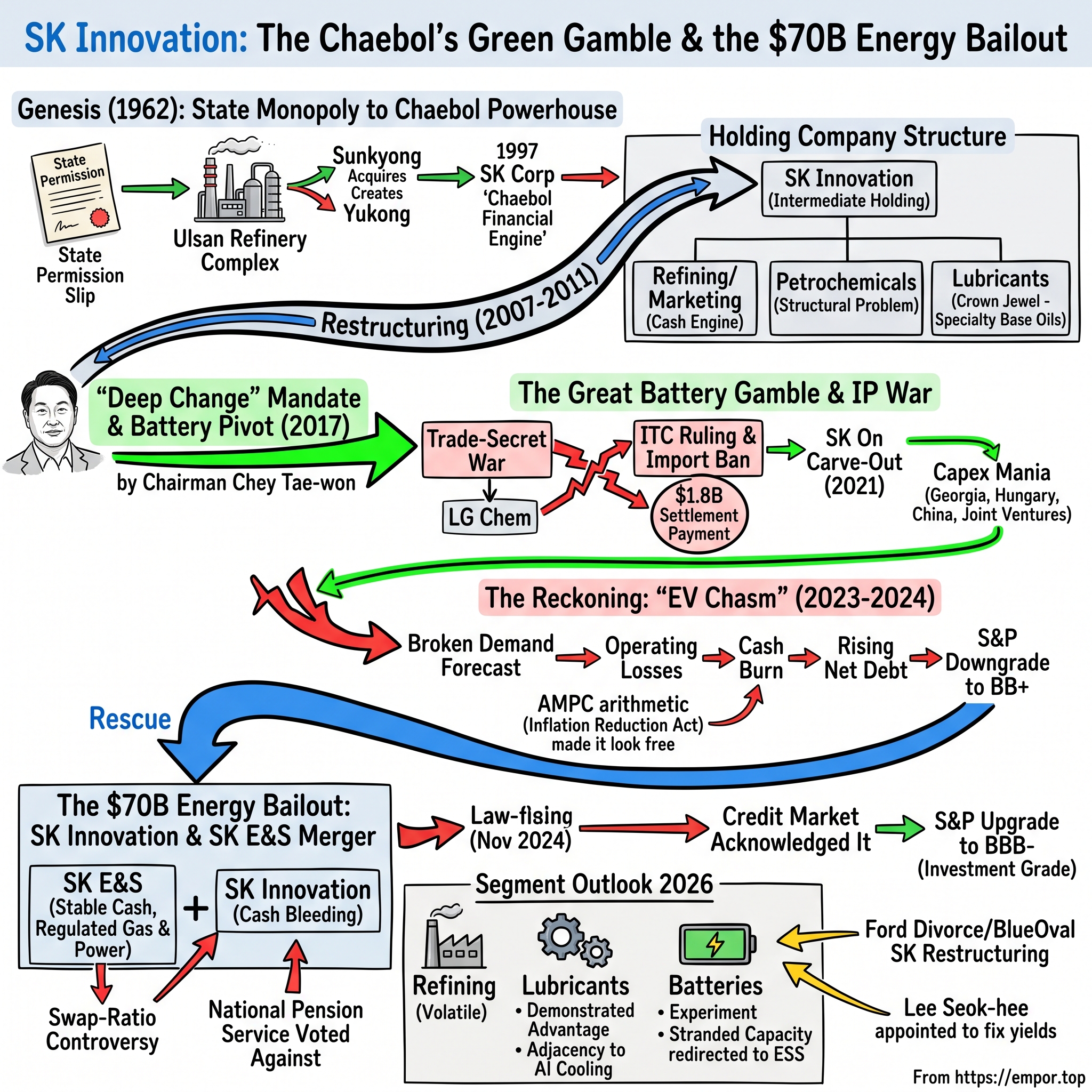
SK Innovation Co., Ltd.: The Chaebol's Green Gamble, the Battery Chasm, and the $70B Energy Bailout
I. Introduction & Episode Roadmap
On the morning of November 1, 2024, in a conference room in Seoul's Jongno district, executives from two companies that had spent decades operating as polite corporate cousins signed the paperwork that fused them into one balance sheet. On paper it was a merger. In practice it was a rescue.
SK이노베이션 SK Innovation Co., Ltd. (096770.KS, listed on the 한국거래소 Korea Exchange) absorbed SK E&S, the unlisted gas-and-power arm of the group, to create an entity with roughly KRW 105 trillion in assets as of mid-2024 — the largest privately held energy company in the Asia-Pacific region, excluding state-run utilities.1[^2] The press release talked about a "balanced energy portfolio." The financial logic was blunter: SK Innovation's electric-vehicle battery subsidiary, SK온 SK On, was burning cash at a rate that its parent's refining margins could no longer absorb, and the group needed a cash-generating utility bolted onto the same consolidated statements before the credit market decided the problem was structural rather than cyclical.
That is the spine of this story. South Korea's second-largest conglomerate, SK그룹 SK Group, took a 1960s state-owned oil refinery, privatized it, turned it into one of the largest single-site refining complexes on earth, and then used those commodity cash flows to underwrite one of the most aggressive capital deployments in the history of the battery industry — more than $15 billion of committed capex from 2021 onward, spread across Georgia, Kentucky, Tennessee, Hungary and China.2 Then Western EV demand stopped growing on the curve everyone had underwritten. What followed was not a graceful pivot. It was an impairment, a joint-venture divorce, a suspended dividend, and a governance fight that Korean minority shareholders are still arguing about.
The interesting question for a long-term investor is not whether SK Innovation made a mistake. Plenty of companies misjudged the EV ramp. The interesting question is what the company actually owns today, how much of its earnings power is durable versus cyclical, and whether the machinery of a Korean chaebol — which can mobilize capital at a speed Western boards cannot match — is also the machinery that destroys value when the bet goes wrong.
Here is the route we'll take:
First, the origin story: how 대한석유공사 Korea Petroleum Corporation, a government-and-Gulf-Oil joint venture, became the crown asset of a textile trading house called 선경 Sunkyong.
Second, the cash engine: the 울산 Ulsan Complex, the economics of crack spreads, and the 2007–2011 restructuring that turned a refiner into an intermediate holding company with four operating children.
Third, the pivot: Chairman 최태원 Chey Tae-won's "Deep Change" mandate, the trade-secret war with LG that nearly locked SK out of the United States, and the carve-out of SK On.
Fourth, the buildout and the reckoning: the American factory blitz, the Inflation Reduction Act arithmetic that made it look free, and what happened when the demand assumptions broke.
Fifth, the restructuring: the SK E&S merger and the swap-ratio controversy, the buyback of pre-IPO investors, the collapse of BlueOval SK, and the leadership churn that followed.
Sixth, the analysis: what each segment actually earns, where the competitive advantages are real versus rhetorical, what management has promised versus delivered, and the two or three numbers that will tell you whether this works.
Let's start where every Korean industrial story starts — with the state.
 Subscribe on LinkedIn
II. Genesis: From State Monopoly to Chaebol Powerhouse (1962–1997)
In 1962, South Korea's per-capita income was somewhere below that of Ghana. The country imported nearly every refined petroleum product it consumed, paid for in scarce dollars, and the government of the day concluded that an industrial economy without a refinery was not going to be an industrial economy at all. So it legislated one into existence. The Korea Petroleum Corporation Act created 대한석유공사 Korea Petroleum Corporation — a joint venture between the Korean state and Gulf Oil of the United States — and construction began on a patch of coastline in 울산 Ulsan, a fishing town on the southeast tip of the peninsula chosen for its deep water and its distance from Seoul.3[^5]
This matters for understanding everything that came later. SK Innovation's core asset was not built by an entrepreneur responding to a market signal. It was built as national infrastructure, sited by planners, financed by policy, and protected by a domestic market that could not source fuel anywhere else. The moat came first; the company came second.
The entrepreneur arrived in 1980. 선경 Sunkyong was a textiles-and-trading house run by 최종현 Chey Jong-hyun, a Wisconsin-trained economist who had spent the 1970s articulating a strategy he summarized as moving "from petroleum to fibers" — the idea that if you controlled the crude, you controlled the naphtha, and if you controlled the naphtha, you controlled the polyester yarn that Korea was exporting to the world.3 Most Korean industrialists of that era were building horizontally, grabbing whatever license the state handed out. Chey Jong-hyun was thinking about a value chain, backwards.
When Gulf Oil moved to exit its 50% stake in the Korean refinery, Sunkyong bought it, and management transferred to the group in line with the government's privatization drive.[^5] It was, by any reasonable measure, the single most consequential acquisition in modern Korean corporate history — a mid-sized trading company acquired the nation's only oil refinery. In 1982 the company was renamed 유공 Yukong, and by the mid-1980s the Ulsan site had grown to roughly 345,000 barrels per day of crude distillation capacity.3
What Chey Jong-hyun understood, and what most accounts of Korean industrial policy underplay, is that the refinery was not merely a profitable asset — it was a permission slip. In a licensed, import-controlled economy, owning the only crude distillation towers in the country meant every downstream chemical the state wanted made domestically had to be made by, or with, Sunkyong. That is a negotiating position, not just a business.
The Yukong years, roughly 1982 to 1997, were about building the pieces that made the refinery more than a refinery. Crude arrived on ships the group increasingly controlled through SK해운 SK Shipping. It was distilled at Ulsan, and the light ends fed petrochemical crackers on the same site — meaning the marginal cost of feedstock for the chemicals business was an internal transfer rather than a market purchase. Downstream, Yukong built out a nationwide network of branded service stations, which did something more valuable than sell gasoline: it gave the refinery guaranteed domestic volume placement, so the plant could run at high utilization regardless of export-market swings. In refining, utilization is everything. A complex running at 95% and one running at 75% are different businesses with the same nameplate.
Then came 1997. The Asian Financial Crisis hit Korea's chaebol with a violence that is hard to convey now: short-term dollar debt, collapsing won, and an IMF program that demanded the dismantling of cross-guarantees between affiliates. Several peer conglomerates simply ceased to exist. Yukong survived — partly because refining generates hard-currency export revenue, which in a currency crisis is the best asset you can own — and in 1997 the company retired the Yukong name and became SK Corporation.3
The rebrand looked cosmetic. It wasn't. Renaming the refinery after the group signaled that the oil business was now the group's identity and its balance sheet anchor, not one holding among many. That decision — that the refinery is the family's financial engine and can therefore be asked to fund the family's ambitions — is the thread that runs directly to a battery plant in Georgia twenty-five years later.
But before SK could deploy that engine, it had to survive a challenge to who controlled it.
III. Holding Company Restructuring & The Refining Cash Engine (1998–2016)
최종현 Chey Jong-hyun died in 1998, and his 37-year-old son 최태원 Chey Tae-won inherited the chairmanship of a conglomerate in the middle of the worst economic contraction in modern Korean history. Chey Tae-won had studied economics at the University of Chicago. He was, by the accounts of people who worked with him, more comfortable with abstraction and portfolio logic than with plant floors — a strategist rather than an operator, which would prove to be both his greatest asset and the source of his most expensive mistakes.
His first crisis was self-inflicted. In 2003, a Seoul court convicted Chey and other SK executives in connection with an accounting fraud at the group's trading arm, and he received a three-year sentence.4 SK Corp's shares collapsed below KRW 9,000.5
Into that wreckage walked a Monaco-based fund almost nobody in Seoul had heard of. Sovereign Asset Management accumulated a stake just under 15% in SK Corp — enough to make it the largest single shareholder in the group's most valuable listed company — and set about trying to remove Chey from management on the grounds that a convicted executive should not run a public company.56 It was the first genuine foreign activist assault on a chaebol, and it ran for roughly two years.
Sovereign lost the war and won a great deal of the argument. Chey survived shareholder votes and returned to management; Sovereign eventually exited at a substantial profit.6 But the fight forced SK to do things Korean conglomerates had resisted for decades: strengthen board independence, improve disclosure, and — critically — adopt a formal holding-company structure that replaced the tangle of circular cross-shareholdings with something an outside investor could actually draw on a page.
That restructuring arrived in stages. In 2007 SK Corporation split, with SK Inc. becoming the group holding company and the operating oil business renamed SK Energy.3 In 2011 the operating company was renamed SK Innovation and itself split its businesses into separately incorporated subsidiaries.3 By the middle of the decade the architecture looked like this: SK Innovation sat as an intermediate holding company beneath SK Inc., and beneath SK Innovation sat SK에너지 SK Energy (refining and domestic marketing), SK지오센트릭 SK Geocentric (petrochemicals, formerly SK Global Chemical), SK엔무브 SK Enmove (lubricants and base oils, formerly SK Lubricants), and later SK어스온 SK Earthon (exploration and production).
The reason this structure matters is that it makes each business individually financeable and individually sellable. A chaebol that wants to raise KRW 2 trillion for a new venture without diluting family control at the top can sell a minority stake in a subsidiary instead. That flexibility is a genuine advantage. It is also, as we'll see, how a company accumulates KRW 24 trillion of net debt without anyone at the holding level feeling it until the interest bill arrives.
Underneath the corporate architecture sat the machine. The 울산 Ulsan Complex processes roughly 840,000 barrels of crude per day across an eight-million-square-metre site, making it South Korea's largest refinery and one of the largest single-site refining complexes anywhere, with SK Energy, SK Geo Centric and the lubricants business all drawing from the same crude stream.78 A separate condensate-and-petrochemical complex at 인천 Incheon adds further capacity.
Here is the unit economics in plain language. A refinery buys crude oil and sells a basket of products — gasoline, diesel, jet fuel, fuel oil, naphtha. The difference between the value of that basket and the cost of the crude, minus energy and operating costs, is the refining margin, and the industry benchmarks it as a "crack spread." SK's margin depends on three things it does not control and one it does. It does not control the Dubai benchmark crude price, the official selling prices that Middle Eastern producers charge Asian buyers, or the Singapore product cracks that set Asian export economics. What it does control is complexity — the ability to buy cheaper, heavier, dirtier crude and still produce a high yield of expensive light products. That capability is the actual moat in refining, and it is why a complex refinery can earn money in a quarter when a simple one loses it.
The uncomfortable truth about this business is that its cash flow is enormous and its earnings are close to unforecastable. In 2025, the refining segment generated KRW 47.19 trillion of revenue and just KRW 349.1 billion of operating profit — a margin under one percent.9 In the first quarter of 2026, SK Energy alone produced KRW 1.28 trillion of operating profit on KRW 11.98 trillion of revenue, because crude prices rose between purchase and sale and inventory gains flooded in.10 Same assets, same crews, wildly different earnings.
There is a further wrinkle that catches investors who model refiners as simple spread businesses. Because a refinery buys crude weeks before it sells the products made from it, reported earnings contain a large timing component: when oil prices rise between purchase and sale, inventory held at old cost is sold at new prices and profit appears from nowhere. When prices fall, the same mechanism destroys profit that operations actually earned. Neither movement tells you anything about how well the plant is being run. Any assessment of SK Energy's underlying performance has to strip this out, and the company's own disclosures make that possible — which is more than can be said for many refiners.
Competitively, SK sits in a domestic oligopoly alongside GS칼텍스 GS Caltex, 에쓰오일 S-Oil and HD현대오일뱅크 HD Hyundai Oilbank — four refiners with far more capacity than Korea consumes, which means all of them are structurally export businesses competing against 中国石化 Sinopec's export quota, new Middle Eastern mega-complexes, and Reliance Industries' Jamnagar. Being the biggest refiner in Korea is not the same as having pricing power.
For most of the 2010s, SK Innovation harvested this business — paying dividends, funding research, and treating the volatility as the cost of admission. Then Chey Tae-won decided the cash flow needed to buy the company a different future.
IV. The Great Battery Pivot & The LG IP War (2017–2021)
Chey Tae-won's signature phrase inside SK was "Deep Change" — the argument, repeated in internal forums throughout the late 2010s, that incremental improvement was a death sentence for a carbon-heavy conglomerate and that the group had to change its business model at the root. The strategic reasoning was not eccentric. If you own refining assets with a 30-year book life and the world's largest auto markets are legislating away internal combustion engines, your terminal value is a question, not an assumption. Chey's answer was to move the group from "black energy" to "green energy," and the vehicle was to be lithium-ion batteries.
SK had been quietly working on cells for years — the group completed a battery plant at 서산 Seosan in 2012, long before there was a market worth the trouble.3 The technical bet was specific and, in hindsight, mostly correct: pouch-format cells using high-nickel nickel-manganese-cobalt chemistry.
That deserves a plain-English translation, because the choice explains both SK's design wins and its manufacturing agony. A battery cell can be packaged as a rigid cylinder, a rigid rectangular can, or a soft foil envelope — the "pouch." Pouches waste less space inside a car's floor and can be shaped more flexibly, so for a given battery pack volume you get more energy, which means more range. The cost is fragility and process difficulty: a pouch has no rigid casing to enforce dimensional discipline, so the manufacturing tolerances have to be extraordinary. Separately, "high-nickel" describes the cathode recipe. More nickel, less cobalt means more energy per kilogram and less exposure to cobalt's price and supply-chain ethics, but the material is more chemically reactive and less forgiving. SK pushed toward NMC 811 and beyond — roughly eight parts nickel to one each of manganese and cobalt.
Put together, SK chose the highest-performance, hardest-to-manufacture combination available. When it works, you win premium programs. When yields disappoint, you scrap expensive material at scale.
The strategy worked commercially. SK secured design wins with Ford Motor Company, Volkswagen Group, and, closer to home, 현대자동차 Hyundai Motor and 기아 Kia. But SK's battery organization had grown at a pace that raised an obvious question about where the know-how came from — and in April 2019, LG Chem asked it in court.
The complaint filed with the US International Trade Commission alleged that SK Innovation had systematically recruited LG battery personnel and, with them, LG's trade secrets. The scale alleged was roughly 100 employees and engineers.11 This was not a patent skirmish over a claim construction; it was a trade-secret case, and the ITC's remedy for trade-secret misappropriation is an import ban.
For two years the case escalated into something close to industrial diplomacy. SK was in the middle of building battery plants in Jackson County, Georgia — a project with thousands of announced jobs in a politically consequential state — and an import ban on its cells and components would have stranded the investment. On February 10, 2021, the ITC ruled in LG's favor, and SK faced a ten-year exclusion order barring it from importing the materials it needed to make EV batteries in the United States.12 The order was subject to a presidential review window, and Washington found itself asked to choose between enforcing intellectual property law and preserving a factory.
The politics were genuinely awkward. An exclusion order under US trade-secret law is subject to a presidential review period, which meant the administration had a narrow window in which to disapprove the ITC's remedy on public-policy grounds.12 SK's argument was effectively economic hostage-taking dressed as public interest: block our imports and thousands of announced Georgia manufacturing jobs, in a state that had just become politically pivotal, become uncertain. LG's argument was that a country which does not enforce trade-secret judgments has no industrial policy worth the name. Both were correct, which is why the case became so difficult to resolve through the process it was filed in.
The parties settled first. On April 11, 2021, SK Innovation agreed to pay LG Energy Solution KRW 2 trillion — about $1.8 billion — structured as lump-sum payments plus a running royalty, with a ten-year mutual non-assertion covenant, resolving all litigation in both the United States and Korea.131415 SK's shares rallied sharply on the news, which tells you how much of the equity value had been hostage to the case.16
The analytical reading of that settlement is less flattering than the market reaction. SK paid roughly $1.8 billion — real cash, plus a royalty stream on future US sales — for the right to continue a business that had not yet earned a won of profit. The settlement did not buy a technology, a customer, or a cost advantage. It bought the removal of an obstacle that SK's own hiring practices had created. That is a large sum to pay for permission, and it went out the door at precisely the moment the battery unit needed every available krona of capital for construction.
Which brings us to the financing architecture. On October 1, 2021, SK Innovation carved the battery business out into a separate company, SK온 SK On, alongside a separate E&P entity, SK어스온 SK Earthon.3 The stated purpose was focus. The operational purpose was access to capital: a standalone battery company could raise money from investors who wanted battery exposure without refining exposure, and eventually list.
SK On duly did so, raising a $944 million pre-IPO round and, across 2022 and 2023, drawing close to KRW 5 trillion from financial investors including consortia led by MBK Partners with participation from BlackRock and the Qatar Investment Authority, plus Korean institutional money.17[^20]18 The terms are the part worth remembering. The convertible preferred shares came with a promise: SK On would go public by the end of 2026, delivering investors a 7.5% internal rate of return, and if it did not, a drag-along provision would let those investors force a sale of the business — including SK's own stake — to a third party.18
SK Innovation had, in effect, sold a put option on its own strategy. It would have four years to make the battery business worth listing. It spent them building factories.
V. Capex Mania, the US Empire, and the "EV Chasm" (2021–2024)
By late 2021 the map of SK On's ambitions read like a campaign plan. In Jackson County, Georgia — a rural stretch of red clay northeast of Atlanta — SK Battery America's two plants came online, with mass production beginning in 2022 and roughly 22 GWh of eventual annual capacity.3 In Kentucky and Tennessee, the BlueOval SK joint venture with Ford Motor Company committed to a combined investment of about $11.4 billion across three mega-plants, backed by a $9.2 billion US Department of Energy loan that was, at the time, the largest of its kind.19 In December 2022, SK On and 현대자동차그룹 Hyundai Motor Group announced a 50-50 joint venture in Bartow County, Georgia, which would ultimately grow into a $5 billion project with 35 GWh of planned annual capacity and roughly $641 million of state incentives attached.202122 Add Hungary for Europe and existing Chinese capacity, and SK On was constructing simultaneously on three continents.
The arithmetic that made this look rational was written into American law. The Inflation Reduction Act's Advanced Manufacturing Production Credit paid $35 per kilowatt-hour for cells produced in the United States and $10 per kWh for modules — a subsidy so large relative to a cell's manufacturing cost that, on paper, a plant running at high utilization could be profitable before the customer paid anything. Layer on the consumer-side credit of up to $7,500 per vehicle stimulating demand, and the model closed beautifully.
Two assumptions were load-bearing, and both were about volume. The credit is paid per unit produced and sold, so it converts to cash only if the cells find a home; and a gigafactory's fixed-cost base is so heavy that unit economics collapse below roughly 70–80% utilization. SK was not underwriting a subsidy. It was underwriting a demand forecast, with a subsidy attached.
The forecast broke in 2023. Western EV adoption decelerated hard — interest rates made monthly payments punishing, charging infrastructure lagged the marketing, and the early-adopter cohort turned out to be smaller than the addressable-market slides implied. Ford, which had been SK's anchor US customer, cut EV production plans and slowed the BlueOval program. Hybrid demand surged instead, and a hybrid needs roughly a tenth of the cells a battery-electric vehicle does.
Inside SK On, the effect compounded. A ramping factory has the worst possible cost structure: full depreciation, full headcount, low output, and high scrap. Yields at the early US plants disappointed, and every scrapped pouch cell carried the cost of nickel-rich cathode material that had already been bought. SK On posted operating losses quarter after quarter from its 2021 carve-out onward, and although management pointed repeatedly to breakeven dates, the losses continued until a first small quarterly operating profit of KRW 24 billion arrived in the third quarter of 2024 — a figure that owed more to AMPC recognition than to operating leverage.23
The parent company's own results tell you how thin the cushion had become. Full-year 2024 consolidated revenue was KRW 74.72 trillion with operating profit of just KRW 315.5 billion — about four-tenths of one percent — and the year included a KRW 423.3 billion operating loss in the third quarter alone.2324 A company with three-quarters of a hundred trillion won of revenue was earning essentially nothing.
Meanwhile the debt built. Consolidated net debt climbed past KRW 20 trillion and kept going, because gigafactories are paid for in cash years before they generate any. The rating agencies responded the way rating agencies do: S&P Global Ratings had SK Innovation below investment grade at BB+ heading into late 2024, and every notch of downgrade raised the cost of the next bond, which raised the interest bill, which reduced the cash available to fund the factories.[^28]
This is the mechanism that turns a strategic misjudgment into a financial emergency. SK's legacy businesses were not failing. Refining was cyclical but cash-generative; lubricants were excellent. But those cash flows were being harvested faster than they were being replenished, and the destination was a business whose customers had just told it they wanted fewer cells. By mid-2024 SK Innovation faced a choice between raising equity into a depressed share price, selling assets into a buyer's market, or finding cash flow somewhere inside the family.
It chose the family.
VI. The Mega-Bailout: SK Innovation & SK E&S Merger (2024–Present)
In the spring of 2024, SK Group launched an exercise it called 리밸런싱 rebalancing — a group-wide portfolio review that, stripped of euphemism, meant identifying which subsidiaries had cash and which needed it. SK Innovation was firmly in the second category. SK E&S, 90%-owned by holding company 주식회사 SK SK Inc., was firmly in the first.
SK E&S was the quiet compounder of the group: Korea's largest private city-gas franchise, operating seven city-gas subsidiaries across eight regions, plus power generation, plus a genuine end-to-end LNG business including rights to about 2.2 million tonnes per year of liquefaction capacity at Freeport LNG in Texas.2526 City-gas distribution in Korea is a regulated regional franchise — customers cannot choose a different pipe — which produces the kind of boring, predictable, rate-based cash flow that is the exact opposite of a refinery's.
Bolting that onto SK Innovation's consolidated accounts did three things at once: it added steady EBITDA to service debt, it improved the consolidated leverage ratio that rating agencies watch, and it gave SK On a funding source that did not require asking the capital markets for permission. The board approved, and the merged entity launched on November 1, 2024, with SK E&S continuing as a "company-in-company" unit renamed SK Innovation E&S, alongside a second CIC that folded in SK Trading International to centralize raw-material and crude sourcing.1
The controversy was the price.
Because SK Innovation was listed and SK E&S was not, Korean rules valued them by different methods — SK Innovation at statutory market value, SK E&S on an asset-and-earnings basis. The resulting swap ratio was set at 1 to 1.1917417, and SK Innovation issued 49,769,267 new shares to SK Inc. in exchange for its SK E&S holding.[^2][^31] SK Inc. had held 36.2% of SK Innovation before the deal; after receiving that block of new shares it held an outright majority of the listed company.[^2]
Minority shareholders made a straightforward objection. SK Innovation's share price in mid-2024 sat near a cyclical trough, hammered by battery losses and weak refining margins. Valuing the listed company at that depressed market price while valuing the unlisted, cash-rich affiliate on its earnings and assets mechanically transferred value from SK Innovation's public shareholders to its controlling shareholder — who happened to be the entity on the other side of the trade. The 국민연금 National Pension Service, holding 6.2%, voted against.[^31]
The deal passed comfortably regardless. At the extraordinary general meeting on August 27, 2024, over 85% of attending shares approved, with roughly 95% of foreign shareholders in favor, and both Institutional Shareholder Services and Glass Lewis had recommended approval on the view that the combination would improve financial stability and create synergies.[^31] Dissenting holders could exercise appraisal rights at KRW 111,943 per share, and SK Innovation had set aside KRW 800 billion against a threshold that could have let it walk away if buyback demands ran too high.[^31]
It is worth being precise about what that vote does and does not prove. It does not establish that the ratio was fair to minorities; a controlling shareholder with 36.2% and a captive base of affiliated and index holders wins most Korean merger votes. What it does establish is that a large majority of outside institutional money concluded that a recapitalized SK Innovation was worth more to them than a standalone one with a battery problem. Foreign investors did not vote for the ratio. They voted for the balance sheet. That is a rational but revealing verdict: the merger was priced as a rescue, and rescues are not priced fairly.
The rescue bought time, and the credit market acknowledged it. S&P upgraded SK Innovation to BBB- from BB+ on November 2, 2024 — back to investment grade on the strength of the added cash flow — then affirmed BBB- with a negative outlook in March 2025, projecting adjusted debt to EBITDA of 7.4 times in 2025 improving to 5.4 times in 2026, still uncomfortably high, with EV battery capex named as the reason.[^28]27 Moody's has kept the company one notch below investment grade at Ba1.28
Then 2025 arrived, and the battery problem got worse before the fix could work.
Restructuring round two. On July 30, 2025, SK Innovation announced a second wave: SK On would absorb SK Enmove, the lubricants business, effective November 1, 2025, and the group would inject roughly KRW 8 trillion of fresh capital across the structure — KRW 2 trillion of third-party allotment at SK Innovation plus KRW 700 billion of perpetual bonds, KRW 2 trillion of third-party allotment at SK On, KRW 300 billion into separator maker SK IE Technology, and a further KRW 3 trillion planned — alongside KRW 1.5 trillion of debt reduction through non-core asset sales.[^34]29 Management set 2030 targets of KRW 20 trillion of group EBITDA, net debt below KRW 20 trillion, SK On EBITDA above KRW 10 trillion, and an SK On debt ratio under 100%.29
The stated rationale for merging a lubricants business into a battery business was cross-selling and integrated thermal-management solutions. The financial rationale was that SK Enmove is the most profitable unit in the group and SK On needed profitable assets on its balance sheet to be financeable at all. Investors should read the synergy language skeptically; the transaction's primary effect was to make SK On's consolidated statements look materially better without changing a single thing about cell manufacturing economics.
Buying out the option. At the same July 2025 board meeting, SK Innovation approved the purchase of all 51,079,105 SK On convertible preferred shares for approximately $2.6 billion, repaying the $2 billion invested in 2023 by the MBK Partners and Korea Investment & Securities PE consortia and extinguishing the end-2026 IPO obligation, the 7.5% IRR guarantee, and the drag-along right.18 The company's framing was that strengthening long-term growth and financial stability mattered more than rushing to market.18
That is one reading. The other is that SK Innovation spent $2.6 billion of scarce cash to avoid having to price SK On publicly in a bad market — which is itself information about what management thought that price would be. The obligation is gone; the eventual need to monetize the battery business is not.
The Ford divorce. On December 11, 2025, Ford and SK On agreed to dissolve BlueOval SK.19 Ford took full ownership of the two Kentucky plants; SK On took full ownership of the Tennessee plant inside Ford's BlueOval City campus; and the DOE loan was restructured to reflect the separated entities.19 Ford simultaneously scrapped plans for an electric pickup at the Tennessee campus in favor of gas-powered models, which explains the divorce more efficiently than any press release.30 BlueOval SK's Kentucky workforce — more than 1,500 people — was laid off.31
The accounting hit landed in the fourth quarter of 2025: SK On recognized roughly KRW 4.2 trillion of asset impairments tied to the BlueOval restructuring, driving a fourth-quarter non-operating loss of KRW 4.66 trillion, a full-year pre-tax loss of KRW 5.82 trillion, and a net loss of about KRW 5.4 trillion — against full-year operating profit of KRW 448.1 billion on revenue of KRW 80.30 trillion.932 Management correctly noted the impairment did not affect cash.9 The board also suspended the dividend for fiscal 2025 entirely, with leadership stating the company "inevitably decided to forgo dividends in order to improve our financial structure and secure future growth drivers."32
For a shareholder base that had already absorbed a dilutive merger, a suspended dividend was the second bill for the same decision.
The unwind completed on May 21, 2026, with the Tennessee plant renamed SK On Tennessee. The financial benefit is real and quantified: roughly KRW 5.4 trillion of debt left the consolidated balance sheet with the Kentucky assets, saving approximately $180 million of annual interest and about KRW 330 billion a year of depreciation.3332 SK On's plan for Tennessee is to diversify it toward energy storage systems and supply multiple manufacturers rather than one.19
Who is running this. The leadership record deserves attention because it is unusually churn-heavy. 박상규 Park Sang-kyu led SK Innovation through the merger and has since departed; 추형욱 Choo Hyeong-wook, who had run SK E&S, became CEO of the combined company.1 In December 2025 the group announced that 장용호 Jang Yong-ho would be appointed co-CEO alongside Choo at the March 2026 annual meeting, each acting severally.3435 At SK On, semiconductor veteran 이석희 Lee Seok-hee — formerly CEO of SK하이닉스 SK hynix, brought in explicitly for his yield-engineering background — was joined by a co-CEO, Lee Yong-wook, previously of SK Siltron, with the division of labor stated as Lee Yong-wook on manufacturing and operations and Lee Seok-hee on customers and R&D.35 Lee Jong-soo, previously head of the E&S LNG business, took over the E&S CIC.35
Appointing a memory-chip yield specialist to fix a cell factory is a genuinely coherent decision — the disciplines are closer than they appear, both being high-volume processes where a fraction of a percent of defect rate decides profitability. Appointing co-CEOs at both the parent and the battery unit within eighteen months of a mega-merger is a different signal. It can mean deliberate specialization. It can also mean a group that is not certain who should be accountable. Investors watching from here should treat the next two annual meetings as the test of which it was.
With the corporate surgery largely complete, the question becomes what the patient actually earns.
VII. Segment-Level Breakdown & Economic Proportionality
Strip away the narrative and SK Innovation in 2026 is five businesses stapled to one credit rating. They differ so much that a consolidated margin figure is close to meaningless. Ranked by what they contribute rather than what they promise, here is what the company owns.
Refining and marketing — the volume machine. SK Energy, together with the Incheon petrochemical complex, is where nearly all the revenue lives and almost none of the reliability. In 2025 refining turned KRW 47.19 trillion of revenue into KRW 349.1 billion of operating profit.9 One quarter later, in the first quarter of 2026, SK Energy alone earned KRW 1.28 trillion and SK Incheon Petrochem another KRW 647.1 billion on KRW 3.02 trillion of revenue.10 The swing came substantially from timing: management attributed the strength to the lag between crude procurement and product sales and disclosed roughly KRW 780 billion of inventory valuation gains, warning explicitly that those gains "may decline or disappear if oil prices fall."10 That candour is worth noting — it is the correct disclosure, and it should stop any investor from annualizing a good refining quarter.
Exploration and production — small, strange, and very profitable. SK어스온 SK Earthon produced KRW 399.7 billion of operating profit on KRW 1.37 trillion of revenue in 2025 — a near-30% operating margin, the best percentage return in the group.9 Its assets are geographically scattered, and its most consequential recent event was the arrival of the first LNG cargo from Australia's Barossa field in early 2026, securing roughly 1.3 million tonnes a year of LNG for two decades.10 Earthon is too small to move the consolidated needle, but its returns are a reminder that SK's best businesses are usually its least fashionable ones.
Lubricants — the actual crown jewel. SK엔무브 SK Enmove is the business a rational investor would look at first and the one the equity story mentions last. In 2025 the lubricants segment earned KRW 607.6 billion of operating profit on KRW 3.84 trillion of revenue — more absolute profit than the refining business generated on twelve times the revenue.9 In the first quarter of 2026 it added KRW 188.5 billion on KRW 1.22 trillion.10
The reason is a specific, defensible technical position. Lubricant base oils are graded by purity and stability; Group III and Group III+ are the high-purity synthetics required for modern low-viscosity engine oils and long drain intervals. Making them requires a hydrocracking configuration that few refiners have and that cannot be bolted on cheaply. SK Enmove has built the largest global share in that category — reported at roughly 40% — and sells finished product under the ZIC brand.[^42]36
The optionality attached to it is immersion cooling. The idea is simple: instead of blowing air over hot electronics, submerge them in a non-conductive fluid that carries heat away far more efficiently. For AI data centres, where rack power densities have outrun what air can handle, this stops being exotic and starts being necessary — and the fluid is a specialty base-oil derivative, which is exactly what SK Enmove already knows how to make. The company has partnered with SK Telecom and Iceotope on data-centre systems and with Hanwha Aerospace on immersion-cooled energy storage, and projects the global immersion coolant market growing to KRW 42 trillion by 2040 from under KRW 1 trillion in 2020.373836
Treat the 2040 number as marketing. Treat the position as real. A business with a 40% share of a hard-to-replicate feedstock, an established brand, and a credible adjacency into AI thermal management is the highest-quality asset in this company by a wide margin — which makes its 2025 absorption into SK On a decision shareholders are entitled to question. Folding your best margin engine into your worst-performing unit improves the subsidiary's optics and reduces the transparency of the group's crown jewel at the same time.
A second-layer note on the accounting is warranted here, because impairment is a judgment rather than a measurement. Writing down KRW 4.2 trillion of battery assets required management to conclude that the recoverable amount of those assets — the higher of fair value less costs to sell, and value in use derived from discounted future cash flows — had fallen below carrying value. Those cash-flow models embed assumptions about EV volumes, cell prices, utilization and subsidy eligibility that are, by definition, the same assumptions that were wrong the first time. The write-down was almost certainly necessary. Whether it was sufficient depends on whether the remaining carrying values for the Georgia, Hungary and Tennessee assets rest on demand curves that hold. An investor cannot verify that from outside; what they can do is watch whether further impairments follow, because a sequence of write-downs is usually evidence that the first one was calibrated to what the balance sheet could absorb rather than to what the assets were worth.
Petrochemicals — the structural problem. SK지오센트릭 SK Geo Centric lost KRW 236.5 billion at the operating level in 2025 on KRW 8.92 trillion of revenue, then swung to a KRW 127.5 billion profit in the first quarter of 2026.910 The loss is not a management failure; it is Chinese capacity. China added enormous ethylene and derivative capacity through the 2020s and turned itself from an importer into a competitor, compressing Asian olefin and aromatic spreads structurally rather than cyclically. SK's answer is to move up-value into specialty packaging and advanced plastics recycling. Management acknowledged on the first-quarter 2026 call that petrochemical restructuring has been delayed by divergence among stakeholders and elevated costs.10 Korean petrochemical consolidation has been discussed for years and executed slowly; assume that continues.
Gas and power — the anchor. SK Innovation E&S contributed KRW 11.86 trillion of revenue and KRW 681.1 billion of operating profit in 2025, and KRW 283.2 billion in the first quarter of 2026.910 The company does not separately disclose a segment EBITDA figure. What matters is not the absolute size but the shape: regulated distribution and contracted power revenue that arrives whether or not crack spreads cooperate. That is the collateral against which the rest of the story is financed. It is also expanding — SK Innovation was selected as project developer for Vietnam's Quynh Lap combined-cycle power project, valued at about $2.3 billion.10
Batteries — the reason we are all here. SK On generated KRW 6.98 trillion of revenue and a KRW 931.9 billion operating loss in 2025, followed by a KRW 349.2 billion loss in the first quarter of 2026 on KRW 1.79 trillion of revenue, with the loss narrowing as European and Asian volumes recovered and North America stayed weak.910 The separator business at SK IE Technology remains loss-making and required a capital injection in the 2025 package.29
The pivot inside the pivot is energy storage. Grid-scale batteries do not care about a car's weight or volume, which changes the competitive calculus entirely, and Korea has been running government procurement auctions to build domestic storage. In the second national ESS auction, SK On won 284 megawatts of a 565 MW programme — 50.3% of the volume — in a tender the company sized at roughly KRW 1 trillion.1039 Management's stated 2026 goal is to secure 20 GWh of global project orders with an explicit emphasis on ESS.9
That is a sensible reallocation of stranded capacity, and it converts the Tennessee plant from a Ford-dependent asset into a multi-customer one. It is not a solution to the pouch-cell cost problem. ESS is a price-led market where 宁德时代 CATL and 比亚迪 BYD compete with cheap lithium iron phosphate cells; SK's answer on the first-quarter call was that "ESS market is driven by quality, safety, and reliability rather than price alone."10 That may be true for some buyers. It is also precisely what a high-cost producer says.
The honest summary of the portfolio: SK Innovation owns one excellent business, two solid cash generators, one structurally challenged commodity business, and one very large experiment. Whether the sum works depends on whether the experiment stops consuming the others.
VIII. Strategic Frameworks: Porter's 5 Forces & Helmer's 7 Powers
If you war-game SK Innovation's competitive position rather than describe it, the picture is less about strategy and more about structural exposure.
Buyers hold the leverage. Global automakers are the definition of a concentrated, sophisticated buyer group. They demand cost-down schedules, impose quality and delivery penalties, and — as Ford demonstrated definitively — can simply change their product plan and leave a supplier holding a factory.30 SK On's Tennessee diversification toward ESS and multiple customers is an explicit attempt to reduce this exposure, which tells you management agrees the exposure was excessive. In refining, buyer power is different but no less binding: gasoline and diesel are commodities priced off Singapore benchmarks, so SK sells at a market price it does not set.
Suppliers hold leverage too. Upstream lithium, nickel and cobalt refining is overwhelmingly Chinese-controlled, and the OBBBA's foreign-entity restrictions now make that dependence a tax problem as well as a procurement problem. On the crude side, OPEC+ and Middle Eastern official selling prices determine SK's largest single input cost. Management flagged raw-material sourcing uncertainty and Middle East conflict volatility as live issues in the first quarter of 2026.10 A business squeezed on both sides is a business whose margin is set by other people.
New entrants are not the threat. Building a refinery in a developed market is effectively impossible on permitting grounds alone, and a gigafactory requires billions plus process knowledge that takes years to accumulate — as SK's own yield struggles demonstrate. This force is genuinely favorable.
Substitutes are the real threat. In batteries, lithium iron phosphate has taken enormous share from nickel-rich chemistries because it is cheaper, safer and adequate for mass-market range, and sodium-ion is arriving at the low end. SK's high-nickel pouch expertise is a premium capability in a market that has been drifting toward value. Meanwhile, hybrids consuming a fraction of the cells per vehicle have absorbed much of the demand that battery-electric vehicles were forecast to take. In refining, the substitution risk is electrification of the vehicle fleet itself — the very risk the battery pivot was designed to hedge, which is an elegant irony.
Rivalry is brutal in both halves. In batteries, SK is the smaller of Korea's three cell makers, competing against LG에너지솔루션 LG Energy Solution and 삼성SDI Samsung SDI domestically and against CATL and BYD, whose scale and vertically integrated cost positions define the market price. In refining, Korea's four-refiner oligopoly all export into the same Asian market as Chinese and Middle Eastern mega-complexes.
Running the same company through Hamilton Helmer's 7 Powers is instructive mostly for what is absent.
Cornered resource — yes, in two places. Korean city-gas distribution licences are legally exclusive regional franchises, and the Freeport liquefaction tolling rights are a contractual position in scarce US export capacity.2526 These are the most durable advantages in the group, and neither has anything to do with the growth story management sells.
Scale economies — yes, in refining. An 840,000 bpd integrated complex that feeds its own crackers and lubricant units has a genuine unit-cost advantage over a standalone refinery. That advantage is real and it is also fully capitalized in the industry's competitive structure; it wins SK survival in downturns, not excess returns.
Process power — yes in lubricants, unproven in batteries. Group III base oil manufacturing is a demonstrated, hard-to-copy capability backed by market share and margin. High-nickel pouch cell assembly at scale in the United States is, on the evidence of yields and impairments, a capability SK has not yet proven it can transplant. Process power is a claim you validate with cost curves, not chemistry slides.
Counter-positioning — inverted. The classic version is a newcomer adopting a model incumbents cannot copy without harming themselves. SK attempted something closer to the reverse: an incumbent adopting a challenger's business model while still needing the legacy business to fund it. That is not counter-positioning; it is self-financed disruption on a clock, and the clock is the legacy cash flow's volatility.
Missing entirely: branding, network economies, switching costs. There is no consumer brand premium in commodity fuels. There are no network effects. Automotive design-in creates some stickiness once a cell is qualified into a platform, but Ford's exit showed how little that is worth when the platform is cancelled.
The blunt conclusion: SK Innovation's genuine competitive advantages sit in regulated gas distribution, refining scale, and specialty lubricants. Its growth narrative sits in batteries, where it has the fewest structural advantages of any business it owns. Investors should be clear which of those they are being asked to pay for.
IX. Primary Evidence & Conference Call Guidance Analysis
A management team's credibility is not measured by what it says in a good quarter. It is measured by the distance between what it promised three years ago and what it reports now, and by whether it explains the gap or reframes it.
Run SK Innovation's calls in sequence and the pattern is clear.
The promise phase, 2022 through mid-2023. Prepared remarks in this period were organized around capacity — gigawatt-hour targets, plant milestones, customer announcements — and around a specific, repeated commitment that SK On would reach operating breakeven. The framing treated the ramp as an engineering schedule: build the lines, qualify the cells, cross into profit. Analysts largely accepted it, because everyone's demand model looked similar.
The reframing phase, late 2023 through mid-2024. As losses widened, the emphasis in prepared remarks shifted from operating breakeven to AMPC recognition. This is an important tell. The credit is a genuine cash benefit and management was right to quantify it, but shifting the headline metric from "the factory earns money" to "the factory earns money including the subsidy" changes the question being answered without acknowledging that the question changed. Analyst Q&A in this stretch pushed on the specifics — unit costs, scrap and yield rates at the US plants, the ramp schedule at BlueOval sites — and answers were consistently less precise than the questions. SK On's first positive operating quarter, the KRW 24 billion in the third quarter of 2024, arrived with AMPC doing the heavy lifting.23
The discipline phase, post-merger. By the fourth-quarter 2025 call the language had changed completely. Management led with portfolio restructuring, described the Ford unwind as a structural balance-sheet improvement worth roughly KRW 5.4 trillion of debt relief, characterized the KRW 4.2 trillion impairment as a one-off with no cash effect, and set 2026 capex at KRW 3.5 trillion with KRW 1.3 trillion for batteries, KRW 900 billion for E&S and KRW 1.3 trillion for regular and strategic investment.932 The dividend suspension was presented as a deliberate financial-structure decision.32 Management also stated plainly that battery-business uncertainty would continue through 2026.40
The first quarter of 2026 call is the cleanest window into how this team now handles a good quarter. It could have led with the KRW 2.16 trillion operating profit. Instead it front-loaded the inventory-gain caveat, disclosed the roughly KRW 780 billion figure, and warned it could reverse.10 On the balance sheet, the CFO reported net debt of KRW 24.6 trillion, up about KRW 2 trillion year-to-date on working-capital and cash movements, total liabilities of KRW 72 trillion, and a debt-to-equity ratio of 189%, down one percentage point.41 Asked directly whether further financing or asset rationalization would be needed and what year-end net debt would look like, the answer was that first-quarter capex was KRW 0.8 trillion against a stable KRW 3.5 trillion annual plan, and that net debt would be managed through portfolio rebalancing and non-core asset sales.41
Note what that answer does and does not contain. It confirms the capex envelope. It does not give a year-end net debt number. For a company whose entire equity case rests on deleveraging, declining to quantify the target while affirming the spend is a meaningful omission, and analysts asked about it directly rather than by implication.
Where the narrative has been consistent, and where it hasn't. Consistent: SK has never wavered on electrification as the strategic destination, and it has never hidden the scale of the losses. The quarterly disclosures are detailed, segment-level, and released promptly, which is better practice than several peers. Also consistent: the group's willingness to explain a bad number in cash terms rather than accounting terms, which is analytically correct even when it is convenient.
Not consistent: the breakeven timeline, which moved repeatedly; the metric of success, which migrated from operating profit to subsidy-inclusive profit; and the capital-allocation posture, which has swung from "spend to win share" to "capital discipline" without a clear accounting of what the earlier spending returned. The 2030 targets announced in July 2025 — KRW 20 trillion of group EBITDA, net debt below KRW 20 trillion, SK On EBITDA above KRW 10 trillion — deserve to be read against that record.29 SK On's EBITDA target implies a transformation from a business losing nearly KRW 1 trillion a year at the operating line to one generating over KRW 10 trillion within five years. No bridge for that has been publicly disclosed. Management has earned the benefit of the doubt on disclosure quality. It has not earned it on forecasting.
An activist would push on three additional things, and they are fair. First, portfolio complexity: a group that has executed two major internal mergers in fourteen months, bought out its own subsidiary's preferred investors for $2.6 billion, and reshuffled leadership at both parent and subsidiary is harder to value, and complexity of that kind usually benefits the controlling shareholder more than the minority. Second, related-party pricing: every one of these transactions had SK Inc. on the other side or adjacent to it, and none was priced by an arm's-length auction. Third, accountability: the individuals who approved a $15 billion-plus capex programme on a demand forecast that broke are, at the group level, the same individuals now presiding over the cleanup. Chey Tae-won's own control position has separately been complicated by an appellate ruling on a divorce settlement of roughly KRW 1.3 trillion, an unusual overhang for a controlling family.42
None of that is fatal. All of it belongs in the risk assessment.
X. Risk Radar & Bull vs. Bear Investment Case
Myth vs. reality. Three consensus narratives about this company deserve fact-checking before anything else.
Myth: the SK E&S merger fixed the balance sheet. Reality: it materially improved it and restored investment-grade status, but net debt was KRW 24.6 trillion at the end of the first quarter of 2026, up roughly KRW 2 trillion year-to-date, with a 189% debt-to-equity ratio.41 The merger changed the trajectory and the rating. It did not retire the debt.
Myth: the BlueOval SK breakup was a loss. Reality: the KRW 4.2 trillion impairment was an accounting recognition of value that had already evaporated, while the transaction removed about KRW 5.4 trillion of debt, roughly $180 million of annual interest and about KRW 330 billion of annual depreciation from the consolidated accounts.93332 The economics of the unwind were favorable. The economics of the original investment were not.
Myth: SK On is one demand cycle away from profitability. Reality: US EV demand did not merely pause. The consumer credit was repealed effective September 30, 2025, producing a pull-forward record third quarter followed by a collapse — US EV market share fell from above 11% in September 2025 to roughly 6% in the following months, and US EV sales were still down 28% year-on-year as of March 2026.434445 A demand recovery to prior trend requires a reason, and the subsidy that supplied the previous reason is gone.
The risk radar. Four risks matter enough to model.
Utilization risk. SK On's factories need roughly 70–80% utilization to earn money, and the North American demand base that was supposed to fill them has structurally reset. ESS orders help fill lines but at lower prices against LFP competitors.
US policy risk. The One Big Beautiful Bill Act, signed July 4, 2025, preserved the 45X manufacturing credit that underpins SK's US economics but added foreign-entity-of-concern guardrails: for taxable years beginning after July 4, 2025, a producer cannot claim 45X if the components received "material assistance" from a prohibited foreign entity, and battery module definitions were tightened.46 SK's upstream materials chain runs substantially through Chinese processors. Compliance is achievable but not free, and the eligibility question is now a live audit risk on the single largest input to SK On's profitability.
Commodity margin risk. Refining earnings are hostage to Asian crack spreads, which face new capacity in China and the Middle East, and to inventory timing that cuts both ways. Petrochemical spreads face structural Chinese oversupply, with Korean industry consolidation delayed.10
Cost of capital. At BBB- with a negative outlook from S&P and Ba1 at Moody's, SK Innovation borrows at a spread that a KRW 24.6 trillion net debt position makes expensive in absolute terms.272841 Every notch matters, and S&P's own projection of 5.4 times leverage in 2026 leaves little room for a bad refining year.
The bull case, stated as fairly as the evidence allows, has three legs.
The first is the cash-flow shield. Regulated city-gas distribution, contracted LNG, and power generation produce earnings that do not correlate with crack spreads or EV sales, and they are now inside the same consolidated statements that service the debt. This is the structural change of the last two years, and it is real.
The second is operational repair with a specific mechanism. The Ford unwind removed the most problematic assets and their debt, capex is capped at KRW 3.5 trillion with only KRW 1.3 trillion to batteries, the dividend is suspended, and yield engineering is now led by executives whose careers were built on defect rates in semiconductor fabs.3235 SK On's loss narrowed sequentially in the first quarter of 2026 as European and Asian volumes recovered.10 If ESS absorbs stranded capacity — and a 50.3% share of Korea's second national auction is evidence, not a promise — utilization improves without a US EV recovery.39
The third is the underappreciated asset. SK Enmove's roughly 40% share of the global Group III base oil market throws off more operating profit than the refining business, and its immersion-cooling adjacency points at AI data-centre thermal management, a market where demand is being driven by rack power density rather than by consumer subsidy.9[^42]37 If any part of this company deserves a premium multiple, it is this one.
The bear case is not the mirror image; it is a different claim about where cash goes.
The core bear thesis is cross-subsidization without adequate return. Refining, lubricants, E&P and gas distribution collectively generate substantial cash. For five years, a large share of that cash has funded a battery business that has consumed more than $15 billion of capex, paid $1.8 billion to settle a trade-secret case, required a $2.6 billion buyout of its own preferred investors, and delivered a KRW 4.2 trillion impairment.13189 Even on management's own numbers, batteries lost KRW 931.9 billion at the operating line in 2025.9 A shareholder who bought SK Innovation for exposure to excellent lubricants and regulated gas assets has instead financed a subscale participant in a market defined by CATL's cost curve.
The second bear leg is the governance discount, and it is not abstract. In fourteen months, minority shareholders experienced a merger priced off a depressed market value that handed the controlling shareholder majority control, a suspended dividend, and the absorption of the group's best margin business into its worst.[^2]32[^34] Each transaction had a defensible financial rationale. Collectively they describe a company where the controlling shareholder's balance-sheet priorities outrank the minority's return, which is precisely the mechanism that sustains the Korea discount. There is no evidence of a shareholder-return framework capable of closing it: the dividend is zero, buybacks are absent, and the stated capital priority is deleveraging.
The third bear leg is that the good quarters are not the business. The first quarter of 2026 looked strong largely because of a KRW 780 billion inventory gain that management itself flagged as reversible.10 Strip timing effects and the underlying earnings of this portfolio remain modest relative to KRW 72 trillion of liabilities.
The numbers that actually matter. Three, and only three, are worth tracking.
SK On's operating result excluding AMPC, together with plant utilization. This is the single cleanest test of whether the battery business is a manufacturer or a subsidy vehicle. AMPC is real cash but it is policy, and policy has already changed once. The relevant question each quarter is what the cells earn before the credit and how full the lines are.
Consolidated net debt and the direction of the debt-to-equity ratio. Everything in the bull case runs through deleveraging. Net debt of KRW 24.6 trillion and 189% debt-to-equity are the baseline; the direction of travel over the next several quarters, against a KRW 3.5 trillion annual capex plan and no dividend, tells you whether the restructuring is working or merely rearranging.41
SK Enmove's operating profit. The best business in the group is now embedded inside SK On, which makes it harder to see. Watching its profit trajectory — and whether immersion cooling starts showing up as a distinct contributor — is how an investor tracks the one asset here with demonstrated pricing power.
Notably absent from that list: refining margins. They matter enormously to reported earnings and they are entirely outside management's control, which makes them a market variable to observe rather than a company performance metric to judge.
XI. Business & Investing Playbook Lessons
Three lessons generalize well beyond Korea.
The chaebol capital paradox. A conglomerate structure can mobilize capital at a speed no standalone company can match. When SK decided batteries were the future, it did not need to convince a public market — it could carve out a subsidiary, sell preferred shares to private equity, cross-guarantee debt, and merge a utility into the parent when the funding gap widened. That is a genuine capability, and it is why Korean and Japanese groups have repeatedly entered capital-intensive global industries from a standing start.
The same machinery removes the discipline that capital markets normally impose. A standalone battery company that lost money for eleven straight quarters would have been forced to cut capex, shrink, or die. SK On did not face that constraint, because there was always another affiliate's balance sheet. The result was that a wrong demand forecast ran for years longer than it would have in a market-disciplined structure, and the eventual correction — impairment, divorce, suspended dividend — arrived all at once instead of incrementally. Investors in group structures should ask not only whether management can raise capital, but who tells them to stop.
Never scale capacity ahead of yield. This is the operational lesson and it is close to a law. In high-volume manufacturing, cost per unit is a function of defect rate, and defect rate is learned rather than designed. Adding a second, third and fourth factory before the first one has demonstrated a stable, low scrap rate does not accelerate learning — it multiplies the cost of not having learned. SK committed to plants on three continents while its US yields were still immature, and the arithmetic was unforgiving: every new line added full depreciation and full headcount to output that arrived slowly and imperfectly. The appointment of semiconductor yield specialists to run the battery unit is an implicit admission that this sequencing was backwards.
Commodity cash flows are the wrong currency for a decade-long transition. SK funded a long-duration, capital-hungry technology bet with cash from a business whose earnings can swing from KRW 349 billion to KRW 1.28 trillion in a quarter for reasons involving nothing but the timing of oil purchases.910 When both the source and the destination are volatile, and the destination requires committed spending regardless of the source's mood, the mismatch is structural. This is why the SK E&S merger was strategically coherent even if the price was contested: what the company needed was not more cash but more predictable cash. The lesson for investors evaluating any energy-transition story is to look at the volatility profile of the funding source, not just its size.
The corollary is uncomfortable for anyone who admires bold capital allocation. SK's diagnosis in 2017 was correct — refining does have terminal-value risk, and electrification is coming. Being right about the destination and wrong about the timing produced a worse outcome than being cautious about both.
XII. Epilogue & Outro
Sixty-four years after the Korean government legislated a refinery into existence on the mudflats of 울산 Ulsan, the company built around it processes 840,000 barrels a day, distributes gas to millions of Korean households, makes a large share of the world's premium synthetic base oil, drills for hydrocarbons off Australia and Vietnam, and operates battery plants in Tennessee, Hungary, China and two locations in Georgia. By assets, it is the largest privately held energy company in the Asia-Pacific region. By 2025 reported net income, it lost roughly KRW 5.4 trillion.9
Both facts are the consequence of the same decision. 최태원 Chey Tae-won looked at a carbon-heavy conglomerate in the late 2010s and concluded that the safe path was the dangerous one. He was not wrong about the direction of the energy system. He was wrong, expensively, about how quickly Western consumers would follow — and, more consequentially, he built as though the answer were certain.
What remains is a company in the middle of its own correction. The financial structure has been rebuilt through a merger its minority shareholders never got to price at arm's length. The most damaging asset has been handed back to Ford along with its debt. The dividend is gone, capex is capped, and the battery business is being redirected toward grid storage while a pair of semiconductor manufacturing veterans try to make pouch cells cheaper. The businesses that were supposed to be legacy — gas distribution, base oils, exploration — are the ones paying the bills, and one of them is quietly positioned in the thermal management of AI data centres.
The green gamble is not resolved. It has simply been refinanced, and the terms of that refinancing were set by the controlling shareholder. What happens next depends on whether SK On becomes a manufacturer that earns its keep or remains a claim on other people's cash flows — and on whether the group, having learned what unbounded ambition costs, can now demonstrate that it has learned what discipline looks like.
References
-
SK Innovation's Merged Entity Officially Launches, setting sail as the largest private energy company in Asia-Pacific — SK Inc., 2024-11-01 ↩↩↩
-
SK On Relieved of Mandatory Listing Pressure, Eyes Set on U.S. IPO? — The Economy, 2025-08 ↩
-
SK Group head gets four-year jail sentence — Philippine Daily Inquirer ↩
-
Sovereign's Fight to Reform SK Group — Bloomberg, 2003-07-06 ↩↩
-
SK Innovation to invest $3.5 billion in Ulsan complex by 2027 for net-zero emission — The Korea Times ↩
-
SK Innovation's Q4 2025 Financial Results: Revenue of KRW 19.67 trillion; Operating Profit of KRW 294.7 Billion — SK Innovation, 2026-01 ↩↩↩↩↩↩↩↩↩↩↩↩↩↩↩↩↩
-
SK Innovation's Q1 2026 Financial Results: Revenue of KRW 24.21 trillion and operating profit of KRW 2.16 trillion — SK Innovation, 2026-05 ↩↩↩↩↩↩↩↩↩↩↩↩↩↩↩↩↩↩
-
SK Innovation To Pay $1.8 Billion To LG Energy To Avert Ban — InsideEVs, 2021-04-11 ↩
-
SK Innovation defeats request to exclude lithium-ion battery technology in ITC dispute with LG Chem — Jones Day, 2021-06 ↩↩
-
LG Energy Solution and SK Innovation Reach Agreement to End USITC Trade Secret Dispute and End Litigation — Business Wire, 2021-04-11 ↩↩
-
Latham Secures US$1.8 Billion Settlement for LG Energy Solution — Latham & Watkins, 2021-04 ↩
-
SK Innovation resolves global patent dispute with LG Chem / LG Energy Solution over lithium-ion battery technology — Jones Day, 2021-06 ↩
-
Shares in SK Innovation surge after settlement with rival brightens U.S. prospects — Investing.com, 2021-04-12 ↩
-
SK On raises $944 mil. in pre-IPO funding — The Korea Times, 2023-05-24 ↩
-
SK On Relieved of Mandatory Listing Pressure, Eyes Set on U.S. IPO? — The Economy, 2025-08 ↩↩↩↩↩
-
Ford, SK On plan to end BlueOval SK joint venture; SK On will operate Tennessee battery plant — Tennessee Lookout, 2025-12-11 ↩↩↩↩
-
SK On and Hyundai Motor Bolster Support for U.S. EVs with Georgia Battery Plant — SK Inc. ↩
-
Gov. Kemp: Hyundai Motor Group and SK On To Build EV Battery Facility in Bartow County — Office of the Governor of Georgia, 2022-12-08 ↩
-
$5B plant opens in North Georgia, delivering EV batteries to Hyundai Metaplant — The Atlanta Journal-Constitution, 2026-07 ↩
-
SK Innovation's Q3 2024 Financial Results: Revenue of KRW 17.66 trillion and operating loss of KRW 423.3 billion — SK Innovation, 2024-11 ↩↩↩
-
SK Innovation's Q4 2024 Financial Results: First Results Post-SK E&S Merger, Operating Profit of KRW 159.9 Billion — SK Innovation, 2025-02 ↩
-
S&P Global Ratings affirms SK Innovation at "BBB-"; outlook negative — Cbonds, 2025-03-21 ↩↩
-
SK Innovation Announces Merger of SK On and SK Enmove Amid Significant Capital Raising — SK Innovation, 2025-07-30 ↩↩↩↩
-
Ford scraps plans for electric pickup at BlueOval City, turns to gas-powered truck models — Tennessee Lookout, 2025-12-16 ↩↩
-
BlueOval SK in Kentucky will lay off entire workforce as Ford announces restructuring — Louisville Public Media, 2025-12-16 ↩
-
SK Innovation: "BlueOval SK Nears Termination... Focus on Financial Structure Improvement" — Asia Economy, 2026-01-28 ↩↩↩↩↩↩↩↩
-
SK On completes BlueOval SK restructuring, takes full control of Tennessee plant — The Korea Times, 2026-05-21 ↩↩
-
SK Innovation Names Jang Yong-ho As New CEO, Adopts Co-CEO Structure — Nasdaq, 2025-12 ↩
-
SK Innovation Announces 2026 Executive Appointments — SK Innovation, 2025-12 ↩↩↩↩
-
SK Enmove expands its lubricant brand ZIC, aiming to lead the global electrical efficiency market worth KRW 54 trillion by 2040 — SK Innovation ↩↩
-
SKT, Iceotope and SK Enmove Join Forces for AI Data Center Innovation — PR Newswire, 2024-03 ↩↩
-
Hanwha Aerospace and SK Enmove Unveil World's First Immersion Cooling ESS — PR Newswire, 2024-09 ↩
-
SK Innovation Co Ltd Q1 2026 Earnings Call Highlights: Strategic LNG Milestones — GuruFocus via Investing.com, 2026-05 ↩↩
-
SK Innovation Co Ltd (XKRX:096770) Q4 2025 Earnings Call Highlights: Strategic Restructuring — GuruFocus via Yahoo Finance, 2026-02 ↩
-
Q1 2026 SK Innovation Co Ltd Earnings Call Transcript — GuruFocus, 2026-05-13 ↩↩↩↩↩
-
How will SK chief's W1.3tr divorce settlement affect his ownership? — The Korea Herald ↩
-
The 30D & 45X Tax Credits Explained: What's at Stake for the U.S. Clean Energy Manufacturing and EV Supply Chains — Center for Climate and Energy Solutions, 2025-09 ↩
-
Record EV sales in the US as tax credit disappears — Benchmark Mineral Intelligence, 2025-10 ↩
-
Post-incentive slump: US EV sales down 28% — electrive, 2026-03-30 ↩
-
"One Big Beautiful Bill Act" Brings Big Changes to Green Energy Tax Credits — Kirkland & Ellis, 2025-08 ↩
 LinkedIn
 WhatsApp
 Reddit
 Hacker News
 Email
Email Kindle
 RSS Feed
 Spotify
 Apple Podcasts
 Amazon Music
 Audible
 YouTube