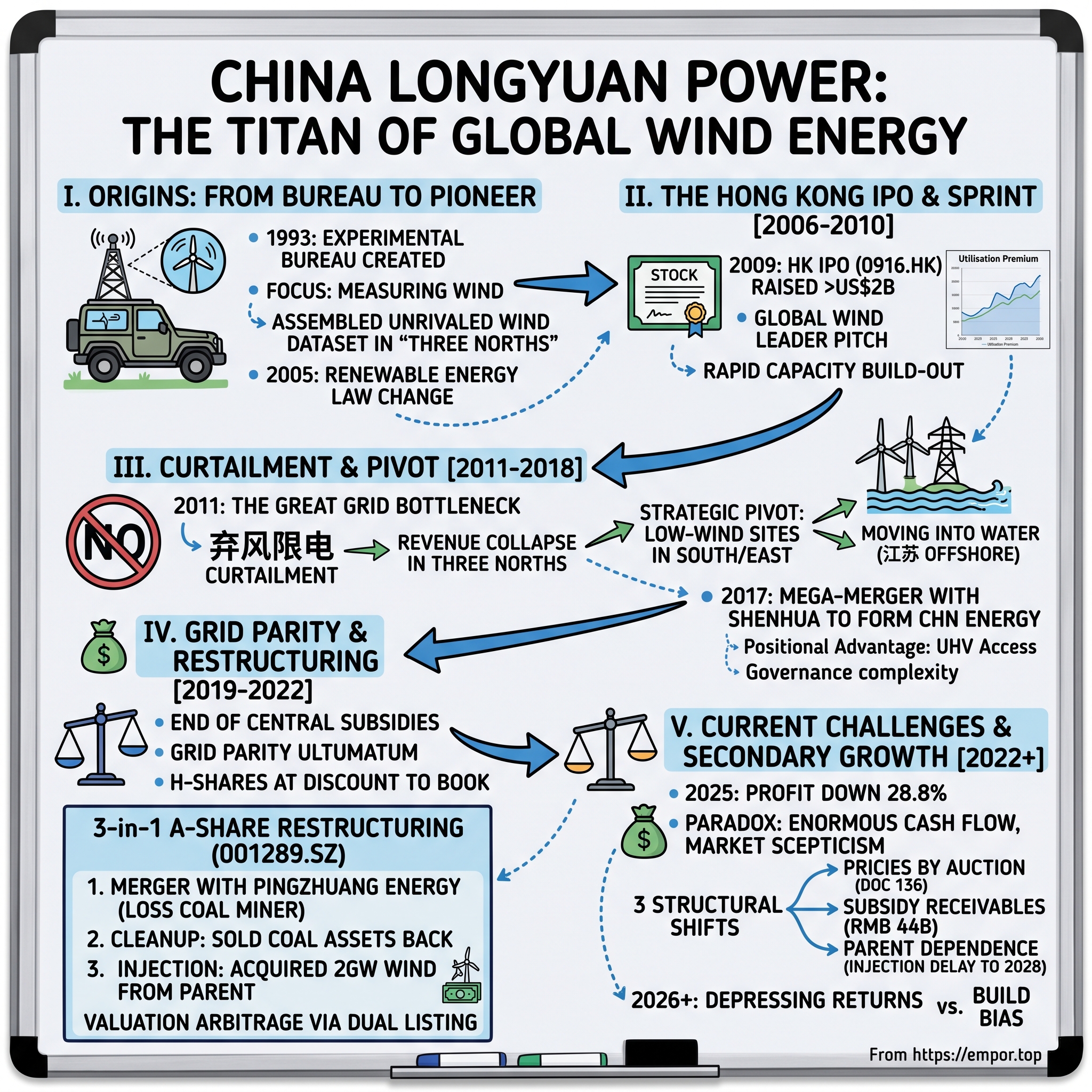
China Longyuan Power: The Titan of Global Wind Energy
I. Introduction & Episode Roadmap [00:00 - 08:00]
In 1993, somewhere inside the labyrinth of China's Ministry of Electric Power, a small bureau was created to answer a question nobody in Beijing thought was urgent: what would China do about renewable energy? The country was building coal plants at a pace the world had never seen. Total installed wind capacity nationwide was under 100 megawatts — less than a single modern offshore wind farm generates today. Turbines came in shipping containers from Denmark and Germany, with foreign engineers flown in to commission them. The bureau's job was, essentially, to experiment.
Thirty-three years later, that experiment operates 46 gigawatts of renewable generating capacity across nearly every province in China, and it is listed twice — in Hong Kong as 0916.HK and in Shenzhen as 001289.SZ. 龙源电力 China Longyuan Power Group Corporation Limited closed 2025 with 32.1 GW of wind and 13.8 GW of solar under its control, and zero megawatts of coal-fired power.1 It is the green-power flagship of 国家能源集团 CHN Energy (China Energy Investment Corporation), the largest power company on earth by installed capacity.2
That is the triumphant version of the story. Here is the other one.
In 2025, Longyuan generated more electricity than ever — 76.5 terawatt-hours, up 1.2% — and earned substantially less money doing it. Net profit attributable to shareholders fell 28.8% to RMB 4.53 billion. Total profit fell 30.6%.1 Its average wind tariff dropped by roughly a tenth in a single year.3 In the first quarter of 2026 the pattern continued: revenue down 3.6%, net profit down 14.8%, wind utilisation hours down 65 to just 520.4 The stock has spent the past year grinding lower, trading in the mid-HK$5 range against a 52-week high above HK$8.5
This is the paradox worth two and a half hours of your attention. Longyuan owns what may be the best portfolio of wind sites in Asia — measured land leases, permitted grid connections, three decades of anemometer data on ridgelines and coastlines that nobody else could get to first. Those assets throw off enormous operating cash flow: RMB 21.8 billion in 2025, up 27.6%.1 And yet the market prices the business as though something structural is breaking.
Something structural is breaking. Three things, actually, and they braid together into the entire investment question:
First, the price of the product is now set by auction rather than by decree. On February 9, 2025, China's 国家发展改革委 National Development and Reform Commission and 国家能源局 National Energy Administration issued Document 136, which pushed essentially all wind and solar output into competitive electricity markets and replaced guaranteed feed-in tariffs with a contract-for-difference style "mechanism price" settled against market outcomes.6 A generation of Chinese renewable assets was built on the assumption of a fixed price. That assumption is gone.
Second, the government owes Longyuan a great deal of money. The company carries roughly RMB 44 billion of receivables, dominated by renewable subsidy claims financed through factoring arrangements.7 To put that in perspective, subsidy income from pre-2021 projects has been estimated at no less than RMB 8 billion a year — larger than the company's entire 2025 total profit.7 The earnings base and the balance-sheet drag come from the same place.
Third, Longyuan is a controlled subsidiary, and its controlling shareholder is also its main source of new assets. CHN Energy held 55.05% directly at the end of the third quarter of 2025, with a further 1.12% through a provincial subsidiary.8 In 2022, as part of the deal that got Longyuan onto the Shenzhen exchange, CHN Energy promised to resolve the overlap between its own unlisted wind business and Longyuan's within three years. In October 2024 that deadline was pushed back three more years, to January 24, 2028.9
Four questions frame everything that follows. How did China build a globally dominant wind industry from a standing start, and how much of Longyuan's advantage came from being early versus being state-owned? What exactly happened in the extraordinary 2022 three-part reorganisation that turned a loss-making Inner Mongolian coal miner into an A-share listing? What do wind farm economics actually look like when the guaranteed price disappears? And will the parent deliver on its injection promise, or is that promise now functioning mainly as a valuation prop?
To answer any of them, we have to go back to the ridgelines.
 Subscribe on LinkedIn
II. Origins: From Ministry Department to Wind Pioneer (1993–2005) [08:00 - 25:00]
Picture a Chinese engineering team in the mid-1990s, driving a Beijing Jeep across the Inner Mongolian grassland with a steel lattice tower strapped to the roof. They stop, assemble the tower, bolt an anemometer to the top, and leave it there for a year — sometimes two — logging wind speed and direction onto data cards that somebody has to physically retrieve. Then they move a few kilometres and do it again.
That was Longyuan's founding business: not generating electricity, but measuring wind. It is an unglamorous activity that turns out to be the single most consequential thing the company ever did, because a wind farm's entire economic life is determined before a single turbine is erected. Get the site wrong by a few metres per second of average wind speed and the project never earns its cost of capital. Get it right and it compounds for twenty-five years.
Longyuan was established in 1993 under the former Ministry of Electric Power and later folded into 国电集团 China Guodian Corporation during the 2002 breakup of China's state power monopoly.[^10] Its early mandate was exploratory in the most literal sense. There was no domestic turbine industry to speak of. Machines were imported from European manufacturers — Vestas, and the firms that became Gamesa — and each installation was as much a diplomatic exercise as an engineering one. Costs were absurd relative to coal. The projects existed because the state wanted to learn, not because anyone had modelled an internal rate of return.
What made this period valuable was precisely that nobody was competing. When you are the only organisation in a country systematically mapping wind resource, you get first refusal on the best sites — and in wind, "best" is geographically concentrated to a startling degree. China's premium onshore resource sits in what the industry calls the "Three Norths": Inner Mongolia, Xinjiang, Gansu and the northeast. Flat, sparsely populated, and windy in a sustained, predictable way. Longyuan spent a decade quietly assembling land-use rights, local government relationships, and grid interconnection approvals across that belt while commercial developers had not yet worked out that the land had value.
The Law That Changed the Arithmetic
Then the arithmetic changed. In February 2005 China's legislature passed the Renewable Energy Law, effective the following January. It did three things that mattered enormously. It obliged grid companies to purchase the full output of qualifying renewable projects rather than dispatching them at their discretion. It created a Renewable Energy Development Fund financed by a surcharge on electricity consumers — the mechanism that would eventually generate both Longyuan's subsidy income and its receivables problem. And it established the legal foundation for administratively set purchase prices.
The tariff regime itself arrived in stages. The decisive version came in July 2009, when the NDRC divided the country into four wind resource zones with benchmark on-grid tariffs of RMB 0.51, 0.54, 0.58 and 0.61 per kilowatt-hour depending on resource quality — deliberately structured so that windier regions received lower prices, equalising returns across geography.10 For a developer with the best sites in the highest-wind zone, this was close to a licence to print money: you received a guaranteed price calibrated to a marginal project's economics while operating an above-average one.
Alongside this ran an industrial policy that shaped the entire global wind supply chain. From 2005, Chinese wind projects faced a requirement that roughly 70% of turbine equipment value be domestically produced. Foreign manufacturers either localised or lost access. Domestic champions — most prominently 金风科技 Goldwind — scaled behind that wall, learning first to assemble, then to design. The requirement was formally revoked in late 2009 under trade pressure, by which point it had already done its work: Chinese OEMs had the volume, and the cost curve was bending sharply downward.11
For Longyuan, the combination was close to ideal. A guaranteed price, a mandated offtake, a rapidly cheapening supply chain, and a land bank nobody else had. The company's early advantage is often described as a policy gift, and partly it was. But the durable part was less about policy than about sequencing: Longyuan had done the boring measurement work before the money showed up, so when the money showed up it knew where to point it.
The obvious next step was to raise capital at a scale a ministry bureau had never contemplated. For that, it would have to leave China.
III. The Hong Kong IPO & China’s Renewable Expansion (2006–2010) [25:00 - 42:00]
December 10, 2009. Hong Kong. The world is eleven months past the Lehman collapse and equity markets are still convalescing — and a Chinese wind farm operator most international investors had never heard of prices the largest overseas share sale ever attempted by a Chinese power company. Longyuan sold H-shares at HK$8.16 and raised more than US$2 billion. The stock opened strongly.12
The pitch was almost too easy to make. China was about to become the world's largest wind market. Longyuan was its largest wind operator. Global investors wanting exposure to the Chinese energy transition had, at that moment, essentially one liquid instrument through which to express it. The company marketed itself as the first new-energy company from the PRC to list, and the label stuck.
The scepticism was equally predictable, and — with hindsight — better calibrated than the enthusiasm. International investors asked the questions you would expect about a Chinese state-owned enterprise: who actually decides capital allocation, the listed board or the parent? What happens when the state's industrial policy objectives diverge from minority shareholders' returns? How reliable is a revenue stream that depends on a government surcharge fund? These were not paranoid questions. Every one of them became a live issue within a decade.
The Sprint
What followed the listing was one of the more aggressive capacity build-outs in the history of the power industry. Longyuan roughly doubled installed capacity every two to three years through the late 2000s and early 2010s, deploying IPO proceeds and cheap state-backed debt into projects underwritten by the four-zone benchmark tariff. There was a second revenue layer too: many Chinese wind farms of this vintage registered under the Kyoto Protocol's Clean Development Mechanism, selling certified emission reductions to European compliance buyers. For a few years, European carbon prices were quietly subsidising Inner Mongolian wind farms.
The operating results validated the site selection thesis. Longyuan consistently ran above the Chinese industry average on utilisation hours — the metric that translates nameplate capacity into actual electricity. Because wind power has almost no fuel cost, utilisation hours flow through to gross profit with brutal directness: a wind farm running 2,200 hours a year against a peer's 1,900 earns roughly 16% more revenue from identical capital equipment. Compounded over a fleet and a decade, that spread is the difference between a good business and an average one.
This is worth pausing on, because it is the cleanest evidence in the whole story that Longyuan's advantage is real rather than rhetorical. The company has continued to disclose its utilisation premium versus the national average every year since — 63 hours above industry average in 2024, 73 hours above in 2025.131 The premium is persistent. It is also, notably, narrow. Sixty to seventy hours on a base of roughly two thousand is a three percent edge. That is a genuine advantage. It is not a moat that survives a thirty percent price decline.
What the Boom Concealed
The uncomfortable truth about the 2006–2010 period is that almost nothing about it tested management. Prices were fixed and generous. Offtake was mandated. Capital was abundant and cheap. The supply chain was collapsing in cost. Under those conditions, the optimal strategy was simply to build as fast as physically possible, and Longyuan did exactly that — competently, but without having to make a single hard trade-off.
Two structural weaknesses were accumulating in plain sight. The subsidy surcharge fund was being committed faster than it was being collected, planting the seed of a receivables problem that would take fifteen years to surface fully. And wind capacity in the Three Norths was being built far faster than transmission capacity to carry the electricity to where anyone actually wanted to use it.
By 2011, the grid stopped pretending it could keep up.
IV. The Great Grid Bottleneck: Curtailment & The 2017 Mega-Merger (2011–2018) [42:00 - 1:04:00]
Here is a scene that repeated itself thousands of times across northwest China in the middle of the last decade. A perfect wind day in Gansu — steady, strong, exactly what the resource assessment promised. And the turbines are feathered, blades pitched out of the wind, standing still. Not because they are broken. Because the grid dispatcher has told the wind farm to stop producing. There is nowhere for the electricity to go.
The Chinese term is 弃风限电 — abandoned wind, restricted power. It is the single most destructive phenomenon in the history of Chinese renewables, and it operates on the one line item a wind farm cannot defend: volume. A curtailed wind farm has already spent its capital. Its depreciation, interest and maintenance costs are fixed. Curtailment takes revenue straight out of the top line and drops it directly onto the bottom.
The numbers were grotesque. National average wind curtailment reached roughly 15% in 2015 and peaked around 17% in 2016. Provincial figures were far worse: Gansu curtailed on the order of 43% of potential wind generation in 2016, Xinjiang around 38%, Jilin around 30%.14 For context, in mature Western wind markets curtailment of 1–3% is considered normal. Nearly half of the electricity that Gansu's wind fleet could have produced was simply thrown away.
The financial transmission mechanism was direct. Utilisation hours collapsed in the affected provinces. Revenue that had been underwritten by a guaranteed price turned out not to be underwritten by a guaranteed quantity. Cash flow tightened while capital expenditure commitments continued. And Hong Kong-listed Chinese clean energy equities derated savagely — the market concluding, correctly, that it had been paying for a policy-guaranteed growth story that had an unpriced physical constraint sitting in the middle of it.
There is a second-order effect worth noting, because it connects directly to the balance sheet problem Longyuan carries today. The subsidy paid to a wind farm was per kilowatt-hour delivered. Curtailment therefore reduced the subsidy claim as well as the tariff revenue — but the fixed costs and the debt service did not move. Developers responded by lobbying for, and eventually receiving, minimum guaranteed purchase hours in the worst-affected provinces. That fix helped, but it also established the pattern that would define the next fifteen years: whenever the physics or the economics of Chinese renewables broke down, the resolution came through an administrative adjustment rather than a market one. An investor holding these assets was, and remains, exposed less to electricity demand than to the willingness of the state to keep patching the system.
The Pivot South, and Into the Water
Longyuan's response was a genuine strategic reallocation, and it is one of the better decisions in the company's history. Rather than continue pouring capital into the highest-wind-speed regions — where the resource was excellent and the ability to sell the output was not — it shifted development toward the low-wind-speed, high-demand coastal provinces of the centre, south and east: Jiangsu, Zhejiang, Fujian.
The engineering logic was counterintuitive. These sites had materially worse wind. But turbine technology was moving in exactly the direction that made poor sites viable: longer blades sweeping more area, taller towers reaching steadier air. A modern low-wind-speed turbine could extract acceptable output from a site that would have been uneconomic a decade earlier. And critically, the electricity had customers next door. A megawatt-hour you can actually sell at a modest tariff beats a megawatt-hour you must abandon at a generous one.
The same logic pushed Longyuan into the water. China's offshore wind industry began, in effect, in the intertidal flats of Jiangsu — shallow, muddy, close to shore, and directly adjacent to the industrial demand of the Yangtze Delta. Offshore construction is a fundamentally different business from onshore: vessels, marine geotechnics, weather windows, corrosion, and in the southern provinces, typhoons. Longyuan accumulated operating experience there over roughly a decade before offshore wind became fashionable. That experience is real, and it is one of the few areas where a "process power" argument for the company has substance rather than slogan.
The Merger That Changed the Parent
Then, on August 28, 2017, China's state asset regulator announced something that reshaped Longyuan's context without changing a single thing about its own operations. China Guodian Corporation — Longyuan's parent — was absorbed into Shenhua Group, the country's dominant coal miner, to create CHN Energy. The combined entity held assets exceeding RMB 1.8 trillion and generating capacity approaching 226 GW, making it the largest power company in the world. It was simultaneously the world's largest coal producer and, with roughly 33 GW, the world's largest wind developer.2
For Longyuan, this cut in several directions at once. The upside was substantial: a parent with an enormous balance sheet and near-sovereign credit standing, a vast thermal fleet whose flexibility could help integrate intermittent renewables, and a seat at the table when ultra-high-voltage (特高压) transmission corridors were planned. UHV lines are the physical answer to curtailment — direct-current highways carrying gigawatts from the resource-rich west to the demand-rich east — and being inside the group that builds and fills them is a meaningful positional advantage.
The complication was that Longyuan was now one renewable platform inside a group that had many renewable assets, several of them unlisted and competing directly with the listed company for projects, provincial quotas and grid allocations. Horizontal competition between a listed subsidiary and its controlling shareholder is not a theoretical governance concern in China; it is a specific regulatory problem that has to be resolved.
Resolving it would produce one of the most intricate pieces of financial engineering the Chinese market has seen.
V. Grid Parity & The Landmark 3-in-1 A-Share Restructuring (2019–2022) [1:04:00 - 1:26:00]
By the end of the last decade, everyone in Chinese renewables knew the party had a scheduled end date. Central government subsidies for new onshore wind projects were phased out after 2020; new utility-scale solar followed in 2021. From that point, new projects had to compete against the local coal-fired benchmark tariff (燃煤基准电价) with no premium at all. The industry called it 平价上网 — grid parity — and it was less a milestone than an ultimatum.
Grid parity did something psychologically important to the sector's valuation. It converted renewable developers from policy beneficiaries into commodity producers with high fixed costs. The equity market's response was to compress multiples across the Hong Kong-listed universe. Longyuan found itself in an awkward position: it owned a large fleet of legacy high-tariff assets generating strong cash flow, it needed equity capital to keep building, and its H-shares traded at a valuation that made issuing equity destructive rather than accretive.
Meanwhile, sitting on the Shenzhen exchange was 平庄能源 Inner Mongolia Pingzhuang Energy Co., Ltd. — a loss-making coal miner controlled by the same ultimate parent, and by then flagged with the dreaded *ST warning label that Chinese exchanges apply to companies in financial distress.
You can see where this is going.
The Three-Part Deal
The transaction that CHN Energy, Longyuan and their advisers constructed did three jobs simultaneously. Announced in 2021 and cleared by the 中国证监会 China Securities Regulatory Commission on December 8, 2021, it worked as follows.15
Part one: the merger. Longyuan absorbed Pingzhuang Energy by issuing new A-shares to Pingzhuang's shareholders in a share swap. Pingzhuang was delisted and dissolved as a legal entity; Longyuan inherited its listing status. The swap converted each Pingzhuang share into 0.3407 Longyuan A-shares, priced at RMB 11.30 per new share, for a total issuance of 346 million shares — just 4.12% of the enlarged share capital.16 That last number is the elegance of the structure: Longyuan obtained a mainland listing while diluting existing shareholders by roughly four percent and raising no cash at all.
Part two: the cleanup. The coal mining assets Longyuan had just inherited were sold straight back out, to Inner Mongolia Pingzhuang Coal (Group) Co., Ltd. — another entity within the parent's orbit — for cash.17 Longyuan wanted the listing vehicle, not the coal mine.
Part three: the injection. Longyuan paid cash for 100% of eight wind power companies held by six of CHN Energy's provincial subsidiaries, spanning the northeast, north China, Guangxi, Shanxi and Yunnan. The consideration was RMB 5.774 billion for roughly 2 GW of operating wind capacity.1718
Longyuan's A-shares began trading on the Shenzhen Stock Exchange main board on January 24, 2022 — and fell 22.87% on the first day.16 The mainland market's initial verdict on the "valuation arbitrage" thesis was, to put it gently, unenthusiastic.
Did Longyuan Overpay?
This is the question a sceptical investor should ask about any related-party asset purchase, and the honest answer is: probably not, on the evidence available.
Start with the crude benchmark. RMB 5.774 billion for roughly 2 GW works out to something close to RMB 2.8 million per megawatt of installed wind capacity — broadly consistent with where operating Chinese onshore wind assets changed hands in that period, and well below the all-in cost of building new capacity from scratch at the time. Paying less per megawatt for a running asset than for a construction project is normally a sign of a poor asset; here it reflected the reverse dynamic, since these were mature farms with legacy tariff entitlements attached. The injected wind portfolio was mature, operating capacity — no construction risk, no permitting risk, immediate cash generation. Analysis at the time indicated the assets had produced roughly RMB 560 million of net profit in the first nine months of 2020, implying an annualised return on equity around 16.8%, against Longyuan's own roughly 9%. On that basis the acquisition was return-accretive.18
But note what that comparison also reveals. If the parent's unlisted wind assets were earning 17% while the listed vehicle earned 9%, the parent had been keeping better assets outside the listed company. The injection was, in part, a correction of that asymmetry — which is exactly why the non-compete undertaking mattered.
The Promise
As a condition of resolving horizontal competition, CHN Energy committed to inject its remaining conventional wind assets into Longyuan within three years of the A-share listing — a deadline of January 24, 2025.
That deadline was not met. In October 2024, alongside a separate RMB 1.686 billion cash acquisition of stakes in eight renewable companies across Shandong, Jiangxi, Gansu and Guangxi, the parent extended the integration window by three years to January 24, 2028, citing policy changes, the complexity of the project volumes involved, and asset compliance considerations.9
The October 2024 deal is worth examining for what it says about capital allocation discipline. The 2,032.9 MW of capacity involved — 1,446.9 MW operating, 586 MW under construction, split roughly two-thirds wind and one-third solar — was acquired at a price-to-book multiple of approximately 1.14 times. At the time, Longyuan's own A-shares traded around 2.07 times book and its H-shares around 0.78 times.9 Buying assets at 1.14x book while your H-shares trade at 0.78x book is, arithmetically, value-destructive for H-share holders and value-accretive for A-share holders. That is not a scandal; it is an unavoidable consequence of a dual-listed structure with a persistent valuation gap. But it is precisely the kind of thing a minority H-shareholder should watch, and it explains why the H-share discount is stubborn rather than temporary.
The extension also reset the clock on the single most-cited element of the bull case. An injection promise with a 2028 deadline is a weaker asset than one with a 2025 deadline, and a promise that has already been extended once carries obviously less credibility than one that has not.
VI. Core Business Deep Dive: Wind Power Economics & Unit Mechanics [1:26:00 - 1:52:00]
Strip away the policy history and the corporate structure, and Longyuan is a machine that converts capital into kilowatt-hours. Understanding it requires understanding only three variables — how much capacity you have, how many hours a year it runs, and what price you receive — and one unforgiving fact: essentially all of the cost is incurred before the first electron is delivered.
A wind farm is a bond-like asset dressed up as an industrial one. You spend the money up front on turbines, foundations, cabling and substations. Then for twenty-plus years you collect revenue with negligible marginal cost — no fuel, modest maintenance, some land rent. Depreciation and interest dominate the income statement. This structure means operating leverage runs in both directions with equal force: a rise in output or price falls almost entirely to profit, and a decline does the same in reverse.
2025 was a live demonstration of the reverse case.
The Segments
Longyuan closed 2025 with total controlled capacity of 45,994 MW — 32,147 MW of wind, 13,841 MW of solar, and a residual 6 MW of other renewables.1 The coal and steam business that once contributed materially to revenue is gone entirely: the company transferred its remaining thermal interest in 2024, including a 27% stake in Jiangyin Sulong Thermal Power sold for RMB 1.319 billion, taking controlled thermal capacity to zero.19
Wind remains overwhelmingly the engine — roughly 82% of 2025 generation came from wind, at 63.09 TWh, up 4.19%.120 Solar is where the growth is: 13.38 TWh generated, up 70.9%, with segment revenue of RMB 3.81 billion, up 56%, and segment operating profit up 121% to RMB 1.15 billion even as depreciation rose 62%.3 Note the mechanics there — solar profit grew faster than solar revenue because the incremental capacity carried better unit economics than the fleet average, which is what happens when you build at today's panel prices.
What Actually Happened to Margins
Reported 2025 revenue of RMB 30.25 billion looks alarming against RMB 37.07 billion in 2024 — down 18.6%.113 Most of that gap is the coal exit. On a comparable, continuing-operations basis, revenue fell about 4%, total profit about 27%, and net profit attributable to shareholders about 22%.7
That comparable set of numbers is the one that matters, and it tells a clear story: revenue down mid-single-digits, profit down more than twenty percent. Gross margin compressed from 37.5% to 34.8%. The direct cost of the renewable generation business rose roughly RMB 2 billion, or about 10%, while renewable revenue fell.7 Costs went up because the asset base got bigger — more capacity means more depreciation, more O&M, more land rent — while revenue went down because price and wind resource both moved the wrong way.
Two forces did the damage. The reported average wind tariff fell by RMB 52 per megawatt-hour, roughly a tenth, and the solar tariff fell RMB 17.13 And wind utilisation hours fell 138 to 2,052 — a resource-driven decline, since wind speeds vary year to year in ways no operator controls.1 Losing both price and volume simultaneously in a fixed-cost business is how a 4% revenue decline becomes a 22% earnings decline.
The half-year numbers make the divergence between physical and financial performance unusually stark. In the first six months of 2025 Longyuan's renewable generation rose 12.7% to 39.65 TWh, and controlled capacity reached 43.20 GW.32 Yet management disclosed the wind tariff on an ex-VAT basis at RMB 0.422 per kWh, down RMB 0.016 year on year, attributing the decline to expanded market trading, a larger share of grid-parity projects, and structural mix effects.21 The interim solar tariff of RMB 0.273 was roughly flat. More electricity, less money per unit — and in a business with this cost structure, the second effect dominates. It is worth flagging that the interim and annual disclosures use different tax bases, which makes precise year-on-year tariff tracking harder than it should be — a minor but real disclosure quality issue for anyone modelling the business.
Cost Position, Explained Simply
It helps to walk through where the money actually goes in a wind farm, because the structure is unlike almost any other industrial business.
Think of a wind project as buying a twenty-five-year annuity with borrowed money. Roughly speaking, the great majority of lifetime spending happens in the first eighteen months: turbines, towers, foundations, the access roads, the collector cabling, the step-up substation, and the connection to the grid. Once that is done, the annual cash outgoings are startlingly small — a maintenance crew, spare parts, land rent, insurance, and interest on the debt. There is no coal to buy, no gas price to hedge, no fuel logistics.
Two implications follow. First, the capital cost per kilowatt installed determines almost everything about a project's return, which is why the collapse in Chinese turbine prices matters so much. As domestic manufacturers scaled behind the old local content wall and then fought each other for volume, the installed cost of onshore wind in China fell dramatically over the past decade. That decline is what made grid parity survivable at all: developers lost the tariff premium at roughly the same time they gained a much cheaper machine. It was not a coincidence — the subsidy sunset was timed against the expected cost curve.
Second, because ongoing cash costs are small and largely fixed, the operating variable that management can actually influence is availability: keeping turbines spinning when the wind blows. A machine down for repair during a windy week is pure lost revenue that can never be recovered. This is why the industry obsesses over remote monitoring, predictive maintenance and in-house service fleets rather than outsourcing to the turbine maker — and why Longyuan spreading centralised monitoring and engineering overhead across a fleet approaching 46 GW is a genuine advantage over a subscale operator running a few hundred megawatts.
In 2025 Longyuan deployed an industry-specific AI model it calls 擎源, spanning five business domains and roughly twenty specialised agents, aimed largely at trading optimisation and predictive maintenance.321
Take that last item with appropriate salt. Every large Chinese SOE announced an AI initiative in 2025. The test is whether O&M cost per megawatt-hour and forecasting accuracy in market bidding actually improve, and Longyuan has not yet disclosed metrics that would let an outsider verify it.
The Peer Set
The most instructive comparison is 三峡能源 China Three Gorges Renewables (600905.SH), the A-share pure-play backed by the Three Gorges group. At the end of 2025 it had 52.37 GW of grid-connected capacity — 24.43 GW wind, 26.78 GW solar — making it larger than Longyuan overall while being far more solar-weighted. Its 2025 revenue was RMB 28.40 billion, down 4.4%, and net profit RMB 3.71 billion, down 39.2%. Its average wind tariff fell 10.4% to RMB 0.4059 per kWh and its solar tariff fell 11.1%.2223
Read those two sets of results together and something important emerges. Both companies suffered tariff declines of roughly ten percent. Both saw earnings fall much faster than revenue. But Longyuan's earnings decline was materially shallower — 28.8% versus 39.2% — and it retains a higher realised wind price. The difference comes chiefly from mix: Longyuan's fleet is older, wind-heavier, and carries more legacy tariff and subsidy entitlement. That is an advantage. It is also, by definition, a depleting one, since every year of grid-parity additions dilutes the legacy share.
The rest of the competitive set is less directly comparable. 华润电力 China Resources Power (0836.HK) is a hybrid coal-and-renewables generator with a strong operating reputation; 中国电力 China Power International Development (2380.HK), the State Power Investment Corporation flagship, has been transforming from coal to clean at speed; 中广核新能源 CGN New Energy (1811.HK) is smaller with nuclear-group backing. What they share with Longyuan is the same regulatory environment, the same turbine suppliers, and the same buyer.
Myth vs Reality
Three consensus claims about Longyuan deserve testing.
Myth: Longyuan's first-mover land bank is an unassailable moat. Reality: the land position is genuine and unrepeatable, and it shows up in a persistent utilisation premium — but that premium is roughly three percent, while the tariff swing in 2025 alone was ten percent. The cornered resource protects relative performance within the sector; it does not protect absolute returns from a price reset.
Myth: Longyuan is a growth company. Reality: it added 4,851 MW net in 2025 and has guided to 4.5 GW of both construction starts and commissioning in 2026 — an explicit deceleration, which management frames as a shift to "high-quality development".13 Capacity growth is now roughly a tenth per year and slowing, against tariffs falling faster than that.
Myth: The subsidy receivable is a timing issue. Reality: it is partly a timing issue and partly a permanent feature of the earnings base. Collections improved markedly in 2025 — operating cash flow rose 27.6% and receivables financing grew only 0.8% — which is real progress.31 But the flip side is that a large share of current profit derives from a legacy subsidy entitlement that expires project by project as those assets reach the end of their subsidised lives.
Which brings us to where the next decade of growth is supposed to come from.
VII. Secondary Growth Drivers: Solar Expansion, Offshore Wind, & Repowering [1:52:00 - 2:07:00]
In April 2025, environmental regulators approved a project in Buerjin County, in the far north of Xinjiang, that reads almost like a parable. Sixty-six wind turbines rated at 750 kilowatts each — installed when Longyuan was still learning the business — would be torn down and replaced by five turbines of 10 megawatts each. Five machines doing the work of sixty-six. And because the site's grid connection and land rights already existed, the project would add five more 10 MW turbines on top, taking the site to 100 MW.24
That is the repowering story, and it is the most interesting growth option Longyuan has.
The Repowering Goldmine — And Its Limits
The Chinese term is 以大代小: replacing small with big. In June 2023 national policy formally encouraged the retrofit of wind farms that had been grid-connected for more than fifteen years or that used turbines smaller than 1.5 MW.25 Longyuan, having built China's earliest commercial wind farms, owns more of exactly those assets than anyone.
The economic logic is compelling and easy to state. In a new wind project, the scarce inputs are not turbines — turbines are a commodity fought over by Goldwind, 远景能源 Envision Energy and 明阳智能 Mingyang Smart Energy at brutal margins. The scarce inputs are land with good wind and a grid connection permit. Repowering gives you both for free. You already hold the lease, the substation, the transmission agreement, the environmental baseline and the local relationships. You are buying only steel and blades, and dropping them onto the best real estate in the portfolio.
Longyuan has initiated repowering across Heilongjiang, Gansu, Inner Mongolia, Liaoning, Fujian, Jilin, Zhejiang and Xinjiang, and by August 2025 had completed a subset of both like-for-like and capacity-expanding retrofits in Guangdong, Ningxia, Xinjiang, Jiangsu and Heilongjiang.25
Now the sceptical read. Repowering has been discussed as a Longyuan catalyst since at least 2024, and the company has not disclosed a consolidated pipeline in gigawatts, a capital expenditure budget, or an expected return profile for the programme. Individual project approvals appear steadily; an aggregate is absent. There are also real frictions: a repowered project may lose its legacy tariff entitlement and be re-rated onto current market pricing, which can offset much of the output gain; provincial approval processes vary; and decommissioning old turbines has its own cost. Until Longyuan quantifies the programme, repowering should be treated as attractive optionality rather than a modellable earnings driver.
Solar: Growth With a Catch
Solar went from a rounding error to 13.8 GW and 30% of controlled capacity in a handful of years, adding 3,143 MW in 2025 alone — more than double the wind additions that year.1
The strategic rationale is better than "solar is cheap". Wind and solar generate on complementary schedules: solar peaks midday in summer, wind tends to peak at night and in winter. Co-locating them lets a developer share a substation, a transmission allocation and a grid connection agreement across two generation profiles, raising the utilisation of the scarcest asset in the whole system — the wire. Longyuan's large desert base projects are designed around exactly this. Its Tengger base in Ningxia had 2 GW of solar operating, another 1 GW of solar and 1 GW of wind under construction, 1.5 GW of wind approved, and 3 GW of solar in filing as of mid-2025; the associated 宁电入湘 ultra-high-voltage line to Hunan has entered service and begun delivering that power east.21
The catch is that solar's realised tariff is structurally lower than wind's — RMB 318 versus RMB 475 per MWh in 2025 — and solar output is far more concentrated in the middle of the day, precisely when spot prices in solar-heavy provinces collapse.1 Growing the solar share raises volume and lowers average revenue per unit. It is growth, but it is dilutive growth.
Offshore: The High-Barrier Bet
Offshore is where Longyuan's accumulated engineering experience translates most directly into competitive advantage, because offshore development is genuinely hard to enter. Marine geotechnical surveys, installation vessels, typhoon-rated foundations and grid landfall permits are not things a new entrant assembles quickly.
The evidence that this position is real is competitive: in Jiangsu's 2025 offshore allocation round, Longyuan ranked first overall, winning four projects totalling 1.6 GW — at Sheyang, Dafeng, Dongtai and Rudong — representing 20.92% of the capacity allocated in that round.26 In December 2024 it won Fujian's Fuding B-1 project at a planned 700 MW. It holds more than 5 GW of offshore development rights.21
Construction began in May 2026 on phase one of the Sheyang project — 297.5 MW of an eventual 1 GW, using 35 turbines of 8.5 MW each, sited roughly 65 kilometres offshore, with expected annual generation around 3.1 TWh. It is the largest single-capacity offshore project in Jiangsu and integrates a semi-submersible platform combining wind, solar and aquaculture.27 Longyuan has also commissioned a floating wind-and-fishery platform, 国能共享号, and in November 2025 formed a joint venture with Envision and Dongfang Electric Wind to build 1.3 GW of offshore capacity.28
Funding follows. In October 2025 Longyuan proposed an A-share placement of up to RMB 5 billion to no more than 35 investors, earmarked for a 500 MW offshore project at Dongfang in Hainan (total investment approximately RMB 5.17 billion) and a 1 GW wind project at Shapotou in Ningxia feeding the Ning-Xiang corridor (approximately RMB 4.27 billion). The State Council's asset regulator approved the overall plan in December 2025.29
Note what that placement signifies. Longyuan is raising equity in Shenzhen, where it trades near or above book, to fund projects — while its Hong Kong shares trade at a substantial discount to book. The dual listing is functioning exactly as designed, and A-shareholders are the beneficiaries.
Which raises the question of who is actually running this company, and for whom.
VIII. Current Management, SOE Governance, & Capital Allocation [2:07:00 - 2:22:00]
On May 24, 2024, 宫宇飞 Gong Yufei stepped out of Longyuan's general manager role and into the chairman's seat.30 His path there says something about how CHN Energy thinks about the job. Gong's background is not turbine aerodynamics or grid dispatch; it runs through project construction, cost control and property development within the Guohua Investment and CHN Energy system — general manager of Guohua Investment's project construction department, chairman of its Shandong branch, deputy general manager of CHN Energy Real Estate.
That is a construction-and-cost-discipline résumé, and it is arguably the right one for this moment. Longyuan's problem is not inventing technology; it is building thousands of megawatts a year at declining prices without destroying returns. 王利强 Wang Liqiang succeeded Gong as general manager and executive director and has become the public face of the company with investors, chairing the extraordinary general meeting held on June 26, 2026 and fronting analyst engagements alongside board secretary 丁鶄 Ding Jing.31
The Promise That Was Kept
Assessing management credibility requires looking at what was promised and what was delivered, and here Longyuan has one clear entry in the credit column. The central operating ambition of the 14th Five-Year Plan period was to double renewable capacity from where it stood at the end of the previous plan. Capacity did roughly double, reaching 46 GW by the end of 2025.3 Whatever one thinks of the returns earned on that capital, the construction machine delivered the volume it said it would, on the timetable it set — across a period that included pandemic disruption, a subsidy sunset and a turbine supply chain in upheaval. Execution on physical delivery is the most reliably demonstrated competence in this organisation.
The debit column is equally clear, and it is about promises made by the parent on Longyuan's behalf. The asset injection deadline slipped. And the framing of the slippage — policy changes, project volume complexity, compliance considerations — was general rather than specific, with no revised milestone schedule offered to the market. When an SOE explains a missed commitment in the language of process rather than the language of dates, an investor is entitled to discount the replacement commitment accordingly.
What the Analyst Meetings Actually Reveal
Longyuan's investor relations records are a more useful window than its press releases. One covering August 20 to September 30, 2025 documents engagement with JPMorgan, Citi, HSBC, 中信证券 CITIC Securities, 中金公司 CICC, Daiwa, 招商证券 China Merchants Securities and others. Attending for the company were Wang Liqiang, Ding Jing, deputy general manager 李星运 Li Xingyun, and securities affairs representative 高振立 Gao Zhenli.21
The questions were exactly the right ones, and the answers are instructive in their texture. On Document 136, management said it was tracking provincial implementation plans closely, focusing on the scale of volume admitted to the mechanism, the auction arrangements for incremental projects, and the ceilings and floors on spot prices. On trading, it described dynamically optimising strategy across medium-and-long-term, monthly, intra-month and multi-day products to align term contracts with spot exposure. On tariffs, it gave a specific number and a specific attribution.
Those are concrete, non-evasive answers. What is absent is equally telling: no quantified guidance on how much volume management expects to clear at mechanism prices, no range for realised tariffs, no sizing of the repowering pipeline, no update on the mechanics or timing of the parent's asset injection. Longyuan communicates operating detail willingly and forward-looking economics almost not at all. For a company whose central uncertainty is future realised price, that is a meaningful gap — and it is one reason the shares carry a discount.
There is also a small but revealing narrative wobble. The interim materials described a "six-in-one" marketing system; the annual report describes a "five-in-one" system organised around trading, subsidies, green certificates, talent and systems.211 Slogan inflation and deflation inside a single year is not a scandal, but it is the kind of thing that happens when a framework is a communications device rather than an operating architecture.
Ownership and Incentives
CHN Energy held 55.05% of Longyuan directly as of the third quarter of 2025 — 4.602 billion shares — with another 1.12% held through CHN Energy Liaoning Electric Power, for combined control of roughly 56%.8
This structure shapes behaviour in ways worth being explicit about. Senior management at a central SOE are, in practice, accountable to the state asset system on a scorecard that includes capacity commissioning, safety, carbon reduction and the preservation and appreciation of state-owned assets. Equity-based compensation of the kind that dominates Western utility pay is not the primary driver. Notably, the sole item of business at the June 2026 extraordinary general meeting was the adoption of new measures governing remuneration of directors and senior management — a signal that the incentive architecture is being revisited, though the substance has not been laid out in a way that lets outsiders judge whether pay is being tied more tightly to per-share outcomes.31
The practical consequence is a systematic bias toward building. Adding gigawatts is legible on a state scorecard; declining to build because returns are inadequate is not. That bias is the single most important governance risk in the story, and the honest assessment is that it has not yet been tested by a period of genuinely poor project economics.
The Capital Allocation Record
Longyuan funds a heavy capital programme largely with debt, and it does so cheaply. In 2025 it completed 23 bond issuances totalling RMB 44.8 billion and maintained an AAA domestic rating with stable outlook.1 For a business whose returns are essentially a spread over its cost of capital, that funding advantage is not a rounding error — it is a substantial part of why the model works at all. It is also, unavoidably, a function of state ownership rather than anything management did.
On distributions, the record has genuinely improved. The 2024 payout held at 30% of net profit attributable to shareholders, at RMB 0.2278 per share. In March 2025 the company disclosed its first medium-term dividend plan, committing to at least 30% of annual net profit for 2025 through 2027, and then added an interim dividend for the first time in its history — RMB 0.10 per share, equal to 24.77% of first-half profit.21 The 2025 total came to RMB 1.625 per 10 shares, with the final instalment proposed at RMB 0.625.1
Establishing an interim dividend and a multi-year floor is a real, if modest, concession to minority shareholders, and the sequencing is notable: it arrived precisely as the H-share discount widened. A sceptic would call it a valuation defence. A fair-minded observer would note that the commitment is a floor, not a ratchet, and that a 30% payout in a business with RMB 20 billion-plus of annual capital expenditure leaves the equity story dependent on returns from reinvestment rather than on cash returned.
Which means the entire case rests on whether those returns hold up.
IX. Investment-Story Spine & Stress Test: Why Win vs Why Not [2:22:00 - 2:37:00]
Let us set the two cases against each other properly, with the burden of proof placed where it belongs.
Why Longyuan Wins From Here
The asset base is genuinely irreplaceable, and there is evidence for it. The utilisation premium versus the national average has persisted for years and was 73 hours in 2025.1 Longyuan won the largest share of Jiangsu's 2025 offshore allocation round.26 It secured 8.63 GW of development indices and signed 5.86 GW of new energy contracts in 2025.1 These are competitive outcomes in contested processes, not self-assessments.
The legacy fleet provides a real earnings cushion. Longyuan's shallower earnings decline than China Three Gorges Renewables in 2025 is direct evidence that an older, wind-weighted, more subsidy-entitled fleet absorbs a tariff shock better.22 The cushion is finite, but it is buying time.
Repowering is a structurally advantaged form of growth. Adding capacity on land and grid connections you already own avoids the two genuine bottlenecks in Chinese renewables. Longyuan owns more of the eligible legacy fleet than anyone.
The cost of capital advantage is measurable and durable. AAA domestic credit and RMB 44.8 billion of bond issuance in a single year at a state-owned funding cost is a hard advantage in a business that is fundamentally a leveraged spread trade.1
The parent relationship provides positional access. Being inside CHN Energy means a seat at the table for desert base allocations and UHV corridors, and the Ning-Xiang line entering service with Longyuan capacity behind it is concrete proof rather than aspiration.21
Why the Case Could Break
The price reset is not a cycle; it is a regime change. Document 136 pushes essentially all renewable output into the market, replacing administered tariffs with a mechanism price settled two-way against market outcomes, with a June 1, 2025 line separating legacy from incremental projects and provincial auctions setting the incremental price.6 By early February 2026, 29 provinces had published mechanism price auction results. Coverage was near-total in Gansu, Xinjiang, Ningxia and Heilongjiang — the resource-rich, demand-poor provinces where Longyuan's oldest assets sit — while only seven provinces produced mechanism prices below RMB 0.30 per kWh, with eastern and southwestern provinces clearing higher.20 The structural read is uncomfortable: Longyuan's best wind is in the provinces with the weakest pricing, and its best pricing is in provinces where it must compete hardest for allocations.
The subsidy receivable is both an asset and an admission. Roughly RMB 44 billion of receivables, mostly subsidy claims converted into factoring arrangements, sits on the balance sheet with impairment provisions below 1% of the balance.7 Collections improved in 2025 and the company even reversed RMB 557 million of credit loss provisions, against RMB 130 million in 2024.7 An activist would push hard on two points: a sub-1% provision on a decade-old government receivable is an accounting judgment, not a fact; and if annual subsidy income from pre-2021 projects is at least RMB 8 billion against total profit of RMB 7.1 billion, then the entire reported profit of the company is, in a sense, a legacy policy annuity that runs off asset by asset.7 That is the single most important accounting judgment in the story and deserves scrutiny in every reporting period.
Related-party dependence cuts both ways. The injection promise has already slipped three years, to January 2028.9 Assets acquired from the parent are priced by negotiation, and the October 2024 purchase at 1.14 times book was above the H-share market's valuation of Longyuan's own equity.9 Every future injection carries the same transfer-pricing question, and H-shareholders have no mechanism to force a better answer.
Curtailment risk has not been abolished, only deferred. National wind utilisation was 94% in 2025 — a 6% curtailment rate that is far better than 2016 but not zero. Wind capacity grew 23% to 640 GW, with 120 GW added in a single year, 79% of it in the Three Norths.33 Transmission is being built; it is being built into a demand base that is adding renewable capacity faster still. Any provincial mismatch shows up immediately in Longyuan's utilisation hours.
Resource variability is an unhedgeable earnings risk. Wind utilisation fell 138 hours in 2025 and another 65 hours year on year in the first quarter of 2026.14 No management team controls the weather, but in a fixed-cost business a weak wind year is an earnings event, and consecutive weak years compound with price declines.
The build bias. Longyuan plans 4.5 GW of commissioning in 2026 — slower than 2025, but still a large capital programme at a moment when realised prices are falling and analysts have cut forward estimates sharply. One brokerage lowered its 2026 and 2027 net profit forecasts to RMB 4.4 billion and RMB 4.9 billion, from RMB 7.2 billion and RMB 7.6 billion previously.4 The relevant question is not whether Longyuan can build 4.5 GW a year. It plainly can. The question is whether a state-scorecard-driven organisation will slow down if returns on the marginal project fall below its cost of capital, and there is no track record yet demonstrating that it will.
The frameworks help clarify which of these forces are structural and which are cyclical.
X. Frameworks: Porter’s 5 Forces & Hamilton Helmer’s 7 Powers [2:37:00 - 2:47:00]
Hamilton Helmer's 7 Powers
Cornered Resource — Strong, but narrower than it looks. Longyuan holds land leases, measured resource data and grid interconnection rights on premium sites accumulated over three decades, in a country where the state allocates both land and grid access. A new entrant cannot buy this. The evidence it produces value is the persistent utilisation premium. The honest caveat, stated once and worth holding onto: a three percent output edge is a real cornered resource that is nonetheless too small to offset a ten percent price decline.
Scale Economies — Strong. At 46 GW, Longyuan buys turbines from suppliers locked in a domestic price war and spreads centralised monitoring, engineering and maintenance overhead across a fleet few can match. In a commodity business with no pricing power, cost position is the primary source of relative advantage, and Longyuan's is near the front of the Chinese field.
Process Power — Moderate. The credible instance is offshore and extreme-environment operations: intertidal Jiangsu, typhoon-exposed Fujian, high-altitude and low-temperature sites in the northwest. Winning the largest share of Jiangsu's competitive offshore round is the best available evidence that this expertise is recognised by the party that allocates the projects. Onshore, the process advantage is thinner — the technology is standardised and diffuses fast.
Counter-Positioning, Network Effects, Branding, Switching Costs — Negligible. Electricity is the purest commodity in existence. The buyer does not know or care which turbine produced the electron. Green certificates create a faint product differentiation — Longyuan traded 16.32 million certificates in 2025, up 59.5%, and 8.56 TWh of green power, up 27.7% — but certificates are themselves a commodity with a market price, not a brand.3
Porter's Five Forces
Buyer power — High, and rising. For most of Longyuan's history the buyer was 国家电网 State Grid or 南方电网 China Southern Power Grid purchasing at an administered price under a mandated-offtake regime. Document 136 replaced that with market clearing, which sounds like liberalisation but functions, in a system with a single dominant grid operator and provincially-designed market rules, as a transfer of pricing power from the generator to the buyer and the rule-setter. The 2025 tariff declines across both Longyuan and its closest peer are the empirical signature of this shift.
Supplier power — Low. The turbine industry is the mirror image of the developer industry: Goldwind, Envision, Mingyang and others compete ferociously for volume, with domestic manufacturing capacity comfortably exceeding demand. This is an unambiguous positive for Longyuan and a large part of why grid-parity projects are viable at all.
Threat of new entrants — Moderate. Capital intensity, land approvals and grid queues keep private entrants marginal. But the relevant entrants are not startups — they are other central SOEs with equally deep balance sheets, and several are expanding renewables faster than Longyuan.
Threat of substitutes — Low, structurally. China's 双碳 dual carbon goals — peaking emissions before 2030, carbon neutrality before 2060 — guarantee decades of demand growth for renewable generation. Within renewables, however, solar substitutes for wind aggressively, and Longyuan's own solar build is evidence of it.
Rivalry — High. Competition among the "Big Five and Small Four" central power groups for base quotas, provincial allocations and grid capacity is intense, and it is competition among parties whose cost of capital and strategic patience are broadly similar. That is the worst kind of rivalry: nobody has a decisive advantage, and everybody can afford to keep building.
Put the two frameworks together and the picture resolves. Longyuan's powers are real but concentrated in cost and resource position — advantages that determine who performs best within the sector. The five forces, meanwhile, act on sector-level profitability, and they are moving against it. A company can hold a durable relative advantage inside an industry whose absolute returns are compressing. Distinguishing those two things is the central analytical task here.
XI. Strategic Playbook & Key KPIs to Watch [2:47:00 - 2:52:00]
Three transferable lessons emerge from thirty-three years of this story.
Optionality in infrastructure is created years before it is exercised. Longyuan's most valuable asset was assembled when wind power was a curiosity and nobody bid against it. The measurement towers were not a strategy; they became one. The generalisable insight is that in asset classes where the scarce input is a permit or a location rather than a technology, the returns accrue to whoever was present before the input was recognised as scarce — and no amount of later capital fully substitutes for it.
Regulatory regime shifts are the dominant risk in policy-created industries. Every material inflection in Longyuan's history was a policy decision: the 2005 Renewable Energy Law, the 2009 tariff zones, the local content rule and its removal, the subsidy sunset, and Document 136. An investor in this business is underwriting a regulatory forecast, whether or not they admit it. The specific lesson from 2025 is that governments retire support schemes on their own timetable, and the transition from administered to market pricing destroys more value than the headline tariff change implies, because it also removes the certainty that justified the leverage.
Dual listings are a tool of the controlling shareholder, not of the minority. The Pingzhuang structure was genuinely ingenious — a mainland listing achieved through roughly four percent dilution and no cash raise. But the persistent A-share premium over the H-share price means capital is raised where it is cheap and assets are bought at prices benchmarked to the higher valuation. That is rational corporate behaviour. It is also why the Hong Kong discount has proven so durable, and any investor in 0916.HK should understand they are the junior partner in that arrangement.
The Three KPIs That Matter
Everything else in this company is noise relative to three numbers. Track these; do not compute them yourself, read them from the filings.
1. Realised average on-grid tariff, and the share of volume clearing at mechanism prices (市场化交易电量占比及平均上网电价). This is the single most important disclosure Longyuan makes. The 2025 decline of RMB 52 per MWh for wind was the proximate cause of a 22% comparable earnings decline. Watch the tariff level, the year-on-year change, and — where disclosed — how much volume is admitted to the provincial mechanism versus fully exposed to spot pricing. Because costs are essentially fixed, this line item flows to profit almost one-for-one.
2. Wind utilisation hours versus the national average (风电利用小时数). Two signals in one number. The absolute level captures resource conditions and curtailment; the premium over the national average captures whether the site-quality advantage is holding. In 2024 the premium was 63 hours; in 2025, 73 hours.131 If the absolute level keeps falling while the premium holds, the problem is weather and grid. If the premium erodes, the cornered-resource thesis is weakening — and that would be the most important negative signal available.
3. Subsidy receivable collection and the receivables balance (可再生能源补贴回收进度). The relevant test is whether the receivables balance stops growing and starts shrinking. In 2025 receivables financing grew just 0.8% while operating cash flow rose 27.6% — the best evidence yet that collections are catching up with accruals.31 Watch the balance, the cash conversion, and any change in provisioning policy on that balance, which remains the most consequential accounting judgment in the accounts.
XII. Primary Source Guidance & Analyst Call Blueprint [2:52:00 - 2:55:00]
For anyone following this story forward, the source hierarchy matters more than usual, because Longyuan discloses through three overlapping channels with different levels of candour.
The A-share annual and quarterly reports filed with the Shenzhen Stock Exchange carry the most operating detail — segment tariffs, utilisation hours, capacity by type, receivables composition — and should be the primary reference.14 The Hong Kong filings and interim announcements are the primary channel for H-share holders and for related-party transaction circulars, which is where the parent-subsidiary mechanics live.17
The most underused documents are the investor relations activity records filed on the mainland disclosure platform. These are effectively condensed analyst Q&A transcripts, listing which institutions attended, who answered, and what was asked. The August–September 2025 record is a model of the form: it documents management's framing on Document 136 implementation, trading strategy, base project progress and the dividend policy in a way no press release does.21 Read them sequentially and the narrative shift becomes visible.
That shift is the thing to track. Between roughly 2018 and 2021, Longyuan's language was about capacity — gigawatts added, targets met, scale doubled. From 2022 onward, and emphatically in 2025 and 2026, the vocabulary changed: high-quality development, marketised trading risk management, quantity-and-price coordination with sales revenue as the core assessment metric, precise implementation of repowering. Management now describes the 2026 plan of 4.5 GW as a deliberate deceleration into a "high-quality development phase".3
Whether that is genuine strategic discipline or a retrospective justification of slower growth is the question a careful investor should hold open. The test is observable and will not take long. If realised tariffs stabilise, if the receivables balance declines in absolute terms, if the utilisation premium holds, and if capital expenditure moderates when project returns compress, then the language reflects a real change in behaviour. If capacity keeps expanding into falling prices while the narrative continues to emphasise quality, the language is decoration.
Thirty-three years after a small bureau started bolting anemometers to steel towers on the Mongolian grassland, Longyuan has become the thing it was created to prove was possible. The harder question — whether a business built entirely on guaranteed prices can earn its cost of capital once the guarantee is withdrawn — is only now being answered.
References
-
龙源电力集团股份有限公司2025年年度报告摘要 — 上海证券报, 2026-04-01 ↩↩↩↩↩↩↩↩↩↩↩↩↩↩↩↩↩↩↩↩↩↩↩
-
China approves merger of Guodian and Shenhua to create world's largest power company — CNBC, 2017-08-28 ↩↩
-
公司点评丨龙源电力:光伏分部经营业绩高增,国补回收助力现金流优化 — 中国银河证券 via 华盛通, 2026-04-07 ↩↩↩↩↩↩↩↩↩↩
-
China Longyuan Power Group Stock Overview & Market Data — Reuters ↩
-
关于深化新能源上网电价市场化改革 促进新能源高质量发展的通知(发改价格〔2025〕136号) — 国家发展和改革委员会, 2025-02-09 ↩↩
-
深度 | 龙源电力收购8家新能源公司股权!国能集团资产注入承诺期延长3年 — 新浪财经, 2024-10-24 ↩↩↩↩↩
-
Onshore wind feed-in tariff, China (2009) — Climate Policy Database ↩
-
Notice on the removal of local content requirement in wind power projects equipment procurement — International Energy Agency ↩
-
Strong Debut for China's Top Wind-Power Producer — Bloomberg, 2009-12-10 ↩
-
Wind Power — Guide to Chinese Climate Policy, Oxford Institute for Energy Studies ↩
-
KWM advises Longyuan Power on CSRC's approval of its absorption and merger of Pingzhuang Energy — King & Wood Mallesons ↩
-
Announcement on absorption and merger of Pingzhuang Energy through share swap, asset disposal and cash acquisition — HKEXnews, 2021-06-20 ↩↩↩
-
Energy Insider: Wind Power Giant Longyuan Cleared for Backdoor Shenzhen Listing — Caixin Global, 2021-12-10 ↩↩
-
龙源电力集团股份有限公司投资者关系活动记录表 编号:2025-03 — 巨潮资讯网, 2025-09-30 ↩↩↩↩↩↩↩↩↩
-
Gong Yufei, Chairman, China Longyuan Power Group Corp — Bloomberg ↩
 LinkedIn
 WhatsApp
 Reddit
 Hacker News
 Email
Email Kindle
 RSS Feed
 Spotify
 Apple Podcasts
 Amazon Music
 Audible
 YouTube