Hyundai Glovis: The Engines of a Global Auto Giant
I. Introduction & Episode Roadmap (00:00 – 12:00)
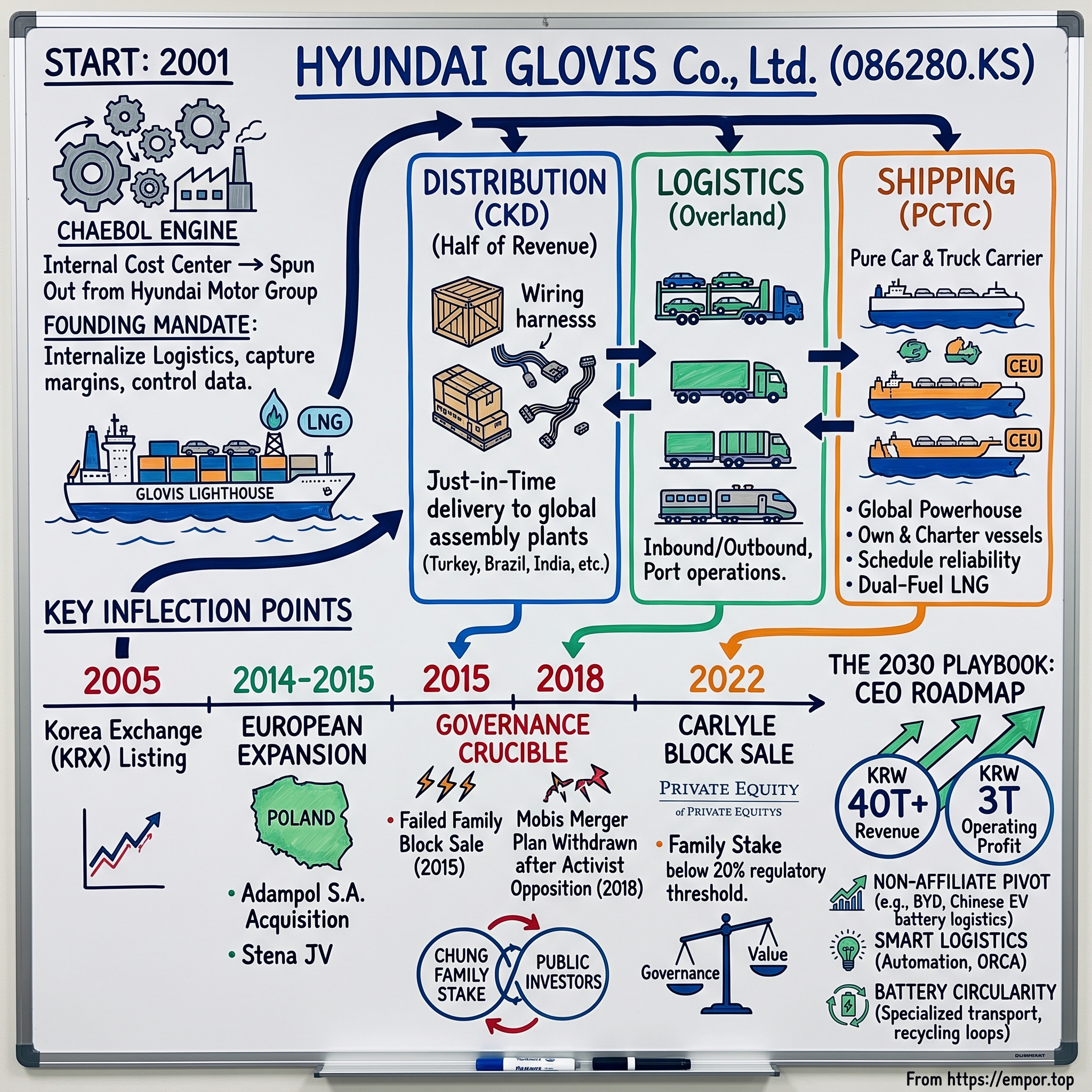
Somewhere in the Pacific right now, a slab-sided ship the length of two and a half football fields is grinding east at sixteen knots. It has no windows to speak of, no elegant lines, and no visible cargo. From the outside, it resembles a swimming shoebox. Inside, stacked across fourteen hydraulic decks, sit roughly ten thousand automobiles — Ioniqs, Tucsons, Sorentos, and, increasingly, Chinese-built electric crossovers bound for Europe. The ship is called Glovis Lighthouse, burns liquefied natural gas instead of heavy fuel oil, and entered service in June 2026 as the first of a new class of 10,800-CEU pure car and truck carriers.1[^2]
Almost nobody outside the automotive supply chain has heard of the company whose name is painted on the hull.
That is the first essential detail regarding 현대글로비스 Hyundai Glovis (086280.KS, listed on the 한국거래소 Korea Exchange). It is one of the largest logistics providers in Asia, posting revenue of KRW 29.6 trillion in fiscal 2025—up 4.1% year on year—with operating profit of KRW 2.1 trillion and an operating margin that crossed 7.0% for the first time.2 It transports a major share of the world's seaborne finished vehicles. Yet at its inception, it was merely an internal department — not an enterprise with a founding myth or a garage startup, but a cost center inside 현대자동차그룹 Hyundai Motor Group, spun out in 2001 to prevent the group from losing margin to foreign shipping lines and freight forwarders.
Twenty-five years later, that former department carries a market capitalization in the tens of trillions of won and projects fiscal 2026 revenue above KRW 31 trillion.[^4] That trajectory raises the central question this story addresses.
The core paradox. Is Hyundai Glovis a genuinely world-class shipping and supply-chain platform that happened to be born inside a 재벌 chaebol, or is it a captive financial vehicle whose primary function has always been to address the governance, succession, and liquidity needs of the Chung family? The evidence demonstrates that it has fulfilled both roles simultaneously throughout its history, and the central investment question is whether the operational platform is now sufficiently established to thrive independently of the second role.
That tension is not academic. Twice in the last decade, the market value of Hyundai Glovis swung violently on developments unrelated to vehicle shipment volumes. In January 2015, a failed block sale of family shares erased roughly a quarter of the company's market capitalization in a single day.3 In 2018, a proposed corporate restructuring that would have transferred Hyundai Mobis's most valuable divisions to Glovis collapsed under activist pressure.4 Both episodes signaled to shareholders that the equity structure was being used as a policy instrument, leaving minority investors exposed.
How this story is structured. The analysis begins with the founding conditions — why a 재벌 chaebol needed to internalize its logistics network, and how the ownership architecture of Glovis was engineered from day one to serve dual objectives. It then examines the three primary cash-generating engines: the Distribution segment, centered on the unglamorous and highly profitable business of Completely Knocked Down (CKD) parts kits; the overland Logistics network; and the deep-sea shipping fleet of pure car and truck carriers (PCTCs), where Glovis expanded from chartering a handful of vessels to competing directly with century-old Scandinavian and Japanese operators.
From there, the focus shifts to key inflection points: the 2015 European expansion in Poland, the 2018 activist campaign, and the 2022 block sale to Carlyle, which operated more as a regulatory workaround than an operational investment thesis. It then assesses the current strategic posture — CEO 이규복 Lee Kyoo-bok's KRW 40 trillion revenue roadmap for 2030, the expansion into non-affiliate accounts (including Chinese automakers competing directly with Hyundai in third markets), warehouse automation, and an EV battery circular economy initiative that remains modest in scale.
Finally, the analysis evaluates the business through Hamilton Helmer's 7 Powers and Porter's 5 Forces, stress-tests the bull and bear cases from the perspective of a skeptical long/short investor, and isolates the core operating metrics that will determine whether the 2030 plan is achievable.
A note on posture before beginning: this analysis avoids cheerleading, acknowledging that financial metrics alone do not resolve the investment debate. Glovis has expanded revenue through most of its existence, as expected for a captive provider receiving guaranteed volume from the world's third-largest automaker. The critical evidence lies at the margin — in non-affiliate contracts won on price and service quality, in fleet economics during fuel price spikes, and in management's execution when investor day commitments encounter a cyclical downturn.
That leads back to 2001, and to an operational challenge that appeared, at the time, to be little more than a spreadsheet exercise.
 Subscribe on LinkedIn
II. Conglomerate DNA: The Chaebol Engine & Founding Context (12:00 – 30:00)
Picture Hyundai Motor Group in 2001. 현대자동차 Hyundai Motor had survived the Asian financial crisis, absorbed 기아 Kia out of bankruptcy in 1998, and set an audacious goal: become a global top-five automaker within a decade, at a time when Hyundai's American brand reputation was still recovering from a legacy of budget cars.
To achieve that, Hyundai had to export aggressively. Exporting automobiles, however, differs fundamentally from shipping consumer electronics. A vehicle is a two-ton asset with a low ratio of value to volume, and it cannot be packed into a standard shipping container. It requires purpose-built vessels, dedicated port real estate, specialized handling crews, inland car-carriers, and pre-delivery inspection compounds at destination ports. In 2001, Hyundai owned virtually none of this infrastructure. Finished-vehicle shipping was contracted out to Scandinavian and Japanese carriers that had dominated the trade for decades. Parts flows to overseas assembly plants passed through foreign freight forwarders. Every vendor extracted a margin, and—more consequentially—controlled operational data that Hyundai could not see.
The founding. In February 2001, the group established a dedicated logistics subsidiary. It was not called Hyundai Glovis at first; the operating name Glovis followed shortly after, and the full "Hyundai Glovis" corporate branding was adopted in November 2011.5 The operational mandate was straightforward: consolidate the fragmented logistics spend of Hyundai and Kia—tens of thousands of shipments, thousands of suppliers, and dozens of destination countries—under a single entity.
What made the setup unusual was its equity structure. This was not a wholly owned subsidiary of Hyundai Motor. Instead, it was capitalized substantially by 정몽구 Chung Mong-koo, then chairman of the group, and his son 정의선 Chung Eui-sun, who together held a commanding majority of the founding equity. From inception, the group's captive logistics provider was majority-owned by two individuals rather than by the publicly listed automakers whose volume generated its cash flows.
Why that mattered, and still matters. Understanding why that ownership structure persists requires examining the plumbing of Hyundai Motor Group, which continues to rely on 순환출자 circular shareholding. Hyundai Mobis is the largest shareholder of Hyundai Motor; Hyundai Motor controls Kia; Kia holds Mobis. The loop closes on itself.6 Control of the entire group therefore rests on controlling Mobis—yet acquiring Mobis directly is financially prohibitive because its shares are locked inside the loop.
Succession in a Korean 재벌 chaebol is fundamentally a financing problem. The Korean inheritance tax on controlling stakes in major estates reaches roughly 50%, requiring heirs to raise substantial cash reserves without liquidating the core shareholdings that confer control. The standard corporate playbook across Korea during the 1990s and 2000s was to personally capitalize an unlisted affiliate, feed it captive group business until it generated substantial scale and cash flow, and then use the appreciated asset as equity currency—by selling shares, borrowing against the valuation, or merging the entity into a holding company higher in the ownership structure at a favorable ratio.
Glovis represented a textbook execution of this strategy. Every truckload of Kia parts and every vehicle shipped to assembly lines in Alabama built not just an operating enterprise, but a personally held asset outside the circular shareholding loop. This arrangement was explicit. It remains a central structural fact about the company: analyzing Glovis strictly as an independent logistics operator overlooks half of its founding rationale.
The captive flywheel. Setting aside governance considerations, the operating logic offered distinct economic advantages. The central operational challenge for a logistics company is capacity utilization. Empty trucks, idle warehouse bays, and underloaded ships immediately compress operating margins because fixed asset costs remain constant regardless of cargo volume. Independent logistics providers typically spend years and significant capital acquiring customer volume to achieve breakeven density.
Glovis faced no such constraint. It began operations with a guaranteed, expanding volume base supplied by two affiliated automakers scaling toward global volume leadership. Customer acquisition costs were virtually non-existent, and baseline capacity utilization was contractually assured. This guaranteed demand allowed Glovis to invest aggressively ahead of capacity—purchasing vehicle carriers, leasing port terminals, and chartering vessels—with a degree of revenue visibility that independent third-party logistics providers could not match. That scale rapidly lowered unit costs, creating an operating density that could then be leveraged to win external, non-affiliate accounts.
The operational flywheel functioned effectively, but its governance structure eventually generated regulatory friction.
The regulatory backlash. By the 2010s, Korean regulatory authorities and public scrutiny focused increasingly on captive affiliate transactions. The practice—referred to in Korea as 일감 몰아주기, or the funneling of group business to personal family vehicles—was viewed as transferring corporate value from public shareholders of operating entities to private family holdings. The 공정거래위원회 Fair Trade Commission established enforcement thresholds: once a controlling family's equity stake in an affiliate exceeded specific statutory limits, inter-affiliate transactions faced heightened regulatory oversight and financial penalties.
For Glovis, this shifting legal framework transformed its founding structure from an asset into a regulatory liability. The family's equity stake ultimately required downward restructuring to remain beneath statutory thresholds.
For investors, the founding era provides a key analytical context. Glovis's initial growth reflected guaranteed captive volume rather than open-market competitive wins. The company's commercial competitiveness only became testable in later years as it expanded sales to non-affiliate customers. What the founding era established was an operating scale and cost structure built on guaranteed volume—assets that provided the foundation for its subsequent industrial capabilities.
That subsidized scale translated directly into specialized operational capability in a critical, low-profile segment of the global automotive supply chain.
III. Early Scaling & The CKD Profit Engine (30:00 – 52:00)
Inside a Hyundai Glovis packing center outside Ulsan, the facility resembles an automated fulfillment center far more than a maritime shipping office. Rows of workstations flank bins filled with alternators, wiring harnesses, brake calipers, and dashboard sub-assemblies. Workers assemble not finished vehicles, but kits — wooden crates packed to a precise manifest, each designated for a specific assembly line, production shift, and date on another continent.
This is Completely Knocked Down, or CKD. It is among the least glamorous operations within Hyundai Glovis, yet historically it has served as one of its most reliable profit generators.
What CKD actually is. When Hyundai or Kia builds vehicles in overseas markets such as India, Brazil, Turkey, Indonesia, or historically Russia, manufacturing every component locally is often economically unfeasible. Conversely, exporting fully assembled vehicles incurs steep import tariffs in emerging markets prioritizing domestic industrial growth. The strategy is to ship disassembled vehicle kits for local assembly, securing lower tariff rates while satisfying local manufacturing mandates.
Managing disassembled vehicle logistics involves considerable operational complexity. A single vehicle contains thousands of components sourced from hundreds of suppliers. Uncoordinated shipments risk mismatched inventory, assembly line stoppages for missing parts, or excessive warehouse buffers. Hyundai Glovis manages procurement across tier-1 and tier-2 suppliers, inspects quality, sequences components, packs kits matching exact assembly sequences, handles customs documentation across multiple jurisdictions, books ocean freight, and ensures just-in-time delivery to manufacturing plants operating on narrow inventory buffers.
Functionally, Hyundai Glovis operates a global meal-kit service for vehicle assembly plants. The company neither manufactures the components nor designs the vehicles; instead, it aggregates parts from thousands of suppliers, portions them precisely, packs them in assembly order, and delivers the kits to international manufacturing facilities exactly when needed.
Why the economics are attractive. Three economic factors underpin this model. First, the operation is asset-light relative to revenue, requiring packing centers and information technology systems rather than deep-sea vessels or port terminals. Second, revenue scales directly with the volume and value of components, providing an automatic index to both assembly volumes and component cost inflation — operating effectively as a toll bridge where revenue expands alongside traffic and price increases. Third, modest operating margin percentages serve as a competitive barrier: low-to-mid single-digit margins on massive throughput offer little incentive for potential entrants while making replacement operationally risky for customers.
The operational volume is substantial. In the first quarter of 2026, the Distribution segment — comprising CKD logistics and associated trading activities — generated revenue of KRW 3.87 trillion, up 10.3% year on year, with operating profit of KRW 164.9 billion.7 By the second quarter of 2026, Distribution revenue reached KRW 4.21 trillion, representing a 17.9% year-on-year increase, while operating profit rose 27.8% to KRW 172.3 billion.8 This segment accounts for approximately half of the company's total revenue.
These financial results highlight a key structural feature. Distribution revenue grew in the high teens during the second quarter while operating margins remained narrowly anchored just above 4%. This pattern reflects a cost-plus or near-cost-plus contractual structure where volume converts into revenue systematically, with margins dictated by contract terms rather than market pricing power. The segment delivers stable, predictable, and capital-efficient cash flows. However, because the parent conglomerate acts as the primary counterparty, the segment also highlights the central captive governance critique.
From a bullish perspective, this stable cash generator funds broader strategic expansion. From a bearish perspective, an administratively set margin caps potential valuation re-rating and leaves minority shareholders exposed to potential contract re-negotiations by the controlling parent group without market protections. The segment operates effectively as a steady cash flow stream accompanied by corporate governance considerations.
The overland network. Alongside CKD operations, Hyundai Glovis built an extensive physical infrastructure layer. This includes inbound factory logistics supplying assembly plants for Hyundai and Kia, outbound transportation of finished vehicles from manufacturing facilities to ports and dealerships, rail transportation arrangements, car-carrier fleets, and vehicle distribution centers responsible for inspection, accessory installation, and staging prior to delivery.
Domestically, this network functions as core industrial infrastructure. Internationally, it established the operational baseline for subsequent commercial growth. Demonstrating the capability to move vehicles from a manufacturing facility in Slovakia to a port in Poland positioned Hyundai Glovis to compete for non-affiliate automotive logistics contracts.
The Logistics segment recorded first-quarter 2026 revenue of KRW 2.49 trillion and second-quarter 2026 revenue of KRW 2.86 trillion, representing year-on-year growth of 1.3% and 10.3%, respectively — with operating profit falling in both quarters, down 17.3% and then 5.9%.78
This divergence reflects volume growth accompanied by margin compression. Management attributed the profit decline primarily to weak global container freight rates impacting the international freight forwarding business. Freight forwarding operates on spread arbitrage, where Hyundai Glovis secures ocean carrier capacity and resells it to cargo owners. When market freight rates drop, the margin spread contracts. Unlike captive internal contracts, freight forwarding operates in a competitive, highly cyclical market subject to broader macroeconomic conditions.
The 2005 listing. On December 26, 2005, Glovis listed on the Korea Exchange with 75 million shares outstanding, roughly 1,000 employees, and about 55,000 shareholders.5 The listing provided a public equity currency for expansion and established a market benchmark for corporate valuation. Simultaneously, it provided the controlling family with a liquid, market-priced valuation on a personally held asset developed through captive group business volume.
Over the following decade, the company's equity value expanded alongside Hyundai Motor Group's rise in global automotive market share. Investors viewed the stock as an efficient vehicle for participating in Korean automotive export growth, offering higher capital efficiency than assembly-focused vehicle manufacturers.
However, controlling overland transport and component packaging captured only a portion of total supply chain value. The largest single cost in transporting vehicles from Korean factories to overseas dealerships remained the ocean transit segment — a service still largely outsourced to third-party shipping lines.
IV. The Maritime Expansion: Building a PCTC Global Powerhouse (52:00 – 1:22:00)
The global car-carrier trade in 2008 was a long-established oligopoly in commercial shipping. A handful of operators — Scandinavian firms Wallenius Wilhelmsen and Höegh Autoliners, alongside the Japanese trio of 日本郵船 NYK Line, 商船三井 Mitsui O.S.K. Lines, and 川崎汽船 K-Line — had controlled the primary trade lanes for decades. High capital requirements and established client relationships created steep barriers to entry.
Into that consolidated market entered a Korean logistics provider with seven years of corporate history, backed by a parent conglomerate seeking direct control over its maritime transport.
Why deep-sea, and why then. The strategic logic behind maritime expansion matched the company's founding rationale, extended to ocean freight. As Hyundai Motor and Kia expanded international vehicle exports, ocean transport represented their largest single logistics expense and the segment where they exercised the least control. Owning or chartering vessels enabled Hyundai Glovis to capture ocean freight margins and secure schedule reliability. For an automaker operating assembly plants on just-in-time inventory and managing dealership allocations, guaranteed sailing schedules carried value beyond the baseline freight rate.
The fleet build-out followed a measured sequence: chartering vessels initially, acquiring assets selectively, and scaling capacity alongside captive demand. Over fifteen years, Hyundai Glovis assembled one of the world's largest car-carrier fleets. By its 2024 investor day, the company operated 85 pure car and truck carriers, with a strategic target to expand the fleet to 128 vessels by 2030.[^4]
What a PCTC actually is. A Pure Car and Truck Carrier is a specialized roll-on/roll-off vessel designed as a multi-deck floating structure with stern ramps. Vehicles are driven directly onto internal decks, secured, and driven off at destination ports. Adjustable hydraulic decks allow vessels to accommodate high-heavy cargo, including buses, tractors, and industrial machinery.
Fleet capacity is measured in Car Equivalent Units (CEU), where one CEU corresponds to a standard sedan. The newer class of vessels chartered by Hyundai Glovis carries 10,800 CEU across 14 decks on a hull measuring 230 meters in length and 40 meters in width.[^2] Delivered in June 2026 under a charter from Seaspan, the Glovis Lighthouse utilizes dual-fuel liquefied natural gas (LNG) propulsion, designed to cut carbon emissions by approximately 24% compared to conventional marine fuel.1 Hyundai Glovis has expanded orders for this vessel class, committing to six additional 10,800-CEU LNG dual-fuel ships built by China's 广船国际 Guangzhou Shipyard International.9
Vessel scale directly drives unit economics in car-carrier operations because fuel, crew, and port costs scale sublinearly relative to cargo capacity. A 10,800-CEU vessel consumes substantially less fuel per carried unit than a traditional 6,000-CEU ship. Consequently, operators managing larger, fuel-efficient vessels achieve a lower cost per vehicle, establishing a structural cost advantage in a commoditized freight market.
Dual-fuel capability introduces an additional operational dimension. Tightening international maritime emissions standards and the European Union's carbon pricing framework have converted fuel selection into a direct operating cost variable. LNG-capable vessels allow fuel arbitrage and mitigate compliance risks. While major competitors are deploying similar vessel technology, early deployment at scale provides a temporary timing and cost efficiency edge.
The European bridgehead: Adampol. Ocean vessels transport vehicles across maritime routes, but land-based assets are required to move vehicles from arrival ports like Bremerhaven to inland dealership networks across Eastern Europe. To establish a European inland distribution network, Hyundai Glovis chose acquisition over organic expansion.
In November 2014, Hyundai Glovis agreed to acquire a 70% controlling stake in Adampol S.A., a Polish finished-vehicle logistics provider, completing the transaction in early 2015. The deal valued Adampol at over €70 million, with the remaining 30% stake subsequently acquired by China's Changjiu Logistics.10
Adampol represented a targeted mid-market acquisition. Rather than paying premium valuations for speculative growth narratives, Hyundai Glovis acquired an established, cash-generative transport operator at standard European transport multiples. The acquisition added rail terminals, truck fleets, and compound facilities across Central and Eastern Europe, alongside an existing portfolio of non-affiliate European automaker clients.
The acquisition demonstrated a disciplined approach to M&A, securing physical assets and third-party customer relationships at reasonable multiples.
Partnership over leverage. In Scandinavia and the Baltic region, Hyundai Glovis expanded short-sea Ro-Ro capabilities through a joint venture with Sweden's Stena AB rather than direct asset purchases. This partnership structure provided route access and operational expertise from an established regional carrier while limiting balance-sheet leverage. In a capital-intensive, cyclical industry, the joint venture structure preserved capital efficiency.
The unit economics of car carriers. PCTC operators generate revenue through two primary contract types: long-term contracts of affreightment with automakers, which offer stable, lower-margin base volumes, and spot or short-term charters, which yield higher rates but fluctuate sharply with shipping capacity. The mix between these contract types determines overall operating margins.
Financial performance in 2026 illustrates these operational dynamics. In the first quarter of 2026, Shipping segment revenue rose 15.5% year on year to KRW 1.45 trillion, while operating profit increased 40.5% to KRW 192.6 billion, driven by higher non-affiliate freight rates and improved vessel utilization.7 In the second quarter of 2026, Shipping revenue expanded further, rising 20.9% year on year to KRW 1.64 trillion, yet operating profit fell 34.6% to KRW 130.9 billion.8
Management attributed the second-quarter profit decline to fuel cost inflation. Escalating geopolitical tensions in the Middle East drove marine bunker fuel prices higher. Because contracted fuel surcharges require two to three months to adjust freight rates, the increased fuel costs impacted operating margins immediately, creating a temporary margin squeeze before cost pass-through mechanisms took effect.8
This operational lag is a defining feature of PCTC financial performance. Rapid increases in fuel costs create short-term margin compression, whereas falling fuel prices generate temporary profit expansions before contract rates adjust downward. Consequently, evaluating shipping margins on a single-quarter basis without accounting for bunker fuel trends and contract structures can give a misleading view of underlying earning power.
At the same time, management noted that expanded export volumes from Chinese automakers helped maintain fleet utilization during Middle East route disruptions.7 While Chinese OEM contracts demonstrate revenue diversification beyond group affiliates, they also expose segment earnings to Chinese automotive export trends and industrial policies.
By the mid-2010s, Hyundai Glovis had established three distinct operational pillars: Distribution, overland Logistics, and deep-sea Shipping. However, the tension between its dual identity as an independent logistics platform and a conglomerate financial vehicle remained unresolved — setting the stage for major corporate restructuring challenges.
V. The Governance Crucible: Elliott, Carlyle, & the 20% Threshold (1:22:00 – 1:52:00)
The first sign that public markets would resist conglomerate governance moves occurred on a Tuesday in January 2015.
Chung Mong-koo and Chung Eui-sun offered 5.02 million Hyundai Glovis shares — approximately 13% of the company — in a block sale priced between KRW 264,000 and KRW 277,500 per share, reflecting a discount of up to 12% to the previous close. The structural goal was to reduce the family's combined stake below 30%, the Fair Trade Commission threshold that then triggered heightened scrutiny of inter-affiliate transactions. The proposed transaction carried a total value of approximately $1.25 billion.3
The sale failed when institutional buyers declined to absorb the offering even at a double-digit discount. Hyundai Motor Group cited market conditions and the size of the block. Market reaction was swift: Hyundai Glovis shares dropped roughly 23%, erasing approximately $2.37 billion in market capitalization in a single trading session.3
That price action proved diagnostic. Operating fundamentals remained unchanged, but market perception of the stock's role shifted. The failed sell-down signaled that controlling shareholders were active sellers and that the share price carried an embedded valuation premium for potential restructuring optionality. When that restructuring path faltered, part of the valuation premium evaporated — a dynamic that continues to influence market sentiment.
2018: the plan. Three years later, Hyundai Motor Group proposed a comprehensive restructuring. Announced in March 2018, the plan called for spinning off Hyundai Mobis's module manufacturing and domestic after-sales parts divisions and merging them into Hyundai Glovis. The exchange ratio was set at 0.61 to 1 — entitling Mobis shareholders to 0.61 new Glovis shares for each Mobis share held.11
The strategic logic addressed multiple corporate objectives. Stripped of those manufacturing units, Mobis would serve as the clean holding entity atop Hyundai Motor and Kia. Enlarged by the cash-generative parts operations, Hyundai Glovis would expand significantly, enabling Chung Eui-sun to convert his personal Glovis stake into equity leadership higher in the group hierarchy, helping unwind the circular shareholding loop and facilitate generational succession.
The clash. In May 2018, activist fund Elliott Management announced it would vote against the proposal.12 Elliott did not oppose corporate reorganization in principle, but challenged the valuation terms. The fund argued that the exchange ratio undervalued Mobis's assets while overvaluing Hyundai Glovis, effectively transferring value from Mobis public shareholders to the controlling family's personally held entity.
Proxy advisory firms quickly supported that stance. Institutional Shareholder Services and Glass Lewis recommended voting against the merger, citing an unconvincing strategic rationale and terms unfavorable to Mobis shareholders.13 Opposition from major proxy advisors made securing approval from international institutional and index investors improbable.
On May 21, 2018, Hyundai Motor Group withdrew the restructuring proposal, citing uncertainty over shareholder support.413
Why it matters two decades into the company's life. The withdrawal marked a significant precedent in Korean corporate governance, representing a rare instance where a major chaebol canceled a family succession restructuring due to minority shareholder opposition. For Hyundai Glovis, the episode created lasting dual implications.
While the outcome demonstrated that minority shareholder rights could constrain governance engineering, it left the group's long-term ownership structure unresolved. Consequently, Hyundai Glovis shares have continued to trade with an overhang tied to potential corporate reorganizations that have been repeatedly attempted but never finalized — a structural factor contributing to the stock's historical valuation discount relative to its operating cash flows.
2022: the workaround. With a direct merger blocked, regulatory pressure mounted as the FTC lowered the equity threshold for inter-affiliate transaction scrutiny from 30% to 20%.14 Because the family's combined holding remained above the new threshold, compliance required a further reduction.
In January 2022, Chung Eui-sun and Chung Mong-koo sold approximately 10% of Hyundai Glovis to private equity firm The Carlyle Group for roughly KRW 611 billion (approximately $510 million), bringing the family's remaining combined stake to 19.99%.[^17]
Landing just two basis points beneath the 20% regulatory boundary highlighted the transaction's primary objective.
The sale operated principally as a regulatory compliance trade rather than a growth-capital raise or strategic partnership. The sizing and execution reflected deliberate engineering around Korean competition law, reinforcing how governance requirements shape the company's equity capital structure.
What Carlyle brought. Nevertheless, selecting Carlyle offered distinct capital structure benefits compared to an open-market placement. Placing the block with a global private equity manager avoided market overhang, introduced a sophisticated institutional voice with board presence and an interest in shareholder value, and provided a partner whose eventual exit could align with future group restructuring.
Carlyle joined a share register that included Norway's Wilhelmsen group, which held a roughly 12% stake developed through a long-standing shipping alliance and held via Treasure ASA.15 This established an atypical ownership structure for a Korean affiliate: a substantial institutional and international shareholder base sitting alongside controlling family interests, advocating for dividend discipline, governance transparency, and fair valuation.
Whether this shareholder structure yields sustained operational improvements remains an active point of evaluation. The expanded capital allocation commitments and dividend policies announced at the 2024 investor day partly reflected these institutional shareholder dynamics.
2026: the question reopens. The broader governance restructuring remains incomplete. By 2026, attention shifted to Boston Dynamics, the robotics developer acquired from SoftBank in June 2021 through a $660 million investment by Hyundai Motor, Hyundai Mobis, and Hyundai Glovis for a 60% combined stake.16 Hyundai Glovis initially held an 11.25% direct interest. On July 16, 2026, the group exercised its option to acquire SoftBank's remaining 9.65% stake to reach 100% ownership, leaving Chung Eui-sun with roughly a 25% personal stake in Boston Dynamics and Hyundai Glovis with approximately 12.5%.16
Market analysts view a potential future public listing of Boston Dynamics as a key succession mechanism. A successful IPO could generate significant capital for Chung Eui-sun — with Korean press estimates suggesting potential proceeds up to KRW 20 trillion — providing liquid funds to cover inheritance tax liabilities and purchase the Hyundai Mobis shares needed to resolve the group's circular shareholding.17
This strategy parallels the approach used with Hyundai Glovis two decades earlier, substituting a robotics venture for a logistics operator. For Hyundai Glovis shareholders, this asset carries dual implications: the company retains an equity stake in a high-valuation robotics asset, while the group gains an alternative succession route that reduces the need to re-engineer Hyundai Glovis's equity structure.
Governance remains a central analytical frame for evaluating Hyundai Glovis equity. However, ownership structures reflect only part of the investment thesis. The core operating drivers reside within the company's three primary business segments, and the following analysis evaluates their performance.
VI. Current State & Segment Economics: CKD, Logistics, & Shipping (1:52:00 – 2:22:00)
Understanding Hyundai Glovis in mid-2026 requires looking past a headline figure that initially resembles unambiguous progress.
In the second quarter of 2026, the company generated its highest quarterly revenue on record at KRW 8.71 trillion, representing a 15.8% year-on-year increase. Yet during the same period, operating profit declined 8.1% to KRW 495 billion, compressing the operating margin to 5.7%.8 For the first half of 2026, total revenue reached KRW 16.52 trillion, yielding an operating profit of KRW 1.02 trillion.8
That divergence—record top-line expansion alongside contracting operating margins—captures the central operational dynamic facing the enterprise.
Where it came from. Fiscal 2025 delivered the strongest operational performance in company history. Revenue grew 4.1% to KRW 29.6 trillion, while operating profit rose 18.2% to KRW 2.1 trillion, pushing the operating margin to 7.0%.2 That milestone achieved management's stated 2030 margin target five years ahead of schedule. The expansion was driven primarily by the shipping division, which combined higher-margin non-affiliate volumes from Chinese automakers with a structural cost initiative that replaced expensive short-term vessel charters with lower-cost long-term charters.2
That fleet restructuring illustrates management's approach to cost discipline. Replacing spot and short-term charters with long-term commitments locked in vessel capacity costs when shipping rates were elevated. While this strategy surrendered potential upside if spot rates collapsed, it established a more predictable, lower cost baseline—a prudent tradeoff in a highly cyclical maritime freight market.
The segment breakdown. The company operates through three distinct divisions with contrasting economic characteristics. Distribution serves as the high-volume cash generator; Logistics historically provides the largest profit base in a highly competitive market; and Shipping remains the smallest by revenue, the most volatile, and the sole segment possessing structural pricing leverage.
Performance across the three segments diverged sharply through the first half of 2026. Distribution recorded the fastest top-line expansion and accelerating profit growth, supported by steady Completely Knocked Down (CKD) parts deliveries to Hyundai and Kia assembly facilities in emerging markets.78 Logistics expanded top-line revenue on higher domestic vehicle shipping volumes, but operating profit declined under pressure from weak global container freight rates. Shipping experienced the sharpest swing, pivoting from a 40.5% profit increase in the first quarter to a 34.6% profit drop in the second quarter, driven almost entirely by sudden fuel cost spikes.
This multi-segment structure creates a portfolio with partially uncorrelated risk exposures: captive automaker production cycles, ocean forwarding freight rates, and marine fuel spreads. In the first quarter of 2026, shipping earnings offset logistics weakness; in the second quarter, distribution growth softened the decline in shipping profits. While individual segment operating profits swung by 20% to 40%, consolidated operating profit fluctuated by single digits—demonstrating a portfolio smoothing effect that stabilizes enterprise cash flow.
Guidance and execution. Management has guided full-year fiscal 2026 revenue above KRW 31 trillion and operating profit above KRW 2.1 trillion.8 With first-half operating profit standing at KRW 1.02 trillion, achieving these full-year targets requires a stronger second-half profit performance. Management expects this recovery to occur as contractual fuel surcharges lag behind earlier fuel price increases and adjust upward in subsequent quarters.8
This expectation serves as a key near-term test of operational execution. If contractual cost-pass-through mechanisms function as designed, shipping margins should recover in the second half of 2026 without requiring additional volume growth. Conversely, if margin compression persists, it would indicate that shipping contracts offer less protection against input-cost volatility than management asserts, altering the assessment of normalized segment profitability.
The 2026 guidance implies modest full-year top-line growth of roughly 5% and essentially flat operating profit relative to fiscal 2025. Following an 18% profit surge in 2025, this projected plateau reflects either conservative forecasting or an implicit acknowledgment that the elevated shipping margins achieved in 2025 may not be easily repeatable. In either case, it suggests that earnings growth toward long-term targets will be cyclical rather than linear.
Executive leadership. CEO 이규복 Lee Kyoo-bok was appointed president and chief executive officer during Hyundai Motor Group's executive reshuffle on November 30, 2022.18 Born in Busan in 1968 and educated in economics at 서울대학교 Seoul National University, Lee built his career primarily in corporate finance and international operations across Hyundai Motor. His executive background includes serving as chief financial officer of Hyundai Motor Brasil, head of the French sales subsidiary, CFO of Hyundai Motor Manufacturing Alabama, and head of Hyundai Motor's Process Innovation Division.1819
Lee's financial background has shaped his management agenda at Hyundai Glovis. Drawing on experience managing overseas subsidiaries and financial planning, his tenure has prioritized capital allocation frameworks, structured shareholder return policies, and explicit long-term performance benchmarks—areas that received less emphasis during the company's early expansion phase.
Capital allocation record. Management introduced a formal shareholder return framework committing to distribute at least 25% of annual net profit for a three-year period beginning in 2025. The policy targets annual dividend increases of at least 5%, aiming to double the dividend per share by 2027 compared to 2023 levels.[^4] Additionally, the company completed a one-for-one bonus share issuance in 2024, with the expanded share base trading on the market beginning August 2, 2024.[^4]
Two analytical caveats apply to these measures. First, a bonus share issuance increases total share count without altering underlying equity value or cash flows, rendering it a cosmetic adjustment rather than a direct return of capital. Second, while a 25% net profit payout ratio aligns with peer averages among Korean industrial companies, it remains conservative relative to global logistics benchmarks, leaving three-quarters of earnings retained for reinvestment.
The long-term return on that retained capital will depend on management's execution against its long-term growth roadmap.
VII. The 2030 Playbook: CEO Investor Day, Smart Logistics, & Battery Circularity (2:22:00 – 2:47:00)
In June 2024, twenty-three years after its founding, Hyundai Glovis held its first CEO Investor Day.
That event marked a structural shift in corporate posture. For more than two decades, an enterprise generating tens of trillions of won in revenue had never convened the investment community to outline a long-term strategic plan. The historical absence underscored the company's legacy as an internal group cost center with a public listing—an entity whose strategic priorities were dictated elsewhere and whose minority shareholders were rarely the primary audience. Holding a formal investor day signaled a change in orientation, driven by Carlyle Group's presence on the share register, South Korea's broader corporate "Value-Up" initiative to reduce structural market discounts, and an executive leadership team anchored in corporate finance.
The targets. By 2030, Hyundai Glovis committed to reaching annual revenue above KRW 40 trillion, generating operating profit of KRW 3 trillion, and sustaining an operating margin of 7%.[^4] To fund this growth, management outlined a six-year, KRW 9 trillion capital expenditure plan—averaging roughly KRW 1.3 trillion annually—allocating approximately 36% to overland logistics, 30% to maritime shipping, 11% to distribution, and 23% to new growth initiatives, including used-battery recycling and smart logistics solutions.[^4]
The operational core of the roadmap resides in fleet expansion. Hyundai Glovis committed to expanding its pure car and truck carrier fleet from 85 to 128 vessels, raising annual seaborne vehicle transport volume from 3.4 million to 5 million units, and capturing a 20% share of the global seaborne car-carrier market.[^4] Management framed this objective as transitioning from a specialized car carrier into a comprehensive logistics provider by 2030, while indicating an intent to pursue targeted acquisitions and explicitly identifying Chinese automaker 比亚迪 BYD among prospective clients.[^4]
Testing the plan against arithmetic. Evaluating these targets against basic operating metrics reveals what the strategy demands. Reaching the revenue goal requires expanding top-line sales from KRW 29.6 trillion in fiscal 2025 to over KRW 40 trillion by 2030—a compound annual growth rate of roughly 6% to 7%. Operating profit must rise from KRW 2.1 trillion to KRW 3 trillion over the same period, requiring annual growth of 7% to 8%. In isolation, these growth rates appear achievable.
However, the required composition of this growth presents operational hurdles. Distribution revenue depends on Hyundai Motor and Kia's overseas assembly volumes—decisions determined by parent group leadership rather than Hyundai Glovis management. The overland Logistics segment continues to face margin pressure in international freight forwarding. Consequently, the bulk of incremental earnings must be generated by the Shipping division through fleet expansion, higher vessel utilization, and premium cargo handling. Expanding the fleet by 50% while transitioning toward larger vessel classes represents a major capacity addition, arriving at a time when competing global carriers are delivering new vessel orders simultaneously.
This capacity addition represents the plan's primary structural risk. Hyundai Glovis is committing substantial capital to a cyclical asset class during an industry upcycle when asset returns peak—the precise point in shipping cycles when capital commitments carry elevated risk. While long-term contracts of affreightment mitigate spot market exposure across the core fleet, newly deployed vessels must secure marginal cargo in a competitive global market.
The non-affiliate pivot, and its awkwardness. The most significant strategic shift involves expanding logistics services for non-affiliate customers, with Chinese automakers representing the fastest-growing customer segment.
The growth trajectory in this trade lane has been rapid. Finished vehicle volumes carried on Hyundai Glovis vessels from China grew approximately 93% over three years, expanding from roughly 260,000 units in 2023 to about 510,000 units in 2025.20 In July 2026, the company disclosed a series of new Chinese contracts, including ocean transport for electric vehicle batteries from southern China to assembly facilities in Hungary, Spain, and Italy; semi-knocked-down parts and manufacturing equipment bound for Eastern European plants; and vehicle disassembly, packaging, and rail transport to Kazakhstan and Uzbekistan via Trans-China railways.20 Additionally, Hyundai Glovis initiated strategic alliance discussions with BYD regarding vehicle export logistics in September 2024.[^24]
These non-affiliate contracts provide concrete evidence of commercial competitiveness. Won in open competition against global peers without captive group advantages, these accounts demonstrate that the scale and capabilities built on internal group volumes can compete independently.
At the same time, this expansion introduces commercial and strategic complexity. Chinese electric vehicle exports represent the primary competitive challenge to Hyundai Motor and Kia across European, Latin American, and Southeast Asian markets. Hyundai Glovis is generating logistics revenue by facilitating the global supply chains of its parent group's direct competitors. While multi-client operations are standard among global shipping lines, managing data confidentiality across competing automakers remains an operational requirement. Furthermore, this growth vector ties a portion of future shipping earnings to Chinese industrial policy, export subsidies, and evolving trade barriers imposed by European regulatory authorities.
Smart logistics. In June 2023, Hyundai Glovis acquired control of Altiall, a logistics automation software specialist founded in 2017, under undisclosed financial terms.[^25] Altiall's primary capability lies in deploying and upgrading warehouse automation systems without interrupting active warehouse operations—a capability that the company indicates can improve operational productivity by up to 30% compared with conventional implementations requiring operational shutdowns.[^25]
The transaction aimed to strengthen Hyundai Glovis's position in South Korea's logistics automation market while enabling software deployment across its network of 45 domestic and 95 international logistics hubs, targeting distribution logistics in food and beverage, apparel, and pharmaceuticals, alongside manufacturing logistics in batteries and automotive components.[^25] This collaboration subsequently yielded ORCA, a proprietary warehouse control system platform.
Operationally, this tuck-in acquisition offers clear internal utility by upgrading software across a large existing warehouse network, allowing efficiency gains to justify the investment prior to external commercialization. However, building a scalable third-party software business remains unproven, suggesting investors should evaluate the transaction primarily on internal productivity benefits until external software revenues materialize.
Hydrogen and the physical showcase. At Hyundai Motor Group Metaplant America in Bryan County, Georgia, Glovis America manages inbound logistics for the group's primary US electric vehicle facility. Operating through HTWO Logistics, a joint venture with Hyundai Motor, a fleet of 21 XCIENT hydrogen fuel cell trucks—comprising over a third of Glovis America's local fleet—transports parts daily from regional suppliers, supported by mobile hydrogen refueling infrastructure.21
This 21-truck fleet functions primarily as an operational demonstration project rather than a standalone profit center. Its primary value lies in validating hydrogen freight capabilities under real-world operating conditions while providing a functional reference for commercial customers seeking to meet Scope 3 emissions reduction targets.
Battery circularity. The company's most prominent emerging opportunity centers on end-of-life electric vehicle battery logistics. Hyundai Glovis patented a specialized container for collecting used battery modules in 2021 and subsequently secured dangerous goods air freight certification from the International Air Transport Association.22 In August 2024, the company established a partnership with the recycling division of China's 华友钴业 Huayou Cobalt to develop collection and supply chain systems for retired batteries and energy storage components.[^28] This was supplemented by an agreement with Australia's Envirostream running through March 2027 to construct localized battery recycling loops.22
The operational logic for entering battery recycling is sound. Transporting used lithium-ion battery packs involves strict safety protocols and regulatory compliance due to fire hazards. A global logistics provider possessing patented transport containers, air freight certifications, and an international hub network is well positioned to handle specialized battery transport and diagnostic logistics.
However, from an earnings perspective, battery recycling, hydrogen transport, and warehouse software currently represent a negligible fraction of consolidated revenue. With management providing limited segment disclosures for these initiatives, they should be evaluated as long-term strategic options rather than primary drivers of near-term cash flow. The company's core financial engine remains firmly rooted in component packaging and maritime car transportation.
That operational reality leads directly to the core analytical question: what structural protections safeguard those two primary businesses over the long term?
VIII. Hamilton Helmer's 7 Powers & Porter's 5 Forces Analysis (2:47:00 – 3:05:00)
Stripping away the narrative leaves the central strategic question for a long-term owner: what prevents a competitor from replicating this business at a lower cost?
Hamilton Helmer's 7 Powers.
Cornered Resource — the strongest, and the most conditional. Hyundai Glovis's foundational advantage is privileged access to the logistics volume of the world's third-largest automotive group. No competitor can replicate this access because it is not commercially available. Helmer's framework defines a cornered resource as preferential access to a coveted asset on attractive terms.
Applying the framework critically, however, reveals a structural vulnerability. A true cornered resource should be durable and independent of a counterparty that can unilaterally reprice it. Hyundai Glovis's access persists because the controlling family and parent group choose to maintain it. In Helmer's terms, this arrangement functions more like a contract than a resource — conferring the benefits of a moat without its permanence. The mitigating factors are operational switching friction and a quarter-century of shared capital investments by the parent group; the unmitigated risk is that contract terms remain administratively set.
Scale Economies — high and genuinely earned. Operating one of the world's largest pure car and truck carrier (PCTC) fleets generates structural cost advantages that persist regardless of corporate ownership. Greater fleet scale improves route density, backhaul utilization, and cost per Car Equivalent Unit (CEU). Deploying larger, modern dual-fuel vessels lowers fuel consumption per vehicle, while transitioning from short-term charters to long-term commitments compounds these savings. Scale economy is the power most likely to survive any shift in the parent relationship, underpinning the commercial viability of the non-affiliate expansion.
Process Power — moderate to high, and underrated. Completely Knocked Down (CKD) kitting represents an operational capability developed over two decades, requiring supplier coordination across thousands of vendors, packing sequences aligned with assembly schedules, and customs clearance across dozens of jurisdictions. Process power builds slowly and erodes slowly. The primary limitation is that this capability was developed within a captive parent relationship, leaving its transferability to third-party customers to be proven over time. Recent contracts with Chinese automakers offer initial evidence of external applicability.
Switching Costs — moderate, and asymmetric. For an assembly plant operating on just-in-time inventory, changing supply chain providers risks line stoppages that carry immediate financial penalties. This operational friction protects Hyundai Glovis against sudden displacement. However, it offers limited protection against gradual repricing during contract renewals, where baseline economic risks reside.
Counter-Positioning — low, and arguably negative. Hyundai Glovis does not deploy a business model that incumbents cannot copy without damaging their legacy operations. If anything, counter-positioning works in reverse: transporting vehicles for competing Chinese automakers introduces conflict-of-interest considerations that independent pure-play carriers do not face.
Network Effects — low. Optimizing route density and port terminal slots yields incremental operating efficiencies, but individual shippers do not derive greater value simply because other shippers utilize the platform. These dynamics reflect scale economies rather than network effects.
Branding — low, and appropriately so. In industrial B2B freight, procurement decisions depend on pricing, capacity, reliability, and regulatory compliance. While the Hyundai Glovis brand carries operational authority in automotive logistics, it commands no consumer pricing premium.
Porter's 5 Forces.
Threat of new entrants — very low. A modern LNG dual-fuel car carrier costs well over $100 million and requires years to build. Shipyard slots are constrained, Ro-Ro port terminal capacity is tightly controlled by incumbents, and automotive OEM relationships take years to cultivate. High capital intensity and limited asset availability prevent rapid entry.
Bargaining power of suppliers — moderate and rising. Shipbuilders, including 에이치디현대 HD Hyundai, 한화오션 Hanwha Ocean, and Chinese yards, maintain strong order books, conferring pricing power on newbuilds and extending delivery schedules. While individual bunker fuel suppliers lack pricing power, commodity price volatility passes directly through to operators — as demonstrated when rising fuel costs erased roughly a third of shipping operating profit in the second quarter of 2026.
Bargaining power of buyers — the split that defines the enterprise. Hyundai Motor and Kia exercise significant leverage over transfer pricing on captive volumes, resulting in low-single-digit operating margins in the Distribution segment. Conversely, external non-affiliate customers operate in a tight global PCTC market driven by surging Chinese exports, allowing Hyundai Glovis to secure higher freight rates. Increasing the non-affiliate volume mix gradually shifts buyer power in the company's favor.
Threat of substitutes — very low. No viable alternative exists for moving finished vehicles across oceans at commercial scale. Rail transport offers localized substitution along select Eurasian corridors, but it cannot match ocean freight on volume or unit cost.
Competitive rivalry — high, and intensifying. Established carriers such as Wallenius Wilhelmsen and Höegh Autoliners maintain large modern fleets and deep European OEM relationships, while Japanese shipping lines retain domestic automaker accounts. Crucially, Chinese operators — including shipping subsidiaries of 中国远洋海运集团 COSCO Shipping and automaker logistics arms like 上汽集团 SAIC Motor's 安吉物流 Anji Logistics — are expanding fleets specifically to support Chinese vehicle exports. This insourcing trend represents a major competitive headwind for Hyundai Glovis's non-affiliate growth strategy.
The synthesis. Hyundai Glovis's competitive position is strongest where its business is least independent, and weakest where its growth potential is highest. Captive parent volumes supply a stable revenue base with capped margins, while the open market offers higher margins without structural protections. The 2030 strategic plan relies on the premise that scale economies and process power built within the captive business can be successfully converted into durable advantages in the open market — a hypothesis currently being tested in real-time commercial contracts.
IX. Bear vs. Bull Case & Investor Stress Test (3:05:00 – 3:25:00)
Every long investment thesis eventually reduces to a small set of observable indicators. For Hyundai Glovis, three key performance indicators warrant close tracking.
The KPIs worth tracking.
One: the non-affiliate share of shipping revenue. This metric converts an unanswerable question—whether Hyundai Glovis possesses independent commercial competitiveness or merely relies on captive group business—into a measurable outcome. Management targets raising non-affiliate revenue toward half of shipping segment sales by 2030. Progress reduces reliance on transfer-priced captive volume while adding higher-margin freight, demonstrating whether scale economies are commercially durable rather than inherited. Stagnation would indicate that the 2030 roadmap lacks an operational engine.
Two: PCTC fleet count and the share that is LNG dual-fuel. The 2030 plan requires expanding the pure car and truck carrier fleet from 85 to 128 vessels, representing management's largest discretionary capital commitment.[^4] Fleet size tracks delivery schedules, while the dual-fuel share indicates whether new capacity delivers structural cost and regulatory advantages. Shipyard congestion industry-wide makes monitoring delivery timelines essential.
Three: shipping segment operating margin across a full fuel cycle. Evaluating margin performance over four to six quarters spanning fuel price moves in both directions tests whether contractual surcharge pass-through mechanisms function as designed. The 2026 fuel price spike provided an empirical test, making the subsequent margin recovery—or lack thereof—a critical indicator of normalized earning power.
The bull case.
Structural tightness in car carriers. Global vehicle exports have outpaced car carrier capacity growth for several years, compounded by an aging global fleet and limited shipyard slots. Capacity constraints provided pricing power on non-contract cargo, as evidenced in the first quarter of 2026, when higher-rate non-affiliate volumes generated a 40.5% increase in shipping operating profit on a 15.5% revenue gain.7 Sustained fleet tightness provides substantial operating leverage as new vessels join the fleet.
Demonstrated non-affiliate commercial expansion. Doubling Chinese vehicle transport volumes over three years and securing new battery, knock-down parts, and rail contracts in July 2026 reflect commercial business won in open market competition rather than speculative projections.20 These wins provide concrete evidence of independent market competitiveness.
Capital allocation discipline. Achieving a 7.0% operating margin in fiscal 2025—hitting the 2030 target five years early—was supported by long-term charter cost restructuring.2 Combined with a formal investor day, a structured shareholder return policy, and a capital expenditure plan funded through operating cash flow rather than debt, management has demonstrated an increasing focus on total shareholder return.
Growth optionality. Initiatives in battery recycling logistics, warehouse automation software, and hydrogen transport require modest capital while leveraging existing logistics infrastructure. These embryonic businesses offer long-term upside potential without burdening the core valuation.
The bear case — and the activist's version of it.
Persistent governance overhang. The stock has experienced sharp historical repricings driven by ownership restructuring events, while group succession requirements remain incomplete. From an activist perspective, minority investors remain exposed to a company whose share register has served group restructuring objectives, whose largest customer dictates transfer pricing, and whose controlling shareholders previously attempted restructuring terms that independent proxy advisors opposed. The 2018 transaction withdrawal demonstrated minority shareholder influence but did not eliminate restructuring incentives.
Opaque related-party margin setting. Approximately half of total revenue originates from the Distribution segment, where operating margins are determined through administrative negotiation with the parent conglomerate rather than market pricing mechanisms. The absence of public market pricing mechanisms or detailed contract disclosures creates a structural analytical blind spot for outside investors.
Industry-wide fleet additions. Major global car carrier operators ordered new vessels during the capacity squeeze, with substantial global tonnage scheduled for delivery between 2026 and 2028. Historically, shipping rate declines outpace cost reductions when fleet supply catches up with cargo demand. Committing KRW 9 trillion in capital near a cyclical peak exposes Hyundai Glovis to potential rate softening, which captive group volumes can only partially buffer.
Concentration in Chinese export flows. Non-affiliate revenue growth relies heavily on Chinese automotive export expansion, leaving earnings vulnerable to European tariff policies, trade friction, or potential insourcing by Chinese logistics providers over a longer horizon.
Tariffs and production localization. The reduction in US tariffs on Korean-built vehicles from 25% to 15%, retroactive to November 1, 2025, relieved severe margin pressure that had previously driven third-quarter operating profits down 29% at Hyundai Motor and 49% at Kia.2324 However, this volatility underscores how trade policy decisions directly impact captive cargo volumes. Furthermore, Hyundai Motor Group's commitment to invest KRW 86.47 trillion domestically from 2026 to 2030 shapes global manufacturing footprint decisions.24 Increased assembly localization near end markets structurally shortens transport distances, creating an underlying tension between parent group localization and logistics volume growth.
Continued regulatory scrutiny. Fair Trade Commission oversight of inter-affiliate transactions remains an ongoing factor, with family shareholdings maintained deliberately at the 19.99% statutory threshold. Any further regulatory tightening could trigger additional equity adjustments.
Second-layer observations.
Three structural nuances warrant investor attention. First, the ownership structure is significant: Carlyle's block holding and Wilhelmsen's equity stake mean any coordinated equity realignment could impact market trading. Second, the 2024 bonus share issuance represented an accounting adjustment rather than a direct return of capital, warranting careful evaluation of corporate governance messaging. Third, the direct equity interest in Boston Dynamics represents a non-core asset with potential valuation upside, while serving as a reminder that group succession planning continues to intersect with the company's balance sheet.
Management credibility, on the evidence.
Management's operational track record offers positive indicators alongside unproven assumptions. In management's favor, the company achieved its 2030 operating margin benchmark five years early, established conservative 2026 financial guidance following a record fiscal year, and provided a specific, verifiable explanation for second-quarter 2026 shipping margin compression—citing a two-to-three month contractual fuel surcharge lag rather than broader macroeconomic headwinds.8
Conversely, current leadership has not yet managed through a prolonged industry downturn. Capital allocation commitments were established during a period of favorable freight rates and expanding margins. Committing KRW 9 trillion primarily to cyclical maritime assets near a cyclical high, while targeting a 20% global seaborne car transport market share, carries execution risks if pursued aggressively during a cyclical downturn. Management's discipline during an industry contraction will provide the ultimate test of its strategic framework.
X. Epilogue & Key Takeaways for Investors (3:25:00 – 3:35:00)
Return to the Glovis Lighthouse, somewhere in the Pacific, ten thousand cars stacked across fourteen decks.
Twenty-five years ago there was no ship. There was a department, created because a Korean automaker was tired of paying Scandinavians and Japanese to move its own products, and because a family needed an asset it could own directly. Those two motives — industrial logic and dynastic engineering — were braided together at the founding, and they have never fully come apart.
That is the honest summary of Hyundai Glovis: a company whose competitive assets are real and whose existence was never purely commercial. The scale economies in its fleet are genuine. The process knowledge in its packing centers is genuine. The Chinese contracts it has won against open competition are genuine. And so are the failed block sale, the withdrawn merger, the 19.99% stake, and the fact that its ownership structure is designed around a regulatory threshold rather than a business plan.
Investors do not have to resolve that tension. They have to price it, and to watch which way it is moving.
Three durable lessons.
Captive scale is a real head start and a real ceiling. Guaranteed volume from a parent lets a company build world-class infrastructure without paying customer acquisition costs — a genuine advantage that Glovis converted into one of the world's largest car-carrier fleets. But the same relationship caps the margin on that volume, because the counterparty setting the price is not competing with anyone. The value in such a company is created at the margin, when captive capability starts winning uncaptive business. Everything before that point is scaffolding.
Ownership structure is strategy. Analyzing this company through its income statement alone is insufficient. The most important events in its history — 2015, 2018, 2022, and quite possibly whatever happens with Boston Dynamics — were decisions about who owns what, not about how to move cars. Wherever a controlling family's personal holdings sit inside a listed entity, the share register is a strategic variable, and understanding it is not corporate governance box-ticking. It is the analysis.
Cyclical capital allocation is where fortunes are made and lost. Glovis has an unusual structure for a shipping-exposed business: an asset-light, stable, inflation-indexed distribution business funding a capital-hungry, volatile marine business. Used well, that combination lets a company invest counter-cyclically when competitors cannot. Used badly, it lets a company fund fleet expansion at the top of a cycle because the cash was there. Which of those is happening at Hyundai Glovis will be visible in the numbers within a few years, and it will matter more than anything in the strategy deck.
What to watch from here. Three things, and they are the same three that have run through this entire story. Whether the fleet arrives on schedule and in the right form. Whether non-affiliate customers keep choosing Glovis when they have every alternative. And whether Hyundai Motor Group's unfinished ownership overhaul, whenever it finally comes, treats the shareholders of its logistics arm as owners or as instruments.
The ships will keep sailing either way. The question has always been who they are really sailing for.
References
-
Seaspan Takes Delivery of First 10,800 CEU Dual-Fuel LNG Pure Car and Truck Carrier — Seaspan Corporation, 2026-06-11 ↩↩
-
Hyundai Glovis reports higher revenue and operating profit in FY 2025 — Transport Intelligence (Ti Insight), 2026 ↩↩↩↩
-
Hyundai succession stalls as Glovis block falters — FinanceAsia, 2015-01 ↩↩↩
-
Hyundai Motor Group cancels $8.8 billion restructuring plan after Elliott opposition — Reuters, 2018-05-21 ↩↩
-
Hyundai Glovis Co Share Price, Forecast & Financials (KRX:086280) — Stockopedia ↩↩
-
How Boston Dynamics IPO could unlock Hyundai Motor Group's ownership overhaul — The Investor / Korea Herald, 2026-03 ↩
-
Hyundai Glovis Q1 Operating Profit Reaches 521.5 Billion Won: "Middle East Risk Limited" — The Asia Business Daily, 2026-04-23 ↩↩↩↩↩↩
-
Hyundai Glovis Q2 Operating Profit Falls 8.1% to 495 Billion Won — Seoul Economic Daily, 2026-07-23 ↩↩↩↩↩↩↩↩↩↩
-
GSI won six more 10,800 CEU LNG dual-fuel PCTCs from Hyundai GLOVIS — VesselFinder ↩
-
Hyundai Glovis completes Adampol purchase — Automotive Logistics, 2015 ↩
-
The History, Swap Ratio, and Reasons Behind the Hyundai Mobis Spin-Off & Merger With Hyundai Glovis — Smartkarma, 2018 ↩
-
US activist fund Elliott to vote against Hyundai restructuring plan — CNBC, 2018-05-11 ↩
-
Hyundai overhaul hits another roadblock with ISS opposition — Reuters via Business Standard, 2018-05-15 ↩↩
-
Fair Trade Commission Enforcement Regulations & Inter-Affiliate Trading Thresholds — Korea Fair Trade Commission ↩
-
Wilhelmsen spins off Treasure entity holding Hyundai Glovis stake — Splash247, 2016 ↩
-
Hyundai Motor Group's Boston Dynamics IPO Seen as Catalyst for Governance Overhaul — Aju Press, 2026-03-02 ↩↩
-
How Boston Dynamics IPO could unlock Hyundai Motor Group's ownership overhaul — Daum News syndication, 2026-03-09 ↩
-
Hyundai Glovis taps financial specialist as new CEO — The Korea Herald, 2022-11-30 ↩↩
-
Kyoo Bok Lee takes over as head of Hyundai Glovis — Automotive Logistics, 2022 ↩
-
Hyundai Glovis looks beyond Hyundai for China growth — The Investor / Korea Herald, 2026-07-27 ↩↩↩
-
Hyundai works with Glovis America on hydrogen truck logistics in Georgia — Automotive Logistics, 2024-12 ↩
-
Hyundai Glovis secures recycling technology for used batteries — The Korea Herald ↩↩
-
US confirms retroactive cut of Korean auto tariffs to 15% — The Korea Herald, 2025-12 ↩
-
Trump's South Korea tariff cuts are major boost for Hyundai and GM — CNBC, 2025-12-03 ↩↩
 LinkedIn
 WhatsApp
 Reddit
 Hacker News
 Email
Email Kindle
 RSS Feed
 Spotify
 Apple Podcasts
 Amazon Music
 Audible
 YouTube