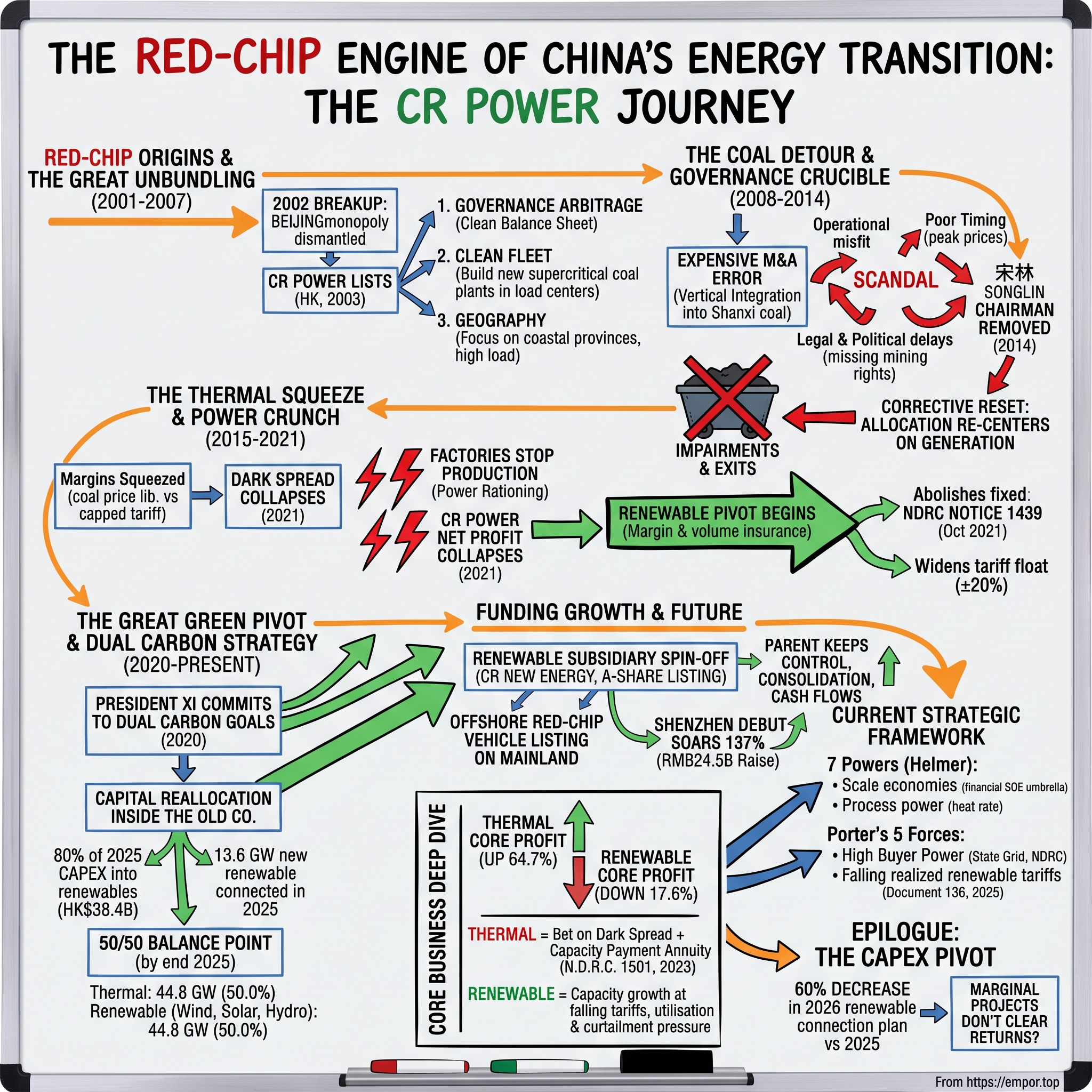
China Resources Power Holdings: The Red-Chip Engine of China's Energy Transition
I. Introduction & Episode Roadmap
On the morning of July 2, 2026, traders on the Shenzhen Stock Exchange watched something they had not seen in years: a state-owned power company behaving like a technology IPO. Shares of 华润新能源 China Resources New Energy, carved out of a Hong Kong-listed parent and sold to mainland investors at RMB10.11, opened, surged as much as 198%, and closed the session at RMB23.95 — up 137% — on the back of the largest initial public offering in the Shenzhen exchange's history, a RMB24.5 billion (roughly US$3.6 billion) raise that shattered the previous record of RMB13.9 billion.12
The parent that had built and then sold down that business, 华润电力 China Resources Power Holdings Company Limited (0836.HK), barely moved.
That asymmetry is the whole story in a single trading day. Here is a company that generated HK$102.0 billion of turnover in 2025 and HK$14.5 billion of profit attributable to owners — a payout that funded a HK$1.127 per-share dividend at a 40.2% payout ratio — and which, at a share price near HK$19.49 and a market capitalisation of roughly HK$101 billion, trades on a mid-single-digit earnings multiple with a dividend yield close to 6%.34 Its renewable subsidiary, spun out with a minority of its shares floated, was awarded a valuation on the mainland that its Hong Kong parent has never enjoyed. Same assets. Same coal plants standing behind them. Two very different sets of buyers.
China Resources Power is not a household name outside Asia, and that is part of what makes it interesting. It was never one of the 五大发电集团 Five Major Power Generation Groups created when Beijing dismantled its electricity monopoly in 2002. It was a commercial outsider: a Hong Kong-incorporated red-chip vehicle, backed by the central state conglomerate 华润(集团)有限公司 China Resources (Holdings) Co., Ltd., that listed on the Hong Kong Stock Exchange in November 2003 and set out to build power plants the way a private developer would — fast, in the richest provinces, with the newest turbines.5
Twenty-three years later, it stands at an exact and rather poetic balance point. As of December 31, 2025, its attributable grid-connected installed capacity reached 89,647 MW. Thermal power accounted for 44,796 MW, or 50.0%. Wind, photovoltaic and hydro together accounted for 44,851 MW, or 50.0% — a 2.8 percentage-point shift toward clean energy in a single year.3 Fifty-fifty, to within fifty-five megawatts. If you wanted a single number to describe where China's electricity system is in 2026, that might be it.
It is worth grounding those megawatts in something physical, because utility numbers go abstract quickly. At the end of 2025 the group operated 50 coal-fired power plants, 221 wind farms, 221 photovoltaic plants, 20 hydroelectric stations and 6 gas-fired plants.3 Its consolidated plants produced 226,790 gigawatt-hours of net electricity during the year — roughly three-quarters of the annual electricity consumption of the United Kingdom, generated by a single company that most Western investors have never analysed.3 This is infrastructure at a scale that has no real analogue in a developed market, assembled in a little over two decades.
The bull case is that this balance is not a transition problem but a business model: a coal fleet that has been converted by regulation from a commodity-margin gamble into something closer to an availability contract, funding a renewable build-out that adds more capacity in a year than most European utilities own in total. The bear case is that both halves are deteriorating in ways the headline profit number hides — thermal earnings are a policy gift that can be re-priced, renewable tariffs are falling faster than volumes are rising, and the group is spending more cash than it generates to keep the machine growing.
This is not a settled argument, and the 2025 accounts contain evidence for both sides — including a quiet accounting adjustment that wiped HK$2.5 billion off revenue and de-recognised HK$2.8 billion of receivables from renewable projects.3 We will get to that.
The route from here: how a red-chip vehicle exploited the 2002 unbundling of China's power sector; how a disastrous detour into 山西 Shanxi coal mining ended in impairments, lawsuits and the downfall of the parent's chairman; how the 2021 power crunch nearly broke the thermal business and then rebuilt its regulatory foundations; how the 双碳 dual carbon goals turned capital allocation upside down; the actual economics of Chinese power generation, explained in plain terms; how the company stacks up against 中国华能 China Huaneng, 龙源电力 China Longyuan and 中国电力 China Power International; what Hamilton Helmer's 7 Powers and Porter's Five Forces reveal when applied to a market where the state sets most of the rules; and finally, the two or three numbers that actually matter for tracking this business from here.
 Subscribe on LinkedIn
II. Red-Chip Origins & The Great Unbundling (2001–2007)
To understand why China Resources Power exists at all, start with a trading office in Hong Kong in the 1930s. China Resources began life as an offshore commercial bridge — a way for the mainland to buy, sell and finance in hard currency outside the direct reach of its own institutions. Over decades it accumulated the unusual dual identity that would later define its power subsidiary: a central state-owned enterprise (央企 central SOE) supervised by the 国务院国有资产监督管理委员会 State-owned Assets Supervision and Administration Commission (SASAC), but headquartered and operating under Hong Kong law, Hong Kong accounting and Hong Kong listing rules.
That hybrid was an asset waiting for the right moment. It arrived in 2002.
For half a century, Chinese electricity had been one organism. The 国家电力公司 State Power Corporation owned the plants, the wires, the dispatch centres and the customer relationships. In 2002, the State Council broke it apart. Transmission and distribution went to two grid monopolies, 国家电网 State Grid and 南方电网 China Southern Power Grid. Generation was split among five new national groups — 中国华能 China Huaneng, 中国大唐 China Datang, 中国华电 China Huadian, Guodian (later merged into 国家能源集团 CHN Energy) and 国家电力投资集团 SPIC — each handed a slice of the old fleet and a mandate to compete.
The logic was straightforward: separate the people who make electricity from the people who deliver it, and generation might behave like an industry rather than a ministry.
The consequence was less obvious. Splitting the incumbent into five created a market with room for a sixth player — provided that player could move faster than the incumbents. And the Big Five, for all their scale, carried the deadweight of the old system: legacy social obligations, retired-worker liabilities, redundant staff, ageing plants inherited rather than chosen.
China Resources Power was incorporated in Hong Kong in August 2001, ahead of the formal breakup, precisely to be that sixth player without the baggage. It listed in Hong Kong in November 2003, offering 920,000,000 shares — 828 million placed internationally and 92 million to Hong Kong retail investors — at a maximum price of HK$2.80, with Morgan Stanley as stabilising manager and dealings expected to commence on Wednesday, November 12, 2003.5 It was a conventional international IPO for what was, in substance, a Chinese state asset. That was the point.
Three structural advantages followed from the red-chip form, and they compound.
The first was governance arbitrage. Listing in Hong Kong meant continuous disclosure, an independent board, international auditors and minority shareholders who could sue. For a Chinese generator in 2003 that was a genuine competitive difference — it lowered the cost of foreign capital and imposed a discipline on project selection that a purely domestic SOE did not face.
The second was a clean balance sheet and a clean fleet. Building new plants from scratch in the early 2000s meant deploying supercritical and ultra-supercritical coal units at exactly the moment the technology matured. A coal plant's economics are dominated by how much coal it burns per unit of electricity — its heat rate. A newer, hotter, higher-pressure unit burns meaningfully less coal for the same output than a 1980s subcritical machine. Over a thirty-year life, that gap is worth billions. The company has kept that lead: in 2025 its consolidated coal fleet's average net generation standard coal consumption rate was 294.35 grams per kWh, improving by another 1.59 grams year on year.3 Roughly speaking, that is a fleet burning close to the theoretical best of installed Chinese coal technology.
The third advantage was geography, and it may have been the most valuable. Rather than accepting an inherited national footprint, China Resources Power chose where to build — concentrating on coastal and central load centres such as 广东 Guangdong, 江苏 Jiangsu and 河南 Henan, where industrial demand was densest, 上网电价 on-grid tariffs were highest, and plants ran the most hours. In a business where you cannot differentiate the product, being physically located next to the customer is the differentiation.
Two decades on, that siting decision still shows up in the numbers. In 2025, on a same-plant basis, the group's coal units ran 4,299 hours, which was 152 hours above the national average for thermal units — even in a year when their own utilisation fell 292 hours.3 Running above the national average while the national average is falling is the operational signature of assets sitting in the right provinces.
The years immediately after listing were the momentum phase, and they had a particular character worth capturing. China's electricity demand was compounding at rates that would be unthinkable in a mature economy — the country was adding the equivalent of a mid-sized European grid every year — and provincial governments were competing to attract generators. A developer with foreign capital, modern equipment designs and a reputation for finishing on schedule was not a supplicant in those conversations. It was courted. Plants were approved, built and connected in cycles measured in a few years rather than a decade, and each new unit was more efficient than the last because the technology was improving that fast.
The strategic discipline in that period was mostly a discipline of refusal. The temptation in a boom is to build everywhere, because everywhere looks profitable when demand is growing at double digits. Concentrating instead on the provinces where power was structurally short meant accepting slower headline growth in exchange for assets that would still be dispatched first when the boom ended. That patience is why the fleet's utilisation advantage survived into an era of national overcapacity — and it is the clearest early evidence that the red-chip governance structure was doing something real rather than decorative, because a purely volume-driven mandate would have produced a different map.
The company's early years were therefore not a story of invention but of positioning: the same commodity, produced more efficiently, sold in better markets, financed more cheaply. It worked well enough that by the late 2000s management began to believe it could extend the logic one step further up the value chain — into the coal itself. That turned out to be the most expensive idea in the company's history.
III. The Coal Mine M&A Era & Governance Crucible (2008–2014)
In 2010, executives from China Resources Power travelled to 古交 Gujiao, an industrial district on the edge of 太原 Taiyuan in Shanxi province, to look at three coal mines. The local government had invited them. The seller was 山西金业 Shanxi Jinye Coking Coal, controlled by the businessman Zhang Xinming. A joint venture in which the group held an indirect interest agreed to pay RMB7.9 billion — around HK$9.9 billion — for the mines and related assets.6
The strategic argument was seductive, and every thermal generator in China was making some version of it at the time. A coal plant's profit is the gap between what it is paid for electricity and what it pays for fuel. Through the late 2000s, coal prices were liberalised while electricity tariffs remained administratively set. The gap was being squeezed from both ends, and generators could do nothing about either. Owning the mine, the theory went, converted an uncontrollable input cost into an internal transfer price. You would hedge yourself.
The theory had three flaws, and Shanxi exposed all of them.
The first was operational. Running an underground coal mine is not adjacent to running a power plant; it is a different industry with different geology, different labour, different safety regimes and radically different failure modes. A power engineer's core competence — squeezing efficiency from a thermodynamic cycle — transfers approximately nowhere to extracting coal from a complex seam.
The second was timing. The acquisition was struck near the top of a coal price cycle. Buying reserves at peak prices is the classic vertical-integration error: the moment the hedge is most attractive is precisely the moment it is most expensive, and the hedge only pays off if prices stay high, which is exactly when you did not need it.
The third was legal and political, and it proved fatal. The transaction could not be completed as planned because the Shanxi government delayed renewing mining rights that had expired. An investor buying coal reserves is really buying a licence to extract them; without valid rights, the asset is a hole in the ground with a valuation attached.
Then it became a scandal. Mainland investigative journalists — including Wang Wenzhi of the Economic Information Daily and Li Jianjun — publicly alleged that the mines had been acquired at an inflated price, and that exploration and production rights had already expired at the time of purchase. In 2013, company executives publicly denied wrongdoing; president Wang Yujun stated that since investing in the three Gujiao mines in 2010 at the local government's invitation, no official had told the company its mining rights were invalid, and that permits were being obtained.6 Six minority shareholders went to court seeking to nullify the deal — a rare event for a Chinese SOE, and only possible because the company was listed in Hong Kong.
In April 2014, 宋林 Song Lin, chairman of parent China Resources (Holdings) and formerly chairman of the power subsidiary, was removed from his post and placed under investigation for corruption.7 He was detained and held for more than two years before being charged with abusing his position between 2004 and 2013 to obtain roughly RMB9.74 million in illicit gains, and later pleaded guilty.8 In August 2014, the company booked around HK$2 billion of impairments on its coal mining assets — and the shares rose on the news, which tells you how completely the market had already written the venture off and how much it valued the closure.9
What did the group actually pay, and was it too much? This is where the historical record frustrates rigorous analysis, and investors should be honest about that. The consolidated reserve, production and cost figures needed to compute a defensible per-tonne acquisition multiple against the wave of Shanxi coal consolidation deals of 2009–2011 were never disclosed in a form comparable to peer transactions. What can be established is the outcome, and the outcome is unambiguous: an asset acquired for RMB7.9 billion generated roughly HK$2 billion of impairments within four years, litigation from its own shareholders, and a criminal investigation reaching the parent's chairman.69 When the price paid cannot be benchmarked but the write-down can be counted, the write-down is the answer.
The corporate reset that followed is easier to observe in behaviour than in any single announcement. Non-performing coal assets were impaired and progressively exited. Capital allocation narrowed back to generation. And the board composition shifted toward a structure unusually weighted with independent directors for a central SOE — a change whose practical consequence is that large related-party or off-strategy transactions now travel through more scrutiny than they did in 2010.
The postscript is instructive about institutional memory. The 2025 accounts still carry echoes: the thermal segment result includes the one-off profit-and-loss impact of disposing of closed coal mine businesses, and HK$351 million of 2025 capital expenditure went to the final payment for coal mines attached to the Inner Mongolia Coal-Electricity Integration Project — a much more disciplined, mine-mouth-adjacent version of the same idea, sized as a rounding error against a HK$48.4 billion capital programme.3
For investors, the lesson generalises well beyond one company. Vertical integration into a commodity you consume is not a hedge; it is a second, correlated bet on the same commodity, plus an operating business you do not know how to run. The discipline the group displays today — concentrating capital in generation, keeping upstream exposure small and mine-mouth — was bought at a price of billions of Hong Kong dollars and one chairman's career. Whether that discipline is durable or merely dormant is a fair question to keep asking, and one we will return to when we examine the current capital programme.
The Shanxi episode at least taught the company what it could not control. The following decade taught it something harsher: that even in its core business, the two variables that determined its profits — the coal price and the electricity tariff — were both set by other people.
IV. The Thermal Squeeze & The 2021 National Power Crunch (2015–2021)
In the autumn of 2021, factories across a dozen Chinese provinces received notices to stop production. Traffic lights failed in the northeast. Households in some cities lost power for hours. It looked, to outside observers, like a supply shortage. It was in large part a pricing failure — and China Resources Power was one of its casualties.
The years leading up to it had already been unkind, in a slower way. Between 2015 and 2020, the group's revenue moved sideways in a narrow band — HK$76.9 billion in 2018, HK$67.8 billion in 2019, HK$69.6 billion in 2020 — while attributable profit swung between roughly HK$4.0 billion and HK$7.6 billion with no visible trend.4 For a business adding capacity every year, flat revenue and erratic profit is a diagnosis: the company was growing its asset base and giving the benefit away in price.
That was the era in which the renewable pivot began, quietly and for unglamorous reasons. Wind and solar were not primarily a climate decision in 2016; they were a margin decision. A wind farm has no fuel bill, which means no exposure to the one variable that had made the previous decade so volatile. Management was, in effect, buying insurance against its own core business.
To see why, you need one concept, and it is simple enough to explain in a sentence. A coal plant's gross margin per unit of electricity is the tariff it receives minus the fuel it burns to produce that unit. Practitioners call the fuel-adjusted version the dark spread; the group reports it directly. Everything else — depreciation, staff, maintenance, interest — is broadly fixed. So the dark spread is not one input among many. It is the business.
Now impose the pre-2021 regulatory regime on that equation. The coal price was largely market-determined and could triple. The electricity tariff was administratively capped and could not. Generators therefore held a position that was structurally short coal with no ability to pass the cost through. In an ordinary year, the arrangement was merely uncomfortable. In 2021, it was ruinous.
Global energy markets tightened, domestic supply was constrained by safety and environmental campaigns, and thermal coal prices went vertical. Domestic prices hit record highs repeatedly through the autumn, and by mid-October 2021 the widely traded 秦皇岛 Qinhuangdao thermal coal benchmark exceeded RMB2,000 per tonne — close to four times the normal level.10 At those input costs, the Oxford Institute for Energy Studies calculated, generation costs for many plants ran above RMB0.6 per kWh before maintenance, wages or any other expense, against tariffs that could not move.10
The result was that generating electricity destroyed value. Every additional megawatt-hour a coal plant produced widened its loss. Rational operators did exactly what the economics dictated: power plants "refused to operate at a loss," and from the last week of September through October 2021 China experienced 限电 power rationing measures across the industrial heartland, with provinces including 江苏 Jiangsu ordering energy-intensive sectors such as iron and steel and chemicals to curtail production.10 What is usually described as an energy shortage was, in mechanical terms, a price control colliding with a commodity market.
The company's own accounts registered the shock with unusual violence for a utility. Turnover actually rose in 2021 — to roughly HK$90 billion, because market prices for power were climbing — while profit attributable to owners collapsed to about HK$2.1 billion, a fraction of the prior year.4 It recovered to roughly HK$7.0 billion in 2022 as coal prices normalised.11 Revenue up and profit down by three-quarters is the arithmetic signature of a business with no cost pass-through. The thermal segment swung to a substantial loss, cushioned only by renewables, whose profits rose precisely because wind and solar plants have no fuel bill at all. That single year did more to justify the renewable pivot than a decade of strategy documents.
Then came the policy response, and it was more consequential than the crisis itself. On October 12, 2021, the 国家发展和改革委员会 National Development and Reform Commission issued Notice No. 1439, which did three things at once: it abolished the fixed catalogue tariff for industrial and commercial users; it widened the band within which coal-fired power prices could float around the benchmark from roughly ±10% to ±20% (with energy-intensive users exempt from the upper limit); and it pushed effectively all commercial and industrial demand into market-based trading.12
Read plainly, Beijing conceded a point it had resisted for two decades: if you want generators to keep the lights on, you have to let electricity prices reflect the cost of making it.
For an investor, the significance of Notice 1439 is not the crisis it ended but the mechanism it created. Before it, a thermal generator's tariff was a political variable. After it, the tariff became a market variable with policy guardrails — which is a different risk, but a hedgeable one, because when coal prices rise, market power prices now tend to rise with them.
The evidence that the mechanism works shows up in the group's recent numbers. In 2025 the dark spread on its consolidated coal plants was RMB148.7 per MWh, an increase of RMB11.1 year on year — and it widened even though the average coal-fired on-grid tariff fell 6.7% to RMB386.1 per MWh, because the average unit cost of standard coal fell faster, by 13.4% to RMB798.6 per tonne.3 Tariffs down, margins up. That is the signature of a business whose selling price now tracks its input cost, which is precisely what 2021 proved it needed.
But market-based tariffs alone solve only half the problem. They stabilise the margin per unit. They do nothing about the units themselves — and as wind and solar flooded onto the grid, the number of hours a coal plant would be allowed to run began to fall. Solving that required a second, stranger intervention, and it arrived alongside the biggest capital reallocation in the company's history.
V. The Great Green Pivot & Dual Carbon Strategy (2020–Present)
On September 22, 2020, addressing the United Nations General Assembly by video, President 习近平 Xi Jinping committed China to peak carbon dioxide emissions before 2030 and achieve carbon neutrality before 2060. The 双碳 dual carbon goals were, at that moment, two sentences in a speech. Within eighteen months they had rewritten the capital budget of every generator in the country.
For China Resources Power, the pivot has been extraordinary in scale — and it is worth pausing on just how extraordinary, because the numbers are easy to skim past.
In 2025 alone, the group connected 13,625 MW of new renewable capacity to the grid: 6,638 MW of wind and 6,987 MW of photovoltaic solar, of which 595 MW was distributed rooftop-style solar.3 For context, that single year of additions exceeds the entire generating capacity of most national utilities in Europe. It also secured development and construction permits for a further 12,029 MW — the pipeline that feeds the following years.3 Attributable wind capacity ended the year at 29,076 MW with another 7,343 MW under construction; attributable solar reached 15,335 MW with 6,132 MW under construction.3
The money followed. Of HK$48.4 billion of cash capital expenditure in 2025, HK$38.4 billion — roughly four out of every five dollars — went into building wind and solar plants.3 For a company whose identity was thermal generation, that is not a tilt. That is a different company being built inside the old one, funded by the old one's cash flows.
The trajectory is worth tracing, because the acceleration is the point. Renewables passed 47.2% of attributable capacity at the end of 2024, reached 49.9% by mid-2025, and crossed to 50.0% by year-end.319 Attributable wind capacity went from 25,549 MW at the halfway mark of 2025 to 29,076 MW six months later; solar went from 12,966 MW to 15,335 MW over the same six months.319 Connecting roughly 3.5 GW of wind and 2.4 GW of solar in a single half-year is an execution rate that few developers anywhere sustain, and it required construction, grid interconnection and commissioning to happen in parallel across hundreds of sites. Whatever one concludes about the returns, the operational capability is not in doubt.
There is a companion fact that most summaries of this pivot omit, and it complicates the narrative considerably: the thermal fleet grew too. Newly commissioned attributable coal-fired capacity in 2025 came to approximately 6,893 MW.3 The 50/50 split was not achieved by shrinking coal. It was achieved by growing renewables faster than a simultaneous, substantial coal build. A company genuinely retiring its carbon base would show falling thermal megawatts; this one shows the opposite, which is entirely consistent with Chinese energy policy — Beijing has explicitly wanted new, efficient coal capacity as system backup — but inconsistent with how the transition is often described to equity investors.
Which raises the question that dominates the equity story: how do you finance a HK$38 billion annual green build without either drowning the balance sheet or diluting the shareholders who own the coal plants paying for it?
The answer was the spin-off, and it was seven years in the making at Chinese regulatory speed. The group first announced the proposed separate listing of its renewable arm in March 2023, issued a shareholder circular in June 2023, and received Hong Kong Stock Exchange clearance that year. The listing application was formally accepted by the Shenzhen Stock Exchange on March 14, 2025.13 The Shenzhen listing committee approved the offering in late April 2026; the CSRC cleared the registration in May 2026; the shares were sold on June 22, 2026 and listed at the start of July.2
The structure is elegant, and worth spelling out because the mechanics are the strategy. The renewable development business — wind farms and photovoltaic plants across the PRC, operating 41.59 GW of grid-connected capacity comprising 27.63 GW of wind and 13.96 GW of solar — was placed into a subsidiary and floated on the Shenzhen main board.14 Only a minority of shares were sold: around 2.1 billion shares representing roughly 16–18% of enlarged capital.2 Proceeds of RMB24.5 billion were earmarked for renewable projects with an aggregate cost of about RMB40.4 billion, including a clean-energy base and a green ecological development project.2 The Hong Kong parent kept control, kept consolidation, and kept the cash flows — and now has a mainland-listed currency with which to fund growth.
There is one further wrinkle that made this a first: because the subsidiary is incorporated offshore while operating principally in mainland China, it became the first company with that structure to list in Shenzhen.2 A red-chip vehicle, listing a red-chip subsidiary on the A-share market. Twenty-three years after the parent's Hong Kong IPO, the arbitrage ran in the opposite direction.
Did it work? On the narrow question of price, spectacularly — a 137% first-day gain values the subsidiary's equity well above RMB300 billion, against a parent market capitalisation of roughly HK$101 billion.14 But that comparison should be read with care rather than celebration. A 137% pop is not primarily a verdict on asset quality; it reflects the mechanics of a mainland IPO market where allocations are rationed and pricing is constrained. The EBC analysis put the point bluntly: the debut "reflects supply scarcity rather than fundamental endorsement."14
The fundamentals underneath give that caution weight. The renewable subsidiary's disclosed financials showed net profit declining to RMB6.1 billion in 2025 from RMB8.28 billion in 2023, with solar and wind tariffs down 24% and 22% respectively and solar curtailment rising to 12.7% in 2025 from 1.5% in 2023.1 In the first quarter of 2026 — the quarter immediately preceding the listing — revenue fell 2.8% to RMB6.21 billion and net profit fell 31.1% to RMB1.62 billion.14
So the honest summary of the great green pivot is this: the company has executed the build-out at a scale and speed few operators anywhere can match, and it has solved the funding problem with genuine financial creativity. What it has not yet demonstrated is that the assets it is building will earn returns comparable to the ones it built five years ago. Capacity growth is proven. Return on that capacity is the open question — and answering it requires understanding exactly how a Chinese power plant makes money in 2026.
VI. Core Business Deep Dive & Segment Economics
Here is the fact that should reframe how you read this company's 2025 results. Group turnover fell 3.1% to HK$102.0 billion and profit attributable to owners rose just 0.9% to HK$14.5 billion — a dull, flat year on the surface.3 Underneath, the two halves of the business moved violently in opposite directions.
Core business profit attributable to owners from thermal power rose 64.7% to HK$7,639 million. Core business profit from renewable energy fell 17.6% to HK$7,604 million.3
Read that twice. In the year the group crossed 50% renewable capacity, the coal plants overtook the wind farms as the larger profit contributor. The green transition, in accounting terms, went backwards.
How the two engines actually make money
The renewable engine is conceptually simple. Build a wind farm or solar plant; the fuel is free; sell every kilowatt-hour the grid will take. Costs are almost entirely fixed — depreciation and interest on the capital sunk into steel and silicon. This produces very high operating margins and very high operating leverage. Because there is no fuel cost to absorb the shock, every renminbi of tariff decline drops straight to the bottom line.
That is exactly what happened. The average on-grid tariff for consolidated wind farms fell 10.5% to RMB391.7 per MWh, and for solar fell 4.3% to RMB304.1 per MWh.3 Volumes grew impressively — wind generation up 16.4%, solar up 55.5% — but volume growth from new plants at lower tariffs does not rescue the earnings of existing plants whose realised prices are falling. Hence: more capacity, more generation, less profit.
Two forces drove the tariff decline, and they are structurally different. The first is the maturing of the technology: newer projects are "parity" projects, built without subsidy, and they earn parity prices. That is healthy — it means renewables now stand on their own economics. The second is policy. On February 9, 2025, the NDRC and National Energy Administration jointly issued Document No. 136, requiring that all renewable generation enter market trading with prices set by competitive bidding rather than administrative fiat, effective from June 1, 2025. Existing projects retain their pricing protections; new projects bid. A difference-settlement mechanism, functionally similar to a contract-for-difference, sits outside the market to cushion revenue when market prices deviate from a benchmark.15
The thermal engine works on the opposite logic, and 2024 changed its architecture. Following NDRC Notice No. 1501 of November 2023, a national 容量电价机制 capacity tariff mechanism took effect on January 1, 2024.16 The idea borrows from capacity markets elsewhere in the world: pay a plant for being available, not only for generating.
The mechanics matter, and they are frequently misstated. The NDRC assessed the average total fixed cost of a coal plant at roughly RMB330 per kW per year. Plants in most provinces receive RMB100/kW/year — about 30% of that benchmark — while seven provinces with higher shares of low-carbon generation (Henan, Hunan, Chongqing, Sichuan, Qinghai, Yunnan and Guangxi) pay RMB165/kW/year, or about 50%. From 2026 the recovery ratio rises to no less than 50% nationwide.17 In its first year the scheme distributed roughly RMB107 billion to coal operators, worth an estimated 4.7% to 7.9% revenue uplift for a typical 600 MW plant depending on the applicable rate.17
The strategic effect is a genuine change in the character of the asset. A coal plant used to be a leveraged bet on the coal-power spread. It is now a bet on that spread plus an annuity that arrives whether or not the plant runs. The company itself describes the future role in exactly these terms, telling shareholders it will "actively promote the transformation of coal-fired power into supportive and regulatory power sources."3
But the mechanism deserves scepticism as well as applause, and there is credible independent analysis on the sceptical side. Global Energy Monitor's review found eligibility guardrails loosely applied, with 70–100% of coal capacity receiving payments across provinces despite national guidelines excluding certain plants — including newly built units and plants beyond typical design lifespans — and found no clear evidence the scheme reduced coal running hours.17 The Regulatory Assistance Project criticised the design for excluding storage, demand response and renewables from eligibility, for allowing new coal to qualify, and for setting fixed percentages rather than competitive bidding.18 Both critiques point the same direction: the payment is generous, politically determined, and therefore adjustable. Investors capitalising it as a permanent annuity are making an assumption about Chinese energy politics, not reading a contract.
The utilisation problem, in plain terms
Different generating technologies run for wildly different fractions of the year, and the gap explains most of what happens to a power company's economics. In 2025, the group's coal plants ran 4,299 hours; wind farms 2,307 hours; solar plants 1,296 hours.3 A year is 8,760 hours. So the coal fleet runs roughly half the time, wind about a quarter, and solar about fifteen percent.
The implication is that a megawatt of solar and a megawatt of coal are not comparable units. Roughly three MW of solar produce the annual energy of one MW of coal. When the company reports that renewables reached 50% of capacity, that emphatically does not mean 50% of the electricity — thermal power still generated the large majority of the group's 226,790 GWh of 2025 net output, and thermal still produced HK$76.5 billion of the HK$102.0 billion in segment revenue.3 Capacity share is a decarbonisation metric. Energy share is the economic one, and it lags by years.
Note also the direction of travel in solar utilisation: down 119 hours, or 8.4%, in a single year.3 Some of that is weather. Much of it is that when every developer in a province builds solar, they all generate at the same moment, and the grid cannot absorb it all. This is 弃风弃光 curtailment — wind and solar output that is simply thrown away — and the subsidiary's disclosed solar curtailment rate rising from 1.5% to 12.7% over two years quantifies how quickly the problem has grown.1
Where the price is set
In 2025, 83.7% of the group's consolidated net generation volume followed market-based pricing, and the average market tariff came in 1.3% above the benchmark on-grid tariff.3 The second half of that sentence is a real, if modest, credential: trading above benchmark means the marketing and trading operation is adding value rather than leaking it, and the same 1.3% premium was reported at the interim stage, suggesting consistency rather than a one-off.19
The final revenue layer is environmental attributes. Green electricity certificates (绿证) let a renewable generator sell the "greenness" of its output separately from the electrons. Prices have been volatile and, in absolute terms, small: certificates traded around CNY 1 in February 2025 before rising to CNY 2.31 by April after Guangdong tied corporate green power purchases to official performance evaluations, with northwestern certificates under CNY 3 and southeastern ones averaging CNY 9.6.20 In March 2025, five government bodies mandated that energy-intensive sectors — steel, non-ferrous metals, building materials, petrochemicals, chemicals and data centres — purchase certificates, with relevant companies required to demonstrate at least 35% renewable consumption by 2030.20 That is a genuine demand engine being constructed. But at a few renminbi per MWh, certificates today offset a rounding error of the tariff declines described above. Treat them as a call option on future policy, not a current earnings pillar.
What the balance sheet says
Now the part management does not lead with. The business is a formidable cash generator at the operating level: roughly HK$44.7 billion of operating cash flow in 2025, which is what a fleet of largely depreciating, low-marginal-cost assets should produce.4 The problem is what sits below it. Cash capital expenditure of HK$48.4 billion exceeded that operating inflow, and free cash flow was slightly negative for the year.34 A utility that cannot fund its own growth from operations is not in distress — this is normal for a business in a build phase — but it does mean the dividend and the capital programme are jointly financed by incremental borrowing, and that arrangement depends entirely on credit staying cheap and available. Bank and other borrowings rose to HK$213.5 billion from HK$190.4 billion, though net debt to total equity improved modestly to 150.8% from 153.6% and EBITDA interest coverage strengthened to 8.7 times.3 Finance costs actually fell 3.2% on a lower average borrowing rate — evidence that the central SOE funding umbrella remains intact and is doing real work.3
Alongside the debt sits HK$10.9 billion of perpetual capital securities.3 Perpetuals are accounted for as equity but paid like debt; during 2025 the group issued HK$8.7 billion and redeemed HK$8.2 billion of them.3 An analyst adjusting leverage for economic substance would treat much of that balance as borrowing, which makes the reported gearing improvement look thinner than it appears.
Then there is the disclosure that deserves the most attention. Buried in the notes, the group recorded a change in accounting estimate: "based on the progress of the current renewable energy subsidy verification and recent relevant developments," it reassessed certain renewable projects, reducing renewable revenue on a cumulative basis by RMB2,274 million (HK$2,506 million) and de-recognising trade receivables of RMB2,543 million (HK$2,815 million) including tax.3
Translated: the company had been booking revenue for subsidy entitlements it no longer expects to collect, and in 2025 it stopped. That single adjustment accounts for the majority of the reported turnover decline — excluding it, turnover would have fallen only 0.7% rather than 3.1%.3 The broader receivables position gives the context: of HK$34.2 billion of gross trade receivables, HK$21.8 billion — nearly two-thirds — is aged over sixty days, because the portion of wind and solar tariff above the local thermal benchmark is settled only after government approval and inclusion in the subsidy directory.3 Impairments also rose 33.9% to HK$775 million, including HK$306 million on renewable non-current assets, HK$150 million on receivables tied to the Derun Biomass project and HK$121 million of goodwill on a new energy project.3
None of this is fraud, and writing it down is the correct and conservative action. But it is a material accounting judgment on the group's fastest-growing segment, and the honest reading is that some of the renewable earnings reported in prior years were of lower quality than they appeared. A skeptical investor should ask whether one adjustment has fully cleaned the position or whether more follows.
With the internal machinery mapped, the next question is how this compares with everyone else trying to do the same thing.
VII. Competitive Landscape & Industry Structure
Imagine five or six enormous ships, all state-owned, all ordered to change course at the same time toward the same destination, all under the same weather. That is China's generation industry in 2026. The interesting question is not who is heading for the green harbour — everyone is — but who is turning most efficiently, and who is carrying the least dead weight.
Start with the largest peer. 华能国际电力 Huaneng Power International, listed in Hong Kong as 0902.HK and in Shanghai as 600011.SH, reported 2025 operating revenue of RMB229.29 billion, down 6.62%, and net profit attributable to equity holders up 42.73% to RMB14.54 billion, with a final dividend of RMB0.40 per share.21 The direction is identical to China Resources Power: revenue down, profit up, driven by cheaper coal. But look at utilisation — Huaneng's average utilisation hours fell 445 hours to 3,111, and electricity sales declined 3.39%.21 Against that, the group's coal fleet at 4,299 hours is running materially harder. Some of that is fleet mix, but much of it is the 2003-era siting decision still compounding: plants in power-deficit coastal provinces get dispatched first.
At the other end of the spectrum sits 龙源电力 China Longyuan Power (0916.HK / 001289.SZ), the pure-play wind pioneer under CHN Energy and the closest thing to a control experiment for "what if you had no coal plants at all?" For the nine months to September 2025, Longyuan's revenue rose 3.70% to RMB22,221 million while net profit attributable to equity holders fell 19.84% to RMB4,613 million, with wind revenue down 1.82% even as photovoltaic revenue surged 64.82% and total capacity reached 43,417 MW.22 Solar generation up 78%; profit down 20%. That is the renewable tariff squeeze in unhedged form.
The comparison is the single most important competitive fact in this article. In the same environment, the pure-play renewable operator's profit fell by roughly a fifth, while the dual-engine operator's group profit held flat — because a 64.7% increase in thermal core profit absorbed a 17.6% decline in renewables. The hedge is not a slide in a strategy deck. In 2025 it was measurable, and it was worth several billion Hong Kong dollars.
中国电力 China Power International (2380.HK), the SPIC-affiliated red chip, illustrates the same dynamic from a third angle. Its 2025 revenue fell 9.56% to RMB49.03 billion and profit for the year fell 9.51% to RMB5.92 billion, explicitly attributed to lower contributions from hydropower, wind and solar — even as thermal profit rose 45.76% on lower fuel costs. Its consolidated installed capacity reached 54,753.7 MW with clean energy at 82.07%.23 Being 82% clean was, in 2025, a disadvantage rather than a badge.
China Power's own disclosure also supplies useful third-party confirmation of the capacity tariff's effect. It reported that although increased renewable participation in spot markets drove down market-traded tariffs, "the comprehensive tariff after taking into account the capacity-tariff basically remained stable, which demonstrated the adjusting impact of the capacity-tariff policy."23 When a competitor independently describes the same stabilising mechanism, the mechanism is probably real.
One more axis separates these companies, and it is the one that ultimately reaches shareholders: what they do with the cash. All four are simultaneously running record capital programmes and paying dividends, which means all four are making the same implicit judgement about how much growth to fund with debt. Huaneng recommended a final dividend of RMB0.40 per share for 2025; China Power proposed RMB0.168, up 3.70% year on year even as its profit fell.2123 Against that, the disclosed and stable payout ratio at China Resources Power is a somewhat firmer commitment than a per-share amount, because it ties distributions to earnings by formula rather than to board discretion each year. It is a small governance difference with a real signalling value: a formula is harder to quietly abandon than a number.
So where does China Resources Power actually win?
Three places, with evidence. First, dispatch position: the above-national-average utilisation hours across all three technologies — coal by 152 hours, wind by 328 hours, solar by 208 hours — are not marketing claims but disclosed operating outcomes, and they compound directly into revenue per installed megawatt.3 Second, thermal efficiency: a sub-295 g/kWh coal consumption rate means the fleet buys less coal per unit sold than the industry, which widens the dark spread at any given coal price. Third, cost of capital: a falling average borrowing rate on a HK$213.5 billion debt stack, in a business where interest is one of the largest line items, is worth more than most operating improvements.3
And where does it not win? Nowhere in the product. Electricity is perfectly fungible; the grid does not pay a premium for a China Resources electron. Nowhere in customer relationships, because there is effectively one buyer per province. And increasingly, nowhere in growth optionality relative to peers — everyone has access to the same turbine suppliers, the same solar module glut, and the same provincial permitting queues.
Myth versus reality
Three consensus narratives attach themselves to this company, and each is partly wrong in a way that changes the analysis.
Myth: crossing 50% renewable capacity means the company has substantially decarbonised its earnings. Reality: capacity is not energy, and energy is not profit. Because coal runs roughly twice as many hours per year as wind and more than three times as many as solar, thermal power still produced the large majority of the group's output and HK$76.5 billion of its HK$102.0 billion in segment revenue.3 More pointedly, in 2025 thermal generated the larger share of core profit for the first time in several years. The capacity milestone is real and worth celebrating as an engineering achievement. It is not yet an earnings fact.
Myth: the renewable spin-off's 137% debut proves the market values these green assets far above what the Hong Kong parent is credited for, so the parent is obviously mispriced. Reality: mainland IPO pops are substantially a function of rationed allocation and constrained pricing rather than a considered valuation of the underlying business — which is why a company whose net profit fell from RMB8.28 billion in 2023 to RMB6.1 billion in 2025, with quarterly profit down 31.1% immediately before listing, could triple intraday.114 The sum-of-the-parts arithmetic is real, but it rests on a mark that has not yet been tested through a full trading cycle.
Myth: the capacity payment is a permanent structural repricing of Chinese coal assets. Reality: it is a two-year-old administrative transfer with a stated fixed-cost recovery ratio that Beijing sets and can reset, criticised by independent analysts for over-inclusive eligibility and for excluding the storage and demand-response competitors that would otherwise bid the price down.1718 It is currently generous. Investors should model it as policy income with a discount for revocability, not as contracted revenue.
That distinction — real advantages in cost and position, no advantage in product or customer, and a large slice of current profit that is granted rather than earned — is exactly what the strategy frameworks are designed to formalise.
VIII. Strategic Frameworks: 7 Powers & Porter's 5 Forces
Applying Western competitive-strategy frameworks to a Chinese state-owned utility requires one honest caveat up front: several of the forces these models measure are not set by competition at all. They are set by the NDRC. That does not make the frameworks useless. It makes them a good way to separate what the company has earned from what the state has granted — which is precisely the distinction an investor needs.
Hamilton Helmer's 7 Powers
Scale economies — real, and quantifiable. With 104,118 MW of manageable grid-connected capacity and a HK$47–48 billion annual construction programme, the group is among the largest single buyers of wind turbines and photovoltaic modules on earth.3 Procurement leverage matters at a moment of severe Chinese solar and wind equipment oversupply. The more important scale effect is financial: the ability to raise HK$213.5 billion at a declining average rate under a central SOE umbrella.3 In an industry where the asset is a thirty-year annuity funded with debt, cost of capital is the dominant variable. This is a genuine power.
Cornered resource — moderate, and eroding. Grid interconnection rights and land in high-demand eastern provinces are genuinely scarce and genuinely valuable, and the company's dispatch outperformance is the proof. But the resource is granted by provincial authorities rather than owned outright, and as everyone builds in the same coastal provinces, the scarcity value of any individual connection point declines.
Process power — the most credible of the set. A coal consumption rate improving to 294.35 g/kWh reflects decades of accumulated operating practice that a competitor cannot buy off the shelf.3 It is also, by its nature, a shrinking prize: the thermodynamic ceiling is close, and each further gram is harder than the last.
Counter-positioning — mislabelled, but the underlying point holds. Counter-positioning in Helmer's sense means adopting a business model the incumbent cannot copy without damaging itself. Nothing stops Huaneng or Datang from running the same dual-engine structure; most are trying. What China Resources Power has is not counter-positioning but a portfolio hedge whose value was demonstrated in 2025 against Longyuan's experience. Valuable, and worth paying for. Not defensible against imitation.
Switching costs, network economies and branding — essentially absent. Commodity electrons, one buyer per province, dispatch by merit order and policy. Nobody chooses this company's power. There is no reason to pretend otherwise.
Net assessment: two solid powers (scale economies, process power), one moderate and eroding (cornered resource), one mislabelled but economically real (the hedge), three absent. That is a decent competitive position for a capital-intensive utility — not a fortress.
Porter's Five Forces
Buyer power — very high, and structurally unfixable. State Grid and China Southern Power Grid, and the provincial trading platforms operating under NDRC rules, control dispatch order, market design and transmission access. The 2025 result — an average selling price down 7.9% across the consolidated fleet — is what buyer power looks like when it is exercised.3 No generator strategy alters this.
Supplier power — low and falling. Long-term coal contracts (中长期合同) cap much of the fuel exposure, and the collapse in wind and solar equipment prices amid Chinese manufacturing overcapacity has handed developers a historically favourable input market. This is the one force currently working strongly in the company's favour, and it is a large part of why 2025 capital costs per MW are attractive. It is also cyclical: equipment oversupply will not last forever.
Threat of substitutes — low for the system, rising for the asset. Nothing substitutes for electricity. But within the system, batteries and demand response are becoming direct substitutes for exactly the flexibility service that now justifies coal capacity payments. The RAP critique that the mechanism excludes storage and demand response is, from a coal owner's perspective, a subsidy — and one that a future policy revision could withdraw.18
Threat of new entrants — very low. Capital intensity, grid allocation, provincial permitting and environmental compliance are absolute barriers to sub-scale entrants.
Rivalry — moderate and intensifying. Historically muted by state coordination, rivalry now bites through provincial spot markets, where all generators bid and renewable output clusters at the same hours. This is the mechanism behind falling realised renewable tariffs, and it will intensify as Document 136 pushes more volume into competitive bidding.
The synthesis: this is a business with strong barriers to entry, weak barriers to imitation, an overwhelming buyer, a favourable supplier position that is cyclical, and rivalry that is rising precisely in the segment management is investing in most heavily. That combination argues for a company that can earn a decent, policy-mediated return on capital indefinitely — and against one that can compound its way to abnormal returns. Which brings us to the people making the allocation decisions.
IX. Management Credibility & Analyst Transcript Friction
史宝峰 Shi Baofeng has signed every major announcement in this story since 2023 — the spin-off updates, the annual results, the routine regulatory filings — and his career path says something about how China Resources allocates its executives.1324 He served as president of the power company from 2021 to 2023 before becoming chairman, and before that was executive director, president and chairman of China Resources Gas Group from 2018 to 2021. That is a leader moved across the conglomerate's energy portfolio rather than raised inside a single plant network: a manager of capital and regulatory relationships more than an operator of turbines. He took the chair in 2023, at the precise moment the strategic question shifted from "can we survive coal volatility" to "how do we fund the green build."
The board around him is worth a note for its unusual composition. As of April 2026, it comprised four executive directors — Shi Baofeng, WANG Bo, SONG Kui and HOU Yongjie — three non-executive directors, and seven independent non-executive directors, including Elsie Leung Oi-sie, Raymond Ch'ien Kuo Fung, Jack So Chak Kwong, Chan Hak Kan, Chan Yung and Man Wing Yee.24 Independents outnumber executives nearly two to one. That is Hong Kong listing governance applied to a central SOE, and it is the institutional residue of the Song Lin era. Whether it constrains capital allocation in practice is unknowable from outside; that it exists at all differentiates this company from its mainland-listed peers.
There is a structural point about incentives that international investors consistently under-weight when analysing Chinese SOEs, and it deserves stating plainly rather than assumed away. Senior executives at a central SOE are evaluated by SASAC against a mandate that blends financial return with policy delivery — clean energy build-out, generation security, safety performance and carbon intensity alongside returns on equity. The company's own forward strategy is written in that register: the 2026 plan opens by framing the year as "the first year of the '15th Five-Year Plan'" (十五五) and commits to "contribute to building a new power system," language that would be unusual in a Western utility's outlook statement.3
The investor consequence is not that management is indifferent to shareholder returns — the two-year payout discipline argues otherwise — but that the objective function has more terms in it than a listed peer in London or New York. When a project clears a policy hurdle but only marginally clears a return hurdle, the tie may break differently here. That is neither good nor bad in the abstract; it is a fact to price. It also cuts the other way in a crisis: a shareholder in a central SOE has an implicit claim on state support that a merchant IPP does not, and the 2025 decline in average borrowing cost during a record borrowing year is the market's ongoing valuation of exactly that.3
Assessing credibility means checking behaviour against prior statements. Three tests, and the company passes two.
Test one: did the spin-off happen as promised? Yes — and this matters more than it sounds. A proposal first announced in March 2023 and circularised that June survived three years of Chinese regulatory process, an application accepted in March 2025, listing committee approval in April 2026, CSRC registration in May, and pricing in June.132 Corporate actions of that complexity frequently die quietly. Completing it, at the largest size in the exchange's history, is concrete execution evidence.
Test two: has the dividend policy held? Yes. The 2025 payout ratio was 40.2%, against 40.1% in 2024, with a HK$1.127 full-year distribution.3 Two consecutive years at the same ratio, through a year when capital expenditure exceeded operating cash flow, is a meaningful signal about priorities: management chose to hold the payout rather than fund growth by cutting it.
Test three: has the narrative stayed consistent? Here it gets more interesting. Compare the interim and annual reporting from 2025. At the half-year, the company reported profit attributable to owners down 15.9% to HK$7,872 million while core business profit was essentially flat at HK$8,278 million, and it emphasised renewable core profit before tax rising 7.4%.19 By the full year, renewable core profit attributable to owners had fallen 17.6%, and the emphasis shifted decisively to thermal, with management highlighting that thermal core profit excluding the coal production business rose 79.8% to HK$7,336 million.3
Neither presentation is wrong. But the choice of the emphasised metric moved to whichever engine was performing, and the "excluding coal production" framing — while analytically defensible given the legacy mining assets — is the kind of adjusted sub-metric that deserves scrutiny rather than acceptance. The group reports core profit (excluding impairments, exchange movements and bargain purchase gains) as its headline measure; in 2025 core profit of HK$15,243 million exceeded statutory attributable profit of HK$14,519 million, and the gap is the impairments and adjustments being excluded.3 Consistently reporting a number that is consistently higher than the statutory one is a presentational choice investors should adjust for, not adopt.
A word on the limits of this exercise, because it matters for how much weight the conclusions can bear. Unlike US or European utilities, the company does not publish verbatim earnings call transcripts through the usual commercial channels, and no transcript for the 2025 results briefing was retrievable in the public record. The analysis here therefore rests on what is disclosed in writing — the results announcements, the interim comparison, the spin-off filings and the statutory board disclosures — rather than on the live texture of analyst questioning. That is a genuine information disadvantage relative to covering a comparable Western utility, and investors should weigh it: written disclosure is curated in a way that a live Q&A is not. What follows is therefore a reading of what management chose to emphasise and how that emphasis moved, which is a weaker instrument than hearing them handle a hostile question, but not a useless one.
The three questions an analyst would press hardest on, and what the disclosures actually answer:
On renewable tariff erosion. The company's stated response is a pipeline shift — the 2026 plan concentrates on large-scale wind and solar bases in desert and grassland areas, offshore wind along the coast, and "high quality projects in high-consumption regions in central-eastern and southern China," while promising to "ensure asset profitability from the outset" by leveraging China Resources Group's industrial synergies.3 The strategic logic is sound: build where the power is consumed locally and curtailment is low. But note the tension inside that same sentence — desert and grassland bases are in exactly the resource-rich, demand-poor western regions where curtailment and price discounts are worst. The strategy is not as cleanly coastal as the framing implies.
On the pace of the build. This is the disclosure that should command the most attention, and it has attracted the least. After connecting 13,625 MW of renewables in 2025, the group plans to add just 5,450 MW in 2026 — a reduction of roughly 60%.3 Capital expenditure guidance barely falls, to about HK$47.2 billion with HK$35.0 billion for wind and solar.3 Spending nearly the same money for less than half the megawatts implies some combination of a shift toward more expensive project types (offshore wind is far costlier per MW than desert solar), longer construction cycles, and a deliberate slowdown. Management frames this as concentration on quality. It is equally consistent with a company discovering that marginal renewable projects no longer clear its return threshold. Both readings are defensible; the accounts do not settle it, and this is the single question most worth putting to management.
On the holding company discount. With the renewable arm separately listed and its equity value on debut exceeding RMB300 billion against a parent capitalisation near HK$101 billion, the arithmetic invites an obvious challenge: is the Hong Kong parent now a discounted wrapper around a mainland-listed asset?14 The counterweight is that the parent retains control and consolidation, receives the cash flows, and now has a funding vehicle that does not require issuing its own shares. The risk is that minority interests in the best-growing business rise permanently — non-controlling interests already took HK$1,719 million of 2025 profit, up from HK$1,263 million.3 Every future renewable megawatt is now shared with A-share investors in a way it was not before. That is the price of the funding, and it is a real one.
X. Risk Radar & Materiality Stress Test
Not every risk deserves equal weight, and a list is not analysis. Here are the five that could actually change the earnings power of this business, ordered by how much damage each could do and how likely it is to arrive.
Renewable price erosion — high materiality, already happening. This is not a future risk; it is the present tense. Document 136 pushes renewable volume into competitive bidding, and the mechanism has a self-defeating quality that deserves naming: wind and solar in a given province generate at the same moments, so as penetration rises, the marginal price in those hours falls toward zero. The generator is not competing against coal; it is competing against thousands of identical machines running on the same weather. The evidence is already in the accounts — wind tariffs down 10.5%, solar utilisation down 8.4%, and a pure-play peer's profit down 20% in nine months.322 What would falsify the bear reading here is realised renewable tariffs stabilising while volumes keep growing. What would confirm it is a second year of tariff decline steeper than volume growth.
Capacity payment revision — moderate-to-high materiality, low near-term probability. The thermal profit rebound rests partly on a policy instrument that is roughly two years old, was designed without competitive bidding, and has been publicly criticised by credible analysts for over-inclusion and for excluding cleaner alternatives.1718 The scheduled 2026 increase to at least 50% fixed-cost recovery is a tailwind. But a mechanism that can be raised by administrative decision can be narrowed the same way — particularly if storage lobbies successfully for inclusion. Investors capitalising the annuity should discount it for the fact that it is revocable.
Subsidy receivables and collection quality — moderate materiality, partially crystallised. The 2025 accounting change de-recognised HK$2.8 billion of receivables and cut revenue by HK$2.5 billion, and roughly two-thirds of the remaining HK$34.2 billion trade receivable balance is over sixty days old, structurally so, because renewable tariff premiums settle only through the government subsidy directory.3 This is a working-capital drag on a business already spending more than it earns in cash. A further reassessment cannot be ruled out.
Curtailment and transmission — moderate materiality, geographically concentrated. Renewable output that cannot reach a customer is worth nothing. The subsidiary's solar curtailment climbing to 12.7% quantifies how fast this deteriorated, and 特高压 ultra-high-voltage transmission lines — the mechanism for moving western power east — take years to build.1 The 2026 plan's emphasis on desert and grassland bases increases exposure to precisely this risk.
Execution risk in the pipeline shift — moderate materiality, under-discussed. Offshore wind and distributed rooftop solar are the two segments management has signalled it will lean into, and neither resembles the onshore wind and utility-scale solar the group has spent a decade industrialising. Offshore construction involves marine logistics, specialised vessels and failure modes that are expensive to discover; distributed solar means thousands of small counterparties rather than a handful of large ones. The company has the balance sheet to absorb learning costs. It has not yet published a track record in either at scale, and a developer's second technology is usually less profitable than its first.
Two risks that get mentioned in this sector and should be sized down for this company: coal price spikes and refinancing. Coal volatility is now substantially absorbed by market-based tariffs and long-term contracts, as 2025's widening dark spread against falling tariffs demonstrated. Refinancing risk is mitigated by central SOE access and an EBITDA interest coverage of 8.7 times — though a leverage position of 150.8% net debt to total equity, plus HK$10.9 billion of perpetuals treated as equity, leaves less headroom than the coverage ratio alone suggests.3
One risk that is genuinely hard to size: electricity demand. The company itself noted that national electricity consumption grew 3.7% year on year in the first half of 2025, "indicating a periodic slow down in electricity demand," while new renewable capacity "squeezed the space for thermal power generation."19 Chinese power demand growth decelerating while the build-out continues is the macro condition under which everything above gets worse simultaneously. Set against that, early 2026 operating data showed group net generation up 14.4% to 101,083,121 MWh over the first five months, with solar output up 43.9% and wind down 2.4% — volume momentum intact, driven overwhelmingly by new solar.25
The demand question has an underappreciated second edge, and for once it points upward. Artificial intelligence infrastructure is an electricity business wearing a software costume: data centres consume power continuously, cannot tolerate interruption, and are being built in China at scale. Chinese policy has already recognised the link — data centres were named among the energy-intensive sectors required to purchase green certificates, with data centre demand alone projected to require 320 million certificates annually by 2035.20 A generator that owns both round-the-clock dispatchable capacity and a large renewable fleet is unusually well positioned to serve a customer that needs firm power and a green attribute to attach to it. This is optionality rather than a current earnings line, and the company has not disclosed material data centre supply contracts. But it is the most plausible source of upside demand surprise in a sector where the consensus worry is the opposite.
A short second-layer note on execution and disclosure. The impairments recognised in 2025 were individually small but qualitatively informative: HK$306 million on renewable non-current assets, HK$150 million on Derun Biomass receivables and HK$121 million of goodwill on a new energy project all point to marginal projects being written down rather than a systemic problem.3 Set against a group balance sheet of HK$409.4 billion, these are housekeeping. The item that is not housekeeping is the revenue and receivables reassessment described earlier — an accounting judgment on the growth segment, taken at year-end, disclosed in the notes rather than the highlights. Investors should watch whether the 2026 interim results carry a further adjustment of the same character.
Taken together, the risk profile has an unusual shape. There is very little chance of the business failing — the assets are essential, the buyer is the state, the credit is sovereign-adjacent. There is a substantial chance of the business earning progressively less on each incremental dollar it invests, and almost all of the identified risks push in that same direction. That is not a solvency question. It is a question about the terminal return on capital of an enormous ongoing investment programme, which is precisely the question the bull and bear cases are really arguing about.
XI. The Investment Thesis: Bull vs. Bear Case
Two intelligent investors can read the same 2025 accounts and reach opposite conclusions. Here is the strongest version of each.
Why it wins from here
The bull case rests on a claim that can be tested rather than asserted: that the dual-engine structure produces materially more stable earnings than either pure-play alternative, and that the market is not paying for that stability.
The 2025 evidence supports the first half. When renewable core profit fell HK$1.6 billion, thermal core profit rose HK$3.0 billion, and group attributable profit finished up 0.9%.3 Over the same period the closest pure-play renewable comparator saw profit fall roughly a fifth, and the most clean-energy-weighted red chip saw profit fall 9.5%.2223 In a year that punished renewable exposure, the hedge worked exactly as designed. That is not a projection; it is a completed experiment.
The second element is the annuity conversion of the coal fleet. With capacity payments rising to at least 50% of assessed fixed costs from 2026, roughly half the standing cost of 44,796 MW of thermal capacity is covered before a single kilowatt-hour is dispatched.317 For a fleet running above the national average utilisation with a best-in-class heat rate, the residual dark spread on the energy it does sell becomes something closer to upside than to survival.
The third is funding. The renewable arm's Shenzhen listing supplies RMB24.5 billion of external equity toward a RMB40.4 billion project programme without the parent issuing a share.2 Combined with declining average borrowing costs, this is the practical expression of the red-chip structure's oldest advantage: mainland assets, multi-market capital access.
A fourth element gets almost no attention and probably deserves some. The share of results from associates rose to HK$2,026 million in 2025 from HK$1,141 million, an increase of roughly three-quarters.3 These are jointly held plants the group does not consolidate — including large units where it holds minority economic stakes, such as the 38.25% interest in the Chongqing Energy Hami project. Equity-accounted earnings of that size, growing that fast, represent real cash-generating capacity sitting outside the headline capacity and revenue figures, and they suggest the group has been using partnership structures to extend its reach without carrying the full capital burden. Whether that continues is not disclosed; that it contributed meaningfully in 2025 is.
The fifth is what an investor is asked to pay: a mid-single-digit earnings multiple and a dividend yield near 6%, against a payout ratio held at roughly 40% for two consecutive years and net debt to total equity that improved rather than deteriorated during a record capital programme.34 For that to be a mistake, the market must be assuming that either the thermal annuity or the dividend is unsustainable.
Why it might not
The bear case does not require anything dramatic to break. It requires only that the current trends continue.
Strip out the hedge and look at trajectory. Renewable core profit fell 17.6% in a year when renewable capacity grew by 13,625 MW.3 That is the growth engine going backwards while consuming HK$38.4 billion of cash. If newly built renewables earn structurally lower returns than the fleet they are added to — which falling tariffs, falling utilisation and rising curtailment all suggest — then the capital programme is diluting returns on equity rather than compounding them. The 60% cut to the 2026 connection target on essentially unchanged capital spending is at minimum consistent with that reading.3
The thermal rebound, meanwhile, is doing the work that renewables were supposed to do, and it is doing it for two reasons that are both outside management's control: coal prices fell 13.4%, and the state introduced a capacity payment.317 Neither is a competitive advantage. Both are cyclical or political. A coal price recovery combined with a capacity payment recalibration would remove most of the 2025 earnings improvement.
Then the cash. Capital expenditure exceeded operating cash flow, free cash flow was negative, borrowings rose HK$23 billion, and HK$10.9 billion of perpetuals flatter the equity line.34 A 40% payout funded partly by incremental debt is sustainable while credit is cheap and available; it is not the same thing as a dividend funded by surplus cash.
An activist would push on three further points. First, portfolio complexity: after the spin-off, the parent is a holding company whose most attractive asset is separately listed and partly owned by others, with non-controlling interests taking a rising share of profit.3 Second, disclosure: the emphasis on core profit and on thermal results "excluding the coal production business" gives management multiple bites at framing a flat year favourably.3 Third, accounting: an adjustment that removed HK$2.5 billion of previously recognised revenue on the growth segment invites the question of what the appropriate historical earnings base actually was.3
The coal build discussed earlier deserves one final observation in this context, because its timing carries information. Those newly commissioned thermal units were substantial machines in premium locations — two 1,000 MW units at Guangdong Shenshan Phase II, two at Hubei Puqi Phase III, two at Zhejiang Wenzhou Phase II, a 660 MW unit at Guangdong Yunfu and two 1,000 MW units at Chongqing Energy Hami.3 In 2026, planned coal commissioning collapses to 350 MW, a single cogeneration unit at Hubei Yichang Phase II.3 So the thermal expansion is essentially complete, and the earnings contribution from those brand-new, high-efficiency units is only now flowing in at full-year run-rate. A bull would call that embedded earnings growth nobody is modelling. A bear would note that it means the recent thermal profit surge was partly a volume story from new assets, not purely a margin story from cheap coal — and that neither driver repeats at the same magnitude.
Framing the frameworks against the debate
The strategy analysis and the investment debate converge on a single point. The company's durable advantages — scale in procurement and financing, thermal process efficiency, dispatch-favourable siting — are all cost advantages in a commodity industry with one dominant buyer. Cost advantages in that structure produce a persistent, modest excess return; they do not produce pricing power, and pricing power is what would be required for the renewable segment to escape the tariff compression now underway. Meanwhile the most valuable current earnings driver, the capacity mechanism, is not a Helmer power at all. It is a policy transfer.
An investor is therefore being asked to underwrite two things: that Chinese energy policy will continue to compensate dispatchable thermal capacity for a long time, and that renewable returns will stabilise at a level above the cost of capital once the current price reset completes. Both are reasonable. Neither is proven by the 2025 results.
XII. Epilogue & Playbook Lessons
Return to the trading floor on July 2, 2026 — the mainland debut, the 137% pop, the parent barely moving — and the episode reads differently than it did at the start.
What actually happened that day was a twenty-three-year-old structural insight being harvested. In 2001, incorporating a Chinese power company in Hong Kong was a way to reach foreign capital that mainland vehicles could not. In 2026, listing a Hong Kong-incorporated renewable subsidiary in Shenzhen was a way to reach mainland capital that the Hong Kong parent could not. Same instinct, opposite direction. The company's most durable competence may not be building power plants at all — it may be arbitraging the persistent gap between where Chinese assets sit and where Chinese capital is willing to pay for them.
Three lessons generalise.
Structure is strategy in capital-intensive industries. Two identical power plants with different owners earn different returns because they are financed at different rates and dispatched under different rules. The red-chip form delivered governance credibility to foreign investors and SOE credit access simultaneously — and the practical proof is a HK$213.5 billion debt stack whose average cost fell during a year of record borrowing.3 Investors examining infrastructure businesses should spend as much time on the financing structure as on the assets.
Hedging a transition beats predicting it. The dominant industry narrative since 2020 has been that coal assets are stranded and renewable assets are the future. In 2025, coal assets generated the profit growth and renewable assets generated the disappointment. The correct posture toward a transition of this magnitude is not conviction about the destination — which is genuinely not in doubt — but structural resilience about the path, which is where the money is lost. Owning both engines cost the company narrative purity and bought it earnings stability. In 2025 that was a good trade. It will not be a good trade every year, and the point is that nobody knows in advance which years.
Growth in megawatts is not growth in value. This is the discipline the story most demands. It is possible to add 13,625 MW of renewable capacity, grow renewable generation by double digits across both technologies, and report renewable profit down 17.6%.3 Capacity is an input. Returns are the output. Any energy transition company should be judged on the second, and the industry — including the analysts covering it — has spent five years celebrating the first.
There is a fourth lesson that is less comfortable and specific to state-adjacent businesses. A large share of this company's current profitability was created by administrative decision rather than commercial achievement: the 2021 tariff liberalisation rescued the thermal margin, the 2024 capacity mechanism underwrote the thermal fixed cost, and the 2025 renewable pricing reform is now compressing the renewable margin. Three policies in five years, each reshaping the earnings base more than any management action did over the same period. Investors in this sector are, whether they frame it that way or not, underwriting the durability and direction of Chinese energy policy. The company's operational excellence determines how much better it does than its peers. Beijing determines the level around which everyone oscillates. Both matter; only one is under management's control, and the analytical error is to attribute policy outcomes to strategy.
Which leads to what to actually track. Not a dashboard. Three numbers, and honestly, mostly the first two.
One: realised renewable tariff versus the provincial benchmark, for wind and solar separately. This is the single variable that determines whether the HK$35 billion going into wind and solar in 2026 creates or destroys value. The company discloses average on-grid tariffs by technology at each interim and annual result. If the rate of decline decelerates while volumes keep compounding, the bull case is validating. If the decline steepens, no amount of megawatt growth compensates.
Two: thermal dark spread plus capacity payment realisation. The dark spread is disclosed directly in each results announcement, and capacity payment recovery ratios are set provincially. Together they determine whether the thermal fleet is a cash annuity or a commodity bet in disguise. Watch particularly whether the 2026 step-up to at least 50% fixed-cost recovery is fully realised in the provinces where the fleet actually sits.
Three: renewable capacity connected versus plan, read against capital expenditure. The 2026 target of 5,450 MW against roughly HK$35 billion of wind and solar spending is the most informative pair of numbers the company has disclosed in years.3 If actual connections come in near plan on that spending, the mix has genuinely shifted to costlier, higher-quality projects. A large miss, or a further target cut, would suggest something more uncomfortable: that the returns available on new renewable capacity in China have fallen below what a disciplined allocator will accept.
That last possibility would be the most consequential outcome in this story — and, given what the Shanxi coal mines taught this particular management team about buying assets at the top of a cycle, arguably the most interesting one to watch.
Because the deepest question this company poses is not whether China's energy transition succeeds. It will. The question is whether the companies building it get to keep any of the value they create, or whether an industry with one buyer, homogeneous output and unlimited state-directed capital simply competes the returns away — leaving behind the cleanest, largest, most impressive power system ever constructed, and a set of shareholders who financed it for a yield.
References
-
China Resources New Energy Soars 137% in Shenzhen Debut After Record IPO — Caixin Global, 2026-07-03 ↩↩↩↩↩↩↩
-
China Resources New Energy's US$3.6 billion IPO smashes records on Shenzhen exchange — South China Morning Post, 2026 ↩↩↩↩↩↩↩
-
Announcement of Annual Results for the Year Ended 31 December 2025 — China Resources Power Holdings / HKEXnews, 2026-03-18 ↩↩↩↩↩↩↩↩↩↩↩↩↩↩↩↩↩↩↩↩↩↩↩↩↩↩↩↩↩↩↩↩↩↩↩↩↩↩↩↩↩↩↩↩↩↩↩↩↩↩↩↩↩↩↩↩↩↩↩↩↩↩↩↩↩↩↩↩↩
-
China Resources Power Holdings Company (HKG:0836) Financials — StockAnalysis ↩↩↩↩↩↩↩↩↩
-
Global Offering Announcement — China Resources Power Holdings Company Limited / HKEXnews, 2003-11-03 ↩↩
-
China Resources Power bosses deny coal mine-purchase fraud accusation — South China Morning Post, 2013 ↩↩↩
-
China Resources chairman Song Lin sacked in corruption scandal — South China Morning Post, 2014-04 ↩
-
Former China Resources chairman Song Lin pleads guilty to corruption — South China Morning Post, 2017 ↩
-
CRP shares rise after it books HK$2b of impairments on coal mining assets — South China Morning Post, 2014-08 ↩↩
-
The 2021 Energy Crisis: Implications for China's Energy Transition (OEF 131) — Oxford Institute for Energy Studies, 2022-03 ↩↩↩
-
Morningstar Equity Research: China Resources Power Holdings (0836.HK) — Morningstar ↩
-
Notice No. 1439 on Further Deepening Market-Oriented Reform of Coal-Fired Power Tariffs — National Development and Reform Commission, 2021-10-12 ↩
-
Latest Update on the Proposed Spin-off and Separate Listing of China Resources New Energy Holdings Company Limited — China Resources Power / HKEXnews, 2025-03-14 ↩↩↩
-
China Resources New Energy IPO: Why Asia's Largest 2026 Listing Soared 198% — EBC Financial Group, 2026 ↩↩↩↩
-
Policy Interpretation: Four Key Firsts in China's Market-Based Reform of New Energy On-Grid Tariffs (Document No. 136) — EnergyTrend, 2025-02-12 ↩
-
Notice No. 1501 on Establishing a Capacity Tariff Mechanism for Coal-Fired Power — National Development and Reform Commission, 2023-11-10 ↩
-
Guest post: China's 'capacity payments' boosted coal-plant revenue by up to 8% — Carbon Brief ↩↩↩↩↩↩↩
-
China's coal power capacity payment policy: What it means and what's next — Regulatory Assistance Project ↩↩↩↩
-
Announcement of Interim Results for 2025 — China Resources Power Holdings / HKEXnews, 2025-08-21 ↩↩↩↩↩
-
As prices surge, what next for China's green power certificates? — Reccessary, 2025 ↩↩↩
-
Huaneng Power International Boosts 2025 Profit Despite Revenue and Volume Declines — The Globe and Mail, 2026 ↩↩↩
-
China Longyuan Power Reports Mixed Nine-Month Results — The Globe and Mail, 2025 ↩↩↩
-
Results Announcement for Year 2025 — China Power International Development Limited / HKEXnews, 2026-03-20 ↩↩↩↩
-
Summary of Financial Information of China Resources Power Investment Company Limited for the Year 2025 (Audited) and the First Three Months of 2026 (Unaudited) — China Resources Power / HKEXnews, 2026-04-30 ↩↩
-
China Resources Power Lifts Five-Month Generation as Solar Output Surges — The Globe and Mail, 2026 ↩
 LinkedIn
 WhatsApp
 Reddit
 Hacker News
 Email
Email Kindle
 RSS Feed
 Spotify
 Apple Podcasts
 Amazon Music
 Audible
 YouTube