China Tower Corporation Limited: The World's Largest Telecom Tower Leviathan
I. Introduction & The Infrastructure Leviathan (00:00:00 – 00:09:00)
Somewhere on a ridge above a county road in Yunnan, a galvanised steel lattice tower stands forty metres tall. It has a concrete pad, a fenced compound, a leased patch of hillside, a power line running to it, a bank of lithium batteries in a cabinet at its base, and a maintenance crew that knows the access track by heart. Bolted to it, at three different heights, are the antennas of three separate mobile networks. Two-thirds of the way up, there is now also a high-definition camera pointed at the treeline, watching for smoke.
Multiply that tower by 2,149,000 and you have 中国铁塔股份有限公司 China Tower Corporation Limited — the largest single portfolio of wireless physical infrastructure on Earth. At the end of 2025 the company operated 2.149 million tower sites hosting 3.856 million tenants, and the year's revenue crossed RMB 100 billion for the first time, reaching RMB 100,411 million.1 It is a company almost nobody outside China has a strong opinion about, and yet it owns roughly half the world's telecom towers.
For scale, the entire United States has a few hundred thousand macro cell sites spread across several competing owners. China Tower's single portfolio is several times larger than the American market in its entirety, and it is managed as one integrated national system, with one planning function, one maintenance organisation and one price book. Nothing quite like it exists anywhere else, and nothing quite like it is likely to be built again, because it required a state to compel three competitors to hand over their most strategic physical assets simultaneously.
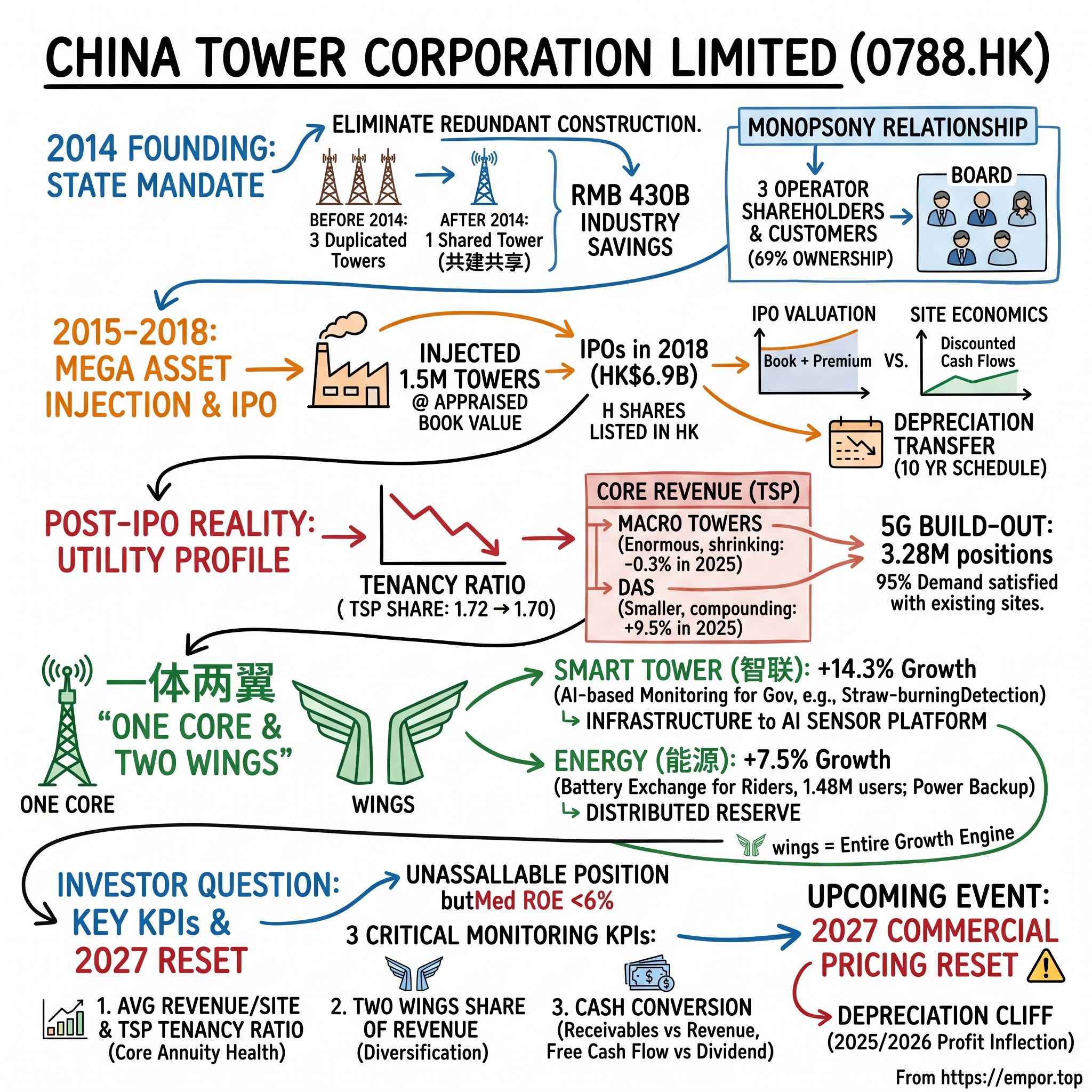
Here is the paradox that makes it worth two hours of your attention. China Tower was created in July 2014 by state design, not entrepreneurial ambition, with a registered capital of RMB 10 billion contributed by the country's three mobile operators.2 Four years later it pulled off the largest initial public offering the world had seen in two years, selling 43.1 billion H shares at HK$1.26 apiece on 8 August 2018.2 And its three largest shareholders — 中国移动 China Mobile, 中国联通 China Unicom and 中国电信 China Telecom, who together still own roughly 69% of the equity — are also, to a first approximation, its only core customers.1
That is not a monopoly. It is something rarer and stranger: a monopoly seller facing a monopsony buyer, where the buyer sits on the seller's board. The company that holds an unassailable position in Chinese tower infrastructure earned a return on its RMB 204 billion of year-end equity of well under 6% in 2025.1 Owning the only bridge in town does not help if the town council sets the toll and also collects it.
It helps to appreciate what "unassailable" means physically. A tower company does not really sell steel. It sells a bundle that is almost impossible to assemble: a legal right to occupy a specific piece of ground or roof, a planning permission, a connection to the electricity grid, a fibre or microwave link back to the network, a structure engineered to hold heavy antennas in a typhoon, backup power for when the grid fails, and a crew that can reach the site within hours. Each element individually is unremarkable. Assembled, at a specific location, at national scale, it is one of the most durable competitive positions in any industry — because a rival cannot buy it, build it quickly, or route around it. Mobile signal is a local good. Whoever controls the good locations controls the market, permanently.
Which is why the economics deserve a second look rather than a shrug. This is not a mediocre business that happens to be big. It is an outstanding business whose surplus is contractually redirected elsewhere, and the distinction matters, because contracts can change while physical positions cannot.
There is a second, more topical puzzle, and it is the one that turns this from a curiosity into a live investment question. In the first quarter of 2026, China Tower's revenue rose 1.5% while profit attributable to shareholders jumped 31.8% to RMB 3,985 million.3 A 32% earnings surge on 1.5% revenue growth is not an operating story. It is an accounting story — and understanding exactly which one is the single most useful thing a long-term investor can do with this company right now.
The same quarter contained the tension in miniature. The tower business, three-quarters of revenue, shrank 1.7%. Indoor coverage grew 7.8%, the Smart Tower business 14.3% and the Energy business 14.1%.3 A shrinking core, a growing periphery, and an earnings line driven by neither.
One more piece of context before the story starts, because it frames how to read every management statement that follows. China Tower is a central state-owned enterprise. Its chairman and general manager are career telecom-system executives appointed through the state personnel process, paid on a state salary scale, and evaluated on national mandates alongside financial results. They are not entrepreneurs pursuing a vision, and the company's disclosure does not read like a founder's letter. It reads like a well-run utility reporting to a regulator — which means the most valuable material is rarely in the strategy language and almost always in the notes.
Four threads run through what follows. First, the state mandate: why 国务院国有资产监督管理委员会 the State-owned Assets Supervision and Administration Commission (SASAC) and the Ministry of Industry and Information Technology decided that three rival operators building three sets of towers up the same hillside was a national waste, and what it means to be a company designed as an industry cost-reduction utility rather than a profit maximiser. Second, monopsony in practice — not as a theoretical bargaining problem but as it actually shows up, in the five-year 商务定价协议 Commercial Pricing Agreements and, more revealingly, in the receivables line of the balance sheet. Third, the 一体两翼 "One Core and Two Wings" pivot: the attempt to convert passive steel into sensor networks and battery-swap hubs, which by 2025 had become the company's entire growth engine. And fourth, the investor question: whether this is a bond substitute wearing an equity's clothes, a captive cost centre for three state giants, or a genuinely optionable platform for edge computing — and what evidence would settle the argument.
To answer any of it, you have to start with a decision made in Beijing in 2014, in which shareholders of China Tower had no say whatsoever, because China Tower did not yet exist.
 Subscribe on LinkedIn
II. State Policy & The Birth of a Monopoly (2014–2015) (00:09:00 – 00:24:00)
Picture the same Yunnan hillside a dozen years earlier. Three construction crews are working within a few hundred metres of each other. Each has negotiated its own land-use right with the same village committee, each has queued separately at the same county planning office for the same permit, each has paid the same provincial grid company to run a separate power line up the same slope, and each will send its own truck up the same dirt track when a rectifier fails. They are not collaborators. They are 中国移动 China Mobile, 中国联通 China Unicom and 中国电信 China Telecom — competitors whose managers are graded on network coverage, and for whom "my signal is better than theirs at this exact spot" is a marketing weapon.
That was the pre-2014 landscape, and its cost structure was absurd in a specific and quantifiable way. The heavy money in a macro cell site is not the radio equipment. It is everything underneath: site acquisition, the negotiation with the landlord, the municipal approvals, the civil works, the mast, the grid connection, the backup power, the fencing, the access road, and the recurring ground lease. In Chinese cities and along its highways and rail corridors, the binding constraint was rarely capital — it was access. There are only so many rooftops with the right sightlines, only so many hilltops, and each one requires a separate negotiation with a separate owner.
Duplicating that base layer three times over is triple-paying for the hardest part of the job. As China moved from 3G to 4G — a build-out that required far denser site grids because higher-frequency spectrum simply does not travel as far — the arithmetic became untenable. Three parallel national networks at 4G density implied a capital programme the state was unwilling to fund three times.
It is worth pausing on why higher frequencies force density, because it recurs throughout this story. Radio waves behave a little like sound: low notes travel through walls and around corners, high notes do not. Low-frequency spectrum covers large areas with few towers but carries less data. The higher-frequency bands that deliver modern data speeds cover a fraction of the area and are stopped by buildings, foliage and rain. Every generation of mobile technology has therefore needed more sites than the last, not fewer — which is why "the network is built" has never once been true, and why the passive layer is the industry's permanent cost centre.
There was a second, less discussed source of friction. Site acquisition in China is a local negotiation conducted by local staff with local counterparties: village committees, property management companies, factory owners, municipal bureaus. It is slow, relationship-dependent, and impossible to centralise. When three operators pursue the same scarce positions simultaneously, they bid up ground rents against each other, and the landlord captures the difference. Consolidating demand into one buyer did not just eliminate duplicate steel; it eliminated a bidding war against the industry's own suppliers.
The intervention. So the state did not encourage sharing. It restructured the industry. In July 2014, under the direction of SASAC and MIIT, the three operators jointly established a new company with registered capital of RMB 10 billion whose entire purpose was to own the passive layer and rent it back to them.2 The mandate was to eliminate redundant tower construction, accelerate national 4G coverage in service of the 网络强国 "Cyber Power" strategy, and enforce 共建共享 co-building and co-sharing as a matter of industrial policy rather than commercial preference.
The genius of the structure — and its curse — was the ownership. The three operators funded it in proportions broadly reflecting their network scale, which meant the new entity was never independent. It was a joint venture of its own customers, a cooperative dressed as a corporation.
This matters more than any org chart usually does, because it determined what the company was optimised to do. An independent tower company exists to extract the maximum sustainable rent from an irreplaceable asset. A cooperative exists to deliver the asset to its members at cost. China Tower was built as the second thing and later asked to behave like the first, in front of international investors who valued it on the assumption it was the first. Almost every subsequent chapter in the story flows from that founding contradiction.
The mandate went further than asset ownership, and this is the part that gave China Tower its permanence: the new company also took over the construction function itself, becoming the entity that builds new macro sites for all three operators rather than merely renting out old ones. Its own long-run tally of more than 6.2 million base station positions constructed is the evidence of what that concentration produced.4 A sharing agreement can be abandoned; a shared subsidiary that has absorbed the entire construction function of an industry cannot be unwound without rebuilding three engineering organisations from scratch. The state did not create an incentive to share. It removed the capability not to.
That cuts both ways for a minority investor, and the ambiguity is worth naming early. Irreversibility is the source of the revenue durability — no operator can walk away. It is also the source of the pricing weakness, because a supplier that cannot be replaced also cannot credibly threaten anything. Bargaining leverage requires an outside option, and by 2015 neither side had one.
What the mandate actually achieved. It is worth being fair to the policy on its own terms, because it worked. By June 2026, chairman 张志勇 Zhang Zhiyong could tell an industry audience that the company had cumulatively built more than 6.2 million base station positions, including 3.28 million 5G positions, and had covered close to 50,000 kilometres of high-speed rail and metro lines. More to the point, he said resource sharing had avoided the construction of 1.27 million duplicate towers and saved the industry more than RMB 430 billion.4
Read that number twice, because it is the whole thesis in one statistic. RMB 430 billion of savings — against a company whose own market capitalisation sits near HK$173 billion — did not accrue to China Tower.5 They accrued to its customers. The value created by the mandate was, by design, transferred through to the three operators and ultimately to Chinese mobile subscribers. China Tower was the mechanism, not the beneficiary.
For an investor, this is the founding fact to carry through the rest of the story. When you evaluate a Western tower company, you ask how much of the value it creates it can keep. When you evaluate China Tower, you have to ask a prior question: was it ever permitted to keep any?
The fair answer is: some, but the amount was always going to be decided politically rather than commercially. And there is a defensible logic to that from the state's point of view. The three operators are themselves state-owned; so is China Tower; so is the ultimate shareholder. Moving profit from one pocket to another achieves nothing for the state as a whole — what matters is total system cost, national coverage, and the price consumers pay. Under that objective function, transferring surplus from the tower company to the operators is not value destruction. It is indifference.
The only party for whom it is not indifferent is the holder of the roughly quarter of the equity that trades in Hong Kong.
The answer began to take shape in the autumn of 2015, when the towers themselves changed hands.
III. The Mega Asset Injection & The $6.9B HKEX IPO (2015–2018) (00:24:00 – 00:41:00)
Consider the mechanics of what happened next, because it was one of the largest asset transfers in the history of the telecommunications industry and it was executed almost entirely between related parties.
In October 2015, the three operators injected their existing tower portfolios into China Tower in a transaction valued at roughly RMB 214 billion. Barclays estimated it covered about 1.5 million towers; the operators did not disclose the site count themselves. The assets were transferred at appraised values that carried premiums over book value of 20% for China Mobile, 18.1% for China Unicom and 17.6% for China Telecom, generating one-off accounting gains for all three. China Tower paid with a mix of newly issued shares and cash, and afterwards the operators held 38%, 28.1% and 27.9% respectively.6 The company's registered capital rose to RMB 129,345 million, and a fourth shareholder appeared: China Reform Holdings, a state-owned investment vehicle, which took a stake alongside the operators.2
Two features of this deal deserve attention.
The valuation was struck against book value, not against tower economics. A premium to depreciated historical cost is a fundamentally different animal from a premium to the discounted cash flows an independent tower operator could generate from the same steel. Independent tower companies in the United States and Europe were, in the same era, being valued on multiples of site-level cash flow that implied per-site values far above accounting cost, because those cash flows came with long leases and contractual escalators. China Tower bought at appraised book plus a high-teens premium — and simultaneously accepted a rental agreement with its sellers that contained neither long duration nor escalators. In effect the sellers received an immediate accounting gain and handed over the depreciation burden of a two-million-site asset base, while retaining the right to negotiate the rent every five years. Whatever else you call that, it was a very good trade for the operators.
The introduction of China Reform mattered structurally. Bringing in a state financial shareholder diluted the operators' direct control and — importantly for the eventual listing — gave the company a shareholder whose interests were financial rather than operational. It was the first faint signal that the state intended this entity to eventually face public markets.
There is a third feature that only becomes visible with hindsight: the transaction fixed the company's cost base at a moment of the sellers' choosing. China Tower did not build those two million towers and did not negotiate those two million ground leases; it inherited them at an appraised price it had no realistic ability to contest, since the counterparties were its own shareholders and the outcome had been decided at a level above the company. Whatever the appraisal methodology, no arm's-length buyer was in the room to test it. For an investor assessing the eventual returns on that capital, this is the single most important thing to know about the asset base: its book value was set administratively, so the return on it was, in a meaningful sense, set administratively too.
The listing. That came on 8 August 2018. China Tower sold 43,114,800,000 H shares at HK$1.26 each, raising HK$54.3 billion, or about US$6.9 billion — the world's largest IPO since Postal Savings Bank of China two years earlier. An over-allotment exercised on 6 September lifted aggregate gross proceeds to approximately HK$58.8 billion.2 The pricing sat at the very bottom of the HK$1.26 to HK$1.58 indicative range, valuing the company at HK$217.3 billion.7
The reception told you exactly who believed what. The international institutional tranche was covered several times over. The Hong Kong retail tranche was barely covered at all: roughly 2.16 billion retail shares drew orders worth about HK$4.5 billion, against HK$8.3 billion of retail demand for the Postal Savings Bank deal in 2016.7 Global infrastructure funds bought the asset — the irreplaceable footprint, the guaranteed baseline occupancy, the coming 5G density cycle. Hong Kong retail investors, who tend to understand Chinese state-owned enterprise dynamics from lived experience, largely passed.
The depreciation transfer was the hidden term of the deal. When you buy two million towers at appraised book value plus a premium, you inherit a depreciation charge calibrated to that price. For China Tower, the 2015-vintage assets were depreciated over ten years, which meant the company would carry an enormous non-cash expense against its income statement for a decade — suppressing reported profit, depressing return on equity, and making the stock look permanently expensive on an earnings basis while its cash generation was perfectly healthy. The sellers booked their gains in 2015. The buyer booked the offsetting cost in annual instalments through 2025. Nobody hid this; it was simply a term that mattered far more over time than it appeared to at signing, and it is the reason the company's reported profitability and its cash profitability have told two different stories for the entirety of its listed life.
The pitch versus the reality. The bull case sold to institutions in mid-2018 had four legs: insurmountable barriers to entry, stable and predictable cash flows, a 4G coverage tailwind, and a 5G super-cycle in which three operators would need vastly more sites. Three of those four turned out to be true. Barriers to entry proved absolute. Cash flows proved stable. 5G did drive an enormous construction programme.
There is a lesson in that split reception that generalises well beyond this deal. The institutional tranche was buying an asset class: infrastructure, hard assets, long duration, defensive cash flows, a familiar template imported from American Tower and Cellnex. The retail tranche in Hong Kong was pricing a relationship: a state-owned supplier selling to state-owned customers who owned it, in a jurisdiction where minority shareholders in such structures have learned what to expect. Eight years later, the local money's read on the governance turned out to be the better guide to returns than the global money's read on the asset.
The fourth leg — that any of this would translate into rising rent per site — did not hold. And here is the eight-year scoreboard, stated plainly: at HK$9.90 on 29 July 2026, and adjusting for the ten-to-one share consolidation completed in February 2025, the H shares traded around a fifth below their IPO price, with a market capitalisation of roughly HK$173 billion against HK$217.3 billion at pricing.517 Investors who have made money on China Tower have made it entirely from dividends, and mostly in the last two years.
The path was not a straight line down, either. The shares have been volatile within the past twelve months alone, ranging from HK$8.66 to HK$12.85 — the high sitting just above the consolidation-adjusted IPO price before the stock gave the gain back, leaving it down about 14% over the year to late July 2026.14 That round trip is itself informative: the market is willing to re-rate this company toward its listing valuation when the depreciation and dividend story is in focus, and unwilling to hold it there. Something keeps pulling the multiple back, and the 2027 calendar is the obvious candidate.
The years in between are worth compressing into one arc. Through the post-listing period the pattern repeated with unusual consistency: volumes up, revenue up modestly, profit up faster than revenue off a small base, cash flow solid, share price flat. By 2023 revenue reached RMB 94,009 million, up 2.0% on the year, with operating profit of RMB 14,502 million, profit attributable to owners of RMB 9,750 million and EBITDA of RMB 63,551 million.8 Those are the numbers of a utility, not of an infrastructure compounder — mid-single-digit percentage profit growth on low-single-digit revenue growth, achieved through cost control rather than price. An investor who bought at the IPO for the 5G cycle got the 5G cycle in full and got very little for it.
Why the shares went nowhere for the better part of a decade is not a story about 5G volumes. It is a story about the contract. The tower story and the rent story diverged, and to see how, you have to look at what the core engine actually earns per site.
IV. Core Engine Economics: Macro Towers, DAS, & Tower Sharing (00:41:00 – 01:02:00)
Walk into a Shanghai metro tunnel between trains and look at the wall. Running along it is what appears to be a thick black cable with slots cut into its outer shield at regular intervals. That is leaky coaxial cable — a length of coax deliberately engineered to be a bad cable, radiating signal along its whole length so that a train full of passengers moving at 80 km/h keeps a connection where no tower could ever reach. Multiply it across 19,373 kilometres of railway tunnels and 14,288 kilometres of subways, and add antennas seeded through the ceilings of 15.15 billion square metres of buildings, and you have China Tower's second business.1
The core engine has two halves, and in 2025 they moved in opposite directions.
The tower half is enormous and shrinking. Revenue from the Tower business was RMB 75,498 million in 2025, down 0.3% from RMB 75,689 million.1 Roughly three-quarters of the company's revenue declined slightly in a year when its physical footprint expanded.
The indoor half is smaller and compounding. The DAS business — distributed antenna systems, the in-building and in-tunnel coverage layer — grew 9.5% to RMB 9,227 million, with building coverage up 19.5% and railway tunnel coverage up 19.7%.1 Together the two make up the TSP business (telecom service provider business), which reached RMB 84,725 million, up just 0.7%.1
Why is the indoor business growing when the outdoor one is not? Because indoor coverage is the one place where the sharing logic has not yet been exhausted. A macro tower on a hillside can be shared once and then it is shared. A shopping mall, a hospital, an airport concourse, an underground car park, an elevator shaft and a high-speed rail tunnel each represent a separate, previously unserved volume of space where the signal from outside simply does not reach — and there are a very large number of them. China Tower has been pushing specifically into these awkward pockets, promoting cheaper engineering approaches such as shared low-power repeaters, spread-spectrum leaky coaxial cable and shared frequency-shifting systems that let one installation serve several operators at once, and it has been retrofitting existing high-speed rail lines for 5G.1 Regulatory tailwinds help: a technical standard for mobile communication infrastructure engineering in buildings and a co-building policy issued by MIIT and thirteen other departments push developers toward shared indoor systems rather than operator-specific ones.1 This is the closest thing in the company to an organically growing, policy-supported market where it holds the natural advantage.
Now the sharing mechanism, in plain terms. A macro tower's costs are almost entirely fixed and almost entirely incurred before the first tenant switches on: the land lease, the permits, the foundation, the mast, the grid connection, the fence, the road. The second tenant needs a mounting bracket at a different height, some additional power capacity and a bit more space in the equipment cabinet. That incremental cost is a small fraction of a new build, and essentially none of the fixed base cost repeats. So each additional tenant on an existing site carries a dramatically higher margin than the first. This is why "tenants per site" — 共享率, the tenancy ratio — is the single most important physical metric in the tower industry worldwide. It is the occupancy rate of a very unusual kind of real estate.
Which brings us to the most important operating fact of China Tower's 2025, and one that runs directly against the consensus narrative.
The tenancy ratio went backwards. The overall ratio slipped from 1.81 tenants per site to 1.79, and the TSP tenancy ratio — operator tenants only — fell from 1.72 to 1.70. Sites grew 2.6% to 2.149 million while operator tenants grew just 0.6%, adding only about 23,000 net operator tenants in the whole year.1 Average annual revenue per site declined 1.2%, from RMB 40,870 to RMB 40,382.1
Sit with that for a moment. The mechanism that was supposed to drive margin expansion for a decade — more tenants layered onto the same steel — has stalled and mildly reversed. And the reason is visible in the company's own disclosure: during 2025 China Tower completed roughly 364,000 5G construction orders, and more than 95% of that construction demand was satisfied using existing site resources.1
That single sentence explains almost everything. Sharing has worked so well that the operators can now add capacity almost anywhere without paying for a new site — and when they do need a new one, it is increasingly in a location so marginal that only one operator wants it. The sharing flywheel did not break. It finished. The easy co-location has been harvested, and incremental sites are being added at the thin end of the distribution, which mathematically drags the average down.
The deterioration also happened during the year, which makes it harder to dismiss as a rounding artefact. At the half-year mark the overall tenancy ratio still stood at 1.81, with 2.119 million sites and 3.844 million tenants; six months later the site count had grown by another thirty thousand while the ratio had slipped to 1.79.131 The second half of 2025 added sites faster than it added tenants. Where the company chose to grow — borders, forests, grasslands, rural areas and high-speed rail corridors under national coverage-extension programmes — is exactly where single-tenant economics live.1 That is not mismanagement; those programmes are part of the mandate. But an investor should be clear that the marginal site China Tower builds today is materially less profitable than the average site it already owns, and that the mandate obliges it to keep building them.
The evidence, then, does not support the idea of a continuing margin-expansion engine in the core. It supports something closer to a mature utility: a very large, very durable, very slightly shrinking rental annuity, with the growth now coming from the indoor layer and from businesses that have nothing to do with mobile operators.
A note on where the cost pressure comes from. If pricing is set by contract and utilisation has plateaued, the only remaining margin lever is cost — and the costs are moving the wrong way. Site operation and support expenses rose 11.3% in 2025, partly because the company has been building out base station access transmission and digital operating capability, and repairs and maintenance rose to RMB 7,103 million as the company extended the service lives of ageing assets and ran remediation programmes on potential structural hazards.1 Other operating expenses jumped 23.5%, driven by business development spending to support the newer segments and a larger bad-debt charge.1
The pattern is coherent and slightly uncomfortable: a mature core with flat-to-declining pricing, an ageing physical fleet requiring more attention, and a growth push that costs money to run. Cost discipline can hold the line for a while — EBITDA margins in the mid-sixties prove it has — but it cannot substitute for price indefinitely.
On market share and the competition question. China Tower's dominance of Chinese macro towers is effectively structural rather than competitive — it was created by transferring the incumbents' assets into it. A handful of small independent operators exist, but none has the regulatory integration, the site portfolio, or the operator relationships to matter at scale, and none is disclosed as a material competitor in the company's own reporting. The relevant competitive threat is not another tower company. It is the operators' ability to satisfy demand without adding a tenancy at all — through spectrum refarming, software capacity gains, small cells on their own street furniture, or in-building systems they build themselves.
The Western contrast, stated precisely. The instinctive comparison is that American Tower and its peers have fat margins and China Tower does not. That is wrong, and the correction is illuminating. China Tower's 2025 EBITDA margin was 65.5% — entirely respectable by global tower standards.1 Its balance sheet is far more conservative than the Western model: net debt of RMB 78,148 million against EBITDA of RMB 65,814 million is roughly 1.2 times, where the US towercos deliberately run near five times to manufacture equity returns.1 The real gap is not operating margin or even leverage. It is contract architecture: long leases with contractual annual escalators versus a five-year price agreement negotiated with your own shareholders, in which the direction of travel has been down.
Which means the crux of this business is not in the field. It is in a negotiating room.
V. The Captive Supplier Paradox: Master Lease Agreements & Monopsony Power (01:02:00 – 01:20:00)
Imagine the meeting at the end of 2022. On one side of the table, China Tower's management, whose 5G construction programme has just added hundreds of thousands of tenancies. On the other, the procurement and finance teams of three operators carrying the heaviest capital expenditure burden in their history, all under SASAC pressure to improve returns. And on the wall behind both sides, invisible but decisive, the shareholder register — because the people negotiating the price down are also the people who will vote on the dividend.
Out of that meeting came the current commercial architecture: three 2023–2027 Commercial Pricing Agreements, one with each operator, setting the updated pricing of the products and services China Tower provides, bundled with three service agreements into a set of six 2023–2027 Service Framework Agreements running from 1 January 2023 to 31 December 2027.1 In its 2023 results the company described the outcome as continuing to provide customers with "quality services at more attractive prices" and framed it as strengthening competitive positioning.8 In the language of state-owned enterprise disclosure, "more attractive prices" is not a phrase a supplier uses about a favourable renegotiation.
How the pricing actually works, conceptually. Rent for a site is built from a base charge reflecting the tower and its capacity, plus pass-throughs and service elements covering ground rent, electricity and maintenance. Layered on top are co-location discounts that deepen as more operators share a site. The logic is elegant from a policy standpoint: the discounts make sharing individually rational for each operator, so the national mandate is enforced by price rather than by decree. The consequence for the landlord is that it funds the incentive. Every incremental tenant that improves China Tower's utilisation also triggers a discount that gives much of the benefit back. The specific discount percentages under the current agreements are not disclosed in the company's published reporting.
Think about what that structure does to the sharing flywheel described earlier. In an independent tower model, the second tenant is nearly pure profit — the landlord keeps the incremental margin and the tenant pays roughly market rent because its alternative is building its own site. In China Tower's model, the second tenant triggers a discount for both tenants. The utilisation gain is real, but it is split with the customers by contract. This is the single most important economic distinction between China Tower and every Western tower company, and it explains why a company that has raised its tenants-per-site over a decade has not translated that into rising revenue per site. The operating leverage was designed to leak.
A second mechanism worth understanding: the annual caps. Because the operators are connected parties under Hong Kong listing rules, the transactions between them and China Tower are governed by disclosed annual caps — maximum aggregate amounts for each category of dealing, approved by independent shareholders. In practice these caps become a public ceiling on how much business each operator expects to do, and they get revised when volumes run ahead of expectations. It is a genuine protection: minority holders get visibility and a vote on the framework. It is also a reminder of the underlying reality, which is that essentially the entire income statement is a related-party transaction subject to procedural rather than commercial discipline.
Now for the part of this story that receives far too little attention, and that a skeptical investor should look at first.
Monopsony shows up on the balance sheet, not just the income statement. When the new agreements took effect, China Tower's trade receivables exploded — from RMB 38,350 million at the end of 2022 to RMB 67,543 million a year later. Free cash flow for 2023 collapsed to RMB 1,125 million. The company's explanation was operational: the new agreements required upgrading the charging system, verifying data for all orders and renegotiating service standards, which delayed collections in the first half before recovering in the second.8 Also buried in that year's notes: commercial acceptance bills held within trade receivables rose from RMB 7,792 million to RMB 18,922 million.8 Commercial acceptance bills are, in plain terms, corporate IOUs. The operators had begun settling in paper rather than cash.
Three years later the pattern has not normalised, it has migrated. At the end of 2025, trade and bills receivables net of provisions stood at RMB 81,840 million, against annual revenue of RMB 100,411 million.1 Bills receivable fell sharply, from RMB 35,536 million to RMB 13,549 million — but gross trade receivables leapt from RMB 48,034 million to RMB 74,113 million.1 The IOUs were replaced by simply owing the money. Of the gross balance, China Mobile's group accounted for RMB 35,687 million, China Unicom's RMB 12,901 million and China Telecom's RMB 10,964 million.1
The ageing is the tell. Amounts outstanding beyond one year totalled roughly RMB 19.1 billion at the end of 2025, up from about RMB 11.1 billion a year earlier, and the allowance for expected credit losses rose to RMB 5,822 million from RMB 4,134 million, with the year's bad-debt charge up RMB 546 million.1 All of this sits against stated credit terms of one to six months.1
What that evidence means. China Tower recognises revenue on schedule and collects when its customer-owners choose to pay. Roughly four-fifths of a year's revenue is sitting in receivables, a meaningful slice of it more than twelve months old, owed overwhelmingly by three state-owned enterprises that are also its controlling shareholders and cannot plausibly be sued by their own subsidiary. This is monopsony power expressed as a working capital transfer — an interest-free loan from the listed vehicle to its parents, funded in part by the listed vehicle's own borrowings. It is the first thing an activist would put on a slide, and the company's own auditors have flagged the adjacent risk: KPMG identified revenue recognition under the Commercial Pricing Agreements and Service Framework Agreements as a key audit matter for 2025, testing pricing terms and order-level data with computer-assisted techniques.1
Two counterarguments deserve a hearing. The first is that the credit quality here is exceptional. These are not distressed customers — they are three of the largest and most profitable state-owned enterprises in China, and the probability of an actual write-off is very low. The provisioning is prudence, not distress. That is fair, and it is why the situation has not produced a crisis.
But it misses the point about cost. Financing roughly RMB 82 billion of customer balances for a company carrying RMB 90 billion of interest-bearing debt means shareholders are paying interest so that customers can defer payment.1 The transfer is not a credit loss; it is a permanent margin leak that never appears as a line item anywhere on the income statement.
The second counterargument is that some of the receivables build reflects the growth of the newer businesses, where government and enterprise customers pay slowly too. That is also partly true, and the rise in non-operator receivables supports it. But the great majority of the balance sits with the three operators, and the operators' share of the balance grew faster than their share of revenue.
The governance geometry. The board formalises the conflict rather than resolving it. Six non-executive directors nominated by the shareholder operators and China Reform sit alongside two executive directors and four independents, and the non-executive directors received no remuneration from the company at all in 2025.1 They are not paid to represent China Tower. They are employees of the customers. Independent directors and the related-party transaction framework provide procedural protection, but the underlying economics are set by parties on both sides of the table.
The result is a return profile that behaves like a regulated tariff rather than a competitive outcome. On RMB 203,993 million of year-end equity, 2025 profit attributable to owners of RMB 11,630 million works out to a return of under 6%, and that is after a year in which reported profit rose 8.4%.1 For a business with an unassailable market position, near-monopoly share and 65% EBITDA margins, that is not a competitive result. It is an administered one.
Which raises the obvious question: if the core cannot earn more, where does growth come from? Management's answer has a name, and it involves pointing cameras at farmland.
VI. "One Core and Two Wings": Smart Tower & Energy Diversification (01:20:00 – 01:38:00)
In spring, across the North China Plain, farmers burn crop stubble to clear fields. It is illegal, it is difficult to police across millions of hectares, and it materially worsens regional air quality. Detecting it requires an elevated vantage point, a camera, a power supply, a data link and software that can distinguish a straw fire from a cooking fire.
China Tower had 2.1 million elevated vantage points with power and fibre already attached. Straw-burning surveillance is now one of its named growth markets.1
This is the "Two Wings" of 一体两翼 — the core tower business as the body, with two non-telecom businesses as wings. In 2025 the wings generated RMB 14,985 million, or 14.9% of revenue, up 1.2 percentage points as a share of the total.1
Wing one: 智联业务 the Smart Tower business. Revenue crossed RMB 10 billion for the first time, reaching RMB 10,172 million, up 14.2%, with Tower Monitoring — the camera-and-analytics product — contributing 62.2% of that.1
The concept is easier than the jargon. A telecom tower is a passive object: steel that holds antennas. A 数字塔 "digital tower" is the same steel with sensing and computing bolted on — high-definition cameras at mid-to-high mounting points, feeding a nationwide distributed monitoring platform that runs recognition algorithms and flags events. By the end of 2025, roughly 252,000 towers had been upgraded this way, and the company reported drawing on more than 900 million unique mid-to-high-point images to train and refine its algorithms.1
The customer list is almost entirely governmental, and specific: farmland protection and mine supervision for natural resource authorities; the national natural disaster early warning network and earthquake monitoring network for emergency response; straw-burning detection for environmental protection; river and lake governance, dam monitoring, flood warning and irrigation digitalisation for water conservancy; lineside surveillance for railways.1 The company's spatial digital intelligence models were included in the first batch of strategic high-value AI application scenarios designated by SASAC across 40 central state-owned enterprises.1
Is the competitive advantage real? Partly, and it is worth separating the durable part from the rhetorical part. The durable part is genuine: a competitor that wanted to build a national high-point sensing network would need elevated positions with secured land rights, guaranteed power, backhaul and a maintenance organisation in every county. That is a decade of work and precisely the asset China Tower already has fully depreciated. No software startup replicates it.
The part that deserves scepticism is the revenue quality. Nearly two-thirds of Smart Tower revenue is monitoring sold to government agencies, which means project-based procurement tied to government budgets, exposed to fiscal tightening at the provincial and municipal level. And the collection risk is not hypothetical: receivables from customers other than the three operators rose to RMB 14,561 million at the end of 2025 from RMB 11,509 million.1 Growing a government-facing services business into a period of local fiscal strain is a real execution risk, not a theoretical one.
There is also a growth-rate signal that management has not addressed directly. Smart Tower revenue grew 18.7% in the first half of 2025 but 14.2% for the full year — which means the second half grew appreciably slower than the first.131 By the first quarter of 2026 the rate was 14.3%.3 A business at RMB 10 billion of revenue decelerating from the high teens toward the mid teens is still growing well, but the trajectory matters enormously for the bull case, which rests on this segment eventually becoming large enough to change the company's character. Deceleration at 10% of revenue arrives long before scale does.
Wing two: 能源业务 the Energy business. Revenue reached RMB 4,813 million, up 7.5%, split between 智换电 battery exchange at RMB 3,029 million — growing a healthy 21.2% — and power backup at RMB 1,784 million, up 7.7%.1 Battery exchange users reached about 1.477 million, an increase of 173,000 during the year.1
The insight behind battery swapping is neat. China's food-delivery and courier riders run electric two-wheelers hard — roughly 13 million riders averaging around 120 kilometres a day, needing two or three battery changes daily. Charging is slow, and charging cheap lithium packs in stairwells has caused enough fires that regulators have pushed hard against it. Swapping solves both: the rider pulls a depleted pack out of a street-side cabinet, drops in a charged one, and rides on. China Tower already had power infrastructure, site access and a battery supply chain from its own backup systems.
The second half of the Energy wing is less glamorous and arguably more defensible. Every tower site carries backup batteries so the network survives a grid outage. Aggregate two million such installations and you have a distributed reserve of stored power, plus the engineering organisation that maintains it. China Tower sells that capability outward as backup and standby power to hospitals, schools and industrial customers, wrapped in a monitoring platform that also covers photovoltaic generation, diesel generation and energy consumption management.1 It is a services business layered on assets the company had to own anyway — closer in spirit to the digital tower logic than to consumer battery swapping, and it grew a modest 7.7% in 2025.1
The pitfalls of the swapping business are equally clear. This is a capital-intensive consumer subscription business built on a degrading asset — lithium packs lose capacity with every cycle and must be replaced. The economics depend on cabinet utilisation and battery lifetime, neither of which the company discloses. Competition is real: independent operators including 哈啰 Hello's power network and Immotor compete for the same rider base, and industry battery deployment actually declined slightly in 2024 even as revenue grew, which suggests a market fighting over utilisation rather than one expanding freely.9 The company has been steering capital here: facilities for the Smart Tower and Energy businesses absorbed RMB 5,970 million of 2025 capital expenditure, 20.2% of the total, up from 15.0% a year earlier.1
The research spending deserves a flag, in both directions. In 2025 the company increased research and development investment by 82% and R&D headcount by 22%, with patent applications up 77% and cumulative patent grants up 54%, and it operates six regional technology innovation centres.1 For a business historically described as a landlord, that is a real change in behaviour, and it is consistent with the digital-tower ambition rather than merely rhetorical.
The sceptical reading is equally valid: an 82% increase in R&D at a company whose core revenue is declining is a bet, and bets at state-owned enterprises are not always disciplined by return thresholds. The company has not disclosed the absolute R&D figure as a percentage of revenue in a way that allows a clean comparison with technology peers, nor has it published returns by segment. Investors are being asked to accept the spending on faith for now, with the patent counts as the only external evidence of output.
Now the sizing, which is the analytically decisive point. Total revenue rose RMB 2,641 million in 2025. The Two Wings contributed about RMB 1,598 million of that increase — roughly three-fifths. DAS supplied most of the rest. The tower business subtracted from it.1
So the honest framing is neither the bull's nor the bear's. The wings are not yet large enough to re-rate the company — at 14.9% of revenue they cannot offset a bad pricing reset. But they are already the entire growth engine, and have been for at least two years. Whether that engine is worth a higher multiple depends on questions that remain open: whether government monitoring contracts recur or churn, whether battery assets earn their replacement cost, and whether either business can grow into a fiscally tighter environment. Management asserts all three. The published evidence supports growth in revenue; it does not yet establish returns.
Which makes the question of who is steering the capital, and how they are measured, unusually important.
VII. Current Management, SASAC Oversight, & Capital Allocation (01:38:00 – 01:50:00)
There is a detail in the 2025 annual report that tells you more about how this company works than any strategy slide. The chairman's total remuneration for the year — salary, allowances, bonus and social insurance contributions combined — was RMB 742,000. The general manager's was RMB 746,000.1 Roughly US$100,000 each, to run a business with 2.1 million sites and RMB 100 billion of revenue.
张志勇 Zhang Zhiyong, aged 60, has been an executive director and chairman since September 2021, having joined the board as a non-executive director in May 2018. His career is a tour of the China Telecom system from the ground up: director of the Qinhuangdao Telecommunications Bureau in 1999, then running the Qinhuangdao and Beijing operations, then general manager of China Telecom's Xinjiang branch, then its Beijing branch, then executive vice president of China Telecom and vice president of its parent. In between he ran China Communications Services, first as general manager from 2008 and later as chairman from 2018 to 2021. He trained as a wireless communications engineer at the Changchun Institute of Posts and Telecommunications and later took a master's in management at BI Norwegian Business School.1
陈力 Chen Li, aged 58, became general manager in April 2024 and an executive director the following month. His career is the mirror image: two and a half decades inside China Mobile's provincial companies — Hubei, Anhui, then chairman and general manager successively of the Qinghai, Liaoning and Shanghai operations, the last of which he ran for eight years until moving across.1
Notice the pairing. The chairman is a China Telecom man. The general manager is a China Mobile man. That is not coincidence; it is the shareholder balance made flesh. The company's two most senior executives were formed by two of its three customers, and both spent their careers being measured on network coverage and cost — the exact metrics that make a good customer-side executive and a compliant supplier.
On the finance side, the outline circulating among investors that names a chief financial officer is out of date on both the title and the person. The senior executive responsible for finance is 胡少峰 Hu Shaofeng, aged 58, the company's chief accountant since April 2022, whose background is in the railway engineering and signalling sector — chief accountant of China Railway Track Systems, then of China Railway Signal & Communication.1 The distinction matters slightly: a chief accountant in a Chinese state-owned enterprise is a stewardship and compliance role more than a capital markets one.
The incentive problem, with receipts. The standard claim is that China Tower's executives have no equity incentives, only SASAC performance evaluations. That is nearly right but misses a far more interesting fact. The company does have a Restricted Share Incentive Scheme, adopted at the 2018 annual general meeting held on 18 April 2019, with a ten-year term, aimed at directors, senior management and core technical staff. The grant price was set at the higher of RMB 1.03 and half of a reference price benchmarked to the H share close of HK$2.20 on 18 April 2019.1
Every tranche failed. The restricted shares entered their first unlocking period in 2021 and did not unlock, because 2020 revenue missed the target; 40% of the granted interests were bought out by the trustee at the grant price. They entered a second unlocking period in 2022 and did not unlock, because 2021 revenue missed; another 30% was bought out. They entered a third in 2023 and did not unlock, because 2022 revenue missed; the final 30% was bought out.1
That is a complete, documented failure of a long-term incentive plan across three consecutive measurement years. It is also, read fairly, a genuine data point about target-setting discipline: the targets set in 2019 were not sandbagged, they were simply missed — three times, in the middle of the 5G build-out that was supposed to be the company's growth era. Management has not restated the scheme's history or reframed the misses; the annual report walks through each failed unlocking plainly.1 Transparency, yes. But it also means the people running the company have had no equity-linked upside for seven years, and are compensated at a level where the dividend they declare has almost no bearing on their own wealth.
Capital allocation: the boring part is the good part. Capital expenditure fell 7.7% to RMB 29,486 million in 2025, and its composition shifted meaningfully: new site construction and augmentation dropped to 51.3% of the total from 56.3%, site replacement fell to 18.6%, and the Two Wings share rose as described.1 Operating cash flow reached RMB 56,116 million, up RMB 6,648 million, and free cash flow rose RMB 9,103 million to RMB 26,630 million.1 The gearing ratio fell 3.3 percentage points to 27.7%, with interest-bearing liabilities of RMB 90,460 million.1
Shareholder returns followed the cash. The 2025 distribution totalled RMB 0.45789 per share pre-tax — an interim of RMB 0.13250 plus a final of RMB 0.32539 — equal to a payout ratio of 77% of distributable net profit, with the final dividend paid on 30 June 2026.110 The company repurchased no shares during 2025 and held no treasury shares.1
The direction of travel here has been genuinely shareholder-friendly and represents the clearest example of management doing what it said it would. The company only began paying an interim dividend in 2024, adding a second annual payment where there had been one, and the declared amount has grown roughly 14% over the past year, leaving the shares yielding about 5.4% at the end of July 2026.513 Rising payout ratios, a new interim distribution, falling leverage and no share issuance is a coherent capital-return policy, executed over several years, in a market where state-owned enterprises are not always generous to minority holders. On capital discipline specifically, the behaviour has matched the narrative.
One capital markets manoeuvre deserves a sceptical footnote. In November 2024 the board proposed consolidating every ten shares into one and reducing issued share capital from RMB 176,008,471,024 to RMB 17,600,847,102. Shareholders approved it in December and it took effect on 20 February 2025.1 The stated purpose was to optimise the capital structure. What it actually did was move the quoted price from around one Hong Kong dollar to around ten, which changes how the stock screens and how it reads to institutional allocators without altering a single cash flow. It is cosmetic — not objectionable, but worth recognising as presentation rather than substance.
A word on the incentive gap that remains. With no functioning equity scheme and salaries below a million renminbi, the practical incentive structure for China Tower's leadership is the state performance evaluation system: profit growth, return on equity, risk control, and delivery of national digital infrastructure objectives. That produces a specific behavioural profile, and the company's record matches it well — conservative leverage, steady dividend increases, careful cost management, reliable delivery of coverage mandates, and no adventurous acquisitions.
What that structure does not produce is aggressive pursuit of shareholder value against the interests of the controlling owners. An executive whose evaluation includes national mandates and whose compensation is unaffected by the share price has no personal reason to fight hard in a pricing negotiation with three shareholder-customers. That is not a criticism of the individuals; it is an observation about what the system is built to reward, and investors should calibrate their expectations for the 2027 negotiation accordingly.
Who owns it now. The register at the end of 2025 showed China Mobile at 27.93%, China Unicom at 20.65%, China Telecom at 20.50% and China Reform at 4.41%, with H shares making up 26.51%.1 Among H shareholders, BlackRock disclosed 6.15% of the class and Singapore's GIC 5.99% — meaningful positions from two of the world's most patient institutional pools, which is a mild vote of confidence in the yield thesis, though neither is large enough to influence a company controlled 69% by its own customers.1
The record, then, is of a management team that has been disciplined with cash and unsuccessful with growth targets, operating under constraints it did not set. Which is exactly why the strategic frameworks are worth applying carefully rather than mechanically.
VIII. Business Playbook & Strategic Frameworks (01:50:00 – 02:04:00)
War-game this business from the outside and something odd happens: it scores brilliantly on almost every structural test, and the score does not translate into returns. Running the standard frameworks properly means explaining why.
Hamilton Helmer's 7 Powers.
Scale economies — strong, but deliberately shared. The fixed-cost absorption across land leases, grid connections and maintenance crews at 2.1 million sites is unmatched anywhere in the industry. The complication is that the co-location discount structure hands most of the benefit to the customer by design. Scale here reduces industry cost rather than capturing producer surplus — the RMB 430 billion of savings attributed to sharing is the measure of a power that exists and is systematically given away.4
Cornered resource — strong and the most durable of the powers. Site access in Chinese cities, along rail corridors and on rural high points is genuinely unobtainable at scale for a new entrant. The proof is in the operators' own behaviour: over 95% of 2025's 5G construction demand was met from existing sites, because the alternative — acquiring new positions independently — is slower and dearer than paying rent.1
Switching costs — strong at the site level, weak at the portfolio level. Moving a live radio installation to a different structure costs capital, causes downtime and degrades coverage, so individual sites are sticky. But the operators do not need to switch sites to hurt China Tower. They only need to renegotiate the price of staying, which they can do every five years.
Counter-positioning — absent, and structurally impossible. A company cannot adopt a business model its owners find threatening when those owners are also its customers.
Branding and network economies — essentially absent. Three customers do not generate network effects, and infrastructure rented under a state mandate does not command a brand premium.
Process power — emerging and unproven. The genuine candidate is the operational machine: independent site selection, national maintenance, the "One Plane" planning system, and the algorithm platform behind digital towers.1 The AI monitoring capability is the one place the company might build something replicable-only-with-difficulty. It is too early to call it a power.
Porter's five forces.
Buyer power — extreme, and the defining feature. The TSP business was 84% of 2025 revenue, and the buyers are the controlling shareholders.1 The receivables evidence shows this power operating not just on price but on payment timing.
Threat of new entrants — negligible. Capital intensity, land rights and regulatory integration make entry implausible.
Supplier power — moderate and underrated. Landlords, provincial grid companies and electricity providers hold genuine local leverage over ground rent and power costs. There is a structural quirk here: the company pays certain site electricity charges on behalf of the operators and is later reimbursed, with RMB 4,136 million sitting in other receivables for such payments at end-2025 — meaning it also finances its customers' utility bills.1 Site operation and support expenses rose 11.3% in 2025 and repairs and maintenance 1.6%, both faster than revenue.1 Input costs are rising against flat pricing.
Substitutes — low today, worth monitoring. Satellite direct-to-device is the headline threat and the reality check is useful. As of mid-2026, China's two big constellations — Guowang, operated by 中国星网 China SatNet, and 千帆 Qianfan — had roughly 350 to 380 satellites in orbit combined, both behind schedule on launch capacity, with direct-to-cell still at test-satellite stage after a Qianfan launch in June 2026 carried a dedicated test payload alongside a China Mobile satellite.11 Satellites will matter for coverage in oceans, deserts and mountains. They do not deliver the capacity density a Shenzhen shopping mall needs. The nearer-term substitution risk is more mundane: spectrum refarming, software capacity gains, small cells on operator-owned street furniture, and building owners installing their own indoor systems.
Rivalry — minimal, and that is precisely the problem. Zero rivalry has not produced pricing power, which is the cleanest possible demonstration that market structure alone determines nothing about returns.
The peer comparison, done properly. Set China Tower beside American Tower, Crown Castle and Cellnex and the differences are not where investors assume. All four own irreplaceable passive infrastructure. All four earn EBITDA margins in the sixties. What separates them is three things, and only one of them is fixable.
The first is contract duration and escalation. Western towercos sign leases measured in ten-year-plus terms with annual increases written into the document, which converts a static asset into a growing annuity without a single new tenant. China Tower renegotiates every five years with no escalator, which converts the same asset into a repeatedly re-priced one. This is a governance outcome, not an operational one, and it will not change while the customers control the board.
The second is leverage. The Western model deliberately borrows against contracted cash flows to manufacture equity returns; China Tower's balance sheet is conservative by comparison. That is a choice, and arguably the right one given the pricing risk — but it means the equity does not enjoy the amplification its peers engineer.
The third is the growth vector. American Tower grows by adding tenants and amendments to existing sites in markets with multiple competing carriers and by acquiring portfolios internationally. China Tower cannot add a fourth mobile operator that does not exist, cannot buy portfolios that are already its own, and has no meaningful international presence. Its only available growth vector is selling non-telecom services off its existing footprint — which is precisely why the Two Wings exist, and why their execution carries more analytical weight than their current 15% revenue share suggests.
Myth versus reality, three checks.
Myth: China Tower is a monopoly, so it must have pricing power. Reality: revenue per site fell in 2025 and tower revenue declined outright.1 A monopoly facing a monopsony is a negotiation, not a franchise.
Myth: 5G was a super-cycle for China Tower. Reality: the 5G build happened — 3.28 million 5G positions constructed cumulatively — and the tower revenue line went sideways for years and then down.41 The volumes were delivered; the price was reset.
Myth: the "Two Wings" have already transformed the business. Reality: they are 14.9% of revenue.1 They are the growth, but not yet the identity.
And one myth in the bears' direction. The claim that China Tower is a financially fragile ward of the state does not survive the numbers: 65.5% EBITDA margins, gearing under 28%, net debt around 1.2 times EBITDA, and free cash flow comfortably covering a 77% payout.1 Whatever the return on capital, the cash generation is real and the balance sheet is stronger than that of most Western infrastructure peers.
All of which sets up the argument that actually matters for the next two years, and it hinges on a depreciation schedule.
IX. The Investor Stress Test: Bull vs. Bear Case & Key KPIs (02:04:00 – 02:18:00)
Start with the question a short-seller would ask in the first minute of a meeting: is this a commercial enterprise, or a state-mandated financing vehicle that converts minority shareholders' capital into cheap infrastructure for three state-owned operators?
The honest answer is that it is measurably both, and the mix has been shifting — recently in shareholders' favour, for reasons that are partly accounting.
Unpacking the 2026 profit surge. Recall the first-quarter numbers: revenue up 1.5%, profit up 31.8%.3 Here is the mechanism, and it is one of the most important things to understand about this company today.
Depreciation and amortisation is China Tower's dominant expense — RMB 48,454 million in 2025, roughly half of revenue.1 Two things happened to it. First, on 16 October 2025 the board approved extending the estimated useful life of DAS assets from seven years to ten, effective 1 July 2025, on the basis of a technology and utilisation assessment and the operators' own practices. Applied prospectively, it reduced 2025 depreciation by RMB 890 million.1 Second, and far larger, the tower assets acquired from the operators in 2015 became fully depreciated by the end of October 2025, cutting a further RMB 1,710 million from the year's charge — but only for the final two months of the year.1 The full-year effect lands in 2026. The scale is visible in one disclosure: the original cost of towers and DAS that were fully depreciated but still in service rose to RMB 113,718 million at the end of 2025, from RMB 4,610 million a year earlier.1
So a decade after the great asset injection, the accounting cost of those two million towers has run out while the steel is still standing. That is the source of the 2026 earnings inflection, and it will persist for years.
The bear case, in four parts.
The 2027 reset. The current pricing agreements expire on 31 December 2027, which means the negotiation happens during 2027.1 The 2022 round produced "more attractive prices" and a receivables shock. If the operators enter that room facing 5G-Advanced and early 6G spending, they will have both the motive and the votes to seek relief again. This is a dated, foreseeable event with real downside, and no investor should be surprised by it.
Quality of earnings. Profit rose 8.4% in 2025 while EBITDA — which strips out depreciation — actually fell 1.1%.1 In other words, every yuan of the earnings increase, and more, came from below the EBITDA line. Cash operating margins compressed. The accounting-estimate change on DAS lives, approved two and a half months before year-end, contributed to the improvement. A sceptic covering the third quarter made the sharper version of the point: excluding the effect of the depreciation-life change, that quarter's profit would have declined by more than 10% year on year.12 The estimate change may well be economically justified — the operators use similar lives, and the assets plainly last longer than seven years — but investors should be clear that a meaningful part of recent reported growth is a change in judgement, not a change in trading.
The steel still needs painting. Depreciation ending does not mean cost ending. The company itself notes that it will extend the service life and reuse of existing assets, strengthen rectification of potential asset hazards, and that repairs and maintenance rose in 2025 to RMB 7,103 million.1 An older, fully depreciated fleet consumes more maintenance, not less. If maintenance and replacement capital expenditure absorbs the depreciation relief, the reported earnings gain will not convert into distributable cash.
Diversification risk. Growing 20%-plus in battery swapping means continuously reinvesting in lithium packs and cabinets — short-lived, degrading assets — while Smart Tower growth depends on government procurement. Neither business has disclosed returns on the capital deployed into it. Rising capital allocation into unproven segments, at a company whose core is a low-return utility, is the classic setup for value-destructive diversification. Nothing in the disclosure yet proves it is happening. Nothing yet disproves it either.
The bull case, tested.
Free cash flow is genuinely inflecting. Free cash flow of RMB 26,630 million in 2025 against dividends at a 77% payout means the distribution is covered with substantial room, and the depreciation roll-off does not increase cash costs at all.1 Unlike the earnings line, this part is not an accounting artefact — the cash was already being generated; what changed is that reported profit, and therefore the payout base, caught up with it.
The wings are compounding off a real asset advantage. Mid-teens growth in Smart Tower and low-twenties in battery exchange, from a footprint no competitor can assemble, is a legitimate optionality argument.1
The balance sheet gives the company time. Falling gearing and modest leverage mean it can absorb a bad 2027 negotiation without a financing crisis — a luxury a five-times-levered towerco would not have.1
The asset is irreplaceable. Whatever the rent, 1.27 million avoided duplicate towers is the measure of how impossible this footprint would be to rebuild.4
What an activist would actually demand, and why nothing will happen. Line up the asks. Shorten the payment terms with the parent operators and enforce them, or charge interest on overdue balances. Disclose returns on capital for the Smart Tower and Energy segments so investors can judge whether the reinvestment is accretive. Institute a buyback, given that the shares have traded below their listing price for most of a decade while free cash flow has been strong. Put an escalator in the next pricing agreement. Add independent directors with genuine influence over related-party terms. Give management equity-linked incentives that survive contact with a five-year price reset.
Every one of those requests is reasonable. None of them can pass, because approving them requires the votes of the counterparties who would pay for them. This is the structural ceiling on shareholder activism at China Tower, and it is why the company trades where it does rather than at infrastructure multiples. The discount is not a mispricing to be arbitraged; it is the market's estimate of how much surplus a minority holder can expect to receive.
What can change is smaller but not trivial: payout ratios, dividend growth, disclosure quality, and the composition of capital expenditure. Those have all moved in shareholders' favour over the past three years, which is a meaningful signal about intent within the constraint.
The falsifiable test, and this is the crux. If the depreciation relief is genuine economic cash, then 2026 and 2027 dividends should rise materially, at a stable or higher payout ratio, without leverage increasing and without free cash flow diverging from profit. If instead maintenance, replacement capital expenditure and receivables absorb it, reported earnings will keep climbing while cash returns do not follow. That divergence is observable within four reporting periods, and it settles the bull-bear argument better than any narrative about edge AI.
The three KPIs that matter. Not tenancy ratio alone, and definitely not revenue growth.
First, average annual revenue per site, read alongside the TSP tenancy ratio. This is the price-times-utilisation of the core annuity, and it is where a pricing reset or a further stall in co-location will show up first. It declined in 2025.1 It is the number that tells you whether the core is a stable annuity or a slowly eroding one.
Second, the Two Wings share of revenue. This measures whether diversification is outrunning core stagnation. It reached 14.9% in 2025.1 Watching the share rather than the growth rate is deliberate: 20% growth on a small base changes nothing, and the share captures both numerator and denominator.
Third, cash conversion — free cash flow against dividends, and trade and bills receivables against revenue. This is the one most investors skip and the one that captures monopsony power in action. The receivables ratio measures how much of reported revenue the customer-owners have actually paid for; free cash flow versus dividends measures whether the distribution is funded by operations or by the balance sheet.
Track those three and the story tells itself, without a single assumption about 6G.
X. Epilogue & Lessons for Infrastructure Investors (02:18:00 – 02:25:00)
Stand back from twelve years of history and the shape of it is unusually clean. A state identified an industrial inefficiency, solved it by creating a company, listed a quarter of that company to global investors, and then allowed the solution to keep working exactly as designed — which meant the savings flowed to the customers rather than to the new shareholders. Every party got what the structure promised them. The operators got cheap infrastructure. Subscribers got coverage. The state got a national network at a fraction of the duplicated cost. And the minority shareholders got a dividend.
There is a version of the China Tower story that would have made a fortune. It goes like this: an independent company acquires two million irreplaceable sites at depreciated book value, signs fifteen-year leases with three creditworthy national operators, embeds annual escalators, levers the balance sheet five times against contracted cash flows, and compounds for two decades. Every element of that story was physically available. None of it was legally available, because the sellers were the tenants and the tenants were the shareholders.
The counterfactual is not idle speculation, either. It is roughly the business model that American Tower and Cellnex built on the same physical foundations, and the gap in outcomes between those companies and this one over the past decade is very largely a gap in contract law and board composition rather than in engineering, scale or asset quality. China Tower is arguably the better asset. It has been much the worse investment.
That is the lesson, and it generalises well beyond China. Infrastructure investors instinctively reach for market share as a proxy for pricing power. China Tower holds a share of its national market that no Western towerco will ever approach, and it earns a return on equity below 6% while giving RMB 430 billion of accumulated savings to its customers.14 Structural dominance tells you about the durability of revenue. It tells you nothing about the division of surplus. That is set by contracts, by governance, and by who holds the votes — and those are the documents worth reading before the market share statistics.
There is a subtler version of the same lesson, aimed at anyone who invests in state-adjacent infrastructure anywhere in the world. When a government uses a listed vehicle to deliver a public good — cheaper connectivity, faster coverage, national digital capability — the public good gets delivered. The mandate works; the towers get built; the savings are real. The open question is always who pays for it, and the answer is frequently the marginal shareholder, in the form of a return on capital administered down to something just above the cost of debt. That is not corruption or mismanagement. It is the deal, and it is legible in the documents years in advance for anyone who reads the related-party notes before the growth slides.
The second lesson is about time and accounting. A decade ago the operators handed over two million towers and took an immediate gain against book value, while transferring a depreciation burden that suppressed China Tower's reported earnings for ten years.6 That burden has now expired, and the same steel that generated an accounting loss of value is generating none — which is why a company with declining core revenue reported a 32% profit increase in the first quarter of 2026.3 Depreciation schedules are not economic truths. They are estimates, and when they roll off en masse, they can make a stagnant business look like a growing one. Sophisticated investors will separate the two rather than celebrate the headline.
The flip side is worth holding onto as well: for a decade the same accounting made a cash-generative business look like a weak one, and plenty of investors dismissed it on reported earnings while it quietly produced tens of billions of renminbi in operating cash. Accounting distortions are symmetrical. They punish before they flatter.
A third lesson concerns how to read a company like this at all. Almost every headline number China Tower publishes is technically accurate and directionally misleading if taken alone. Revenue crossed RMB 100 billion — a milestone the company understandably celebrated — while its largest segment shrank. Profit grew 8.4% while cash operating profit fell. The tenants-per-site figure looks stable at 1.79 until you notice it used to be 1.81 and that the definition includes non-telecom tenants. None of this is deceptive; it is all disclosed in the same documents. But it means the useful work is in reconciling the segments, the notes and the cash flow statement against each other, rather than reading the summary page.
What comes next is genuinely open, and the company has been consistent about where it is pointing. Looking into the 15th Five-Year Plan period, management expects further 5G penetration and expanded 5G-Advanced construction from the operators, while positioning the Smart Tower business around what it describes as location plus computing plus power.1 In June 2026 Zhang Zhiyong framed it as an evolution from "communication towers" to intelligent towers, combining location services, edge computing, power supply and security into an AI-era asset.4 The strategic logic is sound: if inference is going to happen near where data is generated, then two million powered, connected, elevated, land-secured cabinets are a plausible physical substrate for it. The evidence that China Tower can monetise that at attractive returns does not yet exist — 252,000 upgraded towers and RMB 10.2 billion of Smart Tower revenue is a promising start on a base of 2.149 million sites, not a proven platform.1
The nearer-term catalysts are unusually easy to name, which is itself a comfort in a company this opaque about strategy. The full-year effect of the expired depreciation flows through 2026 results. The interim report in the coming weeks will show whether the tenancy ratio and revenue per site stabilised or kept slipping, and whether receivables grew again. The 2026 dividend, declared next spring, will reveal whether the board treats the depreciation relief as distributable. And through 2027 the pricing negotiation will run, with the outcome disclosed before the current agreements lapse at the end of that year. Four observable events, in order, each of which tests a specific plank of the thesis.
So the fair characterisation of China Tower today is neither the leviathan of the bull case nor the ward of the bear case. It is an infrastructure annuity of extraordinary physical durability, whose economics are administered rather than earned; whose reported profits are currently being lifted by the expiry of a decade-old depreciation schedule; whose growth now comes entirely from businesses that did not exist in the IPO prospectus; whose cash arrives on its customers' timetable rather than its own; and whose next chapter will be written in a negotiating room during 2027, by parties who sit on both sides of the table.
The optionality is genuine, and worth stating without either enthusiasm or dismissal. If edge computing becomes economically important in China — if inference workloads really do migrate toward the places data is created — then China Tower owns the distribution layer for it and nobody else can assemble a competing one. If it does not, the company remains a high-yield rental annuity with a modest services business attached. Both outcomes are plausible, and the company is not priced as though the first is likely. That asymmetry is the actual investment case, and it is a very different case from the one sold in 2018.
For long-term investors, that means the question is not whether the towers will still be standing. They will be. The question is how much of what those towers earn will ever reach the people who own a quarter of the company — and the receivables line, the revenue per site, and the dividend will answer it long before any strategy presentation does.
References
-
China Tower Corporation Limited Annual Report 2025 — China Tower Corporation Limited, 2026-03 ↩↩↩↩↩↩↩↩↩↩↩↩↩↩↩↩↩↩↩↩↩↩↩↩↩↩↩↩↩↩↩↩↩↩↩↩↩↩↩↩↩↩↩↩↩↩↩↩↩↩↩↩↩↩↩↩↩↩↩↩↩↩↩↩↩↩↩↩↩↩↩↩↩↩↩↩↩↩↩↩↩↩↩
-
China Tower — About Us: History and Key Milestones — China Tower Corporation Limited ↩↩↩↩↩
-
中国铁塔(00788)第一季度股东应占利润为人民币39.85亿元,同比增长31.8% — 东方财富网, 2026-04-17 ↩↩↩↩↩
-
China Tower Corporation (HKG:0788) Dividend History, Dates & Yield — StockAnalysis, 2026-07-29 ↩↩↩
-
China's 'Big Three' network operators inject 214 billion yuan assets into telecoms tower venture — South China Morning Post, 2015-10-15 ↩↩
-
China Tower prices IPO at bottom of price range after weak retail interest, raising US$6.9 billion — South China Morning Post, 2018-08-01 ↩↩↩
-
Announcement of Annual Results for the Year Ended 31 December 2023 — China Tower Corporation Limited / HKEXnews, 2024-03-18 ↩↩↩↩
-
China's Electric Two-Wheeler Battery-Swap Revolution in 2025: Market Map and Operators — Tycorun, 2025 ↩
-
China's Answer to Starlink: Inside Guowang and Qianfan's Race for Orbit — 5GWorldPro, 2026-07-24 ↩
-
China Tower (788.HK) Announces 2025 Interim Results — Media OutReach / Yahoo Finance, 2025-08-05 ↩↩↩
-
China Tower Corporation (HKG:0788) Stock Price & Overview — StockAnalysis, 2026-07-29 ↩
 LinkedIn
 WhatsApp
 Reddit
 Hacker News
 Email
Email Kindle
 RSS Feed
 Spotify
 Apple Podcasts
 Amazon Music
 Audible
 YouTube