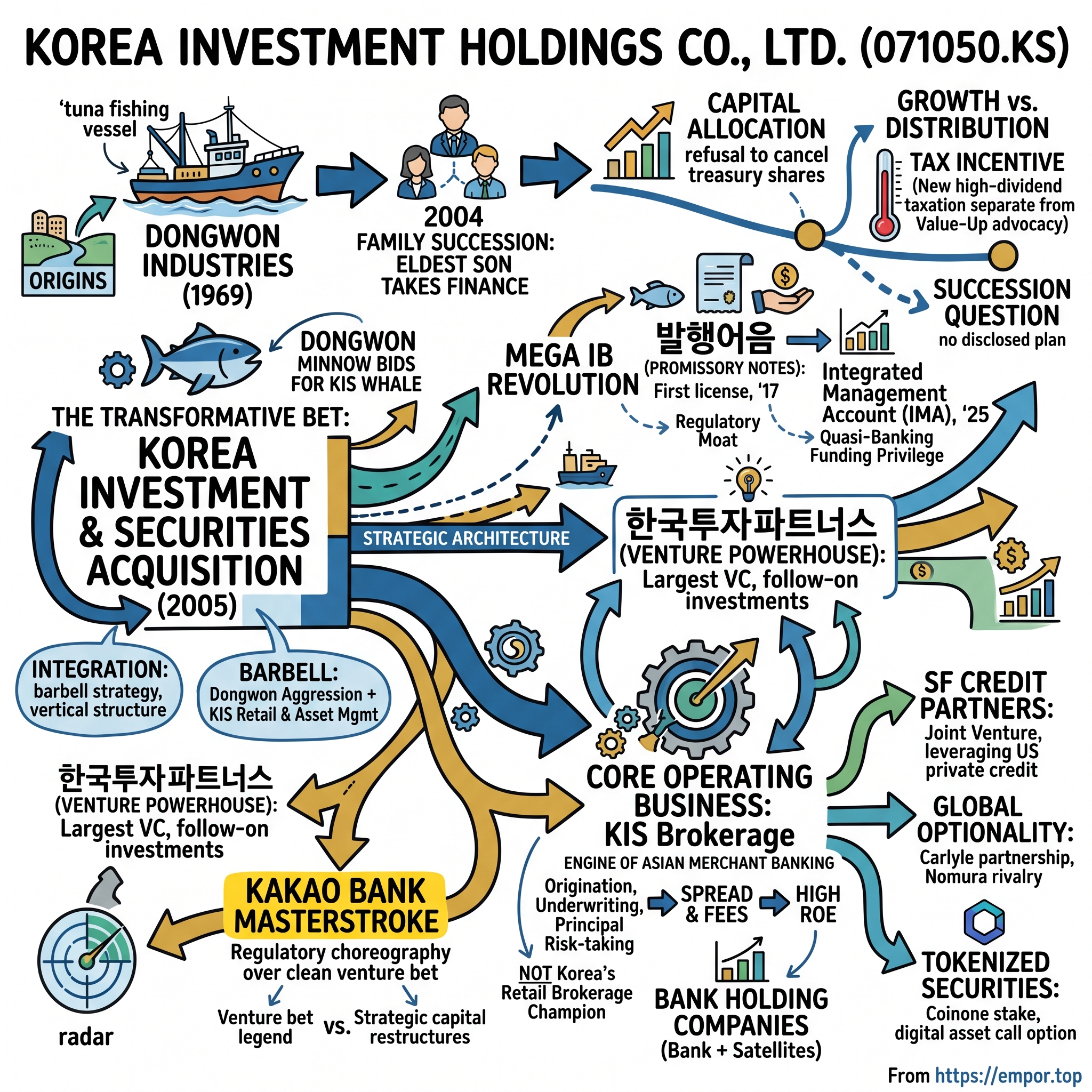
Korea Investment Holdings: The Engine of Asian Merchant Banking
I. Introduction & Episode Roadmap
In February 2026, a Korean securities firm did something no Korean securities firm had ever done. 한국투자증권 Korea Investment & Securities reported a full-year net profit above ₩2 trillion — roughly $1.4 billion — the first time any domestic brokerage had crossed that line.[^1] Operating profit rose 76.3% to ₩2.34 trillion. Net operating revenue reached ₩3.06 trillion, up 39%. Proprietary investment and trading alone threw off ₩1.28 trillion, more than 40% of the firm's revenue base.[^1]
The company that produced those numbers began life as the in-house brokerage of a tuna fishing company.
That is not a metaphor. 한국투자금융지주 Korea Investment Holdings Co., Ltd. (071050.KS, listed on the 한국거래소 Korea Exchange) traces directly to 동원산업 Dongwon Industries, founded in April 1969 by a former deep-sea fishing captain with three employees and ₩10 million of capital.1 Six decades later, the financial half of that empire has become the most profitable financial institution in South Korea on a return-on-equity basis, with parent-level equity of ₩12.1 trillion at the end of 2025 and a consolidated ROE of 18.5% — a figure the company itself flagged as blowing past a 2030 target it had set only a year earlier.2
The core thesis worth testing in this story is straightforward. Korea's four dominant financial holding companies — KB, Shinhan, Hana, Woori — are banks with satellites attached. They gather deposits, lend against real estate and credit cards, earn a net interest margin, and get regulated like utilities. Korea Investment Holdings is something different: a non-bank financial holding company whose earnings come from origination, underwriting, principal risk-taking, and asset gathering. It is closer in spirit to a merchant bank than to a commercial bank. Whether that is a durable structural advantage or simply a higher-beta way to own the Korean capital market is the question this article works through.
It matters right now because the Korean market is in the middle of the most violent re-rating in its history. The benchmark KOSPI closed at 2,770.84 on the day President 이재명 Lee Jae-myung was inaugurated in June 2025, and closed above 8,000 for the first time on May 27, 2026.3 Aggregate market capitalization of listed Korean firms rose 172.9% over that stretch. Three separate amendments to the 상법 Commercial Act, passed between July 2025 and March 2026, expanded directors' fiduciary duties to shareholders, restricted opt-outs from cumulative voting, and — most consequentially for holding companies — made treasury share cancellation mandatory.3 A brokerage's revenue is levered to trading volume and retail risk appetite. Both went vertical.
So this is a story with two clocks running. One is the sixty-year clock of institutional construction. The other is the twelve-month clock of a boom that has flattered every number in the model. Separating the two is most of the analytical work.
There is a mechanical way to think about the difference between this company and the bank holding companies it is usually compared against. A commercial bank earns a spread on money it is legally privileged to gather cheaply, and its constraint is capital adequacy. Its growth is therefore roughly the growth of its loan book, and its ceiling is set by the regulator. A merchant bank of this type earns fees for arranging transactions, spreads on the pieces it keeps, performance on the funds it manages, and gains on the positions it takes with its own money. Its constraint is not capital adequacy but risk appetite and the quality of its underwriting judgment. When judgment is good and markets cooperate, the return on a unit of equity is dramatically higher than a bank's. When either fails, the losses arrive faster than a bank's too, because there is no deposit franchise underneath to cushion them.
That framing sets up the questions worth answering. Is the excess return this firm has generated a product of durable structure — licenses, distribution, underwriting process — or of a favorable cycle and a higher risk setting on the dial? Has management earned the benefit of the doubt through consistent behavior, or only through good outcomes? And where, specifically, would the case break?
One more piece of context belongs up front, because it recurs throughout. This is a company that has repeatedly made money from the Korean state's rulebook — buying an institution the government needed to sell, obtaining a funding license the government created and awarded first to one firm, holding a bank stake the government's ownership statutes forced into an unusual structure, and now receiving one of two licenses to run a new kind of investment account. None of that is improper, and all of it is public. But it does mean the durability of the franchise is partly a function of policy continuity, and Korean financial policy has not historically been continuous.
The roadmap: first, the tuna split, and how 김재철 Kim Jae-chul divided an empire between two sons, handing the volatile financial business to the elder, 김남구 Kim Nam-koo. Second, the 2005 acquisition of a state-rescued brokerage that created Korea's first non-bank financial holding company. Third, the regulatory maneuver of 2017 that let a broker fund itself like a bank without becoming one. Fourth, the 카카오뱅크 KakaoBank position — celebrated as a venture masterstroke, and worth examining more carefully than the legend allows. Fifth, a look under the hood at the operating businesses, from the brokerage to the country's largest venture capital firm. And finally, the parts that a skeptic should press hardest: real estate credit exposure, an unusual refusal to buy back stock, an unfinished insurance acquisition, and a succession question nobody at the company wants to discuss on the record.
 Subscribe on LinkedIn
II. The House That Tuna Built: Dongwon Origins & The 2004 Split
In 1958, a 23-year-old named Kim Jae-chul boarded the 지남호 Jinamho, Korea's first ocean-going fishing vessel, as a trainee navigator.4 The country he left behind at the dock had been flattened by war five years earlier. Deep-sea fishing was one of the few ways a poor nation could earn hard currency: send men very far away, have them catch tuna, sell it in Japan and America. Kim became a captain, and captains in that trade learned a specific lesson — that the vessel's return depends on decisions made with incomplete information, far from shore, where nobody is coming to help.
He came ashore in April 1969 and founded 동원산업 Dongwon Industries in Room 401 of a commercial bank building in Myeongdong, Seoul, with three employees and ₩10 million of capital.1 Three months later the company acquired Korea's first 500-ton tuna longliner. By 1973 it had a foreign base in Ghana. The business eventually became the canned tuna brand in almost every Korean kitchen.
The brokerage nobody wanted
The financial arm arrived almost as an afterthought. 한신증권 Hanshin Securities had been established in 1968; it was privatized in 1982 and Dongwon Industries bought it, renaming it 동원증권 Dongwon Securities in 1996.5 For years it functioned roughly the way a captive finance arm functions inside any industrial group: a treasury outlet, a corporate finance channel, a mid-sized broker with a mid-sized franchise. Nothing about it suggested it would one day out-earn Korea's banks.
There is a piece of trivia about that period that turns out to be substantive. Two of the men who passed through Dongwon Securities in its unglamorous years — 박현주 Park Hyun-joo and 최현만 Choi Hyun-man — left to found what became Mirae Asset, the group that would spend the next quarter-century as this company's principal rival.5 A brokerage does not usually produce its own most dangerous competitor. That it did says something about the density of talent in a firm that outsiders regarded as second-tier, and about a culture that rewarded producers early.
The interesting part is what Kim Jae-chul did with succession, because it went against every chaebol convention. Korean family groups typically hand the crown jewel — the manufacturing business, the cash-generating industrial core — to the eldest son. Kim inverted it. The younger son, 김남정 Kim Nam-jung, took the food and industrial businesses. The elder son, Kim Nam-koo, took finance, which at the time was the riskier and far less prestigious half.
The apprenticeship
Kim Nam-koo was born on October 10, 1963, and graduated from 고려대학교 Korea University with a business degree in 1987, later earning an MBA from 慶應義塾大学 Keio University in Japan in 1991.6 Between those two credentials sits the story everyone at the firm knows. In the winter of his final undergraduate year, in 1986, his father put him on an Alaskan pollock trawler as an ordinary crew member — eighteen-hour working days, six hours of sleep.6 He returned, finished school, went to Japan, and then in 1991 joined Dongwon Securities not as an heir-in-waiting but as a rank-and-file employee in the Myeongdong branch.6
It is easy to over-read origin stories. But the specific residue of that apprenticeship shows up in how the firm operates. Kim's documented management philosophy centers on a "Why Not?" culture — challenge over deference — and he is known internally for the line that hesitation comes from a lack of passion rather than a lack of ability.6 More concretely: a man who has personally hauled nets in the Bering Sea tends to be unsentimental about capital that isn't earning, and comfortable with the idea that risk is the product rather than a byproduct.
Building the holding company
The corporate restructuring came in stages between 2002 and 2005. Preliminary approval as a financial holding company arrived in December 2002. In January 2003 the entity was carved out of Dongwon Industries; 동원금융지주 Dongwon Financial Holdings formally launched in May 2003, and by July 2003 a share swap had brought Dongwon Securities under the holding structure, with the broker delisted and the holding company listed in its place.7 Kim Nam-koo became chief executive of the holding company that year.6
The legal logic behind this sequencing matters more than it looks. Under Korea's Financial Holding Companies Act, a financial holding company cannot sit inside a web of industrial cross-shareholdings. Separating the securities business from the food and shipping group was not a governance nicety; it was the entry ticket. The separation also removed a structural conflict: a broker owned by an industrial conglomerate is perpetually suspected of being that conglomerate's captive financing desk. Cutting the cord made the firm a credible counterparty to every other chaebol in Korea.
The sequencing also reveals something about how this family thinks about optionality. The holding company was built before there was a specific acquisition to make with it. Preliminary approval, carve-out, launch, share swap, listing — an eighteen-month legal construction project completed by a mid-sized broker with no obvious need for a holding structure. Companies that assemble the vehicle before the deal are, in effect, buying an option on being ready. Most of the time that option expires worthless.
This one did not. That cleanliness would be worth a great deal within eighteen months, when a distressed government-owned brokerage came up for sale and the buyer needed to be, above all, a financial holding company in good standing.
III. The Transformative Bet: Acquiring Korea Investment & Securities (2004–2005)
To understand the deal that made this company, you have to understand what a wreck the target was.
한국투자신탁증권 Korea Investment & Trust Securities had been established in 1974 as a pillar of the state-directed financial system — the vehicle through which ordinary Koreans were channeled into government-sanctioned investment trusts.8 For two decades it was the establishment. Then came the 1997 Asian financial crisis and, in 1999, the collapse of the 대우 Daewoo Group, whose bonds sat inside the trust products that firms like this had sold to retail savers by the hundreds of thousands. The losses were catastrophic and, because the products had been sold with an implicit official blessing, they were socialized. Public funds went in. Regulators renamed the firm Korea Investment & Securities in 2003 and left it on the government's books, a ward of the 예금보험공사 Korea Deposit Insurance Corporation, waiting to be sold.8
The scale of the cleanup was extraordinary: authorities injected an additional ₩1.65 trillion of public money to resolve the firm's insolvency before it could be privatized.5
A minnow bids for a whale
When the auction ran in 2004, Dongwon Financial Holdings was, by any reasonable measure, the smaller party. Its brokerage was a respectable mid-tier house. The target had a nationwide retail distribution network and an asset management franchise built over three decades.
Dongwon won. The purchase price for the equity was approximately ₩546.2 billion, and Korea Investment & Securities was formally brought in as a subsidiary in March 2005.57 To finance it, Dongwon Securities executed a capital reduction of 80.21% — a brutal piece of financial surgery that wiped out the great majority of existing book equity to clear the way.5 Kim Nam-koo personally set the bid price.
It is worth sitting with what those two numbers imply next to each other. The state spent roughly ₩1.65 trillion cleaning the business up and then sold the equity for roughly a third of that.5 This is what privatizing a rescued financial institution actually looks like: the public absorbs the losses, and the private buyer acquires the cleaned franchise at a price reflecting the franchise's earning power rather than its historical cost. Whether that represents good policy is a separate argument. What matters analytically is that the buyer's returns were manufactured, in large part, by acquiring distribution that had been paid for by someone else — and that this kind of opportunity appears in a market perhaps twice a century, at the exact moment when almost nobody wants the asset.
The contemporary criticism was that he was buying a bureaucratic, loss-making state institution and paying real money for the privilege. That criticism was not unreasonable at the time. Nothing in Korean financial history to that point suggested that a family-controlled broker could take a rescued government entity and turn it into the country's best-run financial firm.
The integration
What followed in June 2005 was the merger of Dongwon Securities into Korea Investment & Securities, with the parent renamed 한국투자금융지주 Korea Investment Holdings the month before.7 The naming choice tells you something: the acquirer took the target's name. Kim kept the brand that Korean savers recognized and quietly buried his own family's.
The strategic logic was a barbell. Dongwon brought institutional aggression — trading, corporate finance, a willingness to underwrite. The target brought millions of retail relationships and an asset management business. Neither alone was a category leader. Combined, the firm could manufacture a product, distribute it through its own branch network, and take principal risk alongside it. That vertical structure — origination, manufacturing, distribution under one roof — is the single most important architectural decision in this company's history, and everything in the following two decades is a variation on it.
The result was Korea's first non-bank financial holding company, a structure with no precedent in the market.7 The distinction is not cosmetic. A bank holding company in Korea is supervised primarily around deposit safety, capital adequacy, and lending concentration. A non-bank financial holding company built around a securities firm is supervised around net capital ratios and investor protection. The second regime permits vastly more balance sheet velocity for a given unit of equity, which is precisely what a merchant bank needs.
What it actually proves
It is tempting to file this under "great acquisition" and move on. The more useful reading is about the type of opportunity. Kim did not buy a growth asset; he bought a distribution network that the state was desperate to offload, at a moment when nobody else wanted post-crisis Korean financial infrastructure, and he paid for it by destroying most of his own book value to keep control. That is a specific kind of capital allocation: concentrated, cyclical, reputationally uncomfortable, and only available to an owner-operator who does not need to explain a bad year to a committee.
It is also the pattern that recurs. The next opportunity of that kind would come from the regulator's own rulebook.
IV. The Mega IB Revolution & The Promissory Note Engine
Every Korean brokerage executive in the mid-2010s had the same complaint, and it was a legitimate one. Korean securities firms could underwrite, trade, and advise — but they could not fund. A bank takes deposits at near-zero cost and lends them out. A broker borrows in the wholesale market at a spread, which means that any lending business it tries to build is structurally disadvantaged against the bank sitting across the street. Korean capital markets were therefore chronically bank-dominated, and Korean companies looking for anything more creative than a senior secured loan often had to call a foreign bank.
The 금융위원회 Financial Services Commission's answer was the 종합금융투자사업자 framework — the "mega IB" designation, tied to equity capital thresholds, designed to push domestic firms to build balance sheets large enough to compete regionally. The prize attached to the ₩4 trillion tier was the 단기금융업 short-term finance license, better known by the instrument it permits: 발행어음, or issued promissory notes.
What a 발행어음 actually is
Strip away the terminology and this is a certificate of deposit issued by a brokerage. A retail customer hands over cash, receives a note promising a fixed rate over a short term, and the brokerage takes on an obligation to repay principal and interest. It is not deposit insured, but it is a direct obligation of a firm the customer has heard of, and it pays more than a bank account.
For the issuer, this was transformational for one reason: it converted a wholesale borrower into something that funds itself from household savings. The firm can raise money up to a multiple of its equity capital and deploy it into corporate finance assets at a wider yield. The gap between the two is the spread, and unlike a bank, the firm faces no loan-to-deposit ratio cap and no reserve requirement in the commercial-banking sense.
In November 2017, Korea Investment & Securities became the first Korean brokerage to receive that license, and the only one to receive it in the initial round.9 Four rivals — 미래에셋증권 Mirae Asset Securities, NH투자증권 NH Investment & Securities, KB증권 KB Securities and 삼성증권 Samsung Securities — were designated as mega IBs at the same time but had their short-term finance applications held back, leaving them, as the industry put it at the time, half-licensed.
The compounding
The balance grew from roughly ₩8.4 trillion at the end of 2021 to about ₩18 trillion by the end of June 2025.9 By that date the firm had used roughly 177% of its permitted capacity against a ceiling of 200% of separate-basis equity, leaving around ₩3 trillion of additional headroom.910 Composition matters as much as size: at mid-2025 the book was split roughly ₩10.7 trillion into corporate finance, ₩2.4 trillion into real estate, and ₩4.9 trillion into other assets.9
The critical number is the margin. The rating agency 한국신용평가 Korea Investors Service estimated the firm's operating spread on this business at roughly 1.3% in the first half of 2025 and noted explicitly that it was running higher than peers.9 On an ₩18 trillion book, ten basis points of spread is worth around ₩17.6 billion of pre-tax profit.10 Annual profit attributable to the promissory note business ran around ₩200 billion in 2024.10
Here is the honest analytical read. The license is a genuine regulatory moat — you cannot replicate it without ₩4 trillion of equity and a supervisor's blessing, and only five firms have it, with 키움증권 Kiwoom Securities added most recently in November 2025.11 But the spread is not a moat; it is a risk premium. The firm earns 130 basis points because it is funding one-year-and-under liabilities against corporate loans, mezzanine paper, and property exposure that mature much later. Korea Investors Service flagged exactly this as a monitoring item: the entire promissory note book funds within one year, creating asset-liability maturity mismatch and refinancing risk, and the assets purchased with it — bonds, domestic loans, real estate and infrastructure, corporate equity — carry their own volatility.9
The upgrade nobody outside Korea noticed
Then, in November 2025, the framework leveled up again. The FSC designated Korea Investment & Securities and Mirae Asset Securities as the first operators of the 종합투자계좌 Integrated Management Account (IMA) — a designation requiring ₩8 trillion of equity capital, and the first such approval since the concept was written into law in 2017.11
An IMA is the promissory note's more ambitious sibling. Customers deposit money with principal repayment promised at maturity; the firm pools it, invests in corporate finance assets, and passes through the performance. Combined with promissory notes, an approved firm can raise up to 300% of its equity capital.11 The regulator attached real strings: by 2028, 25% of funds raised through promissory notes and IMAs must go to venture capital investment, real estate exposure limits drop from 30% to 10% by 2027, and only 30% of the venture requirement can be satisfied with safer A-grade bonds or mid-sized corporates.11
Read that carefully, because it is a policy trade. The state is handing two firms a quasi-banking funding privilege in exchange for forcing capital into venture and away from property. Korea Investment & Securities launched its first product within weeks and by July 2026 had brought its sixth to market — 한국투자 IMA G1, a ₩120 billion growth-type offering built on acquisition financing, corporate loans, and a mezzanine portfolio, marketed with prize draws for semiconductor ETF shares and Dyson appliances.12 Cumulative IMA money raised was approaching ₩2.5 trillion.
Against ₩18 trillion of promissory notes, ₩2.5 trillion of IMA is not yet material to earnings. What it is, is a claim on the next decade of Korean corporate funding — and a mandate to take more venture risk than this firm's balance sheet has previously carried. Whether that ends as an advantage or as the next provisioning cycle is genuinely undetermined.
Which brings us to the venture bet that already worked, and the legend that has grown around it.
V. The KakaoBank Masterstroke & Strategic Portfolio Architecture
In 2015 the Korean government decided the country needed internet-only banks. The obstacle was ownership law: the 은산분리 separation of banking and commerce meant a technology company could not control a bank. 카카오 Kakao had 40 million users on a messaging app and no legal path to owning the bank it wanted to build. It needed a licensed financial partner willing to hold the majority economic interest and let a tech company run the product.
Korea Investment Holdings took the seat. It first held KakaoBank shares in 2015 and at one stage controlled roughly half the equity.13
The part the legend gets wrong
The popular version is a clean venture bet: seed a startup bank, ride it to an IPO, book a ten-bagger. The reality is a decade of regulatory choreography, and the choreography is the more instructive story.
Because a financial holding company faces hard constraints on holding equity in a third-party bank, the position could not simply sit at the parent. In November 2019, Korea Investment Holdings transferred a large slice of its stake to 한국투자밸류자산운용 Korea Investment Value Asset Management, an indirect subsidiary, specifically to comply with the Financial Holding Companies Act — and in doing so completed its transition to a non-banking financial holding company.137 Value Asset Management then participated in the pre-IPO rounds, buying six million new shares at ₩23,500 each for roughly ₩142 billion in late 2020, in a round that also brought in TPG Capital and Anchor Equity Partners.13
KakaoBank listed in August 2021. The gain was real and enormous — the holding company's ROE hit 27.0% in 2021, an outlier driven by the listing.14
Then came the second maneuver, which is where the financial engineering gets genuinely clever and slightly uncomfortable. By late 2022 the group held 27.18% of KakaoBank, split 4% at the holding company and 23.18% at Value Asset Management, making it the second-largest shareholder after Kakao.15 Korea Investment & Securities applied to the FSC in September 2022 to consolidate those stakes onto its own balance sheet. The reason was capital: absorbing the stake would lift the brokerage's equity toward ₩9 trillion from ₩6.26 trillion, vaulting it past Mirae Asset to become Korea's largest broker by capital.15
The transaction completed, and it produced an accounting result worth pausing on. In 2023, Korea Investment & Securities recognized approximately ₩1.65–1.67 trillion of dividend income from its subsidiary Value Asset Management related to the KakaoBank share disposal.9 Reported net income for the brokerage that year was ₩1.96 trillion and reported ROE was 24.4%.9 Excluding that one-off, underlying net income was ₩295.3 billion — down from ₩413.7 billion the prior year.9
That is a 24.4% headline ROE sitting on top of a business whose underlying profit had fallen by roughly 29%. Both facts are true. An investor reading only the headline in 2023 would have drawn precisely the wrong conclusion about the operating business, which at that moment was absorbing domestic project finance provisions and overseas real estate write-downs. The lesson is not that management did anything improper — the intragroup restructuring had a clear regulatory purpose and the disclosure exists. The lesson is that at this company, reported earnings and operating earnings can diverge violently, and the burden is on the reader to separate them.
What the stake is worth now
Kakao and Korea Investment & Securities each hold approximately 27% of KakaoBank. The position functions less as a growth engine than as a large, liquid, listed capital cushion sitting inside a brokerage — and as a strategic relationship with the most-used consumer finance app in the country. Its market value moves with KakaoBank's share price, which has been volatile.
The portfolio around it
The holding company's structure is deliberately narrow. Besides the brokerage, it comprises 한국투자신탁운용 Korea Investment Management and Korea Investment Value Asset Management in asset management; 한국투자저축은행 Korea Investment Savings Bank; 한국투자캐피탈 Korea Investment Capital; a real estate trust arm established in June 2019; 한국투자파트너스 Korea Investment Partners in venture capital; a private equity unit; and Korea Ratings and Data.167
The brokerage overwhelmingly dominates. In the first quarter of 2026, the securities subsidiary contributed ₩624 billion of net income against a consolidated total of ₩914.9 billion.17 The non-securities subsidiaries were meaningful but secondary: Value Asset Management contributed ₩119.7 billion, the savings bank ₩89.9 billion, and the capital company ₩31.1 billion.17
The savings bank and capital company deserve a note of their own, because they are where the group's credit risk sits closest to the marginal borrower. A Korean savings bank lends to households and small businesses that commercial banks decline, at higher rates; a capital company does equipment, auto and corporate lending outside the banking system. Both were heavily exposed to the property downturn, and both are small enough that a bad cycle in them is an earnings irritation rather than a solvency question — but large enough that their credit costs are worth watching as a leading indicator for the group.
Two conclusions follow. First, anyone modeling this company is essentially modeling one brokerage plus a portfolio of listed securities. Second, the group's most conspicuous gap is insurance — and management has been explicit that it intends to close it, which is the single largest discretionary use of capital currently on the table.
VI. Deep Dive into the Core: Korea Investment & Securities (KIS) & Capital Engines
The Korean brokerage industry keeps score in two ways, and for most of the last decade the two scoreboards disagreed. One is equity capital, which determines what licenses you can hold and how much balance sheet you can run. The other is return on that equity, which determines whether any of it was worth doing. Mirae Asset Securities long led the first. Korea Investment & Securities led the second. In 2025, it took both.
The war-game
On a standalone basis at the end of 2025, Korea Investment & Securities held ₩11.16 trillion of equity capital, up 19.81% year on year, ahead of Mirae Asset Securities at ₩10.41 trillion, NH Investment & Securities at ₩8.61 trillion, Samsung Securities at ₩7.64 trillion, and 메리츠증권 Meritz Securities at ₩7.54 trillion.18 On a consolidated basis Mirae Asset remained ahead at ₩13.49 trillion against ₩11.20 trillion — a distinction worth keeping, because Mirae's global principal investment book is genuinely larger.18
The profitability gap is the more revealing number. Korea Investment & Securities posted a 19.8% ROE for 2025, up 8.3 percentage points from 11.5% in 2024 and first in the industry.19 Kiwoom Securities came second at 16.6%, Mirae Asset third at 14.1% after a sharp recovery from 7.94%, Samsung Securities fourth at 13.5%, NH fifth at 12.1%, with Meritz at 11.5% and KB Securities at 10.2%.19
The longer record is more persuasive than any single year. Over 2021 through 2024, the firm's ROE ran 16.0%, 6.6%, 24.4% and 13.6%. The comparable peer average across large rated brokers ran 12.4%, 5.6%, 6.9% and 7.6%.9 Strip the 2023 distortion and the firm still beat its peer group in each of those years, usually by a wide margin. That is a real, repeated, multi-cycle result, not a one-year artifact.
Where the outperformance actually comes from
Korea Investors Service's segment data makes the source unusually legible. Between 2021 and the first quarter of 2025, the firm's market share in investment banking rose from 11.6% to 19.5%, and its share in trading and principal investment rose from 7.9% to 17.2%.9 Over the same period, brokerage share barely moved — from 8.0% to 8.3% — and asset management share drifted down from 13.4% to 12.1%.9
That pattern says something specific. This firm is not winning on retail commissions. Its domestic commission market share is roughly 7%, seventh in the industry, and its overseas equity brokerage share is similar.9 It is winning by originating and holding risk. Investment banking generated roughly ₩590 billion of net operating revenue on a five-year average, about 29% of the total.9 The 2024 segment split told the same story: brokerage ₩616.2 billion, asset management ₩142.7 billion, IB ₩807.7 billion, and trading and principal investment ₩1,039.4 billion.9
The vertical structure described earlier is what makes this economically coherent. The firm underwrites a deal, syndicates the senior piece to institutions, retains or places the junior piece, funds part of the retained exposure with promissory note money, and distributes the resulting product to its own wealth clients. Each step earns a fee or a spread, and each step feeds the next. Customer financial product balances grew from roughly ₩42 trillion at the end of 2022 to about ₩76 trillion by mid-2025.9 Retail client product balances rose another ₩17 trillion during 2025 to ₩85 trillion.[^1]
The uncomfortable half of the same fact
Higher returns come from higher risk-taking, and the rating agency says so plainly. Risk exposure relative to equity stood at 281.2% at mid-2025 — down from 341.9% at the end of 2022, but still above the large-broker peer average of 229.4%.9 Contingent liabilities, largely credit commitments on property deals, had grown to ₩6.3 trillion by June 2025 from ₩5.4 trillion a year earlier, around 60% of equity.9
Asset quality, though, has held up better than the risk appetite would suggest. Net substandard-and-below assets as a share of equity were 5.0% at mid-2025, against a peer average of 9.7%.9 Real estate finance exposure was ₩4.4 trillion, or 42% of equity — 58% including infrastructure — versus a peer average of 56%.9 Bridge loans, the most dangerous category in the 2022–2024 Korean property freeze, were only 13% of the project finance book against a peer average of 26%.9
So the accurate characterization is not "recklessly aggressive." It is: takes more total risk than peers, but has so far selected better within it. That is a defensible description of underwriting skill. It is also exactly the kind of claim that only a full cycle can validate, and the current cycle has been unusually kind.
Myth versus reality
Three consensus statements about this company deserve correcting.
Myth: it is Korea's retail brokerage champion. It is not. Its domestic commission share sits around 7%, behind several rivals, and its retail brokerage share has been essentially flat for four years.9 The retail relationship matters enormously — but as a distribution channel for products the firm manufactures and as a funding base for promissory notes, not as a commission business. Kiwoom Securities, not Korea Investment & Securities, is the low-cost retail volume leader.
Myth: the KakaoBank position is a strategic distribution partnership. It is a large minority financial stake, assembled and relocated across group entities primarily to satisfy ownership statutes and to bolster the brokerage's regulatory capital.1513 There are strategic side benefits, but treating it as a controlled digital banking channel misreads what the group actually owns.
Myth: superior returns come from a lean cost base. The evidence points elsewhere. The firm's advantage shows up in segments where it takes principal risk and earns origination fees, not in expense discipline — and its performance-linked compensation model means costs expand with profits rather than lagging them. Selling, general and administrative expense rose alongside revenue through the recent cycle.9 This is a revenue-side story, not a cost-side one.
Korea Investors Service maintained the firm's senior unsecured rating at AA with a stable outlook in September 2025, citing diversified business portfolio, strong earnings generation, high risk exposure offset by good asset soundness, and adequate capitalization.9 It also specified the trigger for a downgrade: an adjusted net operating capital ratio falling persistently below 150%, against 170.0% at mid-2025.9 That is a clean, checkable number for anyone tracking the credit.
VII. Hidden Drivers & Global Optionality: VC Powerhouse & US Private Credit
Two businesses sit outside the main earnings engine and matter more for what they say about the next decade than for what they contribute today.
The venture arm nobody outside Korea talks about
Korea Investment Partners is the largest venture capital firm in South Korea, and it is not close. Its assets under management reached ₩3.8 trillion at the end of 2025, some ₩1.3 trillion ahead of second-placed KB Investment, and it was the only domestic firm above the ₩3 trillion mark.20 It ranked second in both new investment (₩307 billion) and exits (₩256 billion) that year, and held ₩412.7 billion of dry powder.20
Its structural approach is worth noting: a "Re-Up" fund series designed specifically for follow-on investments into companies already in the portfolio, with the second such vehicle deploying ₩34.1 billion in 2025 and nearly exhausting its capital within four years of formation.20 Doubling down on winners is easy to say and hard to institutionalize, because it requires a firm to override its own diversification instincts. And in a detail that reads as almost too neat, the firm holds roughly ₩14 billion of SpaceX exposure through a US vehicle — a position that would produce an unusually large mark for a Korean VC in the event of a listing.20
The strategic argument management makes is that the venture arm functions as radar for the whole group: early positions surface pre-IPO financing opportunities, IPO underwriting mandates, and M&A relationships for the brokerage. That argument is plausible and structurally sound. It is also difficult to verify from outside, because the group does not disclose how much brokerage revenue is attributable to venture-sourced relationships. Treat it as a credible mechanism with unquantified magnitude.
What is quantifiable is the new regulatory context. The IMA framework's requirement to route a quarter of promissory note and IMA funds into venture capital by 2028 turns the venture arm from an interesting side business into a piece of compliance infrastructure. A firm that already runs Korea's biggest VC platform is meaningfully better positioned to absorb that mandate than one starting from scratch.
That said, the mandate deserves scrutiny rather than applause. Being required to deploy a quarter of a very large funding pool into venture and growth assets — with only 30% of the requirement satisfiable through safer A-grade bonds or mid-sized corporates — is not obviously good for the firm doing the deploying.11 Venture assets are illiquid, hard to mark, and slow to resolve, while the promissory notes and IMA balances funding them reprice within a year. Regulators are, in effect, using two brokerages' balance sheets as an instrument of industrial policy to redirect capital from property into innovation. That may be excellent policy. It is also a structural extension of exactly the maturity mismatch the rating agency already flags, and the losses, when they come, will land on shareholders rather than on the policymakers who mandated the allocation.
The American experiment
On September 27, 2022, Stifel Financial Corp. and Korea Investment & Securities announced SF Credit Partners, a leveraged lending joint venture aimed at US financial sponsors and corporate borrowers.21 Stifel's chief executive Ronald J. Kruszewski framed it as expanding commitment capacity for leveraged finance. Kim Nam-koo, described in the announcement as chairman and chief executive of the Korean firm, tied it to the New York offices opened in 2021 and to an intention to build a durable US profit center.21 The announcement did not disclose a dollar commitment, and both the venture and the accompanying strategic collaboration remained subject to regulatory approval at the time.
The economic idea is a capital arbitrage rather than a competitive one. A Korean firm with cheap won funding and limited US origination pairs with an American middle-market bank that has abundant origination and finite balance sheet. Korea supplies capital; Stifel supplies deal flow.
The obvious question is whether this survives contact with reality, because the American private credit market did not stand still. Since 2022, direct lending has absorbed enormous institutional capital, spreads have compressed, and covenant quality has weakened. A latecomer with a partner-dependent origination model is, at best, a price-taker in that market. The honest assessment is that SF Credit Partners is optionality rather than an established earnings pillar, and that no public disclosure yet demonstrates it has become a material profit center.
A second global relationship has more visible substance: a 2023 strategic partnership with The Carlyle Group carrying a $300 million investment commitment, which produced a collateralized loan obligation fund, later extended with Anchorage Capital Advisors.[^23] Chief executive 김성환 Kim Sung-hwan has framed the global strategy less as building overseas branches than as sourcing differentiated products abroad and distributing them to Korean clients — with a stated target of lifting overseas contribution from 15% of the business in 2024 to 30% by 2030, and an explicit ambition to overtake 野村證券 Nomura Securities as Asia's leading brokerage.[^23]
That target is testable, which is to its credit. It is also the kind of goal Korean financial firms have announced before and missed. A reader should watch the disclosed overseas contribution ratio rather than the rhetoric.
The newest bet
In May 2026 the firm moved into digital assets, agreeing on May 29 to acquire 20% of the cryptocurrency exchange 코인원 Coinone for ₩80 billion, becoming joint third-largest shareholder alongside OKX Ventures, behind founder 차명훈 Cha Myung-hun and 컴투스홀딩스 Com2uS Holdings.22 The stated rationale was combining institutional finance with blockchain infrastructure ahead of tokenized securities and won-stablecoin legislation.
At ₩80 billion against a ₩12 trillion equity base, this is a rounding error financially. Strategically it is a call option on Korean digital asset regulation, purchased at a moment when that regulation is still being drafted — the same pattern as 2015 and KakaoBank, at a fraction of the size. Whether it repeats that outcome depends entirely on rules that do not yet exist.
VIII. Management Credibility, Culture, & Capital Allocation
Every autumn for more than two decades, the chairman of a ₩12 trillion financial group has stood in front of university auditoriums in Seoul and given the recruiting pitch himself. Kim Nam-koo has led campus recruitment presentations for over twenty consecutive years, and holding company hires go through a final interview conducted by him personally.236
This is not a public relations habit. It is a statement about where the executive believes value is created in a securities firm — in the quality of the people who price risk — and it is consistent with a compensation culture that pays star dealmakers and traders on production rather than seniority, in a market where the bank-owned competitors largely do not.
The operator
The chairman does not run the brokerage day to day. Kim Sung-hwan does, and his path is itself evidence about the culture. He joined the firm in 2004 — the year of the acquisition — and became its youngest executive, taking the chief executive role in early 2024.[^23] His stated program from the outset was to move the firm away from brokerage dependence toward balanced growth across wealth management, investment banking, and retail.
Judged on his own prior statements, the record so far is unusually consistent. In early 2025 he framed the objective as an undisputed and differentiated number one position domestically, focused on business model, risk management and internal controls, client management, and sales support. A year later, following the record year, his message shifted up a level: Asia number one, with three framings — expanding the boundary of capital and business through IMA, expanding the boundary of geography by routing global capital and global product through the firm's platform rather than simply opening overseas branches, and expanding the boundary of industry by becoming, in his phrase, a technology company holding a financial license.30 He also drew a direct line from IMA to becoming "a new financial entity."
Two observations. First, the narrative has not lurched — the same balanced-growth thesis has been restated and extended rather than replaced, which is more than can be said for many financial firms after a windfall year. Second, the language has grown considerably more expansive as results improved, and the "technology company with a financial license" formulation is precisely the sort of claim that carries no measurable test attached. The concrete commitment worth holding management to is the disclosed overseas contribution ratio, not the framing.
Alignment, and its complications
Kim held a 20.7% stake in Korea Investment Holdings — roughly 11.53 million shares — as of a 2020 disclosure.6 That is the tightest owner-manager alignment among Korea's major financial groups, where the big bank holding companies are effectively institution-owned with no controlling family.
Alignment cuts both ways. A controlling owner with a twenty-year horizon can make the 2005 acquisition, or absorb a bad provisioning year without panicking. The same owner can also prioritize dynastic continuity and balance-sheet size over distributions to minority holders — and there is evidence of exactly that tension here.
His eldest son, 김동윤 Kim Dong-yun, born in 1993, joined Korea Investment & Securities through open recruitment in 2019 and has worked in strategic planning.23 When the chairman's shareholding rose by 0.09% in a subsequent July, the market read it as a succession signal; the chairman's public position was that his son entered as an ordinary new employee to learn whether the field suited him.23 No formal succession plan has been disclosed. For a company whose entire operating model depends on one family's control, that is a genuine governance gap rather than a hypothetical one.
The capital allocation record, candidly assessed
The wins are real and already covered: a distressed acquisition bought at the bottom, a regulatory license captured first, a bank stake structured to convert into brokerage capital, and the country's leading venture platform built in-house.
The contested part is distribution. In May 2025, more than a year after the Korea Exchange launched its 기업 밸류업 프로그램 Corporate Value-Up Program, Korea Investment Holdings filed its first value-up disclosure. It committed to an ROE above 15% and equity capital above ₩15 trillion by 2030.14 What it did not commit to was notable: no share buyback plan, no treasury share cancellation plan despite holding 5.4% of shares in treasury, and no numerical dividend payout target.14
The contrast with peers was stark at the time. Mirae Asset Securities had targeted a 10% ROE alongside a payout ratio above 35% and had cancelled more than 100 million shares. Meritz Financial had committed to a payout above 50%. Kiwoom Securities had pledged a 30% total return ratio and cancelled all of its treasury shares.14 Korea Investment Holdings offered growth and nothing else — a position Kim stated directly at the March 2025 shareholder meeting, arguing that value-up should be achieved through growth rather than dividends.14 At that point the stock traded around 0.5 times book despite record quarterly operating profit.14
Then two things happened. The stock rose 126.8% during 2025 and a further 25.2% in the first quarter of 2026, and by early May 2026 traded at roughly 1.23 times book.2 And the company raised its final 2025 dividend to ₩8,690 per common share, totaling roughly ₩507.8 billion — more than double the prior year's ₩3,980 per share and ₩232.8 billion — lifting the payout ratio to 25.1% from 22.4% in 2024, 21.9% in 2023 and 21.1% in 2022.24 The stock jumped 12% on the announcement to a 52-week high of ₩252,000, and a Samsung Securities analyst called the decision a surprise.24
The candid interpretation is less flattering than the outcome. The payout increase precisely satisfied the threshold for Korea's new high-dividend separate taxation regime, which required either a payout above 40% or a payout above 25% combined with dividend growth above 10%.24 The company cleared the second test. A tax incentive appears to have moved capital allocation where a year of shareholder advocacy had not.
Meanwhile the third Commercial Act amendment made treasury share cancellation mandatory: newly acquired treasury shares must be cancelled within a year, and previously held shares carry a six-month grace period after which a company must either cancel within a year or obtain shareholder approval for a retention plan.253 Korea's four bank holding companies moved early and aggressively — KB Financial cancelled ₩1.02 trillion of shares in 2025 and more in January 2026; Woori adopted a policy of immediate cancellation on acquisition, ending 2025 with 0.01% treasury shares.25 A company sitting on 5.4% of its shares with no announced cancellation plan is now on a regulatory clock.
The credibility verdict is mixed and should be held that way. Operationally, management has delivered against ambitious targets — the 2030 ROE goal was cleared five years early.2 On distributions, management has been consistent in its philosophy and consistently behind its peers, and moved only when the tax code and then the Commercial Act made not moving expensive. Those are both facts, and an investor should weigh them together rather than choosing one.
IX. Playbook: Business & Investing Lessons
1. Regulatory arbitrage compounds when you are first, not when you are best. The promissory note license was not won by having a superior product. It was won by having the required capital and a clean application at the moment the FSC first opened the window, and by being the only firm approved in that round. Eight years of compounding a funding advantage flowed from a filing. The same pattern repeated with the IMA designation. The generalizable lesson for investors: in heavily regulated industries, sequencing beats quality more often than anyone likes to admit, and the value accrues to whoever is standing at the door when it opens.
2. Balance sheet velocity beats balance sheet size. For most of the last decade this firm carried less equity than its largest rival and out-earned it anyway, because it turned capital over faster and took fees at more points in the chain. The market share data shows exactly where the turns came from — investment banking and principal risk-taking, not retail commissions. The lesson is that in financial services, return on equity is a strategy variable, not merely a result. Where you deploy the marginal won determines it.
3. A captive venture arm is an intelligence system before it is a fund. Korea Investment Partners generates fund returns, but its more valuable output is proprietary early sight of companies that will later need pre-IPO capital, an underwriter, and an acquirer. The caveat matters: this benefit is asserted by management and not separately disclosed, so it should be treated as a plausible mechanism rather than a quantified one.
4. Unbundling from an industrial parent unlocks a different kind of institution. Separating the securities business from a food and fishing conglomerate did more than satisfy a statute. It removed the permanent suspicion that the broker was a captive financing desk, which is what allowed it to become a trusted counterparty to rival chaebol. Structural independence, in financial services, is a commercial asset and not just a compliance state.
5. Owner-operator concentration is a feature and a liability, simultaneously. The 2005 acquisition, financed by an 80% capital reduction, is not a decision a professional management team facing quarterly scrutiny would likely make. Neither is refusing to buy back stock for a decade while peers did. The same governance structure produces both, and an investor cannot buy one without the other.
X. Strategic Analysis: Powers, Forces, Risk Radar & Stress Test
Helmer's 7 Powers, applied honestly
Scale economies — present, and the strongest of the group. Being the largest promissory note issuer lowers the marginal cost of funding a corporate loan relative to a smaller broker, and being one of only two IMA operators extends that structurally. The mechanism is real: fixed regulatory capital thresholds mean that funding capacity is available only to a handful of firms, and the largest of them can price most aggressively.
Process power — plausible, evidenced, and unproven at extremes. The strongest support is the asset quality data: markedly lower bridge loan concentration than peers and lower non-performing exposure relative to equity, despite carrying higher total risk exposure.9 That combination is hard to fake over four years. The counter-argument is that Korean property credit has just moved from stress to recovery, and process power claims are best tested in the down phase, where this firm did take real losses in 2023.
Counter-positioning — weaker than usually claimed. The KakaoBank stake gave the group exposure to digital banking economics without owning branches. But the position was assembled to satisfy an ownership statute as much as to execute a strategy, and it is a minority financial interest, not a controlling distribution asset. Calling it counter-positioning overstates it; it is better described as a well-timed financial investment with strategic side benefits.
Branding, network effects, switching costs, cornered resource — largely absent. Retail brokerage clients in Korea switch freely and price competition is intense. There is no meaningful network effect in underwriting. The closest thing to a cornered resource is the license set, which is better understood as regulation than as a Helmer power.
Porter's five forces
Threat of new entrants: low at the top, high at the bottom. No new firm can assemble ₩8 trillion of equity to compete in IMA. But retail brokerage is wide open to fintech attackers, and Korean investors have shown they will move accounts for a better app and lower fees.
Buyer power: high in brokerage, moderate in IB. Commission competition has driven domestic brokerage toward commoditization — which is precisely why this firm's brokerage share has barely moved while its IB share nearly doubled. The migration toward wealth management and origination is a rational response to buyer power, not a coincidence.
Supplier power: high, and it is people. In a firm where earnings depend on underwriting judgment, the suppliers are the dealmakers. Performance-linked pay mitigates the risk of losing them; it also means compensation expands with profits and compresses the operating leverage that shareholders would otherwise enjoy in a boom.
Substitutes: the real long-term threat. Passive products, direct-indexing, and low-cost global platforms erode the manufacturing-and-distribution margin over time. The firm's answer — proprietary private credit and alternative products that cannot be indexed — is coherent, but it is the same answer every incumbent asset gatherer gives.
Rivalry: intense and rising. Mirae Asset holds the larger consolidated balance sheet, NH has the agricultural cooperative network, Samsung Securities owns high-net-worth relationships, Kiwoom owns the low-cost retail channel and now has a promissory note license, and Meritz has expanded capital aggressively.1811
Risk radar
Real estate project finance. This remains the single most important credit risk. The mechanism is straightforward: Korean developers fund land acquisition with short-term bridge loans, refinance into project finance on construction start, and repay from pre-sales. When rates spiked in 2022, refinancing froze and the chain broke. Across 2022–2024, Korea Investment & Securities recognized roughly ₩600 billion of net credit costs.9 Substandard-and-below exposure rose from ₩181.5 billion at the end of 2022 to ₩829.6 billion in 2023, eased to ₩677.5 billion in 2024, and rose again to ₩890.9 billion by mid-2025.9
That last move deserves attention because it runs against the recovery narrative. The rating agency noted that deterioration in 2025 was concentrated in main project finance rather than bridge loans, and that some overseas alternative and acquisition finance assets had seen cash flow deterioration or events of default.9 Its judgment was that further losses should remain within the firm's financial capacity. That is a reasoned view, not a guarantee.
Regulatory and internal control. In 2025, institutional sanctions across Korean brokerages rose to 55 from 23, with total penalties of ₩382.7 billion against ₩21.5 billion the prior year.26 Korea Investment & Securities received five institutional sanctions and the largest fines in the industry at ₩63.48 billion.26 Typical infractions across the sector involved incomplete sales disclosure, failures to establish internal control standards, and prohibited underwriting practices. The firm also drew a small fine in June 2026 for failing to report a designated-agent contract under the innovative finance scheme.27 Individually these are absorbable; collectively they are a legitimate flag on control environment at a firm whose model depends on taking more risk than peers.
Concentration and cyclicality of the current boom. The market backdrop that produced 2025 and early 2026 results carries its own warnings. Samsung Electronics and SK Hynix together represent 42.4% of Korean market capitalization, retail margin loans reached ₩25.4 trillion by May 2026, and 84% of listed companies posted losses or traded flat during the rally.3 A brokerage's brokerage-margin interest income — which grew 70.0% year on year in the first quarter of 2026 — is a direct function of that leverage.17 It will fall as fast as it rose.
The activist stress test
A skeptical investor would press on four points. First, treasury shares: 5.4% of the company sits unretired while the law now requires cancellation or explicit shareholder approval to retain — what is the plan, and why has none been announced? Second, the acquisition promise: management has publicly committed to completing an insurance acquisition within 2026, with BNP Paribas Cardif Life reported as the leading candidate ahead of KDB Life, Lotte Insurance and the former MG Insurance business.28 Buying an insurer with shareholder capital, immediately after a record year, from a company that declined to commit to buybacks, is precisely the sequence that invites a diworsification challenge — and the deal has reportedly been slowed by a regulatory investigation into variable annuity products that affects valuation.28 Third, disclosure quality: the 2023 episode showed how far reported earnings can drift from operating earnings, and the group does not break out venture-sourced revenue or SF Credit Partners contribution. Fourth, succession: no disclosed plan at a company entirely dependent on one family's control.
None of these is disqualifying. All of them are unresolved.
XI. The Investment Spine: Bull vs. Bear Case & Key KPIs
Why it wins from here
The affirmative case rests on structure rather than momentum. Korea Investment Holdings holds a licensed position — promissory notes plus IMA — that only one other firm shares, in a market where household savings are migrating out of property and bank deposits and into securities. It has demonstrated, over multiple years and against a clearly defined peer set, that it converts equity into profit more efficiently than competitors. It owns the country's largest venture platform at exactly the moment regulation mandates venture deployment. And it is run by an owner with a fifth of the equity and a twenty-year time horizon.
The evidence supporting this is genuine: sustained peer-beating ROE across four years, IB market share nearly doubling, better asset quality metrics than peers despite higher risk appetite, and a rating agency affirmation at AA/stable.919
Why it may not
The falsifiers are equally concrete. Nearly all group earnings come from one brokerage, and that brokerage's revenue is levered to Korean trading volume, retail margin lending, and property credit — all three of which are cyclical and all three of which are currently near cycle highs. The 2025 ROE of 18.5% was earned in the single best market environment in Korean history; the same business earned an underlying return far below that in 2023.29 A prolonged property downturn, or a market correction that halves trading volumes, would compress earnings quickly. And the promissory note engine that funds the growth carries structural maturity mismatch that has not been tested in a funding stress.
The bull case
Consolidated earnings sustain above the ₩2 trillion level as IMA scales, with KB Securities having raised its 2026 forecast for the group to ₩2.67 trillion.17 The insurance acquisition closes at a sensible price and adds long-duration assets that lift group AUM and fee income. Overseas contribution moves toward the stated 30% goal, validating the global product-sourcing model.[^23] Mandatory treasury cancellation forces a distribution policy the company would not have adopted voluntarily, removing a governance discount. The Coinone stake matures into a real digital asset franchise as legislation lands.
The bear case
Property credit deteriorates a second time, this time in main project finance and overseas alternatives where 2025 already showed weakening.9 Supervisors tighten leverage limits on promissory notes or IMA — a live possibility given the mandated shift away from real estate toward venture, which imposes new risk on balance sheets that have never carried it at scale. Compensation and credit costs absorb the operating leverage that a boom would otherwise deliver. Capital gets committed to an insurance acquisition that dilutes group ROE rather than enhancing it. And the market re-rating unwinds: the shares traded at ₩213,000 in late July 2026 with a market capitalization of about ₩12.4 trillion, against a 52-week range of ₩121,800 to ₩300,500 — a drawdown of roughly 29% from the high already in progress.29
Weighing the two
The most useful way to hold these against each other is to ask which side of the argument the evidence actually settles. The multi-year ROE gap against a defined peer group is settled evidence — it is measured, repeated, and independently compiled. The asset quality comparison is settled evidence too, and it points the same direction. The claim that the venture platform feeds the brokerage, that the American joint venture will become a profit center, and that the group can lift overseas contribution to a third of the business are, at this point, unsettled — plausible, internally consistent, and unproven in disclosed numbers.
The bear case is mostly not a claim about the business being worse than advertised. It is a claim about the cycle. Trading volumes, retail margin balances, and property credit conditions are all near favorable extremes simultaneously, and a firm whose revenue is levered to all three at once has correlated exposures rather than diversified ones. The 2023 experience is the useful reference point: in a bad year for property credit and a mediocre one for markets, this business earned an underlying profit roughly a quarter of what it earns now, while carrying similar equity.9 That is the shape of the downside, and it arrived without anything breaking.
The three things worth tracking
1. Consolidated ROE, adjusted for one-offs. This is the company's own stated yardstick and the cleanest measure of whether the merchant banking model actually converts capital into profit better than peers. The critical discipline is to strip non-recurring items — the 2023 episode is the cautionary example — and to compare against the large-broker peer group rather than against the company's own history, since both move with the same cycle.
2. The 발행어음 and IMA balance, and the spread earned on it. Balance growth shows whether the funding franchise is still expanding into its capacity headroom. Spread shows whether that growth is being bought by reaching for riskier assets. Rising balance with a stable or widening spread is the good outcome; rising balance with a compressing spread means the firm is running harder to stand still.
3. Credit costs and substandard-and-below exposure across the group. Not just at the brokerage, but including the savings bank and capital subsidiaries, where property-linked credit sits closer to the marginal borrower. The 2022-to-2025 series shows this metric moving both directions; the direction of the next two prints will say more about underwriting quality than any strategic announcement.
A fourth item is worth watching even though it is not a performance metric: whether and how the company deals with its treasury shares under the new mandatory cancellation regime, since that is where governance intent becomes observable.
XII. Primary Guidance for Downstream Writers & Analysts
The primary record for this company is thinner in English than its size warrants, and the most valuable materials are Korean-language regulatory and rating documents rather than earnings call transcripts, which the group does not publish in English.
The single most useful document set is the periodic credit opinion published by 한국신용평가 Korea Investors Service on Korea Investment & Securities. The September 2025 edition contains segment-level market share series, the promissory note balance and composition, real estate finance exposure broken down by bridge loan and subordination, the substandard-and-below and provisioning series from 2022 forward, the adjusted net operating capital ratio with an explicit downgrade trigger, and — critically — the disaggregation of the 2023 one-off dividend income that distorted headline earnings.9 Any serious model should start there.
For strategy and capital allocation, three primary moments deserve direct reading. The May 2025 value-up disclosure sets the 2030 ROE and equity targets and, by omission, documents the deliberate absence of buyback and payout commitments.14 The March 2025 shareholder meeting is where the chairman stated the growth-over-dividends position in his own words.14 And the February 2026 full-year results are where chief executive Kim Sung-hwan characterized the record as evidence that the profit structure and execution capability had reached a new level — a claim worth comparing against his January 2026 new year address, where he framed the goal as becoming Asia's number one and described the ambition to become "a tech company with a financial license."[^1]30
For the regulatory architecture, the November 19, 2025 FSC decision designating the first IMA operators is the foundational document, including the venture allocation and real estate reduction schedules that will shape balance sheet composition through 2028.11
For the current cycle, the KB Securities note following first-quarter 2026 results provides the clearest published bridge between market conditions and the group's earnings, including the subsidiary-level profit breakdown and the daily trading volume assumptions underlying forward estimates.17
Finally, three open threads should be revisited as they resolve: the insurance acquisition and its price, the treasury share decision under the amended Commercial Act, and the first disclosed evidence of whether SF Credit Partners and the broader overseas push are contributing measurably to group earnings.
References
-
자기자본 12兆 연 김남구… 한투금융 '2030 밸류업' 빨라진다 — Asia Today, 2026-05-06 ↩↩↩↩
-
KOSPI heading toward 10,000: Fundamentals, policy fuel Korea's market rally — The Korea Times, 2026-05-27 ↩↩↩↩
-
[김재철 회장 퇴진] 국내 최초 원양어선 지남호 승선...26세 젊은 선장 '캡틴 J. C. KIM' — Newspim, 2019-04-16 ↩
-
[Who Is ?] 김남구 한국투자금융지주 대표이사 회장 — Business Post / Korea University Business School ↩↩↩↩↩↩↩
-
한국투자증권㈜ KIS Credit Opinion 업체 개요 — Korea Investors Service, 2025-09-26 ↩↩
-
한국투자증권㈜ KIS Credit Opinion — Korea Investors Service, 2025-09-26 ↩↩↩↩↩↩↩↩↩↩↩↩↩↩↩↩↩↩↩↩↩↩↩↩↩↩↩↩↩↩↩↩↩↩
-
금융위, 한투·미래證 '1호 IMA 사업자' 지정…키움 '발행어음' 인가 — Newsis, 2025-11-19 ↩↩↩↩↩↩↩
-
한국투자증권, 첫 '성장형 IMA' 출시…1200억원 한도 모집 — Hankyung, 2026-07-01 ↩
-
Kakao Bank pre-IPO cost Korea Investment W142b — The Korea Herald ↩↩↩↩
-
한국금융지주, 첫 밸류업 공시…'자사주' 없이 '이익 성장' 방점 — Bizwatch, 2025-05-27 ↩↩↩↩↩↩↩↩
-
Korea Investment expected to take over KakaoBank stake — The Korea Times, 2022-12-06 ↩↩↩
-
한국금융지주, 시장 상승 구간에서 높은 수익성…목표가↑-KB — Hankyung, 2026-05-15 ↩↩↩↩↩
-
증권사, 자기자본 순위 지각변동…한투 1위·메리츠 5위 '약진' — CEO Score Daily, 2026-03-11 ↩↩↩
-
[2025 VC 리그테이블] 순자산(AUM) 4조 클럽 목전 한투파…140억 쏜 스페이스X 기대 — Dealsite ↩↩↩↩
-
Stifel and Korea Investment & Securities Form Joint Venture — GlobeNewswire / Stifel Financial Corp, 2022-09-28 ↩↩
-
내부통제 강화한다더니…증권사, 지난해 기관 제재 전년比 2배↑ — CEO Score Daily, 2025-12-31 ↩↩
-
"연내 보험사 인수" 재차 강조한 한투…여전히 1순위는 카디프 — Invest Chosun, 2026-04-02 ↩↩
-
Korea Investment Holdings Co., Ltd. company profile and market data — Reuters ↩
-
[신년사]한국투자증권 김성환 대표, "붉은 말의 해, 모든 경계 넘어 글로벌 최고 증권사로 도약" — 굿모닝경제, 2026-01-02 ↩↩
 LinkedIn
 WhatsApp
 Reddit
 Hacker News
 Email
Email Kindle
 RSS Feed
 Spotify
 Apple Podcasts
 Amazon Music
 Audible
 YouTube