China Overseas Land & Investment (0688.HK): The Sovereign Blue-Chip Survivor of China's Real Estate Crisis
I. Introduction & Episode Roadmap (12 min)
On the morning of August 25, 2025, the Hong Kong Stock Exchange quietly removed a ticker from its board. 恒大 China Evergrande Group — once the second-largest homebuilder in the world's largest housing market, the company that owned a football club, an electric vehicle venture, and more than US$300 billion of liabilities — was delisted after eighteen consecutive months of suspended trading. A Hong Kong court had ordered its liquidation in January 2024; by then its shares had last traded at sixteen Hong Kong cents.1 Liquidators had control of more than a hundred group entities and had managed to sell roughly US$255 million of assets against tens of billions in claims.1
Four months later, on December 30, 2025, 碧桂园 Country Garden — the developer that had actually sold more homes than Evergrande at the peak — completed a US$17.7 billion offshore debt restructuring, one of the largest ever undertaken by a Chinese company.
Now hold that against a different set of numbers from the same window. In 2021, forty-one Chinese developers each sold more than RMB100 billion of property in a single year. By 2025, that club had ten members — and nine of the ten were state-owned. The only private survivor was a comparatively small Hangzhou specialist, 滨江集团 Binjiang Real Estate.2 Forty-seven of the top hundred developers from 2021 had fallen off the list entirely.2
Ranked third on that shrunken list was a company that most Western investors could not name: 中国海外发展有限公司 China Overseas Land & Investment Limited, listed in Hong Kong under the code 0688.2 In 2025, while national property development investment fell 17.2% and new-home sales volumes hit a ten-year low,3 COLI borrowed money at a weighted average cost of 2.8% — cheaper than many sovereign borrowers in emerging Asia — spent RMB92.42 billion buying land, and still ended the year with RMB103.63 billion of cash on its balance sheet.4 It is the only listed mainland Chinese developer to hold "A-" long-term ratings from two international agencies.5
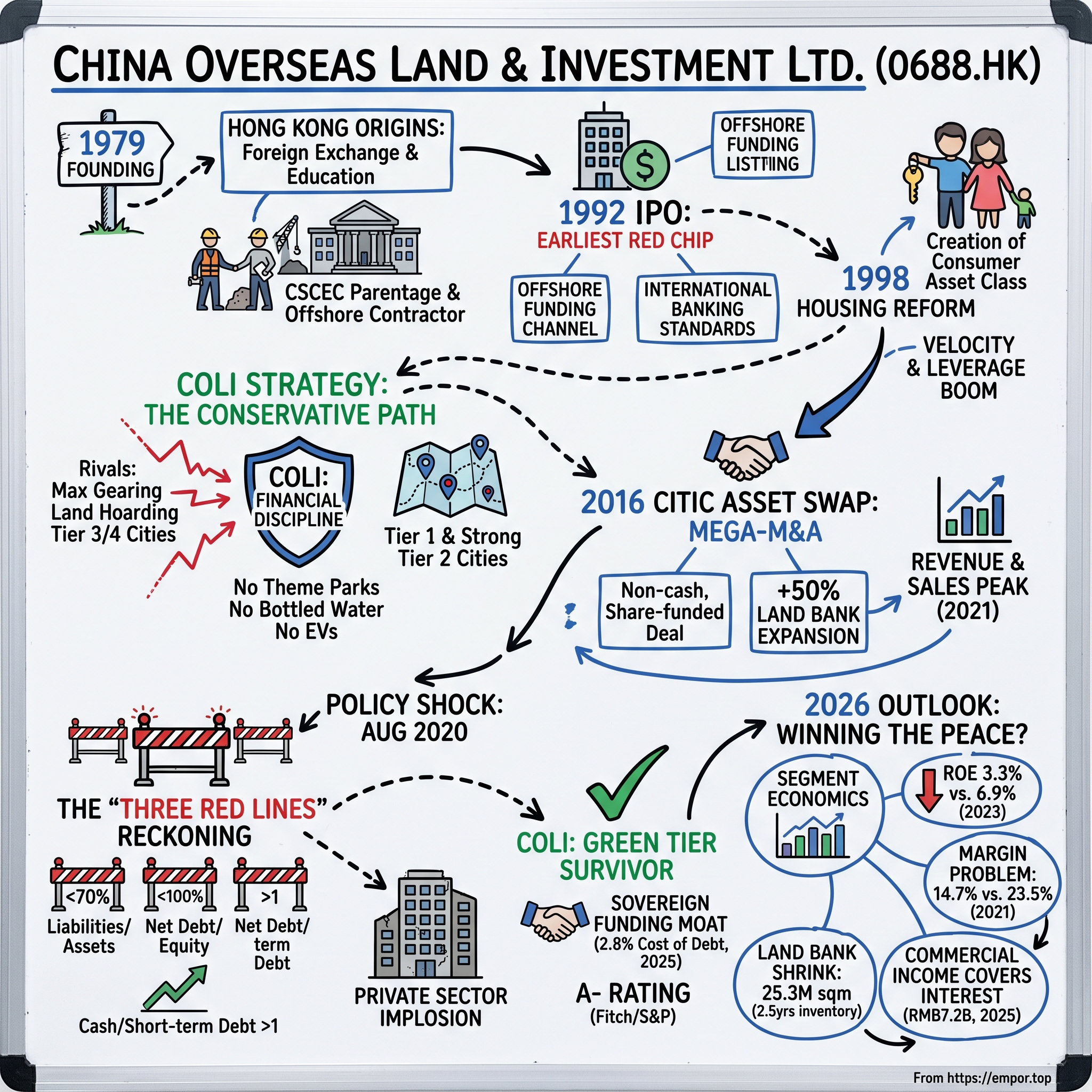
The core thesis this episode tests. COLI began life in 1979 as a small Hong Kong construction contractor, an offshore outpost of 中国建筑集团有限公司 China State Construction Engineering Corporation, the world's largest builder by revenue. It listed in Hong Kong in August 1992 as one of the earliest "red chips" — mainland-controlled companies incorporated offshore.6 Over four decades it built a reputation as the most financially conservative large developer in China: lower leverage than peers, tighter city selection, no theme parks, no bottled water, no electric cars. When credit was cheap and land prices only went up, that discipline looked like a lack of ambition. When Beijing turned off the tap in 2020, it became the single most valuable asset in Chinese real estate.
That much is now consensus, and consensus is where analysis usually goes to die. So the harder question — the one this piece is actually about — is what a fortress balance sheet is worth in an industry that is structurally shrinking. Because here is the uncomfortable arithmetic: COLI's return on equity in 2025 was roughly 3.3%, down from around 6.9% in 2023.7 Its consolidated gross margin fell from 23.5% in 2021 to 14.7% in 2025.7 Its total land bank shrank from 80.77 million square metres at the end of 2021 to 25.28 million at the end of 2025.84 It survived the war. Whether it wins the peace is a genuinely open question.
Themes we'll work through:
- The red-chip advantage. How offshore incorporation plus mainland state parentage gave COLI two capital markets while its private rivals had one, decades before that mattered.
- The M&A benchmark. The March 2016 acquisition of 中信股份 CITIC Limited's residential portfolio — a share-funded, non-cash deal that expanded the land bank by half — and whether it deserves its reputation as the best-executed consolidation in the sector's history.
- The 三道红线 "three red lines" litmus test. What the August 2020 policy actually measured, why it was lethal to some balance sheets and irrelevant to others, and what it reveals about how Beijing chooses winners.
- The sovereign funding moat, stress-tested. A 2.8% cost of debt is a real, measurable edge. But an edge over whom, in a market where the surviving competitors are all financed the same way?
Roadmap: British Hong Kong origins → CSCEC parentage and the 1992 red-chip listing → the 1998 housing reform and the boom years → the CITIC mega-swap → the three red lines and the private-sector implosion → segment economics as they actually stand in 2026 → management, governance and capital allocation → the competitive war-game → bull, bear, and the activist stress test → the two or three numbers that will settle the argument.
It starts, improbably, with a construction crew in colonial Hong Kong.
 Subscribe on LinkedIn
II. Founding Context & Hong Kong Roots (1979–1992) (15 min)
Picture Hong Kong in June 1979. The colony is a British territory with a Chinese population, a hard currency, a common-law property registry, and building codes copied from London. Across the border, 邓小平 Deng Xiaoping's reform programme is barely six months old. Shenzhen is still mostly fields. And a state construction ministry in Beijing — the entity that would become CSCEC — sets up a small subsidiary in Hong Kong to bid for public works contracts.6
That company, founded in 1979, was the seed of what is now COLI.6 The point of it was not property development. The point was foreign exchange, and education.
This is the detail that most narratives skip, and it is the one that explains everything afterwards. In 1979, a Chinese state construction enterprise operating inside China had no reason to care about cash flow. Inputs were allocated, prices were administered, and losses were absorbed by the state. A Chinese state construction enterprise operating in Hong Kong had to tender competitively against British and local contractors, price fixed-sum contracts with real penalty clauses, satisfy British-trained engineers and surveyors, borrow from commercial banks that would foreclose, and settle in a currency it could not print. It had to learn, from the ground up, that a construction project is a financing exercise wearing a hard hat.
Two decades of that education, conducted in the most competitive property market on earth, is the origin of what the market now calls COLI's conservatism. It is worth being precise about the mechanism, because "SOE discipline" is close to an oxymoron. COLI's discipline did not come from being state-owned. It came from being state-owned and forced to operate somewhere the state could not protect it. The 1997–98 Asian financial crisis and Hong Kong's brutal post-handover property crash taught the same lesson again, at scale: highly geared property companies do not fail slowly.
The parentage, and why the structure matters. COLI's immediate parent is China Overseas Holdings Limited (COHL), the Hong Kong-incorporated platform established in 1979 by CSCEC.6 The 2024 annual report's disclosure of interests records COHL as beneficial owner of 51.34% of the shares in issue, with a further 4.76% held through a controlled corporation, giving the CSCEC group an aggregate interest of 56.10% as at December 31, 2024.9 Above COHL sits CSCEC, a centrally administered state enterprise reporting ultimately to the central government rather than to a municipality or a province.
That last distinction — 央企 central SOE versus local SOE versus private — is the most important classification in Chinese real estate, and it is invisible on a financial statement. A central SOE's implicit backstop is the sovereign's. A local government financing vehicle's backstop is a municipality with its own land-sale revenue problem. A private developer's backstop is its own equity. In 2019 nobody priced this difference. In 2022 it was the only thing anyone priced.
The first inflection point: August 1992. COLI listed on the Stock Exchange of Hong Kong in August 1992, one of the earliest red chips.6 The red-chip structure — mainland-controlled, offshore-incorporated, Hong Kong-listed — was a regulatory arbitrage before it was a strategy. It gave COLI something no purely domestic Chinese developer had in 1992: access to Hong Kong equity and to the international bank and bond markets, denominated in convertible currency, governed by Hong Kong listing rules and audited to international standards.
It is worth explaining what "red chip" actually meant in practice, because the label is often used loosely. A Chinese company listing in Hong Kong could do so two ways. It could incorporate on the mainland and list H-shares, in which case it remained a mainland legal entity subject to mainland company law and capital controls. Or it could put a Hong Kong-incorporated holding company on top, list that, and hold its mainland assets through subsidiaries. The second route — the red-chip route — produced a company that was legally a Hong Kong entity: it could raise Hong Kong dollars and US dollars, borrow offshore without mainland approval for each facility, acquire and dispose of assets under Hong Kong company law, and pay dividends without navigating foreign-exchange quotas. COLI got that structure in 1992, more or less by accident of having been founded in Hong Kong in the first place.
The timing was extraordinary, though probably more lucky than clever. COLI raised international capital in 1992 — six years before the mainland's urban housing market legally existed in any recognisable commercial form. When it did come into existence, COLI already had a listed vehicle, an offshore funding channel, a construction parent, and twelve years of hard-won experience in delivering buildings on time in a market that punished failure.
Compare the counterfactual. A private mainland developer founded in the mid-1990s — and most of the eventual giants were — had none of this. It funded itself from onshore bank loans, then from trust products, then from wealth-management channels, and finally, from roughly 2013, from US dollar high-yield bonds sold to international funds through offshore special-purpose vehicles bolted on later, often with structural subordination that nobody examined closely until it mattered. Those developers grew faster. They also built their entire funding stack on the assumption that the offshore high-yield market would stay open. COLI, by contrast, was inside that market from the beginning, with an investment-grade profile and a parent whose name meant something to a credit committee in Singapore or London.
The company was added to the Hang Seng Index in December 2007, the formal acknowledgement that a construction contractor had become one of Hong Kong's blue chips.6
For investors, the durable takeaway from the founding era is not nostalgia. It is that COLI's cost-of-capital advantage — the thing that would matter most three decades later — was structural and inherited, not earned by any management team in the 2020s. That cuts both ways. Structural advantages are hard for competitors to copy. They are also hard for management to take credit for, and impossible to sell.
The mainland was about to open.
III. The Great China Property Boom & "King of Land" Discipline (1998–2014) (18 min)
In July 1998, the State Council abolished the welfare housing allocation system. For fifty years, urban Chinese housing had been assigned by employers — a work unit gave you an apartment, and the apartment was not yours. After 1998, it could be. Within two decades, private homeownership in urban China went from a curiosity to the primary store of household wealth and the collateral underpinning the banking system.
This was the largest creation of a consumer asset class in economic history, and it produced a specific business model. A Chinese developer bought land from a local government at auction, borrowed against it, pre-sold apartments to buyers before construction finished, and used those pre-sale receipts to buy more land. Note what that model rewards: velocity and leverage. If prices rise while you build, the faster you cycle capital, the richer you get. The correct strategy, given those assumptions, was maximum gearing and maximum land hoarding — and for roughly twenty years, that strategy was correct.
COLI played a different, narrower game, and for most of the boom it looked worse for it.
The city-selection bet. COLI concentrated on high-end and upper-mid-market residential development in tier-one cities — Beijing, Shanghai, Guangzhou, Shenzhen — and a short list of strong tier-two markets like Hangzhou, Chengdu and Suzhou. Its private rivals went everywhere. Evergrande and Country Garden built their volume empires in tier-three and tier-four cities, where land was cheap, local governments were desperate, and the arithmetic of pre-sale-funded expansion worked spectacularly on the way up.
The strategic content of COLI's choice was a view about end demand versus speculative demand. Tier-one Chinese cities have net inward migration, restrictive land supply, and buyers who want to live in the apartment. Tier-three cities frequently had none of the three. COLI was, in effect, buying scarcity and paying up for it — which meant lower unit volume growth, higher land cost per square metre, and years of looking underpowered next to peers compounding sales at 40% a year.
The 地王 "land king" persona. COLI acquired a market reputation as a bidder that would take trophy parcels in prime urban cores but would walk away from auctions when pricing broke its return threshold. The phrase 地王 — literally "land king," the winner of a headline-grabbing parcel — was applied to Chinese developers with a mixture of awe and mockery, because paying a record price per square metre is a marketing event, not an investment thesis. COLI's version was more disciplined than most: prime location, but with a stated internal ceiling on leverage.
The 2008 test. When the global financial crisis hit, Beijing responded with a roughly RMB4 trillion stimulus programme and a credit expansion that reflated property almost immediately. Developers who had been over-extended in mid-2008 were rescued within twelve months. This is the single most consequential thing that happened to Chinese real estate risk management, and it had nothing to do with balance sheets: it taught an entire industry that the state would always reflate, and that the punishment for excess leverage was a bad six months. That lesson, absorbed in 2009, is why the 2021 default wave was as violent as it was. A generation of executives had been trained to believe the downside was capped.
COLI's response to 2008 was operational rather than financial. It compressed its cycle from land acquisition to sales launch, standardised its product lines, and leaned on procurement scale and engineering methods shared with its construction parent. It built a consumer brand — 中海地产 China Overseas Property — around construction quality and reliable handover rather than around price.
A note on the machinery, because it explains later margins. Chinese residential development in this era ran on pre-sales, and the mechanics are worth spelling out for anyone who has not looked closely. A developer wins a land parcel at auction, pays the premium in instalments, obtains a pre-sale permit once construction reaches a specified stage, and then sells apartments off-plan to buyers who take out mortgages immediately. Those mortgage proceeds flow to the developer — into regulated escrow accounts, in theory — long before the building is finished. Accounting revenue, however, is recognised only on handover, typically two to three years later. So a Chinese developer's income statement in any given year describes decisions made three to five years earlier, while its cash flow statement describes today. The two can point in opposite directions for years. This single feature explains most of the confusion in Western commentary on Chinese property, and it will matter enormously when we get to COLI's current margins.
There was a second piece of machinery: price caps. From the mid-2010s, many municipal governments imposed ceilings on new-home selling prices as an anti-speculation measure, while land was still sold at open auction. A developer could therefore be forced to buy an input at market price and sell the output at an administered price. The squeeze was not a market outcome; it was policy, and it fell hardest on the highest-priced tier-one product — which is precisely where COLI had chosen to concentrate.
What the brand was actually worth. For most of the boom, roughly nothing measurable. When every apartment appreciates and every developer completes, "reliable delivery" is not a differentiator; it is table stakes, and paying for it is a margin leak. Chinese homebuyers in 2013 were not choosing between developers on delivery risk. They were choosing on location and price, and buying whatever they could get approved for.
This is the honest version of the pre-2020 story, and it is more interesting than the hagiography. For two decades, COLI's strategy was not obviously superior. It was a different risk preference with an unquantifiable option embedded in it: if the market ever stopped going up, the option would pay. Management could not prove the option had value, and shareholders were not compensated for holding it. Anyone assessing COLI on 2014 evidence would have concluded, reasonably, that the company was a well-run, slow-growing, sub-scale participant in a market being conquered by more aggressive operators.
The pay-off was still six years away. But before it arrived, COLI made the biggest single move in its history — and it made it with paper, not cash.
IV. The CITIC Asset Swap: Mega-M&A in State Consolidation (2015–2016) (20 min)
On March 14, 2016, COLI announced that it had agreed to acquire the mainland residential property business of CITIC Limited — the listed arm of one of China's oldest and most sprawling state conglomerates — for approximately RMB31 billion.10
Read the structure carefully, because the structure is the analysis. COLI issued about 1.1 billion new shares to CITIC at HK$27.13 each, a 5.36% premium to the prior close, worth roughly HK$29.72 billion. It also transferred a portfolio of commercial property companies valued at about RMB6.15 billion to CITIC. In exchange, it received residential development assets spanning roughly 24 million square metres of land across 25 mainland cities, including Beijing, Shanghai and Shenzhen alongside second- and third-tier markets such as Chengdu, Dalian and Chongqing. The new shares represented about 11.1% of COLI's existing share capital, leaving CITIC with roughly a 10% stake in the enlarged company. COLI's land bank expanded by approximately 50%.10
Four things worth noticing.
First, no cash left the building. At the exact moment when Chinese developers were bidding land prices to record levels and funding it with trust loans and offshore high-yield paper, COLI increased its land bank by half using equity and a swap of unwanted commercial assets. Its cash reserves and its borrowing capacity were untouched. In 2016 that looked like a merely clever way to finance a deal. In hindsight it was the difference between entering the 2021 downturn with optionality and entering it with a refinancing wall.
Second, the dilution maths were favourable but not free. Roughly 11% share issuance for roughly 50% more land is, on its face, a good trade — and COLI's weighted average share count rose from about 10.18 billion in 2016 to about 10.96 billion afterwards, where it has essentially stayed for a decade. Management has not issued equity since. But dilution is only accretive if the acquired assets earn their cost of capital, and a meaningful share of the CITIC portfolio sat in lower-tier cities that COLI had spent twenty years deliberately avoiding. Some of that inventory took years to work through, and it arrived with the usual integration burden of absorbing another organisation's project companies, joint-venture partners and local relationships.
Third, this was state-directed capital reallocation wearing a market costume. CITIC did not run a competitive auction and sell to the highest private bidder. A central conglomerate that had decided residential development was non-core transferred those assets to the central SOE whose core competence it was, in exchange for equity in the acquirer plus a package of commercial assets better suited to a financial holding company. Everyone stayed inside the state perimeter. The pricing — around book value rather than the inflated multiples private-to-private deals were fetching in 2016 — reflects the absence of a genuine auction as much as it reflects COLI's negotiating skill. Investors should be honest that COLI's most successful acquisition was one it was arguably allocated, not one it won.
Fourth, it set a template that mattered later. Sunac and other private acquirers were, in the same era, buying distressed portfolios with borrowed money at premium prices. Those deals destroyed the acquirers. The CITIC transaction demonstrated a different playbook — pay in paper, take assets at book, keep the cash — that central SOEs would use repeatedly after 2021 when distressed project stakes came up for sale.
The verdict, stated carefully. The CITIC swap is commonly described as the most value-accretive SOE property consolidation in Chinese corporate history, and on the evidence of what happened to the alternatives, that is defensible. But the more precise conclusion is narrower and more useful: the deal was excellent primarily because of what it did not consume. It bought scale without spending liquidity, in the last year before liquidity became the only thing that mattered. That is a lesson about the form of consideration, not about deal-making genius — and it is a lesson that generalises far beyond China.
What integration actually looked like. The unglamorous part of the deal took years. A Chinese residential portfolio is not a portfolio of buildings; it is a portfolio of project companies, each with its own local partners, minority holders, land-premium payment schedules, planning approvals and municipal relationships. Absorbing 25 cities' worth of those entities meant rationalising which projects to accelerate, which to reposition, and which to run off. COLI has never published a project-level post-mortem on the CITIC assets, so an outsider cannot separate the deal's contribution from organic performance — a genuine limitation on how confidently anyone can call the transaction accretive. What is observable is the aggregate: revenue and contracted sales roughly doubled over the following seven years, peaking at RMB369.5 billion of contracted sales in 2021, with no further equity issuance in the intervening decade.87
By 2019, COLI was a top-five Chinese developer with a materially larger land bank, an unchanged share count, and a balance sheet its competitors would have found embarrassing to disclose. It had also, without knowing it, positioned itself for a policy shock that was about to arrive from Beijing.
V. The "Three Red Lines" Reckoning & The Great Private Collapse (2020–2023) (22 min)
In August 2020, regulators summoned executives from twelve of China's largest property developers to a meeting and told them, verbally, that they had been selected for a pilot programme.11 There was no public announcement. There was no legislation. There was a set of three ratios, and a schedule of consequences.
The ratios: liabilities to assets, excluding pre-sale receipts, no more than 70%. Net debt to equity below 100%. Cash holdings at least equal to short-term debt.11
The consequences were where the policy showed its teeth. A developer breaching none of the three could grow interest-bearing liabilities by up to 15% a year. One breach capped growth at 10%. Two breaches, 5%. All three, and the company was banned from adding debt at all.11
Understand what that does. The Chinese development model ran on continuously rolling debt: borrow against land, build, pre-sell, repay, borrow more. It did not require net new borrowing to grow, but it absolutely required the ability to refinance maturing debt with new debt. By tying a developer's permitted debt growth to its existing ratios, the three red lines converted a leverage problem into a liquidity problem, and then converted a liquidity problem into a solvency problem — because the moment bond markets understood that a red-tier developer could not refinance, they stopped lending to it entirely, at any price.
The policy framing came from the top: 房子是用来住的,不是用来炒的 — "housing is for living in, not for speculation" — and, from 2021, the broader 共同富裕 common prosperity agenda. This was not a technical prudential adjustment. It was a deliberate decision to end a growth model.
The implosion. The sequence is now history. Evergrande's US$300 billion-plus of liabilities made it the world's most indebted company; a Hong Kong court ordered its liquidation in January 2024 after it failed to produce a viable restructuring plan, and its shares were struck off the exchange in August 2025.1 Country Garden — bigger by volume, better regarded operationally, and until 2022 rated investment grade by some agencies — took until December 30, 2025 to complete a US$17.7 billion offshore restructuring. 融创 Sunac, 阳光城 Yango and dozens of others followed variations of the same path. Offshore dollar bonds that had yielded 7–9% in 2020 traded at yields implying near-total loss, and then did not trade at all.
The structural outcome is captured in one statistic already noted: forty-one developers cleared RMB100 billion of annual sales in 2021; ten did in 2025, nine of them state-owned.2 This was not a cyclical shakeout. It was the near-total elimination of an ownership class from an industry.
COLI in the same window. At the end of 2021 — the last year of the old world — COLI reported contracted sales of RMB369.5 billion, revenue of RMB242.24 billion, net gearing of 32.3%, and a weighted average borrowing cost of 3.55%.8 It was, in other words, comfortably inside all three lines before the lines were drawn. It had not deleveraged to comply; it had simply never levered up.
Being in the so-called green tier — clearing all three ratios — mattered less as a licence to borrow more than as a signal to everyone else. A green-tier developer could tell a bank, a bond investor and a homebuyer the same thing simultaneously: this company is permitted to refinance. In a market where the binding constraint had become permission rather than price, that signal was worth more than any operational improvement.
The mirror image is what happened to the developers on the wrong side. Offshore US dollar bonds that had priced at single-digit yields in 2020 gapped to distressed levels within months of the policy's implications becoming clear — and the important part is that this was not a gradual repricing. Credit markets do not slide; they gate. Once a developer's bonds trade at a yield that makes refinancing arithmetically impossible, the refinancing does not happen at a worse price. It does not happen at all. A business that needed to roll debt every year, in an industry where the underlying asset takes three years to convert to cash, then has a matter of months.
So it kept buying. In 2021 alone COLI acquired 98 land parcels with attributable land premium of RMB161.02 billion, adding RMB382.21 billion of new saleable resources.8 It continued acquiring through 2022, 2023 and 2024, in auctions where private bidders had ceased to appear and where local governments, desperate for land-sale revenue, were often selling at or near reserve prices. By 2023, contracted sales had grown 5.1% to RMB309.81 billion and revenue had risen 12.3% to RMB202.52 billion — growth, in the third year of a national property depression.[^12]
Meanwhile its cost of debt went the other way from the industry's. From 3.55% in 2021, COLI's average borrowing cost fell to 3.1% in 2024 and to 2.8% in 2025.124 In June 2024, S&P Global upgraded COLI to "A-" with a stable outlook, and the company holds "A-" long-term ratings from two international agencies — the only listed mainland developer that does.5
The analytical point, and the caveat. The funding spread was real, enormous, and directly attributable to ownership structure rather than to operating skill. A developer borrowing at 2.8% can bid a higher land price than one borrowing at 9% and still clear the same equity return; when the 9% borrower cannot borrow at all, the 2.8% borrower simply chooses among parcels. For roughly three years, COLI faced almost no competition for prime land from anyone outside a small group of central SOEs.
But two caveats belong here, and they are the seed of the bear case developed later. First, cheap capital does not create demand. It changes who supplies a shrinking market. Second, buying land into a falling market at "attractive" prices is only attractive if prices stop falling before the inventory is sold. COLI was, in 2021–2024, making a very large, very levered-to-the-macro bet that tier-one Chinese housing prices had a floor — and it was funding that bet by drawing down the very balance-sheet strength that constituted its advantage.
By 2025, the results of that bet had started to show up in the income statement. Which is where the story stops being about survival and starts being about economics.
VI. Segment Breakdown & Core Business Economics (22 min)
Here is the sentence in COLI's 2025 results that deserves the most attention, and it is not about profit. In 2025, revenue from the group's commercial property operations reached RMB7.20 billion — enough, for the first time in the company's history, to cover its entire interest expense.13
That is the kind of milestone that sounds like an investor-relations flourish and is actually a structural fact. It means the company's recurring rental income now services its debt independently of whether it sells a single apartment. For a business model that has depended on pre-sale cash flow for its entire existence, that is a meaningful reduction in fragility. It is also, as we will see, growing far too slowly to change the equity story on its own.
Segment one: property development — still almost everything.
COLI's 2025 revenue was RMB168.09 billion, down from RMB185.15 billion in 2024 and RMB202.52 billion in 2023.74 Contracted sales — the forward-looking number, since revenue is recognised on delivery — fell 19.1% to RMB251.23 billion on 10.56 million square metres of floor area, down 8.1%.14 Development is roughly 96% of revenue.
The geography of those sales is the strategy made visible. Beijing alone contributed RMB50.26 billion, where COLI ranked first in the city for the eighth consecutive year. Shenzhen contributed RMB24.89 billion. Hong Kong contributed RMB22.23 billion — roughly double the prior year, and enough to place COLI in the top five of the Hong Kong market for the first time, driven by a Kai Tak waterfront project that set a district record on a per-square-foot basis and a Yuen Long development that led its sub-market. The five core cities together produced RMB125.44 billion, about half of group sales.13
There is a mix effect running underneath these numbers that is easy to miss and important to understand. In 2024, COLI's contracted sales rose 0.3% to RMB310.69 billion while the corresponding sales area fell 14% to 11.49 million square metres — meaning the average contracted selling price jumped 16.6% to RMB27,047 per square metre.9 The same pattern repeated in the first half of 2026: value up, volume down, price per square metre sharply higher. COLI is not selling more homes. It is selling fewer, much more expensive homes, in fewer, much better locations.
That is a coherent strategy and it flatters the headline sales number, but investors should read it for what it is: a retreat up the quality curve, not a volume recovery. A developer whose square metreage is falling by double digits is shrinking its operating footprint. The revenue line holds up because tier-one prices are high, not because demand is returning.
Concentration at that level is a deliberate bet, and it is the correct bet if you believe tier-one end-user demand is more durable than the national aggregate. The 2026 data so far supports it: in the first half of 2026, national property development investment fell 18.0%, floor space of new commercial buildings sold fell 11.6%, and total new-build sales value fell 13.6%.15 Over the same six months COLI's contracted sales rose 11.8% to RMB134.352 billion, though sales area fell 12.1% to 4.50 million square metres — a mix shift toward far higher average prices, roughly RMB29,844 per square metre.16 In the first quarter alone, sales rose 11% to RMB51.52 billion on revenue of RMB37.04 billion and operating profit of RMB4.11 billion.17
And now the margin problem.
COLI's consolidated gross margin was 23.5% in 2021, 20.5% in 2022 and 20.3% in 2023 on a comparable basis, 17.7% as reported for 2024, and 14.7% in 2025.79 Net profit attributable to shareholders followed: RMB40.16 billion in 2021, RMB25.61 billion in 2023, RMB15.64 billion in 2024, RMB12.69 billion in 2025, with core profit of RMB13.01 billion.74 Earnings per share fell from RMB3.67 to RMB1.16 over four years.7
The mechanism is straightforward and worth spelling out in plain terms, because it is the single most important thing to understand about any Chinese developer's reported profits today. Revenue is recognised when apartments are handed over, typically two to three years after they are sold, which are themselves one to two years after the land was bought. So 2025's reported margin reflects land purchased around 2020–2022 — at the top — sold into a market with government-imposed price caps and weakening demand. The margin on the income statement is a photograph of a decision made half a decade earlier.
This creates a genuine analytical trap in both directions. Bulls argue the reported margin understates current economics, because land bought at auction-lull prices in 2023–2025 will carry better margins when it is delivered in 2027–2028. Bears argue the recent land — bought in intensely competitive tier-one auctions against other cash-rich SOEs — is not actually cheap, and that price caps and weak resale markets will compress the exit. Both are forecasts. Neither is yet evidence. On the August 27, 2025 interim results call, chief executive 张智超 Zhang Zhichao made the defensive version of the case: a core attributable net margin of 10.6% that remained industry-leading, high unrecognised revenue on the balance sheet, and administrative and selling expenses held to 3.8% of revenue.18 That is a claim about relative profitability, not about the level — and it is the right claim for management to make, because the level is not currently attractive.
Myth versus reality: three consensus claims, checked.
Myth: COLI's gross margins run 300–500 basis points above the industry. Reality: the relative claim is probably true and is the one management makes; the absolute level is what matters, and at 14.7% a developer is earning a contractor's margin on a landlord's capital base. Being better than a peer group in liquidation is a low bar.
Myth: COLI has pricing power because buyers trust it to deliver. Reality: it has demonstrable share power, which is not the same thing. Its rising average selling price reflects a shift to more expensive cities and products, not the ability to charge more for the same apartment in the same district than a comparably-positioned SOE rival. In price-capped markets, the ceiling is set by a municipal government, not by brand.
Myth: the balance sheet is a fortress and therefore the equity is safe. Reality: the balance sheet is genuinely strong, and it is being deployed at an accelerating rate into an asset whose price is still falling nationally. Fortress balance sheets protect creditors first. COLI's bondholders have been the clear winners of the last five years; its shareholders have watched earnings per share fall by roughly two-thirds.7
The delivery record, and what backs it. COLI's most cited operational claim is that it has delivered every pre-sold project on schedule through the crisis — the 保交楼 "guarantee delivery of homes" standard that Beijing imposed on the industry from 2022 as stalled construction sites became a social problem. The company has not published an audited completion-rate statistic, so the claim rests on the absence of contrary evidence rather than on a disclosed metric. What is disclosed is the scale of what has to be delivered: the carrying value of the group's stock of properties stood at approximately RMB454.1 billion at the end of 2024 — more than twice a full year's revenue, sitting on the balance sheet as work in progress and finished inventory.9 Every one of those buildings represents a promise to a buyer who has already paid and already taken out a mortgage. That is the real reason delivery reliability became the industry's defining competitive variable, and the real reason a cash-rich balance sheet translated directly into consumer preference.
Segment two: commercial property — the hidden engine, growing quietly and slowly.
The commercial portfolio comprises office buildings, the 环宇城 Unipark family of shopping malls, long-term rental apartments, hotels and related assets under 中海商业 China Overseas Commercial. In 2025, malls and offices together accounted for 81% of the segment's revenue, and management reported mall tenant sales up 7% and footfall up 11%.1813
In October 2025, COLI achieved something more consequential than an incremental rent increase: the Huaxia China Overseas Commercial closed-end infrastructure securities investment fund — a consumption REIT — was listed on the Shenzhen Stock Exchange, seeded with the Yingyuehu Unipark mall in the Guangzhou–Foshan corridor, roughly 153,000 square metres of gross floor area. It was structured as an acquisition and revitalisation of an existing asset rather than a development.
Why this matters more than its size: a C-REIT gives COLI an exit channel for stabilised commercial assets. Historically, a Chinese developer that built a mall owned it forever, tying up capital at a mid-single-digit yield. A functioning REIT market turns the commercial business from a capital sink into a capital cycle — build, stabilise, sell into the REIT, recycle. That is how the best global real estate operators earn returns above their cost of capital on rental assets.
The honest counterpoint is that the segment is not growing fast enough to matter yet. Commercial revenue was RMB5.17 billion in 2021, RMB7.13 billion in 2024 (up 12.1%, with nine new projects opened), and RMB7.20 billion in 2025 — barely 1% growth in the most recent year.8124 Against a group revenue base of RMB168 billion, this is a rounding error that happens to cover the interest bill. Getting it to a level where it materially offsets development cyclicality requires years of compounding that the last twelve months did not deliver, in an office market where Grade-A vacancy in Shenzhen and Shanghai has been conspicuously weak.
Segment three: construction, design and the "ecological" businesses.
Planning, architectural design, construction services, supply-chain management, property technology and education-adjacent ventures together contribute a small single-digit share of revenue.6 Strategically they matter as a cost-position input rather than a profit centre: shared engineering standards and procurement with CSCEC are the plausible source of COLI's construction cost advantage. Investors should be clear, though, that COLI does not publish a cost-per-square-metre comparison against peers, so the size of that advantage is asserted rather than demonstrated.
Two operating facts to carry forward. First, land bank: 25.278 million square metres of gross floor area at end-2025, of which 22.856 million attributable, with 86.5% in first-tier and major second-tier cities.4 That is high-quality — and, at 2025's sales pace of 10.56 million square metres, only about two and a half years of inventory, against 80.77 million square metres four years earlier.8 Second, inventory is turning more slowly: days of inventory outstanding rose to roughly 1,260 in 2025 from about 1,100 in 2024. The company is selling a smaller, better book of land more slowly than it used to.
Which brings us to the people making those choices.
VII. Management, Governance, & Capital Allocation (18 min)
At the August 2025 interim results conference in Hong Kong, chairman 颜建国 Yan Jianguo did something Chinese executives do when they want to signal continuity to a nervous audience: he gave the room a slogan. His framing for the 十五五 15th Five-Year Plan period was 三个充满信心 — "three confidences": confidence in the Chinese economy, confidence in the property industry, and confidence in COLI itself. He closed with 我们将一步一个脚印,让公司走得更稳、走得更远 — roughly, "step by step, so the company walks more steadily and further."18
It is worth pausing on how little information that contains, and then on how much the behaviour around it does.
颜建国 Yan Jianguo — chairman and executive director. Yan is a career insider: decades inside the CSCEC and COLI system, with regional operating roles before reaching the top. He became chairman and, initially, chief executive, and his tenure has been defined by three consistent choices. He kept leverage low when the industry did not. He refused to diversify outside real estate — no automotive venture, no theme parks, no consumer beverages, in an era when several peers pursued all three. And he concentrated the land budget in tier-one and strong tier-two cities rather than chasing volume down the city tiers.
张智超 Zhang Zhichao — chief executive officer and executive director. Zhang took over as CEO on February 11, 2020, with Yan stepping back from the executive role to focus on strategy as executive chairman.19 Zhang came up through regional operations, and his public presence is markedly more operational than Yan's: on results calls he talks about margin composition, expense ratios, unrecognised revenue and specific city markets. On the same August 2025 call he made a genuinely falsifiable forecast — that the Hong Kong market had bottomed and was turning up, with COLI's Hong Kong sales expected to exceed HK$20 billion for the year.18 Hong Kong contracted sales came in at RMB22.23 billion, roughly double the prior year and a top-five position in that market.13 Making a specific, checkable prediction and then hitting it is a small but real credibility data point, and it is the kind of thing worth tracking across calls.
Governance and alignment. COHL holds about 55.99% of the shares.9 The benefits are the ones this whole story has been about: implicit sovereign credit support, funding access, and priority in state-directed asset transfers. The costs are equally structural and rarely stated plainly by sell-side coverage. A 56% state parent means minority shareholders do not control outcomes; that related-party transactions with CSCEC's construction arms are a permanent feature requiring disclosure diligence rather than trust; that COLI may at times be asked to serve policy objectives — participating in a land auction that supports local government revenue, taking on a stalled project, delivering apartments on a 保交楼 mandate — that a purely commercial owner would decline; and that the option of a takeover premium does not exist. COLI trades as a controlled company because it is one.
Incentives — and a disclosure gap worth naming. It is widely asserted that COLI's management incentives are tied to returns on invested capital, profit growth and debt compliance rather than to gross sales volume. The behaviour is consistent with that: the company did not chase the volume league table when volume was the industry's scoreboard, and its executives talk in margin and expense-ratio terms rather than sales-target terms. But the specific metrics, weightings and vesting conditions of senior management remuneration are not disclosed with the granularity a UK or US investor would expect from a listed company of this size. An investor should treat the incentive alignment as inferred from conduct, not verified from documents — which is a reasonable inference here, and still an inference.
Capital allocation: the behaviour, not the rhetoric. This is where the 2025 numbers get genuinely interesting, and where a careful investor should slow down.
In 2024, COLI reported cash on hand of RMB124.17 billion, net gearing of 29.2%, an asset-liability ratio of 55.8%, and record operating cash flow of RMB46.45 billion, on contracted sales of RMB310.7 billion.12 In 2025, cash fell to RMB103.63 billion, net gearing rose to 34.2%, the liability-to-asset ratio improved to 54.1%, and operating cash inflow fell to RMB16.73 billion, on sales of RMB251.23 billion with a 95% collection rate.4
Over the same year, COLI spent RMB92.42 billion of attributable land premium on 35 parcels across 15 mainland cities and Hong Kong — the largest attributable land spend in the industry — adding 4.99 million square metres of gross floor area.413 In the first seven months of 2025 alone it had taken 22 parcels for RMB55.01 billion, with 86% of investment in first-tier and major second-tier cities.13
State that plainly: in a year when sales fell 19% and operating cash flow fell by roughly two-thirds, management increased net gearing by five percentage points and drew down more than RMB20 billion of cash to buy more land than anyone else in China. That is not conservatism. It is a large, deliberate, counter-cyclical investment — arguably the most aggressive capital allocation decision in the company's recent history, made by a management team whose entire reputation rests on restraint.
It may well be right. Buying prime urban land when competitors are absent is the textbook counter-cyclical move, and COLI's balance sheet at 34.2% net gearing remains far stronger than the industry's. But investors should describe it accurately rather than filing it under "prudence," and they should note the pattern to watch: if sales keep falling while land spend stays at RMB90 billion-plus, gearing keeps rising and the funding advantage — which is the whole thesis — slowly erodes.
The dividend, and a small piece of narrative discipline. COLI paid HK60 cents per share for 2024 and HK50 cents for 2025 — a cut of about 17% — while the payout ratio edged up from 38.2% to 38.6%.124 Management framed the payout ratio as maintained, which is technically accurate and slightly beside the point: the ratio held because earnings fell. At the current share price around HK$13.72, that dividend represents a yield of roughly 3.7%.20 The behaviour is defensible — a payout that flexes with earnings is more honest than a fixed dividend funded by debt — but a shareholder should be clear that income from this stock is cyclical, not fixed.
Which sets up the strategic question: is any of this a durable competitive advantage, or just a better position in a worse industry?
VIII. Playbook & Strategic Powers (20 min)
Time to war-game it. Strip away the survivorship narrative and ask what COLI actually possesses that a competitor cannot obtain.
Hamilton Helmer's 7 Powers, applied honestly
1. Counter-positioning — the primary power, and the one that has already largely paid out.
Counter-positioning describes a business model a competitor cannot copy because copying it would damage their existing business. COLI's version was exact: to match COLI's cost of capital, a private developer would have had to accept state ownership, sub-40% gearing, and tier-one-only land discipline — which would have meant abandoning the volume growth that justified its own equity valuation. No private developer could rationally do that in 2015. Every one of them that didn't is now gone or restructured.
The critical investor question is whether this power is forward-looking or spent. Counter-positioning generates returns during the period when incumbents cannot respond. That period has ended, because the incumbents did not respond — they died. COLI's surviving competitors — 保利发展 Poly Developments, 华润置地 China Resources Land, 招商蛇口 China Merchants Shekou, 万科 Vanke, 绿城中国 Greentown China, 建发 Xiamen C&D, 中国金茂 China Jinmao, 越秀地产 Yuexiu Property — are almost all state-owned and financed on broadly similar terms. Against them, COLI's funding structure is not a differentiator. It is the industry's entry ticket.
The evidence is in the scoreboard. In the first half of 2026, only three developers cleared RMB100 billion of gross contracted sales: Poly at RMB135.1 billion, COLI at RMB134.3 billion, and China Resources Land at RMB116.5 billion — with Poly ahead of COLI by roughly RMB800 million, a rounding error.21 That is not an oligopolist with pricing power. That is a knife fight between three similarly-financed state champions for the same prime parcels in the same handful of cities. Land auction competition in tier-one cities is now described by COLI's own management as 相对激烈 — relatively intense — precisely because everyone has retreated to the same ground.18
2. Process power — real, but under-evidenced.
Standardised engineering, procurement scale, and integration with CSCEC plausibly give COLI a construction cost advantage of some size per square metre. Process power is the hardest of Helmer's powers to fake and the hardest to verify from outside. COLI's supporting evidence is indirect: administrative and selling expenses at 3.8% of revenue, a 95% sales collection rate, a consistently industry-leading core net margin, and an unblemished delivery record through the years when buyers were watching handover risk obsessively.184 What is missing is a disclosed unit-cost comparison. Treat this as probable and material, but not proven.
3. Cornered resource — partially, and depleting.
The tier-one land assembled during the 2022–2024 auction lull is a genuine scarce asset: 86.5% of a 25.28 million square metre land bank sits in first-tier and major second-tier cities.4 But a land bank is a consumable, not a moat. At current sales velocity it represents roughly two and a half years of supply, and replacing it now requires bidding against Poly and CR Land in exactly the auctions where cheap land no longer exists. The resource was cornered for a window. The window is closing.
4. Brand — the one power that strengthened.
The most durable thing COLI gained from the crisis was not land or funding; it was buyer trust. When Chinese homebuyers watched pre-sold apartments go unfinished across the country, "will this developer actually deliver my home" became a purchase criterion for the first time in the market's history. A twenty-year investment in delivery reliability that had earned nothing suddenly earned a price premium and share gains. That is brand power in the strict sense: buyers pay more for the same physical product from this seller.
The caveat is coming from policy. The 15th Five-Year Plan explicitly pushes the market toward 现房销售 completed-home sales, away from pre-sales, as a systemic risk reduction.22 If buyers eventually purchase finished apartments, delivery risk goes to zero for everyone — and COLI's hardest-won brand advantage quietly evaporates. The offset is that completed-home sales require developers to fund construction entirely from their own balance sheets, which is brutal for anyone without cash and cheap debt. So the same reform that erodes COLI's brand edge amplifies its funding edge. Net effect: unclear, and worth watching closely.
Powers COLI does not have: no scale economies of consequence (Chinese development is regional and project-based; a national developer is a portfolio of local businesses), no network effects, and no switching costs — a homebuyer transacts once.
Porter's Five Forces, as they stand in mid-2026
Threat of new entrants — very low. Capital intensity, the near-impossibility of obtaining low-cost credit as a new private property borrower, and land-auction qualification requirements have effectively closed the industry to new entrants. Note that this barrier is regulatory and credit-driven rather than earned, which means it could be relaxed by the same authority that imposed it.
Supplier power — low. CSCEC affiliation and purchasing scale, in a construction supply chain with severe overcapacity and contractors desperate for work from counterparties that actually pay.
Buyer power — high, and higher than the boom-era consensus admits. Buyers face falling secondary-market prices, 766 million square metres of unsold national inventory, and no fear of missing out. New-home prices fell 3.3% year-on-year in June 2026.23 A buyer who believes prices will be lower next year has extraordinary bargaining power, and COLI's brand premium buys pricing tolerance, not pricing immunity. Note too that second-hand homes made up around 65% of transactions in thirty major cities in 2025 — the resale market is now the primary competitor to new supply.3
Threat of substitutes — low but rising. Homeownership remains the core Chinese household asset, but 8.7 million affordable rental units had been completed by 2025 and the state is expanding provident-fund coverage and affordable housing provision.22 Public and affordable housing is a structural substitute at the lower end, and it is policy-favoured.
Competitive rivalry — high, and concentrated in exactly the places COLI has chosen to compete. The oligopoly framing is comforting and partly misleading: consolidation has reduced the number of competitors while intensifying the overlap between the survivors. All of them want Shanghai, Beijing and Shenzhen. None of them want tier-three cities. There is no differentiation in funding cost among them. This is the least attractive competitive configuration in Porter's framework — capable rivals, undifferentiated inputs, contracting demand.
The synthesis for investors. COLI's competitive position is strong in absolute terms and weakly differentiated versus the peers who matter. Its funding advantage is real against the industry average and thin against Poly and CR Land. Its brand advantage is real today and policy-vulnerable tomorrow. Its land quality is excellent and finite. If the equity is going to work from here, it will be less because COLI out-competes CR Land and more because the whole sector is priced for something worse than what actually happens.
Which is precisely what a sceptic would attack.
IX. Skeptical Investor Stress Test & Bull vs. Bear Case (20 min)
The activist's file
Imagine a hedge fund analyst who has just been handed COLI and told to find the argument. Here is what they would write.
"You are earning a 3.3% return on equity and calling it success." In 2025, COLI's return on equity was roughly 3.3%, down from about 4.1% in 2024 and 6.9% in 2023.7 Total assets were RMB915.7 billion; net assets RMB419.9 billion.6 A company earning 3% on a RMB420 billion equity base is destroying value against almost any plausible cost of equity, and the fact that its competitors are earning less — or are in liquidation — is not a defence. The activist's demand writes itself: if the business cannot earn its cost of capital deploying capital into land, stop deploying capital into land and return it. Buy back shares at roughly a third of book value instead of buying land at auction against other state developers.
"Your capital allocation has quietly reversed." As established, a management team that built its reputation on restraint spent RMB92.42 billion on land in a year when operating cash flow fell to RMB16.73 billion, taking cash down and gearing up.412 An activist would call this the highest-risk decision in COLI's history dressed in the language of discipline, and would demand explicit hurdle-rate disclosure: what unlevered IRR is management underwriting on 2025-vintage tier-one land, and what house-price assumption sits inside it? COLI does not publish this.
"Your land bank has shrunk by 69% and nobody is asking about it." From 80.77 million square metres at end-2021 to 25.28 million at end-2025.84 Some of that is deliberate quality upgrading; some is deliveries outpacing acquisitions; definitions of land bank shifted as joint-venture and attributable disclosure changed. But the direction is unambiguous and the runway is now roughly two and a half years. A developer with two and a half years of inventory has no choice but to keep buying at whatever price the market demands — which is the opposite of a strong negotiating position.
"Your recurring income story has stalled." Commercial revenue grew 12.1% in 2024 and about 1% in 2025.124 The interest-coverage milestone is real but was reached mostly because interest expense fell, not because rent grew. Grade-A office markets in Shenzhen and Shanghai remain oversupplied.
"Your inventory book has barely been written down, and your own auditor has flagged it." This is the sharpest available criticism, and it comes from COLI's own filings rather than from a short seller's deck. The auditor's report designates the recoverability of the group's property portfolio a Key Audit Matter — the formal signal that an area involves significant judgement and warranted specific audit focus. Against a stock of properties carrying roughly RMB454.1 billion, the impairment provision recognised for the 2024 financial year was approximately RMB745 million.9 That is a write-down of about one-sixth of one percent of the book, taken in a year when national new-home sales values were falling and secondary-market prices were declining in most major cities.
The auditor's described procedures make the mechanism explicit: management assesses net realisable value by estimating remaining construction costs and forecasting future sales prices from comparable properties, and the audit focused specifically on stock "which had negative or relatively low gross profit margins."9 In plain English: some of this inventory is already expected to sell at or below cost, and how much loss is recognised — and when — depends on management's forecast of future selling prices. If those forecasts prove optimistic, the write-downs arrive later and larger. This is not an accusation of impropriety; it is the single largest estimation judgement in the accounts, and an investor who ignores it is not analysing the company. Sell-side notes ahead of the 2025 results reported management guiding to a further decline in recognised gross margin and to impairments broadly in line with the prior year's level — which, on a RMB454 billion book, is a very small number.
"And your unrecognised revenue cuts both ways." Management's favourite defensive statistic is the large balance of sold-but-not-yet-delivered property, which locks in future revenue.18 True — but it locks in revenue at yesterday's prices against yesterday's land costs, which is exactly why margins have fallen for four straight years. A large forward book is only comforting if its embedded margin is adequate, and that margin is not separately disclosed.
"Your urban renewal exposure is capital that does not come back for a decade." COLI participates in complex city redevelopment — the successors to 棚户区改造 shantytown redevelopment and 旧改 old-district renewal — in cities including Shanghai and Guangzhou. These projects are strategically attractive: they supply land in locations that never come to open auction, at prices that reflect the difficulty rather than the market. They are also multi-year negotiations with thousands of existing residents, where relocation compensation, planning consent and phasing risk can extend a project's life far beyond a normal development cycle. Capital committed to urban renewal is capital that does not turn, and a company already carrying 3.5 years of inventory turnover should be asked how much of its balance sheet is locked into projects with no defined completion date. That split is not separately disclosed.
"And you have a 56% shareholder whose interests are not identical to ours." Policy service obligations, permanent related-party construction transactions, no takeover optionality, and — the point an activist would press hardest — no realistic mechanism by which minority shareholders can force a change in capital allocation.
The bull case, stated at its strongest
Share gain in a market that stops shrinking. COLI grew contracted sales 11.8% in the first half of 2026 while the national market fell 13.6% by value.1615 That is roughly a twenty-five point spread in a single half. If national volumes eventually flatten — Fitch expects new-home sales to fall a further 11–13% in 2026 to RMB6.38–6.53 trillion, with prices down 2–3%23 — then a developer taking share at this rate compounds even in a flat market. The number of RMB100 billion competitors going from forty-one to ten is the mechanism.2
The funding spread, applied to better assets. Borrowing at 2.8% against rental assets yielding mid-to-high single digits, with a functioning C-REIT market now available as an exit channel, is a genuine positive spread. Scaled, that is a business worth a real multiple — and it would be valued on a rental multiple, not a developer's.
Policy tailwinds that favour the cash-rich. The 15th Five-Year Plan's urban renewal programme — RMB257 billion of central budget funds and special sovereign bonds allocated in 2026, with total investment of at least RMB15 trillion envisaged over five years, targeting 4,000 urban villages, 115,000 aging communities and 500,000 dilapidated units by 2030 — is a large addressable market that requires patient capital and state relationships.2422 The shift toward completed-home sales is a barrier to entry priced in working capital, and COLI has the working capital.
Valuation. At around HK$13.72, COLI trades at roughly 10.6 times trailing earnings with a dividend yield near 3.7%,20 against net assets of RMB419.9 billion6 — implying a substantial discount to stated book value. If book value is approximately real, the downside is cushioned. That "if" is the entire debate.
The bear case, stated at its strongest
Demographics do not negotiate. China's population is shrinking and urbanisation is decelerating. National new-home sales fell to a ten-year low in 2025 at RMB8.39 trillion on 881 million square metres, with development investment down 17.2%.3 Unsold inventory stood at 766 million square metres.3 There is no configuration of market share that makes a permanently smaller industry a growth industry, and COLI's revenue has now fallen for three consecutive years.
Margins may not have bottomed. The margin path — 23.5% to 14.7% in four years7 — has not yet shown a floor, and secondary-market price declines continue to cap what primary sales can achieve. Every year that gross margin prints lower, the "land bought cheap in 2023 will deliver better margins in 2027" thesis loses credibility.
The auction bail-out problem. Local governments depend on land-sale revenue. Central SOEs are the only reliable buyers. It is not paranoid to observe that a state developer bidding in a state land auction, in a market where the state needs the revenue, may not be a fully arm's-length transaction. Reserve prices in prime cities have not obviously fallen to distressed levels, which is exactly what you would expect if the seller has fiscal needs and the buyers have policy obligations.
Commercial oversupply. Office vacancy in Shenzhen and Shanghai pressures the yield on the very asset class the bull case wants re-rated upward.
Refinancing risk is low but not zero. A 2.8% average cost is a snapshot. It rests on an implicit sovereign backstop and on rating agencies continuing to distinguish COLI from its sector. A downgrade — triggered by rising gearing, falling margins, or a change in perceived state support — would attack the thesis at its foundation, because the funding advantage is not merely an input to the story. It is the story.
Honest conclusion. COLI is the highest-quality operator in a structurally contracting industry, with a defensible but narrowing edge over a handful of similarly-financed rivals, currently converting a fortress balance sheet into land at a pace that will determine returns for the second half of this decade. The bull and bear cases do not disagree much about the facts. They disagree about whether Chinese tier-one house prices have a floor. Every other argument is downstream of that one.
X. Epilogue, Key KPIs, & What to Watch (10 min)
If an investor tracks only a handful of numbers on this company, these are the ones that carry the argument.
1. Gross margin on newly recognised revenue, alongside the tier-one/tier-two share of contracted sales.
This is the single decisive metric, because it is where the 2021–2022 land-cost hangover ends and the 2023–2025 land-buying decisions begin to show up. The path so far runs 23.5% → 20.5% → 20.3% → 17.3% → 14.7%.7 What matters is not the level in any one year but the second derivative: does the decline decelerate, flatten, and turn? Pair it with the share of sales from tier-one and strong tier-two cities — 86.5% of the land bank sits there,4 and the five core cities produced roughly half of 2025 sales.13 If the city mix keeps improving while margin keeps falling, the problem is market pricing, not portfolio selection. If margin stabilises while mix holds, the counter-cyclical land bet is working.
2. Average cost of borrowing, read together with net gearing and cash.
The funding advantage is the load-bearing wall of the entire investment case, and it has two sides that must be read as a pair. Cost of debt has improved — 3.55% in 2021, 3.1% in 2024, 2.8% in 2025 — while net gearing has moved the other way, 32.3% to 29.2% to 34.2%, and cash has fallen from RMB124.17 billion to RMB103.63 billion.8124 A company can hold a low headline borrowing cost for years while its balance sheet quietly deteriorates underneath. Watch both, and watch whether the two international agencies maintain their "A-" ratings.5 Rating actions on this name are not commentary; they are the mechanism.
3. Commercial operating income, measured against total interest expense.
Management chose to highlight the moment rental income first covered the entire interest bill,13 and it was the right thing to highlight — it is a clean, hard test of whether the recurring business is becoming structurally significant or remains decorative. The bar to clear from here is growth well above 2025's roughly 1%, and evidence that the Shenzhen-listed C-REIT channel is being used repeatedly rather than once. If commercial income compounds at a double-digit rate and assets recycle through the REIT, COLI gradually becomes a different kind of company. If it flatlines near RMB7 billion, it stays a cyclical developer with a nice rent roll.
Primary evidence guidance. The most useful material on this company is not the results press release; it is the results conference, and specifically the difference between prepared remarks and analyst questions. On the August 2025 interim call, the prepared remarks were about confidence — Yan's "three confidences" framing — while the substantive content came from operating executives answering questions: Zhang on margin composition and the Hong Kong bottom, the finance side on unrecognised revenue and expense discipline, the commercial team on mall footfall and the mall-plus-office revenue concentration.18 Read those answers against the prior year's, and against the results that followed. Zhang's Hong Kong call proved right within months.13 Compare that concreteness with the historic earnings calls of Evergrande or Country Garden, where the recurring metrics were gross sales targets, land bank scale and expansion velocity — a vocabulary in which balance-sheet safety barely appeared. The vocabulary was the tell.
One more piece of second-layer diligence worth doing periodically: watch for changes in the language around related-party construction contracts with CSCEC entities, for any shift in stated dividend policy from a payout-ratio framing to an absolute-dividend framing, and for the size and disclosure granularity of annual provisions against properties under development. Those three are where an outsider is most dependent on management judgement, and therefore where surprises live.
XI. Outro & Reading List (8 min)
Three lessons survive the specifics of this story.
Capital allocation discipline is most valuable precisely when it looks most unnecessary. For twenty years, COLI's low gearing was a drag on returns and an embarrassment at industry conferences. The option it was buying had no observable value and could not be marked. Then it paid for everything at once. The general principle is uncomfortable for public-market investors: the behaviour that protects you in the tail is, by construction, the behaviour that underperforms in the body of the distribution. Most management teams cannot sustain it, because most management teams are measured quarterly.
State backing is decisive in a systemic credit crunch, and close to irrelevant afterward. When capital markets close, ownership structure determines who survives; when they reopen for a small group of similarly-owned survivors, ownership structure determines nothing. COLI's parentage bought it a seat at the table. What it earns from that seat depends on land selection, cost control, brand premium and the discipline of not overpaying at auction — the ordinary, unglamorous work of being a good developer. The current data on that work is mixed: excellent share gains and market position, deteriorating returns on equity, and a capital allocation posture considerably more aggressive than the company's reputation suggests.
Flight to quality is a real and repeatable phenomenon in real estate downturns, and it is not the same thing as a good investment. Homebuyers did flee to the developer that would finish their apartment. That was worth market share and a price premium. Whether it is worth owning the equity depends on a question no framework can settle: whether the underlying asset — urban Chinese housing, in a country with a shrinking population, a five-year-old price correction, and a state actively redesigning the industry's business model toward completed-home sales — has found its floor.
COLI won the war it was built to fight, forty years before anyone knew it was coming. The peace is a different contest, against opponents financed exactly as it is, for a market that is smaller every year. That contest is still being played.
Reading list. For anyone doing primary work on this company: the investor relations landing page and financial reports archive are the starting point for annual and interim reports;25[^27] the HKEXnews portal holds the regulatory filings, including the monthly contracted-sales announcements that are the highest-frequency operating data available on any Chinese developer;[^28] CSCEC's own disclosures give the parent's perspective on the group;26 and the National Bureau of Statistics monthly real estate releases are the denominator against which every COLI share-gain claim should be measured.315
References
-
World's most indebted company, China Evergrande, delisted from Hong Kong stock exchange — Euronews, 2025-08-12 ↩↩↩
-
China's Property Slump Knocks Half of Top Developers off Key Ranking — Caixin Global, 2026-01-05 ↩↩↩↩↩
-
Investment in Real Estate Development for 2025 — National Bureau of Statistics of China, 2026-01-20 ↩↩↩↩↩
-
China Overseas Land & Investment Ltd. Announces 2025 Annual Results — China Overseas Land & Investment Ltd., 2026-03-31 ↩↩↩↩↩↩↩↩↩↩↩↩↩↩↩↩↩
-
Fitch affirms China Overseas Land's A- rating — S&P Global Market Intelligence ↩↩↩
-
Company Profile — China Overseas Land and Investment Ltd. ↩↩↩↩↩↩↩↩↩
-
China Overseas Land & Investment (HKG:0688) Financials — StockAnalysis ↩↩↩↩↩↩↩↩↩↩↩
-
China Overseas Land & Investment Ltd. 2021 Annual Results — China Overseas Land and Investment Ltd. ↩↩↩↩↩↩↩↩
-
Annual Report 2024 — China Overseas Land & Investment Ltd., HKEXnews, 2025-04-28 ↩↩↩↩↩↩↩
-
CITIC Exits Mainland Homebuilding Business in $4.8B Deal With China Overseas Land — Mingtiandi, 2016-03-14 ↩↩
-
Regulators' Three Red Lines on Debt Spur Property Developers to Curb Leverage — Caixin Global, 2020-11-11 ↩↩↩
-
China Overseas Land & Investment Posts 2025 Net Profit of 13.01 Billion Yuan, Leads Industry with 103.63 Billion Yuan Cash for Expansion — BigGo Finance, 2026 ↩↩↩↩↩↩↩↩↩
-
China Overseas sees 19pc drop in 2025 property sales — The Standard, 2026-01 ↩
-
National Economy Operated within an Appropriate Range in the First Half Year — National Bureau of Statistics of China, 2026-07-15 ↩↩↩
-
China Overseas Land and Investment Limited Announces Property Sales Results for June 2026 — China Overseas Land & Investment Ltd., 2026-07-07 ↩↩
-
China Overseas Land & Investment Posts Higher Q1 2026 Sales and Maintains Strong Balance Sheet — The Globe and Mail, 2026 ↩
-
China Overseas Land & Investment (HKG:0688) Stock Price & Overview — StockAnalysis ↩↩
-
Only 3 Chinese Developers Top 100 Billion Yuan in H1 Sales as Poly and COLI Battle for Crown — BigGo Finance, 2026-07 ↩
-
China's New Five-Year Plan Maps Overhaul of Property Sector — Caixin Global, 2026-03-16 ↩↩↩
-
China New Home Sales to Fall 11% to 13% in 2026: Fitch — Mingtiandi, 2026 ↩↩
-
China's US$2.2 trillion urban renewal plan to boost construction, property sectors — South China Morning Post, 2026 ↩
-
China Overseas Land & Investment Ltd. — Investor Relations ↩
-
China State Construction Engineering Corporation — Official Portal ↩
 LinkedIn
 WhatsApp
 Reddit
 Hacker News
 Email
Email Kindle
 RSS Feed
 Spotify
 Apple Podcasts
 Amazon Music
 Audible
 YouTube