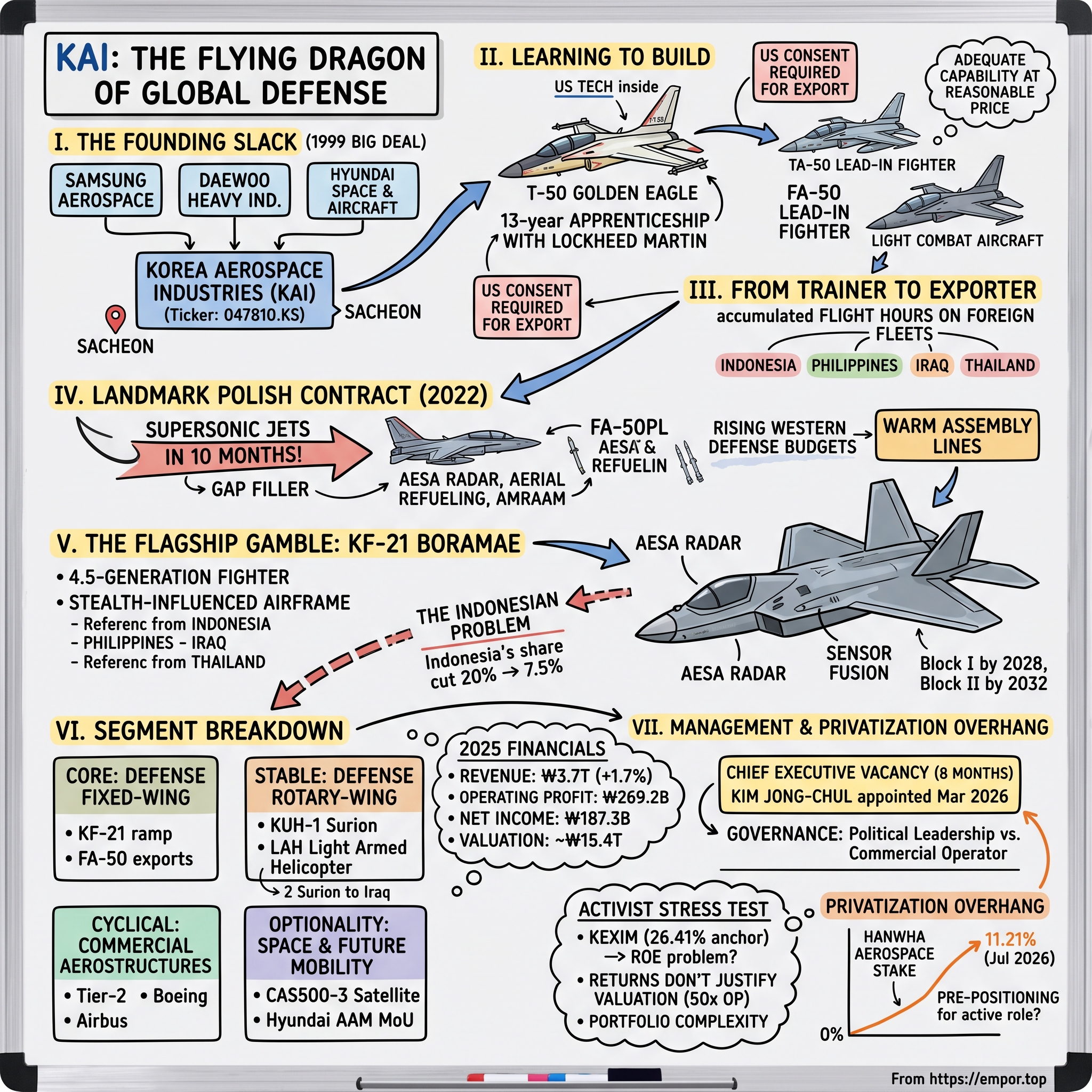
Korea Aerospace Industries (KAI): The Flying Dragon of Global Defense
I. Introduction & Episode Roadmap
On the morning of March 25, 2026, the hangar doors at a factory in Sacheon (사천), a small coastal city on South Korea's southern rim, rolled back in front of the President of the Republic of Korea. Behind them sat a twin-tailed, twin-engine fighter jet painted in air force grey, carrying the tail number 26-001. It was the first series-production KF-21 보라매 KF-21 Boramae — the first fighter aircraft designed, integrated and built in South Korea rather than assembled there under someone else's licence.12 President 이재명 Lee Jae-myung walked the flight line. The cameras did what cameras do at defence rollouts. And somewhere in the accounting department of 한국항공우주산업 Korea Aerospace Industries, Ltd. (047810.KS), a very different clock started ticking: the clock on converting roughly two decades of state-funded development spending into deliverable, billable, margin-bearing aircraft.2
That tension — between national symbolism and shareholder economics — is the whole story of KAI.
Here is the company in plain numbers. In fiscal 2025, KAI generated revenue of ₩3,696.4 billion, roughly $2.6 billion, up just 1.7% year on year, with operating profit of ₩269.2 billion and net income of ₩187.3 billion.3 Those are the financials of a mid-sized industrial contractor. Yet as of late July 2026, the equity market valued KAI at roughly ₩15.4 trillion — about $11 billion — with the shares having traded between ₩85,100 and ₩215,500 over the prior twelve months.4 Put those two facts side by side and the investment question writes itself: the market is not paying for what KAI earned last year. It is paying for the order book, and for the belief that the order book converts.
That order book is real and it is large. KAI closed 2025 with a backlog of ₩27.34 trillion, roughly $18 billion, or more than seven years of 2025-level revenue.5 And in the first quarter of 2026 the conversion visibly began: revenue jumped 56.3% year on year to ₩1.09 trillion, the largest first quarter in company history, with operating profit up 43.4% to ₩67.1 billion.67
The central thesis of this story is narrower and more interesting than "Korean defence is booming." It is this: KAI is the industrial residue of a state-forced merger nobody wanted, and the single most valuable thing that merger produced was not technology — it was slack. Because the Republic of Korea Air Force (대한민국 공군 ROKAF) guaranteed a domestic order stream, KAI kept warm assembly lines and delivery slots that Western primes, running lean against multi-year backlogs, simply did not have. When Russia invaded Ukraine and Poland needed combat aircraft now, KAI could hand over supersonic jets in ten months. That is a real advantage. Whether it is a durable one is the question this piece will test rather than assume.
The route we will take: the 1999 "Big Deal" that fused three warring chaebol aviation arms into one company at gunpoint; the T-50 골든이글 T-50 Golden Eagle co-development with Lockheed Martin that taught a nation to build supersonic aircraft; the 2011 listing and the accounting scandal that nearly wrecked management credibility; the 2022 Poland contract that turned a domestic supplier into an exporter; the KF-21 gamble and its complicated Indonesian partner; the revenue mechanics beneath the headlines; the governance question posed by a state bank holding 26.41% of the shares while 한화에어로스페이스 Hanwha Aerospace quietly buys its way toward a blocking position; and finally, an honest accounting of what would have to be true for the bull case to work — and what would break it.
Start where the company started: with a national economy in collapse.
 Subscribe on LinkedIn
II. The 1999 "Big Deal": Industrial Policy & Post-Crisis Consolidation
In December 1997, South Korea went to the International Monetary Fund with a begging bowl. The country that had built itself from postwar rubble into the world's eleventh-largest economy had run out of dollars. What followed was not a normal recession. It was a state-directed demolition and reassembly of Korean industry — and the aerospace sector, small, loss-making and absurdly duplicated, was near the top of the list.
Consider the situation the government inherited. Three of the largest chaebol — 삼성 Samsung, 대우 Daewoo and 현대 Hyundai — each ran an aerospace arm. Each had built its own facilities. Each wanted the same government contracts. Samsung Aerospace had the crown jewel: licensed assembly of the KF-16 fighter for the ROKAF, plus genuine fixed-wing airframe capability. Daewoo Heavy Industries brought heavy-industrial fabrication muscle. Hyundai Space and Aircraft brought rotary-wing and space assets. Between them they had roughly one country's worth of demand and three countries' worth of capacity.8
The government's answer was the "Big Deal" — a set of forced, cross-conglomerate business swaps in which each chaebol surrendered subscale units in exchange for consolidated positions elsewhere. Samsung agreed to fold its aerospace division in with its rivals'; the trade was explicitly a quid pro quo across other industries.9 On October 1, 1999, the three aerospace divisions were merged into a single entity: Korea Aerospace Industries, headquartered in Sacheon, with the mandate to be the Republic's one and only airframe integrator.8
What that meant on the factory floor is easy to underrate. Merging three aerospace divisions is not merging three balance sheets. It is merging three engineering cultures, three sets of drawings standards, three supplier networks, three quality systems, and three groups of proud engineers who had spent the previous decade competing for the same contracts and briefing against each other in the same ministry corridors. Companies routinely fail at integrations one-tenth this complex when both sides want the deal. Nobody wanted this one. That KAI emerged as a functioning integrator at all is a genuine achievement of the Korean state's capacity to impose an outcome — and a reminder that the company's founding advantage was political, not commercial.
It is worth pausing on how unusual this is. KAI was not founded by an entrepreneur with a vision. It was assembled by bureaucrats with a spreadsheet. There is no garage, no founding myth, no charismatic engineer betting the house. What KAI got instead of a founder was something arguably more valuable in the defence business: a legal and political guarantee that no domestic competitor would ever be allowed to bid against it for fixed-wing aircraft assembly. Every won the Korean state spent on a domestically built aircraft would flow to Sacheon.
That guarantee, however, is double-edged, and the second edge cuts to this day. A monopoly supplier facing a monopsony buyer does not get to set prices. The 방위사업청 Defense Acquisition Program Administration (DAPA) buys domestic aircraft on cost-based terms designed to reimburse KAI fairly and no more. It is a business model that produces reliable volume, near-zero demand risk — and structurally thin margins. KAI's consolidated operating margin of 7.3% in 2025 is a decent number by its own history, but it is not the margin of a company with pricing power.3 It is the margin of a national utility that happens to make fighter jets.
Who owns the champion. The capital structure encoded the state's role permanently. The 한국수출입은행 Export-Import Bank of Korea (KEXIM), the government's export-credit lender, holds 26.41% and remains the controlling anchor shareholder.10 The 국민연금공단 National Pension Service (NPS), Korea's giant public pension fund, has long been the other major domestic institutional holder at roughly 8.5%.11 So KAI is not, technically, a state-owned enterprise. It is something subtler and, for minority investors, more awkward: a listed company whose largest shareholder is a policy bank whose own mandate is to promote Korean exports. When those two objectives align, it is a superpower. When they diverge — on pricing, on dividends, on whether to accept a marginal export order to advance a diplomatic relationship — minority shareholders find out whose interests come first.
Learning to build. The new company's first real test was modest: the KT-1 웅비 KT-1 Woongbi, a single-engine turboprop basic trainer for the ROKAF. Unglamorous, but it established the pattern KAI has repeated ever since — build for the domestic air force first, use the domestic fleet as the reference customer, then sell abroad. The KT-1 eventually found its way to Peru, where the local air force's maintenance service assembled sixteen of twenty aircraft domestically at Las Palmas Air Base, an early demonstration of KAI's willingness to trade production work for orders.12
The second test was not modest at all. In the late 1990s Korea decided it wanted a supersonic advanced jet trainer, and it wanted to build the thing itself. It could not — not alone. So it went to Lockheed Martin.
The Lockheed bargain. The T-50 골든이글 T-50 Golden Eagle programme ran for roughly thirteen years and cost about ₩2 trillion, then around $1.8 billion.13 The funding split tells you exactly who was taking the risk: the Government of South Korea put in about 70%, KAI about 17%, and Lockheed Martin about 13%.13 KAI was the prime; Lockheed Martin Aeronautics was the principal subcontractor, responsible for the avionics, the flight control system and the wings — precisely the hardest, most closely held pieces of fighter design.14
This is the deal that made everything after it possible, and it is worth being clear-eyed about what it was. Korea did not buy a fighter. It bought an apprenticeship, at enormous cost, in the disciplines that cannot be reverse-engineered: aerodynamic design authority, fly-by-wire flight control law, systems integration, flight test. The T-50 flew for the first time on August 20, 2002 and entered ROKAF service in 2005.13 By the end of it, Korea had an aircraft — and, more importantly, several hundred engineers who had built one.
The bargain also created the dependency that shadows KAI's entire export business, which we will return to in earnest: American technology inside a Korean airframe means American consent for every foreign sale.
For now, hold on to the shape of what the 1999 merger produced. A single national integrator. A guaranteed domestic order stream at utility-like margins. And a supersonic airframe, paid for mostly by taxpayers, that KAI would spend the next two decades monetising. The question was whether anyone outside Korea would buy it.
III. From Trainer Jets to Defense Exporter: T-50 Evolution & Public Listing
Every successful defence platform has a moment when its makers realise they built something more useful than they intended. For the T-50, that moment arrived when engineers looked at what they had — a supersonic, twin-tailed jet with an F-16-derived aerodynamic lineage, modern cockpit, and room in the airframe for radar and hardpoints — and asked the obvious question. Why is this only a trainer?
The answer was: it doesn't have to be. The platform was stretched along a capability ladder. The TA-50 became a lead-in fighter trainer, teaching pilots to employ weapons rather than just fly. The FA-50 went further: a genuine light combat aircraft, with a radar, air-to-air missiles, precision-guided bombs and a targeting pod, in an airframe that costs a fraction of a frontline fighter to buy and — critically for the finance ministries that actually decide these things — a fraction to operate per flight hour.
This is a more consequential product decision than it appears, so it's worth unpacking in plain terms. A modern air force faces a barbell problem. At the top sit fifth-generation fighters like the F-35: extraordinary machines with extraordinary running costs. At the bottom sits basic training. The middle — advanced pilot training, air policing, counter-insurgency, border patrol, showing the flag — is work that does not need a $100 million aircraft, and that burns out expensive airframes if you use them for it. For decades, air forces solved this by flying old fighters into the ground. KAI's proposition was: buy a new, supported, Western-compatible jet instead, at a price a middle-income country can actually afford, and use your expensive fighters only for the missions that require them.
That is not a technology moat. It is a positioning moat — Hamilton Helmer would call it counter-positioning — and it works precisely because the incumbents cannot comfortably follow. Lockheed Martin does not want to cannibalise F-16 sales with a cheaper aircraft. Dassault and Saab sell into the tier above. The niche was structurally under-served, and KAI, whose cost base was subsidised by a guaranteed domestic programme, could serve it profitably at prices that would not clear a Western prime's hurdle rate.
Going public. In 2011, KAI listed on the 한국거래소 Korea Exchange under the ticker 047810, giving the state a partial exit route and the company access to equity capital for capacity and for the working capital that international aircraft deliveries devour.15 The listing did something else too, less discussed at the time: it subjected a company built by government fiat to the disclosure regime of the 금융감독원 Financial Supervisory Service and its DART filing system.16 Within a few years, that would matter enormously.
Proof points, one country at a time. The early export record was built slowly and unevenly, in the places where the value proposition was clearest: Indonesia, the Philippines, Iraq, Thailand. None of these were transformational contracts. What they bought KAI was less visible and more valuable — accumulated flight hours on foreign fleets, regional logistics and maintenance experience, and, above all, references. Defence procurement is a business in which nobody wants to be the first customer. Every additional operator makes the next sale marginally easier, and every one of them generates a long tail of sustainment revenue.
The Iraqi contract is the template worth studying, because it shows where the money actually is. In December 2013, Iraq signed for 24 T-50IQ aircraft plus equipment and pilot training, at an initial contract value of roughly $1.1 billion — but KAI's own framing at the time was that supporting those aircraft over twenty years would push total programme revenue beyond $2 billion.56 Read that carefully: the aircraft sale was less than half the lifetime value. The deliveries themselves ran from 2013 to 2019, and Iraq subsequently came back to order repair, maintenance and training services.57 In defence aerospace, the airframe is the customer-acquisition cost; the fleet is the subscription.
The Philippines is the same pattern compounding faster. Having bought FA-50s in the 2010s, Manila came back in June 2025 for twelve more aircraft in a roughly $700 million package including follow-on logistics support, and separately awarded KAI a $64.5 million contract to upgrade its existing fleet.[^17]17 One sale, a decade later, became three revenue streams.
The failures matter too, and they cluster in one place. For all the export momentum, KAI has repeatedly failed to break into the market it wants most: the United States. In September 2018, the US Air Force chose the Boeing–Saab entry over the Lockheed Martin–KAI T-50A for its T-X advanced trainer programme, in a competition decided largely on Boeing's unusually aggressive $9.2 billion bid.58 It was a bruising loss. It was also a preview: KAI's aircraft can be competitive on capability and still lose an American competition on price, politics or domestic-content requirements. That lesson would repeat, in a more pointed form, in 2026.
Then the company nearly threw it away.
In July 2017, KAI's president and chief executive, Ha Sung-yong, resigned as prosecutors closed in.18 The allegations were not a technicality. Ha was subsequently indicted on charges of accounting fraud, bribery and embezzlement, with prosecutors alleging KAI had inflated sales by ₩535.8 billion — around $472 million — and net profit by ₩46.5 billion between 2013 and the first quarter of 2017.19 The mechanism was mundane and, for anyone who follows long-cycle contractors, entirely familiar: overstated progress on development programmes, advance payments recognised too aggressively, and loss provisions on troubled contracts that were not taken when they should have been.20 He was ultimately sentenced to one year and six months in prison, suspended, with two years of probation.20 The scandal also took down the head of DAPA, who resigned over the failure to supervise.18
Two things are worth drawing out here, because they still inform how an investor should read KAI's financial statements today.
First, the fraud was possible because of the nature of the business, not merely the character of the executive. Long-duration development contracts are accounted for on percentage-of-completion: revenue is recognised as costs are incurred against a total estimated cost. Change the cost estimate and you change reported profit, with no cash moving at all. This is the single largest accounting judgement on KAI's books and it has never gone away — it has simply been better governed. When KF-21 mass production ramps, the same estimation machinery is what will determine reported margins.
Second, the episode is the earliest and clearest data point on a recurring governance pattern: KAI's leadership is political, its selection is contested, and the company has repeatedly absorbed the consequences. That pattern recurs in 2026 in a different form, as we'll see.
What the crisis did produce was a genuine tightening — restated figures, rebuilt contract revenue recognition discipline, and a more formal relationship with DAPA on programme reporting. Investors got a cleaner company. What they did not get, and arguably still do not have, is confidence that the board can appoint a chief executive without a political fight.
KAI spent the years after 2017 rebuilding. Then, in February 2022, an event five thousand kilometres away changed the addressable market.
IV. The Landmark Polish Contract: The Global Defense Super-Cycle
Poland's problem in the spring of 2022 was arithmetic. The Polish Air Force was flying Soviet-designed MiG-29s and Su-22s — aircraft whose spare parts came, awkwardly, from the country now waging war on its neighbour. Warsaw wanted them gone. It also wanted to give away some of them to Ukraine, which made the replacement question urgent rather than merely important. And here Poland ran into the wall every Western defence buyer hit in 2022: the primes were sold out. Order an F-16 or a Gripen and you join a queue measured in years, behind customers who signed before the war made everyone else desperate.
Then came a proposition from Sacheon that sounded, on first hearing, implausible.
KAI would deliver twelve combat-capable supersonic jets within a year.
In September 2022, KAI signed a roughly $3 billion contract with Poland for 48 FA-50 aircraft.[^22] The structure was the clever part, and it is the single best illustration of what KAI actually sells. The order was split. Twelve aircraft would be delivered as the FA-50GF — "Gap Filler" — essentially the standard configuration already in ROKAF service, available immediately because KAI could reallocate production slots originally earmarked for the Korean air force. The remaining 36 would be the FA-50PL, a substantially upgraded variant with an active electronically scanned array radar, aerial refuelling, and a Western weapons suite — to be developed and delivered later.
The first FA-50GF aircraft arrived in Poland in July 2023, roughly ten months after signature.21 In an industry where the gap between contract and metal is normally measured in presidential terms, that was extraordinary, and it did more for KAI's brand than a decade of air show appearances. The full twelve-aircraft GF fleet was subsequently consolidated at the 23rd Tactical Air Base at Mińsk Mazowiecki, where the aircraft went into intensive pilot training and air policing duties.22
What actually created the speed. It is tempting to attribute this to Korean manufacturing prowess. That is only partly right, and the honest version is more useful to an investor. KAI was fast because it had a warm line running a mature product for a captive domestic customer who could be asked to wait. In other words, the competitive advantage was inventory position and political flexibility, not a superior factory. The ROKAF, as an arm of the same state that owns 26.41% of KAI through KEXIM, could be persuaded that a NATO beachhead was worth a delivery delay. No Western prime has that option, because no Western prime's largest shareholder is its own government's export bank.
This is the sharpest edge of KAI's moat and also its most fragile. Slack is a depleting asset. Once the domestic slots are consumed by KF-21 production and the FA-50 line is committed to Poland, Malaysia and the Philippines, "we can deliver in ten months" stops being true. The advantage was real; whether it survives the company's own success is unresolved.
And the second phase has been harder. The FA-50PL is where the Polish programme has met reality. The upgraded variant was originally scheduled to begin arriving in 2025. It has not. On January 9, 2026, Poland and KAI signed an annex to the 2022 contract formally revising the delivery schedule; deliveries are now expected to begin in late 2026, with the 36-aircraft batch running through 2028.2223 Under the reporting on the revised schedule, the first FA-50PL aircraft are slated for 2027 arrival in Polish service.23
Investors should sit with that for a moment, because it is the most important single fact in the export story. KAI's marketing proposition is speed. On the standard product, it delivered spectacularly. On the customised product — the one that carries the higher margin, the new radar, the new weapons integration — it slipped by roughly two years. The distinction matters: KAI has proven it can deliver what it has already built. It has not yet proven it can deliver bespoke development on schedule for a demanding NATO customer.
The technical content of that delay is instructive. The FA-50PL is being fitted with Raytheon's PhantomStrike AESA radar, a gallium-nitride-based system; RTX delivered the first set to KAI in October 2025.24 For non-engineers: a mechanically scanned radar is a dish that physically swivels, so it can look in one direction at a time. An AESA is a fixed panel of hundreds of tiny transmit-receive modules that steer the beam electronically — it can track many targets at once, switch tasks in microseconds, and is far harder to jam. It transforms the FA-50 from a jet that can defend itself into one that can fight at range. The Polish aircraft will also carry aerial refuelling capability, a Sniper targeting pod, a helmet-mounted display, and — following US approval — AIM-120 AMRAAM beyond-visual-range missiles alongside AIM-9X Sidewinders.2325
Note who supplies the radar and the missiles. Every one of those capability upgrades deepens the American content of a Korean aircraft.
Margin, and what we can honestly say about it. The consensus narrative is that domestic cost-plus work earns low-to-mid single-digit margins while exports earn low-to-mid teens. KAI does not publish a clean margin bridge by contract type, so investors should treat precise export-margin figures as estimates rather than disclosure. What the reported numbers do support is directionally consistent: in 2025, operating profit rose 11.8% on revenue growth of just 1.7%, lifting operating margin about 70 basis points to 7.3% — a mix effect, with richer KF-21 development billing and Polish FA-50 deliveries offsetting lower-margin work.3 Mix is doing the work. That is the mechanism to watch.
The cash mechanics nobody puts on a slide. Export aircraft contracts are brutal on working capital, and this is where a state anchor shareholder quietly earns its keep. KAI must buy long-lead components — engines, radars, landing gear — build airframes over several years, and carry all of that on its balance sheet against milestone payments that are back-loaded and, as Indonesia demonstrated, sometimes negotiable. A company running multiple simultaneous export programmes is effectively running a lending business it did not ask to be in. This is why KEXIM's role as an export-credit agency is more than symbolism: guarantees and trade finance from Korea's own policy lender let KAI absorb that carry without repeatedly diluting shareholders. Investors evaluating KAI's growth should watch not only revenue but the trajectory of inventories, contract assets and net debt — because a rapid export ramp funded on the balance sheet can look like triumph on the income statement and stress on the cash flow statement at the same time.
The follow-on wave. Malaysia signed for 18 FA-50 Block 20 aircraft in February 2023 in a roughly $920 million deal, with an unusual structure: fourteen aircraft undergo final assembly in Malaysia and four in Korea.26 Six are expected to reach the Royal Malaysian Air Force during 2026, with the balance phased from 2027.27 At the Singapore Airshow in 2026, KAI was pitching Malaysia an upgrade package adding beyond-visual-range capability — the sustainment-and-upgrade annuity again, arriving before the original aircraft have.28
The bigger prizes remain unsigned. Egypt has been in negotiation for a package reported at up to 100 aircraft, with an initial tranche built in Korea and the remainder assembled locally under a technology-transfer arrangement with the Arab Organization for Industrialization.2930 Peru has been discussing 20 to 24 aircraft.31 Both have been "close" for a long time. Neither had closed as of this writing, and an investor's discipline here should be simple: a memorandum of understanding is not a contract, and a contract is not a delivery.
Which brings us to the programme that will determine whether KAI is an exporter of light attack jets or something considerably larger.
V. The Flagship Gamble: KF-21 Boramae & 4.5-Generation Supremacy
Every country that has tried to build an indigenous fighter has a story about the moment it nearly stopped. Korea's came repeatedly — over cost, over whether the technology transfer from the United States would materialise, over whether a nation with no history of designing a fighter from a blank sheet should be attempting one at all.
It did not stop. The KF-21 보라매 KF-21 Boramae — boramae is a young hawk trained for falconry — was conceived to replace the ROKAF's ageing F-4 Phantoms and F-5s with something Korea could modify, upgrade and export without asking permission for every line of software. The prototype flew for the first time in July 2022. Supersonic flight followed in early 2023. In June 2024, DAPA signed the first mass production contract, worth approximately ₩1.96 trillion — around $1.4 billion — for the initial Block I aircraft.[^34]
What the aircraft actually is, in plain language. The KF-21 is a 4.5-generation fighter. It is not an F-35. It has a stealth-influenced airframe shape and some low-observable features, but Block I carries its weapons externally rather than in internal bays, which is the single biggest determinant of radar signature. What it does have is a modern AESA radar, sensor fusion, an electronic warfare suite, and — this is the strategically important part — a design authority that sits in Sacheon rather than in Fort Worth. It is capable of Mach 1.8 and carries up to 7.7 tonnes of weapons.1
The strategic logic is the FA-50 logic applied one tier up. Between an upgraded fourth-generation fighter and a genuine fifth-generation stealth aircraft lies a large, under-served band of demand: countries that want modern sensors and networked warfare, cannot afford or cannot politically obtain the F-35, and do not want to be locked into a single supplier's upgrade path forever. The KF-21 aims squarely at that band. The frequently cited framing — roughly 80% of the capability at roughly 60% of the lifecycle cost — is a marketing construct, not a measured figure, and should be treated as such. What can be said with confidence is that it is materially cheaper to buy and operate than an F-35, and materially more capable than the fourth-generation aircraft most of its target customers currently fly.
The Indonesian problem. The original programme structure had the Korean government and DAPA carrying about 60% of development cost, KAI about 20%, and Indonesia about 20% — with Jakarta committing roughly ₩1.7 trillion in exchange for a prototype, technology transfer, and support for local production of 48 aircraft.[^35]
It did not work. Indonesia fell behind on payments almost immediately. In 2024, the relationship suffered a further blow when two Indonesian engineers seconded to KAI were accused of attempting to remove KF-21 technical data on flash drives; a subsequent investigation cleared them, but the trust damage was done and the renegotiation stalled.[^35] By August 2024, DAPA had cut Indonesia's share from 20% to 7.5%, and in June 2025 the two sides finalised a restructured agreement setting Indonesia's total contribution at ₩600 billion — roughly $440 million, about a third of the original commitment — against roughly ₩400 billion already paid.[^35] Indonesia had asked to stretch payments to 2034; the compromise landed on a June 2026 completion date, and DAPA confirmed the ₩600 billion was fully paid on June 25, 2026.32
The technology transfer was cut to match. A DAPA official framed the trade-off with unusual bluntness: whether a prototype aircraft is provided is itself negotiable, and if Indonesia wants the airframe, the technology transfer package shrinks by an equivalent value.[^35] In April 2026, reporting indicated Korea would transfer a KF-21 prototype to Indonesia.33 By mid-2026, Indonesia had abandoned local co-production entirely, signalling it would instead buy completed aircraft off the Korean line.3435
How an investor should read this. There are two readings and the truth contains both.
The uncharitable reading: KAI's flagship export partnership, the one that was supposed to validate the aircraft internationally and de-risk the development bill, was renegotiated down by two-thirds under duress, contaminated by an industrial espionage allegation, and ended with the partner walking away from the industrial participation that was the entire point. That is not a good look for a company whose bull case rests on selling this aircraft to exactly this category of customer.
The charitable — and, on the evidence, more accurate — reading: Korea kept the money coming, kept the aircraft on schedule, kept the technology, and ended up owning a larger share of a programme that is now flying. Indonesia buying finished aircraft is better for KAI's economics than Indonesia assembling them locally, because assembly work transferred abroad is revenue KAI does not book. Reporting in mid-2026 indicated that Malaysia, the UAE and the Philippines were all studying the aircraft.32 The programme survived its worst partner outcome without a delay to first production.
The most defensible conclusion is narrower than either: the Indonesian saga proves KAI can absorb a partner default without derailing a national programme, because the Korean state stands behind it. It proves nothing yet about export demand for the KF-21, because not a single export order has been signed.
The production schedule is now the story. Forty Block I aircraft are to be delivered by 2028, with a further 80 Block II aircraft — adding full air-to-ground precision strike — running to 2032.1 The first production aircraft, a two-seater, is due for handover to the ROKAF in the second half of 2026.12 Reporting has indicated Block II development was accelerated by roughly 18 months.3
That schedule is the hinge of the entire investment case, and it explains the shape of KAI's income statement over the next several years. Development revenue is lumpy and modest. Serial production revenue is large and repeating: 120 aircraft over roughly six years, at a domestic unit price in the region of $65 million if one divides the initial production contract by its aircraft count. It also explains the first-quarter 2026 revenue jump — the line is filling up.6
Two cautions. First, first-article production on a new fighter is where cost overruns live; learning-curve economics mean the earliest aircraft are the least profitable, and on cost-based domestic contracts KAI's ability to recover overruns is bounded by what DAPA will accept. Second, the margin on Block I is a percentage-of-completion estimate, which returns us to the accounting judgement the 2017 scandal exposed. Investors should watch cost-estimate revisions, not just headline profit.
Whatever the KF-21 becomes, it is one line in a business with four of them. It is worth seeing the whole shape.
VI. Segment Breakdown: Revenue Mechanics & Business Mix
Walk the Sacheon campus and you would not immediately guess you were in a fighter factory. Alongside the combat aircraft lines sit helicopter assembly bays, a satellite cleanroom, and long halls turning out wing structures and fuselage sections destined for commercial airliners built on the other side of the world. KAI is an odd conglomerate: a defence prime, a helicopter manufacturer, a Tier-2 aerostructures subcontractor, and a satellite builder, sharing one balance sheet and one set of factories.
Around a ₩3.7 trillion revenue base, the economic weight sits roughly as follows — with the caveat that KAI's disclosed segmentation shifts as programmes move between development and production, so these are proportions rather than precise splits.3
Defence fixed-wing — the core, roughly half the business and rising. This is the KF-21 ramp, FA-50 export deliveries to Poland and the Philippines, T-50-family production and modernisation, and the long tail of fleet sustainment. It is the segment that carries the story and, increasingly, the segment that carries the margin. The first quarter of 2026 showed why: revenue growth of 56.3% came from what management characterised as balanced expansion across domestic system development, completed-aircraft exports and the parts business, with new orders of ₩309.3 billion up 29.4% year on year.67 Notably, KAI attributed part of that order growth not to new aircraft but to follow-on work — air-to-ground communications equipment upgrades and performance-based logistics support for the Philippine FA-50 fleet.7 That is the sustainment annuity beginning to show up in the numbers, and it is a healthier kind of growth than one-off airframe sales.
Defence rotary-wing — the stable, unglamorous cash engine. The KUH-1 수리온 KUH-1 Surion utility helicopter and the 소형무장헬기 LAH Light Armed Helicopter — marketed as Mirion — supply the Republic of Korea Army (대한민국 육군) and other domestic services. The LAH programme is substantial: DAPA awarded a production contract reported at ₩1.4 trillion, following an earlier ₩300 billion contract in December 2022 covering the first ten aircraft, with the first pair delivered in December 2024.3637
Helicopters are also where KAI's export limitations are most visible. The Surion has been in service domestically since the 2010s. Its first-ever export contract was signed with Iraq on December 23, 2024 — for two aircraft and a logistics package, worth $93.7 million, delivering between 2025 and March 2029.3839 Two helicopters. After more than a decade. KAI has since pushed harder on international helicopter marketing, making its debut at the Verticon show to chase Surion export sales.40 The honest read: KAI's rotary-wing franchise is a domestic programme business with an export option that has not yet been proven. It provides ballast, not upside.
Commercial aerostructures — the cyclical hedge with the worst economics. KAI builds structural components — wing ribs, fuselage sections, control surfaces — for Boeing and Airbus programmes including the A350.41 Strategically this segment does three useful things: it keeps composite and metallic fabrication capacity utilised between defence programme peaks; it holds KAI to commercial-aerospace quality and cost standards, which are unforgiving; and it diversifies away from a single monopsony customer.
Financially, it is the weakest link, and investors should not romanticise it. Tier-2 aerostructures is a low-margin, high-fixed-cost business in which the prime dictates rate, schedule and price. When Boeing's production rates wobble — as they have repeatedly through the mid-2020s — the pain flows straight down. KAI has no pricing power in this segment whatsoever. It is a capacity-absorption business that occasionally turns into a margin drag. The relevant question for an investor is not whether aerostructures grows; it is whether the segment's margin recovers enough to stop diluting group profitability as commercial build rates normalise.
Space, avionics and future mobility — real optionality, immaterial revenue. This is the smallest slice and the one most likely to be over-weighted by enthusiastic narratives. Three components matter.
In satellites, KAI has made a genuine step change. On November 26, 2025, CAS500-3 — a Compact Advanced Satellite in the 500-kilogram class — was launched from the Naro Space Center aboard the fourth flight of the 누리호 Nuri (KSLV-II) launch vehicle, along with twelve cubesats, into a 600-kilometre orbit.4243 The significant detail: KAI built the main satellite itself, a role previously performed by the government's Korea Aerospace Research Institute, using its own platform.44 More significant still, KAI deliberately developed CAS500-3 using components not subject to US International Traffic in Arms Regulations, explicitly to enable exports to Latin America, the Middle East and Southeast Asia without needing Washington's sign-off.44 That is a company that has learned a very specific lesson from its aircraft business and is engineering around it. It is also, so far, a small business.
In maintenance and overhaul, subsidiary Korea Aviation Service (KAEMS) provides civil aircraft MRO — a sensible use of Sacheon's infrastructure and a source of recurring revenue, but not yet a needle-mover.
In future mobility, KAI signed a memorandum of understanding with 현대자동차그룹 Hyundai Motor Group on May 10, 2026 to jointly develop advanced air mobility aircraft.45 The division of labour is logical: Hyundai's aviation powertrain unit supplies electrified propulsion, KAI supplies airframe development and manufacturing, and Hyundai's AAM subsidiary Supernal co-develops the aircraft, with cooperation extending to supply chains, certification and customer networks.45 It is a credible pairing of complementary capabilities. It is also an MoU for a category of aircraft that does not yet have a proven commercial market, and it should be sized accordingly: strategic optionality, not a forecastable revenue line.
So the business is: one segment that determines the outcome, one that pays the bills, one that dilutes the margin, and one that might matter in a decade. The people deciding how to weight them are, therefore, the next thing to examine.
VII. Management, Governance, & Activist Stress Test
For eight months, the chief executive's office at Korea Aerospace Industries was empty.
That is not a metaphor. Following the departure of Kang Goo-young (강구영), a former Republic of Korea Air Force lieutenant general who had led the company since 2022 and presided over the Poland and Malaysia export campaigns, KAI went without a permanent chief executive for roughly eight months. The selection process drew protests from the labour union and civic groups. It was only on March 18, 2026 that the board appointed Kim Jong-chul (김종철), following shareholder approval of his appointment as an inside director that same morning; he took office on March 19.464748
Consider what that vacancy coincided with. KAI was ramping its first indigenous fighter into serial production, renegotiating a NATO delivery schedule, and fielding takeover speculation. It went through all of it without a permanent chief executive. For a company whose bull case depends on flawless programme execution, that is a governance fact, not a footnote.
Who Kim Jong-chul is. Like his predecessor, Kim came from the Air Force. Unlike his predecessor, his defining credential is procurement: he previously headed DAPA — that is, he ran the agency that is KAI's largest customer and its programme regulator.4749 The pattern is now unmistakable. KAI's chief executives are drawn from the military-procurement establishment, and the skill being selected for is navigating the Korean defence bureaucracy and government-to-government export diplomacy.
There is a defensible case for this. In a business where the largest customer is a state agency and the biggest deals are signed between governments, an insider's access is a genuine asset. There is also a cost, and investors should name it: KAI has never been run by a commercial operator whose formative experience was competing for private customers on price and quality. The commercial aerostructures segment — the one part of the business that faces genuinely commercial buyers — is also the one part that consistently underperforms. That is unlikely to be a coincidence.
Kim moved fast on structure. At his inauguration he promised "bone-cutting" innovation and named the growth priorities: AI pilots, software, manned-unmanned teaming combat systems, and unmanned aerial vehicles.49 Effective June 1, 2026, KAI collapsed a sprawling organisation of five divisions, one institute, four headquarters, three centres and five task forces into three divisions, one institute and thirteen headquarters — the company's stated rationale being that dispersed and overlapping functions had undermined accountability and efficiency.50 That is a candid diagnosis of the organisation he inherited, and a reasonable first move. It is also, so far, an input. The output is deliveries.
The credibility test — and KAI fails half of it. The fairest way to assess a management team is to check what it promised against what arrived. KAI provides an unusually clean test case.
On April 2, 2021, KAI's then-president laid out a public target at a Seoul press conference: lift annual sales from ₩3 trillion to ₩5 trillion by 2025, and grow the order backlog from ₩18 trillion to ₩25 trillion.51
The scorecard, five years on: backlog reached ₩27.34 trillion — comfortably ahead of target.5 Revenue reached ₩3.70 trillion — roughly 26% short of the ₩5 trillion goal.3
That split is the single most informative thing in this section. KAI is demonstrably good at winning orders and demonstrably slow at converting them into revenue. Poland's FA-50PL slipping by roughly two years is the same phenomenon expressed as a schedule. The pattern is consistent, it is visible across independent programmes, and it should temper any straight-line extrapolation of the backlog into near-term revenue. The 2026 first-quarter surge is genuine evidence that conversion has begun — but one quarter against a five-year miss is a start, not a verdict.
Capital allocation. KAI retains most of what it earns. The company paid ₩500 per share for 2024, distributed in April 2025, against a payout ratio in the high-twenties percent.52 At a share price around ₩158,100, that dividend rounds to a yield of well under 1% — the yield has been crushed not by a cut but by the share price roughly quadrupling from its 52-week low.452
Retention is defensible on its face: KAI's uses of cash are R&D on KF-21 Block II and on Kim's unmanned and AI priorities, plus working capital for international deliveries, which in this industry is brutal — you build aircraft years before the customer's final payment lands. KEXIM's presence helps here in a way that is genuinely underappreciated: as Korea's export-credit agency, it can provide trade finance and guarantees supporting multi-billion-dollar aircraft sales, meaning KAI can carry large export programmes without repeatedly returning to equity markets. State ownership is not only a drag; on financing, it is a real advantage.
Now the activist stress test. Suppose a well-resourced, unsentimental investor built a position and wrote a letter. What would it say?
Point one: the state shareholder is a return-on-equity problem. KEXIM's 26.41% is held by an institution whose statutory purpose is promoting Korean exports, not maximising KAI's profit. Every decision at the margin — accept a thin-margin order to open a strategic market? price domestic aircraft to help DAPA's budget? give up a delivery slot for diplomatic reasons? — has a shareholder-value answer and a national-interest answer, and it is not obvious which wins. The Poland gap-filler manoeuvre was brilliant precisely because both answers aligned. They will not always.
Point two: the returns don't yet justify the valuation. FY2025 operating profit of ₩269.2 billion against a market capitalisation of roughly ₩15.4 trillion means the equity trades at something on the order of fifty-plus times last year's operating profit.34 Every won of that valuation is a bet on 2028 and beyond. An activist would demand explicit multi-year margin targets by segment and hold management to them — precisely what the missed 2025 revenue target suggests the company is uncomfortable doing.
Point three: portfolio complexity and the diworsification question. Does a company executing its first indigenous fighter into serial production need to also be building satellites, running an MRO subsidiary, subcontracting airliner structures at low margin, and co-developing electric air taxis? Each has a rationale. Collectively they consume management attention at the precise moment programme execution matters most.
Point four, and the one actually being pressed in the market: someone else already thinks KAI is mispriced. Hanwha Group is buying.
The privatisation overhang, live. Hanwha's accumulation has been methodical. Hanwha Aerospace and a subsidiary acquired 4.41% in October 2025; Hanwha Systems added 0.58% in November 2025 for roughly $40 million; by March 2026 the combined holding was 4.99% — sitting exactly beneath the 5% disclosure threshold — making Hanwha the fourth-largest shareholder.1153 This was a return: Hanwha had sold out of a 5.99% stake entirely in 2018.11
Then the pace changed. By June 16, 2026, Hanwha's stake reached 9.04%, overtaking the National Pension Service to become the second-largest shareholder.54 By July 2, 2026 it stood at 11.21%.55 Reporting has indicated Hanwha invested roughly ₩500 billion and planned a further ₩500 billion, with a combined stake set to surpass 15% — interpreted as pre-positioning for a potential privatisation and for an active role in KAI's management.55[^60] LIG Nex1 — rebranding as LIG Defense & Aerospace — has been reported as considering joining a bid, while declining to state a position.11
The political weather has been shifting too. The defence minister publicly criticised KAI's contribution, saying it was "regrettable that KAI is not playing its part amid the rising global demand for Korean defense products."11 When a sitting minister says that about a company his government effectively controls, it is not idle commentary; it is a signal that the status quo has lost its most important defender.
For minority shareholders the situation is genuinely two-sided. A Hanwha-controlled KAI would plausibly be run harder: sharper capital allocation, more aggressive commercial pricing, consolidation of overlapping Korean defence capability. It could also introduce customer-conflict problems — Hanwha Aerospace supplies engines and Hanwha Systems supplies avionics into KAI's own aircraft, so a controlling shareholder would sit on both sides of transactions that minority holders currently see at arm's length. And a contested change of control at a company mid-way through its first indigenous fighter programme carries obvious execution risk. As of this writing, no government decision on selling KEXIM's stake had been announced. The overhang is real, unresolved, and it is now a material driver of the share price independent of anything happening in Sacheon.
Ownership fights are ultimately arguments about how much the underlying franchise is worth. So: how good is the franchise, really?
VIII. Moat Analysis: 7 Powers & Porter's 5 Forces
Strip away the flags and the flypasts and ask the question a capital allocator asks: what stops someone else from doing this?
Hamilton Helmer's 7 Powers, applied honestly.
Cornered resource — strong, and the foundation of everything. KAI holds an exclusive designation as the Republic of Korea's national fixed-wing aircraft integrator, a position handed to it by government fiat in 1999 and never contested since.8 This is the purest cornered resource in the portfolio: a legally protected, non-replicable right of access to a national defence budget. It also cuts the other way — a cornered resource that consists of privileged access to one customer means that customer sets your price.
Process power — real but narrower than claimed. Two decades of flight-test infrastructure, airworthiness certification experience and systems integration at Sacheon constitute genuine accumulated know-how that cannot be bought. The evidence for it is the ten-month Poland delivery.21 The evidence against over-claiming it is the FA-50PL slipping roughly two years and the ₩5 trillion revenue target missed by a quarter.23513 KAI's process power is strongest in repeating what it has already built and weakest in delivering new configurations on promised dates. That is a meaningful distinction, because the export pipeline is full of bespoke configurations.
Scale economies — moderate, and improving. The T-50, FA-50 and KF-21 share tooling, supply chains, engineering talent and facilities. Serial KF-21 production should improve absorption of Sacheon's substantial fixed cost base. But KAI's absolute scale is small: roughly $2.6 billion of revenue against Lockheed Martin's tens of billions.3 KAI does not out-scale anyone. It out-positions them.
Counter-positioning — the strongest power in the portfolio, and the one with a clock on it. KAI sells adequate capability at a price and delivery schedule that Western primes cannot match without damaging their own economics. Lockheed will not build a cheap fighter that eats F-16 sales. The niche is structurally protected by incumbent incentives. But two forces erode it: KAI's own success is consuming the delivery slack that made the speed possible, and rising Western defence budgets are pulling primes toward capacity expansion that would narrow the delivery gap.
Switching costs — present, underrated, and compounding. Once an air force buys FA-50s, it has trained pilots and mechanics on the type, bought spares and simulators, built the maintenance infrastructure, and integrated the aircraft into doctrine. Switching means writing all of that off. The Philippines demonstrates the resulting annuity: an original fleet purchase generated a follow-on order for twelve aircraft, an upgrade contract, and performance-based logistics revenue years later.[^17]177 This may be the most reliably compounding economic engine KAI has, and it receives the least attention.
Branding and network economies — largely absent. Nations do not pay a premium for the KAI badge; they pay less because it is not a Western badge. There is no network effect in fighter aircraft.
Porter's Five Forces.
Threat of new entrants: very low. Building combat aircraft requires capital, decades of accumulated engineering, national airworthiness certification infrastructure and, usually, government sponsorship. The membership of this club changes on generational timescales. KAI's own admission to it took Korea roughly thirty years and billions in state funding.
Bargaining power of buyers: high domestically, moderate internationally. DAPA is a monopsony, and monopsonies do not overpay — this is the mechanical explanation for KAI's structurally modest domestic margins. Internationally, the picture is better precisely because the alternatives are poor: a buyer wanting a new supersonic light combat aircraft with Western weapons compatibility at FA-50 prices has few genuine substitutes. But those buyers are often budget-constrained states that negotiate hard and demand offsets, local assembly and technology transfer — Malaysia got fourteen of eighteen aircraft assembled locally, and Egypt has been negotiating for roughly seventy of a hundred aircraft to be built at Helwan.2629 Every offset concession is margin and future work given away to win the order.
Bargaining power of suppliers: high, and this is KAI's structural weakness. Propulsion, radar and key avionics come from American suppliers under US export control. Raytheon supplies the PhantomStrike radar for Poland's aircraft; American approval was required for AMRAAM integration.2425 A supplier whose government holds a veto over your customer list is the strongest possible supplier position. KAI knows it — hence the deliberately ITAR-free satellite platform, which is exactly the workaround it cannot yet perform on fighter engines.44
Threat of substitutes: low to moderate, and rising. Unmanned combat aircraft and loitering munitions are steadily encroaching on missions light fighters perform. This is a decade-plus threat rather than an immediate one, but it is real — which is precisely why Kim Jong-chul named unmanned systems and manned-unmanned teaming as strategic priorities on day one.49 A company that sells manned light fighters must have a credible answer to the drone question, and KAI's answer is currently a stated intention rather than a product.
Competitive rivalry: high and intensifying. Lockheed Martin's F-16 Block 70 competes above the FA-50 and against the KF-21; Saab's Gripen E targets the same middle-power buyers with a Western pedigree; Leonardo's M-346 and Boeing's T-7A compete in advanced training; and Chinese and Turkish offerings are pressing the same value proposition from below and beside. KAI's win rate to date has been respectable, but it has won largely on delivery speed and price — the two advantages most vulnerable to competitors deciding to fight for the segment.
Net assessment: KAI's moat is genuine but narrower and more contingent than the growth in its share price implies. Its most durable assets are the domestic monopoly designation and the accumulating installed-base switching costs. Its most exciting asset — delivery speed — is the one most likely to erode. An investor underwriting KAI is underwriting a positioning advantage, not a technology advantage, and positioning advantages have to be continually re-won.
Which sets up the final question: what actually breaks this?
IX. Strategic Risk Radar & Bear vs. Bull Case
Risk one: Washington holds a veto — and in 2026 it collected. Every FA-50 and every T-50 contains American technology — the engine above all — and that content brings US export control with it. In practice this means the State Department has a say in which countries can buy a Korean aircraft. It has not blocked a major KAI sale to date, but the constraint shapes the pipeline before it becomes visible: prospective customers in politically awkward positions are simply not pursued.
The sharpest illustration arrived this year, and it deserves attention because it is recent, concrete and directly falsifies a piece of the bull case. On March 25, 2026, the US government issued a request for proposals for the Navy's Undergraduate Jet Training System, a programme to replace the T-45 that Korean industry sized at up to ₩10 trillion, or roughly $7.4 billion.59 Lockheed Martin and KAI were expected to bid a T-50 derivative designated TF-50N, and were widely regarded as front-runners.[^65] Then, in April 2026, Lockheed withdrew — stating it had assessed the solicitation and concluded its offering would not be the best solution "due to the required level of U.S. content and other reasons."60 The field narrowed to three, without a Korean airframe among them.60
That is the ITAR problem inverted and made explicit. The very American content that lets KAI sell abroad is, in the American market, a disqualifying insufficiency: the aircraft is too Korean to satisfy US-content rules and too American to be sold freely without US consent. This is not a tail risk. It is a permanent boundary on the addressable market, and it is the single largest reason a Korean aerospace champion cannot fully control its own commercial destiny. The countermeasure KAI has actually executed is instructive — building an ITAR-free satellite specifically to sell where American components would block the sale.44 Doing the equivalent for a fighter engine is a far harder, far longer project, and there is no public evidence it is close.
Risk two: customer and programme concentration. Strip out exports and KAI's revenue is a function of one buyer's budget cycle and one agency's programme decisions. KF-21 Block I and Block II are, together, the dominant determinant of the next six years of revenue.1 A DAPA budget reprioritisation, a technical problem in flight test, or a domestic political shift on defence spending would hit KAI with very little to cushion it. The export book is growing but remains a minority of the whole.
Risk three: partners who don't pay. The Indonesian renegotiation showed the mechanism clearly — a development partner reduced its commitment by roughly two-thirds and abandoned local production, and Korea absorbed the difference.[^35]34 KAI got through it because the Korean state stood behind the programme. That is a comfort for the KF-21 and a warning for everything else: KAI's export contracts increasingly include local assembly and technology transfer commitments to counterparties with volatile budgets and volatile politics. Egypt's reported structure, with roughly seventy aircraft assembled locally, would embed exactly this risk at scale.29
Risk four: the commercial aerostructures drag. Boeing's production-rate disruptions flow directly into KAI's Tier-2 workload, and this is the one segment where KAI has neither pricing power nor a state backstop. Input-cost inflation in titanium, composites and skilled labour compounds it. This will not sink the company, but it can absorb a meaningful share of the margin expansion the defence business generates — which is exactly why it belongs on the KPI list.
Risk five, which is not usually on the list: KAI's own success. The delivery-speed advantage exists because of unabsorbed capacity. As the KF-21 line fills and the FA-50 order book stretches into 2030, the marginal customer can no longer be told "ten months." At that point KAI competes on price and capability against primes with deeper engineering benches. Management has not, in public materials, articulated how it intends to preserve the speed advantage while running at full capacity. That is a fair question for an analyst to press on the next call.
Myth versus reality. Four consensus statements about KAI circulate widely. Each contains something true and something misleading, and separating them is most of the analytical work.
Myth: "KAI delivers in ten months while Western primes take years." Reality: KAI delivered a standard-configuration aircraft already in production, from slots freed up by a captive domestic customer, in ten months.21 The customised variant of the same aircraft for the same customer slipped from a 2025 start to deliveries expected from late 2026 and into 2027.2223 The speed claim is true of inventory and false of development. Since almost every prospective customer wants a tailored configuration, this distinction is not academic.
Myth: "The KF-21 is a proven export product." Reality: as of July 2026, the KF-21 has exactly zero export orders. Its single foreign development partner cut its contribution by roughly two-thirds and abandoned local production.[^35]34 Interest from Malaysia, the UAE and the Philippines has been reported, but interest is not an order.32 The aircraft is a proven engineering achievement — it flies, it is in serial production, it is on schedule — which is a genuinely different claim.
Myth: "State ownership is purely a drag on returns." Reality: KEXIM's role as Korea's export-credit agency provides financing capacity that materially supports multi-billion-dollar aircraft exports, and the state's ability to reallocate ROKAF delivery slots is what made the Poland win possible in the first place. The state shareholder is simultaneously the source of KAI's most distinctive advantage and of its weakest capital-allocation incentives. Anyone arguing only one side of that is arguing half the case.
Myth: "The order backlog guarantees the revenue." Reality: backlog is a commitment to buy, not a schedule KAI has proven it can hold. The company beat its 2025 backlog target while missing its 2025 revenue target by roughly a quarter.5513 Backlog measures demand; revenue measures execution. KAI has consistently demonstrated the first and inconsistently demonstrated the second.
The bull case, stated properly. The bull case is not "defence is booming." It is a specific, testable sequence. KF-21 Block I deliveries run to schedule through 2028, proving the aircraft and giving foreign buyers a live reference fleet. Serial production absorbs Sacheon's fixed costs, lifting group margin structurally rather than cyclically. The FA-50 franchise converts at least one of its large pending negotiations — Egypt or Peru — into a signed contract, validating that the Polish win was a repeatable capability rather than a wartime accident. Sustainment and upgrade revenue on an installed base spanning Poland, Malaysia, the Philippines, Indonesia, Iraq and Thailand compounds into a high-margin annuity that grows independently of new aircraft sales. And Hanwha's stake-building resolves into a governance outcome — privatisation, or a state shareholder forced to become more commercial — that removes the ownership discount. Under that sequence, KAI's ₩27.34 trillion backlog converts into a business several multiples of its 2025 revenue at a materially higher margin.5
The bear case, stated with equal precision. Every element of the bull case has a plausible failure mode, and several are already partly realised. Schedule slippage is not a hypothetical: the FA-50PL is roughly two years late, and the 2025 revenue target was missed by about a quarter.23513 The KF-21 has zero export orders; its intended anchor foreign partner reduced its stake by two-thirds and walked away from co-production.[^35]34 Egypt and Peru have been "close" for well over a year without closing.2931 Learning-curve costs on early production aircraft, recognised under percentage-of-completion accounting on cost-based domestic contracts, could produce disappointing margins precisely when the market expects the opposite. Aerostructures may stay soft. American export policy may narrow the market. And underpinning all of it, the equity is priced at roughly fifty-plus times FY2025 operating profit — a valuation that requires the sequence to work, largely on time.34 The bear case does not need a catastrophe. It only needs the schedule to slip the way it has already slipped once.
The three things to actually track. Most of what is written about KAI is noise. Three metrics carry the signal.
One: export share of new orders and backlog. This is the cleanest test of whether KAI is a genuinely global competitor or a national contractor with occasional overseas wins. Domestic orders are largely a function of the Korean budget; international orders are a function of competitiveness, and they carry the better margin. Watch the direction of the international share of both new order intake and total backlog, quarter over quarter. A rising share means the counter-positioning thesis is working. A stalling share means the Poland deal was a moment, not a model.
Two: KF-21 deliveries against the published schedule, and the margin on them. Forty Block I aircraft by 2028 is a public, checkable commitment.1 Deliveries per year against that path is the single most falsifiable measure of KAI's execution. Pair it with the reported margin on the production contract and with any revision to total estimated contract costs — because on percentage-of-completion accounting, the cost-estimate revision is where the truth shows up before the profit does.
Three: group operating margin, with commercial aerostructures as the identified swing factor. KAI's 2025 margin of 7.3% was driven by mix, not by pricing.3 The bull case requires that margin to move structurally higher as export deliveries and serial production scale. If it does not — if aerostructures softness or domestic cost-based pricing keeps absorbing the gains — then the whole thesis reduces to revenue growth without operating leverage, which is a very different and much less valuable business.
X. Epilogue & Strategic Lessons
There is a version of the KAI story told in Seoul that treats the company as proof of a doctrine: that a middle power with discipline, patience and enough public money can manufacture a sovereign defence-industrial capability from nothing. That version is broadly true, and it took about thirty years. Korea bought an apprenticeship from Lockheed Martin at enormous cost, insisted on design authority rather than assembly work, protected a single national integrator from domestic competition, and used a captive air force as the reference customer for everything it built. Then it exported. There is no shortcut in that sequence, and countries currently trying to compress it should study the timeline.
The second lesson is more portable, and it belongs to any capital-intensive industry running against a full order book. For roughly two years after February 2022, the scarcest commodity in global defence was not capability. It was a delivery slot. KAI won in Poland not because the FA-50 was the best aircraft available but because it was the best aircraft available in ten months. In industries with long lead times — aerospace, shipbuilding, grid equipment, semiconductors, power generation — time-to-delivery is a first-order competitive weapon, and the companies that hold spare capacity through the quiet years capture disproportionate value when the cycle turns. The uncomfortable corollary, which KAI now confronts, is that this advantage is self-consuming. Fill the line and you become just another supplier with a queue.
There is a third, less comfortable operating lesson buried in KAI's record, and it applies to any company selling a complex product into a market it wants to expand. KAI has been consistently excellent at selling and consistently uneven at scheduling. It beat its five-year backlog target and missed its five-year revenue target; it delivered standard aircraft to Poland in ten months and slipped the customised ones by roughly two years.551323 The pattern suggests an organisation whose commercial function outruns its engineering-programme function — which is exactly the diagnosis implied by a new chief executive collapsing five divisions into three because overlapping functions had eroded accountability.50 Companies with this profile do not usually fail. They usually under-earn relative to what their order books promise, for longer than their shareholders expect.
The fourth lesson is about ownership, and it is the one still being written. KAI exists because the state built it, and the state's continued presence through KEXIM's 26.41% has been simultaneously an asset and a constraint — export financing and diplomatic reach on one side, muted commercial urgency and unresolved shareholder-alignment questions on the other.10 Hanwha's climb from nothing to 11.21% in under a year, with reported ambitions above 15%, is the market's way of arguing that the constraint now outweighs the asset.55[^60] Whether Seoul agrees will shape KAI's economics more than any single aircraft contract.
What can be said with confidence, as of July 2026: the aircraft flies, the first production airframe exists and is due to reach the ROKAF in the second half of this year, the backlog is genuinely large, and the first quarter of 2026 showed the conversion beginning in earnest.156 What remains unproven is whether KAI can hold a schedule under pressure, whether the KF-21 sells abroad, and whether a company with a policy bank as its anchor shareholder can be run for the returns its share price now assumes. South Korea has stated its ambition to become a top-tier global defence exporter. KAI is the piece of that ambition that has to fly on time — and, unlike a national goal, a delivery schedule either is met or is not.
References
-
First Series-Produced KF-21 Fighter Rolled Out In South Korea — The War Zone, 2026-03 ↩↩↩
-
Korea Aerospace Industries (KAI) — Company Analysis and Outlook Report 2026, 2026 ↩↩↩↩↩↩↩↩↩↩↩↩↩↩
-
Korea Aerospace Industries (KRX:047810) Stock Price & Overview — StockAnalysis, 2026-07 ↩↩↩↩
-
South Korea's Big 4 Defense Firms Post Combined Q1 Operating Profit; Order Backlog Tops $68.4 Billion — BigGo Finance, 2026-05 ↩↩↩↩↩↩
-
KAI Q1 Revenue Hits Record 1.09 Trillion Won on Platform Expansion — Seoul Economic Daily, 2026-05-07 ↩↩↩↩
-
KAI Achieves Record-High Q1 Revenue Driven by KF-21 and Complete Aircraft Exports — The Asia Business Daily, 2026-05-07 ↩↩↩↩
-
Export-Import Bank of Korea Corporate Profile & Credit Operations — Export-Import Bank of Korea ↩↩
-
Privatization calls grow as KAI names new CEO — The Korea Times, 2026-03-18 ↩↩↩↩↩
-
Is KAI executing industrial offset commitments even before the FA-50 purchase contract is signed? — Aviacionline ↩
-
High Performance T-50 Golden Eagle Offers Cost-Effective Training Solution for Modern Air Forces — Lockheed Martin ↩
-
Market Data: Korea Aerospace Industries (047810.KS) — Korea Exchange ↩
-
DART Corporate Filings Search (Ticker: 047810) — Financial Supervisory Service ↩
-
KAI secures upgrade contract for Philippine FA-50s — FlightGlobal, 2025-12 ↩↩
-
KAI chief quits over corruption allegations — The Korea Times, 2017-07-20 ↩↩
-
Korea Aerospace ex-chief indicted for fraud, embezzlement — Nikkei Asia ↩
-
Ha Sung-yong's first trial probation on charges of KAI fraudulent accounting and hiring corruption — Aju Press ↩↩
-
KAI delivers first FA-50GF light attack aircraft to Poland — Yonhap News Agency, 2023-07-10 ↩↩↩
-
Poland Solidifies Air Superiority with Arrival of Final FA-50GF Fighters at Mińsk Mazowiecki — Aviation News, 2025-12 ↩↩↩
-
Poland Moves to Arm FA-50PL With AIM-9X — The Aviationist, 2026-01-21 ↩↩↩↩↩↩↩
-
RTX's Raytheon delivers first PhantomStrike AESA Radar for Korea Aerospace Industries' FA-50 fleet — Defence Security Asia, 2025-10 ↩↩
-
U.S. Approves AIM-120 AMRAAM Missiles for Poland FA-50PL Jets — Army Recognition, 2026 ↩↩
-
KAI signs a deal with Malaysia for FA-50 aircraft — Janes, 2023-02-24 ↩↩
-
Six FA-50M Fighters to Arrive by 2026: KAI Confirms Accelerated Delivery Timeline for RMAF — Defence Security Asia ↩
-
Singapore Airshow 2026: KAI moves to boost Malaysia's FA-50 package with proposed BVR capability integration — Janes, 2026 ↩
-
South Korea could export up to 100 FA-50 Fighting Eagle light attack aircraft to Egypt in largest deal to date — Army Recognition, 2025 ↩↩↩↩
-
EDEX 2025: South Korea Pitches FA-50 Light Fighter for Egypt Air Force Modernization — Army Recognition, 2025 ↩
-
Peru may buy up to 24 South Korean FA-50 light combat aircraft followed by potential KF-21 Boramae fighter jets — Army Recognition, 2024 ↩↩
-
Indonesia finalizes KF-21 payment as Malaysia, UAE and Philippines study the jet — Alert 5, 2026-07-02 ↩↩↩
-
South Korea to Transfer KF-21 Fighter Jet Prototype to Indonesia — The Defense Post, 2026-04-08 ↩
-
Indonesia drops KF-21 co-production plans, eying stock warplanes instead — Defense News, 2026-07-06 ↩↩↩↩
-
Indonesia Won't Produce the KF-21 Locally — The Aviationist, 2026-06-30 ↩
-
KAI secures W1.4 trillion LAH production contract — FlightGlobal ↩
-
KAI delivers first pair of Light Armed Helicopters — FlightGlobal, 2024-12 ↩
-
Iraq purchases South Korea's KUH-1 Surion in historic first export deal — Army Recognition, 2024-12 ↩
-
South Korea signs $93.7M helicopter deal with Iraq — Defence Blog, 2024-12 ↩
-
KAI targets Surion helicopter export sales as it makes Verticon debut — FlightGlobal ↩
-
Boeing Commercial Airplanes Aerostructures Supplier Overview — Boeing ↩
-
Successful 4th Launch of Nuri Heralds the New Space Era — Korea AeroSpace Administration, 2025-11 ↩
-
Private sector plays key role in Nuri rocket's successful launch — The Korea Times, 2025-11-27 ↩↩↩↩
-
Hyundai Motor Group Signs MoU with Korea Aerospace Industries to Develop Future Air Mobility — Hyundai Motor Group, 2026-05-10 ↩↩
-
KAI Appoints Kim Jong-chul as New CEO, Ending 8-Month Leadership Vacuum — Seoul Economic Daily, 2026-03-18 ↩
-
Korea Aerospace Industries' new CEO takes office — UPI, 2026-03-20 ↩↩
-
Investor Relations & Corporate Disclosures — Korea Aerospace Industries, Ltd. ↩
-
New KAI CEO Vows 'Bone-Cutting' Innovation, Eyes AI Pilots and Drones — Seoul Economic Daily, 2026-03-19 ↩↩↩
-
KAI Launches First Reorganization Under New CEO Kim Jong-chul — Seoul Economic Daily, 2026-05-29 ↩↩
-
KAI Aims to Become Asia's No. 1 General Aerospace Company by 2030 — Businesskorea, 2021-04 ↩↩↩↩↩
-
Korea Aerospace Industries (KRX:047810) Dividend History, Dates & Yield — StockAnalysis ↩↩
-
Hanwha Acquires 4.99% Stake in KAI, Reigniting Takeover Speculation — Seoul Economic Daily, 2026-03-17 ↩
-
Hanwha Raises KAI Stake to 9.04%, Becomes Second-Largest Shareholder — Seoul Economic Daily, 2026-06-16 ↩
-
Hanwha Aerospace Raises KAI Stake to 11.21% With Additional Purchase — Seoul Economic Daily, 2026-07-02 ↩↩↩
-
KAI signs contract with Iraq for T-50 — SP's Aviation / SPS MAI, 2013-12 ↩
-
Iraq orders T-50IQ repair, maintenance and training services — Shephard Media ↩
-
How Boeing Beat out Korea for Providing America's T-X Trainer Jet — The National Interest ↩
-
US Navy launches competition to replace T-45 trainer — FlightGlobal, 2026-03 ↩
-
Three bidders remain as Lockheed exits Navy trainer competition — Aerospace Global News, 2026-04 ↩↩
 LinkedIn
 WhatsApp
 Reddit
 Hacker News
 Email
Email Kindle
 RSS Feed
 Spotify
 Apple Podcasts
 Amazon Music
 Audible
 YouTube