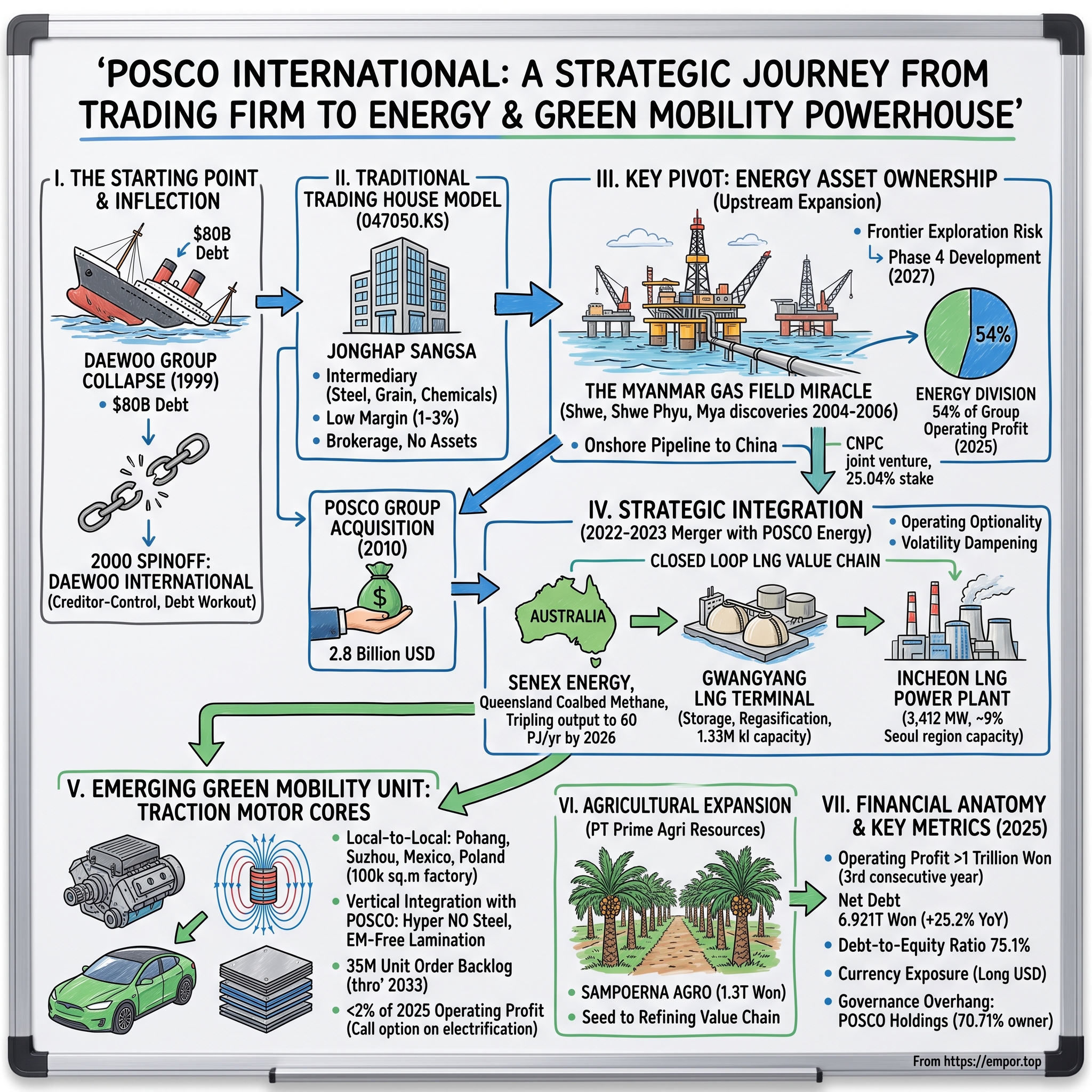
POSCO International: From General Trading Firm to Energy & Green Mobility Powerhouse
I. Introduction & Episode Roadmap
On July 30, 2026, POSCO International Corporation reported the largest quarterly operating profit in its history: 429 billion won on revenue of 9.62 trillion won, up 26.9% year on year and roughly 14% ahead of analyst consensus estimates.1 For a company that most South Korean investors still mentally file under "trading house," that performance stands out. Traditional trading houses rarely beat estimates by 14%, nor do they typically produce earnings surprises, because their business models rely on high turnover and slim transactional margins rather than capital-asset profits.
The story of how that financial shift became possible explains the broader corporate transformation.
For most of its history, the company—trading as 047050.KS on the Korea Exchange—was valued as an intermediary. It moved steel, grain, and chemicals, collecting a fee of roughly 1% to 3% for facilitating transactions. Brokerage, however, offers little structural defense: competitors with credit lines and industry networks can easily undercut pricing, and customer loyalty lasts only until the next quote. South Korean markets historically categorized such firms as jonghap sangsa (general trading companies), assigning them low valuation multiples, cyclical earnings expectations, and persistent market discounts.
POSCO International no longer fits that description. In 2025, the company generated 1.165 trillion won in operating profit—its third consecutive year above the one-trillion-won mark—with roughly 54% of that total, or 623 billion won, coming from its energy division.2 Rather than brokering energy commodities, POSCO International owns the upstream assets. It extracts natural gas off the coast of western Myanmar and from coalbed methane fields in Queensland, Australia, transporting the gas on its own vessels, storing it in proprietary terminals along the southern South Korean coast, and burning it in its power turbines outside Incheon.
This asset-heavy model represents a distinct risk profile. The primary analytical question is not whether a pivot occurred—segment disclosures confirm it did—but whether the resulting earnings power is durable. Upstream depletion naturally shrinks reserves, power generation operates as a price-regulated utility, and offshore gas extraction in junta-ruled Myanmar carries political risk that standard discount rates struggle to model. Meanwhile, the company's widely promoted growth venture—electric vehicle (EV) drive motor cores—contributed approximately 19 billion won in 2025 operating profit, representing just 1.6% of the total.2 Management's emphasis on green mobility contrasts with its current contribution to the bottom line, highlighting a divergence between narrative weight and economic reality.
Myth versus reality, up front.
Three prevailing narratives surround the company, each carrying material analytical flaws.
Myth: It is a trading company. Reality: It is an asset owner with a large legacy trading operation attached. While revenue remains dominated by low-margin intermediation, operating profit is anchored by infrastructure assets. Investors who focus on top-line figures risk misjudging earnings power, while those focusing solely on profit margins may understate capital intensity.
Myth: It is an EV growth play. Reality: The drive motor core division represents a prospective call option with secured contract wins, but it generated under 2% of 2025 operating profit and experienced a year-on-year revenue contraction in the first quarter of 2026.27 It remains an emerging unit rather than the core profit driver.
Myth: Myanmar exposure is merely a reputational concern. Reality: The risk is structural. POSCO International is a minority stakeholder in the onshore pipeline entity, has publicly stated that its preferred dividend schedules were rejected by partners, and extracts gas from a field past its peak production curve.6 The exposure is less about headlines and more about a third of group profits residing in a declining, non-controlled asset.
The analysis that follows traces this evolution. First, the 1999 collapse of Daewoo Group—the largest corporate failure in South Korean history—and the debt workout that left a stranded trading arm without parent support. Second, the high-risk pivot where a capital-constrained broker funded wildcat exploration in the Bay of Bengal and discovered major gas fields. Third, POSCO Group's 2010 acquisition and subsequent strategic repositioning. Fourth, the integrated energy expansion marked by the 2022 acquisition of Australia's Senex Energy and the 2023 merger with POSCO Energy, unifying wellhead-to-power generation operations. Fifth, a factual evaluation of the traction motor core segment. Finally, the report examines financial performance, corporate governance across POSCO Group subsidiaries, competitive positioning, and a stress-tested summary of bull and bear cases.
The transformation begins with a corporate bankruptcy.
 Subscribe on LinkedIn
II. The Daewoo Legacy & The 2000 Spinoff
In November 1999, Daewoo Group founder Kim Woo-choong left South Korea as his corporate empire unraveled. Kim—who had built a modest 1960s textile operation into South Korea's second-largest chaebol, employing approximately 250,000 people—left behind a conglomerate burdened by roughly $80 billion in debt, alongside prosecutor allegations that he had concealed $27 billion in accounting losses, fraudulently borrowed $5.7 billion, and illicitly transferred $1 billion offshore.3 After nearly six years abroad, Kim returned to South Korea in 2005 and was arrested at the airport.
Understanding the significance of Daewoo's collapse requires examining the historical role of the jonghap sangsa (general trading company). Under South Korea's export-driven development model from the 1960s onward, trading houses functioned less as conventional private enterprises and more as instruments of state industrial policy. The government channeled low-cost credit to companies capable of generating foreign exchange, and trading firms acted as the front line—deploying personnel across emerging markets to secure trade contracts. The system rewarded transaction volume rather than return on capital, as higher export figures unlocked additional state credit. Kim Woo-choong embraced this model aggressively, operating under a personal ethos that prioritized global expansion over balance-sheet discipline.
The 1997 Asian financial crisis exposed the structural vulnerabilities of that leverage. As the South Korean won plummeted and dollar-denominated liabilities doubled in local currency terms, aggressive debt expansion quickly turned into insolvency. While competing conglomerates curtailed capital expenditures to survive, Daewoo continued expanding into the downturn, leading creditors to halt financing and initiate liquidation proceedings in 1999.
The classic function of a general trading firm was trade facilitation and risk absorption rather than speculative position-taking. A South Korean manufacturer lacking international sales infrastructure relied on the trading house to identify buyers, arrange shipping, structure trade finance, manage counterparty credit risk in opaque jurisdictions, and execute currency hedges in exchange for a fee. During earlier decades, when domestic manufacturers were small and global distribution was complex, that fee was defensible. By the 1990s, however, major clients such as Samsung, Hyundai, and LG established direct overseas sales networks, systematically disintermediating the trading houses.
The subsequent corporate breakup separated Daewoo's operating divisions. In 2000, the trading arm was spun off as Daewoo International Corporation—a debt-workout entity controlled by its creditors, chief among them the state-run Korea Asset Management Corporation (KAMCO).4
Daewoo International inherited a distinct combination of operational capabilities and financial constraints. It retained thousands of active commercial relationships across dozens of countries and a workforce experienced in structuring complex international trade. However, it also inherited a severely tarnished brand name, a balance sheet governed by creditor debt-recovery mandates, and a core business model that generated thin, basis-point margins on third-party intermediation.
This environment forged an internal corporate culture that shaped the firm's subsequent strategy. Employees who remained operated with a high tolerance for frontier risk under creditors willing to approve value-creating ventures that offered an alternative to liquidation. Daewoo International preserved its predecessor's opportunistic dealmaking capability while operating without access to open-ended credit—a constraint that forced capital discipline.
The strategic imperative facing management was clear: move beyond pure trade intermediation. Because trade brokers capture only a small fee without asset ownership, generating durable returns required owning proprietary resources and physical infrastructure that competitors could not easily replicate with a phone call.
The immediate obstacle was capital. Daewoo International had virtually no funding to acquire established income-producing assets. To build an asset-backed portfolio, the company had to seek high-potential opportunities in neglected, high-risk frontiers where competition was minimal.
III. The Myanmar Gas Field Miracle: Transforming the DNA
In the early 2000s, the Bay of Bengal off the Rakhine coast of Myanmar presented a daunting setting for offshore energy development. The country was ruled by an isolated military government, subject to Western sanctions, and lacked legal protections for foreign investors. International oil majors had evaluated offshore western Myanmar and largely walked away, citing extreme political risk, high deepwater drilling costs, and unproven geology.
Into that vacuum stepped a recently spun-off, creditor-controlled South Korean trading house.
In 2000, Daewoo International secured exploration rights offshore Myanmar, acquiring a 51% operating stake in Block A-1 and later Block A-3, which together covered approximately 5,560 square kilometers.5 The structure was notable: a 51% operating stake meant that a firm whose primary expertise lay in brokering steel coils and bulk commodities was taking full responsibility for managing a frontier deepwater drilling program, making technical decisions, and bearing operational risk.
The strategic rationale reflected the firm's capital constraints. Frontier exploration acreage in a sanctioned state was accessible precisely because established competitors had departed. Lacking the capital to acquire producing assets, Daewoo International accepted elevated political and geological risks to secure an equity position that well-capitalized rivals refused to underwrite—effectively trading risk tolerance for asset ownership.
For four years, the exploration program produced no commercial results. That changed in 2004, when drilling uncovered the Shwe gas field. Subsequent discoveries followed at Shwe Phyu in 2005 and the Mya field in Block A-3 in 2006.5 Three major discoveries in three years transformed an unproven acreage position into a commercial gas province.
Sustaining four years of dry holes placed severe strain on a company operating under creditor oversight. Every dollar spent on offshore drilling reduced the liquidity available to support core trading operations. Persuading debt-workout managers to maintain exploration funding required management to demonstrate that the long-term option value of the gas blocks outweighed the immediate cash burn, turning a technical gamble into a critical governance test.
Monetizing the discovered gas presented severe commercial and diplomatic challenges. Myanmar lacked a domestic market of sufficient scale and possessed no liquefied natural gas (LNG) export infrastructure. The consortium solved the monetization problem by constructing a 793-kilometer onshore pipeline running from the Rakhine coast across Myanmar to the Chinese border in Yunnan province—a project built and majority-controlled by China National Petroleum Corporation (CNPC).5 POSCO International holds a 25.04% equity interest in the onshore pipeline operating entity, while CNPC holds a controlling 50.9% stake.6 Upstream joint-venture partners in the gas blocks include ONGC Videsh and GAIL of India, Myanmar Oil and Gas Enterprise (MOGE), and Korea Gas Corporation.5
Constructing the transit route required navigating complex physical and geopolitical hurdles. Offshore, the operator installed production platforms and subsea gathering pipelines in cyclone-prone waters. Onshore, the pipeline traversed mountainous terrain and regions affected by active ethnic conflict. Commercial execution required aligning five counterparties with competing strategic priorities: a South Korean trading house, Myanmar's military government, a Chinese state energy major, two Indian state enterprise partners, and a South Korean public utility. The resulting multilateral arrangement established a high institutional barrier to entry that protected the asset from competitive displacement.
First commercial gas flowed in June 2013, thirteen years after the initial acreage contract.5 The offshore fields currently deliver approximately 500 million cubic feet of natural gas per day to buyers in Myanmar and China.5
The underlying production-sharing contract (PSC) architecture directly influences reported financial results. Under typical PSC terms, the operator recovers historical capital and operating expenditures from gross gas revenues before profit is divided with the host government. This structure explains why company disclosures cite 'investment recovery ratios' as a primary determinant of operating profit.1 Consequently, quarterly operating margins reflect the project's position within its cost-recovery cycle alongside market gas prices. While cost recovery cushions earnings during periods of lower production, new capital expenditure programs alter recovery schedules in ways not immediately apparent from headline volume figures.
The economic impact of upstream ownership fundamentally altered the firm's financial profile. Unlike trade intermediation, which yields narrow transaction fees, upstream extraction carries high operating margins once initial capital infrastructure is amortized. In 2025—twelve years after initial production—the Myanmar operation generated 392.4 billion won in operating profit.2 Relative to POSCO International's total 2025 operating profit of 1.165 trillion won on revenue of 32.37 trillion won, the Myanmar asset generated approximately one-third of group profit while accounting for a small fraction of gross sales.2
This margin disparity forms the core of the company's valuation transition: while revenue figures reflect the scale of legacy trading operations, operating profit reflects resource asset ownership.
Beyond generating standalone cash flow, the Myanmar project produced two strategic outcomes. First, the steady dividend and profit stream provided internal capital that helped fund subsequent resource acquisitions. Second, operating a complex offshore gas development established organizational capabilities in physical asset management, providing the operational foundation for later expansions in Australia and Indonesia.
However, reliance on the Myanmar fields introduces two ongoing structural vulnerabilities. First, natural field decline requires continuous reinvestment. POSCO International has disclosed that a Phase 4 development project is underway, targeting initial gas delivery in July 2027 to offset declining yields from mature wells.7 Second, geopolitical instability poses persistent operational and cash-flow risks following Myanmar's 2021 military coup. Because POSCO International holds a minority stake in the onshore pipeline joint venture, it lacks unilateral governance control. Management disclosed that its proposal to postpone dividend distributions to the CNPC-controlled pipeline entity 'has not been accepted to date,' while maintaining that continued operation remains necessary to supply energy to local populations.6 Consequently, roughly one-third of group operating profits remains tied to a mature asset located in a high-risk political jurisdiction without direct cash-flow control.
Generating a third of corporate earnings from a depleting asset in a politically volatile jurisdiction created a clear strategic countdown. The subsequent evolution of POSCO International's corporate strategy represents a sustained effort to diversify earnings before Myanmar field decline accelerates—a transition that began with a change in parent ownership.
IV. POSCO Group Acquisition & Steel Integration (2010–2019)
By 2010, the debt workout concluded and creditors sought an exit. On August 30, 2010, POSCO signed an agreement to acquire approximately 68% of Daewoo International—68,681,566 shares—from the KAMCO-led sales council for 3.372 trillion won, or roughly $2.8 billion, funded entirely from POSCO's existing cash without external borrowing.4 The transaction closed by the end of September that year.
The acquisition served two distinct strategic objectives with unequal long-term value.
The primary stated rationale was resource development. POSCO's leadership at the time framed the acquisition around Daewoo International's overseas resource development expertise, which POSCO sought to utilize for rare metals and raw material sourcing.4 Because a steelmaker's cost structure is dominated by iron ore and coking coal bought from a highly concentrated group of global suppliers, acquiring upstream development capabilities offered a strategic hedge against supplier concentration.
The secondary, unstated objective was distribution. POSCO produced massive steel volumes and exported much of that output through third-party channels. Bringing an in-house global trading network with dozens of overseas offices under the corporate umbrella created a captive export channel, allowing POSCO Group to retain trade margins internally.
However, routing steel distribution through the trading house fundamentally reshaped POSCO International's financial profile by expanding a low-margin revenue base. Steel distribution at scale relies on high transaction volumes with slim, competitive margins, generating top-line revenue in the tens of trillions of won at low single-digit operating margins. In 2025, the entire materials division—which encompasses steel trading, thermal coal, battery materials, and drive motor cores—generated less operating profit than the energy division, despite driving the overwhelming majority of corporate revenue.2 In the first quarter of 2026, the steel business specifically contributed 60 billion won in operating profit out of a group total of 358 billion won.7
While the captive-channel logic proved modest in profit contribution, parent ownership delivered a far more valuable asset: balance-sheet backing. A creditor-controlled workout firm could not credibly commit billions of dollars to multi-decade infrastructure projects. As a subsidiary of South Korea's premier steelmaker, POSCO International gained the financial standing required to execute large-scale capital commitments—from acquiring a controlling stake in an Australian gas producer to funding a 900-billion-won LNG storage terminal and a 1.3-trillion-won Indonesian plantation acquisition.
The decade following the takeover represented a prolonged strategic transition. Throughout the 2010s, POSCO International functioned essentially as two businesses under one roof: a high-volume, low-margin steel and commodity distribution operation, and one highly lucrative offshore gas asset that came online in 2013. During those years, parent-level attention was concentrated elsewhere as POSCO built steel capacity abroad, navigated global steel price headwinds driven by Chinese overcapacity, and cycled through executive leadership. Consequently, the trading subsidiary operated as a useful but secondary priority within the group.
As a result, while the Myanmar operation generated substantial cash flow throughout the decade, POSCO International lacked a clear secondary growth platform. Management made incremental resource investments, expanded agro-trading operations, and entered automotive component manufacturing. Yet the underlying structural challenge—that pure trade intermediation generates low returns on capital—remained unaddressed across most of the business. By 2019, an investor examining the company would have seen a firm with a single high-margin asset attached to a large, low-margin distribution base, with limited visibility into how earnings would be replaced as the core gas asset eventually matured.
Corporate identity evolved gradually. The company was renamed POSCO Daewoo in 2016 before adopting POSCO International in 2019, quietly retiring one of South Korea's most historic industrial brand names. This deliberate sequencing reflected POSCO's integration strategy: a gradual absorption that preserved the trading house's entrepreneurial culture and frontier risk appetite while preparing the organization for larger capital deployments.
Parent ownership also transformed the firm's financing profile and investment horizon. Operating under creditor oversight imposed strict liquidity constraints and short refinancing cycles. In contrast, integration into POSCO Group provided access to parent-level credit standing, lowering debt financing costs and enabling investment horizons spanning decades. For example, the development of Gwangyang LNG Terminal 1 required approximately two decades and 1.45 trillion won from project launch to completion—a timeline and capital commitment that creditor committees would not have underwritten.12 Access to patient capital enabled long-term infrastructure construction, though it also established structural governance dynamics tied to parent control.
This financial backing carries clear corporate governance implications that recur throughout the company's story. POSCO Holdings currently owns 70.71% of POSCO International—124,396,358 of 175,922,788 shares outstanding—while the National Pension Service holds 6.71% and treasury stock accounts for 3.11%.8 With a free float of roughly a quarter of the company, minority shareholders hold limited voting leverage. Strategic capital allocation decisions are determined by an executive team appointed by, and accountable to, a controlling parent executing group-level priorities.
For most of the 2010s, that group priority remained steel. In the decade that followed, it shifted.
V. Building the Integrated LNG Master Plan (2022–2023)
Corporate strategists frequently invoke "value chain integration," though such initiatives often fail to create economic value. Between 2021 and 2023, POSCO International executed a deliberate restructuring of its energy division, linking upstream extraction with midstream storage and downstream power generation.
The initiative addressed a clear structural vulnerability. As of 2021, the company relied heavily on its Myanmar gas field—a high-margin but finite asset—while lacking proprietary midstream transport and downstream demand. POSCO International sold gas directly at the wellhead, leaving subsequent margins across shipping, storage, regasification, and power generation to third parties.
Move one: buy more molecules, in a jurisdiction nobody worries about.
In December 2021, POSCO International agreed to acquire Australian natural gas producer Senex Energy in partnership with Hancock Prospecting, the iron ore group controlled by Gina Rinehart.9 The deal closed in April 2022, with POSCO International taking a controlling 50.1% stake and Hancock holding the remainder.
The strategic rationale balanced geographical and political risk profiles. Senex produces coalbed methane in Queensland's Surat Basin—an onshore, low-geological-risk asset in a stable OECD jurisdiction supplying an east-coast Australian market facing long-term structural supply deficits. In risk terms, Senex served as a direct counterweight to Myanmar: while Myanmar offered high margins alongside elevated political risk, Senex provided lower political risk within a regulated domestic market.
The acquisition marked only the initial entry phase. Producing approximately 20 petajoules of gas annually at purchase, Senex embarked on a joint expansion backed by an A$650 million capital commitment, with POSCO International contributing A$326 million (roughly 300 billion won). The capital funded additional production wells, processing facilities, and pipelines designed to triple annual output to 60 petajoules—equivalent to roughly 1.2 million tons of LNG—by 2026.10 Crucially, the expansion volume was largely de-risked: Senex had already secured long-term supply contracts totaling 151 petajoules with creditworthy counterparties, including AGL Energy (Australia's largest electricity generator), BlueScope Steel, and Liberty Steel.10 Contracting offtake prior to capital deployment shifted the expansion risk from market demand to project execution.
Operational execution yielded clear financial results through mid-2026. In 2025, Senex generated 75 billion won of operating profit—up roughly 90% year on year on sales volumes that rose by 9.6 billion cubic feet.2 In the first quarter of 2026, Senex operating profit reached 31 billion won, up about 230% year on year.7 By the second quarter of 2026, management attributed part of its record performance to Senex production increases translating into both volume and margin gains.1 Execution against the original tripling commitment proved real, even if full output arrived closer to 2026 than initial 2025 guidance implied.11
Move two: buy the entire downstream, from inside the family.
On January 1, 2023, POSCO International absorbed unlisted group affiliate POSCO Energy in a direct merger.[^12] The transaction brought two major infrastructure assets under group control.
The first asset is the Gwangyang LNG Terminal, South Korea's first privately owned commercial LNG import facility. Terminal 1 was completed on July 9, 2024, with six storage tanks and 930,000 kiloliters of capacity, representing roughly 1.45 trillion won of investment across nearly two decades since the project launched in 2002.12 Tanks 5 and 6 were built using POSCO's proprietary cryogenic high-manganese steel, engineered for the minus-162-degree storage environment—a direct instance of intra-group technical synergy. A second terminal, adding two further 200,000-kiloliter tanks at a cost of about 930 billion won, was scheduled to bring total storage capacity to 1.33 million kiloliters—enough, by management estimates, to cover roughly 40 days of national winter heating gas demand.13
The second asset is the Incheon LNG Combined Cycle Power Plant: 3,412 megawatts across seven combined-cycle generating units, supplying roughly 9% of the Seoul metropolitan area's generation capacity and operated by POSCO Energy since its establishment as South Korea's first private power generator more than 50 years ago.14
Combining these operations linked gas production in Myanmar and Queensland, international cargo trading, charter shipping, coastal storage at Gwangyang, and power generation outside Seoul. That structure established a closed loop, making POSCO International the only private South Korean company controlling every link of the LNG value chain.[^12]
An independent governance analysis requires scrutinizing the transaction structure. Because the merger occurred between two subsidiaries of the same parent company, it proceeded without a public auction or third-party market price discovery. While intra-group consolidation offered execution speed and eliminated external financing hurdles, asset valuation was determined through negotiation among corporate affiliates. Minority shareholders were effectively required to trust parent-level fairness assumptions. Subsequent operating cash flows confirmed asset quality, providing retrospective validation rather than a substitute for competitive price discovery.
What the integration actually buys — and what it doesn't.
Vertical integration does not create market margin out of thin air; total value chain profitability remains dictated by macro commodity conditions. Instead, integration delivers operational optionality and volatility dampening. When imported LNG prices rise, higher fuel costs at the power generation plant are offset by expanded upstream extraction margins. Conversely, when natural gas prices decline, compressed upstream earnings are counterbalanced by wider power generation spreads. Proprietary storage capacity further enables the firm to hold gas inventories through seasonal price dips rather than selling into depressed spot markets—an option that supported energy division earnings across shifting commodity cycles.
However, integration cannot insulate the firm from utility regulation. The 2025 results showed the power generation business declining on lower system marginal prices and reduced utilization.2 The first half of 2026 repeated that pattern: while overall energy division profits expanded, the generation line specifically faced headwinds from lower spot power prices and softer plant utilization.1 Because South Korea's wholesale power market operates under administrative oversight, regulators possess both statutory tools and policy incentives to cap wholesale power prices during energy shocks. Consequently, downstream ownership exposes the firm to utility-style price caps that vertical integration cannot hedge.
By the end of 2023, the strategy produced a landmark financial result: annual sales reached 33.13 trillion won while operating profit rose 28.9% year on year to 1.1631 trillion won—surpassing one trillion won for the first time in company history, notably achieved alongside a 12.8% decline in sales.11 A nearly 30% increase in operating profit during a double-digit top-line contraction provided clear evidence that POSCO International had shifted from a volume-dependent trade broker to an asset-backed energy producer.
With the energy chain closed, management turned to establishing a secondary growth platform outside fossil fuels—focusing on electric vehicle drive components.
VI. The Hidden Growth Engine: Traction Motor Cores
On October 1, 2025, in Brzeg, Poland, executives opened a 100,000-square-meter factory that cost 94.1 billion won to build.15 The CEO signed the first prototype off the line in a ceremonial launch that marked a strategic expansion inside the European Union's tariff wall.
The underlying component—the drive motor core—is an obscure but critical element of an electric vehicle drivetrain. An electric motor operates by creating a rotating magnetic field that spins an internal shaft. The stationary outer stator and spinning inner rotor together form the motor core. Rather than being cast from solid steel, which would produce large internal eddy currents and waste power as heat, motor cores are constructed like a stacked deck of cards: hundreds of wafer-thin, precisely stamped sheets of electrical steel bonded together. Thinner sheets, higher-grade steel, and cleaner bonding reduce energy lost as heat, translating directly into greater driving range from the same battery.
POSCO International bases its competitive strategy on two key inputs. First, raw material is sourced internally within POSCO Group using Hyper NO, a high-efficiency non-oriented electrical steel—고효율 무방향성 전기강판—designed specifically to reduce core loss in motors.15 Second, the manufacturing process employs proprietary EM-Free technology, which uses thin adhesive layers to laminate the sheets rather than welding or riveting them.15 Removing mechanical fasteners eliminates conductive metal bridges that facilitate unwanted eddy currents, improving efficiency while reducing motor noise and vibration, according to company disclosures.15
Commercially, motor efficiency offers automakers a crucial mechanism to extend vehicle range without enlarging battery packs—the single most expensive component in an electric vehicle. Recovering even a small percentage of energy normally lost to heat allows manufacturers either to advertise greater range or to fit a smaller, cheaper battery pack. Consequently, motor cores are specified years in advance at the vehicle platform design stage, creating durable supplier relationships with meaningful switching costs.
Whether this advantage constitutes a defensible moat requires careful qualification. Adhesive lamination technology itself is not unique to POSCO International; several Japanese and European suppliers possess proprietary bonded-core processes. Instead, the company's distinct advantage lies in its vertical integration with POSCO Group, securing a captive supply of high-grade electrical steel from a parent company that is one of a handful of global producers capable of manufacturing it at scale. In an industry periodically constrained by electrical steel shortages, supply-chain security represents a tangible operational safeguard.
The commercial evidence.
The primary indicator of commercial traction is order backlog: 35 million drive motor cores contracted through 2033.15 In automotive supply chains, backlog represents platform design-in wins; once a component is qualified into a vehicle platform, it generally remains specified throughout that model's multi-year production lifecycle.
The division's manufacturing footprint reflects a deliberate "local-to-local" response to regional trade policies. The company operates domestic plants in Pohang and Cheonan, alongside facilities in Suzhou, China; two plants in Mexico; the new Polish facility; and a plant in India with 300,000 units of capacity.16 The Polish site features an annual capacity of 1.2 million units, began trial production in October 2025 and full-scale production in December 2025, and initially supplies 1.68 million units for Hyundai Motor Group's European EV production, with stated ambitions to add European original equipment manufacturers including Volkswagen.15 Similarly, the Mexican facilities serve the North American market, where U.S. Inflation Reduction Act content rules make regional manufacturing a mandatory requirement for tax credit qualification.
Alongside manufacturing expansion, the company executed a defensive supply-chain realignment for raw materials. Motor cores require permanent magnets dependent on rare earth elements—a supply chain historically dominated by Chinese processors. To mitigate concentration risk, POSCO International disclosed a supply alliance with 25 companies across North America, Australia, and Asia, securing long-term contracts for 8,500 metric tons of permanent magnets explicitly to reduce Chinese dependence.16 It has separately pursued rare earth supply through a partnership with Torngat Metals.7 For an automotive supplier selling into Western vehicle programs where sourcing origin is a contractual prerequisite, securing non-Chinese rare earth inputs represents an essential qualification.
Now the discipline of proportion.
While the growth narrative is compelling, current economic contributions remain modest. The motor core business generated approximately 19 billion won of operating profit in 2025—a turnaround to full-year profitability driven by cost improvements and a sales mix leaning toward hybrid vehicles rather than pure electrics.2 In the first quarter of 2026, the unit earned 2.8 billion won in operating profit, up 1.8% year on year, despite revenue that declined 9.8%.7 By the second quarter of 2026, management pointed to double-digit improvement in profit margin driven by cost reduction.1
Evaluating these data points together reveals a business enhancing its unit economics while overall volume expansion remains constrained. The reliance on hybrid sales highlights an underlying market shift: as pure battery-electric adoption slowed relative to earlier forecasts, the division sustained profitability by adapting to hybrid powertrain demand. While this operational flexibility reflects sound management, it also underscores the gap between initial electric-vehicle volume assumptions and actual market uptake.
Management projects sales growth from 450 billion won in 2025 to 1.5 trillion won by 2030, backed by a global production and sales system exceeding 7 million units annually and a target of roughly 10% global market share by 2030.15 Recent commercial wins align with that trajectory, including a 600-billion-won supply agreement covering three million cores for an undisclosed U.S. EV maker—implying roughly 200 billion won per million units as a public benchmark for pricing.16
Ultimately, achieving management's 2030 targets depends on global adoption rates beyond the company's direct control. Six production facilities across four continents were constructed against demand curves established when electric-vehicle growth expectations were higher. If global EV adoption reaccelerates, this fixed-cost base will generate significant operating leverage. If demand growth remains flat, these facilities risk becoming underutilized assets with extended payback periods. Under present market conditions, the division functions less as an immediate core profit driver and more as a reasonably priced call option on automotive electrification.
That dynamic sets up the broader question of how these corporate divisions fit together.
VII. Segment Economics & Financial Anatomy
Understanding POSCO International requires reading its income statement backward. Standard top-down financial analysis—starting with revenue and working down—misleads because top-line revenue and operating profit reflect two distinct business models.
The revenue entity. In 2025, consolidated revenue reached 32.37 trillion won.2 The vast majority of that total stems from pass-through trade intermediation: moving steel products from the parent company and third parties, thermal coal, battery materials, chemicals, and agricultural commodities at thin margins. A clear illustration occurred in the first quarter of 2026, when the steel distribution operation delivered 60 billion won in operating profit—up 19.7% year on year—against a quarterly group revenue base of 8.41 trillion won.7 Steel distribution is an activity-heavy business that yields modest margins on large transaction volumes, making return on invested capital a more meaningful metric than operating margin.
The profit engine. In contrast, the energy division generated 623 billion won in 2025 operating profit, accounting for roughly 54% of the group total.2 Within energy, Myanmar contributed 392.4 billion won as sales volume expanded by 8.2 billion cubic feet, while Senex delivered 75 billion won.2 By the first quarter of 2026, the energy division's profit breakdown reflected a broader asset base: Myanmar produced 86 billion won (down 1.6% year on year), Senex generated 31 billion won, power generation contributed 43 billion won, and terminal operations earned 13 billion won, up 66.3% year on year.7
This quarterly segment split illustrates a structural transition under way: growth in Myanmar has stalled, while Senex, terminal operations, and power generation are absorbing the shortfall. In the second quarter of 2026, management noted that Myanmar gas operating profit expanded despite lower sales volumes, supported by production-sharing investment recovery mechanics and favorable exchange rates.1 For financial modeling, this distinction is critical: Myanmar's earnings stability currently reflects contract recovery ratios and currency translation rather than volume growth. While volume decline in a mature field represents standard geological field depletion, favorable foreign exchange movements should not be confused with operational momentum.
The quarterly energy disclosures also highlight midstream terminal operations—the fee-based business of receiving, storing, and regasifying LNG cargoes—which grew 66.3% year on year in the first quarter of 2026 off a base of 13 billion won.7 Terminal fees represent high-quality infrastructure earnings: they are backed by long-term contracts, largely insulated from commodity price volatility, and tied to physical assets with multi-decade lifespans where domestic private competition is minimal. Although currently a small profit line, terminal services function as a utility-like annuity. Expanding storage capacity from 930,000 kiloliters at Gwangyang Terminal 1 to 1.33 million kiloliters across Terminal 2 represents a roughly 43% expansion in the physical asset base driving this recurring revenue stream.1213
The third leg: agricultural expansion.
Historically, the agricultural unit was a secondary operation focused on grain sourcing, a grain export terminal in Mykolaiv, Ukraine—where operations remain disrupted by war—and modest Indonesian palm oil holdings. Between 2025 and early 2026, POSCO International deployed approximately 1.3 trillion won (roughly $855 million) to acquire controlling interest in Indonesian palm producer Sampoerna Agro, adding 128,000 hectares of plantations across Sumatra and Kalimantan and bringing the company's total Indonesian plantation footprint to 154,000 hectares—an area approximately two and a half times the size of Seoul.17 Rebranded as PT Prime Agri Resources (PT.PAR) and formally launched in Jakarta on June 18, 2026, the operation established an integrated value chain spanning seed development, cultivation, crude palm oil extraction, and refining, with refining supported by a joint venture with GS Caltex in Balikpapan featuring 500,000 metric tons of annual capacity.17
The financial impact was immediate. The palm division generated 101 billion won in 2025 operating profit—with revenue rising 58%—driven by early consolidation effects and elevated crude palm oil prices.2 Disclosures from both the first and second quarters of 2026 highlighted newly consolidated Indonesian palm assets as a primary contributor to group earnings.71 For full-year 2026, management set a target to more than double palm operating profit.17
This strategic approach mirrors the framework applied in the energy division: acquire upstream production, establish midstream infrastructure, and control downstream processing. While this model creates integrated value chains, it also introduces managerial complexity. Operating palm plantations and processing facilities requires distinct competencies from managing offshore gas developments, steel distribution networks, or automotive components manufacturing.
Currency exposure and financial translation.
As a South Korean enterprise producing dollar-denominated natural gas and palm oil, distributing steel internationally, and reporting in Korean won, currency fluctuations significantly impact reported results. Management has stated that the steel division fully hedges euro-dollar exposures.1 In contrast, the upstream resource businesses remain structurally long the U.S. dollar, meaning a weaker won mechanically boosts reported won profits from Myanmar and Senex without requiring operational volume growth. The second quarter of 2026 demonstrated this effect when Myanmar operating profit increased despite declining gas production, with favorable exchange rates cited among the key drivers.1 Consequently, evaluating underlying operational health requires separating currency translation gains from physical production trends, as currency tailwinds can quickly reverse.
Balance sheet leverage and capital commitments.
Capital allocation presents the primary analytical risk. Upstream expansion at Senex, construction of Gwangyang Terminal 2, Phase 4 development in Myanmar, six drive motor core plants, and the 1.3-trillion-won palm acquisition were executed without dilutive equity offerings. Instead, capital expenditures were funded through debt. By the first quarter of 2026, net debt reached 6.921 trillion won—a 25.2% increase year on year—bringing the debt-to-equity ratio to 75.1%.7
While a 75.1% debt ratio is manageable for an asset-heavy enterprise, the trajectory warrants attention: expanding net debt by over a quarter during a period of record operating cash flow indicates capital investments are exceeding internal cash generation. That capital deployment is supported where projects feature long-term contracted off-take, such as Senex. However, maintaining simultaneous capital programs across multiple divisions increases vulnerability if global commodity prices normalize or credit market conditions tighten.
Simultaneously, shareholder distributions remain conservative. Management guided to a dividend payout ratio of approximately 25%, alongside potential interim dividends.11 Distributing one-quarter of net income to shareholders while expanding net debt by 25% underscores management's explicit capital hierarchy: prioritizing growth reinvestment over capital return to minority shareholders.
VIII. Management, Governance, & Capital Allocation
In February 2024, POSCO Group nominated Lee Kye-in—a career insider whose background spans steel trading, global business, and materials development—as president and chief executive of POSCO International.18 Lee formally assumed the role in March 2024 and was retained during the group's annual executive reshuffle in December 2025.19
This executive continuity carries strategic weight. Chief executive turnover across POSCO Group subsidiaries has historically tracked political shifts as much as operational performance, with parent-level leadership changes frequently cascading down to subsidiary leadership. A chief executive maintaining tenure through an executive reshuffle amid record financial performance provides a signal of internal confidence and operational stability—a critical factor for multi-year capital programs whose payback periods extend beyond typical executive terms in South Korea.
Lee inherited rather than authored the core structural repositioning: the Senex Energy acquisition was executed under former CEO Joo Si-bo, while the POSCO Energy merger integration was led by former CEO Jeong Tak. Under Lee, management reframed corporate strategy from a collection of standalone business lines into an integrated "comprehensive business company" organized around three core pillars: trading, energy, and food.19 During his tenure, the company accelerated its LNG portfolio buildout, expanded its terminal footprint to six facilities, and completed its palm oil value chain through Indonesian acquisitions and a refining joint venture with GS Caltex.19
The December 2025 corporate reorganization provided structural backing for this integrated model. Management unified exploration, production, transport, storage, and power generation into a single Energy Division under Cho Jun-soo, the former head of gas operations.19 The restructuring also established a Safety Planning Office and a Digital Transformation Strategy Office.19
Consolidating energy operations resolved a key organizational friction. Previously, separate links in the LNG value chain operated under distinct reporting structures, requiring inter-departmental negotiation to decide whether to sell, store, or burn imported gas cargoes. Placing the entire chain under unified leadership creates the operational framework required to optimize commercial decisions across the portfolio. However, consolidated reporting also reduces transparency for external analysts, making it more difficult to isolate individual profit margins across specific links in the value chain.
Assessing credibility by behavior.
Evaluating management performance requires testing strategic commitments against disclosed operational results across three key benchmarks:
The Senex tripling. In 2022, management committed to tripling annual gas production from 20 to 60 petajoules, initially targeting 2025 before adjusting guidance toward 2026.1011 Financial returns materialized in 2025 and accelerated through 2026.27 While execution experienced modest schedule slippage, management acknowledged the timeline shift transparently rather than revising baseline targets.
The trillion-won operating profit. Management targeted sustained annual operating profit above one trillion won—a milestone achieved in 2023 and maintained through 2024 and 2025.112
The motor core trajectory. Management continues to emphasize a 35-million-unit order backlog and a 1.5-trillion-won sales target for 2030.15 However, near-term results show a divergence: in early 2026, quarterly segment revenue contracted year on year even as operating profit expanded through cost reductions.7 While long-term targets remain active, current sales volume data has not yet demonstrated the acceleration needed to hit 2030 objectives, making backlog metrics a prospective rather than immediate indicator of earnings power.
Corporate disclosure practices exhibit a clear balance between detail and selectivity. POSCO International provides granular, asset-level operating profit breakdowns across its key operating units—Myanmar, Senex, terminal operations, power generation, steel trading, palm oil, and motor cores.7 This level of disclosure exceeds standard practice among diversified industrial trading houses. However, public reporting remains limited on less favorable metrics, including precise field-level depletion rates for Myanmar gas, plant-specific capacity utilization figures across motor core facilities, and transfer-pricing terms governing inter-company affiliate transactions.
The governance overhang, stated plainly.
With POSCO Holdings owning 70.71% of outstanding shares, POSCO International operates as an integrated group asset rather than an independent enterprise.8 This ownership structure creates specific governance dynamics for minority shareholders. Related-party transactions are central to operations: the steel trading business functions primarily to distribute parent-manufactured steel, while the drive motor core unit relies on the parent for specialized electrical steel inputs. Consequently, transfer-pricing mechanisms across group affiliates directly influence where economic value is captured, yet public disclosures do not provide outside investors with sufficient detail to independently audit these intra-group pricing terms.
Capital allocation is similarly governed by parent-level priorities. While POSCO Holdings established a group-wide corporate "value-up" program that includes performance-linked shareholder return targets and treasury share cancellations, POSCO International maintains a separate, modest dividend payout guidance of approximately 25%.[^21] As POSCO Group commits capital to major initiatives across battery materials and lithium processing, its most cash-generative operating subsidiary represents a primary liquidity source for group capital deployment. While public records show no evidence of improper value transfer, minority shareholders remain structurally subordinate to parent-level capital distribution decisions.
A classic activist investment thesis would identify multiple value-creation levers: a pronounced conglomerate discount across a diverse business portfolio spanning gas extraction, power generation, steel distribution, palm oil, grain trading, and auto components; a payout ratio well below earnings capacity; and consolidating divisional disclosures. However, South Korea's legal and corporate governance framework offers limited recourse against a 70% controlling shareholder. Because majority control insulates management from proxy contests or forced restructurings, shareholder value creation ultimately depends on whether parent-level strategy aligns with the economic interests of minority investors.
IX. Strategic Frameworks: 7 Powers & 5 Forces Analysis
Stripping away the narrative raises a central strategic question: if a well-capitalized competitor attempted to replicate POSCO International's business model, which assets could it duplicate, and which remain out of reach?
Applying Hamilton Helmer's 7 Powers.
Cornered Resource — strong, but decaying and geographically concentrated. The Myanmar production-sharing contracts offer a classic example: a 51% operating interest in blocks rivals avoided, secured before exploration proved the underlying geology.5 A competitor cannot acquire that position today, as the asset is not for sale and local political conditions have deteriorated. The Gwangyang LNG Terminal serves as the domestic counterpart—its coastal berths, regulatory permits, and two decades of development represent a physical footprint on South Korea's southern coast that cannot be easily replicated.12 However, this cornered resource faces two structural limitations: an extractive asset naturally depletes over time, and operating within a sanctioned jurisdiction carries ongoing political risk.
Scale Economies — real, but in the least profitable segment. A global trading network spanning dozens of overseas offices generates consolidated procurement volumes that lower unit freight and distribution costs. However, this scale advantage applies primarily to a business operating on thin, single-digit margins, capping its ability to drive overall shareholder value. In commodity trade intermediation, scale provides market participation rather than premium pricing power.
Process Power — the strongest genuinely defensible claim. South Korea's only fully integrated private LNG value chain—linking upstream equity gas to proprietary midstream storage and downstream power generation—represents a complex operational framework that competitors cannot readily assemble.[^12] While individual assets can be acquired on the open market, synthesizing them required two decades of permitting, infrastructure development, and an internal corporate merger unique to POSCO Group. The company's EM-Free drive-core lamination technology, paired with a captive supply of Hyper NO electrical steel from its parent, represents a secondary, specialized process advantage.15
Switching Costs — narrow and confined to motor cores. Once an electric vehicle platform incorporates a specific drive motor core, re-engineering and requalifying an alternative supplier requires substantial time and capital, explaining the structural visibility of the company's 35-million-unit contract backlog through 2033.15 Across the remainder of the portfolio, switching costs are negligible, as industrial buyers can readily substitute commodity trade intermediaries.
Branding, Network Economies, Counter-Positioning — absent. The remaining competitive powers are absent. POSCO International sells industrial commodities and automotive components to commercial clients who evaluate suppliers primarily on price, reliability, and origin. The enterprise commands no consumer brand premium, benefits from no network effects, and operates no business models that well-capitalized incumbents cannot replicate.
Possessing three distinct competitive powers—concentrated primarily in energy infrastructure—defines the company's economic moat. The competitive advantage resides firmly within the energy division, while the remaining business units operate without structural protection.
Porter's Five Forces, applied to the energy division specifically.
Threat of new entrants: very low. Developing an LNG import terminal requires multi-year construction timelines, environmental approvals, specialized coastal real estate, and extensive marine infrastructure. Gwangyang Terminal 1 alone represented roughly 1.45 trillion won in cumulative capital expenditure over two decades, creating a formidable barrier to opportunistic entry.12
Supplier power: low to moderate, and structurally improving. POSCO International increasingly operates as its own supplier, consuming equity gas from Myanmar and Senex across its proprietary terminals and power turbines, while sourcing specialized electrical steel directly from its parent company. When procuring third-party LNG cargoes on spot or long-term contracts, it remains subject to standard global market pricing.
Buyer power: moderate to high, and the least favorable force. South Korean electricity generators sell power into a wholesale market governed by a system marginal price mechanism that remains subject to administrative regulation. Power producers operate largely as price takers with limited capacity to pass along short-term fuel cost increases. The contraction in 2025 power generation earnings—driven by lower wholesale power prices and reduced plant utilization—reflects this structural dynamic.2
Threat of substitutes: moderate, and the timeline is the whole argument. While renewable energy and battery storage will gradually reduce the share of gas-fired power generation, intermittent renewable sources require dispatchable thermal backup. South Korea's mountainous terrain, high population density, limited land for utility-scale solar installations, and isolated power grid create structural hurdles for alternative power deployment. Consequently, natural gas serves as an extended transition fuel. The primary investment risk is not that natural gas becomes obsolete, but that long-term terminal valuation assumptions may overstate cash flows past the transition horizon.
Competitive rivalry: moderate. In trade intermediation, the company competes against domestic peers such as LX International and Samsung C&T, both of which have similarly expanded into resource assets. In natural gas and power generation, SK Innovation and its energy affiliates represent the closest domestic counterpart, possessing established downstream operational capacity. POSCO International's distinction lies not in dominant scale within any single operational link, but in its unified ownership of the complete value chain.
The peer comparison, honestly drawn.
Comparing POSCO International with its two closest South Korean trading-house peers clarifies its competitive positioning. All three originated as jonghap sangsa general trading companies and subsequently concluded that pure trade intermediation offered limited long-term returns. LX International expanded into coal, nickel, and logistics. Samsung C&T diversified into construction, fashion, and resource holdings, while occupying a central structural position within its group's ownership chain. POSCO International focused on natural gas and uniquely extended its operational scope fully downstream into power generation.
The core distinction is that peers largely assembled portfolios of discrete resource stakes, whereas POSCO International constructed an integrated value chain. A portfolio of independent resource positions provides commodity exposure and asset diversification; an integrated chain grants management the operational flexibility to determine, cargo by cargo, whether natural gas generates higher returns when sold, stored, or burned. Against pure energy operators—such as SK Innovation and state-linked utility incumbents—the comparison inverts: those enterprises possess deep downstream capabilities but lack equivalent equity gas production feeding their own terminals. POSCO International occupies a distinct intermediate position. While this integrated structure does not automatically guarantee a valuation premium, it provides defensible operational advantages.
These analytical frameworks converge on a central conclusion: the company's durable competitive advantage rests on its integrated gas value chain, while its remaining operations remain exposed to cyclical market conditions and competitive pressures.
X. Bull vs. Bear Case & Investor Stress Test
A balanced assessment reveals what investors are acquiring in POSCO International, alongside the primary operational and structural risks facing the enterprise.
The three KPIs that matter.
Beyond the extensive suite of disclosed operating metrics, three key indicators encapsulate the corporate trajectory:
First, energy division operating profit and its composition. Rather than consolidated group profit, analysts must track the energy division's profit broken down across Myanmar, Senex, terminal operations, and power generation. This disclosure line reveals whether the transition from a depleting Myanmar asset to Australian gas production and midstream infrastructure fees is proceeding quickly enough. The first-quarter 2026 result—where Myanmar operating profit remained flat at 86 billion won while Senex, terminal, and power generation expanded—represents the trajectory required to sustain earnings.7 If total energy profit stalls while Myanmar volumes decline, the core succession thesis comes under pressure.
Second, drive motor core revenue rather than contracted backlog. While backlog represents platform selection, revenue reflects actual economic realization. The segment's first-quarter 2026 revenue declined 9.8% year on year even as operating profit rose modestly.7 Sustained top-line expansion is required to convert 35 million contracted units into material earnings. If revenue remains stagnant as global production capacity increases, capital is being deployed ahead of end-market demand.
Third, the spread between South Korean system marginal electricity prices and landed LNG import costs. This margin determines whether the Incheon power plant functions as a profit driver or a fixed-cost burden, representing the primary portfolio variable governed by utility regulation rather than market pricing.
The bull case, and the evidence behind it.
The primary investment thesis rests not on electric vehicles, but on empirical evidence across shifting commodity cycles that the company can expand operating profit during top-line contractions. The 2023 financial performance—where operating profit rose 28.9% despite a 12.8% decline in revenue—demonstrates this structural decoupling.11 This divergence marks the transition from a low-margin trade broker to an asset-backed resource producer.
Second, projected volume growth is largely de-risked by commercial off-take agreements. The expansion of Senex Energy is backed by 151 petajoules of long-term supply contracts with established industrial and utility counterparties.10 Concurrently, the construction of Gwangyang Terminal 2 expands gas storage capacity in a domestic market reliant on imported LNG. These assets generate utility-like cash flows, even as public markets continue to value the enterprise substantially on its trading heritage.
Third, operational diversification has broadened beyond legacy resource holdings. In 2025, the company generated material operating profit across four distinct pillars—Myanmar natural gas, Australian gas production, South Korean power and terminal operations, and Indonesian palm oil—alongside a modestly profitable motor core business.2 Maintaining multiple distinct cash-flow streams provides greater earnings resilience than the single-asset reliance of the prior decade.
The bear case, stress-tested.
Depletion is a structural certainty rather than a prospective risk. The Myanmar offshore fields generated 392.4 billion won in 2025 operating profit, representing roughly one-third of group profit.2 By the second quarter of 2026, operating profit was sustained on declining physical extraction volumes through cost-recovery mechanisms and favorable foreign exchange rates.1 While the Phase 4 development project targeting initial gas delivery in July 2027 mitigates field decay, this capital expenditure serves to slow natural depletion rather than expand peak output.7 Consequently, valuation models treating current Myanmar cash flows as perpetual streams overstate baseline value, while detailed field-level depletion schedules remain undisclosed.
Political exposure carries tail risks that standard discount rates struggle to model. POSCO International holds a minority 25.04% equity stake in the CNPC-controlled onshore pipeline operator and disclosed that its request to defer dividend distributions to that entity was rejected.6 This dynamic demonstrates that management lacks unilateral governance control over cash distributions. Heightened international sanctions, forced asset divestment, or pipeline disruptions along the 793-kilometer transit corridor through active conflict zones represent scenarios where potential losses involve asset impairment rather than incremental earnings adjustments.
Regulatory price interventions limit downstream margins. The performance of the domestic power generation business in 2025 demonstrated the impact of softer system marginal prices and reduced plant utilization.2 A more severe downside risk involves an asymmetric market shock: rising global LNG prices increasing fuel costs while state regulators cap wholesale electricity prices to shield consumers. While vertical integration allows upstream gas profits to cushion downstream margin compression, this offset remains partial and mismatched across quarterly reporting periods.
Capital deployment in electric vehicle components faces demand-ramp headwinds. Six manufacturing facilities across four continents were planned based on aggressive global EV adoption projections. Disclosed metrics—including contracting quarterly segment revenue alongside profit margins supported by hybrid vehicle mix and cost reductions—indicate a slower adoption curve.27 With substantial fixed manufacturing infrastructure established, an extended period of flat EV demand would lengthen capital payback periods across facilities in Poland, Mexico, and India.
Leverage has expanded alongside concurrent capital programs. Net debt increased 25.2% year on year to 6.921 trillion won in the first quarter of 2026, occurring during a period of strong operating cash flows.7 Managing Myanmar Phase 4 development, constructing Gwangyang Terminal 2, executing the Senex expansion, operating six motor core plants, and integrating the 1.3-trillion-won Indonesian palm acquisition requires extensive operational bandwidth.17 While individual projects carry strategic merits, their cumulative capital demands reduce balance-sheet flexibility during potential commodity downturns.
Portfolio complexity preserves market valuation discounts. The corporate structure combines upstream gas extraction, power generation, steel distribution, palm oil plantations, grain trading, and auto components within a single legal entity. Management maintains that international trade capabilities provide operational connectivity across these divisions, yet capital markets have historically applied a conglomerate discount. With POSCO Holdings holding a 70.71% controlling interest, minority shareholders lack structural mechanisms to force structural unbundling or portfolio simplification.8
Secondary operational variables require continued monitoring. Full operational recovery of the Ukrainian grain export terminal remains contingent on geopolitical stability. Furthermore, segment disclosure granularity has shifted following the organizational unification of the Energy Division. Finally, inter-company transfer pricing with the parent company—covering steel trading volumes and Hyper NO electrical steel inputs—significantly influences segment profitability while remaining unresolvable from public disclosures.
What would falsify each case.
Defining explicit disconfirming criteria is essential for testing both investment theses.
The bull case would be invalidated if energy division operating profit flattens across consecutive quarters while Myanmar's profit contribution continues to decline, indicating that Senex, terminal operations, and power generation are not scaling quickly enough to offset field depletion. Additionally, if net debt continues expanding at double-digit rates through a broader commodity downturn, balance-sheet flexibility to fund future capital projects would be constrained.
Conversely, the bear case would be invalidated if infrastructure fee income from terminals and power generation continues compounding as observed in early 2026, establishing a recurring earnings base independent of commodity price swings and Myanmar risk.7 It would also be disproven if drive motor core revenue expands alongside margin improvements, confirming that global manufacturing capacity was aligned with genuine commercial demand.
These empirical markers offer visible resolution over near-term quarters rather than requiring long-term assumptions.
In summary, POSCO International possesses an asset-backed profit engine and a defensible economic moat centered within its integrated energy division. However, significant cash flows remain tied to a mature asset in a frontier political jurisdiction, while the widely promoted green mobility narrative continues to await full commercial realization.
XI. Business & Investing Lessons
Lesson one: escaping the trader's trap requires owning something that cannot be re-bid.
The defining insight of POSCO International's past twenty-five years is that collecting a percentage on third-party transactions is not a defensible business—it is an intermediation fee that competitors can readily undercut. Escaping that trap required more than refining trade execution; it required converting transactional cash flow into physical assets protected by high entry barriers, including gas fields, pipeline stakes, storage terminals, and power turbines. The critical distinction is that these assets were guarded by structural rather than merely financial barriers. While capital alone can build a warehouse, few entities can secure a coastal LNG import terminal in South Korea or an operating stake in a frontier offshore gas block that required thirteen years to achieve initial production. When a low-margin intermediary reinvests capital, the core analytical test is not whether an asset is capital-intensive, but whether a well-funded competitor can replicate it.
Lesson two: institutional character survives parent ownership—and cuts both ways.
The initial gamble on Myanmar was executed by a debt-workout entity with a tarnished brand and scarce capital, enabled by an inherited culture that viewed frontier markets as opportunities rather than compliance risks. The same corporate DNA that drove Daewoo Group's collapse—aggressive expansionism and comfort in high-risk jurisdictions—generated its most lucrative surviving asset once constrained by capital scarcity and disciplined by a conservative parent company's balance sheet.
The broader analytical lesson is that aggressive corporate cultures are neither inherently value-creating nor value-destroying; they are operational inputs whose results depend on governance constraints. Unconstrained by credit limits, Daewoo's corporate culture generated an $80 billion collapse.3 Constrained by creditor oversight and subsequently by POSCO's financial discipline, that same risk tolerance yielded the Shwe and Senex gas assets. When evaluating an enterprise with a risk-taking heritage, the critical question is not how aggressive management appears, but what structural mechanisms restrict its actions.
Lesson three: vertical integration creates optionality, not margin—and only when the organization is structured to capture it.
The most instructive operational development in this transformation was not the merger that assembled the LNG value chain, but the December 2025 reorganization that placed exploration, production, transport, storage, and power generation under a single executive.19 For nearly three years, the enterprise owned an integrated chain while operating it through fragmented reporting lines, requiring inter-departmental negotiations to execute simple commercial trade-offs.
That gap between owning integrated assets and operating an integrated business is where corporate integrations frequently falter. Assets are acquired and synergy targets declared, yet siloed organizational structures prevent commercial optimization. For investors evaluating vertical integration claims, the primary diagnostic is not the transaction announcement, but whether management aligns organizational authority and incentive structures across the complete value chain. POSCO International required nearly three years to achieve that operational alignment—a realistic timeline, but one that underscores that integration synergies are forged through structural execution rather than financial transaction.
Lesson four: evaluating diversified enterprises requires disaggregating narrative from economics.
When a conglomerate reports consolidated financial figures across divisions with divergent economic models, blended metrics obscure underlying business realities. A low single-digit group operating margin suggests a mediocre industrial distributor; disaggregated, however, it reveals a high-volume, low-margin distribution network shielding a highly lucrative energy infrastructure portfolio. The core analytical task for such enterprises is systematic disaggregation: analyzing segment disclosures to identify where profit originates and determining whether that specific operating unit possesses a defensible competitive moat.
The corollary is that management focus and media visibility do not always align with economic weight. The drive motor core division has attracted extensive executive promotion, facility inaugurations, and public announcements, despite contributing a minor fraction of the operating profit generated by coastal LNG storage terminals in Gwangyang or offshore gas fields in Myanmar. Public narrative often emphasizes growth options, but enterprise valuation rests on physical assets that generate recurring cash flow. Sound analysis requires focusing on where cash flow is produced rather than where narrative weight is applied.
XII. Outro & Links
The enterprise that reported a record quarter on July 30, 2026, is fundamentally different from the trading house that emerged from the Daewoo debt workout in 2000, and lingering market skepticism reflects uncertainty over which corporate identity current valuations represent.1 The empirical evidence demonstrates a genuine structural shift: operating profit that expands during top-line contractions, four distinct cash-generating pillars, and an integrated natural gas value chain unmatched by domestic private peers. At the same time, the transformation remains incomplete and vulnerable in critical areas—one-third of group profit originates from a depleting offshore field in a jurisdiction without direct cash-flow control, the electric vehicle growth narrative runs well ahead of segment revenue, net debt has expanded across five concurrent capital programs, and alignment between controlling and minority shareholders remains structural rather than guaranteed.
For fundamental investors, ongoing analysis centers on three specific metrics: monitoring the energy division's quarterly profit mix to verify whether Australian gas production and midstream terminal fees offset declining Myanmar yields, tracking drive motor core revenue rather than contracted order backlog, and evaluating the spread between domestic wholesale electricity prices and landed LNG import costs. These data points will clarify the company's long-term earnings power far more effectively than corporate strategy presentations.
Primary documentation—including quarterly segment disclosures, regulatory filings on South Korea's DART system, and official investor relations materials—provides the foundation for tracking this corporate evolution.
References
-
POSCO International posts record quarterly operating profit of KRW 429 billion in Q2 2026 — Alpha Business (알파경제), 2026-07-30 ↩↩↩↩↩↩↩↩↩↩↩
-
POSCO International 2025 results: record revenue of KRW 32.4 trillion and operating profit of KRW 1.2 trillion — EBN News, 2026 ↩↩↩↩↩↩↩↩↩↩↩↩↩↩↩↩↩↩↩↩
-
POSCO to Purchase Daewoo International Shares — Association for Iron & Steel Technology, 2010-08-30 ↩↩↩
-
Myanmar Shwe Project: Company Position Statement — POSCO International ↩↩↩↩
-
POSCO International Q1 2026 slides: record profit on SENEX ramp-up — Investing.com, 2026 ↩↩↩↩↩↩↩↩↩↩↩↩↩↩↩↩↩↩↩↩
-
POSCO International to Acquire Australia's Senex Energy with Hancock — Reuters, 2021-12-12 ↩
-
POSCO INTERNATIONAL Speeds Up Natural Gas Expansion Plan in Australia via Subsidiary Senex Energy — POSCO Newsroom ↩↩↩↩
-
POSCO INTERNATIONAL, Accelerating Growth through Investment Marking '2nd Year since Merger with POSCO ENERGY' — POSCO Newsroom ↩↩↩↩↩↩
-
POSCO INTERNATIONAL Completed Construction of Gwangyang LNG Terminal 1 — POSCO Newsroom, 2024-07 ↩↩↩↩↩
-
South Korea's LNG terminal fully operational, second due in 2026 — Offshore Energy ↩↩
-
Incheon LNG Combined Cycle Power Plant — POSCO International ↩
-
POSCO INTERNATIONAL Completes Drive Motor Core Plant in Poland "Capturing the European Electric Vehicle Market" — POSCO Newsroom, 2025-10 ↩↩↩↩↩↩↩↩↩↩
-
Posco International to supply W600b drive motor cores to US EV maker — The Korea Herald ↩↩↩
-
POSCO International launches PT.PAR, strengthening integrated palm oil value chain — The Korea Times, 2026-06-18 ↩↩↩↩
-
POSCO International Names Lee Kye-in as New President and CEO — Korea Times, 2024-03-25 ↩
-
POSCO International retains CEO Lee Kye-in; new Energy Division under EVP Cho Jun-soo — TheBell, 2025-12-05 ↩↩↩↩↩↩
 LinkedIn
 WhatsApp
 Reddit
 Hacker News
 Email
Email Kindle
 RSS Feed
 Spotify
 Apple Podcasts
 Amazon Music
 Audible
 YouTube