China Petroleum & Chemical Corporation (Sinopec): The Downstream Colossus and China's Energy Transition
I. Introduction & Episode Roadmap
Somewhere on the G15 expressway between Shanghai and Ningbo, at three in the morning, a long-haul driver pulls a diesel tractor unit into a service plaza. The canopy is a wall of red and white. Under it, eight fuel islands. Beside it, a lit-up convenience store selling instant noodles, bottled tea, sunflower seeds, and a private-label latte. Behind the store, a row of DC fast chargers with a queue of two. On the far edge of the forecourt, a squat unit dispensing compressed hydrogen to a fuel-cell truck that will run to Jiaxing and back.
That single forecourt is 中国石油化工股份有限公司 China Petroleum & Chemical Corporation, better known as Sinopec, in miniature: a company that owns roughly 31,195 of these sites and is trying to work out what each one will be worth in 2040.1
Sinopec is the largest refiner on earth by throughput. In 2025 it processed 250 million tonnes of crude oil — a shade over five million barrels a day — sold 229 million tonnes of refined products, and produced 15.28 million tonnes of ethylene.1 Revenue was RMB 2.78 trillion, roughly $390 billion, which places it among the top handful of companies on the planet by turnover.1 The scale is genuinely difficult to hold in the head. Sinopec's refining system alone consumes about five percent of world oil supply.
And yet the interesting thing about Sinopec is not the size. It is the shape.
The core paradox. Almost every oil major you can name is, at heart, a producer. It finds hydrocarbons, lifts them, and sells them; refining is a hedge, a nuisance, or a legacy. Sinopec was deliberately constructed the other way around. It is a structural net buyer of crude — it produced 282.4 million barrels of oil in 2025 while running 1.8 billion barrels through its refineries.1 The gap is filled by imports. That makes Sinopec something closer to a giant industrial converter with a nationwide retail arm bolted on: it buys a global commodity at world prices and sells a domestic product at prices set by a government agency. Its profits live in the spread, and it controls only one side of it.
The transition crossroads. For twenty-five years that structure worked, because China's demand for gasoline and diesel went in one direction. That era ended. China's refined oil consumption fell again in 2025, with electric vehicles passing thirty percent of the fleet-relevant sales mix and continuing to climb.34 Sinopec's own research arm — which has more incentive to be optimistic than almost anyone — has publicly forecast that Chinese petroleum consumption will peak by 2027 at no more than about 800 million tonnes.4 By 2026, forecasters had incremental Chinese oil demand growth concentrated entirely in petrochemical feedstocks, with gasoline in outright decline.5 A company that spent a generation building the finest fuel distribution network in Asia is now watching the product it distributes go into structural retreat, at home, faster than anywhere else in the world.
The thesis to test. The bull story on Sinopec is elegant: a mature cash cow with an irreplaceable real-estate footprint, paying out four-fifths of its profit, quietly converting pumps into chargers. The bear story is that the moat monetizes less every year while the capital keeps flowing to the segments that lose money. Both stories are supported by the same financial statements. This piece works through which one the evidence actually favours — and it starts with a number the bull case has to explain.
In 2025, Sinopec's marketing and distribution segment — the 31,000-station retail network, the supposed crown jewel — earned an operating profit of RMB 10.0 billion.1 Two years earlier the same segment earned roughly RMB 26 billion.2 The crown jewel's earnings have been cut by more than half in two years. Meanwhile, the segment everyone treats as the awkward stepchild, exploration and production, earned RMB 45.5 billion and carried the company.1
That inversion — downstream weak, upstream strong, at a company built to be the opposite — is the story. To understand how it happened, you have to go back to a State Council meeting in 1998 that drew a line across the map of China.
 Subscribe on LinkedIn
II. State Foundations & The Great 1998 Sector Split
Picture Beijing in the spring of 1998. The Asian financial crisis is a year old and burning through the region. China's leadership under Premier Zhu Rongji is in the middle of the most aggressive industrial restructuring the country has attempted since reform began — tens of millions of state workers would lose jobs over the following years. Into that environment lands a decision about oil.
The ministry era, briefly. China's modern petroleum industry grew out of the 石油工业部 Ministry of Petroleum Industry, an organ of the state in the most literal sense: it was a government department that happened to drill wells. Daqing, discovered in 1959, made China self-sufficient in crude for two decades and became a national parable about self-reliance. Refining and petrochemicals were split off administratively in the 1980s and grouped under a separate corporate entity, but the logic remained ministerial rather than commercial. Nobody was optimizing for return on capital. The system was optimized for tonnes.
That mattered because by the mid-1990s the arithmetic had turned. In 1993 China became a net oil importer for the first time. Domestic production was plateauing while demand from a manufacturing economy was compounding. The state needed enterprises that could operate as companies — raise foreign capital, sign international contracts, be held to a balance sheet.
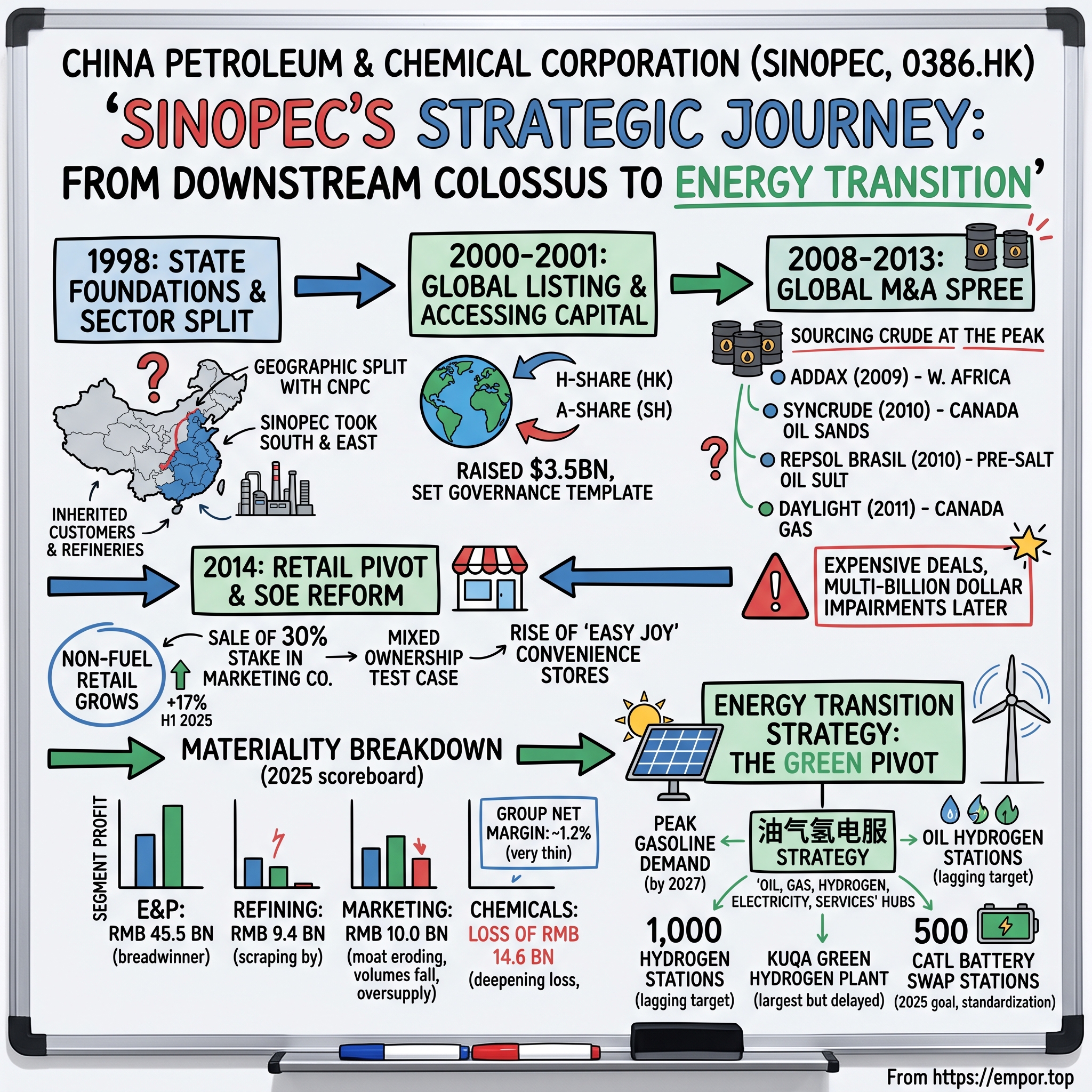
The 1998 reorganization. The solution was radical and, in retrospect, fateful. Rather than splitting the industry by function — one upstream company, one downstream company — the State Council split it geographically, then handed each half a full vertical stack. 中国石油天然气集团公司 China National Petroleum Corporation (CNPC), parent of what would become 中国石油 PetroChina, took the north and west: Daqing, Changqing, the Tarim Basin, the great onshore oil provinces. 中国石油化工集团有限公司 China Petrochemical Corporation, the Sinopec Group, took the south and east: the Yangtze Delta, the Pearl River Delta, the coastal manufacturing belt, and the refineries and pipelines that served them.
Read that division carefully and you can see the entire subsequent history of both companies written into it. CNPC got the oil. Sinopec got the customers. In 1998, with China's economy about to enter its greatest expansion, getting the customers looked like the better half of the deal. Sinopec inherited the refineries feeding the factories of Jiangsu, Zhejiang and Guangdong, and the service stations serving the cars those factories' owners were about to buy.
It is worth pausing on how unusual this is by global standards. Exxon, Shell, BP and Total all evolved as integrated companies where downstream existed to absorb and add value to the barrels the company itself produced. Integration was a hedge: when crude prices collapsed, refining margins typically widened, and the two halves of the business smoothed each other. Sinopec was handed the hedge without the thing being hedged. It has downstream's exposure to margin compression and upstream's exposure to input costs, and only a partial natural offset between them. The result is a company that structurally prefers cheap oil — a strange thing for an oil company to be — and that has spent its corporate life explaining to investors why its results move in the opposite direction to its peers'.
What it did not inherit was reserves. This was not an oversight; it was the point. The structural imbalance — vast conversion capacity, modest wellhead output — was designed in on day one, and every strategic move Sinopec has made in the twenty-eight years since has been, in one way or another, an attempt to manage the consequences.
The 2000 listing. Two years later the commercial arm was floated. Sinopec Corp's H shares were listed in Hong Kong on October 18, 2000, with a concurrent New York and London listing and a Shanghai A-share listing following in 2001.3 The offering raised roughly $3.5 billion into a market that was, at the time, deeply sceptical of Chinese state issuers. The listing structure — parent Sinopec Group retaining a controlling block, minorities getting the rest — was the template for a generation of Chinese SOE flotations, and it has defined the governance question ever since: minority shareholders own a slice of the cash flows, but the parent, acting for the state, sets the direction.
There is a coda worth noting because it closes the loop on the internationalist ambition of 2000. In August 2022, Sinopec, alongside PetroChina, China Life and others, notified the New York Stock Exchange of its intention to voluntarily delist its American Depositary Shares, citing limited ADS trading volume and the administrative burden of US reporting obligations, against a backdrop of the unresolved audit-inspection standoff between Washington and Beijing.910 The quad-listing became a dual listing. Hong Kong and Shanghai are now where the argument about Sinopec's future is settled.
What this means for an investor. Sinopec's founding architecture is not history — it is a permanent feature of the investment case. A refiner without reserves is a spread business. When crude is cheap and demand is growing, that spread is a licence to print money and the lack of upstream looks like capital efficiency. When crude spikes, or when demand for the finished product falls, the same structure becomes a vice. Sinopec spent the following decade trying to escape it by buying oil abroad, and the results were expensive enough to be worth a section of their own.
III. The 2008–2013 Global M&A Spree: Sourcing Crude at the Peak
In June 2009, Brent crude had just clawed its way back from the depths of the financial crisis to around $70 a barrel. The consensus in the industry — echoed by nearly every major sell-side house — was that the crisis had merely interrupted a structural supercycle. China was still growing at eight percent. Peak oil was mainstream. The scarce asset in the world, everyone agreed, was a barrel in the ground.
Sinopec had a specific version of that anxiety. Its refineries needed crude they did not own. Every barrel bought on the open market exposed the company to a price it could not influence and could not fully pass through, because the sale price at the pump was administered in Beijing. Equity oil — barrels the company owned outright — was the obvious hedge. So Sinopec went shopping, and it shopped at the top of the market.
Addax Petroleum, 2009. The opening move was the biggest Chinese overseas oil acquisition to that point. Sinopec's international arm offered C$52.80 a share in cash for Addax Petroleum, a Geneva-headquartered, Toronto-listed producer with assets in Nigeria, Gabon and Iraqi Kurdistan. The deal valued Addax at roughly $7.2 billion and represented about a 47% premium to the pre-announcement share price.[^12] It closed that August.11
The strategic logic was defensible: West African crude is light and sweet, well suited to Sinopec's system, and physically shippable to China. The execution was harder. Nigerian operations brought security, community and regulatory friction that a Beijing-headquartered SOE was poorly equipped to manage; the Kurdistan assets sat inside an unresolved constitutional dispute between Erbil and Baghdad over who could legally sell the oil. A 47% control premium leaves no margin for that kind of complexity. Paying it in mid-2009 embedded an oil price assumption that never materialized.
Syncrude, 2010. The following April, ConocoPhillips agreed to sell its 9.03% interest in the Syncrude oil sands joint venture in Alberta to Sinopec's international subsidiary for $4.65 billion, with Canadian regulatory approval following in June.1213 Oil sands mining is the highest-cost, most capital-intensive, most carbon-intensive way to produce a barrel. It works beautifully above $80 and is a liability below $50. Sinopec bought a minority, non-operated stake — no control over costs, no control over pace — four years before the price collapse of 2014-16 turned the entire Canadian heavy oil complex into a graveyard of write-downs.
Repsol Brasil, 2010. In October 2010 Sinopec agreed to inject $7.1 billion into Repsol's Brazilian unit for a 40% stake, capitalizing the vehicle at roughly $17.8 billion and buying into the pre-salt exploration play off Rio.15 Commentators at the time noted that the price was an enormous premium to any conventional valuation of Repsol Brasil's proved and probable reserves — the buyer was explicitly paying for barrels not yet found.15 This one aged the best of the four. Brazilian pre-salt turned out to be a world-class resource with genuinely low unit costs, and the position gave Sinopec a real seat in deepwater alongside 中国海洋石油集团有限公司 China National Offshore Oil Corporation (CNOOC). But "the best of the four" is a low bar, and even here Sinopec paid an exploration-success price before exploration success.
Daylight Energy, 2011. The last of the marquee deals was the smallest and the clearest error. In October 2011 Sinopec agreed to acquire Daylight Energy, a Calgary-based producer, for C$10.08 a share, valuing it at roughly $2.1 billion.14 Daylight's asset base was weighted to Western Canadian natural gas — bought, as it turned out, on the doorstep of the North American shale gas deluge that would crush Henry Hub and AECO pricing for the better part of a decade.
The verdict. Across the 2008-2013 window Sinopec committed well over $30 billion to overseas upstream assets, and it committed the bulk of it within a thirty-month band that history now marks as the crest of the commodity supercycle. The company took multi-billion-dollar impairments across the international portfolio in the years that followed. It is worth being precise about what went wrong, because the failure mode was not stupidity — it was structural. Sinopec was not buying barrels because barrels were cheap. It was buying barrels because it needed barrels, and a buyer with an operational imperative is a buyer with no price discipline. That is the single most important thing an investor can learn about how this company allocates capital: when the strategic narrative and the valuation disagree, the strategic narrative has historically won.
There is a second, subtler lesson buried in this period, and it concerns how the deals were justified internally. Equity oil was framed as a hedge — own the barrels, neutralize the price exposure. But a hedge only works if it is sized and priced as one. Buying a West African producer at a 47% premium does not neutralize crude price risk; it doubles down on it, because the acquisition's value turns on the same oil price that determines the refining margin. Far from offsetting each other, Sinopec's upstream purchases and its downstream exposure both depended on the same variable moving the same way. When crude collapsed after 2014, the international portfolio impaired while the refining business was rescued by cheap feedstock — and management could point to the second as evidence the strategy was working. It was not a hedge. It was a barbell described as a balance, and investors should be alert to the same framing whenever a strategic rationale is offered in place of a return calculation.
The lesson did get absorbed, at least partially. From roughly 2014, overseas M&A largely stopped and capital was redirected to domestic unconventional resources — the 涪陵页岩气田 Fuling shale gas field in Chongqing, China's first commercial shale gas development, which passed 80 billion cubic metres of cumulative production by late 2025,18 and the ultra-deep 顺北油气田 Shunbei oil and gas field in the Tarim Basin, where reservoirs sit below 7,300 metres and total recoverable resources have been assessed at roughly 1.2 billion barrels of oil equivalent.19 Domestic, controllable, and drilled at a cost of Sinopec's own choosing. It is a more sensible way to close the upstream gap than bidding 47% premiums in Geneva, and — as the 2025 segment numbers show — it is the part of the portfolio now doing the heavy lifting.
But the more consequential pivot of that decade did not happen in a rock formation. It happened on a forecourt.
IV. The 2014 Retail Pivot: 国企改革 SOE Reform & The Rise of 易捷 Easy Joy
In February 2014, Sinopec announced something that had no real precedent in the Chinese state sector: it was going to sell a minority stake in its most valuable, most strategic, most politically sensitive asset to private investors. Not a subsidiary. Not a listing vehicle. The retail network itself.
The context was 国企改革 state-owned enterprise reform — a signature policy of the leadership that had taken office the previous year, built around the idea of "mixed ownership": injecting private capital, and with it private discipline, into state monopolies without surrendering state control. Sinopec volunteered to be the test case, and the market's response told you how starved investors were for exactly this kind of asset.
The deal. In September 2014, Sinopec sold a 29.99% stake in 中国石化销售有限公司 Sinopec Marketing Co., Ltd. to a syndicate of 25 Chinese and foreign investors for RMB 107.1 billion, about $17.5 billion.16 The buyer list was a who's-who of Chinese capital: 嘉实基金 Harvest Fund Management led with RMB 15 billion, 中国人寿 China Life Insurance and a consortium including the People's Insurance Group of China and 腾讯 Tencent Holdings each put in RMB 10 billion, with 复星国际 Fosun International, 新奥能源 ENN Energy, 海尔 Haier and RRJ Capital also participating.16 At the time it was the largest privatization since the current leadership took office.16
Do the arithmetic and the implied valuation of the whole marketing unit was roughly RMB 357 billion — around $58 billion for a business consisting of more than 30,000 filling stations, over 23,000 convenience stores, product pipelines and storage.1617 For context, that single subsidiary was being valued at a substantial fraction of the entire listed parent's market capitalization. Investors were paying for something the consolidated financials had never isolated: the land.
What the buyers were actually buying. A Chinese filling station is not primarily a fuel retailer. It is a permit.[^4] Urban land in China is leased, not owned, and the rights to operate a fuel retail site at a major intersection in Hangzhou or on a Guangdong expressway ramp were allocated over decades under a planning regime that no longer issues them at that density. You cannot buy your way to 30,000 of those locations. That is the moat, and it is a genuine one — a cornered resource in the strict sense, created by regulation rather than by ingenuity.
The 2014 thesis was that this cornered resource was being catastrophically under-monetized. Each site sold one product, at a margin the government capped, to a customer who spent ninety seconds there and left. The plan was to convert dwell time into basket size.
The 易捷 Easy Joy engine. The vehicle was Easy Joy, Sinopec's in-house convenience banner, which grew into China's largest convenience store chain by store count — roughly 27,800 outlets — outnumbering any dedicated retail operator in the country.35 The expansion pushed well beyond drinks and snacks: 易捷咖啡 Easy Joy Coffee as a private-label café brand, auto services, insurance and financial products, parcel pickup, and an e-commerce and FMCG operation running through the store network.
The economics, honestly assessed. Non-fuel retail carries gross margins in the twenties and thirties of percent, against low single digits on wholesale fuel — the margin structure is real, and it does not move with the oil price. But size matters here, and the numbers deserve to be read without enthusiasm. In 2024, gross profit from the non-fuel business was RMB 11.5 billion, up RMB 0.9 billion year on year.2 In the first half of 2025, non-fuel business profit was RMB 3.09 billion, up 17.0%.6 Both figures grew. Both figures are also small relative to a group that turns over RMB 2.78 trillion, and — critically — small relative to the RMB 8.6 billion of decline in the marketing segment's total operating profit over the same two-year window.12
That is the honest reading of the 2014 pivot after twelve years. Easy Joy is a good business that has been executed competently and is compounding. It is not, on current evidence, growing fast enough to offset the erosion in the fuel business it sits next to. The buffer exists; it is not yet a floor. Whether it becomes one is the central quantitative question in the Sinopec investment case, and it comes into sharp relief when you take the segments apart.
V. Segment Economics & Materiality Breakdown
Here is where the received wisdom about Sinopec — repeated in broker notes, company presentations and most third-party profiles — collides with the 2025 annual report.
The received wisdom says Sinopec is a downstream company: marketing generates most of the profit, refining most of the rest, upstream is a volatile sideshow and chemicals a cyclical option. For most of the last decade that was true. It is not true now, and the gap between the story and the accounts is the most important thing an investor can notice about this company today.
The actual 2025 scoreboard. Segment operating profit for the year ended December 2025: exploration and production, RMB 45.5 billion. Refining, RMB 9.4 billion. Marketing and distribution, RMB 10.0 billion. Chemicals, a loss of RMB 14.6 billion.1 Group profit attributable to shareholders was RMB 32.5 billion on RMB 2.78 trillion of revenue — a net margin of roughly 1.2%.1
The company built to be downstream now earns roughly ninety percent of its segment profit upstream. Read that again, then read the trend.
1. Marketing & Distribution (营销及分销). This segment earned RMB 25.9 billion in 2023, RMB 18.6 billion in 2024 — down 28.1% — and RMB 10.0 billion in 2025.12 Worse, the intra-year split is brutal: RMB 8.0 billion in the first half of 2025, implying roughly RMB 2.0 billion in the second.61 Refined product sales volumes fell 5.8% in the first half and finished the year at 229 million tonnes against 239 million the year before.61
So the moat is real, and the moat is earning less every year. Both things are true. The mechanism is straightforward: volume is falling because EVs are displacing gasoline, unit margins are compressing because a shrinking pool of fuel demand is being fought over by Sinopec, PetroChina and a large independent sector, and the fixed cost of running 31,195 sites does not fall when the volume does. Operating leverage works in both directions, and Sinopec has a great deal of it.
2. Refining (炼油). Throughput of 250 million tonnes in 2025 was broadly flat, and the segment earned RMB 9.4 billion — up from a very depressed RMB 6.7 billion in 2024, which had itself been down 67.4% on the prior year.12 Two years of near-zero returns on an asset base of that magnitude tells you the Chinese refining system is running with structural surplus capacity against falling domestic demand.
The one genuinely encouraging operational thread here is mix. Sinopec has been deliberately pushing barrels away from gasoline and diesel toward chemical feedstock and jet fuel — light chemical feedstock output rose 8.4% and jet fuel 7.3% in 2025.16 Jet is the one refined product with a credible demand growth story in China, and feedstock flexibility is the right adaptation to a declining road-fuel market. It is management doing the sensible thing. Whether it is enough depends on chemicals, which is where the problem lives.
The pricing mechanism, explained simply. Sinopec does not set its own pump prices. The 国家发展和改革委员会 National Development and Reform Commission (NDRC) adjusts maximum retail gasoline and diesel prices every ten working days, tracking a basket of international crude prices, provided the move exceeds RMB 50 per tonne.8 Crucially, the mechanism has guardrails: when international crude falls below $40 a barrel, domestic prices stop falling and the excess refining margin is directed into a state risk reserve rather than to shareholders; when crude exceeds $130, price increases are capped or suspended to protect the wider economy.78
Think of it as a collar. Below $40, refiners are protected from a price war but do not keep the windfall. Above $130, they eat the input cost. In between, they are essentially guaranteed a workmanlike margin and denied a great one. This is genuinely valuable in a crash — it is why Chinese refiners did not blow up in 2020 the way independent refiners elsewhere did. But investors should be clear-eyed that the floor protects the industry's stability, not the shareholder's upside, and the ceiling is a real, uncompensated risk in a geopolitical spike.
3. Exploration & Production (勘探及开发). The orphan segment is now the breadwinner. Oil and gas output reached 525.28 million barrels of oil equivalent in 2025, up 1.9%, with natural gas production of 1,456.6 billion cubic feet, up 4.0%.1 Gas is the strategic prize: domestic, policy-favoured, growing, and increasingly the product Sinopec sells into industry and trucking as a bridge fuel.
But note the capital allocation. E&P absorbed RMB 70.9 billion of the RMB 147.2 billion 2025 capital budget — nearly half — and 62% of first-quarter 2026 capex went to upstream projects.128 For a company whose stated identity is downstream, that is a striking reallocation, and it is arguably the most rational thing management has done in a decade. Sinopec still imports the overwhelming majority of its refinery feedstock; every domestically produced barrel and cubic metre reduces exposure to a price it cannot control.
4. Chemicals (化工). And then there is the hole in the boat. Chemicals lost RMB 6.0 billion in 2023, RMB 10.0 billion in 2024, and RMB 14.6 billion in 2025 — a deepening loss in each of three consecutive years, despite sales volume rising 3.6% to 87.12 million tonnes.12 Selling more and losing more is the signature of a commodity in genuine oversupply.
The cause is not Sinopec-specific. China added enormous ethylene and polyolefin capacity through the late 2010s and early 2020s, much of it in single-site mega-complexes built by private groups — 荣盛石化 Rongsheng Petrochemical, whose Zhejiang Petrochemical complex runs 40 million tonnes a year of refining with 4.2 million tonnes of ethylene, 恒力石化 Hengli Petrochemical, and more recently 裕龙石化 Yulong Petrochemical in Shandong. Rating agency forecasts had Asian ethylene operating rates at roughly 75-76% through 2026-27 — a level at which marginal producers lose money more or less continuously.30
Here is the uncomfortable part for shareholders. In 2024 Sinopec spent RMB 44.9 billion of capex on chemicals — its largest single segment allocation that year — and RMB 35.9 billion in 2025, on ethylene projects at Maoming, Zhenhai and Qilu and aromatics at Jiujiang.21 The company has been pouring its second-largest capital allocation into its only loss-making segment, in an industry with a multi-year oversupply forecast, while the marketing segment that actually generates cash received RMB 13.8 billion.1 Management's defence — that new-generation crackers are cost-advantaged, that old capacity will be retired by policy, and that the alternative is ceding the market permanently to private rivals — is coherent. It is also exactly the kind of "we must build to stay relevant" reasoning that produced the Addax premium. An investor is entitled to want the payback maths, and the payback maths on those crackers is not disclosed at project level.
A note on how thin the whole thing is. Group net margin of roughly 1.2% deserves more attention than it usually receives.1 At that level, a two-percent swing in average realized fuel margin, or a modest move in feedstock cost that cannot be passed through inside the ten-day pricing window, is the difference between a good year and a bad one. This is a business with enormous revenue and very little cushion, which is why the earnings are as volatile as they are and why quarterly results can double or halve on inventory effects alone. Investors accustomed to thinking of Sinopec as a defensive utility-like income stock should sit with that number. The dividend is funded from a margin that thin.
A note on what the segments do not show. Sinopec reports four segments plus corporate, and the reporting is genuinely detailed on volumes. What it does not provide is any disaggregation within marketing — no split between company-operated and franchised sites, no urban versus rural or expressway breakdown, no unit economics for converted multi-energy stations, and no separation of the non-fuel business into its constituent lines. For the single most important question facing the company — whether the average station can survive the transition — the disclosure stops one level above where the answer lives. That is not an accusation of concealment; SOE disclosure conventions are simply less granular than US retail practice. But it means outside investors are reasoning about the conversion thesis from aggregates, and should hold their conclusions with corresponding humility.
The segments, then, tell a clear story: upstream carrying the group, refining scraping by, the retail moat eroding, chemicals bleeding. Which raises the obvious question — who is deciding what to do about it?
VI. Current Management, Incentives & Governance
On June 27, 2025, Sinopec announced a change at the top that told you a great deal about how China's energy sector is actually run. The incoming chairman was not an internal successor. He came from the competition.
The chairman: 侯启军 Hou Qijun. Hou was appointed chairman of Sinopec's board effective August 21, 2025, succeeding 马永生 Ma Yongsheng.2122 His entire prior career had been at CNPC and its affiliates — vice general manager from 2017, then general manager of the newly created national pipeline operator, then back to CNPC as general manager. In other words, the person now running China's largest refiner spent his career running China's largest oil producer, and moved between the two by state appointment.
Western investors sometimes read these rotations as instability. That is the wrong lens. Senior SOE leaders are, functionally, senior state cadres with industrial portfolios; they are moved to serve policy continuity across the sector, not shareholder continuity within a company. The practical implication is specific and worth internalizing: succession at Sinopec is not a board process that minority shareholders influence, and a change of chairman can signal a change in national priority rather than a judgment on company performance.
The predecessor. Ma Yongsheng, who chaired the company through the preceding period, was a petroleum geologist by training and an Academician of the Chinese Academy of Engineering — a scientist-executive whose reputation was built on the discovery and development of the 普光气田 Puguang gas field in Sichuan and on deep-strata exploration. His tenure aligns closely with the strategic pivot visible in the accounts: away from overseas acquisition, toward domestic deep and unconventional gas. If you want to understand why Fuling and Shunbei got funded, the geologist in the chair is not a bad place to start.
The president: 赵东 Zhao Dong. Zhao, appointed president in 2024, is the counterweight — a professor-level senior accountant with a doctorate and a career in finance and international operations, including senior financial roles in the sector's overseas arms.22 He also chairs the board's Sustainable Development Committee.22 The pairing of a technical chairman with a financial president is a deliberate SOE pattern, and it maps onto the two things Sinopec is being asked to do simultaneously: find domestic hydrocarbons, and stop destroying capital in chemicals.
Ownership and who management actually answers to. Sinopec Group holds a controlling stake of roughly two-thirds in the listed company on behalf of the state, exercised through the 国务院国有资产监督管理委员会 State-owned Assets Supervision and Administration Commission (SASAC). SASAC evaluates central SOE leadership on a scorecard that includes return on equity, net profit growth, operating cash flow, R&D intensity, and — increasingly — carbon and energy-security targets. It does not evaluate them on total shareholder return.
This is the governance fact that dominates all others. When Sinopec's interests and the state's interests align — as they do on dividends, since SASAC wants cash returned to the state as majority holder — minority shareholders benefit enormously. When they diverge — on, say, whether to keep running a marginal refinery that employs 4,000 people, or whether to build a cracker into an oversupplied market to preserve national market share — minority shareholders are passengers. Every valuation of Sinopec is implicitly a bet on how often those interests align.
Capital allocation: the record, read carefully. Management has consistently guided to a payout of at least 75% of profit including buybacks, and has consistently delivered: 75% for 2024, and 79% on an IFRS basis (81% under Chinese accounting standards) for 2025.21 Buybacks are real and ongoing — the company repurchased H shares in Hong Kong between September and November 2025 at prices ranging from HK$4.06 to HK$4.46, ran a parallel A-share programme on the Shanghai exchange, and secured a fresh repurchase mandate at the 2025 results.33 In July 2026, Sinopec was buying back A-shares for cancellation on consecutive trading days as part of a broader wave of coordinated state-sector buyback and dividend announcements.3231
Now the caveat that too many yield-focused summaries skip. A payout ratio is not a payout amount. The 2024 dividend was RMB 0.286 per share. The 2025 dividend was RMB 0.20 per share.21 The ratio went up; the cash went down by thirty percent, because profit fell. Anyone underwriting Sinopec on a headline yield in the high single digits should understand that the yield floats with earnings, and earnings are levered to a refining and chemicals cycle that has been deteriorating for three years. The commitment is to a ratio. Only the ratio is durable.
The counterweight on the capital side is that management has, at last, started shrinking the budget: total capex fell from RMB 175 billion in 2024 to RMB 147.2 billion in 2025, with 2026 guided to RMB 131.6-148.6 billion.1 Discipline in a downturn is the right instinct. Whether it survives contact with the transition ambitions in Section VIII is the open question.
VII. Competitive Landscape & Industry Structure
Imagine you are dispatching a tanker of Basrah Medium into a Chinese port in 2026. Twenty years ago, there were effectively two buyers who mattered and the negotiation was about volume. Today the buyer list includes two state majors, one offshore specialist, and a set of privately built mega-complexes whose individual scale rivals anything in Europe. The market Sinopec dominates has quietly become one of the most competitive refining arenas on earth.
PetroChina. The other half of 1998. 中国石油 PetroChina remains the upstream heavyweight with the north and west, and it competes directly with Sinopec in fuel retail — the two networks are the two national brands, and in much of the country the local duopoly is between them. The rivalry is real but bounded: neither is incentivized to start a destructive price war under an administered pricing regime, and both answer to the same ultimate shareholder. It is competition conducted with a certain decorum.
CNOOC. The offshore pure-play has, on almost any measure, the best economics in the Chinese oil complex: low unit lifting costs, high-return offshore developments, and no exposure to refining or retail. In a period of firm crude and weak downstream, CNOOC is the structural winner and Sinopec the structural loser — which is precisely what the last three years of segment results across the three companies have shown. For investors choosing among Chinese energy names, this is the cleanest way to frame it: CNOOC is a bet on the oil price, Sinopec is a bet on the spread and on China's road-fuel demand curve.
The private mega-refiners. These are the genuine disruptors, and they came from an unexpected direction — textiles. Rongsheng and Hengli both grew out of the polyester chain and built backwards into refining to secure their own feedstock, ending up with vast, modern, single-site integrated complexes designed from a blank sheet for chemical yield rather than fuel yield.30 A single-site complex commissioned in 2019 has structurally lower unit costs than a legacy site that has been debottlenecked over forty years. That is not a management failing at Sinopec; it is physics and vintage. But it means Sinopec's chemical losses are not purely cyclical — a portion is a permanent cost-curve disadvantage against newer assets, and no recovery in ethylene margins fixes that.
Foreign joint ventures. ExxonMobil's Huizhou complex in Guangdong and the long-running BASF-YPC venture in Nanjing represent the third strand: world-class technology operating inside China, sometimes as Sinopec's partner and sometimes as its competitor for the same high-value polymer customers.
Seven Powers, applied without generosity
Cornered resource — strong, but decaying. The 31,195-site network is the real thing: a position created by land-use regulation that no amount of capital can replicate. But a cornered resource is only as valuable as the flow it monetizes, and the flow is shrinking. The power is genuine; the rent is falling.
Scale economies — strong in procurement, weaker in conversion. Sinopec's purchasing scale through its trading arm 联合石化 UNIPEC gives it real advantages in crude sourcing, blending optionality and freight. Its refining scale, however, is distributed across many sites of varying vintage rather than concentrated in a few optimal ones — which is precisely the axis on which the private complexes beat it.
Process power — moderate and real. Proprietary catalysts, deep-strata drilling capability, and a large internal research establishment produce genuine technical output: 9,953 patent applications filed in 2025 with 5,768 granted, industrial-scale 60K carbon fibre production, and a first seawater-electrolysis hydrogen facility.1 Sinopec's ability to drill economically below 7,000 metres at Shunbei is not something most companies could buy. Whether this translates into shareholder returns rather than national capability is a separate question, and the answer so far is ambiguous.
Counter-positioning — asserted, not yet demonstrated. The claim is that Sinopec can convert legacy stations into multi-energy hubs faster than pure-play charging networks can build out. It has advantages: land, grid connections, a captive customer base. It also has a disadvantage no incumbent escapes — every charging bay it installs cannibalizes a fuel island, and pure-play competitors have no legacy revenue to protect. Counter-positioning is a power precisely when the incumbent cannot respond; here Sinopec is the incumbent, and the framework should be applied to it, not by it.
Porter's Five Forces, in the current environment
Rivalry: high and rising. Severe in chemicals, where oversupply has pushed the industry to sustained losses. Increasingly severe in fuel retail, where a shrinking volume pool is being contested by two state networks and a large independent sector.
Supplier power: high, and only partly mitigated. Sinopec buys the majority of its feedstock on world markets from producers with pricing power. UNIPEC's scale, term contracts, discount-crude sourcing and trading optionality genuinely reduce the cost of that dependence, but they do not change its direction.
Buyer power: moderate, and structurally unusual. The retail consumer has no negotiating power but is protected by the NDRC ceiling; commercial and industrial buyers of chemicals and wholesale fuel have substantial leverage in an oversupplied market.
Threat of substitutes: the defining force. This is the one that matters. Electrification is not a marginal threat to Sinopec's core product — it is a direct, accelerating, government-supported substitution, and China is running it faster than any market in the world.
Threat of new entrants: low, and getting lower. China's carbon peaking action plan capped national primary refining capacity at roughly 1 billion tonnes a year — about 20 million barrels per day — with policy directing the elimination of small and outdated plants and consolidation into complexes above 10 million tonnes.20 No one is building a greenfield merchant refinery in China. That is a meaningful protection for incumbent capacity — and a meaningful risk for Sinopec's older, smaller sites, which are exactly what the policy is designed to retire.
The independent sector, and why it matters more than it looks. Beyond the named mega-refiners sits Shandong's "teapot" complex — dozens of independent refineries operating on import quotas, historically running older equipment at variable utilization and competing aggressively on wholesale price. For years these operators set the marginal price in eastern China's fuel market, which is precisely where Sinopec's network is concentrated. The national policy push to consolidate them into larger complexes20 is a genuine long-term positive for Sinopec's wholesale realizations, and it is one of the few structural tailwinds in the story. But consolidation replaces many weak competitors with a few strong ones, as the emergence of Yulong in Shandong illustrates.30 Whether that is a net improvement depends on whether the new capacity is more disciplined than the old — and there is not yet three years of evidence either way.
The competitive picture, in short: Sinopec's defensive positions are durable, its offensive positions are contested, and the force acting most strongly against it is the one it cannot negotiate with.
VIII. Energy Transition Strategy: Peak Gasoline & The Green Hydrogen Pivot
In August 2023, Sinopec switched on something genuinely unprecedented in Kuqa, in Xinjiang: a solar-powered water-electrolysis plant designed to produce 20,000 tonnes of green hydrogen a year, pipe it to a nearby refinery, and displace hydrogen that would otherwise have been made from fossil feedstock.23 At commissioning it was, by capacity, the largest operating green hydrogen project on the planet. State media coverage was extensive. The message was clear: the incumbent was not going to be disrupted quietly.
Then came the part that gets less coverage. The plant did not reach nameplate capacity on schedule. Sinopec publicly acknowledged that ramp-up would take considerably longer than planned, with full annual capacity pushed out to the fourth quarter of 2025 — a delay of roughly two years from the original expectation of hitting rate at completion.2425 The stated issues were the practical ones that dog every first-of-a-kind electrolysis project: matching intermittent solar output to equipment that prefers steady load, and integrating variable hydrogen supply into a refinery that runs continuously.
That sequence — genuine technical ambition, world-leading announcement, multi-year delay, candid but low-key disclosure — is the single most useful data point for evaluating Sinopec's transition strategy. It should be held in mind for everything that follows.
The threat being responded to. China's EV penetration passed 30% and continued climbing, driving a third consecutive annual decline in refined oil consumption.34 Sinopec's own forecasting arm has projected national petroleum consumption peaking by 2027,4 and independent forecasters have gasoline demand falling outright in 2026 with electric vehicles displacing tens of millions of tonnes of annual gasoline consumption.54 Diesel is under separate attack from LNG-fuelled heavy trucks — a substitution Sinopec has partially embraced, since it sells the LNG.
The 油气氢电服 strategy. The response is to convert stations from single-product fuel retail into "oil, gas, hydrogen, electricity and services" hubs. The operational metrics from 2025 show genuine traction on the small numbers: vehicle LNG sales grew 74% year on year, charging and battery-swapping volumes rose 182%, and hydrogen refuelling volumes increased substantially.1 EV charging revenue in the first half of 2025 was RMB 0.5 billion.6
Sit with that last figure for a moment. RMB 0.5 billion of half-year charging revenue against a group that turns over RMB 1.41 trillion in the same period.6 The growth rates are spectacular and the base is trivial. That is not a criticism of execution — every transition starts here — but it is a hard constraint on the timeline. Tripling a number that small, repeatedly, still does not replace a fuel business measured in hundreds of billions.
The partnerships. Sinopec has been sensible about not building alone. It signed a charging partnership with 蔚来 NIO and had constructed 279 facilities with the automaker by September 2024, including 119 battery swap stations across 29 provincial-level administrations.27 In April 2025 it announced a far larger tie-up with 宁德时代 CATL — no fewer than 500 battery swap stations in 2025 alone, with a stated long-term ambition of 10,000, alongside smart microgrids combining solar, storage, charging and swapping.26 Partnering with the world's dominant battery maker to solve the standardization problem is, strategically, the right move: Sinopec brings land and grid, CATL brings the pack and the technology.
The hydrogen ambition. Sinopec's stated goal is to become China's leading hydrogen energy company, and it has a real industrial starting point — it already produces several million tonnes of hydrogen a year as a by-product of refining and chemical operations, which gives it the largest existing hydrogen logistics footprint in the country. It set an interim target of 1,000 hydrogen refuelling stations, and delivery against that target has lagged substantially.
Here the neutral assessment has to be blunt. Green hydrogen's near-term commercial case is strongest exactly where Sinopec is applying it — as a decarbonized substitute for grey hydrogen already consumed inside a refinery, where the alternative has a known cost and the offtake is captive. That is genuinely sensible. The case for hydrogen as a transport fuel sold at forecourts remains unproven anywhere in the world, and depends on fuel-cell trucking economics that battery-electric trucking keeps undercutting. Sinopec has not disclosed project-level returns or payback periods for its hydrogen investments, and until it does, the honest position for an investor is that this is an option with real industrial logic behind the refinery gate and an unquantified one in front of it.
The charging business, explained plainly. It helps to be concrete about why swapping a pump for a charger is not a like-for-like substitution. A fuel island turns over a customer roughly every three to five minutes and sells a product on which the retailer earns a thin but reliable margin per litre. A fast charger occupies the same footprint for twenty to forty minutes and sells electricity — a commodity bought from the grid at a regulated tariff and resold at a service fee, with the margin squeezed between two prices the operator does not set. On pure throughput economics, a charging bay is worse than a fuel island: fewer customers per hour, less gross profit per transaction, higher upfront capital, and grid-connection costs that scale with power.
The bull argument is that this arithmetic inverts once you count the store. A driver who is stationary for thirty minutes buys coffee, food and merchandise; a driver stationary for three minutes buys nothing. That is why the charging and convenience businesses have to be evaluated together rather than separately, and why Easy Joy is strategically far more important than its current profit contribution suggests. The proposition is not "Sinopec sells electricity instead of petrol." It is "Sinopec uses electricity to convert a fuel stop into a retail visit." That is a coherent, and in principle testable, thesis. Sinopec has not yet published the test.
What the evidence supports. Sinopec is not in denial about the transition — that charge, sometimes levelled at incumbent oil companies, does not stick here. It is forecasting the peak publicly, reallocating capital toward gas, and building charging and swapping at scale with credible partners. What the evidence does not yet support is the proposition that the new revenue lines will scale fast enough to offset the old ones. On the current run-rate, they will not, and the gap has to be filled by something else — which brings us to the argument.
IX. Investment Case: Bull vs Bear "Why Win / Why Not"
The bull case, stated at its strongest
One: the network is genuinely irreplaceable, and the option on it is free. Sinopec's 31,195 sites sit on land rights that cannot be assembled again at any price. Every one has grid connection, planning consent for fuel storage, forecourt space, and a customer flow. If China's vehicle fleet electrifies, those vehicles still have to charge somewhere, and highway corridors and dense urban districts have very few alternative sites. Investors buying today are paying for the fuel business and getting the conversion option attached. The 2014 transaction established that private capital would pay roughly $58 billion for the network alone1617 — a marker that has never been formally revisited.
Two: the payout discipline is real and has been tested. Management said at least 75% and delivered 75% in 2024 and 79-81% in 2025, in a year when profits fell hard.21 Raising the payout ratio into a downturn, backed by buybacks conducted for cancellation, is behaviour consistent with the stated policy rather than in tension with it. Operating cash flow of RMB 162.5 billion against capex of RMB 147.2 billion in 2025 shows the cash generation still covers the programme.1
Three: the regulated floor is a genuine crash hedge. In a global oil collapse, Sinopec's domestic pump prices stop falling at a $40 crude equivalent while its feedstock keeps getting cheaper.78 Very few refiners anywhere have that protection. It caps the downside in the scenario that destroys unregulated competitors.
Four: upstream and gas are working. The capital redirected from foreign acquisitions to domestic unconventional resources is producing — record cumulative output at Fuling, growing gas volumes, and an E&P segment carrying the entire group.181 That is a decade-old strategic decision now visibly paying off.
The bear case, stated at its strongest
One: the substitution is faster than the conversion. The marketing segment's operating profit has fallen from roughly RMB 26 billion to RMB 10 billion in two years, and the second half of 2025 annualizes worse than that.12 Against that, half-year charging revenue is RMB 0.5 billion and half-year non-fuel profit RMB 3.09 billion.6 The new economics are growing from a base roughly an order of magnitude too small to catch the decline in time. This is the core bear point and it is arithmetic, not opinion.
Two: chemicals is a structural loss, not a cycle. Three consecutive years of deepening losses, industry operating rates forecast in the mid-seventies through 2027, and newer competitor assets with a permanent cost advantage.1230 A cyclical trough recovers. A cost-curve position does not.
Three: capital is flowing to the wrong places. RMB 35.9 billion into loss-making chemicals in 2025, RMB 44.9 billion in 2024, against RMB 13.8 billion into the marketing network that generates the cash and holds the option value.12 Management has a strategic rationale, but the pattern is uncomfortably close to the one that produced $30 billion of top-of-cycle upstream purchases a decade ago: build because the strategy demands it, price the asset afterwards.
Four: the dividend is a ratio, not an amount. The 2025 dividend fell 30% year on year even as the payout ratio rose.12 Income investors are underwriting a percentage of an earnings stream with three of four segments in decline.
Five: minority shareholders do not control the outcome. SASAC's scorecard weights energy security, employment stability and carbon targets alongside financial return. In any scenario requiring painful capacity closure or a retreat from a strategically important but unprofitable business, the state's priorities decide.
Myth versus reality
Three consensus statements about Sinopec deserve direct correction, because all three appear regularly in third-party research and none survives contact with the 2025 accounts.
"Sinopec is a downstream company whose profits come from marketing and refining." Not currently. Exploration and production generated RMB 45.5 billion of segment profit in 2025 against RMB 19.4 billion combined from refining and marketing.1 The identity and the income statement have parted company, and any model built on the old segment weightings will misprice the sensitivity to crude.
"Sinopec offers a reliable 7-9% dividend yield." The payout ratio is reliable; the yield is not. The dividend fell from RMB 0.286 to RMB 0.20 per share year on year.21 A stock yielding well because the price fell alongside the payout is a different proposition from one yielding well because of a durable distribution.
"The NDRC floor guarantees refining profitability." It prevents a destructive price war below $40 crude and directs the excess margin to a state reserve rather than to shareholders.78 It is a stability mechanism for the industry, not a profit guarantee for equity holders — and it did not prevent the refining segment from earning RMB 6.7 billion in 2024 on a quarter of a billion tonnes of throughput.2
Where the argument actually turns
The two cases are not symmetric. The bull case rests substantially on option value that has never been marked — the conversion of retail sites to a use whose economics are unproven at scale. The bear case rests on realized, disclosed, three-year trends in the audited accounts. That does not make the bulls wrong; free options on irreplaceable assets are how fortunes are made in cyclical industries. But it does mean the burden of proof sits with the bulls, and the proof required is specific: marketing segment profit stabilizing, and non-fuel plus charging economics growing faster than fuel economics shrink. Neither has happened yet.
X. Risk Radar & Activist / Skeptical Investor Stress Test
Demand destruction, which is not really a risk but a condition. Most companies face demand risk as a probability. Sinopec faces it as an observed fact: three consecutive annual declines in Chinese refined oil consumption, EV share above 30% and rising, and a peak forecast by the company's own analysts.344 The investment question is not whether it happens but at what gradient, and whether Sinopec's fixed cost base can be reduced at a comparable rate. Station networks are not easily shrunk — closing sites forfeits the very land rights that constitute the moat.
Petrochemical oversupply and impairment risk. Three years of deepening losses against a backdrop of forecast sub-80% regional operating rates raises the question of asset carrying values.130 Sinopec has not signalled large chemical impairments, but a segment losing RMB 14.6 billion a year with no near-term margin recovery in sight is a standing test of the impairment judgments underpinning the balance sheet. This is precisely the kind of accounting judgment worth monitoring in the annual report's critical estimates disclosures rather than the press release.
Refining rationalization and stranded assets. The national capacity cap and the policy push to eliminate sub-scale plants20 cut both ways. It protects the industry from new entrants and it puts Sinopec's older, smaller inland refineries directly in the crosshairs. Closing them is economically rational and politically expensive; keeping them open is the reverse.
Feedstock and geopolitical exposure. Sinopec imports the bulk of its crude, which means exposure to Middle East supply disruption, freight and insurance costs, chokepoint risk, and sanctions-compliance complexity for UNIPEC as a global trading counterparty. The first quarter of 2026 provided a live demonstration: Sinopec cut March refining runs by about 5% in response to regional conflict, while simultaneously booking inventory gains from the resulting price rise.28 Feedstock volatility is not an abstraction for this company; it is a quarterly operating variable.
The ceiling risk, underappreciated. Much is made of the $40 floor. Rather less is made of the $130 ceiling, which transfers the cost of an oil price spike from consumers to refiners.78 In a genuine supply shock, Sinopec's structural short position in crude becomes an uncapped exposure with a capped ability to recover it at the pump.
Balance sheet and refinancing. Sinopec has historically run a conservative capital structure by the standards of global refiners, and operating cash flow of RMB 162.5 billion in 2025 comfortably exceeded the capital programme.1 The relevant question is not immediate solvency but the sequencing of commitments: the payout policy, the E&P programme, and the chemicals build all draw on the same cash flow, and a further leg down in refining or chemicals would force a visible prioritization. Implicit state support means Sinopec's cost of debt is unlikely to be the binding constraint. Its own cash flow will be.
Execution risk in the transformation itself. This is the least discussed and arguably the most real. Converting 31,000 forecourts is not a strategy decision; it is thirty-one thousand construction projects, each requiring grid capacity, local approvals, and a site-level judgment about whether demand justifies the capital. Kuqa's two-year ramp delay24 is a useful prior for how first-of-a-kind energy infrastructure behaves inside this organization. Scaling execution across a national network, site by site, is a materially harder problem than commissioning one showcase plant.
The activist's brief
If a genuinely activist investor could take a position here — and the ownership structure means they effectively cannot — the case would write itself, and it is worth articulating because it clarifies what management should be asked at every results presentation.
On capital allocation: Why is the largest discretionary capital allocation outside upstream going into the only segment losing money, in an industry with a documented multi-year surplus? What is the assumed mid-cycle ethylene margin in the Maoming, Zhenhai and Qilu project economics, and what utilization rate makes them NPV-positive?
On portfolio complexity: Sinopec runs upstream, refining, chemicals, retail, convenience retail, coffee, insurance distribution, logistics, hydrogen, charging and battery swapping. Several of these have no obvious relationship to each other beyond shared real estate. A conglomerate discount is the default market response to that, and the burden is on management to demonstrate the synergies are real rather than adjacent.
On disclosure: Sinopec does not publish project-level returns for its hydrogen and charging investments, does not break out unit economics for converted multi-energy stations, and does not disclose the payback assumptions on new crackers. Its investor communications run through results announcements, presentations and a Hong Kong analyst briefing rather than the fully published quarterly transcript culture of US-listed majors,[^38] which makes it harder to hold management to prior statements over time. For a company asking investors to underwrite a decade-long transition, this is a legitimate governance criticism.
On accountability: Management has, to its credit, been consistent on the payout commitment and honest about the Kuqa delay.24 It has been considerably vaguer on when chemicals returns to profitability, and the segment has missed the implicit recovery expectation three years running without a specific, quantified turnaround plan being put in public.
The stress test
The question: If gasoline volumes decline 20-30% over the next decade, can non-fuel retail, charging and swapping cover the fixed-cost overhead of more than 31,000 stations?
What management points to: Integrated stations generate more gross profit per customer visit, because charging dwell time of twenty to thirty minutes converts to convenience-store basket size in a way that a ninety-second fill never did; non-fuel profit is growing 17% year on year; charging and swapping volumes tripled.61
What the evidence actually supports: The dwell-time logic is sound and observable in retail data globally. But it has been demonstrated at a small number of high-traffic urban and expressway sites, not across a network that includes thousands of low-throughput rural and secondary-road locations where charging demand is thin and convenience baskets are small. The disclosed aggregate — RMB 3.09 billion of half-year non-fuel profit and RMB 0.5 billion of half-year charging revenue against an RMB 8.6 billion two-year decline in segment profit — does not yet demonstrate coverage.612 The honest answer is that the model works at the good sites and is unproven at the average site, and the average site is what determines the outcome.
XI. Downstream Article Writer Guidance: Conference Calls & Transcripts
A note on how to follow this company, because Sinopec's disclosure rhythm differs materially from a US-listed major and rewards a different reading technique.
Sinopec's primary investor communications are the annual and interim results announcements filed with the Hong Kong and Shanghai exchanges, the accompanying results presentations, and quarterly filings under Chinese accounting standards.[^38]16 The company holds results briefings in Hong Kong with analyst questions, but does not publish a full verbatim transcript in the way that has become standard for US issuers. The practical consequence is that the highest-information documents are the segment discussion in the results announcement and the operating-data tables — which are detailed and, in this company's case, considerably more candid than the summary language surrounding them.
Five threads are worth tracking release by release.
One: domestic refined product demand. The prepared language has for several years described demand as "recovering" or "stable" while the volume tables have shown decline — a 5.8% fall in refined product sales in the first half of 2025 and a full-year total of 229 million tonnes against 239 million in 2024.612 Compare the adjective to the table every time. The 2026 guidance of 170 million tonnes of domestic fuel sales1 is the number against which to measure whether management is planning for the decline or hoping through it.
Two: crude procurement and discounted feedstock. Watch for commentary on Middle East official selling prices, discounted-barrel sourcing, and how UNIPEC's trading result is characterized. Inventory effects are the single largest source of noise in Sinopec's quarterly earnings — the first quarter of 2026 is the case in point, where reported refining segment profit multiplied several times over the year-earlier figure primarily because rising crude prices revalued inventory rather than because crack spreads structurally improved.2928 A refining segment that earned RMB 9.4 billion across all of 20251 does not sustainably earn a multiple of that in a single quarter on operational improvement.
Three: chemicals recovery timing. The most important thing to listen for is specificity. "Market conditions remain challenging, we are optimizing product mix and reducing costs" has been roughly the language for three years while the loss deepened from RMB 6.0 billion to RMB 14.6 billion.21 A credible turnaround statement would name capacity closures, quantify a target operating rate, or attach a date. Watch also for any deferral of the announced cracker projects — a capex delay disclosed quietly in the capital expenditure table would be a more meaningful signal than anything said aloud.
Four: payout versus capex. The two commitments are in tension whenever cash flow tightens. Track operating cash flow, the capex guidance range, and the payout ratio together. The 2026 guidance range of RMB 131.6-148.6 billion1 is wide enough to accommodate either discipline or renewed expansion; where the company lands inside it is the real disclosure.
Five: green hydrogen and charging returns. The question that has not been answered publicly is the payback period. Until Sinopec discloses a project-level return on Kuqa or on a converted multi-energy station, analyst pressure on this point — and the specificity or evasiveness of the answer — is itself the data.
XII. Key Operational & Financial KPIs to Watch
There is a long list of things one can track at a company this size. Most of them are noise. Three genuinely determine the outcome, and they are listed first for a reason.
1. Marketing & distribution segment operating profit — the one that matters most. Not volume, not station count, not non-fuel revenue: segment operating profit. This single line captures the interaction of falling fuel volumes, compressing unit margins, growing non-fuel contribution and the fixed cost of the network. It went from roughly RMB 26 billion to RMB 18.6 billion to RMB 10.0 billion across 2023-2025.21 If the bull case is right and the moat is being successfully re-monetized, this number stabilizes and then turns. If it keeps falling, no amount of charging-volume growth rates changes the conclusion. Watch it half by half, because the second half of 2025 was materially worse than the first.
2. Chemicals segment operating profit. The second determinant, for the opposite reason: it is where the losses are. Three years of deepening deficit against a capital programme that keeps funding the segment. Stabilization here would add RMB 15 billion to group profit without a single new customer. Continued deterioration eventually forces a choice between the dividend and the capex.
3. Refined product distribution volume and its mix. The demand-side ground truth, and the leading indicator for KPI one. Total tonnes matters, but the mix matters more — gasoline in decline, jet fuel growing, diesel under pressure from LNG trucking, and chemical feedstock rising as Sinopec redirects barrels away from road fuel.16
Two further metrics are worth monitoring as supporting evidence rather than as primary signals.
Non-fuel merchandise gross profit and margin. The Easy Joy contribution — RMB 11.5 billion of gross profit in 2024, RMB 3.09 billion of half-year profit in 202526 — is the numerator of the conversion thesis. Growth rate matters less than growth relative to the decline in fuel profit.
Natural gas production, and charging and swapping station counts. Gas output of 1,456.6 billion cubic feet in 20251 tracks the one growing hydrocarbon business. Station conversion counts track execution speed on the transition — useful, but only meaningful when the company begins disclosing what those converted sites earn.
Resist the temptation to over-weight the headline net profit number. At a company where a quarter's result can swing by several billion renminbi on crude inventory revaluation,29 group earnings are a poor short-term signal. The segment lines are where the business actually reveals itself.
XIII. Epilogue & Playbook Lessons
Return to that forecourt on the G15 at three in the morning.
Everything about it was built for a world in which the number of vehicles in China went up and every one of them burned refined product. The canopy, the tanks, the pipeline that feeds it, the refinery at the other end of that pipeline, the tanker discharging Basrah Medium into a coastal terminal, the trading desk in Singapore that bought the cargo — all of it, an enormous, beautifully engineered machine for converting foreign crude into Chinese mobility. Sinopec built the best version of that machine anyone has ever built. And it finished building it at almost exactly the moment the demand curve turned.
The playbook lesson on distribution. The 2014 transaction proved something important: markets will pay a large premium for irreplaceable physical distribution, separate from the commodity that flows through it. That insight remains valid and remains the strongest thing about this company. What twelve years of subsequent evidence has shown is the harder half of the lesson — owning a cornered resource guarantees you the position, not the profit. Converting a permit into an earnings stream requires the products sold through it to be worth selling, and the pace of that conversion has to match the pace of decline in what came before. Sinopec has the position. It has not yet demonstrated the pace.
The playbook lesson on capital allocation under state ownership. Sinopec has run the same experiment twice. In 2008-2013 it bought upstream assets at cycle peaks because strategic necessity overrode valuation discipline, and it wrote billions off. In 2022-2026 it has been building chemical capacity into a documented surplus, for reasons that are again strategic rather than valuation-driven. The pattern is not incompetence; it is the predictable output of a system where the scorecard weights national capability and market position alongside return on capital. Investors who understand that will not be surprised by it. Investors who model Sinopec as a Western major with a discount will be.
The countervailing feature — and it is genuinely valuable — is that the same state ownership produces one of the most reliable payout commitments in global energy. SASAC wants its dividend, and minority holders ride along. That alignment has held through a severe earnings downturn, which is the only real test of a payout policy.
Final thoughts. Sinopec is the cleanest available proxy for a specific and consequential question: what happens to the physical infrastructure of the oil age in the first large economy to leave it? Not a stranded-asset thought experiment, but a live one, with audited quarterly results.
The evidence as of mid-2026 says the transition is being managed intelligently and is nonetheless losing the race on the current run-rate. The upstream pivot worked. The retail moat is real and shrinking in value. The chemicals build is the most questionable capital decision on the books. The transition businesses are growing fast from a base too small to matter yet. The dividend is disciplined but falling with earnings.
What would change the assessment is not a better narrative from management. It is two numbers moving in a different direction: the marketing segment finding a floor, and the chemicals segment finding a bottom. Until those appear in the accounts, the story of Sinopec remains a story about the most valuable set of forecourts in the world, and an open question about what they will be worth once nobody needs to fill up.
References
-
Sinopec Announced 2025 Annual Results — Annual Payout Ratio Reached 81% — China Petroleum & Chemical Corporation, 2026-03-23 ↩↩↩↩↩↩↩↩↩↩↩↩↩↩↩↩↩↩↩↩↩↩↩↩↩↩↩↩↩↩↩↩↩↩↩↩↩↩↩↩↩↩↩↩↩↩↩
-
Sinopec FY2024 Annual Results — ACCESS Newswire via The Globe and Mail, 2025-03-23 ↩↩↩↩↩↩↩↩↩↩↩↩↩↩↩↩↩↩↩↩↩
-
China Petroleum & Chemical Corporation 2024 Annual Results Announcement (company profile and listing history) — HKEXnews, 2025-03-23 ↩
-
Sinopec forecasts China's petroleum consumption to peak by 2027 — NaturalGasWorld ↩↩↩↩
-
China 2026: Oil growth shifts to petchems as EVs kill transport demand — Kpler, 2026-01-19 ↩↩
-
Sinopec FY2025 Interim Results — China Petroleum & Chemical Corporation, 2025-08-21 ↩↩↩↩↩↩↩↩↩↩↩↩↩
-
China sets floor for retail fuel pricing — The State Council of the People's Republic of China, 2016-01-13 ↩↩↩↩
-
How does China adjust its domestic refined oil prices? — Global Times, 2026-04 ↩↩↩↩↩
-
China Petroleum & Chemical Corporation Announces Intention to Delist — Sinopec Corp. ↩
-
China Life Insurance, PetroChina and Sinopec to delist from NYSE amid audit dispute — South China Morning Post, 2022-08 ↩
-
Sinopec finalizes Addax acquisition — World Oil, 2009-08-18 ↩
-
Sinopec-ConocoPhillips partnership transaction approved — Government of Canada, 2010-06 ↩
-
ConocoPhillips To Sell Syncrude Stake To Sinopec For $4.65 Bln — RTTNews, 2010-04 ↩
-
Sinopec Picks Up Canada's Daylight Energy For $2.1 Billion — Forbes, 2011-10-10 ↩
-
Sinopec Dreaming Big In Deal For Repsol's Brazil Fields — Forbes, 2010-10-01 ↩↩
-
Sinopec sells $17.5b stake in retail unit to investors — China Daily, 2014-09-15 ↩↩↩↩↩
-
Is Sinopec's Retail Sale A Big Deal? — Forbes, 2014-09-14 ↩↩
-
Sinopec's Fuling Shale Gas Field Hits 80 Billion Cubic Metres of Cumulative Production — Sinopec Group ↩↩
-
Shunbei ultra-deep oil and gas field, Tarim Basin — Seetao ↩
-
China's action plan for CO2 cuts to cap primary refining capacity at 20 mil b/d by 2025 — S&P Global Platts, 2021-10-27 ↩↩↩
-
Chinese oil company Sinopec announces new chairman — Reuters via TradingView, 2025-06 ↩
-
Sinopec Announces New Chairman and Board Committee Adjustments — The Globe and Mail, 2025 ↩↩↩
-
Sinopec Xinjiang Kuqa Green Hydrogen Pilot Project Enters Operation — PR Newswire, 2023-06 ↩
-
Problems at world's largest existing green hydrogen project will not be solved until late 2025, Sinopec admits — Hydrogen Insight ↩↩↩
-
China's Sinopec says world-leading green hydrogen project will take longer than expected to ramp up — South China Morning Post ↩
-
CATL, oil giant Sinopec to jointly build over 500 swap stations this year, with long-term goal of 10,000 — CnEVPost, 2025-04-02 ↩
-
Nio enters charging partnership with China's oil giant Sinopec — CnEVPost, 2024-09-25 ↩
-
Higher Oil Prices Lift Sinopec Profit 28% in First Quarter — OilPrice.com, 2026-04-28 ↩↩↩
-
Sinopec Q1 Net Profit Surges Nearly 27%; Refining EBIT Soars — BigGo Finance, 2026-04 ↩↩
-
Industry Credit Outlook 2026 — Chemicals — S&P Global Ratings, 2026-01-14 ↩↩↩↩↩
-
Multiple Chinese SOEs announce share buybacks, dividend payouts amid confidence in capital market — Xinhua, 2026-07-20 ↩
-
Sinopec Bought Back 1.3 Million Type A Shares On Other Exchanges For RMB6.7 Million On July 21 — Reuters via TradingView, 2026-07-21 ↩
-
Sinopec Announced 2025 Annual Results — The Board Considered and Approved the Proposal to Grant a Mandate for New Round of Share Repurchase — EQS News, 2026-03 ↩
-
China's Energy Shift: Refined Oil Consumption Declines, EVs Surpass 30% Penetration — SunSirs ↩↩↩
-
Sinopec Corp. Unveils its 2025 Interim Report — Sinopec Group ↩
 LinkedIn
 WhatsApp
 Reddit
 Hacker News
 Email
Email Kindle
 RSS Feed
 Spotify
 Apple Podcasts
 Amazon Music
 Audible
 YouTube