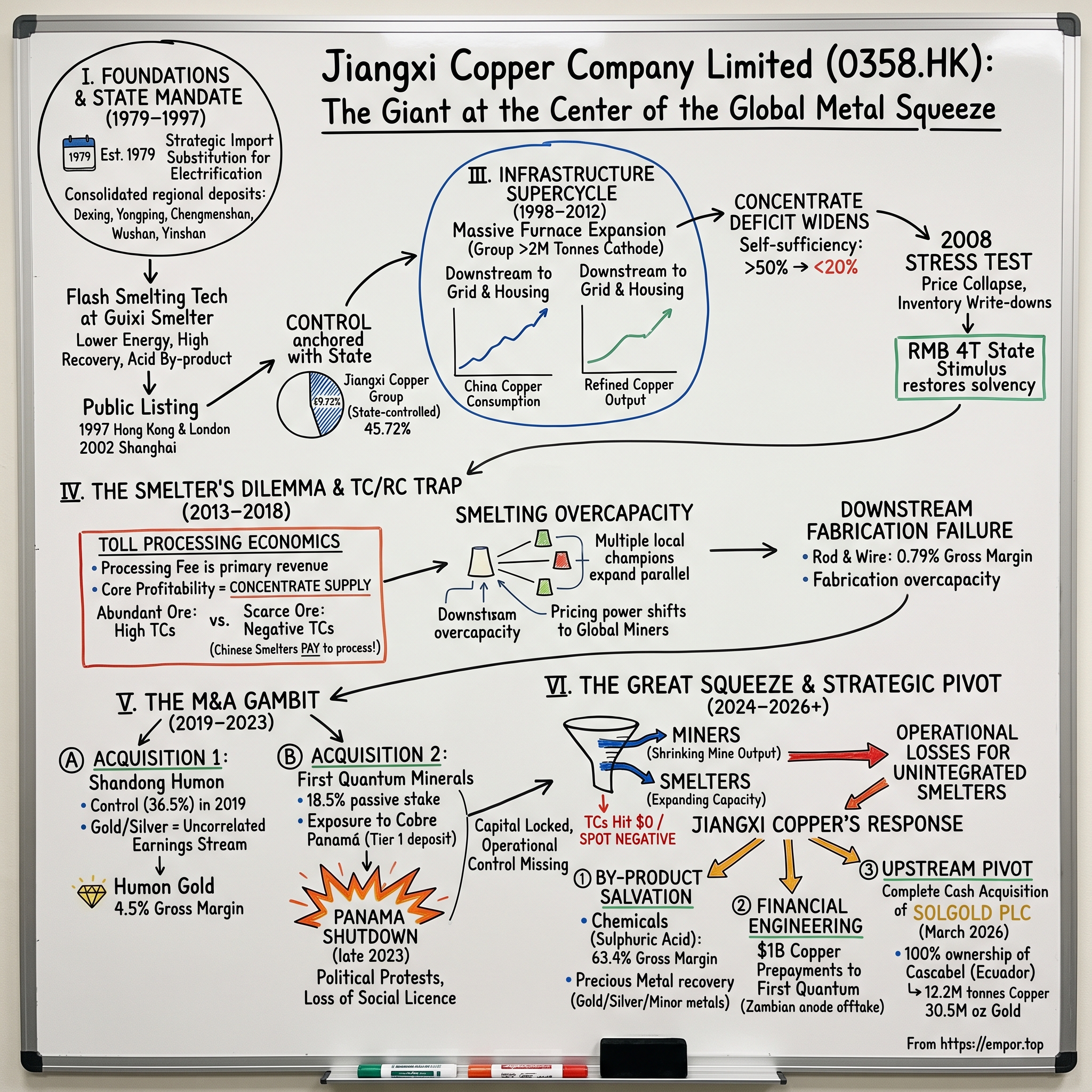
Jiangxi Copper: The Giant at the Center of the Global Metal Squeeze
I. Introduction & The Copper Titan's Dilemma
In the city of Yingtan, set among the hills of eastern Jiangxi province, stands a plant that operates at a scale unmatched anywhere else on Earth. It processes shiploads of grey-brown powder — copper concentrate containing roughly 25% metal by weight, dredged from open pits in Chile, Peru, Zambia, Mongolia, and Indonesia — turning it into sheets of 99.99% pure cathode copper. The 贵溪冶炼厂 Guixi Smelter produces more than a million tonnes of copper a year on a single site, accounting for roughly a tenth of China's total electrolytic copper output.1 Twelve of its most labor-intensive process steps are fully automated: robotic arms stack finished plates, machine-vision systems inspect them, and an intelligent dispatch center monitors the entire operation in real time.1 Yingtan has no local copper mines; it built one of the world's premier metallurgical hubs entirely on imported ore and affordable electricity.
That scale defines 江西铜业股份有限公司 Jiangxi Copper Company Limited. In 2025, the group reported revenue of RMB 544.6 billion — roughly $76 billion — ranking among China's largest industrial enterprises by revenue.2 Production reached 2.38 million tonnes of copper cathode, 118.93 tonnes of gold, 1,383 tonnes of silver, and 7.03 million tonnes of sulphuric acid.3
Yet on that massive turnover, the company generated RMB 7.13 billion in net profit attributable to shareholders.2 That represents a net margin of approximately 1.3% — a figure thin even by the standards of grocery chains.
The slim margin stems from the central economic mechanism of metal refining: treatment and refining charges, known as TC/RCs. As a custom smelter, Jiangxi Copper does not own most of the metal it refines. Operating primarily as a toll processor, it receives concentrate from mining companies, smelts and refines it, and collects a fee per tonne of concentrate treated and per pound of metal refined. Consequently, a custom smelter's core profitability depends not on high copper prices, but on concentrate supply. When ore is abundant, smelters command high processing fees. When ore is scarce, miners auction concentrate to whichever smelter accepts the lowest processing fee.
By December 2025, that competition pushed processing fees to an unprecedented floor. 安托法加斯塔 — Antofagasta, the Chilean miner controlled by the Luksic family — agreed to a 2026 annual benchmark with a Chinese smelter at zero dollars per tonne and zero cents per pound.4 That followed a record-low 2025 benchmark of $21.25 per tonne, down from $80 the previous year.45 During the second half of 2025, spot treatment charges fell between negative $40 and negative $50 a tonne, effectively requiring Chinese smelters to pay miners to process concentrate.3 Meanwhile, refined copper prices surged: three-month LME copper averaged $9,976 a tonne in 2025, crossed $12,000 in December, and breached $13,000 for the first time on January 5, 2026.36
This dynamic created an acute operational squeeze: while global demand drove copper prices to record highs, the world's largest smelter processed raw material for virtually no processing fee.
Jiangxi Copper generated its RMB 7.13 billion profit through three primary mechanisms that demand detailed examination. First, its owned mines yield roughly 270,000 tonnes of copper-in-concentrate annually, capturing mining margins rather than tolling fees.3 Second, secondary product sales provide substantial earnings: gold, silver, selenium, tellurium, rhenium, bismuth, and sulphuric acid — a smelting byproduct that generated a 63.4% gross margin in 2025.7 Third, state backing provides structural stability: Jiangxi Copper Group, controlled by 江西省国有资产监督管理委员会 Jiangxi SASAC, holds 45.72% of the listed company, anchoring it to a state balance sheet.8
Recently, a fourth strategic lever emerged through a major capital deployment. After spending a decade as a passive 18.5% shareholder in Canada's 第一量子矿业 First Quantum Minerals — and seeing that company's flagship mine in Panama halted by political protests — Jiangxi Copper pivoted. In March 2026, it completed an all-cash £867 million acquisition of SolGold plc, securing 100% ownership of the Cascabel copper-gold project in Ecuador. Cascabel's primary Alpala deposit holds an estimated 12.2 million tonnes of contained copper, 30.5 million ounces of gold, and 102.3 million ounces of silver.910
The acquisition places a custom processor with limited internal ore reserves in control of one of the world's largest undeveloped copper deposits. Whether this transaction offers a viable exit from smelter fee compression or exposes the company to new Latin American political risks forms the central question of this analysis. Examining that question requires tracing the supply chain back to its origin.
 Subscribe on LinkedIn
II. Foundations & The Red Metal Backbone (1979–1997)
In 1979, China consumed copper sparingly, mostly for an electrical grid that was still largely unbuilt. The 德兴 Dexing region in northeastern Jiangxi province had contained copper deposits since antiquity, but turning its vast, low-grade ore into usable metal required capital, massive scale, and modern flotation technology. Established in 1979 during the initial phase of 改革开放 reform and opening up, Jiangxi Copper Corporation carried an explicit state mandate to overcome what official corporate histories describe as "the backwardness of China's copper industry."11
The founding logic was strategic import substitution rather than commercial profit. As the vital core of electrification, copper wire could not be imported wholesale if China was to build a national power grid, manufacturing base, and export economy. The state consolidated Jiangxi's dispersed deposits — Dexing, 永平铜矿 Yongping, 城门山铜矿 Chengmenshan, 武山铜矿 Wushan, and 银山 Yinshan — into a single state enterprise linked to a new smelter at Guixi.7
Jiangxi possessed geology but little capital. Dexing is a porphyry deposit, meaning copper is not concentrated in rich underground veins but dispersed in low concentrations across massive rock formations. Porphyry mining requires moving mountains of material, crushing the rock, floating the ore, and accepting that over 99% of the excavated material is waste. This high-volume, capital-intensive extraction was ill-suited to a capital-scarce economy and required long-term state backing to survive its first two decades.
The resulting enterprise was designed not to maximize return on equity, but to secure domestic metal supply. That founding orientation would shape the company's governance and capital allocation for decades.
The technological path chosen for Guixi proved equally consequential. Rather than adopting the labor-intensive reverberatory furnaces common in Chinese metallurgy at the time, the plant installed imported flash smelting technology. In this process, dried copper concentrate is blown into a superheated, oxygen-enriched chamber where the sulfur within the ore combusts, acting as its own fuel. This design yielded three lasting advantages: lower energy costs per tonne, higher metal recovery rates, and a sulfur dioxide stream captured as sulphuric acid rather than vented — a byproduct stream that later became a major source of profits.
Through the 1980s and early 1990s, commercial profitability remained elusive. Ore grades were low, capital was state-allocated, output was distributed according to central plans, and standard financial metrics like return on equity were secondary. Instead, the enterprise built operational capability: running flash furnaces continuously, recovering molybdenum and precious metals from low-grade porphyry, and managing environmental emissions from acid processing.
Going to Hong Kong before China went to the world
A major restructuring occurred in 1997, when Jiangxi Copper reorganized into a joint-stock company and listed shares in Hong Kong and London, becoming the first Chinese mining enterprise to list overseas.11 Coming just as Hong Kong transitioned to Chinese sovereignty and as the Asian Financial Crisis unfolded, the international offering submitted a provincial state-owned enterprise to global financial disclosures. An A-share listing on the Shanghai Stock Exchange followed in 2002 under ticker 600362.SH, and the group completed an overall listing in 2008.11
Despite these public offerings, control remained anchored with the state. The parent company, Jiangxi Copper Group, maintained majority control, holding 45.72% of listed shares after acquiring an additional 57.4 million shares in 2025.8 Hong Kong Central Clearing nominees hold 31.03% on behalf of international H-share investors.8 While international equity holders provided substantial capital, strategic direction remained in state hands.
Overseas listings introduced international accounting standards, English-language disclosures, and global analyst coverage, but they did not shift ultimate governance. The board remains accountable to the provincial SASAC, whose priorities encompass regional employment, provincial industrial policy, national resource security, and 共同富裕 common prosperity. Profitability is one priority among several rather than the sole objective.
In the copper industry, state ownership creates a complex commercial dynamic. Unlike consumer businesses where brand value accrues directly to shareholders, a commodity processor operates where the state serves simultaneously as owner, regulator, primary lender, permitting authority, environmental enforcer, power provider, and major customer through entities like State Grid. When policy aligns with market expansion, minority shareholders benefit from state backing; when policy prioritizes maintaining industrial throughput or employment during market downturns, commercial returns can be squeezed.
For fifteen years following its restructuring, this alignment held firm, as China's rapid urbanization and industrial expansion created steady demand for every tonne of copper the company produced.
III. The Great Chinese Infrastructure Supercycle (1998–2012)
The defining symbol of Chinese copper demand between 1998 and 2012 was the transmission tower. State Grid Corporation of China constructed a high-voltage electrical grid across the nation in roughly fifteen years, stringing millions of kilometers with copper and aluminum. Concurrently, hundreds of millions of citizens moved into modern urban housing requiring electrical wiring, air conditioning motor windings, and industrial busbars. Chinese refined copper consumption expanded at rates unseen globally since post-World War II reconstruction.
Jiangxi Copper responded with a direct strategy: expanding furnace capacity. Guixi underwent successive expansion phases, raising single-site refined copper capacity from a few hundred thousand tonnes to more than one million tonnes annually.1 Group-wide cathode capacity now exceeds two million tonnes per year across five producing smelters — Guixi, 江西铜业(清远)Jiangxi Copper (Qingyuan), 江铜宏源 JCC Hongyuan, 江铜国兴(烟台)JCC Guoxing (Yantai), and 浙江江铜富冶和鼎 Zhejiang Jiangtong Fuye Heding — with Guixi remaining, in the company's phrasing, "the single-unit copper smelter of the largest scale in the world."7
Upstream, the company expanded domestic mining operations alongside its furnaces. Its asset base encompassed five 100% owned mining complexes in or near Jiangxi: Dexing's Tongchang and Fujiawu open pits, Yongping, Chengmenshan (including the Jinjiwo silver-copper deposit), Wushan, and Yinshan.7 As of December 31, 2025, these deposits contained wholly owned reserves of approximately 8.56 million tonnes of copper, 227 tonnes of gold, 8,216 tonnes of silver, and 161,000 tonnes of molybdenum.7
However, a structural imbalance lay beneath these operational figures. The captive mines produced roughly 200,000 to 270,000 tonnes of copper-in-concentrate annually,37 while group smelters consumed the concentrate equivalent of more than two million tonnes of cathode copper. This left Jiangxi Copper with a concentrate self-sufficiency ratio in the low teens, leaving the enterprise increasingly exposed as every expansion of furnace capacity widened the deficit.
The 2008 stress test
The 2008 Global Financial Crisis exposed the vulnerability of this widening deficit. Copper prices plummeted from roughly $8,900 per tonne to below $3,000 within months. For a custom processor holding extensive physical inventories carried at peak valuations, inventory write-downs were immediate. Compounding the loss, domestic downstream customers cancelled orders en masse during the demand shock.
The industry's recovery was driven by state intervention rather than operational restructuring. Beijing's RMB 4 trillion stimulus package directed massive capital into copper-intensive infrastructure, including high-voltage power grids, rail networks, roadways, and residential housing. As a primary supplier to State Grid, Jiangxi Copper emerged as a direct beneficiary of the government spending initiative.
While the stimulus restored immediate financial solvency between 2008 and 2010, it masked an underlying structural deterioration. Between the late 1990s and 2012, Jiangxi Copper's concentrate self-sufficiency declined from over 50% to under 20%. The enterprise spent a decade scaling a custom smelting business whose long-term pricing power and bargaining position relative to global miners were steadily diminishing.
A secondary, structural consequence of the expansion era emerged over the following decade. Regional smelters expanded on the assumption that global mine supply would keep pace, while provincial champions built capacity independently without a national coordinating mechanism. Local governments backed parallel expansions — Jiangxi Copper at Guixi, Tongling Nonferrous Metals in Anhui, and Yunnan Copper in Yunnan — culminating in a national overbuilding of smelting capacity. This collective coordination failure shifted structural pricing power permanently to global mine owners. In market economies, overcapacity is typically resolved through corporate restructuring or bankruptcies; without that mechanism in China's state-supported smelting sector, treatment and refining charges absorbed the market adjustment.
For equity investors, the supercycle delivered immediate volume growth while creating the conditions for long-term margin compression. The relentless upward trajectory of production volumes obscured the reality that processing capacity was outpacing raw material access.
This period highlights a broader lesson for industrial analysis: volume growth in a commoditized conversion step does not equate to economic franchise growth. Jiangxi Copper expanded smelting throughput for fifteen years while deepening its reliance on third-party miners, foreign jurisdictions, and volatile treatment charges. The structural consequences of that exposure would unfold over the subsequent decade.
IV. The Smelter's Dilemma & The TC/RC Margin Trap (2013–2018)
Understanding the structural trap of custom smelting requires examining the economics of toll processing, where standard commodity price cycles fail to generate expected processor profits.
Consider an industrial tolling business: an operator processes raw material supplied by others for a fixed fee without owning the input or the final product. When refined product prices double, the processor receives none of the price appreciation. When raw material becomes scarce and competing processors bid for limited supply, processing fees collapse. When processing capacity exceeds raw material availability, fees fall toward zero or drop into negative territory.
Custom copper smelting functions on this precise mechanism. The treatment charge (TC) is set in dollars per dry metric tonne of concentrate, while the refining charge (RC) is set in cents per pound of contained copper, traditionally fixed at a one-to-ten ratio—yielding benchmarks such as $80 per tonne and 8.0 cents per pound, $21.25 and 2.125 cents, or zero and zero. Smelters retain metal recovered above contractually specified recovery rates—known as "free metal"—alongside valuable by-products contained in the concentrate, including gold, silver, rare metals, and sulphuric acid derived from captured sulfur. Under balanced market conditions, treatment charges provide primary operating revenue while by-products supply incremental margin. In tight concentrate markets, by-product sales become the enterprise's primary source of operating profit.
The cartel that isn't quite a cartel
Chinese smelters recognized this structural vulnerability early and sought strength in collective bargaining. The 中国铜原料联合谈判组 China Smelters Purchase Team (CSPT) brought together Jiangxi Copper, 铜陵有色 Tongling Nonferrous, 云南铜业 Yunnan Copper, 中国铜业 China Copper, and peer processors to coordinate negotiating stances against global mining majors and set minimum spot purchase guidance.
While frequently characterized in international media as a buying cartel, the CSPT functions in practice as a loose coordination forum hampered by a structural free-rider problem. Member smelters compete directly for the same concentrate, while local employment commitments, provincial output targets, and debt service obligations make curtailing furnace throughput politically and financially difficult. Consequently, the group frequently issues discipline guidelines that members fail to maintain in spot markets—a coordination breakdown that recurred visibly in 2026.
This negotiating imbalance stems from physical operating realities. A mining company holding raw ore can choose when to sell; concentrate degrades minimally, allowing miners to stockpile inventory or reduce milling rates during low-fee periods. Conversely, a smelter operates continuous flash furnaces that incur severe financial penalty if shut down. Cooling and reigniting a flash smelting unit requires several weeks, costs millions of dollars, and risks structural damage to refractory linings. Because furnaces cannot idle cheaply, processing charges reflect smelter operating urgency rather than miner concession.
Annual benchmark negotiations—conducted each November at Asia Copper Week and the CESCO conference in Santiago—serve primarily as a public measure of concentrate availability. While annual processing fees remained comfortable for a decade, benchmarks began a sustained decline around 2018.
Over the same period, major global mining operators consolidated operations while curtailing greenfield project development. Following the 2011–2015 commodity downturn, capital discipline across global mining meant new large-scale mine supply failed to match the rapid expansion of Chinese smelting capacity.
The downstream hedge
Jiangxi Copper's response through this period was to move down the value chain rather than up it. By building manufacturing facilities for copper rods, wires, tubes, plates, strips, and foil, the group established itself as China's largest copper processing manufacturer, operating more than two million tonnes of annual processing capacity across ten fabrication plants.7
However, downstream fabrication failed to resolve the enterprise's margin vulnerability. In 2025, copper rods and wires generated RMB 127.7 billion in revenue at a gross margin of 0.79%.7 Other processed copper products generated RMB 14.9 billion in revenue at a 1.53% gross margin.7 Chinese copper fabrication suffered from severe industrial overcapacity, with the company's annual report noting that ordinary copper processing remained "plagued by overcapacity and intensifying cut-throat competition," while observing that only high-end products retained a "relatively robust" gross margin.7 Moving downstream ultimately substituted a low smelting margin for an equally thin fabrication margin. The enterprise also expanded trading, logistics, and financial leasing operations—with the trading book alone generating RMB 145.2 billion in 2025 revenue at a 1.12% gross margin—increasing top-line revenue, working capital requirements, and counterparty exposure.7
To manage price exposure during processing cycles, the group established hedging operations on the Shanghai Futures Exchange and the London Metal Exchange. Because smelters purchase concentrate based on forward quotational periods and sell refined cathode weeks later, holding physical metal creates structural inventory exposure. While risk management required derivative hedging, these paper positions generated substantial annual gains and losses that moved inversely to copper prices, frequently masking underlying physical operating results.
Ultimately, mitigating fee compression required securing upstream mining assets. By 2019, Jiangxi Copper pivoted toward direct international mine acquisition.
V. The M&A Gambit: Shandong Humon & The First Quantum Saga (2019–2023)
Upstream expansion in copper poses a fundamental strategic challenge: top-tier orebodies rarely change hands, and when they do, sellers command premium valuations. In 2019, Jiangxi Copper addressed this constraint through a dual strategy — combining a conservative domestic acquisition with an aggressive offshore stake.
Acquisition one: buying a gold business
山东恒邦冶炼股份有限公司 Shandong Humon Smelting (002237.SZ), based in Yantai, specializes in smelting complex, refractory gold ores — difficult arsenic- and antimony-bearing material that standard refiners cannot economically process — and operates as one of China's designated key gold smelting enterprises. In March 2019, Jiangxi Copper agreed to acquire 273 million shares, representing approximately 29.99% of Humon, for roughly RMB 2.98 billion (about $444 million).12 The transaction was subsequently restructured into a larger deal, leaving Jiangxi Copper with a 36.50% controlling stake.137
The transaction expanded the group's annual capacity by 98.33 tonnes of gold and 1,000 tonnes of silver, along with by-product capacity of 335,000 tonnes of electrolytic copper and 1.68 million tonnes of sulphuric acid, backed by 150.1 tonnes of proven registered gold reserves.7
The core strategic rationale extended beyond treating gold as a macroeconomic hedge. Rather, the acquisition provided a cyclical offset within the same physical process. Gold and copper smelting margins respond to distinct market supply conditions; when tight copper concentrate supply depresses treatment and refining charges, precious metal refining volumes and prices remain structurally independent. Humon provided an uncorrelated earnings stream built on shared metallurgical capabilities. In 2025, that diversification proved crucial: gold generated RMB 94.5 billion in revenue at a 4.50% gross margin — up 1.4 percentage points year over year — while silver contributed RMB 21.3 billion at an 8.35% gross margin. Together, precious metals yielded roughly RMB 6.0 billion in gross profit against a group total of approximately RMB 25.6 billion.7
Acquisition two: the Vancouver bet
The group's bolder move targeted Vancouver-listed First Quantum Minerals (FQM). Beginning in 2019, Jiangxi Copper accumulated an 18.5% position, becoming the company's largest single shareholder.14 The investment offered indirect exposure to two world-class mining complexes: Cobre Panamá, one of the largest greenfield copper developments built in recent decades, and Kansanshi in Zambia.
First Quantum occupied a rare position in the global mining sector, having accomplished what few peers managed during the 2010s: developing a major greenfield copper mine from the ground up. Cobre Panamá represented a roughly $10 billion investment in a country without a major mining history, scaling into one of the world's largest copper operations by the early 2020s. Combined with Kansanshi and Sentinel in Zambia, FQM stood as one of the few remaining independent miners holding tier-one copper deposits not already owned by majors like BHP, Rio Tinto, Glencore, or Freeport. For a Chinese smelter facing a severe concentrate deficit and a mandate to secure raw material, FQM offered one of the few remaining gateways to scale.
Structurally, however, the investment carried significant limitations. Jiangxi Copper held no operational control, possessed no contractual right to direct concentrate to its domestic smelters, and faced severe obstacles to a full acquisition. In January 2024, the company invested an additional $212 million in FQM shares. In July 2024, the two parties signed a three-year shareholder rights agreement that formalized these boundaries: Jiangxi Copper agreed not to increase its stake or sell any block of 5% or more without FQM's consent, receiving in return the right to nominate one director for board consideration.1415 The agreement reflected Canada's stricter regulatory framework for Chinese investment in critical minerals, under which Ottawa stated it would approve foreign takeovers of Canadian mining firms only in "the most exceptional circumstances."15
Ultimately, Jiangxi Copper committed well over $1 billion to a minority position in an enterprise it could neither control nor easily exit, while remaining exposed to jurisdictional risks outside its historical operating experience.
Panama
In late 2023, those jurisdictional risks materialized abruptly. A renegotiated concession agreement for Cobre Panamá sparked widespread public protests across the country, leading Panama's Supreme Court to rule the contract unconstitutional and the government to order the mine closed. An operation producing approximately 350,000 tonnes of copper annually — roughly 1.5% of global mine supply — halted output overnight, stripping First Quantum of its primary revenue driver and triggering a severe liquidity strain.
The shutdown underscored a crucial vulnerability in resource development. The asset functioned as engineered, with geology and processing infrastructure performing to specification. Instead, the failure lay in the loss of social licence — the political and public consent of a host nation that determined it was receiving an inadequate share of the extracted value. Social and political friction of this nature falls outside traditional financial modeling and resource statements, yet it has constrained global copper supply expansion over the past decade more effectively than ore grade degradation or cost inflation.
From a capital allocation standpoint, the strategy yielded mixed results. Acquiring exposure to tier-one assets during a period of rising resource scarcity reflected a logical strategic objective. However, accepting a minority structure stripped the group of downside control, while effectively discounting host-country political risk. Jiangxi Copper's subsequent strategic adjustments — accepting standstill terms, shifting toward commercial prepayments, and ultimately pursuing the full acquisition of SolGold — indicate an enterprise adjusting its capital deployment approach after absorbing significant costs.
A notable accounting adjustment accompanied this transition. Jiangxi Copper reclassified its FQM investment from a financial asset to a long-term equity investment accounted for under the equity method.7 This accounting treatment means quarterly market price fluctuations no longer flow directly through the income statement, reducing reported earnings volatility while obscuring real-time changes in the position's underlying market value.
Just as the Panama operations halted, the global concentrate market supplying two million tonnes of feed to Jiangxi Copper's smelters entered a period of unprecedented disruption.
VI. The Great Smelter Squeeze & The 2024–2026 Crisis
The mechanics of the smelter squeeze were almost mathematically clean, making them exceptionally unforgiving.
On the supply side, global mine output stalled. The closure of Cobre Panamá removed roughly 350,000 tonnes per year, while operational disruptions and grade declines compounded losses across other major mines. Jiangxi Copper's 2025 review stated the position plainly: global copper concentrate production growth for 2025 was negative, at about -2%, with output at several large mines shrinking and second-half operations hit by severe accidents.7
On the processing side, smelting capacity continued to expand—primarily across China, but also in Indonesia and India. A growing national and global furnace fleet competed for a shrinking pool of mined ore.
The cost of this imbalance fell entirely on treatment and refining charges (TC/RCs). The 2024 annual benchmark of $80 per tonne dropped to $21.25 for 2025, and reached zero for 2026 in the annual settlement between Antofagasta and a Chinese smelter reported in December 2025.45 Spot rates plunged even faster: through the second half of 2025, spot treatment charges hovered between negative $40 and negative $50 per tonne.3 In July 2026, Antofagasta pushed the paradigm further by agreeing to spot-indexed sales with select Chinese smelters—a structural shift that transferred even the residual certainty of a fixed annual fee away from processors, softened only by a negotiated floor.16
A negative treatment charge fundamentally upends smelting economics. Under negative TC/RCs, a smelter purchases concentrate by paying the miner the full market value of the contained metal plus a cash premium for the right to refine it. The smelter incurs substantial energy and processing costs to convert that raw material into cathode copper, effectively losing money on every processed tonne. Smelters continue operating under these loss-making conditions because idling a continuous flash furnace inflicts higher fixed overhead costs while forfeiting valuable by-product streams.
The lifeline, and what it bought
Jiangxi Copper responded to the concentrate shortage with strategic financial engineering. Rather than competing for spot cargoes at negative processing charges, the company extended capital against guaranteed future metal deliveries. In February 2024, it structured a $500 million copper prepayment with First Quantum, providing upfront cash in exchange for 50,000 tonnes of copper anode annually from the Kansanshi mine in Zambia over three years, priced at prevailing market rates.17 On April 23, 2025, Jiangxi Copper expanded this mechanism through a supplementary $500 million prepayment securing an additional 50,000 tonnes per year of Zambian anode over a three-year period.18
This transaction served a triple function: a liquidity injection to a distressed strategic investee, a direct physical supply agreement that bypassed the spot concentrate market, and a senior claim ranking ahead of Jiangxi Copper's existing equity stake. Through a single financial instrument, the group shifted from a vulnerable toll processor into a secured financier backed by physical offtake. However, the structure also concentrated risk, tying Jiangxi Copper's equity value, trade receivables, and physical feedstock to the same counterparty, as well as to Zambian and Panamanian political dynamics.
The by-product salvation, quantified
The primary driver of Jiangxi Copper's operational resilience in 2025 lay in an overlooked segment of its income statement. Chemical products—primarily sulphuric acid and sulphur concentrates generated as smelting by-products—produced RMB 5.53 billion in revenue at a gross margin of 63.36%. This gross margin expanded by 29.02 percentage points in a single year, driven by a 95.65% surge in segment revenue against a modest 9.18% rise in costs.7 Derived from an industrial waste stream, the chemical division delivered approximately RMB 3.5 billion in gross profit—representing roughly 14% of group gross profit from less than 1% of total revenue.7
Sulphuric acid presents unique economics: it cannot be transported long distances economically, it is generated automatically during smelting, and its market price depends on regional fertilizer and chemical demand entirely separate from copper markets. In 2025, Chinese domestic acid prices rallied sharply just as copper smelting fees collapsed. An integrated smelter equipped with acid capture infrastructure holds a portfolio of uncorrelated revenue streams that pure custom refiners lack, providing the structural cash flow that allowed Jiangxi Copper to remain profitable while unintegrated peers faced restructuring.
Precious metal recovery provided a second essential earnings buffer. Copper concentrate from porphyry deposits typically contains trace amounts of gold and silver, which the smelter collects from electrolytic anode slimes and sells independently. Under standard TC/RC contracts, smelters retain metal recovered above contractually specified thresholds. When treatment charges drop to zero, these precious metal residues constitute a critical portion of processing economics. Selling gold and silver registered with the London Bullion Market Association into a surging 2025 bullion market,7 Jiangxi Copper captured a secondary high-margin revenue stream that lowered its effective break-even treatment charge well below that of standard custom smelters.
Together, chemical by-products and precious metal recovery explain how the group navigated a zero-dollar processing fee environment. In 2025, approximately one-third of Jiangxi Copper's gross profit originated from non-copper streams insulated from concentrate market pricing—a structural buffer that nevertheless remains tied to commodity markets beyond the company's direct control.
Feeding the furnace by other means
Beyond prepayments and by-product monetization, Jiangxi Copper adapted its raw material mix. When primary concentrate carries negative treatment charges, alternative feedstocks become economically superior.
First, 废铜 scrap copper—including recycled cabling, industrial off-cuts, and radiators—bypasses concentrate benchmark negotiations entirely, allowing smelters to purchase secondary material at a discount to refined copper prices. Government policy has reinforced this pivot: Beijing's Implementation Plan for High-quality Development of the Copper Industry (2025–2027) explicitly targeted higher utilization rates for recycled copper alongside a 5% to 10% expansion target for domestic mine output.7 Second, intermediate blister and anode copper—material already smelted upstream—requires only final electrolytic refining. The Zambian prepayment contracts delivered 100,000 tonnes per year of anode copper directly into this stage,1718 insulating that volume from primary smelting margin compression.
This raw material diversification reveals the operational rationale behind the First Quantum prepayments. Rather than acting solely as a capital rescue for an investee, the transactions secured intermediate feedstock that bypassed the primary concentrate bottleneck. While counterparty credit risk remained a key consideration, the underlying industrial logic directly served furnace requirements.
The discipline that wasn't
In late 2025, members of the China Smelters Purchase Team (CSPT) publicly pledged to reduce primary smelting capacity by more than 10% in 2026—a collective curtailment of roughly 961,000 tonnes of copper-in-concentrate demand designed to eliminate the projected 834,000-tonne global concentrate deficit.1920
However, by April 2026, corporate earnings outlooks from major Chinese smelters revealed plans to maintain or expand 2026 production volumes despite the pledge.21 Concurrently, the CSPT abstained from issuing spot TC/RC guidance for the first quarter of 2026.
This divergence between collective commitments and individual operational targets highlights a persistent coordination challenge within China's copper smelting sector. With high fixed overhead costs and valuable by-product margins, individual smelters face strong incentives to maintain high throughput while expecting peers to curtail production. As the industry's largest and lowest-cost operator with the most extensive by-product earnings, Jiangxi Copper maintains little commercial incentive to lead production cuts, prioritizing volume and integrated margins over industry-wide capacity discipline.
VII. Segment Breakdown, Hidden Value & Strategic Optionality
Strip away top-line revenue, and Jiangxi Copper presents a starkly different financial profile.
The group's 2025 revenue of RMB 544.6 billion produced roughly RMB 25.6 billion in gross profit—yielding a group gross margin of about 4.7%, derived from disclosed segment revenues and costs.7 The critical analytical question is where that gross profit actually originates.
Copper cathode—the core volume business generating 2.38 million tonnes and RMB 240.9 billion in revenue—produced roughly RMB 10 billion in gross profit at a 4.13% gross margin.7 That contributed approximately 39% of group gross profit from 44% of revenue. Two operational nuances behind this figure warrant examination. First, the reported margin rose by 0.31 percentage points in 2025 despite annual benchmark fees collapsing to $21.25 per tonne and spot treatment charges turning negative. This margin expansion demonstrates that the reported cathode spread reflects more than a pure tolling fee: it incorporates self-mined feed, free metal recovery, favorable inventory timing gains in a rising price environment, and intermediate processing of blister and scrap copper. Second, cathode revenue fell 9.21% year over year even as cathode output grew 3.86% and refined copper prices rose 7.5%.37 This divergence points toward accounting reclassifications between cathode sales and trading operations rather than a structural shift in volume or pricing power.
Precious metals—gold at RMB 94.5 billion with a 4.50% gross margin, and silver at RMB 21.3 billion with an 8.35% margin—together generated approximately RMB 6.0 billion in gross profit, representing roughly 24% of the group total.7 Gold segment revenue expanded 43.5% in 2025.7 While this growth validates the strategic acquisition of Shandong Humon, operational output tells a more nuanced story: gold production volume remained flat, moving from 118.26 tonnes in 2024 to 118.93 tonnes in 2025, a gain of just 0.57%.3 Meanwhile, silver production volume expanded 13.92%.3 Consequently, precious metal revenue growth was almost entirely driven by surging bullion prices rather than expanded mining throughput—a critical distinction when evaluating management operational execution and earnings durability.
Chemicals delivered roughly RMB 3.5 billion in gross profit on RMB 5.5 billion in revenue.7 Operating as the group's highest-margin division by a wide margin, chemical earnings remain highly exposed to cyclical commodity price swings outside corporate control.
Self-mined concentrate represents the group's highest-margin asset base, though its scale remains constrained relative to smelting capacity. Copper contained in self-produced concentrate reached 269,900 tonnes in 2025, an apparent 35.15% increase; however, the company noted that the 2025 reporting scope expanded to include equity output, making the operational gain more modest than headline figures suggest.3 The company targets 200,000 tonnes for 2026.7 Capturing genuine mining margins, captive mine production meets barely a tenth of total smelter feed requirements.
Trading operations significantly inflate top-line figures while contributing modest operating income. Generating RMB 145.2 billion in revenue at a 1.12% gross margin, trading yielded roughly RMB 1.6 billion in gross profit—accounting for 27% of group revenue but only 6% of gross profit.7 Physical commodity trading provides tangible operational value to an integrated refiner by smoothing supply logistics, generating market intelligence, and monetizing group warehousing and financing capacity. However, trading operations also absorb working capital and introduce counterparty exposure, inflating top-line revenue without generating proportional earnings power.
The segment breakdown reveals a structural duality: an immense, low-margin refining volume engine anchored by four smaller, highly profitable secondary divisions. While market discussions typically focus on smelting volumes, the smaller divisions generate the bulk of sustainable cash flows.
The two forward options
Lithium battery copper foil. Battery foil represents a high-value niche within a competitive processing sector. Produced as ultra-thin sheets rolled or electrodeposited to a thickness of four to six microns—roughly one-tenth the width of a human hair—copper foil serves as the primary anode current collector in lithium-ion battery cells. Thinner foil reduces inactive mass, enhancing cell energy density and commanding premium processing fees that require precise manufacturing tolerances. 江西江铜耶兹铜箔 Jiangxi Jiangtong Yates Copper Foil, a joint venture established in 2003, produced its first 10,000-meter reel of four-micron battery foil in May 2022, placing the entity among a select tier of Chinese manufacturers capable of mass production at that gauge.22 The group committed approximately RMB 11.4 billion ($1.8 billion) to construct a 100,000-tonne annual capacity foil complex in Shangrao, structured in two 50,000-tonne phases with the second phase targeted for completion in 2028.[^23] Meanwhile, an East China lithium battery copper foil project expanded production during 2025.7
Corporate disclosures reflect these shifting dynamics: management noted that copper foil demand expanded alongside clean energy growth—with lithium battery foil outperforming—while demand for traditional rods, strips, and tubes contracted due to domestic real estate weakness.7 Despite this strategic pivot, total financial contribution remains modest. Copper foil figures are consolidated within the broader processed copper division, which generated RMB 14.9 billion in total revenue at a 1.53% gross margin.7 On current disclosure, evaluating the enterprise as an advanced materials producer remains premature.
The upstream option. In December 2025, Jiangxi Copper launched a formal cash offer for SolGold plc at 28 pence per share through a Hong Kong subsidiary. The English High Court sanctioned the transaction scheme on March 2, 2026, and it became effective on March 4.7 The £867 million all-cash acquisition—following two prior bids—secured 100% ownership of the Cascabel project.923 Cascabel's primary Alpala deposit holds proven, indicated, and inferred resources estimated at 12.20 million tonnes of copper, 30.50 million ounces of gold, and 102.30 million ounces of silver.7
While resource figures appear transformational, project execution remains subject to long development timelines and political risks. Cascabel is an undeveloped underground block-cave asset in Ecuador requiring several billion dollars in capital expenditure and extended technical development before reaching initial concentrate production, in a jurisdiction with a history of local community opposition and mining referenda. Furthermore, reported resource figures include inferred estimates, which carry lower geological certainty. Jiangxi Copper also retains a 25% stake in MCC-JCL Aynak Mining, the project vehicle for the Aynak copper deposit in Afghanistan—an asset that has remained undeveloped for over a decade.7 Historically, the group has successfully acquired strategic options on tier-one geology, but translating undeveloped deposits into commercial furnace feed presents ongoing execution challenges.
VIII. Current Management, Governance & Capital Allocation
On July 7, 2026, the board of Jiangxi Copper received a resignation letter from 郑高清 Zheng Gaoqing. Having reached statutory retirement age, he stepped down as chairman, executive director, and chair of both the nomination and ESG development committees, effective immediately, departing all roles within the company.24
Zheng had signed the 2025 annual results announcement as chairman on March 26, 2026.7 He had held the post since September 2020, a period during which total profit grew from RMB 3.34 billion to surpass RMB 10 billion for the first time.7 As of August 2026, no successor has been named.
This departure creates a notable governance hiatus. The company is navigating the integration of its largest-ever overseas acquisition, managing $1 billion in prepayment exposure to a distressed Canadian counterparty, and executing an RMB 26.6 billion investment plan through 2026 while operating without a permanent chairman.7 While statutory retirement is routine across state-owned enterprises and provincial authorities will eventually name a replacement, the transition illustrates a core governance reality: leadership continuity remains governed by China's cadre management system rather than board-level succession planning, leaving minority shareholders with little influence over executive appointments.
Day-to-day operations rest with the remaining executive leadership—led by president and general manager 周少兵 Zhou Shaobing, executive directors Gao Jian-min and Liang Qing, and CFO 于信心 Yu Minxin—alongside employee director Miao Shenggang and independent non-executive directors Wang Feng, Lai Dan, Liu Shuying, and Liu Zhihong.7
What the capital allocation record actually shows
Operational execution remains management's strongest suit. In 2025, the company recorded historic highs in molybdenum recovery, sulphur recovery, and overall copper smelting recovery rates under a stated principle of "utilizing both high-grade and low-grade resources to the full extent."7 Research and development spending expanded 26.56% to RMB 1.42 billion.7 Across China's 14th Five-Year Plan period, the group secured 252 invention patents and led or participated in drafting 127 industrial standards.7 On the project front, the Wushan Phase III expansion and Kazakhstan's Bakuta tungsten mine were commissioned, while a Mexican slag processing facility reached substantial completion.7
By contrast, the financial metrics reveal several structural strains that merit close analytical scrutiny.
First: cash conversion lagged accounting profit. Operating cash flow swung to a negative RMB 6.91 billion in 2025 from a positive RMB 2.43 billion in 2024—a net deficit of nearly RMB 9.4 billion that management attributed to inventory carrying costs in a rising price environment.7 The cash drain accelerated in the fourth quarter alone, which absorbed RMB 13.2 billion.8 For an enterprise reporting RMB 7.13 billion in attributable net profit, an operating cash deficit of this magnitude indicates that paper earnings did not translate into liquid cash flow, driven largely by working capital tied up in physical inventory during the copper rally.
Second: derivative hedging created substantial earnings drag. Fair-value adjustments swung to a loss of RMB 2.51 billion from a positive RMB 145 million, while investment income fell to negative RMB 2.41 billion due to derivative losses.7 Combined, paper derivative positions generated roughly RMB 4.9 billion in financial drag. This outcome reflects the mechanical friction of hedging: a smelter holding short futures against physical inventory incurs paper mark-to-market losses during a commodity rally. Consequently, attributable net profit of RMB 7.13 billion fell well short of profit excluding non-recurring items of RMB 9.15 billion—a gap that widened in the fourth quarter, when reported net profit of RMB 1.11 billion trailed non-recurring profit of RMB 2.89 billion.8
Third: balance sheet expansion is accelerating ahead of major capital spending. The group's asset-liability ratio rose to 56.95% in 2025 from 54.54% a year earlier.8 While an EBITDA-to-total-debt ratio of 7.78% and interest coverage of 5.13 times indicate manageable solvency, total assets grew 13.24% in 2025 and an additional 18.85% by the end of the first quarter of 2026 to reach RMB 259.9 billion, lifting the liability-to-asset ratio to approximately 62.5%.825 Furthermore, the 2026 capital budget of RMB 26.58 billion—inclusive of equity investments—represents nearly double market expectations, landing in the same year as the SolGold cash outflow.7
Fourth: capital returns remained restrained. The board proposed a total 2025 dividend of RMB 1.00 per share—comprising an RMB 0.40 interim payment and an RMB 0.60 final distribution—totalling approximately RMB 2.07 billion, or 29.05% of attributable net profit.826 The final payout fell from RMB 0.70 per share in 2024 despite higher headline net income.7 A payout ratio below 30% during a strong copper price environment underscores management's prioritization of capital expenditure over shareholder distributions.
Conversely, shareholder alignment received a positive signal from the parent company. Jiangxi Copper Group acquired an additional 57.38 million shares during 2025, elevating its controlling stake to 45.72%.8 While state oversight involves strategic priorities beyond equity returns, open-market purchases by a controlling parent indicate long-term state balance-sheet support.
A legal contingency also lingers. Subsidiary Shenzhen Jiangxi Copper Marketing is defending a contract breach lawsuit brought by Bangdi Auto Technology regarding deliveries between 2011 and 2015, with claims seeking RMB 1.075 billion in compensation. The litigation remains in trial, and directors state they cannot reliably estimate the ultimate financial outcome.7 Representing roughly 15% of annual net profit, the claim poses an unquantified legacy liability.
Narrative consistency, tested
Evaluating a state-owned enterprise requires assessing how corporate strategy evolves and how management accounts for strategic pivots. Over the past decade, Jiangxi Copper's international approach underwent three distinct phases.
From 2019 to 2022, the strategy emphasized strategic equity acquisition: securing a major position in a world-class copper producer to gain governance influence and global resource exposure. From 2023 to 2025—following the operational shutdown of Cobre Panamá and tightened Canadian regulatory restrictions—the approach shifted toward structured financing, utilizing prepayments and offtake agreements to act as a senior lender rather than an equity operator. Beginning in late 2025, the group returned to outright acquisitions, targeting an undeveloped greenfield deposit via a public takeover in London rather than a negotiated minority stake.
Corporate disclosures present these deployments as a unified, long-term roadmap focused on resource expansion and strategic diversification.7 While that framing reflects the overarching objective of securing copper reserves, it simplifies a complex sequence of events that included an illiquid minority investment affected by foreign regulatory changes, followed by three successive bids for SolGold before securing full control.23 Furthermore, official reporting provides limited detailed evaluation of the First Quantum equity position's underlying performance, while the transition to equity-method accounting reduced the visibility of market value fluctuations.7
This pattern highlights a common feature of state-owned enterprise reporting: completed operational milestones receive extensive disclosure, while strategic shifts and challenged investments are framed within broader long-term policy mandates.
IX. Economic Moats, Porter's 5 Forces & Helmer's 7 Powers
Stripping away the narrative leaves the central structural question: what prevents competitors from eroding this business model over a decade?
Hamilton Helmer's 7 Powers
Scale Economies — strong and real. Guixi's single-site output of over one million tonnes provides compounding advantages. Fixed overhead, oxygen plants, acid capture infrastructure, slag processing, rail and river logistics, and the labor required to run a flash furnace all scale sub-linearly with throughput. The behavioral evidence of this cost advantage is clear: with treatment charges at zero or negative levels, marginal Chinese smelters face mounting losses and consolidation, while Jiangxi Copper increased cathode output by 3.86% and expanded its cathode gross margin.37 Scale is what allows an enterprise to maintain operations when industry peers cannot.
Process Power — moderate. Four decades of flash-smelting optimization, record recovery rates across molybdenum, sulfur, and copper, and the automation of twelve labor-intensive process steps represent accumulated operational capabilities that cannot be bought off the shelf.17 However, metallurgical process power decays over time: the underlying technology is widely licensable, Chinese engineering firms export smelter designs globally, and the recovery-rate gap between industry leaders and average operators is measured in fractions of a percent.
Government Privilege / Counterpower — strong and double-edged. State-owned enterprise status provides access to policy-bank credit, priority in domestic mining rights, and a leading role in the CSPT bargaining group. Beijing's Implementation Plan for High-quality Development of the Copper Industry (2025–2027) explicitly commits to controlling new copper smelting capacity — a policy that, if enforced, shields incumbents from further capacity expansion.7 Yet government counterpower also imposes constraints: provincial state objectives prioritize employment and industrial throughput, which explains why coordinated production curtailments repeatedly fail.
Cornered Resource — weak, presenting the central operational bottleneck. The Dexing deposit is large and long-life, but low-grade. Compared with tier-one Andean and African porphyries, the domestic resource base cannot compete on unit extraction costs and covers barely a tenth of group furnace capacity. The Cascabel acquisition represents an effort to acquire a cornered resource outright, though verifying its ultimate success will require a decade of development.
Brand, Network Effects, Switching Costs, Counter-Positioning — essentially absent. LME Grade A copper cathode is a standardized commodity specification rather than a differentiated product. The registration of "Guiye," "JCC," and "HUMON-D" with the LME, along with LBMA registration for JCC gold and silver, provides deliverability and institutional trust, but confers zero pricing power.7 Copper fabricators readily switch suppliers for a price concession of a few dollars per tonne.
Porter's Five Forces
Supplier Power — extremely high, serving as the industry's defining dynamic. A zero-dollar benchmark represents maximal supplier leverage in contract form.4 Antofagasta's July 2026 shift toward spot-indexed term contracts further erodes smelter pricing certainty.16
Buyer Power — moderate. Downstream buyers transact against transparent London Metal Exchange and Shanghai Futures Exchange reference prices plus regional premiums. Although individual fabricators and grid contractors lack monopsony leverage, public benchmark pricing prevents smelters from capturing excess sales spreads.
Threat of Substitutes — low to moderate. Aluminum continues to substitute for copper in select high-voltage transmission and building-wire applications, with record copper prices accelerating substitution pressure. However, superior electrical conductivity, connector reliability, and spatial constraints limit aluminum's viability in electric motors, data-center power distribution, and fine-gauge wiring.
Threat of New Entrants — low. Multi-billion-dollar capital requirements, stringent domestic environmental permitting, 双碳 dual carbon goals energy caps, and explicit state restrictions on new smelting capacity make greenfield custom smelters in China virtually unbankable.7 The primary threat of new entry originates offshore, where Indonesian and Indian smelters constructed near port facilities or mine sites compete for the same global concentrate feed.
Rivalry — high and structurally unfixable. Peer processors including Zijin Mining, Tongling Nonferrous, Yunnan Copper, and China Copper compete aggressively for scarce raw material, driven by shared fixed overheads and the operational imperative to maintain continuous furnace throughput. Among these peers, Zijin Mining represents a sharp contrast: a Chinese enterprise that addressed its raw material deficit by transforming into a global miner, earning a market valuation that reflects its captive upstream margin.
The peer test
Comparing Jiangxi Copper against its closest domestic peers highlights both its relative operational strength and its valuation constraint.
Against custom smelters such as 铜陵有色 Tongling Nonferrous and 云南铜业 Yunnan Copper, which operate with limited captive ore reserves, Jiangxi Copper maintains a clear structural advantage. Its single-site throughput at Guixi remains unmatched, its by-product revenues provide deep margin protection, its precious metals integration via Shandong Humon offers genuine earnings diversification, and its access to offshore capital and international assets is significantly broader. In a sustained low-treatment-charge environment, Jiangxi Copper functions as a sector consolidator rather than a consolidation candidate.
Conversely, the comparison with 紫金矿业 Zijin Mining underscores the valuation gap facing toll processors. Confronted with the same national concentrate deficit, Zijin spent fifteen years acquiring and developing major orebodies across the Democratic Republic of Congo, Serbia, Tibet, and other jurisdictions. By assuming substantial execution and geopolitical risks, Zijin captured the high-margin upstream resource rent, earning a premium market valuation. In contrast, Jiangxi Copper focused primarily on optimizing its metallurgical conversion step, pursuing major upstream resources only recently. The Cascabel transaction represents an effort to replicate the global mining model late in the cycle—attempting to develop a major greenfield asset in a challenging jurisdiction with a management team whose historical expertise rests in refining rather than mine construction.
Ultimately, Jiangxi Copper combines a world-class cost position and state balance-sheet backing with a business model constrained by structurally weak bargaining power. This combination generates operational resilience and cyclical cash flows rather than long-term compounding. Achieving a durable strategic re-rating depends on securing captive resources—a strategic pivot that defined recent capital deployments, but one whose success will take years to fully establish.
X. Strategic Risk Radar, Skeptical Stress Test & Bull vs. Bear Case
What could actually break
The processing spread stays at zero indefinitely. This is the base-case risk, not a tail event. With global concentrate output shrinking and Chinese smelter discipline demonstrably unenforceable, no obvious mechanism exists to restore a positive treatment charge over the next two to three years.1921 Offsetting by-product credits form the load-bearing assumption in every bull case, and sulphuric acid at a 63% gross margin represents a cyclical spike rather than a permanent baseline.7 If acid prices normalize while treatment charges remain at zero, roughly RMB 3 billion in gross profit evaporates with nothing replacing it.
Concentrated counterparty and sovereign exposure. Jiangxi Copper holds an 18.5% equity stake it cannot sell freely, plus $1 billion in prepayment claims, all tied to First Quantum, whose operational fate rests substantially with the government of Panama.141718 News flow in 2026 offered mild relief: First Quantum withdrew its international arbitration against Panama, and in April 2026 the Panamanian government authorized the processing and export of existing on-site stockpiles, while both sides stressed that this did not signal a mine reopening.27 Panama is weighing options that include a state mining company taking an equity share, with a decision targeted by late 2026 and formal talks expected in late 2026 or early 2027.27 Any of these outcomes almost certainly entails a higher state take than under the original contract. While the equity stake is worth more than in 2024, it is unlikely ever to regain its pre-2023 valuation.
Ecuador is the new Panama risk. Cascabel is now a wholly owned asset requiring a decade of mine construction in an Andean jurisdiction with active community and environmental politics surrounding large mining projects. Jiangxi Copper has acquired the underlying geology, but it has yet to prove it can navigate the complex social and political dynamics—the precise vulnerability exposed in Panama.
Working capital and price reflexivity. The operating cash deficit of RMB 6.9 billion in 2025 was a mechanical consequence of holding vast physical inventories during a copper price rally.7 That dynamic works in reverse: a sharp drop in copper prices would release working capital but simultaneously trigger inventory write-downs—mirroring the 2008 downturn—while inflicting mark-to-market losses on physical holdings and derivative hedges.
Carbon and power cost inflation. Non-ferrous metals are being integrated into China's national emissions trading scheme. Smelting is highly electricity-intensive; while Guixi's scale provides energy-efficiency advantages that favor Jiangxi Copper relative to marginal domestic peers, carbon pricing raises the absolute cost floor for all processors without expanding the treatment spread.
Chinese demand mix. Output of traditional copper rods, strips, and ordinary tubes contracted in 2025 due to domestic real estate weakness, offset by growth in battery foil and clean-energy applications.7 China's 15th Five-Year Plan projects 9% growth in power grid investment, offering genuine structural demand support.7 However, this demand shift is not neutral: expanding clean-tech segments remain relatively small, while contracting traditional sectors account for the bulk of Jiangxi Copper's two-million-tonne fabrication capacity.
Myth versus reality
Three widespread assumptions about the company require correction against its regulatory disclosures.
Myth: Jiangxi Copper is a pure leveraged play on copper prices. Reality: the company is a leveraged play on the spread between refined copper and concentrate prices, combined with unhedged exposure to gold, silver, and sulphuric acid. In 2025, three-month LME copper prices averaged a 7.63% gain, while Jiangxi Copper's attributable net profit rose just 2.41%.32 Higher copper prices benefit the group by lifting the value of self-mined ore, boosting free-metal credits, and improving inventory carry; however, price surges also intensify concentrate bidding wars, inflate working capital needs, and generate derivative losses. The relationship between copper prices and net earnings is far more conditional than the simple commodity-proxy thesis suggests.
Myth: the dividend provides a reliable 30% to 35% payout yield. Reality: the 2025 payout ratio was 29.05%, and the final dividend was cut from RMB 0.70 to RMB 0.60 per share during a year of record copper prices and higher net profit, driven by an RMB 26.6 billion annual capital allocation plan.8726 Distribution policy remains strictly subordinate to capital expenditure.
Myth: the First Quantum stake is a liquid, marked-to-market asset. Reality: the holding is accounted for under the equity method, constrained by contract, and cannot be sold in blocks of 5% or more without First Quantum's consent.715 Its balance-sheet carrying value reflects accounting earnings rather than realizable market value—and no obvious buyer exists, given Canada's policy against approving foreign takeovers of critical mineral producers outside exceptional circumstances.15
The activist's case
A skeptical investor would summarize the case plainly: why allocate capital to an enterprise that turns over $76 billion to generate $1 billion in net income, converts none of that profit into operating cash flow, lost RMB 4.9 billion on derivatives during a copper bull market, raised balance-sheet leverage, cut its final dividend to a sub-30% payout, and is deploying RMB 26.6 billion annually while acquiring a development-stage Ecuadorian deposit after three escalating bids?7823 Pure-play miners like Zijin Mining, Freeport-McMoRan, and Antofagasta capture upstream commodity rents. As a custom processor, Jiangxi Copper absorbs capital intensity, environmental liabilities, and balance-sheet risk while transferring pricing power to mine owners. Under this view, the company operates as a low-margin utility, and the SolGold acquisition reflects commitment escalation—bidding repeatedly for control of a greenfield asset after failing to secure operational control of First Quantum.
The counter-argument is not that this critique is false, but that it is incomplete. Refined cathode accounts for 44% of group revenue and 39% of gross profit; the remaining 61% of gross profit originates from precious metals, chemicals, captive mining, and specialized processing.7 The by-product portfolio provides a structural earnings buffer that preserved profitability during an unprecedented squeeze in treatment charges. Furthermore, state backing provides tangible economic value through policy-bank financing, administrative controls on regional smelting expansion, and downside protection during industry downturns. Finally, the upstream pivot addresses the group's core strategic weakness—its lack of captive ore reserves—even if development execution carries substantial risk.
Bull versus bear
The bull case rests on a structural global copper deficit driven by power grid construction, electrification, and AI data-center infrastructure; sustained copper prices above $13,000 per tonne; expanding margins across captive mining, precious metals, and chemical by-products; a potential Cobre Panamá restart that revalues the group's investment; a successful long-term development of Cascabel to establish true reserve self-sufficiency; and a gradual earnings re-rating through high-value copper foil production. The market has partially priced this outlook: Jiangxi Copper's stock roughly doubled in the year leading to mid-2026, reaching a market capitalization of approximately HK$152 billion, while management guided first-half 2026 attributable net profit to between RMB 7.55 billion and RMB 8.50 billion—an 80.86% to 103.61% increase over the RMB 4.18 billion earned in the first half of 2025.2829308
The bear case assumes that smelting treatment charges remain near zero, leaving two million tonnes of refining capacity functioning as a zero-margin utility; that chemical and precious metal prices mean-revert, eroding the group's earnings buffer; that the First Quantum stake remains illiquid and equity-accounted while prepayments increase counterparty exposure; that Cascabel absorbs billions in capital over a decade without delivering commercial feed; that operating cash flow continues to trail reported profit; and that domestic real estate weakness outweighs green-technology copper demand. In this scenario, current profits represent a cyclical peak, and aggressive capital expenditure risks misallocating peak cash flows.
Empirical evidence does not fully support either extreme. What has shifted is that Jiangxi Copper's future financial performance depends far more on operational execution across assets it directly controls than at any prior point in its history as a listed enterprise—shifting the company from passive reliance on global mining benchmarks to direct operational accountability.
XI. Playbook Lessons & Investor Key Performance Indicators
Beware the middle of the value chain. The most durable lesson in this story is structural. Jiangxi Copper executed its operational playbook effectively — building the world's largest single-site smelter, achieving high recovery rates, automating processes, and integrating downstream into fabrication — yet none of these measures protected its margins. The scarce resource was never conversion capacity; it was mined ore. When a raw material becomes scarce, economic rent migrates to asset owners, and operational excellence in processing cannot arrest that shift. Any enterprise that purchases a commodity, transforms it, and sells the output against transparent reference prices remains structurally exposed. The primary defence is not processing efficiency, but ownership of the scarce factor, a genuine by-product portfolio, or both.
By-products can rescue a weak primary process. Sulphuric acid at a 63% gross margin, gold and silver generating 4% to 8% gross margins on substantial top-line sales, and minor metals such as tellurium and rhenium explain why the enterprise generated net profits while its core tolling operations faced severe margin compression.7 Analysts evaluating any custom processing business must examine what outputs leave the facility alongside the primary metal, and whether those secondary streams trade in independent markets.
State backing is a real asset with a real price. State-owned enterprise status provides Jiangxi Copper with low-cost credit, policy protection against new domestic smelting capacity, and the balance-sheet strength to withstand downturns that compress private competitors. Conversely, state ownership entails a dividend payout ratio below 30%, corporate mandates that incorporate provincial employment targets, leadership transitions governed by the state cadre system, and a persistent valuation discount relative to private peers. Both sides of that structural tradeoff remain active.
Collective discipline in a fragmented industry is a promise, not a plan. The CSPT episode of 2025–2026 offers a clear case study in coordination failure. A coalition of major Chinese smelters announced a coordinated output curtailment of over 10% — sufficient on paper to eliminate the global concentrate deficit — yet member firms individually planned to maintain or expand production volumes.192021 Any investment thesis that relies on competitors acting against their immediate operational interests should be treated as a speculative option rather than a baseline assumption. When economic incentives favor maintaining furnace throughput and enforcement relies strictly on informal consensus, defection remains the default outcome.
Political risk in mining is not a tail risk; it is the main risk. The closure of Cobre Panamá resulted not from geological surprises, cost overruns, or engineering failures, but from a national dispute over resource revenue distribution. Similar fiscal and environmental debates are active across major copper-producing jurisdictions as elevated metal prices increase the perceived value of local mineral wealth. While a resource estimate quantifies in-ground tonnage, no balance-sheet metric captures the ongoing political and social consent required to extract it.
The three things to watch
1. The treatment and refining charge — annual benchmark and spot. These charges serve as the primary barometer for custom smelting profitability. Beyond tracking the annual benchmark settlements announced each December and spot rates published by Shanghai Metals Market, the structural terms of supply contracts require close attention: Antofagasta's shift toward spot-indexed term contracts featuring a negotiated floor fundamentally alters industry dynamics by removing the predictable annual fixed fees that smelters historically relied upon.16 A sustained recovery of spot treatment charges above zero would offer the most direct evidence that the concentrate squeeze is easing.
2. Copper concentrate self-sufficiency. The ratio of copper-in-concentrate sourced from owned mines or equity-linked offtake agreements against total smelter feed defines the enterprise's underlying business model — determining whether Jiangxi Copper operates as an integrated producer or remains exposed as a custom toll processor. That self-sufficiency ratio has hovered in the low teens for more than a decade. Long-term capital deployments — including the Cascabel acquisition, the Wushan Phase III expansion, the Aynak equity interest, and structured prepayments with First Quantum — represent strategic attempts to increase internal feed. Tangible progress will appear in annual mine output disclosures long before influencing consolidated net margins.
3. By-product earnings contribution — gold volume and chemicals margin. Rather than tracking top-line gold revenue — which fluctuates with global bullion prices — analysts should monitor physical production in tonnes alongside gross margins in the chemical division. In 2025, gold output remained flat at 118.93 tonnes even as gold revenue expanded 43.5%, while the production target for 2026 stands at 119 tonnes.37 Expanding this earnings buffer requires volume growth rather than price appreciation alone. Furthermore, testing whether the chemical division can sustain a 63% gross margin represents a critical metric for evaluating overall profit stability.
References
-
Smart transformation powers growth of China's major copper smelter — People's Daily Online, 2026-03-09 ↩↩↩↩
-
江西铜业股份有限公司2025年年度报告摘要 — 上海证券报 (Shanghai Securities News), 2026-03-27 ↩↩↩
-
Announcement of Results for the Year Ended 31 December 2025 — Jiangxi Copper Company Limited / HKEXnews, 2026-03-27 ↩↩↩↩↩↩↩↩↩↩↩↩↩
-
Chinese Smelters, Antofagasta Set 2026 Copper Concentrate TC/RC Benchmark at $0.00 — Shanghai Metals Market (SMM), 2025-12-19 ↩↩↩↩
-
Chinese Smelters Agree Historic Low 2025 Copper TC/RC Benchmark — S&P Global Commodity Insights, 2024-12-18 ↩↩
-
Copper price hits record $13,000/t as rally continues — Benchmark Mineral Intelligence, 2026-01-05 ↩
-
2025 Annual Results Announcement (full text, including business review, segment data, resources, 2026 business plan and post-balance-sheet events) — Jiangxi Copper Company Limited / HKEXnews, 2026-03-26 ↩↩↩↩↩↩↩↩↩↩↩↩↩↩↩↩↩↩↩↩↩↩↩↩↩↩↩↩↩↩↩↩↩↩↩↩↩↩↩↩↩↩↩↩↩↩↩↩↩↩↩↩↩↩↩↩↩↩↩↩↩↩↩↩
-
江西铜业股份有限公司 2025 年年度报告摘要 (shareholder register, quarterly data, gearing) — 江西铜业股份有限公司 / cninfo, 2026-03-26 ↩↩↩↩↩↩↩↩↩↩↩↩
-
SolGold completes £867 million takeover by Jiangxi Copper Company Limited — Fasken, 2026-04 ↩↩
-
Jiangxi Copper Finalizes SolGold Acquisition, Expanding China's Hold on Ecuadorian Copper Projects — PYMNTS, 2026-03 ↩
-
Company Profile — Jiangxi Copper Corporation, 2026-08-02 ↩↩↩
-
Jiangxi Copper to Pay USD444 Million for Control of Humon Smelting — Yicai Global, 2019-03 ↩
-
Jiangxi inks new 2.51B yuan deal to buy 43.15% of Chinese gold smelter — S&P Global Market Intelligence, 2020 ↩
-
Jiangxi Copper buys $212 million of First Quantum shares — Mining.com, 2024-01 ↩↩↩
-
First Quantum reaches agreement with major Chinese shareholder Jiangxi Copper to curb its power — The Globe and Mail, 2024-07-23 ↩↩↩↩
-
Antofagasta agrees spot-indexed copper ore sales with some Chinese smelters — Kitco News, 2026-07-01 ↩↩↩
-
First Quantum inks $500 million copper deal with Jiangxi amid Panama mine struggles — Mining.com, 2024-02-21 ↩↩↩
-
First Quantum Minerals Reports First Quarter 2025 Results — First Quantum Minerals, 2025-04-23 ↩↩↩
-
China's top copper smelters to cut output to combat negative processing fees — Mining.com, 2025-12-01 ↩↩↩
-
How CSPT smelter cuts could reshape China's copper demand in 2026 — CRU Group, 2025 ↩↩
-
Results of major smelters show no sign of China's plans to reduce copper production — Energy News / OE Digital, 2026-04-02 ↩↩↩
-
Top 10 lithium battery copper foil companies in China — Tycorun Energy, 2022 ↩
-
SolGold weighs higher $1.1B Jiangxi bid as copper M&A heats up — Mining.com, 2025 ↩↩↩
-
Jiangxi Copper Announces Key Management Changes — The Globe and Mail, 2026-07-07 ↩
-
2026 First Quarterly Report — Jiangxi Copper Company Limited / HKEXnews, 2026-04-28 ↩
-
Jiangxi Copper Sets June 2026 AGM to Approve 2025 Results and Dividend — The Globe and Mail, 2026 ↩↩
-
Panama mulls state miner to revive Cobre Panama — The Northern Miner, 2026 ↩↩
-
Jiangxi Copper Company (HKG:0358) Market Cap & Net Worth — Stock Analysis, 2026-05-28 ↩
-
Why is Jiangxi Copper stock rising today? — Investing.com, 2026-07 ↩
 LinkedIn
 WhatsApp
 Reddit
 Hacker News
 Email
Email Kindle
 RSS Feed
 Spotify
 Apple Podcasts
 Amazon Music
 Audible
 YouTube