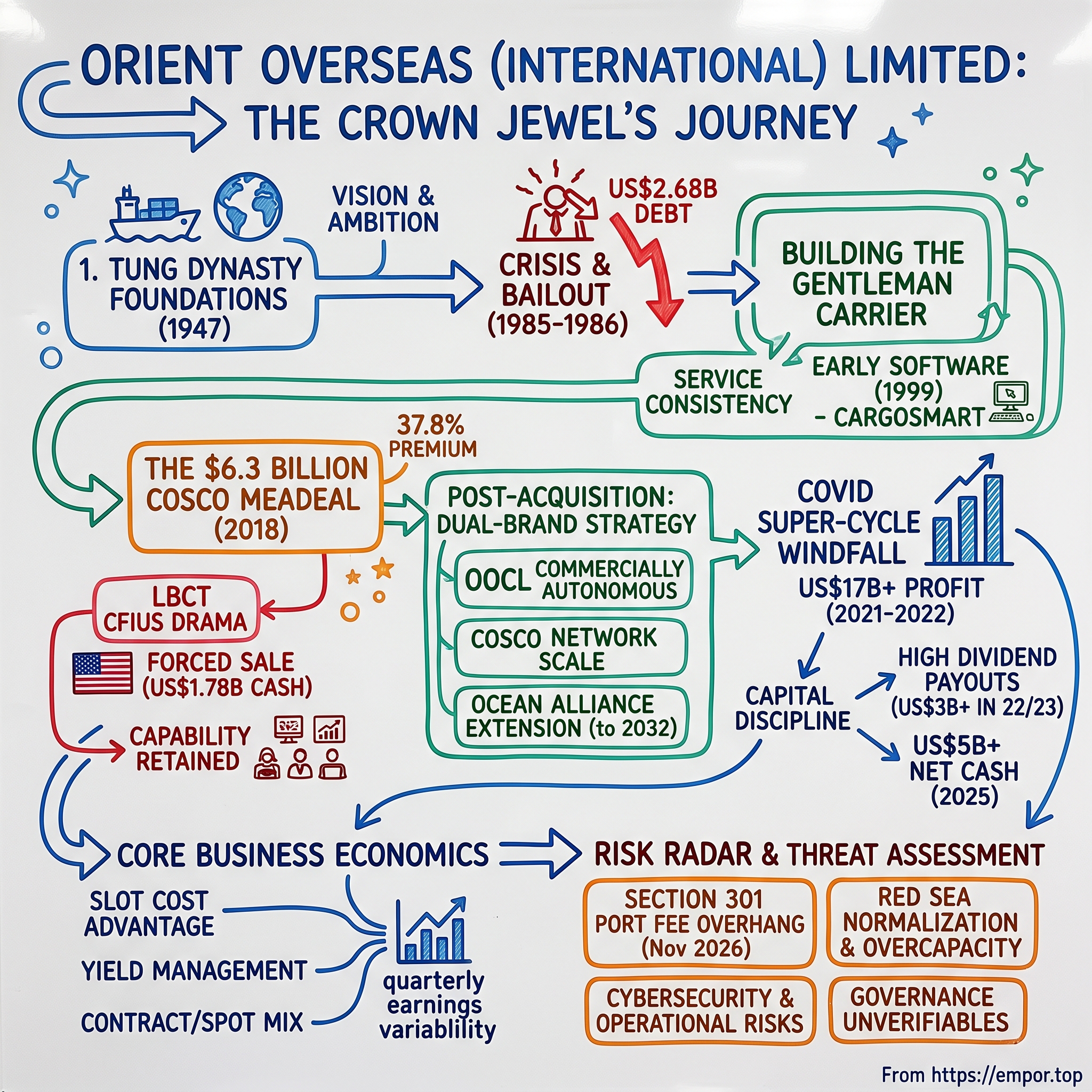
Orient Overseas (International) Limited: The Crown Jewel of Asian Shipping
I. Introduction & Episode Thesis
There is a moment in every commodity business where the numbers stop making sense, and for container shipping that moment arrived in 2021 and 2022. A Hong Kong-listed holding company with a fleet you could count without running out of patience — a business whose product is, at bottom, moving a steel box from one port to another — earned US$7.13 billion in 2021 and then US$9.96 billion in 2022. Two years. More than seventeen billion dollars of profit, from a company whose entire market value today sits near HK$102 billion, roughly US$13 billion.123
That company is 东方海外(国际)有限公司 Orient Overseas (International) Limited — OOIL to the market, 0316.HK on the Hong Kong Stock Exchange — the holding vehicle for 东方海外货柜航运有限公司 Orient Overseas Container Line, universally known as OOCL. It is a business with a peculiar dual identity. On one side, it is a 79-year-old Hong Kong shipping dynasty founded by 董浩云 Tung Chao-yung, a man who once owned the longest ship ever built and whose son became Hong Kong's first Chief Executive.45 On the other, it has been since 2018 a controlled subsidiary of 中国远洋海运集团 COSCO Shipping Holdings, the container arm of China's state maritime champion, which paid US$6.3 billion for it.6
The consensus story about OOIL runs roughly like this: OOCL is the "gentleman of container shipping," a boutique premium carrier with better IT, better service, better customers and structurally better margins than the commodity operators around it — and COSCO, in an act of unusual restraint for an acquirer, left it alone. The listed vehicle carries no meaningful net debt, pays out roughly half or more of its earnings in dividends, and functions for investors as a high-yielding, publicly traded claim on global trade volumes.
Most of that is true. Some of it deserves harder scrutiny, and this piece will apply it. The margin premium is real against Western peers but harder to verify against the parent that consolidates OOIL's own results. The "operational autonomy" is genuine at the front office and considerably less so at the network level, where COSCO and OOCL now plan capacity together. And the dividend, which is the single feature most retail holders buy the stock for, is not a policy in the contractual sense — it is a recommendation the board makes each year, and one whose most plausible driver is the cash needs of a majority owner in Shanghai, not the yield preferences of minorities in Hong Kong.
The paradox worth sitting with is this. A state-owned parent that controls roughly 71% of the shares could, in principle, run this asset in any number of value-extractive ways.7 Instead it has preserved the brand, kept the balance sheet in net cash of about US$5.0 billion at the end of 2025, and paid out roughly half of profit in each of the last two years.1 Why? And more usefully for an investor: what would have to change for that arrangement to stop being benign?
The story unfolds in six movements. First, the Tung family and the origins of a fleet built on ambition and nearly destroyed by it. Second, the 1986 rescue by Beijing-linked capital, which is impossible to separate from the 2018 sale to Beijing-owned capital. Third, the takeover itself and its extraordinary geopolitical epilogue in Long Beach, California. Fourth, the pandemic windfall and what management did with a mountain of cash. Fifth, the actual economics — how a container voyage makes or loses money, why alliances exist, and where OOCL's edge sits. And sixth, the case for and against owning a cyclical, state-controlled asset in a year when the U.S. has already tried once to price Chinese-linked tonnage out of its ports, and could do so again in November.
That last thread is not background colour. As of this writing, the single largest identifiable swing factor in OOIL's forward earnings is a U.S. trade action that was switched on in October 2025, switched off in November 2025, and is currently scheduled to switch back on in about fifteen weeks.89 Hold that thought; it will matter more than anything the company itself controls.
Start, though, in 1947, with a man loading a ship in Shanghai.
 Subscribe on LinkedIn
II. The Tung Dynasty & Historical DNA
The founding legend of Orient Overseas is a voyage. In 1947, Tung Chao-yung — C.Y. Tung to the English-speaking world — sent a ship crewed entirely by Chinese seafarers from China to Europe and the U.S. East Coast, at a time when the deep-sea trades were the near-exclusive province of British, Norwegian, Greek and American owners. The symbolism was the point. Tung was a nationalist and a romantic about the sea, and he wanted a Chinese merchant marine that answered to nobody.
The commercial vehicle came later. Orient Overseas Line was established in 1969, and by the 1970s Tung had assembled one of Asia's largest privately held fleets, spanning tankers, bulkers and the newly emerging business of containerisation. He was also, by temperament, a maximalist. The clearest artefact of that temperament still floats through maritime folklore: the ultra-large crude carrier that Tung acquired half-finished from Sumitomo Heavy Industries' Oppama yard, then ordered "jumboised" — physically cut and lengthened — until it reached 458 metres, the longest ship ever constructed. He named it Seawise Giant, a homophone of his own initials.4
The detail that matters for investors is not the ship's size but its timing. Tung bought and extended it during a savage tanker slump, when the rest of the industry had concluded that vessels of that scale were uneconomic. The New York Times at the time called it a puzzling judgement, noting that Tung was the only owner still buying the big ones.4 He was making the classic shipowner's bet: that the downturn was cyclical, that the weak would be shaken out, and that whoever held the most steel when the cycle turned would own the recovery.
It was a bet he lost. The tanker market did not turn in time.
The 1985 collapse and the rescue that defined everything after
C.Y. Tung died in 1982, leaving his eldest son 董建华 Tung Chee-hwa a fleet, a philosophy, and a debt load calibrated for a recovery that never arrived. Three years later, in August 1985, the younger Tung had to make the announcement every operator dreads: the group could not repay US$2.68 billion owed to roughly 200 banks. Contemporary accounts ranked it as the third-largest corporate bailout in history to that point, behind Chrysler and Lockheed.5
What followed is the hinge on which this entire company still turns. Japanese creditors demanded a signal of confidence in the form of fresh equity. Tung went first to Taipei, where he found no takers. Then he went to Beijing. The transaction was brokered through the Hong Kong tycoon 霍英东 Henry Fok, a man with deep mainland connections, who invested US$120 million in return for 8% of the shares. Tung later acknowledged publicly that Fok had been backed by Beijing, while insisting the deal was commercial and that everyone involved earned a return.5
Read that sequence again with an investor's eye. In 1986, mainland state-linked capital rescued a Hong Kong shipping family from insolvency. Eleven years later, in 1997, that family's eldest son became the first Chief Executive of the Hong Kong Special Administrative Region — a selection that drew immediate questions about whether the 1985 rescue had effectively been collateral.5 And thirty-two years later, in 2018, the family sold the whole enterprise to a Beijing-owned state shipping group. The 2018 transaction is often narrated as a surprise. It was not. It was the last chapter of a relationship that began when the alternative was liquidation.
Building the "gentleman carrier"
The operating company that emerged from the restructuring was run by the second son, 董建成 Tung Chee-chen — C.C. Tung — who served as chairman, president and chief executive for decades, and it looked nothing like his father's.6 Where C.Y. Tung had chased scale across every asset class that floated, C.C. Tung narrowed the business to containers and pursued something the industry had historically been terrible at: consistency.
That meant schedule reliability that customers could plan factories around, cargo damage rates that kept high-value shippers loyal, and — most distinctively — a genuine investment in software at a time when most liner companies still ran on fax machines and telex. OOCL built an internal systems capability and, in 1999, launched CargoSmart, a booking, tracking and documentation portal that let shippers see and manage their freight electronically. In an industry where the standard customer experience involved calling an agent to ask where a box was, this was a meaningful differentiator, and it seeded a software franchise that survives inside the group to this day under a different name.
The reputational result was the "gentleman carrier" label: a mid-sized operator that competed on service quality and yield rather than on volume, that avoided the ruinous market-share wars that periodically bankrupted its competitors, and that charged a premium for it. The financial result was subtler. Being a premium niche operator is a wonderful way to earn better margins in a normal year and a dangerous way to survive a structural shift, because in shipping, scale eventually shows up in unit cost whether you like it or not.
It is worth pausing on what containerisation actually meant, because the word has been repeated so often that its violence has been sanded off. Before the box, general cargo moved as loose crates, sacks and drums, loaded piece by piece by gangs of dockworkers, with a ship spending as much time alongside a berth as it did at sea. The container converted that artisanal process into a standardised industrial one: the same steel unit fits a ship, a train and a truck chassis, so cargo can move from a factory floor in Dongguan to a distribution centre in Ohio without a human ever touching the goods inside. That standardisation collapsed the cost of moving manufactured goods across an ocean to something close to a rounding error on the retail price, which is the physical precondition for the entire Asian export economy of the last five decades.
The strategic implication for carriers was less pleasant than it sounds. Standardisation is what made global trade cheap, and it is also what made shipping a commodity. Once every carrier moves an identical box on an identical schedule, the only remaining dimensions of competition are price, reliability and the quality of the information wrapped around the shipment. OOCL's entire identity — punctuality, low damage rates, early software — was an attempt to compete on the two dimensions that were not price. It worked, in the sense that customers paid up. It could not, however, exempt the company from the industry's underlying physics.
By the mid-2010s that shift had arrived. Maersk and MSC were operating vessels of 18,000 TEU and larger; slot costs on the biggest ships were falling below anything a mid-sized carrier could match; and in 2016 South Korea's Hanjin Shipping — the world's seventh-largest liner — simply collapsed, stranding cargo at sea and demonstrating that a carrier's brand equity was worth precisely nothing without a balance sheet and an alliance behind it. OOCL was profitable, respected and roughly a twentieth the size of the emerging giants.
The Tung family, two generations after C.Y. Tung had bet everything on the biggest ship in the world, faced the arithmetic honestly: in this industry, being excellent and sub-scale is a slow-motion problem. What they did next was sell to the one buyer who could pay a premium for excellence and supply the scale themselves.
III. The $6.3 Billion COSCO Megadeal & LBCT CFIUS Drama
On a Sunday in July 2017, Hong Kong's stock exchange filings system carried an announcement that reordered the global liner league table. COSCO Shipping Holdings, together with 上海国际港务(集团)股份有限公司 Shanghai International Port Group (SIPG), launched a cash offer for all of Orient Overseas at HK$78.67 per share, valuing the company at HK$49.23 billion, or about US$6.30 billion.610 The Tung family, holding 68.7% of the shares, had already agreed to sell.6
The price told you what COSCO thought it was buying. HK$78.67 was a 37.8% premium to OOIL's last closing price of HK$57.10 — an unusual amount to pay in an industry then limping through one of its worst rate environments in decades.6 Acquirers in shipping downturns normally buy distressed steel at a discount to book value. COSCO paid a premium to book for a company whose ships it could have replicated by ordering newbuildings, which means it was not buying the ships.
It was buying three things the ships could not deliver. First, customers: OOCL's franchise on the Transpacific and Asia-Europe head-haul lanes, built over decades with retailers and manufacturers who had never in their lives booked with a Chinese state carrier. Second, systems: a genuinely differentiated IT stack in an industry where most of the competition was still stitching together legacy platforms. Third, and most importantly, a Hong Kong-domiciled commercial front end whose brand did not carry the political freight of a mainland state-owned enterprise — a subtlety that would become very expensive within a year.
There is a useful way to sanity-check whether the price was defensible, and it starts with the observation that shipping is one of the few industries where book value means something concrete. A carrier's balance sheet is mostly ships, and ships have observable second-hand prices. That is why liner equities habitually trade below book in downturns: the market is saying it can buy the same steel cheaper elsewhere. Paying a premium to book, as COSCO did in the depths of a rate slump, is therefore an explicit statement that the intangibles — the customer book, the systems, the brand, the people — are worth more than the ships they sit on. Whether that judgement was correct is a question the subsequent decade answered emphatically in COSCO's favour, though for reasons nobody involved in 2017 could have anticipated.
The strategic logic on COSCO's side was consolidation arithmetic. Post-Hanjin, the industry had concluded that there was no viable position between "global scale" and "regional niche," and everyone was buying. COSCO's own framing at announcement was the standard synergy language — realising synergies, enhancing profitability, achieving sustainable long-term growth — and the deal lifted the combined group to third place globally with more than 400 vessels and capacity above 2.9 million TEU.6 The offer completed on 24 July 2018, with COSCO Shipping Holdings taking the controlling position and SIPG a 9.9% economic interest alongside it.[^11]
Long Beach: when the deal met Washington
Then the acquisition ran into the one asset nobody had adequately war-gamed.
OOIL owned Long Beach Container Terminal — LBCT — a highly automated container facility inside the largest port complex in North America. In the hands of a Hong Kong family company, it was a piece of infrastructure. In the hands of a Chinese state-owned enterprise, it became, in the view of the Committee on Foreign Investment in the United States, a national security question: automated terminal systems, cargo data on U.S. imports, and physical control of throughput at a strategically critical gateway, all owned by Beijing.
The resolution was a National Security Agreement with the U.S. Departments of Homeland Security and Justice. LBCT was placed beyond COSCO's operational control and put up for sale. On 30 April 2019, OOIL announced the disposal of 100% of the terminal to a consortium led by Macquarie Infrastructure Partners IV for US$1.78 billion, with an expected book gain of just under US$1.3 billion; the transaction closed later that year.11
The way the company handled the forced sale is the most instructive piece of corporate craft in this whole story, and it is worth being precise about why. A distressed regulatory divestment normally destroys value twice: you sell under a deadline into a buyer pool that knows you must sell, and you lose the operational capability the asset provided. OOIL avoided the second loss entirely. Alongside the sale, OOCL committed to a 20-year arrangement to procure or place a minimum number of vessel lifts at Long Beach at agreed ship and rail tariffs, with penalties for falling short.11
Strip out the legal language and the structure is elegant: OOCL converted an owned asset into a contracted service. It gave up the equity in the terminal and kept the thing that actually mattered commercially — guaranteed berth and handling capacity at a chokepoint port, at pre-agreed rates, for two decades. It also crystallised US$1.78 billion in cash in 2019.
Whether that timing was foresight or fortune is unknowable, and it is worth resisting the temptation to call it genius. Nobody in April 2019 was forecasting a pandemic that would triple freight rates. But the consequence is factual: OOIL entered the most violent bull market in the history of container shipping with a fortress balance sheet and no need to raise capital at any point during it. The counterfactual — a leveraged carrier forced to negotiate with banks in early 2020 — is a materially worse company today.
There is a second lesson in Long Beach that has aged into something larger. The CFIUS action was the first clear signal that OOIL's ownership had converted a commercial asset base into a politically contingent one. In 2019 the cost of that was one terminal. In 2025, as we will see, Washington priced the entire fleet.
For the moment, though, COSCO had its prize, and faced the question every acquirer of a premium brand eventually faces: what do you actually do with it?
IV. Post-Acquisition Integration: Dual-Brand Strategy & Ocean Alliance
The default corporate instinct after a US$6.3 billion acquisition is absorption. Merge the sales forces, retire the smaller brand, consolidate the systems onto the acquirer's platform, and book the cost synergies within eighteen months. It is the playbook that has destroyed more acquired franchises than any other.
COSCO did the opposite, and the choice was deliberate enough to have its own name inside the group: 双品牌战略, the dual-brand strategy. OOCL kept its name, its Hong Kong headquarters, its own commercial organisation, its own customer relationships and its own pricing desk. A shipper who booked with OOCL in 2019 dealt with the same people, on the same systems, under the same service commitments as in 2016. Management has referenced the dual-brand model consistently in results commentary since, including in the 2024 annual results where chairman 万敏 Wan Min framed the group as prepared to "embrace opportunities and respond to challenges" on the strength of dual-brand operation and operational efficiency.12
Behind that preserved front office, however, integration ran deep. Network planning, vessel deployment, slot allocation, equipment repositioning and procurement moved toward joint decision-making. This is the part investors most often misread. OOCL's autonomy is commercial, not industrial. The company does not independently decide which ships sail which loops; it participates in a capacity system planned at group and alliance level.
Why alliances exist, in plain language
Container shipping has a structural problem that most industries do not: the product is a scheduled service, and a scheduled service requires a fixed number of ships regardless of how much cargo you have. To run a weekly Asia-to-Northern-Europe service, you need roughly eleven to thirteen vessels in a continuous loop, because the round trip takes about that many weeks. If you want to offer customers a sailing every week from four different Asian ports to four different European ports, the vessel count multiplies fast.
For a carrier of OOCL's size, providing that coverage alone would mean either an enormous fleet running half-empty or a thin, uncompetitive network. Alliances solve this. Carriers pool vessels into shared loops and each partner receives an allocation of slots on every ship in the loop. OOCL puts three ships into a service and receives space on all thirteen. The customer sees a comprehensive weekly network; the carrier carries the capital cost of only its own contribution.
OOCL and COSCO co-anchor the Ocean Alliance alongside 达飞海运 CMA CGM and 长荣海运 Evergreen Marine. In February 2024 the four extended their operational agreement by five years, pushing the expiry from 2027 out to 2032 across seven major East-West trades linking Asia with Northern Europe, the Mediterranean, the Middle East and both North American coasts.13 The extension surprised parts of the market — Vespucci Maritime's Lars Jensen said publicly he had expected the grouping to split up — because it came precisely as the rival 2M alliance was dissolving and Maersk was pairing off with Hapag-Lloyd to form Gemini.13
For OOIL shareholders, the extension is one of the more underappreciated de-risking events of the last few years. It fixes the company's access to a competitive global network through 2032. Without it, a sub-1.2-million-TEU carrier would face the question of who, exactly, it would sail with — and the answer, in a consolidating industry, might have been nobody on acceptable terms.
The second-order benefit is subtler and shows up in the cost line. Because COSCO and OOCL plan capacity jointly and can co-load each other's cargo, an OOCL box that would otherwise sail on a half-empty OOCL ship can travel on a COSCO vessel that is already going, and vice versa. In a business where the marginal cost of an extra container on a sailing ship is close to zero and the marginal cost of an extra sailing is enormous, that flexibility is worth real money. It is also the mechanism that makes OOCL's reported utilisation partly a function of a relationship rather than purely a function of its own commercial skill — which matters when assessing how much of the margin premium is transferable.
Myth versus reality
Three claims about post-acquisition OOCL circulate widely enough to deserve direct testing.
Myth: OOCL operates with complete autonomy from COSCO. Reality: commercial autonomy is real and network autonomy is not. Pricing desks, customer contracts and brand remain OOCL's; vessel deployment, slot allocation, equipment flows and procurement are group decisions. An investor buying "an independent premium carrier" is buying the commercial front end of an integrated state network.
Myth: OOCL's margin premium proves its culture survived state ownership. Reality: the premium versus Maersk and Hapag-Lloyd is large and consistent, but the causal attribution is unproven, because a meaningful share of the gap reflects business mix — no global logistics build-out, a large intra-Asia book — and the co-loading relationship described above. The defensible statement is that the operating quality is visible; the defensible caveat is that it has never been observed independent of COSCO.
Myth: the Tung family sold at the top and COSCO overpaid. Reality: the offer was struck in a depressed rate environment at a premium to a depressed price, and the 2021–2022 windfall arrived four years later. Judged against the earnings that followed, US$6.3 billion for this asset looks like one of the better-timed acquisitions in modern shipping — an outcome, it should be said, that no party could have forecast at the time.
Testing the "superior margins" claim honestly
The most repeated claim about OOCL post-acquisition is that its margins prove the premium culture survived state ownership. The evidence is real but narrower than the claim.
Against Western peers, the gap is stark. In 2025, OOIL's container transport and logistics business ran an EBIT margin of roughly 15.9%.1 Maersk, the industry's most sophisticated integrator, turned US$54.0 billion of revenue into US$3.5 billion of EBIT — about 6.5%.14 Hapag-Lloyd, the Gemini partner widely regarded as a well-run carrier, produced roughly US$1 billion of EBIT on US$20.6 billion of revenue, and moved 8% more cargo than the prior year while earning 8% less per box.15 On this comparison, OOCL earned roughly two to three times the operating margin of two of the best-run carriers in the Western world.
Against its own parent, the picture is murkier, and the honest answer is that public disclosure does not permit the clean comparison the bull case assumes. COSCO Shipping Holdings' 2025 accounts consolidated OOIL inside them: group revenue of RMB 219.50 billion, net profit of RMB 30.87 billion — about US$4.32 billion — and container volumes of 27.4 million TEU, up 5.8%.16 COSCO also owns a large terminal business, whose throughput reached 153.0 million TEU in 2025, and terminals earn steadier margins than ships.16 You cannot subtract a clean "COSCO Shipping Lines standalone" margin from those figures, and OOIL's reported margin is therefore not demonstrably superior to its sibling liner brand — only demonstrably superior to Maersk and Hapag-Lloyd.
Part of the gap, moreover, is structural rather than cultural. OOCL is a pure liner and logistics operator with a large intra-Asia franchise; Maersk carries the cost of a global end-to-end logistics build-out, and Hapag-Lloyd absorbed start-up costs for the Gemini network in 2025.15 Some of OOCL's premium is genuine yield and cost discipline. Some of it is simply a narrower, asset-lighter business mix that flatters the ratio.
That is the responsible reading: the operating quality is real and visible, the causal story about state ownership leaving a premium culture untouched is plausible but not proven, and the most defensible version of the claim is that OOCL has not deteriorated under COSCO — which, for a premium brand absorbed by a state giant, is itself a meaningful result.
Then the world handed the entire industry a windfall that made questions of margin discipline briefly irrelevant.
V. The Post-COVID Super-Cycle & Windfall Economics
In the autumn of 2021, dozens of container ships sat at anchor off Los Angeles and Long Beach, visible from the shore, waiting weeks for a berth. Every one of them was a floating warehouse that had stopped being transport and started being scarcity. That image — ships parked outside the world's most important import gateway while retailers screamed for inventory — is the single best explanation of what happened to freight rates, and to OOIL's income statement.
The mechanics were simple and brutal. Locked-down Western consumers stopped buying services and started buying goods. Port labour, chassis, trucks and warehouses could not absorb the surge. Ships queued. A vessel spending three weeks at anchor is a vessel not carrying cargo, so effective global capacity collapsed at the exact moment demand peaked. Spot rates on the Transpacific, which had spent the previous decade oscillating around low four figures per forty-foot container, went to multiples of that.
For a liner operator, the operating leverage in that environment is extraordinary, because the cost of carrying a box does not rise with the price of carrying it. Fuel, crew, port dues, depreciation and terminal handling are broadly fixed per voyage. Every incremental dollar of freight rate drops nearly intact to operating profit.
The results were accordingly absurd. In 2021, OOIL generated revenue of US$16.83 billion and EBIT of US$7.40 billion — an operating margin of roughly 44% on 7.6 million TEU of liftings.3 In 2022, revenue rose to US$19.82 billion and group EBIT reached US$10.09 billion, a margin above 50%, with net profit of US$9.96 billion and earnings of US$15.09 per share.2 For perspective, the 2022 profit alone was more than half the company's total revenue that year, and roughly three-quarters of what the entire enterprise is worth in the market today.2
What management did with the money
This is where cyclical companies reveal their character, and the industry's history offered two well-worn options. Option one: order ships. Every shipowner who has ever lived has been tempted at the top of a cycle to convert record cash into record capacity, and the resulting deliveries have reliably arrived three years later into a glutted market. Option two: acquire your way out of shipping — buy forwarders, terminals, air cargo, warehousing — and tell shareholders you are becoming an integrated logistics platform. Several peers chose that path aggressively.
OOIL did neither at scale. It ordered some ships — 22 vessels for US$1.576 billion announced in 2021, comprising ten 16,000-TEU and twelve 23,000-TEU units for delivery between 2023 and 2025 — which is a genuine but proportionate commitment against nearly US$8 billion of EBIT in that single year.3 And it paid out. For 2022, the board recommended distributions equal to roughly 70% of profit, including a final dividend of US$2.61 per share and a special dividend of US$1.95.2
The balance sheet consequence was a company that ended 2022 with US$11.2 billion of cash and a net cash position of US$9.1 billion.2 Consider the timing: that cash pile was assembled immediately before the sharpest global tightening cycle in four decades. A leveraged carrier spent 2023 and 2024 refinancing into materially higher rates. OOIL spent those years earning interest.
The analytical conclusion an investor should draw is narrower than "management is brilliant," and more durable. What the 2021–2023 period demonstrates is a genuine institutional preference for distributing cyclical windfalls rather than reinvesting them at the top of a cycle — a preference that is unusual in shipping and that has now been observed across multiple years and multiple boards. That is a behavioural fact with predictive value.
Two caveats keep it honest. First, the headline yields quoted from that era are arithmetic artefacts of peak earnings, not a sustainable income stream; a payout ratio applied to a once-in-a-century profit produces a once-in-a-century dividend. Investors who anchored on the double-digit — occasionally far higher — trailing yields of 2022 and 2023 were, in effect, capitalising a pandemic. The subsequent normalisation of the ordinary distribution, to US$1.32 per share for 2024 and US$1.14 for 2025, is the more honest picture of what this business pays out in a functioning market.121 Second, the payout decision is not purely shareholder-friendly design. A controlling parent that consolidates OOIL but does not receive its cash flow directly has an obvious interest in dividends flowing upward — and the same logic applies at COSCO Shipping Holdings, which itself distributes about half its net profit.16 Minority holders are riding alongside the parent's cash needs, which is a comfortable position right up until those needs diverge.
The windfall ended as abruptly as it began. By 2023, congestion had cleared, rates had collapsed, and OOIL's revenue fell to US$8.34 billion with net profit of US$1.37 billion — a 86% earnings decline from the peak.12 The super-cycle was over, and what was left behind was the ordinary business: a well-run carrier in a structurally oversupplied industry, now with a state-owned parent and a very large cash balance.
Which raises the question of who is actually steering it.
VI. Current Management, Corporate Governance & Capital Allocation
Walk into OOIL's annual general meeting and the governance structure resolves into something unusual: a Hong Kong-listed company whose chairman also chairs the Chinese state shipping group that controls it, whose chief executive arrived from that same parent, and on whose board still sits a member of the founding family that sold out eight years ago.
The chairman is Wan Min, who simultaneously holds the top position at the COSCO Shipping group.12 That is not a governance oversight; it is the design. It puts the person accountable for the parent's strategy directly in the chair of the subsidiary, which maximises alignment between the two entities and correspondingly reduces the independence of the subsidiary's board from the majority owner's priorities. Investors should be clear-eyed that both of those consequences follow from the same fact.
The chief executive is 陈扬帆 Chen Yangfan, appointed executive director and CEO with effect from 25 October 2023 on an initial three-year term, having come from a senior role at China COSCO Shipping Corporation.17 杨志坚 Yang Zhijian serves as an executive director and sits on the executive, finance, risk and strategic development committees.18 At the operating liner company, 陶维栋 Tao Weidong serves as chief executive of OOCL and has been the public face of the fleet renewal programme.19 And 董立均 Andy Tung, C.C. Tung's son and formerly co-CEO of OOCL, has remained on the board as a non-executive director since January 2020 — a continuity gesture that also preserves institutional memory of the pre-2018 franchise.18
Two observations about this roster. It is thoroughly a COSCO-appointed executive team, which means the "OOCL culture survived" narrative rests on preserved systems, staff and customer relationships rather than on preserved leadership. And CEO tenure at the listed vehicle has been short by the standards of a business with fifteen-year asset lives — a pattern worth watching, because rotating executives seconded from a state parent optimise differently from owner-operators with decade-long horizons.
Ownership and the minority question
COSCO Shipping Holdings and SIPG hold their stakes through Faulkner Global Holdings, which controlled approximately 71% of the ordinary share capital as disclosed in OOIL's recent annual reporting.7 The remaining free float trades on the Hong Kong exchange.
That structure creates the governance question every minority holder in a state-controlled listco must answer: is value being extracted upward? The mechanisms available would be related-party transactions — bunker fuel purchased from group affiliates, terminal services bought from COSCO Shipping Ports, vessels chartered between the brands, slots exchanged within the alliance — each of which can be priced to move margin from the listed entity to the unlisted parent.
The honest answer is that no evidence of extraction is visible in the public record, and there is a structural check: as a Hong Kong-listed issuer, OOIL must disclose and benchmark connected transactions under the exchange's listing rules, with independent shareholder approval required above certain thresholds.20 But absence of visible extraction is not proof of its absence, and the analytical soft spot is real. Because network planning is joint, the allocation of cargo, slots and cost between the two brands is a management judgement made by executives appointed by the parent. There is no disclosure granular enough for an outside investor to verify that OOCL receives its economically fair share of the joint network. That is a permanent, structural item on the risk ledger — not an accusation, but an unverifiable.
An activist would press three points here. First, the disclosure gap above. Second, capital allocation optionality: a company sitting on roughly US$5.0 billion of net cash against a market capitalisation near US$13 billion is holding an enormous, low-returning asset, and there is no buyback programme of consequence — arguably rational when the free float is already thin, but it means minorities receive their return only in the form the parent also wants. Third, the payout convention itself: distributions of about 50% of profit in each of the last two years look like a settled practice, but a practice is not a policy, and the board retains full discretion to change it in a downturn.1
Capital discipline, tested against behaviour
Management's stated capital plan is fleet renewal rather than fleet expansion, and the recent record broadly supports that framing. Through 2025 the group took delivery of nine 16,828-TEU vessels, completing that series, and ordered fourteen 18,500-TEU methanol dual-fuel ships for delivery in 2028 and 2029.1 Earlier, in 2024, it took seven large vessels and chartered six 13,000-TEU units.12 The first of a seven-ship series of 24,000-TEU methanol dual-fuel giants, OOCL Wisdom — at 24,168 TEU the largest methanol dual-fuel container vessel in the world — was named on 8 May 2026 at the Nantong COSCO KHI yard in Jiangsu, with OOCL's chief executive framing it as evidence of commitment to "green and low-carbon development, digital intelligence and sustainability."19
That is a substantial newbuilding programme, and calling it pure "renewal" requires care: 16,828-TEU and 24,168-TEU ships replacing older, smaller tonnage add net capacity even when vessel counts stay flat. The verifiable operating consequence is visible in the quarterly data — loadable capacity grew 6.1% in 2025 against liftings growth of 3.7%, which is why the load factor fell 1.9 percentage points.1 Growing capacity faster than volume is what the entire industry is doing, and it is the mechanism by which freight rates deflate. OOIL is a participant in the oversupply it complains about, not a bystander.
On credibility, management's public commentary has been notably specific rather than promotional. In discussing the first half of 2025, the group drew a clean distinction between the drivers of two different years — framing the Red Sea as the defining factor behind 2024's strength, and tariff policy and trade disputes as the decisive influence on 2025 — and flagged in advance that the U.S. port fees on China-linked tonnage due in mid-October would "have a relatively large impact," while disclosing that OOCL and COSCO had launched services routing cargo through Mexico in response.21 Naming a specific threat, quantifying it as material and describing an operational mitigation before the event is the behaviour of a management team explaining rather than deflecting. It is a small data point, but it is the right kind.
To judge whether any of this operating machinery deserves a premium, you have to understand how the money is actually made.
VII. Core Business Economics & Global Container Shipping Industry
Picture a 24,000-TEU container ship leaving Shanghai for Rotterdam. It is nearly four hundred metres long, carries the equivalent of roughly twelve thousand forty-foot boxes stacked twelve high, burns something in the order of a hundred tonnes of fuel a day, and costs a quarter of a billion dollars or more to build. Once it sails, essentially all of its costs are locked. The only variable that matters is how much cargo is aboard and what that cargo paid.
That single sentence explains almost everything about this industry's behaviour: the price wars, the alliances, the boom-bust cycles, and why an eight-percentage-point swing in utilisation can be the difference between a record year and a loss.
The structure of the industry
Container shipping is a consolidated oligopoly that behaves like a fragmented commodity market, which is an unusual and unhappy combination. Alphaliner's capacity data from May 2025 put MSC first at roughly 6.62 million TEU and 20.6% of global capacity, Maersk second at about 4.57 million TEU and 14.2%, CMA CGM third at 3.95 million TEU and 12.3%, and COSCO Shipping fourth at 3.37 million TEU and 10.5% — with Hapag-Lloyd at 7.5%, ONE at 6.3%, Evergreen at 5.6%, and HMM, ZIM and Yang Ming rounding out the top ten in the 2% to 3% range.22 The top four alone control well over half the world's slots.
Concentration of that order would normally imply pricing power. It does not here, for two reasons. Capacity is added in enormous indivisible lumps — you cannot order a third of a ship — and it arrives two to three years after the decision to build, which guarantees that supply responds to the last cycle rather than the current one. And the underlying service is close to undifferentiated: a box that arrives on Tuesday is a box that arrives on Tuesday, whoever's funnel is painted on the ship.
Three alliances organise the East-West trades: the Ocean Alliance, the Gemini Cooperation formed by Maersk and Hapag-Lloyd, and the Premier Alliance grouping ONE, Yang Ming and HMM. MSC, uniquely, has enough ships to run a comprehensive global network alone.
Within that map, OOCL is deliberately small. The group's operating capacity was around 1.15 million TEU at the end of 2025 — roughly a third of the combined COSCO group total and well under a fifth of MSC's.1 OOCL is not competing for the title of largest carrier. It is competing to be the most profitable operator of a network it does not have to own outright.
How a voyage makes money
The revenue side is two numbers multiplied together: how many boxes you lift, and what you earn per box. OOIL reports both quarterly, split by trade lane, which makes it one of the more transparent carriers in the world for an outside analyst.
The cost side is best understood through "slot cost" — the all-in expense of carrying one twenty-foot container one voyage. It comprises the vessel's capital cost spread across its slots, bunker fuel, port and canal dues, terminal handling charges at both ends, inland haulage, and the frequently underestimated cost of repositioning empty boxes. That last item deserves a moment, because it is where good operators separate themselves. Global trade is directionally imbalanced: far more full containers move from Asia to North America than back. Somebody has to pay to send the empties home, and a carrier that finds backhaul cargo, or that stages its equipment intelligently, structurally beats one that doesn't.
OOCL's claimed edge sits on both sides of that equation. On the cost side, alliance slot-sharing lets it access mega-vessel economics without carrying mega-vessel capital, and co-loading with COSCO fills space that would otherwise sail empty. On the revenue side, the company has invested for two decades in yield management — the airline-style discipline of deciding which cargo to accept at what price rather than filling the ship with whatever books first. The observable proxy is load factor, which OOIL discloses each quarter as a directional change.
There is one further lever that explains much of the variance between carriers in any given year: the mix between contract and spot cargo. Large shippers negotiate annual or multi-year contracts — the Transpacific contracting season traditionally settles around May, the Asia-Europe season around January — while the remainder of the ship is filled at prevailing spot rates. A carrier heavily weighted to contracts gives up the upside when spot rates triple, and is protected when they collapse. A carrier weighted to spot does the reverse. This is why two competent operators on identical routes can report wildly different results in the same quarter, and why any single quarter says less about management quality than it appears to. It also explains the pattern visible in OOCL's own numbers: the company's revenue per box moves less violently than the published spot indices, which is the signature of a substantial contract book acting as a shock absorber in both directions.
The evidence for the edge is decent but not overwhelming, and the fair summary is that OOCL's execution is visible in its margin relative to Western peers, while the portion attributable to yield management versus favourable trade mix versus alliance structure cannot be disentangled from public disclosure.
From normalisation to the Red Sea, and to now
The recent history of this business is a case study in how much of a liner's earnings is determined by events entirely outside its control.
After 2023's collapse, the Houthi attacks on shipping in the Bab-el-Mandeb strait forced carriers to abandon the Suez Canal for the long way around the Cape of Good Hope. Adding roughly ten to fourteen days to each Asia-Europe round trip does not change how many ships exist; it changes how much work each ship can do, absorbing a meaningful slice of effective global supply. Rates rose sharply, and OOIL's 2024 revenue recovered to US$10.70 billion with EBIT of US$2.62 billion and net profit of US$2.58 billion, or US$3.90 per share, with a dividend of US$1.32.12
Then 2025 took it back. Revenue fell 9% to US$9.72 billion, operating profit fell 42% to US$1.54 billion, net profit fell 41% to US$1.51 billion and earnings per share dropped to US$2.29.123 Liftings actually rose 3.7% to 7.87 million TEU — the company carried more cargo than ever — but liner revenue fell 10.6% to US$8.78 billion because the average price per box collapsed.1 The Shanghai Containerized Freight Index averaged 37% lower across the year.16 Volume was never the problem; price was.
The lane-level data from early 2026 shows the same signature with sharper edges. In the first quarter, total liftings grew 1.7% to 1.997 million TEU while liner revenue fell 7.6% to US$2.14 billion and average revenue per TEU dropped 9.1%.24 The Transpacific — historically OOCL's most lucrative trade — did the real damage: liftings there fell 5.9% to 523,385 TEU while revenue fell 16.8% to US$744.8 million, meaning the company lost both volume and price on its best lane simultaneously.24 Asia-Europe volumes rose 11.8% but revenue still slipped 4.5%.24
And then, abruptly, the market turned again. In the second quarter of 2026 OOCL's liner revenue rose 19.8% year on year to US$2.54 billion, liftings rose 8.8%, the load factor improved 1.9 percentage points, and average revenue per TEU rose 10.1% — leaving first-half revenue up 5.5% with revenue per TEU essentially flat at plus 0.2%.25
The cause was not a demand renaissance. Through May and June 2026, Asia-U.S. West Coast spot rates rose roughly 120% and East Coast rates about 85%, with Shanghai-to-Los Angeles assessed near US$6,349 per forty-foot container in early July and Shanghai-to-New York near US$7,902.26 The drivers were importers pulling cargo forward ahead of tariff deadlines in late July, the closure of the Strait of Hormuz since 10 July — which cut transits about 60% week-on-week and left roughly 200,000 TEU of capacity restricted or trapped in the region — and a renewed attack off Yemen on 5 July that put the tentative Suez return back in doubt.26 By mid-July roughly 11% of the global container fleet was sitting at anchor waiting for berths, the highest since 2022, and the SCFI had begun to retreat.26
That is the honest characterisation of OOIL's current earnings power: a well-run operator whose quarterly results are dominated by chokepoint geopolitics and tariff calendars. The company's skill determines the spread it earns versus other carriers. It does not determine the level.
There is one part of the business, though, where OOCL has tried to build something the freight market cannot take away.
VIII. Hidden / Digital Business: IQAX, CargoSmart & GSBN
Here is a fact about global trade that sounds like it belongs in the nineteenth century, because it does. The bill of lading — the document that proves who owns the cargo, and without which the goods cannot be released — has historically been a piece of paper that must physically travel from the shipper to a bank to the consignee. Cargo routinely arrives at a port before its ownership document arrives by courier. Fortunes in demurrage have been made on that gap.
OOCL has been attacking this problem longer than almost anyone, and the lineage runs directly back to the CargoSmart portal launched at the end of the 1990s. That software unit was eventually reorganised and rebranded as 智安达 IQAX, which develops shipping-industry software including an electronic bill of lading product.
The consortium layer sits above it: the Global Shipping Business Network, a not-for-profit venture co-founded by carriers and terminal operators to run a shared, blockchain-based data infrastructure for trade documents.27 The point of a consortium here is not the blockchain buzzword but a genuine coordination problem — an electronic bill of lading is only useful if the counterparty's bank, the terminal and the customs authority all accept that exactly one original exists and that you hold it.
The most concrete proof point came in March 2025, when OOCL completed what was described as the first cross-platform electronic bill of lading transaction: OOCL issued an eBL through IQAX, it was transferred to the receiving party via ICE Digital Trade's CargoDocs platform, and then surrendered back to OOCL, with GSBN acting as the security layer maintaining a single verifiable original across two competing systems under the legal framework of the U.K.'s Electronic Trade Documents Act 2023.28 Interoperability is the entire game in trade digitisation, because a document standard that only works inside one vendor's walled garden solves nothing.
Now the proportionality, which matters more than the technology. Digital services are not a material revenue line for this group. OOIL does not break out software as a reportable segment of consequence, and the honest framing is that IQAX is a cost-and-service asset, not a hidden technology company waiting to be revalued. Anyone building a sum-of-the-parts valuation with a software multiple attached to it is inventing an asset.
To understand why any of this matters commercially, it helps to see where the money actually leaks in a container shipment. The freight itself is a single line item. Around it sits a swarm of small, labour-intensive processes: booking confirmation, container release, customs filings in two or more jurisdictions, dangerous-goods declarations, terminal appointment scheduling, invoice reconciliation, and the physical handling of documents through banks. Each of those steps costs money, introduces delay, and generates disputes. A shipper whose cargo sits at a terminal for three extra days because a document is in transit pays storage charges and misses a retail window. Compressing that cycle is worth more to a large importer than a modest difference in freight rate, and it is exactly the kind of value that does not show up in a published rate index.
The customer-side implication is stickiness rather than lock-in. When a retailer's own planning systems are wired into a carrier's booking and tracking interfaces, switching carriers means re-plumbing an internal process, not just signing a different contract. That raises the price at which a competitor can pry the volume away. It does not make it impossible, and during a rate war it will not come close to offsetting a large enough discount from a rival.
The real economic argument for the digital stack is defensive and unglamorous: lower documentation and administrative cost per box, faster cargo release, fewer errors, and deeper integration with the systems of large enterprise shippers — the kind of workflow entanglement that makes switching carriers annoying rather than impossible. That is worth something. It is worth a percentage point or two of margin and some customer stickiness, which in a business this cyclical is not nothing.
It is not, however, a moat that survives a freight rate war, and it should not be scored as one. Which brings us to a formal accounting of where the durable advantages actually lie.
IX. Framework Analysis: 7 Powers & Porter's 5 Forces
Strip away the narrative and ask the cold question: what, specifically, prevents a competitor from taking OOCL's business, and how durable is each barrier?
Hamilton Helmer's 7 Powers, applied honestly
Scale economies — real, but borrowed. OOCL accesses the unit costs of 24,000-TEU vessels without owning enough of them to fill a global network, because alliance slot-sharing converts scale from something you must buy into something you can rent.13 This is genuine and it is the single largest cost advantage the company has. It is also, definitionally, not proprietary: every Ocean Alliance member enjoys it, and the arrangement has a contractual expiry in 2032. A power with a renewal date is a power with a countdown clock.
Process power — the strongest claim, partially evidenced. Decades of accumulated capability in stowage planning, equipment repositioning, yield management and documentation are hard to copy quickly because they live in software, data and staff habits rather than in assets. The evidence is the persistent operating margin gap against Maersk and Hapag-Lloyd.11415 The counter-evidence is that the gap is partly explained by business mix and by the co-loading relationship with a parent that fills OOCL's ships. Score it as high, with the caveat that it has never been observed independent of COSCO.
Counter-positioning — weak, and arguably backwards. The bull framing is that a premium boutique brand operating under a state umbrella creates a position competitors cannot mirror. That is real as a commercial arrangement but it is not counter-positioning in Helmer's sense, because it involves no business model that incumbents are unable to adopt for fear of damaging their own. More importantly, the state umbrella now cuts the other way: it is precisely OOCL's Chinese state ownership that exposed it to U.S. port fees in 2025 and cost it the Long Beach terminal in 2019.
Cornered resource — low. Port access, berth windows and the Long Beach lift arrangement have value, but they are contracts, not exclusive rights.
Network economies, switching costs, branding — low to moderate. Liner shipping has almost no true network effects: another customer on the ship does not make the service better for existing customers. Switching costs exist at the workflow level via systems integration, but a large retailer can and does move volume between carriers each contracting season. Brand supports rate premiums with quality-sensitive shippers and is worth something real, but it is a preference, not a lock.
Net assessment: two solid powers, one of them rented, and a set of weak ones. This is not a monopoly business dressed as a shipping line. It is a well-run cyclical with a modest, defensible operating edge.
The practical consequence of that assessment is a discipline about what the operating edge can and cannot do. A few percentage points of structural margin advantage is enough to keep a carrier profitable in years when average operators break even, and enough to compound book value quietly across a full cycle. It is not enough to make earnings predictable, not enough to protect against a policy shock aimed at the owner rather than the operator, and not enough to justify valuing the business on anything resembling a stable multiple of a single year's profit. Investors who treat OOIL as a quality compounder are applying the wrong template; investors who treat it as a cyclical with a better-than-average operator and an unusually strong balance sheet are applying roughly the right one.
Porter's Five Forces
Rivalry — severe and structural. The combination of undifferentiated service, lumpy capacity additions and high operating leverage means rivalry expresses itself as periodic price collapse rather than as steady competition. The 2025 experience — more cargo carried, far less money earned — is rivalry in its purest form.115
Buyer power — high, and increasingly organised. Large shippers tender annual contracts across multiple carriers and shift volume on price. That power inverts only during genuine capacity crunches, which is exactly what the second quarter of 2026 demonstrated when rates doubled in weeks because chokepoints closed.26
Supplier power — moderate, with a shipbuilding twist. Yards enjoy pricing power in order booms and fuel suppliers pass through cost. The specific wrinkle for this group is that the yards are often affiliated: OOCL Wisdom was built at a COSCO joint-venture yard.19 That eases access to berths and financing while adding another related-party surface investors cannot independently price.
Threat of new entrants — very low. The capital, the network coverage, the alliance access and the regulatory footprint required to compete at scale are prohibitive. Nobody is starting a global liner from scratch.
Threat of substitutes — low. For deep-sea container freight there is no economic substitute. Air freight is an order of magnitude more expensive; rail serves only Eurasia. This is the industry's genuinely comforting force, and it is why liner shipping survives its own cyclicality.
The synthesis is uncomfortable for anyone hoping for a compounder. Two of the five forces are strongly favourable and permanent, two are strongly unfavourable and equally permanent. This is a business that will keep existing, will keep earning outsized returns in disrupted years and poor returns in oversupplied ones, and cannot escape either state.
That structural verdict is the right lens through which to view the specific threats now facing the company.
X. Risk Radar & Material Threat Assessment
The Section 301 port fee overhang — the largest single quantifiable risk, and it has a date. On 14 October 2025, the United States began charging vessels owned or operated by Chinese entities US$50 per net ton per voyage at U.S. ports, escalating by US$30 annually toward US$140 by 2028.89 The bills were immediate and enormous: COSCO and OOCL together paid US$42.8 million in the first week alone, with individual calls costing millions per ship, and HSBC estimated the measure would erode roughly 65% of OOCL's projected EBIT margin and about 74% of COSCO's.8 On 10 November 2025, following the trade agreement announced on 1 November, the U.S. Trade Representative suspended the action for one year, through 9 November 2026, with China reciprocally suspending its retaliatory port fees.299
That suspension expires in roughly fifteen weeks. This is not a diffuse geopolitical worry; it is a dated, quantified, binary event whose downside case removes most of a normal year's operating profit from the liner business. Two mitigating observations: the fee is per voyage rather than per box, so the group can concentrate U.S. calls onto fewer, larger, non-Chinese-linked vessels; and the Mexico routing services launched in 2025 show management prepared the operational workaround in advance.21 Neither mitigant makes the exposure small. Any investor in this security is, whether they frame it that way or not, taking a position on U.S.-China trade policy.
Overcapacity and Red Sea normalisation. The industry is absorbing a delivery wave that is projected to lift global capacity by roughly 36% between 2023 and 2027.30 Simultaneously, the Suez routing is partially returning: Maersk completed its first Red Sea voyages since 2023 and CMA CGM briefly redeployed loops before reversing after security incidents.3031 Monthly average capacity offered through Suez on Asia-Europe services had already collapsed from about 4.1 million TEU in 2023 to roughly 292,000 TEU in 2025.31 The mechanism to understand is that a full return releases capacity into an already oversupplied market almost overnight, because the same ships suddenly complete more round trips per year. Bank of America has framed a Red Sea resumption as exacerbating structural oversupply, and Hapag-Lloyd's own 2026 guidance range spans from a US$1.5 billion pre-tax loss to a US$500 million profit — a carrier of similar quality openly acknowledging it could lose serious money this year.3015 OOIL enters that environment with net cash rather than debt, which changes survivability but not direction.
Decarbonisation capital expenditure. Meeting tightening IMO greenhouse gas requirements means replacing conventional tonnage with methanol, LNG or ammonia dual-fuel ships. The group has committed to fourteen 18,500-TEU methanol dual-fuel vessels for 2028–2029 delivery on top of the 24,000-TEU series already delivering.119 The accounting consequence is a rising depreciation charge against uncertain green-fuel economics, since green methanol currently costs a substantial premium to conventional bunkers and the ability to pass that through to shippers is unproven. This is a real margin risk dressed in ESG language, and it should be tracked as capital intensity rather than as a sustainability initiative.
Demand and tariff-distorted trade patterns. Beyond the port fees, the tariff regime itself distorts volumes: importers pull cargo forward ahead of deadlines and then stop, producing artificial peaks followed by artificial troughs. That pattern was visible in the first half of 2026, with volumes surging into late-July deadlines.26 A carrier cannot plan a network around a policy calendar, and the resulting whipsaw raises operating cost even when annual volume is unchanged.
Cybersecurity, with precedent. This is not a theoretical risk for this group. In late July 2018 — the same week the OOIL acquisition completed — COSCO suffered a cyberattack that caused widespread network failures across its Americas operations, taking down email, internet telephony and network applications in the United States, Canada, Panama and much of South America, with data connections to customs authorities, terminals and railroads restored only gradually.32 Vessel operations themselves were unaffected, which is the reassuring part; the disquieting part is that a modern liner's competitive advantage lives almost entirely in the booking, documentation and customs systems that were knocked out. For a company whose stated differentiation is software and process, an extended systems outage attacks the moat directly rather than the ships.
The unverifiable governance risk. Not a headline threat, but a permanent one: the joint-network arrangement makes cost and revenue allocation between OOCL and its parent a matter of internal judgement that no outside investor can audit.
Taken together, the risk profile is unusual. The balance sheet risk is close to nil. The policy risk is severe, dated and outside management's control. That is the opposite of most equities, and it demands a different kind of monitoring.
XI. Playbook: Business & Investing Lessons
Lesson one: acquiring a premium brand and then leaving the front office alone is a real strategy, not a sentimentality. COSCO's dual-brand approach preserved the asset it actually paid a 37.8% premium for — customers who chose OOCL specifically because it was not a Chinese state carrier — while consolidating everything invisible to those customers.6 The transferable insight is that in service businesses, the acquired value usually lives in relationships and habits that dissolve on contact with an integration programme. The counter-lesson is equally important: preserving a brand does not preserve independence, and investors should not confuse a nameplate with governance.
Lesson two: distributing a windfall is a decision, and it compounds credibility. Every shipping cycle produces a cohort of owners who convert peak cash into peak-priced steel. OOIL's boards chose distribution at roughly 70% of profit in the boom year and roughly half of profit in the two years since, keeping a large net cash position through the sharpest tightening cycle in forty years.21 The generalisable point is that capital allocation behaviour observed across several years is far better evidence than any stated policy, and that in deeply cyclical industries the discipline to not reinvest at the top is worth more than operational excellence.
There is a practical corollary worth spelling out, because it is where most cyclical management teams go wrong. The temptation at the top of a cycle is not usually reckless — it is reasonable-sounding. Freight rates are high, so the return on a newbuilding looks compelling; competitors are ordering, so inaction feels like ceding share; and the shipyard slot is available now but will not be in two years. Every element of that reasoning is individually sound and collectively catastrophic, because it is the same reasoning happening simultaneously across the whole industry, and the ships all arrive in the same year. Resisting it requires a governance structure willing to look passive while peers look ambitious.
Lesson three: when forced to sell, sell the asset and keep the capability. The Long Beach divestment could have been a straightforward destruction of value under regulatory duress. Structuring a 20-year lift commitment alongside the sale converted terminal ownership into contracted access, retaining the commercial function while realising US$1.78 billion of cash and a book gain approaching US$1.3 billion.11 The broader lesson for any business facing forced divestment, sanctions or regulatory unwind: identify precisely which economic function the asset performs, and negotiate to retain that function rather than fighting to retain the asset.
A fourth lesson the outline does not claim, but the record supports: political proximity is a two-sided asset. The relationship with Beijing that saved this company in 1986 is the same relationship that delivered a premium exit for the founding family in 2018 — and the same relationship that cost it a Californian terminal in 2019 and exposed it to punitive U.S. port fees in 2025.56118 Companies whose competitive position depends on the state inherit the state's enemies along with its support. That should be priced, in both directions.
XII. Bull vs. Bear Case & Key KPIs
Why this business could win from here
The bull case does not rest on growth, and any version that does should be discarded. It rests on three testable propositions.
The first is durable operating outperformance. In a year when Maersk earned roughly 6.5% EBIT margins and Hapag-Lloyd roughly 5%, OOIL's container business earned close to 16%, and the same relative ordering has held across boom and bust.11415 If that spread persists, OOIL earns acceptable returns in years when good peers earn none.
The second is balance sheet asymmetry. Roughly US$5.0 billion of net cash against US$6.24 billion of gross cash and US$1.28 billion of total indebtedness means the company does not merely survive a downturn — it earns interest through one while competitors negotiate covenants.123 In an industry that periodically kills its participants, being unkillable has option value: distressed tonnage and distressed competitors become acquirable at exactly the moment nobody else can bid.
The third is the distribution convention. Dividends of about half of profit in 2024 and 2025, with the parent's own cash needs aligned behind them, mean shareholders receive the cyclical earnings rather than watching them disappear into the next newbuilding order.112
What could break the case
The bear case is shorter and sharper. If the Section 301 suspension lapses in November 2026 without extension, a measure already estimated to consume the majority of OOCL's projected EBIT margin returns — and unlike a freight downturn, it is targeted specifically at this company's ownership.8 If the Red Sea normalises simultaneously into a fleet growing at the currently projected pace, the industry faces a supply shock into weak demand, with a well-regarded peer already guiding to a possible nine-figure loss.3015
Beneath both sits the structural issue: this is a controlled company with an unauditable internal-allocation surface, a thin float, and no mechanism by which minorities can influence outcomes. The market applies a discount to that arrangement, and the discount is not irrational.
There is also a valuation-mechanics problem that neither case resolves. Roughly a third of the company's market value sits in cash, which means a large part of what an investor buys earns a money-market return rather than a shipping return.1 That flatters the balance sheet and depresses return on equity simultaneously. Whether the cash is worth face value depends entirely on whether it eventually reaches shareholders — through distributions, as recent practice suggests — or is redeployed into vessels at a point in the cycle that later looks unwise. The same pile is a fortress under one interpretation and dead capital under another, and only the board's future behaviour will settle which.
The synthesis is that the bull and bear cases are not really in conflict. They describe the same asset: an operationally strong, financially fortified, politically exposed cyclical whose earnings will remain violently variable and whose ownership structure caps both the downside of financial distress and the upside of independent strategy.
The three KPIs that matter
One: average liner revenue per TEU, by trade lane. This is the single most informative number the company publishes, and it is published quarterly with lane-level detail. It isolates price from volume — the distinction that explained why 2025 saw record cargo and collapsing profit — and the Transpacific line specifically is where the policy risk shows up first.124
Two: load factor, read against loadable capacity growth. Load factor is the utilisation gauge, and it is meaningful only alongside how fast the company is adding slots. Capacity growing faster than liftings, as in 2025, is the leading indicator of rate pressure; the reversal in the second quarter of 2026 was the leading indicator of the rate spike.125
Three: the status of the U.S. Section 301 maritime action after 9 November 2026. This is not a conventional financial metric, and it belongs on the list precisely because it currently dominates the others. Whether the suspension is extended, modified, allowed to lapse, or replaced in negotiation determines a swing in operating profit larger than anything within management's control.299
Everything else — fleet renewal milestones, digital initiatives, alliance news — is second-order. Watch what each box earns, how full the ships are, and what Washington decides in November.
References
-
OOCL announces 2025 full year results — Container News, 2026-03-12 ↩↩↩↩↩↩↩↩↩↩↩↩↩↩↩↩↩↩↩↩
-
OOIL nets US$10B in 2022 on record liner profits — PortCalls Asia ↩↩↩↩↩↩
-
OOCL reports more than US$7.3 billion operating profit in 2021 — Container News ↩↩↩
-
How Hong Kong's Behemoth Ship, the Seawise Giant, Came to Be — Zolima City Magazine ↩↩↩
-
COSCO Shipping to Buy OOCL for $6.3 Billion — gCaptain, 2017-07-09 ↩↩↩↩↩↩↩↩
-
OOIL Financial Reports and Results Disclosures — Orient Overseas (International) Limited ↩↩
-
Cosco, OOCL Rack Up $43M in Port Fees in First Week After USTR Penalties Take Effect — Sourcing Journal via Yahoo Finance ↩↩↩↩↩
-
USTR Port Fee Suspension: What You Need to Know — Holland & Knight, 2025-11 ↩↩↩↩
-
COSCO Shipping to Buy Orient Overseas for $6.3 Billion — The Wall Street Journal, 2017-07-09 ↩
-
OOCL sells Long Beach terminal for US$1.78 billion — FreightWaves, 2019-04-30 ↩↩↩↩
-
OOCL sees strong 2024 results despite ocean shipping challenges — FreightWaves via Yahoo Finance, 2025-03 ↩↩↩↩↩↩↩
-
Ocean Alliance extended for 5 additional years — Supply Chain Dive, 2024-02-27 ↩↩↩
-
Top shipowners' 2025 results: more containers, less profit — trans.info ↩↩↩
-
Hapag-Lloyd profits tumbled in 2025 despite carrying more cargo — FreightWaves, 2026-03 ↩↩↩↩↩↩↩
-
COSCO Shipping Holdings profit dips to $4.3b in 2025 — Baird Maritime, 2026-03 ↩↩↩↩
-
OOIL appoints Chen Yangfan as CEO in management shake-up — FreshPlaza ↩
-
OOIL Corporate Information — Orient Overseas (International) Limited ↩↩
-
OOCL names OOCL Wisdom, its first 24,000 TEU methanol dual-fuel container vessel — Seawanderer, 2026-05-08 ↩↩↩↩
-
New normal at the heart of OOIL half year results — Hong Kong Maritime Hub, 2025-08 ↩↩
-
Global Container Lines Rankings by TEU Capacity — Container News, 2025-05 ↩
-
OOCL parent's profit falls to $1.5b in 2025 on trade tensions and tariffs — Baird Maritime, 2026-03 ↩↩
-
OOCL Q1 2026: Revenue falls 7.6% — Container News, 2026-04 ↩↩↩↩
-
OOIL announces operational update for 2Q2026 — Shipping Herald, 2026-07 ↩↩
-
Global Logistics Update: July 16, 2026 — Flexport, 2026-07-16 ↩↩↩↩↩
-
Global Shipping Business Network Consortium Overview — GSBN ↩
-
OOCL completes first cross-platform eBL transaction — Smart Maritime Network, 2025-03-19 ↩
-
USTR Suspension of Action in Section 301 Investigation of China's Targeting of the Maritime, Logistics, and Shipbuilding Sectors for Dominance — Office of the United States Trade Representative, 2025-11 ↩↩
-
Red Sea Reopening Threatens Shipping Profits as Overcapacity Pressures Mount — Global Trade Magazine ↩↩↩↩
-
Red Sea Return: What It Means for 2026 Container Shipping Contract Rates — Xeneta ↩↩
-
Cyberattack overshadows COSCO's OOIL purchase — FreightWaves, 2018-07 ↩
 LinkedIn
 WhatsApp
 Reddit
 Hacker News
 Email
Email Kindle
 RSS Feed
 Spotify
 Apple Podcasts
 Amazon Music
 Audible
 YouTube