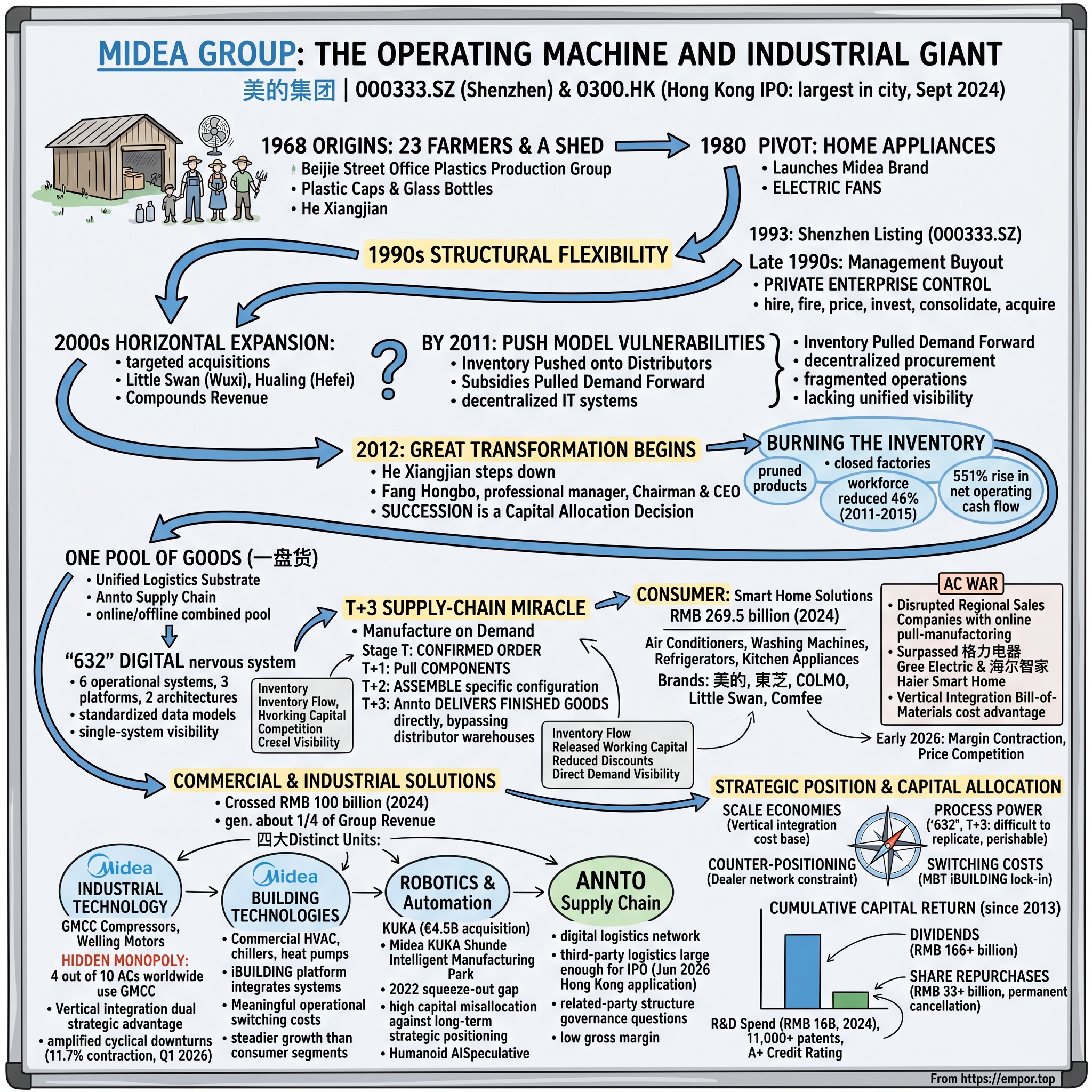
Midea Group: The Operating Machine and Industrial Giant of China
I. Introduction & Episode Roadmap
On July 7, 2026, a production line switched on inside a factory in Wuhu, Anhui province, manufacturing portable air conditioners designed for buildings where permanent exterior units are prohibited.
The operational context behind that line illustrates the company's speed. During a severe heatwave in Western Europe, historic preservation laws across France, Italy, and Germany restricted mounting external condenser units to building facades. In response, 美的集团 Midea Group engineered a U-shaped split unit — the PortaSplit — that threads through a partially open window without permanent installation. After securing roughly 160,000 orders for the unit starting in June, the new Wuhu facility produced 20,000 units in three and a half days, and the initial container shipment bound for France departed within seven days of the order.2526
This episode reflects a structural capability: the capacity to expand manufacturing lines, source components internally, schedule factory production, and ship finished goods faster than traditional competitors can complete initial planning. That operational agility has served as a central thread across Midea's expansion for fourteen years.
In its 2025 financial year, Midea reported revenue of RMB 458.5 billion — approximately US$64 billion — up 12.1% year on year, with net profit attributable to shareholders rising 14.0% to RMB 43.9 billion. Overseas revenue reached RMB 195.9 billion, growing 16%.12 The group's shares trade on two exchanges: 000333.SZ in Shenzhen, where they have been listed since a 2013 corporate consolidation, and 0300.HK in Hong Kong, following a September 2024 listing that marked the city's largest initial public offering in years.4
Describing Midea simply as a "Chinese appliance giant," while accurate, understates its business model. Unlike standard appliance manufacturers such as Whirlpool or Electrolux, Midea produces compressors used by competing air-conditioner brands, owns a major global industrial robotics platform, operates a third-party logistics network large enough to file for an independent public listing, and consistently generates operating cash flow exceeding 10% of revenue alongside negative working capital. Midea has constructed an integrated manufacturing system, with consumer appliances functioning as its highest-volume application.
Financially, the group operates through two primary divisions. Its consumer segment, Smart Home Solutions, generated RMB 269.5 billion in 2024 through air conditioners, washing machines, refrigerators, and kitchen appliances sold under brands including 美的 Midea, 東芝 Toshiba, COLMO, 小天鹅 Little Swan, and Comfee.3 Its commercial and industrial segment, Commercial & Industrial Solutions, crossed RMB 100 billion for the first time that same year at RMB 104.5 billion — representing about a quarter of group revenue — before growing 17.5% in 2025 to RMB 122.8 billion.31 This business-to-business segment comprises four distinct operating units: 美的工业技术 Midea Industrial Technology, which produces GMCC compressors and Welling motors; 美的楼宇科技 Midea Building Technologies, which supplies commercial HVAC systems, chillers, heat pumps, and building management software; an automation unit centered on Germany's KUKA; and a digital logistics network anchored by 安得智联 Annto Supply Chain.[^41]
This structure combines business lines with distinct cyclical drivers. A compressor plant, a commercial chiller order book, and a consumer washing machine line respond to different customer segments across different time horizons. This model functions either as genuine operational diversification or as a conglomerate discount, depending on the strength of the shared manufacturing and supply-chain layer beneath them. Evaluating that operational layer is central to understanding Midea's performance.
Five core questions organize this analysis:
Why did the founder transfer control to a professional management team in 2012, and has that structure delivered superior capital allocation or created new governance challenges? How much of Midea's "T+3" supply-chain framework represents a defensible process advantage rather than standard modern manufacturing practices? Was the €4.5 billion purchase of KUKA a transformative strategic success or an expensive cross-border integration lesson? How did Midea surpass 格力电器 Gree Electric and 海尔智家 Haier Smart Home in air-conditioner volume, and can it defend that position against tech-centric competitors like 小米 Xiaomi? Finally, why did a business generating substantial domestic cash flow seek additional capital through a Hong Kong listing?
Recent results add timeliness to these questions. On April 29, 2026, Midea reported first-quarter revenue of RMB 131.1 billion, up 2.55% year on year, and net profit of RMB 12.67 billion, up 2.03%. Excluding non-recurring items, core net profit fell 14.0% year on year.5 This marked a sharp deceleration from the same period a year earlier, when first-quarter revenue grew 20.6% and net profit rose 38.0%.27 Across the broader market, Chinese white-goods sales fell 6.2% during the quarter, led by a 13.8% decline in air conditioners.5 After a decade of sustained expansion, Midea faces a cyclical industry contraction that tests the resilience of its operating model.
The story begins at the origin — with 23 farmers, a shed, and a product history few remember.
 Subscribe on LinkedIn
II. Origins & Early Evolution: From Shunde Caps to Appliance Scale (1968–2011)
In 1968, in 顺德 Shunde—a district of Foshan in Guangdong's Pearl River Delta then dominated by agriculture—26-year-old 何享健 He Xiangjian organized 23 fellow villagers to form the Beijie Street Office Plastics Production Group, manufacturing glass bottles and plastic bottle caps.6
The collective township enterprise operated when private business was formally illegal, producing basic commodities without proprietary technology, branding, or competitive barriers. Aside from its geographic origins and founder, that initial operation bore little resemblance to the modern corporate group.
The business pivoted in 1980 when it entered home appliances and launched the Midea brand with electric fans—the simplest appliance, requiring only a motor, blades, and a housing.6 Starting with the motor established a defining operational principle. When Midea expanded into air conditioners in the mid-1980s, rather than assembling third-party components, it worked backward into manufacturing compressors and motors, the two elements that dictate most of an air conditioner's cost, efficiency, and reliability. Over subsequent decades, that component integration became the group's core manufacturing advantage.
Corporate restructuring followed in the 1990s. As Shunde's local government permitted township enterprises to reorganize into shareholding companies, Midea listed on the Shenzhen Stock Exchange in 1993, becoming one of China's earliest township collective enterprises to go public.[^36] By the end of the decade, management had bought out the state's equity stake, establishing Midea as a private enterprise controlled by He Xiangjian and his executive team. In an industrial sector dominated by state-owned enterprises, a private manufacturer competing on cost and speed held key structural flexibility: it could hire, fire, price, and invest based strictly on commercial logic.
That ownership transition reshaped capital discipline across the group. From the late 1990s onward, Midea's executives allocated private capital rather than answering to municipal authorities with non-commercial objectives. This alignment underpinned subsequent decisions over the following two decades, including plant consolidations, foreign acquisitions, and high dividend payout ratios.
In the 2000s, Midea accelerated expansion through targeted acquisitions. The group acquired controlling stakes in 无锡小天鹅 Wuxi Little Swan, an established laundry manufacturer, and Hefei-based 华凌 Hualing in refrigeration. The strategy relied on horizontal category expansion: leveraging Midea's distribution network and manufacturing footprint to cross-sell appliances. Supported by China's urban construction boom, revenue compounded rapidly as new housing completions generated demand across multiple appliance categories.
However, rapid top-line growth masked deep operational vulnerabilities.
By 2011, Midea relied on a traditional wholesale "push" model. Factories produced to internal sales targets, pushing inventory onto tiered distributors, sub-distributors, and retailers. Midea recognized revenue upon dispatch from its warehouses, meaning reported growth partially reflected inventory transfers into distributor channels. Simultaneously, China's post-2008 stimulus subsidies pulled rural consumer demand forward while leaving sales channels filled with unsold stock.
Internal operations were similarly fragmented. Growth through acquisitions and semi-autonomous business units produced decentralized IT systems, procurement channels, supplier relationships, and inventory tracking. With more than a hundred isolated IT systems across the organization, headquarters lacked visibility into group-wide inventory levels, impairing working capital management and causing growth to consume cash.
In 2011, Midea initiated a comprehensive restructuring under the slogan "product leading, efficiency driven, global operation" to address structural inefficiencies and elevated costs.7 Stimulus programs were fading, raw material costs were rising, and profit margins in several categories had compressed to low single digits. Additionally, the group held extensive land and fixed assets that yielded low returns on capital.
While Midea had achieved massive industrial scale, it lacked unified operational control—a deficiency that magnified process errors across its manufacturing footprint.
Addressing these weaknesses required leadership willing to restructure established units and eliminate redundant capacity. In August 2012, He Xiangjian stepped down from operational management, transferring control to a professional management team tasked with executing that transformation.
III. The Great Transformation: Non-Family Succession, "632", & The T+3 Miracle (2012–2015)
方洪波 Fang Hongbo joined Midea in 1992 as an editor of the company newsletter. Holding a history degree from East China Normal University, he had no engineering background, shared no family connection to founder He Xiangjian, and initially wrote internal communications for a Guangdong fan manufacturer. Twenty years later, in August 2012, he became Chairman and Chief Executive of the entire group.7
That succession was rare in Chinese private enterprise, where first-generation founders typically transferred leadership to direct heirs. Although He Xiangjian had a son, he handed operational control to a professional manager while retaining his family's economic interest through 美的控股 Midea Holding. That entity remains the controlling shareholder with roughly 31% of the shares, while Fang holds a personal stake of around 1.5%.29
This structure established Midea's governance framework: the founding family absorbs capital risk and collects dividends, while executive management directs operations with substantial equity alignment—Fang's stake reached a valuation of well over US$1 billion in recent years. Unlike public companies subject to rotating management or quarterly earnings pressures, this structure provided stable capital backing. That alignment enabled Fang to execute a sweeping operational downsizing that short-term shareholder pressures might otherwise have derailed.
Burning the inventory
The initial phase focused on reduction. Midea pruned low-margin product lines, eliminated thousands of stock-keeping units (SKUs), closed factories, and returned underutilized industrial land to local governments—land accumulated during earlier expansion phases that carried ongoing holding costs. Between 2011 and 2015, these reductions reduced the group's workforce by 46%.7
The financial outcomes reflected the strategic pivot. Between 2011 and 2015, Midea reported a 106% increase in net profit and a 551% rise in net operating cash flow, even as revenue grew only slightly.7 Net profit roughly doubled and cash generation expanded more than sixfold without meaningful top-line expansion. These gains stemmed entirely from internal operational adjustments, product mix optimization, cost management, and working capital discipline.
The restructuring illustrated a core manufacturing principle: revenue that requires more capital than it returns creates liability rather than enduring value. Fang's willingness to demonstrate this publicly as a listed company, despite initial market skepticism, marked a turning point in Midea's operational model.
"632": building the nervous system
Cutting unprofitable revenue was only the first step; preventing its return required unified software infrastructure.
The initiative was named "632" after its structural framework: six operational systems, three management platforms, and two technical architectures.7 The six operational systems governed core physical workflows: product development (PLM), enterprise resource planning (ERP), customer relationship management (CRM), manufacturing execution (MES), supplier relationship management (SRM), and supply chain management (SCM). Three management platforms oversaw cross-cutting administrative functions, while two technical architectures established a unified data model and integration layer across all operations.
Prior to 632, Midea's divisions operated with fragmented IT systems and inconsistent operational metrics. A washing machine plant and an air-conditioner plant defined order data differently, preventing group-wide tracking. The 632 framework standardized data models and definitions across every operating unit, creating single-system visibility for components, suppliers, and inventory across the enterprise.
The transition faced internal resistance as business unit leaders lost operational autonomy and data opacity. Implementing the system required several years and substantial capital investment. However, establishing standardized, real-time demand visibility provided the necessary digital foundation for Midea's subsequent factory transformations.
T+3: manufacturing on demand
With unified IT systems in place, Midea transitioned from a traditional push-manufacturing model to a pull system. Instead of building to sales forecasts and holding finished goods in storage, the new approach—designated the T+3 供需联动模式 T+3 supply-demand linkage model—manufactured products strictly against confirmed orders and expedited delivery.
The operational process was structured into four distinct three-day stages. At stage T, a confirmed order from a retailer, e-commerce platform, or end consumer initiated the production cycle. At stage T+1, the digital platform pulled required components from integrated suppliers with real-time visibility into order demand. At stage T+2, the manufacturing plant assembled the specific product configuration. At stage T+3, 安得智联 Annto delivered finished goods directly to retail stores or end consumers, bypassing distributor warehouses. Each phase targeted a duration of approximately three days.
This model created three compounding operational effects. First, inventory shifted from a capital-intensive asset to a managed flow, releasing working capital. Second, manufacturing directly against confirmed orders reduced excess inventory, limiting the discounting cycles that erode appliance margins. Third, distributors transitioned from inventory buffers into direct distribution channels, providing Midea with direct visibility into end-market demand.
These operational shifts directly drove cash flow generation. In a traditional push system, manufacturers finance component purchases and finished goods storage while awaiting distributor sales. Under a pull system with rapid order fulfillment and standard supplier payment terms, customer collections occur prior to supplier payments, turning working capital into a net source of cash. This mechanism enabled Midea to generate RMB 60.5 billion in operating cash flow in 2024, compared with RMB 38.5 billion in net profit.3
While Midea attributes dramatic cycle-time reductions and warehouse contractions to T+3, these internal metrics are unverified. Independent validation arrived in September 2025, when the World Economic Forum designated Midea's air-conditioner facility in Thailand as a Global Lighthouse factory—the first overseas appliance facility to receive the designation. The forum cited a 42.6% reduction in end-to-end order cycle time and a 17.1% improvement in on-time delivery.1213
The structural reorganization concluded in 2013, when Midea consolidated its operating assets into the Shenzhen-listed entity 000333.SZ, unifying corporate ownership under a single public vehicle.
IV. Cross-Border M&A & Capital Deployment Benchmarking (2016–2022)
By 2016, Midea had resolved its core operational inefficiencies, but that success created a new challenge: in a mature domestic appliance market, an efficient manufacturing operation becomes a cash-generation engine with limited domestic reinvestment opportunities. The group was generating more capital than its core consumer appliance business could productively absorb.
Management's deployment of that capital over the following six years produced two contrasting case studies in Chinese outbound cross-border acquisitions.
Case one: Toshiba's appliance business, or how to buy a brand for the price of the inventory
On March 30, 2016, Toshiba and Midea signed a definitive agreement transferring an 80.1% controlling stake in Toshiba Lifestyle Products & Services Corporation—the 東芝 Toshiba home appliance business—for approximately JPY 53.7 billion, or about US$473 million.840
The headline purchase price was deceptive in both directions. Toshiba Lifestyle was suffering heavy operating losses under a high Japanese cost structure, slow decision cycles, and subscale purchasing. Toshiba, burdened by an accounting scandal and urgent balance-sheet restructuring, was a distressed seller. Rather than acquiring a profitable business, Midea acquired assets it could not rapidly build from scratch: established premium brand equity across Japan and Southeast Asia, an extensive appliance patent portfolio, Japanese engineering and design capability, and a 40-year global brand licensing agreement.
The integration thesis was direct. Midea did not require operational instruction in manufacturing. Instead, Midea sought Toshiba's brand heritage and engineering capabilities, while Toshiba required Midea's procurement scale and supply-chain velocity. Midea integrated the Japanese business into its component sourcing—supplying its own GMCC compressors and Welling motors—and logistics networks, while intentionally preserving Toshiba's domestic Japanese product development, industrial design, and brand positioning.
The strategy proved effective. Toshiba became one of two core pillars supporting Midea's domestic premium expansion, alongside its proprietary COLMO brand. By the first quarter of 2025, combined retail sales for the two premium brands were growing more than 55% year on year.27 The transaction demonstrated how acquiring distressed premium brand equity and restructuring its underlying cost base through scale supply chains can generate sustained industrial value.
Case two: KUKA, or how to buy a robotics champion and discover what you actually bought
KUKA presented a fundamentally different operational and political dynamic.
Founded in Augsburg in 1898, KUKA was one of the world's four major industrial robotics manufacturers and a primary automation partner to the German automotive industry. After accumulating an initial equity stake, Midea launched a voluntary tender offer in 2016 at €115 per share, valuing the robotics company at roughly €4.5 billion.32 The transaction represented the largest acquisition of a German industrial enterprise by a Chinese company.
The acquisition triggered intense political opposition across Germany and the European Union. Public debates over the transaction prompted Germany and the broader EU to tighten foreign investment screening regulations, turning the acquisition into a reference case in European discussions regarding Chinese acquisitions of industrial technology.33 To secure regulatory clearance, Midea signed an investment agreement containing restrictive governance covenants, including multi-year guarantees on employment levels, production sites, and the operational ring-fencing of KUKA's customer data and intellectual property. These commitments secured political consent but restricted Midea's ability to integrate the business during its initial years of ownership.
Midea completed the acquisition in stages, eventually initiating a squeeze-out of remaining minority shareholders approved at KUKA's annual general meeting on May 17, 2022. Cash compensation for minority holders was set at €80.77 per share10—approximately 30% below the initial €115 offer price—with the squeeze-out taking effect upon commercial register entry in November 2022.9 That valuation gap reflected the operational hurdles encountered over the intervening six years.
Evaluating the acquisition requires balancing initial capital misallocation against long-term strategic positioning.
The bear case centers on timing and governance constraints. Midea acquired a business heavily dependent on global automotive capital expenditure near the peak of an auto investment cycle, paying a full transaction multiple while agreeing to governance covenants that delayed operational synergies. European facilities maintained high cost structures, while automotive clients compressed operating margins. Consequently, KUKA diluted group return on invested capital for several years, as Midea paid a premium for an industrial asset it could not immediately restructure.
Conversely, long-term strategic benefits materialized after governance restrictions expired. KUKA shifted its operational focus toward the Chinese market. The Midea KUKA Intelligent Manufacturing park in 顺德 Shunde grew into the largest industrial robotics production hub in China, delivering over 80,000 industrial robots. In the first quarter of 2025, KUKA's China order book grew more than 35% year on year, accompanied by European project wins exceeding €50 million.27 Customer demand transitioned from traditional European automotive plants to Chinese electric vehicle production, lithium battery manufacturing, electronics assembly, and logistics automation. KUKA Group revenue reached €3.9 billion in 2025, while Midea's robotics and automation segment grew 11.8% year on year in the first quarter of 2026 to RMB 8.2 billion—providing revenue support during a broader domestic appliance slowdown.
A decade after the initial offer, the acquisition demonstrates both the cost of regulatory friction and the value of strategic control. Midea paid a premium for operational control that governance covenants deferred for six years. While whether the returns justify the €4.5 billion purchase price remains subject to debate, geopolitical and regulatory shifts mean European authorities would likely block a comparable acquisition today—making early control an asset that cannot be replicated under current cross-border investment rules.
The bolt-ons, and the pattern they reveal
Around those major acquisitions, Midea built out its B2B portfolio through targeted bolt-on investments. The group acquired Italy's Clivet to secure European manufacturing capacity and commercial distribution channels for HVAC and heat pumps; Israel's Servotronix to acquire motion control and servo drive technology for its automation hardware; a controlling stake in CLOU Electronics to expand into energy storage and smart grids; and the climate division of Switzerland's Arbonia alongside Toshiba Elevator China, both completed in the first quarter of 2025.27
These transactions reflect a consistent deployment model: Midea acquires specialized external capabilities—such as established premium brands, control software, European distribution channels, or installed equipment bases—and applies its scale manufacturing and supply-chain efficiency in return. Rather than purchasing pure sales volume, management acquires technical or market assets to integrate into its industrial ecosystem. Whether this multi-segment expansion yields a cohesive industrial technology group or creates conglomerate complexity remains a central question for capital allocation.
Evaluating that balance requires examining the core air-conditioning business that generates the cash funding these industrial investments.
V. Core Engine Deep Dive: Smart Home Solutions & The Air Conditioning War
Every June, Chinese appliance retail undergoes a major seasonal expansion. Air conditioning represents the most seasonal major consumer durable category in the domestic market, where sudden heatwaves can drive sales volumes that dwarf standard monthly marketing campaigns. Historically, the industry's central operational challenge was positioning sufficient inventory near end consumers ahead of peak summer demand without accumulating excess unsold stock if warm weather failed to materialize.
For decades, manufacturers managed this demand volatility by shifting inventory holding risks onto multi-tiered regional distributors. Midea disrupted this structure primarily through digital supply-chain optimization rather than relying solely on product differentiation.
The economics of the core
Smart Home Solutions generated RMB 269.5 billion in 2024, representing roughly two-thirds of group revenue.3 Air conditioning serves as the segment's largest component and primary profit engine. In 2024, Midea reported holding the top market share position across nine domestic appliance categories,27 while Euromonitor ranked the company as the world's leading smart home appliance brand.3
Air conditioning holds disproportionate strategic importance due to its cost structure. Components such as compressors, motors, heat exchangers, and controllers account for a larger share of total product value in air conditioners than in other high-volume consumer appliances. Consequently, internal control over component manufacturing directly dictates operating margins. Midea's leading market share in finished air conditioners directly reflects its upstream dominance in key components.
The three-way war
Zhuhai-based 格力电器 Gree Electric, led for decades by 董明珠 Dong Mingzhu, constructed China's most powerful traditional offline appliance distribution network. Gree operated through regional sales companies—joint ventures with major regional distributors—that held inventory, enforced strict price discipline, and generated high gross margins. For years, this network established Gree as the world's most profitable air conditioner manufacturer.
However, this reliance on regional sales companies created a strategic constraint. The distribution network functioned as an inventory buffer absorbing factory production. Pivoting to direct online fulfillment threatened to cannibalize traditional sales channels, erode distributor profit margins, and trigger channel conflict. Consequently, Gree faced counter-positioning: its primary historical advantage limited its ability to respond to changing consumer buying habits.
The financial impact of this structural constraint became increasingly visible in recent results. Gree remains heavily concentrated in a single category and market, with consumer appliances—led by air conditioners—accounting for 78.4% of its revenue in the first half of 2025 at RMB 76.3 billion.17 In the first quarter of 2026, Gree reported modest revenue growth of 3.52% year on year to RMB 42.97 billion and net profit growth of 3.01% to RMB 6.08 billion, while operating cash flow declined 29.1%.5 For comparison, Midea generated nearly three times Gree's total revenue during that same quarter.
海尔智家 Haier Smart Home pursued a distinct strategy centered on international brand acquisitions and premium market positioning. Haier acquired GE Appliances in the United States and Fisher & Paykel in New Zealand, while building 卡萨帝 Casarte into China's leading luxury appliance brand. In 2025, Haier's global revenue crossed RMB 300 billion for the first time, reaching RMB 302.35 billion—up 5.71% year on year—with net profit rising 4.39% to RMB 19.55 billion.16 Haier also maintained strong domestic market positions in other categories, holding offline market shares of 47.7% in refrigerators and 47.4% in washing machines.16
Comparing 2025 financial performance highlights key operational differences between the models. While Haier expanded revenue by 5.7% and net profit by 4.4%, Midea grew revenue by 12.1% and net profit by 14.0% from a revenue base that was 50% larger.116 Haier's overseas strategy carries higher operating overhead from running localized facilities in Western markets, providing brand equity while weighing on operating margins and organizational speed.
Midea targeted the distribution channel directly. Utilizing its T+3 system, Midea fulfilled e-commerce orders directly from assembly plants without storing finished goods in distributor warehouses. This enabled the company to price online products competitively without requiring channel partners to absorb margin reductions. By July 2025, Midea led China's total air conditioner market across all channels with a 29% revenue share, compared with 17% for Gree and 15% for Haier.18
The brand ladder and "one inventory"
To address premium consumer segments without diluting its core brand, Midea established a multi-tiered brand architecture. COLMO occupies the top tier as an AI-focused ultra-premium line competing directly against Casarte. Toshiba sits just below COLMO, providing Japanese design and engineering credibility in tier-one and tier-two cities. The core Midea brand covers the mid-market volume segment, Little Swan leads in laundry appliances, and Comfee serves digital-native buyers and export channels in Europe and North America.
Beneath these brands lies a unified logistics substrate known as 一盘货 ("one pool of goods"). Instead of maintaining separate stock allocations for different distribution channels, online and offline inventory are combined into a single digital pool managed by Annto and dispatched to orders dynamically. Enabled by the 632 IT integration, this structure eliminates channel-specific inventory imbalances where e-commerce warehouses face stockouts while nearby retail stores hold unsold inventory.
The thing that just changed
This operational model delivered strong growth until the first quarter of 2026, when domestic white-goods sales contracted 6.2% year on year and air conditioner sales dropped 13.8%.5
The primary driver was the changing impact of consumer trade-in subsidies (以旧换新). Beijing launched the national consumer goods trade-in program in 2024 to stimulate domestic demand, significantly boosting sales for major appliance manufacturers in 2024 and 2025. However, pulling forward consumer demand created a subsequent purchasing deficit. Although government incentives continued in 2026—with the central government front-loading RMB 62.5 billion in funds to offer 15% subsidies up to RMB 1,500 per qualifying appliance1415—demand operated against a baseline of previously accelerated purchases.
While Midea maintained modest revenue growth during the quarter, profitability contracted: core net profit excluding non-recurring items fell 14.0% year on year.5 For a business focused on operational efficiency, preserving volume while losing margin indicates intensifying price competition. This margin pressure represents the first major stress test of the T+3 model during a market contraction rather than an expansion cycle.
This margin compression highlights a broader structural question: to what extent can the group's commercial and industrial segments insulate overall performance from consumer appliance volatility?
VI. The B2B Growth Engine: Industrial Tech, Building Technologies, & Robotics
A central operational fact reframes Midea's business model: roughly four out of every ten air conditioners sold worldwide contain a compressor manufactured by its subsidiary, GMCC. Approximately one in six refrigerators globally relies on a GMCC compressor as well.11
This positioning shifts the competitive dynamic. When a European brand, a Japanese manufacturer, or a domestic rival sells an air conditioner, Midea often earns a profit margin on the unit's most expensive internal component. Consequently, many of Midea's primary consumer rivals double as its business-to-business customers.
The hidden monopoly: GMCC and Welling
A compressor serves as the core engine of a refrigeration system—compressing refrigerant gas while determining most of an air conditioner's energy efficiency, noise level, and operational lifespan. Manufacturing compressors at scale requires precise engineering tolerances and significant fixed capital investments, creating a steep cost curve where production volume drives down unit costs and funds ongoing manufacturing enhancements. GMCC sells more than 100 million compressors annually, holding the top global market share in residential air-conditioner compressors while maintaining leading positions in air-conditioner and washing machine motors.1136
This vertical integration provides a dual strategic advantage. Internally, GMCC supplies Midea with a bill-of-materials cost advantage for its own appliances that non-integrated competitors buying on the open market cannot match, as Midea captures the component margin rather than paying a vendor markup. Externally, supplying competitors generates both incremental operating profit and operational visibility: compressor order books function as a direct leading indicator of industry-wide production schedules and competitor build volumes.
Welling, Midea's motor manufacturing division, represents a broader industrial expansion. While home appliance motors remain a mature category, Welling has expanded into electric vehicle drive motors, thermal management pumps, and electric power steering systems, supported by a manufacturing hub in Mexico designed to supply North American automotive supply chains.27 Categorized under Midea's Industrial Technology division, this business segment expanded 45% year on year in the first quarter of 2025, reaching RMB 11.1 billion.27
However, component manufacturing also proved particularly vulnerable during the subsequent industry downturn. In the first quarter of 2026, Industrial Technology revenue contracted 11.7% year on year to RMB 6.8 billion. Supplying components to appliance manufacturers exposes the division to amplified cyclical swings: when downstream brand manufacturers reduce production, they cut component orders immediately to run down existing inventory. Vertical integration provides a cost advantage during periods of high demand, but it creates downside operating leverage during demand contractions.
Midea Building Technologies: the highest-quality growth in the group
Midea Building Technologies (MBT) supplies commercial heating, ventilation, and air-conditioning (HVAC) systems—including variable refrigerant flow units, centrifugal chillers, heat pumps, and air handlers—to commercial real estate, data centers, and industrial facilities. The hardware is paired with iBUILDING, a software management platform that integrates HVAC equipment, elevator operations, and building automation systems into a unified cloud interface.37
This commercial focus creates two distinct structural advantages compared to consumer white goods. First, commercial customers—such as property developers, facility owners, and industrial contractors—evaluate equipment on multi-decade operating cycles, making procurement technical, relationship-driven, and less sensitive to short-term retail price fluctuations. Second, once iBUILDING integrates a facility's environmental, vertical transport, and energy systems, switching hardware suppliers requires re-architecting the facility's underlying management software, creating meaningful operational switching costs that do not exist in consumer appliances.
In practical terms, commercial towers and hospitals historically operated siloed systems: chillers, air handlers, elevators, sub-meters, and occupancy sensors were supplied by separate vendors with independent controls. The iBUILDING platform consolidates these streams into a single management console, allowing facility operators to monitor floor-by-floor power consumption, predict equipment maintenance needs, and adjust environmental controls dynamically based on occupancy. Once a property management team anchors its maintenance protocols and energy compliance reporting to this consolidated dashboard, replacing the underlying HVAC hardware introduces significant operational disruption, anchoring customer retention.
In commercial HVAC, Midea competes against global incumbents including ダイキン Daikin, Carrier, Trane Technologies, and Johnson Controls. These established players maintain long-standing specification relationships with engineering firms, extensive service networks, and large installed equipment bases. As a market challenger, Midea competes primarily on pricing, manufacturing lead times, and domestic market access, rather than established brand equity or deep service coverage in developed overseas markets.
Despite those competitive hurdles, the division has delivered steadier growth than Midea's consumer segments. Building Technologies revenue expanded 20% year on year in the first quarter of 2025 to RMB 9.9 billion,27 followed by 10.1% growth to RMB 10.8 billion in the first quarter of 2026. While growth decelerated, MBT remained the group's most resilient division during the broader industry slowdown. Future growth relies heavily on European heat pump adoption and Chinese commercial building decarbonization initiatives—both of which remain subject to regulatory shifts and policy subsidies.
Robotics, and the embodied AI question
Beyond KUKA's core industrial automation, Midea has invested in early-stage robotics initiatives. At the World Artificial Intelligence Conference in Shanghai in July 2025, the company unveiled a humanoid robot prototype and committed RMB 1.5 billion—approximately US$208 million—to build an embodied artificial intelligence platform.19 Midea subsequently showcased a six-armed robotic system designed for industrial assembly tasks,20 while constructing a new Midea Welling Robotics facility in Shunde scheduled to open in 2027.35
These initiatives require cautious evaluation. Humanoid robotics involves significant technical and economic hurdles, with a wide gap separating initial prototypes from cost-effective factory deployment. Midea's plan to deploy its Meila humanoid units in retail stores during 2026 for product demonstrations functions primarily as promotional marketing rather than commercial automation. While the RMB 1.5 billion capital commitment represents a manageable expense relative to group cash flow, these projects remain speculative options rather than near-term earnings drivers. Outside industry assessments noted that while Midea has expanded its artificial intelligence initiatives, material contributions to product features and group revenue have yet to materialize.
Annto, and a governance question wearing a logistics costume
The fourth commercial pillar is 安得智联 Annto Supply Chain, which originated in 2000 as Midea's internal logistics department and has expanded to serve over 7,000 corporate clients across consumer goods, electronics, and renewable energy sectors. Annto's revenue reached RMB 21.5 billion in 2025, representing an annualized growth rate of approximately 15% over three years.22 In June 2026, Annto submitted an application for an independent initial public offering on the Hong Kong Stock Exchange.21
A standalone listing presents distinct trade-offs. Proponents argue that an independent public listing provides Annto with direct capital access, reassures third-party clients regarding supply-chain confidentiality, and highlights asset value within Midea's corporate structure. Conversely, structural questions remain regarding profitability and governance. Annto operates with a low gross margin of roughly 7%, largely because it relies on Midea as its anchor customer, limiting its pricing power.22 Carving out a logistics subsidiary that remains dependent on parent-company volume introduces scrutiny regarding related-party transfer pricing, as service rates directly dictate profit distribution between Midea shareholders and prospective public investors in the logistics entity.
In total, the Commercial & Industrial Solutions segment achieved management's revenue targets, expanding 17.5% in 2025 to RMB 122.8 billion and contributing approximately 27% of group revenue.1 However, performance across divisions remains uneven and partially correlated with broader industrial cycles. In the first quarter of 2026, Industrial Technology contracted 11.7% while Building Technologies grew 10.1% and Robotics and Automation rose 11.8%. While commercial diversification broadens Midea's revenue base, it does not fully insulate the group from macroeconomic and industrial contractions.
VII. Strategic Position, Helmer's 7 Powers, & Porter's 5 Forces
Evaluating Midea's long-term competitive durability requires assessing the structural barriers that protect its cash flows from competitive erosion. Applying standard strategic frameworks—specifically Hamilton Helmer's 7 Powers and Michael Porter's Five Forces—highlights both the genuine strengths of Midea's industrial model and its key strategic vulnerabilities.
Where the powers are real
Scale economies represent Midea's most concrete and defensible advantage. The underlying mechanism is structural rather than purely size-driven. Because subsidiary GMCC supplies a significant portion of global air conditioner compressors, Midea's finished-goods cost base eliminates the vendor markup that non-integrated rivals must pay. Furthermore, as one of the world's largest industrial buyers of copper, steel, aluminum, and resin, Midea secures raw material input costs below those of smaller competitors. Because high-precision compressor manufacturing incurs substantial fixed capital costs, the largest producer achieves lower unit production costs. This upstream dominance mathematically lowers finished-goods costs, enabling Midea to defend unit volume during market contractions—albeit at the expense of operating margins, as demonstrated in early 2026.
Process power provides a second structural advantage, though its long-term durability faces headwinds. The combined "632" enterprise IT architecture and T+3 supply-chain framework are difficult to replicate—not because the concept is proprietary, but because implementation requires unifying systems across dozens of operating units, restructuring divisional governance, and realigning distributor channels under unified corporate direction. Competitors like Gree Electric observed this operational model for over a decade without successfully adopting it, constrained by organizational friction rather than technical limitations. However, as enterprise software has commoditized over the past fourteen years, digital-native entrants like Xiaomi are constructing appliance operations without legacy distribution constraints, narrowing Midea's historical process lead.
Counter-positioning proved decisive during Midea's market share gain against Gree, whose multi-tiered dealer network prevented a direct response to online pull-manufacturing without incurring channel conflict. Having captured market share from traditional incumbents, Midea has largely exhausted this source of competitive differentiation against legacy peers. Conversely, Midea now faces counter-positioning pressure from tech-centric entrants like Xiaomi, which operates a direct-to-consumer digital ecosystem, monetizes services beyond hardware sales, and functions without traditional distribution overhead.
Switching costs remain negligible in consumer white goods, where retail buyers experience zero friction when changing brands. Meaningful switching costs exist primarily within Midea Building Technologies, where the iBUILDING platform integrates commercial HVAC, elevator controls, and facility management software into customer operations. However, this commercial segment currently contributes less than 5% of group revenue, while customer lock-in claims across smart consumer home ecosystems remain unverified by disclosed repeat-purchase data.
Branding power represents Midea's least developed power. More than 45% of Midea's overseas smart home revenue stems from proprietary brands rather than white-label contract manufacturing,2 marking an increase from just over 43% a year earlier.3 However, proprietary brand ownership does not automatically confer pricing power. In Western markets, Midea and Comfee compete primarily on price and value rather than premium positioning, and the company does not disclose price realization premiums over unbranded competitors. While Toshiba and COLMO command genuine premium brand equity, their market strength remains concentrated predominantly in Asia.
Midea possesses no structural network economies, nor does it hold a cornered resource in the traditional sense, outside executive leadership under Chairman Fang Hongbo—a factor that represents executive succession risk rather than an enduring competitive moat.
The five forces, honestly scored
Threat of new entrants into traditional appliance manufacturing remains low due to high capital, tooling, and supplier integration requirements. However, the threat from adjacent technology platforms with established distribution and consumer touchpoints is substantial. Xiaomi demonstrated this threat by shipping more than 5.4 million air conditioners in the second quarter of 2025—a 60% year-on-year increase—capturing 16.71% of China's online air conditioner market by that July.1718 Goldman Sachs projected that Xiaomi would capture approximately 10% of the total Chinese air conditioning market by 2026 by pricing units roughly 7% below the market average, evaluating Midea as relatively resilient while identifying Gree as the most exposed incumbent.18
Supplier power is exceptionally low as a direct result of upstream vertical integration. Midea manufactures its own compressors, motors, controllers, and tooling, while maintaining massive purchasing scale for external raw materials. Consequently, supplier bargaining power is limited, leaving Midea exposed primarily to underlying raw material commodity prices—with copper and aluminum cost inflation cited by analysts as earnings drags in 2026 alongside foreign exchange fluctuations.
Buyer power is moderate and increasing. Consumers face minimal switching costs and widespread product choices, while dominant Chinese e-commerce platforms—including 天猫 Tmall, 京东 JD.com, and 抖音 Douyin—exert significant bargaining power as primary distribution gatekeepers. The margin compression observed across the appliance sector in early 2026 reflects this growing buyer leverage during market promotions.
Threat of substitutes remains minimal. No viable functional alternative exists for mechanical cooling and refrigeration, while rising global temperatures structurally expand the addressable market for residential and commercial climate control—as demonstrated by the surge in European heatwave orders.25
Competitive rivalry is intense and escalating. Market dynamics are shaped by competition among three major domestic incumbents, aggressive expansion by tech-enabled entrants, a contracting near-term domestic market, and the aftermath of government trade-in subsidies that accelerated consumer purchases. This combination continues to compress industry operating margins.
In summary, Midea's competitive moat is grounded in component scale and process efficiency rather than premium brand equity or network effects. While these cost-based advantages provide strong defense against traditional peers, they remain vulnerable to tech-centric competitors willing to operate hardware at low gross margins. Long-term valuation expansion depends significantly on establishing recognized overseas premium brand equity—an asset that remains in development across Western markets.
VIII. Management, Governance, & Capital Allocation Record
Chief Executive Fang Hongbo maintains a low public profile compared to peers like Gree's Dong Mingzhu, avoiding livestreamed sales events and frequent media appearances while leading Midea for fourteen years.
Evaluating management performance requires testing whether operational execution matches stated strategy over time. At Midea, this track record is verifiable because the company publishes an annual shareholder letter outlining forward-looking strategic priorities.
Consistency of the narrative
A review of these shareholder letters reveals a consistent strategic arc over fourteen years, centered on operational efficiency, global expansion, and technology reinvestment. In 2011, management introduced the core framework "product leading, efficiency driven, global operation."7 In 2020, Midea initiated a second major digital transformation focused on comprehensive digitization and intelligence, reorganizing its business from three operating axes into five segments: consumer electronics, HVAC, electromechanical, robotics and automation, and digital innovation.7 By early 2023, Fang publicly defined Midea's next growth driver as a "second curve" in emerging sectors, including electric vehicle components and energy storage.38 The 2025 shareholder letter, published in early 2026, reinforced these themes with five operational priorities: prioritizing core white goods and HVAC alongside robotics and energy breakthroughs, maintaining value-chain cost leadership, transitioning from white-label exports to global brand building, advancing innovation in AI and new energy, and flattening organizational hierarchies to accelerate decision-making.1
Rather than shifting strategy in response to short-term market trends, management has repeatedly refined its core framework. The 2025 letter's assertion that "we must dare to question the paths and methods we once took for granted"1 aligns with Midea's historical willingness to shrink workforce and capacity during its 2012 restructuring.
Evaluating this narrative requires noting two structural limits in corporate communication. First, Midea does not hold the open quarterly analyst Q&A conference calls common among Western listed companies; annual shareholder letters and financial filings handle the bulk of corporate disclosure. This limits real-time external scrutiny during operational downturns. Second, annual letters serve as management-curated documents, meaning evaluating corporate intent ultimately requires examining capital allocation behavior.
The capital allocation record
Midea's capital distribution record demonstrates consistent shareholder returns. For the 2024 fiscal year, Midea paid RMB 3.50 per share in dividends, totaling RMB 26.7 billion—representing a payout ratio of approximately 70% and a 28.5% increase over the previous year.3 In 2025, total cash dividends rose to RMB 4.30 per share including interim payouts, totaling roughly RMB 32.3 billion and bringing the payout ratio to 73.5%.2 Since consolidating its corporate listing in 2013, cumulative cash dividend distributions have exceeded RMB 166 billion, alongside more than RMB 33 billion in share repurchases.2
The structure of Midea's share buybacks highlights capital discipline. In 2025, Midea completed a RMB 10 billion repurchase program covering 135 million A-shares, allocating 95 million shares—70% of the total—for permanent cancellation to reduce registered capital.2 Permanently retiring repurchased shares directly increases remaining shareholders' equity ownership, unlike holding shares in treasury for future stock-based compensation. Midea subsequently adjusted a follow-on buyback program originally intended for employee incentives into an outright share cancellation plan targeting between RMB 6.5 billion and RMB 13 billion.5 Repurchases continued into 2026, with the company reporting the acquisition of 458,900 A-shares for RMB 38.8 million on July 24.
Capital return has not constrained internal reinvestment. Research and development expenditure reached RMB 16 billion in 2024, bringing ten-year cumulative R&D spending above RMB 100 billion while securing approximately 11,000 global patents, including roughly 5,000 invention patents.3 R&D investments expanded another 14% year on year in the first half of 2025 to RMB 8.8 billion.28 Generating RMB 60.5 billion in operating cash flow in 20243 allowed Midea to fund a 70% dividend payout alongside rising technology investment without increasing leverage.
In September 2025, S&P Global Ratings upgraded Midea's long-term issuer credit rating to 'A+'.23 Achieving an A+ credit rating as a Chinese industrial manufacturer reflects a capital-efficient operating model where working capital functions as a net source of cash generation.
What a sceptical investor would attack
Skeptical investors highlight three principal governance and structural vulnerabilities across the group.
Portfolio complexity. Midea operates across consumer appliances, compressors, motors, electric vehicle components, commercial HVAC, elevators, industrial robotics, energy storage, third-party logistics, and experimental humanoid robotics. Management's explicit 2026 objective to streamline operations and focus on core lines1 serves as an admission that multi-segment expansion increased managerial overhead. The proposed Hong Kong listing of logistics subsidiary Annto reflects this consolidation effort, though whether further segment rationalizations will follow remains unconfirmed.
Related-party structure. With Annto seeking a separate public listing while relying on Midea as its anchor customer,22 and with 美的控股 Midea Holding maintaining a controlling 31% equity stake in the group,29 inter-company operations create potential transfer-pricing complexities among entities with distinct minority shareholder bases. While not indicative of improper practices, these overlapping ownership structures place elevated demands on corporate disclosure and governance oversight.
Key person concentration. Chief Executive Fang Hongbo, aged 58, has led the organization for fourteen years without a publicly designated successor. Because Midea's primary competitive edge relies on operational discipline and system execution rather than proprietary patents or luxury branding, leadership continuity represents an unhedged operational risk—particularly for an organization whose defining early achievement was executing a non-family leadership succession.
The Hong Kong listing
In September 2024, Midea completed a major global capital market transaction by listing H-shares on the Hong Kong Stock Exchange. On September 17, the company priced its offering at HK$54.80 per share, raising approximately HK$31 billion (US$4.0 billion)—a figure that expanded to US$4.6 billion upon full exercise of the over-allotment option.294 The transaction marked Hong Kong's largest initial public offering in several years and one of the largest global equity listings of 2024. Eighteen cornerstone investors acquired US$1.256 billion of the offering, led by COSCO Shipping at US$281 million and UBS Asset Management Singapore at US$100 million.29 High institutional demand enabled underwriters to expand the deal size by 15% during bookbuilding, serving as a benchmark for international institutional participation in Chinese equity listings.39 On its trading debut, the stock gained up to 9.5% before closing at HK$59.10.30
Because Midea already generated over RMB 60 billion in annual operating cash flow and returned most of its net income via dividends, the transaction served strategic rather than funding objectives. The dual listing provided Midea with offshore capital to fund international factory construction without incurring cross-border currency conversion friction, an internationally traded equity currency for overseas acquisitions, and a diversified institutional shareholder base. Broadening global equity ownership helps position Midea as a multinational enterprise rather than a domestic exporter when negotiating with overseas customers and regulatory bodies. Official filings designated proceeds for global research and development, smart manufacturing and supply-chain upgrades, and international sales network expansion.31
Capital deployment following the listing aligns with those declared goals. Midea's international network includes localized operations across roughly 50 countries, supported by 29 overseas research centers and 43 manufacturing bases.1 In Thailand's Chonburi Eastern Economic Corridor, Midea constructed a US$168 million, 208,000-square-meter air-conditioner production facility with an annual capacity targeting six million units in 2026.12 In June 2026, Midea packaged this operational framework into the 'Agentic Factory Overseas Expansion Solution'—a suite of twelve modules covering cross-border supply chain management and cultural integration offered to Chinese firms building overseas capacity.24 This offering demonstrates how internal operational capabilities can be productized, though its ultimate value depends on whether managing third-party implementations distracts leadership from core manufacturing operations.
IX. Investor Playbook, Bull vs. Bear Case, & Key Risk Radar
Evaluating an industrial enterprise as vast and diversified as Midea requires isolating vital operational signals from corporate noise. Three specific metrics capture the core of the group's investment thesis.
First, the commercial and industrial share of group revenue. This business-to-business segment represented 25.5% of revenue in 2024 and roughly 27% in 2025.31 The valuation thesis—that markets should re-rate Midea as an industrial technology group rather than a consumer appliance manufacturer—depends on this share expanding past 30%. Crucially, that expansion must stem from absolute growth in building technologies and industrial components, rather than cyclical contraction in consumer appliances.
Second, the proprietary brand share of international consumer appliance revenue. Own-brand sales reached more than 45% of overseas smart home revenue in 2025, up from just over 43% in 2024.23 Capturing a brand margin rather than a contract manufacturing margin represents Midea's largest internal opportunity for structural margin expansion. However, expanding brand share only creates long-term value if it generates pricing power rather than volume at discounted price points; investors should monitor overseas gross margins alongside sales mix to verify that progress.
Third, core net profit growth excluding non-recurring items. Headline net income can mask underlying operational trends. In the first quarter of 2026, for example, headline net profit rose 2.03% year on year while core net profit fell 14.0%.5 For an organization with substantial investment portfolios, government grants, and derivative hedging positions, the divergence between headline and core earnings reveals the true health of ongoing operations.
Notably absent from this priority list is short-term top-line revenue growth. Through the first nine months of 2025, group revenue expanded 10% year on year to RMB 320.3 billion34—a figure suggesting steady compounding that nonetheless offered no warning of the margin compression two quarters later. Top-line revenue largely reflects external demand conditions, whereas the three core metrics track the execution of management's strategic priorities.
The bull case
The optimistic case for Midea does not depend on a rapid rebound in Chinese consumer spending. Instead, it rests on the group using its cost structure to expand global market share while competitors face margin pressure.
That advantage is driven by vertical integration. Internal production of GMCC compressors and Welling motors gives Midea a structural bill-of-materials advantage over non-integrated peers. Expanding overseas production in Thailand, Brazil, Egypt, Mexico, and Indonesia transforms that cost efficiency into tariff-resilient supply for faster-growing international markets. The surge in European orders in July 2026 demonstrated this speed: two facilities took 200,000 unit orders from Europe in a single month, standing up capacity in days,25 capturing market share while local manufacturers struggled to react.
Furthermore, commercial and industrial revenue expanded 17.5% in 2025, while Building Technologies delivered double-digit growth even during a severe domestic appliance contraction. Paired with a capital return policy that distributes nearly three-quarters of net profit through cash dividends and share cancellations, this operational foundation offers steady cash returns while management executes its long-term industrial re-rating and overseas brand expansion.
The bear case
The cautious view holds that Midea remains an exceptionally efficient producer of mature commodities operating in a slowing domestic market where future growth is already reflected in the stock price.
First, domestic demand faces structural headwinds. China's real estate downturn has curtailed new-home appliance installations, shifting the market toward replacement sales tied to broader economic growth. While government trade-in incentives provided temporary stimulus, that intervention pulled future demand forward: in the first quarter of 2026, Chinese white-goods sales fell 6.2% and air conditioner sales dropped 13.8%.5 Policy subsidies offer temporary relief rather than permanent growth.
Second, cost advantages offer limited defense against competitors operating under different economic models. Tech-centric entrants like Xiaomi leverage ecosystem monetization to offer comparable hardware at prices roughly 7% below market averages—a pricing strategy that challenges traditional manufacturers whose shareholders demand appliance margins, whereas Xiaomi does not.18
Third, external geopolitical risks are mounting. With approximately 40% of group revenue generated outside China,3 Midea faces rising Western trade barriers, anti-dumping investigations, and stricter rules of origin. Constructing localized overseas factories mitigates trade tariffs but requires heavy capital expenditure and introduces capacity utilization risks if trade flows shift again.
Fourth, capital allocation questions linger around major acquisitions. A decade after the transaction, KUKA's return on invested capital has yet to conclusively justify its €4.5 billion purchase price, while the final €80.77 minority squeeze-out price—versus the initial €115 tender offer—remains a persistent benchmark in capital-allocation discussions regarding Midea for as long as the asset is held.10
The risk radar, restricted to what is material
Housing and macro. New-home completions remain the single largest external variable driving domestic appliance installations, operating beyond management control.
Input costs and currency. Fluctuations in copper, aluminum, steel, and resin directly influence gross margins. While GMCC's internal supply and financial hedging lessen raw material volatility, 2026 performance encountered headwinds from both input costs and foreign exchange fluctuations. With international revenue reaching nearly RMB 196 billion,1 currency translation exposure represents a primary operational factor.
Global execution risk. Expanding manufacturing facilities across multiple international jurisdictions introduces operational risk around local labor regulations, supply-chain logistics, and quality control. While World Economic Forum Lighthouse designation for Midea's Thailand facility provides concrete evidence that its manufacturing model can function overseas,13 scaling that performance across dozens of facilities remains an ongoing operational test.
Technology disruption. Should artificial intelligence ecosystems evolve into primary consumer purchase drivers rather than secondary software features, pure manufacturing scale could yield diminishing returns. Independent evaluations indicate that Midea's software and artificial intelligence investments have not yet generated material changes in product performance or segment revenue.
Governance and corporate complexity. Managing a multi-segment global enterprise increases operational friction, prompting management to designate complexity reduction as a core priority for 2026.1
X. Epilogue & Core Investing Lessons
Midea's trajectory spans from a Shunde workshop producing bottle caps in 1968 to a dual-listed industrial group generating RMB 458.5 billion in 2025 revenue, operating across dozens of countries, and manufacturing the compressor inside roughly four out of every ten air conditioners sold worldwide.
The core of that industrial transformation occurred between 2012 and 2015 — a period when the group shrank its manufacturing footprint, reduced its workforce by nearly half, and generated minimal top-line growth while doubling net profit and multiplying operating cash flow more than sixfold.7
Three broader lessons extend beyond the company itself.
Succession is a capital allocation decision. Founder He Xiangjian's decision to transfer operational control to a professional manager while retaining his family's economic interest through a controlling holding company created a distinct governance structure: patient capital paired with professional management, unencumbered by short-term quarterly pressures. This alignment provided Chief Executive Fang Hongbo the operational latitude to downsize capacity and eliminate low-margin revenue between 2012 and 2015 to establish long-term profitability. Whether this governance model can endure after Fang's eventual departure remains an open question, as Midea lacks a publicly designated successor.
Process can serve as a moat, but it is inherently perishable. Legacy competitor Gree Electric struggled to match Midea's T+3 pull-manufacturing system not because the framework was proprietary, but because adopting it would have dismantled the traditional dealer network underpinning Gree's historical profitability. That counter-positioning provided Midea a durable advantage against legacy peers. However, process efficiency offers little defense against digital-native entrants like Xiaomi, which built direct-to-consumer distribution models without legacy channel constraints.
Owning key components provides structural power, but amplifies cyclical downturns. Subsidiary GMCC's compressor dominance remains Midea's most defensible asset: it lowers internal bill-of-materials costs, captures margins from competing appliance brands, and provides early visibility into industry-wide production trends. Yet component manufacturing also proved the most vulnerable segment during the early 2026 market downturn, as downstream brand manufacturers curtailed component orders to run down existing inventory. Vertical integration provides operational leverage, but that leverage operates in both directions.
As of mid-2026, fourteen years of operational restructuring have produced a manufacturer operating with higher supply-chain velocity and component integration than its traditional domestic peers. The group returns substantial cash to shareholders through high dividend payouts and share cancellations while pursuing its most complex strategic shift: transitioning from a domestic exporter into a global manufacturer operating localized facilities and selling under proprietary brands. However, this transition coincides with a contracting domestic appliance market, a year-on-year decline in core net profit, and aggressive price competition from well-capitalized technology rivals.
Midea's operating model has proven its effectiveness during periods of industry expansion. A sustained market contraction represents the ultimate test of its structural resilience.
References
-
Midea Group Letter to Shareholders — Midea Group Investor Relations ↩↩↩↩↩↩↩↩↩↩↩
-
Midea Group Delivers Double-Digit Revenue and Profit Growth in 2025 — TipRanks ↩↩↩↩↩↩
-
Midea Group Reports Record 2024 Results, Delivers Unprecedented Shareholder Returns — Midea Group ↩↩↩↩↩↩↩↩↩↩↩↩
-
Midea Group Completes $4.6 Billion Hong Kong IPO — Skadden, Arps, Slate, Meagher & Flom LLP, 2024-09 ↩↩
-
Midea and Gree's Q1 Reports Diverge: A $1.9 Billion Buyback and Cancellation vs. Billions in Dividends — BigGo Finance ↩↩↩↩↩↩↩↩
-
Midea Group: From Plastic Caps to a Global Technology Conglomerate — World Intellectual Property Organization ↩↩
-
Midea Re-launched a Comprehensive Strategic Transformation — Midea Group, 2020-08-12 ↩↩↩↩↩↩↩↩
-
Toshiba and Midea Agree on the Transfer of Toshiba's Home Appliances Business — Toshiba, 2016-03-30 ↩
-
Guangdong Midea Electric Co., Ltd. specifies transfer request — KUKA AG, 2022-03 ↩↩
-
Midea Establishes First Overseas Air Conditioner Lighthouse Factory as a Benchmark for Supply Chain "Going Global" — Midea Group, 2025-09 ↩↩
-
Global Lighthouse Network 2025: World Economic Forum Recognizes 12 New Sites — World Economic Forum, 2025-09 ↩↩
-
China unveils 2026 subsidy scheme for home appliance trade-ins — Xinhua, 2025-12-31 ↩
-
China front-loads 62.5 bln yuan funds to support 2026 consumer goods trade-in program — The State Council of the People's Republic of China, 2025-12-30 ↩
-
Haier Smart Home Co., Ltd. Annual Report 2025 — Haier Smart Home, 2026-03-26 ↩↩↩
-
Gree's earnings cool while Xiaomi heats up China's air conditioner race — KrASIA ↩↩
-
Xiaomi snatches 10% of the air conditioning market share? Goldman Sachs: Midea is resilient, Gree is most vulnerable to impact — Longbridge, 2025-09 ↩↩↩↩
-
Midea unveils humanoid robot and invests $200 million in embodied AI — Robotics & Automation News, 2025-08-01 ↩
-
Chinese home appliance giant Midea unveils six-arm robot for factory work — South China Morning Post ↩
-
Midea's Logistics Subsidiary Annto Files For Hong Kong IPO — Benzinga, 2026-06 ↩
-
Annto drives out from Midea's shadow with Hong Kong IPO — Bamboo Works ↩↩↩
-
Midea Group Co. Ltd. Upgraded To 'A+' On Stronger Business Position — S&P Global Ratings, 2025-09 ↩
-
Midea Launches "Agentic Factory Overseas Expansion Solution" — PR Newswire, 2026-06-09 ↩
-
Midea Sees Explosive European Demand for Air Conditioners in July 2026 — IndexBox, 2026-07 ↩↩↩
-
Midea Delivers 20,000 Air Conditioners to France in Seven Days During Heatwave Crisis — IndexBox, 2026-07 ↩
-
Midea Group Reports Q1 2025 Results: Revenue Hits RMB128.4B with 38.0% Net Profit Growth — Midea Group, 2025-04 ↩↩↩↩↩↩↩↩
-
Midea Group Reports a Record-Breaking Financial Performance in 2025 H1 — PR Newswire, 2025-08 ↩
-
This year's largest IPO: Midea Group listed successfully in Hong Kong with fundraising of HK$31 billion — Futu News, 2024-09 ↩↩↩↩
-
Chinese appliance maker Midea soars in Hong Kong after US$4 billion IPO — Taipei Times, 2024-09-18 ↩
-
Home appliance giant Midea seeks to raise US$3.46 billion in Hong Kong IPO — South China Morning Post, 2024-09 ↩
-
Midea/KUKA: a blueprint for Chinese outbound investment — Freshfields ↩
-
After Kuka – Germany's Lessons Learned from Chinese Takeovers — China Observers in Central and Eastern Europe ↩
-
Midea Group's third quarter report: operating income of 320.3 billion yuan, up 10% year-on-year — Midea Group, 2025-10 ↩
-
Midea Welling Robotics lands in Foshan Shunde, production to start in 2027 — Gasgoo ↩
-
Fang Hongbo of Midea Group: Build a second growth curve and focus on emerging industries such as new energy auto parts and advanced energy storage — Midea Group, 2023-01-30 ↩
-
Behind the scenes: Inside Midea's mega Hong Kong IPO — Euromoney ↩
-
Toshiba and Midea complete transfer of Toshiba's home appliances business — Evertiq ↩
 LinkedIn
 WhatsApp
 Reddit
 Hacker News
 Email
Email Kindle
 RSS Feed
 Spotify
 Apple Podcasts
 Amazon Music
 Audible
 YouTube