中国光大环境(集团)有限公司 China Everbright Environment Group Limited: The Furnace, the Cash, and the Concessions
I. The Biggest Operator Has a Waste-Supply Problem
Picture a waste-to-energy plant on the edge of a Chinese city at the end of 2025. The garbage trucks queue at the weighbridge and tip their loads into a bunker deep enough to swallow a building. A crane claw lifts the refuse into a furnace that runs day and night. The heat boils water, the steam spins a turbine, and the electricity flows into the grid. In 2025, more and more of that steam was not going to the turbine at all. It was being piped out of the plant to factories and industrial parks that pay for heat.
Across the whole portfolio of 中国光大环境 China Everbright Environment Group, the numbers for that year told a story of a business working harder than ever. The Group processed about 3% more household waste than in 2024, and it supplied about 39% more heat and steam.1 By any operational measure, the furnaces were busy.
And yet Group revenue fell 9%, to about HK$27.5bn.1 The explanation sits in a single line of the income statement. Construction revenue, the money the Group books while it is still building plants, fell by more than half, by 53%.2 The company was running more waste through its existing machinery while building far fewer new ones. For most of its listed life, construction had been the engine of reported growth. In 2025, that engine was idling.
That mismatch frames everything about this company. Everbright is the largest operator in its field by the measure that matters most to the industry: it had 196 waste-to-energy projects with a designed capacity of about 163,050 tonnes of household waste per day at the end of 2025.1 That is roughly the daily rubbish of a country the size of a large European nation, fed into furnaces the Group built, owns or runs. About 72% of its revenue now comes from operating services, the recurring fees and power sales from plants that already exist. About 10% comes from construction. The remaining 18% is something stranger, a line called finance income on service concessions, which this story will unpack in detail because it sits at the heart of how the company's profits are measured.1
So the question this episode sets out to answer is not whether Everbright is big. It plainly is. The question is whether that scale is a durable advantage or a large footprint built for a growth cycle that has already peaked. China spent the better part of two decades building incinerators to escape its landfills. That build-out made Everbright. Now the country has, in many places, more furnace capacity than waste to fill it, and the business has to find growth from utilization, collections and returns on an asset base that is already built, rather than from announcing the next project.
There are four stakes on the table. The first is whether the operating franchise can grow again once construction stops flattering the top line. The second is whether reported earnings can become cash, because for most of the last twelve years they did not. Over FY2014 to FY2025, the Group reported roughly HK$48.9bn of net profit, and its cumulative operating cash flow over the same stretch was slightly negative, at about minus HK$726m.1 The third is whether the past expansion earned its cost, given that returns on capital trended down for a decade. The fourth is whether a new leadership team, with the chairman now also serving as acting chief executive, can manage the balance sheet and the strategy at the same time.
Before going further, it helps to be clear about who "Everbright" is in this story, because the name covers a sprawling state-owned family. The listed company, stock code 257 in Hong Kong, is controlled by 中国光大集团 China Everbright Group, a central state-owned financial conglomerate whose interests also include a bank, securities firms and other businesses.1 None of those belong in this story's numbers. What does belong are two listed subsidiaries that the Group controls and consolidates: 光大水务 China Everbright Water, listed in Singapore and Hong Kong, and 光大绿色环保 China Everbright Greentech, listed in Hong Kong.1 When this story says "the Group," it means the Hong Kong parent and everything it consolidates, including those two. When the money and the cash show up, they show up here.
That boundary matters because the Group's history is a story of a listing that kept being reinvented. To understand why the company holds the assets it holds today, and why its accounts look the way they do, it is worth going back to the first furnace.
 Subscribe on LinkedIn
II. A Listed Company Finds Its Second Life in Suzhou
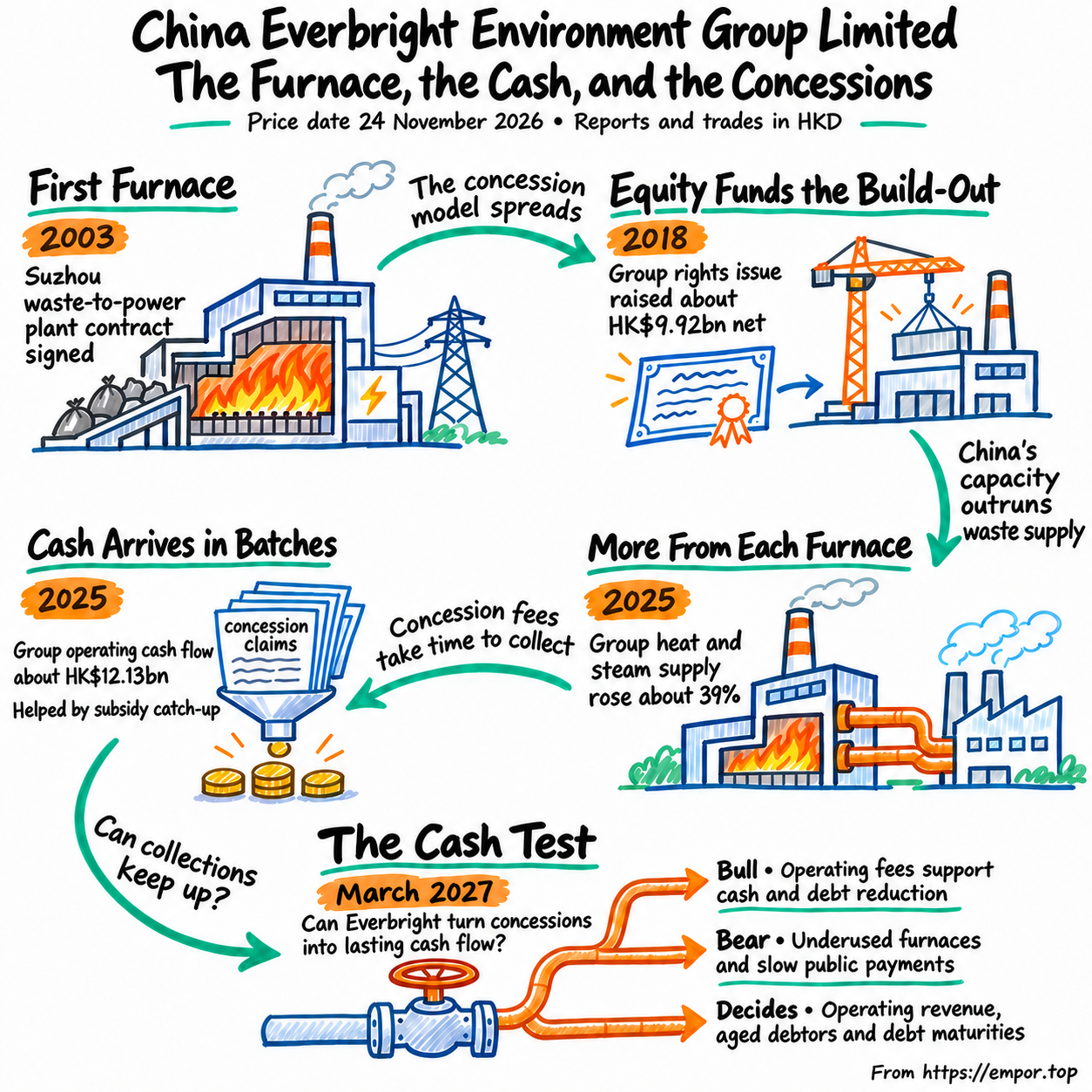
In September 2003, a Hong Kong-listed company with a long and somewhat unfocused corporate history signed a contract to build a household-waste incineration plant in 苏州 Suzhou, the canal city west of Shanghai.3 It was the Group's first waste-to-energy project.3 Nobody at the time would have called it the founding of China's largest incinerator operator. It looked more like a bet by a state-backed financial group that one of its listed vehicles could make itself useful in a country drowning in its own rubbish.
The listed shell itself was older than its environmental business. The company came into China Everbright Group's orbit in 1993, when the state conglomerate acquired control of it, and it carried the name 中国光大国际 China Everbright International for most of the years that followed.4 Through the 1990s it was a holding company in search of a purpose. The Suzhou contract gave it one.
The idea was elegant. Chinese cities in the early 2000s were filling landfills at an alarming rate, and the land around fast-growing cities was too valuable, and too close to people, to keep burying refuse in it. Incineration solved two problems at once. It shrank waste to a small fraction of its volume, and it turned the heat into electricity that could be sold to the grid. A city government could hand the operator its garbage plus a fee for every tonne, and the operator could sell the power on top. For a company backed by a state financial group, with access to capital and a relationship-friendly parent, the model fit neatly: raise money, build a plant, run it for decades, and collect fees from a government that would always need its rubbish taken away.
Once the template worked in Suzhou, it was repeated. The same project-development skill that went into a waste plant could be applied to wastewater treatment, to biomass power, to hazardous-waste disposal and to other environmental services.3 Over the following fifteen years, the company became less a single business than a machine for winning, financing and building environmental infrastructure projects across China, and later a handful abroad.
The growth record from that build-out looks spectacular at a distance. In Hong Kong dollar terms, revenue grew about 12.4% a year from FY2015 to FY2025, and net profit grew about 7% a year.1 Revenue went from under US$1bn equivalent in 2014 to a peak of about US$6.4bn in 2021.1 For a period in the late 2010s, revenue was growing at 35% to 60% a year.1 In 2020, the company marked how far it had travelled by changing its name from China Everbright International to China Everbright Environment Group, a name that finally described what it did.3
But that long-run number is a trap if it is read as the growth rate of a mature utility. Most of it came from construction. When a concession operator builds a plant, accounting rules let it book revenue for the construction work, almost as if it were a contractor building for a client. That revenue arrives in a rush during the build-out phase and vanishes when building stops. The decade's compound growth rate captures a company that was building at a frantic pace, not one whose operating fees were compounding at double digits.
The reversal makes that plain. Revenue peaked in 2021 and then fell four years in a row, declining about 25% in 2022, 14% in 2023, 6% in 2024 and 9% in 2025.1 Over FY2020 to FY2025, revenue shrank about 8.5% a year in Hong Kong dollars.1 Net profit fell about 7.3% a year over the same five years.1 That is too large and too sustained a decline to dismiss as ordinary volatility. It is the arithmetic of a construction boom ending.
There is a reasonable defence. A business that stops building is not necessarily a business in decline, if the plants it already built keep generating fees. Profit fell less than revenue, because construction revenue carries thin margins compared with running a plant. Net margin, which had been squeezed from about 27% in 2014 to about 11% in 2024 as construction became a bigger slice of the mix, recovered to about 15% in 2025 as construction shrank.1 In that light, the shrinking top line is partly a healthier mix.
Still, the question the build-out leaves behind is sharper than a mix shift. Did the Group build assets that will now compound through operations, throwing off cash for decades as a well-run concession portfolio should? Or did it build projects whose economics depended on the next round of construction and on local governments paying on time, neither of which can be taken for granted? To answer that, it is necessary to understand exactly how a concession turns a furnace into money, and why the money so often arrives late.
III. The Concession That Turns a Furnace into a Long-Dated Claim
Imagine a field outside a mid-sized Chinese city where a new Everbright plant is going up. Cranes swing steel into place for the boiler hall. The city has signed a concession agreement, but it has not paid the Group a single yuan for the construction. It will not, either, not directly. Under the typical arrangement, the grantor makes no payment during construction; the operator recovers its investment through fees once the plant starts working.2 Yet even before the first truck of rubbish arrives, the Group's income statement can already show revenue from this plant, and its balance sheet can already show a large asset.
That is the central magic trick of concession accounting, and it explains more about Everbright's numbers than any other single fact.
The contracts come in a few flavours, known by their initials. Under BOT, build-operate-transfer, the Group builds the plant, operates it for a long concession period and hands it back to the government at the end. Under BOO, build-own-operate, it builds and keeps the plant. Under TOT, transfer-operate-transfer, it takes over an existing plant from the government, runs it and later hands it back.2 In all of them, the economic core is the same. The Group finances and builds, or acquires, treatment capacity. It then runs that capacity for many years, earning a fee for each tonne of waste or cubic metre of wastewater, plus revenue from selling electricity and, increasingly, heat and steam.
Under the accounting rules for such arrangements, those decades of future fees get split into three pieces that show up as three different lines in the revenue mix. In 2025 they looked like this. Operation services brought in about HK$19.8bn. Construction services brought in about HK$2.7bn. Finance income on service concessions brought in about HK$5.0bn.2
The first is the easiest to understand. It is the recurring core: the fees for handling waste and water, the power sales, the steam sales, the payments for running plants. This is the business a long-term owner is really buying.
The second, construction revenue, is the Group acting as its own contractor. While building a concession plant, it recognises revenue for the construction work at something like a contractor's margin. This revenue depends entirely on the project pipeline. Build lots of plants, and it is large. Stop building, and it disappears, which is precisely what happened in 2025.
The third, finance income, is the subtle one. Because the government has, in effect, agreed to pay the operator over decades for an asset the operator financed up front, part of the future fee stream is treated as repayment of a loan the operator made to the grantor. The accountant books an asset, a service-concession or contract asset, representing that future consideration. Each year, interest accrues on it, and that interest is recognised as finance income. Think of it as a mortgage in reverse: the Group lent the city a plant, and each year books the interest on that loan as revenue, while the principal is meant to come back through operating-period fees.
Put those three lines together and the economic picture becomes clearer. Once a plant is commissioned, it can earn steadily for a long time, from waste fees and energy output. That is the operating promise of the model, and for an essential service it is a real promise. Cities do not stop producing rubbish.
The catch is that the strength of the promise depends on details the Group does not publish in a consistent way. The company does not disclose, across its portfolio, a consistent set of concession lengths, minimum waste commitments or guaranteed volumes.2 An outside investor therefore cannot see how much of the portfolio is protected by a "put-or-pay" floor, where the city pays even when it delivers less waste, and how much is exposed to whatever rubbish happens to arrive at the gate. That distinction becomes critical in a market where waste supply has fallen behind furnace capacity.
The deeper issue is timing. All three revenue lines can be recognised before cash arrives. Construction revenue is booked during construction, but paid back only through future operating fees. Finance income is booked as interest accrues on an asset, not when cash changes hands. Even operating revenue can include renewable-energy tariff subsidies, a top-up the central government pays on green power, which often waits years for administrative settlement.2
The result is visible on the balance sheet. At the end of 2025, the Group carried service-concession and other contract assets of about HK$104.9bn, net of allowances for expected losses.1 That figure is more than three times the company's entire market value. It is a claim on future fees, not cash in hand.
And the cash record shows how long such claims can take to settle. Across FY2014 to FY2025, the Group reported about HK$48.9bn of cumulative net profit. Its cumulative cash from operations over the same twelve years was roughly zero, slightly negative at about minus HK$726m.1 Every dollar of profit, in aggregate, stayed on the balance sheet as concession assets and receivables rather than turning into money the company could spend. Free cash flow over the same period was about minus HK$12.9bn, while the Group paid about HK$15.5bn of dividends.1 Those dividends, and the plants themselves, were funded by borrowing and by shareholders.
That is not, by itself, proof of anything sinister. A company in heavy build-out phase should consume cash, because construction comes first and fees come later. The real test is whether the cash flows reverse once building slows. The fact sheet suggests that reversal has begun: operating cash flow turned positive in 2022 and rose sharply through 2025.1 But one strong year, or even four improving ones, cannot settle a twelve-year question. The concession model creates a substantial operating base, but its accounting can move reported earnings well ahead of collections.
The concession was the Group's main way to grow its waste business. For water, though, Everbright chose a different route. Rather than simply building more water plants inside the parent, it put its water business into another listed company.
IV. The Water Business Went Public Through a Reverse Takeover
In June 2014, a small Singapore-listed company called HanKore Environment Tech announced that it would acquire China Everbright Water Investments, the water-treatment arm of what was then China Everbright International.5 On paper, a little company was swallowing a big one. In substance, the big one was taking over the little one's listing.
This is what financiers call a reverse takeover. Instead of paying cash, HanKore issued new shares to the Everbright seller as consideration. The transferred water business was valued at about RMB5.81bn, and once the new shares were issued, the Everbright seller held about 78% of the enlarged company.56 HanKore was renamed China Everbright Water, and the parent continued to consolidate it as a subsidiary.6
Why go to the trouble? The transaction documents framed the deal around scale and focus: combining Everbright's water assets with HanKore's existing wastewater projects would create a larger water platform with its own access to capital markets.56 A separately listed vehicle could raise money in its own name, attract investors who wanted pure water exposure, and give the parent a currency for future deals without diluting shareholders of the Hong Kong company. The valuation was supported by independent valuation work set out in the circular.6
It is tempting to treat this as an acquisition and ask whether Everbright overpaid. That is the wrong frame. This was a carve-out of the Group's own business, injected into a listed shell, rather than a cash purchase of an unrelated competitor. The Hong Kong company did not write a large cheque for HanKore; it swapped its water business for a controlling stake in a bigger listed water company. The public documents describe the valuation work and the expected benefits of scale, but they do not supply a clean set of comparable transaction multiples that would support a confident judgment that the price was too high or too low.
The more useful test is what the water platform became. In 2025, the Group's environmental-water segment generated about HK$5.35bn of external revenue and about HK$1.92bn of adjusted EBITDA.2 That makes water about one-fifth of the Group's revenue, a meaningful business, but one that remains much smaller than environmental energy, the waste-to-energy core, which generated about HK$15.0bn of revenue.2 A decade after the reverse takeover, water had become a solid second leg of the business, not a rival to the furnace.
It is also worth separating the water subsidiary's listing from the parent's own capital history. The 2014 deal raised no new ordinary equity for the Hong Kong company. It reorganised where assets sat and created a second listed entity within the family. Later, Greentech, the biomass and hazardous-waste arm, was spun off into its own Hong Kong listing as well, completing a structure in which the parent owns two listed children plus its own core energy business. That structure creates flexibility, but it also creates layers: minority shareholders at each subsidiary, separate boards, and a parent whose consolidated figures include earnings that belong partly to other investors.
Alongside these large structural moves, the Group kept adding individual project concessions by acquisition, picking up plants in places such as Yulin and Zhaotong.1 These were local additions to the network rather than transformative deals. The disclosed record does not provide a consistent series of purchase prices or returns for each acquired project, so there is no way from outside to benchmark whether each one earned its cost.
That leaves a bigger question hanging over the whole expansion. How much of Everbright's growth came from well-priced operating assets, and how much from building capacity ahead of demand, funded by whoever would provide the money? In 2018, the answer to the funding part of that question arrived in the form of one of the largest equity raises in the company's history, and it came as a surprise.
V. A HK$10 Billion Rights Issue Funded the Build-Out
On 14 August 2018, shareholders of China Everbright International woke up to an announcement that their company wanted a great deal more of their money. The board proposed a rights issue: for every 27 shares an investor held, they could buy 10 new ones at HK$6 each.7 The total was roughly US$1.3bn. The market's reaction was immediate and brutal. The shares fell as much as about 26% during the day, one of the sharpest drops in the company's history.89
Part of the shock was the size. Part of it was the surprise. Analysts noted that only months earlier, the company had indicated it had sufficient funding for its plans, and now it was asking shareholders for almost HK$10bn.9 The subscription price was set at a deep discount to where the stock had been trading, which is typical of a rights issue designed to make sure shareholders take up their entitlement, but which also signals that the company needs the money badly enough to sweeten the offer.9
The raise went ahead and was completed in September 2018, bringing in about HK$9.92bn net of expenses.7 The prospectus laid out where the money would go: new environmental projects, research and development, equipment, working capital, and repayment of debt.7
This was not routine refinancing. It was a meaningful act of capital allocation that asked shareholders to fund the next leg of the build-out. For those who took up their rights, it meant committing more capital to the business at HK$6. For those who did not, it meant dilution: their slice of the company shrank by more than a quarter. Either way, shareholders were betting that the projects the money funded would earn returns above the cost of the capital.
The investment thesis at the time was coherent. China's waste-to-energy market was booming. Provinces and cities were tendering new incineration capacity as fast as operators could build it. Everbright had the scale, the parent and the track record to win a large share of those tenders, but it needed equity to support the borrowing that each new project required. The rights issue also reduced reliance on bank debt at a moment when leverage was climbing. In short, the company raised equity to grow faster without stretching its balance sheet.
The present strategy reads almost like the mirror image. Management now talks about strict control of capital expenditure and a shift toward asset-light contracts, in which the Group operates or maintains plants it does not own rather than financing new ones.1 Cash purchases of property, plant and intangible assets fell to about HK$1.86bn in 2025 from about HK$2.37bn in 2024.1 A company that once raised HK$10bn to build is now explicitly trying not to.
Research and development, one of the uses the 2018 prospectus named, offers a revealing footnote to that shift. In 2025 the Group spent about HK$63m on reported R&D, and about HK$69m in 2024, or roughly a quarter of one percent of revenue in each year.1 For a company of about 15,400 employees that presents itself as a technology-led environmental operator, that is a small number.1 The company describes applied research, intelligent plant control and commercial deployment of its own equipment, and some development work is embedded in project costs rather than reported as R&D.1 Still, the figure makes clear what kind of company this is. Its edge, if it has one, lies in engineering and operating plants, not in a laboratory.
That turn in strategy does not mean the 2018 raise was a mistake. The money was raised and deployed, the projects were built, and many of them are running. Nor was Everbright alone responsible for what happened next in the industry. It was one participant, albeit the largest, in a broad national build-out driven by policy, local-government demand and dozens of competing operators. When capacity outran waste growth, every operator felt it.
But the record since 2018 gives a clear signal about how well the capital earned its keep, and it is a mixed one. Leverage did not fall after the raise. Debt-to-equity went from about 0.56 in 2014 to about 1.14 after the 2018 raise, then climbed to a peak of about 1.91 in 2021, and stood at about 1.85 at the end of 2025.1 The equity raise, in other words, did not replace debt; it supported more of it. Meanwhile, returns trended down. Return on invested capital fell from about 10% in the mid-2010s to about 5% by 2025, and asset turnover, how much revenue each dollar of assets generates, fell from about 0.3 to about 0.15.1 By the end of 2025, every dollar of assets was producing about half the revenue it had produced at the peak of the build-out.
Some of that decline is mechanical. As construction revenue disappears and assets become long-dated concession receivables, turnover naturally falls. A mature concession portfolio should look less "productive" by this measure than a construction boom does. Still, a return on invested capital of around 5% for a business borrowing mostly at floating rates in renminbi is not a comfortable cushion. It suggests that the projects built in the boom years, funded partly by the 2018 raise, earn returns that sit not far above the cost of funding them.
The question for today's management is therefore plain. With capital expenditure under tight control, the shares trading below book value and leverage still high, will the leadership harvest the operating base, improve cash recovery and reduce debt? Or will it keep investing in new projects whose contract economics are difficult to see from outside? To answer that, the story has to step back and look at the market those projects compete in, because the industry Everbright helped build has changed shape beneath it.
VI. China's Incinerators Built Faster Than the Waste Supply
For a decade, the problem in Chinese waste was too much rubbish and not enough furnaces. Landfills overflowed, cities protested against dumps, and the national government set ambitious targets for incineration. Operators raced to build, and local governments raced to sign. By the mid-2020s, the problem had flipped. In many places, there were now more furnaces than waste to fill them.
Industry reporting in 2025 described it as China's little-known oversupply problem: insufficient waste amid a glut of incinerators.10 Waste supply had grown far more slowly than incineration capacity, partly because the build-out overshot, partly because waste sorting and recycling diverted material, and partly because population and consumption growth slowed in some regions. Industry estimates put national waste-to-energy utilization at about 60% in 2024, implying roughly 40% of capacity sitting idle.10 That national average is not an Everbright utilization figure, and it would be wrong to assign it to the company. The Group does not publish a portfolio-wide utilization rate against designed capacity. But the industry backdrop matters, because a waste-to-energy plant is a high fixed-cost machine. It earns when it burns. A furnace running at 60% of design capacity spreads the same depreciation, staff and maintenance across fewer tonnes and fewer kilowatt-hours.
The war game over the municipal tender
Everbright's scale is real. Its 163,050 tonnes per day of designed capacity across waste-to-energy projects is the benchmark the industry is measured against.1 For comparison, 首创环境 Capital Environment, a significant rival in Hong Kong, reported annual waste-treatment capacity of about 14.98m tonnes in 2025, which works out to roughly 41,000 tonnes a day.11 On that crude comparison, Everbright's designed waste capacity is about four times Capital Environment's. The two measures are not perfectly like-for-like, because Capital Environment's figure covers more than incineration and designed capacity is not the same as tonnes actually processed. But the gap in scale is wide.
Scale, though, is not the same as market power. The competitive set includes Capital Environment, 上海康恒环境 Shanghai SUS Environment, 中国天楹 China Tianying, and a long tail of municipal, provincial and state-backed operators. Contracts are awarded city by city, often through tenders, and the economics vary widely from one locality to the next. No single national market-share figure can settle the question of who has an edge where.
The sharpest force in this market is the buyer. In waste-to-energy, the customer is usually a local government that controls the tender, sets or approves the fee, issues the permits, and decides where the waste goes. That is a remarkable concentration of power in one counterparty. In 2025, Everbright disclosed, unlike in 2024, that a single local-government customer accounted for more than 10% of Group revenue, about HK$2.98bn, and that local PRC government authorities in total accounted for about HK$23.65bn of revenue, the overwhelming majority of the business.2 Public-sector dependence is not a risk factor at the edge of this company. It is the company.
Rivalry is also intensifying in a new way. As fewer new plants get tendered, operators are chasing the same pool of adjacent work: asset-light operation and maintenance contracts for plants owned by others, waste sorting, municipal sanitation, and heat supply to industrial parks. Each of those can improve the return on an existing furnace or fill a gap left by fewer new projects. Each also invites the same rivals to bid.
What does Everbright's scale actually buy, then? The plausible answer is operating capability. A company that runs nearly two hundred waste-to-energy plants should know more than most about squeezing electricity out of a tonne of rubbish, running furnaces safely, meeting emission standards and winning complex concessions that smaller operators cannot finance. That is a real advantage in a tender. But the Group does not publish the evidence that would show whether it is consistently defensible: a bid-win rate, a contract renewal or retention rate, or a series showing the fees it realises against competitors.
Switching costs are real at the plant level. Once a city has an Everbright plant on its land, connected to its grid and fed by its trucks, replacing the operator mid-concession is expensive and disruptive. But the public buyer remains free to rebid at the end of a concession, to award new capacity to someone else, and to steer waste toward other plants. A first-built plant is not a permanently captured customer.
The narrower moat that the numbers support
The operational evidence for a narrower advantage is genuine, and it is worth stating clearly. In 2025, waste processing volume rose about 3%, on-grid electricity rose about 5%, and electricity output per tonne of waste was about 467 kWh, up about 1%.1 Heat and steam supply, as the opening scene showed, rose about 39%.1 Those numbers say the Group is getting more out of each tonne and selling more products from each furnace. That is the sort of incremental, operator-driven improvement a well-run portfolio should show when new construction slows.
Why does steam matter so much? Because of how a waste-to-energy plant makes money from heat. A conventional plant turns a tonne of rubbish into steam, and then turns that steam into electricity, losing a large share of the energy in the conversion. Selling the steam directly to a nearby factory skips that lossy step. The customer pays for heat it would otherwise produce by burning coal or gas, and the plant earns from the same tonne without needing another tonne of waste. In a market where the constraint is no longer furnace capacity but feedstock, every extra yuan squeezed from the waste already arriving is worth more than a new plant that would compete for the same rubbish. A 39% jump in heat and steam supply is therefore the clearest sign that management understands the problem it faces.
The limitation is geography. Steam cannot travel far through a pipe before it cools, so the opportunity depends on having industrial customers near each plant. Some of Everbright's plants sit next to industrial parks; many sit beside cities with no factory demand nearby. The company does not disclose how much of its capacity is connected to heat customers, or what share of energy revenue steam now contributes, so there is no way to tell from outside how far the heat strategy can scale before it runs out of neighbours.
It is not the same as growth. A 3% rise in volume in an oversupplied market is respectable, but it does not replace a construction line that halved.
Then there are the future-facing projects. Everbright has explored hydrogen production and methanol synthesis at pilot scale, and Greentech has begun commercial supply of biomethane.1 These are interesting, and they fit the logic of making old plants and old feedstocks work harder. But pilots are not revenue, and the company's record shows no history of converting technical firsts into material earnings lines at speed. Neither has yet been shown to move Group economics, and investors should treat them as options rather than pillars.
The company's current answer to the oversupply problem is coherent: more heat and steam, more resource recovery, more asset-light services, and tighter capital spending. That answer might improve the economics of mature assets. The next few years have to prove that those additions can offset fewer new projects and weak national waste utilization. And the first place to look for that proof is the most recent set of results, which arrived with a headline that sounded contradictory.
VII. Revenue Fell, Profit Recovered, and Cash Still Has to Catch Up
On 20 March 2026, Everbright published its results for 2025. The headline numbers seemed to point in opposite directions. Revenue had fallen 9%, to about HK$27.52bn, as construction revenue dropped 53%.2 Yet profit attributable to shareholders had risen 16%, to about HK$3.93bn.2 And operating cash flow had jumped to about HK$12.13bn, the strongest in the company's recent history.1
To an optimist, that combination looked like the long-awaited harvest: the build-out ending, the operating base taking over, profits and cash both rising. To a skeptic, it looked like a business shrinking while a few accounting and financing tailwinds flattered the bottom line. The truth sits between those views, and getting it right requires separating three things: what happened in operations, what happened in financing and impairments, and what happened in collections.
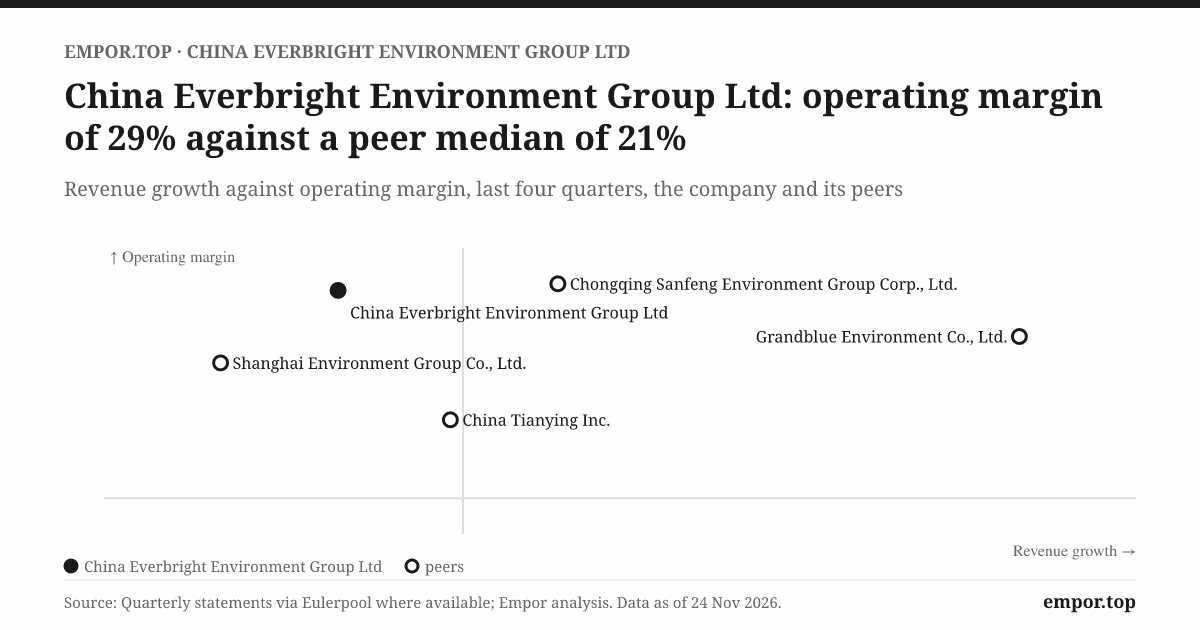
Start with operations. Operation-service revenue rose about 2% in 2025.2 That is modest, but it is the line that matters for a harvest strategy, and it grew while the total fell. At the segment level, the picture is of a durable core. Environmental energy, the waste-to-energy business, generated about HK$15.0bn of revenue and about HK$7.11bn of adjusted EBITDA. Environmental water generated about HK$5.35bn of revenue and about HK$1.92bn of adjusted EBITDA. Greentech, the biomass, hazardous-waste and solar arm, generated about HK$6.73bn of revenue and about HK$1.64bn of adjusted EBITDA.2 The energy business is the engine, with an EBITDA margin of nearly half its revenue. Greentech, by contrast, earns much thinner margins, and that matters for what comes next.
Now the profit bridge. Gross profit and consolidated revenue both declined in 2025.2 So the 16% rise in attributable profit did not come from selling more at higher margins. It came mainly from two places lower down the income statement. The first was financing. Finance costs fell by about HK$613m, as the Group repaid debt and benefited from lower Chinese interest rates on its largely floating-rate renminbi borrowings.2 The second was impairments. Asset write-downs and expected-credit-loss charges were lower in 2025 than in the punishing 2024, when the Group had taken heavy charges.2
That second point cuts both ways. The years 2024 and 2025 together included substantial impairments of goodwill, property, plant and equipment and intangible assets, concentrated mainly in Greentech and other operations.1 Those write-downs are a direct verdict on past capital allocation: they say some assets the Group bought or built were worth less than their book value. Lower impairments in 2025 helped earnings recover from 2024, but the recovery is partly a story of a bad year not being repeated, rather than of a business getting better. "Better operations" is part of the explanation, not the whole of it.
There is a third, quieter contributor that deserves a sentence, because it is easy to mistake for operating earnings. In 2025 the Group booked about HK$1.44bn of "other revenue," equal to roughly a quarter of its profit before tax, and the largest piece was about HK$826m of value-added-tax refunds, alongside about HK$92m of government grants.1 VAT refunds are a standing policy benefit for environmental services in China, so they are recurring in the sense that they have been around for years. But they are a policy, and policies can change. At the same time, a separate line of other income and losses was a net loss of about HK$1.47bn, dragged down by credit-loss charges and impairments.1 Put the two side by side and "other income" turns out to be a tug of war between state support and write-downs, not a clean, repeatable profit stream.
The tax line tells a similar story of noise. In the second half of both 2024 and 2025, the effective tax rate collapsed to about 1%, against a more normal rate in the mid-twenties in the first halves.1 For the full year, the rate fell to about 17% in 2025 from about 24% in 2022.1 A lower tax charge flatters net profit growth, and investors projecting the 2025 recovery forward should not assume the tax rate stays at that level.
The interim results for the first half of 2026 extended the same pattern. Revenue was down about 1% year on year, almost flat, while profit attributable to shareholders rose about 10%.12 The interim dividend rose to HK16 cents per share.12 The decline in revenue is slowing, which suggests construction is approaching a floor, but top-line growth has not returned.
The receivables that will not shrink
Now the cash, which is where this story has been heading since the first furnace.
The 2025 cash surge was real money. But it is worth understanding where it came from. About HK$2.57bn of that year's operating cash flow came from a reduction in contract assets, meaning the Group collected or converted more of its long-dated concession claims than it added.1 In 2024, by contrast, contract assets had increased by about HK$1.04bn, and operating cash flow was about HK$6.78bn.1 Non-cash charges, including amortisation, expected credit losses and impairments, also added back large sums.1 A big part of the swing came from a large catch-up in renewable-energy subsidy payments: unbilled tariff-subsidy contract assets fell from about HK$5.20bn at the end of 2024 to about HK$2.30bn at the end of 2025.1 The rating agency 联合资信 Lianhe Credit Rating noted that cash flow had improved with subsidy receipts and cost controls.4
Subsidy settlements are good news, but they are not a repeatable engine. The renewable-energy subsidy is a central-government top-up for green power, and its settlement depends on administrative procedures that move at their own pace. By June 2026, the unbilled subsidy balance had crept back up to about HK$2.74bn.12
It is worth being precise about the kinds of claims on Everbright's balance sheet, because they are often lumped together. Contract assets, about HK$104.93bn net at the end of 2025, largely represent future concession consideration the Group expects to earn over the life of its contracts, including the unbilled subsidy portion.1 Debtors, about HK$24.15bn net, are amounts already billed.1 The ageing of the debtors is where the warning sign sits. Debtors more than 13 months old rose to about HK$11.63bn from about HK$9.88bn a year earlier, even though invoices are generally due 30 to 90 days after billing.1 Almost half of the billed receivables had been outstanding for more than a year.
Some of that ageing is measured from the date revenue was recognised rather than the date a bill became due, so not every one of those balances is contractually overdue.1 But the direction is unmistakable, and the auditor, KPMG, made the expected-credit-loss assessment on debtors and contract assets a key audit matter, noting about HK$2.66bn of loss allowances across those balances.1 That is not a qualification of the accounts. It is the auditor telling readers that management's judgment about how much of this money will be collected is one of the most important and uncertain numbers in the report.
The headline ratio is debtor days, how many days of revenue are sitting in receivables. It rose from about 107 in 2014 to about 472 in 2025.1 That figure does not mean every government invoice is 472 days late. Part of it reflects shrinking revenue in the denominator and the way subsidy balances accumulate. But it does signal, in one number, the severity of the cash-conversion burden this company carries. Measured that way, Everbright is owed well over a year of revenue.
Set the 2025 cash surge against the longer record, and the verdict is clear. The profit recovery is real, but it is not yet evidence of renewed growth or sustained cash conversion. Over twelve years, the Group's cumulative operating cash flow remained negative against about HK$48.9bn of reported profit. One strong year, built partly on a subsidy catch-up and lower finance costs, cannot overturn that.
For anyone tracking this company, three readings carry most of the signal. The first is operation-service revenue, alongside waste throughput and electricity per tonne, which shows whether the operating base is growing; it rose about 2% in 2025. The second is aged debtors and subsidy balances, which show whether profits are becoming cash; aged debtors rose to about HK$11.6bn in 2025, while subsidy balances fell. The third is net debt and current maturities, which shows whether the balance sheet is getting safer; total interest-bearing borrowings fell to about HK$88.55bn from about HK$91.67bn, but about HK$29.94bn of that was due within a year.1 A low P/E or a generous dividend yield says nothing about any of these.
Those numbers now belong to a leadership team that changed shape in the middle of 2026, in a way that put more power in fewer hands.
VIII. The Chairman Took the CEO's Chair
On 17 July 2026, Everbright announced that its chief executive, 栾祖盛 Luan Zusheng, had resigned for age-related reasons, and that the chairman, 王思联 Wang Silian, would take on the role of acting chief executive.13 At a stroke, the two most powerful jobs in the company were held by one person.
Wang had arrived at Everbright less than two years earlier. He was appointed executive director and chairman of the board in September 2024, succeeding 黄海清 Huang Haiqing, who had also stepped down for age-related reasons.14 Before joining the Group, Wang had been vice chairman and president of China CYTS Tours Holding, a state-owned travel company, a background in managing a large state-linked enterprise rather than in environmental engineering.14 He also became chairman of Everbright Greentech.14 That pattern is typical of China's central state-owned enterprise system, where senior executives rotate between group companies and the chairman serves as the parent's principal representative in the listed company.
Combining the chairman and chief executive roles departs from Code Provision C.2.1 of the Hong Kong corporate governance code, which recommends that they be held by different people.12 The company acknowledged the deviation and said it would consider separating the roles at an appropriate time.12 The succession was disclosed as retirement-related, not as a dismissal or a crisis, and there is no evidence of anything other than an orderly transition. The governance question is narrower: whether a temporary concentration of power becomes a prolonged arrangement.
It helps to be clear about where real control lies, because it is not with the executive team. At the end of 2025, China Everbright Group and its own upstream controller, 中央汇金 Central Huijin, the state investment arm, were each deemed interested in about 43.08% of the shares.1 That stake belongs to the controlling group, not to the managers. The executives themselves hold little equity. Their incentives come from a bonus system, and its design is revealing. Executive bonuses consider operating profit, new-project investment, and safety and environmental performance.1
Think about what that rewards in a business that must choose between adding new projects and collecting cash from old ones. Operating profit, measured under concession accounting, can rise without cash arriving. New-project investment, as a bonus criterion, rewards growth in the asset base at exactly the moment the company says it wants to control capital expenditure. Collections, aged-debtor reduction and free cash flow are not named in the disclosed criteria. The company does not disclose individual chief executive or finance director pay, nor a multi-year comparison of pay against profit.1 The incentive scheme was not obviously designed for a harvest strategy.
The board, at the end of 2025, had two executive directors, two non-executive directors and three independent non-executive directors.1 One of those independent directors had served for roughly 28 years, an unusually long tenure for someone meant to provide independent oversight.1 At the annual general meeting in May 2026, about 6.85% of votes cast opposed his re-election.[^15] Every resolution passed.[^15] That is a specific and modest dissent signal from minority holders, consistent with investors who dislike very long tenures, rather than evidence of any activist campaign. With the controlling group holding over 43%, minority opposition would need to be far larger to matter.
On credibility, the record so far is mixed rather than negative. Borrowings fell in 2025 and operating cash flow rose, which is what a leadership promising tighter capital discipline should deliver.1 But full-year revenue remained below its prior-year level, the long history of weak cash conversion is not erased by one year, and there is not yet a long enough record under Wang to judge whether promises and outcomes line up. The company has also been preparing a possible second listing on the Shenzhen market; its sponsor reported in July 2026 that the process was still in the counselling stage.15 Whether that listing would bring new capital, and on what terms, has not been disclosed.
What would change the assessment? Three things: the appointment of a permanent chief executive, with the roles separated; a clear public explanation of capital priorities, showing how management ranks debt reduction, collections, dividends and new projects; and repeated years of cash generation alongside falling aged receivables. Until those arrive, the market is pricing the company with the uncertainty built in, and the price itself is the next clue.
IX. Analysis & Bear vs. Bull Case
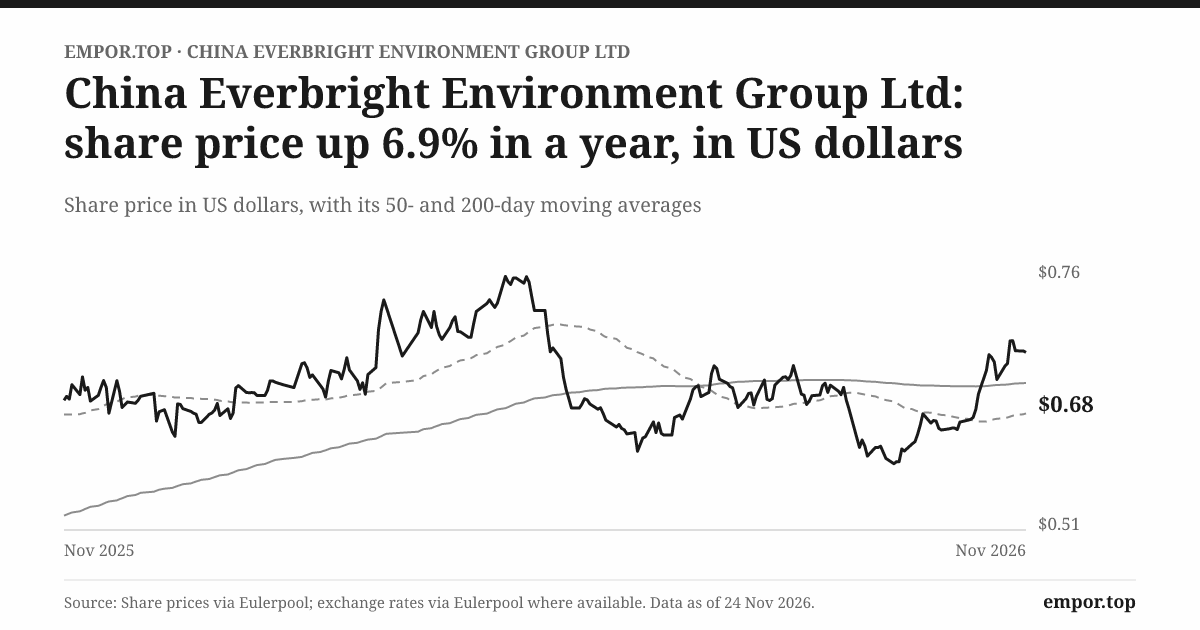
On 24 November 2026, Everbright's shares closed at about HK$5.30, giving the company a market value of about HK$32.1bn.1 Investors looking at the screen saw two numbers that seemed to make the case on their own: a price of about 7.4 times earnings, and a price of about 0.6 times book value. On those figures, the market was valuing the company at a little over half of what its own accounts said its net assets were worth.
Then they saw a third number, which complicates the first two. Over the twelve years to 2025, the company's cumulative operating cash flow was negative. The whole investment debate sits in the gap between those figures. Is the discount to book compensation for a balance sheet full of claims that may never be fully collected? Or is it an opportunity, if the operating assets keep producing cash the way they did in 2025?
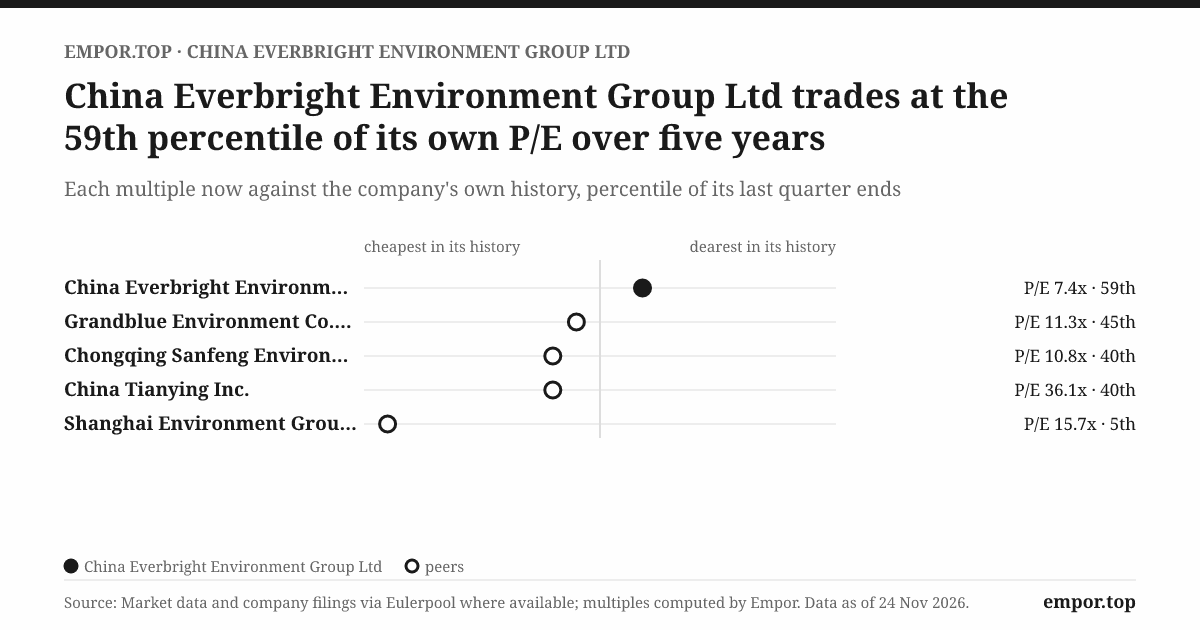
The first thing to correct is the popular reading that Everbright is unusually cheap against its own history. It is not. Its P/E of about 7.4 times sits above its own five-year median of about 6.4 times.1 The market has been pricing this company at single-digit earnings multiples for years, and it currently pays slightly more than usual. The second correction concerns cash. On the latest data, the stock shows a free-cash-flow yield of about 31.5%.1 That figure is real arithmetic, built on the strong 2025 cash year, but it is precisely the number most distorted by a single subsidy catch-up and a contract-asset reduction. Nobody should capitalise one year of collections as if it were a steady state.
The enterprise value tells a fuller story. Add the Group's large debt to its market value, and the enterprise value is about HK$121bn, nearly four times the equity.1 On that basis, the business trades at about 11.8 times EBITDA.1 That is not a distressed multiple. It is the multiple of an infrastructure business whose equity is a thin slice on top of a large pile of borrowing. Small changes in the value of the concession assets translate into large changes in the value of the equity.
Why it wins, and why it might not
The bull case starts with essentiality. Everbright runs one of the largest portfolios of waste, water and environmental services in China, and those services are not optional for the cities that buy them. In 2025, operating revenue rose, waste volumes and electricity per tonne improved, heat and steam grew sharply, finance costs fell, and borrowings came down.12 In the first half of 2026, attributable profit rose about 10% and the interim dividend increased.12 If construction has bottomed and the operating base keeps growing modestly, the reported earnings should increasingly be backed by fees from running plants rather than by building them. In that world, cash flow normalises, debt falls, and a company trading below book value re-rates simply by proving its assets are worth what the accounts say.
The bear case starts with the same facts read from the other side. Construction volume is contracting, and there is no sign of a replacement growth engine at scale. National overcapacity puts pressure on utilization and makes tenders more competitive. Local governments hold structural bargaining power and can delay payment. Aged debtors are rising, the contract-asset pile is enormous, and about HK$98bn of assets and subsidiary equity were pledged as security for borrowings at the end of 2025, which limits financial flexibility.1 Net current assets fell to about HK$3.29bn from about HK$12.04bn a year earlier, as more debt fell due within twelve months.2
Framing the competitive position through the classic lens of industry forces sharpens the picture. Buyer power is the dominant force, and it is very high: the customer is a government that sets the fee, controls the waste, issues permits and pays on its own schedule, as the disclosure of a single local authority above 10% of revenue illustrates. Rivalry is moderate to high and rising, as operators chase the same asset-light and heat-supply work in a market with too many furnaces. The threat of new entrants is low for large concessions, because financing a plant requires capital and state-linked credit, but low entry threats matter less when new tenders are scarce. Substitutes exist in the form of recycling, waste sorting and composting, which reduce the feedstock rather than replace the plant. Supplier power is modest; equipment and construction inputs are widely available.
Seen through Hamilton Helmer's framework of durable advantages, the evidence supports only a narrow claim. Scale economies exist in operating know-how and procurement, and possibly in financing costs, but they do not translate into pricing power over a government buyer. Switching costs are meaningful during a concession but reset at the contract boundary. A cornered resource, if any, is the concession itself, a long-dated local monopoly over one city's waste, but it is granted by the buyer and only as good as the buyer's willingness to deliver waste and pay. There is no meaningful network effect, brand power or proprietary process power visible in the disclosures. The plausible advantage is execution: running plants better than rivals, extracting more electricity and steam per tonne. That advantage is real but unproven as a moat, because the company does not publish the bid-win, retention or fee-realisation data that would show it consistently earns more than competitors.
Two second-layer risks are worth naming briefly, because they shape how an outside shareholder should read the reported numbers. The first is currency. More than 96% of the Group's revenue and investments, and about 99% of its borrowings, are in renminbi, while its shares trade and report in Hong Kong dollars.1 The natural matching of renminbi assets and renminbi debt keeps the operating exposure low, as management argues. But translation can swing reported equity sharply: translation differences on foreign operations were positive about HK$2.0bn in 2025 after negative about HK$1.5bn in 2024.1 A price-to-book ratio is partly a bet on the exchange rate. The second is the family relationship. The Group keeps deposits with China Everbright Bank, a sister company under the same controlling group, with a maximum daily balance of about HK$680m in 2025, and pays affiliates modest underwriting, advisory and property-management fees.1 Those dealings are small against the size of the business, were reviewed by the independent directors and checked by the auditor against approved caps, and do not suggest value leakage.1 They are a reminder, though, that this listed company sits inside a larger state-owned system whose priorities are not always identical to those of minority holders.
The credit market offers a useful second opinion. In January 2026, Lianhe assigned the Group its top AAA rating with a stable outlook, citing scale, policy support, shareholder support and access to financing.4 That rating supports the view that Everbright can refinance its debt and is unlikely to face a liquidity crisis. But the same rationale flagged large receivables and contract assets, restricted assets and weaker long-term solvency indicators as the key risks.4 The rating agency, in other words, sees the same tension as the equity market: a franchise backed by the state, sitting on a balance sheet whose assets are slow to turn into cash.
A skeptical long-short investor would push the argument further. If capital expenditure is under tight control and the shares trade at roughly 0.6 times book, why should the company prioritise any new project over debt reduction, cash collection or returning capital to shareholders? Every new concession adds another long-dated claim to a balance sheet already full of them, at returns on invested capital around 5%. The only convincing answer would be project-level evidence that new contracts earn materially better returns than the old ones, or that heat and asset-light contracts produce cash faster. The company does not publish that evidence. Until it does, the strategy language about disciplined growth cannot be tested from outside.
Valuation comparisons need equal discipline. Everbright Greentech, the Group's own controlled subsidiary, traded at about 12.9 times earnings in November 2026, well above the parent.16 But Greentech is not a clean peer: it is a consolidated part of the same group with a different business mix. Broader peer baskets put the median forward P/E for environmental and utility peers around 11 times, but those baskets include businesses with very different cash profiles.17 Neither comparison establishes a fair value for the parent. What they show is that the market applies a specific discount to the Hong Kong holding company, which is consistent with investors pricing in the cash-conversion risk, the leverage and the holding-company layering.
So the "why win" case is that Everbright has the scale, the operational capability, the heat-and-steam monetisation and the multi-service portfolio to keep growing operating revenue modestly while collecting more cash and paying down debt. The "why not" case is that capacity stays underused, public buyers squeeze fees or delay payment, and profits keep arriving years ahead of cash. History so far narrows the bull claim rather than rejecting it: the operating franchise is real, but the evidence that it converts reliably to cash is one year deep.
The readings that will settle it are the three already named: collections and the ageing of debtors; operating-service revenue and utilization; and debt maturities set against operating cash flow. Each has a latest reading, and each has a direction. Next year's numbers will show whether those directions hold.
X. Business & Investing Lessons
Go back to the Suzhou plant in 2003. It solved a public problem, burning a city's waste instead of burying it. It generated power for the grid. And under the accounting that would come to define the company, it began booking a long stream of future service revenue from the moment it was built. Everything good and everything difficult about Everbright was already present in that first furnace.
The first lesson comes from that 2003 pivot. A listed shell in search of a purpose found a public need that would not go away, and built one of the largest environmental operators in Asia around it. But the plant was only the start of a capital cycle that runs for decades, from financing to construction to operation to collection, and each step can go wrong. A public need can become a business, but the first plant is only the beginning of the capital cycle.
The second comes from the 2018 rights issue. Shareholders handed the company almost HK$10bn to build faster, and the shares fell by a quarter on the day they were asked. The money built plants, and the plants run. But leverage kept rising, returns kept falling, and impairments later arrived on parts of the portfolio. The lesson for any investor asked to fund an expansion is that the size of the raise and the quality of the use are separate questions. Growth funded by shareholders earns its keep only when the projects pay back.
The third comes from 2025. The company produced the best operating cash flow in its recent history, driven by a large catch-up in subsidy payments and a fall in contract assets. It would be easy to declare the cash problem solved. But the same year saw aged debtors rise, and the twelve-year cumulative cash record stayed negative. A single year is a data point; a pattern is a business. One good collections year is evidence; a pattern of cash conversion is proof.
The fourth comes from the steam pipes. As the market stopped needing new furnaces, Everbright began selling heat and steam to industrial customers, recovering resources, and running plants for others. That is the right instinct for a mature infrastructure operator, but it is also an admission that growth now has to come from squeezing more out of assets already built. When the market stops needing new furnaces, the operator has to make the old ones work harder.
The fifth is the lesson that binds the others, and it belongs to this company more than to any other. Everbright built a huge concession book on the premise that a government contract is as good as cash. The balance sheet now holds more than HK$100bn of contract assets that say otherwise, at least on timing. Operating scale and technical capability are genuinely valuable, but they do not cancel the power of the buyer or the cost of being paid late. A concession is a promise from a government, and its value is set by the government's habits, not the plant's capacity.
XI. Epilogue
As 2026 draws to a close, Everbright stands in an unusual position. It runs one of the largest environmental infrastructure portfolios in the world, it has just reported its best cash year in a long time, its profit is rising, and its acting chief executive is also its chairman. The pipeline of new projects is narrower than at any point in its modern history, and the company says that is by design.
The next decisive moment will come in March 2027, when the Group reports its full results for 2026. Three things in that report will decide which story investors are living in.
The first is whether operation-service revenue keeps growing, and by how much, now that construction revenue is too small to hide behind. A growing operating line, alongside steady waste throughput and electricity output per tonne, would show that the harvest strategy is working. A flat or falling one would suggest that national overcapacity is starting to bite on the Group's own plants.
The second is whether the contract assets and receivables turn into cash without another one-off subsidy catch-up. The unbilled subsidy balance was already creeping back up by mid-2026. If aged debtors fall and operating cash flow stays strong after working-capital movements, the 2025 surge will look like the start of a pattern. If aged debtors keep rising and cash flow falls back, it will look like a one-time windfall.
The third is leadership and the balance sheet together. Will the acting chief executive role become permanent, or will the company appoint a separate chief executive and separate the roles, as it has said it will consider? Will it explain its capital priorities clearly, and will current borrowings keep falling relative to cash generation? The Shenzhen listing process, if it advances, will also show whether the company wants new equity, and for what.
There are two possible endings. In one, Everbright becomes what its concession accounting has always assumed it was: a stable, cash-generating portfolio of essential services, gradually deleveraging, paying a growing dividend and proving its book value. In the other, underused furnaces, assertive local governments and slow subsidy payments keep the cash arriving years behind the profit, and the apparent value of the assets becomes harder to believe. The company's own disclosures leave the answer open until the next figures arrive.
XII. Outro
Back at the plant on the edge of the city, the crane claw dips into the bunker again. The furnace burns, the turbine spins, the steam flows out to the factories. Everything about the machine works. It was built to solve a city's waste problem, and it does.
But the machine is waiting on two things it cannot control. It is waiting for the next truckload, in a country that built more furnaces than its rubbish can fill. And it is waiting for the next government payment, on a balance sheet that holds more than a hundred billion Hong Kong dollars of claims. Everbright is a story of infrastructure that can be essential, profitable and still short of cash. The furnace turns waste into power; the balance sheet has to turn promises into cash.
References
-
Annual Report 2025 — China Everbright Environment Group Limited, 2026-04-23 ↩↩↩↩↩↩↩↩↩↩↩↩↩↩↩↩↩↩↩↩↩↩↩↩↩↩↩↩↩↩↩↩↩↩↩↩↩↩↩↩↩↩↩↩↩↩↩↩↩↩↩↩↩↩↩↩↩↩↩↩↩↩↩↩
-
Annual Results for 2025 — China Everbright Environment Group Limited (HKEX), 2026-03-20 ↩↩↩↩↩↩↩↩↩↩↩↩↩↩↩↩↩↩
-
Milestones — China Everbright Environment Group Limited ↩↩↩↩
-
Credit Rating Rationale — China Lianhe Credit Rating, 2026-01-27 ↩↩↩↩
-
Everbright Water business injection announcement — HanKore Environment Tech, 2014-06-02 ↩↩↩
-
Circular on proposed acquisition of China Everbright Water Investments and reverse takeover — Singapore Exchange, 2014 ↩↩↩↩
-
Rights Issue Prospectus — China Everbright International, 2018-08-30 ↩↩↩
-
China Everbright International shares tumble after surprise US$1.3 billion rights issue — South China Morning Post, 2018-08-14 ↩
-
China Everbright Shares Dive After $1.3 Billion Rights Issue — Bloomberg, 2018-08-14 ↩↩↩
-
China's little-known oversupply problem: insufficient waste amid glut of incinerators — South China Morning Post, 2025-07-24 ↩↩
-
Annual Report 2025 — Capital Environment Holdings Limited, 2026-04-20 ↩
-
Interim Results for the Six Months Ended 30 June 2026 — China Everbright Environment Group Limited (HKEX), 2026-08-28 ↩↩↩↩↩↩
-
Announcement on resignation of CEO and appointment of Acting CEO — China Everbright Environment Group Limited (HKEX), 2026-07-17 ↩
-
Announcement on change of Chairman and appointment of Executive Director — China Everbright Environment Group Limited (HKEX), 2024-09-27 ↩↩↩
-
IPO Counselling Progress Report, Second Update — CITIC Securities, 2026-07-13 ↩
 LinkedIn
 WhatsApp
 Reddit
 Hacker News
 Email
 Kindle
 RSS Feed
 Spotify
 Apple Podcasts
 Amazon Music
 Audible
 YouTube