Industrial Bank of Korea: The Policy Moat and the Value-Up Paradox
I. Introduction & Episode Roadmap
On the morning of July 27, 2026, the investor relations team at a bank headquartered in Seoul's Jung-gu district published a press release that, on its face, looked like a disappointment. First-half consolidated net income had fallen 4.4% year on year to KRW 1.4429 trillion, dented by foreign-exchange valuation losses and a larger provisioning charge.12 Buried a few lines down was a sentence that mattered far more to anyone who had followed this institution for the previous six decades: for the first time since its founding in 1961, the bank would pay a quarterly dividend — KRW 210 per share, with a record date of July 31, 2026.2
For a normal commercial bank, a quarterly dividend is plumbing. For 중소기업은행 Industrial Bank of Korea — universally known as IBK, trading as 024110.KS on the 한국거래소 Korea Exchange — it was something closer to a constitutional amendment. This is an institution created by statute, majority-owned by the state, whose largest shareholder is a government ministry that books its dividend as budget revenue. Everything about its capital return runs through a political filter. Getting to a quarterly cadence required an amendment to the bank's articles of incorporation and regulatory sign-off, which is why an initiative first floated for 2025 only arrived in the second quarter of 2026.3
That is the tension this story is about. IBK is two things at once, and the two things do not always agree.
The dual-hat problem. The 기획재정부 Ministry of Economy and Finance (MOEF) holds 474,430,991 shares, or 59.50% of IBK.4 Two other state institutions — 한국산업은행 Korea Development Bank with 7.20% and 한국수출입은행 Export-Import Bank of Korea with 1.84% — hold most of the rest of the government bloc.4 Roughly three out of every ten shares float. And yet IBK is not a quiet agency. It is the largest lender to Korean small and medium enterprises by a wide margin: KRW 270 trillion of SME loans on the books at the end of June 2026, a 24.6% share of the national SME lending market and the highest reading in its history.12 It out-lends every private financial group in the country in the segment that matters most to Korea's industrial base.
The core question. Is IBK a public utility wearing an equity ticker — a place where minority capital goes to absorb national credit shocks — or is it a mispriced, high-payout compounder that the 기업 밸류업 프로그램 Corporate Value-Up Program is slowly forcing into the open? At roughly KRW 20,500 a share in late July 2026, the market capitalised the whole thing at about KRW 16.3 trillion, well below stated book value, against a return on equity that has been sliding rather than climbing.[^5]5
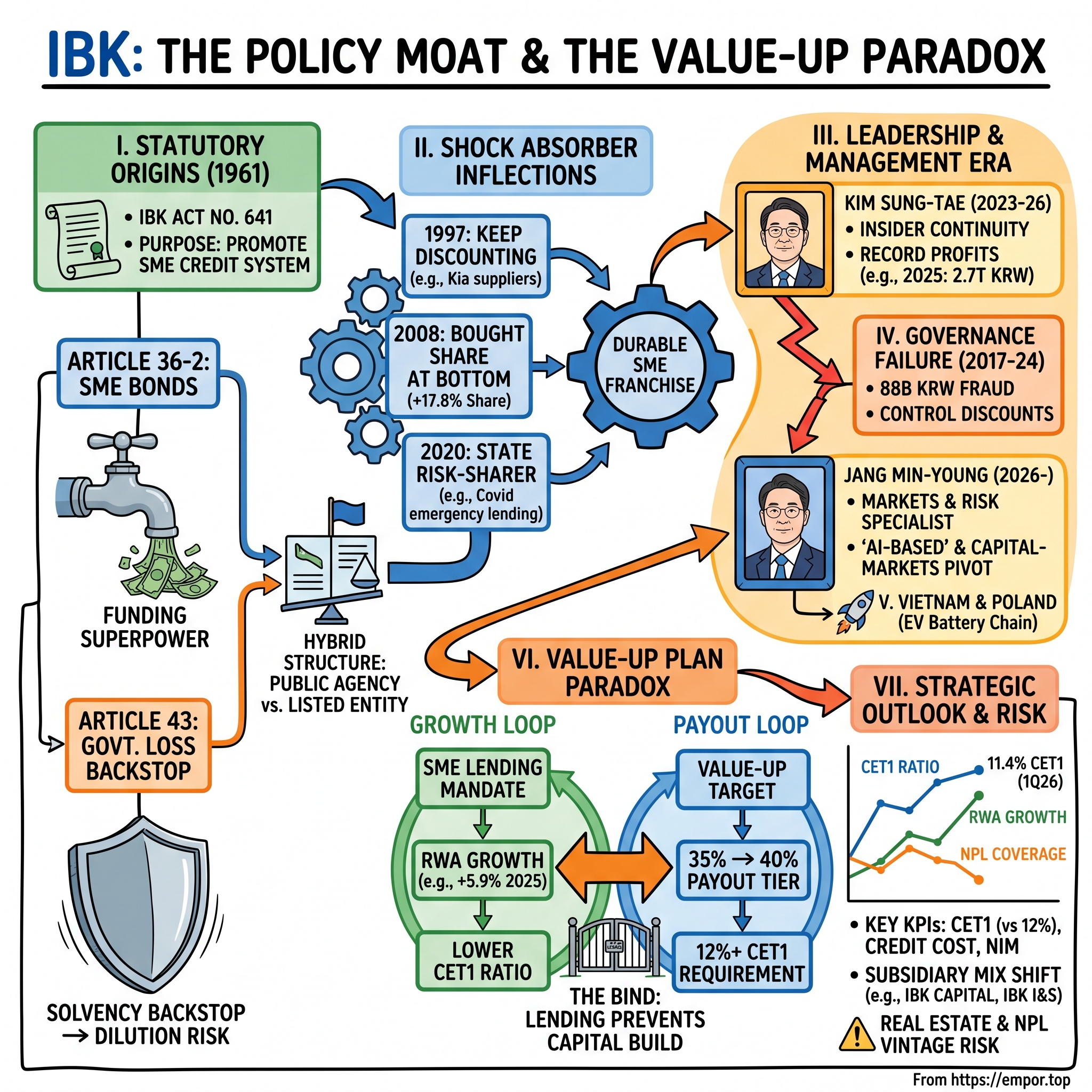
The honest answer, which this piece will build toward, is that both readings are partially right, and the reason they can coexist is a structural loop inside IBK's own value-up plan. The bank promised to raise its dividend payout ratio from 35% to 40% — but only once its Common Equity Tier 1 ratio clears 12%.6 Its CET1 ratio sat at 11.44% at the end of the first quarter of 2026.7 The fastest way to build CET1 is to slow risk-weighted asset growth. The fastest way to slow risk-weighted asset growth is to lend less to SMEs. And lending to SMEs is the one thing IBK exists to do — a mandate the new chief executive has just re-committed to at a scale of KRW 300 trillion through 2030.8 The moat and the re-rating are drawing on the same well.
Where we're going. We start with the statute — because with IBK, the law is the business model, and two specific articles of the Industrial Bank of Korea Act do more analytical work than any strategy deck. We then trace how the institution behaved in the crises that defined it: 1997, 2008, 2020, and the rate shock of 2022–2023, which together establish whether the counter-cyclical story is real or rhetorical. We look hard at leadership — the three-year tenure of 김성태 Kim Sung-tae, which produced record profits and a serious governance scandal, and the arrival of 장민영 Jang Min-young in February 2026. We size the core SME franchise against 국민은행 Kookmin, 신한은행 Shinhan, 하나은행 Hana, 우리은행 Woori and NH농협은행 NongHyup, run it through Helmer and Porter, then put proportionate weight on the non-bank subsidiaries and the overseas build-out. Finally, the numbers, the discount, the risks, and the two or three metrics that will actually tell you whether the thesis is working.
Start where IBK started: with a piece of legislation.
 Subscribe on LinkedIn
II. Statutory Origins & Legal Framework: The Birth of a Policy Engine
Seoul in 1961 was not a place with a functioning capital market. Per-capita income was on par with the poorest countries on earth, the banking system had been battered by war and inflation, and what little institutional credit existed was directed by the state toward a handful of large export-oriented groups — the seeds of what would become the 재벌 chaebol. For a machine shop in Yeongdeungpo or a textile operation in Daegu, the formal banking system was effectively closed. Working capital came from the private curb market at rates that would today read as usury.
It is worth pausing on what that curb market actually was, because it explains why a state bank was the chosen instrument rather than, say, a subsidy scheme. The 사채시장 informal lending market was not a fringe. For a large share of Korean small businesses through the 1960s and into the 1970s, it was the credit system: money lent by individuals and informal syndicates, priced at multiples of official bank rates, secured by personal guarantees and social pressure rather than by documentation. It was fast and it was flexible, and it made long-horizon investment impossible. No one buys a machine tool with a five-year payback using money that can be called next month.
The government under 박정희 Park Chung-hee had a specific industrial problem. Its development model ran on directing scarce foreign-exchange and domestic savings toward export champions. That model worked — but export champions need supply chains, and supply chains are made of exactly the small firms the banking system would not touch. A chaebol assembling machinery for export cannot do so if the workshop that makes its castings is refinancing at 4% a month. The SME credit gap was not a social welfare issue. It was a bottleneck in the industrial policy itself.
Into that vacuum, on July 1, 1961, the military government promulgated 중소기업은행법, the Industrial Bank of Korea Act, as Law No. 641. The bank itself opened on August 1, 1961, capitalised with KRW 200 million and seeded with assets inherited from the agricultural banking system.910 Its statutory purpose is worth reading in the original register, because it has never been amended away: the Act exists "to promote independent economic activities of small and medium proprietors and to enhance their economic status by establishing the Industrial Bank of Korea which contributes to the establishment of an efficient credit system for the small and medium proprietors."11 Within a year, in March 1962, the bank had launched a small-business consulting service — advisory work bundled with credit, a pattern that persists.10
That is the origin myth, and it is genuinely a myth in the useful sense: it is a story the institution tells about itself that also happens to describe how it makes money. But the part that should interest an investor is not the mission statement. It is two clauses buried deep in the Act.
The funding superpower
Article 36-2 authorises IBK to issue 중소기업금융채권, Small and Medium Industry Finance Bonds, and caps the outstanding amount at 20 times the aggregate of the bank's paid-in capital and reserves.11 That number is enormous. It means IBK's wholesale funding capacity is constrained by a formula rather than by depositor sentiment.
Why does this matter in practice? Think about how a normal commercial bank funds a loan book. It competes for deposits — checking accounts, savings, and above all time deposits, the expensive kind that migrate to whoever posts the highest rate this month. Deposit competition in Korea is fierce and periodically irrational; every few years a rate war breaks out and the whole sector's funding cost jumps. IBK plays that game too, but it has a second, structurally different tap: it can issue bonds into the institutional market, in size, at tenors that match its loan book, priced off the credit of an entity whose losses the government is statutorily obliged to cover.
Which brings us to the second clause.
The backstop
Article 43 of the Act provides that IBK's net losses in each fiscal year shall be made up by its reserve funds, and — the operative language — "if such net losses remain even after being made up by reserve funds, the Government shall make up for the remaining losses."11
Read that slowly. This is not an implicit guarantee of the sort that ratings agencies infer from ownership. It is a statutory obligation on the Republic of Korea to absorb residual losses. For a bondholder, it collapses IBK's credit risk toward sovereign risk. For an equity holder, it does something subtler and more double-edged: it removes existential solvency risk from the story, but it also tells you exactly what kind of institution you own. A bank whose losses the state will cover is a bank the state expects to take losses on its behalf.
The government has honoured the arrangement in practice, not just on paper. During the Asian financial crisis, as SME failures cascaded and non-performing loans surged, the state injected KRW 1.8 trillion of capital into IBK across October 1998 and January 1999.10 A decade later, as the global financial crisis hit, it put in another KRW 1 trillion between December 2008 and January 2009.12 The backstop is real. It is also, in equity terms, dilution — capital arriving at the worst possible moment in the cycle, at whatever price the state chooses.
Going public without giving up control
The hybrid structure arrived in stages. IBK listed its shares on the KOSDAQ market in November 1994 and transferred to the main KOSPI board in December 2003.10 Along the way it built out a group: leasing and development finance subsidiaries in 1986, further finance affiliates through 1991–1993, a unified "IBK" corporate identity across the group in 2007, a securities arm in 2008, a pension insurance business in 2010.9
What the listing accomplished, and what makes IBK analytically interesting rather than merely large, is that it forced a policy institution to live inside a quarterly reporting cycle. From 1994 onward, IBK had to explain its net interest margin to analysts, publish an ROE, and justify a dividend — while simultaneously executing whatever the Ministry of Economy and Finance and the 금융위원회 Financial Services Commission asked of it. No private bank has to reconcile those two audiences. IBK does it every quarter.
The obvious question is whether that reconciliation is stable or merely unresolved. Six decades of statute give IBK a funding cost and a solvency profile no private competitor can replicate. The same six decades give the state a claim on IBK's balance sheet that no minority shareholder can vote against. Whether that trade is good for the minority depends entirely on what happens when the economy breaks — which is exactly what the next four decades of crises put to the test.
III. Inflection Points: Testing the Economic Shock Absorber
There is a scene from 1997 that has become part of IBK's institutional folklore, and unlike most corporate folklore it is checkable. When 기아그룹 Kia Group collapsed and the commercial banks stopped discounting the bills of its supplier network — the hundreds of second- and third-tier parts makers whose receivables were suddenly worthless paper — IBK kept discounting. Suppliers that would otherwise have failed on a liquidity technicality survived long enough for Kia to be absorbed by 현대자동차 Hyundai Motor.10
That is the shock-absorber function in one sentence: a bank that keeps the payment system working for small firms when the private system freezes. It is also, of course, a bank taking credit risk that everyone else has just declined to take. Both things are true, and which one dominates depends on whether the state shares the loss.
2008: buying market share at the bottom
The global financial crisis is the cleanest natural experiment in IBK's history, because we can see what the counter-cyclical mandate did to both sides of the ledger.
On the profit side, 2008 was bad. IBK's net income fell 34.3% to KRW 767 billion; stripping out a KRW 266.5 billion gain on the sale of LG Card in the prior year, the underlying decline was still 14.9%.12 Asset quality deteriorated visibly into the fourth quarter as the crisis intensified.12
On the balance sheet side, 2008 was a land grab. IBK grew SME loans by KRW 10 trillion to KRW 78.5 trillion and total loans 15.5% to KRW 97.4 trillion — expanding aggressively precisely when the commercial banks were retrenching to defend their capital ratios.12 It ended the year with the number one position in SME lending at a 17.78% market share.12 And the government completed a KRW 1 trillion capital injection across the turn of the year to give the bank room to keep going into 2009, with management stating it would prioritise funding SMEs "with bright business prospects or recovery potential."12
Hold that 17.78% figure. It is the single most important number in this section, because IBK's share today is 24.6%.1 Nearly seven percentage points of the Korean SME lending market changed hands over eighteen years, in one direction, and the mechanism was not clever product design. It was showing up with capital in the years when everyone else was leaving.
The analytical conclusion is a real one but narrower than the promotional version. IBK does not win SME clients because its bankers are better; it wins them because its cost of capital does not spike when credit spreads blow out, and because its majority shareholder recapitalises it mid-crisis. That is a durable advantage. It is also an advantage that transfers value from the taxpayer and, at moments of capital injection, potentially from existing minority holders to the franchise. An investor should price the franchise gain and the dilution risk together, not separately.
2020: the state as risk-sharer
The COVID-19 emergency ran the same playbook at greater speed. IBK supplied roughly KRW 24 trillion of liquidity to small businesses and the self-employed during the pandemic response.10 The scale invited an obvious fear — that a policy bank pushed to lend at emergency rates into the teeth of a demand collapse would be sitting on a mountain of bad loans by 2022.
That did not happen, and the reason is structural. Korea's SME credit architecture is not a single balance sheet; it is a risk-sharing lattice. 신용보증기금 KODIT and 기술보증기금 KIBO provide partial guarantees on qualifying SME exposures, the government subsidises rate differentials on designated programmes, and IBK originates and services. The bank carries origination risk and servicing cost; the state carries a meaningful slice of the tail. This is the mechanism that makes IBK's counter-cyclical behaviour rational rather than suicidal, and it is the single most under-appreciated feature of the business by investors who model it as a normal bank.
It is also the mechanism most exposed to political change. Guarantee coverage ratios and rate subsidies are set by policy, not contract, and they can be tightened.
There is a second-order effect of the pandemic response that is easy to miss and matters for how one reads the current loan book. Emergency lending programmes, by construction, extend credit to firms that would not have qualified under normal underwriting — that is the entire point. When those programmes end, the resulting exposures do not disappear; they roll into ordinary loans, get restructured, or default. A meaningful portion of the KRW 24 trillion IBK deployed during COVID has been living inside its book ever since, seasoning through a rate shock its borrowers did not anticipate when they took it. Every subsequent asset-quality number is partly a statement about that vintage.
2022–2023: the rate shock, and who actually paid
The Bank of Korea's tightening cycle was the first stress test in which the state did not obviously absorb the pain. Policy rates climbed from near-zero to 3.50%, and the burden landed directly on SME operating margins — firms with floating-rate working capital lines and thin coverage. IBK ran interest-relief programmes for distressed borrowers, which is what a policy bank does, and which also has the convenient side effect of deferring defaults.
What the data shows is a loan book that bent without breaking. The non-performing loan ratio ended 2024 at 1.34% and improved to 1.28% at the end of 2025, down six basis points; the credit cost ratio for 2025 was 0.47%.13 Those are unremarkable numbers for a bank whose entire book is unrated small businesses, and they are the strongest available evidence that IBK's underwriting is not merely a subsidised giveaway.
But the caution is important, and it runs through the rest of this story: forbearance and headline NPL ratios are the two metrics most vulnerable to management discretion in a policy bank. A lender that is institutionally reluctant to pull the trigger on a struggling manufacturer will, mechanically, report better asset quality for longer than a lender that isn't. The delinquency data — which is harder to manage than NPL classification — is the better tell, and it has been moving the wrong way. We'll come back to it.
The pattern across all four crises is consistent enough to be called a strategy rather than a series of accidents: IBK gains share in downturns, gives back profitability while doing so, and gets recapitalised if it needs to be. Which raises the leadership question. Running an institution like that requires someone who can hold two mandates in tension without collapsing into either one — and in the last three years IBK has had two very different people try.
IV. Modern Era & Current Management: The Kim Sung-tae Era
The Korean state-bank chief executive appointment is one of the more revealing rituals in Asian finance. Formally it is a technocratic process. In practice it is a negotiation between the presidential office, the Financial Services Commission, and a labour union that has demonstrated, repeatedly, that it can physically prevent an unwelcome appointee from entering the building.
The union's position has never been subtle: it opposes 낙하산 인사 — "parachute" appointments of politically connected outsiders — and it has said it will resist unqualified regime-adjacent candidates to the end.14 That history is what made January 2023 notable.
Kim Sung-tae: the insider
김성태 Kim Sung-tae took office as IBK's 27th chief executive in January 2023. He had joined the bank in 1989, spent 33 years inside it, and was promoted to executive vice president in 2020 — the fifth internally promoted chief executive in IBK's history.14 His predecessor, 윤종원 Yoon Jong-won, had come from the presidential secretariat and the economic bureaucracy, and his 2020 arrival had been contested.15
The case for an insider at a bank like IBK is specific and worth stating plainly, because it is not the generic "continuity is good" argument. SME credit is not a scored, automatable product in the way that mortgages or credit cards are. Underwriting a KRW 3 billion equipment loan to a machine-tool maker in Changwon requires knowing what that sub-sector's order book looks like eighteen months out, which of the local firms have real customers versus one captive customer, and what a used five-axis machining centre is actually worth in a forced sale. That knowledge lives in people and in files, not in a model. A chief executive who has spent three decades inside that knowledge base can interrogate the credit committee; one who arrived from the Blue House cannot.
Kim's tenure delivered on the numbers. Consolidated net income reached KRW 2.674 trillion in 2024, with SME loans up KRW 13.4 trillion (5.7%) to KRW 247.2 trillion and a then-record 23.65% market share.16 In 2025, consolidated net income hit a record KRW 2.7189 trillion — even as standalone bank net income fell 1.7% to KRW 2.3858 trillion, with the difference made up by capital markets, securities and special-purpose vehicle subsidiaries.13 SME loans grew 5.9% to KRW 261.9 trillion and share reached 24.4%.13 Total consolidated assets passed KRW 500 trillion.15
The part that doesn't fit the highlight reel
In January 2025, IBK disclosed an improper lending case worth KRW 24 billion. Two months of on-site inspection by the 금융감독원 Financial Supervisory Service found a further KRW 64 billion, taking the total to KRW 88.2 billion.17
The details are worse than the number. The scheme ran from June 2017 to July 2024 and implicated 28 current and former employees.17 At its centre was a retired IBK employee — a fourteen-year veteran — and his spouse, who worked as a loan officer at the bank; the pair allegedly orchestrated KRW 78.5 billion of the total by creating shell companies for real estate ventures, disguising borrowed money as equity, inflating sale prices through fraudulent contracts, and using entry-class relationships to route around approval controls, with roughly KRW 1.57 billion in bribes and entertainment distributed to participating staff.17
Then the governance failure. The FSS concluded that IBK discovered the problem in September 2024 and did not disclose it to regulators until December, splitting internal audits across locations in a way that obscured the connections between cases, and deleting 271 related files and internal messages in January 2025.17 Kim issued a public apology on March 26, 2025 and announced an "IBK reform plan" — mandatory improper-lending verification forms on all loans, a new credit inspection organisation, separation of sales and review functions, audit advisory committees, an innovation committee.17 A week after the announcement, the measures were still in review, and only six of the more than twenty implicated employees had been reassigned.17
For an investor, this is not a headline-risk item to be waved through. It is direct evidence about the operating culture of a bank whose entire equity story rests on the credibility of internal credit controls over an unrated, relationship-originated loan book. A control environment in which a retired employee and a serving loan officer can run KRW 78.5 billion of fraud for seven years, and in which the institutional reflex on discovery was concealment rather than disclosure, is a control environment that deserves a discount. The reform plan may work. The evidence that it has worked will be the absence of a repeat, and that takes years to accumulate.
Jang Min-young and the handover
Kim's three-year term expired at the start of 2026. On January 23, 2026, 장민영 Jang Min-young was appointed IBK's 28th chief executive, and he was inaugurated at headquarters on February 20, 2026.188
Jang is another insider, but of a different type. Born in 1964, a German literature graduate of Korea University who joined the bank in 1989 — the same intake year as Kim — he took an MBA at Pennsylvania State University in 2002 and then built an unusual internal résumé: investor relations team lead in 2010, branch manager on Yeouido in 2013, head of fund management in 2015, director of the IBK Economic Research Institute in 2018, deputy president for risk management in 2020, and then out to the asset management subsidiary, where he became chief executive in 2024.18 Regulators framed the choice around his "expertise in financial markets and risk management competency."18
That combination — capital markets plus risk — is a deliberate signal about what the state wants next. Jang's inaugural address committed IBK to an "IBK-style productive finance project" deploying KRW 300 trillion through 2030 into AI, semiconductors, energy and other future growth sectors, alongside KRW 75 trillion of small-business support including refinancing and management consulting, expanded credit evaluation that weighs technology and growth potential rather than collateral, and an "IBK National Growth Fund Task Force" to push into capital markets.8 He also declared the bank would become an "AI-based financial institution," arguing that IBK "must evolve beyond a simple fund provider to become a financial partner leading industrial transformation."8
On July 14, 2026, he restructured the organisation to match: the Global Business Group was split out as a standalone unit under deputy president 정광석 Jung Gwang-seok, a Waseda MBA who joined in 1996; the Digital Group was converted into an "AX Strategy Group" for AI transformation; and a new Productive & Inclusive Finance Department was created for start-up and personal recovery support.19
Two things should be held in mind here. First, KRW 300 trillion over five years is a supply target, not a return target — and supply targets are how policy banks get into trouble. Second, Jang inherited an immediate labour dispute over unpaid overtime compensation, with strike action threatened in January before he took office.18 The most consequential test of a new state-bank chief executive is not the vision statement; it is whether he can say no to volume when the credit cycle says he should.
That question lands squarely on the core business — which is where the moat, if there is one, has to be visible.
V. Core Business Deep-Dive: SME Banking Economics & Competitive Moats
Walk into any of Korea's industrial belts — the machinery cluster in Gyeonggi, the auto-parts corridor running through Ulsan and Changwon, the semiconductor equipment supply chain around Hwaseong — and one thing is true of almost every firm with fifty to three hundred employees: IBK is somewhere on its balance sheet. Often as the lead lender. Frequently as the payroll bank. Occasionally as the reason it still exists.
That ubiquity is the business. As of the end of the first quarter of 2026, IBK's total loans stood at KRW 317.9 trillion, of which KRW 264.2 trillion — 83.1% — were SME loans.7 This is not a diversified bank with an SME division. It is an SME lender with some other stuff attached.
The engine, and its efficiency
The revenue formula is arithmetic, not alchemy. Net interest income is average earning assets multiplied by net interest margin; net profit is that, plus fee and trading income, less operating costs and credit provisions.
Where IBK diverges from the promotional version of its own story is on the margin. The intuition many investors bring is that SME lending must earn a fat spread — riskier borrowers, higher rates. IBK's actual NIM was 1.59% in the second quarter of 2026, up four basis points from 1.55% a year earlier, and essentially flat against 1.60% in the first quarter.20 Through 2025 it ran between 1.55% and 1.63%.21 That is a thin margin — thinner than several of its consumer-heavy commercial peers.
Why? Because IBK's book is not high-yield lending in disguise. A large portion carries state guarantees or policy rate subsidies, both of which compress the spread by design. IBK is not paid to take SME risk; it is paid to intermediate SME credit at scale with the state absorbing part of the tail. The economics are therefore volume economics. IBK earns a modest spread on an enormous, statutorily protected asset base, and its profitability lives or dies on funding cost and credit cost rather than on pricing power.
That reframing matters, because it tells you what to watch. A bank with pricing power defends its margin in a downturn. IBK does not have pricing power in that sense — the policy programmes set the price. What it has is a structurally cheap and structurally stable liability side, and a credit cost that has, so far, stayed in a tight band: 0.47% in 2025 and 0.46% in the first half of 2026, up five basis points year on year.1320
The competitive map
Korean corporate banking is an oligopoly with a state-owned anchor. On one side sit the four private financial groups — KB금융지주 KB Financial Group and its 국민은행 Kookmin Bank, 신한금융지주 Shinhan Financial Group, 하나금융지주 Hana Financial Group, 우리금융지주 Woori Financial Group — plus NH농협은행 NongHyup Bank with its rural and cooperative franchise. These are formidable institutions with far more diversified earnings, larger fee businesses, and consumer books that generate the low-cost deposits every banker covets.
On the other side sit IBK's policy siblings: 한국산업은행 Korea Development Bank, which handles large-corporate restructuring and heavy industrial finance, and 한국수출입은행 Export-Import Bank of Korea, the export credit agency. Neither competes with IBK for the machine shop in Ansan.
The competitive result is stark, and one 2025 statistic captures it better than any market-share table. Through July of that year, IBK's SME loan balance grew by roughly KRW 12 trillion — and IBK accounted for 82% of the entire Korean banking sector's SME loan growth, KRW 11.3 trillion out of KRW 13.8 trillion.10
Read that number twice, because it cuts both ways. It is the clearest possible demonstration of competitive position: in a year when Korean SME credit demand was being met, four out of five marginal won came from IBK. It is also the clearest possible statement of concentration risk. IBK is not one of several lenders sharing the marginal SME credit exposure of an economy facing weak domestic demand and an uncertain export cycle. It is, at the margin, the lender. If Korea's SME sector has a bad three years, the losses have a single primary address.
Why commercial banks don't fight harder
Three mechanisms explain the gap, and only two of them are moats.
The first is regulatory capital. Under Basel III, unrated SME exposures attract higher risk weights than residential mortgages or large-corporate loans. Every won a commercial bank lends to a small unrated manufacturer consumes more capital — and therefore more shareholder return capacity — than a won lent against an apartment in Gangnam. A private bank managing to a 13% CET1 target and buying back stock has a strong incentive to let IBK have the machine shop. This is not a moat IBK built; it is a moat regulation built around it, and it can be re-cut.
The second is funding structure, already covered: the bond issuance authority and the statutory loss backstop together give IBK a liability profile that does not reprice violently in a crisis. In Helmer's vocabulary this is closest to counter-positioning — IBK occupies a position its rivals could theoretically copy but rationally will not, because copying it would mean accepting statutory policy obligations, government-appointed leadership, and a permanent cap on the ability to withdraw from a segment when it turns. No listed private bank would trade its strategic freedom for IBK's funding cost. That is what makes the position defensible.
The third is genuine and proprietary: process power and scale economies in credit data. IBK has been underwriting the same population of Korean manufacturing SMEs continuously since 1961. It has watched multiple full default cycles play out sub-sector by sub-sector — what happens to shipbuilding suppliers when orders vanish, how auto-parts makers behave when a captive OEM cuts volumes, which machinery segments recover and which don't. A consumer-oriented commercial bank building an SME book from scratch would need decades to accumulate that. The 82%-of-market-growth statistic is downstream of this: IBK can say yes to credits its rivals cannot price.
It helps to make that concrete, because "proprietary credit data" is the sort of phrase every bank uses and few can substantiate. Consider what it takes to price a five-year loan to a firm in Changwon that machines housings for industrial pumps. The firm has forty employees, no credit rating, financial statements prepared by a local accountant, and one customer that accounts for 60% of revenue. A standard credit model looks at the leverage ratio and the customer concentration and declines. A lender with sixty years of files on this sub-sector asks different questions: is that customer a Korean OEM that has historically supported its supply base through downcycles, or one that switches on price? When pump demand last fell 30%, how many firms of this size in this region actually failed versus merely shrank? What did comparable machining equipment fetch at auction in 2009 and again in 2016? None of that lives in a ratio. It lives in an institution that has watched the same firms through several cycles and written down what happened.
This is why the advantage compounds rather than depreciating. Every year IBK originates a disproportionate share of Korean SME credit, it also observes a disproportionate share of Korean SME outcomes — and observations of defaults are the training data for the next decade of underwriting. A competitor cannot buy this. It has to live through it.
There is a fourth mechanism, switching costs, which the bank emphasises and which deserves a more sceptical reading. IBK does integrate deeply into SME operations — corporate banking platforms, payroll accounts, tax settlement, equipment and factory lease financing. Once a firm's payroll, receivables and equipment leases sit with one bank, moving is genuinely painful. But this is table stakes in corporate banking, not a differentiator; Kookmin and Shinhan offer the same integration. The honest version is that switching costs make IBK's existing book sticky, but they do not explain why IBK wins new business. Funding cost and credit-data depth explain that.
Porter, briefly
Rivalry is intense but structurally bounded: the four private groups compete hardest for the largest and best-rated SMEs, leaving the long tail — where IBK's data and capital advantage bites — less contested. Buyer power is low and fragmented; a firm with 120 employees does not negotiate hard against its lead bank, particularly one holding its payroll and guarantees. Supplier power, in banking, means funding, and here IBK's position is unusually strong for the reasons already covered. Substitutes are the live threat: non-bank financial institutions, corporate bond markets for the larger end of the SME spectrum, and increasingly capital-market and fund structures — which is precisely why Jang's mandate includes a growth-fund task force. New entrants are effectively barred; you cannot legislate yourself a second IBK.
The synthesis for an investor is this. IBK's competitive advantage is real, evidenced by two decades of one-directional share gain and by its dominance of marginal SME credit supply. But it is an advantage in volume and cost of capital, not in margin. It produces a large, low-yielding, capital-hungry asset base rather than a high-return franchise. That distinction is the entire reason the stock trades where it does — and it is why the parts of IBK that could earn a higher return on capital, the non-bank subsidiaries, matter more than their size suggests.
VI. Non-Bank Subsidiaries & Strategic Growth Engines
Here is a fact that should reframe how you think about IBK's recent earnings. In 2025, the bank on a standalone basis earned less than the year before — net income down 1.7% to KRW 2.3858 trillion as falling rates squeezed interest income. Yet the consolidated group posted a record KRW 2.7189 trillion.13 The entire delta, and more, came from the subsidiaries: capital, securities and special-purpose vehicles.13
For a group that has historically been described — accurately — as a monoline SME lender with appendages, that is a meaningful shift in the earnings mix. It does not make IBK a diversified financial group. It does mean the appendages are now doing real work at the margin.
IBK캐피탈 IBK Capital
The largest and most strategically coherent of the non-banks earned KRW 245.6 billion in 2025.13 Its business is industrial equipment leasing, instalment finance, mezzanine corporate debt and venture investment — which is to say, it lends against exactly the assets IBK's core SME clients buy, at points in the capital structure the bank itself cannot occupy.
The synergy here is not a slide-deck synergy. A machine-tool maker that has exhausted its senior credit line at the bank can be served by the capital arm with an equipment lease or a subordinated facility, at a higher yield, on a smaller balance sheet. The group keeps the client relationship, earns a better spread on the incremental exposure, and puts the risk in a vehicle with a different capital treatment. That is a genuinely useful structure.
The corresponding risk is equally real and rarely discussed: capital companies in Korea fund themselves in the corporate bond market and are the first entities to feel a funding squeeze when spreads widen. The 2022 Legoland credit event demonstrated how quickly Korean non-bank funding can seize. A capital subsidiary is a leveraged bet on the same SME credit cycle as the parent, with worse liability structure.
IBK투자증권 IBK Investment & Securities
The securities arm earned KRW 57.5 billion in 2025.13 Its niche is SME investment banking — IPO underwriting for smaller listings on KOSDAQ and KONEX, corporate bond issuance, and SPAC structures for mid-tier industrial firms.
This is strategically logical and financially modest. Roughly KRW 58 billion against a group that earns KRW 2.7 trillion is around 2% of consolidated profit. The correct way to size it is as an option rather than an earnings driver: if Jang's capital-markets pivot works, the securities arm is the vehicle through which IBK converts lending relationships into fee income and equity participation. If it doesn't, it remains a small, cyclical brokerage.
The smaller entities — IBK자산운용 IBK Asset Management, IBK저축은행 IBK Savings Bank, IBK연금보험 IBK Pension Insurance, and IBK벤처투자 IBK Venture Investment, established in 2023 — are individually immaterial to consolidated earnings.15 They matter mainly as the internal talent and experience pipeline that produced the current chief executive.
창공 IBK Changgong and the venture pipeline
IBK operates start-up incubation centres under the 창공 Changgong ("Blue Sky") brand across Korea and abroad. The direct profit contribution is negligible, and it would be analytically dishonest to present it otherwise. Its actual function is customer acquisition at the earliest possible stage: identify high-growth technology firms before they have a credit history, build the relationship, and be the incumbent lender when they mature into borrowers. Jang's July 2026 reorganisation formalised this thinking by creating a dedicated Productive & Inclusive Finance Department covering start-up support.19
Whether it works is unproven. Venture incubation as a customer funnel is a strategy many banks have tried and few have quantified. IBK does not disclose the eventual lending revenue attributable to Changgong graduates. Treat it as a reasonable use of a small budget, not as evidence of a technology strategy.
Following the clients offshore
The overseas build-out is more concrete, because it follows a specific, verifiable logic: go where Korean SMEs go.
In Vietnam, IBK received local subsidiary approval from the central bank on April 23, 2026 — nine years after first applying in 2017 — and is targeting an official launch in October 2026, which would make it the third Korean bank with a Vietnamese subsidiary after Shinhan and Woori.19 The subsidiary structure matters: branches are capital-constrained and geographically limited, while a locally incorporated bank can open in the industrial parks where Korean manufacturers actually operate.
In Europe, IBK opened an office in Wrocław, Poland in May 2023 and launched a Polish subsidiary in November 2025, serving roughly 780 Korean electric-vehicle battery and automotive companies operating in the region.19 This is arguably the most interesting item in the international portfolio, because it maps directly onto Korea's most significant industrial export of the 2020s — the battery supply chain — at a moment when European EV demand is genuinely uncertain. IBK Indonesia rounds out the Asian footprint.
A bank official framed the strategy without much marketing gloss: the goal is "supporting domestic SMEs striving locally," not expanding IBK's own market share abroad.19 That is credible and also limiting. It means the international network will scale with Korean outbound manufacturing investment and no faster, and that its credit quality is correlated with — not diversifying against — the domestic book. A Korean parts maker's Polish subsidiary fails for the same reasons its Korean parent does.
Which brings the story to the number that governs everything: capital.
VII. Financials, Capital Allocation, & The Value-Up Stress Test
Every equity story eventually reduces to a single constraint. For IBK, it is a two-digit number that most investors have never looked at: 11.44%.
That was the Common Equity Tier 1 ratio at the end of the first quarter of 2026, alongside a total BIS ratio of 14.87%.7 The bank is comfortably solvent. It is nowhere near where it needs to be to pay shareholders more.
The mechanism that traps the payout
IBK published its first Corporate Value-Up Plan in 2024, under the FSC's national programme to address chronic under-valuation of Korean equities. The plan set two headline targets: lift CET1 gradually toward 12.5%, and expand the dividend payout ratio toward a maximum of 40%, on the back of stable profit growth and improving ROE.6 As a first step, IBK reported a CET1 ratio of 11.32% and a 35% payout ratio for 2024.6
The critical detail — and the one that makes this a paradox rather than a plan — is that the two targets are linked by a formula. IBK's value-up framework applies the payout ratio in tiers keyed to CET1: at CET1 between 11% and 12%, the payout ratio is 35%; only when CET1 reaches 12% to 12.5% does the payout step up to 40%.22
So the question is simply whether IBK can accumulate capital. And here the mandate bites. Growing SME loans 5.9% in 2025 added risk-weighted assets faster than retained earnings could offset, holding CET1 near 11.5% and leaving the bank short of the 12% threshold required to unlock a higher payout.22 The result was mechanical: for the 2025 fiscal year IBK declared a dividend of KRW 1,048 per share, down 1.6% from KRW 1,065 for 2024, with the payout ratio held at 35%.2223
That is the value-up paradox in its cleanest form. IBK's shareholders are told the payout will rise to 40%. The condition for the rise is capital accumulation. The bank's statutory purpose, and its chief executive's KRW 300 trillion pledge, require it to deploy capital into risk-weighted SME assets at a pace that prevents the accumulation. Absent a step-change in profitability or a slowdown in loan growth that would contradict the mandate, the 35% payout is not a floor management is generous to maintain. It is a ceiling the business model imposes.
The buyback problem
Private Korean banks have a second lever. KB, Shinhan, Hana and Woori have all combined dividend growth with share repurchase and cancellation, which mechanically raises earnings per share and book value per share and has driven a visible re-rating in the sector. IBK has done almost none of this; its shareholder return is essentially dividend-only.22
The reason is ownership arithmetic. MOEF holds 59.50%.4 Buying back and cancelling shares held by minorities would increase the government's proportional stake, pushing state ownership higher rather than lower — the opposite direction from the long-standing policy preference for gradual privatisation, and a move with political and legal consequences the ministry has no appetite for. So the single most effective tool the private banks have used to close their valuation discount is, for practical purposes, unavailable to IBK.
What the market pays
At roughly KRW 20,500 per share in late July 2026, IBK carried a market capitalisation of about KRW 16.3 trillion, against a 52-week range of KRW 18,500 to KRW 29,550.[^5] Brokerage work in April 2026 put the stock at around 0.45 times book against a 2026 ROE forecast of 7.6%, characterising that as a low valuation.5 On the KRW 1,048 declared for 2025, the trailing yield at the recent price is roughly 5%.
Two observations follow, and they cut against the more excitable version of the IBK bull case.
First, this is no longer a deep-value 0.3x-book, 10%-yield situation of the kind that existed a few years ago. The stock has already partly re-rated — the 52-week high is more than 40% above the recent price, meaning a meaningful move happened and then partly reversed. The easy discount has been arbitraged.
Second, a 0.45x price-to-book multiple on a 7.6% forecast ROE is not obviously wrong. A simple sanity check: for a bank to trade at book value, its sustainable ROE needs to at least match its cost of equity. For a Korean bank, a reasonable cost of equity sits comfortably above 7.6%. On that arithmetic, a sub-1x multiple is not a discount to be closed; it is the correct pricing of a business earning below its cost of capital. The re-rating case therefore depends entirely on ROE improving — through better mix, subsidiary contribution, or slower asset growth — not on sentiment toward Korean governance.
Myth versus reality
Three consensus beliefs about IBK deserve testing against the numbers.
Myth: IBK is a high-yield dividend play. Reality: the yield is around 5% on a payout ratio pinned at 35% by a capital constraint, and the absolute dividend per share fell for 2025. It is a decent yield, not an exceptional one, and it is not currently growing.
Myth: SME lending means fat margins. Reality: NIM is around 1.59%, held down by guarantees and policy pricing.20 The business is a volume business.
Myth: government ownership makes the earnings safe. Reality: government ownership makes the balance sheet safe via Article 43. It does the opposite for earnings, because the mandate obliges IBK to lend into downturns, and because the state's dividend need is a claim on cash that competes with capital accumulation.
The activist's case, and the counter
A skeptical investor would make the following argument, and it is a strong one. IBK's payout is capped by a capital ratio that its own mandate prevents it from improving. Its CET1 trails private peers running comfortably above 13%. It cannot buy back stock. Its ROE fell to 8.16% in the first quarter of 2026 from 9.57% a year earlier, with ROA down to 0.61% from 0.70%.7 Its NPL coverage ratio slipped to 105.2% from 111.3%.7 And its internal control environment produced a KRW 88.2 billion fraud that management allegedly concealed from the regulator. On that reading, the discount is not an anomaly to be closed but a rational assessment of a business that will never be allowed to optimise for shareholders.
The counter-argument, which is genuine but narrower than its proponents claim, is fiscal. MOEF is not an indifferent owner; it received roughly KRW 500 billion from the 2024 dividend alone, and that cash flows into the national budget.23 A ministry that needs recurring revenue has a structural interest in IBK paying the maximum sustainable cash dividend every year — an alignment that private-bank minorities do not enjoy with their institutional shareholders.
But notice the limit of that alignment. It supports a stable dividend, not a growing one, and it actively works against retaining capital to reach the 12% threshold that would unlock the 40% payout. The government wants its cash now. That is precisely why the payout has sat at 35% for three consecutive years.
What would actually have to change
It is worth being precise about the escape routes, because "value-up momentum" is not one.
There are only three ways CET1 gets to 12%. The first is faster earnings retention — which requires ROE to rise materially above its current level, since a bank retaining 65% of an 8% return on equity grows capital roughly 5% a year while risk-weighted assets have been growing around 6%. That gap is the whole problem, and it is arithmetic rather than sentiment. The second is slower risk-weighted asset growth, which means lending less to SMEs — directly contrary to the chief executive's KRW 300 trillion productive finance commitment and to the bank's statutory purpose.8 The third is a change in the capital treatment of IBK's assets: more state guarantee coverage, or a regulatory adjustment to SME risk weights. That is a policy decision, not a management decision, and there is no disclosed proposal on the table.
Notice that the first route — higher ROE — is the only one available to management without either contradicting the mandate or waiting on regulators. And the only visible lever for higher ROE is the earnings mix shift toward subsidiaries and fee income that showed up in the 2025 results.13 That is why the non-bank contribution, small as it is in absolute terms, carries more analytical weight than its share of profit suggests. It is the sole mechanism inside management's control that connects operating performance to the payout target.
Capital is the constraint. What could turn the constraint into a crisis is credit.
VIII. Material Risk Radar
In April 2026, an item appeared in IBK's quarterly disclosure that did not make headlines but should have. The delinquency rate on the bank's real estate sector exposure had jumped to 1.28%, from 0.87%.7 Not a drift. A step change, in a single year, in the sector that has caused more distress in Korean finance since 2022 than any other.
That is the right register for this section. IBK's risks are not exotic. They are the ordinary risks of lending to small manufacturers, amplified by the fact that IBK does more of it than anyone else.
Risk 1: the SME default wave
The mechanism is straightforward. Korean SMEs are squeezed from three directions — weak domestic consumption, an export cycle dependent on Chinese and American demand, and cumulative interest burden from the 2022–2023 rate shock that has not fully washed out. When those firms fail, IBK provisions.
The early indicators are already moving. Total delinquency stood at 0.94% at the end of the second quarter of 2026, against 0.95% in the first quarter and 0.91% a year earlier — a slight sequential improvement on a clearly higher base.20 Corporate-sector delinquency reached 0.98% in the first quarter, up from 0.91%.7 SME non-performing loan formation rose ten basis points to 0.72%, which analysts attributed to accumulated pressure from weak domestic demand and elevated rates on smaller enterprises.21
The headline NPL ratio, meanwhile, actually improved — 1.27% at the end of June 2026, down ten basis points from 1.37% a year earlier.20 The divergence between rising delinquency and falling NPL is the thing to watch. It can mean effective workout and recovery. It can also mean classification lag. The tiebreaker is coverage, and coverage fell to 105.2% from 111.3%.7 A bank building provisions ahead of a deteriorating book does not see coverage decline.
The amplification factor is IBK's share of marginal supply. Having originated 82% of the banking sector's SME loan growth in 2025, IBK owns a disproportionate share of the most recently underwritten — and therefore least seasoned — SME credit in Korea.10 Vintage risk is concentrated in exactly one balance sheet.
Risk 2: real estate and project finance contagion
Korea's real estate project finance problem has been grinding through the financial system since the 2022 credit event, mostly in savings banks, securities firms and capital companies rather than in the commercial banks. IBK's direct exposure is structurally limited, because its book is dominated by operating manufacturing SMEs and equipment finance rather than by development speculation.
But "limited" is not "absent," and the 1.28% real estate delinquency figure shows where the stress is landing.7 Two indirect channels also matter: IBK Capital operates in exactly the non-bank segment most exposed to project finance and most vulnerable to a funding squeeze; and construction-sector SMEs — subcontractors, materials suppliers, equipment lessors — sit inside the core book and fail when developers do.
Risk 3: rate cuts and margin compression
This risk is often stated backwards. The danger is not high rates; it is falling ones. When the Bank of Korea eases, IBK's floating-rate corporate loan book reprices downward quickly, while its funding — term deposits and issued bonds — reprices on a lag. The margin compresses in the interval.
The scale is easy to underestimate. On an earning-asset base of the size IBK carries, ten basis points of NIM is worth hundreds of billions of won of annual net interest income. That is a material fraction of group profit for a metric that can move on a single central bank decision. IBK has defended the margin recently through low-cost deposit management and loan pricing discipline, holding NIM at 1.59% in the second quarter of 2026 versus 1.55% a year earlier.2021 That defence has worked so far. It has not been tested through a full easing cycle.
Risk 4: FX and the volatility tax
The first half of 2026 delivered a reminder that IBK's earnings have a currency component most investors ignore. Sharp won depreciation produced foreign-exchange valuation losses — KRW 91.1 billion in the first quarter alone — which, together with higher provisions, was the direct cause of the reported profit decline.720 Non-interest income in the second quarter fell 55.1% year on year even as interest income rose 10.7%.20
These are mark-to-market swings on foreign-currency positions, not credit losses, and they reverse. But they make quarterly earnings noisier than a domestic SME lender's should be, and they complicate the year-on-year comparisons that drive the stock.
Risk 5: political and regulatory drift
This is the risk that cannot be modelled and should not be ignored. A future administration could direct IBK to absorb losses from distressed non-bank financial institutions, mandate uncompensated rate reductions during an election cycle, or expand policy lending programmes without corresponding guarantee support. There is no contractual protection against any of it. Article 43 protects solvency; nothing protects returns.
The governance overhang from the improper lending case compounds this. The FSS has signalled it views the matter as serious, and sanctions against the institution and potentially its executives remain a live process.
A second-layer note on the AI transformation
Jang's reorganisation of the Digital Group into an AX Strategy Group, and his stated ambition to convert IBK into an "AI-based financial institution," should be read as both an opportunity and an execution risk.198 The opportunity is genuine and specific to IBK: the bank's competitive edge is a six-decade archive of SME credit outcomes, and machine learning is precisely the technology for extracting signal from long, messy, structured-plus-unstructured historical data. If any bank in Korea has a defensible reason to invest heavily in credit analytics, it is this one.
The execution risk is equally specific. Large state institutions with strong unions, legacy core systems and a workforce of over thirteen thousand employees are not natural fast adopters9, and IBK's most valuable underwriting knowledge is tacit — held by relationship managers rather than written into fields a model can read. There is also a control dimension: the improper lending case turned on falsified documentation passing through human approval chains, and automating decisions on top of a control environment that has already failed is not obviously a risk reduction. No specific budget, headcount or timeline for the AI transformation has been disclosed. Until measurable outcomes appear — lower cost-to-income, better early-warning detection, faster origination — this should be treated as stated intent rather than as a value driver.
Taken together, these risks share a common shape: none of them threatens IBK's existence, and all of them threaten its return on equity. Which is the right note on which to ask what the whole story teaches.
IX. Playbook: Business & Investing Lessons
Lesson 1: a legal mandate can be a moat — and a cage
Most durable competitive advantages in finance come from scale, brand or distribution. IBK's comes from a statute. The bond issuance authority under Article 36-2 and the loss backstop under Article 43 together give it a cost of capital its listed rivals cannot match at any price, because matching it would require accepting obligations no private board would accept.11
The lesson generalises beyond Korea. When you find a company whose advantage is written into law, do two things. First, verify that the law does what the company says it does — read the article numbers, not the investor presentation. Second, ask what the law demands in return. IBK's statute delivers cheap funding and eliminates solvency risk. It also compels the bank to lend into recessions, subjects its leadership to political appointment, and gives a ministry a controlling vote on capital allocation. The moat and the cage are the same set of clauses.
Lesson 2: institutional memory is a credit control
IBK has now promoted two consecutive chief executives from a 1989 intake cohort, and the union's resistance to outside appointments is a structural feature rather than an aberration.1418 In most industries this would be a warning sign — insularity, resistance to change, an absence of outside perspective.
In SME credit it is closer to a control. Underwriting decisions in this segment depend on tacit, sector-specific, cycle-tested judgement that does not transfer through a strategy consultant. Continuity of that judgement is a form of risk management.
But the improper lending case is the necessary counterweight, and it is a serious one. The same tight-knit internal culture that preserves credit memory also produced a seven-year fraud run through entry-class relationships and personal networks, and an institutional first reflex toward concealment.17 Insider continuity strengthens underwriting judgement and weakens internal challenge. Investors should price both effects rather than accepting the flattering half.
Lesson 3: judge state-controlled entities on cash, not on financial engineering
The most common analytical error with IBK is to benchmark it against private banks on the metrics those banks optimise — buyback yield, EPS accretion, total shareholder return mechanics — and conclude it is structurally inferior. It is inferior on those metrics, permanently, and no amount of value-up rhetoric will change the ownership arithmetic that makes buybacks impractical.
The correct frame is cash. What does the entity distribute, how reliable is that distribution, and whose interest guarantees it? For IBK the answer is a payout ratio anchored at 35% by an explicit capital-linked formula, a dividend of KRW 1,048 for 2025, and a majority shareholder that treats the cheque as budget revenue.2223
That framing produces a clearer, less flattering picture than the value-up narrative: a dependable but non-growing cash return, from a franchise that is gaining share while earning below its cost of capital. Whether that is attractive depends entirely on price and on whether ROE inflects — which is the debate to close on.
X. Strategic Position, Bull vs. Bear Case, & 3 Core KPIs
The three metrics that matter
Strip away the narrative and IBK's equity outcome over the next few years is determined by three numbers. Not ten. Three.
1. The CET1 ratio, measured against 12%. This is the master variable, because it is the explicit trigger in IBK's own value-up framework for stepping the payout ratio from 35% to 40%.22 It was 11.32% at the end of 2024, around 11.5% for 2025, and 11.44% at the end of the first quarter of 2026.6722 Everything about the shareholder return story runs through whether this number moves up or sideways. Watch it quarterly, and watch it alongside risk-weighted asset growth — if CET1 rises only because loan growth stalled, that is a different signal than if it rises because profitability improved.
2. The credit cost ratio, alongside the delinquency trend. This validates loan book quality and is the single largest swing factor in net income. It was 0.47% for 2025 and 0.46% in the first half of 2026.1320 Read it together with the delinquency rate — 0.94% at the end of the second quarter of 2026 — and with NPL coverage, which has been falling.207 The headline NPL ratio alone is the least informative of the four; it is the most subject to classification judgement.
3. Net interest margin. IBK's margin has run in a narrow band around 1.55%–1.63%, most recently 1.59%.2021 With an earning-asset base above KRW 300 trillion, small moves here are large in absolute profit. Whether IBK can hold this level through a Bank of Korea easing cycle is the cleanest available test of whether its funding advantage is structural or merely cyclical.
The bear case
Korea's domestic economy stays soft, export orders disappoint, and the SME sector's cumulative interest burden converts into defaults. The credit cost ratio rises through 0.60% and keeps going. IBK, holding the largest and least-seasoned pool of Korean SME credit, provisions disproportionately. Simultaneously, the Bank of Korea eases, the margin compresses toward 1.50%, and the two effects compound into an ROE that settles well below the 8.16% recorded in the first quarter of 2026.7
In that world, the value-up plan does not merely stall — it reverses. CET1 stays stuck below 12%, the payout stays at 35%, the absolute dividend falls with earnings as it did for 2025, and the government's need for budget revenue prevents capital accumulation. Add an FSS sanction from the improper lending case, and add the risk that a future administration directs IBK toward another rescue mandate. The stock stays below half of book value indefinitely, and the bear's conclusion is that the discount was never a mispricing.
In Porter's terms, the bear case is that the threat of substitutes — non-bank credit, direct capital markets — erodes IBK's best borrowers while regulation forces it to keep the worst, and that its bargaining position with its own controlling shareholder is nil.
The bull case
The counter-argument does not require heroic assumptions. It requires the earnings mix to keep shifting.
Note what actually happened in 2025: the bank standalone earned less, and the group earned a record, because the subsidiaries grew.13 Capital, securities and structured vehicles earn higher returns on equity than the core lending book and consume less regulatory capital per won of profit. If Jang's capital-markets pivot — the growth fund task force, the expanded securities and investment activity — genuinely shifts the mix, IBK's ROE can rise without a corresponding surge in risk-weighted assets. That is the only clean path to 12% CET1 that does not require abandoning the mandate.
On top of that: the SME share position keeps compounding, from 17.78% in 2008 to 24.6% in 2026, giving IBK an earnings base that grows with Korean industry regardless of cycle.121 The quarterly dividend, initiated at KRW 210 per share, changes the shareholder register over time by making the stock eligible for income mandates that require regular distributions.2 And Korea's international corridors — the Polish subsidiary serving 780 Korean battery and automotive firms, the Vietnamese subsidiary targeted for October 2026 — attach IBK to the parts of Korean manufacturing that are still growing.19
In Helmer's terms, the bull case rests on counter-positioning and process power being durable enough to keep the volume compounding, while a mix shift toward fee and capital-markets income lifts the return on that volume.
The unresolved question
Both cases agree on the diagnosis and differ on the prognosis. IBK is a dominant, structurally advantaged lender that earns below its cost of capital because its dominant business is capital-intensive and low-margin by design.
The bear says that is permanent, because the statute that creates the dominance also creates the low margin, and because a controlling shareholder with a budget deficit will always prefer today's dividend to tomorrow's compounding.
The bull says the non-bank mix shift is a genuine escape route, that the state's own value-up programme has changed what the ministry considers acceptable, and that a business trouncing every private competitor for marginal share in the most important lending market in Korea is worth more than 0.45 times book.
What would settle it is not commentary. It is four consecutive quarters in which CET1 climbs toward 12% while SME loan growth continues and credit costs stay near current levels. That combination has not yet occurred. Until it does, IBK remains what it has been since November 1994: a policy institution that trades, and a stock whose most important variable is written in a statute rather than a strategy document.
References
-
IBK Industrial Bank First-Half Profit Falls 4.4% on Won Volatility — Seoul Economic Daily, 2026-07-27 ↩↩↩↩
-
‘최초 분기 배당 실시’ IBK기업은행, 2026년 상반기 경영실적 발표 — 이지경제 EZY Economy, 2026-07-27 ↩↩↩↩
-
기업은행, 2026년부터 분기 배당 도입 ‘금융위, 정관 변경 승인’ — 아세안익스프레스 ASEAN Express ↩
-
Status of Shareholders — Industrial Bank of Korea Global IR ↩↩↩
-
기업은행 (024110) 기업분석 리포트 — 키움증권 Kiwoom Securities, 2026-04-27 ↩↩
-
기업은행, 환율 충격에 순익 감소… 이자이익은 선방 — 비즈트리뷴 Biztribune, 2026 ↩↩↩↩↩↩↩↩↩↩↩↩↩
-
기업은행, 제28대 장민영 은행장 취임… 300조 생산적 금융 추진 — 뉴스포스트 Newspost, 2026-02-20 ↩↩↩↩↩↩
-
중소기업과 소상공인의 국책은행 IBK기업은행, 1961년 설립되다 — 컨슈머포스트 Consumer Post ↩↩↩
-
Industrial Bank of Korea Act (English translation) — Korea Legislation Research Institute ↩↩↩↩
-
기업은행, 2008년 당기순이익 7,670억원 — 세무·회계 전문지 TaxTimes, 2009 ↩↩↩↩↩↩↩
-
기업은행, 2025년 순이익 2.7조원…자회사 성장에 최대 실적 — 인사이트코리아 Insight Korea, 2026-02 ↩↩↩↩↩↩↩↩↩↩↩
-
기업은행, 2024년 중기대출 247조 돌파…시장 점유율 역대 최고 — 녹색경제신문 Greened, 2025-02 ↩
-
IBK기업은행 부당대출, 재발방지 'IBK쇄신안' 언제 실행되나 — 세정일보 Sejung Ilbo, 2025-03 ↩↩↩↩↩↩↩
-
장민영 기업은행장, 생산적금융 '적임' 자본시장 전문가 — 한국금융신문 Korea Financial Times, 2026-01-23 ↩↩↩↩↩
-
장민영 기업은행장, 글로벌사업그룹 신설...중기 가는 곳에 IBK 있다 — 인사이트코리아 Insight Korea, 2026-07 ↩↩↩↩↩↩↩
-
IBK기업은행, 2분기 순이익 6895억원…전년 대비 0.7% 감소 — 주간한국 Weekly Hankooki, 2026-07-27 ↩↩↩↩↩↩↩↩↩↩↩
-
기업은행, NIM 사수한 '본업 체력'…2Q 첫 분기배당 관전 포인트 — 블로터 Bloter, 2026 ↩↩↩↩
-
IBK기업은행 배당, 올해도 버겁다… "35% 박스 벗어나지 못할 것" — 디지털포스트 PC사랑, 2026 ↩↩↩↩↩↩↩
-
기업은행, 주당 1065원 배당 확정…최대주주 기재부 5000억 챙긴다 — 뉴스1 News1, 2025-02-27 ↩↩↩
 LinkedIn
 WhatsApp
 Reddit
 Hacker News
 Email
Email Kindle
 RSS Feed
 Spotify
 Apple Podcasts
 Amazon Music
 Audible
 YouTube