China Chengtong Development: The Lender Behind the Rebound
I. The Name on the Ticker
Type 0217.HK into some market-data screens and the company name that comes back is Powerwell (Pacific) Holdings Ltd. It is the wrong name. Hong Kong's exchange registers stock code 00217 to China Chengtong Development Group Limited, 中國誠通發展集團有限公司, a Hong Kong-incorporated investment holding company whose filings, results and shareholder circulars all sit under that code.1 So this story starts by fixing the label. It follows the listed issuer and the subsidiaries beneath it, and nothing else.
That boundary matters more than usual here, because the listed company shares its surname with a much larger parent. Its immediate holding company is China Chengtong Hong Kong Company Limited, known in the filings as CCHK. Its ultimate holding company is 中国诚通控股集团 China Chengtong Holdings Group, or CCHG, a central state-owned enterprise under the direct supervision of China's State Council.2 CCHG is a state capital-operating company with interests that run far beyond anything owned by the Hong Kong subsidiary. None of that wider group's assets, revenue or headcount belongs to the listed shareholder. What the listed shareholder owns is a small set of businesses in mainland China, and above all a leasing company called Chengtong Financial Leasing.3
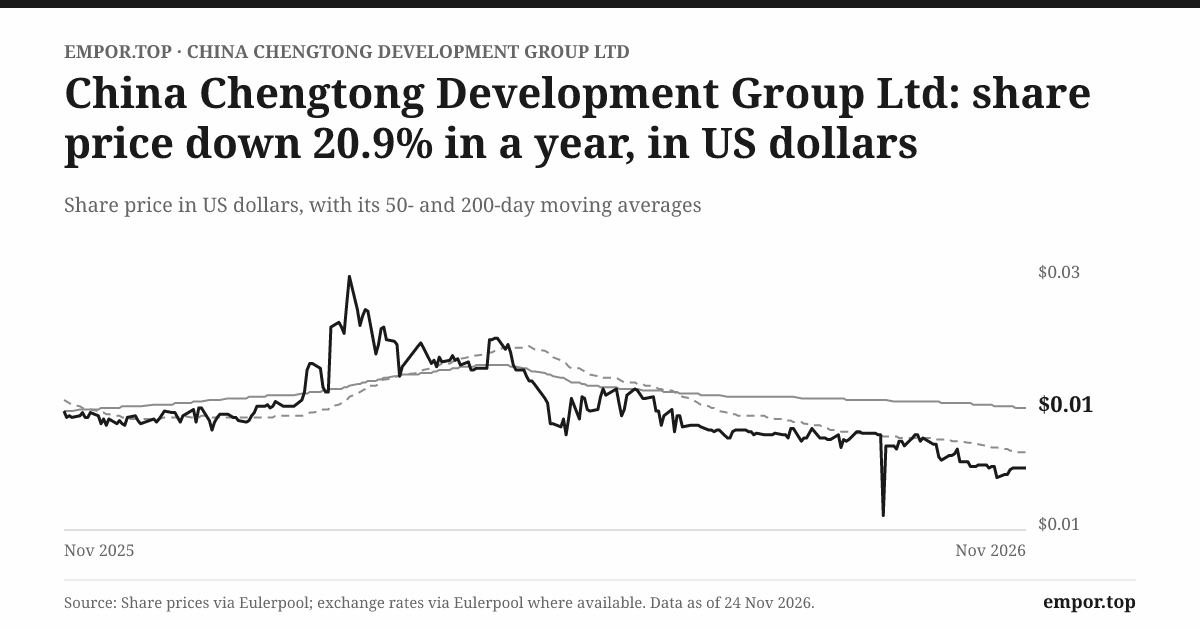
The scale of the public equity is easy to state. At about ten Hong Kong cents a share on 24 November 2026, the company's 5.96bn shares4 were worth roughly HK$596m, or about US$76m. CCHK owns about 53% of them, and CCHG is deemed to hold that stake through its ownership of CCHK.2 Fewer than half the shares trade freely, and the controlling holder can carry any ordinary vote on its own.
Against that small market value sits a much bigger balance sheet. By June 2026 the group reported total assets of about HK$14.3bn and total liabilities of about HK$11.2bn.3 Most of the assets are loans to other companies, and most of the liabilities are borrowings raised to fund them. The listed equity is a thin layer of ownership on top of a lending machine more than twenty times its market value.
That shape gives the story its questions. The first is about history. This company has walked away from big trading businesses twice. Did those retreats leave it a stronger business, or just a smaller one? The second is about economics. Leasing now dominates the group, so can leasing earn enough on the capital it consumes? The third is about the customer. Almost every borrower is a state-owned enterprise. Is that a genuine credit edge, or does it hand concentrated bargaining power to borrowers who have plenty of other lenders?
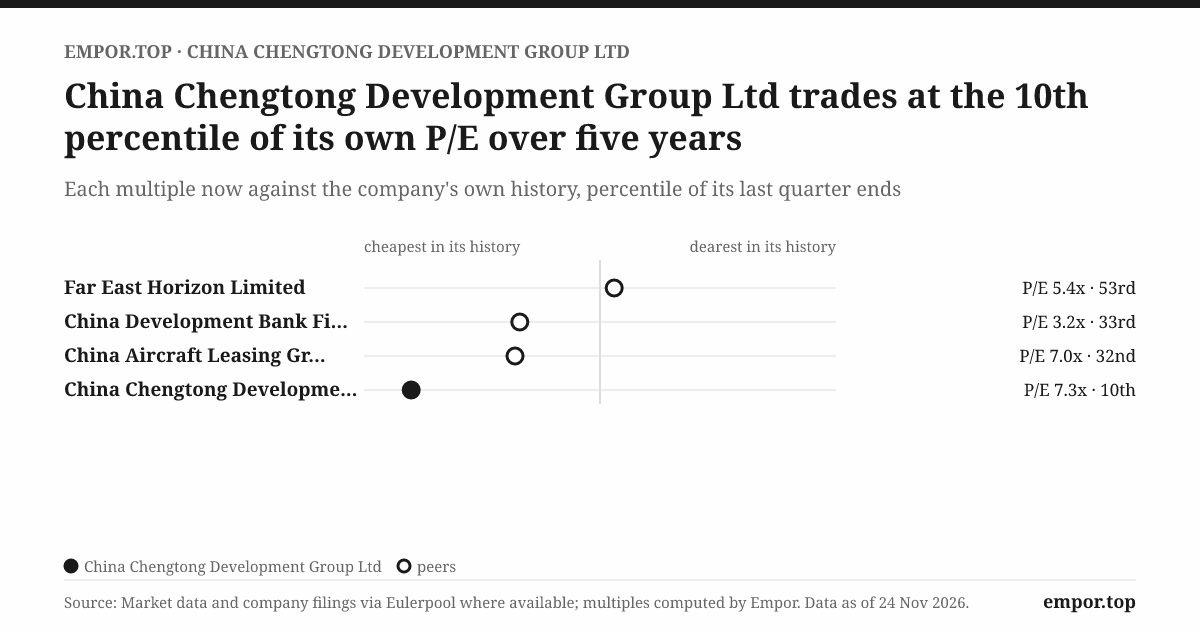
The fourth is about funding: can borrowing keep pace with a fast-growing loan book without eating the returns? The fifth is about price. On trailing earnings the shares trade at about 7.3 times, against a five-year median of about 12.3 times. Is that a discount, or a warning about returns?
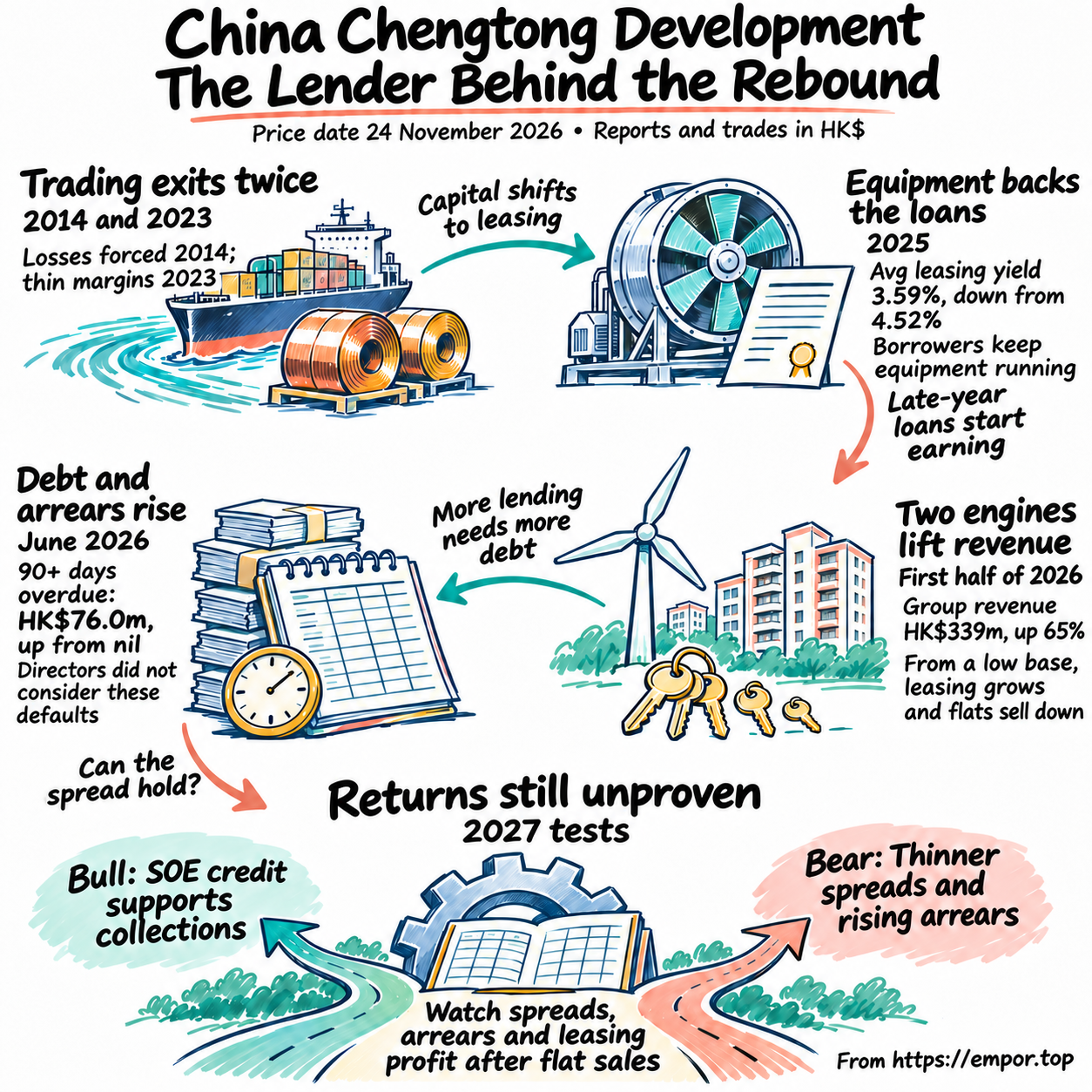
One number needs care from the start. In the six months to June 2026, the company reported revenue of about HK$339m, up 65% from about HK$205m a year earlier.5 Some data services show a far larger jump, above 200%, for the latest period, because they compare against a smaller base than the company's own reported half-year. The figures in this story are the company's reported periods and classifications, which give a rebound of about two-thirds. That is impressive enough. It also comes from a low base, and from more than one source, as the next chapters show.
The way to understand this company is to start with what it gave up. Long before it was a lender, it was one of the larger commodity traders listed in Hong Kong, in turnover terms, and the way that business ended explains a lot about the one that replaced it.
 Subscribe on LinkedIn
II. When Turnover Stopped Being the Goal
In 2013, China Chengtong Development reported turnover of about HK$15.5bn.6 For a company now valued at under HK$600m, that number looks almost fictional. Nearly all of it came from bulk commodity trading, mostly through two platforms set up in the fourth quarter of 2011: Chengtong International Trading in Hong Kong and Hangzhou Ruineng in Zhejiang, each held 55% by the group alongside an outside venture partner.7 The trade was enormous and the margin was microscopic. The gross profit margin on bulk commodities in 2013 was about 0.2%.7
The financing behind that trade was not microscopic. Purchases were settled with long-dated letters of credit and discounted bills, and the trading business carried about HK$275m of finance costs in 2013.8 In the same year the group earned about HK$274m of interest on bank deposits and short-term investments.7 Those two figures do not net neatly, because one belongs to a segment and the other to the group, but their similar size is a clue. The business moved copper and other metals, but much of the money was in the financing wrapped around the cargoes. A trading book that runs at a 0.2% gross margin lives or dies on what happens to prices, funding and counterparties between purchase and sale.
In 2014 all three moved against it. The group and its venture partner could not agree on the operating model and the risk-monitoring measures for the trading platforms, so the two sides agreed to stop new business through Chengtong International Trading and Hangzhou Ruineng.8 Trading continued through wholly owned subsidiaries, mostly in copper. Then metal prices rose early in the year and slid for the rest of it, while suppliers charged a premium over exchange prices in return for accepting long-term letters of credit. The bulk-commodity gross margin swung from a profit of 0.2% to a loss of about 3.3%, and the segment lost about HK$122m.7
The board had already started cutting. It reduced trading volumes from the fourth quarter of 2014, sold its stakes in the two joint-venture platforms through a public listing-for-sale in December 2014 for about HK$36m, and disposed of its coal subsidiary to a company owned by the parent.7 Turnover fell about 79% to HK$3.22bn, and the group recorded a loss attributable to owners of about HK$51m, against a profit of roughly the same size a year earlier.9 The chairman's statement called the shutdown of the platforms "necessary and beneficial to the long-term development of the Group".6
In February 2015, the group suspended bulk commodity trading altogether.10 What followed was the first test of the idea that less turnover could mean a better business. Turnover for 2015 fell to about HK$577m, yet profit attributable to owners rose to about HK$82m, and profit before tax reached about HK$126m.10 Losing more than four-fifths of revenue had improved earnings, because the revenue that disappeared had been losing money.
That year also brought fresh capital. In June 2015 the company completed a top-up placing of 968m shares at HK$1.01 each, raising net proceeds of about HK$962m and introducing institutional shareholders.10 Remember that price. Today the shares trade at about a tenth of it. Investors who bought into the post-trading reinvention paid HK$1.01 for a stake that the market now values at about ten cents.
Hidden in the 2014 accounts was the seed of what came next. That year the group signed three sale-and-leaseback agreements with outside companies, financing about RMB240m and booking leasing turnover of roughly HK$2m.7 It was a rounding error beside the trading book. It became the core of the company.
Commodity trading did not stay dead. It returned and, by 2022, had grown back to about HK$762m of revenue at a gross margin of about 1.2%.11 Group revenue that year was about HK$1.28bn. Then, in early 2023, management suspended the business again, citing its inherent risks and low margins, and said it would redirect resources to leasing.11 Trading revenue fell by about HK$748m, to almost nothing, and group revenue dropped 42% to about HK$740m.11 Leasing rose to 82% of the total.3
The two retreats look alike on the surface, but they were not the same kind of decision. The 2014 exit came after losses and a breakdown with a partner, so the company was forced into it. The 2023 suspension came while the business was still earning a thin positive margin, which made it a choice. Management chose to give up about three-fifths of reported revenue because each dollar of it kept only about one and a half cents of gross profit and carried price risk that could wipe out years of that margin in a single quarter.
So there is real evidence of course correction here. The company has twice recognised that a large top line was not worth its risk, and twice acted on it. But the record also carries a warning. For years, much of this company's reported size came from activity that generated very little durable profit. And the second exit came only after the business had been rebuilt, which shows that the first lesson did not last.
The repeated retreat counts as discipline only if the capital freed up goes somewhere that earns more than it costs. In 2023 that somewhere was a leasing book. So the next question is what that leasing book actually is.
III. The Business Is a Loan Book Wearing a Leasing Label
Picture a coal mine in Shanxi, a wind farm in Inner Mongolia or a steel mill's ore operation in Xinjiang. The owner needs cash but does not want to sell its equipment, because the equipment is how it makes money. So it sells the ventilation fans, wind towers or crushers to Chengtong Financial Leasing, keeps them running on site, and pays the money back in instalments of principal plus interest over a few years. When the last instalment clears, it buys the equipment back for a nominal sum, sometimes a single renminbi.3 Nothing physical moves. The only thing that changes is who holds the title.
That is a sale and leaseback, and it is the heart of this company. In substance it works like a mortgage on industrial equipment. Because the lessee keeps control of the assets before and after the deal, the accountants do not treat it as a lease at all. The company books these arrangements as secured loans under the accounting standard for financial instruments, and calls the resulting assets loan receivables.5 The label on the door says leasing. The ledger inside says lending.
That makes this company's economics simple to describe and hard to excel at. Chengtong advances capital against equipment, earns interest over a term of one to five years, and relies on the borrower to repay or, failing that, on the collateral being worth enough to recover the money.2 Its lending rates float with China's loan prime rate, or LPR, the benchmark banks quote to their best customers.2 Its funding also floats in part, and is drawn from banks, securitisations, bonds and the parent. Profit is the gap between those two rates, multiplied by the size of the book, minus the costs of running it and the losses on loans that go bad.
In 2025 leasing generated about HK$413m of revenue, roughly 71% of the group's HK$579m.2 Three streams made it up. Interest on loans was the largest, at about HK$269m. Rental income from true operating leases, where Chengtong owns and rents out equipment such as containers, added about HK$90m. A new line, consultancy service fees, added about HK$53m.2 That last stream deserves a pause. It did not exist the year before, and the company recognised it at a single point in time rather than over the life of a loan.2
In a year of heavy new lending, fees booked up front made current earnings look better than the interest those loans will earn in later years. That accounting choice is legitimate, but it matters when judging how repeatable the revenue is.
The other two businesses are smaller. Property development and investment brought in about HK$138m of revenue, up 54%, almost all from selling apartments at CCT-Champs-Elysees, a residential project in Zhucheng, Shandong, that the group has been selling down for more than a decade.82 Marine recreation and a hotel in Hainan brought in about HK$29m, down 12%, as the company cited a more diversified tourism market and extreme weather.2
Segment results show where the profit came from. Leasing contributed about HK$119m, property about HK$41m, and marine and hotel a small loss.2 Property's contribution was real, but it came from delivering a finite stock of flats, not from a business that renews itself. In 2025 the property segment's revenue rose 54% while leasing revenue fell 4%.2 So property helped the year's numbers without replacing leasing as the main engine.
To see whether that engine works, look at two rates the company itself publishes. In 2025 the average yield on the leasing book was about 3.59%, down from about 4.52% the year before.2 The group's effective borrowing rate was about 2.66%, down from about 3.70%.2 The spread between them was a little under one percentage point in both years. For every HK$100 of loans on the books, Chengtong earns roughly HK$0.90 more in interest than it pays to fund them, before staff, offices, credit losses and tax.
Management explained the falling yield partly as a timing effect. New loans came late in the year, and some of the change "primarily reflects shifts in the composition of revenue recognition methods" rather than lower project returns.2 That claim has some support, since the consultancy fees are part of the story. But the pricing of new business tells its own tale. The 70 new leasing projects signed in 2025 carried interest rates of about 2.50% to 4.61%, against 3.50% to 5.67% for the 18 projects signed in 2024.2 Lower rates on new loans mean lower yields in the years ahead, whatever the accounting mix.
The book itself swung sharply. Gross leasing receivables were about HK$8.9bn at the end of 2023.11 They fell to about HK$6.6bn in 2024, when management described a "prudent strategy" in the face of interest-rate, inflation and geopolitical risks and used collections to repay debt.3 Then they jumped to about HK$10.5bn in 2025, as new lending of about HK$7.9bn, more than three and a half times the prior year's, went out the door.2 The headline growth in 2025 was real, but part of it was a rebuild of a book that had been bigger two years earlier.
Where the money went is less clear than it should be. At the end of 2025, infrastructure was the largest named sector, at about HK$2.8bn of net receivables, and manufacturing had almost doubled to about HK$2.0bn. The biggest single bucket, though, was "others", which more than tripled to about HK$3.3bn, roughly a third of the book.2 Interest income from that same catch-all category more than doubled.2 A third of a loan book grouped under a label that says nothing makes it harder for an outsider to judge sector risk, just when the book is growing fastest.
Most of the book is also short. Of the roughly HK$10.5bn in net receivables at the end of 2025, about HK$6.4bn was due within a year.2 That makes the book less exposed to the long-term value of any single wind turbine. It also means the company must find new borrowers every year just to stay the same size, at whatever rates the market offers.
Some things the company does not publish. Its filings do not give a portfolio-wide history that tracks each year's loans through collections, realised yields and losses, the cohort view that would show whether the lending has earned its keep over a full cycle. Nor does the company publish a research and development series, which matters less for a lender than the absence of loan-level history. Equipment collateral and a growing book do not prove a moat on their own. Whether the borrowers create one is the next question.
IV. The State-Owned Customer Is Both the Credit Story and the Competitive Problem
At the end of 2025, about 99% of Chengtong's net leasing receivables were owed by state-owned enterprises.2 The names that appear in its circulars read like a directory of Chinese state industry. There are mining subsidiaries of the steel giant 中国宝武 China Baowu, renewable-power subsidiaries of 中国华电 China Huadian, and coal operations tied to 山西焦煤 Shanxi Coking Coal and the Shanxi provincial government.3 The loans finance power stations, solar arrays, mines and factories, assets the national economy is unlikely to abandon.
The strongest version of the bull case starts here. The borrowers are large, connected to the state and, in management's words, "made regular and timely repayment".2 The financed equipment serves as collateral. The industry mix spreads across infrastructure, manufacturing, energy saving, logistics and newer categories.2 Credit-loss provisions have stayed small. At the end of 2025 the allowance for expected losses was about HK$38m against a gross book of about HK$10.5bn, about 0.36%.2
Look more closely and the picture narrows. Concentration rose during the lending spurt. At the end of 2025 the five largest customers accounted for about 26% of net leasing receivables, up from about 14% a year earlier. The single largest was 7%, up from 5%, and the largest group of related customers was 10%.2 Those levels eased slightly by June 2026, to 25% for the top five and 6% for the largest single customer.5 They are not alarming for a corporate lender, but they are moving the wrong way for anyone hoping growth would diversify the book.
The late-payment record needs care too. At the end of 2025, loans with a carrying amount of about HK$63.5m were past due, up from about HK$20.6m a year earlier, but none of the 2025 balance was 90 days or more overdue, whereas all of the 2024 past-due balance had been.2 The allowance fell from about HK$63m to about HK$38m, which sounds like improvement. Most of that fall came from settlement. The group signed debt-settlement agreements with one customer in the "doubtful" category and one in the "loss" category, and wrote off about HK$33m.2 The provision shrank because bad loans left the book, not because the book got better.
Then came the 2026 interim report. By June 2026, past-due loans had risen to about HK$118.5m, and about HK$76.0m of that was 90 days or more overdue, up from nil six months earlier.5 The directors said they did not regard it as default "based on the financial background of the customers".5 That may prove right, since state-linked borrowers often catch up. Still, it is the first marker in the new, larger book that something has slipped, and the total provision rose about 21% in the half.5 Under China's five-category system, which grades loans from "performing" through "special mention", "sub-standard" and "doubtful" to "loss", about HK$325m sat in "special mention" at mid-year, the watch list just short of trouble.5
History adds a useful detail. The doubtful and loss balances cleared out in 2025 look very like the ones that first appeared on the five-category table at the end of 2023, when about HK$53m was graded doubtful and about HK$18m was graded as loss, after a year in which almost the whole book had been graded performing.11 Balances of almost the same size sat in those categories at the end of 2024 too, so on the company's own grading they took about two years to move from first warning to final settlement.2
That is the rhythm investors should expect from this book. Trouble surfaces in the categories first, lingers while lawyers and borrowers negotiate, and reaches the income statement later. The arrears that appeared in mid-2026 will take time to resolve one way or the other.
So the SOE mix does support a credit argument. Losses relative to the book have been low, and the borrowers are the kind of companies the state tends to support. What it does not support is a pricing or distribution moat, and this is where the same customers become the competitive problem.
Large state-owned borrowers are among the most sought-after clients in Chinese finance. Banks court them, bank-owned leasing companies court them, manufacturers' captive lessors court them, and so do independent leasing firms. Chengtong itself names competition from bank-affiliated, captive and independent leasing companies, some of similar or larger scale.2 The best-known bank-backed peer, 国银金融租赁 China Development Bank Financial Leasing, reported total assets of about RMB433bn at the end of 2025, nearly forty times the size of the Hong Kong-listed Chengtong group.12
It earned a return on average equity of about 11.9% and ran a cost-to-income ratio under 10%.12 Chengtong's return on equity in 2025 was under 2%, and its selling and administrative expenses of roughly HK$122m equalled about half of its gross profit and net interest income.2
The industry backdrop is not expanding to absorb everyone. China's leasing contract balance shrank in both 2023 and 2024 and stood at about RMB5.4tn in June 2025, according to Lianhe Ratings Global. The agency also noted that highly rated issuers dominate bond and securitisation funding, and that a rule taking effect in January 2026 tightened checks on whether sale-and-leaseback deals reflect genuine asset use.13 Management's own 2025 review described an industry facing "rising compliance costs and narrowing interest margins".2 In a market like that, a borrower such as a Huadian wind subsidiary can choose among many lenders. The pricing reflects it: many of Chengtong's newest loans are set at a discount to the LPR, the benchmark that banks themselves quote to prime customers.3
One widely quoted metric makes the book look stranger than it is. Measure receivables as days of revenue, and Chengtong's figure rose to about 4,000 days in 2025. Read like a trade-credit statistic, that would mean customers take more than a decade to pay. It does not mean that. For a lender, the receivables are the product, and dividing a five-year loan book by one year's interest will always produce an absurd number. The useful measures are the ones above: overdue balances, write-offs, recoveries, collateral values and the yield left after losses.
Management's account of all this has shifted noticeably within a year, and there is no analyst-call record to test it against. The company's results announcements and circulars are the main public record of its thinking. In the 2024 results the language was defensive, describing a prudent strategy, a slowing book and debt repaid.3 Twelve months later it was expansive: "intensifying efforts to deploy capital into high-quality projects", aligned with "national strategic priorities" in energy, transport and new infrastructure.2
Both may have been sensible responses to their moment. But a lender that cuts its book by a quarter one year and grows it by three-fifths the next is showing appetite, not a stable underwriting philosophy. The test is whether the larger book pays more than it costs, and the first half of 2026 offered the first real look.
V. The Rebound Has Two Engines—and One Is Hard to Repeat
Late in August 2026, the company issued a positive profit alert, telling the market its first-half profit would rise sharply.14 When the interim accounts arrived, the headline numbers lived up to the warning. Revenue for the six months to June rose about 65% to roughly HK$339m. Profit before tax rose about 203% to roughly HK$67m. Profit attributable to shareholders more than quadrupled, up 343% to about HK$44m.5 After three years in which revenue had fallen from about HK$1.17bn in 2021 to about HK$579m in 2025,2 the company finally had a period that looked like growth.
The question is what kind of growth. Take the rebound apart and two engines appear, plus some help from lower costs.
The first engine is leasing, and it is the one that matters. Leasing revenue rose about 49% to about HK$266m. Interest income, the core of it, rose about 51% to about HK$192m, because the loans written in late 2025 were then earning a full half-year of interest.5 Leasing segment results rose about 71% to about HK$79m.5 That is real progress, and it is exactly what the late-2025 lending spurt was meant to deliver.
Two details temper it. Consultancy fees, booked up front, more than tripled to about HK$28m, so roughly a tenth of leasing revenue came from a line that tracks how much new business is signed rather than how much is outstanding.5 And part of the jump in segment results came from gains on disposing of operating-lease assets, which the company booked in other income.5 Neither is improper. Both are less repeatable than interest on a stable book. Meanwhile, the leasing segment's gross margin slipped from about 37% to about 36%, because funding costs rose in step with revenue as the company borrowed to grow.5 The book got bigger, but the margin on each dollar did not get better.
The second engine is property, and it is running out of fuel. Property revenue rose about 413% to about HK$53m, and the segment swung from a loss of about HK$2.7m to a profit of about HK$7.4m.5 The reason is simple: the company delivered a lot of flats at CCT-Champs-Elysees. The unsold area, about 14,956 square metres at the end of 2025, had fallen to about 3,659 square metres by June 2026, while the average residential selling price slipped to about RMB4,363 per square metre.5
At that pace, the remaining stock was a few months of deliveries. Management's stated aim is to complete the project's sales "as soon as possible", with proceeds recycled into leasing.3 That is a sensible way to wind down, but it cannot be repeated. Once the last flat is handed over, this engine stops.
The third, smallest piece is the Hainan marine-recreation and hotel business, which grew revenue about 19% in the half and cut its segment loss by about 83%.3 That is welcome, but it is a rounding error in a group whose profit depends on a lending book hundreds of times the size of that business's revenue. Its main contribution to the rebound was to stop subtracting from it.
The rest of the improvement came from the cost side. Finance costs outside the leasing segment fell by about half, largely because the group repaid Hong Kong bank loans, and gross profit and net interest income rose about 56%, slightly slower than revenue.5 Lower central costs help, but they are a one-time step down rather than a trend that compounds.
Set against the longer record, the interim looks like a recovery from a trough, not yet a new trajectory. Revenue in 2025 was about half its 2021 level, and over the three years to 2025 it shrank at more than 20% a year in the company's own currency.2 A 65% rise from the 2025 first half, when leasing was still starved of new loans and property had barely delivered anything, partly reflects how low the starting point was.
The rebound is real. It is in the audited and reviewed numbers, and the leasing part rests on a book that genuinely grew. But it does not yet show sustained growth in leasing income or in returns, because the book's spread is thin, its newest loans are priced lower, and the property tailwind is ending. The split that will settle the question is leasing interest and fee income, with segment results and credit costs, reported period after period once property sales have stopped.
There is a second reason to hold the celebration. The loan book that produced the leasing growth had to be paid for, and almost all of that money was borrowed.
VI. The Asset Book Grew; So Did the Funding Need
Six months into 2026, the treasury picture looked comfortable on its face. Cash and deposits had risen to about HK$1.68bn, from about HK$1.06bn at the end of 2025.3 Behind that cash, though, total debt had climbed about 21% in half a year, to about HK$10.9bn.3 The company had more cash because it had borrowed more, and it had borrowed more because it was lending more.
This is the cash-flow puzzle that runs through the whole of the company's modern history. Between 2014 and 2025, the group reported cumulative net profit of roughly HK$731m, while its cash flow from operations added up to about negative HK$4.5bn. For an industrial company, a gap like that would be a red flag about the quality of earnings. For a lender, much of it is the business model. Every new loan is a cash outflow, recorded in operating activities, and every repayment is an inflow later. In 2025 alone, an increase of about HK$3.6bn in finance-lease and loan receivables drove about HK$3.5bn of cash used in operations, even though the group was profitable.2
The company's own history shows the mechanism working in both directions. In 2024, when management slowed new lending, receivables fell, operating cash flow turned positive, and the group used collections to repay ABS and bank borrowings.3 Total liabilities fell 27% that year.3 In 2025 the process reversed, and borrowing surged. The balance sheet behaves like an accordion: it expands when the company lends and contracts when it collects. By the end of September 2026, the company's statement of indebtedness showed borrowings of about HK$9.5bn, below the June figure, which suggests collections were already flowing back.3
So negative operating cash flow is not, by itself, a sign of trouble. But it does not remove the risks that come with funding a lending book mostly with debt. Those risks lie in what the debt is made of.
At the end of 2025 the group owed about HK$5.24bn to banks, more than double the year before. It had about HK$2.33bn of asset-backed securities, about HK$1.12bn of corporate bonds and about HK$360m of loans from related parties.2 By June 2026, bank borrowings had risen to about HK$6.83bn.3 The securitisations, or ABS, are bundles of Chengtong's loan receivables sold to investors as bonds, so the investors are paid from the borrowers' repayments. CCHG guaranteed them.3
That guarantee is the clearest form of parent support, and it should be described precisely. It is a guarantee on specific securities. It does not make the listed subsidiary's debts the parent's debts, and the bank borrowings, which are secured on the subsidiary's own receivables, carry no parent guarantee.3 Nor is the parent's direct lending especially cheap. At the end of 2025 the loans from related parties carried interest at 3.5% from a CCHG subsidiary and 4.0% from CCHG itself, above the group's average borrowing cost of about 2.66% that year.2 Whatever advantage state ownership brings, cut-price money from the parent is not one of them.
The direction of travel matters as much as the level. In 2023 the group's bank loans carried effective rates of roughly 2.7% to 6.75%; by mid-2026, their contractual rates were about 2.19% to 3.90%.3 Much of the stability in the leasing spread over those years came from funding costs falling about as fast as lending yields. A spread that depends on rates falling on both sides at once is exposed if they stop falling in step. Bank loans reprice as they roll, bonds and ABS reprice at refinancing, and the newest lending is already priced at a discount to the benchmark.
Funding costs have been the company's friend. By mid-2026, the senior ABS tranches carried rates of about 1.55% to 2.98%, and the corporate bonds about 2.1% to 2.15%.3 That is respectable, though it does not stand out. Lianhe Ratings Global put the average 2025 coupon for AAA-rated Chinese leasing bonds at about 1.93%.13 The bonds fall due in January and June 2027, and some related-party loans mature in November 2026 and March 2027.3 Refinancing is a near-term task, not a distant one.
The liquidity cushion also thinned as the book grew. The current ratio, current assets divided by current liabilities, fell from about 1.63 times at the end of 2025 to about 1.11 times by June 2026, and the company's own debt-to-equity measure rose from about 3.07 times to about 3.53 times.3 Management says the borrowers' "stable cash flow" and "ample credit facilities" allow the group to meet short-term obligations.3 That is plausible for a book of short-dated SOE loans. It also depends on lenders continuing to roll the facilities.
One reassuring number needs adjusting. The company reported interest coverage of about 10 times for 2025 and about 19 times for the first half of 2026.3 Those ratios divide profit before interest and tax by finance costs, but most of the group's interest expense, about HK$151m in 2025, sits inside the leasing segment's cost of sales rather than in finance costs.2 Adding total interest of about HK$162m back to 2025's profit before tax of about HK$102m, then dividing by total interest, gives coverage of roughly 1.6 times.2 That is the honest figure for a spread lender, and it shows how little room sits between what the book earns and what it costs.
There is one smaller contingent exposure left over from the property business. The group guarantees mortgages that banks granted to buyers of CCT-Champs-Elysees flats. Those guarantees fell from about HK$231m at the end of 2024 to about HK$83m a year later, and to about HK$66m by the end of September 2026.23 It is a modest and shrinking tail risk, but it is a reminder that a property project leaves obligations behind it even after the last flat is sold.
Currency adds another layer for a Hong Kong-listed shareholder. Nearly all the operating assets and borrowings are in renminbi, and the group does not hedge.23 Translation moves equity up and down with the RMB, adding about HK$120m to reserves in the first half of 2026 after losses in 2023 and 2024.3 That does not change the loan book's economics, but it does make book value per share move without any change in the business.
Put the balance sheet beside the returns and the central tension is plain. Equity was about HK$2.95bn at the end of 2025.3 The group earned a return on equity of about 1.6% that year and about 2.7% over the twelve months to June 2026. Debt runs at more than three times equity. Expansion creates value only if each new loan earns more than its full cost of funding, operation and credit loss, with something left over for shareholders who could earn more than 2.7% almost anywhere.
Every new deal therefore faces the same test. Proving it would take a maturity and funding-cost schedule matched against collections, with covenant headroom and loss performance alongside, and the company does not publish that in one place. It does publish the terms of its biggest new deals, and in November 2026 it put a stack of them in front of shareholders.
VII. The November Deals Put the Strategy to a Shareholder Vote
On 11 November 2026, the company sent shareholders a circular with a long title: very substantial acquisitions in relation to sale-and-leaseback arrangements, a major transaction in relation to an assignment, and a notice of a general meeting.3 The meeting is set for 10 a.m. on Friday, 27 November, at the company's offices on Des Voeux Road Central.3 Under Hong Kong's listing rules, the size of the package, aggregated with earlier deals involving the same borrower groups, requires shareholder approval.
"Acquisition" is a misleading word here. Chengtong is not buying a mine or a wind farm. It is buying equipment from the operators, leasing it straight back, and recording a secured loan of about RMB538m in total for the sale-and-leaseback arrangements in the circular.3 The operators keep running their assets. Chengtong's protection is the operators' ability to pay and, behind that, whatever the equipment would fetch if they could not.
The Dunde deal shows how the economics work. Bazhou Dunde Mining is about 95% owned by Xinjiang Bayi Iron and Steel, which in turn is controlled by China Baowu.3 Chengtong agreed to buy Dunde's mining equipment for RMB250m, about 88% of its net book value of about RMB284m, and lease it back for six years.3 Total interest over the term is estimated at about RMB26.85m, paid with principal in twelve semi-annual instalments. The rate floats at a fixed discount to the five-year LPR.3 The circular notes that the equipment generates no separately identifiable income stream.3
Do the arithmetic and the return comes into focus. If principal is repaid roughly evenly, the average loan outstanding over six years is a little more than half the original RMB250m. RMB26.85m of interest over that period works out to roughly 3% a year. That is an estimate, since the exact repayment schedule is not published, but it is consistent with a rate set at a discount to the five-year benchmark. Against the group's 2025 borrowing cost of about 2.66%, the spread is well under a percentage point.
The company's case for the price is careful but limited. It says it assessed the internal rate of return "taking into account the Group's overall funding mix and cost of capital", found the return "commercially sound", and judged it within its "profitability benchmark for finance lease arrangements".3 It did due diligence on Dunde's operations and relied on "strong support" from China Baowu.3 It also built in sensible protections: early repayment needs mutual consent, Chengtong can refuse it unless the early-exit return is at least as good, and the interest rate does not fall with the LPR if the borrower is behind on payments.3
What the circular does not provide is a benchmark against other lenders' pricing, or a figure for the return after expected credit losses and operating costs. A purchase price at 88% of book value describes the collateral cushion, not the profitability of the loan.
The early-repayment clause is not hypothetical. A Sinosteel subsidiary that borrowed from Chengtong in 2025 served notice and repaid its lease in full in April 2026, about a year in.3 The board judged that the early-exit return was no worse than the full-term return. Still, it shows how quickly well-funded state borrowers can refinance when they find cheaper money, which leaves the lender to redeploy the cash at whatever the market pays next.
The China Huadian tranche makes the point more sharply. Five subsidiaries of Huadian New Energy, the group's listed renewables arm, agreed to sale-and-leasebacks of wind and solar equipment totalling RMB245m.3 The purchase prices sit at discounts of about 1% to 7% to net book value, and four of the five leases run for just two years, the other for three.3 Total expected interest across all five is only about RMB9.5m.3 Short terms and thin discounts suggest these borrowers hold the bargaining power.
They are among the most creditworthy power producers in China, and they can choose their lenders. Two further Huadian deals, Xinte and Wengniuteqi, are two-year arrangements priced off the one-year LPR, one at a premium and one at a discount.3 None of this means Chengtong has entered the renewable-energy business. It has lent money to renewable-energy businesses, at rates those businesses found attractive.
The circular also covers a different kind of deal. Chengtong agreed to buy, for up to RMB300m, an existing leasing contract that a Shanxi Coking Coal leasing company had written in July and September 2026 with a coal miner owned jointly by Shanxi Coking Coal and China Baowu's Taiyuan Iron and Steel.3 Chengtong would take over a seven-year stream of repayments that had not yet started, with expected interest of about RMB25.4m, on pricing it did not negotiate, though the board said it falls within its usual range for low-risk SOE borrowers.3 Buying another lessor's book is a fast way to deploy capital. It also hands over the choice of borrower and the negotiation of price to someone else.
Two days after the circular, a further deal showed how these approvals actually work. On 13 November, Chengtong agreed a five-year, RMB400m sale-and-leaseback of solar equipment with Jinta Zhongguang Solar Power Generation, priced at about 96% of an appraised value, with expected interest of about RMB44.2m.15 The guarantor, a Tianjin power company, counts CCHG as its second-largest shareholder with about 26.7%, though the company classifies the counterparties as independent third parties for listing-rule purposes.15 The valuation behind that price is worth a moment. The independent valuer used a cost method, estimating what it would cost to replace the solar equipment, about RMB429m, and then multiplying by a "newness rate" of about 97% to reach an appraised value of about RMB417m.15
That tells shareholders roughly what the panels would cost to rebuild. It does not tell them what the equipment would sell for in a forced sale if the borrower failed, which is the number a lender actually depends on. Appraisals of this kind measure the collateral's book replacement value, not the loan's recovery value.
This one needed no meeting at all. Because no shareholder had a material interest, the company accepted CCHK's written approval in place of a vote.15
Set these deals beside the earlier history and a pattern emerges. The company walked away from bulk trading because its margins were too thin for its risks. It is now building a lending book whose newest loans appear to earn roughly 3%, funded at roughly 2.7%, with operating costs and credit losses still to come. The thin-margin problem has not been solved. It has moved from metals to money. The difference is that SOE credit is far less volatile than copper prices, and that is a genuine improvement. Whether it is enough will be judged by collections and returns, not by deal volume.
The vote on 27 November has not yet happened. CCHK's stake alone exceeds half the shares, and the circular says no shareholder must abstain.3 The result will be published on the exchange's website after the meeting, and any change to the package should be read then. But the real decision about whether this strategy works rests with the people running it, most of whom have been in their jobs for barely a year.
VIII. A New Board, a Parent Owner and a Short Track Record
On 7 November 2025, the company's chairman, Li Qian, resigned. On the same day, three new executive directors joined the board.2 For most of 2025, Li had chaired the board and run the business day to day, because the company had had no managing director since 25 December 2024. It had not found a suitable candidate, and the arrangement was a disclosed departure from Hong Kong's governance code, which calls for the two roles to be separate.2 Twelve months earlier, in January 2024, the board had been led by a different chairman, Zhang Bin, with Gu Honglin as managing director.16 In under three years the company has had four board chairs and spent much of that time without a chief executive.
The new team came mostly from inside the Chengtong system. Sun Jie, who became chairlady and a non-executive director in November 2025, is an accountant who spent more than two decades in CCHG's finance departments. She was CCHK's financial controller from 2006 to 2022 and is now its chief accountant.2 Chen Jianying, 49, is the one leasing professional. He brings more than twenty years in China's financial-leasing industry, including senior roles at Far East International Leasing, Shanghai Electric Financial Leasing and Pu Yin Financial Leasing.
He joined the group in May 2024 and chairs Chengtong Financial Leasing.2 Bai Chunrui, 43, a certified public accountant, spent years in the group's risk-control and legal departments before becoming CCHK's general counsel.2 A fourth appointee, Zhang Chuanyi, a CCHK strategy executive who had run the leasing subsidiary, was no longer on the board by the June 2026 annual meeting.4
By November 2026 the line-up had changed again. The circular and the 13 November announcement were signed by Zhao Peng as chairman, with Zhao, Chen and Bai listed as executive directors and three independent non-executives, Tony Lee Man Chun, He Jia and Liu Lei.315 As recently as the interim report in September, Sun Jie had still been listed as chairlady.5 Whatever the reasons for the change, Zhao's record at the head of the listed company spans only weeks.
That timeline matters for judging the record. The 2025 lending surge was signed partly under the old chairman and partly in the weeks after the new team arrived. The 2024 slowdown belonged to their predecessors. The first full period that can fairly be credited to the current executives is 2026, and its most important evidence, how the late-2025 and 2026 loans perform, will not be visible for another year or two.
The pay picture is hard to read cleanly. Compensation for key management rose from about HK$2.5m in 2024 to about HK$4.1m in 2025.2 With directors arriving and leaving during the year, that is not a like-for-like increase, and it is modest in absolute terms for a company with a HK$10bn-plus book. The company has a share-award scheme with shares held by a trustee,2 but without a clear record of awards and vesting to current executives, it would be wrong to assume their incentives track minority shareholders' returns. The more powerful incentive comes from the parent. Most of the board's careers run through CCHG and CCHK, and the strategy is framed explicitly around serving state-owned enterprises and "national strategic priorities".3
The longest-serving voice in the boardroom belongs to an independent director. Tony Lee Man Chun, 72, joined the board in November 2013, before the first trading retreat, and chairs the audit committee. He spent more than four decades in banking and capital markets, including twelve years as chief executive of the Hong Kong arm of the broker Shenyin Wanguo, now Shenwan Hongyuan.2 He has watched the company exit trading twice and swing its loan book down and up again. Independent directors in a controlled company cannot set strategy. They can insist on disclosure, and the audit committee is the natural place for a demand for vintage-level loan data to start.
Minority shareholders have little visible voice. At the June 2026 annual general meeting, every resolution passed with at least 99.96% support.4 The total votes cast were about 3,171,012,000 shares. CCHK alone holds about 3,169,656,000.415 So the roughly 2.8bn shares held by everyone else cast only about 1.4m votes between them, about one vote for every two thousand shares. The vote record shows near-total absence rather than consent. With the controller able to approve major transactions by written consent, minority investors have little practical influence through the ballot box.
Credibility therefore has to be judged by behaviour, not by votes. In the company's favour is a real record of stopping businesses that did not work: trading in 2014 and 2015, trading again in 2023. Against it are a leadership carousel, an abrupt swing from shrinking the book to growing it fast, and a first sign of late payments in the new loans. The confidence investors can reasonably place in this team is the confidence that comes with a short tenure: provisional.
The team will earn more by publishing clear credit, yield and collection data as the portfolio grows, so outsiders can check the underwriting rather than taking it on trust. The market, as it happens, has already priced in how much trust it is willing to extend.
IX. Analysis & Bear vs. Bull Case
Start with what the market is saying. At about ten cents, the shares trade at about 7.3 times trailing earnings, against a five-year median of about 12.3 times. They trade at about 0.2 times book value, which the company puts at about HK$0.51 a share. On enterprise-value measures, which add the group's debt to its market value, the picture flips. Enterprise value is about HK$9.5bn, roughly 38 times EBITDA and 61 times operating profit. For a lender those multiples mostly confirm that debt is the raw material. They do not show that the equity is expensive.
The price-to-book figure is the one that speaks loudest. Investors are offering about twenty cents for every dollar of net assets the company reports. A discount that deep usually means one of two beliefs. Either the book value will not hold, because the loans are worth less than stated, or it will hold but earn so little that it deserves little more than its liquidation value. The audited record leans toward the second reading.
Loss provisions have been small and write-offs modest. But returns have been very low for a long time, at about 2.7% on equity over the latest twelve months and under 5% in every year since 2014. A low P/E reflects a recent rebound in earnings from a depressed base. A price-to-book of 0.2 reflects a decade of returns below any plausible cost of equity.
The bull case has real substance. Ninety-nine per cent of the borrowers are state-owned enterprises, which have repaid reliably.2 The loans are secured on working equipment, and most mature within two years, so credit mistakes surface and wash out quickly. The parent guarantees the securitisations, and the parent's network brings deal flow from groups such as China Baowu and China Huadian.3 The company has shown it will exit businesses that do not pay, and the exit from low-margin trading has left a simpler earnings mix.
Funding costs have fallen faster than lending yields at times, and interim leasing results rose about 71%.5 There is also a dividend, a final of HK0.25 cent a share for 2025, worth roughly 2.5% at today's price.4 And with the shares at a fifth of book value, even a modest improvement in returns could move the price meaningfully.
The bear case is just as concrete. The book grew from about HK$6.6bn to about HK$11.9bn gross in eighteen months,25 far faster than the company has demonstrated it can earn on it. The visible spread is under a percentage point, new loans are priced lower than old ones, and selling and administrative expenses consume about half of gross profit and net interest income. Debt is more than three and a half times equity.
The first 90-day arrears in the new book appeared within months of the lending spurt.5 The property earnings that flattered 2025 and 2026 are about to end. The current executive team has not yet completed a full reporting year in its present form. Minority shareholders, meanwhile, have no practical say over the transactions that will decide the outcome.
Run the industry through Michael Porter's five forces and the structure looks unforgiving. Buyer power is high. The best borrowers, large SOEs, can raise money from banks, bank-owned lessors, captive lessors, bond markets and the parent groups' own finance arms, and the short two-year Huadian terms and below-benchmark pricing show who holds the pen.3 Supplier power, here the power of whoever provides funding, is moderate. Banks and bond investors are plentiful in a low-rate China, but they favour AAA-rated issuers, and Chengtong pays a little above the AAA average.13 The threat of substitutes is high, because a bank loan, a bond or an internal group loan can replace a sale and leaseback with little friction.
Rivalry is intense in a market whose contract balance has been shrinking since 2022, with thousands of leasing companies chasing the same prime borrowers.13 The barrier to entry is real but not unique: a licence, a funding line and an underwriting team. The new rules on asset verification raised that bar for everyone.13 No retention, win-rate or pricing data shows switching costs. When Sinosteel found cheaper money, it repaid early.3
Hamilton Helmer's seven powers framework asks which durable advantages could let a company earn returns above its cost of capital. Scale economies do not work in Chengtong's favour, because a peer like China Development Bank Financial Leasing is nearly forty times larger and runs at about a fifth of Chengtong's ratio of costs to income.12 Network economies and switching costs are absent, since one borrower's loan does not make the product better for another, and refinancing is easy. Brand matters little in wholesale lending to SOEs. Process power, meaning a superior underwriting process, would show up in better loss rates or higher risk-adjusted yields than peers, and the filings do not show either.
That leaves cornered resource and, by extension, counter-positioning through the parent. The CCHG relationship plausibly provides introductions, and the ABS guarantee lowers some funding costs. But a relationship becomes power only when it produces measurably better terms, lower losses or higher returns than competitors, and Chengtong's returns sit far below the bank-backed peer's. The honest conclusion is that the advantage is real but small, and it has not yet shown up in the numbers that matter.
The gap with the bank-backed peer is plain in one more number. China Development Bank Financial Leasing earned about 1.2% on its average total assets in 2025.12 Chengtong earned about 0.4% on its assets that year. The peer runs at far higher leverage, which makes its return on equity larger still, but even before leverage it extracts roughly three times as much profit from each dollar on its balance sheet. That is what a genuine funding and scale advantage looks like in this industry, and Chengtong does not have one.
Imagine a sceptical shareholder asking the board one question: why keep adding lending assets when the returns on equity stay below 3%? The shareholder would note that loans from the parent cost 3.5% to 4.0%, more than many new loans earn.2 They would note that the group spends about half its gross profit and net interest income on overheads, while the larger peer spends about a tenth of income. They would also note that a business valued at a fifth of book could do more for minorities by shrinking and returning capital than by growing a book that earns its cost of debt and little more.
The board points to its internal return benchmark.3 The answer that would settle the debate is different: a published, audited record of the return each year's lending earned after funding, operating costs and losses. Until that exists, the sceptic's question stands.
Three measures carry most of the information. The first is the leasing spread, the yield on the book minus the effective borrowing rate. In 2025 it was about 3.59% against 2.66%, a margin of a little under one point, with both sides falling.2 The second is seriously overdue loans, those past due 90 days or more. They moved from nil at the end of 2025 to about HK$76m at June 2026, and that direction matters more than the level.5
The third is leasing segment results, the profit the lending business actually produces: about HK$119m for 2025 and about HK$79m for the first half of 2026, up 71%.25 If the spread holds, arrears stay contained and segment results keep rising after property sales end, the bull case gains real evidence. If any of the three moves the other way, the bear case is the better description.
None of this amounts to a price target, and the market's valuation is not a peer-relative judgement either, because the closest listed comparables differ in size, funding and leverage too much for a simple multiple comparison. What the valuation does say is clear enough. The market prices this company as a lender whose returns are not yet proven to exceed its costs. The lessons of its history explain why.
X. Business & Investing Lessons
Go back to 2013, when this company’s commodity trading business paired huge turnover with a wafer-thin margin and heavy financing costs.68 Within two years most of that turnover was gone, and profit was higher than before.10 A decade later, the company suspended commodity trading again. The first lesson is the one most investors already know and too few apply: a smaller business can be a better business, but only if the replacement earns its capital.
Chengtong proved the first half twice. It has not yet proved the second, because the replacement lending business still earns a thin spread on a much larger balance sheet. Revenue that is cut away does not prove discipline. The proof is in what the freed-up money earns next.
The state-owned customer base has kept losses low, by the company's account.2 But the same standing that makes these borrowers safe makes them powerful customers. As the recent Huadian deals showed, even a blue-chip borrower can have the leverage to demand benchmark-discounted rates.3
A state-owned borrower can lower one kind of risk; it cannot create a moat by itself. For founders, the general version is that a blue-chip customer list proves you can get through the door. It says nothing about whether you can charge enough once inside. For investors, the test of an advantage built on customers is the price the customers accept, not their names.
Over the years, reported profit and operating cash flow have diverged sharply, with cash flow turning positive when lending paused in 2024.3 An analyst trained on industrial companies would read the long-run gap as a disaster. An analyst trained on banks would see a growing loan book. Both readings are incomplete.
For a lender, cash outflow may be growth. The proof is what comes back, with interest, by vintage. Without that record, the repayment half of the cycle remains untested.
Minority participation was negligible in June 2026.4 In November, a RMB400m transaction was approved by a single letter from the controlling shareholder.15 When control is this concentrated and participation this low, minority investors are passengers on a route the controller chooses. The route may well be a good one, but they should price the fact that they cannot change it. Part of what the 0.2 price-to-book represents is a governance discount, and no amount of loan growth will remove it on its own.
XI. Epilogue
On the evening of 25 November 2026, China Chengtong Development stands at a hinge. The loan book it rebuilt in 2025 and expanded through 2026 is about twice the size it was in mid-2025.5 The flats at CCT-Champs-Elysees are nearly all sold.5 The executive team is barely a year old, and its chairman is newer still.3 On Friday morning, shareholders will meet on Des Voeux Road Central to vote on more than RMB800m of new lending commitments, a vote whose outcome the controlling holder's stake can decide alone.3
The next moments will tell the story. The first comes after Friday, when the poll results are published. The completion of the Dunde, Huadian and Jinmei transactions will show whether the deals close on the disclosed terms, subject to conditions that must be met by the end of 2026.3 The second comes in early 2027, when corporate bonds and related-party loans fall due and the company must show it can refinance them at rates that keep the spread intact.3 The third, and most important, comes with the 2026 annual report in spring 2027. That will be the first full year with no meaningful property boost and a full twelve months of interest on the enlarged book.
Those results can point two ways. In the better version, leasing segment results keep rising after property is stripped out, the 90-day arrears that appeared at mid-year are cured or recovered without large write-offs, and the yield on the book holds near its 2025 level while funding costs keep falling. That would show the leasing pivot earning real money, and it would begin to close the gap between the share price and book value.
In the worse version, interest income grows but margins compress as cheaply priced SOE loans replace older ones. Arrears rise as the new vintages age, and the group's return on equity stays stuck below 3% even as debt climbs. That would confirm the market's verdict that this is a large balance sheet working hard for very little.
That loan-vintage record would change the debate faster than any single result. Without it, outsiders see the deals going out and the provisions coming in, but not the full arc in between. Publishing it would be the clearest signal that management expects its underwriting to be judged on results.
The questions this story opened with have partial answers. The retreats from trading did produce a simpler business. They have not yet produced a more profitable one. The SOE customers lower the credit risk but raise the competitive pressure. Funding has kept pace so far, at the cost of rising leverage and a thinner liquidity cushion. And the low P/E is mostly a discount to a weak history of returns rather than to promising new earnings. What remains unresolved is whether the new team can make a thin spread wide enough, at a large enough scale, for long enough, to pay the equity holders a proper return. The next two annual reports will begin to answer that, and the answer is not yet known.
XII. Outro
The equity of China Chengtong Development is worth about HK$596m. The loans it must fund and collect are worth about HK$10.5bn on the audited books at the end of 2025, and nearly HK$12bn by mid-2026.25 Somewhere in Shanxi, a coal-mine ventilation fan is spinning that the company will own on paper if Friday's vote goes its way, and in Inner Mongolia, a wind turbine is turning that may soon be financed by a two-year loan, one likely to be repaid before anyone outside the company knows whether it earned its keep.
This company once measured itself by turnover, then by how much turnover it was willing to give up. Now it measures itself by the size of its book. In this story, scale is not the ending; repayment is. The listed company's future rests on the cost of money, the quality of its state-owned borrowers and whether a state-backed network can turn a growing loan book into returns that last.
References
-
Listed Company Information Title Search, stock code 00217 — HKEX ↩
-
Annual Report 2025 — China Chengtong Development Group Limited, 2026-04-24 ↩↩↩↩↩↩↩↩↩↩↩↩↩↩↩↩↩↩↩↩↩↩↩↩↩↩↩↩↩↩↩↩↩↩↩↩↩↩↩↩↩↩↩↩↩↩↩↩↩↩↩↩↩↩↩
-
Very Substantial Acquisitions in relation to the Sale and Leaseback Arrangements; Major Transaction in relation to the Assignment; Notice of General Meeting (circular) — China Chengtong Development Group Limited, 2026-11-11 ↩↩↩↩↩↩↩↩↩↩↩↩↩↩↩↩↩↩↩↩↩↩↩↩↩↩↩↩↩↩↩↩↩↩↩↩↩↩↩↩↩↩↩↩↩↩↩↩↩↩↩↩↩↩↩↩↩↩
-
Poll Results of the Annual General Meeting Held on 25 June 2026 — China Chengtong Development Group Limited, 2026-06-25 ↩↩↩↩↩↩
-
Interim Report 2026 — China Chengtong Development Group Limited, 2026-09-25 ↩↩↩↩↩↩↩↩↩↩↩↩↩↩↩↩↩↩↩↩↩↩↩↩↩
-
2014 Annual Report — China Chengtong Development Group Limited, 2015 ↩↩↩
-
Announcement of 2014 Final Results — China Chengtong Development Group Limited, 2015 ↩↩↩↩↩↩
-
2013 Annual Report — China Chengtong Development Group Limited, 2014 ↩↩↩↩
-
Profit Warning — China Chengtong Development Group Limited, HKEX, 2015-02-13 ↩
-
2015 Annual Report — China Chengtong Development Group Limited, 2016 ↩↩↩↩
-
Annual Report 2023 — China Chengtong Development Group Limited, HKEX, 2024-04-24 ↩↩↩↩↩
-
2025 Annual Report — China Development Bank Financial Leasing, HKEX, 2026-04-27 ↩↩↩↩
-
Summary Report: China's Financial Leasing Industry — Lianhe Ratings Global, 2026-07-30 ↩↩↩↩↩
-
Positive Profit Alert — China Chengtong Development Group Limited, HKEX, 2026-08-25 ↩
-
Major Transaction: Sale and Leaseback Arrangement — China Chengtong Development Group Limited, HKEX, 2026-11-13 ↩↩↩↩↩↩↩
-
Resignation of Executive Director, Change of Managing Director and Change of Composition of Board Committee — China Chengtong Development Group Limited, HKEX, 2024-01-12 ↩
 LinkedIn
 WhatsApp
 Reddit
 Hacker News
 Email
 Kindle
 RSS Feed
 Spotify
 Apple Podcasts
 Amazon Music
 Audible
 YouTube