SK Telecom: From Monopoly Spectrum to Global Telco AI
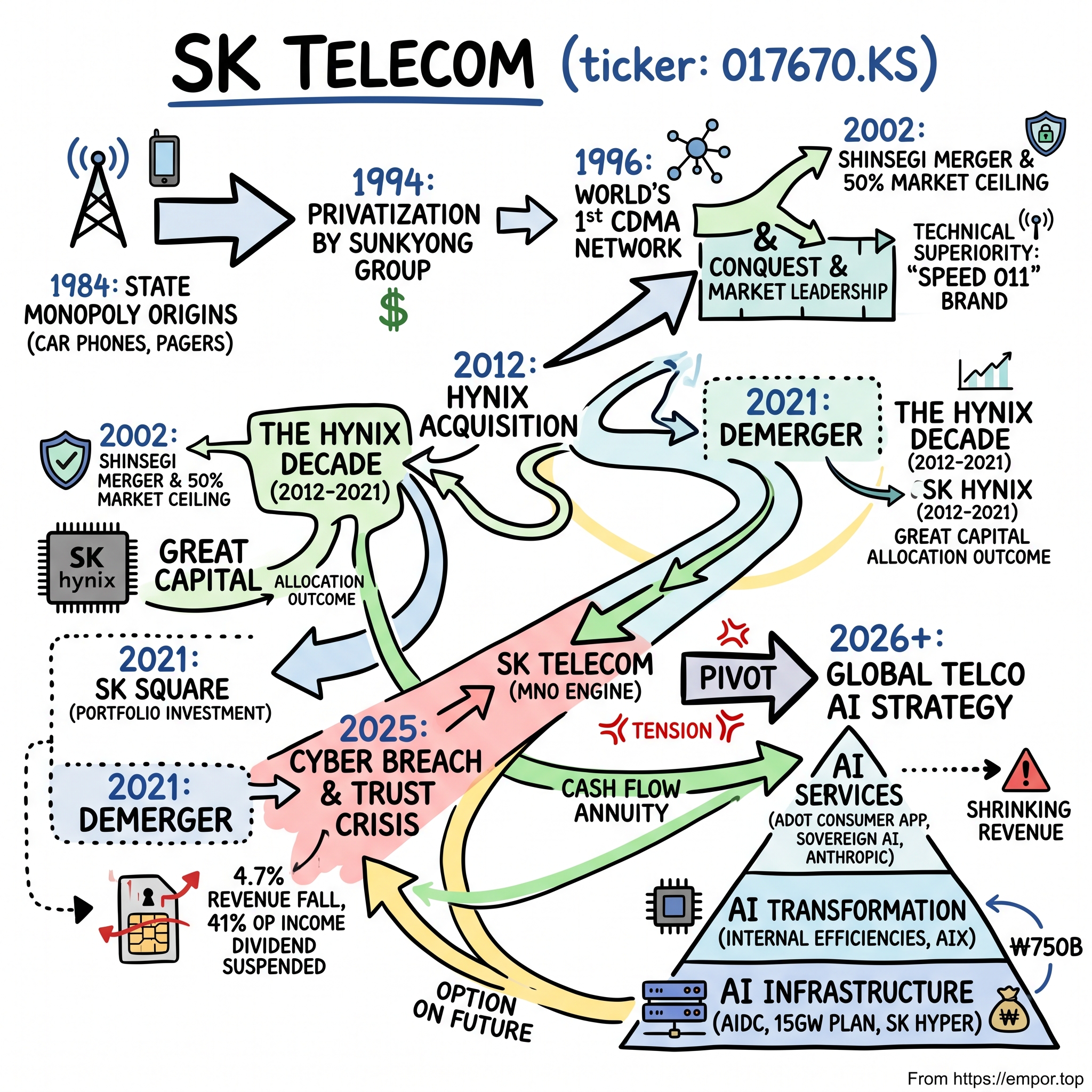
I. Episode Roadmap & Thesis
On the evening of April 18, 2025, a piece of malware sitting quietly inside a server at SK텔레콤 SK Telecom — the company that carries roughly one in three of South Korea's mobile calls — began shipping data out of the building. By the time anyone noticed unusual traffic, 9.82 gigabytes had left. The file contained the digital DNA of the country's phone network: subscriber identifiers, phone numbers, and the authentication keys that live inside a SIM card and prove to the network that you are you. Investigators later established that the intruders had first walked in during August 2021, come back in June 2022, and simply waited.1
Twenty-three point two million people were affected — roughly 45% of the entire South Korean population.1 Within forty-eight hours of the public disclosure, more than 70,000 subscribers walked out the door, about 60% of them to KT 케이티.2 The company began replacing SIM cards for its entire base of some 25 million users.2 Then-CEO 유영상 Ryu Young-sang stood in front of the National Assembly and called it "the worst hacking incident in the history of the telecommunications industry," conceding that the "initial response was lacking."2
That is an unusual place to begin the story of a company usually filed under "boring Korean dividend utility." But it is the right place, because it compresses the entire investment question into a single episode. SK Telecom's business rests on something more fragile than spectrum licenses or fiber: the assumption by 20-odd million households that this company is the safe, premium, default choice. In 2025 that assumption broke, and the financial statements recorded the damage with brutal clarity. Consolidated revenue fell 4.7% to ₩17.1 trillion. Operating income dropped 41.1% to ₩1.07 trillion. Net income fell 73% to ₩375.1 billion.3 The board suspended the quarterly dividend for the second half of the year — for a stock owned overwhelmingly because of that dividend.4
And here is the twist that makes this a genuinely interesting story rather than a cautionary tale: while the core business was bleeding trust, the same management team was making the largest capital commitment in the company's history — not to networks, but to artificial-intelligence compute. In July 2026, SK Telecom announced a plan to build toward 15 gigawatts of AI data center capacity in Korea by 2035, phased in from 2029, framed by the company as the country's "third national infrastructure revolution" after the Gyeongbu Expressway and broadband internet.5 To put 15 GW in perspective: that is roughly the electricity draw of a mid-sized industrial nation, and the company itself estimated a single 1 GW-class AI data center can cost on the order of ₩70 trillion.5 SK Telecom's entire shareholders' equity was about ₩13 trillion at the end of 2025.6
So the thesis of this episode is a tension, not a conclusion. On one side sits a cash machine: a three-player mobile oligopoly, protected by spectrum, capital intensity, and a regulator that has repeatedly failed to create a fourth competitor. On the other sits a company that has spent the last three years telling investors it is no longer really a telco at all — that it is an "AI Native" company, a builder of sovereign compute, an equity holder in Anthropic, a partner of OpenAI and AWS and Nvidia. The question every long-term investor has to answer is whether the second story is a genuine second act or a very expensive distraction financed by the first.
Three facts frame that question honestly. First, the AI businesses are real but small: in the first quarter of 2026, AI data center revenue grew 89.3% year-on-year — to ₩131.4 billion, against consolidated revenue of ₩4.39 trillion. The separately reported "AI B2B/B2C" line actually shrank 10.3% to ₩45.0 billion.78 Second, the core is recovering but not healed: the mobile business added about 210,000 handset subscribers in Q1 2026, a genuine reversal, but off a base still roughly 900,000 smaller than a year earlier.9 Third, this is a company with an extraordinary historical track record of exactly one bet of this kind — and that bet, SK하이닉스 SK Hynix, worked so spectacularly that it distorts how everyone, including management, thinks about risk.
Here is how the story unfolds:
- Origins (1984–1994): a state monopoly, a chaebol that handed back a license it had already won, and the auction that gave
SK그룹 SK Groupits cash engine. - Conquest (1995–2010): the world's first commercial CDMA network, the acquisition of a rival that forced regulators to invent a market-share ceiling, and the move into fixed-line.
- The Hynix decade (2011–2021): a mobile carrier buying a memory chipmaker, the greatest capital-allocation outcome in modern Korean corporate history — and the 2021 demerger that handed it away.
- The core engine: what actually earns the money, how Korean telecom economics work, and what the 2025 breach revealed about the durability of the franchise.
- The AI pyramid: data centers, Anthropic,
에이닷 A. (Adot), and the widening gap between announced ambition and booked revenue. - Governance and capital allocation: a new CEO installed after a crisis, a suspended-then-restored dividend, and a ₩750 billion subsidiary created three weeks before this was written.
- The frameworks, the bull and bear cases, and the small number of metrics that actually matter.
The posture throughout is neutral. SK Telecom's management tells a coherent and, in parts, well-evidenced story about becoming Asia's AI infrastructure hub. Some of it is already visible in the numbers. Much of it is a promise about 2029 and beyond, made by a company that in 2025 could not keep the promise it had already made about its dividend. Both things are true at once.
 Subscribe on LinkedIn
II. Origins: The State Monopoly & Sunkyong's Great Bet (1984–1994)
To understand what SK Telecom is, you have to understand that it did not start as a company. It started as an arm of the state.
In March 1984, the Korean government established the entity that would become SK Telecom to run mobile communications — car phones and wireless paging — under the umbrella of the state wireline monopoly that is today KT 케이티.10 This was Korea in the mid-1980s: a country a generation removed from the Korean War, governed by a military-rooted developmental state that treated infrastructure as an instrument of national industrial policy. Steel got POSCO. Shipbuilding got Hyundai. Telecommunications got a state carrier, because the planners understood something that took Western economies longer to internalize — that whoever controls the communications layer controls the tempo of everything built on top of it.
The early product was almost comically elite. A car phone in 1984 Korea was not a consumer good; it was a status object, priced and rationed for senior officials and corporate executives. The pager — the 무선호출기, the beeper — came later and went genuinely mass-market, becoming the defining accessory of Korean urban life in the early 1990s. When the company introduced portable handheld service around the 1988 Seoul Olympics, it was as much a piece of national theater as a commercial launch: the country was showing the world it had arrived.10
Then, in the early 1990s, the government decided to sell.
The privatization drama that followed is the founding myth of SK's telecom business, and like most founding myths, it is better than fiction. 선경그룹 Sunkyong Group — a textiles-and-oil-refining conglomerate led by Chairman 최종현 Chey Jong-hyon — competed for and won a second-generation mobile license. And then it gave it back. The problem was not the bid; it was the optics. Chey's family was connected by marriage to the family of the sitting president, and the award ignited accusations of favoritism severe enough that Sunkyong voluntarily surrendered the license rather than carry the taint.
Read that decision in the cold light of capital allocation and it looks insane: a conglomerate walking away from a government-granted monopoly on the most attractive growth market of the coming decade. Read it as reputation management under a chaebol system where political legitimacy is a hard operating input, and it looks like one of the shrewdest sacrifices in Korean corporate history. Sunkyong bought itself the right to try again, cleanly, later.
Later arrived in January 1994. Under a privatization policy explicitly designed to sharpen the competitiveness of the domestic telecommunications industry, the government put the state carrier up for open bidding — and SK Group, then still Sunkyong, won it.10 The exact price is not disclosed in the company's own English-language corporate history, and the figures that circulate in secondary accounts should be treated with caution. What is beyond dispute is the character of the transaction: Sunkyong paid a price the market of the day considered aggressive to the point of recklessness, for a business whose subscriber base was tiny and whose product most Koreans had never used.
This is the first and most important pattern in the entire SK Telecom story, and it repeats: this company pays up, early, for privileged infrastructure positions that other people think are overpriced. It happened in 1994 with the mobile license. It happened in 2011 with a distressed memory chipmaker. It is happening right now with gigawatts of AI data center capacity. Sometimes the pattern produces the greatest acquisition in Korean corporate history. Whether it always will is the open question of this episode.
There is a second, less romantic lesson buried in the 1994 auction, and it concerns what privatization actually transferred. The government did not sell a customer base — the mobile market at the time was a rounding error. It sold a position: incumbency in a licensed industry, with the operational knowledge, the tower sites, the interconnection arrangements and the regulatory relationships already in place. Buyers of infrastructure assets consistently underpay for that bundle because it does not appear on an income statement. Sunkyong's willingness to pay a price that looked absurd against current earnings was, in effect, a wager that Korean households would spend a rising share of income on communication for the next thirty years. They did. Almost every subsequent debate about whether SK Telecom overpaid for something — Hanaro, Hynix, and now data centers — is a rerun of the same argument, with the same participants taking the same sides.
The prize was renamed SK Telecom in 1997, and its role inside the group was immediately clear.10 SK's legacy businesses — refining, chemicals, textiles — were classic cyclicals: capital-hungry, margin-volatile, hostage to crude spreads and global demand. A mobile carrier was the opposite. Customers paid monthly, in advance, in cash, and did not stop paying during recessions. In the terminology of the trade, SK had bolted an annuity onto a cyclical. That annuity would fund everything that followed, and it still does.
What the group had not yet acquired was any technological credibility. In 1995, SK Telecom was a newly privatized operator with an unproven consumer market and a government about to make one of the strangest technology bets any nation has ever made on its behalf.
III. Wireless Conquest: CDMA, Shinsegi, & Network Supremacy (1995–2010)
In the early 1990s, the world's telecom industry had effectively settled on a standard for digital mobile. Europe had built GSM, GSM worked, and GSM was becoming the global default. South Korea looked at that consensus and chose the other thing.
The other thing was CDMA — Code Division Multiple Access — a technology developed by a then-modest San Diego company called Qualcomm, and at that point commercially unproven at national scale anywhere on earth. The engineering distinction matters, and it is easier to grasp with an analogy. GSM works like a dinner party where guests take strict turns to speak, each allotted a precise slice of time on a given frequency. CDMA works like a dinner party where everyone speaks simultaneously but each pair converses in its own private language; the receiver simply filters out every language but its own. The second approach is harder to build and far less intuitive — but it packs dramatically more conversations into the same slice of radio spectrum. For a country with the population density of South Korea, spectrum efficiency was not an academic virtue. It was the whole game.
SK Telecom launched the world's first commercial CDMA network in January 1996. The consequences ran far beyond one company's balance sheet. The decision handed Korean manufacturers a protected home market in which to master a technology nobody else had commercialized, which is a meaningful part of how 삼성전자 Samsung Electronics became a global handset power rather than a regional appliance maker. It made Korea, for a decade, the world's live laboratory for mobile data. And it gave SK Telecom something no amount of marketing spend can manufacture: an engineering reputation. The "Speed 011" brand — 011 being SK's dialing prefix in the era before number portability — became shorthand for the network that simply worked, in elevators, in subways, on mountain roads. Korean consumers paid a premium for it for the better part of twenty years.
It is worth pausing on the economics of that reputation, because "brand" in telecom is usually a euphemism for advertising spend, and this was something different. Mobile service is an experience good with a binary failure mode: a call either connects or it does not, and every customer runs the test dozens of times a day. In a country where commuters spend hours underground and cities are built vertically, a network that held a call in a subway tunnel or on the twentieth floor produced a form of proof no competitor could rebut with marketing. That proof translated directly into pricing: for most of the 2000s, SK Telecom charged more than its rivals and lost fewer customers than its rivals, which is the textbook definition of pricing power. The lesson generalizes badly to the present day, though — the reason it worked was that networks were genuinely unequal. Once all three Korean carriers achieved near-universal coverage and comparable speeds, the premium began to erode into the flat ARPU line the company reports now. Technical superiority is only a moat while the technology is hard.
That brand equity created a problem of a very pleasant kind: SK Telecom kept winning. By the late 1990s the company was pulling away from its rivals, and in April 2000 it moved to buy the largest of them outright, acquiring 51% of 신세기통신 Shinsegi Telecom, the operator behind the 017 prefix.11 Combined, the two carriers controlled roughly 52% of Korea's mobile customers — and at that level, Korea's antitrust authority balked.11
The 공정거래위원회 Korea Fair Trade Commission cleared the deal, but attached a condition that would shape Korean telecom policy for the next two decades: the combined entity had to get its market share back below 50%.11 Consider how strange that instruction is. SK Telecom was not ordered to divest assets or license spectrum. It was ordered to have fewer customers. And so, in one of the more surreal episodes in modern telecom history, the country's best network spent 2000 and 2001 deliberately turning business away — slowing activations, tightening deactivation policy, and from April 1 to June 30, 2001, refusing to accept new subscribers at all. It worked: share came in at approximately 49.7% at the June 30, 2001 deadline, and the merger completed in January 2002.1211
The lasting legacy was psychological. A "50% ceiling" became the unwritten constitution of the Korean mobile market — a shared understanding among the three carriers and their regulator about how much of the country any one operator was permitted to own. It removed the incentive for SK Telecom to fight for share at any cost, and it quietly institutionalized the rational, margin-preserving oligopoly that persists today. Investors who admire the stability of Korean telecom economics are, in a real sense, admiring the long tail of a 2000 antitrust remedy.
By the mid-2000s the wireless-only story was maturing, and SK Telecom went looking for the other half of the household. In December 2007 it agreed to buy a 38.89% controlling stake in 하나로텔레콤 Hanaro Telecom for ₩1.09 trillion — about $1.2 billion — from a consortium led by AIG and Newbridge Capital, taking total ownership to 43.59%.13 The seller's return tells you how badly SK wanted it: the private-equity owners roughly doubled their money on a 2003 investment.13 Renamed SK Broadband in September 2008, the asset gave SK Telecom fixed-line voice, high-speed internet, and eventually IPTV.
The strategic logic was switching costs, and it is worth being precise about the mechanism, because it is the single most durable competitive advantage this company owns. A mobile customer is loosely attached — Korea has had number portability for years, and moving carriers takes an afternoon. A household is a different animal. Once a family's mobile lines, home broadband, and television all sit on one bill, with family discounts stacked across the lines and a two-year IPTV contract underneath, leaving requires coordinating four people, forfeiting discounts, and accepting a service interruption on the living-room television. Bundling does not make customers love you. It makes leaving annoying. In telecom, annoying is worth several percentage points of annual churn — which, compounded over a decade of subscriber lifetime value, is worth more than any advertising campaign ever run.
By 2010, then, SK Telecom had assembled a genuinely formidable machine: the premium network brand, a structurally capped but dominant share, a fixed-line business to anchor households, and cash flow that arrived with metronomic regularity. What it did not have was growth. Korea's mobile market was approaching saturation, ARPU had stopped climbing, and the domestic story was, in the honest reading, finished. Which is precisely when the company did the least predictable thing in its history.
IV. The Hynix Masterstroke & The Great Corporate Split (2011–2021)
In late 2011, a mobile phone company announced it was buying a memory chip factory. The sell-side reaction was close to unanimous, and it was not admiration.
The target was Hynix Semiconductor — a company that had been through hell. Spun out of the wreckage of the Hyundai group's semiconductor ambitions, Hynix had spent the 2000s in and out of creditor control, kept alive by Korean banks that had no better option than to keep it breathing. Memory chips are the most brutally cyclical business in technology: enormous fixed costs, commodity output, and price swings violent enough to erase a year of profits in a quarter. Hynix was posting consecutive quarterly losses when SK came calling.14
SK Telecom completed the purchase on February 14, 2012, paying ₩3.37 trillion — about $3 billion — for a 21.05% stake at ₩23,099 per share.14 It was the largest acquisition the company had ever made. The CEO's stated rationale was to "develop Hynix into a new growth engine and to boost business synergy between the chipmaking and telecommunications business" — a synergy argument that was, to put it charitably, thin.14 There is no operational synergy between running cell towers and etching DRAM. And SK Group committed to injecting at least a further ₩4.2 trillion in facility investment on top of the purchase price, into a business that was losing money.14
The critics had the better of the argument on every point except the one that mattered. What SK actually bought was not synergy. It was a chance to own one of only three companies on earth capable of manufacturing advanced DRAM at scale, purchased at a cyclical trough from a distressed seller who wanted out. 최태원 Chey Tae-won, the SK Group chairman who drove the deal, was making a structural bet: that memory would consolidate from a commodity knife-fight into an oligopoly, and that oligopoly memory would earn oligopoly returns. It took a decade and a half, but he was right in a way that exceeded any plausible base case at the time.
The scale of that vindication is difficult to overstate. On June 22, 2026, SK하이닉스 SK Hynix overtook 삼성전자 Samsung Electronics to become South Korea's most valuable listed company, having briefly crossed a market capitalization of ₩2 quadrillion — roughly $1.3 trillion — days earlier, driven by demand for high-bandwidth memory that has become the physical bottleneck of the global AI build-out.[^15] A ₩3.37 trillion investment in a loss-making chipmaker became a stake in one of the most valuable companies in the world. On any reasonable measure, it is among the greatest single capital-allocation decisions in the history of Asian business.
Which brings us to the most consequential and least understood event in SK Telecom's modern history: the company no longer owns it.
The reasons were structural. Under Korea's Fair Trade Act rules governing 재벌 chaebol holding-company structures, a sub-subsidiary sitting several layers down — as SK Hynix did, held under SK Telecom, held under SK㈜ SK Inc. — faced severe constraints on its own acquisitions, generally required to take 100% ownership of anything it bought. For a semiconductor company in a decade of industry consolidation, that was a strategic straitjacket. Meanwhile, the public market was applying the conglomerate discount with characteristic ruthlessness: investors who wanted telecom cash flows did not want chip cyclicality, investors who wanted chip upside did not want to buy it wrapped in a utility, and the blended entity satisfied neither.
The solution was a horizontal demerger. In October 2021, shareholders approved a plan to split SK Telecom into two listed companies, alongside a share split.15 The surviving SK Telecom kept the mobile business, SK Broadband, and the emerging AI services. A newly created SK스퀘어 SK Square took the investment portfolio — the SK Hynix stake, 원스토어 ONE Store, 티맵모빌리티 TMAP Mobility, 11번가 11st, and the security business.15 The stated purpose was to unlock value trapped by the conglomerate structure.15
For SK Square shareholders, the subsequent AI-memory boom was a windfall. For shareholders of the surviving SK Telecom, the arithmetic is more uncomfortable, and it deserves to be stated plainly rather than glossed. The company gave away the single greatest asset it ever created and retained the mature, regulated, low-growth business. Anyone holding SK Telecom shares today owns a telecom operator that once owned a fifth of what is now a trillion-dollar chipmaker and no longer does.
Management would counter, fairly, that the split was a precondition for SK Hynix's own strategic freedom, that shareholders received SK Square shares in the demerger rather than being expropriated, and that a clean pure-play telco is exactly what income investors said they wanted. All true. But the strategic residue matters for how you read everything that follows. SK Telecom emerged from 2021 as a company with a strong cash flow, a defensible franchise, and no growth engine — and with an institutional memory that says the answer to "no growth engine" is to buy an enormous, capital-intensive, deeply cyclical asset that everybody else thinks is overpriced.
There is one small, telling epilogue. In June 2026, SK Telecom's board approved investing ₩738.4 billion for a 0.9% stake in SK hynix NAND Product Solutions, a US subsidiary of its former subsidiary — a commitment equal to about 5.7% of SK Telecom's equity capital, payable in staged capital calls through June 2030.16 The company framed it as securing synergies with its AI business.16 Read less charitably, it is SK Telecom paying to buy a sliver of exposure back to the family jewel it distributed five years earlier — and doing so via a related-party transaction inside the group, exactly the kind of arrangement minority shareholders in Korea have learned to scrutinize.
V. Anatomy of the Core Engine: Korea's MNO Oligopoly & Economics
Strip away the AI slideware and this is what SK Telecom actually is: about 31 million mobile connections, 7.31 million broadband homes, and a bill that arrives every month.8
The mobile business — the MNO segment — remains the heart. In the first quarter of 2026 it produced mobile service revenue of roughly ₩2.58 trillion, down 3.0% year-on-year, from a base of 31.0 million total connections (down from 31.9 million a year earlier).8 Of the handset base, 17.8 million subscribers were on 5G, or 81% — a penetration rate among the highest of any large market on earth.8 SK Broadband, which became a wholly owned subsidiary in May 2026 when SK Telecom bought out the last 0.76% of minority holders for ₩15,032 per share, contributed ₩1.15 trillion of revenue in the quarter and, notably, grew its operating income 21.4%.177
The number that best explains the strategic anxiety driving everything else is ARPU: average revenue per user of ₩29,261 per month in Q1 2026, up 0.2% year-on-year.8 That is roughly $21 a month for unlimited access to one of the fastest mobile networks in the world — and it has been essentially flat for years. This is the core economic fact of the modern telecom industry, and it is worth sitting with. SK Telecom's customers consume vastly more data than they did five years ago, on a network that cost trillions of won to build, and they pay the same. Every gigabyte of growth in Korean smartphone usage accrues to 카카오톡 KakaoTalk, to YouTube, to Netflix, to Coupang — not to the company that carries the bits. That is the "dumb pipe" problem in one number, and no amount of corporate strategy has yet solved it anywhere in the world.
What makes the business work anyway is cost structure and stability. The network is a fixed cost; the marginal customer on an existing tower is nearly free. Churn ran at 0.9% a month in Q1 2026 — meaning the average customer relationship lasts on the order of nine years.8 Capital intensity, having peaked in the 5G build-out, has normalized: full-year 2025 capex was about ₩1.24 trillion in wireless and ₩885 billion in fixed-line and data centers, roughly ₩2.1 trillion combined against ₩17.1 trillion of revenue.6 The company carries AAA domestic credit ratings from all three Korean agencies and A-/A3 international ratings — cheap money, which matters enormously for a business about to contemplate multi-gigawatt construction.6
The regulatory ceiling and the floor
Korean telecom is governed as much by politics as by economics, and the industry's two regulators — the 과학기술정보통신부 Ministry of Science and ICT and the 방송통신위원회 Korea Communications Commission — sit at the intersection of both. Mobile tariffs are a cost-of-living metric in Korea, which means every administration, regardless of ideology, arrives in office with a plan to make phone bills cheaper. That is a permanent, structural cap on pricing power, and it is the single most underappreciated reason Korean telecom stocks trade at low multiples.
Two regulatory episodes bracket the current period. The first was a failed attempt to break the oligopoly. In 2024, the government auctioned 28 GHz spectrum — the very high-frequency, very short-range flavor of 5G — to seed a fourth national carrier, and a consortium called Stage X won with a bid of ₩430.1 billion against a ₩74.2 billion base price.18 Then Stage X failed to pay in its required capital, and the ministry cancelled the allocation, returning the fees.1918 The would-be disruptor never launched a single cell site. The episode is more damning of the economics than of Stage X: mmWave spectrum is nearly useless for national coverage — the signal barely penetrates a wall — and all three incumbents had already had their own 28 GHz licenses clawed back for missing build-out obligations. Korea's fourth-carrier problem is not a failure of political will. It is that a fourth carrier cannot make money.
The second episode cut the other way. On July 22, 2025, Korea repealed the 단통법 Dantongbeop — the Mobile Device Distribution Improvement Act — which since 2014 had capped the handset subsidies carriers could offer.20 The law had been introduced to stop irrational subsidy wars and force price transparency; the science ministry ultimately concluded it had instead restricted "healthy competition by preventing mobile carriers from offering legal subsidies."20 Its removal restored the carriers' oldest and least attractive weapon: buying customers with cash off the price of a phone. That repeal landed in the middle of SK Telecom's worst year, at the exact moment its rivals had 23 million reasons to go hunting for its subscribers.
What the breach actually proved
Which returns us to April 2025. The immediate financial damage was severe — the operating profit collapse described earlier, driven by USIM replacement across the base, compensation packages including discounted bills and free data, and security remediation.3 On August 28, 2025, the 개인정보보호위원회 Personal Information Protection Commission imposed a record ₩134.8 billion fine, and its findings were more damaging than the number.1 The regulator noted that SK Telecom had discovered hackers reaching its home subscriber server in February 2022 and had not investigated; that the server held sensitive data and could be accessed without authentication checks; and that the authentication keys were not encrypted.1 PIPC Chairman 고학수 Ko Haksoo said the company "had been in a vulnerable state for quite a long time, with significant weaknesses."1 SK Telecom said its explanations "were not reflected in the outcome," and in January 2026 it sued in the Seoul Administrative Court to overturn the penalty — a live legal overhang as of this writing.1
For investors, the analytical conclusion is not "cybersecurity is a risk," which is trivially true of every company. It is more specific and more useful. First, the franchise proved less sticky than the churn statistics implied: a decade of bundling and family discounts did not stop tens of thousands of customers leaving within two days of a trust shock. Switching costs are real, but they are a tax on leaving, not a wall. Second, the damage was disproportionate to the direct financial loss — the fine was roughly one-eighth of a normal year's operating profit, but the subscriber and revenue impact stretched across four quarters and cost shareholders two dividend payments. Third, and most usefully, it exposed how much of this business's value is the intangible premium of being the default safe choice. That premium is the thing SK Telecom is now trying to convert into an entirely different business.
Myth versus reality
Three pieces of received wisdom about this company deserve testing against the record.
Myth: SK Telecom is a ~40% share monopolist protected by a regulatory cap. The reality is subtler. The historical share ceiling was a constraint, not a guarantee, and the market has quietly restructured beneath it. Budget resellers — the 알뜰폰 operators — lease wholesale capacity from the incumbents and undercut headline plans substantially, and a meaningful slice of the customers who left during 2025 went to them rather than to the two facilities-based rivals.2 SK Telecom's own connection count fell by roughly 900,000 over the year to March 2026.8 The oligopoly is intact at the infrastructure layer; at the retail layer it has been leaking for years.
Myth: 5G was a growth story. It was a capex story. Korea reached 81% 5G penetration of the handset base, among the highest anywhere, and blended ARPU still sits near ₩29,000 and grew 0.2% year-on-year.8 The entire generational upgrade — trillions of won of spectrum and equipment — delivered faster service at the same price. Any investor evaluating the eventual 6G cycle should start from that precedent rather than from vendor marketing.
Myth: the dividend is a bond coupon. It is not, and 2025 proved it. The board skipped two quarterly payments when the business hit trouble, then restored the payment when profits recovered.47 The dividend is a policy, reviewed quarterly against earnings and capital needs, and the largest capital need in the company's history is now in front of it.
VI. The AI Pyramid: Datacenters, Anthropic, & Adot (2022–Present)
On October 1, 2025 — five months after the breach, three weeks before its CEO was replaced — SK Group's chairman hosted Sam Altman at SK's Seoul headquarters. By the end of the meeting, SK hynix had signed a letter of intent to supply high-bandwidth memory for OpenAI's Stargate program, committing to production capacity of up to 900,000 DRAM wafers a month, and SK Telecom had signed a memorandum of understanding to develop, build and operate an AI data center in Korea's southwest as part of "Stargate Korea."21 Chey called it an honor to participate as a core partner in building "future global AI infrastructure." Altman said Korea had "the vision, technology, talent and infrastructure to lead globally in AI."21
MOUs are not contracts, and it is worth being disciplined about the distinction. But the meeting captures the strategy that has consumed SK Telecom since 2023, originally packaged as the "AI Pyramid": infrastructure at the base, AI transformation of the core business in the middle, consumer and enterprise AI services at the top.
Level one: the compute base
The base level is the one with real revenue attached. SK Telecom's AI data center business grew 34.9% in 2025 to ₩519.9 billion, helped by higher utilization at its Gasan and Yangju facilities and the acquisition of a data center in Pangyo.3 In Q1 2026 the growth rate accelerated sharply to 89.3%, to ₩131.4 billion for the quarter.7 On the Q1 call, the CFO told analysts that AIDC profitability is "comparable to the existing telecom business" with "much room" for improvement, while declining to disclose margins on competitive-sensitivity grounds — a reasonable position that nonetheless leaves the most important number unverifiable.9
To understand why a phone company is well-placed here, it helps to know what an AI data center actually is. A traditional data center is a warehouse of servers doing many small tasks, sipping perhaps 5–10 kilowatts per rack. An AI training facility is closer to an industrial smelter: racks of GPUs drawing 50–130 kilowatts each, generating so much heat that air cooling fails and liquid must be piped directly to the chips. The binding constraints are therefore not silicon — they are land, grid connection, and substations. And a national telecom operator happens to own decades of experience acquiring difficult sites, negotiating with utilities, and building resilient facilities near population centers. That is the genuine, non-rhetorical asset SK Telecom brings.
The build-out has escalated in three steps, each larger than the last. Construction of an Ulsan AI data center, a joint venture with AWS, began in September 2025.39 At MWC Barcelona on March 1, 2026, CEO 정재헌 Jung Jai-hun announced an "AI Native" strategy targeting 1 GW-class hyperscale capacity nationwide and an upgrade of the company's own foundation model from 519 billion to over one trillion parameters.22 Then on July 5, 2026, the company unveiled the 15 GW plan: 5 GW phased in from 2029, expanding to 15 GW by 2035, with over 2 GW concentrated in the southeastern region around Ulsan and 1 GW in the southwest.5 Financing, the company said, would come from a mix of its own investment, strategic partners, long-term customer contracts, and project finance.5
Then, on July 23, 2026 — six days before this was written — the board approved the vehicle to do it: SK Hyper, a wholly owned subsidiary capitalized with ₩750 billion through 2030, of which ₩330 billion was expected in July 2026.23 SK Hyper's remit is explicitly the bottleneck: securing land, building and operating substations, recruiting global customers.24 Jung framed the timing bluntly — "now is the golden time for execution, as competition to secure AI infra" intensifies.24
The skeptical reading writes itself, and honest analysis requires stating it. ₩750 billion is 5.79% of shareholders' equity, and roughly 1% of the estimated cost of a single gigawatt-class facility.235 The subsidiary is a land-and-power development company, not a compute company. Its funding is staged and contingent on progress. That is either prudent optionality — spend a little to control sites, then bring in partners and project finance once anchor customers sign — or it is a headline capacity number with no committed capital behind it. Both interpretations fit the disclosed facts. What would settle it is signed, long-term customer contracts with credible counterparties, and that is precisely what investors do not yet have.
Level two: turning AI on itself
The middle layer of the pyramid attracts the least attention and may be the most economically honest part of the strategy. "AIX" — AI transformation — means using the technology inside the company rather than selling it.
The March 2026 strategy set out what that looks like in practice: rebuilding the integrated IT systems that run sales, line management and billing so they are designed for AI rather than retrofitted; moving network operations toward autonomous management of radio quality, traffic and equipment using AI-RAN techniques; and deploying more than 2,000 internal AI agents across departments, tracked on an internal utilization dashboard.22 On the Q1 2026 call, a network executive was careful to qualify the AI-RAN ambition, noting that SK Telecom is "actively participating in technology research" with Samsung, DOCOMO and Nvidia, but that adoption depends on "technology maturity, standardization, and commercial validation" — an unusually disciplined answer in a field where most operators simply assert the future.9
Why this matters more than it sounds: a mobile operator's two largest controllable cost lines are customer service and network operations. A call center handling millions of Korean-language interactions a year is exactly the workload large language models handle well, and an autonomously tuned network reduces both energy consumption and the engineering headcount required to keep quality high. If AIX works, it shows up not as a new revenue line but as margin in the existing one — which is precisely how management framed 2026's profit recovery, citing productivity improvements from enterprise AI adoption alongside telecom fundamentals and data centers.9
It is also the part of the strategy least susceptible to disconfirmation, and investors should hold that thought carefully. Cost savings attributed to internal AI are almost impossible to audit from outside: they blend into headcount, energy and outsourcing lines that move for a dozen unrelated reasons. When a company tells you AI improved its margin, the honest response is to ask what the margin actually did — and in 2026, the answer will be entangled with a post-crisis recovery that would have lifted margins anyway.
Level three: the services that were supposed to differentiate
The top of the pyramid has been the more disappointing story, and it is instructive about how hard it is for a telco to compete in AI products.
The consumer flagship is 에이닷 A. (Adot). Its breakout feature, launched in October 2023, was call recording and summarization on the iPhone — a genuinely clever bit of product engineering.[^26] Call recording is culturally normal in Korea and native on Android, but Apple has never permitted it on iOS; SK Telecom solved this by routing calls through its own app, then transcribing and summarizing them automatically, with recordings stored on-device and auto-deleted after a year.[^26] It was a real product-market insight: solve a hyper-local friction that a global platform will not. By early 2026, Adot had passed 10 million users.4
But 10 million users is not 10 million paying customers, and the segment financials say so. The AI B2B/B2C revenue line was ₩45.0 billion in Q1 2026 and declined 10.3% year-on-year, dragged by weakness in cloud.8 For a strategy whose entire premise is that a telco can move up the stack into AI services, a shrinking services line four years in is the most important disconfirming evidence available.
The alliance story has evolved similarly. In August 2023, SK Telecom invested $100 million in Anthropic, with the two companies announcing plans for a multilingual telco-specific large language model overseen by Anthropic's chief science officer.25 In June 2024, SK Telecom, Deutsche Telekom, e&, Singtel and SoftBank signed an agreement to establish a joint venture to co-develop and launch that telco LLM, aimed at a combined base of about 1.3 billion customers across 50 countries.26 The JV was eventually established in late 2025 as Syntelligence AI, funded with $37.5 million from the five partners.27
And then it changed course. By February 2026, Syntelligence was a nine-person company whose CEO had explicitly deprioritized the original mission — "we decided to defer spending time on telco-domain specific LLMs," on the reasoning that general-purpose foundation models had simply become too good — pivoting instead to a network-based anti-fraud and spam-call service, sold on its merits against competing products with no preferential treatment from the founding operators.27 That is a rational, even admirable, decision by the JV's management. It is also a clean falsification of the 2023–24 thesis that telcos possessed proprietary domain data valuable enough to justify their own class of language model. Investors should update accordingly: the "telco LLM" is no longer a differentiator, and SK Telecom's Anthropic stake is now best understood as a financial position, not a strategic one. Management has been notably guarded about that stake — on the FY2025 call, asked directly about its value and any potential monetization, executives cited confidentiality clauses and said no decisions had been made.4
Where SK Telecom has instead planted its flag is sovereign AI. On December 28, 2025 it unveiled A.X K1, a 519-billion-parameter Korean-language foundation model built with a consortium including 크래프톤 KRAFTON, 42dot, Rebellions, Seoul National University and KAIST, positioned as a national "teacher model" under Korea's government-backed sovereign foundation model program.28 The bet is that Korea, like several mid-sized economies, will pay for AI it controls — trained on its own language and cultural context, running on domestic infrastructure, outside the jurisdiction of American hyperscalers. That is a plausible thesis with real political tailwinds. It is also a thesis whose customer is largely the state, whose economics are unproven, and whose technical premise — that a domestic 519B-parameter model competes usefully with frontier labs spending tens of billions — is exactly the assumption Syntelligence just abandoned.
The remaining pieces sit further out. The AI chip effort was consolidated when SK's in-house designer SAPEON merged with Korean startup Rebellions in 2024, creating a domestic challenger in AI inference silicon.29 Compute access was addressed through an investment in US GPU cloud provider Lambda.[^32] And a partnership with Joby Aviation targets electric air taxis in Korea, an option with a long fuse and no near-term financial materiality.30
The proportionality point deserves to be stated once, flatly, because it is easy to lose in the noise: mobile and broadband still generate the overwhelming majority of SK Telecom's revenue and effectively all of its profit. AI data centers, at their Q1 2026 run rate, are about 3% of revenue. Everything in this section is an option on the future, purchased with cash flows from the past.
VII. Management, Governance, & Capital Allocation
On October 30, 2025, SK Group announced its annual executive reshuffle, and the most closely watched line concerned SK Telecom. 유영상 Ryu Young-sang, who had run the company since 2021 — through the demerger, the AI pivot, and the breach — moved to the group's SUPEX Council to lead its AI committee. In his place, the group installed 정재헌 Jung Jai-hun, a lawyer by training who had served as the company's chief governance officer and head of external cooperation, and who had chaired the governance committee of the SUPEX Council.31
The choice tells you what the group thought its problem was. When a telecom operator installs a career network engineer or a marketing executive, it is playing offense. When it installs a lawyer whose background is governance, regulatory relations and external affairs, it is managing a legitimacy crisis: a record privacy fine under appeal, parliamentary scrutiny, class-action claims, and a customer base that needed to be persuaded to stay.311 Within nine months, that same lawyer was announcing a 15-gigawatt infrastructure program and standing on a stage in Barcelona describing his company as "AI Native."225 Whether that represents a genuine strategic conviction or the fastest available way to change the subject is a fair question, and the honest answer is that it is too early to know.
Above him sits Chairman Chey Tae-won, who remains the ultimate strategic authority across SK Inc., SK Telecom and SK hynix, and who also chairs the Korea Chamber of Commerce and Industry — a role that makes him, in practice, a semi-official spokesman for Korean business. The Stargate meeting happened in his building.21 Investors in SK Telecom should be clear-eyed that this is not a company whose strategy is set solely by its own board. SK㈜ SK Inc. holds 30.57% of the shares, and group priorities — including the group's positioning of AI infrastructure as its defining bet — flow downhill.17
The dividend, and what happened to it
For most of the post-demerger period, SK Telecom's equity story was simple: a defensive utility paying a large, predictable quarterly dividend. That story broke in 2025, and how management handled the break is the best available evidence on its credibility.
The company paid ₩830 per share in the first and second quarters of 2025, then suspended the dividend for the third and fourth quarters, citing breach response costs, customer compensation and security spending.4 Full-year 2025 dividends came to ₩1,660 per share — which, against collapsed earnings, still represented a payout ratio of about 86.6%.6 It resumed the quarterly payment at ₩830 in Q1 2026.7
Two readings are available. The charitable one is that a board facing a genuine crisis chose balance-sheet prudence over financial engineering, took the pain in two quarters, and restored the payment as soon as earnings supported it — and that the high payout ratio on depressed earnings shows the commitment was never abandoned. The uncharitable one is that a stock owned primarily for income failed to deliver income precisely when its holders were most exposed, and that this reveals the dividend as a residual of operating performance rather than a genuine commitment. Both readings are defensible; the second is the one a prospective buyer should weight, because it describes what will happen again if the AI build-out consumes more cash than planned.
One technical item from the Q1 2026 call is worth noting for holders: management disclosed transferring ₩1.7 trillion into retained earnings in March 2026, an accounting step to enable tax-advantaged dividend treatment from the end of 2026 — a genuine, if unglamorous, piece of shareholder-friendly plumbing.9
What analysts are actually pushing on
The two most recent calls show a consistent pattern of pressure and a consistent pattern of response.
On the FY2025 call on February 5, 2026, CFO 박종석 Park Jong-seok opened by acknowledging that "the cybersecurity incident and its subsequent developments also led us to a period of careful reflection," and set a target of returning operating income to 2024 levels during 2026 — while cautioning that full revenue recovery faced headwinds from subsidiary disposals and lost subscribers.4 NH Investment & Securities pressed on when the dividend would normalize; management deferred to the board, citing "capital allocation balance."4 Daishin Securities asked whether rivals' cancellation-fee waivers would deliver SK Telecom the same subscriber gains LG Uplus had enjoyed; the MNO executive answered that most new customers were "voluntary win-back" of prior breach victims returning, attributing recovery to benefits and security improvements rather than price.4 Management pledged to avoid "destructive marketing competition."4
By the Q1 2026 call on May 7, the tone had shifted from apology to ambition: management told Yuanta Securities it now targeted operating income higher than pre-incident levels by the end of 2026, and repeated the refusal to chase market share, emphasizing "high LTV subscribers" over volume.9 KB Securities pushed twice — once on AIDC margins and once on subscriber share targets — and got no numbers either time.9
Assessed as behavior over time, this is a management team that is disciplined on marketing spend (consistent across both calls, and consistent with the post-Dantongbeop restraint the numbers show), honest about the duration of the breach damage, and opaque on exactly the disclosures that would let investors underwrite the AI thesis. The escalation from "return to 2024 levels" in February to "higher than pre-incident levels" in May, delivered three months apart, is either genuine confidence from a strong quarter or the beginning of a pattern of raising the bar rhetorically. The 2026 full-year result will settle it.
The activist's list
A skeptical investor would put five items on the table. The related-party purchase of a stake in SK hynix's US NAND subsidiary — ₩738.4 billion for 0.9% of an entity SK Telecom does not control and whose economics it does not disclose — is the most obvious.16 The 15 GW headline, unsupported by committed capital or disclosed anchor contracts, is the second.5 The absence of any AIDC margin disclosure, while AIDC is used as the primary justification for the equity story, is the third.9 The shrinking AI services line inside a company branding itself AI Native is the fourth.8 And the governance question underneath all of them is the fifth: SK Telecom's capital is being deployed in service of a group-level AI strategy, and minority shareholders have limited ability to object.
None of these is disqualifying. All of them are reasons to demand evidence rather than accept narrative — which is exactly what the analytical frameworks in the next section are for.
VIII. Hamilton Helmer's 7 Powers & Porter's 5 Forces
Strategy frameworks are most useful when they produce disagreement with the consensus, so it is worth running SK Telecom through both and being blunt where the standard scoring is too generous.
Seven Powers
Scale economies — strong, and the most reliable power here. Roughly 31 million mobile connections and 7.31 million broadband homes sit on a network whose cost is overwhelmingly fixed.8 The marginal customer costs almost nothing to serve, which is why churn and subscriber count matter more to earnings than pricing does. This power is real, durable, and shared with the two rivals — which is precisely why it produces stability rather than excess returns.
Cornered resource — strong, but narrower than it appears. Nationwide spectrum in the useful low and mid bands cannot be replicated; there is no more of it, and the government controls issuance. But the 28 GHz episode showed the limits: spectrum that cannot be economically deployed is not an asset, and all three carriers surrendered their mmWave licenses.18 The regulatory ceiling on foreign ownership of facilities-based carriers is often cited as an additional moat; in practice it restricts the buyer base for the stock more than it deters competition.
Switching costs — moderate, and lower than the pre-2025 consensus. Household bundling genuinely raises the cost of leaving, and 0.9% monthly churn is evidence of it.8 But 70,000 subscribers left in two days when trust broke.2 The correct reading is that switching costs suppress idle churn, not motivated churn. That is a meaningful distinction for anyone underwriting the stability of this cash flow.
Brand — moderate, and impaired. The "Speed 011" premium was earned over two decades and was, until recently, worth real ARPU. A record privacy penalty, a regulator publicly describing the company as vulnerable "for quite a long time," and a nationwide SIM replacement do not destroy a brand, but they convert it from an asset into a liability that has to be repaired.12 The rebuilding is visible in the subscriber recovery; the premium is harder to see in a flat ARPU line.
Process power — modest. Decades of network operations expertise is genuine, and it is the credible underpinning of the data center ambition. It is not, however, proprietary in a way rivals cannot match.
Counter-positioning — weak, despite the marketing. Counter-positioning requires a business model incumbents cannot copy without damaging themselves. Nothing SK Telecom is doing in AI meets that test: KT and LG Uplus are building data centers too, and the hyperscalers face no structural constraint that prevents them serving Korea. The Syntelligence pivot is the clearest evidence that the supposed telco advantage in AI was not an advantage at all.27
Network effects — absent. Interconnection is regulated and universal. No SK Telecom customer is more valuable to another SK Telecom customer.
Net: this is a company with two strong, shared, defensive powers and no proprietary offensive one. That is a recipe for a stable, low-multiple business — which is exactly what the market prices.
Five Forces
Threat of new entrants: very low. The Stage X collapse settled the question for this decade.19 Building a national mobile network requires spectrum, capital, and years, and the returns on offer do not justify any of them.
Supplier power: high, and rising. Network equipment is a global oligopoly. More importantly, the AI pivot introduces a supplier — Nvidia — with more pricing power than any vendor SK Telecom has ever faced, plus a new and unfamiliar constraint in grid power and land, which is why SK Hyper exists at all.24 Building a business whose principal input is allocated by a monopolist is a materially different risk profile from buying base stations.
Buyer power: moderate. Consumers have portability and a growing 알뜰폰 budget-carrier alternative reselling on incumbent networks, but only three facilities-based choices with rationally aligned pricing. The 2025 repeal of the subsidy cap raised buyer power at the margin by restoring cash discounts as a competitive weapon.20
Substitutes: low for connectivity, severe for value capture. No app replaces the network. But every incremental unit of value created on top of the network has, for fifteen years, accrued to someone else. This is not a threat to revenue; it is a permanent ceiling on growth.
Rivalry: moderate, and the key variable to watch. Korea's three carriers have behaved rationally for two decades, protected by the post-Shinsegi share norms.11 Two things now test that: a subscriber base in motion after the breach, and the removal of the subsidy cap. Management has repeatedly said it will not fight on price.49 If that discipline holds through 2026, the oligopoly thesis survives intact; if it breaks, margins go with it.
Compared with peers, SK Telecom's position is neither unusually strong nor weak. Deutsche Telekom has scale and a US growth engine; SoftBank has an investment portfolio; KT has a larger enterprise and cloud franchise domestically. What distinguishes SK Telecom is the aggressiveness of its infrastructure ambition relative to its size — which is the crux of the bull and bear cases.
IX. Bear vs. Bull Case & The 3 Critical KPIs
The bull case
The bull case begins with the observation that the worst has already happened and has been paid for. A record fine, a nationwide SIM replacement, two skipped dividends and nearly a million lost subscribers are in the base. From that trough, Q1 2026 delivered operating income above ₩500 billion for the first time since the incident, positive handset net adds, and SK Broadband growing operating income at over 20%.78 If management's guidance of exceeding pre-incident profitability by end-2026 proves out, holders will have bought a recovering annuity at crisis prices.9
The second leg is that the AI data center business is not speculative — it is already growing at 89% and, on management's account, earns telecom-like margins with room to improve.79 Korea has three things the global AI build-out is short of: power, industrial land near grid capacity, and a government treating AI infrastructure as national policy. SK Telecom has the site-development and utility-negotiation muscle to convert those into leases, and it has an anchor relationship with the memory supplier at the center of the AI boom. If even a fraction of 15 GW is delivered with committed customers, the earnings base changes character entirely.5
The third leg is scarcity and structure. There will be no fourth Korean carrier. Spectrum is finite. The dividend, once earnings normalize, is funded by a business whose customers do not leave in ordinary times. For an investor seeking Korean exposure with a domestic-demand profile and an embedded call option on AI infrastructure, few alternatives exist.
The bear case
The bear case starts with a simple observation: this company has now told investors three different growth stories in five years — the pure-play telco after the demerger, the AI Pyramid with a proprietary telco LLM, and now AI-Native infrastructure at gigawatt scale. The middle one has been substantially abandoned by the joint venture created to execute it.27 Strategy that changes faster than results arrive is a warning, not a virtue.
Second, the economics of the pivot are unproven at exactly the point where they must be proven. The disclosed AI services line is shrinking.8 AIDC margins are undisclosed.9 The 15 GW program has no announced anchor tenants, and the vehicle created to pursue it is capitalized at roughly 1% of the cost of one gigawatt.235 Meanwhile the capital that has been committed includes ₩738.4 billion for a non-controlling stake in an affiliate's US subsidiary.16 A skeptical investor could reasonably describe this as narrative-led capital allocation inside a group structure where SK Telecom's balance sheet is a convenient source of funding.
Third, the core is structurally capped. ARPU has been flat for years, tariffs are a political variable in every election cycle, and the subsidy-cap repeal restored the industry's most value-destructive competitive tool at the moment SK Telecom was weakest.820 Management's pledge to avoid price wars is credible only so long as its rivals cooperate.
Fourth, cybersecurity is now a permanent, elevated cost line and an unresolved legal matter, with the appeal against the ₩134.8 billion penalty pending.1 The reputational recovery is real but partial, and a second incident would be existential for the premium-brand thesis.
Finally, there is the refinancing and cost-of-capital dimension. A company with AAA domestic ratings can borrow cheaply to build data centers.6 A company that levers up materially to chase multi-gigawatt construction while paying out most of its earnings cannot count on keeping those ratings — and the dividend, as 2025 demonstrated, is the line item that adjusts first.
The three KPIs that matter
Everything above reduces to three things worth tracking each quarter.
1. AI data center revenue growth, and the first disclosure of its margin. This is the entire growth thesis in one line. The level matters less than two things: whether growth stays in the high double digits as the base grows, and whether management ever discloses segment profitability. Continued refusal to disclose, alongside continued capital commitment, is itself information.
2. Capex relative to operating cash flow, and what it does to the dividend. SK Telecom has proven it will cut the dividend under stress. The AI build-out is the next stress test. Watch whether total capital commitments — including staged contributions to SK Hyper and the SK hynix affiliate — begin to crowd out the quarterly payment. Rising capex with an intact dividend means the strategy is being funded by partners and project finance, as promised; rising capex with a shrinking dividend means shareholders are funding it directly.
3. Monthly churn and handset net adds. This is the trust meter. It is the single cleanest measure of whether the breach was a one-time event or a permanent impairment of the franchise, and because the core still supplies effectively all of the profit, it is the number that determines whether there is any cash flow to invest with at all.
X. Epilogue & Playbook Lessons
There is a photograph that would sum up this company well, if it existed: a substation, somewhere in Ulsan, half-built, with a phone-company logo on the fence.
That is where SK Telecom has arrived after four decades. It began as a state monopoly selling car phones to officials, was privatized to a textiles-and-oil group that had already given one license back, bet the country's wireless future on a technology nobody else had commercialized, was ordered by its own regulator to shed customers, bought a bankrupt chipmaker that became one of the most valuable companies on earth, gave that chipmaker away in a demerger, lost the data of nearly half its country's population, and is now proposing to build power infrastructure at a scale normally associated with sovereign energy programs.
Three lessons carry forward.
First: a utility's real product is optionality. The recurring, non-cyclical cash flow of a mobile operator is not interesting in itself — it compounds slowly and is priced accordingly. Its value is that it lets an owner make a small number of enormous, uncorrelated bets and survive being wrong. That is what happened in 1994 and again in 2011. The discipline this demands is that the bets must be few, and the core must be protected while they mature. The uncomfortable question for SK Telecom today is whether the current program — data centers, a foundation model, an AI chip venture, a GPU cloud stake, an affiliate's NAND subsidiary, air taxis — is a small number of large bets or a large number of medium ones.
Second: financial engineering solves valuation problems, not business problems. The 2021 demerger did what it was designed to do; the pieces are worth more apart than together, and SK Hynix got the strategic freedom it needed. But five years on, the surviving company is still searching for growth, and one of its notable recent moves was to buy a small piece of exposure back to the asset it distributed.16 Splitting a company reveals value. It does not create it.
Third: the "telco moves up the stack" thesis remains unproven, in Korea as everywhere else. SK Telecom has run the most aggressive version of this experiment of any operator on earth — a frontier-lab equity stake, a five-operator alliance, a hyperscale sovereign model, a consumer AI app with over ten million users.2526284 The verdict so far is mixed at best: the joint venture abandoned the telco-specific model thesis, the AI services line is shrinking, and the one part that is working — data centers — works because it is fundamentally a real estate, power and construction business, not an intelligence business.2787
Which may be the truest thing about SK Telecom in 2026. Every era of this company's success came from owning a scarce physical position before the market understood what it was worth: spectrum in 1994, fabs in 2011, and now land and grid capacity in the 2030s. The AI narrative is the wrapper. The asset underneath is the same one it has always been — infrastructure, bought early, paid for with an annuity, and held for a very long time. Whether the price paid this time proves as prescient as the last two is a question that will not be answered by a press release, a keynote, or a gigawatt target. It will be answered by contracts, margins, and the dividend.
References
-
South Korea fines SK Telecom $97M over data breach — TelecomsTech News, 2025-08-28 ↩↩↩↩↩↩↩↩↩
-
SK Telecom scrambles to restore trust after massive data breach — The Korea Herald, 2025-04-30 ↩↩↩↩↩↩
-
SK Telecom Announces FY 2025 Results — SK Telecom Newsroom, 2026-02-05 ↩↩↩↩
-
Earnings call transcript: SK Telecom Q4/FY2025 results — Investing.com, 2026-02-05 ↩↩↩↩↩↩↩↩↩↩↩
-
SK Telecom Pursues 15GW AI Data Center Buildout, Aiming to Become Asia's AI Infrastructure Hub — SK Telecom Newsroom, 2026-07-05 ↩↩↩↩↩↩↩↩↩
-
SK Telecom Co., Ltd. Form 6-K: 2025 results, capex and credit ratings — SEC via StockTitan, 2026-02 ↩↩↩↩↩
-
SK Telecom Announces Q1 2026 Results — SK Telecom Newsroom, 2026-05-07 ↩↩↩↩↩↩↩↩
-
SK Telecom Q1 2026 slides: AI surge offsets mobile headwinds — Investing.com, 2026-05-07 ↩↩↩↩↩↩↩↩↩↩↩↩↩↩↩↩
-
Earnings call transcript: SK Telecom Q1 2026 beats expectations — Investing.com, 2026-05-07 ↩↩↩↩↩↩↩↩↩↩↩↩↩
-
SK Telecom, SK Shinsegi Telecom merger hits 11th hour roadblock — RCR Wireless News, 2002-01-03 ↩↩↩↩↩
-
SK Telecom Acquiring Control Of Hanaro For $1.2B — Forbes, 2007-12-03 ↩↩
-
SK Telecom completes Hynix takeover — The Korea Times, 2012-02-14 ↩↩↩↩
-
SK Telecom shareholders approve spin-off plan — Reuters, 2021-10-12 ↩↩↩
-
SK Telecom to Invest 738.4 Billion Won in SK hynix's US AI Hub — The Elec, 2026-06 ↩↩↩↩↩
-
SK Telecom Co., Ltd. Form 6-K: comprehensive share exchange with SK Broadband — SEC via StockTitan, 2026-05-29 ↩↩
-
CMS Expert Guide to 5G Regulation and Law: South Korea — CMS ↩↩↩
-
South Korea revokes fourth mobile carrier license for Stage X — Yonhap News Agency, 2024-07-31 ↩↩
-
Handset subsidy ban to be lifted next week — The Korea Herald, 2025-07-17 ↩↩↩↩
-
SK Group Partners with OpenAI to Advance Global AI Infrastructure — SK Inc., 2025-10-01 ↩↩↩
-
SK Telecom CEO Unveils 'AI Native' Strategy at MWC26 — SK Telecom Newsroom, 2026-03-01 ↩↩↩
-
SK Telecom Co., Ltd. Form 6-K: establishment of SK Hyper and capital contribution — SEC via StockTitan, 2026-07-23 ↩↩↩
-
SKT CEO Jung Jae-heon says now is golden time to scale AI data centre business with SK Hyper — Digital Today, 2026-07 ↩↩↩
-
SKT Invests USD 100 Million in Anthropic and Joins Forces with the Company to Promote AI Innovation — SK Telecom Newsroom, 2023-08-13 ↩↩
-
Global Telco AI Alliance Founding Parties Sign Agreement to Establish a Joint Venture — SK Telecom, 2024-06-19 ↩↩
-
Syntelligence AI is the Global Telco AI Alliance now — The Mobile Network, 2026-02 ↩↩↩↩↩
-
SK Telecom Unveils A.X K1, Korea's First 500B-Scale Hyperscale AI Model — SK Telecom, 2025-12-28 ↩↩
-
South Korean AI chip startups Rebellions, Sapeon sign merger agreement — Reuters, 2024-08-18 ↩
-
SKT and Joby Aviation Expand Partnership for UAM in South Korea — SK Telecom, 2023-06-29 ↩
-
SK Telecom changes president following hacking fiasco — The Korea Times, 2025-10-30 ↩↩
 LinkedIn
 WhatsApp
 Reddit
 Hacker News
 Email
Email Kindle
 RSS Feed
 Spotify
 Apple Podcasts
 Amazon Music
 Audible
 YouTube