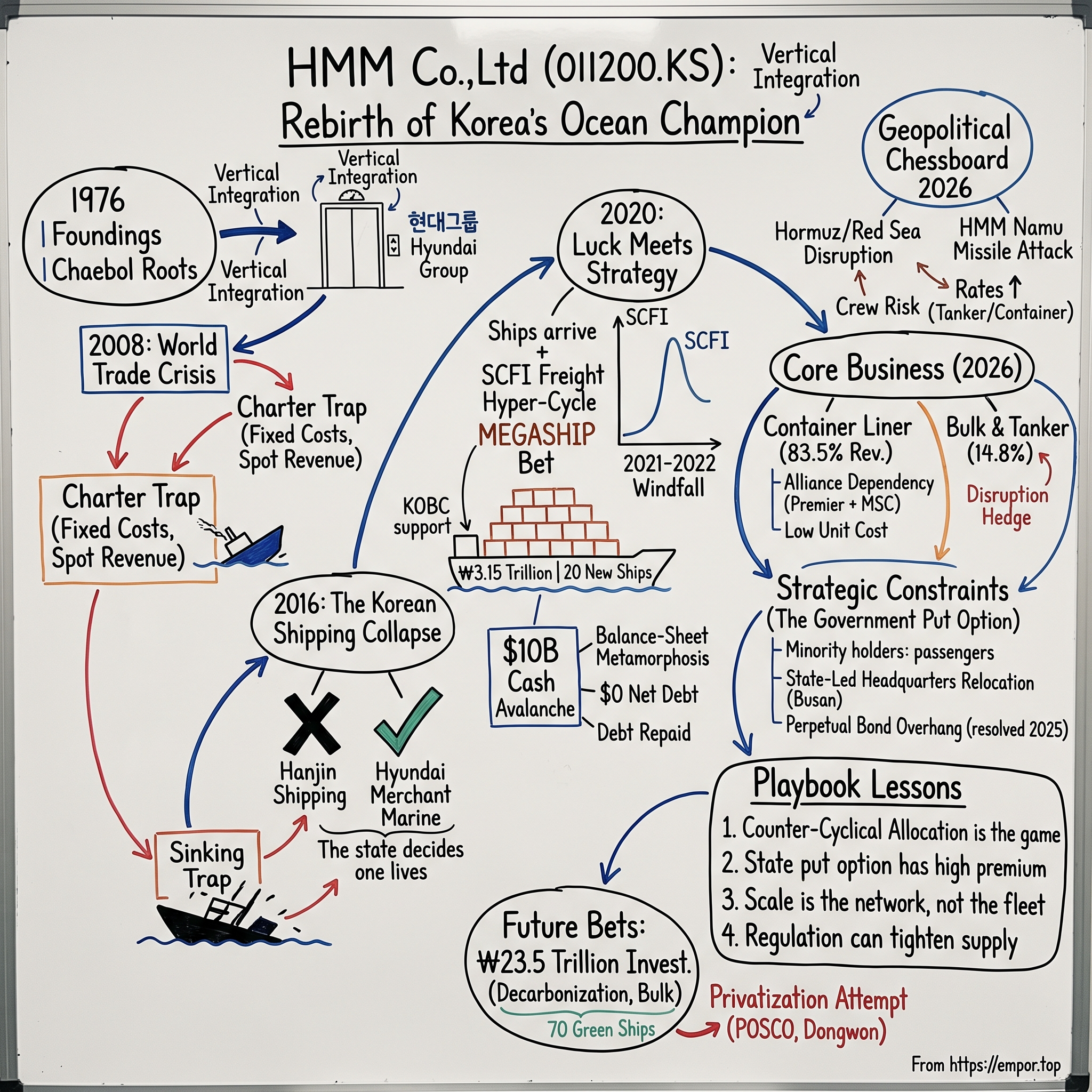
HMM Co., Ltd.: Rebirth of Korea's Ocean Champion
I. Introduction & Episode Roadmap (0:00 – 0:15 | 15 min)
On the morning of May 4, 2026, a Panama-flagged box ship called the HMM Namu was making its way through the Strait of Hormuz when two objects came out of the sky and hit her. One of the 24 crew — six of them Korean nationals — was injured. The ship was left inoperable, drifting in the world's most militarized shipping lane, and it took a Dubai shipyard roughly two months to put her back together.12 A Korean government inspection team later recovered debris carrying markings that traced back to an Iranian production facility and concluded the vessel had most likely been struck by Iranian-made Noor anti-ship missiles; Tehran's ambassador in Seoul denied involvement, and Seoul itself stopped short of declaring the strike deliberate.3
It is a strange kind of milestone. A single damaged ship, one injured sailor, a repair bill, and a diplomatic incident — this is what it looks like when a mid-sized Korean container line becomes an instrument of national exposure to somebody else's war. And it is a useful place to start, because the entire story of HMM주식회사 HMM Co., Ltd. is the story of a company whose fate has never been fully its own.
Rewind ten years and the company was called 현대상선 Hyundai Merchant Marine, it was drowning in charter contracts signed at the top of a boom, and its own creditors were openly debating whether Korea needed two ocean carriers or one. The answer, delivered in the most brutal way imaginable in the autumn of 2016, was one. Korea's larger and prouder carrier, 한진해운 Hanjin Shipping, was allowed to collapse, stranding more than $14 billion of cargo on ships that ports would not let dock.4 Hyundai Merchant Marine — smaller, weaker, arguably the worse business — was the one that lived, because by then it belonged to the state.
What the state then did with it is the interesting part. In 2018, with global container lines cutting capital expenditure and freight rates flat on their backs, Korea's policymakers and the company's management signed off on roughly ₩3.15 trillion (about $2.8 billion) of orders for twenty new container ships, twelve of them among the largest ever built.5
The ships started arriving in the second quarter of 2020, which turned out to be the single luckiest delivery window in the modern history of ocean shipping. Two years later the company printed close to ₩10 trillion of operating profit in a single year.6
Which brings us to the present paradox. HMM today trades on the 한국거래소 Korea Exchange under the ticker 011200, with a market value around ₩19.8 trillion in late July 2026.[^7] It sits on roughly ₩12.9 trillion of cash and short-term financial investments — an enormous number against that market value — with almost no conventional borrowing outside of ship leases.[^8] It is the eighth-largest container carrier in the world, with a fleet approaching one million TEU of capacity, over 80% of it in ships above 10,000 TEU.7 And it is still about 70% owned by two Korean state institutions that have been trying, and failing, to sell it since 2022.
Meanwhile the freight cycle has turned hard. Full-year 2025 operating profit fell 58% from 2024, and first-quarter 2026 operating profit was down 56% year on year.68 Then a Middle East escalation slammed the Strait of Hormuz shut in late February 2026 and pushed rates violently back up — the kind of windfall no management team can take credit for, and no investor can underwrite.
Here is how this episode is structured. First, the chaebol origins inside 현대그룹 Hyundai Group and the leverage trap that was built into the business model. Second, the great Korean shipping collapse and the political decision to save one carrier and kill the other. Third, the counter-cyclical megaship bet. Fourth, the pandemic freight hyper-cycle and the balance-sheet metamorphosis it funded. Fifth, a deep dive into how the business actually makes money. Sixth, the ownership problem: perpetual bonds, the failed sale to 하림그룹 Harim Group, and the second privatization attempt now underway. Seventh, the 2025 alliance reshuffle and the geopolitics of 2026.
And finally, the playbook, the frameworks, and the honest bull and bear cases.
The through-line is simple, and it is uncomfortable: almost every good thing that has happened to this company since 2016 was set in motion by the Korean state, and almost every constraint on what it can do with the resulting cash comes from the same source.
 Subscribe on LinkedIn
II. Chaebol Roots: The Founding & The Pre-Crisis Era (1976–2008) (0:15 – 0:35 | 20 min)
In 1976 South Korea's per-capita income was under a thousand dollars, and the country's industrial strategy was a wager: build heavy industry at scale, export the output, and use the foreign exchange to buy the next factory.
The wager had a logistics problem attached to it. Ships carrying Korean steel, Korean cars, and Korean-built equipment were mostly foreign ships, chartered from foreign owners at foreign prices, and in a crisis those ships would sail for someone else's cargo first.
정주영 Chung Ju-yung — the 현대그룹 Hyundai Group founder who had already built a shipyard at Ulsan by showing a Greek shipowner a picture of a beach and a 500-won note — established Asia Merchant Marine that year to close the loop. It was renamed Hyundai Merchant Marine in 1983.9 The logic was pure chaebol: Hyundai built the ships, Hyundai built the cars and the steel, so Hyundai should carry them. Vertical integration, decades before the phrase became a management-consulting product.
It is worth pausing on the founder, because his instincts explain the company's DNA better than any strategy document. Chung was a farmer's son who had walked out of what is now North Korea as a teenager, and his defining management trait was a refusal to treat capital constraints as real constraints. He built businesses first and worked out the financing afterwards, on the assumption that the Korean state — whose industrial policy he was executing — would not let a national champion fail. He was mostly right about that, and the assumption survived him by decades.
The most vivid illustration came near the end of his life. On June 16, 1998, Chung — frail, walking with a cane — crossed the demilitarized zone at Panmunjom leading a convoy of trucks carrying 500 head of cattle he was donating to the North, becoming the first South Korean civilian permitted to make that crossing.10 The "cattle drive diplomacy" opened the door to inter-Korean economic cooperation, and later that year South Korean tourists began sailing to Mount Kumgang on cruise ships under a Hyundai venture.10
It was a remarkable act of personal diplomacy. It was also a signal to anyone reading the group as an investment: this was a conglomerate whose capital allocation answered to national politics, family legacy, and historical grievance at least as much as to return on invested capital. That instinct never left the shipping arm.
The fleet grew in every direction at once, and each direction was tied to a specific piece of the national industrial project. Car carriers — ungainly floating parking garages — sailed Korean vehicles to America and Europe as the domestic auto industry found export markets. LNG carriers, among the most technically demanding ships afloat, served the country's gas import program, a strategic necessity for an economy with essentially no domestic hydrocarbons. Crude tankers fed the refineries. Bulk carriers fed the steel mills.
And containers, the fastest-growing leg of all, for the manufactured goods that were becoming the country's signature export.
By the 2000s Hyundai Merchant Marine was a full-spectrum Korean shipping company, which sounds like diversification and was in practice something closer to a leveraged bet on a single variable: the volume and price of world trade.
Two structural weaknesses were being built in during those good years, and both are worth understanding because they explain everything that happened later.
The first is the chartering trap. A container line can own its ships or rent them.
Renting — chartering-in — looks capital-light and flexible, which is exactly why it is so seductive at the top of a cycle. But charters are signed for five, seven, ten years at fixed daily rates, while the revenue those ships earn is set daily in a spot market that can fall 80% in a year.
In the boom of the mid-2000s, Korean carriers chartered aggressively at peak day-rates. They had, in effect, sold a fixed-cost obligation and bought a floating-rate asset.
It is the shipping equivalent of borrowing at a fixed rate to buy a commodity.
The second is the ordering reflex. Chaebol shipping arms ordered ships when cash flow was strong — which is to say when asset prices and yard prices were highest — and stopped ordering when cash flow was weak, which is when ships were cheapest. Almost every shipping company on earth does this. It is the single most reliable value-destroying behavior in the industry, and it is why the sector's long-run returns on capital have been so poor.
Then came 2008. World trade did not slow; it fell off a cliff, with container volumes on the main east-west lanes contracting outright in 2009 for the first time in the containerized era. Freight rates collapsed. Hyundai Merchant Marine's revenue was suddenly a fraction of what it had been, while its charter payments, its crew costs, its port fees, and its bunker bills were more or less unchanged. Operating leverage, that magic word investors love in the good years, works in exactly the same way going down.
The company did not die in 2009. Governments everywhere flooded the system with stimulus, Chinese demand for commodities exploded, and freight rates staged a violent recovery in 2010 that convinced most of the industry the crisis was over. It was not over. It was the beginning of a seven-year grind in which the world's container fleet kept growing faster than the cargo, and the weakest balance sheets were slowly, methodically drained. Korea had two of the weakest.
There was a governance dimension to that weakness as well. Chung died in 2001, and the sprawling empire he had assembled fragmented among his sons and their widows into competing groups. The shipping company ended up inside the branch with the least industrial cash flow behind it — a holding structure built around an elevator manufacturer, a shipping line, and the North Korea venture. When the freight market turned against it, there was no automotive or steel profit pool standing behind the balance sheet to absorb the losses, only asset sales and the patience of banks.
By early 2016 the group chairwoman, 현정은 Hyun Jeong-eun — who had taken over the conglomerate in 2003 after her husband's death — was buying new HMM shares with roughly $24 million of her own money in an attempt to shore up the company's liquidity.11 In March she stepped down from the shipping company's board as the creditor-led rehabilitation took hold.12
Whatever one thinks of chaebol governance, that sequence is the honest picture of what the family lost: a controlling stake in a national institution, surrendered not to a rival but to the state.
III. The Great Korean Shipping Collapse & Bailout Crisis (2008–2016) (0:35 – 1:00 | 25 min)
By the early 2010s, the boardrooms of Korea's two shipping lines had taken on the atmosphere of a hospital ward. The treatments were the same for both patients, and they were all forms of selling organs.
Between 2010 and 2015 Hyundai Merchant Marine accumulated trillions of won in losses, and 현대그룹 Hyundai Group responded with a fire sale of the family silver. The logistics arm went. The securities arm went. Stakes in terminals — the strategic assets that give a carrier priority berthing and a share of the stable, high-margin end of the value chain — were sold to raise cash for a business that was burning it.
Each disposal bought a few more quarters of solvency and made the surviving company structurally weaker. It is the classic distressed-restructuring death spiral: you sell the assets that generate the stable earnings to fund the assets that generate the volatile losses.
There was one more lever, and it was the humiliating one. The company had to go to its foreign shipowners — the counterparties on those peak-rate charters — and ask them to accept less. The negotiating position was not persuasion but threat: accept a haircut, or the company files for court receivership and the owners take whatever the Korean bankruptcy process decides to give them.
Creditors made the charter cuts an explicit precondition of any further state support. Foreign owners, who had watched shipping companies fail before and knew exactly how little they recover in liquidation, mostly took the deal.
The terms are worth knowing, because they show how a modern out-of-court restructuring actually gets done. Owners agreed to roughly a 20% reduction in charter hire from July 2016 through the end of 2019, and in exchange were handed shares in the restructured company — converting a contractual claim they might never collect into equity in a business they were now, involuntarily, invested in.13
Bondholders were pushed through a similar exercise. Creditors then attached a commercial condition to the whole package: the company had to secure a slot-charter arrangement with 2M, the Maersk–MSC partnership that was then the largest alliance on earth, so that it would still have a competitive network on the day it emerged.1415
That last condition is the most revealing detail of the entire restructuring. The creditors understood something that pure balance-sheet restructurings usually miss: in a network business, solvency without a network is worthless. A container line with clean books and no alliance is a line with ships and no cargo.
Hanjin Shipping's management played the same hand and lost it.
On August 31, 2016, Hanjin Shipping filed for court receivership after its creditors — led by 한국산업은행 Korea Development Bank — rejected the Hanjin group's rescue plan as far too small against the carrier's roughly $5.4 billion of debt.16 What followed became the most vivid demonstration in modern history of how fragile the container network actually is. Around 85 Hanjin ships were refused entry at ports around the world, because port operators, tug operators, and terminal owners knew they would not be paid. More than $14 billion of other people's cargo — Christmas inventory for American retailers, components for European factories — sat on the water, legally and physically stranded, while crews rationed food.4
Korean courts formally declared the company bankrupt on February 17, 2017.
Why did one carrier die and the other live? Not because the survivor was the better business. It was because of who owned it and how much of the state's money was already committed. Hyundai Merchant Marine's restructuring had already put 한국산업은행 KDB into the shareholder register through debt-for-equity conversion; the state was in, and to let it fail would have been to write off public funds already deployed. Hanjin's controlling family, by contrast, had been asked to put in more of its own money and declined at the level creditors demanded.
There was also a policy calculation dressed as market discipline: Korea had two loss-making carriers in a global overcapacity glut, and letting one fail removed capacity, disciplined the sector, and — this was the assumption — transferred cargo to the survivor.
That assumption turned out to be badly wrong in one important respect. Hanjin's transpacific market share did not flow to its compatriot; it flowed largely to foreign carriers, and Korean exporters discovered they now depended on non-Korean ships to reach their customers. The lesson Seoul drew from the wreckage was not "the market cleared." It was "an export nation that cannot move its own exports has surrendered something it cannot buy back."
There is a second-order lesson in the wreckage that applies well beyond Korea. When a shipping company fails, the ships do not disappear; they are arrested, sold, and redeployed by someone else, usually at a lower cost basis. Capacity exits the company but not the industry.
That is why letting a carrier fail almost never fixes an overcapacity problem, and why the policy hope that Hanjin's death would rescue the freight market was misplaced from the start. Rates on the transpacific spiked briefly during the chaos and then resumed their slide.
That conclusion is the birth certificate of the modern company. From 2016, control passed decisively to the state. KDB and, from its 2018 founding, 한국해양진흥공사 Korea Ocean Business Corporation converted debt into equity and injected fresh capital largely through low-coupon perpetual convertible bonds — an instrument that behaves like equity for accounting purposes, costs the borrower very little in cash interest, and quietly stores an enormous future claim on the company's share count. That last feature would dominate the equity story for the next seven years.
The formal separation from 현대그룹 Hyundai Group followed, and in 2020 the company shed the name that had come to mean distress and became HMM.
For investors, the takeaway from this period is not a lesson about shipping cycles. It is a lesson about who bears the loss. The equity was nearly wiped out, the creditors took control, and the enterprise survived — meaning the asset survived and the shareholders did not. Anyone underwriting HMM today is underwriting a company whose principal historical shareholder experience was expropriation by rescue.
IV. "Project 2020": The Counter-Cyclical Megaship Gamble (1:00 – 1:25 | 25 min)
Picture the container shipping industry in mid-2018. Freight rates were mediocre. The Chinese, Danish, French, and Swiss giants were digesting acquisitions and cutting capital budgets. Almost nobody wanted to order ships, because the last order book had produced the glut that had just destroyed a generation of returns. Korean shipyards, which had built much of that glut, were sitting half-empty and shedding workers.
Into that silence, Korea placed one of the largest single container newbuilding orders in history. In 2018 HMM's predecessor signed for twenty large container ships worth about ₩3.15 trillion, roughly $2.8 billion — twelve vessels of around 23,000–24,000 TEU split between 대우조선해양 Daewoo Shipbuilding & Marine Engineering (seven) and 삼성중공업 Samsung Heavy Industries (five), plus eight ships of about 14,000 TEU at 현대중공업 Hyundai Heavy Industries.517 The financing came with state maritime support behind it, through the newly created KOBC.17
Strip away the politics and the industrial logic was genuinely sound, for three reasons worth spelling out.
The first is unit cost, and it is worth explaining in plain terms because it is the physical foundation of the whole industry. A ship's fuel consumption is governed roughly by the resistance of pushing a hull through water, which does not rise anything like as fast as the volume the hull encloses. Double the box capacity and you might add half again to the fuel burn and almost nothing to the crew — the same twenty-odd people sail a 12,000-TEU ship and a 24,000-TEU ship.
A container ship's operating costs — crew, insurance, maintenance, and above all fuel per unit of cargo — therefore do not scale linearly with size. Doubling a ship from 12,000 to 24,000 TEU does not double the fuel burn or the crew.
The result is that slot cost, the all-in cost of moving one container one voyage, falls materially on the largest ships. In a business where the product is undifferentiated and the price is set by an index, the low-cost operator on a given trade lane is the one that survives the trough. Ordering these ships at the bottom of the yard-price cycle locked in that cost advantage for a 20-to-25-year asset life.
The second is regulation. The International Maritime Organization's 2020 sulfur cap was coming, forcing ships either to burn more expensive low-sulfur fuel or to fit exhaust scrubbers. Ordering new tonnage in 2018 meant the compliance decision was made at the design stage rather than retrofitted in a panic — and the new ships were built LNG-ready, preserving the option to convert later.7
The third reason was never really about HMM. It was industrial policy. Korea's shipyards needed orders; the state's shipping company needed ships; the state's maritime finance vehicle needed a mission.
This was a closed loop of public money moving between public purposes, and it is precisely the kind of transaction that a purely commercial competitor could not have executed. That is a genuine advantage. It is also the origin of the constraints that bind the company today.
There was one problem the order created immediately: nobody can fill twelve 24,000-TEU ships alone. A megaship only earns its cost advantage if it sails full, and filling it requires a network — dozens of weekly services, hundreds of port pairs, and a customer base far larger than any mid-sized carrier commands.
The answer, for every carrier outside the top three, is an alliance: a vessel-sharing agreement in which competitors pool ships on the main east-west trades and each sells slots on the others' vessels.
In April 2020 the company joined THE Alliance alongside Hapag-Lloyd, Ocean Network Express, and 陽明海運 Yang Ming. That membership was not a nice-to-have; it was the operational precondition that made the entire megaship investment coherent. It also revealed the structural truth of this industry: for a carrier of HMM's size, the relevant scale is not the company's own fleet but the alliance's combined network.
Alliance membership is therefore both the source of the company's competitiveness and its single greatest point of dependency — a dependency that would be tested five years later.
It is also worth being clear-eyed about the risk that was taken, because hindsight has laundered it. Twenty ships is an enormous commitment of capacity for a carrier of this size — roughly a 50% increase in container capacity delivered into a market that in 2018 was widely expected to remain oversupplied for years. Had trade patterns simply continued their pre-2020 trajectory, those ships would have arrived into a soft market carrying heavy depreciation and financing costs, and the counter-cyclical bet would today be taught as a cautionary tale about state-directed capital allocation. The strategy was sound; the outcome was also lucky. Both things are true, and an investor who cannot hold them simultaneously will systematically misjudge cyclical businesses.
The ships began arriving in the second quarter of 2020, and the first of them, HMM Algeciras, was for a time the largest container ship in the world. Management could reasonably claim credit for a well-timed, well-structured investment. What happened next, nobody planned.
V. The COVID Freight Hyper-Cycle & The $10B Cash Avalanche (1:25 – 1:50 | 25 min)
The best way to understand 2021 and 2022 in container shipping is to stop thinking about demand and start thinking about queues.
Consumer demand for physical goods did rise when the world locked down and services spending collapsed into merchandise spending. But the truly explosive variable was on the supply side: ports stopped working properly. Terminals lost labor to illness and quarantine. Warehouses filled. Truck and rail capacity to move boxes inland evaporated. Ships arrived at Los Angeles, Long Beach, Rotterdam, and Shanghai and waited — sometimes for weeks. Every day a ship spends at anchor is a day of capacity removed from the world fleet. At the peak, effective global capacity fell by a double-digit percentage without a single ship being scrapped.
In a market where supply is fixed in the short run and demand is inelastic — a retailer with an empty shelf will pay almost anything to fill it — that produces something close to a vertical price curve. The Shanghai Containerized Freight Index, which had sat around 800 points before the pandemic, went above 5,000 at the early-2022 peak. Spot rates on some Asia–US lanes rose more than tenfold.
For a company that had just taken delivery of the world's most efficient large container ships, and whose cost base was largely fixed, the effect on the income statement was almost absurd. Revenue in 2019 had been about ₩5.5 trillion, with an operating loss.[^20] In 2021 revenue reached ₩13.8 trillion and operating profit ₩7.38 trillion. In 2022 revenue hit ₩18.6 trillion and operating profit ₩9.95 trillion — an operating margin above 53%.[^20]
To put that in perspective: in a single year, a company that had spent the previous decade being kept alive by state creditors earned roughly three times its entire 2019 revenue in operating profit.
It is important to be precise about what this proves and what it does not. It does not prove that management is exceptional at running a shipping line. Every major container carrier on earth printed record profits in those two years; the industry as a whole earned more in 2021–2022 than in the preceding two decades combined.
What HMM's numbers do demonstrate is operating leverage on a modern, low-cost fleet. When the price of the product rises tenfold and your cost per slot is among the lowest in the industry, the incremental margin approaches 100%. The megaship bet did not create the windfall; it maximized the company's capture of it.
There is a timing mechanic inside these numbers that matters for reading any container line's results, and it explains why the peak earnings arrived when they did. Roughly half a carrier's volume moves under annual contracts negotiated months in advance. When spot rates exploded in 2020 and 2021, the contract book was still priced at pre-pandemic levels, so the initial upside came almost entirely from spot cargo. The following year, contracts were renegotiated at the new elevated levels — which is why 2022 produced the highest operating profit even though spot rates had already peaked and begun falling by mid-year.
The same lag runs in reverse on the way down, which is why carriers kept reporting reasonable numbers well into a collapsing market and then reported terrible ones after the spot market had already stabilized.
The genuinely durable consequence was on the balance sheet, and it is the single most important legacy of the period. The company entered the cycle as one of the most leveraged shipping companies in the world and left it as one of the least leveraged industrial companies in Korea. Ship finance was repaid. Expensive charters were replaced by owned tonnage. By the first quarter of 2026, the company held about ₩12.9 trillion in cash and short-term financial investments against roughly ₩222 billion of conventional interest-bearing borrowings, with the remaining balance-sheet debt consisting essentially of lease obligations on vessels and equipment.[^8] Equity stood near ₩27.8 trillion, against a stock market value below ₩20 trillion.[^7][^8]
That gap — a company trading well below the accounting value of its own equity, with cash alone worth roughly two-thirds of its market capitalization — is the central fact of the HMM investment debate. It is either a spectacular mispricing or a rational discount applied to cash that shareholders cannot reach and to earnings that are structurally cyclical. The rest of this story is an attempt to work out which.
It is also worth noting what the company did not do with the money, because in shipping the errors of the boom are usually made at exactly this moment. It did not buy a competitor at peak valuation. It did not embark on a sprawling logistics acquisition spree of the kind several peers pursued with their pandemic windfalls, some of which have since been written down. It did not lever up. The main capital deployment during and immediately after the boom went into replacing chartered tonnage with owned tonnage and into ordering vessels — an expansion of the core business rather than a diversification away from it. Whether the subsequent ₩23.5 trillion program maintains that discipline is a separate question, examined later.
One more observation about the windfall, because it matters for how one reads management's subsequent behavior. Cash of this magnitude, arriving suddenly at a company with a state-controlled shareholder register and no controlling commercial owner, creates a capital allocation problem with no clean answer. Return it, and the state is accused of privatizing public-rescue gains to minority shareholders. Spend it, and you risk the classic shipping error of investing at the top. Sit on it, and you earn interest income while the equity trades at a discount.
Over the following four years, the company would do a version of all three.
VI. Core Business Deep Dive & Segment Economics (1:50 – 2:15 | 25 min)
Stand on the quay at Busan New Port when one of the 24,000-TEU class comes alongside and the abstraction of "global trade" becomes physical. The ship is four hundred metres long — longer than the Empire State Building is tall — and stacked twenty-four containers wide. If you unloaded her onto trucks and lined them up bumper to bumper, the queue would run for well over a hundred kilometres. Every one of those boxes represents a purchase order somebody placed months ago, an inventory decision, a factory shift, a retail shelf.
That is the product. Now the economics.
It is overwhelmingly a container liner. In the first quarter of 2026, containers generated 83.5% of revenue, bulk shipping 14.8%, and everything else 1.6%.8 That mix has been remarkably stable, and it means that essentially all of the interesting variance in the company's earnings comes from one place: the price of moving a box on the main east–west trade lanes.
The container business works like a scheduled airline for cargo. HMM publishes a service — say, a weekly string from Busan and Shanghai to Rotterdam and Hamburg — commits ships to it, and then sells the slots. Roughly half the volume moves on annual or multi-year contracts with large shippers, the other half at spot rates that reset weekly. The economics turn on three things: the freight rate achieved, the cost of the fuel burned, and the percentage of slots actually filled on the profitable leg.
That last point deserves a plain-English explanation, because it is where much of the industry's economics hide. Trade is unbalanced: far more cargo moves from Asia to the United States and Europe than back. The Asia-outbound leg is the "head-haul," and it is where the money is made; the return leg often runs at low utilization and low rates, essentially repositioning empty boxes.
So a carrier can report a respectable average utilization and still be losing money, or run at over 95% on head-haul and make a fortune. The number that matters is the head-haul fill rate against the rate achieved.
The bulk and tanker division — very large crude carriers, dry bulk ships for iron ore and coal, and specialized liquid cargo — is often described as a natural hedge against container volatility. That description is generous. The two markets are not reliably negatively correlated; both are ultimately levered to world trade. What bulk genuinely provides is a different cycle clock, longer contract structures, and, in 2026, direct exposure to a tanker market that has been repriced upward by Middle East disruption. Management has been expanding it deliberately, targeting a bulk fleet of 110 vessels by 2030 against 36 at the time the plan was set.18
Then there are the terminals and logistics assets: a 50% interest in the Busan New Port terminal that serves as HMM's home base, a 20% stake in Rotterdam World Gateway, container terminals at Kaohsiung, Tacoma, and Los Angeles, and — in a neat historical rhyme — the Algeciras terminal that was originally built by the defunct Hanjin, which HMM acquired outright.1920
These are small in revenue terms and strategically outsized. Terminal ownership buys berth priority when ports are congested, converts a variable cost into an equity return, and provides the fixed points around which a feeder network can be organized. In July 2026 the company launched its first dedicated hub-and-spoke feeder service, connecting Algeciras to West African ports with five vessels on a 35-day rotation.21
Now the competitive position, which is where an investor should be honest. HMM operates roughly 0.9 million TEU of capacity and ranks eighth globally.7 The scale above it is not close: MSC alone runs over seven million TEU and about a fifth of world capacity, with Maersk, CMA CGM, and COSCO each several times HMM's size.22
The top ten carriers together control around 85% of global capacity, so HMM is a member of the oligopoly — but it is the smallest member with a full global network, and its share is roughly 3%.
What does that smallness actually cost? Three things. First, less pricing influence: HMM is a price-taker on trade lanes where MSC's deployment decisions move the market.
Second, thinner regional density — fewer intra-Asia and feeder services means more reliance on partners to fill the last leg, which is precisely the gap the new hub-and-spoke strategy is trying to close. Third, and most important, alliance dependency: HMM's competitiveness on Asia–Europe rests on being inside a vessel-sharing structure with partners whose own strategies it does not control.
Against that, the cost position is real and measurable. Over 80% of the container fleet is in ships above 10,000 TEU, and the fleet is young.7 The shift from chartered-in tonnage to owned tonnage that the pandemic cash funded removed the fixed-charter time bomb that nearly killed the company twice.
And in a specific, quantifiable way, being Korean has recently become an asset: when the United States Trade Representative imposed port fees on Chinese-built and Chinese-operated vessels from October 2025, HMM was among the very few large carriers with no exposed ships at all, while the top ten carriers collectively faced billions of dollars of potential annual charges before the program was suspended in November 2025 for a year.2324
There is a piece of evidence worth weighing here, because it is the closest thing to a controlled experiment the industry offers. In 2025, freight rates fell hard — the Shanghai index averaged 37% below 2024 — and the company still finished the year with an operating margin of 13.4%.6 Several mid-tier carriers globally struggled to stay in the black on comparable volumes. A double-digit margin in a year when the price of the product fell by more than a third is genuine evidence of a cost position, not merely a claim about one.
It is not proof of a moat; a moat implies the advantage is defensible against competitors who want to copy it, and any carrier with capital can order the same ships from the same yards. But it is proof that the fleet renewal did what it was supposed to do.
Two consensus narratives deserve correction here. The first is that the bulk division diversifies the container risk. It does not, in the way most investors assume; it adds a second cyclical commodity exposure with a different clock, and in 2026 the two happen to be moving together because the same Middle East disruption drives both. The second is that "HMM trades below its cash" makes it self-evidently cheap. Cash inside a company is worth what the controlling shareholder allows it to be worth, and here the controlling shareholders are two public institutions with an explicit mandate to recover taxpayer money — which means the cash is simultaneously the reason the shares look cheap and the reason they stay cheap.
Three operating metrics carry the earnings: the freight rate achieved per TEU relative to bunker cost, the head-haul utilization rate, and the owned-versus-chartered mix that determines how fixed the cost base is in a downturn. Everything else in the quarterly release is commentary — and all three of them are, in the end, hostage to who owns the company and what that owner wants.
VII. The Government Trap: Perpetual Bonds, The Failed Harim Deal, & Management Today (2:15 – 2:35 | 20 min)
In December 2023 the Korean financial press had its deal of the year. 하림그룹 Harim Group — a poultry conglomerate that had bought its way into shipping by acquiring the bulk carrier 팬오션 Pan Ocean — was named preferred bidder, alongside private equity firm JKL Partners, for the 57.9% of HMM held by KDB and KOBC. The price was about ₩6.4 trillion.25 A chicken company was going to buy the national flag carrier, and the government was going to recover a chunk of public money.
Seven weeks later it was dead. On February 6–7, 2024, negotiations collapsed.26[^30] The stated sticking points were governance: the buyers wanted relief from the sellers' post-closing conditions, including limits on how quickly the state shareholders would step back from management influence and constraints on what could be done with the company's cash. The sellers refused to hand a leveraged private buyer unrestricted access to a cash pile largely accumulated on the back of a state rescue.27
Both sides had a defensible case. The buyer wanted control commensurate with the price; the seller had a fiduciary duty to taxpayers and a political duty not to be seen gifting a public asset.
The deeper problem was structural, and it had a name: perpetual bonds. The instruments KDB and KOBC had used to recapitalize the company were convertible into ordinary shares at a fixed, low price. Any buyer of a controlling stake would find that the state, having sold control, could subsequently convert bonds into a very large block of new shares — diluting the buyer and, potentially, handing the state back an uncomfortably large position.
Nobody could price the company cleanly while that overhang existed.
Here is the most important and least appreciated update to the story: that overhang is gone. The conversions ran through 2024 and into 2025, and in April 2025 the final tranche of roughly ₩720 billion was converted, exhausting the last of the state creditors' convertible perpetual bonds.28
The arithmetic of what happened to shareholders over that decade is stark. In 2018 the company had about 191 million shares outstanding.[^20] Fully converted, the count reached roughly 1.025 billion. The dilution had been visible for years in the gap between basic and diluted earnings per share — in 2022, basic EPS was about ₩20,620 while diluted EPS was ₩9,899, meaning more than half the earnings power belonged to bonds that had not yet become shares.[^20]
Then the company did something about it. In August 2025 it announced a ₩2.14 trillion tender offer to repurchase and cancel 81.8 million shares at ₩26,200 — about 8% of the count.[^33] The state shareholders tendered into it, recovering ₩918.7 billion for KDB and ₩909.7 billion for KOBC, and the share count fell back to roughly 943 million.[^34][^20]
Combined with dividends — the company paid ₩600 per share for 2024 and ₩700 per share for 2025 — that made it one of the more aggressive capital returners in the Korean market, under a January 2025 "value-up" plan promising over ₩2.5 trillion of returns within a year and, by 2030, a payout ratio of 30% or a 5% dividend yield, whichever is lower.29
Assess management by behavior rather than statements, and the record here is better than the reputation. A commitment was made in January 2025 and executed within eight months at scale. That is not nothing in a market where value-up pledges are frequently rhetorical.
Leadership has changed. 김경배 Kim Kyung-bae, the former 현대글로비스 Hyundai Glovis chief who ran the company from March 2022 and oversaw the fleet renewal program, stepped down after three years. In March 2025, 최원혁 Choi Won-hyuk — a career logistics operator with roughly four decades in the industry, including eight years running LX Pantos — was appointed chief executive on a two-year term.30 His stated priorities on taking office were conventional: a clear growth strategy toward the top tier, faster change, and a more global organizational culture. His most consequential act so far has been political rather than commercial.
That act was Busan. Under the administration of 이재명 Lee Jae-myung, the government pushed to relocate HMM's headquarters from Seoul to the port city, as part of a broader plan — including the relocation of the 해양수산부 Ministry of Oceans and Fisheries — to make Busan Korea's maritime capital. The company's union resisted hard, on the entirely practical grounds of housing, schooling, and family disruption. Negotiations stalled for months and a strike was a live possibility.
On April 30, 2026, management and union reached a compromise: the chief executive's office moves first, other functions may remain in Seoul as branch operations, and compensation measures were promised for relocating staff, with a landmark headquarters building planned in Busan's North Port redevelopment.31 Shareholders approved the change to the articles of incorporation at an extraordinary meeting on May 8, with legal registration targeted for the end of May.3132
And behind all of it, the sale machinery restarted. Through the second half of 2025, KDB — whose chair, 박상진 Park Sang-jin, took office in September and has said publicly that privatization is necessary and should move quickly — commissioned accounting firms to produce a fair-value assessment of its stake, the standard first step before a formal process.33 포스코 POSCO retained Samil PwC, Boston Consulting Group, and outside counsel to test whether owning a container line makes sense for a steelmaker that spends roughly ₩3 trillion a year on logistics.33 동원그룹 Dongwon Group, which lost the 2023 auction by a reported ₩200 billion, set up a task force and told the market it would clarify its intentions by early January 2026.33
Korean business media put the likely price for the state stake at ₩8–10 trillion, well above the 2023 figure, reflecting both the higher share price and a control premium.33[^40]
Two things about that process should temper enthusiasm. First, interest is not a bid: POSCO has consistently framed its work as a feasibility review, and Korean press reporting during 2026 has swung between describing the group as an eager buyer and as a reluctant one. Second, the structural obstacle that killed the Harim deal — what the buyer may do with the cash, and how quickly the state steps back — has not been publicly resolved. The perpetual bond problem is gone; the control problem is not.
On management credibility, the fair read is mixed rather than damning. The value-up commitment was specific and was delivered. The narrative across successive results releases has been consistent — rates down, costs up, cost discipline and network redesign as the response — rather than shifting to whatever explanation flatters the quarter. Management has not over-promised on freight rates; if anything its published outlook language has been persistently cautious, warning about new vessel deliveries, elevated costs, and American tariff policy even in quarters when results were strong.8
What is missing is the thing no state-controlled management can supply: a credible long-term answer on capital structure, because the answer depends on an owner who is trying to sell.
A skeptical investor should sit with what that episode reveals. The location of a listed company's headquarters was determined by regional development policy, negotiated between a state-appointed management and a labor union, and ratified by shareholders who had no realistic ability to vote it down.
Whatever one thinks of the merits, this is not a company where the capital allocation and organizational decisions are made primarily on commercial grounds — and that is the discount the market has been applying.
VIII. The Premier Alliance & The Modern Geopolitical Chessboard (2025–Beyond) (2:35 – 2:50 | 15 min)
In January 2024, Hapag-Lloyd told its partners it was leaving. The German carrier had agreed to form the Gemini Cooperation with Maersk, built around a hub-and-spoke network promising schedule reliability above 90%. For the three carriers left behind — Ocean Network Express, HMM, and Yang Ming — this was an existential arithmetic problem: THE Alliance's Asia–Europe network had been sized around four members' ships, and one of the four was walking out with its capacity.
The response was competent and fast. The remaining three rebranded as the Premier Alliance and committed to five years from February 2025.34 More importantly, they replaced the lost capacity not by ordering ships but by renting network from the largest carrier on earth: a slot-exchange cooperation with MSC covering nine Asia–Europe services.35 MSC, having exited its own alliance with Maersk, had more ships than partners; the Premier Alliance had more partners than ships.
The trade was obvious once someone made it.
It is worth understanding what Gemini was actually selling, because it changed the competitive question in this industry. Maersk and Hapag-Lloyd's pitch was not lower price or bigger ships; it was punctuality. Their design ran a small number of mainline services between a limited set of hub ports, with dedicated shuttle vessels feeding everything else — the container equivalent of an airline hub system — and they published a target of better than 90% schedule reliability. For a decade, liner shipping had competed almost entirely on price while delivering arrival times that a shipper could not plan around. Gemini's bet was that large importers would pay for predictability because unreliable arrival forces them to hold expensive safety-stock inventory.
For HMM specifically, this was the cheapest possible fix. It preserved Asia–Europe port coverage and sailing frequency without a won of incremental capital expenditure at a moment when the freight cycle was rolling over. It also deepened the dependency described earlier: HMM's European network now rests on a commercial agreement with a competitor that could, in a future negotiation, price that access differently.
The alliance has since been quietly rebuilding its network architecture. From April 2026 the Premier Alliance implemented a restructured service map that concentrates transshipment on fewer hubs — notably Shanghai and Busan, with China hub count reduced — adds direct port calls, and reorganizes Asia–Mediterranean services so they terminate at eastern Mediterranean ports, positioning them to switch back to Suez routing quickly if the Red Sea reopens.3637 The explicit goal is schedule reliability, which across the industry has been poor; that is a direct competitive response to Gemini's reliability pitch, and it is measurable. Whether HMM's alliance can close that gap is one of the few genuinely testable operational questions in this story.
Then there is the geopolitics, which in 2026 has been the dominant variable and belongs to no one's strategy.
The Red Sea diversions that began in late 2023 pushed Asia–Europe traffic around the Cape of Good Hope, adding roughly ten days to voyages and absorbing a large slice of global capacity — which is the main reason the delivery of a record newbuilding order book in 2024 and 2025 did not collapse rates entirely. By the start of 2026, expectations of a Red Sea normalization were already deflating contract rates: long-term Far East–Europe rates fell about a quarter in the first three weeks of January.38
Then, on February 28, 2026, military strikes on Iran triggered a chain of events that closed the Strait of Hormuz within 48 hours. Tanker traffic went to near zero, war-risk and P&I cover was withdrawn from early March, and every major carrier suspended transits.39 Container rates, which had been sliding, reversed hard: the Shanghai index jumped 16% in a single week to 2,572 points as carriers passed through fuel and routing costs.40
Tanker day-rates went from roughly $37,000 to around $177,000 on some routes.39 It was in this environment that the HMM Namu was hit in early May.
Sitting alongside the shooting war is a slower-burning trade conflict, and it has been reshaping the transpacific. American tariff policy through 2025 and into 2026 pulled cargo forward — importers rushing shipments ahead of announced duty increases — and then left holes behind, producing volume patterns that have almost nothing to do with underlying consumption. Management has repeatedly flagged tariff policy as a source of uncertainty in its outlook commentary rather than claiming to have a strategy for it, which is the honest position: a carrier can reposition ships between trades, but it cannot manufacture demand that policy has destroyed or borrowed from a future quarter.8
The port-fee episode described earlier is the other face of the same trend. Trade policy is no longer only about the goods inside the box; it is increasingly about the nationality of the ship carrying it, the yard that built the hull, and the flag on the stern. For a Korean carrier buying Korean ships, that shift has so far been favorable. It is not a durable advantage — the fees were suspended within a month of taking effect, and the next administration in Washington could redraw the rules entirely — but it is a reminder that in this industry, the rule-writers move faster than the ship-builders.
For HMM's income statement, the effect has been genuinely two-sided, and management said as much: the first quarter of 2026 saw revenue and profit fall on lower rates while costs rose specifically because of the Middle East crisis.8 The rate benefit lags the cost hit. The tanker exposure helps. The risk exposure — to crews, hulls, and insurance — is now non-trivial and was, until this year, largely theoretical.
Layered on top is the decarbonization capital cycle. The company's response has been to commit ₩23.5 trillion of investment through 2030, with over 60% earmarked for low-carbon vessels and green facilities, a target of roughly 70 green ships, a container fleet of 130 vessels and 1.55 million TEU, and net zero by 2045.1841
The most recent tranche was a roughly ₩4 trillion order announced in late 2025 for twelve 13,000-TEU LNG dual-fuel container ships split between HD현대중공업 HD Hyundai and 한화오션 Hanwha Ocean, plus two very large crude carriers, with completion targeted by 2029.4243
That order is the tell. A company that says it is disciplined about capital and worried about oversupply has just placed its largest newbuilding order since 2018 — into an industry-wide order book at record levels. Management's defense is that IMO carbon intensity rules and the EU's emissions trading scheme make old tonnage economically obsolete regardless of the freight cycle, and that Korean yards and Korean-built hulls carry a regulatory advantage in the American market. That defense is coherent. It is not the same thing as proven.
The honest way to frame it is as a bet on regulation rather than a bet on demand. If carbon rules bite as scheduled — if the cost of burning conventional fuel keeps rising through emissions trading and intensity ratings, and if older ships are progressively pushed to slower speeds or scrapping — then dual-fuel tonnage ordered in 2025 becomes the low-cost fleet of 2030, and effective supply tightens by more than the raw order book suggests. If enforcement softens, or if the shipping industry's decarbonization timetable slips the way most industrial decarbonization timetables have slipped, then the world simply has more ships.
Those two futures produce very different valuations, and neither is knowable today. What can be said is that the company has now twice made the same kind of wager: build modern tonnage into a soft market and let the cycle come to it. It worked spectacularly once, with substantial help from an event nobody forecast.
IX. Playbook: Business & Investing Lessons (2:50 – 3:05 | 15 min)
Counter-cyclical capital allocation in commodity infrastructure is the whole game — and almost nobody does it. The 2018 order worked because ships are standardized, long-lived assets whose acquisition cost is set by a wildly cyclical yard market while their revenue is set by an unrelated freight market. Buying when yards are empty embeds a cost advantage that compounds for two decades. The reason this is rare is not ignorance; it is that the bottom of the cycle is precisely when a company has no cash and no board appetite for risk. HMM could do it only because a state institution supplied the capital and the courage.
The generalizable lesson for investors is to look for the rare cases where a company's funding source is decoupled from its own cash flow cycle — and then to check whether that funding source is imposing a cost elsewhere.
State support is a put option with a very expensive premium. The floor is real: this company did not go bankrupt when a better-run rival did, and it will not go bankrupt in the next downturn either. But the price of that floor has included massive equity dilution through instruments designed to protect public funds, capital allocation supervised by institutions whose mandate is taxpayer recovery rather than shareholder return, a sale process run on political timing, and a headquarters relocation decided by regional development policy.
Investors buying "cheap" state-controlled assets should price the option and the premium separately.
In network industries, the relevant scale is the network's, not the company's. HMM's own fleet is a third the size of Hapag-Lloyd's and an eighth of MSC's, yet it competes on the same trade lanes with broadly comparable service. That is alliance economics: slot-sharing converts a subscale operator into a viable one. The corollary is that alliance membership is the single largest non-financial risk in the business, because it can be withdrawn by a partner's strategic decision — as Hapag-Lloyd demonstrated.
Any thesis on a mid-tier carrier must include a view on what happens when the music stops and the alliance chairs are rearranged again.
Operating leverage is a magnificent asset and financial leverage is a lethal liability, and cyclical companies routinely confuse the two. The same fixed cost base that produced a 53% operating margin in 2022 produced years of losses in the 2010s. The difference was not the cost structure; it was whether the company also carried debt and fixed charter obligations into the trough. HMM's current balance sheet is the direct, deliberate answer to that lesson: enormous liquidity, minimal conventional borrowing, and owned rather than chartered ships. Whether that survives contact with a ₩23.5 trillion investment program and a privatization is the open question.
Regulation can be a more reliable source of tightening supply than demand ever is. The most consequential planning input in shipping today is not a trade forecast; it is a compliance timetable. Sulfur caps, carbon intensity ratings, emissions trading, and — in a newer and more explicitly protectionist form — port fees levied on ships built in a particular country all change the relative cost of one operator's fleet against another's, without a single customer changing behavior. HMM's zero exposure to the American port fee regime was not a strategic masterstroke; it was the incidental result of buying Korean ships from Korean yards for industrial-policy reasons. Investors should watch regulation the way they watch demand, because in capital-intensive commodity industries it is frequently the faster-moving variable.
Finally: never mistake a windfall for a franchise. The 2021–2022 profits were an industry-wide gift from a broken supply chain, and the danger of such years is that they let a management team, a board, and a shareholder base all draw the wrong lesson about how much of the outcome was skill. The durable outcomes were the balance sheet and the fleet. Everything else was weather.
X. Strategic Analysis, Risk Radar, & Bull vs. Bear Case (3:05 – 3:25 | 20 min)
Every framework applied to a container line runs into the same wall: this is an industry that sells an undifferentiated product at a publicly quoted price, using assets anyone with capital can buy from the same handful of yards. That does not mean the analysis is pointless. It means the analysis has to be about degree and durability rather than about the existence of a moat.
Run HMM through Hamilton Helmer's 7 Powers and the honest result is thin — which is itself the finding.
Scale economies: real but shared. The 24,000-TEU ships deliver a genuine low slot cost on Asia–Europe, and the fleet's concentration in large vessels is among the highest in the industry.7 But this is a power the industry's larger players hold in greater measure, and HMM accesses full-network scale only through the alliance. Call it a cost position rather than a moat.
Counter-positioning: moderate and politically contingent. Access to state-backed maritime finance through KOBC is capital that pure commercial peers cannot replicate. It is also capital that comes attached to obligations no commercial peer would accept.
Process power: unproven. Fill rates and routing efficiency are legitimately good, but schedule reliability across the Premier Alliance has trailed Gemini's, and the 2026 network redesign is an admission that there was ground to make up.36
Everything else is absent. There is no network effect — a container on an HMM ship is worth no more because other containers are on HMM ships. There are no switching costs: shippers re-tender annually and shift volumes on price. There is no brand power in a commodity freight market. There is no cornered resource.
The absence of these is not a criticism of management; it is the structure of liner shipping, and it is why the sector's long-run returns are poor.
Porter's five forces tell the same story from a different angle. Rivalry is brutal and getting worse: a record order book delivering through 2024–2026 into a market whose tightness depends on geopolitical detours. Buyer power is high, because the large global retailers and forwarders that book the contract volume benchmark every rate against public spot indices. Supplier power is moderate to high, with three consolidated Korean yards, a small number of engine makers, and terminal operators on the other side of the table — though HMM's terminal stakes blunt the last of these.
New entrants are effectively barred by capital intensity and alliance gatekeeping. Substitutes barely exist: air freight costs multiples more per unit, and rail land-bridges across Eurasia have been rendered politically unreliable.
The activist stress test writes itself, and it is worth stating in the sharpest form.
A skeptical investor would begin with the cash. Roughly ₩12.9 trillion of liquid assets sits inside a company valued below ₩20 trillion, earning interest income rather than a return on capital. The 2025 buyback was a genuine step, but the largest single beneficiary of any return of capital is the state — and the largest single constraint on returning more is also the state, which needs the cash intact to make the company saleable.
Minority holders are therefore passengers in a negotiation between two public institutions.
The second challenge is capital allocation direction. Having warned about oversupply, management is spending ₩23.5 trillion by 2030 and expanding a bulk fleet from 36 vessels toward 110.18 Bulk expansion in particular deserves scrutiny: it is a business in which HMM has no evident structural advantage, entered with cash generated in a different business, at a point in the cycle when tanker economics have been inflated by war.
That is the textbook shape of diworsification, and the burden of proof sits with management.
The third is governance and disclosure. Segment reporting is thin relative to peers, the sale process makes the medium-term ownership structure unknowable, and the headquarters relocation demonstrated that non-commercial stakeholders can determine major corporate decisions. A related-party question sits underneath all of it that is rarely stated plainly: the company's largest shareholders are also, through the state maritime finance system, participants in the financing of its ships, and its newbuilding orders flow to domestic yards whose health is an explicit government objective. None of that is improper, and all of it is disclosed. But an investor should understand that the counterparties on several sides of HMM's largest transactions share an owner with HMM itself.
The fourth is accountability. Chief executives at this company serve short terms — two years for the incumbent, three for his predecessor — set by a board that answers to state shareholders.30 Short tenures reward caution and make long-horizon capital allocation harder to hold anyone to. When the ₩23.5 trillion program reaches its 2030 endpoint, it is unlikely that any of the people who authorized it will still be in post to answer for it.
The bull case, stated fairly. This is a structurally different company from the one that nearly died: a modern, young, largely owned fleet with a low cost position; a balance sheet with essentially no conventional net debt and a cash pile larger than most peers' market values; a demonstrated willingness to return capital at scale; alliance and MSC arrangements that preserve network reach without capital expenditure; zero exposure to the American port fees that hit Chinese-built tonnage; and a valuation that already embeds a heavy state-control discount.
If the privatization completes — and the 2026 process has drawn interest from 포스코 POSCO and 동원그룹 Dongwon Group at valuations reported at ₩8–10 trillion for the state stake, well above the failed 2023 price — the discount has an identifiable catalyst.33[^40] Any freight-rate spike drops through to earnings with extraordinary force, as 2021 and 2022 demonstrated.
The bear case, stated equally fairly. Freight rates are the only variable that really matters, and they are set by a global capacity balance that HMM cannot influence and that currently depends on ships taking the long way around Africa. If the Red Sea and Hormuz normalize, that capacity floods back into a market already absorbing a record order book, and rates could fall well below the levels that made 2025's ₩1.46 trillion operating profit look resilient.6 The company earns its cost advantage on lanes where the market leader is more than seven times its size.
The cash is real but partially inaccessible, and every quarter it earns a money-market return is a quarter of value leakage against equity cost of capital. A sale, if it happens, hands control to a buyer whose first act will be to decide what happens to that cash — with no assurance minority holders benefit. And a failed sale leaves the status quo: a well-capitalized, well-run, structurally constrained company in a commodity industry, trading at a discount for reasons that are not irrational.
The way to hold both cases at once is to separate the two questions the market is really pricing. The first is cyclical: where do freight rates go, and how much does this fleet earn through the cycle? On that question, HMM is a competent, low-cost, well-capitalized operator in a poor industry, and its earnings will swing violently with a price it does not set. The second is structural: what happens to ₩12.9 trillion of cash and 70% of a share register held by two public institutions? On that question, nothing is knowable until the sale either completes or is abandoned again — and the answer, not the freight market, is what has kept the shares trading well below the accounting value of the equity.
The risk radar beyond the cycle is short but real: crew and asset exposure in Middle East transits, now demonstrated rather than hypothetical; trade protectionism reshaping transpacific volumes; refinancing and cost-of-capital risk that is currently negligible but would return quickly if the investment program were funded into a trough; and execution risk in the bulk diversification.
XI. Synthesis, Key KPIs, & Investor Takeaways (3:25 – 3:35 | 10 min)
If a reader tracks only a handful of numbers on this company, they should be these.
First, the spot freight indices — the SCFI above all. This is not a lazy answer; it is the mechanical answer. Container shipping is a business in which cost per slot moves slowly and price moves violently. The company's own reporting frames every quarter against the index: the first quarter of 2026 saw the SCFI average 1,507 points versus 1,762 a year earlier, and operating profit fell by more than half.8 Full-year 2025 saw the index average 1,581, down 37% from 2024, and operating profit fell 58%.6
The relationship is close to arithmetic. Anyone forming a view on HMM's earnings is, whether they admit it or not, forming a view on the index.
Second, unit cost per TEU relative to peers. The entire industrial case for the 2018 megaship order and the 2025 LNG dual-fuel order rests on the claim that HMM can move a box more cheaply than most competitors. That claim is testable each quarter by comparing HMM's cost per unit against Maersk, Hapag-Lloyd, and ONE at comparable volumes.
If the gap holds through a rate trough — if HMM stays profitable while mid-tier peers post losses, as it did through 2025 — the cost position is real. If it does not, the fleet is simply modern rather than advantaged.
Third, cash and net cash per share against the ownership structure. The dilution phase is over; the final convertible tranche was exhausted in April 2025 and the share count has since been reduced by cancellation. The relevant question has flipped from "how much will I be diluted?" to "what happens to ₩12.9 trillion of liquid assets?"
Watch the trajectory of cash per share alongside the privatization process. Every won returned in dividends and buybacks, every won spent on newbuildings, and every development in the KDB sale changes the answer.
It is worth being explicit about what would falsify each side of the argument, because a thesis that cannot be broken is not a thesis. The bull case breaks if the company posts losses in a trough while larger peers stay profitable — that would mean the cost position is not what it appears — or if the cash is deployed into acquisitions or fleet expansion at prices that do not clear a cost of capital, or if a completed sale transfers control on terms that leave minority holders with a diluted claim on a smaller cash pile. The bear case breaks if the sale completes on clean terms with a buyer that runs the company commercially, or if the combination of carbon regulation and geopolitical rerouting keeps effective capacity tight for long enough that a "cyclical peak" starts looking like a plateau.
The next hard data point arrives with the second-quarter results in August 2026, and the questions worth carrying into them are specific: how much of the post-Hormuz rate increase actually reached the revenue line rather than being consumed by fuel and rerouting costs; what the bulk and tanker division earned in a dislocated market; whether the April network restructuring shows up in reliability and utilization; and whether management's language on the ₩23.5 trillion program has changed now that a second consecutive year of falling container rates is on the record.
Two supporting items are worth monitoring without being headline KPIs: schedule reliability on Premier Alliance services, which is the single measurable test of whether the 2026 network redesign works against Gemini; and the terms attached to any completed sale of the state stake, which will determine whether minority shareholders participate in the cash or merely watch it change hands.
For primary evidence, the quarterly and annual investor materials on the company's IR portal remain the cleanest source for rate sensitivity, fleet plans, and segment mix, and Korean regulatory filings on the DART system carry the ownership and convertible-bond history in full.4445 The 2024 statements from the Ministry of Oceans and Fisheries and KDB after the Harim collapse, and the 2025–2026 sequence of buyback, conversion, and sale-restart announcements, together document the state's evolving position better than any single management presentation.
The final thought is the one the whole story keeps arriving at. HMM is not primarily a story about ships, and it is not really a story about a freight cycle. It is a story about what happens when a country decides that a company is infrastructure. Korea made that decision in 2016, paid for it with public money, was repaid handsomely by an accident of pandemic timing, and has spent the years since trying to work out how to hand the asset back to the private sector without giving away the winnings.
Until that question is resolved, the company will keep doing what it does now: running some of the most efficient large ships afloat, earning money when the world's supply chains break, and sitting on a mountain of cash that belongs, in the most literal sense, to the state that saved it.
References
-
HMM ship damaged in Iran missile attack to exit Hormuz in July — Baird Maritime, 2026 ↩
-
Repairs finished on Korean cargo ship hit in Strait of Hormuz missile attack — Korea JoongAng Daily, 2026 ↩
-
Iranian anti-ship missiles attacked Korean vessel in Hormuz: gov't — The Korea Times, 2026-05-27 ↩
-
The collapse of Hanjin Shipping makes waves in South Korea's business culture — World Finance ↩↩
-
Hyundai Merchant Marine Pulls Trigger on 20 Large Containerships for $2.8 Billion — gCaptain, 2018 ↩↩
-
HMM Remains Profitable in 2025 Despite Global Freight Rate Collapse — gCaptain, 2026 ↩↩↩↩↩
-
HMM Poised to Hit 1M TEU Capacity with New Class of Vessels — The Maritime Executive ↩↩↩↩↩
-
HMM reports lower revenue, profit in Q1 2026 — PortCalls Asia, 2026-05 ↩↩↩↩↩↩
-
On this day in Korea — June 16, 1998: Chung leads cattle to North — The Korea Herald ↩↩
-
Hyundai Group chairwoman buys $24m in new HMM shares — Lloyd's List, 2016 ↩
-
Fading fortunes of female chiefs at Hyundai Merchant, Hanjin Shipping — The Korea Herald, 2016-05-03 ↩
-
Capital Product Partners L.P. Announces Charter Rate Reduction of Five of the Partnership's Vessels as Part of the Hyundai Merchant Marine Financial Restructuring — GlobeNewswire, 2016-07-18 ↩
-
Creditors Approve Debt Recast for Hyundai Merchant — The Maritime Executive, 2016 ↩
-
Hyundai Merchant Marine to Join THE Alliance After 2M Expiration — gCaptain ↩
-
The fall of Hanjin Shipping in South Korea – after five years — International Bar Association ↩
-
HMM Signs for 20 Container Ships from "Big Three" Yards — The Maritime Executive ↩↩
-
HMM to invest KRW 23.5 trillion by 2030 — PortCalls Asia ↩↩↩
-
HMM widens its port terminal portfolio with Hanjin's TTI facility at Algeciras — The Loadstar ↩
-
HMM launches MA2 service connecting Spain and West Africa — SBS News, 2026-07-07 ↩
-
USTR Port Fee Implementation: What You Need to Know — Holland & Knight, 2025-10 ↩
-
USTR Fees Could Cost Top 10 Carriers $3.2B in 2026, says Alphaliner — The Maritime Executive ↩
-
Harim Group Selected Preferred Bidder for South Korea's HMM — Reuters, 2023-12-18 ↩
-
South Korea's HMM Sale Talks With Harim Group Collapse — Reuters, 2024-02-06 ↩
-
Sale of South Korea's HMM Collapses Over Control and Financing Terms — The Maritime Executive, 2024-02-06 ↩
-
HMM aims for over 2.5 trillion won in shareholder returns within one year — Cyprus Shipping News, 2025-01-27 ↩
-
HMM to relocate to Busan after reaching agreement with union — The Korea Times, 2026-04-30 ↩↩
-
President Lee Welcomes HMM's Busan Relocation as Boost for Regional Development — Seoul Economic Daily, 2026-04-30 ↩
-
Posco, Dongwon weigh fresh bids as HMM sale resumes — The Korea Herald, 2025-12-11 ↩↩↩↩↩
-
Ocean Network Express, HMM, and Yang Ming Marine will continue the Premier Alliance for five years, effective February 2025 — Logistics Management ↩
-
HMM, ONE, Yang Ming continue as Premier Alliance, partner with MSC on slot exchange — Container News ↩
-
Premier Alliance adopts hub-and-spoke options in its restructured network — Kuehne+Nagel ↩↩
-
Premier Alliance lines update 2026 service network — Seatrade Maritime News ↩
-
Red Sea Return: What It Means for 2026 Container Shipping Contract Rates — Xeneta, 2026 ↩
-
Strait of Hormuz Crisis 2026: Full Timeline & Ocean Freight Impact — Seavantage, 2026 ↩↩
-
Hormuz crisis side effect: a sharp rise in container shipping rates — Lloyd's List, 2026 ↩
-
HMM to acquire 70 green ships by 2030, invest billions in sustainable growth — Offshore Energy ↩
-
HMM Orders $2.8 Billion Fleet of LNG-Fueled Containerships and VLCCs — gCaptain, 2025 ↩
-
HMM Places KRW 4 Trillion Newbuilding Order for Dual-Fuel Vessels — Logistics Manager, 2025 ↩
-
DART Electronic Disclosure System (HMM Regulatory Filings 011200) — Financial Supervisory Service ↩
 LinkedIn
 WhatsApp
 Reddit
 Hacker News
 Email
Email Kindle
 RSS Feed
 Spotify
 Apple Podcasts
 Amazon Music
 Audible
 YouTube