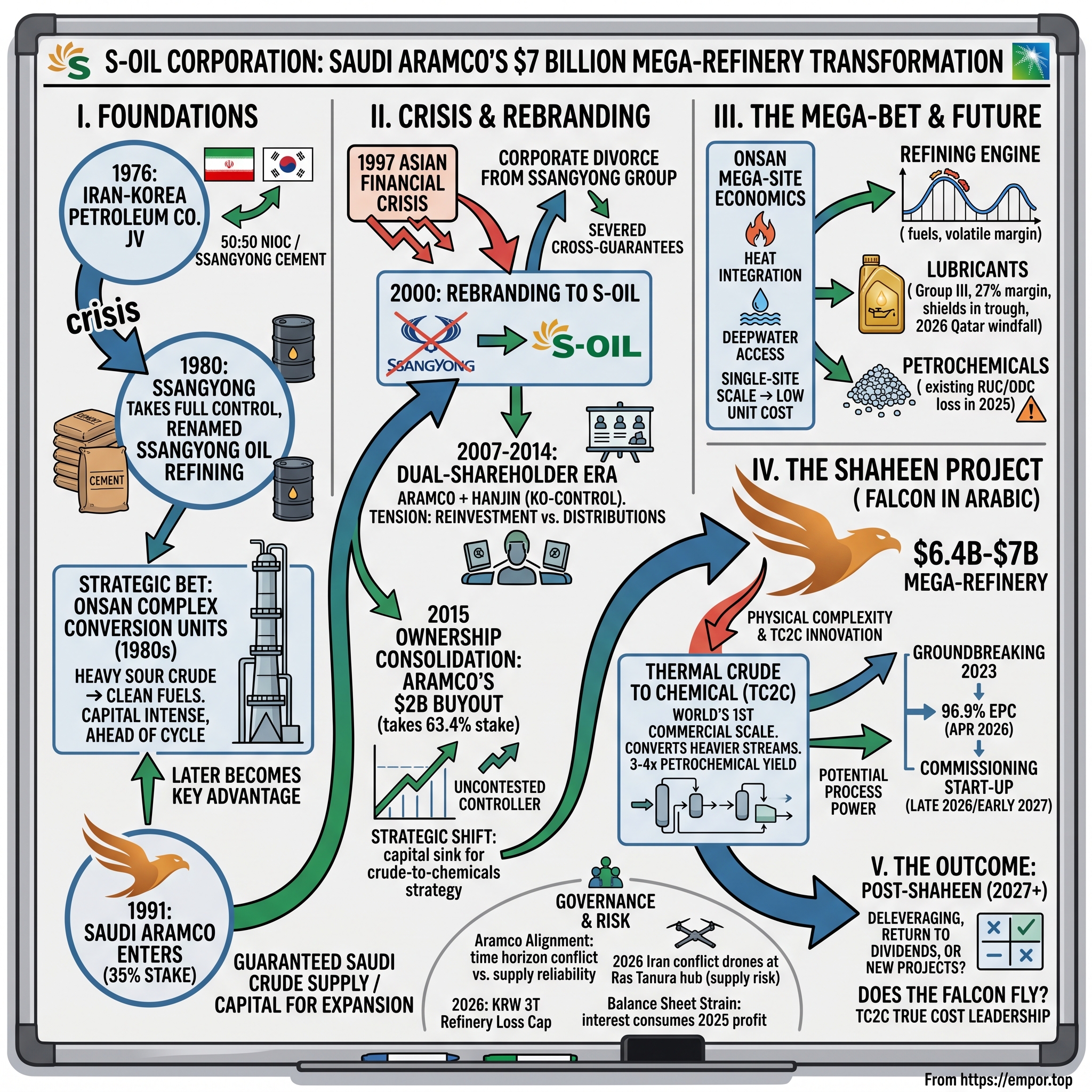
S-Oil Corporation: Saudi Aramco's $7 Billion Mega-Refinery Transformation
I. Introduction & The $7 Billion Saudi-Korean Energy Gamble
On the southeastern coast of South Korea, where the Sea of Japan meets a strip of reclaimed industrial land, there is a construction site that has consumed roughly 98,000 tonnes of structural steel and, at peak, drew an average of 11,000 workers through its gates every single day.1 The site covers 880,000 square metres — a little larger than Monaco's entire land area — and it sits directly adjacent to a refinery that already processes more crude oil in a day than most countries consume.
The project is called Shaheen. It is Arabic for falcon, the bird that appears on the Saudi royal standard. And the fact that a Korean industrial complex in 온산 Onsan, 울산 Ulsan carries an Arabic name tells you almost everything you need to know about who actually controls 에쓰오일 S-Oil Corporation.
S-Oil trades on the 한국거래소 Korea Exchange under the ticker 010950. It looks, from the outside, like a classic Korean industrial blue chip: a listed refiner with 116 million shares outstanding, a long history of paying generous dividends, and a retail shareholder base that has treated it for two decades as a proxy on oil prices. But 63.4% of the company is owned by Saudi Aramco through its Dutch holding vehicle, Aramco Overseas Company B.V.[^2] That is not a strategic minority stake. That is control — of the board, of the crude supply, of the capital allocation, and ultimately of the answer to the only question that matters for the remaining 36.6% of shareholders: what is this company for?
The Saudi answer has been consistent and expensive. S-Oil exists to convert Saudi crude oil into products the world will still want in 2050, and to do it at a scale that locks in Saudi barrels for decades. The KRW 9.258 trillion Shaheen investment — roughly $6.4 billion to $7 billion depending on which exchange rate you use across the four-year build — is the largest single investment in the history of Korea's petrochemical industry.2 It broke ground in March 2023. As of late April 2026, engineering, procurement and construction stood at 96.9% complete, with mechanical completion targeted for the end of June 2026.3
At the centre of it sits a technology that has never been run at commercial scale anywhere on Earth: Thermal Crude to Chemical, or TC2C. In plain terms, a conventional petrochemical plant takes crude oil, refines it into naphtha, and then cracks the naphtha into ethylene and propylene — the molecular building blocks of plastics. TC2C skips much of the middle. It takes heavier, cheaper streams and thermally converts them far more directly into chemical feedstock. S-Oil has said the process delivers three to four times the petrochemical yield of conventional routes.4 If that holds at scale, it is a genuine cost-curve event for Asian petrochemicals. If it does not, S-Oil has spent seven billion dollars finding out.
This is the tension that makes S-Oil worth three hours of anyone's attention. It is a company whose founding partner was Iran, whose controlling shareholder is Saudi Arabia, whose regulator is the Korean government, and whose 2026 earnings have been simultaneously inflated by a Middle Eastern war and suppressed by a Korean price cap. It turned fifty years old in 2026 — the same year it is supposed to finish the bet that defines its next fifty.5
The story runs in seven movements: the Iranian origin and the SsangYong rescue; Aramco's 1991 entry and the crisis-era rebranding; the 2015 consolidation that ended Korean co-control; the physics and economics of the Onsan site; the lubricants business that has quietly been carrying the company; the Shaheen build and its financing strain; and finally the governance question — whether a 63.4% parent that also sells you your only raw material can be trusted to run a listed company on behalf of everyone on the register.
 Subscribe on LinkedIn
II. Founding Context: From Iran-Korea Oil to SsangYong
To understand why South Korea built a refinery with Iranian money in 1976, you have to understand what the 1973 oil shock did to a country that had, at the time, essentially no economy that did not run on imported crude.
South Korea in the early 1970s was in the middle of the most aggressive state-directed industrialisation programme of the twentieth century. Heavy industry, chemicals, shipbuilding, steel — all of it mandated from the Blue House, all of it financed with borrowed dollars, and all of it utterly dependent on energy the country did not have. Korea has no oil. It has never had oil. When OPEC quadrupled the price of crude between October 1973 and January 1974, the Korean development model did not just get more expensive; it faced an existential question about whether the barrels would show up at all.
The answer Seoul arrived at was the answer resource-poor industrialising nations have always arrived at: if you cannot own the oil, marry into it.
In 1976, a joint venture was incorporated under the name 한이석유 Iran-Korea Petroleum Company. It was a 50:50 partnership between Ssangyong Cement Industrial and the National Iranian Oil Company.6 The logic was elegant. NIOC would supply guaranteed crude and take half the downstream profit; the Korean side would supply land, labour, management and access to a market growing at double digits. Iran under the Shah was, in that moment, America's closest ally in the Gulf and an enthusiastic exporter of capital. Korea was a place to put it.
The arrangement lasted three years.
The 1979 Iranian Revolution did not merely change who governed Tehran. It made every Iranian overseas industrial investment politically radioactive and commercially unmanageable overnight. Capital controls, sanctions, war with Iraq from 1980, and the wholesale replacement of NIOC's management class meant the Korean venture went from strategic asset to orphan. By 1980, 쌍용 SsangYong Group had acquired NIOC's 50% and taken full control, renaming the business 쌍용정유 SsangYong Oil Refining.6
What SsangYong did next is the part of the origin story that still matters commercially. Korea's existing refiners — the companies that would become SK이노베이션 SK Innovation and GS칼텍스 GS Caltex — had been built around a simple proposition: buy crude, distil it, sell the fractions. That is a low-capital, low-complexity business that makes money when the crack spread is positive and loses money when it is not.
SsangYong built Onsan differently. It invested early and heavily in conversion capacity — the hydrocrackers and desulfurisation units that let a refinery take the cheap, ugly, sulphur-heavy bottom of the barrel and turn it into clean diesel and jet fuel. In the 1980s this looked like an expensive indulgence. Heavy sour crude traded at only a modest discount to light sweet crude, and nobody was regulating sulphur very hard.
The bet was that both of those conditions would change. They did — comprehensively, over the following three decades, as environmental regulation tightened globally and the light-heavy crude differential widened. The structural advantage S-Oil has today, the ability to buy the barrels other refiners cannot process and sell the products those refiners cannot make, was seeded by capital decisions taken by a Korean cement conglomerate forty years ago.
It is worth appreciating how counterintuitive that decision looked at the time. A conversion unit costs an order of magnitude more than the distillation column it sits beside, takes years to build, and earns nothing at all in a market where nobody is paying a premium for low-sulphur diesel. A Korean refining executive in 1985 arguing for hydrocracking capacity was arguing for lower returns today in exchange for an advantage that depended on regulators in Europe and North America eventually doing something they had not yet committed to doing. Most companies do not make that trade, and the ones that do usually make it because a single person with authority believed something specific about the future and was willing to be wrong in public for a decade.
That is worth pausing on, because it establishes the pattern that repeats through the whole company history. S-Oil's edge has never come from being clever about oil prices. It has come from spending enormous amounts of capital, ahead of the cycle, on physical complexity — and then living through the years when the market refuses to pay for it. Shaheen is the fourth iteration of that same bet. Whether the fourth one works is a genuinely open question, and the reason the parent's identity matters so much is that only a shareholder with Aramco's balance sheet and time horizon would keep making it.
Which brings us to how a Saudi national oil company ended up on a Korean share register in the first place.
III. The 1991 Aramco Entrance & The 2000s Rebranding
The Gulf War ended in February 1991 with Saudi Arabia's oil infrastructure intact, its treasury drained by the cost of hosting a coalition army, and its strategic planners newly obsessed with a question they had mostly been able to ignore: what happens if the customers go away?
Saudi Aramco's problem was structural. It sat on the world's cheapest oil reserves and sold them into a spot market where buyers could switch to Venezuelan, Russian, or West African barrels whenever the price signal told them to. Reserves are only an asset if someone burns them. The strategic response, pursued through the 1990s and again with much greater intensity after 2015, was to buy refining capacity in the fastest-growing consuming regions and hard-wire it to Saudi crude. Downstream integration is how a producer converts a commodity position into a demand position.
Korea was close to the top of that list. Its refining sector was growing, its economy was compounding at rates the Gulf could only envy, and one of its four refiners was owned by a cement company that badly needed capital.
In 1991, Saudi Aramco acquired a 35% interest in SsangYong Oil Refining.7 The transaction bundled equity with a long-term crude supply agreement, and it solved both sides' problems in a way that few cross-border deals ever manage. Aramco got a guaranteed, contractually locked home for hundreds of thousands of barrels a day of Arab Light and Arab Heavy crude in a market it wanted permanent access to. SsangYong got cash for expansion, priority of supply during disruptions, and — critically for a Korean industrial group in the 1990s — preferential credit terms from a counterparty with a stronger balance sheet than any Korean bank.
The relationship was tested almost immediately, and by a crisis that had nothing to do with oil.
The 1997 Asian financial crisis destroyed the Korean chaebol model as it had existed since the 1960s. Groups that had grown on cheap directed credit and cross-guarantees between affiliates found that when the won collapsed and the IMF arrived with conditions attached, the cross-guarantees were not a strength but a transmission mechanism. SsangYong Group did not survive intact. Its refining arm, however, was one of the few assets in the group generating hard-currency revenue.
The resolution was a corporate divorce. SsangYong Oil separated completely from its parent conglomerate, buying back the group's shareholding into treasury stock and severing the cross-guarantee web that had been dragging it down. In 2000 the company rebranded to S-Oil, shedding a name that had become synonymous with insolvency.6
For seven years the company operated with Aramco as its dominant shareholder and a large treasury block sitting on its own balance sheet — a structure that is stable until someone decides to monetise it.
In 2007, someone did. 한진그룹 Hanjin Group, the conglomerate behind Korean Air and Hanjin Shipping, acquired a 28.4% stake, becoming co-controlling shareholder alongside Aramco.8 For Hanjin, an airline and shipping group, owning a refiner was a partial hedge against its single largest input cost — a logic that reads better in a slide deck than it does on a balance sheet, because refining margins and jet fuel prices do not actually move in a conveniently offsetting way.
What the arrangement did create was a genuine dual-shareholder structure. Two large holders, each with roughly a third of the company, each with board representation, each with different priorities. Aramco wanted crude offtake and downstream expansion. Hanjin wanted cash. For seven years, the tension between those two objectives was the central fact of S-Oil's governance — and, arguably, the last period in which minority shareholders had a natural ally in the boardroom.
The alignment there was accidental rather than principled. Hanjin was not advocating for retail shareholders out of conviction; it simply happened to want the same thing they wanted, which was distributions rather than reinvestment. But accidental alignment still functions. A dominant shareholder who must persuade a second large holder before committing several trillion won to a project faces a discipline that a 63.4% owner does not. Every capital allocation proposal in that era had to survive a conversation with someone who would rather have had the money.
Governance students sometimes describe this as the difference between a contested and an uncontested controller. It rarely appears in any filing and it never shows up in a governance score, but it is frequently the most economically significant fact about a listed subsidiary.
That balance ended when one of the two shareholders ran out of money.
IV. The 2015 Ownership Consolidation: Aramco's $2B Buyout
By 2014, Hanjin Group was in serious trouble. Hanjin Shipping was carrying debt built up through the container-shipping overcapacity that followed the global financial crisis, in an industry where freight rates had collapsed and stayed collapsed. Korean Air was managing its own leveraged fleet. The group needed cash, and it needed it in a form that did not involve issuing equity into a falling market.
The S-Oil stake was the most liquid large asset Hanjin owned. In 2014 it was put up for sale, and there was really only one plausible buyer.
Aramco Overseas Company B.V. agreed to acquire Hanjin's 28.4% holding in a transaction valued at roughly $2 billion.8 The purchase took Aramco from 35% to approximately 63.4%, and it removed the last domestic counterweight from S-Oil's ownership structure.[^2]
The timing deserves scrutiny, because it says something about how Aramco thinks and something about what minority shareholders should expect.
2014 was a terrible year to own a refinery and an excellent year to buy one. Crude collapsed from above $100 a barrel in June to below $60 by December as OPEC declined to defend price against US shale. Refining margins were depressed, Asian downstream assets were trading well below replacement cost, and the consensus view was that Korean refining was a structurally challenged, low-return business. Aramco bought into that. It was buying a distressed cyclical asset from a distressed seller at a point in the cycle when almost nobody else wanted the exposure — and it was buying something no financial acquirer could value the same way, because Aramco is also the supplier. For Aramco, the asset's worth is not just its downstream earnings; it is the thirty-year offtake certainty attached to it.
That is a permanent asymmetry, and it is the single most important governance fact about S-Oil. A financial investor holding S-Oil shares earns one return: the refining and chemicals business. Aramco earns two: the upstream margin on every barrel it sells into Onsan, plus its 63.4% share of whatever the downstream business earns. The two returns are not symmetric in a downturn. When Asian refining margins collapse — as they did in 2020, and as they largely did across 2024 and 2025 — S-Oil absorbs the full downstream loss, including inventory writedowns on crude bought at higher prices, while Aramco continues collecting revenue on the crude it delivered.
None of this is improper. S-Oil buys crude under Aramco's official selling price formulas, the same published, benchmark-linked mechanism Aramco applies to unaffiliated Asian buyers. There is no evidence in the public record of preferential related-party pricing. But "not improper" and "aligned" are different things, and the distinction becomes acute precisely when capital allocation decisions get made.
The post-2015 strategic shift made that explicit. Before consolidation, S-Oil was managed substantially as a cash-returning cyclical: run the refinery hard, distribute the profits, keep the balance sheet clean. After consolidation, it became the primary vehicle for Aramco's crude-to-chemicals strategy in Asia — a capital sink rather than a capital source, for as long as it takes to build out the chemical capacity.
Aramco has not been shy about the broader ambition. It subsequently took a large minority position in HD현대오일뱅크 HD Hyundai Oilbank as well, a roughly $1.6 billion investment giving it exposure to a second Korean refiner.9 For Korea, this means a meaningful share of national refining capacity now sits behind Saudi strategic decision-making. For S-Oil minority holders, it means they are one asset in a portfolio, not the portfolio.
To assess whether that is a good place to stand, you first have to understand what the asset actually is.
V. Core Business Mechanics: Refining Engine & Onsan Mega-Site Economics
There is a useful mental model for a modern refinery, and it is not "factory." It is more like a very large, very expensive sorting machine that has been taught chemistry.
Crude oil arrives as a soup of hydrocarbon molecules of wildly different sizes. The simplest thing you can do is heat it and let the fractions separate by boiling point — light gases at the top, gasoline and naphtha next, then kerosene and diesel, then heavy fuel oil and finally a tarry residue at the bottom. That is atmospheric distillation, and it is what a "simple" refinery does. The problem is that the world wants far more of the light products than crude naturally contains, and almost none of the heavy residue.
A complex refinery solves this by breaking the big molecules into small ones. Hydrocrackers add hydrogen under pressure to convert heavy oil into diesel and jet fuel. Residue fluid catalytic crackers take the bottom of the barrel and crack it into gasoline and propylene. Solvent deasphalting extracts usable oil from what would otherwise be asphalt. Desulfurisation units strip out the sulphur that would otherwise make the products unsellable under modern fuel specifications.
Every one of those units costs hundreds of millions to billions of dollars. Together, they determine whether a refinery is a price-taker on a thin, universally available margin, or a genuine converter that captures the spread between cheap ugly crude and expensive clean products.
The Onsan complex is at the complex end of that spectrum. Its crude distillation capacity of approximately 669,000 barrels per day places it among the largest single-site refineries in the world, and it is backed by the conversion units that let S-Oil actually use that scale.10 S-Oil does not publish a Nelson Complexity Index figure, so any specific number quoted for the site should be treated as a third-party estimate rather than a company disclosure. What is verifiable is the unit list, and the unit list is what generates the economics.
Single-site scale matters more in refining than in almost any other industrial business, for an unglamorous reason: heat integration. When your hydrocracker, your reformer and your cracker all sit within a few hundred metres of each other, the hot streams leaving one unit preheat the feed entering another. Intermediate products move by pipe rather than by ship. One set of jetties, one set of tanks, one maintenance organisation, one control room serves the whole site. A refiner running the same nameplate capacity across three sites in three countries pays for all of that three times and captures none of the thermal synergy. This is the least discussed and most durable of S-Oil's structural advantages, and it is the one that does not depend on anybody's forecast being right.
The revenue architecture follows directly. Refining is the overwhelming bulk of S-Oil's sales — the company generated KRW 34.247 trillion of revenue in 2025, down 6.5% year on year, with fuels the dominant contributor.11 It is also, by an enormous margin, the most volatile source of profit. In 2025, the refining segment posted a full-year operating loss of KRW 157.1 billion, while total company operating profit came in at KRW 288.2 billion — a 31.7% decline and an operating margin of 0.8%, the lowest in five years.11 Set that against 2022, when S-Oil earned KRW 3.4 trillion of operating profit on a roughly 8% margin, and the shape of the business becomes clear.12
That range — from an 8% margin to a 0.8% margin within three years, on broadly similar volumes — is the single most important thing to internalise about this company. S-Oil's earnings are not a function of how well it is managed in any given quarter. They are a function of the Singapore complex refining margin, the light-heavy crude differential, and the direction of oil prices during the six-to-eight weeks between when crude is loaded in the Gulf and when the products are sold in Asia.
That last mechanism — the "lagging effect" — deserves explanation because it dominates reported results and is routinely misread. S-Oil buys crude that takes weeks to arrive and then sits in tanks. Product prices reprice daily. When crude prices rise sharply, the oil already in inventory is instantly worth more than S-Oil paid, and the accounting books a gain. When prices fall, the reverse. These are real cash effects over a full cycle but they are essentially a leveraged bet on the direction of oil, layered on top of the underlying processing margin.
The first quarter of 2026 was the purest possible demonstration. S-Oil reported revenue of KRW 8.9427 trillion and operating profit of KRW 1.2311 trillion — against an operating loss of KRW 21.5 billion in the same quarter a year earlier.13 The company attributed the swing principally to inventory-related gains and lagging effects as crude prices surged on Middle East supply disruption.13 The refinery did not become better run in twelve months. The oil price went up.
On crude sourcing, S-Oil's position is genuinely unusual. The overwhelming majority of its feedstock comes from Aramco under long-term contract, shipped largely by Aramco's affiliated carrier Bahri. Through the supply chaos of early 2026, management stated that S-Oil maintained stable imports of approximately ten cargoes per month despite widespread regional disruption.13 For a refiner, feedstock certainty during a supply crisis is worth a great deal — it is the difference between running at capacity while competitors scramble and idling units for lack of crude. This is the clearest evidence that Aramco ownership delivers something tangible to minority holders and not merely to Riyadh.
Domestically, S-Oil is the smallest of Korea's four refiners, competing against SK Innovation, GS Caltex and HD Hyundai Oilbank in a market where all four sell an essentially identical product. That last point deserves emphasis because it is easy to gloss over. Korean petrol stations carry four different brands, four different loyalty programmes and four different colour schemes, and behind all of it sits fuel that meets the same national specification and is frequently swapped between refiners under exchange agreements to save on transport. Brand, in Korean fuel retail, is a distribution and convenience proposition. It is not a pricing power proposition.
The company responds the way a subscale player with excess complexity should: it exports the majority of its output — across Asia-Pacific, Australia and the US West Coast — rather than fighting for domestic share in a saturated market. There is a real logic to this. Domestic Korean fuel demand has been broadly flat for years and faces the same electrification headwind as every developed market. Export markets, by contrast, let S-Oil sell into whichever regional arbitrage is open in a given month, and its coastal location with deepwater access means loading a cargo for Australia is no harder than trucking to Busan.
Being small at home and large in export markets is a defensible position when your cost per barrel of conversion is competitive. It is a dangerous one when it is not — because an exporter has no captive customer base to fall back on. In a genuine regional margin collapse, the domestic-focused refiner still sells its barrels at a bad price, while the exporter may struggle to place cargoes at all. S-Oil's insurance against that scenario is precisely the conversion complexity that lets it make products others cannot.
The refining engine, then, is a high-quality asset attached to a genuinely uncontrollable margin. Which is precisely why the two smaller segments matter far more than their revenue share suggests.
VI. Segment Deep-Dive: Lubricants & Petrochemicals — The Margin Shields
Here is a fact that ought to reframe how anyone thinks about S-Oil.
In the fourth quarter of 2025, base oils accounted for roughly 9% of the company's sales — and 49% of its operating profit.14
Across the full year the picture was even starker. In 2025, S-Oil's lubricants segment generated operating profit of KRW 582.1 billion. Refining lost KRW 157.1 billion. Petrochemicals lost KRW 136.8 billion. Total company operating profit was KRW 288.2 billion.11 Arithmetically, the lubricants business did not merely support the company in 2025. It was the company, and then some — it paid for the losses in both of the other divisions and still left something over.
So what is a lube base oil, and why does it earn 27% operating margins in a year when refining loses money?
Start with what motor oil actually is. Roughly 80% of a bottle of engine oil is base oil — a highly refined, very stable hydrocarbon fluid — and the rest is an additive package. Base oils are graded by the American Petroleum Institute into groups. Group I is the old, lightly processed stuff, made cheaply and increasingly obsolete. Group II is hydroprocessed and cleaner. Group III is severely hydrocracked: almost entirely free of sulphur, aromatics and impurities, with a viscosity that barely changes between an Arctic winter and a hot engine block. It performs close to a synthetic fluid at a fraction of a true synthetic's cost.
That last property is why Group III became a structurally attractive business rather than a commodity. Modern engines run hotter, with tighter tolerances and longer service intervals, and modern fuel-economy regulations push manufacturers toward ever-thinner oils. Thin oil that still protects the engine requires Group III. Automotive OEMs then write those specifications into their warranty terms, which means a lubricant blender cannot simply substitute a cheaper base stock without losing the approval. That approval process takes years and costs money. The result is a market with genuinely high switching costs, few qualified producers, and demand that does not much care about the price of the input.
S-Oil is one of a handful of global producers at scale, marketing its own products under the S-OIL SEVEN brand and supplying international majors.15 The Onsan lube complex is fully integrated into the refinery — the feedstock is a stream that would otherwise be sold as a lower-value product — which means the marginal cost of a barrel of base oil is materially below what a standalone plant would face.
Then, in 2026, the market handed the business a windfall.
In March 2026, Qatar's Pearl GTL complex — the gas-to-liquids plant that is one of the world's few large sources of premium Group III-equivalent base oil — suffered facility destruction that removed an estimated 30,000 barrels per day of supply from the global market.16 There is no spare capacity in Group III. It cannot be conjured from a different unit or substituted with Group II. Export prices out of Ulsan went from roughly $127 per barrel in February 2026 to $233 by May, before settling around $250 — even as crude prices were falling.16
A base oil price that rises while the feedstock price falls is the definition of margin expansion, and analysts at Korea Investment & Securities projected the lubricants segment would deliver around KRW 475.6 billion of operating profit in a single quarter — a record — with supply constraints expected to persist into 2027.16
Investors should hold two thoughts at once here. The first is that S-Oil's lubricants franchise is a genuinely good business with real barriers, and 2025 proved it can carry the whole company through a refining trough. The second is that a large part of the 2026 result is a windfall from someone else's industrial accident, and windfalls mean-revert. The structural margin in Group III is attractive. It is not $250 a barrel attractive. Any analysis that extrapolates the 2026 lubricants run-rate is extrapolating a plant explosion in Qatar.
The petrochemicals segment tells a much less flattering story, and it is the one that matters most for evaluating Shaheen.
S-Oil's existing chemicals footprint came from the previous mega-project: the Residue Upgrading Complex and Olefin Downstream Complex, a roughly KRW 5 trillion investment that entered commercial operation in November 2018 and was, at the time, described as the largest project in the history of Korea's oil and petrochemical industry.17 The RUC takes refining residue — the bottom of the barrel — and converts it into gasoline and propylene. The ODC takes that propylene and makes polypropylene and propylene oxide, the feedstocks for car bumpers, packaging film and polyurethane insulation.17 The company also operates a large aromatics complex producing paraxylene and benzene into the Asian polyester chain.
Strategically, RUC/ODC was the right idea: move up the value chain, convert a waste stream into a product, reduce dependence on transport fuels. Financially, the verdict is considerably more mixed. In 2025 — its seventh full year of operation — the petrochemicals segment posted an operating loss of KRW 136.8 billion, with the loss narrowing to KRW 7.8 billion in the fourth quarter as paraxylene spreads improved.11
That is the uncomfortable precedent hanging over Shaheen. S-Oil has already run this play once, at a fifth of the cost, and after seven years it has not produced consistent segment profitability. The explanation is not primarily execution — the units were built and they run. The explanation is that between 2018 and 2026, China added petrochemical capacity on a scale that swamped Asian demand growth. S-Oil built into a market that then got much more crowded.
Management's counter-argument for Shaheen is that the technology changes the cost position rather than merely adding volume. That claim is testable, and 2027 is when it gets tested.
There is a second observation buried in the segment history that investors should carry forward. Look at how the three segments behaved in the fourth quarter of 2025: refining swung back to a KRW 225.3 billion profit as Asian product supply tightened on global facility disruptions and diesel and kerosene spreads improved, petrochemicals narrowed its loss to near breakeven on better paraxylene spreads, and lubricants delivered its strongest quarter in two years.1114 All three moved in the same direction at the same time, for reasons that were largely external.
That correlation is the uncomfortable structural truth about S-Oil's diversification. The segments are not genuinely uncorrelated hedges against one another — they are three claims on overlapping hydrocarbon spreads, all of which respond to the same regional supply and demand shocks. In 2025 the lubricants business did offset the other two, which is real evidence of some diversification benefit. But a portfolio manager should not model these as independent businesses that smooth the cycle. In a deep enough downturn, all three compress together, and the balance sheet has to absorb it alone.
VII. The Shaheen Project: World's First TC2C Mega-Bet
In March 2023, ground was broken at Onsan on a project that Aramco described as its largest single investment in South Korea.4 The strategic reasoning behind it was not subtle, and Aramco has never pretended otherwise.
Every credible long-range energy forecast shows transport fuel demand peaking somewhere in the next decade or two as electric vehicles displace internal combustion. Nobody serious argues about the direction; the arguments are about timing and steepness. For a national oil company sitting on multi-decade reserves, that is a demand problem with a very specific solution: petrochemicals. Plastics, films, fibres, insulation, packaging — these consume hydrocarbons as material rather than as fuel, and their demand curve is tied to population and income growth rather than to the powertrain of the marginal car. If you can move barrels from the gasoline pump to the polymer plant, you extend the life of the reserve base.
Aramco's global slogan for this is crude-to-chemicals. Shaheen is its first commercial expression at scale, and Korea is where it is being proven.
The physical package is substantial. At the centre is the world's largest steam cracker by ethylene capacity, designed to produce 1.8 million tonnes of ethylene per year alongside 770,000 tonnes of propylene, 200,000 tonnes of butadiene and 280,000 tonnes of benzene.18 Downstream sit polymer plants producing high-density and linear low-density polyethylene. There is a pyrolysis gasoline unit, extensive storage, and a 150-megawatt gas turbine power plant with heat recovery designed to cut the energy intensity of the whole complex.18 Peak construction employment reached about 17,000; permanent operating employment is expected at over 400.4
But the piece that makes this genuinely novel — and genuinely risky — is TC2C.
Here is the analogy. Think of conventional petrochemical production as making flour by first milling wheat into several grades, selecting only the one grade you want, discarding or selling the rest, and then baking with it. Refining crude into naphtha and then cracking the naphtha is exactly that: a multi-step process where each step has a yield loss and each step needs its own expensive equipment. TC2C, as Aramco and Lummus have designed it, compresses that chain. It applies thermal processing to convert heavier crude-derived streams much more directly into the light molecules a cracker wants — LPG and naphtha-range feed — with far less of the intermediate infrastructure. S-Oil has stated the process delivers three to four times the petrochemical yield of conventional routes.18
If that number holds under sustained commercial operation, it materially lowers the cost of producing a tonne of ethylene, because you are converting a larger fraction of each barrel into the product you want and burning less energy doing it. That is what "cost-curve event" means in practice — not a marginal efficiency gain, but a repositioning of where S-Oil sits relative to every naphtha-fed cracker in Asia.
The word doing enormous work in that paragraph is if. TC2C has never operated at commercial scale. Every first-of-a-kind process unit in the history of the chemical industry has encountered problems that pilot plants did not reveal: catalyst behaviour under real feed variability, fouling in heat exchangers, metallurgy under thermal cycling, control system stability during upsets. These are usually solvable. They are rarely solvable on the original schedule, and the gap between mechanical completion and stable, on-spec, design-rate operation is where first-of-a-kind projects lose their economics.
The construction record has been credible. Progress moved from roughly 40% overall completion in October 2024, to 85% construction completion by October 2025 — a fifty-point advance in a year — to 93.1% by mid-January 2026 and 96.9% EPC completion by late April 2026, with mechanical completion targeted for end-June 2026.1113 Hyundai Engineering's site leadership described it as "on time, on plan and on vision."1 For a project of this scale, in a country with tight construction labour and a heavy safety regulatory regime, that is a genuinely good delivery record.
The commissioning schedule, however, has quietly moved, and investors should notice it.
Through 2025, the public framing was mechanical completion in the first half of 2026 and commercial production in the second half of 2026.18 On the January 2026 results call, management's framing was mechanical completion in the first half of 2026, commissioning testing in the second half, and commercial operations in early 2027.11 That is a shift of one to two quarters in the revenue start date, disclosed without much fanfare. It is not a red flag on its own — it is arguably a realistic restatement of what commissioning a first-of-a-kind unit involves — but it is exactly the kind of narrative drift that deserves tracking across future calls rather than accepting once. The honest reading is that the construction has gone well and the start-up is the part still carrying risk.
Then there is the balance sheet.
S-Oil ended 2025 with total debt of approximately KRW 7.9 trillion against shareholders' equity of KRW 8.9 trillion, with net debt of roughly KRW 6.1 trillion.19 Total liabilities to equity sat around 200%. Interest expense for 2025 was approximately KRW 276 billion — set against operating profit of KRW 288.2 billion.1112 That is the number that should focus attention: in 2025, S-Oil's entire operating profit was almost exactly consumed by its interest bill. Property, plant and equipment on the balance sheet grew from KRW 11.3 trillion at end-2023 to KRW 17.0 trillion at end-2025 as Shaheen capitalised.19
The company remained profitable at the net line in 2025 — KRW 216.9 billion, a swing from a KRW 193 billion loss in 2024 — but that was driven substantially by non-operating items rather than by the business earning its cost of capital.1112
This is the financial reality of the bet in one sentence: S-Oil has spent four years converting a moderately leveraged cyclical into a heavily leveraged one, during a period when its core segment was losing money, on the promise of an asset that has not yet run.
The mitigants are real. Aramco has provided competitive financing structures and long-term feedstock arrangements, and the practical value of a 63.4% parent with an AA-equivalent credit profile is that refinancing risk is far lower than the standalone metrics would suggest. But the mitigants come with a governance price, which is the subject of the next section: a company that depends on its controlling shareholder for financing is not in a strong position to argue with that shareholder about dividends.
VIII. Management, Governance, & Capital Allocation: The Aramco Alignment
If you were designing, from scratch, the profile of an executive to run a Korean refinery through the commissioning of a Saudi mega-project, you would probably arrive at something close to Anwar A. Al-Hejazi.
Al-Hejazi took over as Representative Director and CEO of S-Oil in 2023 — the same year Shaheen broke ground.20 He holds a bachelor's degree in chemical engineering from King Fahd University of Petroleum and Minerals, the institution that has supplied Aramco's technical leadership for generations, and he joined Saudi Aramco in 1996.20
What is notable about his career track is how relentlessly operational it is. He was Section Head for Oil Facilities in Facilities Planning in 2010, Operations Superintendent at Safaniyah Oil Operations in 2012, and Manager of Shaybah Producing Facilities in 2014.20 Safaniyah is the largest offshore oil field in the world. Shaybah sits in the Empty Quarter — a producing complex built in one of the most hostile environments on the planet, where the logistics of simply getting equipment to site are a project in themselves. These are not staff jobs. They are assignments where the measure of performance is whether the plant runs.
He then pivoted to the commercial and regional side, becoming Representative Director of Aramco Asia Japan in 2016 and President of Aramco Asia in 2018.20 By the time he arrived at S-Oil he had spent seven years running Aramco's Asian business relationships.
That biography is a signal about what the parent wants from this period. S-Oil is not being run by a financier or a marketer. It is being run by a man whose entire career has been about getting large, complex, capital-intensive facilities to operate reliably. In 2026 that is precisely the correct optimisation — the value of Shaheen is determined almost entirely by whether it starts up on time and runs at rate.
It is also, however, the profile of someone whose incentives are naturally weighted toward the project rather than toward the share register.
Which brings us to the dividend, and to the most contentious element of S-Oil's recent history for Korean investors.
For most of the two decades after its rebranding, S-Oil enjoyed a specific reputation in the Korean market: it was a high-dividend stock. Payout ratios were generous, yields were often high single digits, and it functioned in many Korean portfolios the way a utility or a REIT functions elsewhere — an income holding whose cyclicality was tolerated because the cash came back.
Shaheen ended that. Funding a KRW 9.258 trillion project without issuing equity meant the cash had to come from operations and debt, and so the payout policy was reset. S-Oil's stated guidance is now a minimum of 20% of net income distributed as dividends, with increases if profits allow.11 The company paid KRW 1,700 per share for the 2023 financial year, against a payout ratio in the low twenties.21 Against 2025's net income of KRW 216.9 billion, a 20% minimum policy is arithmetically a small dividend.
How management has handled that reset is the more revealing question, and here the record is mixed in an instructive way.
On the credit side, the guidance has been consistent. The minimum-20% framework has been restated on successive calls rather than quietly abandoned or reinvented, and management has repeatedly declined to promise a payout it could not fund. When the question of an interim dividend arose in 2026 following the enormous first-quarter profit swing, the finance leadership's position was that a conservative approach to an interim distribution appeared necessary given volatility and uncertainty in the operating environment.22 That is not a popular answer for a retail shareholder base watching a KRW 1.23 trillion quarterly operating profit. It is, however, a defensible one from a company carrying KRW 6 trillion of net debt whose reported profit was substantially inventory-driven — and refusing to distribute a paper gain is a mark of discipline, not evasion.
Management also disclosed a corporate value-up plan in March 2026 under the Korean regulatory framework encouraging listed companies to address chronic valuation discounts, framing 2026 around the completion of the capital programme.23
On the debit side, there are two things a sceptical investor should keep on the file. The first is the commissioning-date drift already discussed — a change in the commercial start-up guidance from second-half 2026 to early 2027 is material to any cash flow model and deserved more explicit framing than it received. The second is the deeper structural point: a dividend policy expressed as a percentage of net income, in a business whose net income can swing from minus KRW 193 billion to plus KRW 217 billion on inventory effects, is not really a policy at all. It is a residual. Shareholders receive whatever the oil price happens to leave behind after the capital programme is funded.
The genuinely constructive test of management credibility arrives in 2027. The company has spent three years telling investors that the payout compression is temporary and tied to Shaheen. Once mechanical completion is behind it and capital expenditure falls away, the argument for retention weakens sharply. What management does with the first year of post-Shaheen free cash flow — accelerate debt paydown, restore the dividend, or find a new project to fund — will say more about whose interests are actually being served than any statement made on a call.
There is a reasonable case for prioritising deleveraging first, given where the balance sheet sits. There is a much weaker case, from a minority shareholder's perspective, for rolling straight into another Aramco-sponsored capital programme without a period of returns. Watching which of those happens is the single highest-value governance observation available on this company.
One further behavioural detail is worth recording, because it is the sort of thing that only becomes visible by reading calls in sequence rather than reading the most recent one in isolation.
Across the 2024 and 2025 results calls, the recurring analyst pressure point was not strategy — analysts have broadly accepted the crude-to-chemicals logic — but the quality of reported earnings. In a business where inventory effects can dominate a quarter, the question analysts kept returning to was how much of the headline number reflected the underlying processing margin and how much reflected the direction of crude. Management has generally answered that question directly, disaggregating inventory and lagging effects in its own disclosure rather than allowing a good headline to stand unqualified.13 That is a small thing, but it is the correct behaviour, and it is not universal in the sector. A management team that volunteers the deflating explanation for its own best quarter is easier to believe when it explains a bad one.
The counterweight is that this transparency has been strongest on items outside management's control — oil prices, spreads, geopolitics — and thinnest on items inside it, specifically project timing and the eventual shape of the shareholder return policy. Companies are usually most detailed about the things they cannot be blamed for. It is a pattern worth pricing in when reading the 2027 commentary on Shaheen's ramp.
IX. Strategic Playbook: Porter's 5 Forces & Hamilton Helmer's 7 Powers
Strip away the narrative and ask the structural question: does S-Oil have a durable competitive advantage, or is it a well-run asset in a bad industry?
Applying Hamilton Helmer's 7 Powers framework honestly — which means acknowledging where the powers are absent, not just where they are present — produces a more nuanced answer than either the bull or the bear case usually allows.
Scale economies are real and verifiable. The Onsan site's roughly 669,000 barrels per day of distillation capacity, concentrated in a single integrated complex with shared utilities, jetties, tankage and heat integration, produces a structurally lower unit conversion cost than the same capacity distributed across multiple sites.10 This power is durable because it is physical. It does not erode with technology change or management turnover. It is, however, a relative advantage against fragmented competitors — and S-Oil's Asian peers, particularly the newer Chinese integrated complexes, also operate at enormous single-site scale.
Process power is the contested one. If TC2C delivers the yield improvement claimed, and if S-Oil accumulates operating know-how that competitors cannot readily replicate, this becomes the company's most valuable power — process power is by definition slow to copy because it lives in accumulated organisational learning rather than in equipment anyone can buy. But process power cannot be claimed in advance. As of July 2026 the unit has not run commercially, and every historical first-of-a-kind chemical process has a start-up learning curve. The honest position: this is a potential power, not a demonstrated one.
Cornered resource is the clearest and most unusual. S-Oil's long-term crude supply relationship with its controlling shareholder gave it approximately ten cargoes per month of reliable delivery through a period in 2026 when Middle Eastern supply chains were being actively disrupted by conflict.13 No competitor can replicate that relationship, because it is an ownership relationship. This is a genuine, verifiable power — and, as discussed, it comes bundled with a governance cost.
Counter-positioning is the weakest claim in the standard bull narrative, and it should be treated sceptically. The argument is that S-Oil is investing in petrochemicals while peers freeze capex, positioning it for post-cycle dominance. But counter-positioning in Helmer's sense requires that incumbents cannot follow because doing so would damage their existing business. That is not the situation here. Chinese producers have been adding petrochemical capacity aggressively and continuously — the problem for S-Oil is not that competitors won't follow, it is that they are already ahead of it in volume terms. Building capacity into an oversupplied market is not counter-positioning. It is a bet that your cost position will let you survive the oversupply. Those are different propositions and only the second one is defensible.
Notably absent from the list: branding, network economies, and switching costs at the corporate level. In refined fuels, molecules are molecules. The one place switching costs genuinely exist is Group III base oils, where OEM specification approvals create real friction — and it is not a coincidence that this is also the segment with the highest margins.
Now Porter, which sharpens the picture in a different direction.
Threat of new entrants: very low. An integrated refining and petrochemical complex of this scale requires five to ten billion dollars, a decade of permitting and construction, and coastal industrial land with deepwater access. In South Korea, that land essentially does not exist any more. Nobody is building a greenfield competitor to Onsan on Korean soil.
Supplier power: structurally unusual. S-Oil's dominant supplier is also its controlling shareholder, which converts what would normally be an adversarial negotiation into an intra-group arrangement priced off published formulas. The effect is that S-Oil faces less supply risk than any independent refiner and no less price risk, since official selling price differentials move with the market.
Buyer power: moderate to high, and segment-dependent. Fuels are sold into a globally transparent market where the Singapore benchmark sets the price and no individual refiner has pricing power. Specialty base oils and specific polymer grades are different, which is exactly why they earn better margins.
Threat of substitutes: high on a long horizon, low on a short one. Electric vehicles are a genuine structural threat to gasoline and, more slowly, to diesel. Sustainable aviation fuel and hydrogen are longer-dated. The relevant investor question is not whether transport fuel demand peaks but how much of S-Oil's asset base can be redirected to non-fuel uses before it does — which is, precisely, the Shaheen thesis.
Competitive rivalry: high and intensifying. This is the force that matters most right now. Chinese petrochemical capacity additions have been running well ahead of regional demand growth, compressing olefin and aromatic spreads across Asia. S-Oil's own petrochemical segment lost money in 2025 in exactly this environment.11 Shaheen will start up into that market, not into a recovered one.
A useful cross-check on all of this is to compare S-Oil against the peers it actually competes with, rather than against an abstract standard.
Against its three Korean rivals, S-Oil is the most chemically integrated relative to its size and the most export-weighted, but it is also the smallest and the only one that is majority foreign-owned. SK Innovation and GS Caltex sit inside diversified Korean groups with their own capital priorities and, in SK's case, a large battery business competing for funding. HD Hyundai Oilbank has its own Aramco relationship. None of these are cost-structure advantages for S-Oil; the honest read is that Korea's four refiners are broadly comparable operators facing the same regional margin and the same domestic regulator, and S-Oil's differentiation sits in the lubricants franchise and the supply relationship rather than in fuels.
Against the newer Chinese integrated complexes, S-Oil's position is harder. Those facilities were built in the last decade, at greenfield scale, with crude-to-chemicals configurations designed from the outset and with domestic demand and policy support behind them. Shaheen is, in part, a response to exactly that competitive set — an attempt to reach a comparable configuration on an existing site. Whether a retrofit onto a 1980s refinery footprint, however sophisticated, can match a purpose-built complex on cost is the substance of the TC2C question.
The synthesis: S-Oil has one clearly durable power (scale), one genuinely unique power that carries a governance cost (the Aramco supply relationship), one high-margin niche with real switching costs (Group III base oils), and one enormous unproven claim (TC2C process advantage). It operates in an industry with almost no entry threat and almost no pricing power. That is a business that can defend itself but cannot easily earn excess returns unless the process claim is true.
Everything therefore turns on whether the falcon flies — and on a set of risks that have very little to do with chemistry.
X. Skeptical Investor Stress Test & Risk Radar
Imagine an activist investor building a position in S-Oil and preparing the letter. What would be in it?
The opening argument writes itself: Aramco is running a listed company as a captive outlet, and minority shareholders are financing it.
The evidence an activist would marshal is circumstantial but coherent. Since taking undisputed control in 2015, Aramco has directed S-Oil into two consecutive multi-trillion-won capital programmes — RUC/ODC and Shaheen — that together consumed roughly KRW 14 trillion of investment.4 The first has not yet produced a consistently profitable petrochemical segment after seven years.11 Funding the second required compressing a dividend policy that had been the primary reason many domestic investors owned the stock, and pushed net debt to roughly KRW 6 trillion against operating profit that in 2025 barely exceeded the interest bill.1119 Meanwhile, the controlling shareholder collected upstream margin on every barrel delivered throughout the period, including through the years when the downstream business was losing money.
The company's defence is legitimate and should be stated fairly. Crude is purchased under standard, published official selling price formulas applied to Aramco's global customer base; there is no evidence of preferential related-party pricing. Aramco has provided financing support that S-Oil could not have obtained standalone on the same terms. And the supply reliability during the 2026 disruptions had genuine commercial value. Aramco is not extracting value through hidden transfer pricing. It is exercising control the way any 63.4% owner is entitled to — by determining strategy.
But that is the point. The conflict is not about pricing; it is about time horizon. Aramco's return on Shaheen is measured across the thirty-year offtake it secures for Saudi crude. A minority shareholder's return is measured on the equity, over a holding period that is almost certainly shorter. When those horizons diverge, the majority wins by definition, and there is no domestic co-controlling shareholder left in the room to argue the other side. That structural absence — the thing the 2015 buyout created — is the real governance issue, and no amount of independent audit committee representation changes it.
An activist would also press on disclosure quality. Segment reporting is adequate but the commissioning-date change from second-half 2026 to early 2027 illustrates a pattern of material timeline information emerging in call commentary rather than in prominent disclosure.1118 For a company whose entire equity story rests on a single project's start-up date, that is a reasonable thing to demand more of.
Beyond governance, four risks are currently live and material.
First, and most immediately, Korean price regulation. In March 2026, the Korean government introduced a fuel price cap — the first such measure since 1997 — under which authorities set maximum wholesale prices refiners may charge distributors, adjusted every two weeks.24 By May 2026 the caps had been frozen for a fourth consecutive period, at 1,934 won per litre for gasoline, 1,923 won for diesel and 1,530 won for kerosene.24 The government allocated 4.2 trillion won against estimated refiner losses of approximately 3 trillion won and launched a settlement committee to calculate compensation.24 Vice Industry Minister 문신학 Moon Shin-hak framed the rationale in terms of inflation transmission, noting gasoline's weight in consumer prices and diesel and kerosene's role in production and logistics costs.24
The mechanism matters enormously for S-Oil. In a period of rising crude prices, a refiner subject to a domestic wholesale cap cannot pass through its input cost increase — it absorbs the squeeze and books a receivable against a compensation process it does not control. Analysts attributed a significant part of the expected sequential decline in second-quarter 2026 refining profitability to precisely this: the inability to raise domestic sales prices during a period of rising oil prices.25 Compensation may eventually arrive, but timing, completeness and the political durability of the arrangement are all outside the company's hands. This is regulatory risk of the most direct kind, and it is new.
Second, geopolitical supply risk — with an irony that is hard to miss. On 2 March 2026, two drones attributed to Iran targeted Aramco's Ras Tanura facility, a refinery and export hub processing over 500,000 barrels per day. Both were intercepted, but debris caused a contained fire, operations were halted on security grounds, and exports were rerouted through Yanbu on the Red Sea for roughly a week before resuming around 10 March.26 The attack came amid the broader 2026 Iran conflict, in which energy infrastructure across the region has been repeatedly targeted.26
A company founded in 1976 as an Iranian-Korean joint venture now depends for its survival on Saudi crude flowing past Iranian missiles. The concentration risk here is difficult to overstate: S-Oil sources the overwhelming majority of its feedstock from a single country, through a small number of loading terminals, in the most militarily contested waterway on Earth. The supply held through the 2026 disruptions, which is genuine evidence that the Aramco relationship works under stress. It is not evidence that it would hold through a Strait of Hormuz closure.
Third, Chinese petrochemical overcapacity. Shaheen adds 1.8 million tonnes of annual ethylene capacity — roughly 13% of Korea's current national output — into an Asian market where large integrated Chinese producers have been adding capacity faster than demand has grown.1 S-Oil's own official framing acknowledges the underlying market condition, noting that Korea still imports more than half its ethylene demand because of high domestic production costs.1 That is the bull argument for import substitution. It is equally an admission that Korean crackers have been uncompetitive. Shaheen's entire economic case depends on TC2C moving S-Oil to a different point on the cost curve than the Korean crackers currently struggling.
Fourth, refinancing and cost of capital. With roughly KRW 7.9 trillion of total debt and interest expense that consumed essentially all of 2025's operating profit, S-Oil's financial flexibility is at its narrowest point in years, at exactly the moment when a large asset is transitioning from capitalised construction to depreciation.1119 Depreciation on a KRW 9.258 trillion asset will begin flowing through the income statement from start-up, which mechanically compresses reported earnings before the asset generates a single won of contribution. That accounting transition is knowable, quantifiable, and frequently underappreciated in the early quarters after a mega-project comes online.
There is a related accounting judgement worth flagging now rather than discovering later. During construction, interest costs attributable to a qualifying asset are capitalised into the asset's carrying value rather than expensed. When the asset reaches its intended condition for use, that capitalisation stops and the interest starts hitting the income statement directly. For a project of Shaheen's size and duration, the swing is not trivial, and it arrives in the same period as the new depreciation charge and before commercial revenue is at full rate. Investors should expect a period in which reported earnings look worse than the underlying business is performing, and should be careful not to read that as evidence the project has failed. The corollary is equally true: they should not accept it as an excuse indefinitely either.
A fifth item belongs on the watch list rather than the risk list. S-Oil's asset base is now concentrated overwhelmingly in a single geographic location — one industrial complex on one stretch of Korean coastline. Fire, typhoon, seismic event or an extended unplanned outage at Onsan would not affect a division; it would affect the company. Single-site scale is the source of the cost advantage described earlier, and single-site concentration is its unavoidable mirror image. This is a well-understood industrial risk that is managed through engineering and insurance rather than eliminated, but it is the reason large refiners are conventionally valued with a discount to what their peak-cycle earnings would otherwise justify.
XI. The Investment Story Spine: Bull vs. Bear Case & The 3 Critical KPIs
Every cyclical industrial with a transformation project generates the same two stories. What distinguishes a useful analysis is being specific about what would have to be true for each.
The case for S-Oil from here rests on three legs, of descending evidential strength.
The strongest leg is the capital expenditure cliff. This is close to arithmetic. With EPC at 96.9% as of late April 2026 and mechanical completion targeted for end-June, the vast majority of Shaheen's cash outflow is behind the company.3 A business that has been consuming cash on construction for four years stops doing so. Even holding operating performance flat, free cash flow improves materially simply because the capex line falls away. That deleveraging is the most reliable element of the bull case because it does not depend on a market forecast.
The second leg is lubricants. The Group III franchise demonstrated in 2025 that it can generate enough profit to absorb losses in both other segments.11 Its barriers — OEM specification lock-in, integration into the refinery, few qualified global producers — are real and were not manufactured by a consultant. The caveat, stated plainly, is that the 2026 earnings level is inflated by a competitor's outage and should not be capitalised.16
The third and weakest leg is TC2C cost leadership. This is the leg that carries the largest potential value and the least evidence. It becomes an investment case only after the unit runs at rate, on spec, for several quarters, and after S-Oil discloses enough about unit economics for the yield claim to be assessed against actual output rather than against design documents.
The case against is equally specific.
The most serious bear argument is not about oil demand — it is that S-Oil has already run this experiment and it did not work. RUC/ODC was a KRW 5 trillion investment in exactly the same strategic direction, and the petrochemical segment it created lost KRW 136.8 billion in 2025.1117 The bear does not need to argue that management is incompetent. The bear only needs to argue that Asian petrochemical spreads are set by Chinese capacity decisions that S-Oil does not influence, and that a better cost position within a structurally oversupplied market produces survival rather than returns.
The second bear argument is structural refining decline. If EV adoption compresses Asian transport fuel demand faster than the region's refining capacity rationalises, complex refiners face chronic sub-economic margins. S-Oil's 0.8% operating margin in 2025 was not caused by EVs, but it is an uncomfortable preview of what a structurally oversupplied refining market feels like.11
The third is the governance discount. Korean listed companies with dominant controlling shareholders trade at persistent discounts to book value, and S-Oil's specific version — a foreign state-owned parent whose strategic priorities are set in Riyadh — is among the harder versions to argue away. The corporate value-up disclosure in March 2026 signals awareness of the issue.23 Whether it produces a change in behaviour is a separate question.
The most useful way to hold both cases simultaneously is this: the bull case and bear case do not actually disagree about the facts. They disagree about whether a superior cost position inside a structurally oversupplied industry is worth owning. That is an empirical question, and it will be answered by operating data rather than by argument.
Which is why the tracking list should be short. Three metrics carry most of the information.
KPI 1: The Singapore complex refining margin. This is the single largest determinant of S-Oil's refining segment earnings and it is published continuously by third parties, which means investors can track it without waiting for the company. What matters is not the absolute level but the position relative to the company's cash breakeven, and the duration of any move — a spike that lasts three weeks does nothing, while a sustained shift changes the annual result. The 2026 complication is that the Korean price cap partially decouples domestic realisations from the benchmark, so the benchmark now needs to be read alongside the compensation mechanism rather than on its own.24
KPI 2: Petrochemical spreads — ethylene and paraxylene over naphtha. This is the direct scoreboard for both the existing RUC/ODC assets and, from start-up, for Shaheen. It is the number that tells you whether Chinese capacity additions are still compressing the market, and it is the cleanest early read on whether the entire crude-to-chemicals thesis is being validated or falsified. If Shaheen ramps into a market where ethylene barely clears cash costs, no amount of yield advantage rescues the return.
KPI 3: Shaheen commissioning progress and net debt to EBITDA. These belong together because they are two sides of the same transition. The first tells you whether the asset is arriving; the second tells you whether the balance sheet is recovering. Specifically: does commercial operation actually begin in early 2027 as most recently guided, does the unit reach design utilisation, and does net debt begin falling once capex stops.1119 A company that finishes a mega-project and immediately announces another one has answered the capital allocation question in a way that no dividend policy statement can override.
XII. Epilogue & Lessons for Investors
There is a particular kind of company that only exists because a state decided it should.
S-Oil has been that company three times over. It was founded because the Shah's Iran wanted an industrial foothold in East Asia and because a Korean government terrified of an oil embargo wanted guaranteed barrels. It was rescued and rebuilt because a Korean cement conglomerate made a contrarian capital bet on refining complexity. It was recapitalised because Saudi Arabia decided, after the Gulf War, that owning refineries in growing economies was cheaper insurance than hoping the customers stayed. And it is being transformed today because Saudi Arabia has concluded that the age of burning oil is finite and the age of building things from oil is not.
At no point in that fifty-year history has the decisive capital allocation decision been made primarily on behalf of the minority shareholders. That is not a criticism of anyone's conduct. It is simply the nature of the asset, and the most useful thing an investor can do is stop expecting otherwise.
Three lessons generalise beyond this one company.
First: physical complexity is the most durable moat in commodity processing, and the most poorly rewarded in the short run. The conversion units SsangYong built in the 1980s did not pay off for a decade. The RUC/ODC complex has not obviously paid off in seven years. This is what makes complex refining such a difficult asset class for public market investors — the payback periods are longer than most portfolio holding periods, and the intervening years look like value destruction. Investors who want that exposure have to be honest with themselves about the horizon they are actually able to hold.
Second: when a national oil company owns your downstream asset, you are a passenger in someone else's strategy. The upside is enormous — feedstock security through a shooting war, financing on terms no standalone refiner could obtain, and a shareholder who will keep funding through the trough. The downside is that your capital return is a residual claim on a strategy set by a sovereign with a different time horizon and a second, invisible profit stream on the same barrels. Both of those are true simultaneously, and pretending either one away produces bad analysis.
Third: first-of-a-kind technology is priced as an option, and options expire. TC2C could genuinely reset where S-Oil sits on the Asian ethylene cost curve. Or it could be a competent, expensive, unremarkable cracker with an unusual front end. The distance between those two outcomes is several billion dollars of enterprise value, and it will be resolved not by strategy decks but by operating data in 2027 and 2028.
Fifty years after a Korean cement company and an Iranian oil ministry incorporated a joint venture nobody expected to survive, the successor entity has bet its balance sheet on a technology named after a falcon. The construction has gone well. The market it is flying into is crowded, the regulator has just taken control of its domestic pricing, and its crude arrives past a war.
Whether the falcon flies is, at this point, the whole investment case.
References
-
S-Oil's Shaheen project nears finish, fueling petrochemical ambitions — The Korea Herald, 2025-10 ↩↩↩↩↩
-
S-Oil Launches Landmark $7 Billion Shaheen Project with Saudi Aramco TC2C Tech — The Korea Herald, 2023-03-09 ↩
-
S-OIL flying high with SHAHEEN Project for expansion into petrochemicals — S-OIL, 2023 ↩↩↩↩
-
S-Oil breaks ground on $7 bln Shaheen petrochemical project in Ulsan — The Korea Times, 2023-03-09 ↩
-
S-Oil Corporation Official Investor Relations Page — S-Oil ↩↩↩
-
Aramco to buy Hanjin Group's 28.4% stake in S-Oil for $2 billion — Reuters, 2014-07-02 ↩↩
-
Saudi Aramco amps up in South Korea with $1.6 billion bet on refiner Hyundai Oilbank — Gulf News ↩
-
The Ten Largest-Capacity Refineries in the World — Engineering News-Record ↩↩
-
에쓰오일, 5년래 최저 이익률에도 '순익 흑자' 반전…비결은 — Daum News, 2026-01-26 ↩↩↩↩↩↩↩↩↩↩↩↩↩↩↩↩↩↩↩
-
S-Oil Financial Information & Financial Statements — S-Oil IR ↩↩↩
-
S-OIL Q1 2026 Earnings Release — Newswire Korea, 2026-04 ↩↩↩↩↩
-
S-Oil Q4 base oil profit hits two-year high on Group III price recovery — Base Oil News, 2026-01 ↩↩
-
S-OIL SEVEN Lubricants & Group III Lube Base Oil Product Line — S-OIL SEVEN ↩
-
S-Oil's Shaheen project to spark industry revival with record output — The Korea Herald ↩↩↩↩↩
-
S-Oil Corporation Stock Quote & Financial Data (010950.KS) — Reuters ↩↩↩↩↩
-
S-Oil weighs interim dividend on 1.2 trillion won operating profit — Seoul Economic Daily, 2026-05-12 ↩
-
S-Oil, 2026년 기업가치 제고 계획 공개…샤힌 프로젝트 진행률 95% — Nate News, 2026-03-16 ↩↩
-
Korea faces dilemma over prolonged fuel price cap — The Korea Times, 2026-05-08 ↩↩↩↩↩
-
Oil Prices Rise Again but Q2 Earnings Falter — Refiners Aim for Second Half Rebound — The Asia Business Daily, 2026-07-14 ↩
 LinkedIn
 WhatsApp
 Reddit
 Hacker News
 Email
Email Kindle
 RSS Feed
 Spotify
 Apple Podcasts
 Amazon Music
 Audible
 YouTube