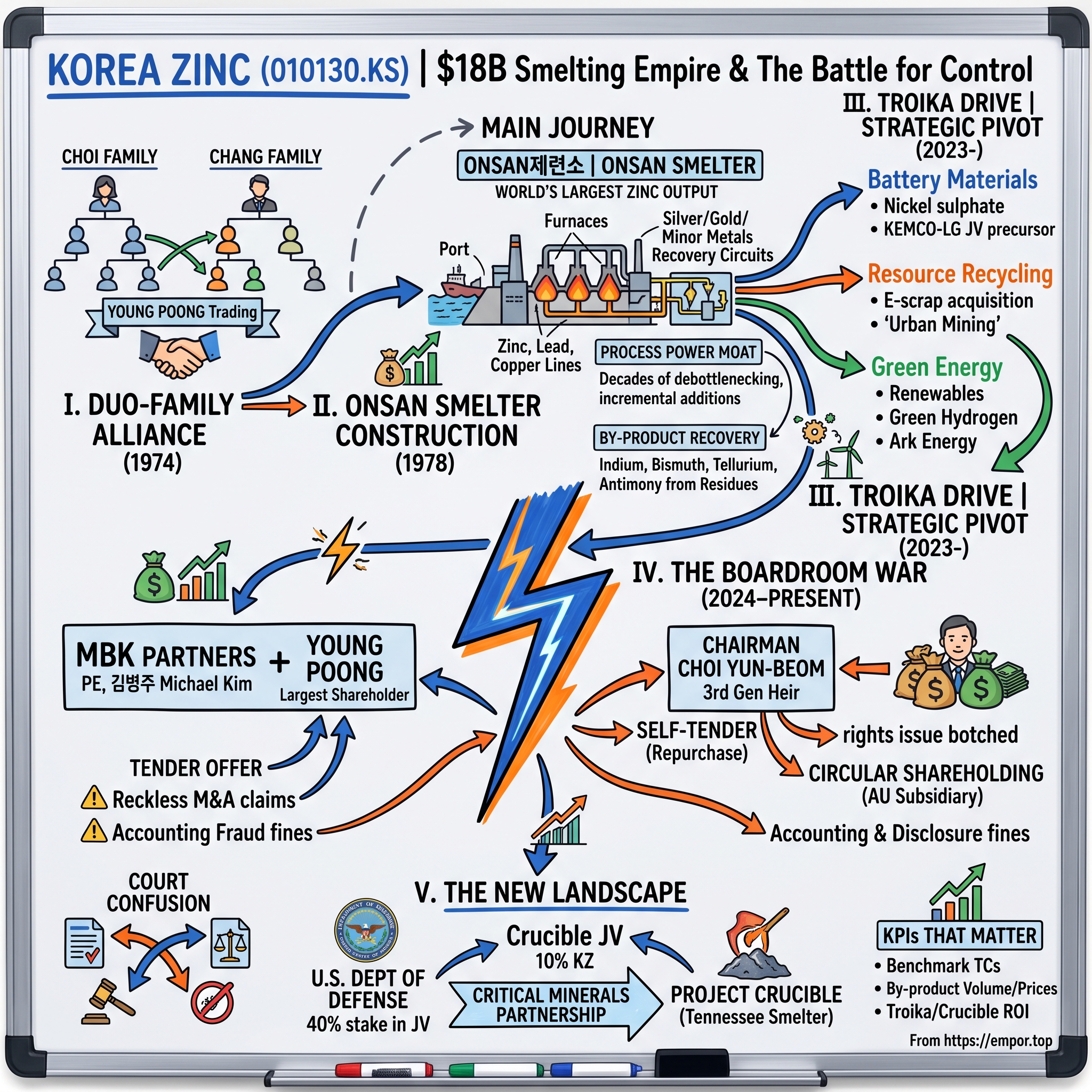
Korea Zinc: The $18 Billion Smelting Empire & The Battle for Control
I. Introduction & Episode Roadmap [00:00 - 08:00]
On the industrial coastline south of Ulsan, where the Korean peninsula runs out of land and into the East Sea, there is a site of roughly 1.41 million square meters that most Koreans have never visited and most global investors could not place on a map. Inside it, furnaces have not gone cold in more than four decades. Concentrate arrives by ship as grey powder — crushed rock from mines in Australia, Peru, Chile, Mexico, and Canada — and leaves as ingots of zinc, lead, and copper, as bars of gold and silver, and as small, unglamorous quantities of indium, bismuth, tellurium, and antimony that almost nobody thinks about until the country that supplies 90% of them decides to stop.
This is the 온산제련소 Onsan Smelter, and it belongs to 고려아연 Korea Zinc Company, Ltd. (010130.KS, listed on the 한국거래소 Korea Exchange). The plant produces more than one million tonnes a year of over ten different metals, including 630,000 tonnes of zinc — the largest output from any single smelting site in the world.1 It is, by almost any measure, the most boring extraordinary business in Asia.
And for the past two years it has been the epicenter of the loudest, ugliest, most expensive corporate control fight in modern South Korean history.
Here is the central paradox of this story. A fifty-two-year-old metallurgical cash cow — the kind of asset that in most markets would be owned quietly by an insurance company and left alone — became the battleground on which a private equity titan, a founding family, a financial regulator, a competition regulator, the Korean Supreme Court, and eventually the United States Department of Defense all took positions. Along the way the share price went from roughly 500,000 won to an all-time high of 2,407,000 won on December 6, 2024, and back down to roughly 949,000 won as of late July 2026 — a round trip that had almost nothing to do with the price of zinc.
The fight is between MBK파트너스 MBK Partners, the Seoul-headquartered buyout firm founded by 김병주 Michael ByungJu Kim, allied with Korea Zinc's largest shareholder 영풍 Young Poong, on one side; and Chairman 최윤범 Choi Yun-beom, the third-generation heir who runs the company, on the other.
It is not a fight about whether zinc smelting is a good business. Both sides agree it is. It is a fight about who gets to decide what to do with the cash it throws off — and, underneath that, a fight about whether Korean corporate governance has actually changed or merely learned new vocabulary.
Layered on top is a second, stranger story: Korea Zinc's attempt to convert a legacy base-metals refiner into what management calls the 트로이카 드라이브 Troika Drive — battery materials, resource recycling, and green energy — and, more recently, into a designated instrument of American critical-minerals policy.
In December 2025 the company sold roughly 10% of itself to a joint venture in which the U.S. Department of Defense holds a 40% interest, raising 2.85 trillion won to fund a $7.4 billion smelter in Tennessee. That is not a sentence anyone writing about a Korean zinc refiner in 2020 would have expected to type.
The roadmap. Act I covers the 1974 dual-family alliance that built a non-ferrous industrial franchise under Young Poong, and the seed of its eventual destruction. Act II goes inside Onsan to explain, in plain language, how smelter economics actually work — because you cannot judge either side of the governance fight without understanding where the money comes from. Act III examines the Troika Drive and the acquisitions made in its name, including the one that regulators later ruled was accounted for improperly. Act IV is the war itself: tender offers, a circular shareholding built through an Australian subsidiary, a botched rights issue, criminal referrals, and a foreign government arriving as a shareholder. Act V steps back for the frameworks, the bull and bear cases, and the small number of metrics that actually matter from here.
Start where the money started: with two men, a trading firm, and a country that had almost nothing.
 Subscribe on LinkedIn
V. The Dual-Family Empire: Origins & Founding Context (1974–1990s) [08:00 - 20:00]
In 1949, South Korea was not an industrial nation. It was a recently liberated agricultural colony with a per-capita income below that of Ghana, one year away from a war that would flatten most of what infrastructure it had.
In that year 최기호 Choi Ki-ho and 장병희 Chang Byeong-hee founded a trading house called 영풍 Young Poong — literally "abundant wind."2 Two families, one balance sheet, no written rulebook for what would happen when the founders' grandchildren disagreed. Keep that last detail in mind; the entire third act of this story turns on it.
Young Poong moved from trading into mining, and mining into metals. The decisive moment came in the early 1970s, when President 박정희 Park Chung-hee's administration launched the heavy and chemical industrialization drive — a state-directed campaign to build steel, shipbuilding, petrochemicals, and non-ferrous metals more or less from scratch, financed by policy loans and protected by import restrictions. Korea was building steel mills. Steel mills need galvanizing. Galvanizing needs zinc. Korea had none.
On August 1, 1974, the two families incorporated Korea Zinc to fix that.3 The division of labor they agreed on was elegantly simple and, in hindsight, structurally unstable: the Choi family would run Korea Zinc; the Chang family would run Young Poong Corporation and the group's electronic-components affiliates. Each side held meaningful stakes in the other's vehicle. It was a handshake federation — two sovereign houses, cross-owned, with a shared surname on the letterhead and no dispute-resolution mechanism beyond mutual goodwill.
The Onsan plant was completed in 1978 with an initial annual capacity of 50,000 tonnes.4 That number is worth sitting with. Today the same site produces zinc at more than twelve times that rate, plus lead, copper, gold, silver, and a laboratory's worth of minor metals. The compounding did not come from a single visionary leap.
It came from four decades of debottlenecking, incremental furnace additions, and — critically — a decision to keep expanding on the same footprint rather than building satellite plants. Every additional circuit at Onsan shared the same port, the same power infrastructure, the same sulphuric acid handling, the same workforce, the same permits. That choice, made for pragmatic reasons in the 1980s, is the root of the cost advantage the company still enjoys.
The early decades were also, frankly, easy in ways they would not be later. Domestic demand was captive: 포스코 POSCO and later 현대제철 Hyundai Steel needed zinc for galvanized sheet, and buying it from a Korean smelter one shipping day away beat importing it. Government policy favored domestic supply.
Environmental permitting for a heavy-metals smelter in 1978 Korea was not the multi-year adversarial process it is today — which is precisely why the barrier to building a competing plant is now so high, and why an incumbent site is worth so much more than its book value suggests.
The 1990s brought the first real test of whether this was a protected national champion or a genuine industrial competitor. Trade liberalization removed much of the import shelter. The 1997 Asian financial crisis devastated Korean heavy industry and forced the dismantling of numerous chaebol.
Korea Zinc came through it intact, for a reason that is easy to miss: as a processor rather than a miner, it had modest fixed capital tied up in wasting assets and it earned dollars from export sales while paying many of its costs in a collapsing won. A crisis that killed leveraged conglomerates was survivable for a business whose revenue was denominated in London Metal Exchange prices.
The one genuinely bold capital allocation decision of the founding era came in 1996, when Korea Zinc established Sun Metals Corporation in Townsville, Queensland.5 The logic was to place a greenfield zinc smelter directly next to Australian concentrate supply, with cheap land, abundant sun, and — eventually — the ability to run on renewable power.
At the time it looked like an expensive vanity project by a mid-cap Korean industrial. It has since become the platform for the company's Australian renewable energy arm and a supply hedge against Asian concentrate volatility. It also, decades later, became the legal instrument through which Chairman Choi tried to disenfranchise his own largest shareholder — but that is Act IV.
The second generation was defined by 최창걸 Choi Chang-gul, one of the company's founding members in 1974, who joined Young Poong Mining in 1973 after an MBA and work experience in the United States. He served as chairman and later honorary chairman, and died in October 2025 — during the war for the company he helped build, at the age of 84.6 His generation's contribution was less about strategy than about temperament: an engineering-first culture in which the smelter's technical staff, not the Seoul office, held the prestige. That culture is real, it shows up in the operating numbers, and it is the strongest thing the incumbent management has going for it.
What the founders never built was a governance architecture. There was no voting trust, no drag-along or tag-along framework, no buy-sell agreement, no arbitration clause. Two families held large blocks in each other's companies on the assumption that the arrangement would remain friendly. For fifty years it did. For an investor, the lesson arrives before the crisis does: an ownership structure that depends on the personal relationships of people who are no longer alive is not a structure at all. It is a countdown.
Before the countdown expires, though, you have to understand what everyone was fighting over — and that requires going inside the furnaces.
III. Engineering the Onsan Smelter: The Process Power Moat (20:00–35:00) [20:00 - 35:00]
A zinc smelter looks, from the outside, like a refinery that has been left in the rain. Conveyors, silos, stacks, a permanent low-frequency hum. Inside, the process is closer to industrial cooking than to anything a software investor would recognize: you take a rock that is maybe half zinc and half everything else, and you separate the half you want from the half you don't, at temperature, at scale, continuously, forever.
Here is the simple version. Miners dig ore and crush it into "concentrate" — a powder that might be 50% zinc by weight, with the rest being sulphur, iron, lead, silver, and traces of exotic elements. Concentrate is nearly worthless to a steelmaker.
Someone has to roast off the sulphur, dissolve the zinc into solution, and electrowin it into a metal sheet you can actually sell. That someone is a smelter, and the smelter gets paid in a way that surprises most people: the miner pays the smelter. The fee is called a treatment charge, or TC, quoted in dollars per dry metric tonne of concentrate.
TCs are set annually in a benchmark negotiation, and Korea Zinc is one of the two parties that sets it for the world — historically opposite Teck Resources. Watch the trajectory, because it explains almost everything about the last three years of this industry: $159/t in 2021, $230/t in 2022, $274/t in 2023, then a 40% collapse to $165/t in 2024.7 The 2025 settlement fell to roughly $80/t, a historic low, and the 2026 benchmark recovered only marginally to $85/t.8
Read that as a business person, not a commodities trader. The core, headline revenue line of every zinc smelter on earth was cut by roughly 70% in three years. The cause was not weak demand for zinc — it was a shortage of concentrate.
Mines closed or curtailed because zinc prices had been too low for too long, and the smelters that remained were left bidding against each other for feedstock. In China, spot TCs on imported concentrate fell to as little as $15–28 per dry tonne. Under those conditions, a large fraction of the global smelting industry ran at or below cash breakeven.
Korea Zinc, in the same window, posted record profits. That is the fact that demands explanation, and the explanation is the investment case.
Where the money actually comes from. A smelter has three revenue engines, and TCs are only the first. The second is "free metal" — the gap between the metal a smelter is contractually obliged to pay the miner for and the metal it actually recovers. Contracts typically assume the smelter will lose a certain percentage in processing. If your recovery rate is better than the contract assumes, you keep the difference. That difference is pure margin, and it scales directly with metallurgical skill.
The third engine is the one that separates Korea Zinc from almost everyone else: by-product recovery. Zinc concentrate is not pure zinc. It carries silver, gold, copper, lead, indium, bismuth, tellurium, germanium, gallium, and antimony in trace quantities. Recovering them requires additional circuits, additional capex, and a great deal of process know-how — and many smelters simply don't bother, sending the residues to slag piles or selling them cheaply to someone who will.
Onsan runs a slag-fuming and multi-metal recovery complex specifically designed to strip value out of what competitors treat as waste. The company produces roughly 150 tonnes of indium annually — around 11% of global demand, and roughly 29% of U.S. indium imports — and is South Korea's only domestic producer of indium, bismuth, and tellurium.9
Think of it as a slaughterhouse analogy, unappetizing but accurate: two operators buy the same animal at the same price. One sells the prime cuts. The other sells the prime cuts, the offal, the hide, the bones, and the rendered fat. In a good year the difference is a rounding error. In a year when the price of the prime cut collapses, the second operator is the only one still solvent.
That is exactly what happened. When China imposed export controls on antimony in September 2024 and on tellurium, bismuth, indium, tungsten, and molybdenum on February 4, 2025, prices for those materials went vertical — antimony rose from the low thousands of dollars per tonne to the tens of thousands.10 Korea Zinc, which had been recovering these metals for years as a by-product of doing something else, suddenly found that its offal was worth more than its prime cut.
Onsan's antimony line runs at roughly 10 tonnes a day, and the company completed its first antimony export to the United States in June 2025. The 2026 first-quarter result — operating margin of 12.3%, up 5.2 percentage points year over year — was driven substantially by critical minerals and precious metals, not by the zinc business proper.11
Why this is hard, and why the hardness is the point. The mainstream zinc process — roast, leach, purify, electrowin — is not secret. It is in textbooks. What is not in textbooks is how to run it profitably when your concentrate blend changes every shipment, when each new impurity poisons a different part of the circuit, and when the residue stream you are trying to monetize contains a dozen elements that all want to end up in the wrong place. The step Korea Zinc built its reputation on is slag fuming: rather than dumping the iron-rich residue left after zinc leaching, the plant re-treats it at high temperature to volatilize the remaining zinc, lead, and minor metals, which are then captured and fed back through dedicated recovery circuits. Each additional element recovered requires its own chemistry, its own control philosophy, and its own tolerance for the fact that a change made to capture more indium may cost you a fraction of a percent of copper.
This is why "process power" in metallurgy behaves less like a patent and more like a craft. A competitor with unlimited capital could build the same furnaces. What it could not buy is thirty years of operators who know which knob to turn when the feed changes — knowledge that lives in shift logs and in people, and that degrades if the plant stops running.
It is also why the single-site concentration at Onsan matters so much: co-locating every circuit means residues move by conveyor rather than by ship, and a metal that would be uneconomic to recover if it had to be trucked to a separate facility becomes economic when the next furnace is four hundred meters away.
Where this puts the cost position. Korea Zinc has consistently sat in the lower portion of the global zinc cash cost curve, and the mechanism is now visible: cost per tonne is depressed by on-site cogeneration, by the fixed-cost absorption that comes from being the largest single site in the world, and — most importantly — by by-product credits that are subtracted from the cash cost of zinc. When silver and antimony revenues are booked against zinc's cost line, the reported cash cost of producing zinc can fall dramatically without a single operational change. That is a genuine competitive advantage and also an accounting convention that flatters the headline number. Investors should understand both halves.
Is this a durable moat or a lucky lottery ticket? Honest answer: both, in proportions that are hard to disentangle. The recovery infrastructure is genuinely hard to replicate — it took decades, it sits inside an existing permitted site, and the process knowledge is embedded in people rather than patents. That is real. But the value of that infrastructure right now is being set by Chinese export policy, which is a political variable that can reverse. An investor should treat Korea Zinc's by-product complex as a permanent structural advantage whose earnings contribution is currently being paid at a wartime premium. The advantage survives a normalization in minor-metal prices. The earnings do not.
The company also spent 2024 on an "Onsan Smelter Rationalization Project," a set of process and logistics improvements that lifted annual lead capacity from 420,000 to 450,000 tonnes and cut logistics costs to roughly 3 billion won, about a third of the prior year's figure.12 Modest numbers on their own. What they signal is more important: management was still grinding on unit economics while simultaneously fighting a takeover battle — evidence that the operating organization and the boardroom drama were, to a meaningful degree, running on separate tracks.
That operating machine generates the cash. What management chose to do with the cash is where the trouble starts — and to see why, you need the shape of the P&L.
IV. Segment Economics & The Global Smelting Landscape [35:00 - 50:00]
Picture two versions of Korea Zinc's income statement side by side. In 2024, consolidated revenue was 12.05 trillion won and operating profit was 723.5 billion won — a margin of about 6%. In 2025, revenue jumped 37.6% to 16.58 trillion won and operating profit rose 70.3% to 1.23 trillion won, both records, extending the company's streak to 44 consecutive profitable years.13 Then the first quarter of 2026 arrived: revenue of 6.07 trillion won, up 58.4%; operating profit of 746.1 billion won, up 175.2%; a single quarter that roughly matched the entire operating profit of 2024.11
A 175% profit increase in a commodity processing business is not normal. It is not a demand story and it is not a capacity story. It is a mix-and-price story, and the honest way to read it is that Korea Zinc's earnings power has become substantially more leveraged to a small number of volatile minor-metal and precious-metal prices than its "zinc smelter" label implies.
How the revenue splits. Korea Zinc's disclosed segmentation is coarse — a recurring complaint from analysts and, pointedly, from its dissident shareholders. Broadly, zinc has historically represented roughly a third of revenue, the precious metals complex of silver and gold another third, lead somewhere in the mid-to-high teens, and copper plus specialty metals the balance. Those ratios have been shifting toward the precious and minor metals as prices moved. What the disclosure does not let an outside investor do with confidence is calculate segment-level margins, which is precisely the number that would settle several of the arguments in this story. That is a governance fact, not just an accounting one.
Two demand shifts deserve a moment. Silver, long treated as a lesser precious metal, has become an industrial input at scale — solar photovoltaic cells use it in conductive paste, and electrification broadly consumes it. Gold and silver also benefit when investors want hard assets, which they did through the 2025–2026 period of Middle East supply-chain disruption.
And zinc itself remains tied to one thing above all: galvanizing steel to stop it rusting. That is a construction and infrastructure demand curve, which means China, which means the single largest swing factor in the base-metals half of the business is a property market management does not control and rarely discusses in detail.
Against the field. The global smelting landscape is unusual in that Korea Zinc's most direct comparators have mostly been absorbed into commodity trading houses or state ownership. Nyrstar, once the largest zinc smelting company in the world, ended up inside Trafigura and progressively divested — including, as we'll see, selling its entire U.S. business to Korea Zinc.14 Glencore operates smelters as part of an integrated mine-to-market system where the smelter is a logistics node, not a profit center. Boliden runs a genuinely well-managed integrated European operation. Chinese smelters — Zhuzhou, Zhongjin, and the rest — operate at enormous aggregate scale but under domestic policy constraints and, lately, under crushing spot TCs.
The structural point is that most zinc smelting capacity worldwide is owned by entities for whom smelting is not the point. It is a service function attached to a mine or a trading book.
Korea Zinc is one of the very few large smelters that is a standalone smelting business, judged by its own P&L, with no mine to subsidize it and no trading desk to hide behind. That focus is why the by-product recovery investment happened at all — nobody else had the same incentive to squeeze the last percentage point out of a residue stream.
It also explains an asymmetry that matters for the years ahead. When treatment charges collapse, an integrated miner-smelter is largely indifferent: what the smelting arm loses, the mining arm gains, and group profit is roughly unchanged. A standalone smelter has nowhere to hide — which sounds like a weakness and, in the 2024–2026 environment, turned out to be the opposite.
Because Korea Zinc could not rely on a mine to bail out the smelter, it had spent two decades building the only other available buffer. The competitors that could afford to be indifferent never built one, and are now the ones curtailing output.
Myth versus reality: the "premium multiple." A persistent piece of sell-side folklore holds that Korea Zinc trades at a structural premium to global smelting peers because of superior assets. It is worth testing, because the premise quietly underpins a lot of bullish commentary. The premium was real for much of the past decade, and the reasons given for it — higher utilization, on-site cogeneration, proprietary metallurgy, and until 2024 a balance sheet with effectively no net debt — were substantially true. But the premium that existed between late 2024 and 2025 was something else entirely: it was a control premium, generated by two parties bidding for the same shares. When the bidding stopped, so did the premium. The stock's peak of 2,407,000 won in December 2024 was not a valuation of the smelter; it was a valuation of the fight.
At roughly 949,000 won in late July 2026, with a market capitalization near 19.4 trillion won, the market is once again pricing the business rather than the auction — and it is doing so at a level well below where a takeover made it briefly appear to belong. Any investor comparing today's multiple to the 2024 peak is comparing an asset to an event.
The balance sheet tells the real story of the war. At the end of 2023, Korea Zinc had total debt of 926 billion won against cash and short-term investments of 2.07 trillion — net debt of roughly 249 billion won, essentially nothing.37 One year later, at the end of 2024, total debt had ballooned to 4.97 trillion won and net debt to 4.08 trillion. The company had not built a new smelter. It had bought its own shares.
That is the cleanest possible summary of what the control fight cost: a company that entered 2024 with one of the strongest balance sheets in Korean heavy industry exited it having levered up by roughly 4 trillion won to purchase treasury stock. Interest expense rose from 50.8 billion won in 2023 to 129.6 billion in 2024 to 208.3 billion in 2025.
By the end of 2025, following the Crucible equity injection, net debt had come back down to roughly 2.51 trillion won and total equity had risen to 11.18 trillion — but the deleveraging came from issuing 10% of the company to a new shareholder, not from operations. Inventory, meanwhile, rose from 3.78 trillion won at end-2024 to 6.22 trillion at end-2025, which is what happens when metal prices rise sharply: a smelter's working capital requirement inflates with the value of what sits in its pipes and warehouses. That is a benign form of cash absorption in a rising market and a painful one in a falling market, and it is a mechanism worth remembering when metal prices eventually turn.
For a long-term investor, the analytical conclusion is uncomfortable and worth stating plainly: the operating business performed superbly through this period, and the financial position of the company deteriorated sharply anyway, for reasons entirely internal to the shareholder register. Capital that could have funded the Tennessee project, or the nickel refinery, or dividends, was consumed defending and attacking control. Both camps bear some responsibility for that, and neither has fully accounted for it.
Which brings us to the man who decided to spend it.
V. The Third Generation & "Troika Drive": The Strategic Pivot (2019–2023) [50:00 - 1:10:00]
Choi Yun-beom did not look like the person who would blow up a fifty-year truce. Educated abroad, a grandson of co-founder Choi Ki-ho, he came up through the company rather than parachuting in, and he took the chief executive role in 2019 and the chairmanship in 2022.
Colleagues describe a technically fluent operator who talks about furnaces the way other Korean chaebol heirs talk about brand equity. His public framing has been consistent since he took over: Korea Zinc is not a zinc company, it is a metals-processing company, and the metals that matter in the twenty-first century are not the ones that mattered in the twentieth.
The strategic logic was defensible on its face. Onsan's core competence is taking a complex, dirty, multi-element input and separating it into pure, saleable outputs. That competence is agnostic about what the input is.
If it can be a zinc concentrate from Peru, it can also be a spent lithium-ion battery, a shredded circuit board, or a nickel intermediate from Indonesia. Reframed that way, the pivot was not diversification for its own sake; it was applying an existing capability to feedstocks with better long-term demand curves.
That reframing became the 트로이카 드라이브 Troika Drive, announced in its full form in 2023, with three legs.[^15]
Leg one: secondary battery materials. Korea Zinc already produced nickel sulphate through its 켐코 KEMCO affiliate. In 2022 it formed a precursor joint venture with LG화학 LG Chem to move up the value chain into cathode precursor production.[^16] In 2023 it signed a 185 billion won (roughly $140 million) investment agreement with Trafigura to build what it called an "all-in-one" nickel refinery at Onsan — a plant designed to accept multiple nickel feedstocks, including mixed hydroxide precipitate from Indonesia and recycled black mass, and refine them into battery-grade nickel.15 The facility, with a planned annual output of 42,600 tonnes of contained nickel, was budgeted at 506.3 billion won and targeted for completion in 2026, which would lift total group nickel capacity toward 65,000 tonnes a year.
The strategic bet underneath: Western battery makers and automakers needed nickel and precursor material that was not Chinese, for both trade-policy and supply-security reasons. Korea Zinc, sitting in a U.S. free-trade-agreement partner country with world-class refining capability, was one of a very small number of firms that could credibly supply it.
Leg two: resource recycling. Urban mining — recovering metals from electronic waste rather than from ore. Economically, e-scrap is a richer feedstock than most mines: a tonne of circuit boards contains far more gold than a tonne of typical gold ore. The constraint is collection, not chemistry, which is why the strategy required buying companies rather than building plants.
Leg three: renewable energy and green hydrogen. Through Sun Metals in Queensland and its Ark Energy arm, Korea Zinc developed solar and wind capacity to power the Townsville smelter and explored exporting green ammonia.5 The commercial case rests on European and Japanese customers eventually paying a premium for low-carbon metal. That premium exists in pilot volumes. Whether it exists at scale, at a price that covers the capital, remains unproven — and management has not published the economics that would let an outsider judge.
Then came the acquisitions, and with them the trouble.
In 2022 Korea Zinc acquired Igneo Holdings, a U.S. electronics-recycling business, for approximately 374.9 billion won, generating 323.4 billion won of goodwill.16 Management defended the deal as buying an established North American collection network — the scarce asset in e-scrap — rather than a set of shredders.17 Critics, and later the dissident shareholders, argued the multiple paid was far above where comparable recycling assets traded and that the underlying earnings never materialized.
Ordinarily this would be an argument between reasonable people about a mid-sized acquisition. It stopped being that in 2026. South Korea's 증권선물위원회 Securities and Futures Commission determined that Korea Zinc should have recognized an impairment loss of 163.6 billion won — more than half the Igneo goodwill — in its 2022 year-end accounts, and did not.16 The regulator imposed a fine of approximately 8.43 billion won on the company, with additional fines of 487.9 million won and 275.3 million won on its chief executive and a responsible officer, and ordered auditor designation.
The findings also cited understated valuation losses on investment assets and obstruction of the external auditor's normal audit.
That is a serious set of findings, and it deserves to be stated without softening. It is one thing for a management team to overpay for an acquisition; that is a judgment error, and every acquirer makes some.
It is a different thing for the regulator to conclude that the resulting loss was not recognized when it should have been, and that the auditor was obstructed. The first is a capital allocation question. The second is a disclosure-integrity question, and it bears directly on how much weight an investor should place on management's own account of anything else.
A further acquisition, Kataman Metals, added a U.S. scrap-trading desk in 2024 to secure copper-bearing e-waste feedstock — smaller, more logically connected to the smelter, and far less contested.
Testing management credibility across the cycle. The useful discipline here is not to ask whether the Troika Drive is a good idea — it may well be — but to ask whether management's account of it has held up over time. On that test the record is mixed and, in places, poor. The strategic narrative has been consistent since 2019: same three legs, same framing, same emphasis on redeploying smelting competence. Consistency of narrative is a genuine positive, and it distinguishes Korea Zinc from companies that reinvent their story every downturn. But the financial narrative has moved in ways that were not explained at the time. A company that had positioned itself as conservatively financed took on billions in debt within a single year. A board that had signalled leverage discipline pivoted to an emergency dilutive equity raise within days of a buyback. And an acquisition presented as a strategic platform was subsequently found by the regulator to have carried an unrecognized impairment from its very first year-end.
None of that proves bad faith.
All of it constitutes evidence that when this management team came under pressure, its public account of its own plans lagged its actual decisions. For an investor, the practical implication is to discount forward-looking statements about the new businesses more heavily than statements about the smelter — because the smelter's performance is verifiable in the output data, and the new businesses' performance is verifiable only in disclosures whose reliability a regulator has already questioned.
The white knights. Running in parallel with the strategy was a defensive program that would define everything after. Choi's family branch held roughly 15% directly; the Chang family through Young Poong held far more. To close the gap, Korea Zinc placed shares — new issues, treasury stock, and cross-holdings — with a roster of Korean industrial partners and one trading house: 한화 Hanwha Group, 현대자동차그룹 Hyundai Motor Group, LG Chem, and Trafigura among them, assembled into a friendly voting bloc in the low-to-mid 30% range.
Each individual transaction had a commercial rationale attached — battery materials with LG, hydrogen with Hanwha, supply agreements with Hyundai, concentrate and nickel with Trafigura. Some of those rationales were real. But the aggregate effect was unmistakable, and the timing was not subtle: an incumbent management team that could not win a vote on its own economic ownership constructed one by issuing equity to friends. Every one of those placements diluted the largest shareholder without asking it.
You do not need to take a side in this fight to see what happens next. When a family that has held a third of a company for fifty years watches its stake diluted transaction by transaction in the name of strategic partnership, it does not write a letter. It calls a private equity firm.
VI. The $18 Billion Boardroom War: Young Poong & MBK Partners vs. Chairman Choi Yun-beom (2024–Present) [1:10:00 - 1:30:00]
The public trigger was almost comically petty for a fight of this size. In early 2024, relations between the two houses curdled over dividend policy, over the termination of shared raw-material purchasing arrangements, and — the detail that reads like a screenwriter's invention — over Young Poong's refusal to renew Korea Zinc's lease at the Young Poong Building in central Seoul. The company that the Choi family ran was, quite literally, evicted by the family that owned the landlord.
Then came September 13, 2024, and the fight went nuclear.
The tender offer. Young Poong and MBK Partners announced an unsolicited tender offer for Korea Zinc shares, with MBK holding an option over Young Poong's stake that would deliver it operational control. The opening price was 660,000 won per share. Over the following weeks it was raised to 750,000 won, then to 830,000 won. MBK's public case was governance: that the Choi management had entrenched itself through share placements, that it had pursued what MBK characterized as reckless and unvetted M&A — Igneo above all — and that shareholder value had been diluted to protect board seats.18
The counter-attack was extraordinary in scale. Korea Zinc's board approved a self-tender to repurchase shares worth up to 3.1 trillion won, roughly $2.25 billion, first at 830,000 won and then raised to 890,000 won.[^21] Bain Capital came in alongside as a financial investor, injecting 429.5 billion won for a 2.5% stake. In effect, the company borrowed several trillion won to buy its own shares at a price set by a bidding war against its own largest shareholder — using the corporate balance sheet to fund a control defense whose primary beneficiary was the incumbent management.
The tender closed short. Korea Zinc and Bain secured roughly 2.33 million shares against the more than 4.14 million sought — about half.[^22] MBK and Young Poong, meanwhile, obtained enough stock to claim the largest position. Nobody had won. Everybody had spent.
The rights offering that broke the narrative. What happened next is the single most damaging episode in the modern history of this company's credibility. Days after completing a buyback at 890,000 won per share — an implicit statement by the board that the stock was worth at least that — Korea Zinc announced a public rights offering of approximately 2.5 trillion won, issuing new shares at around 670,000 won, a roughly 20% discount to the market. The board had just told shareholders their stock was cheap at 890,000 and was now proposing to sell them more of it at 670,000.
The market reaction was violent and entirely rational. The stock collapsed. On November 6, 2024, the 금융감독원 Financial Supervisory Service suspended the share issuance.19 The company withdrew the plan.
In January 2025 the FSS referred the matter to prosecutors for suspected violations of the Capital Markets Act, alleging that Korea Zinc had already been planning the capital increase before completing the tender-offer buyback and had failed to disclose it — which, if established, would make the tender offer report materially false.[^24] Chairman Choi and other officials became subjects of a criminal investigation. Choi publicly apologized and gave up the board chairmanship while remaining chairman of the executive committee.
Assess that sequence as a governance analyst would. Set aside intent entirely. The observable facts are: a board approved a buyback at one valuation and a dilutive issue at a materially lower valuation within days; the regulator found the disclosure inadequate enough to suspend the deal and refer it to prosecutors; and management's own account of its plans changed between those two events.
Whatever the eventual legal outcome, an investor is entitled to conclude that the board's decision-making process under pressure was not reliable, and that guidance from this management about capital structure should be weighted accordingly.
The Australian maneuver. If the rights offering was the credibility low point, what followed was the legal one. Ahead of an extraordinary general meeting on January 23, 2025, Young Poong Precision — an entity in the Choi orbit — sold a 10.33% stake in Young Poong to Sun Metals Corporation, Korea Zinc's Australian subsidiary. Under Article 369(3) of Korea's 상법 Commercial Act, when cross-shareholdings between a company and its subsidiary exceed 10%, the shares lose their voting rights. In one transaction, Korea Zinc's largest shareholder was stripped of its vote at its own company's meeting.20
Choi won the meeting, including the adoption of cumulative voting — a mechanism that lets minority holders concentrate their votes on individual candidates, and which would later prove decisive in his favor.21 MBK called it the worst kind of maneuvering. On March 7, 2025, the Seoul Central District Court suspended most of the resolutions passed at that meeting.[^27]
The courts have since split, in a way that is genuinely instructive about how unsettled Korean corporate law remains on these questions. On April 2, 2026, the Supreme Court upheld the voting restriction as applied at the March 28, 2025 annual meeting, rejecting Young Poong's argument that "subsidiary" under Article 369(3) covers only domestic companies and finding it difficult to conclude that management had committed breach of trust or violated fair trade law.22
Then, on July 13, 2026, the Seoul Central District Court ruled that the same mechanism applied at the January 2025 extraordinary meeting had been unlawful, and — for the first time — attached personal civil liability to management, ordering chief executive Park Ki-deok to pay 100 million won in damages for what it characterized as an intentional tort.23 Separately, in June 2026, the 공정거래위원회 Korea Fair Trade Commission opened a sanction process over the circular shareholding structure itself.24
Two courts, one mechanism, opposite conclusions. The damages figure is trivial; the precedent is not. Korean executives now have a live judicial statement that engineering away a shareholder's vote can carry personal liability.
The regulators went after both sides. It would be a mistake to read this as a story of one guilty party. In July 2026 Young Poong was fined a record 20.5 billion won for intentional accounting fraud.25 The Igneo accounting sanctions landed on Korea Zinc. The KFTC is examining the cross-shareholding. The FSS referred the rights offering to prosecutors. Whatever else this episode has accomplished, it has produced the most comprehensive regulatory examination of a Korean corporate control fight in decades — and neither camp has emerged from it clean.
The national backdrop. It would be a mistake to read this purely as a family quarrel. The Korea Zinc fight landed in the middle of a broader national argument about the "Korea discount" — the persistent tendency of Korean equities to trade below global comparables, widely attributed to controlling-shareholder behavior that treats minority investors as an afterthought. Seoul's policy establishment had spent years promoting value-up programs and governance reform; here was the most visible test case imaginable, featuring a domestic buyout fund arguing the shareholder-rights position and an incumbent family arguing the national-champion position.
The politics were genuinely unresolved. Was a private equity firm taking control of a strategic smelter an overdue governance correction, or a financial owner acquiring critical national infrastructure with an eye to a resale? Both framings were used aggressively in public.
The eventual legislative answer arrived in February 2026, when amendments to the Commercial Code were passed — effective March 6, 2026 — introducing mandatory treasury share cancellation and tightening the rules on how treasury stock can be held and disposed of. Those amendments closed off, prospectively, several of the tools that had been deployed in this very fight. The dispute changed the law.
Then Washington arrived. On December 15, 2025, Korea Zinc announced Project Crucible: a $7.4 billion integrated smelter and refining complex in Clarksville, Tennessee.26 The financing structure was without real precedent. Korea Zinc would issue approximately 2.85 trillion won (about $1.9 billion) of new shares to a U.S. joint venture — Crucible JV LLC — in which the U.S. Department of Defense holds roughly 40% of voting rights alongside unnamed American strategic investors, giving the JV about 10% of Korea Zinc. A further $4.7 billion would come from U.S. government loans and institutional financing, plus roughly $210 million in Commerce Department subsidies under the CHIPS and Science Act. JPMorgan was among the backers.27 The project would build out from Nyrstar's existing Clarksville smelter — the only primary zinc smelter in the United States, operating since 1978 — whose U.S. assets, including two Tennessee mining complexes, Korea Zinc agreed to acquire and formally took over on April 1, 2026.14 Trafigura continued to market the smelter's zinc output through 2026.
The industrial logic is the strongest thing in this entire story. The United States has essentially no domestic capacity to refine the minor metals China restricted, and Project Crucible is designed to produce thirteen non-ferrous metals including eleven U.S.-designated critical minerals, plus semiconductor-grade sulphuric acid, processing around 1.1 million tonnes of feedstock and producing roughly 540,000 tonnes of metal annually — including 300,000 tonnes of zinc — from phased startup in 2029. In April 2026 it became the first project led by a South Korean company to receive FAST-41 federal permitting coverage.28
And yet. Young Poong and MBK went to court to block the share issuance, arguing it was a dilutive entrenchment device dressed in a flag — a "white knight" wearing a government uniform. On December 24, 2025, the Seoul Central District Court dismissed the injunction, finding that the fundraising could not be viewed as markedly unfair compared with alternatives and that it did not decisively alter control.29 Payment settled on December 27.
The dilution was real: the MBK–Young Poong bloc fell from roughly 44% to the high-30s, and Choi's own camp fell from roughly 30% to the mid-20s.30 The dissidents said they were disappointed, and then said they would support the project anyway.
That last detail is the tell. Both sides now agree Tennessee is a good idea. They disagree about who should be holding the pen.
Where the board stands today. At the annual meeting on March 25, 2026, five directors were elected to a fourteen-member board. Chairman Choi was re-elected. So was Walter Field Mclallen, backed by the Crucible JV, who topped the poll with roughly 15.61 million votes — narrowly ahead of Choi himself.31 The MBK–Young Poong side increased its board representation from four seats to five; Choi-aligned directors hold nine.32 The remarkable arithmetic is that the dissident bloc holds about 41.1% of the shares against Choi's 37.9% — and still lost, because cumulative voting, the very mechanism Choi pushed through at the disenfranchised January 2025 meeting, let a minority concentrate its votes.
The fight did not end. It was scheduled. On September 9, 2026, Korea Zinc will hold an extraordinary general meeting at the Mondrian Hotel in Yongsan, Seoul, to amend its articles to expand the number of separately elected audit committee members, to elect four independent directors by cumulative voting, and to elect one independent director to the audit committee.33 The company is not doing this by choice: Korea's revised Commercial Act requires at least two separately elected audit committee members by September 10, 2026, and the corresponding proposals were voted down in March.
The audit committee is the body that would oversee, among other things, the accounting matters the SFC has already sanctioned. Both sides understand exactly what is at stake.
VII. Playbook: Business & Strategy Lessons [1:30:00 - 1:45:00]
1. Cross-shareholding defenses are a loan against your own governance. Issuing equity to friendly industrials works mechanically — it dilutes the adversary and manufactures votes. But each placement is a transaction that a regulator, a court, or a future activist can examine on its own merits, and the more of them you stack, the more of your governance record is composed of transactions whose primary purpose was control. Korea Zinc's defensive architecture succeeded at its narrow objective and simultaneously created the evidentiary record that regulators, the FSS, the SFC, and the KFTC have been working through ever since. The defense and the liability were the same asset.
2. A world-class operating asset does not immunize you from a capital-allocation discount. Through the entire crisis, Onsan kept setting records. It did not matter. The market marked the equity down anyway, because investors were pricing not the furnaces but the probability that cash generated by the furnaces would be deployed sensibly. The Igneo sequence — an acquisition at a contested multiple, followed by a regulatory finding that the impairment was not booked when it should have been — is the specific reason that discount had teeth. If you want the market to capitalize your growth adjacency at anything above cost, you have to disclose its returns. Korea Zinc mostly did not.
3. In commodities, the durable edge is in processing, not ownership of the rock. This is the genuine intellectual contribution of the Korea Zinc story. The conventional wisdom in mining is that the mine is the asset and the smelter is the toll booth. Korea Zinc's record during the worst treatment-charge environment in decades demonstrates the opposite can hold: when your revenue depends on how much of the feedstock you can convert into saleable product rather than on the headline processing fee, superior metallurgy is a margin engine that operates independently of the commodity cycle. The caveat is equally important — that engine's current output is being amplified by a geopolitical shock, and no one should extrapolate 2026 minor-metal pricing indefinitely.
4. Multi-generational partnerships without contractual architecture carry structural tail risk. Two families, cross-owned, no voting trust, no buy-sell, no arbitration, no succession framework. It worked for fifty years and then produced tender offers, criminal referrals, three levels of court, two regulators, and a foreign defense ministry on the share register. The failure was not in 2024. It was in 1974, when nobody wrote anything down.
5. When the state becomes your shareholder, you have swapped one dependency for another. The Crucible structure solved Korea Zinc's immediate problems elegantly — it funded the U.S. expansion, deleveraged the balance sheet, and added a shareholder with no interest in helping MBK. But a shareholder that is also a customer, a regulator, a lender, and a national-security agency has objectives that will not always align with the return on capital of a Korean-listed minority holder. That is a trade, not a free option, and the terms of the trade will only become visible over years.
VIII. Strategy Frameworks: Porter's 5 Forces & Helmer's 7 Powers [1:45:00 - 1:58:00]
Porter's Five Forces
Threat of new entrants — very low, and getting lower. A greenfield integrated smelter now costs billions; Project Crucible's own budget of $7.4 billion is the market-clearing evidence. Beyond capital, permitting a heavy-metals facility in any developed jurisdiction is a multi-year, politically contested process. The most telling data point is that Clarksville, built in 1978, remained the only primary zinc smelter in the United States nearly five decades later. Nobody built another one. The FAST-41 designation Korea Zinc received exists precisely because the permitting barrier is otherwise close to prohibitive — which is a moat for incumbents and, incidentally, an argument that this moat is partly a gift of policy rather than of engineering.
Supplier power — moderate to high, and currently the binding constraint. Concentrate comes from a concentrated set of miners, and the collapse in benchmark treatment charges from $274/t to roughly $80–85/t is exactly what supplier power looks like when it is being exercised. Korea Zinc's position as one of the two parties that sets the global benchmark gives it information and relationship advantages, not pricing power. Its real defense is not negotiation — it is that its by-product recovery makes a marginal tonne of concentrate worth more to it than to a competing bidder, which lets it win feedstock at prices that would be uneconomic for others.
Buyer power — low to moderate. Zinc ingot is a standardized, LME-priced commodity, which caps pricing power at the base-metals level. But buyers of high-purity indium at 99.999%, of battery-grade nickel sulphate, or of antimony for defense applications are not shopping on price alone; they are shopping on availability and origin. Being a non-Chinese source of a Chinese-restricted material is a genuine, if policy-dependent, source of buyer dependence.
Threat of substitutes — low. There is no cost-effective replacement for zinc in galvanizing. Aluminum-zinc coatings and organic alternatives exist at the margins; none displaces the core application. The bigger substitution risk is not chemical but architectural — a sustained decline in construction steel demand, particularly in China, would shrink the addressable market regardless of what Korea Zinc does.
Rivalry — moderate, and structurally asymmetric. Most competing capacity is owned by miners or traders for whom the smelter is infrastructure. Korea Zinc competes as a standalone processor and, on cash cost, sits well down the curve. In a normal cycle that produces stable share. In a downcycle, it produces survivorship — the pattern visible in 2024–2025 when much of the industry ran near breakeven and Onsan set records.
Hamilton Helmer's Seven Powers
Process Power — the primary and best-evidenced moat. Helmer's criterion is an advantage embedded in organizational activity that a competitor cannot copy even with full knowledge, because it accrues slowly through hard-won practice. Onsan's multi-metal recovery complex qualifies. The evidence is not management's claim; it is the margin differential in a period when the industry's headline revenue line fell 70% and this company's operating margin expanded. That said, Process Power is the hardest power to verify from outside, and the current earnings expression of it is inflated by minor-metal prices.
Scale Economies — strong, and site-specific. Every incremental circuit added at Onsan over five decades shared existing port, power, permitting, and labor infrastructure. This is not scale in the abstract; it is the compounding of a single-site decision made in the 1970s. The open question is whether it transfers. Project Crucible is the test: management is explicitly attempting to rebuild the Onsan model on American soil, and if the advantage is truly reproducible, it should show up in Clarksville's cost curve after 2029. That is a hypothesis, not yet a fact.
Cornered Resource — emerging, and partly political. The 국가핵심기술 National Core Technology designation obtained for the company's nickel and precursor processes restricts foreign transfer and was, transparently, deployed as a takeover defense as much as an industrial policy.[^40] More substantively, being the only domestic producer of indium, bismuth, and tellurium in a U.S. treaty ally gives Korea Zinc a position that cannot be bid away, because it cannot be quickly replicated. This is a real power. It is also a power granted and revocable by governments.
Counter-Positioning — claimed, not yet demonstrated. Management argues that urban mining and low-carbon smelting represent a business model incumbents cannot follow without cannibalizing themselves. The theory is coherent. The evidence is thin: Igneo's earnings disappointed badly enough to trigger an accounting sanction, and the green-premium economics of Sun Metals and Ark Energy have not been disclosed in a form that permits independent assessment. Treat this as an option, not a moat.
Switching Costs, Network Economies, and Branding are essentially absent, which is unremarkable for a commodity processor. Anyone claiming otherwise for this business is selling something.
IX. The Investment Case: Bull vs. Bear & Core KPIs [1:58:00 - 2:10:00]
The Bull Case
The core of the bull argument is that Korea Zinc has been repriced as a governance disaster while quietly becoming a critical-minerals infrastructure asset. The operating record supports the second half of that sentence: 44 consecutive profitable years, 105 consecutive profitable quarters, and record results delivered in the teeth of the worst treatment-charge environment in living memory. Local coverage in July 2026 pointed toward the possibility of annual operating profit exceeding 2 trillion won for the first time.34 Whether that arrives on schedule is a function of metal prices, but the direction of travel is not in dispute.
The second pillar is friend-shoring. China's export controls on antimony, indium, tellurium, bismuth, germanium, and gallium turned Korea Zinc's by-product complex from a curiosity into strategic infrastructure — a shift confirmed by the extraordinary step of the U.S.
Department of Defense taking an indirect equity position and the Commerce Department attaching CHIPS Act money to a zinc smelter. Project Crucible, once operating, would give the company a permitted, subsidized, government-backed processing platform inside the world's largest defense market, at a moment when no one else is building one.
The third pillar is that the governance fight, for all its destructiveness, has forced both camps into a shareholder-return arms race. Korea Zinc has committed to a value-up roadmap targeting an average shareholder return ratio above 40%, has signalled cancellation of its remaining treasury shares, and in the first quarter of 2026 paid a quarterly dividend of 5,000 won per share while cancelling 2.04 million treasury shares.1135 MBK and Young Poong have pushed for codified director fiduciary duties and a stock split.36 Korea's amended Commercial Code, passed in February 2026, now mandates treasury share cancellation across the market. Whichever faction ends up in control, the direction of shareholder policy has been ratcheted one way.
The Bear Case
Start with the thing the bulls tend to skip: the accounting sanction. A regulator concluded that a material impairment was not booked when it should have been, fined the company and its executives, ordered auditor designation, and cited obstruction of the external audit.16 That is not a disagreement about valuation methodology.
For a company whose segment disclosure is already coarse enough that outside investors cannot compute divisional margins, it is a direct hit to the reliability of everything management reports. Any investor underwriting the Troika Drive's returns is relying on numbers produced by a control environment that a regulator has formally found wanting.
Second, the balance sheet still carries the war. Interest expense quadrupled between 2023 and 2025 as a direct consequence of a 2.7 trillion won-plus treasury buyback executed to defend control. The 2025 deleveraging came from selling 10% of the company, not from operating cash. And the company has now committed to $7.4 billion of U.S. capital spending, of which $4.7 billion is debt and government financing, in an environment where the cost of capital is materially higher than when this journey started.
Third, the earnings quality question. Operating margin went from roughly 6% to 12.3% in five quarters, and management's own attribution points at antimony, silver, gold, and critical minerals — that is, at prices set by Chinese export policy and by investor demand for hard assets. Both can reverse.
Meanwhile the benchmark treatment charge, the recurring fee for the core business, sits at $85 per tonne, near an all-time low, with no evident catalyst for recovery while mine supply stays tight. Strip out the minor-metal windfall and the underlying smelting business is being run in the hardest conditions of its history.
Fourth, the control fight is not resolved — it is calendared. A shareholder holding 41.1% has lost two consecutive board contests to a shareholder holding 37.9% because of a voting mechanism, while courts have issued conflicting rulings on the legality of the manoeuvre that produced that arithmetic and one court has attached personal liability to a sitting chief executive.
The KFTC's review of the circular shareholding remains open. A criminal referral over the rights offering remains open. Each of these is a live path by which the current board could be destabilized.
Fifth, the risk radar that applies specifically to this business rather than to markets generally. Smelting is enormously energy-intensive; Korean industrial power tariffs and Australian energy costs feed directly into unit economics, and the renewable investments at Sun Metals are as much a hedge against that exposure as an ESG statement. Environmental and permitting risk is permanent and asymmetric — a heavy-metals plant that has operated since 1978 in a densely industrialized coastal zone carries legacy liabilities and community-relations obligations that do not appear on a balance sheet until they do.
Feedstock geopolitics cut both ways: the same Chinese export controls that inflated by-product prices could, in a different configuration, restrict inputs Korea Zinc needs. And a large share of the demand for the company's flagship product still traces back to construction steel in China, a market whose multi-year weakness has not yet been offset by anything.
Sixth — and this is the activist's sharpest question — what exactly is a minority investor's claim on this business? The register now contains a founding family bloc, a rival family bloc allied with a buyout fund, a syndicate of Korean industrial partners holding shares placed for defensive purposes, a global commodity trader, and a joint venture controlled in part by a foreign defense ministry.
Every one of those holders has objectives beyond the share price. A skeptical long/short investor would ask whether any of them are optimizing for the residual claimant, and would not find an obviously satisfying answer.
The KPIs That Actually Matter
1. The annual benchmark zinc treatment charge, in dollars per tonne. This is the single cleanest read on the health of the core business and on the balance of power between miners and smelters. It is negotiated publicly, settled annually, and Korea Zinc is one of the parties setting it. A sustained recovery from the $80–85 range would mean the concentrate shortage is easing and the base business is normalizing; continued suppression means the entire non-Chinese smelting industry remains dependent on by-products to make money.
2. By-product and precious-metal recovery, and the realized prices behind it. The percentage of operating profit attributable to silver, gold, antimony, indium, and the other minor metals — and how much of that is volume versus price. This is where the current earnings surge lives, and it is where the moat either proves itself or is revealed as a price windfall. Investors should watch whether recovered volumes keep rising when minor-metal prices eventually fall back.
3. Troika Drive and Project Crucible capital deployed versus profit generated. The nickel refinery's ramp, KEMCO's utilization, the recycling businesses' contribution, and — from 2027 — Clarksville's construction progress against its $7.4 billion budget and 2029 startup. This is the honest scoreboard for management's central claim: that a smelting franchise can be redeployed into new feedstocks at attractive returns. Igneo is the reason this metric requires skepticism rather than trust.
X. Epilogue & What to Watch [2:10:00 - 2:15:00]
On the morning of September 9, 2026, shareholders will gather in a hotel ballroom in Yongsan to vote on what sounds like an administrative matter: how many audit committee members Korea Zinc should elect separately, and who they should be. It is not administrative.
The audit committee is the body that supervises the financial reporting that a regulator has already sanctioned, and the seats are being contested by a shareholder bloc holding 41.1% against one holding 37.9%, under a cumulative voting system that has twice delivered the smaller bloc the better outcome. The revised Commercial Act made this meeting mandatory. The two camps made it a battle.
Three things are worth tracking from here, and they run on different clocks.
The legal and regulatory clock is the fastest. The Seoul Central District Court's July 2026 finding of personal liability over the January 2025 voting restriction sits awkwardly beside the Supreme Court's April 2026 ruling upholding the same mechanism at a different meeting; appeals and further proceedings are near-certain.
The Korea Fair Trade Commission's sanction process on the circular shareholding structure remains open, and its outcome could force an unwinding of the Sun Metals arrangement entirely. The prosecutorial referral over the abandoned rights offering is unresolved. None of these will move the furnaces. All of them can move the board.
The operating clock runs quarterly. The KEMCO all-in-one nickel refinery was targeted for completion in 2026, and its ramp will be the first real evidence of whether the battery-materials leg of the Troika Drive earns its capital.
Antimony, indium, and silver realizations will determine whether the extraordinary 2026 margin expansion was a step-change or a spike. The 2027 benchmark treatment charge negotiation, which Korea Zinc will conduct on behalf of the industry, will tell the market whether the core business is finally getting relief.
The strategic clock runs in years. Project Crucible breaks ground in 2027 and starts phased production in 2029. If it works, Korea Zinc will have done something no company has managed in fifty years — built a new integrated non-ferrous smelting complex in the United States — and will have converted a Korean industrial franchise into a piece of allied critical-minerals infrastructure with a government on the register.
If it runs over budget, or if the political conditions that produced it change, it will be the largest capital commitment in the company's history made by a management team whose capital allocation record is, on the evidence, contested.
The furnaces at Onsan will keep running through all of it. They have not stopped since 1978, through five decades, three generations, two families, one hostile takeover, and a war in the boardroom that neither side has won. That may be the most useful fact in this entire story: the asset was never really in doubt. Only the people arguing over it were.
References
-
Korea Zinc's Onsan Smelter: Blueprint for $7.8B U.S. Plant — Seoul Economic Daily, 2026-03-09 ↩
-
Bitter Korea Zinc feud risks ripping apart $11 billion metals empire — Fortune Asia, 2024-10-02 ↩
-
Korea Zinc Investor Relations Portal — Korea Zinc Company, Ltd. ↩
-
Sun Metals Corporation / Ark Energy — Townsville operations and renewable projects ↩↩
-
Choi Chang-gul, Honorary Chairman of Korea Zinc and "Nonferrous Metals Industry Pioneer," Passes Away — The Malaysian Reserve, 2025-10-09 ↩
-
Zinc benchmark TCs settled at $165/t; down nearly 40% y-o-y on continued tight supply — Fastmarkets ↩
-
Low Zinc TCs Signal Persistent Pressure on Global Smelters — The Metalnomist, 2026-05 ↩
-
Korea Zinc Solidifies Critical Role in US-Korea Economic Security Amid Chinese Export Controls as the World's No.1 Indium Producer — PR Newswire, 2025-02 ↩
-
China's Antimony Export Restrictions: The Impact on U.S. National Security — CSIS ↩
-
Korea Zinc posts record Q1 earnings on strong demand for critical minerals — The Korea Herald, 2026-05-06 ↩↩↩
-
Korea Zinc Completes Onsan Smelter Project, Boosting Efficiency and Cutting Costs — PR Newswire, 2024-12-13 ↩
-
Korea Zinc posts record profit as metals soar — The Korea Herald, 2026-02 ↩
-
Nyrstar completes sale of its US assets to Korea Zinc — Nyrstar, 2026-04-01 ↩↩
-
Korea Zinc signs KRW185 billion (USD140 million) investment agreement with Trafigura to build an all-in-one nickel refinery — Trafigura, 2023 ↩
-
MBK, Youngpoong Urge Full Investigation into Korea Zinc's Alleged Overpriced Acquisition of Igneo Holdings — The Asia Business Daily, 2026-06-17 ↩↩↩
-
Korea Zinc defends e-scrap acquisition amid buyout feud — Resource Recycling, 2024-09-30 ↩
-
MBK Partners and Young Poong to Restore Korea Zinc's Shareholder Value through Governance Reform — Business Wire, 2024-12-11 ↩
-
Financial watchdog suspends Korea Zinc's issuance of new shares — The Korea Times, 2024-11-06 ↩
-
Korea Zinc limits rival's voting rights to fend off takeover — The Korea Herald, 2025-01 ↩
-
Korea Zinc chairman defends management control by dismissing rival's voting rights — The Korea Times, 2025-01-23 ↩
-
Korea's Supreme Court Upholds Korea Zinc's Voting Restriction, Rebuffing Young Poong's Legal Challenge — PR Newswire, 2026-04-03 ↩
-
Court Rules Korea Zinc's Voting Rights Restriction Against Young Poong Unlawful — Seoul Economic Daily, 2026-07-13 ↩
-
KFTC Launches Sanction Process on Korea Zinc's Circular Cross-Shareholding — The Asia Business Daily, 2026-06-12 ↩
-
Youngpoong Fined Record 20.5 Billion Won for Intentional Accounting Fraud — Seoul Economic Daily, 2026-07-15 ↩
-
Korea Zinc plans $7.4bn US minerals refinery with Washington's backing — Al Jazeera, 2025-12-15 ↩
-
Korea Zinc launches $7.4b Tennessee smelter project — The Korea Herald, 2026-04-02 ↩
-
Project Crucible Minerals Manufacturing Project Gains FAST-41 Coverage — Federal Permitting Improvement Steering Council, 2026-04-27 ↩
-
Court rejects Young Poong-MBK injunction bid, clears Korea Zinc's US smelter plan — The Korea Times, 2025-12-24 ↩
-
Korea Zinc completes share sale of 2.85 trillion won to Crucible JV — S&P Global Market Intelligence, 2025-12 ↩
-
Korea Zinc chair secures board control in proxy battle victory — The Korea Herald, 2026-03-25 ↩
-
MBK-Young Poong expands foothold in Korea Zinc board battle, narrows gap with current management — The Korea Times, 2026-03-24 ↩
-
Korea Zinc to Hold Extraordinary Meeting Sept. 9 in Board Showdown — Seoul Economic Daily, 2026-07-21 ↩
-
Korea Zinc Poised to Top 2 Trillion Won in Annual Operating Profit for First Time — Seoul Economic Daily, 2026-07-10 ↩
-
Korea Zinc to Cancel All Treasury Shares by Year-End, Targeting Shareholder Return Ratio Above 200% — Alphabiz ↩
-
MBK, Young Poong propose codifying fiduciary duty, stock split at Korea Zinc — The Korea Times, 2026-02-12 ↩
-
Korea Zinc Financial Disclosures & Filings — DART (Electronic Disclosure System) ↩
 LinkedIn
 WhatsApp
 Reddit
 Hacker News
 Email
Email Kindle
 RSS Feed
 Spotify
 Apple Podcasts
 Amazon Music
 Audible
 YouTube