ViTrox: The Inspection Company Riding the AI Wave
I. The Factory That Could See
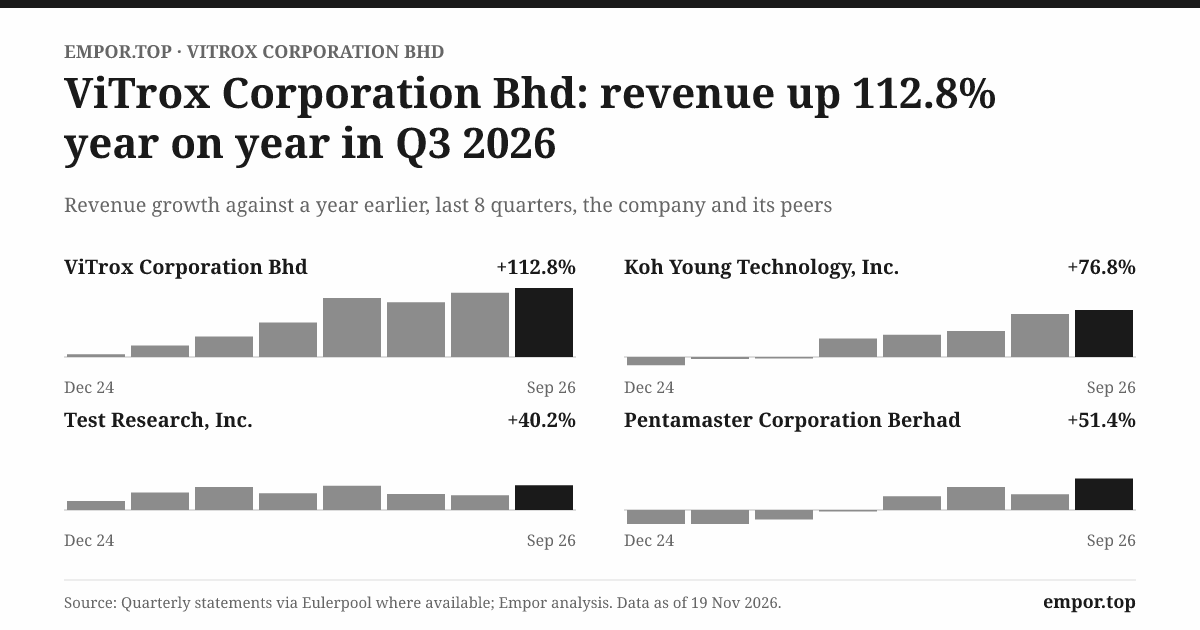
On 5 November 2026, a Penang company most investors outside Malaysia had never heard of published a quarterly report that read like a misprint. In the three months to September, ViTrox Corporation Berhad had sold RM485 million of inspection equipment and services, 112% more than in the same quarter a year earlier.1 Across the first nine months of the year it had booked about RM1.13 billion, up 104%.1 To put that in proportion: in its entire 2025 financial year, itself a strong recovery year, ViTrox had sold RM843 million.2 Nine months of 2026 had already beaten the whole of 2025 by roughly a third, and a full quarter remained.
The explanation management gave was short and fashionable. The artificial-intelligence buildout, it said, was lifting demand across both of its core equipment businesses: the machines that inspect semiconductor packages and the machines that inspect finished circuit boards.1 Every AI server rack is a tower of boards and chips, and every one of those boards and chips has to be checked for flaws before it leaves a factory. As the boards get denser, the solder joints smaller and the packages more stacked, the checking gets harder. ViTrox makes the cameras, X-ray systems, optics and software that do that checking. In a year when the world's largest technology companies were spending on data centres at a pace that strained power grids, the business of looking for microscopic defects suddenly had a queue outside the door.
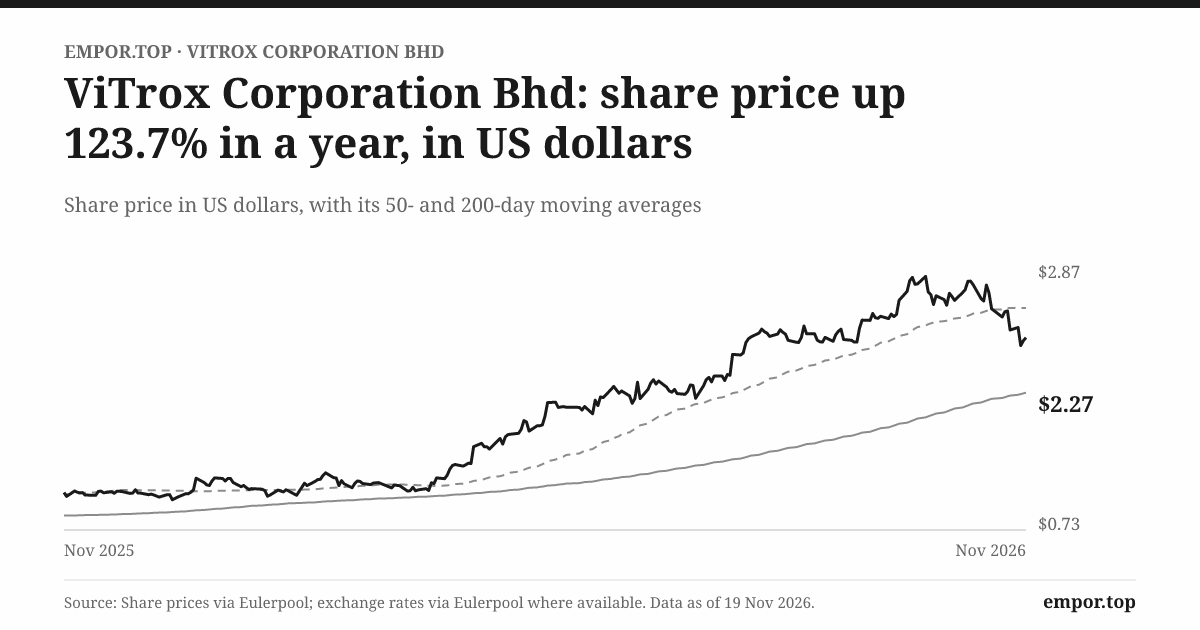
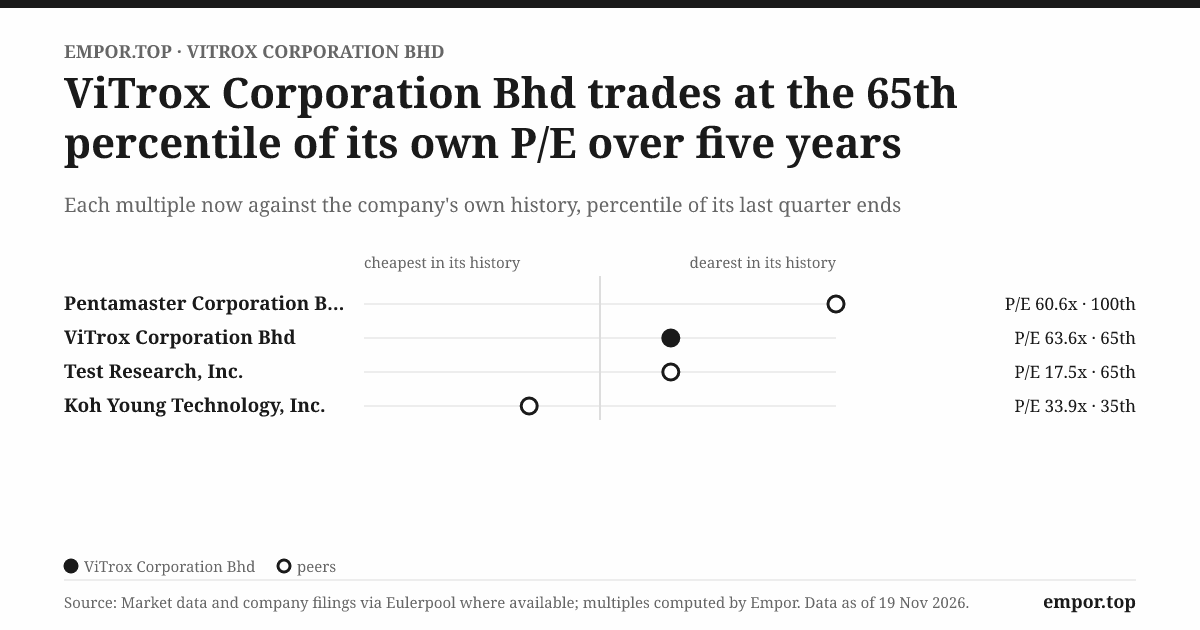
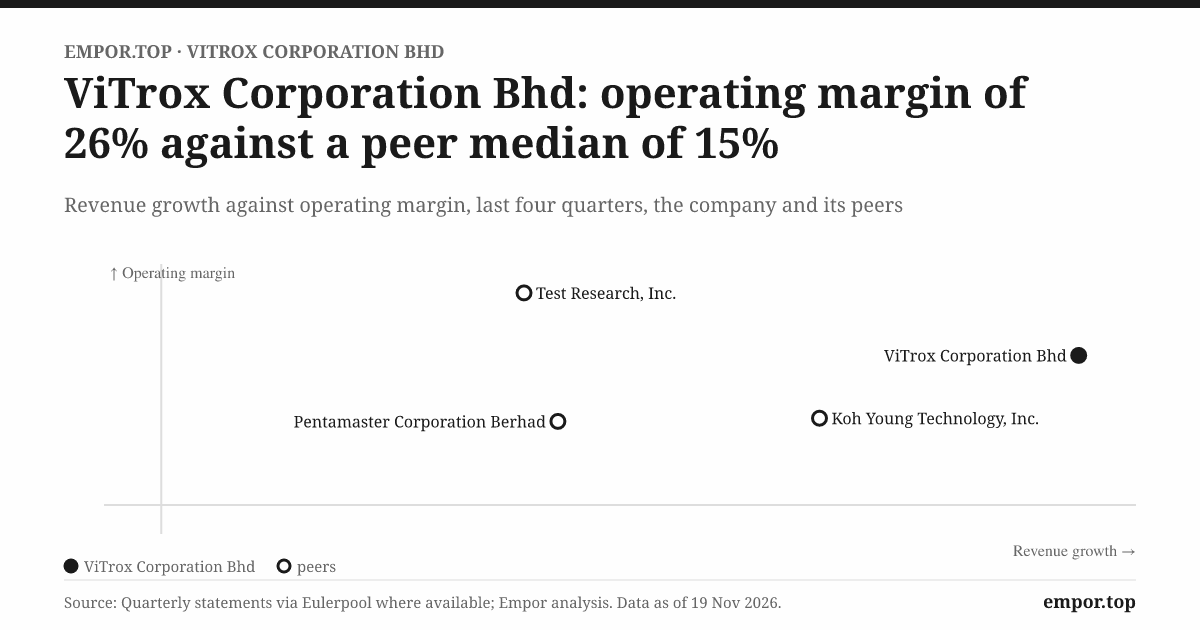
Profit moved even faster than revenue, which is what happens when a factory with high fixed costs runs full. ViTrox's operating margin in the September quarter rose to about 28%, its highest in the recent run, and net profit more than tripled from a year earlier.1 Profit before tax for the nine months was up about 158%.1 The stock market had noticed long before the quarterly report. On 19 November 2026 the shares closed at RM9.31, which valued the company at about RM19.2 billion, or roughly 64 times the profit of the previous twelve months.3 Fifty-two weeks earlier the price had touched RM3.98.3 The shares had more than doubled from that low, peaked at RM11.24, and then given back about a sixth of the gain.3
So this is a story about a boom. But it is also a story about the shape of the ground beneath one. ViTrox is a capital-equipment company, and capital-equipment companies live on their customers' decisions to build. When customers build, orders arrive in waves; when they stop, the waves recede all at once. ViTrox's own record makes the point without any help. Its revenue fell in 2019, fell again in 2023 and slipped once more in 2024.2 The 2023 drop was about 23%, and in that year's annual report management wrote that the uplift it had anticipated from AI workload chips had been less than expected.4 Three years before its record quarter, in other words, ViTrox had already told shareholders that AI would help, and the help had not arrived on schedule.
That history is the reason this story cannot simply celebrate the September quarter. A record year proves demand is strong now. It does not prove that the floor beneath demand has risen, that ViTrox will keep its share of the market as competitors chase the same orders, or that the profit it reports will turn into cash in the bank. Those are three separate questions, and the rest of the story is built around them.
The first is about the machine. Inspection is a niche inside a niche, and chip complexity is rising fast. Can ViTrox's systems keep winning places on production lines as the problems get harder, or will larger and better-funded rivals take the most demanding work? The second is about money. ViTrox has a long habit of reporting profits faster than it collects cash, because machines sit in inventory before shipment and customers take months to pay after it. Can a company growing this quickly avoid having its success trapped in receivables? The third is about price. At roughly 64 times trailing earnings, against a five-year median of about 57 times, the market was paying for more than a good year.3 What exactly does that price assume?
It helps to know who is answering these questions. ViTrox is still run by the people who started it. Chu Jenn Weng, its chief executive, has led the company since before its listing in 2005, and his two co-founders sit beside him on the board.2 Between them, the three founders own almost half the shares.2 The company designs and builds its machines in Penang, the island in northwest Malaysia that has spent half a century as one of Asia's most important electronics manufacturing hubs, and sells them to factories around the world. It is, by the standards of a Bursa Malaysia listing, unusually global, unusually technical and unusually founder-controlled.
Those traits are the attraction and the risk in the same package. A founder-led engineering company can invest through a downturn because nobody can fire the founders for missing a quarter. It can also invest into a peak, because the same people who were right about the technology are deciding how much capacity to build. The September quarter is the moment when both possibilities are most visible. To judge which one is unfolding, the story has to go back to where the company began: a rented bedroom in Penang and a camera bought for fifty ringgit.
 Subscribe on LinkedIn
II. Three Engineers, One Inspection System
In 1990, a young man from Seremban received a gift from his mother: a second-hand Pentax SLR camera that had cost RM50.5 Chu Jenn Weng was not a photographer by trade. He was on his way to Universiti Sains Malaysia in Penang to study electrical and electronic engineering on a scholarship from the Kuok Foundation, and he would later write a master's thesis in image processing.5 But the camera stuck. A machine that turns light into a picture, and a picture into information, was close to the idea that would define the rest of his working life.
After university Chu went to work for Hewlett-Packard's Malaysian operation, the kind of employer that a top Penang engineering graduate of the 1990s was expected to choose.5 HP gave him training in Silicon Valley, and in 1995 he made the pilgrimage that so many engineers have made to the garage in Palo Alto where Bill Hewlett and Dave Packard started their company.5 ViTrox's own telling of its history treats that visit as the origin of the ambition: Chu came home wanting to build a Malaysian high-technology company, rather than working for a foreign one.6 It is a familiar story in technology, and it is worth noticing how specific his version was. He did not want to start a company that assembled other people's designs, which is what most of Penang's industrial economy did. He wanted one that owned the intellectual property.
The opening arrived as a customer problem rather than a business plan. In 1998, a former colleague asked Chu and a fellow HP engineer, Steven Siaw Kok Tong, to build a vision system for a semiconductor contract manufacturer in Perak.5 Back-end semiconductor plants, the factories that package and test chips after they are made, were full of human inspectors peering at components through magnifiers, and full of slow, expensive imported machines. Chu and Siaw quit their jobs, used their initial capital to buy parts and cameras, and set to work.5 The capital was about RM20,000, and the workshop was Chu's rented bedroom, about 100 square feet, in Taman Permai in Sungai Dua, Gelugor.5 The company was formally incorporated in 2000, and its name combined the two ideas the founders were selling: vision and electronics.6
The first employee was Yeoh Shih Hoong, a first-class honours graduate from USM who turned down offers from better-known employers to join two engineers working out of a bedroom.6 That decision deserves a beat. In Malaysia at the turn of the century, a top engineering graduate who chose an unknown local start-up over a multinational was making an unusual bet, both on the founders and on the idea that a Malaysian company could compete in precision equipment. Yeoh eventually became the third founder in everything but the paperwork, an executive director and a large shareholder.62 There was also a mentor in the background: Ahmad Fadzil Mohamad Hani, Chu's lecturer at USM, who later joined ViTrox's board.5
What did these three build that a factory would pay for? Picture a back-end semiconductor plant. Thousands of chip packages move along a tray or tube every hour. Each one has leads or solder balls that must be the right height, in the right place, without cracks or bridges. A human can check some of them, slowly and inconsistently, and gets tired by the fourth hour of a shift. A machine-vision system checks all of them, in fractions of a second, without touching them. It photographs each part with carefully arranged lights and lenses, then runs software that compares what it sees with what the part should look like. If the inspection is wrong in one direction, bad parts escape into customers' products. If it is wrong in the other, good parts are thrown away. If it is slow, the whole line waits.
That third failure mode is the one that turns inspection from a quality function into a business function. A semiconductor packaging line or a circuit-board assembly line is an expensive asset, and its owner is paid by the unit. A machine that inspects accurately but slowly is a bottleneck. A machine that is fast but misses defects is a liability. The value of good inspection lies in being both, which is why customers care about it far more than its small share of a factory's total cost would suggest.
The breakthrough came in 2004, when ViTrox launched its first three-dimensional vision inspection system for semiconductor components.5 Two-dimensional vision tells you whether a lead is in the right place on a flat image. Three-dimensional vision tells you whether it is the right height, whether a package is warped, whether a solder ball is slightly too short to make contact. As packages became smaller and their connections finer, height became the measurement that mattered. ViTrox had built a product for the direction the industry was heading, rather than where it had been.
The same year, ViTrox converted into a public limited company, and in September 2005 it listed on Bursa Malaysia's MESDAQ market, the exchange's board for younger growth companies.78 The listing offered 17.6 million new shares at 60 sen each.8 It was a modest raise by any standard, which says something about what the founders needed: not a war chest, but a currency, a public profile and a way to attract engineers who would accept shares as part of the deal. ViTrox's revenue in its first year as a listed company was RM13.9 million.9 Four years later, in 2009, it moved to Bursa's Main Board.6
It is tempting, with hindsight, to treat each of these steps as proof that something unstoppable was under way. The founding myth has all the classic ingredients: the camera from mother, the garage pilgrimage, the bedroom workshop, the first-class graduate who said no to the multinationals. ViTrox tells it with pride, and it is a good story. But a founding story is evidence of capability and ambition, not of a durable business advantage. Many engineering start-ups launch a clever first product. Fewer persuade customers to put that product on their lines, reorder it, recommend it and pay a price that funds the next generation.
That is the distinction that matters for the rest of this story. A technical first opens a door. Whether ViTrox walked through it and built something defensible on the other side can only be judged from what customers did over the following two decades: how many came back, how much they paid and how the company's margins held up when demand fell. The founders built a machine that could see. The harder task, which took the next twenty years, was building a machine that factories could not easily do without.
III. The Machine That Had to Earn Its Place on the Line
Follow a printed circuit board through a modern assembly line. A bare green board enters at one end. A printer lays down tiny deposits of solder paste through a stencil. A pick-and-place machine sets hundreds or thousands of components onto those deposits at high speed. The board passes through a reflow oven, where the paste melts and hardens into joints. At several points along the way, and then at the end, an inspection system looks at the board and asks whether everything is where it should be. ViTrox makes machines for those stations. Some use cameras and structured light to build a three-dimensional picture of the solder and components. Others use X-rays to look through components at joints hidden underneath them, which matters a great deal when the component is a large processor package sitting on hundreds of solder balls that no camera can see.
This is the business ViTrox calls Automated Board Inspection. Its other main business, Machine Vision Systems, does the equivalent job one step earlier in the supply chain, inspecting the semiconductor packages themselves in back-end assembly and test plants.7 A third segment, Integrated Industrial Embedded Solutions, sells electronic modules and related products, and the company also sells software for connected factories.7 Those smaller lines are useful context, but the investment case today rests on the two equipment businesses, because those are where the AI demand is landing.
The group had reached that scale in 2025.2 It spent RM88.9 million on research and development, or about 10.6% of revenue.2 For a Malaysian listed company, that is an extraordinary level of R&D intensity; for a global equipment maker, it is respectable rather than unusual. The point is that ViTrox has kept funding its engineering bench through good years and bad, and that the products it sells are the output of that bench rather than licensed designs.
How does the money arrive? ViTrox recognises equipment revenue when it delivers a machine and the customer accepts it, and recognises technical-support services over time.2 Credit terms range from 14 to 365 days, though normal terms are described as not exceeding twelve months.2 The company does not disclose what a machine costs, how long its service contracts run, whether customers commit to minimum volumes or what share of revenue comes from recurring services.2 That last gap matters. A business that earns a growing stream of service and software revenue from its installed base becomes less cyclical over time, because the stream continues when new orders stop. A business that mainly sells boxes rises and falls with its customers' capital budgets. ViTrox's disclosures leave investors to infer which kind it is, and the revenue record of 2019, 2023 and 2024 points firmly toward the second.
There is one encouraging piece of evidence about the customers. In 2025, no single customer accounted for 10% or more of revenue; the largest was about 5%, and the top ten together were about 43%.2 Two years earlier, the top ten had been about 53%.2 For an equipment maker riding a demand wave led by a handful of hyperscale technology companies, that is a better spread than one might expect. It means the AI boom is reaching ViTrox through many contract manufacturers and packaging houses, rather than through one or two giant buyers who could squeeze its price.
It is important to be precise about what that evidence shows. A spread-out customer list reduces the damage if any one buyer leaves. It does not show that buyers cannot leave. Electronics manufacturers routinely qualify more than one inspection vendor for a given step, and the largest of them have engineering teams whose job includes keeping suppliers honest on price. ViTrox does not name its customers, publish retention rates, disclose how often it wins competitive evaluations or show how its prices have moved.2 Without those numbers, diversification is a statement about risk, not proof of a moat.
Why does X-ray matter so much in the current wave? An AI accelerator or high-end networking chip is not soldered to a board by visible pins along its edge. It sits on a grid of hundreds or thousands of tiny solder balls underneath the package, a design known as a ball grid array. Once the package is placed, those joints are hidden. A camera looking down sees only the top of the chip. To find a void inside a joint, a ball that did not fully melt or two balls that have bridged together, the inspection system has to look through the package, much as an airport scanner looks through a suitcase. That is a harder, slower and more expensive kind of inspection, and it becomes more important as packages grow larger and boards more valuable. It is also exactly where ViTrox's newest products, including its high-end QX1 X-ray system, have been aimed.10
Who else is looking at the board
The competitive map is crowded and uneven. In board inspection, ViTrox's most direct rivals include 고영테크놀러지 Koh Young Technology of South Korea, which made its name in three-dimensional solder-paste inspection; 德律科技 Test Research, Inc., known as TRI, of Taiwan; and Viscom of Germany, a specialist in X-ray and optical inspection. Further up the stack sits KLA, the American process-control giant whose inspection and metrology tools are used inside wafer fabs. KLA is not a like-for-like comparison: it is many times ViTrox's size and focused on a different, more expensive part of the semiconductor process. But its existence is a reminder that the most demanding inspection problems, especially in advanced packaging, attract the deepest pockets in the industry. No public source provides clean product-level market shares that would show whether ViTrox is gaining or losing ground against these competitors, and ViTrox does not publish its own.
Michael Porter's five forces offer a useful way to think about the line. Buyers have real power, because they are large manufacturers that can and do qualify several vendors, and because inspection equipment is a capital purchase that procurement teams negotiate hard. Substitutes exist in several forms: other optical techniques, X-ray rather than optical inspection, inline testing, or simply inspecting less and accepting more risk when budgets tighten. Suppliers may have more power than they appear to. Specialist components such as X-ray tubes, high-end cameras and precision motion parts come from a limited number of sources, and when one is scarce, shipments stall. That turned out to be a live issue in 2026. The threat of new entrants is moderated by the engineering depth required and by the long qualification process a new vendor faces before a customer trusts it on a production line. And rivalry among the existing players turns on accuracy, speed, how easily a machine slots into a customer's line, software, service quality and, inevitably, price.
Hamilton Helmer's seven powers framework asks a sharper question: which structural advantages, if any, let ViTrox earn returns above what competition would normally allow? Three are worth testing. The first is switching costs. Once a customer has programmed an inspection system for a product, trained its operators on the software and tuned the defect thresholds to its own yield targets, changing vendor is not free. That friction is plausible, and it is the most likely source of whatever durable advantage ViTrox has. But ViTrox does not publish retention or repeat-order data, and the fact that its revenue fell by almost a quarter in 2023 shows that customers can and do stop buying when they stop expanding. Switching costs protect an installed base. They do not protect a capital-equipment maker from a capital-spending pause.
The second is scale economies. As ViTrox's volume rises, it can spread R&D and factory overhead across more machines, which should help margins. The September quarter's 28% operating margin is evidence that operating leverage works in this business.1 But scale also cuts the other way: KLA, Koh Young and others have their own scale, and ViTrox's R&D budget, while large for its size, is small next to the largest players in process control.
The third is the one that founding stories most often claim and least often deserve: a cornered resource. ViTrox has accumulated awards, patents and technical firsts, from the 2004 three-dimensional system onwards. None of those, on their own, prevents a competitor from building a comparable machine. The truest version of the claim is narrower. ViTrox has assembled a large, experienced engineering team in a lower-cost location, with a culture built around a founding narrative its engineers believe. That is a genuine advantage in cost and execution. It is not a lock.
Where does that leave the moat? Somewhere between plausible and proven. There is a credible engineering story, a diversified customer base and a business that has stayed profitable in every year of the past decade, including the bad ones.2 There is also no published evidence of market-share gains, retention, sustained price increases or switching costs strong enough to hold revenue up in a downturn. The honest verdict is that ViTrox's advantage is real but narrower than its founding story implies: it is the advantage of a well-run specialist that wins its share of a cyclical market, not yet the advantage of a company that can bend the cycle.
The test that would settle the question is not a record quarter. It is whether customer wins and product capability sustain margins through the next full downturn. That test has been set before, and the most recent one began in the years when ViTrox's revenue more than doubled and then fell back.
IV. The 2020 Boom, the 2023 Miss, and the AI Bet
The pandemic is usually remembered as a disaster for factories. For ViTrox, 2020 was the year the machines could not be built fast enough. Revenue rose about 39% to RM470 million, and management attributed the increase to higher sales volume and better use of its production capacity.11 The strongest piece of that growth came from tray-based machine-vision systems, the equipment used in semiconductor back-end plants to inspect packages as they move through assembly.11 Net profit for the year was about RM106 million.5
It is worth resisting the easy story that this was a pandemic windfall. The demand behind 2020 had been building for some time: more chips per car, more chips per phone, the arrival of 5G handsets and base stations, and a global semiconductor industry starting to add packaging and test capacity in Southeast Asia. The pandemic accelerated that demand rather than creating it, as people bought laptops, cloud providers expanded data centres and carmakers who had cancelled chip orders scrambled to reinstate them. ViTrox was positioned for a structural trend and then received a cyclical shove on top of it.
The shove kept going. Revenue grew by about 45% in 2021 and another 10% in 2022, reaching about RM750 million.124 Net profit peaked at roughly RM200 million in 2022, with operating margins near 29%.4 By mid-2021, ViTrox was being written about as a Malaysian success story with more than 600 customers and about 700 employees, a new 450,000-square-foot headquarters in Batu Kawan Industrial Park, and plans for further campuses and even a ViTrox university.5 The company was a symbol as well as a business: proof that Penang's electronics economy could produce designers and not only assemblers.
When the uplift did not come
Then the market turned. Through 2022 and into 2023, demand for smartphones and personal computers slumped as consumers who had bought devices during the pandemic stopped buying. Data-centre operators digested what they had built. Semiconductor makers cut capital spending. ViTrox's revenue fell about 23% in 2023, to about RM575 million.4 Management attributed the decline to weaker demand for both its machine-vision and board-inspection products and, strikingly, to a less-than-anticipated uplift from AI workload chips.4
That sentence is the most important line in ViTrox's recent history, and it deserves careful reading. It does not say AI was irrelevant. It says the company had expected AI-related demand to cushion or offset the downturn, and the cushioning was smaller than hoped. In other words, management had identified the right trend and the wrong timing. That is a common failure in technology investing, and it is not a damning one. But it is direct evidence that when ViTrox's leaders talk about AI as a demand driver, they are describing something they have been wrong about before.
The downturn did not end in 2023. Revenue slipped again in 2024, by about 4%, to roughly RM552 million, and net profit fell to about RM89 million.132 Operating margin dropped below 19%, the weakest in more than a decade.13
It is worth taking that margin slide apart, because two different things were happening at once. Between 2022 and 2025, operating margin fell by roughly ten percentage points, from about 29% to about 19%, as revenue shrank against a cost base the company chose not to cut: engineers, R&D and new floor space do not get cheaper when orders slow.2 Net margin fell further, from about 27% to about 16%, and most of the extra gap came from tax rather than operations.2 For years ViTrox had paid almost no tax, thanks to incentives on its main operating subsidiary; its effective rate was about 2% in 2022 and about 25% by 2025.2 So the downturn exposed two vulnerabilities at the same moment. One was operating leverage running in reverse, which is the normal fate of an equipment maker in a slump. The other was a tax advantage that had flattered reported profits through the previous boom and was no longer doing so. Anyone comparing 2026's net margins with 2022's needs to remember that the earlier figure was earned under a lighter tax burden. The company's response was defensive but not panicked. Top management took a temporary 10% pay cut.2 Headcount contracted by about 5%.2 But R&D stayed an explicit priority, at about 10% of revenue, and the company kept investing in facilities.2
This is the first place where the founder-led structure shows its value. A management team answerable to impatient outside owners might have cut R&D to protect earnings in 2023 and 2024. ViTrox did not. Whether that was wise depends entirely on what came next, and what came next was the recovery. In 2025, revenue rebounded about 53% to RM843 million, net profit rose to about RM132 million, the pay cuts were revoked in January, and the company resumed hiring and expanded overtime as orders recovered.2 By the first nine months of 2026, revenue had more than doubled again.1
The language management uses today has a different emphasis from 2023's. It points to AI infrastructure, advanced packaging and networking equipment, rather than to AI workload chips in general.1 That shift matters. In 2023, the hoped-for demand was for chips themselves. In 2026, it is for the boards, packages and networking gear that surround them in data centres, where the inspection problem is unusually hard because the boards are large, dense and expensive. A single defective joint under a high-end AI accelerator can scrap a board worth thousands of dollars. That is a genuinely different demand story, and it is consistent with the reported numbers: by the third quarter of 2026, AI and telecommunications programmes made up about 71% of the board-inspection order backlog, according to RHB Research.10
Yet the same analysis contains a warning. RHB reported that ViTrox's shipments in the third quarter were capped by component shortages, particularly of X-ray tubes, and that the firm expected fourth-quarter revenue to ease from the September record in what it called a "supply-driven pause."10 The record quarter was not only a demand story; it was also a story about how much ViTrox could physically build. When a business is constrained by supply, its reported revenue understates demand for a while, and then, when supply catches up, it can overstate the sustainable run-rate as backlogs are cleared.
The investor's question is therefore not whether AI is driving demand. Clearly it is. The question is whether this wave is changing the base rate of ViTrox's growth or amplifying the next cycle. The long record narrows the structural claim. Across the three years to 2025, revenue grew only about 4% a year and net profit fell by about 13% a year.2 Over ten years, revenue grew about 18% a year, with net profit rising about 12% a year.2 The longer number is impressive. It also includes three years of falling revenue, which means it is a cycle-adjusted average, not a smooth climb.
What would show that the floor has moved? Revenue and operating margin in 2027 and 2028, after the current shipment surge has been delivered. If ViTrox can hold revenue well above its 2025 level and keep operating margins in the mid-20s as AI-related orders normalise, the structural case will have real evidence behind it. If revenue drops back toward its pre-boom trend and margins compress, 2026 will join 2020 and 2021 as another, larger peak in a cyclical record. The company has already chosen which outcome it is preparing for, and that choice is being poured in concrete.
V. A Factory Expansion in the Middle of a Surge
Every equipment maker eventually faces the same decision, and it usually arrives at the worst possible moment. Orders are coming in faster than the factory can build. Lead times are stretching. Customers are asking whether they should go to a competitor who can deliver sooner. The choice is to build more capacity now, betting that demand will still be there when the new factory is ready, or to hold back and risk losing customers who may not come back. Build too little, and the boom goes to rivals. Build too much, and the next downturn arrives with an empty factory and a fixed cost base.
ViTrox has made this choice before, and its record is a reasonable one. In 2021, at the top of the last boom, it was already operating from its 450,000-square-foot Batu Kawan headquarters, known internally as Campus 2.0, and talking about Campus 3.0.5 Through the 2023 and 2024 downturn, it kept spending. Property, plant and equipment on the balance sheet more than doubled over the five years to 2025.2 Cash spent on property, plant and equipment was about RM23 million in 2024 and about RM38 million in 2025, roughly 4% to 5% of revenue in each year.2 The new capacity programme continues that pattern. The company says Campus 4.0 is expected to ease shipment bottlenecks in the near term, and RHB Research has reported that Campus 5.0 could more than triple capacity by 2028.10 ViTrox has not published a full capital budget for these projects in its quarterly reports, so the scale of the commitment has to be judged from the spending as it happens.
The R&D record tells a similar story of persistence. Over the decade to 2025, ViTrox's R&D spending ranged between about 8% and 13% of revenue.2 The 2023 downturn reduced the absolute amount, but the ratio held, and spending rose again through 2024 and 2025 to its current level of almost RM89 million.2 Research costs are expensed as incurred rather than capitalised, which means the reported profit already absorbs them; there is no hidden pile of deferred development cost on the balance sheet waiting to be written off.2
What do these figures suggest about ViTrox's capital discipline? The most useful benchmark is not a competitor's absolute spending, which reflects different scale and strategy, but ViTrox's own revenue and cash generation. On that basis, the company's reinvestment is substantial but not reckless. Capital expenditure of about 4% to 5% of revenue is moderate for an equipment maker. R&D of about 10% is high for a Malaysian company but in line with what precision-equipment makers typically spend to stay competitive. The bigger question is not the size of the spending but its timing. Factory investment and hiring are accelerating after a period in which revenue more than doubled in nine months. Lead times, backlog and customer commitments need to justify the pace, and the public evidence on those is partial. RHB has reported about RM172 million of orders booked for delivery in 2027, which provides some visibility but is far from a full year of the current run-rate.10
Headcount provides another clue. After contracting about 5% in 2024, ViTrox's workforce grew only about 2% in 2025, even as revenue grew by more than half.214 That gap means the company met its recovery largely through overtime and higher productivity rather than permanent hiring. It is a sensible way to handle uncertain demand, because overtime can be cut quickly and permanent staff cannot. It also suggests the factory and its workforce were stretched well before 2026's surge, which is consistent with the shipment constraints that followed.
The acquisitions that did not happen
ViTrox's capital allocation story has one notable absence: large acquisitions. In 2018, the company publicly said it was exploring mergers and acquisitions in related industries to accelerate growth.15 The annual reports since then do not identify a consequential completed acquisition. There is therefore no purchase price to compare with industry multiples and no goodwill to test for impairment. The visible capital-allocation choices have been internal: R&D, facilities and working capital.
That absence is worth a moment, because it is easy to read as discipline and harder to prove. A company that looks for acquisitions and buys nothing may be disciplined about price, or may have found nothing that fits, or may have decided organic growth was enough. The filings do not distinguish between these. What can be said is that ViTrox has not destroyed shareholder value through acquisitions, because it has not made any material ones, and that its growth has come from its own engineering. That is a narrower claim than "disciplined capital allocator," and the narrower claim is the one the evidence supports.
There is also a smaller related-party footprint to note. In 2025, ViTrox bought about RM23 million of goods from an associate company and its subsidiary, and received about RM22 million of services from a company in which a director has a substantial financial interest.2 Together, these were about 5% of revenue. The company describes the service provider's relationship but does not state the pricing method.2 At this scale, the transactions are not a red flag, but a growing company should keep them visible, and a careful shareholder will want to know how they are priced.
Capacity on its own is not a moat. A bigger factory lets ViTrox ship more machines when demand is strong, and potentially lower its unit costs. It also raises the fixed costs that the business must cover when demand weakens, and it locks capital into a physical asset that cannot be redeployed. The confirming evidence will come after the new campuses are operating: utilisation rates, delivery performance and returns on invested capital in the first full year when demand is merely normal rather than exceptional. Until then, the factory expansion is an operating bet, made by founders who have been right about the long-term direction of their industry and wrong, at least once, about its timing.
That bet would be easier to judge if ViTrox's profits reliably turned into cash. They do not, and that is where the story turns from the factory floor to the warehouse.
VI. When Profit Stayed in the Warehouse
Imagine a single order in 2025. A circuit-board manufacturer somewhere in Asia agrees to buy a set of ViTrox's X-ray inspection systems for a new server-board line. ViTrox orders components, some of which take months to arrive. Its engineers assemble and calibrate the machines in Penang. The machines sit in the warehouse until they ship, then sit on the customer's floor until the customer accepts them. At that moment, ViTrox recognises the revenue and the profit. The customer, under terms that can stretch from two weeks to a full year, has not yet paid.2 On the income statement, the order is a success. In the bank account, it is still a hole.
That is the shape of ViTrox's cash problem, and it is not new. Across the twelve years from 2014 to 2025, the company reported about RM1.2 billion of net profit and generated about RM956 million of cash from operations, or roughly 77 sen of operating cash for every ringgit of profit.212 For a company with modest debt and no aggressive accounting, that is a persistent and meaningful gap. It is not the signature of a business that books fictitious revenue; it is the signature of a business whose growth requires it to finance its customers and stock its own shelves.
The 2025 accounts show the mechanism in a single year. Operating cash flow recovered to about RM77 million, from about RM40 million in 2024.2 But net profit was about RM132 million, so cash covered less than 60% of profit. The bridge between the two numbers is almost entirely working capital. Inventory absorbed about RM100 million of cash as ViTrox built machines and stockpiled components for the recovery. Receivables absorbed about RM148 million as sales grew faster than collections. Payables provided about RM158 million in the other direction, because ViTrox was also slower in paying its own suppliers.2 Strip away the payables cushion, and the business would have consumed cash in a year of strong profit growth.
There is one genuine improvement buried in the same accounts. Inventory, measured as days of the cost of goods sold, fell from about 340 days in 2019 to about 207 days in 2025.212 For a company that builds complex machines from long-lead components, that is a material gain in discipline: ViTrox is holding roughly seven months of stock rather than eleven. Part of the improvement reflects faster turnover in a recovering market, and some of it may reverse as the company stockpiles scarce parts for 2027. But it shows that the working-capital problem is concentrated where the customer relationship sits, in receivables, rather than spread across the whole cycle.
That point about payables deserves attention. Leaning on suppliers is a legitimate way to finance growth, but it is also a source of cash that can reverse. If component suppliers tighten terms, or if ViTrox has to pay up front to secure scarce parts such as X-ray tubes, the same working-capital line that helped in 2025 would hurt.
How long customers take to pay
The most telling measure is how long ViTrox waits to be paid. Debtor days, the number of days of revenue sitting in unpaid customer invoices, rose from about 122 in 2023 to about 157 in 2024 and 163 in 2025.2 In plain terms, by the end of 2025 ViTrox was carrying more than five months of sales as money owed by customers. That is high by most industrial standards. It is not a historic extreme: in 2013, debtor days were about 179.12 But the direction of travel during a recovery matters. When demand is strong and customers are eager to secure machines, a supplier usually has more bargaining power to collect on time. Debtor days rising into a boom suggests that ViTrox is either offering generous terms to win orders, or shipping a growing share of revenue late in each period, or dealing with slower payers, or some combination.
The ageing table sharpens the picture. At the end of 2025, net trade receivables were about RM369 million, up from about RM233 million a year earlier.2 Of the gross balance, about RM23 million was more than 90 days past due, and ViTrox held an allowance of about RM2.5 million against that overdue bucket.2 The total allowance for bad debts fell from about RM7.3 million to RM3.5 million, after the company recorded about RM3.8 million of impairment gains, meaning it reversed provisions it had previously taken.2 The auditor identified receivables impairment as a key audit matter, which is a signal that the judgement involved was significant rather than that anything was wrong.2
How should a shareholder read that combination? Reversing provisions while overdue balances grow is not necessarily aggressive; it can reflect old disputes settled or customers who paid after being provisioned. The ageing table does not, on its own, prove poor collection, and a falling allowance does not, on its own, prove good credit quality. But the two moving in opposite directions is the kind of pattern that deserves watching. ViTrox does not identify any customer receiving unusual terms, and its notes report no separate contract-asset or unbilled-revenue balance that would indicate revenue recognised ahead of invoicing.2 The accounts are clean in the sense that matters most. They are less reassuring in the sense that the cash cycle is long and lengthening.
There is a currency dimension too. Most of ViTrox's receivables are in US dollars: about RM342 million of them at the end of 2025, against much smaller dollar payables and borrowings.2 That means a strengthening ringgit erodes the value of money already owed to the company. In 2025, ViTrox recorded about RM18 million of realised foreign-exchange losses and about RM2 million of unrealised ones, against a smaller loss the year before.2 The company hedges with forward contracts and natural offsets, and by September 2026 its forward cover had grown substantially.1 But every extra month a dollar invoice sits uncollected is another month of currency exposure.
The cash question now extends beyond receivables. ViTrox ended 2025 with about RM409 million in cash and short-term deposits.2 By 30 September 2026, that balance had fallen to about RM284 million, while borrowings, all secured term loans, stood at about RM77 million.1 In nine months of record profits, cash fell by about RM125 million. Over the trailing twelve months, free cash flow was negative.3 Some of that reflects the capacity build, some reflects inventory being stocked to fill a swelling order book, and some reflects receivables growing with revenue. None of it is alarming for a company with net cash and low debt. All of it says that, so far, the AI boom is consuming ViTrox's cash rather than generating it.
That is the KPI that matters most for this part of the story: operating cash flow relative to net profit, read together with debtor days, the size of overdue receivables and movements in the bad-debt allowance. If ViTrox's growth is healthy, the ratio should climb back towards and above its long-run 77% as the current shipments are collected. If it stays well below that level while revenue grows, the company's profits will be more an accounting achievement than an economic one. The people with the most at stake in that answer are the ones who started the company, because they still own almost half of it.
VII. The Founders Still Own the Call
At the end of March 2026, ViTrox's register of shareholders showed three names at the top. Chu Jenn Weng held about 24.3% of the company, Siaw Kok Tong about 17.3% and Yeoh Shih Hoong about 8.3%.2 Together, they held about 49.8% of a company valued at more than RM19 billion.23 The largest institutional investor on the list, the Malaysian government pension fund Kumpulan Wang Persaraan, held about 2.5%.2 The public float was about 43%, spread across about 6,000 shareholders.2
Founder ownership on this scale is unusual for a company of ViTrox's size and age. Twenty-six years after incorporation, the original team has not sold its stake to a private-equity owner, merged with a larger rival or handed control to professional managers. Chu has been chief executive since 2005.2 Siaw and Yeoh remain executive directors.2 The chief financial officer, Lim Kim Seng, has held the role since 2016, and no turnover in either the chief executive or chief financial officer role has occurred since then.216 Continuity is a feature of the company's identity, and it shows up in its investment choices.
The alignment is obvious. When founders own half the company, their wealth rises and falls with every other shareholder's. They have little incentive to overpay themselves, and ViTrox's pay disclosures bear that out. In 2025, Chu received about RM413,000 in total remuneration, Siaw about RM396,000 and Yeoh about RM373,000.2 For the executives running a company worth tens of billions of ringgit, those are modest sums; their real compensation is the value of their shares. Group key-management pay rose from about RM1.7 million in 2024 to about RM2.2 million in 2025, as net profit recovered from about RM89 million to about RM132 million.2 The 10% top-management pay cut imposed during the downturn was revoked in January 2025.2 The chief financial officer's individual pay is not disclosed.2
The limit of alignment is equally clear. A founder group with nearly half the shares effectively controls every ordinary shareholder vote. Minority investors share in the economics, but not in the decision-making. That matters most for exactly the kind of decision ViTrox is now making: a large capacity build at the top of a demand surge. If the founders are right, minority shareholders benefit. If they are wrong, minority shareholders cannot easily stop them.
What does the capital-allocation record say about how the founders have used that control? Across 2014 to 2025, ViTrox generated about RM549 million of free cash flow and paid about RM288 million of it out as dividends, or a little more than half.212 The dividend payout ratio has ranged from about 12% to about 40% of profit, with a median of about 20%.2 The rest of the free cash has accumulated on the balance sheet: cash and short-term investments rose from about RM40 million at the end of 2013 to about RM409 million at the end of 2025.122 The company completed a one-for-one bonus issue in June 2024, which split the shares without raising capital.2 It renews a share-buyback mandate each year, but there is no record of an executed buyback in 2025, and no rights issue, open offer or delisting attempt in the reports from 2023 to 2025.2
This is a conservative pattern: modest dividends, heavy reinvestment, a growing cash pile and very little financial engineering. It is consistent with founders who think of the company as a long-term project rather than a source of personal cash. It is also, from a minority shareholder's perspective, a pattern that leaves a lot of capital in the founders' hands for them to deploy. At a dividend yield of about 0.1% on the current share price, shareholders are almost entirely dependent on the founders' reinvestment generating returns.3
The board around the founders
Governance provides a counterweight, though a modest one. At the end of 2025, four of ViTrox's ten directors were independent.2 The chairman, Kwong Sen Kiew, is a non-independent non-executive director, and the board includes Chu's former USM lecturer, Ahmad Fadzil Mohamad Hani.516 Malaysia's corporate-governance code asks that at least half of a board be independent; with four of ten, ViTrox sits below that line.16 At the June 2026 annual general meeting, every resolution passed, and the highest dissent was about 3% against the re-election of independent director Mary Yeo Chew Yen.17 That is a low level of opposition, but with the founders holding half the shares, a low number tells you more about the composition of the register than about the views of outside holders.
A skeptical investor would ask whether shareholders should support the capacity build given the cycle, cash conversion and valuation. The founders' reputation is not an answer. Neither is the fact that they were right about the long-term growth of inspection. The answer has to come from the numbers that the capacity build will eventually produce: utilisation rates, cash generation and returns on invested capital in the years after the new campuses come online.
On the evidence so far, founder ownership and continuity align management with shareholders but do not settle the questions of capital discipline or execution. The record supports a focused reinvestment story. It does not yet prove that the reinvestment earns its keep. And the market, at the current price, is assuming that it will.
VIII. The Multiple Is Asking for More Than a Good Quarter
On 19 November 2026, ViTrox's shares closed about 17% below their 52-week high.3 For a stock that had more than doubled over the year, that looked almost like a correction. Yet even after the pullback, investors were paying about 64 times the company's trailing twelve-month earnings, above its own five-year median of about 57 times.3 Turn the multiple upside down and the earnings yield was about 1.6%, less than a Malaysian fixed deposit.3 The enterprise value was about 13 times trailing sales, and the free-cash-flow yield was slightly negative.3 In the week before 20 November alone, the shares fell about 10%, as investors digested the prospect of a fourth-quarter pause in shipments.10
The shares have always moved violently. Their one-year volatility was about 40%, and over the past five years they suffered a peak-to-trough fall of about 58%, a reminder that investors who bought at the top of the 2021 boom waited years to recover their money.3 A premium multiple on a cyclical business magnifies both directions: when earnings expectations rise, the price rises faster, and when they fall, the multiple compresses at the same time as the earnings.
What does that price assume? At 64 times earnings, a shareholder is accepting that today's profit, about RM300 million over the past twelve months, is only the beginning. To earn even a 5% earnings yield on today's price, ViTrox would need to roughly triple its trailing profit and hold it there. That is not impossible for a company whose quarterly profit has just more than tripled. It is a demanding standard for a company whose net profit fell by about 13% a year over the three years to 2025.
The case for the machine
The bull case starts with the present. Profit before tax for the first nine months of 2026 rose about 158%, and the September-quarter operating margin expanded to about 28%.1 The balance sheet carried more cash than borrowings.1 Return on equity over the trailing twelve months was about 22%, and return on invested capital about 26%, close to the levels of the 2021-2022 boom.3 AI servers, high-speed networking equipment and advanced packaging are creating real, tangible demand for inspection, and the specific products driving ViTrox's orders, including its high-end QX1 X-ray inspection system, sit directly in the path of that demand. RHB Research reported that ViTrox shipped a record 154 automated X-ray inspection systems in the third quarter, and expects the high-end QX1 to make up more than half of X-ray shipments in 2027, up from about a third.10 Management has also said it expects recurring service revenue to more than double by 2028-2029, according to RHB.10
There is a structural argument behind the cyclical one. Malaysia has become one of the world's most important centres for chip assembly, packaging and test, as companies seeking to diversify their supply chains away from China expand there.18 ViTrox sits physically and culturally inside that cluster, with a cost base and engineering pool that larger Western and Korean competitors cannot easily match. If Southeast Asia's role in the global electronics supply chain keeps growing, ViTrox's addressable market grows with it.
The case against the multiple
The bear case starts with the record. Between 2022 and 2025, revenue grew only about 4% a year and net profit fell about 13% a year.2 The 2026 surge arrives after a two-year slowdown, which means part of its growth rate is a rebound from a low base rather than new demand. Profit quality also deserves scrutiny. Operating leverage clearly helped, but so did tax: ViTrox's effective tax rate rose to about 25% in 2025, then fell to the mid-teens in 2026's quarters, as tax incentives at its main subsidiary supported the bottom line.21 A tax incentive is real money, but it is not a competitive advantage, and incentives expire. Other income, mainly interest on cash deposits, rent from investment properties and fair-value gains on those properties, was about RM39 million in 2025, or about 22% of profit before tax.2 That share was smaller than in 2024, when it was about a third, but it is still a meaningful slice of earnings that does not come from selling inspection machines.2
The external risks work through the economics in specific ways. A reversal in semiconductor and data-centre capital spending would cut new orders directly, as it did in 2023. Component shortages, especially of X-ray tubes, can delay shipments and push revenue between quarters, as the September quarter already showed.10 A stronger ringgit would reduce the value of dollar receivables and erode margins, as it did in 2025.2 And competition for engineering talent in Penang, where multinational chipmakers are also expanding, could raise wages or constrain the pace at which ViTrox can add capacity.
Where the market puts it among its neighbours
Peer comparison offers little help. Among Bursa Malaysia's equipment makers, UWC traded at about 64 times trailing earnings and Pentamaster at about 42 times on one peer screen, but those figures were not dated to ViTrox's price date, and both companies have very different businesses.19 UWC is mainly a contract manufacturer of precision parts and assemblies; Pentamaster makes automated test equipment and factory-automation systems. Neither is a clean product or cycle match for an inspection specialist, and the global inspection competitors are listed in different markets with different investor bases. The peer screen is rough context, not a valuation anchor.
That leaves the moat analysis to do the work. ViTrox has a credible answer to the question of why it wins: specialised inspection capability, sustained R&D investment, a diversified customer base, a cost position inside Asia's electronics cluster and products that are directly relevant to the hardest current inspection problems. The question of why it might not is equally clear: the cycle, limited public evidence of switching costs or market-share gains, weak historical cash conversion, profit supported by tax incentives and other income, and a premium multiple that leaves little room for disappointment.
Three measures distil the investment case. The first is revenue and operating margin after the 2026 surge; the latest reading is a 28% operating margin in the September quarter, up sharply from about 19% for 2025.12 The second is operating cash flow relative to net profit; the latest annual reading was below 60% in 2025, under the twelve-year average of 77%. The third is debtor days, which rose to 163 in 2025 and have been moving in the wrong direction for two years.2 Together, they will show whether the boom is building a stronger business or simply a larger order book.
The valuation is not irrational. It is a bet that the September quarter is a new floor rather than a peak. ViTrox's own history has punished that bet once, in 2023, and rewarded it before. The lessons from that history are where the story goes next.
IX. Playbook: Business & Investing Lessons
Go back to 2023 for a moment. Revenue was falling by almost a quarter. Smartphone and PC customers had stopped expanding. The AI uplift that management had hoped would cushion the slowdown had arrived smaller and later than expected.4 Margins were compressing, staff numbers were shrinking, and the founders had cut their own pay.2 It would have been easy, and conventional, to cut R&D to protect profit. ViTrox kept spending at about a tenth of revenue.2 Two years later, revenue grew 53%, and a year after that, it more than doubled again.21
The first lesson is the one ViTrox learned in Penang's back-end plants two decades ago: a good machine earns its place one factory line at a time. The 2004 three-dimensional inspection system was a technical first, but it became a business only when customers bought it, reordered it and trusted it with their yields. Awards and firsts are the beginning of that process, never the end. Every inspection company can claim a technical breakthrough. Fewer can show a customer who came back after the downturn.
The second lesson is sharper and belongs to ViTrox more than to any other company: a forecast is not a moat. In 2023, management told shareholders that AI workload chips would provide an uplift, and the uplift fell short.4 In 2026, AI demand arrived with overwhelming force, through a slightly different channel, in AI servers, networking gear and advanced packaging rather than in the chips themselves.1 The company was right about the direction and wrong about the timing, and the gap cost it two years of falling earnings. For investors, the lesson is to separate the trend from the forecast: AI demand for inspection is real, but the timing of any one company's share of it is not a structural certainty.
The third lesson is about the warehouse. Growth that sits in receivables still has to pass the cash test. In 2025, ViTrox's net profit rose by almost half, yet its operating cash flow covered less than 60% of that profit, and customers took more than five months to pay.2 A company can report a record year and still be financing its customers' expansion with its own money. The profit is real; the cash, until it arrives, is a promise.
The fourth lesson is the one the founders are now testing in concrete: build for the next cycle, but measure what the last one paid back. ViTrox's campuses, from the 450,000-square-foot Batu Kawan headquarters onward, represent a long-standing willingness to build ahead of demand.5 That willingness has served it well over two decades. But each new campus raises the fixed costs the business must cover in a downturn. The return on those investments is not the boom that justified them; it is the cash they generate in the next slow year.
For founders, the wider lesson is that persistence in engineering investment can preserve relevance through a cycle, but cannot by itself convert technical progress into repeatable demand and cash. For investors, it is that a company's own history is the best stress test of its current story, and that the most useful question to ask of a record year is what happened after the last one.
X. Epilogue
Tonight, ViTrox is a company running flat out. Its Penang factories are building as many machines as their component suppliers allow. X-ray tubes are scarce, and alternative sourcing is expected to lift output from the end of 2026.10 The company says Campus 4.0 is expected to ease the bottleneck in the near term, and RHB Research has reported that Campus 5.0 could more than triple capacity by 2028.10 About RM172 million of orders are already booked for delivery in 2027, and AI and telecommunications programmes make up the large majority of the board-inspection backlog.10 The share price has pulled back from its peak, but the valuation remains demanding.3
The next moments that will decide the story are already on the calendar. The fourth-quarter results, due in early 2027, will show how deep the expected supply-driven pause is, and whether it was really about supply rather than demand. The 2026 annual report, due by April 2027, will reveal the full cash-flow bridge for the year, the updated receivables ageing table and the movement in the bad-debt allowance. It will also show whether customer concentration crept back up as AI demand concentrated among fewer, larger buyers, or stayed spread across a broad base.
Beyond that, the questions become structural. Will AI and networking remain the dominant drivers of both board inspection and machine vision, and will other end markets, such as cars, phones and industrial electronics, recover enough to cushion the next slowdown? Will the new campuses and new component sources remove shipment bottlenecks without leaving ViTrox with excess capacity if demand cools? Will operating cash flow finally catch up with profit, as the receivables from 2025 and 2026 are collected?
And, perhaps most revealingly, will management explain the next miss with the same specificity it brings to explaining record growth? In 2023, ViTrox was candid that the AI uplift had fallen short. That candour was a good sign. The real test of a management team is not how it describes a boom but how it describes the moment the boom ends, and what plan it has when that moment arrives.
Three outcomes are possible. If revenue in 2027 and 2028 holds well above the 2025 level, operating margins stay in the mid-twenties and cash conversion improves, ViTrox will have moved onto a higher growth path, and the current valuation will look like a reasonable bet on a structurally stronger business. If revenue normalises but stays above its pre-boom trend, with margins and cash conversion holding up, the company will have grown into a larger version of the cyclical specialist it has always been. If revenue falls back sharply, margins compress and cash conversion weakens, 2026 will join 2022 as another peak in a cycle that ViTrox's own history has documented, and the new campuses will become the fixed costs of the next downturn.
The story remains open because the current surge has not yet been tested through a normalisation in demand. The evidence to watch is clear.
XI. Outro
Return to the line. A server board, dense with processors and memory, rolls out of a reflow oven somewhere in Asia. Above it, an X-ray system built in Penang looks through the components at hundreds of solder joints no human eye could see, and decides in a fraction of a second whether the board is good. The machine does not know that the board will end up in an AI data centre, or that the company that built it is now priced as if the boom will last. It just keeps looking.
ViTrox began as a bet by three Malaysian engineers that they could build a global high-technology company from a bedroom in Gelugor. They have won that bet so far.92 The next one is harder. It is whether the AI-era boom becomes a durable, cash-generative business that keeps the line moving when the cycle slows.
References
-
Quarterly Report for the Third Quarter Ended 30 September 2026 — ViTrox Corporation Berhad, 2026-11-05 ↩↩↩↩↩↩↩↩↩↩↩↩↩↩↩↩
-
Annual Report 2025 — ViTrox Corporation Berhad, 2026-04-30 ↩↩↩↩↩↩↩↩↩↩↩↩↩↩↩↩↩↩↩↩↩↩↩↩↩↩↩↩↩↩↩↩↩↩↩↩↩↩↩↩↩↩↩↩↩↩↩↩↩↩↩↩↩↩↩↩↩↩↩↩↩↩↩↩↩↩↩↩↩↩↩↩↩↩↩
-
Investor Relations Overview — ViTrox Corporation Berhad ↩↩↩↩↩↩↩↩↩↩↩↩↩↩
-
Annual Report 2023 — ViTrox Corporation Berhad, 2024 ↩↩↩↩↩↩↩
-
Cover Story: Realising ViTrox's vision — The Edge Malaysia, 2021-07-29 ↩↩↩↩↩↩↩↩↩↩↩↩↩↩
-
Annual Report 2005 — ViTrox Corporation Berhad, 2006-05-25 ↩↩
-
Stronger output expected for ViTrox as supply bottlenecks ease — The Star, 2026-11-20 ↩↩↩↩↩↩↩↩↩↩↩↩
-
Sustainability Report 2025 — ViTrox Corporation Berhad, 2026 ↩
-
Corporate Governance Report 2025 — ViTrox Corporation Berhad, 2026 ↩↩↩
-
22nd AGM Poll-Voting Results — ViTrox Corporation Berhad, 2026-06-04 ↩
-
How 'Friendshoring' Made Southeast Asia Pivotal to the AI Revolution — TIME, 2024 ↩
 LinkedIn
 WhatsApp
 Reddit
 Hacker News
 Email
 Kindle
 RSS Feed
 Spotify
 Apple Podcasts
 Amazon Music
 Audible
 YouTube