Sino Land: The Cash Fortress of Hong Kong Real Estate
I. Introduction & Episode Roadmap (0:00 – 0:15 / 15 mins)
In June 2025, the bond market delivered one of those verdicts that no press release can soften. 新世界發展 New World Development, a Hong Kong developer with a century of pedigree and a controlling family as blue-chip as any in the territory, told holders of its perpetual securities that it would defer the coupons. The securities cratered.1 Weeks later the company closed a HK$88.2 billion loan refinancing — one of the largest ever arranged in Hong Kong — a deal whose sheer size was itself the story: this was not growth capital, it was a rescue of the balance sheet.2 By the end of 2024, analysts at UBS had already pegged New World's net debt including perpetuals at roughly HK$165 billion, with net gearing above 90%.1
Roughly six kilometres away, in the Tsim Sha Tsui East office tower that carries its own name, another Hong Kong developer was quietly reporting something that looks, in context, almost absurd. As of 31 December 2025, 信和置業 Sino Land Company Limited (0083.HK) carried a net cash position of HK$51.4 billion.3 Not net debt. Net cash — money left over after every dollar of borrowing had been repaid in full, twice over and then some.
That is the central enigma of this story. Property development is, everywhere on earth, a leveraged business. You buy land with debt, you build with debt, you sell, you repay, you repeat — and when the music stops, the developers with the thinnest equity cushions go first. The Mainland Chinese developer bust that began with 恒大 Evergrande and rolled through the sector was the industrial-scale version of that lesson. Hong Kong's own downturn, a correction that ran roughly six years from late 2019, produced a quieter but no less brutal version.4 And yet here is a family-controlled developer, listed on the HKSE, sitting on a pile of cash roughly equal to half its entire stock market value, with borrowings so small they barely register.
Sino Land closed at HK$10.66 on 28 July 2026, giving it a market capitalisation of about HK$102 billion.5 Strip out the net cash and the market is valuing the whole operating business — the land bank, the malls, the offices, the hotels in three countries, the property management arm — at something around HK$51 billion. Whether that is a screaming bargain or an honest assessment of what a permanently over-capitalised developer is worth is the question this episode exists to interrogate.
The snapshot. Strip away the narrative and Sino Land is four businesses stapled to a bank account. It develops and sells residential flats, overwhelmingly in Hong Kong. It owns and leases a portfolio of malls, offices, industrial buildings and car parks of roughly 13.4 million attributable square feet across Hong Kong, Mainland China, Singapore and Sydney.9 It owns six hotels under The Fullerton, Conrad and Olympian banners across three cities.9 And it manages buildings — its own and others' — for recurring fees. Its total land bank stood at approximately 18.9 million attributable square feet as at 30 June 2025.9
The company is one of three related Hong Kong-listed vehicles in the Sino Group stable, alongside its controlling parent Tsim Sha Tsui Properties and Sino Hotels (Holdings), with investor materials published centrally by the group.23 For an outside shareholder, that layered structure is not a detail — it is the frame through which every capital allocation decision is made.
Here is the roadmap.
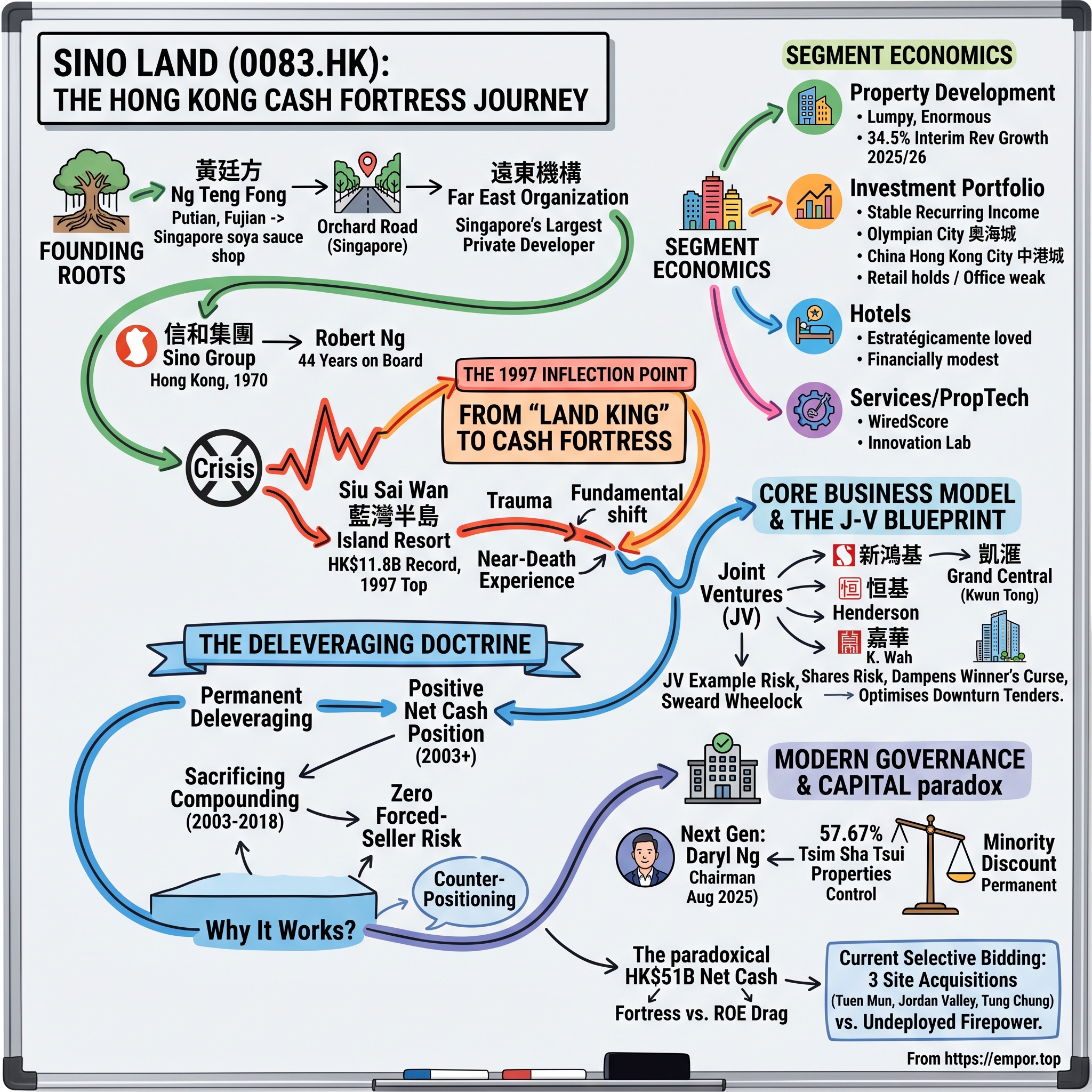
We start with the founders' arc: the journey of 黃廷方 Ng Teng Fong from Putian, Fujian to a Singapore soy sauce shop, the building of 遠東機構 Far East Organization into Singapore's largest private developer, and the decision to cross the South China Sea and plant a second flag in Hong Kong.
Then the 1997 trauma — the moment Sino Land's aggression earned it the moniker 地王 "Land King", the record-shattering Siu Sai Wan land purchase at the exact top of the market, and the near-death experience that followed. This is the hinge of the entire story. Everything Sino Land does today is legible only as a reaction to what happened after 1997.
Third, the joint-venture blueprint: how a company that once bid alone and enormous became the most reliable syndicate partner in Hong Kong, appearing again and again alongside 新鴻基地產 Sun Hung Kai Properties, 恒基兆業 Henderson Land, 嘉華國際 K. Wah International and 會德豐 Wheelock and Company.
Fourth, segment economics — where the money actually comes from, and in what proportion. Development sales are lumpy and enormous; rental income from assets like 奧海城 Olympian City and 中港城 China Hong Kong City is small but reliable; hotels are strategically loved and financially modest.
Fifth, governance and the next generation. In August 2025, after 44 years on the board, 黃志祥 Robert Ng Chee Siong retired as Chairman and handed the company to his son, 黃永光 Daryl Ng Win Kong.67 That transition happened less than a year ago, and it is the most under-analysed variable in the story.
And finally, the capital allocation paradox. Is a HK$51 billion cash pile an impregnable moat, or a HK$51 billion admission that management cannot find anything better to do? We will test both readings against the evidence — the peer comparison, the deployment record, the dividend, and what management has actually said versus what it has actually done.
Let us begin where the cash instinct was born: not in Hong Kong, but in a shophouse in Singapore.
 Subscribe on LinkedIn
II. Founding Roots & The Ng Family Empire (0:15 – 0:40 / 25 mins)
The boy arrived in Singapore at the age of six. His parents, emigrants from Putian in Fujian province, set up a soya sauce factory and a grocery shop — the kind of business where margins are counted in cents, credit is extended on a handshake, and the difference between a good year and a ruinous one is whether your customers pay you.8 黃廷方 Ng Teng Fong (1929–2010) grew up inside that arithmetic. He would later run one of Asia's largest property empires, but the instincts formed behind a shop counter never left him: cash is not an abstraction, it is the thing that lets you open the doors tomorrow.
He entered real estate in the 1950s and formally established Far East Organization in 1960.8 The timing was extraordinary — Singapore was about to detach from Malaysia, urbanise at speed, and rehouse a population from kampongs into concrete. Ng bought aggressively along Orchard Road when Orchard Road was not yet Orchard Road, and earned the nickname "King of Orchard". Within two decades Far East was Singapore's largest private property developer.8 By the time he died in 2010, Far East and its Hong Kong sibling had between them developed more than a thousand properties, and he was ranked Singapore's wealthiest man.8
Crossing the water. What makes the Ng story structurally unusual is that Ng Teng Fong did not simply expand Far East into Hong Kong. He built a second, separate empire there. 信和集團 Sino Group was founded in Hong Kong around 1970, and Ng drove it into the top tier of the territory's developers.8 信和置業 Sino Land was subsequently listed on the Hong Kong Stock Exchange, with the family's control held through a listed parent, 尖沙咀置業 Tsim Sha Tsui Properties Limited (0247.HK) — an arrangement that persists today, with Tsim Sha Tsui Properties holding 57.67% of Sino Land as at 30 June 2025.9
The two arms were then divided along a clean generational line. Far East Organization in Singapore stayed private, run by Ng Teng Fong's elder son Philip Ng as CEO. Sino Group in Hong Kong went public and was run by the second son, Robert Ng, who joined the Sino board in 1981 and took charge in 1991.6 Two brothers, two cities, two entirely different disclosure regimes. One family balance sheet philosophy.
That structural detail matters more than it first appears. Because Far East is private, the family has always had a large pool of wealth that is not subject to quarterly scrutiny, activist letters, or index-fund voting policies. Sino Land, the listed vehicle, has never had to be the family's only store of value. A minority shareholder in 0083.HK is therefore not investing alongside a family whose entire net worth depends on Sino Land's return on equity. This is the first and most important thing to understand about why the cash sits where it sits.
Robert Ng's Hong Kong. The son who inherited the Hong Kong arm was, by temperament and circumstance, formed by a harder market than his father's Singapore. Robert Ng joined the Sino board in 1981, at the moment Hong Kong property was heading into the confidence crisis that accompanied the Sino-British negotiations over the territory's future, and took charge a decade later.6 He would go on to serve 44 years on that board before retiring in 2025 — a tenure spanning the handover, two full property crashes, the SARS collapse, the global financial crisis, and the post-2019 correction.7
Very few Hong Kong executives have been in the same seat long enough to have personally experienced that many cycles. It is difficult to read Sino Land's balance sheet policy without accounting for the fact that the person setting it had watched the market break, repeatedly, from a position of full personal exposure. Investors sometimes describe conservative capital allocation as a "philosophy". Here it is closer to a memory.
Why the Hong Kong bet was structurally different from Singapore. The two markets the family operated in look superficially similar — dense Asian city-states, land-scarce, government-controlled supply, high home ownership aspiration. They are in fact governed by opposite logics. Singapore's state builds and sells the majority of housing directly through public channels, capping the private sector's share and dampening the cycle. Hong Kong left far more of the market to private developers and financed its government substantially through selling them land. The result was that Hong Kong's private property market ran hotter, cycled more violently, and rewarded leverage more richly — right up until it didn't.
The board on which they played. Hong Kong's property market is not a free market in land, and never has been. Effectively all land is held on Crown — now Government — leasehold, and the state is the sole original supplier. The government releases sites through competitive tender, which means it controls both the quantity and, indirectly, the price of the single most important input in the industry. For decades this created a fiscal loop that shaped everything: land premium receipts funded a large slice of public spending, which gave the government a structural interest in not flooding the market. Even in the 2026-27 financial year, with the market recovering, the government budgeted only around HK$18 billion of land premium revenue and released a strikingly thin residential programme, explicitly prioritising market stability over revenue maximisation.10
Layer on the second structural feature: the Hong Kong dollar's peg to the US dollar. Because the peg fixes the exchange rate, Hong Kong cannot set its own interest rates — it imports them from the Federal Reserve. Think of it as a house with no thermostat: whatever temperature Washington chooses, Hong Kong lives in. When the Fed tightened hard in 2022-2023, Hong Kong's benchmark interbank rate, HIBOR, was dragged up to a peak of 5.63% in December 2023 — punishing mortgage borrowers and leveraged developers in a city whose economy was not remotely booming. When the Fed cut, HIBOR collapsed, averaging 1.00% by July 2025.9 Neither move had anything to do with Hong Kong's own property cycle. This is the single most under-appreciated risk factor in Hong Kong real estate: the cost of money is set abroad.
Into this system came a small club of family developers — 長江實業 CK Asset, Sun Hung Kai Properties, Henderson Land, New World Development, and Sino Land among them — who learned to buy scarce land, bank it patiently, and sell into a structurally supply-constrained market. It was, for forty years, one of the great wealth-creation machines in the world.
Why the oligopoly was so durable. It is worth pausing on the mechanics, because they explain why this small group has been so hard to displace. Land is sold in large, indivisible parcels that require enormous single cheques. Construction in Hong Kong is unusually difficult — vertical, dense, on reclaimed land or steep hillside, under building codes among the world's most demanding. Presale rules require developers to obtain consent before marketing unbuilt flats, which favours firms with established compliance machinery. And the buyer's ultimate decision — which flat, in which building, near which MTR station — is decided by a location that only a handful of firms have spent fifty years accumulating.
The result was a market where the incumbents did not need to be operationally brilliant. They needed to be present, patient and solvent. Two of those three are free. The third is where developers die.
That is the lesson the 1990s taught in reverse. Because land had risen for so long, borrowing to buy it looked less like risk-taking and more like arithmetic: if the asset appreciates faster than the interest accrues, more debt is simply more profit. Every developer in Hong Kong internalised this. Ng Teng Fong internalised it more aggressively than most. And in 1997, it nearly destroyed the company he had built.
III. The 1997 Inflection Point: From "Land King" to Cash Fortress (0:40 – 1:10 / 30 mins)
Picture a Hong Kong government land auction in the mid-1990s. The room is packed. The auctioneer works a gavel. Developers' representatives signal in small, practised gestures, and the numbers climb in increments that would buy a mid-sized company elsewhere in Asia. And in that room, more often than anyone else was comfortable with, the winning paddle belonged to Sino Land. The nickname the market gave Ng Teng Fong — 地王, "Land King" — was not entirely a compliment. It described a man who kept bidding after everyone else had stopped.
March 1997. The handover to Chinese sovereignty was three months away. Hong Kong property prices had gone near-vertical. And Sino Land led a consortium that paid HK$11.82 billion for a waterfront residential site in Siu Sai Wan, on the eastern tip of Hong Kong Island — the most expensive land transaction in the city's history at the time, and a record that stood for two decades until mainland bidders took an Ap Lei Chau site for HK$16.86 billion in 2017.11 The site became 藍灣半島 Island Resort.
It is hard to overstate how badly timed this was. It was, effectively, the last great land purchase of colonial Hong Kong, executed at the absolute crest of the bubble. Within months the Asian Financial Crisis had detonated across the region. Currencies broke. Capital fled. Hong Kong defended its peg by letting interest rates spike violently — the only tool the currency board permits — which meant mortgage costs exploded at precisely the moment buyers vanished. Residential property prices in Hong Kong entered a decline that would ultimately run for roughly six years and take the market down by well over half.
What that does to a leveraged developer. The mechanics are brutally simple and worth spelling out, because they explain everything that follows. A developer that has committed HK$11.8 billion to a site has typically funded it with a mix of bank debt and equity, on the assumption that flats sold on completion will repay the loan with a profit. If prices then fall 50%, the revenue side of that equation halves while the debt side does not move at all. Worse, the developer must keep paying interest through the construction period — at rates that have just doubled. And worst of all, the bank looks at the collateral, sees it has halved in value, and asks for more security or a partial repayment. That is the moment a solvent company becomes an insolvent one, not through bad operations, but through arithmetic.
Sino Land did not go under. But it came close enough to feel it. The most vivid documented moment came in January 1998: Sino Land's stock fell 45% in a single day on a rumour that the Ngs had missed a loan payment. The report was later proved false — but as Forbes noted at the time, the price action was "a clear sign of how jittery investors had become".12 Across the region, the combined fortunes of the Ng family and Singapore's Kwek family fell by an estimated US$5 billion.12
Read that January 1998 episode carefully, because it is the founding trauma. The company was not actually in default. It was simply believed to be, for a few hours, and the market wiped out nearly half its equity value before lunch. When you are a leveraged developer in a falling market, your solvency is a matter of public opinion. The only way to make yourself immune to that is to hold so much cash that no rumour is survivable-adjacent — it must be self-evidently absurd.
This was not the family's first encounter with the violence of markets, either. A decade earlier, the October 1987 global crash had taken Hong Kong's stock market offline for four days and collapsed its futures market outright, requiring a government-organised rescue.13 Robert Ng was among the large index-futures speculators caught in that unwind; the individual settlements were negotiated privately and were never comprehensively disclosed. The point for our purposes is not the specifics but the pattern: this family had, by 1998, twice watched leverage and liquidity — not operations — nearly end them.
How the survival actually worked. The mechanics of getting through 1998-2003 were unglamorous and are worth stating, because they are the practical content of what later became doctrine. Developers in Sino Land's position had three levers and used all of them. They negotiated with banks — extending maturities, converting short-term facilities into longer ones, accepting tighter terms in exchange for time. They sold assets selectively, choosing what to release rather than being told. And they slowed construction and phased launches, stretching the sales programme over years instead of dumping inventory into a market with no bid.
Notice what all three have in common: each one buys time, and each one is available only to a company whose lenders believe it will still exist in three years. The developer that loses that belief loses access to every lever at once, which is why the January 1998 rumour was so dangerous. Solvency, credibility and optionality are the same asset viewed from different angles.
The mutation. What happened next is the most consequential strategic decision in Sino Land's history, and it was essentially a decision to stop doing something. The family navigated the crisis through the usual toolkit — bank negotiations, disciplined asset sales, patience on holding inventory rather than dumping it. But structurally, over the following two decades, Sino Land did something almost no other Asian developer did: it deleveraged permanently and then kept going, past zero, into a large positive net cash position, and stayed there through an entire property super-cycle.
Consider what that meant in practice. Between roughly 2003 and 2018, Hong Kong property prices rose relentlessly. Every year that Sino Land held cash instead of borrowing to buy land was a year it earned less than a leveraged competitor. Compounding at a lower rate for fifteen years is an enormous sacrifice. The company made it anyway.
Was this wisdom, or was it scar tissue? Honestly, the evidence supports both readings, and an investor should hold them simultaneously. Framed generously, the family concluded that in a business where the downside is total and the upside is merely large, survival probability is worth more than expected return. Framed skeptically, a controlling family that already had a second, private fortune in Singapore had far less reason to push the listed vehicle's returns than a minority shareholder would like — and turned its own risk preference into corporate policy.
The Island Resort epilogue. There is a coda to the Siu Sai Wan story that is easy to miss and worth stating, because it complicates both the bull and bear readings. The project was eventually built and sold. Island Resort became a large, well-occupied residential estate on the eastern harbourfront, and over the subsequent two decades Hong Kong property prices did not merely recover to 1997 levels — they went far beyond them. On a long enough timeline, the disastrous purchase was rescued by the cycle.
This matters because it means the lesson Sino Land drew was not "we overpaid for land." Over twenty-five years, they did not. The lesson was narrower and sharper: "we nearly did not survive long enough to find out." Solvency risk and valuation risk are different animals. A developer can be right about the asset and still be destroyed by the financing. Everything about Sino Land's subsequent behaviour is consistent with a firm that concluded it must never again let the financing decide the outcome.
The cost of the doctrine, honestly stated. Deleveraging from a crisis position to zero debt is a rational post-crisis move that many firms make. Continuing past zero into a large permanent net cash position, and staying there for two decades, is something else. It requires deliberately generating more cash than the business consumes, year after year, and declining to lever the balance sheet even when land is available and money is cheap. In the years from roughly 2009 to 2018, when Hong Kong property compounded strongly and borrowing costs were near zero, that choice cost shareholders real money in foregone returns. There is no way to characterise it otherwise.
The counterargument is that the same decade produced the peers whose balance sheets later needed rescuing. Both statements are true. The doctrine bought insurance, and insurance has a premium.
And two decades later, when the Mainland developer sector imploded and Hong Kong's own leveraged names started negotiating with lenders rather than buyers, the same balance sheet that looked timid in 2015 started to look like foresight. What Sino Land had to figure out next was how to stay commercially relevant — how to keep bidding on trophy sites without ever again writing a HK$11.8 billion cheque alone.
The answer was to stop bidding alone.
IV. Core Business Deep Dive: Industry Structure & The Joint-Venture Model (1:10 – 1:45 / 35 mins)
In May 2014, the 市區重建局 Urban Renewal Authority opened tenders for Development Areas 2 and 3 of the Kwun Tong Town Centre project — the largest urban renewal scheme Hong Kong had ever attempted, the reconstruction of an entire decayed district centre in Kowloon East. Six bids came in. The bidders read like a roll call of the industry: Cheung Kong, Henderson Land, Sun Hung Kai Properties, 鷹君 Great Eagle, and a consortium of Wheelock, 南豐 Nan Fung and New World Development. The winner was a Sino Land-led tender in which Sino held 90% and 華人置業 Chinese Estates Holdings the remaining 10%.14
Note the structure. Even when Sino Land wanted a project badly enough to lead it, and even when it could comfortably have funded 100% from its own balance sheet, it brought a partner. That is not a financing decision. It is a philosophy.
The completed project — 凱滙 Grand Central, 1,999 residential units above a shopping mall, a public open space, and Hong Kong's first air-conditioned public transport interchange — is now the template that the URA points to for district-based renewal.15 It is also a useful illustration of what modern Hong Kong development actually involves: not buying a field and building on it, but rehousing thousands of existing residents, reconfiguring a transport interchange, satisfying a public authority's social objectives, and delivering commercial returns on top. The entitlement cycle runs many years. The capital is committed up front. And there is no way to exit halfway.
Where land actually comes from. Hong Kong developers replenish land through four channels, and each has a different risk profile. Government tenders are the cleanest — pay the premium, get the site, build. URA redevelopments, as above, are slower and socially complex but come with planning support. 香港鐵路 MTR Corporation property tenders bolt residential and retail development onto rail stations, which is commercially wonderful (captive footfall, guaranteed transport) and operationally gruelling (you are building on top of a live railway). And there is farmland conversion and old-building assembly, the slowest route of all, where a developer buys individual flats in an ageing block one by one until it controls enough to force a compulsory sale.
Sino Land plays across all of these, but its distinguishing feature is how it takes the risk.
Why the tender system punishes optimism. A Hong Kong government land tender is a sealed-bid auction. Developers submit a single number; the highest compliant bid wins; there is no second round and no opportunity to revise. That structure produces a well-documented economic problem known as the winner's curse. If eight sophisticated firms each estimate a site's value and the highest estimate wins, the winner is by construction the firm that was most optimistic — which, on average, means the firm that most overestimated the asset.
The only defences against the winner's curse are to bid below your own estimate, to bid rarely, or to share the exposure with partners so that being wrong is survivable. Sino Land, since 1997, has visibly used all three. The Jordan Valley tender attracted competing bids from subsidiaries of essentially every major Hong Kong developer; Sino Land won it in partnership rather than alone.18 The Tung Chung tender drew six bids, with Sun Hung Kai bidding solo and Sino Land bidding jointly with Kerry.19 The pattern is consistent across a decade.
The syndicate blueprint. The logic of the joint venture, once you have lived through 1997, is almost mathematically obvious. Take the Grand Victoria site in South West Kowloon. In 2017, a consortium of Wheelock Properties, Sino Land, SEA Holdings, K. Wah International and 世茂 Shimao Group paid a land premium of HK$17.28 billion for New Kowloon Inland Lot No. 6549 — a 169,510 square foot waterfront plot.16 That headline number is larger than the Siu Sai Wan record that nearly broke the company twenty years earlier. But Sino Land's share of it was a fraction. The company got exposure to a trophy harbourfront site without ever concentrating its balance sheet on one bet again.
There is a second, subtler benefit that only becomes visible in a downturn. Shimao, one of the five partners, subsequently ran into the Mainland developer liquidity crisis and moved to sell its stake in the project.16 In a solo development, a funding problem is yours alone. In a syndicate, a distressed partner's stake becomes an opportunity for the partners with cash — which is precisely the situation Sino Land engineered itself into.
The JV model does more than spread risk. It changes the competitive dynamics of bidding itself. When four or five of the largest developers in a small market form a consortium for a given site, they are simultaneously not bidding against each other for that site. Whatever the regulatory framing, the practical effect on the auction price is downward. The same firms that compete ferociously on flat launches in Yuen Long routinely co-invest on the mega-plots where a bidding war would be mutually destructive. Sino Land is, by revealed behaviour, the industry's most consistent syndicate participant — which is exactly the role a cash-rich, risk-averse, patient balance sheet is suited to play.
The shape of the pipeline the model produced. Look at what Sino Land actually obtained occupation permits for in the year to June 2025 and the JV fingerprint is everywhere. Grand Mayfair I and II in Yuen Long, at roughly 291,710 attributable square feet, were joint ventures. Villa Garda in Tseung Kwan O, at about 382,587 attributable square feet, was a joint venture. La Montagne in Wong Chuk Hang, at roughly 159,576 attributable square feet, was a joint venture. Of the projects completed that year, only two smaller ones — a Lantau site and ONE CENTRAL PLACE in Central at about 84,261 square feet — were held 100%.9
Read that composition carefully. The wholly-owned projects are the small ones. Every large project is shared. This is not an accident of circumstance; it is a consistent policy applied across geography and product type, from mass-market New Territories flats to a Central boutique development. Sino Land takes full ownership when the sum at risk is small enough to be irrelevant, and shares it when it is not.
The corollary is that a large share of Sino Land's economics sits in associates and joint ventures rather than in consolidated subsidiaries — which is why the company reports property sales, rental and hotel figures on an "attributable" basis including its share from associates and JVs.9 For an investor, this is a genuine analytical friction: consolidated revenue understates the business, headline balance sheet figures understate the assets under influence, and comparing Sino Land's reported line items directly against a peer that develops solo produces misleading conclusions. It is disclosed clearly, but it requires work.
Benchmarking the balance sheet. Now the comparison that defines the investment case. As at 30 June 2025, the Group held cash and bank deposits of HK$52,256 million against total borrowings of HK$2,683 million, leaving net cash of HK$49,573 million.9 Because it is in a net cash position, the conventional gearing ratio — net debt to shareholders' equity — is not merely low; it is not applicable, and the company says so in its own filings.9 Of the small amount of borrowing that does exist, 67.1% is repayable within a year, and all of it is denominated in Hong Kong dollars, meaning the company carries essentially no currency mismatch between its liabilities and the market where its assets sit.9 Total assets stood at HK$185,514 million.9
Set that against New World's roughly HK$165 billion of net debt including perpetuals and net gearing north of 90% at end-2024.1 These two companies are in the same industry, in the same city, subject to the same interest rate cycle imported from the Federal Reserve, and facing the same six-year price correction. One spent the middle of 2025 negotiating the largest refinancing in Hong Kong corporate history. The other spent it deciding which government land tender to enter.
That is not a small distinction, and it has a specific, testable consequence: it determines who can buy in a downturn. In August 2025, Sino Land won a government tender for a residential site on Hoi Chu Road in Tuen Mun for HK$1.09 billion, beating CK Asset, 嘉里建設 Kerry Properties and 中國海外發展 China Overseas Land & Investment — the government's first residential plot sale of that financial year.17 The site, of about 282,103 square feet of attributable floor area, sits near the MTR Tuen Mun South extension under construction.9 In January 2026, a joint venture between Sino Land and Great Eagle took New Kowloon Inland Lot No. 6674 at Choi Hing Road in Jordan Valley for a premium of HK$1.61 billion on a 50-year grant — a site that also obliges the developer to build a day activity centre and hostels for mentally handicapped residents, a reminder that Hong Kong land grants routinely carry social obligations attached to the title.18 And in May 2026, Sino Land submitted a joint offer with Kerry Properties for the Tung Chung Town Lot No. 54 site, one of six bids for a waterfront parcel near the future Tung Chung East MTR station expected to yield around 990 residential units.19
Three acquisitions in twelve months, two of them with partners, none of them requiring a single dollar of new borrowing. That is the cash fortress converting from a defensive asset into an offensive one — which is the entire bull case, and it is finally being tested in real time.
The obvious question is whether the underlying businesses those acquisitions feed are actually any good. So let us open the engine.
V. Segment Analysis: Cash Flows, Value Drivers & Economic Weight (1:45 – 2:15 / 30 mins)
Walk into 奧海城 Olympian City on a Saturday afternoon and you will find something that has become rare in Hong Kong retail: a mall that is genuinely busy with people who live nearby. It sits directly above the MTR's Olympic Station in West Kowloon, wrapped in residential towers that Sino Land co-developed with the railway. It is not a luxury temple selling handbags to tourists. It is a regional catchment mall, and that distinction has turned out to be worth a great deal in the 2020s.
Sino Land's business divides into four unequal parts, and the honest summary is that one of them makes most of the money in a good year, one of them makes the money that arrives regardless, and two of them are rounding errors that matter for reasons other than profit.
Property development: the engine, and the volatility. For the financial year ended 30 June 2025, total revenue from property sales attributable to Sino Land, including its share from associates and joint ventures, was HK$10,813 million, up from HK$8,893 million a year earlier.9 The completions driving that were Grand Mayfair I & II in Yuen Long, Villa Garda in Tseung Kwan O and La Montagne in Wong Chuk Hang, alongside continued sales of remaining stock in previously completed projects including St. George's Mansions in Ho Man Tin, Grand Victoria, La Marina, Silversands in Ma On Shan and ONE SOHO in Mong Kok.9
Look at the sell-through numbers in that stock list, because they are the tell. As at the end of the financial year, Grand Victoria was 95.8% sold, La Marina 96.5%, Silversands 91.9%, Grand Mayfair II 85.0% — and St. George's Mansions, the ultra-luxury Ho Man Tin project, only 74.9%.9 The pattern is consistent with what every Hong Kong developer experienced through the correction: mass and mid-market product cleared; the very top end did not. Ultra-luxury inventory is the hardest thing to move when confidence is weak, because the buyer pool is small, discretionary and internationally mobile.
Here is where the balance sheet stops being an abstraction. A developer with heavy debt and unsold luxury stock has to cut prices, because the lender's clock is running. Sino Land, carrying no meaningful debt, can simply hold the flats and wait — which it visibly did, and which is why St. George's units were still being released for sale years after completion. Whether that patience maximises value is genuinely unknowable; holding inventory has a real opportunity cost, and a slow sell-down at a good price is not obviously better than a fast one at a slightly worse price. But it does remove forced-seller risk, which is a different and more defensible claim.
The recent momentum has been real. In the six months to 31 December 2025, revenue rose 34.5% to HK$5,185 million, with attributable property sales revenue of HK$6,912 million against HK$2,448 million a year earlier.3 Between 1 July 2025 and 13 February 2026 the group sold 2,325 units, of which 1,052 were attributable to Sino Land, across launches including Villa Garda, Grand Mayfair III and ONE PARK PLACE, plus residential units and car parking at St. George's Mansions.3 Management pointed to two further launches in 2026: La Mirabelle in Tseung Kwan O and the Wing Kwong Street/Sung On Street development in To Kwa Wan.3
Property investment: the cash that arrives regardless. As at 30 June 2025, Sino Land held approximately 13.4 million square feet of attributable floor area in investment properties and hotels across Mainland China, Hong Kong, Singapore and Sydney, of which retail and office accounted for 63.7%, industrial 11.7%, car parks 11.7%, hotels 8.7% and residential 4.2%.9 Attributable gross rental revenue for the year was HK$3,486 million, down 1.8%, with net rental income down 4.4% to HK$2,782 million.9 In the following interim period rental revenue slipped a further 2.3% to HK$1,708 million.3
Those are small declines, but the composition beneath them is the interesting part. Overall portfolio occupancy was 89.6%, down 1.2 percentage points. Residential leasing actually improved sharply, up 3.9 points to 90.7%. Retail held at 92.6%. Office fell to 83.9% from 86.5%.9
The retail portfolio's quiet defence. Sino Land's response to the retail shift is instructive because it is unglamorous and measurable. Rather than chase tourist spend, the company leaned into marketing campaigns tied to the government's tourism revitalisation push, deepened collaborations with tenants on payment-linked promotions, and pushed its "S+ REWARDS" loyalty programme — and reported positive year-on-year foot traffic growth at its major flagship malls even as overall consumption stayed soft.9
Foot traffic up while spending is soft is a specific and honest signal: the malls are still winning the visit, but the visit converts to less. For a landlord, that is better than the alternative, because footfall is what tenants ultimately pay rent for. It is also why retail occupancy held at 92.6% while office fell — a neighbourhood mall's tenants have nowhere better to go, whereas an office tenant in 2025 Hong Kong had a great deal of choice.
The other retail asset worth naming is 中港城 China Hong Kong City on the Tsim Sha Tsui waterfront, a mixed-use retail, office and cross-border ferry terminal complex, sitting alongside the Tsim Sha Tsui East office cluster that includes Tsim Sha Tsui Centre and Empire Centre. These are legacy assets acquired at historical cost bases that could not be assembled today at any price — which is a genuine advantage in book value terms, and a genuine liability in the sense that the office component sits in exactly the segment currently under the most pressure.
That divergence tells the whole story of Hong Kong property in the mid-2020s in three numbers. Residential leasing is strong because the government's talent admission schemes have imported people — over 510,000 applications and roughly 220,000 skilled individuals and their families relocated, according to the company's own summary of the programmes.9 Retail is holding because a neighbourhood mall serves residents who still need groceries, dentists and dinner, even as mainland tourists shifted spending toward experiences and Hong Kong residents increasingly cross the border to shop in Shenzhen — a structural change the company acknowledges directly in its own review.9 Office is weak because Hong Kong built a great deal of Grade A space into a market that then shrank; citywide Grade A vacancy reached 17.5% in 2025, with values more than 50% below peak.4 The government has responded by pausing new commercial land sales and permitting hotels and commercial buildings to be converted into student accommodation.9
The investor takeaway is uncomfortable but clear: the recurring-income portfolio is stable, not growing. It is a floor, not an engine. Anyone underwriting Sino Land on the theory that rental income compounds should look hard at three consecutive periods of negative rental growth and adjust.
Hotels: strategically loved, financially modest. Hotel revenue including the attributable share from associates and joint ventures was HK$1,506 million for FY2025, with operating profit of HK$475 million — both slightly below the prior year.9 In the following half-year, hotel revenue rose to HK$822 million and operating profit to HK$289 million.3 The portfolio comprises The Fullerton Hotel Singapore, The Fullerton Bay Hotel Singapore, The Fullerton Ocean Park Hotel Hong Kong, Conrad Hong Kong, The Fullerton Hotel Sydney and The Olympian Hong Kong.9
Set HK$475 million of hotel operating profit against a group underlying profit of roughly HK$5.1 billion for the year and the proportionality is obvious.20 Hotels are a single-digit-percentage contributor. They matter to the family — The Fullerton is a genuine luxury brand with heritage assets in three cities — and they matter for the group's positioning. They do not move the earnings needle. The dynamics are worth one line: Hong Kong visitor arrivals rose to nearly 47.0 million in FY2025 from 42.3 million, helped by the 50,000-seat Kai Tak Stadium opening in March 2025, but room rates came under pressure because mainland visitors increasingly travel same-day and book late.9 More bodies, less spend per body — a pattern visible across Hong Kong hospitality.
Property management and services. The smallest segment, and the one investors most consistently ignore. Sino's management arm services a large portfolio of buildings — residential estates, offices, malls and industrial properties — providing building maintenance, security, cleaning and car park operations for recurring fees. The revenue is small and the margins are thin by design; property management in Hong Kong is a cost-plus business governed by owners' committees who scrutinise every line item.
Its strategic value is therefore not financial. It is informational and operational. A developer that manages the buildings it sold knows, in real time, how its product ages, what residents complain about, which estates are turning over, and what a given design decision costs to maintain twenty years later. It is also the channel through which the technology programme actually lands: an innovation lab is a press release unless there is an operating platform of hundreds of buildings on which to deploy what it produces. Sino Land reported that 35 of its managed properties achieved WiredScore digital infrastructure certification in FY2025, which is only possible because it controls the buildings' operations rather than merely having sold them.9
Be precise about what this is worth, though. It is a modest operational advantage and a real feedback loop. It is not a moat, and no investor should underwrite Sino Land on the strength of its facilities management arm.
Mainland China and the geographic mix. As at 30 June 2025, Sino Land held approximately 3.5 million attributable square feet of land bank in Mainland China, of which about 1.7 million square feet were projects under development — principally a 100% interest in Dynasty Park Phase IV in Zhangzhou and a 20% interest in The Palazzo in Chengdu.9 Against a total land bank of approximately 18.9 million attributable square feet, that is a genuinely small exposure.9 In the context of the Mainland property crisis, restraint north of the border was one of the more valuable decisions Sino Land did not have to explain.
The land bank composition itself is revealing: 48.8% commercial, 26.2% residential, 10.5% industrial, 8.3% car parks and 6.2% hotels, split by status into 4.0 million square feet under development, 13.4 million square feet for investment and hotels, and 1.5 million square feet held for sale.9 Management describes it as sufficient for development needs "over the next few years" and commits to being selective in replenishment.9
Myth versus reality: three consensus claims, checked.
Myth: "Sino Land's net cash covers most of its market capitalisation, so you get the business almost free." Reality: net cash of HK$51.4 billion against a market value of about HK$102 billion is roughly half, not "most".35 The figure quoted in older commentary reflected a much lower share price; the stock has re-rated, and the margin of safety is correspondingly thinner than the popular framing suggests. Half is still a striking number. It is not the same number.
Myth: "The recurring rental portfolio is a growing, defensive income stream." Reality: it is defensive but it is not growing. Gross rental revenue fell 1.8% in FY2025 and a further 2.3% in the following half-year, with net rental income down more sharply than gross because a government waiver fee concession expired and demand notes came due on new properties.93 Occupancy declined at the group level. The portfolio is holding a line, not advancing one.
Myth: "The high-rate era proved cash is a permanent competitive weapon." Reality: it proved cash is a cyclical weapon. The same HIBOR that made deposits lucrative in 2023 had collapsed to around 1% by mid-2025, and the company's flat FY2025 underlying result was attributed in part to precisely that decline in interest income.920 A moat that disappears when the Federal Reserve cuts rates is not a moat; it is a position.
None of these corrections is fatal to the investment case. But each moves the case from "obvious" to "conditional" — and conditional cases require you to specify the conditions.
What the land bank language reveals. Management describes its replenishment posture as "selective", which deserves scrutiny, because it is the hinge between the balance sheet and the business.9 A developer that is permanently selective eventually becomes a developer that is permanently smaller: the land bank depletes as projects complete, and if it is not replaced at least as fast, future development revenue shrinks mechanically. At approximately 18.9 million attributable square feet, of which only 4.0 million is under development and 1.5 million held for sale, the pipeline is adequate but not expansive.9 Roughly three-quarters of the land bank is, in substance, the investment and hotel portfolio — assets the company intends to keep, not sell.
That is a structurally different company from the one that bid HK$11.82 billion for a single site in 1997. It is smaller in ambition, safer in construction, and dependent for growth on decisions that have not yet been made. Which brings us to the people making that call — and to a chairman who took the job less than a year ago.
VI. Modern Management, Governance & Capital Deployment (2:15 – 2:45 / 30 mins)
On 31 August 2025, Robert Ng Chee Siong stepped down as Chairman and Executive Director of Sino Land after 44 years on the board, and his son Daryl Ng Win Kong — then 47, an Executive Director since April 2005 and Deputy Chairman since November 2017 — took the chair.76 It was the third generation of the family taking control of the Hong Kong arm, and it happened with a minimum of drama: no contested succession, no strategic review, no change in the dividend.
That smoothness is itself a data point. Family succession in Asian property is where empires historically fracture. Sino's transition was signposted for nearly a decade through the deputy chairmanship, executed on a stated date, and accompanied by no change in stated strategy. For a controlled company, orderly succession is a governance strength — but it is worth noting that the same control structure that made the transition easy also means minority shareholders had no say in it.
The ownership arithmetic. Control runs through Tsim Sha Tsui Properties, which held 57.67% of Sino Land as at 30 June 2025.9 That single number governs everything about the minority shareholder experience. No activist can win a vote. No board seat can be contested successfully. No special dividend can be forced. No buyback can be mandated. If a shareholder disagrees with the capital allocation policy, the only available action is to sell. Investors should price this honestly rather than treat it as a footnote: a persistent valuation discount at a controlled company is not an anomaly to be arbitraged away, it is the market charging rent for a structural inability to influence outcomes.
The absence of financial engineering, as evidence. One of the more telling things about Sino Land is what does not appear in its filings. There are no perpetual securities — the hybrid instruments that flatter reported gearing by sitting in equity while behaving like debt, and whose deferred coupons became the visible symptom of distress elsewhere in the sector.1 There is no complex offshore financing structure. All of the group's debt is denominated in Hong Kong dollars, matching the currency of its assets, and the company states plainly that foreign exchange exposure is kept minimal.9
For a company of this asset scale, that is close to a null financing strategy — and deliberately so. The absence of engineering is itself the policy. It also has a practical consequence for analysis: there is very little in Sino Land's accounts that requires an investor to reverse-engineer economic reality from presentational choices, which is not something that can be said of every large property company. Specific executive compensation levels are disclosed in the annual report rather than summarised here, but the broader posture — generational planning, no leverage, no hybrids, no structural complexity — is consistent and observable.
A second-layer note on the accounting. There is one judgment area worth flagging for anyone reading the reported numbers rather than the underlying ones. Sino Land, like every Hong Kong property company, carries its investment properties at fair value, with changes running through the income statement. Those valuations are estimates produced by professional appraisers using assumptions about market rents and capitalisation rates — inputs that are genuinely uncertain when office values are more than 50% below peak and transaction evidence is thin.4 The HK$682 million net revaluation loss in the December 2025 half-year is a non-cash item, and the company sensibly directs attention to underlying profit, which excludes it.3
That is the correct presentation, and Sino Land is consistent about it. But investors should hold two thoughts simultaneously. First, revaluation losses do not consume cash and do not threaten a company with no debt covenants tied to asset values — which is exactly why a fortress balance sheet matters here. Second, a sustained decline in appraised values is still telling you something real about the earning power of the assets, and it should not be waved away simply because it is non-cash. The reported net profit fall from HK$1,820 million to HK$1,533 million was driven by this item; the underlying line was essentially flat.3 Both numbers are informative about different things.
The related-party structure deserves a similar flag. Sino Land sits inside a group where the listed parent holds the controlling stake and the family also controls a large private business in Singapore. That arrangement is long-established and disclosed, but it means transactions and strategic priorities are set within a group context rather than by Sino Land's minority shareholders. The group publishes its investor materials centrally across the listed entities.23
Daryl Ng's agenda. The next-generation programme has two visible planks, and it is worth separating what is substantive from what is presentational.
The first is innovation. In October 2018, Sino Group launched Sino Inno Lab, a sandbox platform for start-ups, inventors and technology companies to test PropTech solutions — robotics, artificial intelligence, big data, blockchain applications — in a real operating environment without disrupting live buildings.21 The economic logic is real if unglamorous: a developer that manages hundreds of buildings has a testbed that a start-up cannot otherwise access, and in exchange gets early access to tools that reduce building operating costs. Think of it as the property equivalent of a pilot plant.
The second is sustainability, and here Sino Land has accumulated an unusually dense set of third-party credentials. In FY2025 the company received validation from the Science Based Targets initiative for its long-term emissions reduction targets; it was named to the FTSE4Good Index Series for the first time and recognised on CDP's 2024 "A List" for climate action; it maintained an "AA" MSCI ESG rating; and it was honoured as a Global Sector Leader in the residential category of the 2024 GRESB Real Estate Assessment with a five-star rating.9 Thirty-five of its managed properties achieved WiredScore certification during the year.9
The commercially relevant question is whether any of this converts into cash. The honest answer is: partially, and mostly in one segment. In a Hong Kong office market with 17.5% vacancy, a landlord competing for the shrinking pool of multinational and financial tenants who have their own corporate decarbonisation mandates gains a real, if unquantified, edge from certified green space. Sino Land itself frames this as positioning to "attract tenants seeking high-quality, sustainable office environments".9 But it did not stop office occupancy falling 2.6 percentage points in FY2025.9 ESG credentials appear to be a necessary condition for competing at the top of the office market, not a sufficient one for winning.
The capital allocation record — what actually happened. This is where the story gets genuinely contested, and where the standard bull narrative needs stress-testing.
The narrative goes: the 2022-2025 high-rate environment turned Sino Land's cash pile into a profit engine while it crushed leveraged competitors. The first half of that is directionally true and the second half is entirely true. But the specific claim that the cash generated a large and durable interest income stream deserves a hard look, because rates have already collapsed. HIBOR fell from 5.63% in December 2023 to an average of 1.00% by July 2025.9 Cash that earned a high single-digit contribution to profits at the peak earns a fraction of that today. In its FY2025 commentary, broker DBS attributed the flat underlying result partly to lower interest income, alongside softer rental and hotel contributions, with higher development earnings making up the difference.20
That is the crucial and under-appreciated point. The interest-income windfall was a cyclical gift, not a structural moat. It has already substantially reversed. Underlying profit for FY2025 was broadly flat year-on-year at approximately HK$5.1 billion.20 Underlying profit for the six months to December 2025 was HK$2,220 million, essentially unchanged from HK$2,241 million a year earlier, even as revenue rose more than a third.3 Reported net profit fell to HK$1,533 million from HK$1,820 million, after a HK$682 million net revaluation loss on investment properties.3
Revenue up 34.5%, underlying profit flat. That gap is the whole diagnosis: development volume is recovering, but it is only just offsetting the decline in interest income and rental income. The engine is running harder to stay in the same place.
Dividend discipline. The dividend has been the most consistent thing about the company. FY2025 total dividend was HK58 cents per share — HK15 cents interim paid on 23 April 2025 plus a HK43 cents final — unchanged from the prior year, with a scrip alternative offered at a conversion price of HK$9.77 per share.920 The interim dividend for the following year was again held at HK15 cents.3 At HK$10.66 a share, HK58 cents is a yield of roughly 5.4%.5
Two observations. First, the dividend is comfortably covered: HK58 cents against underlying earnings per share of about HK$0.54 for the six-month period alone is a payout well within cash generation.3 Second, and more critically, the persistent scrip dividend option offsets cash outflow by issuing shares. A company holding HK$51 billion of cash that simultaneously encourages shareholders to take stock instead of cash is, at the margin, expanding its share count rather than shrinking it. For a stock trading at a large discount to net asset value, that is the opposite of what value-focused capital allocation would suggest. It is a small effect, but it points in a revealing direction.
What analysts actually push on. Sino Land does not publish full earnings call transcripts in the way a US-listed company does; its investor communication runs through results announcements, results briefings, non-deal roadshows, site visits and investor conferences, as the company describes in its own governance disclosure.9 That is a lower-transparency model than a public transcript, and it is worth naming as a disclosure limitation rather than glossing over it: an outside investor cannot easily audit the Q&A.
What can be observed is the sell-side output that follows those briefings, and it consistently circles one issue. DBS, reviewing the FY2025 results, framed the entire investment case around the balance sheet — describing the "strong net cash" position as leaving the company "well poised to pursue more accretive land acquisitions" — while simultaneously flagging that the shares traded at a roughly 73% discount to net asset value excluding cash.20 That pairing is the analyst community's polite way of asking the uncomfortable question: if the cash is so valuable, why does the market refuse to pay for it?
Management's answer, repeated across cycles, is that the cash exists to be deployed into land when others cannot bid. That is a coherent answer. It is also an answer that only becomes verifiable at the moment of deployment — which is precisely why the recent acquisition activity matters more than any statement.
Management credibility, tested. The consistency of the narrative across cycles is genuinely impressive: the message that the balance sheet exists to enable acquisitions at attractive valuations has appeared in the company's materials year after year, through both the boom and the bust. Consistency is not the same as being right, but it does mean management has not shifted its story to match whatever just happened — a low bar that many peers fail.
Where the record is now testable is deployment. Management said it would buy when others could not. In the twelve months to mid-2026, it bought a Tuen Mun site outright, a Jordan Valley site with a partner, and bid on Tung Chung with another. Combined, those commitments amount to a few billion Hong Kong dollars against a HK$51 billion cash position. That is a genuine acquisition record, and it is also a very small fraction of the available firepower. The company's own framing — "selective in replenishing its land bank" — is candid about this.9 A skeptic would say the fortress has been mobilised at a trickle. A supporter would say the Hong Kong government released almost no land to buy, budgeting just HK$18 billion of premium revenue for the entire 2026-27 year and offering only one small residential site in one quarter.10 Both are true, and they are not fully reconcilable.
Which brings us to the analytical frameworks — and to the harder question of whether any of this constitutes durable competitive advantage at all.
VII. Strategic Analysis: Helmer's 7 Powers & Porter's 5 Forces (2:45 – 3:05 / 20 mins)
Strategy frameworks are most useful when they force you to say what a company does not have. So let us run Sino Land through Hamilton Helmer's 7 Powers with genuine discipline, and admit where the answer is "none".
Counter-Positioning. This is the strongest claim in the file, and it is a real one. Counter-positioning exists when an incumbent's business model makes it unable or unwilling to copy a challenger's approach. Sino Land operates with a massive net cash position in an industry structured around leverage. Its competitors cannot easily replicate this — not because they lack the idea, but because deleveraging from 90% net gearing to negative gearing requires either a decade of retained earnings or a massively dilutive equity raise, and no leveraged developer will choose either in a downturn. The advantage manifests precisely when it matters most: when land prices fall, the cash-rich buyer bids and the levered buyer is negotiating with lenders.
The falsification test is straightforward and honest: has this advantage actually produced superior returns? Over the past two years, Sino Land has acquired three sites while a major peer restructured HK$88 billion of debt. That is directionally supportive. But the underlying profit line has been flat, and the acquisitions have been modest in scale. Counter-positioning here is demonstrated, but not yet converted. An investor should treat it as an option that has been proven to exist rather than a return that has been proven to arrive.
Cornered Resource. Partially present. Sino Land owns prime Hong Kong commercial and retail assets — the Tsim Sha Tsui East cluster, the Olympian City complex above an MTR station, the China Hong Kong City waterfront development with its cross-border ferry terminal — acquired at historical cost bases that cannot be replicated. Land at a rail interchange in a supply-constrained city genuinely is a cornered resource. But note the important qualifier: this power is shared with every other legacy Hong Kong developer. Sun Hung Kai's rail-linked portfolio is larger and arguably better located. Cornered resources that all your competitors also possess produce industry-level economics, not company-level outperformance.
Process Power. Modest but real. Executing a URA town centre redevelopment — rehousing residents, building a transport interchange, satisfying a public authority, delivering commercial returns — is an organisational capability accumulated over years, not bought. Sino Land has done it repeatedly, including winning consecutive phases of the Kwun Tong project.1415 Similarly, operating inside five-party joint ventures without paralysis is a skill. But process power in construction is slow-moving and partially transferable; competitors bid on the same tenders and win their share.
Scale Economies. Weak. Procurement savings from syndicate JVs and centralised property management exist but are marginal in a business where the dominant cost is land, and land is priced at auction against equally scaled rivals. Sino Land is not the largest Hong Kong developer, and there is no evidence of a construction cost advantage.
Switching Costs, Network Economies, Branding. Effectively absent for the core business, and it is important to say so plainly. A homebuyer choosing between developments compares location, price, layout and finish. There is no lock-in, no repeat-purchase dynamic, no digital network. Sino has a respected brand in Hong Kong residential, which supports launch pricing at the margin, but it does not command a structural premium the way a luxury goods brand does. On hotels, The Fullerton has genuine brand equity — in a segment contributing single-digit percentages of profit.
So the honest Helmer scorecard: one strong power (counter-positioning), two moderate (partial cornered resource, process power), and four essentially absent. That is a company with a specific, cyclical, balance-sheet-derived edge — not a structurally advantaged compounder.
How that compares to the peer set. Place Sino Land against its three most relevant Hong Kong comparators and the differentiation sharpens.
Sun Hung Kai Properties is the scale and execution leader, with a deeper rail-linked portfolio and a larger development pipeline. Its powers derive from operational scale and land quality, not from its balance sheet. Henderson Land's distinctive capability is the patient assembly of old buildings and agricultural land — a genuine process power that Sino Land does not match. CK Asset has taken the opposite path from all of them, diversifying heavily out of Hong Kong property into infrastructure and utilities, effectively deciding that the Hong Kong land model no longer justifies concentrated exposure. And New World demonstrated what the same industry structure does to a firm that levers into it and gets the cycle wrong.12
Sino Land's position within that set is specific: it is not the biggest, not the best at land assembly, and not diversified. It is the one that cannot be forced to sell. In an industry where the historical mode of failure is a liquidity event rather than an operational one, that is a legitimate form of differentiation — but investors should be clear that they are buying financial resilience, not operational superiority, and price it accordingly.
Now Porter. The five forces analysis is where the industry, rather than the company, does the explaining.
Threat of new entrants: very low. The barriers are close to absolute. A new entrant would need billions of dollars of capital, decades of relationships with a small government land bureaucracy, and construction capability in one of the world's most demanding urban environments. Mainland developers tried to enter aggressively in the 2016-2018 window — the Ap Lei Chau record was set by a mainland consortium — and most of them subsequently retreated under their own debt pressures.11 The barrier held.
Bargaining power of buyers: high, and structurally so in a soft market. Homebuyers in Hong Kong face abundant choice among simultaneous launches from competing developers, and they demonstrated their power through the correction by simply not buying. Developers responded with discounts and incentives. The recovery has improved this — Hong Kong recorded 49,955 sale and purchase agreements in the first half of 2026, up 35.6% year on year, with aggregate value up 48.1% to HK$410.29 billion — but the underlying dynamic is unchanged.22 For the office portfolio, tenant power is currently extreme, which is precisely what 17.5% vacancy means in practice.4
Bargaining power of suppliers: moderate. Construction contractors and skilled labour in Hong Kong are in limited supply and costs have inflated. The company flags persistent inflationary pressure and prioritises cost management.9 This compresses development margins but affects all developers equally.
Threat of substitutes: moderate and rising in two segments. For offices, hybrid work and cross-border alternatives in Shenzhen and the Greater Bay Area substitute directly for Hong Kong Grade A space. For retail, the substitute is not another mall — it is a day trip north of the border, or an experience rather than a purchase. The company's own review identifies this shift in Chinese tourist behaviour and increased outbound travel by Hong Kong residents as reshaping the retail environment.9 Residential faces no meaningful substitute; people must live somewhere, and Hong Kong land supply remains rationed.
Rivalry: high, but strategically softened. This is the most interesting force in the Hong Kong context. Rivalry among the major developers is intense on flat launches, where they undercut each other openly. But on land acquisition — the input that actually determines long-run returns — rivalry is systematically dampened by the syndicate model. The bidders for a HK$17 billion harbourfront plot are frequently the same five firms, together.
A note on the rivalry paradox. It is worth dwelling on the strangest feature of this industry, because it has no clean analogue elsewhere. In most sectors, competitors that co-invest on their principal input would attract regulatory attention. In Hong Kong property, multi-developer consortia on government land tenders are entirely normal, disclosed, and effectively institutionalised. The government sells to whoever bids highest, and it has shown no inclination to restrict who may bid together.
The practical consequence is that the intensity of competition in Hong Kong property is asymmetric across the value chain. On the input side — land — the largest firms frequently cooperate. On the output side — selling flats to households — they compete brutally on price, discounts and mortgage subsidies. That is close to the opposite of the usual pattern, where firms compete for inputs and try to maintain discipline on price. It is also, for a developer with a low cost of capital and no urgency to sell, an unusually favourable structure: you can be selective about entering the competitive part of the chain while participating fully in the cooperative part.
The synthesis: Hong Kong property is a structurally attractive industry — high entry barriers, rationed supply, rivalry moderated by co-investment — that is currently experiencing a cyclical trough in two of its three main asset classes. Within that industry, Sino Land's differentiation is almost entirely financial rather than operational. That is a narrower edge than the "cash fortress" framing implies, and it cuts directly to the bull and bear cases.
VIII. Bear vs. Bull Case, Key KPIs & Playbook Lessons (3:05 – 3:30 / 25 mins)
Imagine an activist investor building a presentation on Sino Land. The first slide writes itself, and it is devastating in its simplicity: a company holding HK$51.4 billion of net cash against a HK$102 billion market value.35 Half the market capitalisation is a bank deposit. The second slide is the valuation: by DBS's assessment at the FY2025 results, the shares traded at roughly a 73% discount to net asset value excluding cash, offering a prospective dividend yield above 6% at the time.20 The third slide asks the only question that matters: why does this cash exist?
The bear case, argued properly.
The return-on-equity drag. This is the core structural criticism and it is arithmetically undeniable. Shareholders' funds at the parent level stood at HK$98,515 million as at 30 June 2025 against a group underlying profit of roughly HK$5.1 billion.920 A very large share of that equity base is invested in bank deposits earning, in a 1% HIBOR world, close to nothing in real terms. Every year that capital sits idle, the company compounds book value at a rate structurally below what a developer earning development margins on deployed capital would achieve. Over a decade, that gap is not a rounding error — it is the difference between a compounder and a store of value.
Deployment has been slow relative to firepower. Three site acquisitions totalling a few billion dollars over roughly a year is real activity, but it is a small fraction of available capital. Management's defence — that the government is releasing very little land, budgeting only HK$18 billion of premium revenue for 2026-27 and offering a single small residential site in one quarter — is factually accurate.10 But it is also a double-edged argument. If the supply of things worth buying is structurally constrained by government policy, then a HK$51 billion war chest sized for a buying opportunity that the government will not permit is, by definition, oversized. That is a capital return argument, not a strategy argument.
The cyclical windfall has already reversed. The high-rate era made the cash pile look brilliant. That era ended. With HIBOR down to around 1-2% and interest income falling, the cash now costs the company more in foregone returns than it generates.920
Structural pressure in two of three property segments. Office is in genuine distress citywide, with values more than 50% below peak and vacancy at 17.5%.4 Retail faces a real behavioural shift as spending migrates across the border. Sino Land's rental income has now declined for consecutive periods.93 Recurring income is not the reliable growth floor the narrative sometimes implies.
The governance discount is permanent, not temporary. With 57.67% held through Tsim Sha Tsui Properties, no external party can force change.9 Worse, from a minority perspective, the family's separate private Singapore fortune means the listed vehicle's ROE is not the family's primary wealth metric. Add the scrip dividend, which expands share count at a deep discount to NAV, and the pattern is of a company managed for permanence rather than per-share value.
The bull case, argued equally seriously.
Genuine asymmetry in the downside. Net cash equals roughly half the market capitalisation.35 That does not make the stock cheap on its own — value is only realised if the cash is eventually distributed or productively deployed — but it does make a permanent capital impairment scenario very difficult to construct. The company cannot be forced into a distressed sale, cannot face a covenant breach, and does not have refinancing risk. In an industry where the primary way investors lose everything is a liquidity event, that removes the main failure mode.
The optionality is real and has now been demonstrated. This is the part of the bull case that improved measurably in 2025-26. Before then, "we will buy when others cannot" was a claim. Now there is evidence: a competitive government tender won against CK Asset, Kerry and China Overseas in August 2025, a partnered acquisition in January 2026, and an active bid in 2026, all funded from cash.171819 Meanwhile the most leveraged large peer spent the same window refinancing.2 The mechanism works. The question is only magnitude.
Cycle timing may be turning. Hong Kong's property market appears to have inflected. JLL characterised 2026 as the year the office and housing markets led a recovery after roughly six years of correction.4 Transaction volumes and values in the first half of 2026 rose sharply.22 Sino Land's own revenue growth of 34.5% in the December half, driven by development completions, is consistent with that.3 A developer with a full land bank, a recovering market, and no debt service to fund is well positioned for a recovery — if one is genuinely underway.
The income floor is covered. A dividend held flat through the worst of the downturn, backed by rental income of roughly HK$3.5 billion a year and interest income on a large deposit base, is a genuinely defensive characteristic in a sector where multiple peers cut or suspended distributions.9
The why-win / why-not spine, stated plainly.
Why Sino Land wins from here, if it does. The mechanism is narrow and specific: it is the only large Hong Kong developer that can transact freely at the bottom of a cycle, because it has no lender to satisfy and no covenant to breach. If Hong Kong's recovery is real — and transaction volumes and values in the first half of 2026 say something is genuinely happening — then a company entering that recovery with a full land bank, no debt service, three recent site acquisitions and a stabilising rental base earns operating leverage that levered peers cannot match, because their recovery cash flow goes first to creditors.224 The evidence for this mechanism is behavioural and already partially observed: it won a contested government tender against three larger or equally capitalised rivals in August 2025, and it did so without financing.17
Why it might not. Three things break the case. First, the cash may simply never be deployed at scale, because the government does not sell enough land to deploy it into — and an undeployed fortress is a permanently value-destroying asset in a low-rate world, not an option. Second, the recurring-income base may keep eroding: office is in a structural, not cyclical, correction, and retail is losing wallet share across the border. If rental income declines for another three years, the "defensive floor" argument weakens materially. Third, the governance structure means none of this can be corrected by outside pressure; the discount can persist indefinitely regardless of the underlying value, because there is no mechanism to close it.
The most honest summary is that this is a company whose competitive edge is real but conditional, whose downside protection is genuine but only half as large as the popular framing suggests, and whose central question — what happens to HK$51 billion — has not yet been answered by management in any binding way.
What would falsify each case. The bear case breaks if Sino Land deploys a material fraction of the cash — say, a quarter of it — into land or asset acquisitions at trough valuations that subsequently generate development margins well above the cost of capital. The bull case breaks if the cash simply sits for another five years while rates stay low, rental income keeps eroding, and the discount to NAV persists because the market correctly concludes the cash will never be released.
The risk radar — only what is actually material here.
Interest rate and cost-of-capital risk, running backwards. For most developers, falling rates are unambiguously good. For Sino Land, they are ambiguous: lower rates support property prices and transaction volumes, which helps the development business, but they simultaneously destroy the earnings on HK$51 billion of deposits. The company is, unusually, partly short the property cycle through its balance sheet. This is the single most distinctive risk in the story and it is not widely modelled.
Concentration risk in one city. Approximately 3.5 million square feet of a roughly 18.9 million square foot land bank sits in Mainland China; the hotel portfolio adds Singapore and Sydney.9 Everything else is Hong Kong. That concentration protected the company from the Mainland developer crisis, and it exposes it entirely to Hong Kong's policy, demographic and cross-border dynamics. There is no geographic diversification to fall back on if Hong Kong's structural role changes.
Regulatory and political risk. The government is simultaneously Sino Land's principal supplier of land, its chief regulator, and the setter of stamp duty and mortgage policy that determines demand. Policy moves quickly: the stamp duty threshold change effective 26 February 2025, which raised the property value eligible for the HK$100 flat rate from HK$3 million to HK$4 million, materially altered transaction economics at the mass-market end.9 Favourable policy is currently a tailwind. It is not a contractual right.
Demand-side dependence on immigration policy. The strength in residential leasing and the recovery in home prices are meaningfully driven by talent admission schemes that have relocated roughly 220,000 skilled individuals and their families, alongside doubled non-local student quotas at publicly funded institutions from the 2024/25 academic year.9 This is a genuine demand driver and it is also a policy that can be tightened.
Execution risk in the transition. A chairman less than a year into the role, inheriting a strategy defined by his father's generation and a capital allocation question that has gone unanswered for two decades. There is no evidence of missteps. There is also, by definition, no track record as principal.
What is not a material risk here. Refinancing risk and covenant risk, which dominate the analysis of most peers, are essentially absent given HK$2,683 million of total borrowings.9 Cybersecurity and technology disruption exist but do not threaten the core economics of owning land in a supply-constrained city. It is worth being disciplined about this: the risks that matter for Sino Land are cyclical, political and allocational, not financial.
The three KPIs that actually matter.
One: net cash and, critically, what happens to it. Not the level — the direction, and the reason for changes. A falling net cash balance because land is being acquired at trough prices is the bull case executing. A falling balance because operating cash flow has turned negative is the opposite. A flat balance for years is the bear case winning by default. Watch this alongside the pace and pricing of land tender wins.
Two: development sell-through velocity and realised prices at launch. The percentage of units sold within the first weeks of a launch, and the price per square foot achieved, is the cleanest real-time read on both Hong Kong demand and Sino Land's own product positioning. The projects to watch are the 2026 launches — La Mirabelle in Tseung Kwan O and the To Kwa Wan development — plus the sell-down of remaining St. George's Mansions stock, which is the direct test of whether luxury demand has returned.3
Three: rental reversions and occupancy, split by segment. Group occupancy is a blended number that hides the story. What matters is whether office occupancy stops falling from its 83.9% level and whether retail holds above 90% as cross-border spending patterns settle.9 Rental reversion — the percentage change in rent on lease renewal versus the expiring rent — is the single best forward indicator, because occupancy can be defended by cutting rent, and a landlord doing so is losing while appearing to hold.
Three lessons that generalise beyond Hong Kong.
Crisis trauma becomes permanent corporate DNA. A company that nearly died in 1997-98 built the rest of its existence around never being in that position again — through fifteen subsequent years in which the caution cost it money. This is a real and underrated organisational phenomenon: the risk appetite of a firm is often set by the worst thing that ever happened to it, not by the current opportunity set. It produces resilience and it produces missed compounding, and it produces both from the same source.
Joint ventures convert competitors into risk-sharing partners. The syndicate model let Sino Land participate in mega-projects it would never fund alone, capped single-project exposure, and had the side effect of reducing the intensity of bidding wars. When a distressed partner needed to sell out of Grand Victoria, the structure turned a rival's problem into an option for those with capital.16 Structural cleverness in how you take risk can matter more than being right about the market.
Liquidity is the ultimate strategic option — and options have a carrying cost. This is the tension the whole story rests on. Unleveraged cash guarantees survival through any crisis; it also guarantees underperformance during any boom. An option only pays if you exercise it. Sino Land has now begun to exercise, modestly, in a market where the government is deliberately restricting what there is to buy.
Whether that patience eventually reads as discipline or as inertia depends on what happens to HK$51 billion over the next few years — and, for the first time in a generation, on the judgement of a chairman who has been in the seat for less than twelve months.
References
-
Hong Kong's New World Development Tumbles On Bond Payment Delays Amid Debt Troubles — Forbes, 2025-06-02 ↩↩↩↩↩
-
New World Development secures HK$88.2 billion loan refinancing deal — Dimsum Daily, 2025-06-30 ↩↩↩
-
Benefiting from Property Sales Growth, Sino Land Interim Revenue Increases by 34.5% to HK$5,185 Million — Media OutReach Newswire / Laotian Times, 2026-02-27 ↩↩↩↩↩↩↩↩↩↩↩↩↩↩↩↩↩↩↩
-
2026: Hong Kong's office and housing markets lead recovery after a six-year correction — JLL, 2026 ↩↩↩↩↩↩↩
-
Sino Land Company (HKG:0083) Market Cap & Net Worth — StockAnalysis, 2026-07-28 ↩↩↩↩↩
-
Billionaire Robert Ng's Eldest Son, Daryl, Taking The Helm At Hong Kong's Sino Group — Forbes, 2025-08-03 ↩↩↩↩
-
Robert Ng Retires as Sino Group Chair as Son Takes Over — Mingtiandi, 2025 ↩↩↩
-
Ng Teng Fong — Singapore Infopedia, National Library Board ↩↩↩↩↩
-
2024/2025 Annual Report to the shareholders — Chairman's Statement, Tsim Sha Tsui Properties Limited (Stock Code: 247), HKEXnews, 2025-08-27 ↩↩↩↩↩↩↩↩↩↩↩↩↩↩↩↩↩↩↩↩↩↩↩↩↩↩↩↩↩↩↩↩↩↩↩↩↩↩↩↩↩↩↩↩↩↩↩↩↩↩↩↩↩↩↩↩
-
Hong Kong keeps tight grip on housing land supply despite property rebound — South China Morning Post, 2026 ↩↩↩
-
Chinese builders pay record HK$16.86 billion for Ap Lei Chau site — South China Morning Post, 2017 ↩↩
-
Consortium of Sino Land, Chinese Estates Holdings wins deal to redevelop Kwun Tong — South China Morning Post, 2014 ↩↩
-
Park Metropolitan – DA1, Grand Central – DAs 2&3, Kwun Tong Town Centre Project — Urban Renewal Authority ↩↩
-
Shimao Selling Stake in Kowloon's Grand Victoria Project — Mingtiandi ↩↩↩
-
Sino Land wins Tuen Mun land tender with HK$1 billion bid amid an improved housing market — South China Morning Post, 2025-08-13 ↩↩↩
-
Jordan Valley site sold — news.gov.hk, HKSAR Government, 2026-01-07 ↩↩↩
-
6 bids for Hong Kong land sale signal renewed confidence despite market caution — South China Morning Post, 2026-05-15 ↩↩↩
-
Sino Land – Strong financials, inexpensive valuation — DBS Vickers, 2025-08-28 ↩↩↩↩↩↩↩↩↩
-
Sino Group Launches 'Sino Inno Lab' — PR Newswire Asia, 2018-10 ↩
-
Land deals jump 35.6% year-on-year in first half of 2026 — Dimsum Daily, 2026 ↩↩↩
 LinkedIn
 WhatsApp
 Reddit
 Hacker News
 Email
Email Kindle
 RSS Feed
 Spotify
 Apple Podcasts
 Amazon Music
 Audible
 YouTube