Shangri-La Asia: The Hotel Empire That Owns Its Rooms
I. A $1.9 Billion Hotel Company With $7.2 Billion of Enterprise Value
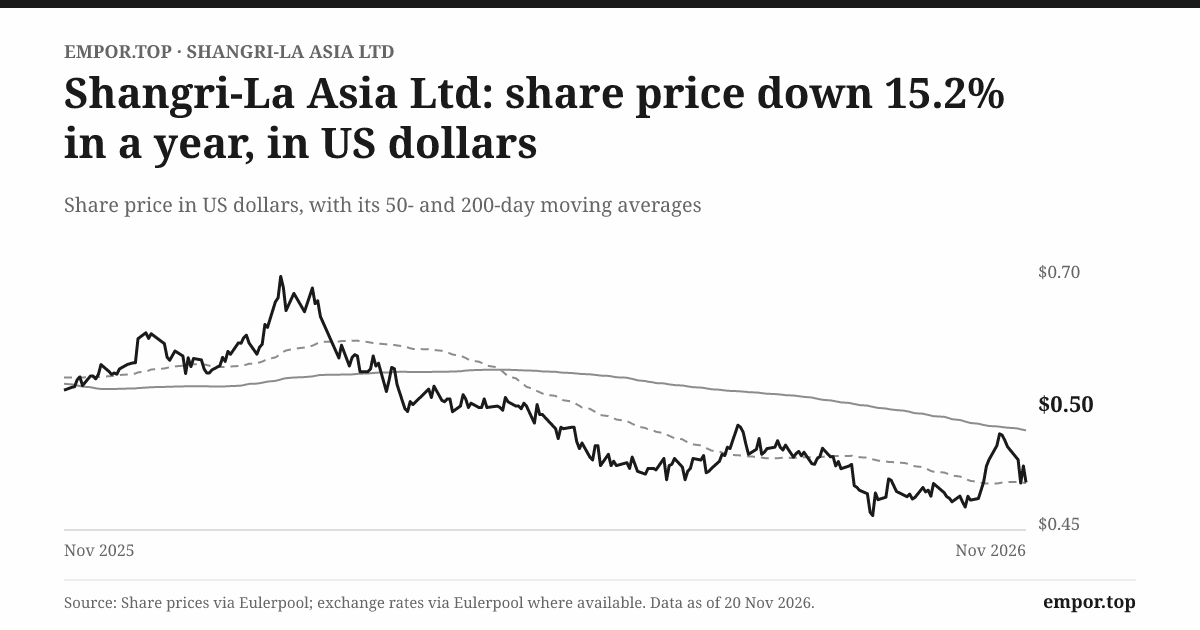
Walk into the lobby of a Shangri-La hotel almost anywhere in Asia and the effect is deliberate. The ceiling is high, the flowers are fresh, the staff seem to have been waiting for you in particular, and the whole room says that someone has spent a great deal of money so that you can feel, for a night or two, that money is no object. It is one of the best-known luxury hotel names in the region. Then step outside, open a brokerage screen, and look at the company that owns most of those lobbies. On 20 November 2026, 香格里拉(亞洲)有限公司 Shangri-La Asia Limited traded at about fifty US cents a share, a little above its 52-week low and more than a quarter below its high for the year.1 The whole company was valued by the stock market at roughly $1.9 billion.1
That number is the first puzzle of this story, because it is not really the size of the business. Add the company's debt, subtract its cash, and account for the partners who own slices of its hotels, and the enterprise value rises to about $7.2 billion, almost four times the market value of the shares.1 Most of what an investor buys here is not equity in a hotel brand. It is a claim that sits behind lenders, bondholders and lease obligations on a portfolio of buildings. The price of that claim is about 0.4 times the book value of the company's equity, which means the market values each dollar of net assets the accountants record at roughly forty cents.1
A discount that deep usually means one of two things. Either the market is wrong and the assets are worth far more than the share price implies, or the market is saying the assets earn too little on their recorded value to be worth that value to an outside shareholder. Shangri-La Asia has a respectable top line. In 2025 its consolidated revenue was about $2.23 billion, and its operating margin, at about 15%, was the best it had reported in more than a decade.2 Yet its return on equity was only about 2%, and its return on invested capital was below 2% for the year.2 A luxury brand with a 2% return on its capital is a contradiction that needs explaining, and the explanation is the subject of this episode.
The story turns on four questions. The first is whether the post-pandemic recovery is durable or merely a rebound from a very deep hole. The second is whether Shangri-La can grow as a fee platform, earning money from managing hotels that other people own, rather than only from the hotels on its own balance sheet. The third is whether the properties themselves generate returns that justify the debt and the constant reinvestment a luxury hotel demands. The fourth is whether the current leadership, sitting atop a controlled, asset-heavy company, can steward it credibly and be held to account when it falls short.
Before any of that, a boundary needs drawing, because Shangri-La is a name that describes several different things at once. There is the hotel brand that a traveller sees. There is the wider hotel group, which includes hotels held in partnership with other investors. And there is the listed company, whose financial statements consolidate only the subsidiaries it controls. Hotels held through associates, where Shangri-La owns a meaningful but non-controlling stake, do not show up line by line in its revenue; their profits arrive as a single line of equity-accounted earnings.2 The company also publishes an "effective share" view, which adds its proportional slice of those associates. In 2025, that effective-share revenue was about $2.71 billion, against the $2.23 billion that actually appears in the consolidated income statement.2 Both numbers are honest, but they answer different questions, and confusing them is the quickest way to overstate how large the listed company's own business is.
The last piece of the opening scene is the one that carries the whole story. At the end of June 2026, the group managed 107 hotels and resorts.3 The vast majority of them were hotels in which the group itself held an ownership interest. Only 19 were owned by third parties who simply paid Shangri-La to run them.3 The global hotel giants that dominate investor conversations, Marriott, Hilton and IHG, have spent decades selling off buildings and growing by signing management and franchise contracts. Shangri-La went the other way. It owns its rooms.
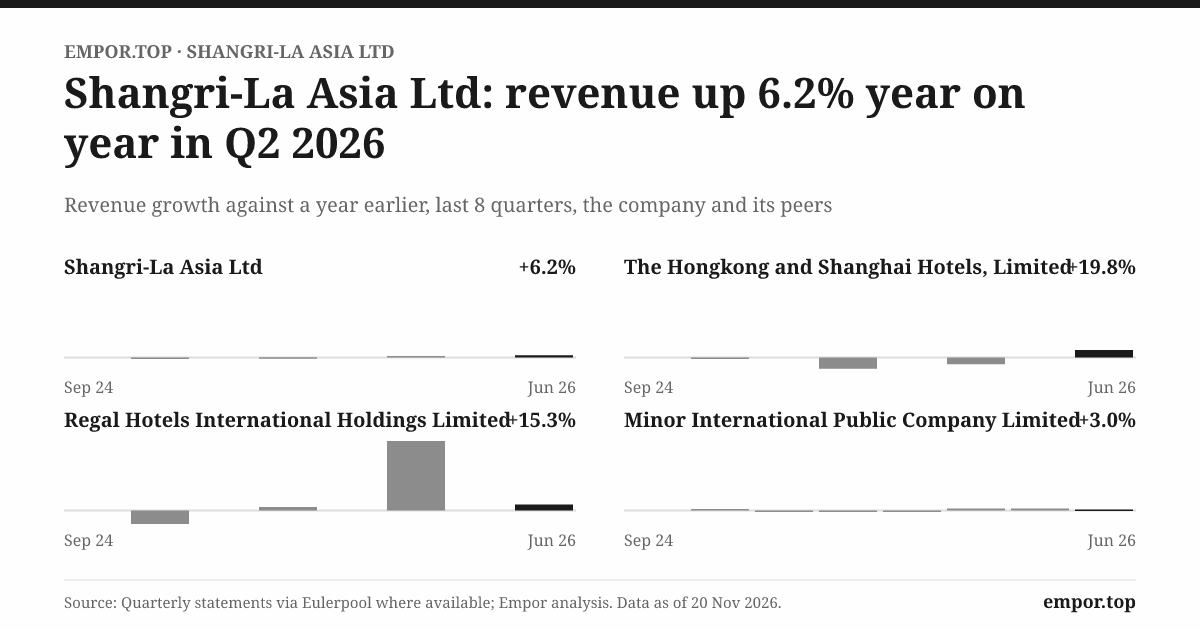
Owning the rooms gives a company control of every detail a guest notices, from the marble in the bathroom to the pace of the breakfast service. It also hands the company every bill: the construction loans, the refurbishment cycles, the staff who must be paid whether or not the rooms are full, and the property valuations that auditors scrutinise every year. The first half of 2026 brought encouraging news. Revenue rose by about 6% and attributable profit jumped by more than half, to about $89 million.4 The question is whether that improvement marks the start of a better economic model or another turn of the cycle in a business that has, over the long run, struggled to earn its keep. To answer it, the story has to go back to the decision that made Shangri-La what it is: the decision to build a brand and own the buildings at the same time.
 Subscribe on LinkedIn
II. A Hotel Brand Becomes a Listed Asian Property Network
In 1971 a new hotel opened on Orange Grove Road in Singapore, set in landscaped gardens a short drive from the shopping streets of Orchard Road. It was the first Shangri-La hotel, and it belonged to the business empire of 郭鹤年 Robert Kuok, the Malaysian-born trader who had built fortunes in sugar, flour and commodities across Southeast Asia.5 The name came from the fictional Himalayan paradise of James Hilton's novel Lost Horizon, a place of serenity removed from the noise of the world. For a commodities trader, a hotel was an unusual bet. Sugar is sold by the tonne; a luxury hotel sells an experience one night at a time, and it takes years before the building pays for itself.
The bet worked well enough that the Kuok interests kept making it. The group entered Hong Kong in 1981 and mainland China in 1984, at a time when China's opening to foreign business had barely begun and an international-standard hotel in a Chinese city was a statement of confidence as much as a commercial project.5 That timing matters for everything that follows. Shangri-La did not arrive in China as a franchisor licensing a logo to local developers. It arrived as an owner and builder, often in partnership, putting up landmark properties in cities that were about to become some of the fastest-growing commercial centres on earth. Owning the building was, in a sense, the only way to guarantee the product. In many of those cities, there was no ready supply of sophisticated hotel owners for a brand to sign up.
The listed company came later. Shangri-La Asia was incorporated in 1992 and listed on the Hong Kong stock exchange in 1993.5 What followed over the next six years was a series of transactions that shaped the entity investors own today. Between 1993 and 1996, the listed company acquired hotel and property interests from the wider Kuok Group.5 In 1997 it acquired the hotel management group, the operating team and contracts that actually ran Shangri-La hotels.5 And in 1999 it acquired controlling interests in three listed hotel companies, consolidating more of the estate under one Hong Kong-listed roof.5
Each of those steps did something specific. The early asset purchases gave the listed company buildings and the revenue that came with them. The 1997 purchase of the management group gave it the know-how and the contracts to run hotels, including ones it did not own, which is the seed of the fee business. The 1999 consolidation tidied a scattered set of holdings into a single structure with a single controlling shareholder. By the end of the decade, Shangri-La Asia was both an owner and an operator, and the two roles were bound together from the start.
That origin raises an obvious question for any minority shareholder: when a listed company buys assets from its own controlling family's group, who gets the better deal? It is a fair question, and it deserves a careful answer rather than an insinuation. The transaction-level prices of those 1990s transfers, and the comparable hotel valuations of the time, are not something the company publishes in its current disclosure, and without them it is impossible to say whether the listed company paid too much, too little or about the right amount. Related-party origins are common among Asian conglomerates. They are part of the structure, not proof that value was destroyed.
What can be measured is what the estate has earned since. That is the real capital-allocation test of those early decisions. The structure that came out of the 1990s also persists in the ownership register. Kerry Group Limited, the Kuok family's holding vehicle (嘉里集团), held about 50.1% of the listed company's shares at the end of June 2026.3 A shareholder buying in Hong Kong today is buying alongside a controlling family that has held the business for half a century and has every ability to set its long-term direction.
There is something admirable in that continuity. Families that think in decades can build hotels that take years to plan and decades to pay back, and they can resist the pressure to sell buildings at the bottom of a cycle. But continuity is not the same as a good return, and a controlling shareholder can also tolerate a low one for a very long time. Shangri-La spent the following two decades doing what owners do: building towers, buying more property and expanding the estate across Asia and beyond. The towers would make the brand famous. They would also turn the company's growth into a long-running test of whether all that capital was earning enough.
III. The Towers That Turned Growth Into a Capital-Returns Test
A luxury hotel tower is a strange kind of asset. It takes years to acquire the land, design the building, secure the permits and raise the financing. It takes more years to build. During all that time it produces no revenue. Then the doors open, and the economics flip: almost all of the costs are fixed, from the loan interest and depreciation to the hundreds of staff required to deliver the service the brand promises. A full hotel is a wonderful machine, because every extra guest drops mostly to profit. An empty hotel is a machine for burning money, because the bills arrive anyway.
The global hotel industry offers a way to keep the brand and shed most of that risk. Marriott, Hilton and IHG principally expand through franchise and management agreements. A property developer or real-estate fund owns the building, takes the construction and financing risk, and pays the brand a fee, often a share of revenue plus a share of profit, for the name, the reservation system and the loyalty programme. The brand company needs relatively little capital, which is why its returns on capital can look so much higher than those of the owners who pay it.
Shangri-La chose, and kept choosing, the other model. Of the 107 hotels the group managed at the end of June 2026, 83 were group-owned, whether through subsidiaries or through associates in which the group holds a stake, five were leased, and only 19 belonged to third parties.3 It is also worth keeping the scale in proportion. Shangri-La is a regional luxury operator with around a hundred hotels. It is not a global room-count peer to Marriott or Hilton, each of which counts its hotels in the thousands. The comparison is useful because of the contrast in business model, not because Shangri-La competes with them on size.
The ownership model shows up immediately in the revenue line. Of the roughly $2.23 billion of consolidated revenue in 2025, hotel operations, meaning the rooms, restaurants, banquets and other spending in the hotels the company owns or leases, contributed about $2.07 billion.2 That is more than nine dollars in every ten. The hotel management and related services business, the part that most resembles the asset-light model, reported about $259 million of revenue before intersegment eliminations, but much of that came from managing the group's own hotels and therefore cancelled out on consolidation. After eliminations, it contributed about $97 million of revenue from outside the consolidated group.2 Stripped of the accounting, the listed company is, overwhelmingly, a hotel owner that happens also to run hotels for others.
Owning the buildings gives Shangri-La something real. It controls the guest experience completely, rather than negotiating it with an owner who might prefer to delay the next renovation. It captures the full operating profit of a successful hotel, not just a fee. And it holds property that may appreciate over time, especially in cities where prime land is scarce. Those are the reasons a family company with a long horizon might deliberately choose ownership.
The returns tell a harder story. On the company's 2025 figures, return on equity was about 2.1%, return on capital employed about 2.6% and return on invested capital about 1.9%.2 On the twelve months to June 2026, helped by the stronger first half, those figures improved to roughly 2.7%, 4.7% and 3.8%.3 Even the better set sits well below what most investors would consider the cost of capital for a cyclical hotel business. And this is not a pandemic artefact. Across the decade before COVID, return on equity sat in a band of roughly 2% to 3% and return on invested capital mostly between 1% and 2%.26 The pattern is longer than any single crisis.
This is the clearest way to understand the 0.4 times book multiple from the opening scene. If a company's equity earns 2% to 3% a year, and an investor wants something closer to 8% or 10% to own a cyclical hotel business, the investor will only pay a fraction of book value for that stream of earnings. The discount is not necessarily the market misunderstanding the assets. It may be the market doing simple arithmetic on what the assets have actually earned.
The downside evidence comes from the company's own accounts. In 2015, Shangri-La recorded impairment charges against hotel properties, a recognition that some buildings were worth less than their carrying value given the earnings they could realistically produce.6 In 2019, a year before the pandemic, it booked a further property impairment charge of about $20 million, and the auditor flagged hotel-property impairment as a key audit matter, meaning it was among the areas requiring the most judgement in the entire audit.7 In the 2025 audit, the auditor again identified hotel impairment and investment-property valuation as key audit matters, while issuing an unmodified opinion with no emphasis of matter.2 The repeated focus is not an accusation of anything improper. It is a reminder that the balance sheet rests on estimates of future hotel performance, and that a hotel's book value is only as good as the cash it can generate.
That last point deserves a careful framing. None of this proves that any particular hotel was overpriced when it was built or bought. The company does not publish a hotel-by-hotel record of acquisition prices against comparable transactions, and without that record a clean claim of overpayment would be speculation. What the record supports is narrower and more useful: the estate, taken as a whole, has not yet demonstrated that ownership produces a strong return on the capital it ties up. Shangri-La's ownership may be a strategic choice with real benefits for the brand. It is not, on the evidence of the returns, a capital moat.
The investor test that follows is simple to state and hard to pass. Can management grow earnings and cash from the existing estate faster than it must spend on upkeep, refurbishment and new properties? If it can, the low returns could rise from a depressed base and the discount to book could narrow. If it cannot, the brand will keep looking magnificent and the shareholders will keep earning less than lenders. To see where the money actually comes from, the story has to follow a single guest through the door.
IV. What the Guest Pays For—and What the Company Keeps
Picture a business traveller arriving at a Shangri-La in Shanghai on a weekday evening. The car pulls up, a doorman opens the door, the check-in is quick, and the room looks out over the city. Over three nights the guest pays for the room, eats breakfast in the hotel, holds a client dinner in one of its restaurants and perhaps books a meeting room for a morning presentation. To the guest it is one experience under one brand. To the listed company, the same stay can mean three entirely different things depending on who owns the building.
The accounting follows the ownership structure: subsidiary hotels contribute revenue and costs, third-party hotels generate fees, and associates contribute a share of profit as a single line.2 The same lobby, the same uniforms, three different economic relationships.
For the hotels it owns, the bridge between travel demand and revenue runs through two numbers that every hotel investor watches. Occupancy is the share of available rooms that are sold on a given night. RevPAR, revenue per available room, multiplies that occupancy by the average room rate, so it captures both how full the hotel is and how much each guest pays. A hotel can raise RevPAR by filling more rooms or by charging more for them, and the difference matters, because the second usually flows more directly to profit.
The first half of 2026 shows how differently those numbers can move across the company's main markets. In mainland China, the group's largest market by number of hotels, weighted average occupancy was about 61% and RevPAR rose about 6% to around $72.8 In Hong Kong, occupancy was about 81% and RevPAR rose about 12% to around $248.8 Those two figures tell different stories. Hong Kong is a dense, high-priced market where the hotels were close to full and pricing moved strongly. Mainland China is a much broader estate where two rooms in five were still empty on an average night and the rate per available room was less than a third of Hong Kong's. The mainland improvement is real, but it is coming from a level that leaves a great deal of fixed cost carried by unsold rooms.
The effective-share figure remains useful context for the wider estate, but it is not consolidated sales.2 For an investor trying to value the listed company's own cash flows, consolidated revenue and the associate earnings line are the honest starting points.
There is a fourth line of business that sometimes gets mistaken for a hidden growth engine: property development and investment properties, such as office and residential space attached to some hotel complexes. In 2025, property activity added to the group's effective-share revenue and EBITDA, but its contribution was smaller and more uneven than hotel operations, which remained the core of the business.2 Development profits tend to arrive in lumps when units are sold or projects completed, which makes them a poor foundation for a recurring earnings thesis. Investment properties provide steadier rent, which lenders value, but rent does not change what Shangri-La fundamentally is.
Now look at what the guest's stay is worth to the company in the cases where it does not own the building. The hotel management and related services segment earned about $21 million of profit in the first half of 2026.8 That is a meaningful sum for a fee business that needs little capital, and it shows the fee model works. But set it beside the scale of hotel operations and it is small: in a half-year in which the company generated more than a billion dollars of revenue, the profit from managing hotels was in the low tens of millions. The fees are strategically useful, because they extend the brand into cities without requiring Shangri-La's own capital, but they are nowhere near large enough to recast the company as an asset-light platform.
The biggest gap in the story is a gap in the company's own disclosure. Shangri-La does not publish a consistent, year-by-year split of its third-party management fees, its royalty fees, the profit those fees generate, and the growth in rooms it manages for others. It does not disclose its standard fee formula, any minimum fee commitments, or what share of the segment's revenue is recurring.2 It reports hotel counts and segment totals, which is enough to show that the business exists, but not enough to show whether asset-light growth is accelerating, stalling or quietly being subsidised by the owned estate.
That matters because the fee business is where the bull case most needs evidence. If management fees were growing quickly, with each new contract adding profit without adding debt, the low returns on the owned estate would matter less over time, because more of the company's earnings would come from a business that barely uses capital. If fees were flat, the company would remain what its revenue line says it is: an owner of buildings with a modest operating sideline. Inference from the hotel counts and the segment profit points to the second picture today, but only the company can supply the numbers that would settle it.
There is also a more modern question about the guest's journey that applies to every hotel company. Physical lodging is less exposed to substitution by artificial intelligence than digital services are, because no software can replace a bed, a pool or a banquet hall. But the path by which a guest finds and books that bed is changing, and booking platforms, dynamic pricing and service technology can shift who captures the customer relationship and how much it costs to acquire. For a luxury brand, the risk is not that technology empties the hotel. It is that more of each booking's value leaks to intermediaries, or that competitors use better pricing tools to fill their rooms at Shangri-La's expense.
The guest in Shanghai, in other words, is paying mostly for a building the company owns, and the company keeps the profit only after paying for that building's staff, upkeep and financing. The part of the business that earns money without owning the building is real, profitable and small. The obvious next question is whether that small part is growing fast enough to matter.
V. The Fee Business Has to Prove It Can Outgrow the Estate
At the end of June 2026, the Shangri-La brand flew over 19 operating hotels that the company did not own, and its pipeline held five more third-party hotel-development management agreements, contracts to run properties that other owners were still building.3 On paper this is the asset-light future the global hotel industry has been chasing for decades. Every one of those contracts lets the brand enter a new city without the listed company raising a construction loan, and every one of them, once open, should send a stream of fees back to Hong Kong with very little capital attached.
The proportions are what keep the story honest. Even if all five pipeline agreements opened tomorrow, the third-party estate would still be well under a quarter of the total.3 The pipeline can extend the brand's reach, which has value in itself, because a guest who discovers Shangri-La in one city may book it in another. But on current evidence the estate remains owner-heavy, and a handful of contracts each year will not change that quickly.
The operating numbers for the managed portfolio are also more mixed than a one-sided growth story would allow. In the first half of 2026, third-party-owned hotels reported weighted average occupancy of about 66%, up one percentage point, but RevPAR fell about 3% to around $111.8 In plain terms, those hotels filled slightly more rooms at lower average prices. Management attributed part of the weakness to conflict in the Middle East, where some of its managed hotels are located, alongside an improving picture on the mainland.8 That explanation is plausible, and it is the kind of regional detail investors should want. But it also illustrates something structural: because the third-party portfolio is smaller and geographically scattered, a shock in one region can move its results in a way that a broad owned estate absorbs more easily.
History offers a caution worth remembering. In 2019, the hotel management business reported an effective-share EBITDA loss of about $36 million.7 The company attributed it partly to lower fees and partly to investment in future efficiency and business development, which is to say that it was spending money to build the platform before the platform was earning enough to pay for itself.7 That episode does not disprove the strategy. Building a management business often requires upfront investment in sales teams, systems and pre-opening support. But it does show that the costs of building a fee platform can arrive before the fees, and that there is no guarantee the scale will follow. A management business that loses money in a reasonably normal travel year has not yet demonstrated it can carry the company's growth.
Contract turnover also matters. In 2025, three third-party hotel-management agreements ended: Shangri-La Vancouver and two hotels in Muscat.2 In the same year, the company signed two new management agreements for hotels under development.2 That is roughly one-for-one replacement, with the departures being operating hotels already producing fees and the additions being hotels that will produce fees only once they are built and open. It is important not to read too much into this. Losing a management contract is not the same as losing customers in the sense of room-night guests; the travellers who stayed at those hotels did not necessarily abandon the brand. But for the fee business, contracts are the customers, and a year in which nearly as many operating contracts leave as new development contracts arrive is a year in which the platform runs to stand still.
The connected-party side adds another layer. Some of the hotels Shangri-La manages for others belong to entities related to its controlling shareholder, and selected connected-party hotel-management agreements run for 20 years.2 Long terms provide stability, but they also mean part of the managed portfolio is not a test of whether independent owners choose Shangri-La in an open market. The cleanest evidence for the fee business would come from arm's-length owners signing, renewing and staying.
So the confirmation test for this part of the thesis is clear, and it rests on disclosures the company could make. Investors would want annual third-party management and royalty fee revenue and the profit it generates; net additions and departures of managed hotels, with the reasons for departures; and the share of new rooms that require Shangri-La's own capital, whether as equity, loans or guarantees. Until those numbers are published and moving in the right direction, the asset-light thesis remains a strategy label rather than a demonstrated outcome.
And the estate, as the next part of the story shows, is where the company's fortunes are decided, especially when the rooms suddenly empty.
VI. The Pandemic Exposed the Cost of an Empty Room
In early 2020, Shangri-La's hotels faced the scenario every hotel owner fears. Borders closed. International flights stopped. Business travel, conferences, weddings and tourism disappeared in a matter of weeks across the company's core markets. The buildings were still there, beautifully maintained, and the staff were still on the payroll, but the guests were gone. For a company built on hotels designed for international travellers, it was the purest possible test of what happens when the fixed costs of ownership meet a collapse in demand.
The warning signs had arrived before the virus. In 2019, consolidated revenue fell about 3.4%, while effective-share hotel EBITDA dropped about 16.7%.7 The gap between those two numbers is the whole story of operating leverage in miniature: a small decline in revenue produced a much larger decline in profit, because labour and other fixed costs did not fall when demand did.7 The company pointed to particular drags: Hong Kong, where months of social unrest hit tourism and business travel; mainland China, where economic conditions weakened; and Sri Lanka, where the April 2019 Easter Sunday terrorist attacks in Colombo struck the hotel sector, including the group's own hotel.7 Each explanation was specific and credible. Together they showed how exposed an owner-operator is to local shocks it cannot control.
Then came 2020, and the discontinuity is too large to smooth into a trend line. Consolidated revenue fell by more than half, to about $1.0 billion.9 The company reported an operating loss of about $433 million that year and a further operating loss of about $354 million in 2021.92 Attributable losses ran to about $460 million and $290 million in those two years, and even 2022 ended in the red as mainland China maintained strict travel controls.2 Dividends stopped entirely for several years.2 An operating margin that had been around 10% before the pandemic swung to roughly minus 42% in 2020.9
What those numbers mean is that the company's cost base was built for a world in which its hotels were reasonably full. When occupancy collapsed, there was no way to shrink the buildings, the depreciation or the debt, and only limited ability to shrink the workforce without damaging the service the brand depends on. A franchisor in the same crisis would have seen its fees fall, sometimes sharply, but would not have been carrying the losses of the hotels themselves. Shangri-La carried them.
The recovery, when it came, was real. Revenue climbed back above $2 billion in 2023 and operating profit returned to about $215 million.2 Measured over three or five years, revenue growth looks spectacular, but that is the arithmetic of climbing out of a hole. Measured over the decade from 2015 to 2025, revenue grew only about 0.5% a year and net profit declined about 2.2% a year.2 In other words, after a decade that included both a good stretch and a catastrophe, the company's consolidated revenue in 2025 was roughly where it had been in 2015, and its profit was lower.
The most recent full year shows how difficult it is to read the trajectory from headline profit alone. In 2025 revenue rose about 2.2% and operating margin reached about 15%, yet attributable net profit fell about 30% to about $112 million.10 The decline was largely the work of non-operating items, which had swung in the company's favour in 2024 and against it in 2025.10 The operating business improved while the bottom line deteriorated. For an investor, that is a reason to focus on hotel operating profit, regional RevPAR and cash conversion, rather than on attributable profit, which absorbs fair-value movements, foreign exchange and other items that say little about whether rooms are earning more.
The first half of 2026 brought a better picture on both measures. Revenue rose about 6.4% year on year and attributable profit rose to about $89 million from about $58 million a year earlier.4 That improvement deserves credit. It came with stronger RevPAR in both mainland China and Hong Kong, the two markets that matter most to the consolidated estate.8
But regional detail shows why the consolidated averages can conceal as much as they reveal. Mainland China's RevPAR growth of about 6% and Hong Kong's of about 12% were offset elsewhere: the third-party portfolio's RevPAR fell about 3%, and the United Kingdom, where the group operates in London, was slightly lower.8 A company with hotels across many countries will always have some markets rising while others fall. The investor question is not whether every region is improving, but whether the improvement is coming from pricing, from occupancy or from mix, and whether it is broad enough to persist when one large market stumbles.
On that question, management's own materials offer more regional detail than many hotel owners provide, with occupancy and RevPAR by market and a stated explanation for the weaker areas.8 The interim results were presented to investors on 27 August 2026, with a results event and transcript made available through the usual investor channels.11 What the presentation does not offer is a clean decomposition of how much of the improvement in each market came from rate versus occupancy, or how much of the profit improvement came from cost control versus demand. Those are the distinctions that separate a cyclical rebound from a structural change, and they are the distinctions a careful reader of the 2025 prepared remarks and the 2026 interim materials should push management to make.
The verdict on durability is therefore balanced, and it can be stated plainly. The recovery is genuine. The first-half results are better on operations and on profit. But the long record does not yet show a durable return to growth, and one strong half-year in a business this cyclical cannot settle the through-cycle question. The pandemic did not change the company's model; it revealed it. Fixed costs make a full hotel profitable and an empty one ruinous, and Shangri-La owns enough hotels to feel both extremes in full. A change at the very top brings the people now charged with navigating the next cycle into focus.
And the estate is where the company's fortunes are decided, especially when the rooms suddenly empty.
VII. Hui Kwong Kuok Takes the CEO’s Seat
In July 2025, Shangri-La Asia announced that its executive chairman, 郭惠光 Kuok Hui Kwong, would also become group chief executive officer, with the change taking effect in August.12 The appointment put the two most powerful jobs in the company, running the board and running the business, in the hands of one person, and that person was a member of the family whose holding company controls the listed group. Kuok, a daughter of Robert Kuok, had already been the public face of Shangri-La's leadership as chair, presenting its results and articulating its direction.12 Now there would be no separate chief executive between the board and the operating teams.
The company did not hide the significance of the move. In its 2026 interim report it acknowledged that combining the roles of chair and chief executive was a departure from the relevant provision of the Hong Kong corporate governance code, which recommends the roles be separated, and it cited a board with a majority of independent directors as mitigation.3 That acknowledgement is a requirement of the code's comply-or-explain regime, but it is also a useful reminder of the trade-off. Concentrated leadership can be decisive and consistent, especially in a family company with a long horizon. It also removes one of the most important internal checks on a chief executive: a chair whose job is to ask hard questions on behalf of all shareholders.
Around the new chief executive, the senior team was reshuffled. Teo Nee Chuan became group chief financial officer in March 2026, following an appointment announced in December 2025.13 Chua Chee Wui, who had served as chief financial officer since 2019, continued as group chief investment officer and an executive director.133 Separating the finance and investment roles is sensible for a company whose most consequential decisions are about where to deploy capital. It also means that the people responsible for the company's capital-allocation choices and the people responsible for reporting their results are no longer the same person, which is a modest improvement in accountability.
The ownership picture needs to be stated carefully. Kerry Group Limited held about 50.1% of the issued shares at the end of June 2026, unchanged in share count from the end of 2025; the slight dip in percentage from about 50.2% reflected the reported share denominator rather than any sale.32 Other entries in the substantial-shareholder register reflect interests held through the same family structure, and they should not be added together as though they were independent holdings.2 The company's filings establish Kerry's control. They do not establish a large direct personal shareholding by the chief executive beyond what the disclosures show, and it would be wrong to assume one.
Pay is the next test of alignment. In 2025, Kuok's total reported cash remuneration was about $2.09 million, including a discretionary bonus of about $0.87 million.2 Aggregate remuneration for the executive directors was about $3.53 million, down from about $3.85 million in 2024.2 In the same year, attributable net profit fell about 30%.10 It would be easy to frame that juxtaposition as pay rising while profit fell, but that is not quite what happened: aggregate executive pay actually declined, and much of the profit fall came from non-operating items rather than from the hotels, which improved their margin. A discretionary bonus in a year when the operating business got better is defensible on its own terms. The more useful critique is about disclosure. The remuneration framework describes the discretion but does not tie the bonus to published targets for returns on capital, fee growth or cash generation, so an outside shareholder cannot easily check whether pay tracks the metrics that matter most for this company.2
Shareholders did send one signal worth noticing. At the annual general meeting on 29 May 2026, every resolution passed, but the general mandate allowing the board to issue new shares drew about 9.3% of votes against, and the top-up to that mandate drew about 9.2%.14 By contrast, director re-elections drew only around 1.2% opposition and the reappointment of the auditor about 1.5%.14 Given that Kerry alone holds about half the votes, a 9% opposition implies that a much larger share of the votes cast by independent shareholders went against the issuance powers. General mandates are routine in Hong Kong, and many institutional investors vote against them as a matter of policy because they permit dilutive placements at a discount without a separate vote. Still, the dissent shows that a meaningful group of outside shareholders is unwilling to give a controlled company an open cheque to issue equity, and it is the clearest shareholder signal in the poll.
Related-party dealings are the other governance thread, and they need proportion rather than alarm. In 2025, Kerry subsidiaries outside the listed group paid Shangri-La about $22.5 million in hotel-management, consultancy, service and royalty fees, roughly 1% of consolidated revenue.2 Group associates paid about $31.4 million in service and royalty fees.2 Going the other way, the listed company paid named Kerry-related counterparties about $6.2 million for rent, office expenses, administration and wine.2 The company describes the pricing as normal commercial terms, or, where no comparable transaction exists, terms no less favourable than those offered to third parties.2 The operating flows are small relative to the business.
The financial exposures are where the closer reading is warranted. The same disclosure lists loans and guarantees to associates and financial assistance involving subsidiaries of Kerry Holdings, including about $128 million of loans and about $99 million of guarantees in one financial-assistance category alone, alongside separate associate loans and guarantees.2 These are not operating fees; they are capital the listed company has put at risk on behalf of entities it does not wholly own. Nothing in the disclosure suggests they are impaired. But in a company where the controlling shareholder sits on both sides of some arrangements, and some affiliate hotel-management agreements run for 20 years, a minority shareholder would want a year-by-year schedule of these exposures by counterparty and a clear account of how independent directors review them.
The final question about leadership is credibility, and it can only be judged by the record of explanations and outcomes. In 2019, management explained the downturn specifically, naming Hong Kong unrest, mainland softness, Sri Lanka and fixed labour costs, and its explanations matched the reported numbers.7 Through the pandemic, it reported the losses plainly and suspended dividends rather than borrowing to maintain them.2 In 2026, it has offered regional operating detail and named the Middle East as a source of weakness in the managed portfolio.8 That is a reasonably consistent record of explaining what happened. What it has not yet produced is a record of setting measurable targets for the shift toward asset-light growth and then reporting against them. Without targets, there is nothing against which to judge delivery, and credibility rests on candour about the past rather than accountability for the future.
The leadership has the control and the continuity to make long-term decisions. Whether those decisions earn their cost of capital is a question about money, and the money in this company is easier to count than it first appears, and harder to interpret.
VIII. The Cash Is Real; the Free Cash Flow Depends on the Definition
At the end of 2025, Shangri-La Asia had about $2.5 billion of cash and short-term investments on its balance sheet, the largest pile it had held in more than a decade.2 Most of it, about $1.97 billion, sat in short-term bank deposits with an average maturity of about three months and an average yield of about 3.6%.2 On its own, that looks like a fortress. But the same balance sheet carried borrowings of about $7.6 billion, up from about $5.1 billion a decade earlier.2 The company was holding a great deal of cash and owed a great deal more. To understand which of those numbers matters most, the debt needs to be taken apart.
Start by separating real borrowings from leases. At December 2025, bank borrowings and bonds totalled about $6.86 billion, while lease liabilities, the accounting value of long-term rental commitments on leased hotels and offices, were about $753 million.2 By June 2026, bank loans were about $5.07 billion and fixed-rate bonds about $2.17 billion, with lease liabilities steady at about $755 million.3 Subtract the cash, and net borrowings excluding leases were about $4.5 billion.3 That produced gearing, measured as net borrowings against equity, of 80.0% at June 2026, up from 77.2% six months earlier.3 About 78% of the borrowings were at fixed rates, which protects the company against a sudden rise in interest costs, and the company reported that it was in compliance with its loan covenants.3
Why would a company with $2.5 billion of cash keep owing $7 billion? Part of the answer is prudence: a hotel owner that lived through 2020 has every reason to keep a large liquidity buffer. Part of it is refinancing: the company has been raising long-dated money ahead of maturities. And part of it is the economics of the carry. Interest income in 2025 was about $84 million, a meaningful contribution in a year when profit before tax was about $224 million.2 Other gains, net, which include that interest along with investment-property fair-value movements and swap losses, came to about $99 million.2 In other words, a large share of the company's pre-tax profit came not from renting rooms but from treasury activity. That is not a criticism in itself, but it means the profit line flatters the hotels if read on its own, and it is a reminder that cash earning 3.6% is offset by debt that costs money too.
Now the central puzzle of this section. How much free cash does Shangri-La actually generate? There are two answers, and they are very different. On the simplest definition, cash from operating activities minus capital expenditure, free cash flow in 2025 was about $92 million.2 The company itself reported consolidated free cash flow of about $313 million for the year, up about 15%.2 The gap between the two, about $220 million, is larger than the entire smaller figure. Neither number is wrong. They are measuring different things, and the difference matters enormously, because the market's quoted free-cash-flow yield of about 23% looks very different depending on which definition sits underneath it.1
The reconciliation runs through the details of the cash-flow statement. In 2025, the company's operating cash before working-capital changes was about $530 million.2 After working-capital movements, interest paid, lease payments and taxes, cash from operating activities was about $160 million.2 So roughly $370 million of operating cash was consumed between the hotels' gross cash earnings and the cash that the business actually kept, much of it by the cost of carrying debt and leases. The reconciliation also deducted about $208 million of profits from associates, because those profits are accounting earnings; the cash from associates arrives only when they pay dividends, which under the accounting rules can appear outside operating cash flow.2 One plausible source of the gap between the two free-cash-flow measures is precisely where associate dividends, interest and lease payments sit in each calculation. The company's own figure deserves to be read against its stated definition, and investors should be wary of using either number to support a dividend or a valuation until they know which costs it includes.
Then look at the other side of the equation: what the company spends on its buildings. In 2025, Shangri-La spent about $64 million on property, development and investment-property additions, roughly 2.9% of consolidated revenue.2 In the same year, depreciation on property, plant and equipment was about $191 million, plus about $50 million of right-of-use depreciation on leased assets, and the company recorded a hotel impairment of about $30 million.2 Capital spending of about a third of depreciation is a striking ratio for an owner of luxury hotels, which need periodic refurbishment to keep their rates. It may mean the estate is in a lull after an intensive building period, with most hotels recently renovated. It may also mean that upkeep is running below its long-term level, which would flatter today's free cash flow at the expense of tomorrow's competitiveness. The company does not split its capital spending between maintenance of existing hotels and expansion of the estate, so investors cannot tell which interpretation is right.
The longer history puts all of this in context. From 2014 to 2025, operating cash flow totalled about $2.2 billion, more than four times the roughly $476 million of cumulative net profit over the same period.2 That gap reflects the large non-cash charges in hotel accounting, chiefly depreciation and impairment. But over the same twelve years, free cash flow on the simple definition was negative about $1.2 billion, because property investment absorbed more than the operations produced.2 The company still paid about $548 million in dividends, and its cash balance rose by about $1.4 billion.2 Those three numbers only add up because borrowings rose by around $2.5 billion over the period. Put plainly, over a dozen years the hotels did not generate enough free cash to fund their own investment, let alone the dividends; the difference was borrowed. Operating cash is not distributable cash when hotels require recurring reinvestment.
There is one more risk that sits inside the cash story: currency. The company says local hotel revenues and most expenses provide a natural hedge, and it does not substantially hedge foreign-exchange exposure with forward contracts, citing risk and cost.2 Its own sensitivity analysis shows that a 5% movement in the US dollar against other currencies could change profit by about $157 million, more than the entire 2025 attributable profit.2 In the first half of 2026, foreign exchange produced a gain of about $4 million, against a loss of about $7 million a year earlier.3 The exposure is large relative to earnings, and it can push reported profit around in ways that have nothing to do with how many rooms were sold.
The credit view is one useful input. In 2025, 联合资信 China Lianhe Credit Rating rated the issuer and relevant bonds AAA with a stable outlook on its domestic scale.15 The agency cited the brand, investment-property earnings, asset value and bank facilities as strengths.15 It also named constraints: the hotel sector's exposure to economic and external shocks, mainland demand and competition, the lower liquidity of hotel assets, and the gap between hotels' carrying values and their market values.15 That last point is the same tension the 0.4 times book multiple expresses from the equity side. When the company returned to the onshore market with its first medium-term note of 2026, listed on 上海清算所 Shanghai Clearing House in April, a rating report was attached to the offering.16 The rating supports access to funding. It does not remove operating or refinancing risk.
That funding access has been put to work. In the first half of 2026, the company raised RMB3.2 billion through 熊猫债 Panda bonds, renminbi bonds issued in mainland China by a foreign-incorporated issuer.3 In November 2026, it issued a CNH1.02 billion, seven-year 点心债 dim sum bond in the offshore renminbi market, its debut in that market, for general corporate purposes including refinancing.17 These are debt raises, not equity dilution; the company recorded no ordinary share issue outside its share-award scheme and no buyback in 2025.2 Diversified funding sources are a genuine strength for a company that must refinance billions of dollars of debt across cycles. But each new bond is also a vote of confidence the company has to keep earning, in a business whose returns on capital remain low.
The capital-allocation question that closes this section is the one that the next decade will answer. Of the money Shangri-La spends on its properties, how much maintains existing hotels, how much expands the estate, and how much recurring free cash remains after interest, leases and upkeep? Until the company answers that with a reconciled, consistently defined free-cash-flow measure and a split of maintenance and growth spending, the cash on the balance sheet is real, but the free cash flow depends on the definition. And that uncertainty shapes every judgement about whether the company can win from here.
IX. Analysis & Bear vs. Bull Case
A traveller planning a week in Hong Kong, Singapore or Shanghai opens a booking app and sees a list of luxury hotels. Shangri-La is on it, with a strong address, a polished reputation and a price. So are the Four Seasons, the Ritz-Carlton, the Mandarin Oriental, the Peninsula and a dozen others, each a tap away. The traveller compares photos, reviews, rates and loyalty points, and chooses. That moment of choice is where any moat must ultimately show up, and it is the right place to begin weighing whether Shangri-La can win from here.
Consider first the forces that shape profitability in luxury hotels. Buyers have meaningful power. Guests can compare and switch among luxury hotels with almost no cost, and online travel agencies have made those comparisons instant. No single customer is material to Shangri-La, which describes its customer base as large and internationally dispersed, but the company does not publish top-five customer shares, corporate-account concentration or the share of bookings that come through intermediaries.2 Fragmented customers mean no one buyer can squeeze the company, yet collectively they are price-sensitive and well informed.
Supplier power is visible in the cost base rather than in any one vendor. The most important inputs are labour and property, and both are largely fixed. The 2019 experience, when a small revenue decline produced a much larger profit decline because labour costs did not flex, is the clearest evidence of how much those inputs constrain margins.7 The company employed about 24,800 people in its subsidiaries at the end of 2025, a workforce that must be trained, retained and paid in good years and bad.2 Supplier concentration is not disclosed.2
Rivalry is intense and comes from two directions. Global asset-light groups bring enormous distribution, loyalty programmes with tens of millions of members and the ability to sign new hotels in any city where an owner wants a brand. Regional luxury operators, many of them family-controlled and asset-heavy like Shangri-La, compete on service and location in the same gateway cities. The threat of new entry is moderated by the cost and time required to build a luxury hotel in a prime location, but it is not absent: any well-capitalised developer can sign a management contract with a global brand and open a competing property. Substitutes, from serviced apartments to home-sharing platforms, matter less at the top of the market than in the middle, but they put a ceiling on what extended-stay and leisure guests will pay.
That leaves the question of durable advantage, which Hamilton Helmer's framework of seven powers helps sharpen. Shangri-La does not enjoy network economies in any strong sense; its loyalty programme benefits from scale but is smaller than those of the global groups. It does not have switching costs, because a guest can choose another hotel tomorrow. It does not have a cornered resource unless one counts specific prime sites, which can be valuable but are, by definition, priced into the property's book value. It does not have scale economies relative to Marriott or Hilton. Process power, the accumulated know-how of delivering a distinctive service, is plausible for a company that has run luxury hotels for half a century, but hard to prove from outside.
The strongest power claim is brand, not lock-in. A brand power exists when customers will pay more for the same objective product because of the name above the door. Shangri-La's brand is well-known in Asia, and its RevPAR in Hong Kong, at about $248 in the first half of 2026, suggests the hotels can command strong rates in their best markets.8 But the company does not publish the evidence that would establish brand power: customer retention, rate premiums against direct competitors in the same cities, loyalty-programme economics or market share. Hong Kong RevPAR could reflect location as much as brand. Mainland RevPAR of about $72 suggests the brand is not lifting rates far in the broad estate.8 The fairest conclusion is that brand advantage is plausible but incompletely demonstrated, and it is not strong enough on current evidence to overcome the low returns that ownership produces.
The bull case rests on four things going right together. Luxury travel demand across Asia continues to improve, and regional RevPAR gains in mainland China and Hong Kong extend into a sustained recovery.8 Because the cost base is largely fixed, those revenue gains flow disproportionately to operating profit, pushing returns on capital meaningfully higher from a depressed base. The asset-light pipeline converts into a growing stream of fee income that requires little of the company's capital. And the large cash position, long-dated funding and mostly fixed-rate debt carry the portfolio safely through the next shock.3 If all of that happened, the low price-to-book multiple would reflect yesterday's returns rather than tomorrow's, and the operating leverage that hurt so badly in 2020 would work in shareholders' favour.
The bear case is the same machine running the other way. The recovery fades or stays regionally uneven, with strength in Hong Kong offset by weakness in the managed portfolio or in long-haul markets. Property costs, refurbishment needs and impairments absorb whatever operating gains arrive. Cash-flow definitions obscure the true maintenance burden, and when capital spending eventually returns to a level consistent with depreciation, free cash flow shrinks. Debt stays high, interest costs rise as cheap fixed-rate borrowing is refinanced, and the fee platform remains too small to change the company's economics. In that world, the discount to book is not an opportunity but an accurate price for assets that do not earn their cost.
The historical record weighs on this debate in a specific way. Over the longest relevant span, from 2014 to 2025, returns on equity rarely exceeded 3.5%, free cash flow was cumulatively negative, and the fee business lost money in at least one pre-pandemic year.27 That record does not reject the bull case, but it narrows it. The claim that ownership gives Shangri-La a capital advantage is not supported. The claim that the brand commands premium economics is unproven. The claim that the fee business can outgrow the estate is unproven and, so far, unconfirmed by the pace of additions. What survives is a smaller, more testable thesis: that operating leverage in a sustained recovery, combined with disciplined capital spending, could lift returns from very low to merely modest.
A skeptical activist would push on precisely those points. Where are the property-level returns, so that shareholders can see which hotels earn their capital and which do not? What is the split between maintenance and growth capital spending, and why is current spending so far below depreciation? How much does the third-party fee business contribute to profit, and how fast is it growing? What hurdle rate does the board apply to new developments, and to loans and guarantees for associates and connected parties? In a controlled company where the chair is also the chief executive, those questions carry extra weight, because the usual mechanisms for forcing answers, a takeover threat or a board revolt, barely apply.
Three measures matter most for tracking whether the story is improving. The first is regional occupancy and RevPAR, especially in mainland China and Hong Kong.8 The second is the scale and growth of the fee business, including management-fee revenue, profit and third-party room additions. The latest reporting gives a baseline on hotel counts and segment profit, alongside a decline in managed-portfolio RevPAR.38 The third is recurring free cash flow after maintenance capital spending, interest and lease payments, which remains difficult to assess from the company's reporting.2
Valuation is context, not a conclusion. On 20 November 2026, the shares traded at about 13.5 times trailing earnings, 0.4 times book value, 8.5 times enterprise value to EBITDA, with a dividend yield of about 2.6% and a quoted free-cash-flow yield of about 23%.1 That last number depends entirely on the free-cash-flow definition and should not be compared with other companies without knowing what it includes. A March 2026 regional peer comparison by Thanachart Securities showed Shangri-La Asia at about 15.0 times forecast 2026 EV to EBITDA, against a regional peer average of about 14.5 times.18 Those figures come from a different date and a forecast basis, so they are not like-for-like with the November snapshot. What they suggest, read together, is that the market prices the enterprise roughly in line with regional hotel peers on cash earnings, while pricing the equity at a deep discount to book. That combination is what one would expect if investors believe the hotels' cash earnings are fairly valued and the accounting book value is not.
The case, then, hinges on two things that can be measured. Hotel economics must improve enough to lift returns on capital, and third-party fees must grow without a matching rise in debt. Neither is happening yet at a pace that would change the company's character. The lessons of that gap, between a famous brand and a modest return, extend well beyond one Hong Kong-listed hotel company.
X. Business & Investing Lessons
A luxury hotel at full occupancy is one of the great sights of commerce. The lobby hums, the restaurants are booked, the brand glows above the entrance, and every guest who walks through the door confirms the founder's original bet. What no guest sees is the loan that built the tower, the refurbishment schedule that will soon demand another round of capital, and the auditor's annual question about whether the building is still worth what the books say. Shangri-La's half-century teaches that hotel reputation and hotel-owner economics are different assets, and that investors must price them separately.
The first lesson comes from the company's origins, when the listed business brought together the Kuok Group's hotel and property interests and the team that ran them. The brand grew because the buildings existed; the buildings existed because the family could fund them. But a listed shareholder inherited both, and has been living with the returns on every one of those buildings ever since. A brand can be built with a property portfolio, but investors still have to price every building. The wider lesson for founders who combine operating businesses with real assets is that the operating story and the property story will eventually be judged separately, whether or not the company reports them that way.
The second lesson comes from 2020, when the hotels emptied and operating losses revealed the cost of ownership. The rooms that had been full for years offered no protection at all once travel stopped, because the costs of owning and staffing them did not stop. When the room is empty, fixed costs make yesterday's occupancy a poor moat. For investors, this is the essential test of any asset-heavy business with a premium brand: ask not how good it looks at the peak, but how much of the cost base survives a year with no customers.
The third lesson comes from the managed-hotel pipeline: it remains small, contract turnover has offset additions, and the management business once lost money building itself. Every hotel company now says it wants to grow asset-light. Very few report enough to let outsiders see whether they are succeeding. Asset-light growth is an outcome to measure, not a strategy label. The wider lesson is that any company describing a strategic pivot should be judged by whether it publishes the numbers that would prove the pivot is working, and by whether those numbers move.
The fourth lesson comes from the cash-flow statement, where operating cash fell sharply after interest, leases and tax, capital spending ran well below depreciation, and long-term investment still left free cash flow negative overall. Operating cash pays for a hotel's next renovation before it becomes a shareholder's cash. For investors reading any property-heavy company, the gap between profit, operating cash and free cash is not a technicality; it is where the true cost of the business lives.
The management lesson is more balanced. Concentrated control has given Shangri-La continuity, a long horizon and the ability to hold buildings through crises that might have forced a more widely owned company to sell at the bottom. Those are real advantages. But control is not the same as credibility, and credibility in a controlled company depends on what it voluntarily discloses: transparent returns by property, rigorous oversight of related-party loans and guarantees, and clear answers on how capital is allocated. The families that build great listed companies are the ones that publish enough for minority shareholders to trust them without having to take their word for it.
XI. Epilogue
Tonight, Shangri-La Asia stands at a point where the evidence is genuinely mixed. In the first half of 2026, consolidated revenue rose about 6.4% and attributable profit about 54%.4 Hong Kong and mainland China both improved. But the managed portfolio's RevPAR fell about 3%, gearing edged up to 80%, and the company was still raising new bonds to refinance old ones.8317 The question that opened this story, whether Shangri-La is recovering or changing its economics, is still open.
The next decisive moment will be the full-year 2026 results, expected in the first part of 2027, followed by the 2026 annual report. Those documents will show whether the regional momentum of the first half held through the second, when comparisons were tougher and geopolitical disruption in the Middle East and elsewhere continued to weigh on international travel. If mainland China occupancy rises meaningfully above 61% and Hong Kong holds its pricing, operating leverage should push margins and returns higher, and the bull case's first leg will look sturdier. If the second half disappoints, the first half will look like what the long record suggests it may be: another turn of the cycle.
The second test is the fee business. The pipeline of five development agreements will begin opening over the coming years, and each opening is a chance for the company to show the fees it generates and the capital, if any, it required. If Shangri-La begins to disclose third-party fee revenue and profit consistently, investors will be able to see for the first time whether asset-light growth is accelerating. If the managed-hotel count stays stuck around 20 while the owned estate dominates, the asset-light story will remain a phrase in presentations.
The third test is cash and leverage. A clearly reconciled free-cash-flow measure, with maintenance capital spending separated from growth, would settle the gap between the $92 million and $313 million interpretations of 2025. Investors will watch whether capital spending rises toward depreciation as hotels need refurbishment, whether gearing falls from 80% or keeps climbing, and whether dividends are funded from recurring free cash or, as over the past decade, partly from borrowing.
The fourth test is governance. A combined chair and chief executive, a 9% vote against issuance powers and a significant schedule of loans and guarantees to related entities are not problems in themselves. They become problems only if accountability does not follow. The next annual meeting, the next remuneration report and the next connected-transaction disclosures will show whether the company answers the questions its minority shareholders have begun, quietly, to ask.
Each of these outcomes points back to the same tension. Shangri-La's brand has never been the problem. The problem is whether the company that owns most of the buildings behind the brand can make them earn enough. That question will not be settled by one good year of profit. It will be settled by returns, fees and free cash, measured over a full cycle.
XII. Outro
Go back to that lobby: the high ceiling, the fresh flowers, the staff who seem to know your name. A guest looks up and sees the Shangri-La sign, a promise of a lost paradise first made on a hillside in Singapore more than fifty years ago. Behind the sign sits the question that has followed this company for half a century: whether owning the place was worth the price.
Most global hotel brands have learned to sell the sign and let someone else own what stands behind it. Shangri-La kept both. Its brand crosses borders easily, from Hong Kong to London to the Gulf, but its buildings keep the company tied to every local cycle, every border closure and every refinancing. Shangri-La sells a place to stay. Its investor story has always been about who owns the place, and whether owning it was ever worth the price.
References
-
Annual Report 2025 — Shangri-La Asia Limited, 2026-04-23 ↩↩↩↩↩↩↩↩↩↩↩↩↩↩↩↩↩↩↩↩↩↩↩↩↩↩↩↩↩↩↩↩↩↩↩↩↩↩↩↩↩↩↩↩↩↩↩↩↩↩↩↩↩↩↩↩
-
Interim Report 2026 — Shangri-La Asia Limited, 2026-09-21 ↩↩↩↩↩↩↩↩↩↩↩↩↩↩↩↩↩↩↩
-
Offering Circular, Corporate History and Group Structure — Shangri-La Hotel Limited, 2025 ↩↩↩↩↩↩
-
2019 Annual Report — Shangri-La Asia Limited, 2020-04-27 ↩↩↩↩↩↩↩↩↩
-
2026 Interim Results Presentation — Shangri-La Asia Limited, 2026-08-27 ↩↩↩↩↩↩↩↩↩↩↩↩↩↩↩
-
2020 Annual Report — Shangri-La Asia Limited, 2021-04-26 ↩↩↩
-
2026 Interim Results Event Summary and Transcript Availability — Quartr, 2026-08-27 ↩
-
CEO Appointment Announcement — Shangri-La Asia Limited, 2025-07-16 ↩↩
-
CFO Appointment Announcement — Shangri-La Asia Limited, 2025-12-16 ↩↩
-
Tracking Rating Report — China Lianhe Credit Rating Co., 2025 ↩↩↩
-
2026 Medium-Term Note Listing — Shanghai Clearing House, 2026-04-21 ↩
-
Regional Hotel Peer Comparison — Thanachart Securities, 2026-03-19 ↩
 LinkedIn
 WhatsApp
 Reddit
 Hacker News
 Email
 Kindle
 RSS Feed
 Spotify
 Apple Podcasts
 Amazon Music
 Audible
 YouTube