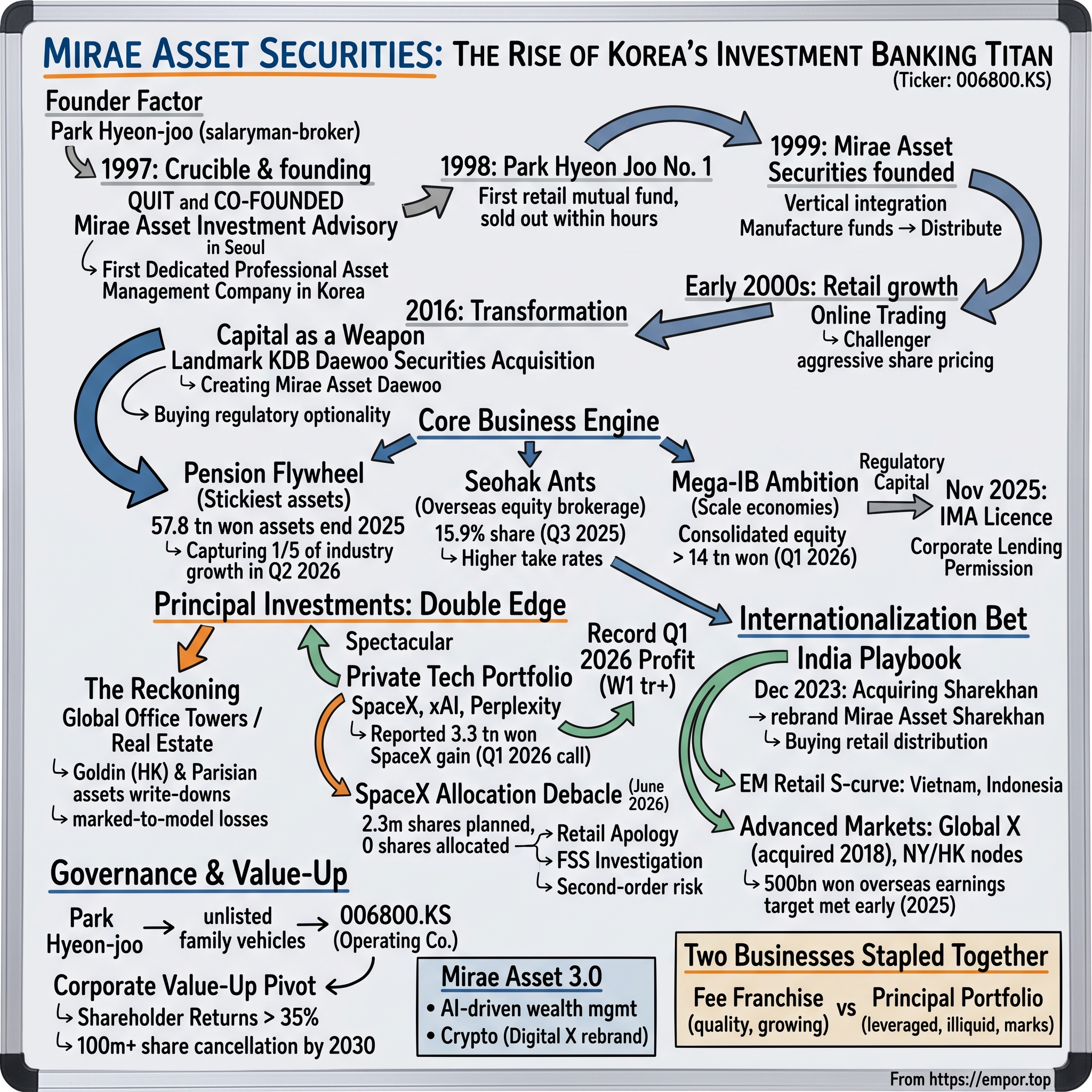
Mirae Asset Securities: The Rise of Korea's Investment Banking Titan
I. Introduction & Episode Roadmap
On June 15, 2026, the two vice chairmen who run 미래에셋증권 Mirae Asset Securities did something almost unheard of for the chief executives of South Korea's largest brokerage. They apologized. Publicly. To hundreds of thousands of retail clients who had wired money into subscription accounts expecting to receive shares in the most anticipated stock market debut in a generation, and who had received exactly zero.1
Three days earlier, SpaceX had priced its initial public offering at $135 a share and closed its first Nasdaq session at $161.11, a nineteen percent pop that valued Elon Musk's rocket company at roughly $2.1 trillion.1 Mirae Asset had been in the underwriting syndicate. Documents circulating in the market indicated that 2,314,815 of the 555,555,555 Class A shares on offer had been earmarked for the Korean firm. Mirae had run two subscription rounds for a combined $500 million of stock, and the books had filled within minutes. Then, in the final allocation, lead manager Goldman Sachs redirected the shares elsewhere, and Korea's biggest broker was left holding nothing but a queue of angry customers and a refund obligation.1[^2]
Rewind exactly one month, and the same company was in an entirely different mood. On May 12, 2026, Mirae Asset reported a first-quarter consolidated net profit of 1.0019 trillion won, the first time any Korean securities house had cleared a trillion won of net income in a single quarter. Operating profit rose 297 percent year-on-year to 1.375 trillion won. Annualized return on equity hit 29 percent. Consolidated revenue reached 14.43 trillion won, up 138 percent.23 By any conventional reading, this was the best quarter in the history of Korean investment banking.
Both stories are true, and the tension between them is the whole point of this company.
Here is the thesis, stated plainly. Mirae Asset Securities is not a commercial bank with a brokerage attached, and it is not a fee-collecting agency business dressed up as an investment bank. It is a merchant bank — an institution that gathers other people's assets at scale, and then deploys an enormous amount of its own capital into illiquid, marked-to-model positions where the outcome is decided years later. The retail franchise generates the float and the fees. The balance sheet generates the drama. In 2023 and 2024, the drama came from global office towers that stopped being worth what the models said. In 2025 and 2026, it came from a portfolio of private technology holdings — SpaceX, xAI, Perplexity, and others — whose upward revaluations have driven a large share of reported profit and turned a sleepy Korean financial stock into, by some measures, the best-performing large-cap equity in the world this year.4
That is a genuinely unusual proposition for a listed broker, and it deserves scrutiny rather than applause. A firm whose quarterly earnings swing on unrealized valuation marks in private companies is a firm whose earnings quality must be interrogated, not assumed. The SpaceX allocation debacle is a useful reminder of the second-order risk: Mirae's principal stake in SpaceX and its distribution promises to clients are two different things, and the market did not distinguish between them until the distribution promise failed in public.
Four threads run through this story.
The founder factor: how 박현주 Park Hyeon-joo, a salaryman broker who quit a comfortable job in the worst year in modern Korean economic history, built the country's only financial conglomerate of real scale that is not attached to a chaebol or a bank holding company — and why his continued centrality is simultaneously the firm's most valuable asset and its sharpest governance question.
Capital as a weapon: how Korean regulators deliberately built a capital-threshold ladder to manufacture a domestic bulge bracket, and how Mirae climbed it — through the landmark 2016 acquisition of KDB대우증권 KDB Daewoo Securities and, in November 2025, through designation as one of the first two holders of an Investment Management Account licence, a permission that lets it raise multiples of its own equity for corporate lending.[^6]5
The alternative-asset double edge: the same institutional muscle that put hundreds of billions of won into Hong Kong and Paris office paper put money into private rockets and private AI. One cost the firm years of write-downs. The other has, so far, been spectacular. Whether that is skill or sequencing is the central analytical question.
And the internationalization bet: the Korean domestic market is aging, saturated, and fee-compressed. Mirae's answer has been to follow Korean savers abroad — capturing the 서학개미 "Seohak ants," the retail investors who trade US equities overnight — and to buy retail distribution in markets where the demographics still work, most notably India's Sharekhan.
We will go in order: from the 1997 crucible, to the Daewoo transformation, through the segment-level economics, into the principal investment book where the real volatility lives, out to India and the global footprint, then to governance and capital returns, and finally to a structured competitive and bear-versus-bull assessment. Along the way we will keep asking the question that matters for a long-term owner of this business: which parts of the 2026 result are franchise, and which parts are weather?
 Subscribe on LinkedIn
II. Founding Crucible & The Park Hyeon-joo Legend (1997–2005)
Picture Seoul in July 1997. The Thai baht had broken free of its peg two weeks earlier. Korean corporate credit was already cracking — Hanbo Steel and Sammi had gone under that spring — and within five months the country would be signing the largest bailout package the International Monetary Fund had ever assembled. Foreign creditors were refusing to roll over short-term paper. Chaebol-affiliated brokerages, which had spent the decade lending against the reputations of their parent groups, were about to discover what those reputations were worth.
That was the month Park Hyeon-joo chose to quit.
He had joined 동원증권 Dongwon Securities in 1986 and made his name as an investment professional there over the following decade.6 On July 18, 1997, he co-founded Mirae Asset Investment Advisory and its venture capital affiliate alongside eight colleagues from the securities industry — the first dedicated professional asset management company in Korean history.67 The timing looks either insane or visionary depending on where you stop the tape. It was, in fact, both.
The insight underneath it was not a market call. It was a structural observation about Korean household savings. In the mid-1990s, the Korean household balance sheet was overwhelmingly parked in bank deposits and real estate. Equity ownership was something you did through a broker, in a transactional, high-turnover, tip-driven way — brokerage as a casino, not as asset management. There was no domestic institution whose business model was to hold Korean equities on behalf of ordinary households for years and charge a management fee for doing it. Park's bet was that the crisis would eventually break the deposit habit, and that whoever owned the product and the distribution when it broke would own the next twenty years.
In December 1998, with the Korean market still bombed out, he launched the country's first retail mutual fund and named it after himself: the "Park Hyeon Joo No. 1" fund. It sold out within hours.7 The self-naming is worth dwelling on, because it tells you something about how this company has always been run. In a Korean corporate culture built around institutional anonymity and chaebol family names, Park put his own name on the product as a personal guarantee of stewardship. He then went out and marketed directly to retail investors, preaching long-horizon equity ownership over trading. Korea's mutual fund industry essentially dates from this moment, and Park is routinely described as its father.7
The commercial logic of what came next is where the strategy gets interesting. Manufacturing funds is a high-margin business but a fragile one, because the distributor — the bank or broker who actually faces the customer — captures the relationship and can substitute your product for someone else's at will. Park had watched this dynamic from inside a brokerage. So in 1999 the group founded Mirae Asset Securities, a broker of its own, to own the shelf as well as the goods.8
This is vertical integration in the classic sense, and it was unusual in Korea at the time. The asset manager built the product. The securities arm distributed it, took the brokerage commission, financed client positions with margin loans, and — critically — captured the customer data and the customer relationship. When Korean households finally did rotate out of deposits during the early-2000s bull market, Mirae was positioned on both sides of the transaction.
Through the early 2000s, the new brokerage went after entrenched incumbents — 삼성증권 Samsung Securities, 한국투자증권 Korea Investment & Securities, and the bank-affiliated houses — with a combination of branch expansion, fee competition, and early adoption of online trading. It was, in the parlance, a challenger: no chaebol parent to fall back on, no captive corporate client base, no state relationship. What it had was product, a founder-brand, and a willingness to price aggressively for share.
The early-2000s bull market validated the wager spectacularly. As Korean households rotated savings out of bank deposits and into domestic equity funds, the money flowed toward the manager who had spent the previous years building both the products and the brand. Mirae gathered assets in the trillions of won, and Park became something Korea had not previously produced: a financial celebrity who was neither a chaebol heir nor a state banker but a salaryman who had built an institution from nothing. That biography — the 샐러리맨 신화, the salaryman myth — became part of the firm's marketing and part of its recruiting pitch, and it still shapes how Korean investors relate to the company.26
It also seeded a specific institutional habit worth flagging early, because it recurs throughout this story: Mirae has always been willing to be first into a product category and to market it directly and aggressively to retail investors. That instinct built the mutual fund industry, built the overseas equity franchise two decades later, and produced the SpaceX subscription episode of 2026. It is the same trait producing very different outcomes.
The analytical takeaway from this period is not the origin-story romance. It is that Mirae Asset was built, from the first day, as an asset-gathering machine with a distribution arm bolted on — and that ordering has never really changed. Everything the firm has done since, including the parts that went badly, follows from the same instinct: get the assets, own the customer, then figure out how to monetize the balance sheet that sits behind them.
By the middle of the 2000s, that instinct had run into a wall. Retail brokerage in a country of fifty million people has a natural ceiling, and Korean regulators were about to redraw the map of what a securities firm could even be.
III. The Mega-IB Ambition & The Landmark Daewoo Merger (2006–2016)
Every so often a regulator decides to build an industry structure by decree, and everything that follows for a decade is a response to that decision. In Korea, that decision was the "Mega-IB" framework.
The problem the 금융위원회 Financial Services Commission was trying to solve was straightforward and slightly wounded in tone. Korea had the world's tenth-largest economy and no investment bank capable of leading a serious cross-border transaction for a Korean company. Samsung and Hyundai raised capital through Goldman Sachs and Morgan Stanley. Korean brokerages were, in aggregate, small, undifferentiated agency businesses fighting over the same domestic commission pool. So the FSC built a ladder: cross specific equity capital thresholds, and you unlock specific privileges. Prime brokerage services for hedge funds at one rung. The ability to issue short-term promissory notes and lend to corporates at another. And at the top, at 8 trillion won of equity capital, the Investment Management Account — the IMA, a vehicle allowing a firm to raise client money with a principal guarantee and channel it into corporate credit.[^6]
The design was explicit about its intent: it was an oligopoly-by-regulation, and the entry ticket was denominated in equity. For Mirae Asset, which had spent a decade growing organically, the arithmetic was brutal. Organic retention of earnings was never going to get the firm to the top of that ladder in any commercially relevant timeframe. It needed to buy capital.
Which brings us to the crown jewel sitting in state hands.
대우증권 Daewoo Securities was the institutional broker of record in Korea — top-tier research, top-tier underwriting, deep corporate relationships, and a franchise that had survived the implosion of the Daewoo Group because the state had rescued it. 한국산업은행 Korea Development Bank had held the stake since the post-crisis cleanup and had been trying to sell it for years, in part to recoup public money.9 By 2015, it was finally, genuinely for sale, and every serious financial group in Korea wanted it: KB금융그룹 KB Financial Group and 한국투자금융지주 Korea Investment Holdings among them.
Mirae Asset won. On January 25, 2016, it agreed to acquire a 43 percent stake — 140.5 million shares — for 2.39 trillion won, working out to roughly 16,979 won per share.9 Regulatory clearances followed through the year, with final FSC approval in November 2016, and the two brokerages merged in December at a ratio of 1:2.9716317, creating Mirae Asset Daewoo.8 The name reverted to Mirae Asset Securities in 2021 once the integration had run its course.8
Was it an overpay? At the time, plenty of people said yes. The price implied a premium to the depressed book-value multiples that Korean financial stocks were fetching in the mid-2010s, a period when the entire sector traded well below book and the phrase "Korea discount" entered general usage. Analysts worried about the classic post-merger risks, and in this case the cultural distance was real: Mirae was an aggressive, sales-driven, founder-run retail house; Daewoo was an elite, institutional, credentialed dealmaking culture with a state pedigree. Those two things do not blend easily.
But the strategic logic was not really about the earnings Daewoo was producing. It was about what the combined equity capital unlocked. The deal roughly doubled Mirae's capital base at a stroke and made it the largest brokerage in Korea by size — which is to say, it bought Mirae a position on a regulatory ladder that no organic growth path could have reached. Everything downstream of that — prime brokerage, corporate lending capacity, the scale to underwrite large domestic bond issues, and eventually the IMA — flowed from the capital, not from the client list.
The integration itself was the harder part, and it is the part that rarely makes it into the retrospective. Merging two brokerages means merging two branch networks with overlapping catchment areas, two IT stacks with incompatible order management systems, two compensation philosophies, and two sets of people who had spent years competing for the same clients. It also means deciding whose culture wins. In Mirae's case the answer was neither, at least on paper: the combined firm kept the Daewoo name for five years, which had the practical effect of preserving the institutional franchise's brand equity with corporate clients while Mirae's retail and asset-gathering DNA was pushed through the organization underneath it. Dropping "Daewoo" in 2021 was the signal that the absorption was complete.8
The verdict took the better part of a decade to render, and Park himself returned to it publicly in April 2026, noting that both the Daewoo acquisition and the 2018 purchase of US ETF manager Global X had been dismissed at the time as a "winner's curse" and had proven strategically sound in hindsight.10 Founders are, of course, unreliable narrators of their own M&A record, and this particular retrospective was delivered in a year when everything was going right. The more defensible reading is narrower: the Daewoo deal succeeded at the specific thing it was designed to do, which was to convert cash into regulatory optionality, and the value of that optionality was not realized until much later.
Much later arrived on November 19, 2025. The FSC designated Mirae Asset Securities and Korea Investment & Securities as Korea's first two IMA operators — eight years after the framework was created and nobody had qualified.[^6]5 The IMA regime lets an approved firm raise up to 300 percent of its equity capital and channel it into corporate lending while guaranteeing client principal. Mirae's qualifying capital base was reported at 10.3 trillion won at designation, and industry estimates put the incremental risk capital the two firms could mobilize at roughly 35 trillion won.[^6]5 Sector analysis at the time projected the IMA rollout would unlock on the order of $14 billion of additional risk capital across the industry by 2028.[^13]
Read that carefully, because it cuts both ways. A principal-guaranteed product funded at three times equity and invested in corporate credit is, functionally, a bank deposit business run by a securities firm without deposit insurance. It is enormously powerful in a benign credit environment and a genuine source of tail risk in a bad one. The IMA is the single most important structural development in this company's regulatory position in a decade, and it has barely been tested.
Capital, in this business, is not a scoreboard. It is a licence. Which raises the obvious next question: what does Mirae actually do with it?
IV. Core Business Engine & Segment Financial Breakdown
Strip away the narrative and a securities firm is four machines bolted together, each with completely different economics.
The first machine is wealth management and retail brokerage — an agency business that charges a toll on transactions and a fee on assets, consumes almost no capital, and lives or dies on market volumes and customer stickiness. The second is investment banking — underwriting, advisory, and real estate project finance, a lumpy, relationship-driven business with high margins and severe cyclicality. The third is sales and trading — market-making, structured product issuance, fixed income positioning, which requires balance sheet and generates returns that look like fees until they suddenly look like losses. And the fourth is principal investment — the firm's own money, in illiquid assets, marked to model.
Mirae runs all four, plus a fifth: an international network that increasingly behaves as its own profit center.
Start with the base year. In fiscal 2025, Mirae Asset Securities produced pre-tax income of 2.08 trillion won, up about 70 percent, operating income of 1.92 trillion won, up 61 percent, and net income of 1.5936 trillion won, up 72 percent — a record on every line. Consolidated ROE came in at 12.4 percent, with the fourth quarter marking a third consecutive quarter above 10 percent.11 Consolidated equity ended the year at 13.478 trillion won.11
The composition matters more than the headline. Brokerage commissions were 1.01 trillion won, up 43 percent. Wealth management fees were 342.1 billion won, up 21 percent. Trading and other financial gains were 1.27 trillion won, up 14 percent.11 So the agency businesses grew fast, and the capital-markets businesses grew respectably, and neither of them alone explains a 72 percent jump in net income. The gap is principal investment, which we will get to.
The Seohak ants. The most genuinely differentiated piece of Mirae's retail franchise is its position in overseas equity brokerage for Korean households. When a Korean retail investor buys Nvidia at two in the morning Seoul time, someone has to route that order, handle the currency conversion, custody the position, and settle it across time zones. Mirae built that infrastructure earlier and deeper than most peers, and it shows up in share: as of the third quarter of 2025, Mirae led overseas brokerage fee revenue with roughly 15.9 percent share, ahead of 키움증권 Kiwoom Securities at 9.5 percent, Samsung Securities at 9.3 percent, NH투자증권 NH Investment & Securities at 8.4 percent, and Korea Investment & Securities at 7.5 percent.12
Why does this matter economically? Because foreign equity brokerage carries materially higher take rates than domestic Korean equity trading, where fee competition has driven commissions toward zero. A domestic Korean trade is close to a commodity. An overnight US trade with FX conversion attached is not — at least not yet.
That "not yet" is doing real work. 토스증권 Toss Securities, the mobile-native challenger, has been climbing this exact league table on the strength of a lighter interface and fractional share trading, and at one point in 2025 overtook Kiwoom to lead overall foreign securities brokerage volume.13 The overseas equity franchise is a genuine advantage today and a contested one tomorrow, and the honest way to describe it is as a lead that is being actively attacked by firms whose cost structures are lower.
The pension flywheel. The stickiest thing Mirae owns is retirement money. Korean retirement pensions — defined benefit, defined contribution, and individual retirement pension accounts — historically sat with banks and insurers earning deposit-like returns. Over the past several years, savers have been moving that money to brokerages where they can direct it into equities and ETFs, and Mirae has captured a disproportionate share of the migration.
The numbers here are the most impressive operating statistic in the entire company. Pension assets reached 57.8 trillion won at the end of 2025, up 35 percent, ranking first among brokerages.11 Momentum then accelerated: in the second quarter of 2026 alone, Mirae's retirement pension reserves grew by roughly 9.58 trillion won, which was 21.2 percent of the entire Korean market's 45.14 trillion won of growth in the quarter. For the first half of 2026, reserves rose about 14 trillion won, a 36.5 percent increase from the start of the year, reaching 52.02 trillion won and cementing the number one position among securities firms.1415 Including individual pension accounts, total pension assets at Mirae stood at 80.81 trillion won at end-June, carrying approximately 24.61 trillion won of unrealized gains.14
One firm capturing a fifth of an entire national market's quarterly pension inflows is not a rounding error. It is evidence of a distribution advantage that is showing up in customer behavior, not in a management slide. And retirement money is the best kind of asset a financial firm can hold: it is contractually sticky, it compounds, and it does not churn out on a fee promotion. Note the second-order effect embedded in that 24.61 trillion won of unrealized gains — the assets are heavily equity-linked, so the fee base itself is levered to markets. In a drawdown, both the flows and the balances compress together.
The client asset base. Total assets under management ended 2025 at 602 trillion won — 518 trillion domestic, 84 trillion overseas — up 120 trillion year-on-year.11 By the end of the first quarter of 2026, AUM had reached 660 trillion won, a 58 trillion won increase in three months, and by May 10 the figure had surged to 776 trillion won.2 That kind of vertical move in a few weeks is a market-driven number, not an inflow number, and should be read accordingly.
Sales, trading, and the structured product machine. The least visible engine is the one that manufactures financial products. Korean retail investors have a long-standing appetite for equity-linked securities and derivative-linked securities — structured notes that pay an enhanced coupon so long as an underlying index stays above a knock-in barrier. Explained plainly: the investor is selling insurance against a market crash and collecting the premium as yield. Most of the time the index behaves and the note pays. Occasionally the index does not behave, the barrier breaks, and retail investors discover they were short a put option all along.
For the issuing brokerage, this business is a hedging operation. The firm sells the note, then trades futures and options continuously to neutralize its exposure, earning a spread if the hedging works and absorbing losses if markets gap. It is a genuine competency and a genuine source of tail risk, and it is why the Korean securities sector periodically faces mis-selling investigations after a structured product cycle turns. Trading and other financial gains — the line that captures this activity along with fixed income and proprietary positioning — reached 1.27 trillion won in 2025, growing 14 percent, notably slower than the fee businesses.11 That slower growth is itself informative: it suggests the trading book is being run with less aggression than the headline ROE might imply, which the first quarter of 2026 corroborated when management attributed bond underperformance partly to conservative hedging.3
The IB seat at the table. In domestic investment banking — IPO underwriting, corporate bond issuance, M&A advisory, and real estate project finance — Mirae competes head-to-head with Korea Investment & Securities, NH Investment & Securities, KB Securities, and Samsung Securities for essentially the same mandates. League table position in Korea rotates year to year, and no house holds a structural lock on the corporate relationships. What Mirae brings that most peers cannot is balance sheet: the capacity to commit its own capital alongside a mandate, to hold inventory, and to bridge a transaction. What it has historically lacked, relative to a KB or a Shinhan, is a commercial banking parent whose lending relationships feed the pipeline. The trade-off is visible in the results — Mirae's IB revenue is more deal-driven and therefore more volatile than that of the bank-affiliated houses.
Where 2026 got harder. Here is the part that got less attention than the trillion-won headline. On the first-quarter 2026 earnings call, management disclosed that overseas equity brokerage fees fell 11 percent quarter-on-quarter, that IB fee revenue dropped 39 percent quarter-on-quarter on geopolitical risk and a thinner pipeline of new projects, and that the bond business underperformed amid rising yields and conservative hedging.3 In other words: in the quarter Mirae posted the best profit in Korean brokerage history, three of its four operating engines went backwards.
That is the single most important fact in this section, and it is why the "record quarter" framing needs a caveat. The fee franchise is real, growing, and structurally advantaged in pensions and overseas trading. But in the first quarter of 2026 it was not what produced the earnings. Something else was.
V. Principal Investments: Commercial Real Estate Reckoning vs. Private Tech Wins
In April 2019, a South Korean securities firm did something no South Korean securities firm had done before: it joined a syndicate financing a 28-story office tower on the Kowloon East waterfront in Hong Kong. The building was the Goldin Financial Global Centre. The financing totalled roughly 1.5 trillion won, and the co-investors were serious names — Singapore's sovereign wealth fund GIC and Deutsche Bank among them. Mirae Asset's ticket was $243 million, in the mezzanine tranche.[^19]
Mezzanine is the layer of the capital stack that sits above equity and below senior debt. In a rising market it is a wonderful place to be: you collect a high coupon and you are protected by the equity beneath you. In a falling market it is the worst place to be, because the equity cushion evaporates and you are still junior to the banks. The Goldin investment became the case study. The developer collapsed under debt; a liquidator took control; and in January 2023 PAG and Mapletree Investments jointly acquired the building for HK$5.6 billion — a fraction of what the original financing had implied. By November 2023 Mirae was among creditors signing due-diligence agreements to sell other Goldin Financial Holdings assets, including wineries, through public tender in an effort to recover what it could.[^19]
Goldin was not an isolated bet; it was a template. Between roughly 2016 and 2021, Mirae's balance sheet went shopping globally for yield — offices in the United States, logistics and towers in France, hotels across Europe. The rationale at the time was defensible on its own terms: Korean rates were near zero, the domestic real estate project finance market was crowded, and global core real estate offered spread with apparently low volatility. What that thesis did not price was the possibility that office demand and the discount rate would move against the asset class simultaneously.
Both moved. Post-COVID hybrid work hollowed out office utilization while central banks raised policy rates at the fastest pace in four decades. The result showed up in Mirae's income statement in instalments rather than one dramatic hit. In the third quarter of 2023, the firm booked roughly 110 billion won of provisions, including about 60 billion won related to a State Farm property investment in Dallas and about 48 billion won on the Majunga tower in Paris.16 In the fourth quarter of 2024, overseas commercial real estate valuation losses ran into the hundreds of billions of won, against an overseas CRE exposure reported at around 1.5 trillion won as of the prior quarter, more than half of it in hotels and offices.17
Two observations about how management handled this, both of which matter for assessing credibility.
The first is favorable. Mirae carried much of this book at fair value through profit and loss rather than parking it in a category that would have let losses accumulate off the income statement. That accounting choice made quarterly earnings uglier and more volatile, but it meant the damage showed up promptly rather than being deferred. In a Korean securities sector where several peers were criticized for slow provisioning, that is a point in the firm's favor.
The second is less flattering. Management's public framing throughout the episode was that overseas commercial real estate losses were "limited" and that a 10 percent-plus ROE target remained comfortably achievable.18 The target was in fact met in 2025 — but it was met because of the tech portfolio, not because the real estate view turned out to be right. There is a difference between a forecast that proves accurate and a forecast that is rescued by an unrelated line item, and investors evaluating management's calibration should hold that distinction firmly.
Now the other side of the ledger.
While the real estate book was being marked down, Mirae Asset was building a position in private technology companies — most consequentially SpaceX, alongside xAI, X, Perplexity, and a stake in drone maker DJI Technology.4 Disclosure on the exact cost basis has been inconsistent across group entities and reporting periods: the first-quarter 2026 call described roughly 610 billion won invested across SpaceX, xAI, and X, contemporaneous reporting has referenced an initial SpaceX outlay in the range of 800 billion won, and market coverage has cited over $400 million committed across SpaceX and xAI at the group level.234 The precise figure is not consistently disclosed across sources, and readers should treat any single number with caution. What is not ambiguous is the scale of the mark: on the first-quarter 2026 call, Mirae reported a cumulative valuation gain on SpaceX of 3.3 trillion won, within a total innovative-company portfolio of roughly 6 trillion won, alongside about 2 trillion won of alternative assets and about 4 trillion won of IB-related positions.3
Fair value gains from principal investments were approximately 804 billion won in the first quarter of 2026 alone — the fifth consecutive quarter of positive revaluation — against 645 billion won for all of 2025.211 Put those two facts next to the segment disclosures from the previous section and the picture resolves: the record quarter was, to a substantial degree, a valuation event.
This is where an investor has to be disciplined about accounting. A revaluation gain on an unlisted holding is a Level 3 fair value estimate. It is not cash, it is not realized, and it is derived from observable transactions in the private market — funding rounds, secondary sales, tender offers — that are themselves sensitive to sentiment. When those marks go up, they flow straight through the income statement and inflate ROE. When they go down, the same mechanism runs in reverse. Mirae's own CFO acknowledged the valuation uncertainty on unlisted names directly, noting for instance that Perplexity had no near-term IPO plans.3 Management deserves credit for saying so plainly; that does not change the underlying fact that a meaningful share of recent reported profitability has not been converted into cash.
Which is precisely what made the SpaceX IPO the pivotal event of 2026 for this company — and precisely why it went so badly wrong in a way that had nothing to do with the investment itself.
Two separate things were riding on the listing. The first was Mirae's own principal position, where the CFO told analysts in May that a successful IPO at around a $1.75 trillion valuation could generate on the order of 1.3 trillion won of additional gains.3 Park Hyeon-joo had told the press in April that he expected roughly 2 trillion won of valuation gains from SpaceX across the year — a sum approaching Mirae Asset Securities' entire prior-year pre-tax profit.10 On that dimension, the listing delivered: SpaceX priced and traded up sharply.1
The second thing riding on the listing was Mirae's promise to its clients. Having been included in the syndicate and having marketed subscriptions aggressively, the firm ran two rounds totalling $500 million of demand and filled the books in minutes.1 Then the allocation came back at zero, with market participants attributing the reallocation to surging institutional demand that led Goldman Sachs to place the shares elsewhere.1[^2] Mirae refunded subscription deposits in full and apologized.19
The regulatory response was fast and unusually pointed. The 금융감독원 Financial Supervisory Service moved almost immediately, converting an initial fact-finding review into a formal, open-ended inspection focused on investor protection and internal controls.1920 FSS governor 이찬진 Lee Chan-jin said publicly on June 22 that he found the zero allocation "incomprehensible even now."21 The inspection concluded on July 16, 2026, and the agency moved to a sanctions-review phase. Reporting on the findings indicates the central issue was not the allocation failure itself but what regulators characterized as indirect marketing — promoting the offering through the media before allocation quantities were confirmed, and thereby conveying certainty the firm did not have. Observers noted the countervailing argument that because no shares were received, no investor suffered a direct financial loss, which may argue for lighter sanctions; regulators may nonetheless apply a strict internal-controls standard given management statements about giving opportunities "to as many investors as possible" made while the allocation remained contingent.22
The sanction outcome remains undetermined as of this writing, and it is a live regulatory overhang. But the more durable lesson for investors is about the business model rather than the penalty. Mirae's competitive pitch to Korean retail investors is privileged access to global assets they cannot easily reach themselves. That pitch depends on the firm's standing inside international syndicates it does not control. In June 2026, a New York lead manager made a routine allocation decision, and Korea's largest brokerage discovered the limits of being a distribution partner rather than a principal. Being a large shareholder in SpaceX and being a favored underwriter of SpaceX turned out to be entirely different things.
The through-line from real estate to rockets is the same institutional trait: Mirae deploys its own capital into positions where the payoff is illiquid, long-dated, and dependent on somebody else's market. Sometimes that is brilliant. Sometimes it is Goldin. The firm has now demonstrated both, which is more information than most investors have about most balance sheets — and it points toward the strategy Mirae has been running to reduce its dependence on any single market: geography.
VI. The India Playbook: Acquiring Sharekhan & Global Footprint
There is a demographic clock ticking underneath every Korean financial institution, and everyone in Seoul can hear it. Korea's fertility rate is among the lowest ever recorded in a peacetime economy. Its working-age population peaked years ago. A retail brokerage business in a country whose customer base is shrinking and aging can grow wallet share, but it cannot grow the wallet.
India has the opposite problem, which is to say the opposite opportunity: a young population, rapidly rising equity participation, and a systematic investment plan culture that has turned monthly mutual fund contributions into a household habit for tens of millions of people. Mirae Asset had been operating in Indian asset management for years and had built a genuinely successful mutual fund business there. What it did not have was retail brokerage distribution — the direct customer relationship.
So it bought one. In December 2023 Mirae Asset agreed to acquire Sharekhan Limited from BNP Paribas, and the transaction closed on November 28, 2024 after all regulatory approvals were received. The price was approximately ₹3,000 crore, equivalent to roughly 586.6 billion won or about $360 million, for 100 percent of the business.2324 It was the first acquisition of an Indian brokerage by a Korean company, and the entity was rebranded Mirae Asset Sharekhan.24
Assess the price on its merits. Sharekhan was a legacy full-service retail broker with a large client base, a national branch and franchise network, and a well-known brand — but also a cost structure built for an earlier era and a competitive position under pressure from discount and app-native brokers. Paying roughly $360 million for that asset is a very different proposition from paying a growth multiple for an Indian fintech broker. Mirae was not buying a technology platform; it was buying reach, licences, and a customer list, and betting that it could modernize the front end while cross-selling its existing Indian asset management products into the base. The rationale was explicitly about time: building three million-plus client relationships organically in India would have taken the better part of a decade.
Whether that bet is working is a question the disclosure does not yet fully answer, and investors should be honest about the gap. Mirae does not break out Sharekhan's standalone profitability in its consolidated reporting in a way that allows clean attribution. What it does disclose is aggregate emerging-market wealth management assets: at the end of the first quarter of 2026, client assets across India, Vietnam, and Indonesia stood at 78 trillion won.2 That is a substantial and growing number, but it bundles three very different markets and mixes asset management with brokerage.
The broader international picture is more legible, and more interesting than the India story alone. In fiscal 2025, Mirae's overseas subsidiaries produced pre-tax income of 498.1 billion won, up 200 percent, contributing 24 percent of total pre-tax income. The New York subsidiary alone delivered a record 214.2 billion won. Management noted that these results had essentially achieved the group's 2030 overseas earnings target of 500 billion won — six years early.11 The first quarter of 2026 continued the run: overseas pre-tax income of 243.2 billion won at an annualized post-tax ROE of around 14 percent, with Hong Kong contributing 81.3 billion won and New York 83 billion won.23
Here is where an independent reading diverges from the corporate narrative. The overseas earnings story is frequently presented as validation of the emerging-market retail expansion. But look at where the money is actually coming from: New York and Hong Kong, the two nodes that house the group's trading, prime brokerage, and principal investment activity. Those are capital markets profits, and they are correlated with the same private-technology and market-beta exposures that drove the headline result. The genuinely new, structurally growing, demographically-driven retail franchises in India, Vietnam, and Indonesia are gathering assets impressively but are not yet the profit engine. Beating a 2030 earnings target in 2025 is a real achievement; describing it as proof that the emerging-market thesis has been validated would be an overreach that the disclosed segment data does not support.
The rest of the global footprint fills in the map, and it is worth understanding why Mirae chose the particular countries it did.
Vietnam and Indonesia are, in demographic and market-development terms, roughly where Korea sat in the late 1980s and early 1990s: young populations, rising household incomes, low but rapidly growing equity participation, and a domestic brokerage industry that is fragmented and technologically behind. Mirae entered both early and has built top-tier retail brokerage positions in Ho Chi Minh City and Jakarta. The strategic logic is not that these markets are large today — they are not, relative to Korea — but that a firm which owns retail distribution before mass equity participation arrives captures the entire subsequent S-curve. It is, in effect, an attempt to run the 1998-to-2007 Korean playbook again in markets where the starting conditions still permit it. The honest caveat is that this thesis has been popular with foreign financial institutions in Southeast Asia for two decades and has produced more strategic presentations than profits; Mirae's version is further along than most, but the evidence that it converts into meaningful group earnings is still thin.
Global X, the US ETF manager acquired in 2018, is the more immediately consequential piece. ETFs are the fastest-growing product category in global asset management, and owning a US-domiciled manufacturer gives the group the ability to build products, distribute them into American and European channels, and feed them back into Korean retail and pension accounts — the same vertical integration logic Park applied in 1999, executed on a global shelf. And management has been explicit about the next move: on the first-quarter 2026 call, the firm confirmed it is pursuing a US brokerage acquisition to complete a global investment platform, while candidly describing US market entry through acquisition as "a difficult path."3 Park reiterated the ambition in April, alongside plans to launch the Mirae Asset mobile trading platform internationally — Hong Kong, Singapore, China, and the US — in the second half of 2026, integrating equities, digital assets, and alternatives in one interface.10
That candor about difficulty is worth noting. Korean financial institutions have a poor historical record acquiring US-regulated broker-dealers, and the strategic logic — owning distribution in the market where your customers already want to invest — is sound in principle and expensive in practice. The firm has earned some benefit of the doubt on cross-border M&A through Global X and Daewoo. It has not yet earned it in the US retail market, where it would be competing against firms with structurally lower costs and vastly deeper brand recognition.
Which brings the story back home, to the question of who actually owns the upside of all this expansion.
VII. Governance, Capital Allocation & Korea's Corporate Value-Up
Follow the ownership chain of Mirae Asset and you learn more about the company than any strategy deck will tell you.
At the top sits Park Hyeon-joo. He is the largest shareholder of 미래에셋컨설팅 Mirae Asset Consulting with 48.49 percent and of 미래에셋캐피탈 Mirae Asset Capital with 34.32 percent. Mirae Asset Capital is in turn the largest shareholder of Mirae Asset Securities, holding 30.20 percent of the common stock. 미래에셋자산운용 Mirae Asset Global Investments, the group's asset management arm, holds a substantial stake in Capital, and Mirae Asset Consulting holds another. The chain runs from the founder, through unlisted family-controlled vehicles, into the listed operating company.25
This is not unusual for Korea. It is, however, the specific structure that Korea's corporate governance reform agenda exists to address, and it produces a predictable set of investor concerns: control exercised through unlisted intermediate holding companies, capital that circulates within the group, and a founder whose economic interest is expressed at a level above the listed entity that public shareholders can actually buy.
Park's formal position reinforces the point. He stepped back from the chairmanship of Mirae Asset Securities and now serves as the group's Global Strategy Officer, directing overseas business, AI, and digital asset strategy without holding the registered CEO role at the listed subsidiary.266 Day-to-day management sits with co-CEOs 김미섭 Kim Mi-seob and 허선호 Hur Seon-ho, both vice chairmen, who took their roles in October and December 2023 respectively and were re-nominated for further terms by the board's executive nomination committee in February 2026.27 In January 2026 the two co-CEOs used their New Year address to declare 2026 the first year of "Mirae Asset 3.0," extending the group's strategy into digital assets.28
The arrangement has an obvious virtue and an obvious risk. The virtue is that the firm's most valuable strategic asset — Park's global network, deal instincts, and willingness to take positions nobody else in Korea will take — remains fully engaged. The risk is that the person setting the strategy is not the person legally accountable to the listed company's shareholders for executing it. When a founder-GSO publicly forecasts 2 trillion won of valuation gains from a single private holding, that is strategic direction being communicated outside the ordinary channels of corporate disclosure. Investors should weigh it accordingly.
The Value-Up pivot. Korea's 기업 밸류업 프로그램 Corporate Value-Up Program, launched by the FSC in 2024, was the government's attempt to address the persistent discount at which Korean equities trade to global peers by pushing listed companies toward better capital returns and governance disclosure.29 Mirae Asset's response has been, by Korean standards, unusually concrete.
The policy the firm has committed to for 2024 through 2026 is to return at least 35 percent of controlling adjusted consolidated net income through dividends and share cancellation, and to retire a minimum of 15 million common shares and 1 million preferred shares annually.30 The medium-term target for 2027 through 2030 is to eliminate more than 100 million issued shares.31
The execution record is checkable, which is the point. Total shareholder return ratios ran 31.4 percent in 2021, 30.6 percent in 2022, 53.3 percent in 2023, 39.8 percent in 2024, and 40.4 percent in 2025 — above the stated policy floor in every year.30 Dividends paid rose to 464.5 billion won for 2025 from 146.7 billion won for 2024, with common stock dividend per share reaching 300 won. Treasury stock cancellations were 170.2 billion won in 2025, 220.3 billion won in 2024, and 82.2 billion won in 2023.30
On June 17, 2026, the board approved the largest buyback in company history: 300 billion won, comprising 200 billion won of common shares, 10 billion won of first preferred shares, and 90 billion won of second preferred shares, to be acquired between June 18 and September 17, 2026 and subsequently cancelled in full.31 The inclusion of first preferred shares was a first, and management framed the exercise as narrowing the price gap between common and preferred lines.31
There is genuine substance here. Retiring shares rather than merely repurchasing and warehousing them is the distinction that separates real Korean capital return from cosmetic capital return, and Mirae has done the former consistently for five years. The mechanical effect — fewer shares outstanding, higher earnings and book value per share — is the most reliable value creation lever the company controls, precisely because it does not depend on markets cooperating.
The activist's counter-brief. A skeptical investor would push back on four fronts, and each of them is legitimate.
First, the denominator. A payout policy keyed to "controlling adjusted net income" in a year when net income is substantially driven by unrealized fair value gains on private holdings means shareholders are receiving cash returns calculated on profits that have not been converted to cash. That is a financing decision as much as a distribution decision, and it is worth watching whether the payout policy holds if the marks reverse.
Second, the multi-class share structure. Mirae has common, first preferred, and second preferred lines. Management's use of second preferred shares for buybacks is explicitly justified on the grounds that the lower price allows more shares to be retired per won spent — sensible arithmetic, but also a reminder that the capital structure is more complicated than it needs to be, which is itself a discount factor.
Third, and most pointedly, the Korbit transaction. In July 2026, Korea's Fair Trade Commission approved the acquisition of 코빗 Korbit, the country's oldest cryptocurrency exchange, and by July 23 the acquiring entity had built a stake of roughly 97.15 percent, with cumulative investment rising from 133.5 billion won to about 141.4 billion won.323334 The exchange was rebranded Digital X, and Park described it as "the strongest core axis" of the Mirae Asset 3.0 strategy, with plans spanning real-world asset tokenization, security token offerings, and stablecoin infrastructure.35 It is the first time a Korean financial group has taken control of a domestic crypto exchange.
Note the acquirer: Mirae Asset Consulting — the unlisted family-controlled vehicle — not Mirae Asset Securities.3234 So the group's flagship digital asset platform, described by the founder as a central pillar of the entire group's forward strategy, sits outside the listed company that public investors own. Whatever the commercial or regulatory reasons for that structure, the effect is that minority shareholders of 006800.KS carry the strategic narrative without holding the asset. This is exactly the kind of arrangement that Korea's governance reform agenda was designed to surface, and it deserves a clear answer from the company about how value will flow between the entities.
Fourth, related to the third: Park donated 25 percent of his holding company shares to charity in January 2024, a genuine act of philanthropy that also, incidentally, sits inside a control structure whose economics are opaque to outside shareholders.36 Both things can be true.
None of this makes Mirae a governance outlier by Korean standards — on capital return execution it is closer to a leader than a laggard. But investors buying the listed entity should be precise about what they are buying: an operating company inside a founder-controlled group, whose most-hyped new venture is currently held elsewhere in that group.
With ownership and incentives on the table, the question becomes structural. What, exactly, protects this business from competition?
VIII. Strategic Position: Porter's 5 Forces & Helmer's 7 Powers
Financial services is a brutal industry to build a moat in, because the product is money and money is fungible. Applying Hamilton Helmer's framework to Mirae is therefore an exercise in separating what is genuinely durable from what is merely currently working.
Scale economies — strong, and regulator-reinforced. This is Mirae's best power, and it is unusual because it is not primarily a cost-per-unit story. Korea's Mega-IB ladder converts balance sheet size directly into permissions. With consolidated equity around 14.1 trillion won as of the first quarter of 2026 and a regulatory capital base that qualified for IMA designation, Mirae can underwrite issue sizes, extend corporate credit, and carry inventory that tier-two Korean brokerages simply cannot.2[^6] Scale also lowers funding cost and supports a global subsidiary network whose fixed costs are spread across a larger revenue base. Crucially, this power is defended by the state: a competitor cannot innovate its way past an 8 trillion won capital threshold. The caveat is that the same regulator that built the ladder can rewrite it.
Cornered resource — real but concentrated in one person. Park Hyeon-joo's network is the reason a Korean securities firm ended up in a SpaceX funding round in the first place. That access is not replicable by a competitor with a similar balance sheet. But a cornered resource embodied in a single founder in his sixties is a wasting asset with succession risk attached, and the firm's own governance structure — strategy set by a GSO outside the listed entity's executive line — makes the dependency more acute rather than less. Rate this as genuine, valuable, and time-limited.
Process power — moderate and eroding at the edges. The overseas trading infrastructure that lets Korean retail investors trade US equities overnight, with integrated FX and settlement, took years to build and shows up in a 15.9 percent share of overseas brokerage fees.12 That is real process advantage. But Toss Securities has demonstrated that a well-executed mobile front end with fractional trading can take share against it, and the underlying plumbing is increasingly available to buy rather than build.13 The pension franchise is the more durable version of this power, because it combines infrastructure with contractual stickiness.
Counter-positioning — historically the sharpest, currently the riskiest. Mirae's genuine counter-position was going global and going alternative while domestic peers stayed anchored in Korean real estate project finance. Competitors could not easily follow because their risk committees, funding structures, and cultures would not permit it. That is textbook counter-positioning — and it produced both the CRE write-downs and the SpaceX gain. Counter-positioning that generates asymmetric outcomes in both directions is better described as a risk appetite differential than as a moat.
Switching costs, branding, and network economies are thinner. Retirement accounts create meaningful switching friction; general brokerage accounts create almost none. The Mirae brand carries real weight in Korean retail wealth management, though the SpaceX allocation episode was a live demonstration of how quickly brand equity in this business can be damaged by an operational failure — Park's own formulation, that trust takes a lifetime to build and collapses in an instant, was delivered in the same month.35 Network economies are effectively absent.
Now Porter, which frames the competitive weather rather than the structural defenses.
Rivalry is intense. Korea Investment & Securities, NH Investment & Securities, Samsung Securities, KB증권 KB Securities, and Kiwoom all compete for the same domestic pools, and Korea Investment & Securities received the same IMA designation on the same day, which means Mirae's top-of-ladder position is shared rather than exclusive.[^6] Below them, Toss Securities and 카카오페이증권 Kakao Pay Securities compete on interface and price with cost structures that legacy full-service brokers cannot match.
Buyer power is high in trading and low in pensions. A retail investor can move a brokerage account in an afternoon, and commission competition has driven domestic equity trading close to zero-fee. This is why the pension and overseas franchises matter so disproportionately: they are the two places where the customer does not costlessly leave.
Threat of new entrants is bifurcated. The capital thresholds make de novo entry into institutional and IB businesses effectively impossible for a fintech. But the retail front end has been repeatedly and successfully attacked by app-native entrants, and the entry cost there keeps falling.
Supplier power in this industry mostly means talent and funding markets, and the SpaceX episode exposed a supplier relationship nobody had modelled: access to global syndicate allocations, controlled by bulge-bracket lead managers, over which Mirae has no leverage whatsoever.
Substitutes are the quiet long-term threat. Direct indexing, low-cost global ETFs, and increasingly capable AI-driven advice tools all compress the value of intermediation. Mirae's own answer — the Mirae Asset 3.0 push into AI-driven wealth management and tokenized assets — is a recognition that the substitute risk is real, though it remains a strategy rather than a demonstrated capability.
Net assessment: the durable structural advantages are the regulatory capital position and the pension franchise. The rest is a combination of a founder's access, a temporarily superior trading infrastructure, and an appetite for risk that has recently been rewarded. That distinction is the foundation for the bull and bear cases.
IX. Analysis, Stress Test & Bear vs. Bull Case
Start with what the market has already decided. Mirae Asset Securities has been, by some measures, the world's best-performing large-cap stock of 2026, roughly tripling in value on enthusiasm for its private technology holdings.4 Coverage of the move has noted the stock trading at around 21 times forward earnings, roughly triple its five-year average, with the explicit criticism that most of the gain reflects unrealized portfolio valuations rather than demonstrated improvement in the operating business.4 That is the debate in one sentence.
Myth versus reality. The consensus narrative is that Mirae Asset has been re-rated because it is a SpaceX proxy. That is mostly right and importantly incomplete. The SpaceX position is the marginal driver of the share price, but it is not the reason the underlying business improved. Brokerage commissions grew 43 percent in 2025 and pension reserves grew a third in six months for reasons that have nothing to do with rockets.1114 Conversely, the counter-narrative — that this is a quality Korean financial compounder whose tech portfolio is incidental optionality — is also wrong, because in the record first quarter of 2026 three of the four operating engines contracted quarter-on-quarter while fair value gains carried the result.3 The accurate framing is that investors own two businesses stapled together: a mid-single-digit-to-low-double-digit ROE Korean wealth and capital markets franchise, and a leveraged, illiquid venture portfolio. Pricing them as one thing is where mistakes get made.
The bear case.
Start with earnings quality, because everything else follows from it. A large share of recent profitability has come from Level 3 fair value marks on unlisted holdings that have not been monetized. The mechanism that produced five consecutive quarters of gains runs identically in reverse.23 A funding-round repricing at SpaceX, xAI, or Perplexity, or a broader compression in private technology valuations, would hit reported earnings and ROE directly — and would do so at a moment when the market has re-rated the stock on those same earnings.
Second, real estate risk has not disappeared, it has receded. Overseas commercial real estate exposure has been reduced through asset sales and marked down over several years, and management indicated the pace of fair value losses slowed materially in 2025 relative to 2024.18 But domestic Korean real estate project finance guarantees remain a sector-wide exposure, and the securities industry's provisioning cycle on PF has been extended and repeatedly underestimated.
Third, the IMA is a leveraged credit business wearing a wealth management label. Raising up to three times equity capital against a principal guarantee and lending it to Korean corporates is attractive when spreads are wide and defaults are rare.[^6] It is a materially different risk profile in a domestic credit downturn, and it is new enough that neither management nor the regulator has observed it under stress.
Fourth, fee compression is structural, not cyclical. Domestic commissions are effectively competed away; the overseas franchise where Mirae still earns real take rates is precisely where app-native competitors are attacking hardest.13
Fifth, governance and regulatory overhang. The FSS sanctions decision arising from the SpaceX subscription episode is unresolved.22 The control structure routes strategic assets — Digital X most conspicuously — through unlisted family vehicles.3234 Neither is fatal; both are discount factors that a re-rated stock has arguably stopped pricing.
The bull case.
The share cancellation program is the most reliable element and the least discussed. Retiring at least 15 million common shares and a million preferred shares a year, with a stated ambition of more than 100 million shares between 2027 and 2030, mechanically compounds earnings and book value per share regardless of what markets do.3031 Five consecutive years of exceeding the stated payout floor is the kind of behavioral evidence that matters more than any policy statement.30
The pension franchise is the best asset the company owns and is compounding faster than almost anyone expected. Capturing a fifth of an entire national market's quarterly reserve growth is not a marketing claim; it is observed customer behavior at national scale.14 Pension assets are contractually sticky, demographically supported by Korea's aging population, and generate recurring fees on balances rather than one-time fees on transactions.
The international earnings base has arrived years ahead of plan, with overseas subsidiaries contributing roughly a quarter of pre-tax income in 2025.11 Even discounting the portion that is capital-markets beta, the group has demonstrated it can run profitable operations outside Korea — which is more than most Korean financial institutions have managed.
And the optionality is genuine, not imaginary. A monetization path on the private technology book converts model gains into cash, and the SpaceX listing has already established a public reference price for the largest holding.1 India, Vietnam, and Indonesia are gathering assets in markets with the demographic profile Korea lost twenty years ago.2
The risk radar, restricted to what actually transmits. Not every macro headline reaches this business, so it is worth being specific about the channels that do.
Currency is the most direct and the least discussed. A large and growing share of Mirae's client assets, principal investments, and subsidiary earnings are denominated in dollars. A weakening won inflates the reported won value of overseas assets and earnings; a strengthening won deflates them. That means part of the recent growth in overseas contribution and portfolio marks is translation rather than performance, and the same mechanism will work against the reported numbers if the won appreciates.
Cost of capital transmits through two channels simultaneously. Higher rates compress the value of every long-duration asset on the balance sheet, from real estate to pre-revenue technology holdings, and they raise the funding cost of the leveraged businesses — margin lending, inventory financing, and now the IMA book. A securities firm running a principal portfolio is structurally long duration whether or not it describes itself that way.
Geopolitics reaches the business through deal flow rather than through headlines. Management explicitly attributed the 39 percent quarter-on-quarter fall in IB fees in early 2026 partly to geopolitical risk suppressing new project supply.3 Capital markets activity is the first thing corporates postpone when the outlook clouds.
Technology risk cuts in an unusual direction here. AI-driven advice and low-cost passive products are a substitution threat to the intermediation fee pool, and Mirae's response — the Mirae Asset 3.0 push into AI wealth management, tokenization, and a globally deployed mobile platform — is a bet that it can be on the disrupting side.1028 Sitting alongside that is the operational and cybersecurity exposure that comes with running a crypto exchange inside a financial group, which Park addressed directly when he stressed mandatory anti-money-laundering, know-your-customer, and fraud detection standards at the Digital X rebrand.35 Stating the standard is not the same as demonstrating it, and this is a new capability for the group.
Management credibility. The record is mixed in an instructive way. On capital returns, management has set specific numerical targets and beaten them consistently for five years — that is the strongest evidence of discipline in the file.30 On the value-up ROE target of 10 percent or better, the goal was hit, though as noted the composition of the earnings that hit it was not what the original framing implied.3111 On overseas commercial real estate, management's characterization of losses as limited was directionally optimistic through a period when write-downs kept arriving.18 On the SpaceX subscription, the firm marketed a certainty it did not possess, apologized promptly and refunded in full, and is now subject to a regulatory finding on exactly that point.1922 On the first-quarter 2026 call, management disclosed the quarter-on-quarter declines in overseas brokerage, IB fees, and bond performance rather than burying them behind the headline — a genuine mark in favor of disclosure quality.3 The pattern that emerges is a management team that is transparent about numbers and consistently optimistic about narrative, which is a combination investors can work with as long as they read the numbers first.
The three KPIs that matter. Ignore the noise and track these.
One: the share of pre-tax income coming from principal investment fair value gains. This is the single best measure of earnings quality in this company. When the ratio is high, reported ROE is being flattered by marks. When it falls while total profit holds, the operating franchise is genuinely carrying the load. Watch the direction, not the level.
Two: retirement and total pension reserves, and the firm's share of quarterly industry inflows. This is the cleanest read on whether the distribution advantage is real and widening. It is disclosed quarterly, it is comparable across competitors, and it is the closest thing this business has to recurring revenue.
Three: overseas subsidiary pre-tax income, ideally separated between the New York and Hong Kong capital-markets nodes and the emerging-market retail franchises. This tests whether the internationalization thesis is a genuine geographic diversification or a second expression of the same market and private-technology beta already present in the domestic result.
Everything else — quarterly commission rates, individual deal wins, the running commentary on any single portfolio holding — is secondary to those three.
X. Playbook: Business & Investing Lessons
Regulatory thresholds can manufacture moats that competition cannot. The most durable advantage Mirae Asset possesses was not invented in a strategy session; it was created by the FSC when it decided that specific privileges would attach to specific capital levels. When a regulator draws a line denominated in equity, the correct competitive response is to get across it by any legitimate means available — which is exactly what the Daewoo acquisition was for. Investors should look for these thresholds in any regulated industry, because they convert balance sheet into permission, and permission is far harder to compete away than product.
Buy the capital, not the earnings, when the licence is the prize. The 2016 Daewoo transaction was widely criticized on valuation grounds by people measuring it against Daewoo's standalone earnings power. That was the wrong denominator. The relevant question was what the combined equity base unlocked over the following decade, and the answer arrived in November 2025 with the IMA designation.[^6] Acquisitions that look expensive against current earnings can be cheap against future permissions — and the discipline is being honest about which kind of deal you are actually doing.
Balance-sheet-heavy strategies are rate regime bets whether or not you intend them to be. Deploying principal capital into illiquid mezzanine real estate at the bottom of a rate cycle produced attractive yields and a false impression of low volatility. The same positions became a multi-year drag when discount rates and end-user demand moved together.[^19]1617 Any business model that earns a spread on illiquid assets is implicitly short the discount rate, and the leverage is invisible until it isn't.
Fair value accounting is a mirror, and mirrors work in both directions. Mirae's decision to carry positions at fair value through profit and loss forced ugly quarters during the real estate downturn and produced spectacular ones during the private technology upswing. This is arguably the more honest accounting choice. But it means reported earnings are a valuation signal as much as an operating one, and any analysis that treats mark-driven net income as equivalent to cash-generative net income will systematically misprice the business at both extremes.
Distribution partnerships are not the same as ownership. The most expensive lesson of 2026 cost Mirae no money at all. Having a principal stake in an asset and having the right to sell that asset to your clients are entirely separate things, and the second depends on counterparties who owe you nothing.1[^2] Any business whose customer proposition rests on privileged access to third-party supply should ask what happens the day the supplier reallocates.
Founder-led risk appetite is a factor exposure, not a management style. The single variable that best explains Mirae Asset's outcomes across thirty years is a willingness to hold positions that peer institutions' risk committees would reject — Korean equity funds in 1998, a state-owned brokerage in 2016, Hong Kong mezzanine in 2019, a rocket company in 2022. When that appetite is rewarded, it looks like vision; when it is punished, it looks like recklessness; and it is the same underlying trait either way. Investors in founder-controlled financial institutions are, whether they intend to be or not, taking a levered position on one person's judgment. The correct response is not to admire it or fear it, but to size it.
Geographic diversification is a demographic hedge, but only if the earnings actually diversify. Buying retail distribution in India, Vietnam, and Indonesia is a rational response to a shrinking home market.23 But the earnings diversification only counts when the new geographies produce profits that are uncorrelated with the old ones — and profits concentrated in New York and Hong Kong trading operations may be geographically distributed while remaining economically correlated with everything else on the balance sheet.11
XI. Epilogue
The distance Mirae Asset has travelled is easier to see if you hold two images side by side.
The first is July 1997: nine people leaving the securities industry to start an investment advisory firm in a country weeks away from requesting the largest IMF bailout in history, with an idea that Korean households might one day want to own equities for the long term.67
The second is 2026: a firm with consolidated equity around 14.1 trillion won, over 776 trillion won of client assets at its May peak, roughly a quarter of its profits earned outside Korea, one of the first two IMA licences in the country, a stake in the largest technology listing of the year, and control of Korea's oldest crypto exchange residing one level up the ownership chain.211[^6]34
What remains unresolved is the character of the business. Mirae Asset has built two genuinely defensible things — a regulatory capital position that competitors cannot replicate, and a retirement savings franchise that is capturing customers at national scale — and has wrapped them inside a principal investment book that will keep producing outcomes at both tails. The 2026 result showcased the favorable tail. The 2023 and 2024 results showcased the other one. Both are the same institution making the same kind of decision.
For the next several years, the questions worth watching are narrow and answerable. Does the private technology book convert into realized cash, and at what fraction of the marks? Does the IMA business scale without importing credit risk that a securities firm is not organized to manage? Does Sharekhan become an identifiable profit contributor rather than an entry in an aggregate emerging-market asset number? Does the FSS sanction land lightly or heavily, and does the internal-control finding change how the firm markets access products? And does the share count keep falling on the schedule management has committed to, which is the one lever entirely within its own control?
XII. Outro
There is a broader point here about Korean capital markets, and Mirae Asset is the clearest illustration of it.
For thirty years the debate about the Korea discount has been framed as a governance problem, and it largely is. But it has also been a scale problem. A country whose corporations raised capital exclusively through foreign investment banks was a country exporting the most profitable layer of its own financial system. The Mega-IB framework was an explicit state attempt to fix that, and Mirae Asset was the firm most willing to do what the framework demanded: accumulate capital, take cross-border risk, and accept the volatility that comes with a principal book.
The results are genuinely mixed, and that is the honest conclusion. Korea now has securities firms with global reach, licences to run leveraged credit businesses, and positions in the private technology companies defining this decade. It also has a listed brokerage whose quarterly earnings can swing on the valuation of a rocket company, whose flagship digital asset venture sits in a family holding company, and which discovered in the space of one month that it could post the best quarter in industry history and still have to apologize to its own customers.
Whether that combination represents the maturation of Korean finance or simply a more sophisticated expression of its old problems is the question every investor in this sector is implicitly answering. The next few years, and specifically the conversion of unrealized marks into realized cash, will settle a good deal of it.
References
-
Mirae Asset Securities fails to secure SpaceX IPO shares, frustrating Korean investors — The Korea Times, 2026-06-14 ↩↩↩↩↩↩↩↩
-
Mirae Asset becomes first Korean brokerage to top W1tr quarterly profit — The Korea Herald, 2026-05-12 ↩↩↩↩↩↩↩↩↩↩
-
Mirae Asset Securities Co Ltd (XKRX:006800) Q1 2026 Earnings Call Highlights: Record Profits — GuruFocus via Investing.com, 2026-05 ↩↩↩↩↩↩↩↩↩↩↩↩↩
-
World's top-gaining stock is a Korean broker riding SpaceX hype — Bloomberg via Yahoo Finance, 2026 ↩↩↩↩↩
-
Korea steps up investment banking by tapping first IMA operators — The Korea Herald, 2025-11 ↩↩↩
-
Founder & GSO — Mirae Asset Securities Investor Relations ↩↩↩↩
-
Park Hyeon-Joo Builds Mirae Asset Into a South Korean Powerhouse — Institutional Investor ↩↩↩↩
-
Corporate History — Mirae Asset Securities Investor Relations ↩↩↩↩
-
Mirae Asset to Buy $2 Billion Stake in Daewoo Securities — Bloomberg, 2016-01-25 ↩↩
-
미래에셋증권, 2025년 사상 최대 실적…세전이익 2조 돌파 — 한국경제, 2026-02-09 ↩↩↩↩↩↩↩↩↩↩↩↩↩
-
증권사 외화예수금 '사상 최대'…해외주식 점유율 키움·토스·미래 '3파전' — 알파경제 via Investing.com Korea ↩↩
-
미래에셋증권, 2분기 퇴직연금 적립금 9.6조 증가…금융권 1위 — 디지털데일리, 2026-07-27 ↩↩↩↩
-
미래에셋증권 "해외 상업용 부동산 손실 제한적…ROE 10% 이상 충분히 달성" — 소비자가 만드는 신문 ↩↩↩
-
미래에셋 '스페이스X 0주' 배정 후폭풍…금감원, 곧바로 경위파악 착수 — 파이낸셜뉴스, 2026-06-15 ↩↩↩
-
금감원, 미래에셋 '스페이스X 0주' 무기한 검사…청약 홍보·내부통제 사정권 — 이투데이, 2026-06-16 ↩
-
SpaceX IPO Left Korea Broker With No Shares on Misunderstanding — Bloomberg via Yahoo Finance, 2026-06 ↩
-
금감원, 미래에셋 '스페이스X 0주' 검사 마무리…제재수위 심사 나설 듯 — 서울경제, 2026-07 ↩↩↩
-
Mirae Asset sets up Indian brokerage with Sharekhan acquisition — The Korea Herald, 2024-11 ↩↩
-
Mirae Asset acquires Indian brokerage firm Sharekhan for $360 million — Mirae Asset Global Investments, 2024-11 ↩↩
-
미래에셋캐피탈 대주주 지분 매각 추진…박현주 회장 지배력에 '변화' 조짐 — 인베스트조선, 2025-07-24 ↩
-
[신년사] 김미섭·허선호 미래에셋증권 대표 2026년 '미래에셋3.0' 원년 — 경제일보, 2026-01-03 ↩↩
-
Corporate Value-Up Program — Financial Services Commission ↩
-
Shareholder Return — Mirae Asset Securities Investor Relations ↩↩↩↩↩↩
-
미래에셋증권, 3000억원 규모 자사주 취득 후 전량 소각 계획 — 한국금융신문, 2026-06-18 ↩↩↩↩↩
-
Mirae Asset wins approval to acquire cryptocurrency exchange Korbit — UPI, 2026-07-09 ↩↩↩
-
South Korea's oldest crypto exchange is now part of the Mirae Group family — CoinDesk, 2026-07-23 ↩
-
Mirae Asset Rebrands Korbit as Digital X in Korea's First TradFi Crypto Takeover — TechTimes, 2026-07-24 ↩↩↩↩
-
박현주 회장 "코빗, Digital X로 새 출발…미래에셋 3.0 핵심축 될 것" — 이투데이, 2026-07-24 ↩↩↩
 LinkedIn
 WhatsApp
 Reddit
 Hacker News
 Email
Email Kindle
 RSS Feed
 Spotify
 Apple Podcasts
 Amazon Music
 Audible
 YouTube